❌

Reading view

BYD tem mais trabalhadores que Toyota, GM, Ford e Tesla

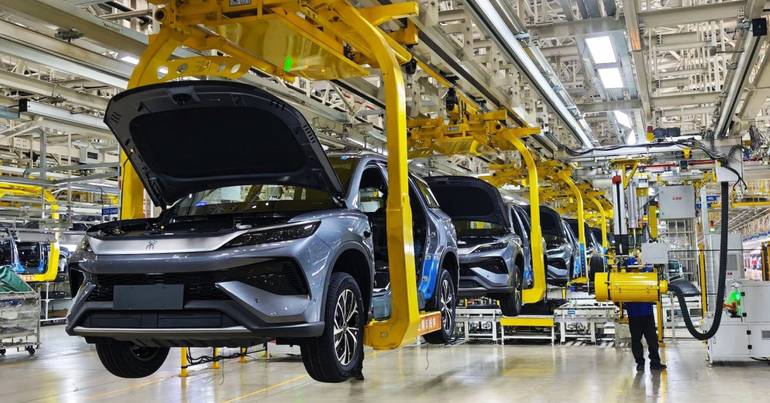
A BYD tem ao seu serviço 1,02 milhões de empregados, o que significa mais 45% do que todo o Grupo VW, que produz quase o dobro dos veículos e mais 62% que a Toyota, que fabrica 2,3 vezes mais.

A BYD continua a aumentar o seu volume de produção, que em 2025 atingiu 4,8 milhões de unidades, dos quais 2,2 milhões foram modelos 100% eléctricos. Mas o número de trabalhadores tem aumentado a um ritmo ainda mais rápido, quando comparado com a concorrência
  •  

BYD avança com exportações, mas lucro e receita ficam abaixo do esperado

O lucro líquido da BYD avançou 28% no terceiro trimestre, impulsionado pelo forte desempenho nas exportações. A maior vendedora de veículos elétricos do mundo acelera a expansão internacional para compensar a desaceleração da demanda na China, seu principal mercado.

A montadora sediada em Shenzhen informou nesta quinta-feira, 29, que o lucro líquido somou 10,02 bilhões de yuans (US$ 1,50 bilhão), acima dos 7,82 bilhões de yuans registrados um ano antes. A receita aumentou 14%, para 221,49 bilhões de yuans.

Apesar do avanço, os números ficaram abaixo das expectativas do mercado. Analistas ouvidos pela Visible Alpha estimavam lucro líquido de 11,10 bilhões de yuans, com receita de 240,83 bilhões de yuans no período.

No acumulado de janeiro a setembro, o lucro líquido caiu 4,2%, para 22,34 bilhões de yuans, enquanto a receita ficou praticamente estável em 566,30 bilhões de yuans, informou a empresa.

Os resultados evidenciam os desafios enfrentados pelas montadoras chinesas no maior mercado automotivo do mundo. Com a competição doméstica mais intensa e as vendas perdendo fôlego, a BYD – como outras rivais locais – busca no exterior uma nova frente de crescimento.

As vendas internacionais continuaram a sustentar o desempenho no trimestre, representando mais de 40% do total.

A BYD exportou mais de 550.700 veículos de “nova energia” (categoria que inclui elétricos puros e híbridos plug-in), mais que o dobro do volume de um ano antes. Já as vendas totais cresceram em ritmo bem menor, de 19%, para 1,3 milhão de unidades.

Analistas avaliam que a expansão internacional se tornará ainda mais decisiva se a demanda na China continuar enfraquecendo. O fôlego no exterior, porém, dependerá da capacidade da empresa de contornar barreiras comerciais crescentes e avançar na produção local em mercados estratégicos.

No curto prazo, a BYD parece bem posicionada. A nova fábrica na Hungria deve iniciar a produção em breve, reforçando a base industrial da companhia na Europa em um momento em que a União Europeia busca restringir importações de híbridos produzidos na China.

Na China, há sinais favoráveis: a demanda por modelos com recarga ultrarrápida segue firme, e as entregas podem ganhar tração nos próximos meses com a redução das restrições de oferta de baterias, segundo analistas da Bernstein.

México criará fabricante de veículos elétricos de baixo custo até 2026


  •  

BYD Shark, il pick-up ibrido plug-in sbarca in Europa. E punta sulle prestazioni

BYD porta la tecnologia ibrida plug-in anche nel mondo dei pick-up con il nuovo Shark, un modello a doppia cabina che punta a combinare capacità di carico, prestazioni e consumi contenuti. Già presentato al Festival of Speed di Goodwood, arriverà inizialmente sul mercato britannico, per poi raggiungere altri Paesi europei selezionati nei prossimi mesi.

Il nuovo pick-up utilizza la tecnologia Super Hybrid DMO, sviluppata per affrontare anche i percorsi fuoristrada. Sotto la carrozzeria lavorano un motore benzina turbo da 1,5 litri e due propulsori elettrici, uno per asse, per una potenza complessiva di 436 cavalli e 650 Nm di coppia. Numeri che consentono allo Shark di accelerare da 0 a 100 km/h in appena 5,7 secondi.

La batteria Blade da 32,2 kWh permette, secondo i dati dichiarati dalla casa, di percorrere fino a 90 km in modalità elettrica, mentre l’autonomia complessiva raggiunge i 675 km. La ricarica rapida in corrente continua, fino a 55 kW, consente di passare dal 30 all’80% in 21 minuti.

Non mancano le caratteristiche tipiche di un mezzo da lavoro: il cassone offre una capacità di 1.200 litri, la portata utile arriva a 790 kg e il traino raggiunge le 2,5 tonnellate. La trazione integrale prevede modalità specifiche per sabbia, fango, neve e ghiaia.

L’abitacolo, omologato per cinque persone, propone un quadro strumenti digitale da 10,25 pollici e uno schermo centrale da 15,6 pollici. Tra le dotazioni figura anche la tecnologia Vehicle-to-Load, che permette di alimentare dispositivi esterni fino a 6 kW, dagli utensili da lavoro alle attrezzature per il tempo libero. Il BYD Shark ha inoltre ottenuto cinque stelle nei test Euro NCAP.

L'articolo BYD Shark, il pick-up ibrido plug-in sbarca in Europa. E punta sulle prestazioni proviene da Il Fatto Quotidiano.

  •  

Owner or owned? Indonesia’s Chinese battery chain dilemma

Indonesia has spent a decade trying to turn its mineral wealth into something more valuable than raw commodity exports. The strategy is ambitious: restrict raw nickel exports, attract investment, build processing capacity and move downstream into electric-vehicle (EV) batteries that will power the next generation of transport and energy storage. China is central to the […]

The post Owner or owned? Indonesia’s Chinese battery chain dilemma appeared first on Asia Times.

  •  

Chinese EVs racing into Gulf’s oil-rich car market

The Gulf Cooperation Council, a bloc of oil-rich states long known for its appetite for imported cars, is becoming a growing market for Chinese electric vehicles (EVs) that are largely being blocked out of the West. Saudi Arabia, the United Arab Emirates, Qatar, Kuwait, Bahrain and Oman are diversifying toward alternative energy, embracing environmental goals […]

The post Chinese EVs racing into Gulf’s oil-rich car market appeared first on Asia Times.

  •  

EU Caps Chinese Hybrid Car Imports at 350,000 as Brussels Moves to Protect Europe’s Motor Industry

The European Union has reached an agreement with China to restrict imports of Chinese hybrid vehicles to 350,000 annually, introducing a significant new barrier to the expansion of Chinese manufacturers in Europe’s automotive market.

The arrangement, confirmed on 12 October, follows months of negotiations between Brussels and Beijing and reflects growing concern about the competitive position of European carmakers.

The import ceiling could reduce Chinese hybrid vehicle sales in the EU by more than half compared with previously anticipated volumes, although the actual effect will depend on demand, product classifications and implementation.

The agreement comes as manufacturers gather for the Paris Motor Show, where the future of European vehicle production, Chinese competition and industrial policy have become central subjects.

China’s Commerce Ministry has presented the outcome as a negotiated arrangement intended to preserve trading relations, while the European side has emphasised the need to prevent rapidly increasing imports from undermining domestic production.

Chinese manufacturers confront a new European barrier

Chinese carmakers have expanded aggressively in overseas markets as domestic demand has weakened. Chinese passenger vehicle exports rose sharply in September, with manufacturers increasingly targeting Europe, Latin America and Asian markets.

Hybrid vehicles have become particularly important because they offer consumers lower fuel consumption without requiring the same degree of dependence on charging infrastructure as fully electric cars.

This has allowed Chinese brands to compete in market segments where European manufacturers retain substantial established production capacity.

The new quota limits the number of eligible Chinese hybrid vehicles permitted to enter the European market each year. According to details of the import restrictions, shipments exceeding the permitted volume would face restrictions at EU customs.

The mechanism differs from a conventional tariff because imports beyond the ceiling cannot simply enter the market by paying a higher duty. Manufacturers and importers will need to consider both delivery costs and the availability of import allocations.

European manufacturers seek protection

The measures arrive amid growing pressure on the European automotive industry, which faces high production costs, expensive energy, competition from Chinese manufacturers and the capital requirements of shifting towards electrified transport.

Companies operating in Germany, France, Italy and other established manufacturing centres must fund the development of new vehicles while maintaining existing factories and employment.

Chinese manufacturers benefit from extensive domestic production networks, considerable scale and access to battery manufacturing capacity.

European policymakers have questioned whether competition takes place under equivalent economic conditions, particularly where Chinese producers receive support from state-directed industrial policies.

Beijing rejects allegations that its export performance results principally from unfair state assistance, arguing that Chinese companies have achieved competitiveness through investment, innovation and efficiency.

The quota represents a departure from the assumption that European consumers will necessarily have unrestricted access to the lowest-priced imported vehicles.

Its economic effects will depend partly on whether European manufacturers can use the additional protection to improve productivity and develop more competitive models.

Will Chinese manufacturers move production into Europe?

Restrictions on imports do not necessarily reduce the presence of Chinese-owned companies in the European automotive industry.

Several manufacturers are already developing production capacity outside China, including within the European Union. BYD’s investment in Hungary is one example of how Chinese companies can pursue access to European consumers through local manufacturing rather than relying entirely on imported finished vehicles.

The new arrangements could strengthen the commercial incentive to expand such operations.

For European governments, Chinese investment presents a difficult calculation. New factories may create employment, increase industrial activity and preserve automotive supply chains, while also expanding the influence of Chinese manufacturers within Europe’s domestic market.

The economic consequences depend on how much research, component manufacturing, battery production and other high-value activity takes place locally.

A Chinese-owned assembly plant using predominantly imported components would provide different benefits from a fully developed European production network.

The British dimension

The debate is also drawing attention to the position of the United Kingdom, whose automotive industry remains closely integrated with European supply chains despite Brexit.

Executives from Stellantis and Renault have supported including Britain within proposed European industrial protection measures, reflecting the importance of UK manufacturing operations to their broader businesses.

Such an arrangement would raise questions about regulatory alignment, trade preferences and the conditions under which non-EU production could qualify for European industrial support.

British manufacturers also face the challenge of Chinese competition, and decisions taken in Brussels could influence investment strategies across the wider European automotive sector.

Protection versus competitiveness

The restrictions may offer European manufacturers additional time to adapt, but they do not eliminate the structural challenges confronting the industry.

Energy prices, labour costs, the availability of batteries and the affordability of new vehicles remain important factors in the competitiveness of European production.

Nor will the quota necessarily prevent Chinese firms from gaining market share through investment, partnerships or vehicles manufactured outside China.

The EU’s approach combines restrictions on imports with the possibility of continued Chinese industrial participation inside Europe.

The outcome will depend on whether European manufacturers use the reduced competitive pressure to strengthen their technological and manufacturing position, or whether the restrictions primarily accelerate the relocation of Chinese-owned production into the EU.

  •  

EU weighs safeguard tariffs as China refuses hybrid car limits

Beijing has rebuffed a European Union request to voluntarily cap hybrid car exports to the bloc, raising the prospect of new, steep EU tariffs on Chinese hybrids, which have so far escaped the duties on pure electric vehicles. China has refused to set quotas on its exports of hybrid electric vehicles (HEVs) and plug-in hybrid […]

The post EU weighs safeguard tariffs as China refuses hybrid car limits appeared first on Asia Times.

  •  
❌