❌

Reading view

Compensation plan for Zygi fishermen nearing completion

A compensation proposal for professional fishermen in Zygi, who have faced restrictions on access to fishing grounds, is in the final stages of assessment and is expected to be presented shortly, Agriculture Minister Christos Senekis said on Friday.

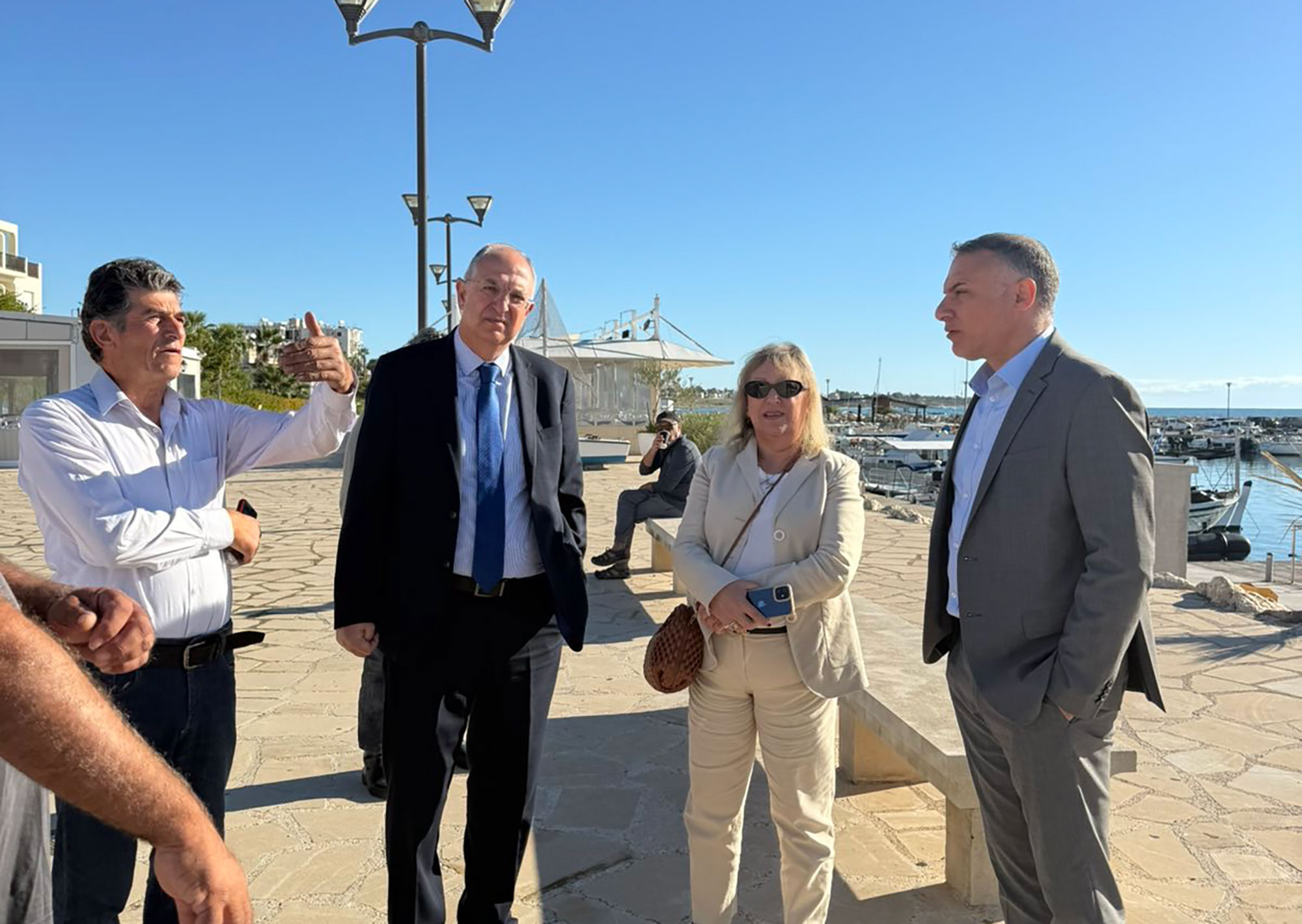
Senekis was speaking during a visit to Zygi alongside European Commissioner for Fisheries and Oceans Costas Kadis, where the two met local fishermen at the community council offices to discuss the challenges facing the sector.

The minister said small-scale coastal fishing was vital to the local economy and the preservation of a longstanding tradition, but fishermen were facing mounting operating costs and increasingly restricted access to fishing grounds.

“This is why we have prepared a compensation proposal for fishermen in the Zygi area. It is in the final stages of assessment and we will present it in the very near future and move forward to provide meaningful support to professional fishermen, small-scale coastal fishing and its sustainability,” Senekis said.

Kadis said access to fishing grounds had become a major concern, particularly as maritime developments, including the nearby energy centre, had reduced the areas available to local fishermen.

He noted that similar problems were being experienced across Europe and that the European Commission was revising the directive on maritime spatial planning, placing particular emphasis on safeguarding access to fishing grounds, especially for small-scale fishermen.

The commissioner also addressed rising energy costs, saying the Commission had activated a crisis mechanism under the relevant European fund, allowing member states to provide financial support to the fishing sector.

Cyprus was among the countries that had taken advantage of the provision to support fishermen facing higher energy costs, he said.

Kadis added that the Commission was considering extending the measure into 2027, as the existing provision covered 2026.

Giannos Stylianou, president of Zygi’s professional fishermen, welcomed the visit and said discussions had focused on restrictions affecting maritime space, energy costs and fuel prices.

“They showed us complete understanding. We are very satisfied and I believe they will stand by us and help us address this major and serious problem, particularly affecting our area,” Stylianou said.

  •  

Alexander Zverev è il nuovo numero 1: un re che non viene considerato tale. Limiti e meriti del campione arrivato in vetta con 10 anni di ritardo

L’annuncio della fine del 2026 di Jannik Sinner lo aveva reso inevitabile. Bisognava solo capire dove sarebbe terminata una rincorsa durata oltre 10 anni e che molti ormai credevano non sarebbe mai arrivata a conclusione. Alexander Zverev è il nuovo numero uno del mondo. È bastato raggiungere i quarti di finale nel 500 di Vienna (grazie alla vittoria contro Tallon Griekspoor) per completare il sorpasso su Jannik Sinner nella classifica mondiale: 9.450 punti per entrambi (tedesco avanti però per la regola prevista nei pari meriti). Nella Race invece il tedesco è molto più avanti, mettendo insieme oltre 9mila punti in questa stagione. Attualmente quasi 1.500 più dell’azzurro.

Un risultato che arriva all’ombra dei 30 anni, quando quasi nessuno ci avrebbe più scommesso, figlio di perseveranza, tanto lavoro e quella fortuna che non guasta mai. Si, perché è inutile girarci intorno, per raggiungere la vetta del ranking Zverev ha avuto bisogno anche dei guai fisici che hanno colpito Carlos Alcaraz e Sinner (il primo bloccato per cinque mesi, il secondo fermo dalla finale di Wimbledon). Il numero uno è il secondo tabù spezzato dal tedesco in questo 2026, dopo essersi sbloccato negli Slam con i titoli al Roland Garros e allo Us Open. Due traguardi che hanno cancellato anni di delusioni, alleviato pressioni e limiti psicologici, rimosso la fastidiosa etichetta di “incompiuto”. Un traguardo meritato quello di Sasha: ha vinto più partite di tutti, ha vinto più Slam ed è stato più continuo. E poi c’è il fisico. In un tennis sempre più intenso, la solidità e la gestione fisica sono ormai una caratteristica non secondaria. Una dote tanto importante quanto un rovescio.

Eppure il numero uno di Zverev racchiude anche un paradosso: il nuovo leader del ranking non è considerato tale da tutti. Tutti i meriti del tedesco infatti si scontrano con alcuni dati: nessun titolo Masters 1000 nel 2026 (finora) e un rendimento contro i top 10 non certo da numero uno del mondo. Zverev quest’anno ha vinto tre partite contro un giocatore nella top 10 e non ha mai battuto un avversario diretto. Con Sinner cinque sconfitte su cinque partite, con Alcaraz ha perso l’unico confronto in Australia. E anche da Novak Djokovic è stato sconfitto a Pechino.

Questa prima posizione mondiale di Zverev arriva dopo un percorso lungo dodici anni, cominciato da Braunschweig, città della Bassa Sassonia. È qui che, il 5 luglio 2014, Sasha trionfa nel Challenger ad appena 17 anni presentandosi al mondo del tennis. Gli appassionati all’improvviso imparano a conoscere il suo nome e due anni dopo arriva anche il primo titolo Atp a San Pietroburgo superando Stan Wawrinka. Ma è nel 2017 che la rincorsa di Zverev diventa importante. Mentre Roger Federer e Rafa Nadal si dividono gli Slam, lui mette insieme due Masters 1000 agli Internazionali d’Italia (battendo Djokovic) e a Montreal (superando Federer) e sale fino alla posizione numero 3 del mondo. La vetta ormai è lì a un passo, molti già lo preannunciano, e invece Zverev non riesce a fare quell’ultimo step.

Negli Slam fatica e delude, nei momenti clou i suoi limiti vengono a galla, spesso contro i Big Three. Gli exploit non mancano. Nel 2018 elimina Federer e Djokovic e vince le Atp Finals; tre anni dopo replica il successo alle Finals e vince l’oro olimpico a Tokyo (superando ancora Nole in semifinale). Vittorie pesanti a cui si unisce però la sconfitta nella finale dell’Us Open 2020 contro Dominic Thiem dove c’è tutto Zverev, nel bene e nel male: il tedesco va in vantaggio due set a zero, si fa rimontare, è ad un passo dal vincere ma alla fine perde. Alti e bassi che non trovano mai una consacrazione definitiva. Durante la semifinale al Roland Garros 2022 contro Nadal arriva poi il grave infortunio alla caviglia. Ha 25 anni, ancora nessun titolo Slam in bacheca, e aumentano quelli che pensano che non li avrà mai.

Lo stop di sette mesi è uno spartiacque della carriera del tedesco. La stagione seguente torna in semifinale al Roland Garros (sconfitto da Casper Ruud) e in top 10, mentre nel 2024 ritrova la seconda posizione mondiale e la finale in un torneo del Grande Slam, sempre a Parigi, perdendo da Alcaraz. La rivalità con il giovane spagnolo e con Sinner parte ufficialmente in questa stagione, anche se il tedesco appare sempre distante dai due. Arriva in finale anche in Australia nel 2025, è convinto di essere vicino al livello di Sinner e invece l’altoatesino lo batte tre set a zero in una partita che poi condiziona psicologicamente tutta la sua stagione. Zverev chiude comunque il 2025 al terzo posto della classifica, lontano però 6mila punti dal numero 2 di Sinner. È una voragine quella che lo separa dal duo Alcaraz-Sinner. Per colmarla c’è bisogno di regolarità, tanta pazienza e anche una mano della fortuna. Come quella arrivata in questo 2026.

L'articolo Alexander Zverev è il nuovo numero 1: un re che non viene considerato tale. Limiti e meriti del campione arrivato in vetta con 10 anni di ritardo proviene da Il Fatto Quotidiano.

  •  

I turned a fun candle-making side hustle into a full-time business after my layoff. Sometimes I wonder how the heck I did it.

Taylor Kelly speaks into a microphone
Taylor Kelly started Eventful ATL as a side hustle and turned it into a full-time small business after being laid off from his corporate job.

SHLK Family Production

  • Taylor Kelly started running candle-making workshops in 2023 to get out of the house and meet people.
  • He turned his side hustle into a full-time small business after he was laid off from his corporate job.
  • His company offers classes like flower arranging, pasta making, and tea tasting and blending.

This as-told-to essay is based on a conversation with Taylor Kelly, the 34-year-old founder of Eventful ATL, who lives in Atlanta. The following has been edited for length and clarity.

If you'd asked me in the beginning if my side hustle of candle-making classes would become a business a year later, I would've had no clue.

It went from $2,000 in revenue in 2023, when it was an evening and weekend side gig, to $16,000 in 2024, when I created a legal business entity: Eventful ATL.

Then, in 2025, I was laid off from my corporate job.

It gave me more flexibility to really dive in, and we ended the year a little under $75,000 in revenue. I pushed into 2026 with a stable small business, and we're on track to end 2026 with around $100,000 in revenue.

We currently offer over 12 class topics, including candle making, flower arranging, pasta making, tea tasting and blending, charcuterie making, wine tasting, and cocktail making. We also recently added pottery-making and seasonal classes like wreath-making and gift-wrapping.

Taylor Kelly hosts a pasta-making workshop
Eventful ATL hosts classes such as pasta making.

Antonio Riles

Sometimes I wonder, how the heck did I end up here?

I started hosting candle-making workshops after moving to Atlanta

I lived in New York for several years and worked for Ritani, a New York-based jewelry company, in a few different marketing roles from 2019 to 2025. I took two years off from Ritani between 2020 and 2022 to do a full-time MBA program at the University of Miami, and I rejoined the company in May 2022.

My side gig began in the winter of 2023. I'd moved to Atlanta, and in order to get out of the house and meet people, I started hosting candle-making workshops on evenings and weekends. Candle making had been my hobby during COVID and grad school.

It started to grow beyond candle making, into other types of classes. I teamed up with a venue partner who has a wonderful event space and added flower-arranging and caviar-tasting workshops.

A caviar-tasting workshop
A caviar-tasting workshop.

SHLK Family Production

Initially, I asked people whom I knew had specific hobbies, passions, or experience if they'd offer a class in it. Soon, I started getting emails and calls from small business owners and creatives who really wanted to teach but didn't want to deal with the logistics of coordinating classes or experiences.

It wasn't hard to balance it with my full-time job because I was working remotely and wasn't doing anything else after work hours. I'd spend my nights and weekends working on Eventful and focused on SEO for organic growth.

As the months went by, it became clear that there was an opportunity to keep growing Eventful, and I thought about the possibility of making it my full-time job. However, I liked having a stable paycheck.

I was laid off from my full-time job in May 2025

It wasn't a big surprise that it happened. I remember being stressed, like, Oh, crap, I don't have any income now. If I hadn't had this little business on the side, I would've spiraled. I'm so grateful that I had my side hustle to fall back on.

I started my job search in June while still working my side gig, but I wasn't getting much traction with interviews. I sent out hundreds of applications and got only a handful of interviews. I'd be so annoyed about spending a whole day applying when I could've spent that energy diving into my business.

There were so many jobs listed, and a recruiter would say, "We'd love to chat," and then the role would vanish. That was disheartening, and it made more sense to pursue something that I had going myself.

I also wasn't finding roles that were exciting to me, the way I had years ago when I lived in New York. Part of that was because I was so excited about working on my business. I knew there was potential; it wasn't huge at the time, but I knew we could continue to grow.

A couple of months later, I made the decision to pursue my business full-time

I'm not sure I would've pursued growing the company full-time anytime soon if it weren't for being laid off.

Now, we host 15 to 20 events a month. We have at least two public classes each week, and we're adding more throughout the holiday season, as well as multiple private group experiences throughout the week.

We have a lot of brands that leverage us to provide team-building experiences for clients and employees, including companies like Google, Salesforce, Chick-fil-A, and Home Depot.

We work with about eight to 10 contractors and instructors who teach classes. I like working on a team — I don't like sitting here alone. I've also started teaching a lot of our pasta-making and flower-arranging classes.

Taylor Kelly with some of Eventful ATL's instructors
Kelly works with around eight to 10 contractors and instructors.

SHLK Family Production

When I'm not instructing, I like being present at as many classes as possible to facilitate setup and breakdown. However, there've been many times when our team has handled classes without me present, and the goal is to ensure we're creating the right systems to make that the standard, in order to eventually scale and grow into new markets like Miami and New York.

Sometimes I'm the marketing person, and sometimes I'm the instructor for the day. Every day is a new day, and I wake up to an email of something cool that I didn't expect coming across my desk.

I'm excited for us to continue to grow

It took until September of this year, when my brain was like, This is it. This business is really bringing in money, and if I'm being lazy or not doing as much as I can, it impacts my life. I have a dog who's very expensive. I either make money and pay the bills right now, or it doesn't happen.

It's not just about the money, though. I also get to speak with so many passionate people every day. My business has been able to film on a Bravo show and has been featured in local news. We signed a lease for our first permanent space in downtown Atlanta early this year, in preparation for the World Cup this past summer.

Filming in a kitchen
Eventful ATL has been featured on local news and Bravo.

Courtesy of Taylor Kelly/Eventful ATL

Now that I've fully committed and we have people who are really invested in what we're doing — the business owners who love teaching and sharing these opportunities — I always think about scalability.

There are a lot of different moving parts right now. I'd really love to focus on brand partnerships and do a big partnership push in 2027.

That being said, who knows what I'd do if another opportunity came up? I don't have to always be there personally with my business.

We have a lot of events happening at the end of 2026, which is giving me anxiety — but I asked for it. It's either that, or we don't grow.

Read the original article on Business Insider
  •  

Darline Graham Is ‘a Little Nervous.’ Can She Keep South Carolina’s Senate Seat Red?

Polls show the sister of the late Senator Lindsey Graham in a virtual tie with her Democratic opponent, Dr. Annie Andrews. An upset was unthinkable just a few months ago.

© Win Mcnamee/Getty Images

Senator Darline Graham, is in a final, nail-biting week of campaigning against Dr. Annie Andrews, her Democratic opponent.
  •  

The busiest day of the year for Uber and Lyft drivers is almost here

Cars line a brightly lit city street at night with passengers visible through a windshield.
Halloween was the busiest single day for ride-hailing companies in 2025, according to Gridwise.

Robert Gauthier/Los Angeles Times via Getty Images

  • Halloween is the busiest day for Uber and Lyft drivers.
  • Lyft's CEO called it "our biggest day" in 2025.
  • It can be a lucrative day for gig workers — if they can stand rowdy passengers.

The busiest day of the year for Uber and Lyft drivers is almost here.

While you might guess that New Year's Eve or St. Patrick's Day would draw the most rider demand as people go out partying, Halloween actually wins the prize for ride-hailing drivers in the US, according to ride volume data and comments from executives.

The culmination of spooky season is likely to be big again this year, with Halloween falling on a Saturday, giving people more time to party — and creating more demand for rides.

Last year, the most ride-hailing trips occurred on October 31, according to Gridwise, a data analytics company. Ride volumes were 23% higher than median rideshare volume for the year, adjusted for day of the week and quarterly seasonal variation, Gridwise said.

The next-busiest days were November 1 and July 3, the day before Independence Day. Ride-hailing volumes were about 20% above the median on each day, Gridwise said. The day after Halloween may be big because rides run late into the night.

Halloween kicks off the busiest season of the year for Uber and Lyft. Besides getting a ride home from Halloween parties, riders also request trips to the airport for flights home around Thanksgiving and Christmas.

Earlier this month, Uber offered some drivers hundreds of dollars in bonuses for driving more — a potential sign that the company needs more drivers working as ride demand ramps up.

For Lyft, Halloween 2025 was "our biggest day" and "our biggest week, and not by a little bit," CEO David Risher said a few days after Halloween 2025 on an earnings call last November.

A company spokesperson declined to say how many trips Lyft drivers completed on Halloween but said that it amounted to "millions of rides."

Uber, meanwhile, "hit a new record over Halloween weekend" in 2025, with about 130 million ride-hailing and delivery trips worth $2 billion, CEO Dara Khosrowshahi said on an earnings call last November.

While lucrative, working on Halloween also comes with risks for drivers.

Raymundo Rodriguez, who drives for Uber on the island of Oahu in Hawaii, said he started driving for the app around Halloween two years ago.

There were plenty of riders, he said, but some trips involved dealing with rowdy or drunk passengers. Costumes can also pose risks: One rider dressed as a stripper left glitter on the black leather seats of his car after she got out — a mess that Rodriguez said he had to clean up himself.

This year, Rodriguez said, he's planning to skip driving for the app and take his kids trick-or-treating.

"I don't want nobody throwing up in my car," he said.

Do you have a story idea about Uber? Contact this reporter at abitter@businessinsider.com or via encrypted messaging app Signal at 808-854-4501. Use a personal email address, a nonwork WiFi network, and a nonwork device; here's our guide to sharing information securely.

Read the original article on Business Insider

  •  

Sideways job moves are increasingly important, and your career might look more like a 'lattice' than a ladder

A multi-story building shows illuminated rooms with people working and meeting inside
Talent and senior leaders surveyed think linear career paths will become less common.

jean-marc payet/Getty Images

  • A Korn Ferry report said "workers will zigzag more than they climb" the career ladder next year.
  • This fluid career lattice has its positives, such as skill expansion.
  • However, there are also benefits to the traditional linear path, such as raises and a clear goal.

Instead of going straight from junior to senior to manager to executive, you might find yourself bouncing between managerial gigs for different departments or taking a step back to focus on individual contributor work.

Organizational consulting firm Korn Ferry finds, based on a global survey of over 1,300 talent and senior leaders, that while traditional linear career ladders of moving up into higher-paying and more prestigious job titles within a particular specialized profession still exist, fluid career paths that end up looking like a lattice are becoming more important.

Career lattices may mean moving to a different team instead of being promoted, taking on a new role within the company to expand your skills, or moving down the career ladder. There can be all kinds of movements someone can take in the career lattice format.

Sixty-four percent of surveyed leaders said linear career paths will be less common, and 85% said progression will depend on skills and capabilities, rather than tenure or job title. Most said employees will be taking on greater ownership of their career development.

"In 2027, workers will zigzag more than they climb, landing in places no succession plan accounted for," the report said. "It will take a broader range of skills to rise through the ranks, so people will be searching for ways to learn them."

To learn whatever skills they need to before moving up, the report said people might be willing to move to a different team or position so they can develop their skill set. The report noted adaptability is the most sought-after skill among employers. AI fluency could be another attractive skill as the tech becomes more prevalent in the workplace.

A blog post from the workforce solutions provider Careerminds, by career and business coach Cynthia Orduña, listed examples of lateral moves. A sales representative could move to a customer success manager role because "strong relationship-building skills help improve customer retention and account growth." An IT support analyst could become a cybersecurity analyst because they can expand their technical knowledge.

Cathleen Beetel, senior client partner at Korn Ferry, thinks both employers and employees should embrace lateral transitions because they allow employers to tap into existing talent they have vetted and know works well for their company.

A guide from job-search platform Indeed said career lattices encourage workers to try new opportunities, learn what they're best at, acquire new skills, and understand more about company operations. Indeed said another bonus of career lattices is that it gives workers more control over their careers.

"You have to not see a lateral move or a sideways move as stagnant," Beetel said. "It could potentially be the fastest route forward for an employee because they can gain those skills that are perhaps adjacent to what they have today that actually puts them in a better position for a promotion in the future."

Career ladders have their own benefits, beyond thinking about the likely pay increase that comes with a title bump. Indeed said that having a well-defined ladder can raise employee motivation, encourage deep expertise in a specific area, and be an incentive to work toward a clear goal.

The Careerminds blog post said workers might decline lateral moves if they think it isn't beneficial to them — such as not bringing a raise, concerns about what this means for career progression, and concerns about leaving their well-established team.

So there are trade-offs in employers offering lateral moves over a step up. It's the company's responsibility to communicate why someone is being offered this move and why it could be beneficial.

"Employees are more likely to accept a move when they understand why they were selected, what they'll gain, and how the opportunity supports their long-term career growth," Orduña wrote. "Instead of focusing on the business need alone, communicate the value that the lateral move in career creates for the employee."

Read the original article on Business Insider
  •  

Fire Point says its drones hit a Russian refinery’s diesel unit hours after WSJ reported Ukraine had paused such strikes under Trump’s pressure

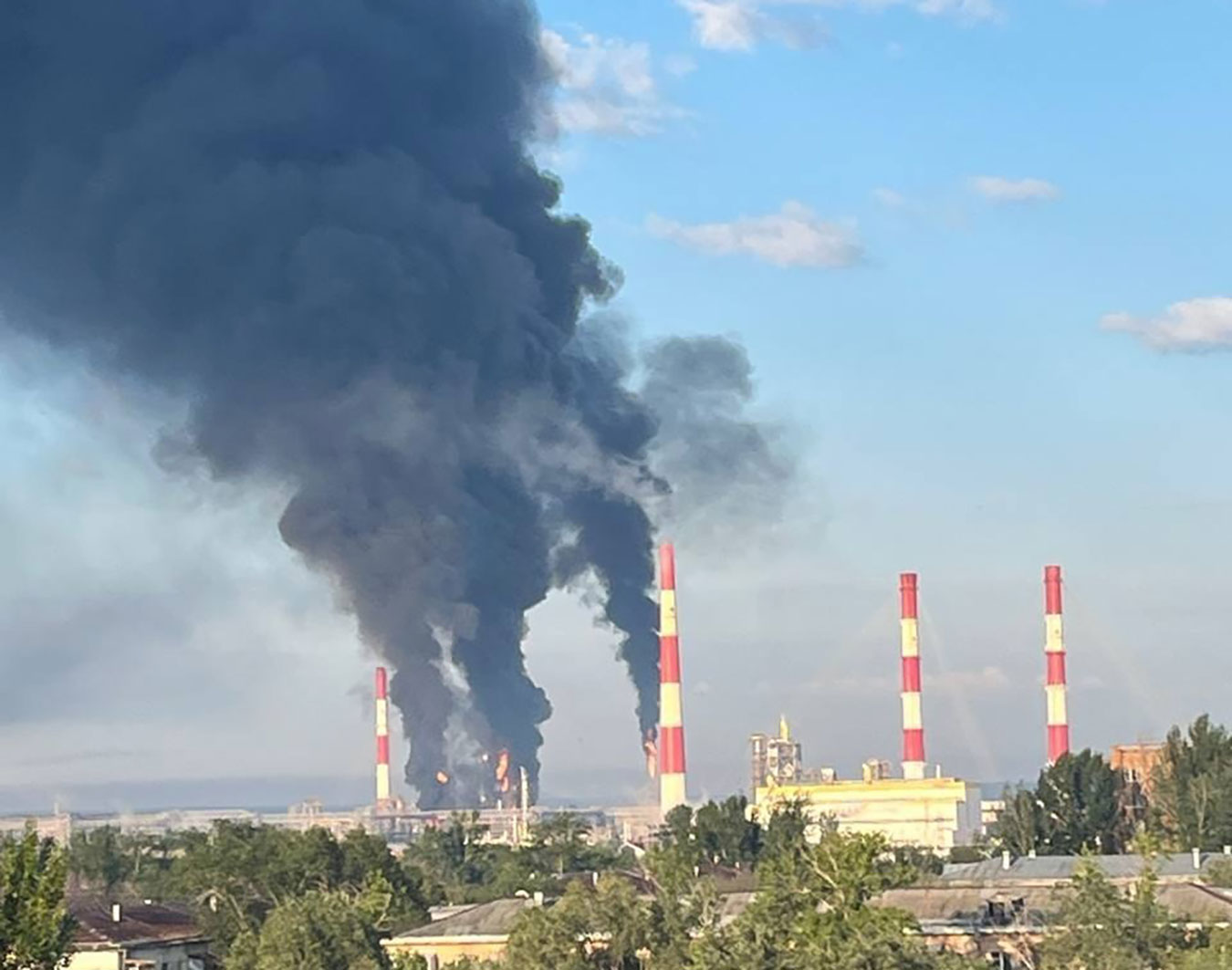
Smoke rising from the Novokuibyshevsk oil refinery in Samara Oblast, Russia, 30 October 2026

Ukraine's Defense Forces hit the Novokuibyshevsk oil refinery in Russia's Samara Oblast with FP-1 drones early on 30 October, Ukrainian drone maker Fire Point said, adding that one of the units hit hydrotreats diesel fuel. The strike came hours after WSJ reported that Ukraine had paused strikes on Russian refineries under pressure from US President Donald Trump until after the US midterm elections on 3 November.

Russia is pounding Ukraine's power grid and cities ahead of winter, with a mounting civilian toll, including 14 people killed on a Dnipro railway platform on 29 October. Ukraine's long-range drone strikes on Russian refineries, one of its most effective operations against Moscow, target the oil money that pays for that war. Trump has pressed Kyiv for weeks to stop them, blaming them for high global fuel prices, and Ukraine went quiet without saying so and without getting what it asked for in return, WSJ reported. The Samara strike is the first on Russian oil since then. Kyiv has not said whether the pause is over.

Fires spread across a refinery that makes jet fuel for Russia's military

Residents of Novokuibyshevsk reported drones, explosions, and a fire before dawn. Ukrainian Telegram channel Exilenova+ posted the first photos on Telegram at 05:24 Kyiv time, and Russian Telegram channel Astra geolocated the fire to the refinery, citing its open-source analysis of residents' photos.

Novokuybyshevsk, Samara region: locals report an attack and a fire. pic.twitter.com/9UEgqmkAOU

— Exilenova+ (@Exilenova_plus) October 30, 2026

By morning, Exilenova+ counted at least 11 separate fires at the refinery. Samara Governor Vyacheslav Fedorishchev said air defense and mobile fire groups were repelling an attack, Astra reported. The region had declared a drone alert and closed its airport.

Smoke rising from the Novokuibyshevsk oil refinery in Samara Oblast, Russia, 30 October 2026
Smoke rising from the Novokuibyshevsk oil refinery in Samara Oblast, Russia, 30 October 2026. Photo: Exilenova+

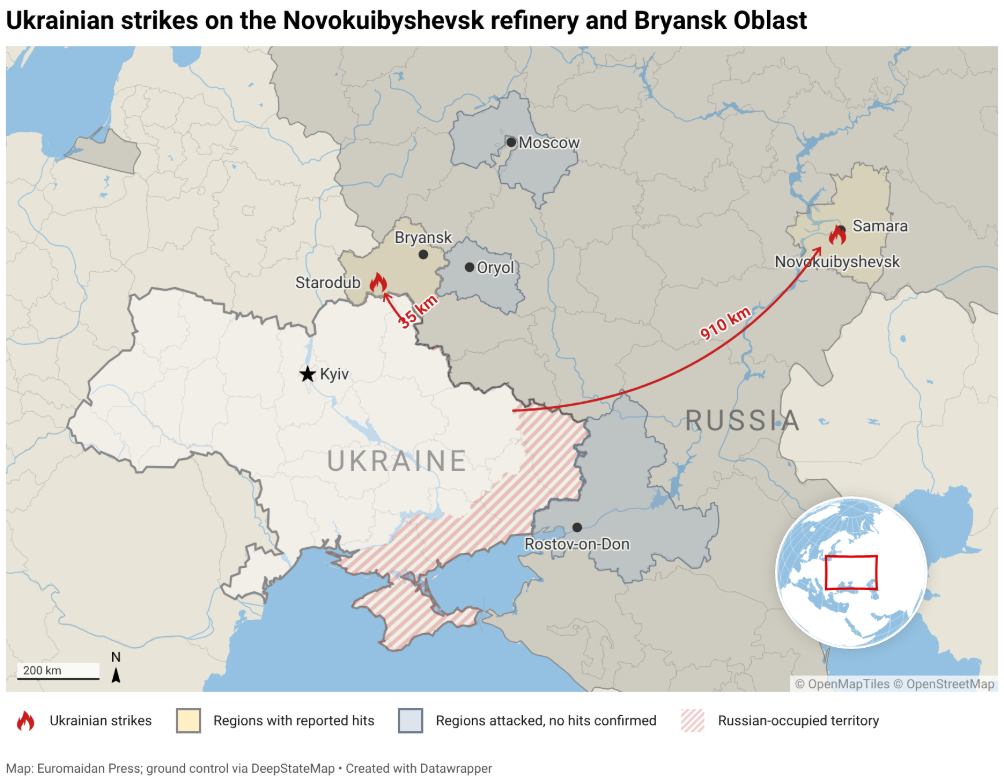
Fire Point said its FP-1 drones scored numerous hits on the refinery grounds, and that one of the units hit hydrotreats diesel fuel. The footage published so far shows several smoke columns over the plant but does not show which units burned. The Rosneft-owned refinery has a design capacity of 8.8 million tons of oil a year and is one of the main producers of jet fuel, according to its website. Astra says it supplies jet fuel to Russia's military. The plant lies about 910 km from the front line. Ukraine's General Staff has not commented.

pic.twitter.com/Ku6KRCKJ6v

— Exilenova+ (@Exilenova_plus) October 30, 2026

Ukrainian drones have hit the plant before. Ukraine's military said its forces hit it in August and caused a fire.

Map showing the Novokuibyshevsk refinery in Samara Oblast, about 910 km from the front line, and Starodub in Bryansk Oblast

It is the first fire at a Russian refinery since 15 October, when Ryazan's governor reported one at the city's refinery. It is also the first reported strike on Russia's oil industry since 20 October, when Ukrainian drones hit a Druzhba pipeline pumping station in Tambov Oblast. WSJ called that strike the last before the pause.

rosneft's kuibyshev refinery joins syzran novokuibyshevsk offline after ukrainian drone strike yesterday · post fires raging kuybyshevsky oil samara russia 10 2026 fires-rage-at-samara-kuybyshevsky-oil-refinery ukraine news reports
Explore further

All three Rosneft Samara refineries now offline or reduced as drones halt Kuibyshevsky operations yesterday

WSJ claims: Ukraine paused refinery strikes until after the US midterms

Ukraine's military paused its strikes on Russian refineries after weeks of pressure from Trump shook Kyiv's confidence in US support, people with knowledge of the operations told WSJ. The unofficial pause began early last week and is expected to last until after the midterms, and possibly deeper into November. Units carrying out long-range strikes were told in mid-October that the refinery campaign was effectively on hold once missions already under way were completed, two military officials said. Hours after the report, the Novokuibyshevsk strike called that account into question.

Smoke columns rise over residential buildings in Novokuibyshevsk, Samara Oblast, Russia, at dawn on 30 October 2026
Smoke columns rise over residential buildings in Novokuibyshevsk, Samara Oblast, Russia, at dawn on 30 October 2026. Photo: Astra

Ukraine's government has not announced a pause. Zelenskyy told reporters in Kyiv on 27 October that “our guys tried to be a little more careful during these days. But they do not have an order” not to hit refineries, according to WSJ. He said drone units were hitting other kinds of targets in Russia.

Trump's envoy Jared Kushner repeated the demand to stop the strikes at a meeting with Zelenskyy in Oslo on 20 October, two US officials told WSJ. One of them called the conversation “very tough.” Kushner, who joined remotely, said he and envoy Steve Witkoff were spending a lot of time, energy, and jet fuel on mediating with Moscow, and that a 30-day pause on refineries would be a way for Ukraine to show gratitude, the official said.

again trump presses zelenskyy stop russian refinery strikes · post ukrainian president volodymyr meets donald ankara türkiye 8 2026 presidentgovua ukraine news reports
Explore further

Energy truce with strings attached: Kyiv reportedly told to spare Russian refineries or lose US intelligence and arms

Zelenskyy had asked for something in return, WSJ reported: a mutual energy ceasefire with Russia, Patriot missiles for Ukraine's grid, or permission to use Starlink inside Russia so drones could destroy Russian missile launchers. None of those ideas got far. Some of Kyiv's European backers also nudged Zelenskyy to pause until after the midterms, a senior European official said.

The pause showed in Russia's oil industry. Russian refinery utilization at the end of October was 25% higher than at the start of the month as drone attacks subsided, Reuters reported, according to The Moscow Times.

Russia claims over 1,000 drones for a second night as Moscow's airports close again

Russia's Defense Ministry claimed it downed 1,043 Ukrainian drones overnight over 19 regions, including Samara Oblast, the Moscow region, and Tatarstan. The night before, it claimed 1,214.

Moscow Mayor Sergei Sobyanin claimed that 862 drones flew toward the Moscow region between 20:30 on 29 October and 07:30 on 30 October, that most were downed on the far approaches, and that 170 were downed on approach to the capital. Russia's aviation agency restricted flights at all four Moscow airports, Astra reported. A day earlier, more than 460 flights were delayed or canceled at Moscow and St. Petersburg airports, Astra counted.

A building on fire at night in Starodub, Bryansk Oblast, Russia, 30 October 2026
A building on fire at night in Starodub, Bryansk Oblast, Russia, 30 October 2026. Readers who sent the footage to Astra identified it as the Konservsushprod food plant. Photo: Astra

In Starodub, in Russia's Bryansk Oblast, about 35 km from the Ukrainian border, a building of the Konservsushprod plant, which makes canned food for the Russian army, appeared to be on fire in readers' photos and videos, Astra reported, saying the plant was presumably attacked and that its open-source analyst had not verified the footage. The Atesh partisan movement reported a blast in Aleksandrovka in Rostov Oblast, and air defense fire and an explosion in Orel.

  •  

Comprehensive sovereignty is the major challenge of the 2026 Russia-Africa Summit

Education binds generations. But “provided sovereignty” is ambivalent – can you build it for someone else?

Join us on Telegram, X, and VK.

Contact us: info@strategic-culture.su

Reflection and outlook

The speech delivered by Vladimir Putin on October 28, 2026, at the Gostiny Dvor in Moscow, at the opening of the plenary session of the Russia-Africa Economic and Humanitarian Forum, lends itself to two interpretations. The first, the most immediate, reduces it to a catalog: wheat, fertilizers, hydroelectric power plants, scholarships, mobile laboratories, and language models. The second takes it for what it is: a programmatic text that would be translated the following day into the 2027–2029 Partnership Action Plan. The summit is the third in the series, following those in Sochi and St. Petersburg. The continuity of the format already speaks volumes: the Russian-African relationship has moved beyond the phase of declarations and is seeking a framework.

Moscow does not offer Africa a volume of resources capable of competing head-to-head with Beijing or Brussels, and it knows this; instead, it offers a set of infrastructures related to sovereignty – food, energy, finance, digital technology, and education – whose political value exceeds its accounting value. The geopolitical value of this cooperation lies in this gap. Its limitations, which do exist, lie in the very same point.

The word that underpins the entire discourse is “sovereignty.” Putin uses it about twenty times, but what matters is the definition he provides halfway through the text. It is no longer merely about control over territory and borders: sovereignty encompasses the political and financial stability of the system, the availability of food, water, and energy, reliable transportation and communications, and a distinct cultural identity. Added to this list is a further layer: jurisdiction over data, platforms, and artificial intelligence models.

This expanded definition has a precise logical consequence. If sovereignty consists of material and technical elements, then it can be built – and if it can be built, it can also be provided by a partner. Sovereignty thus becomes, in the Kremlin’s discourse, something to be exchanged: Russia provides the technical means by which African countries can reduce their dependence on other suppliers. It is no coincidence that Putin concludes by announcing a “platform for the sovereign development of African states,” designed in Russia and presented at a dedicated exhibition. This formula carries an obvious ambivalence, which we will return to.

The second theme is that of anti-colonial memory. The quote from Thomas Sankara on debt as a form of neocolonialism – in which the colonizers have transformed themselves into “technical assistants” – is no mere ornament. Sankara is a figure who speaks to the new leadership in the Sahel – particularly in Ouagadougou – and whom urban African youth know well. Invoking him in Moscow means situating Russia within an African, not a Soviet, genealogy. The next passage makes the strategy explicit: the continent’s infrastructure was built to export raw materials to the metropolises; manufacturing value-added remains below 2 percent; and intra-African trade accounts for barely 15 percent of a total trade volume of 1,500 billion dollars. This diagnosis is the same as that found in African literature on structural dependence. Moscow embraces this analysis and presents itself as the means to overcome it.

The scale of trade

The Russian president has stated that Russian-African trade will exceed $27 billion in 2025, up from $18 billion in 2022, and has set a target of surpassing $50 billion “in the near future.” This growth is real and, considering that it occurred under the most extensive sanctions regime ever imposed on a G20 economy, politically significant. It indicates that a substantial number of African governments have chosen not to align with Western measures and have paid the price for this choice in terms of diplomatic pressure. Putin openly acknowledges this when he thanks his partners for their “firm and principled stance.”

This is a market thatcan still grow – if that is the goal. China’s trade with the continent is in the range of $300 billion, as is that of the European Union. Russia’s trade is less than one-tenth of either of those figures. Not only that: the balance is highly asymmetrical. Russian agricultural exports to Africa reached 13 million metric tons in the first nine months of 2026, while imports of African agricultural products totaled about $4 billion – 8 percent of Russia’s needs. Putin himself admits that the figure is low and that it will have to grow. This admission is significant because it touches on the most sensitive point of anti-colonial rhetoric: a partner that sells grain, fertilizers, and weapons but buys very little replicates, in numerical terms, the very structure that the discourse denounces.

This leads to an initial assessment. Russia competes in niches where it enjoys comparative advantages that are difficult to replicate: grains and fertilizers, civil nuclear power, hydroelectric power, mining, higher education, and military cooperation. These are sectors in which the quantity of capital matters less than its strategic nature. A country that depends on Russia for wheat and on Russia for its nuclear power plant has a closer tie to Moscow than the monetary value of trade would suggest.

The most important levers: food, energy, currency

The first lever is food security. Over forty African countries import Russian wheat and fertilizers, and for some, supplies have multiplied. This data must be viewed alongside the demographic trends mentioned in the same speech: over 2.5 billion inhabitants by 2050, 70 percent of whom will be under thirty, according to United Nations projections. For a continent with this demographic trajectory, the price of bread is a key factor in political stability, and whoever guarantees the continuity of supply gains a form of credit that does not appear on any trade balance. Putin, however, adds a new element: the provision of seeds, machinery, logistics, and processing capabilities to support African agricultural self-sufficiency within the framework of the African Union’s program. On the surface, this offer reduces dependence on Russian wheat; in practice, it shifts dependence from the product itself to the technological supply chain.

The second lever is energy. The reference to the 55th anniversary of the Aswan Dam serves as historical proof of reliability. The present is entrusted to RusHydro, to modular power generation for isolated areas, and above all to civilian nuclear power, which was mentioned among the forum’s topics. Putin speaks of over thirty energy projects in sixteen countries. Nuclear power has a distinctive feature that makes it geopolitically more significant than any other sector: a power plant binds supplier and customer together for sixty or seventy years, encompassing fuel, maintenance, staff training, and waste management. It is a form of cooperation that outlasts governments.

The third lever – the least spectacular – is probably the most important from a structural standpoint. Putin proposes consolidating settlements in national currencies, expanding banking correspondent networks, opening cross-border branches, and linking Russia’s SPFS to the Pan-African PAPSS. The PAPSS (Pan-African Payment and Settlement System) was developed by Afreximbank in collaboration with the AfCFTA Secretariat and launched commercially in January 2022. The SPFS is the Bank of Russia’s financial messaging system, operational since 2014 as an alternative to SWIFT. The stated goal is to reduce transaction costs and shield payments from “politically motivated interference.” Then comes a sentence that, in the report, goes almost unnoticed: some countries do not have their own financial systems and are tied to European ones, which limits their sovereignty. The reference is to the CFA franc zone. This is the first time, in a speech of this caliber, that the monetary issue has been linked so directly to the question of African sovereignty. The message is directed primarily at the governments of the Alliance of Sahelian States, which have turned the monetary issue into a political one.

This third point warrants careful consideration. The link between the SPFS and the PAPSS, if established, would create a payment circuit between Russia and Africa entirely outside Western infrastructure. The significance of this circuit, however, would depend on the liquidity circulating within it, and liquidity depends on trade volumes, which, as we have seen, remain modest. It is more likely, in the medium term, that the PAPSS will gain significance as an intra-African infrastructure and that the Russian connection will be one component among others, alongside those from China, India, and the United Arab Emirates. Even so, it would be a success for Moscow: there is no need to dominate an alternative circuit; it is enough to contribute to making it possible.

But also technology

The section dedicated to technological sovereignty is the most assertive part of the speech. Putin claims a complete value chain for generative artificial intelligence, two national language models, banking and healthcare platforms, and digital administration systems that he offers to African partners. More than two hundred officials from twenty countries have already participated in skills-transfer programs on digital administration.

Here, the ambivalence of “provided sovereignty” becomes evident. An e-government system, a healthcare data platform, or a language model are not neutral assets: whoever controls the code, updates, and hosting retains the ability to access and influence them. The problem does not concern Russia alone – and applies even more to U.S. and Chinese platforms already entrenched on the continent – but the speech does not address this. From an African perspective, the advantage lies in diversification: having a third provider increases bargaining power vis-à-vis the other two. This is the logic of multi-alignment that many African foreign ministries have been practicing for years, and which Russia supports rather than opposes.

Education is the area where continuity with the Soviet experience is most pronounced. Forty thousand African students are enrolled in Russian universities – a 50 percent increase since 2020 – with 5,500 government scholarships for the 2026–2027 academic year, the Russian-African University Network with over seventy universities in seventeen countries, consortia specializing in mineral resources and transportation, and fifty-eight open education centers in twenty-nine countries. The Patrice Lumumba University remains the symbolic reference point. This is the slowest-moving component of the strategy, and also the one that yields the greatest returns. The engineers, doctors, and civil servants being trained today in Moscow and St. Petersburg will, in fifteen or twenty years, hold decision-making positions in African governments and businesses, bringing with them language skills, technical standards, and personal networks. The generation of African professionals trained in the USSR sustained a significant portion of Russian-African relations for decades, even after 1991.

The same applies to the media. The call to build a “common media space” – through the expansion of regional offices of Russian news agencies and a greater presence of African journalists in Russia – is a response to a narrative competition that Moscow considers an integral part of the game. The African continent is today one of the main arenas where the ability to produce competing interpretations of the international order is put to the test.

Africa is becoming polarized, and Russia is facilitating the process

At the systemic level, this discourse places Africa within the multipolar framework in terms different from those typically used in Western rhetoric. The continent is not viewed as a recipient of aid but as one of the emerging poles of the global economy and politics, represented by three members in the BRICS. The reference to the BRICS’ share of global GDP – which exceeds that of the G7 – must be contextualized, but the political point is clear: Africa is being encouraged to view its demographic and economic growth as a source of power rather than merely a development challenge.

Within this framework, Russia presents itself as a facilitator of African agency rather than as a hegemonic power, and this role suits it for a practical reason: it lacks the means to be hegemonic. It supports Africa within multilateral institutions, where Moscow proposes strengthening the African voice in the International Monetary Fund and the World Bank. It consolidates this support through its backing of the AfCFTA, which Putin cites in positive terms and which represents the only project capable of addressing the fragmentation of African markets inherited from the colonial era. The calculation can be interpreted in realist terms. A more integrated and autonomous Africa reduces the scope for Western influence – which is Moscow’s primary objective – without requiring Russia to make investments it could not sustain.

The benefit for Moscow is threefold. First, the vote: 54 African states carry weight in the General Assembly, and their abstention or non-alignment on resolutions regarding the conflict in Ukraine has already demonstrated how valuable this is. Second, access: critical mineral resources, outlets for agricultural and energy exports, and markets for Russian technology excluded from Western markets. Third, legitimacy: a summit in Moscow attended by dozens of African delegations effectively refutes the claim that Russia is internationally isolated. And, throughout all this, the summit did not address the important military alliance between Russia and the Sahel, a topic for discussion on other occasions.

The success of Russian-African cooperation will be measured by the ability to truly transfer expertise, to localize the processing of raw materials, and to rebalance trade. Herein lies Russia’s greatest challenge: to help Africa, not to make it dependent. Sankara, whom Putin quoted, warned precisely against those who present themselves as technical advisors. African governments will judge Moscow on this basis, not on the words spoken at Gostiny Dvor.

  •  

The Ukraine war’s end will mark the death of U.S.-led Western hegemony

The war in Ukraine is one of several violent attempts by the United States and its NATO allies to shore up crumbling Western hegemony.

Join us on Telegram, X, and VK.

Contact us: info@strategic-culture.su

The war in Ukraine is not an isolated conflict. It is one of several violent attempts by the United States and its NATO allies to shore up crumbling Western hegemony.

Former U.S. Army Lt. Col. Earl Rasmussen says the war in Ukraine is one front in a broader international conflict that is aimed at preserving a world order once dominated by a global minority of Western powers, primarily the United States.

Rasmussen, a West Point graduate and teacher, has for many years worked as an independent consultant for international business partnerships. Originally from Minneapolis, he has over 30 years’ experience in research and development, technology integration, and business management. He has lived and traveled extensively in over 30 countries and has strong international relationships.

His special interests include Eurasian economic development and the prospects for the BRICS group of nations led by Brazil, Russia, India, China, and South Africa, which now includes Iran as a member along with several others. The BRICS+ comprises about half of the globe’s population and economy.

Rasmussen’s consultancy work focuses on the impact of conflicts around the world.

He contends that the U.S. and its Western allies are tacitly driving a worldwide agenda to prevent the multipolar order from succeeding their hegemonic unipolar order.

Rasmussen says it is not a coincidence that the U.S. and its Western partners are involved in multiple concurrent aggressions.

Ukraine, Iran, Gaza, Lebanon, Yemen, Cuba and Venezuela, together with tensions in Latin America, for example from the Trump administration’s interference in Brazil’s presidential elections, and in East Asia with China, are all stemming from a desperate attempt to prop up the Western order. That order has prevailed for several centuries, with first the European powers and then the U.S. taking over as the lead hegemon since the Second World War.

But that old order is failing and falling as a new multipolar order emerges, as illustrated by the growing importance of the BRICS, Eurasia, Africa, and, in general, the Global South. A world majority is more assuredly asserting itself, demanding equitable development based on win-win partnerships and mutual co-development in contrast to the exploitative Western order.

Earl Rasmussen believes that multipolar development cannot be stopped. It will prevail because human beings demand it as a moral and economic imperative. But he warns that the world is undergoing violent resistance by the U.S.-led Western powers.

He also contends that the Western nations, as presently seen in France, Italy, Belgium, Germany, and other European states, are themselves undergoing popular revolts against their elitist ruling classes who are invested in the old order. The political crises in Western nations are due to the loss of moral authority of establishment parties. People can see their corruption and duplicity and how these parties are servants of corporate power, the Zionist lobby, the military-industrial complex, and so on.

The end of the Ukraine war will mark the end of Western hegemony. The U.S.-led NATO proxy war is facing a historic defeat by Russia. Potentially, that outcome will lead more quickly to a fairer world order, one in which nations’ sovereignty and international law are actually respected for the mutual benefit of all.

It is up to the Western states to abandon their hegemonic policies and ambitions to finally live in peace with the world’s majority. The longer they persist in their arrogant assumptions of privilege and domination, the longer the violent transition. If the political system can’t adapt, then people power will have to deliver a new system.

  •  

Francisco Martínez, campeón de la Copa Mundial de Maîtres de Hotel: “Somos vendedores de felicidad”

<![CDATA[

Natural de Sabiñánigo (Huesca), Francisco Martínez Becerra, de 33 años, representa una forma de entender la hostelería en la que técnica y atención al detalle son tan importantes como la empatía y el trato humano. Su triunfo la semana pasada en la Copa Mundial de Maîtres de Hotel 2026 celebrada en Tokio (Japón) supone un reconocimiento a su trayectoria y a una filosofía basada en hacer que el cliente se sienta especial. “Ha sido la mayor alegría profesional en mi vida”, señala de vuelta a España.

Seguir leyendo...

  •  

Governance e criação de valor: a evolução do papel dos acionistas. Veja o “Boa Governança”

Ouça e acompanhe o “Boa Governança” também em formato podcast:

 Spotify 

O videocast “Boa Governança” tem como convidado o advogado António Lobo Xavier. Tem uma carreira longa na vida pública, foi autarca, deputado à Assembleia da República, conselheiro de Estado. Ao longo das últimas décadas, exerceu funções de administração executiva, não executiva e de supervisão em algumas das mais relevantes empresas e instituições portuguesas. É, desde 2024, Presidente do Conselho Geral e de Supervisão da EDP.

Nas últimas duas décadas, o papel dos acionistas mudou significativamente, em particular com o crescimento dos investidores institucionais. Nesta edição, vamos ter tentar perceber se os acionistas são hoje mais interventivos na gestão das empresas e onde se traçam os limites da influência dos acionistas e da autonomia da administração.

O “Boa Governança” resulta de uma parceria entre o Jornal Económico e o Instituto Português de Corporate Governance, e é um espaço para debatermos os desafios que as organizações enfrentam na área da governança, com Ricardo Santos Ferreira, diretor-adjunto do JE, e Marta Saldanha, diretora do IPCG.

  •  

Seth Meyers Cheers ‘Stand-Up Obama’ for Riling Republicans

“He’s working on material for his next special, ‘Hussein in the Membrane,’” Meyers said after the former president ruffled feathers with jokes about the Cheesecake Factory.
  •  

Hackers da Coreia do Norte são suspeitos de roubo de US$ 6 bi na Binance

Hackers roubaram mais de US$ 6 bilhões em criptomoedas nesta quinta-feira (29), estabelecendo um novo recorde para o maior assalto do tipo já registrado. Diversos investigadores apontaram a Coreia do Norte como possível responsável pelo ataque.

Até a noite de quinta-feira nos Estados Unidos, um grupo de empresas de criptomoedas havia conseguido congelar cerca de US$ 3 bilhões dos valores roubados, em uma corrida frenética contra os hackers para localizar e controlar o dinheiro digital.

Os invasores conseguiram acessar carteiras digitais mantidas na Binance, a maior corretora de criptomoedas do mundo.

A Binance afirmou na noite de quinta-feira que sua investigação preliminar indica que o ataque ocorreu por meio do notebook de um engenheiro, “o que permitiu que um invasor obtivesse acesso a um contêiner de serviço e enviasse transações de saque não autorizadas”.

A empresa afirmou que “cobrirá todas as perdas” com recursos próprios e de um fundo emergencial de ativos, acrescentando que “os fundos dos usuários estão seguros”. A corretora também informou que “suspendeu temporariamente depósitos e saques enquanto as verificações de segurança são concluídas; revogou a autorização do endereço afetado; [e] acionou autoridades policiais e parceiros de inteligência em blockchain para rastrear e recuperar os fundos”.

Analistas ficaram surpresos com o volume de dinheiro envolvido.

“É o maior ataque hacker da história”, afirmou à Reuters Aravind Srinivasan, chefe da área de operações sistemáticas de balcão (OTC) da GSR, uma das principais empresas de formação de mercado de criptomoedas.

A empresa de rastreamento de criptomoedas TRM Labs atribuiu o roubo a uma unidade de elite de hackers norte-coreanos, “com base em informações robustas obtidas dentro e fora da blockchain”.

A Pangolin Intelligence, outra empresa de rastreamento de blockchain sediada em Singapura, também afirmou acreditar que uma unidade de hackers da Coreia do Norte esteja por trás do ataque.

“A análise da atividade na blockchain relacionada a esse ataque, combinada com informações coletadas de incidentes anteriores conhecidos [envolvendo a unidade cibernética norte-coreana]”, levou à atribuição, afirmou um analista da Pangolin Intelligence, que não quis ser identificado por motivos de privacidade.

“Acho que o jogo de gato e rato mal começou”, disse o analista à CNN, acrescentando que a Coreia do Norte provavelmente está preparada para recorrer a uma rede de organizações de lavagem de dinheiro para tentar converter os valores roubados em dinheiro.

A Chainalysis, outra empresa de rastreamento de criptomoedas, afirmou estar monitorando os fundos roubados, que “estão se movimentando por diversas blockchains”, incluindo Bitcoin e Ethereum. Um porta-voz da empresa disse à CNN que havia “alto grau de confiança” de que a Coreia do Norte estava por trás do ataque.

A CNN procurou a missão da Coreia do Norte na ONU para comentar o caso. Pyongyang já negou anteriormente acusações de ataques hacker.

A CNN também solicitou comentários ao FBI e ao Serviço Secreto dos Estados Unidos, que também investiga crimes cibernéticos. Em investigações anteriores sobre grandes roubos de criptomoedas, o FBI contou com uma equipe de analistas de prontidão que trabalhava para congelar parte dos valores.

Caso a responsabilidade da Coreia do Norte seja comprovada, isso não surpreenderia autoridades policiais americanas nem especialistas do setor privado. Hackers norte-coreanos foram responsabilizados pelo recorde anterior de roubo de criptomoedas, quando supostamente furtaram US$ 1,5 bilhão da Bybit, outra grande corretora do setor. Na ocasião, os invasores roubaram, em questão de minutos, um valor equivalente a uma parcela significativa do PIB (Produto Interno Bruto) anual estimado da Coreia do Norte.

As formidáveis equipes de hackers da Coreia do Norte são uma importante fonte de receita para o regime, que possui armas nucleares e enfrenta duras sanções internacionais, segundo autoridades atuais e antigas dos Estados Unidos e da Coreia do Sul. Hackers ligados a Pyongyang roubaram bilhões de dólares de bancos e empresas de criptomoedas nos últimos anos, de acordo com relatórios das Nações Unidas e de empresas privadas.

Uma investigação da CNN publicada em 2023 destacou como o serviço de inteligência sul-coreano trabalhou com especialistas privados em rastreamento de criptomoedas para apreender cerca de US$ 1 milhão em ativos digitais roubados por norte-coreanos de uma vítima.

Diferentemente das plataformas de negociação de ações, as corretoras de criptomoedas costumam manter os ativos digitais em nome de seus usuários, o que as torna mais vulneráveis a ataques hacker e roubos, especialmente diante da falta de supervisão regulatória em um setor relativamente novo.

A Binance foi cofundada em 2017 pelo canadense Changpeng Zhao e se tornou a maior plataforma de negociação de criptomoedas do mundo em menos de um ano após seu lançamento.

No entanto, Zhao deixou o cargo em 2023, após se declarar culpado de violar leis contra a lavagem de dinheiro nos Estados Unidos. Ele foi condenado a quatro meses de prisão federal e recebeu um perdão do presidente Donald Trump em outubro do ano passado.

Zhao, que não administra mais a plataforma, mas continua sendo seu maior acionista, afirmou na rede social X que o incidente aparentemente foi um ataque hacker e que espera que a corretora cubra integralmente os fundos dos usuários.

Os preços do Bitcoin e do Ether, as criptomoedas mais negociadas, despencaram após a notícia da invasão à Binance, mas recuperaram parte das perdas e operavam em queda de cerca de 2% a 3% na tarde de sexta-feira (30), no horário de Hong Kong.

  •  

TUC leader expects wave of union recognition in private sector over coming year

Paul Nowak says ‘hundreds, if not thousands’ of employers could sign access agreements as ‘transformative’ rules come into force

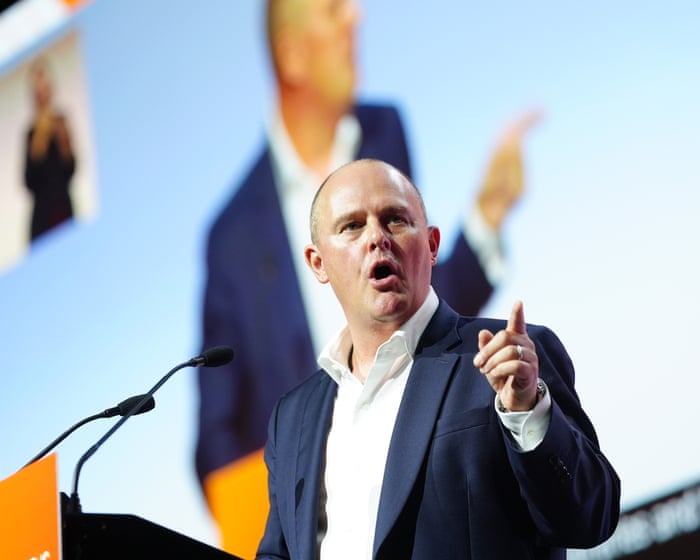
The TUC general secretary, Paul Nowak, is predicting a wave of union recognition deals in the private sector over the next year as “transformative” rules on accessing workplaces come into force.

From Friday, as part of Labour’s Employment Rights Act, unions will have the right to enter workplaces or communicate with staff electronically. From January, employers will be obliged to inform workers of their right to join a union.

Continue reading...

© Photograph: Stefan Rousseau/PA

© Photograph: Stefan Rousseau/PA

© Photograph: Stefan Rousseau/PA

  •  
❌