The upcoming Texas gubernatorial election between incumbent Greg Abbott and challenger Gina Hinojosa will determine if a new congressional map favoring Republicans or one protecting Latino representation becomes law.
The upcoming Texas gubernatorial election between incumbent Greg Abbott and challenger Gina Hinojosa will determine if a new congressional map favoring Republicans or one protecting Latino representation becomes law.
Assume the following: A person unlawfully entered the United States 20 years ago and has since started a business and raised U.S.-citizen children, has no criminal record, and has never been found to be dangerous. Should federal immigration law treat that person the same way it treats someone who was just apprehended at the border? Should the law treat that person as if Congress hadspecifically made them subject to mandatory detention for criminal or terrorism-related conduct?
Under the Trump administration, the answer is yes. President Donald Trump's current policy treats noncitizens who entered without lawful admission as subject to mandatory detention without bond throughout removal proceedings, even if they have lived in the United States for decades and have no criminal record. The executive branch adopted that position innew Immigration and Customs Enforcement (ICE) guidance issued in July 2025, reversing its prior interpretation of the same detention law.
The U.S. Supreme Court will now decide whether Congress actually required the result Trump is seeking. On October 1, the justicesagreed to hear the case of Rhoney v. Barbosa da Cunha. Ricardo Aparecido Barbosa da Cunha, a Brazilian national, entered the United States without inspection around 2005. He later applied for asylum, received work authorization, and eventually bought a home. He operates a small construction business and lives with his wife and two U.S.-citizen children. He has no criminal record. But immigration officers still arrested him while he was driving to work in Massachusetts in September 2025.
After Cunha challenged his detention, a federal courtordered a bond hearing and an immigration judge found that he posed neither a danger nor a flight risk and therefore released him on bond while his case proceeded. The Trump administration then appealed to the U.S. Court of Appeals for the 2nd Circuit and lost. Now the Supreme Court will have the final word.
The Supreme Court is not deciding whether Cunha may ultimately remain in the country. Instead, it is deciding the narrower question of whether the Immigration and Nationality Act mandates detention pending removal proceedings for someone like Cunha who is present in the United States without having been lawfully admitted.
The legal dispute turns on two phrases in one section of this federal immigration law. According to Section 1225, a noncitizen present in the United States who has not been legally admitted is considered an "applicant for admission." But when Congress imposed mandatory detention later in that same section, it used additional language, applying it to an applicant for admission who is "seeking admission."
That distinction may sound technical and trivial, but its consequences are enormous. If every statutory "applicant for admission" is automatically still "seeking admission," then the government can treat someone who crossed the border 20 years ago the same as someone arriving today and keep them in jail without the possibility of bond. If the two phrases mean two different things, however, then Cunha and others like him are generally eligible for a bond hearing underSection 1226, which permits both detention and release on bond or conditional parole.
The Trump administration argues that if Congress has deemed someone an applicant for admission, that person must necessarily still be seeking the admission for which they are considered an applicant. But the administration's argument asks the Court to stretch federal law beyond its reasonable limits. Congress expressly deemed certain people "applicants for admission." It did not separately deem them to be "seeking admission."
This case, in short, is about textualism. And as the late Justice Antonin Scalia and his co-author Bryan Garner argue in their book, Reading Law: The Interpretation of Legal Texts, one of the key principles of textualism is that "a material variation in terms suggests a variation in meaning." When Congress uses different words in closely related provisions, in other words, courts should hesitate before assuming that the different words mean the exact same thing.
In ordinary English, it is certainly difficult to describe a man driving from home to work after living in the United States for over two decades as presently "seeking admission." He is not seeking to enter the U.S.; he already entered decades earlier. The 2nd Circuit's unanimous opinion—written by Judge Joseph Bianco, a Trump appointee—reached this conclusion, holding that "seeking admission" describes ongoing activity rather than merely a retained statutory status.
Meanwhile, when the U.S. Court of Appeals for the 5th Circuit upheld the administration's position in a similar case, Judge Dana Douglas, an appointee of former President Joe Biden, invoked the same Scalia-Garner textualist principles in dissent.
The legal dispute, therefore, does not follow neat partisan lines. Judges from different ideological backgrounds have both concluded that the administration's reading goes beyond the words that Congress wrote.
The broader statutory structure also supports that conclusion. Congress has long required mandatory detention in Section 1226 for specified criminal and terrorism-related grounds. And theLaken Riley Act of 2025 expanded those mandatory-detention categories. But if nearly everyone who ever illegally entered the country is already subject to mandatory detention, as the administration asserts, then all of those carefully drawn separate categories for mandatory detention suddenly become superfluous and pointless for noncitizens who illegally entered the country, an objectionthat Douglas raised in dissent.
History also clarifies the point. For nearly 30 years, across five presidential administrations (including Trump's first), the government generally treated people like Cunha as potentially eligible for bond. Trump only reversed course in July 2025. The 2nd Circuit thus accuratelydescribed the earlier interpretation as a well-established executive branch practice.
Of course, past executive practice cannot override clear statutory language. But if Congress really did mandate a sweeping detention regime in 1996, it is striking that every presidential administration since then has operated under a totally different understanding.
None of this gives Cunha lawful immigration status. Nor does it guarantee his release or prevent the government from deporting him. Rather, it allows an immigration judge to ask a basic question: Is keeping this particular person in jail actually necessary while his case proceeds?
The administration may believe mandatory detention makes immigration enforcement faster or more effective. And Congress is free to adopt that policy if it chooses to do so. But Congress does have to choose it first.
Protecting the constitutional separation of powers is one of textualism's most important functions. Textualism is often described as a conservative method of statutory interpretation. But its deeper value is constitutional. It forces both courts and presidents to follow the law Congress actually passed. Sometimes that produces harsher results. Sometimes it produces more humane ones. But either way, it restrains the executive and judicial branches from exceeding their proper spheres.
Whether mandatory detention would accelerate Trump's deportation program is a question of policy. Whether it is just is a question of ethics. Whether Congress authorized it is a question of law.
In Cunha, the best textualist reading is that Congress preserved the possibility of bond and left room for an immigration judge to determine whether detention is necessary. That textualism, liberty, and compassion point to the same result is not the reason to reach it. In this case, however, it is a welcome coincidence.
A federal judge ruled Tuesday that a Donald Trump-backed lawyer has been “unlawfully serving” as the top federal prosecutor in Los Angeles. The decision regarding Bill Essayli’s service does not immediately take effect, and Essayli said the Supreme Court “will ultimately decide” the legality of his tenure.
The justices may have the last word not only on Essayli but also on a host of lawyers who have purported to lead districts around the country without being confirmed by the Senate. U.S. District Judge J. Michael Seabright noted in his ruling that the federal government has asked the Supreme Court to consider the issue in disputes over Trump’s chosen lawyers in Nevada (Sigal Chattah) and northern New York (John Sarcone).
In an order accompanying his ruling, Seabright, a George W. Bush appointee, gave the government a chance to try to halt his ruling pending appeal as the administration presses the appointment issue to the justices.
Urging the high court to use the Nevada case to resolve the nationwide issue, the Justice Department argued that lower court rulings against the administration “misconstrue” the law that deals with federal vacancies, “upend a quarter-century of practice,” “threaten chaos for the next presidential transition” and “cast a pall over prosecutions in 14 judicial districts nationwide.”
We could learn later this year whether and when the justices will take up the matter. They could grant review to decide it this term after holding a hearing and issuing a ruling that would be expected by July.
Meanwhile, given Seabright’s pause on his decision taking immediate effect, Essayli said he will “continue running the office.” The New York Times included Essayli on its list of prosecutors who are “carrying out Trump’s grievance agenda,” writing that he “has pushed to charge cases against anti-Trump protesters, many of which fell apart in court” and “carried out a direct order from Mr. Trump to open an investigation of voting in the state.”
Subscribe to theDeadline: Legal newsletterfor expert analysis on the top legal stories of the week, including updates from the Supreme Court and developments in the Trump administration’s legal cases.
Years ago, I bought a contraption designed to separate and concentrate the most volatile components of a liquid mixture. I would tell you what I did with it, but I don't want to implicate myself in a federal felony.
Since 1868, it has been illegal for Americans to locate a "distilled spirits plant" in "any dwelling place," an offense currently punishable by a maximum $10,000 fine and up to five years in prison. The federal ban on home distilling is at the center of a case that the Supreme Court recently agreed to hear, which raises a specific constitutional issue but also highlights the absurdity of treating this hobby as a crime.
That policy, the U.S. Court of Appeals for the 5th Circuit ruled last April, cannot be justified as an exercise of the federal government's tax power. To the contrary, Judge Edith Jones said in the court's opinion, the ban is "an anti-revenue provision that prevents distilled spirits from coming into existence," meaning its effect is "to reduce revenue instead of raising it."
Nor is the provision consistent with "the Supreme Court's explanation of how the federal power of taxation works," Jones wrote. When Congress imposes a tax, the Court explained in 2012, it "leaves an individual with a lawful choice to do or not do a certain act, so long as he is willing to pay a tax levied on that choice." But in this case, Jones noted, would-be home distillers "have only the choice not to do as they wish or risk fines and imprisonment."
The government argued that the ban helps collect liquor taxes by prohibiting a form of production that is difficult to detect. But "Congress cannot prohibit intrastate activity solely because it might produce products hard to tax," Jones said. If it could, she warned, there would be "no limit whatsoever" to its tax power.
Under the government's logic, Jones noted, "Congress may criminalize nearly any at-home conduct only because it has the possibility of concealing taxable activity. Home-based businesses may be forbidden. Remote work may be deemed a crime."
The Trump administration, which wants the Supreme Court to overturn the 5th Circuit's decision, argues that threatening to imprison home distillers is a "necessary and proper" safeguard against tax evasion. But whatever your take on the constitutional question, that policy is morally indefensible, haphazardly enforced, and inconsistent with the federal government's treatment of wine and beer.
The lead plaintiff in this case is Scott McNutt, a member of the Hobby Distillers Association. In 2014, McNutt received a "Notice of Potential Civil and Criminal Liability" from the Treasury Department, which said it had reason to believe he "may have purchased a still capable of producing alcohol and/or equipment and materials that may be used in the manufacture of a still."
The notice warned that "federal law provides no exemptions for the production of distilled spirits for personal or family use." It added that "unlawful production of distilled spirits is a criminal offense," which it erroneously claimed was "punishable by a fine of up to $500,000" as well as "imprisonment for not more than 5 years."
Meanwhile, online retailers such as Amazon sell a wide variety of home stills, many of which are explicitly advertised as appliances designed to produce alcoholic beverages such as vodka, gin, brandy, and whiskey. Customers could be forgiven for assuming that's legal, especially since federal law has long permitted home wine and beer production "for personal or family use."
McNutt's lawyers say he "owns a still that he has used to lawfully distill fuel alcohol and seeks to 'tinker around' with beverage spirits." Another plaintiff, Thomas Cowdrey, "likewise seeks to experiment in creating new beverage spirits, including 'apple pie vodka,' for which he has developed a recipe."
Because of a law Congress enacted 158 years ago, McNutt and Cowdrey would be felons if they acted on those desires. It might be time to rethink that policy.
Issued in a brief, unsigned opinion, the justices’ decision favors President Donald Trump’s administration, which opposes maintaining a practice that President Joe Biden formalized.
“In 2024, Biden’s administration adopted a regulation that formally codified administrative closure procedures, concluding that it lets judges efficiently manage their caseloads and promote the fair treatment of immigrants. That regulation replaced a prior rule adopted in 2020 during Trump’s first term in office that had been judicially blocked,” Reuters reported.
When Trump returned to the White House in January 2025, however, he announced that he would no longer allow administrative closure of cases as a mechanism for reducing workloads in immigration courts.
The family of Renee Good, one of two US citizens fatally shot by federal immigration agents in Minneapolis in January,have sued the Trump administration, saying there had been "no accountability" for her killing during deportation sweeps.
Texas had already challenged that policy in a federal court, arguing that the rule lets immigration judges “effectively grant indefinite amnesty to aliens illegally present in this country.”
Three cities with large immigrant populations — Baltimore, Maryland; Columbus, Ohio; and New Haven, Connecticut — along with an immigrant rights advocacy group, filed a lawsuit seeking to preserve Biden’s decision. The courts rejected these requests, bringing the matter before the Supreme Court.
Administrative closure of deportation proceedings, however, has been practiced for decades. According to government statistics, the rule has benefited about 360,000 migrants since 1990.
Brazil’s Liberal Party, the party behind presidential candidate Flávio Bolsonaro, on Monday recognized the election results leading to President Luiz Inácio Lula da Silva’s victory, even though the far-right leader has not conceded. Party president Valdemar Costa Neto said in a statement posted on the social platform X that the party recognizes the election results but…
The Supreme Court is scheduled to hear arguments in Viramontes v. Cook County regarding the constitutionality of state and local bans on AR-15 semiautomatic rifles.
As the 2026 midterms approach, concerns are mounting over whether President Trump will attempt to overturn results through legal challenges, seizure of voting machines, or other controversial measures.
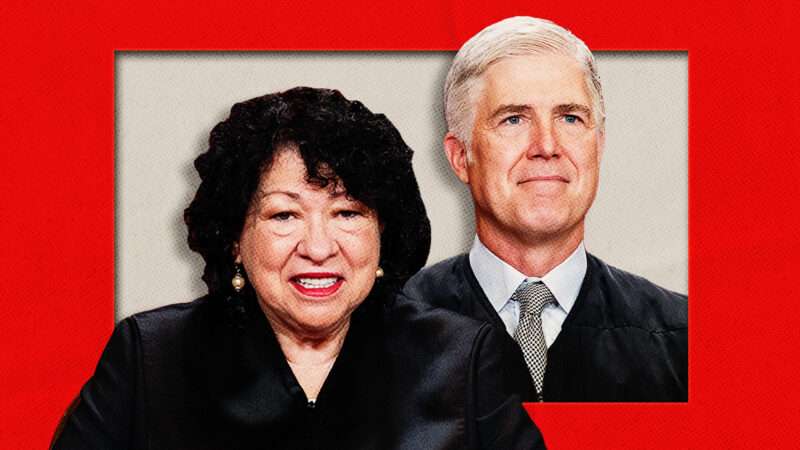
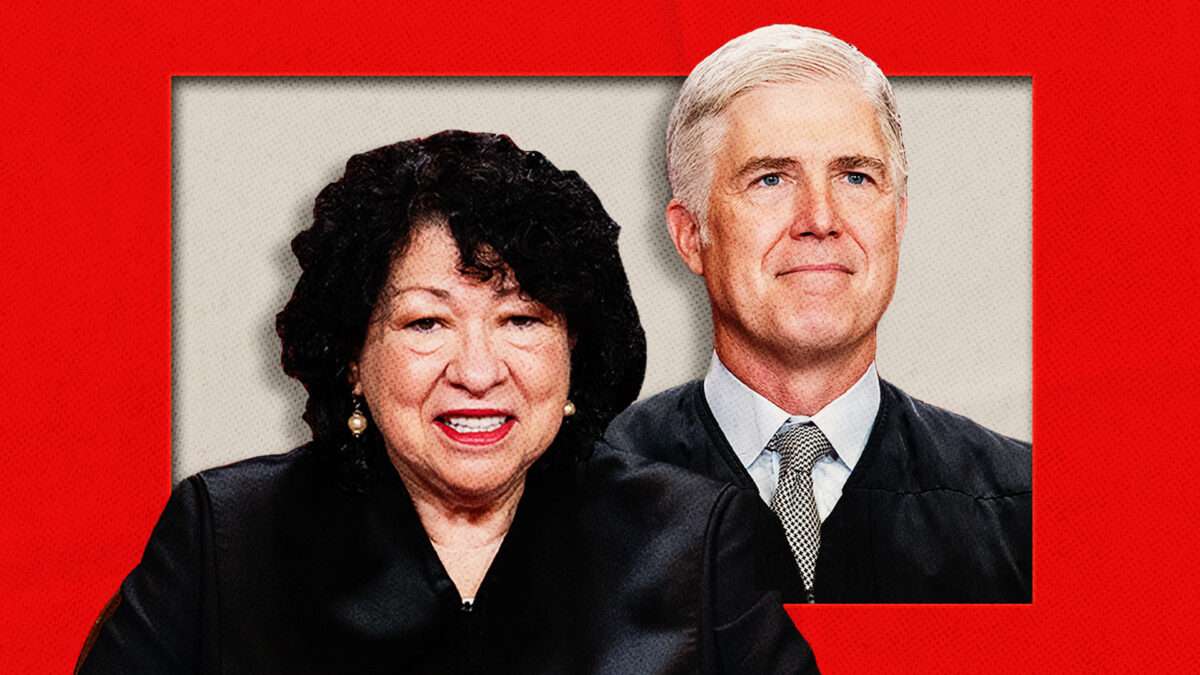
One of the more interesting developments at the U.S. Supreme Court in recent years has been the rise of a kind of sporadic alliance in defense of civil liberties between Justices Sonia Sotomayor and Neil Gorsuch.
In 2018, for example, Gorsuch, joined by Sotomayor, blasted the Supreme Court for refusing to even hear arguments in Stuart v. Alabama, an important case about forensic evidence, criminal trials, and the Sixth Amendment right to cross-examine one's accusers.
Similarly, in United States v. Davis (2019), Sotomayor joined Gorsuch's majority opinion striking down a federal law that called for enhanced sentencing when a gun was used in connection with certain federal crimes because the law at issue was too imprecisely written to pass constitutional muster. "When Congress passes a vague law," Gorsuch wrote, "the role of courts under our Constitution is not to fashion a new, clearer law to take its place, but to treat the law as a nullity and invite Congress to try again."
Gorsuch and Sotomayor have also been on the same page in a number of Fourth Amendment cases, though Sotomayor's overall Fourth Amendment record is arguably stronger than Gorsuch's. In Torres v. Madrid (2021), for instance, the Supreme Court held that when the police shoot a fleeing suspect, it still counts as a "seizure" for Fourth Amendment purposes even if the suspect kept on the move after being shot. "The application of physical force to the body with the intent to restrain is a seizure," the Court held, "even if the person does not submit and is not subdued." Sotomayor joined that pro-civil liberties decision; Gorsuch, along with Justices Clarence Thomas and Samuel Alito, sided with the officers and voted in dissent.
Fortunately, the Gorsuch-Sotomayor band was back together last week to make some noise in support of the Bill of Rights in a dispute that pitted property rights against police powers. As Reason's Billy Binion reported, the Supreme Court declined to hear a case challenging a lower court's "categorical rule" that "property destroyed in the exercise of [a state's] 'police power' is immune to claims under the Takings Clause, the U.S. Constitution's pledge that government cannot usurp private property without fairly compensating the owner."
Sotomayor, joined by Gorsuch, strongly implied that she thought the lower court's rule was unconstitutional, though she accepted that "further percolation" on the issue was needed before the Court should step in. "Where, as here, a person alleges a 'classic taking in which the government directly appropriates private property for its own use' or to pay an outstanding debt, like a tax lien," Sotomayor wrote, "the talismanic invocation of the State's 'law enforcement authority,' may be insufficient to avoid the requirement of just compensation." (Citations omitted.) Sotomayor then urged the lower courts that are "considering this issue to take care that due deference to state police powers does not eclipse constitutional rights."
Just as Gorsuch's Fourth Amendment record has its blemishes, Sotomayor's record on property rights has also been less than impressive at times. So it is doubly welcome to see these two justices back in the trenches together on this particular civil liberties front.
Elsewhere in the Law
Writing at SCOTUSblog, Anastasia Boden, a senior attorney at the Pacific Legal Foundation, has an interesting article about the Supreme Court's landmark 1926 decision in Euclid v. Ambler, in which, as Boden put it, the Court ruled in favor of a town's "power to pass comprehensive zoning, and against a local developer who had argued the town's plan exceeded the city's police power and destroyed the property's value." In effect, the Court's ruling was "the birth of modern zoning."
One of the things that has long fascinated me about Euclid v. Ambler is the fact that the opinion was authored by Justice George Sutherland, who is probably best remembered today for his role as a leading judicial foe of President Franklin Roosevelt's New Deal. In Euclid v. Ambler, however, Sutherland endorsed a view of regulatory authority that has been celebrated by liberal academics as "a model of pragmatic and well-balanced Progressive jurisprudence."
I suppose we might call it an irony of legal history: The intellectual leader of the Supreme Court's anti–New Deal bloc actually left a greater mark on the law by shoring up the immense power of city planners.
Paz's activism drew sharp criticism from some south Tel Aviv residents and strong support from right-wing politicians; she acknowledged the toll it took on her supportive family
Is there an exception to the 5th Amendment's promise that government cannot take private property without "just compensation"? The Supreme Court declined to address that question this past Monday when it rejected a trio of petitions asking the justices to consider whether people should be compensated when law enforcement seizes or destroys their property.
Two of the cases concerned individuals who were not accused of a crime but whose property nevertheless became collateral damage as police pursued a suspect. In June 2022, police fired 30 tear gas canisters into Amy Hadley's home in South Bend, Indiana. Officers smashed windows, tore down security cameras, ransacked furniture, ripped down a panel and a fan, and punched holes in the walls as they searched for a fugitive named John Parnell Thomas, who had never been there. The police had erroneously concluded that Thomas accessed the internet via the IP address at Hadley's home. According to Hadley, the police caused at least $16,000 in damages, which insurance only partially covered.
About two months later, a SWAT team in Los Angeles arrived at Carlos Pena's North Hollywood printing business and destroyed it, along with his equipment inside, crippling his livelihood after a fugitive broke in and barricaded himself in the shop. (The suspect ultimately escaped.) Pena alleged approximately $60,000 in damages in his suit against the city, which declined to compensate him for his losses. His insurance also refused to step in—as is common in such cases, as policies often exclude damage caused by the government.
The third petition concerned Chicago drivers whose vehicles were seized by the city over modest unpaid parking tickets. Ryan O'Donnell's vehicle was impounded and sold for scrap because of about $524 in debt. Michael Goree's was seized and relinquished to the lienholder over a debt that did not belong to him; the $560 in unpaid tickets were for a different vehicle owned by his co-signer.
In all of these cases the lower courts' reasoning came from a similar place. Hadley, O'Donnell, and Goree's petitions were heard by the U.S. Court of Appeals for the 7th Circuit, which has adopted a categorical rule: Property destroyed in the exercise of "police power" is immune to claims under the Takings Clause, the U.S. Constitution's pledge that government cannot usurp private property without fairly compensating the owner. Pena's case went to the U.S. Court of Appeals for the 9th Circuit, where the judges have declined to issue such a sweeping exception but have instead ruled that governments are exempt from paying out claims when the police actions in question were "necessary."
In a statement, U.S. Supreme Court Justice Sonia Sotomayor, joined by Justice Neil Gorsuch, outlined the many inconsistencies between the circuits on the topic. "It is still an 'open question' whether these or any other approaches are consistent with this Court's precedents. Few of these decisions likewise explain the source of any such police-power exception to the Takings Clause—whether the common law, the Constitution, or elsewhere," she wrote. "Such questions thus continue to 'benefit from further percolation' in the lower courts before this Court chooses to intervene."
Sotomayor was quoting herself. In 2024, she released similar remarks in response to a petition from Texas woman Vicki Baker, whose house in McKinney had been hollowed by a SWAT team attempting to capture a fugitive. The high court declined to hear Baker's case, although she finally found relief under the Texas state constitution this year.
"It's possible that the Court sincerely doesn't think the lower courts have done enough thinking on this important but novel issue," Patrick Jaicomo, a senior attorney at the Institute for Justice who represented Hadley, tells me. "Still, we've brought them 5 cases from 5 circuits. How much more percolation is needed?…The Court is going to have to address this important issue, and it's not clear what another circuit decision or 6 might do to aid that consideration."
Though Sotomayor's statement ran in parallel to the one two years ago, its slightly sharper warning intimated that we may be inching closer to a resolution. "I again encourage courts considering this issue to take care," she wrote, "that due deference to state police powers does not eclipse constitutional rights."
Hillary Clinton may no longer be the most influential voice in the Democratic Party, but she remains a member in good standing of the party establishment. So when she expresses support for expanding the number of justices on the Supreme Court, it tells us that what was once a radical idea has gone mainstream.
“We should seriously look at expanding the court while the Democrats are in power,” Clinton said on a recent podcast. “You know, it used to be that you’d have one justice for each circuit. We now have 13 circuits, we should have 13 justices.”
Adding four justices to the court is just one of the potential reforms that have been suggested as a way of curbing the court’s abuses. Others include 18-year term limits for justices, ethics rules with actual teeth (no more billionaire-funded junkets for you, Justice Thomas) and limits on the court’s ability to strike down any law they don’t like. Whichever particular reforms one prefers, it is no longer acceptable for a Democrat to simply decry the latest awful ruling. They have to be willing to entertain fundamental change to the institution.
This shift in Democrats’ thinking is as remarkable as it is recent. Five years ago, Sen. Ed Markey introduced a bill to do just what Clinton and others now favor, adding four justices to the court; it got only two co-sponsors, Sens. Elizabeth Warren and Tina Smith. Joe Biden responded to demands for court reform with Washington’s favorite way of burying an issue: He appointed a commission to study it. They produced a lengthy white paper, but it wasn’t until July 2024 — after he pulled out of the presidential race — that Biden finally endorsed term limits and an enforceable ethics code.
The situation today is far different. Supreme Court reform will almost certainly be part of the 2028 Democratic platform, and just about every politician considering a presidential bid has already come out for at least some version of reform.
What changed? The most important factor is the court’s own behavior. There are the monumental decisions: overturning Roe v. Wade, gutting the Voting Rights Act, eliminating any meaningful restrictions on billionaires pouring money into campaigns, outlawing affirmative action in education and giving the president immunity from prosecution for crimes, among other things. Taken together, the court’s conservative majority is so obviously pursuing its own partisan political project: to remake the law and the structure of the federal government in line with their personal preferences. Yet the justices pretend that they and only they are truly committed to the framers’ intentions and the text of the Constitution.
“We are not part of any political movement, and we are not attempting to further any political agenda,” said Samuel Alito, the most partisan justice on the court. “People think we’re making policy decisions,” lamented Chief Justice Roberts earlier this year, when nothing could be further from the truth. So says the man who has steered the court’s stampede to the right, including achieving his lifelong goal of destroying the Voting Rights Act.
Even Elena Kagan, the most conciliatory of the liberal justices, said in a recent speech that the court’s decisions rubber-stamping partisan gerrymandering showed “a lack of the appropriate concern or understanding of the consequences of their decisions.” With all due respect, Kagan was mistaken: They know exactly what the consequences of their decisions are. That’s why they rule the way they do.
So thanks to the conservative justices, Democrats are moving toward a consensus on court reform. There is no left versus center division within the party on whether the court’s decisions have or haven’t created a crisis. The only question is what should be done about that crisis. Anyone wanting to lead the party is going to have to be willing to take on this court and rebalance the scales. If they don’t, their constituents won’t stand for it.
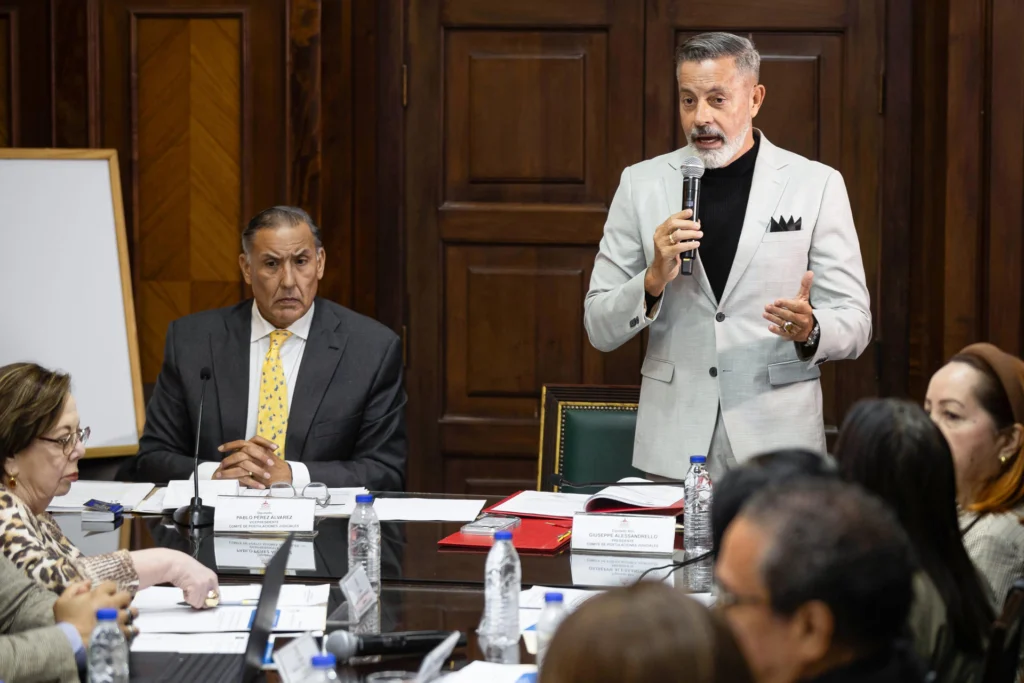
Venezuela’s National Assembly installed a Judicial Nominations Committee on Friday to evaluate and select new Supreme Court justices, a step lawmakers described as central to consolidating institutional stability.
The committee was formally established on October 23, at the Federal Legislative Palace in Caracas, one day after being sworn in during a legislative session.
Giuseppe Alessandrello, who presides over the body, announced that its immediate task is to draw up a work schedule under the Law of the Supreme Court of Justice.
Alessandrello said the law opened the selection process to ordinary citizens. Writing on social media, he stated that the legislation brought people into the work of “evaluating and selecting the leadership, in this case of the Supreme Court of Justice, to seek plurality.”
#23Oct || Desde el Palacio Federal Legislativo se realiza la Instalación del Comité de Postulaciones Judiciales. pic.twitter.com/MczZA2GxJ7
Text reads: “From the Federal Legislative Palace is carried out the installation of the Judicial Applications Committee.”
The committee operates within a broader national dialogue that authorities describe as “building a new Venezuela.” Officials have repeatedly framed the judiciary as the institution responsible for guaranteeing what they call true and just peace among citizens. “The judicial branch is the institution that will guarantee peace among us,” Alessandrello said.
The work schedule will set specific periods for the call for nominations, the evaluation of candidates, and the handling of challenges and responses.
The final goal is to present a definitive list of eligible candidates to the National Assembly.
Alessandrello stressed the weight of the assigned tasks, linking them directly to institutional stability. The committee’s operational work and the eventual delivery of the list will follow the terms and periods established by current law.
The process is governed by the Organic Law of the Supreme Court of Justice and the Constitution of the Bolivarian Republic of Venezuela. It covers the selection of both principal and alternate justices of the Supreme Court of Justice.
Subrayó el rol clave de la ciudadanía:
"La ley incorporó a los ciudadanos y ciudadanas de la sociedad en este trabajo de evaluar y seleccionar a las directivas, en este caso del Tribunal Supremo de Justicia, para buscar la pluralidad". pic.twitter.com/LhNVkaK6ov
Text reads: “The President of the committee, Giuseppe Alessandrello, highlighted the group’s harmony: “Everything we produce is decided unanimously and the auspices with the work of the committee are positive.” He also emphasized the importance of plurality in this process. He stressed the key role of citizenship: “The law incorporated citizens of society in this work of evaluating and selecting directives, in this case from the Supreme Court of Justice, to seek plurality.”
Selecting Court Leadership
The mandate extends beyond the high court itself. It also includes related judicial positions, among them the directorship of the National School of Magistrates.
The committee emerged from a process announced earlier this month. The National Assembly opened the nomination period between October 2 and October 9, allowing interested citizens and institutions to take part in the selection of the court’s leadership.
Once the schedule is finalized, the committee will move through successive phases, receiving nominations, reviewing candidates, and addressing any challenges filed against applicants. Each challenge will carry its own opportunity for a formal response before the list reaches the legislature.
The final list of selected candidates will be delivered to the National Assembly for consideration. The body’s work therefore functions as a preliminary filter within a process whose ultimate decisions rest with the legislature.
Welcome back, Deadline: Legal newsletter readers. Supreme Court justices were off the bench this week because they’re in between their October and November hearing sessions. But they still made plenty of news, in both their written work and public comments.
They started by adding two potent cases to a docket that is growing this term in both size and importance. Following last week’s agreement to review a discovery dispute over Elon Musk’s purported government efficiency effort, on Monday the court added two more appeals: on race in middle school admissions and congressional authority to ban home distilling. The court will keep adding cases throughout the year, with all the rulings in argued cases typically coming by July.
Justices Sonia Sotomayor and Neil Gorsuch were together again, speaking out for the second week in a row about a case the court refused to hear. Last week, Gorsuch joined Sotomayor to lament what they saw as unjust prosecution. This week, the Trump appointee joined the Obama appointee to critique what they saw as constitutional problems with car seizures in Chicago. It’s not new for this duo to team up in a certain type of case that lends itself to bipartisan agreement, but they have been ramping up that agreement so far this term.
Sotomayor’s statement appeared on the order list, which, as regular readers know, is an important document that announces the latest actions on pending petitions. That’s where we learned about the two new cases that the court took up and the (much longer) list of cases the court rejected. It takes four justices on the nine-member bench to grant review, and the court denies most petitions.
But Sotomayor’s statement reminds us that the justices occasionally offer their thoughts even when, as here, they agree with the denial but still find it important to highlight broader issues. These writings help us understand the justices’ priorities and what new cases the court might take up in the future.
Another sort of signal came from Justice Samuel Alito, who didn’t explain himself but noted that he wanted to review one of the petitions the court denied on the list. The failed petition came from Missouri officials who wanted the court to revive a rule that registered sex offenders must put signs on their doors for Halloween that read, “No candy or treats at this residence.” An appeals court said the rule wrongly compelled speech under the First Amendment. Although Alito merely noted, without explanation, his difference of opinion, the vote fits with his overall approach, because he generally backs law enforcement and has split from his colleagues in other First Amendment disputes.
Alito had company later in the week when the court rejected the Trump administration’s request to immediately enforce its preferred policy on gender-affirming care in prison. The justices did not explain the rare (albeit temporary) win for transgender people at a court that has ruled against them in a series of other cases. But whatever the justices were thinking, we know it wasn’t unanimous, because Alito and Justice Clarence Thomas both indicated (also without explanation) that they wanted to grant the government’s request.
Justice Elena Kagan made news outside her written work, with an appearance at a law school in Washington, D.C., the sort of speaking engagement that the justices will do from time to time. Kagan, who was dean of Harvard Law School before she became a justice, gave her GOP-appointed colleagues a failing grade when it comes to democracy. Reprising impassioned criticisms of rulings on voting and campaign finance that she has made in dissenting opinions, the Obama appointee said the court “has kind of blinded itself to the very deleterious effect of their rulings on how the political system works and has created a democracy that does not work as well as it should.”
Kagan apparently agreed with her colleagues this weekin an election case, when the Supreme Court granted a Republican-backed request from New Hampshire to block the use of student IDs for voting in the midterms. In a brief unsigned order, the high court chided a lower court judge for, as the justices saw it, improperly interfering with state rules right before an election. Justice Ketanji Brown Jackson was the only one to publish a dissent, in which she contended the judge was justified in trying to protect voting rights.
The justices are still off the bench for another week, as they are set to return to the courtroom in November to hear the next batch of regularly scheduled arguments. But as Election Day approaches on Nov. 3, they will continue to field unscheduled emergency applications on voting and whatever else comes their way.
Subscribe to theDeadline: Legal newsletterfor expert analysis on the top legal stories of the week, including updates from the Supreme Court and developments in the Trump administration’s legal cases.
“If Donald Trump defies court orders because the Supreme Court said he cannot be prosecuted for actions he takes as president, could those people who carry out his illegal requests be prosecuted or fined even though they are acting on his orders?” — Kit Read
Hi Kit,
Maybe.
The Supreme Court’s 2024 ruling in Trump v. United States only dealt directly with criminal immunity for presidents, holding that they have at least presumptive immunity for all official acts, as well as absolute immunity for acts within their “conclusive and preclusive” constitutional authority.
What all that means in practice hasn’t been fully fleshed out. It would take a follow-up case to clarify the ruling’s limits, and it’s unclear if or when such a case will come.
At any rate, the court focused on presidents in that ruling. It did not grant immunity to aides acting on the president’s behalf.
Yet, while arguments have been made against subordinate immunity, it’s technically an open question that the justices haven’t decided one way or the other.
So the answer to your question at the moment is: maybe.
But you might wonder: What could the argument be for immunizing presidential underlings?
One scholarly account argued that the logic of the immunity ruling “renders the President’s subordinates absolutely immune for a potentially broad range of official acts, even if those acts are otherwise unlawful.” That’s because if the president has complete power over executing the law, then, the argument goes, subordinate actions that implement that power are lawful, as opposed to being unlawful but immune from prosecution.
As with clarifying the immunity ruling’s limits as it applies to presidents, whether the Supreme Court will decide the subordinate immunity question depends on the court taking an appeal that raises that issue in the future. And as with presidential immunity itself, there is no clear candidate for an appeal the court would take to answer that question.
Either way, if a president wants to ensure that any of his henchmen won’t be federally prosecuted, he could always pardon them.
The Supreme Court on Thursday ruled New Hampshire’s top election official can fully stop voters from using their student IDs when showing up to the polls in the midterms — a request backed by the Republican National Committee (RNC). A lower judge ruled officials had improperly gone further than a new state law placing restrictions on…
A nearly unanimous Supreme Court has granted New Hampshire’s emergency request to block the use of student IDs for voting in the November midterm elections.
The case raised a recurring theme at the high court about the propriety of judgesintervening on the eve of political contests, against the familiar backdrop of GOP-backed voting restrictions purporting to ensure election integrity.
On Thursday, the majority said that the district court judge who ruled against the state failed to justify deviating from the general principle that federal courts shouldn’t alter election rules on the eve of an election. Justice Ketanji Brown Jackson dissented, writing she “would not disturb a clearly justifiable federal-court order issued to ensure that the public receives accurate information about a State’s electoral processes.”
The Biden-appointed justice said she wasn’t as sure as the majority that the judge’s action falls under that general noninterference rule, known as the “Purcell principle.” She said the judge was trying to address alleged misinformation rather than change state law.
“When a federal court determines that material misrepresentations are being made about a State’s election rules, an injunction to prohibit that conduct does not contribute to public confusion, it prevents that very problem,” Jackson wrote in her solo dissent.
While New Hampshire’s federal representatives are Democrats, Republicans run the state government. Gov. Kelly Ayotte signed a bill into law this year that prohibits the use of student IDs for voting.
A New Hampshire-based nonprofit called Coalition for Open Democracy sued the state over the law, which the group said needlessly burdens young voters under the guise of trying to solve the “non-existent problem” of nonresident voter fraud.
In a ruling earlier this month, U.S. District Judge Joseph Laplante refused to block the law, called HB 323. But the George W. Bush appointee said related guidance from New Hampshire Secretary of State David Scanlan, a Republican, went too far. Laplante said Scanlan overstepped in barring election officials from considering student IDs even as evidence under a “safety-valve provision” that lets voters prove who they are if they don’t otherwise have a proper photograph.
“The State has offered no independent justification for that broader prohibition,” wrote Laplante, explaining that such justification is needed even for minimal burdens on voting rights. He blocked enforcement of Scanlan’s directive to the extent it “prohibits or discourages election officials from considering student IDs as evidence of voter identity,” and he ordered the secretary of state to issue revised guidance for the midterms.
Laplante declined to halt his ruling, as did an appellate panel over dissent from a Trump-appointed judge. State officials then turned to the justices in Washington, arguing that Laplante’s order risks late-breaking confusion. The Republican National Committee filed an amicus brief supporting the state.
Opposing the state’s emergency application, Open Democracy said granting the application would be the chaos-inducing move. The group noted that Scanlan had already quickly complied with the order to provide revised guidance, and that his website “has told voters since the October 2 Order that supervisors may consider a student ID along with other evidence.”
That guidance is now the status quo, Open Democracy observed. Therefore, it said, granting the state’s application would “reverse the rules for a second time in a month.”
Subscribe to theDeadline: Legal newsletterfor expert analysis on the top legal stories of the week, including updates from the Supreme Court and developments in the Trump administration’s legal cases.
On December 2, the Supreme Court will consider constitutional challenges to "assault weapon" bans in Connecticut and Cook County, Illinois, that cover widely owned rifles, including the AR-15. As the plaintiffs in those consolidated cases see it, such laws plainly violate the Second Amendment because they prohibit arms in common use for lawful purposes. In briefs filed on Wednesday, Connecticut and Cook County urge the justices to reject that test, saying a weapon's popularity is not dispositive. The relevant question, they say, is whether their rifle restrictions fit a historical tradition of banning "unusually dangerous weapons."
Cook County and Connecticut have the burden of showing that their laws are "consistent with this Nation's historical tradition of firearm regulation," the test established by the Supreme Court's 2022 decision in New York State Rifle & Pistol Association v. Bruen. On the face of it, that is a daunting challenge.
In the 2008 case District of Columbia v. Heller, the Supreme Court said the Second Amendment protects the right to own "bearable arms" that are "in common use" for "lawful purposes like self-defense." That description indisputably encompasses "AR-15 platform and similar semiautomatic rifles," the firearms at issue in these cases. But Heller also recognized "the historical tradition of prohibiting the carrying of 'dangerous and unusual weapons.'" Cook County and Connecticut argue that the rifles they have deemed intolerable fall into that category.
"There is a robust historical tradition of regulating unusually dangerous weapons that
compromise public safety," Cook County says. "Such regulations, which long
predate the founding, have included outright bans and other restrictions on exceptionally dangerous weapons like launcegays, trap guns, Bowie knives, and slung shots."
Cook County argues that its ordinance is "relevantly similar" to those historical restrictions because it targets "exceptionally lethal weapons that are disproportionate to the end of self-defense." AR-15s are "offensive weapons of war designed for maximum lethality and are not customarily used for self-defense," the brief says. "The purpose and operation of the ban is consistent with our Nation's historical tradition and accounts for the exceptional dangerousness of these technologically advanced weapons."
The ban is "an appropriate contemporary restriction implemented by the legislature in response to dramatic technological change and unprecedented societal concern," the brief says. "It is tailored to respond to the particular dangers presented in areas with mass casualty exposure and acute public safety risk."
Connecticut offers a similar argument. One problem with this defense is the premise that "assault weapon" bans focus on "exceptionally lethal weapons." As critics of such laws have been pointing out for decades, the features they target, such as folding stocks, pistol grips, and barrel shrouds, do not affect a rifle's basic operation. With or without them, a rifle fires the same ammunition at the same rate with the same muzzle velocity. And because AR-15s use intermediate-caliber ammunition, they are arguably less lethal than shotguns and many hunting rifles that are not classified as "assault weapons."
Cook County's emphasis on technological developments is also questionable. Constitutional guarantees establish principles that courts routinely apply to technologies that did not exist at the founding. Although the Framers did not have radio, television, or the internet, for example, the First Amendment nevertheless constrains government regulation of those media.
More specifically, Heller rejected the idea that modern weapons are not covered by the Second Amendment by recognizing a constitutional right to own semiautomatic pistols. The Supreme Court said "the Second Amendment extends, prima facie, to all instruments that constitute bearable arms, even those that were not in existence at the time of the founding." The Court confirmed that point in the 2016 case Caetano v. Massachusetts, which involved a state ban on stun guns.
Cook County also asserts that AR-15s are not suitable for self-defense, a claim that would be hotly contested by many owners of such rifles, who commonly report using them for that purpose. "Plaintiffs have shown that AR-15s are well-adapted for self-defense," U.S. District Judge Peter Sheridan wrote in 2024, when he reluctantly concluded that New Jersey's AR-15 ban was inconsistent with Heller while expressing his dismay at that result. "Evidence has been presented to the Court that the build of the AR-15 makes it well-suited to self-defense because it is 'light weight, [has] very mild recoil, and [has] good ergonomics'; it is a weapon which is 'well suited to younger shooters, female shooters, and other shooters of smaller stature.'"
Sheridan added that "the AR-15's design features—including the effectiveness of its cartridge for self-defense use and its better continuity of fire when used with available magazines—make the AR-15 a good choice for self-defense." And he noted that "the AR-15 has been used recently in several, relatively high-profile self-defense events in Florida, Illinois, Texas, Pennsylvania, and Oklahoma."
Cook County and Connecticut are also wrong in suggesting that self-defense is the only "lawful purpose" that matters. While Heller emphasized the use of handguns "in defense of hearth and home," it did not say that was the full extent of the Second Amendment right. To the contrary, the phrase "lawful purposes like self-defense" implies that the right extends to other uses, such as hunting, pest control, and target shooting. The decision explicitly mentioned hunting as a "reason Americans valued the ancient right."
The briefs are misleading in another way that may prove decisive. They conflate "dangerous and unusual" with "unusually dangerous," which is not the same thing.
During the 19th century, state legislators restricted (and sometimes banned) weapons such as Bowie knives, spears, sword canes, slungshots, and brass knuckles. But the historical evidence suggests those weapons were not targeted simply because they were "unusually dangerous." Legislators were also concerned about how the weapons were typically used.
Solicitor General D. John Sauer, who filed a brief supporting the challenges to the AR-15 bans, notes that the 19th-century laws targeted weapons associated with "duels, brawls, and other criminal activities." And in reviewing those laws, state courts distinguished between arms favored by criminals and arms commonly used for lawful purposes.
In 1871, for example, the Tennessee Supreme Court held that legislators could ban weapons that were "not usual" but could not ban "the usual arms of the citizen." The top courts of Texas, Arkansas, West Virginia, North Carolina, and Michigan concurred that the right to arms encompassed weapons commonly owned by law-abiding people, including rifles.
AR-15s and similar rifles readily pass that common-use test. In January, the National Shooting Sports Foundation, the gun industry's trade association, reported that Americans own more than 32 million "modern sporting rifles," its preferred term for the models covered by "assault weapon" bans. Survey data suggest that somewhere between 16 million and 25 million Americans have owned AR-15-style rifles. Last year, a unanimous Supreme Court described the AR-15 as "the most popular rifle in the country."
According to Cook County and Connecticut, however, none of that matters. "Once it is established that a regulation pursues a legitimate public safety objective in a permissible manner, raw ownership numbers cannot immunize a firearm from regulation," Cook County says. It argues that opponents of its ordinance have misconstrued the significance of the common-use test and misunderstood how it interacts with Bruen.
"When the Second Amendment's plain text covers an individual's conduct, the Constitution presumptively protects that conduct," the Supreme Court said in Bruen. "To justify its regulation, the government may not simply posit that the regulation promotes an important interest. Rather, the government must demonstrate that the regulation is consistent with this Nation's historical tradition of firearm regulation. Only if a firearm regulation is consistent with this Nation's historical tradition may a court conclude that the individual's conduct falls outside the Second Amendment's 'unqualified command.'"
The common-use question, Cook County argues, figures only in the first Bruen step: "the inquiry whether the weapon at issue is one 'the Second Amendment protects.'" But even if ownership of AR-15s is covered by "the Second Amendment's plain text," it says, that does not resolve the question of whether they can be banned, which depends on the historical analysis required by the second step of the Bruen test.
"This Court's decision in Bruen confirms that the Second Amendment's step-two inquiry does not insulate popularly owned firearms from regulation," the brief says. In Bruen, it was "undisputed" that "handguns are weapons 'in common use' today for self-defense," including "outside the home." But "instead of being the end of this Court's inquiry, that observation was just the beginning." The decision also included an "extended analysis" of the historical laws that New York cited to justify its "proper cause" requirement for carry permits. "If lawful common use alone were enough to forbid regulation," Cook County argues, "there would have been no need to engage in that careful and prolonged analysis."
The question in Bruen was not whether the Second Amendment precludes "regulation." It was whether New York's specific approach, which required residents to demonstrate a "special need" before they were allowed to exercise the right to bear arms, was consistent with the historical tradition. That is why the Court considered (and rejected) the purported historical analogs that New York offered.
Cook County conflates requirements for carry permits, the issue in Bruen, with an outright ban on ownership, the policy it is defending. Connecticut likewise blurs the distinction between carry restrictions and complete prohibition.
"The Bowie knife was 'widely carried by Americans of all stripes,' including 'upstanding citizens and villains' alike," Connecticut's brief says. "The widespread use of Bowie knives and other weapons for lawful purposes did not prevent dozens of States from restricting those weapons." But those laws generally restricted or banned public carry. They rarely made it illegal to acquire or possess a Bowie knife, which is the approach that Connecticut and Cook County have taken with AR-15s.
That policy is hard to reconcile with Heller. I will quote Sheridan again, since his comments made it clear that he would have preferred to uphold New Jersey's AR-15 ban. Under Heller, he said, "a categorical ban on a class of weapons commonly used for self-defense is unlawful." Given "the Supreme Court's clear direction on this point," he concluded, New Jersey's law "is unconstitutional" as applied to "the Colt AR-15 for use for self-defense in the home."
Last July, the U.S. Court of Appeals for the 3rd Circuit agreed and went further, extending that conclusion to "the full class of semi-automatic rifles" banned in New Jersey. "Together, Heller and Bruen teach that bans or broad prohibitions on possessing or carrying of a class of weapons in common use for lawful purposes fail to find support in our Nation's tradition of firearm regulation," Judge Arianna Freeman, a Joe Biden appointee, wrote in the majority opinion. "That principle resolves our inquiry here."
To beat back the challenges to their laws, Connecticut and Cook County will have to persuade the justices that the 3rd Circuit's understanding of Heller and Bruen is wrong, meaning they are free to ban firearms in common use for lawful purposes. That seems like a tall order, and Cook County's position is especially puzzling. According to its brief, the fact that a weapon is covered by the Second Amendment does not mean Americans have a right to possess it. The more you think about that claim, the less sense it makes.

 Login