 Login

Conservation Efforts for Caucasian Leopards Show Promise
In Armenia, a three-legged Caucasian leopard’s astonishing hike signals that conservation efforts for the endangered animal may be working.

Education binds generations. But “provided sovereignty” is ambivalent – can you build it for someone else?
Join us on Telegram , X
 , and VK
 .
Contact us: info@strategic-culture.su
Reflection and outlook
The speech delivered by Vladimir Putin on October 28, 2026, at the Gostiny Dvor in Moscow, at the opening of the plenary session of the Russia-Africa Economic and Humanitarian Forum, lends itself to two interpretations. The first, the most immediate, reduces it to a catalog: wheat, fertilizers, hydroelectric power plants, scholarships, mobile laboratories, and language models. The second takes it for what it is: a programmatic text that would be translated the following day into the 2027–2029 Partnership Action Plan. The summit is the third in the series, following those in Sochi and St. Petersburg. The continuity of the format already speaks volumes: the Russian-African relationship has moved beyond the phase of declarations and is seeking a framework.
Moscow does not offer Africa a volume of resources capable of competing head-to-head with Beijing or Brussels, and it knows this; instead, it offers a set of infrastructures related to sovereignty – food, energy, finance, digital technology, and education – whose political value exceeds its accounting value. The geopolitical value of this cooperation lies in this gap. Its limitations, which do exist, lie in the very same point.
The word that underpins the entire discourse is “sovereignty.” Putin uses it about twenty times, but what matters is the definition he provides halfway through the text. It is no longer merely about control over territory and borders: sovereignty encompasses the political and financial stability of the system, the availability of food, water, and energy, reliable transportation and communications, and a distinct cultural identity. Added to this list is a further layer: jurisdiction over data, platforms, and artificial intelligence models.
This expanded definition has a precise logical consequence. If sovereignty consists of material and technical elements, then it can be built – and if it can be built, it can also be provided by a partner. Sovereignty thus becomes, in the Kremlin’s discourse, something to be exchanged: Russia provides the technical means by which African countries can reduce their dependence on other suppliers. It is no coincidence that Putin concludes by announcing a “platform for the sovereign development of African states,” designed in Russia and presented at a dedicated exhibition. This formula carries an obvious ambivalence, which we will return to.
The second theme is that of anti-colonial memory. The quote from Thomas Sankara on debt as a form of neocolonialism – in which the colonizers have transformed themselves into “technical assistants” – is no mere ornament. Sankara is a figure who speaks to the new leadership in the Sahel – particularly in Ouagadougou – and whom urban African youth know well. Invoking him in Moscow means situating Russia within an African, not a Soviet, genealogy. The next passage makes the strategy explicit: the continent’s infrastructure was built to export raw materials to the metropolises; manufacturing value-added remains below 2 percent; and intra-African trade accounts for barely 15 percent of a total trade volume of 1,500 billion dollars. This diagnosis is the same as that found in African literature on structural dependence. Moscow embraces this analysis and presents itself as the means to overcome it.
The scale of trade
The Russian president has stated that Russian-African trade will exceed $27 billion in 2025, up from $18 billion in 2022, and has set a target of surpassing $50 billion “in the near future.” This growth is real and, considering that it occurred under the most extensive sanctions regime ever imposed on a G20 economy, politically significant. It indicates that a substantial number of African governments have chosen not to align with Western measures and have paid the price for this choice in terms of diplomatic pressure. Putin openly acknowledges this when he thanks his partners for their “firm and principled stance.”
This is a market thatcan still grow – if that is the goal. China’s trade with the continent is in the range of $300 billion, as is that of the European Union. Russia’s trade is less than one-tenth of either of those figures. Not only that: the balance is highly asymmetrical. Russian agricultural exports to Africa reached 13 million metric tons in the first nine months of 2026, while imports of African agricultural products totaled about $4 billion – 8 percent of Russia’s needs. Putin himself admits that the figure is low and that it will have to grow. This admission is significant because it touches on the most sensitive point of anti-colonial rhetoric: a partner that sells grain, fertilizers, and weapons but buys very little replicates, in numerical terms, the very structure that the discourse denounces.
This leads to an initial assessment. Russia competes in niches where it enjoys comparative advantages that are difficult to replicate: grains and fertilizers, civil nuclear power, hydroelectric power, mining, higher education, and military cooperation. These are sectors in which the quantity of capital matters less than its strategic nature. A country that depends on Russia for wheat and on Russia for its nuclear power plant has a closer tie to Moscow than the monetary value of trade would suggest.
The most important levers: food, energy, currency
The first lever is food security. Over forty African countries import Russian wheat and fertilizers, and for some, supplies have multiplied. This data must be viewed alongside the demographic trends mentioned in the same speech: over 2.5 billion inhabitants by 2050, 70 percent of whom will be under thirty, according to United Nations projections. For a continent with this demographic trajectory, the price of bread is a key factor in political stability, and whoever guarantees the continuity of supply gains a form of credit that does not appear on any trade balance. Putin, however, adds a new element: the provision of seeds, machinery, logistics, and processing capabilities to support African agricultural self-sufficiency within the framework of the African Union’s program. On the surface, this offer reduces dependence on Russian wheat; in practice, it shifts dependence from the product itself to the technological supply chain.
The second lever is energy. The reference to the 55th anniversary of the Aswan Dam serves as historical proof of reliability. The present is entrusted to RusHydro, to modular power generation for isolated areas, and above all to civilian nuclear power, which was mentioned among the forum’s topics. Putin speaks of over thirty energy projects in sixteen countries. Nuclear power has a distinctive feature that makes it geopolitically more significant than any other sector: a power plant binds supplier and customer together for sixty or seventy years, encompassing fuel, maintenance, staff training, and waste management. It is a form of cooperation that outlasts governments.
The third lever – the least spectacular – is probably the most important from a structural standpoint. Putin proposes consolidating settlements in national currencies, expanding banking correspondent networks, opening cross-border branches, and linking Russia’s SPFS to the Pan-African PAPSS. The PAPSS (Pan-African Payment and Settlement System) was developed by Afreximbank in collaboration with the AfCFTA Secretariat and launched commercially in January 2022. The SPFS is the Bank of Russia’s financial messaging system, operational since 2014 as an alternative to SWIFT. The stated goal is to reduce transaction costs and shield payments from “politically motivated interference.” Then comes a sentence that, in the report, goes almost unnoticed: some countries do not have their own financial systems and are tied to European ones, which limits their sovereignty. The reference is to the CFA franc zone. This is the first time, in a speech of this caliber, that the monetary issue has been linked so directly to the question of African sovereignty. The message is directed primarily at the governments of the Alliance of Sahelian States, which have turned the monetary issue into a political one.
This third point warrants careful consideration. The link between the SPFS and the PAPSS, if established, would create a payment circuit between Russia and Africa entirely outside Western infrastructure. The significance of this circuit, however, would depend on the liquidity circulating within it, and liquidity depends on trade volumes, which, as we have seen, remain modest. It is more likely, in the medium term, that the PAPSS will gain significance as an intra-African infrastructure and that the Russian connection will be one component among others, alongside those from China, India, and the United Arab Emirates. Even so, it would be a success for Moscow: there is no need to dominate an alternative circuit; it is enough to contribute to making it possible.
But also technology
The section dedicated to technological sovereignty is the most assertive part of the speech. Putin claims a complete value chain for generative artificial intelligence, two national language models, banking and healthcare platforms, and digital administration systems that he offers to African partners. More than two hundred officials from twenty countries have already participated in skills-transfer programs on digital administration.
Here, the ambivalence of “provided sovereignty” becomes evident. An e-government system, a healthcare data platform, or a language model are not neutral assets: whoever controls the code, updates, and hosting retains the ability to access and influence them. The problem does not concern Russia alone – and applies even more to U.S. and Chinese platforms already entrenched on the continent – but the speech does not address this. From an African perspective, the advantage lies in diversification: having a third provider increases bargaining power vis-à-vis the other two. This is the logic of multi-alignment that many African foreign ministries have been practicing for years, and which Russia supports rather than opposes.
Education is the area where continuity with the Soviet experience is most pronounced. Forty thousand African students are enrolled in Russian universities – a 50 percent increase since 2020 – with 5,500 government scholarships for the 2026–2027 academic year, the Russian-African University Network with over seventy universities in seventeen countries, consortia specializing in mineral resources and transportation, and fifty-eight open education centers in twenty-nine countries. The Patrice Lumumba University remains the symbolic reference point. This is the slowest-moving component of the strategy, and also the one that yields the greatest returns. The engineers, doctors, and civil servants being trained today in Moscow and St. Petersburg will, in fifteen or twenty years, hold decision-making positions in African governments and businesses, bringing with them language skills, technical standards, and personal networks. The generation of African professionals trained in the USSR sustained a significant portion of Russian-African relations for decades, even after 1991.
The same applies to the media. The call to build a “common media space” – through the expansion of regional offices of Russian news agencies and a greater presence of African journalists in Russia – is a response to a narrative competition that Moscow considers an integral part of the game. The African continent is today one of the main arenas where the ability to produce competing interpretations of the international order is put to the test.
Africa is becoming polarized, and Russia is facilitating the process
At the systemic level, this discourse places Africa within the multipolar framework in terms different from those typically used in Western rhetoric. The continent is not viewed as a recipient of aid but as one of the emerging poles of the global economy and politics, represented by three members in the BRICS. The reference to the BRICS’ share of global GDP – which exceeds that of the G7 – must be contextualized, but the political point is clear: Africa is being encouraged to view its demographic and economic growth as a source of power rather than merely a development challenge.
Within this framework, Russia presents itself as a facilitator of African agency rather than as a hegemonic power, and this role suits it for a practical reason: it lacks the means to be hegemonic. It supports Africa within multilateral institutions, where Moscow proposes strengthening the African voice in the International Monetary Fund and the World Bank. It consolidates this support through its backing of the AfCFTA, which Putin cites in positive terms and which represents the only project capable of addressing the fragmentation of African markets inherited from the colonial era. The calculation can be interpreted in realist terms. A more integrated and autonomous Africa reduces the scope for Western influence – which is Moscow’s primary objective – without requiring Russia to make investments it could not sustain.
The benefit for Moscow is threefold. First, the vote: 54 African states carry weight in the General Assembly, and their abstention or non-alignment on resolutions regarding the conflict in Ukraine has already demonstrated how valuable this is. Second, access: critical mineral resources, outlets for agricultural and energy exports, and markets for Russian technology excluded from Western markets. Third, legitimacy: a summit in Moscow attended by dozens of African delegations effectively refutes the claim that Russia is internationally isolated. And, throughout all this, the summit did not address the important military alliance between Russia and the Sahel, a topic for discussion on other occasions.
The success of Russian-African cooperation will be measured by the ability to truly transfer expertise, to localize the processing of raw materials, and to rebalance trade. Herein lies Russia’s greatest challenge: to help Africa, not to make it dependent. Sankara, whom Putin quoted, warned precisely against those who present themselves as technical advisors. African governments will judge Moscow on this basis, not on the words spoken at Gostiny Dvor.
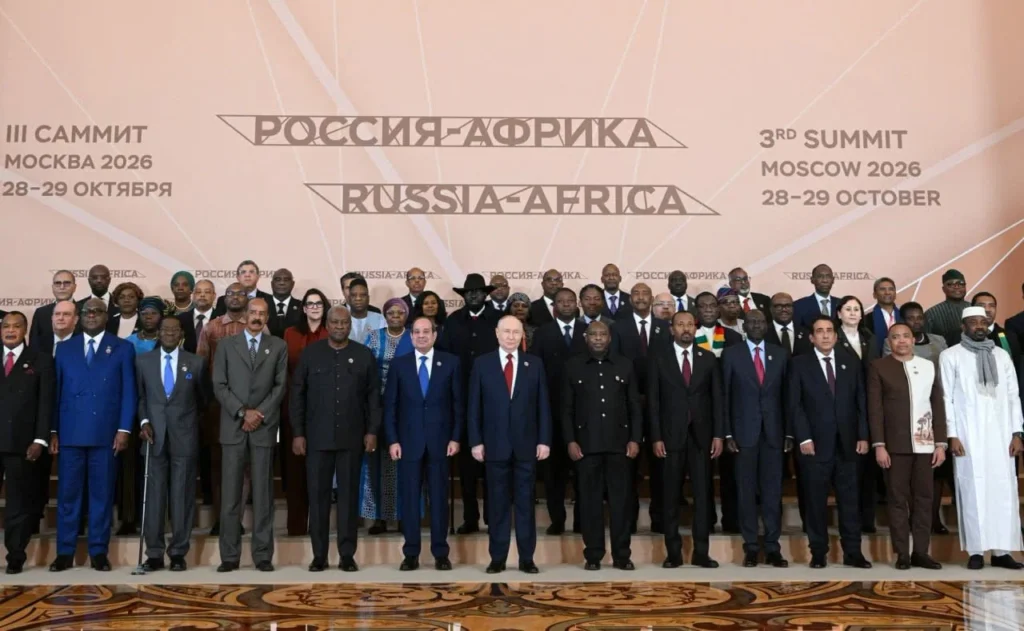
The 3rd Russia-Africa Summit concluded on October 29 at the Kremlin, where the plenary session approved the final declaration, a specific agreement on artificial intelligence, and the action plan that will govern the 2027-2029 period, presenting the A7 platform as a sovereign alternative to Western banking.
These documents set out the agreed roadmap for expanding cooperation between Moscow and African states while advancing what both sides describe as a fairer international system. A world order free from hegemonies ultimately summarizes the goal declared by the parties.
RELATED: Moscow Hails Africa as Multipolar Pillar Ahead of Russia-Africa Summit
The final declaration consolidates what the Kremlin describes as steady progress toward a just international system, while the separate statement on artificial intelligence opens a new technological front in the partnership.
Alongside the summit, the Economic and Humanitarian Forum also took place, serving as a platform to deepen bilateral exchange. According to participants, the forum sought a joint response to financial pressures and coercive measures imposed by Western countries.
Addressing the plenary session, Vladimir Putin stated that bilateral relations rest on a shared history of friendship, which he described as the foundation for a global architecture with multiple centers of power and no double standards. In this sense, the Russian President reaffirmed his country’s commitment to international law, the Charter of the United Nations (UN), and the sovereignty of African nations, which he argued is essential for strengthening their economies and social sectors.
The model currently promoted by Moscow combines technology transfer with sovereign investment. Through this approach, the parties reaffirm their rejection of resource exploitation and their commitment to stronger cooperation across the Global South.
Putin insisted that the Russian business model breaks sharply with the extractivism practiced throughout history by the imperial powers of the collective West. “Their approach is the exact opposite. Far from extracting profits in the manner of the colonial practices once employed by former imperial powers, they reinvest their earnings in the development of their national economies,” the Russian leader said.
This combination of technology transfer and sovereign investment, he argued, underpins the rejection of resource plunder and moves forward the integration of the Global South on more equal terms.
🇷🇺🌍 Putin Pushes for $50B+ Russia–Africa Trade and Alternatives to Western Finance
— Think BRICS (@RealBRICSnews) October 29, 2026
At the Russia–Africa summit in Moscow, Putin called for doubling bilateral trade, expanding payments in national currencies and sharing Russian technology in energy, AI, agriculture and… pic.twitter.com/JJ8ZaU53v3
Russian President Putin underscored the operational efficiency of the A7 platform, explaining that conversions between currencies, digital ones included, are processed instantly, slashing the costs, delays and financial intermediation that have long made Global South trade more expensive.
“Digital currencies are developing all over the world, both in the United States and here in Russia, but why can’t the African continent connect to this high-tech system?” he asked the international delegates. His answer was unequivocal. “This system is sovereign as well. It is not tied to anyone or anything, and nobody is going to block it,” he stressed.
⚡️Russia showcases payment systems operating beyond Western control
— Russian Embassy in South Africa 🇷🇺 (@EmbassyofRussia) October 29, 2026
Finance Minister #Siluanov highlighted Russian company A7, which is preparing to offer cross-border payment services in #Africa, with transactions processed "in one click" for a fee of just 0.3% pic.twitter.com/xFlbWGK15b
Created in the wake of the Western financial measures introduced in 2022, the A7 platform now processes around 2,000 transactions per day on average. It is being presented to African countries as a mechanism for selling raw materials, purchasing industrial inputs, financing infrastructure projects, and importing food using their own currencies, without relying on Western banking systems or their associated conditions and transaction costs.
The action plan running through 2029 supplies the framework for converting the summit’s pledges into concrete mechanisms over the next three years, consolidating what both parties describe as movement toward a just international system.

Recent reports indicate that North Korean leader Kim Jong Un attempted to visit China to orchestrate a dramatic diplomatic scene akin to his June 2019 summit with US President Donald Trump at Panmunjom – but Beijing politely turned him down. Kim’s primary motive for seeking a visit to China stemmed from mounting frustration with Russian […]
The post Beijing gave Kim Jong Un the cold shoulder and here’s why appeared first on Asia Times.
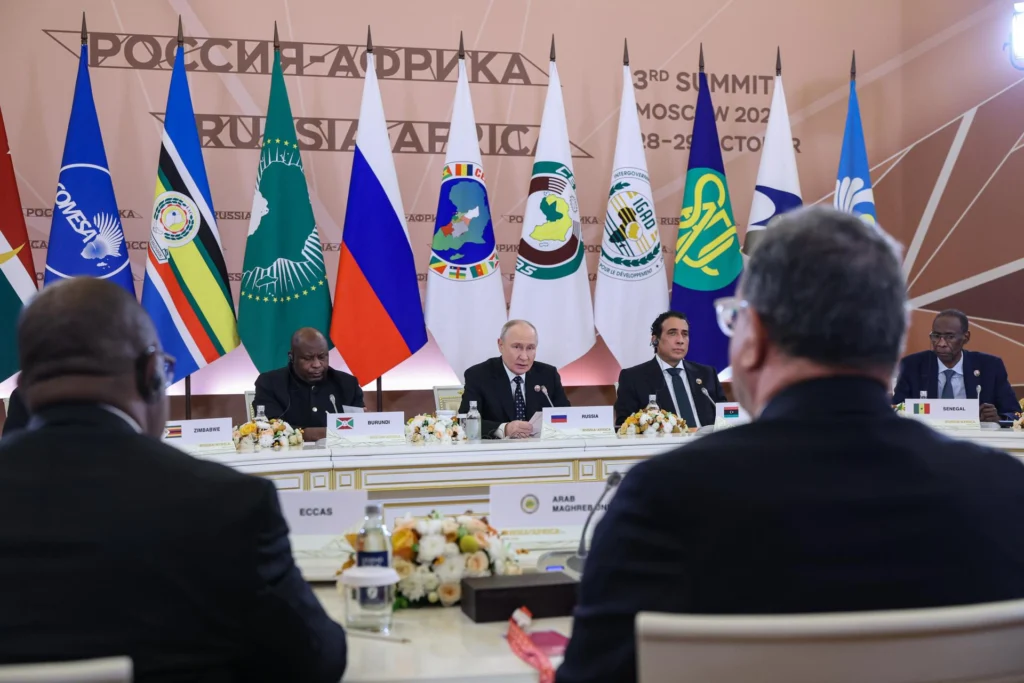
Serguéi Lavrov spent nearly an hour and a half on Tuesday with the heads of Africa’s leading media outlets, gathered in Moscow on the eve of the third Russia-Africa summit, and laid out how Russia sees the continent.
“We regard the African continent as a distinct civilization, one of the most important pillars of the multipolar world that is now, as an objective course of history, actively taking shape on the international stage, replacing the hegemony that Western countries have exercised for more than 500 years,” the Foreign Minister said.
RELATED: Russia-Africa Summit Opens in Moscow with 48 National Delegations
According to Lavrov, Russia wants to help strengthen the sovereignty of African states, the development of their industries and greater self-sufficiency in the economy, finance and technology. The summit agenda, on October 28 and 29, groups those goals into four areas, namely political and economic cooperation, security, science and technology, and cultural and humanitarian ties.
Nearly all the delegations from the 48 confirmed countries are already in Moscow, and 22 of them are led by heads of state. On the table are 33 documents, among them an agreement on cooperation in artificial intelligence, and the 2027-2029 joint action plan, which Vladimir Putin and Burundi’s Évariste Ndayishimiye, the current chair of the African Union, will adopt at Thursday’s plenary session. Putin also has 24 bilateral meetings scheduled, with the leaders of Egypt, Ethiopia, Ghana, Mali and Libya, as well as Iran and Qatar, in a week when the Russian capital is also hosting the Gas Exporting Countries Forum.
Seven years separate this gathering from the first one, held in Sochi in 2019, which closed with 92 agreements worth some $12.5 billion. The second brought together delegations from 48 countries in St. Petersburg in July 2023, and since then the Russian Foreign Ministry has created the Department of Partnership with Africa to follow up on what was signed, while intergovernmental commissions grew from four in 2023 to nine in 2025. In August, Ministry Spokeswoman Maria Zakharova announced that Moscow would bring to this summit a package of contracts on peaceful nuclear energy, independent payment systems, food security, digitalization and artificial intelligence.
Paul Kagame confirmed his attendance after several Western governments suspended part of their financial aid to Rwanda in 2025, and in Moscow he will sign the creation of a cooperation commission with a country he has already invited to build fertilizer plants. Ghana, whose parliament is processing a military-technical cooperation agreement with Russia, has an open tender for its first nuclear power plant, a 1,000-megawatt facility, in which Rosatom is competing with suppliers from China, South Korea, Canada and the United States.
Trade between Russia and Africa exceeded $27 billion in 2025, and Russia’s Ministry of Economic Development projects it will grow 1.5 to 2 times by 2030, to between $40.5 billion and $54 billion. That same year, China posted record trade of $348 billion with the continent, while the European Union traded more than €356 billion with Africa in 2024.
In 2023, oil, refined products, wheat and metals made up 90% of Russian exports to Africa, while Russia bought mainly fruit, cocoa and coffee. The balance leaves Russia with a surplus of more than $10 billion a year.
Settling that trade became harder when Russia’s exclusion from SWIFT in February 2022 cut off the usual channels of Russian banks. Moscow responded with its own payment network, in which the ruble already covers 84% of transactions with Africa, backed by the Russian financial messaging system, China’s CIPS, crypto assets and the A7 payment agent, which operates in Nigeria and Zimbabwe. For African importers the circuit still carries costs, since obtaining rubles requires a double conversion through dollars, exposes them to the volatility of that currency and leaves their banks open to Western secondary sanctions, which is why several banks on the continent refuse to process payments linked to Russia.
Egypt, which accounts for 30% of Russia’s trade with Africa, hosts the Russian Industrial Zone on the Suez Canal, agreed in 2018 for 50 years, which took its first step in July 2026 when Moscow selected the developer. An Egyptian government source estimates investment of up to $5 billion and completion in 2028, and goods made there with more than 30% local content will enter as Egyptian products the markets where Cairo has preferential agreements. Benedict Oramah, President of Afreximbank, the African Export-Import Bank, urged Russian companies to seize an open market in energy, mining, railways and health, and in June the bank signed contracts with four Russian manufacturers.
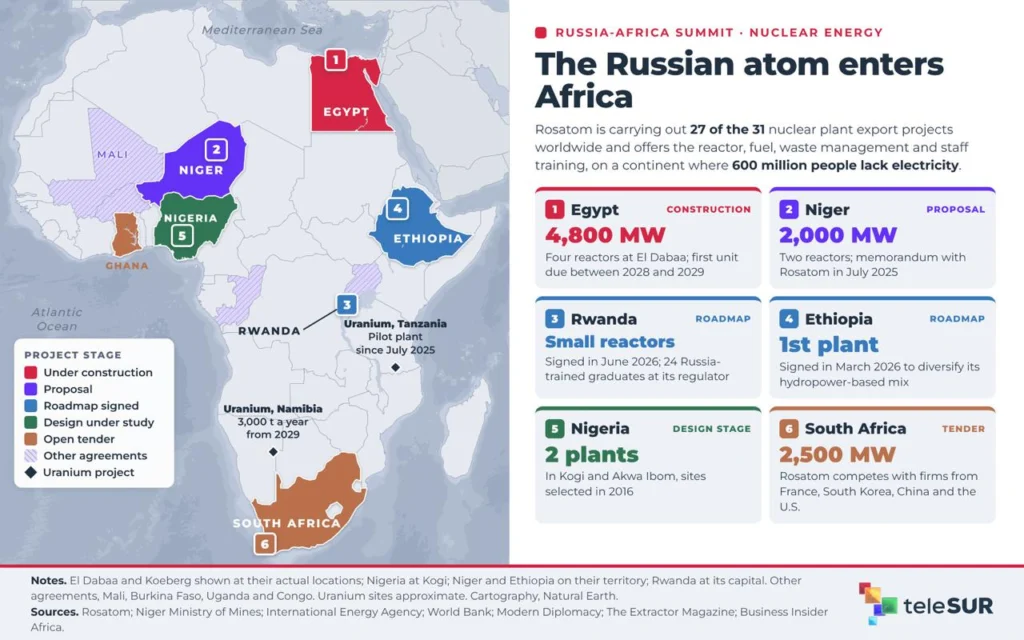
On Egypt’s Mediterranean coast, at El Dabaa, Rosatom is building four 1,200-megawatt reactors that will supply 10% of the country’s electricity. A Russian state loan covers most of a cost set in 2017 at $28.75 billion, which other estimates put at $30 billion, and the first unit is due to come online between 2028 and 2029.
The Russian corporation, which is carrying out 27 of the 31 nuclear plant export projects underway worldwide, offers a complete package covering the reactor, fuel, waste management and staff training over a 40- to 60-year lifespan, to a continent where some 600 million people live without electricity. The International Energy Agency estimates that universal access requires $15 billion a year, six times what was committed in 2023 for sub-Saharan Africa.
Niger, the world’s eighth-largest uranium producer, supplied France’s power plants for more than five decades (France gets about 70% of its electricity from nuclear power) and in 2022 provided almost a quarter of the natural uranium delivered to European plants. Only 20% of its 25 million inhabitants have electricity, and in Arlit and Agadez, where the ore is mined, coverage is close to zero. French company Orano took 86.3% of all the uranium sold from the Somaïr mine since 1971, more than its 63.4% shareholding. General Abdourahamane Tiani’s government nationalized the mine and the power utility Nigelec in June 2025, and although a tribunal of the International Centre for Settlement of Investment Disputes ruled in Orano’s favor in September and barred the sale of the ore, some 1,000 tonnes of concentrate are waiting at Niamey airport. The French press reported a deal to sell them to Rosatom.
Niger’s Mines Minister, Ousmane Abarchi, brought to Moscow a proposal for two reactors totaling 2,000 megawatts. “Electricity must be accessible to everyone on this planet; it should not be a privilege,” he said, and his Russian counterpart for energy, Sergei Tsivilev, replied that Moscow wants to build a complete peaceful nuclear energy system in Niger, beyond mining.
A plant of that size takes ten to fifteen years from contract signing to the first unit in operation, and costs tens of billions of dollars. The Russian model, tested in Egypt and Bangladesh, rests on state loans repaid over decades, and analysts following the case note that in Niger the most visible collateral is the uranium itself.
In Namibia, the world’s third-largest uranium producer, Rosatom plans to invest $500 million in a mine set to start production in 2029. Rwanda signed a roadmap in June for small modular reactors, Ethiopia signed another in March for its first power plant and Nigeria resumed the design of two plants. South Africa, home to Koeberg, the continent’s only commercial nuclear plant, launched a tender for 2,500 megawatts in which Rosatom is competing with French, South Korean, Chinese and U.S. companies.
RELATED: Russia Bets on Global Majority in Africa Summit Build-Up
Rosoboron export has military-technical cooperation agreements with 46 African countries and has signed some 150 contracts worth more than $20 billion since 2023. Between 2020 and 2024, Russia was the continent’s leading supplier of heavy weapons, with 21% of imports, ahead of China and the United States, helped by a Soviet-era arsenal that still needs spare parts and by contracts free of political conditions. Even with the war in Ukraine, which cut its global arms exports by 64% between 2021 and 2025, Africa accounts for 30% of the state company’s order book.
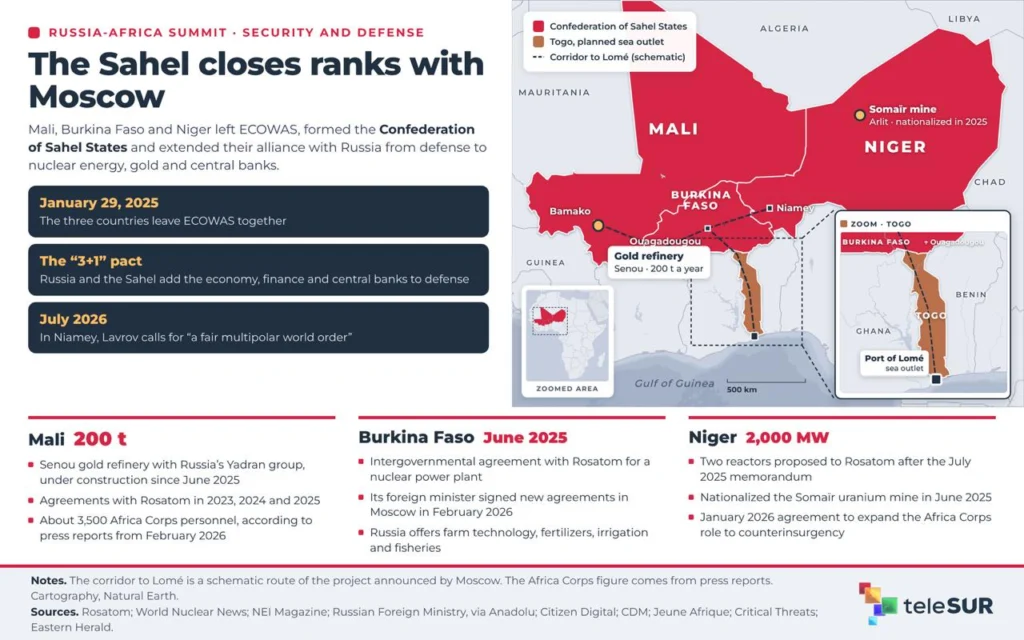
Mali, Burkina Faso and Niger asked French troops to leave, formed the Confederation of Sahel States and opened their barracks to the Africa Corps, the force that replaced the Wagner Group under the direct command of Russia’s Defense Ministry. The “3+1” pact, signed in Niamey, extends cooperation to the economy and the central banks of the three countries, and Moscow plans to use the Togolese port of Lomé as a sea outlet for a landlocked region.
In July, during the second round of consultations with the Sahelian foreign ministers in Niamey, Lavrov spoke of building together “a fair multipolar world order” against “neocolonial practices.” Russia reopened its embassy in Niger this year, and Putin asked his Foreign Minister to invite the three presidents to the summit.
The alliance is fighting the jihadist coalition JNIM, which in September 2025 blockaded fuel supplies to Bamako and in April 2026 forced the Africa Corps out of Kidal. When Human Rights Watch attributed killings of civilians to Russian forces in July, Moscow and Bamako jointly rejected the accusation.
Lavrov announced in August a security memorandum with ECOWAS, the bloc the three Sahelian countries left in January 2025, and offered to mediate between the two; the regional organization has not yet confirmed the scope or the signing date.
The break with Niger cost the United States the withdrawal of 1,000 troops and a $110 million drone base in 2024, and Donald Trump brought a transactional approach. Massad Boulos, the presidential adviser for Africa, toured Burkina Faso, Mali and Niger in early 2026 and acknowledged past mistakes in the name of sovereignty, while Erik Prince, owner of a military contracting firm and an informal adviser to Trump, has been meeting with Madagascar’s junta since late 2025.
A U.S. company agreed in late 2025 with Mali’s state mining company to revive a gold deposit valued at $11 billion. In Madagascar, Washington is negotiating the $700 million Toliara project to extract titanium, zirconium and rare earths, along with a proposal for a military presence at the former naval base of Antsiranana. Colonel Michaël Randrianirina, who came to power after the overthrow of Andry Rajoelina, received Russian drones and instructors and U.S. envoys almost at the same time.
The Washington think tanks that call the Russian offer a “survival package” for military governments now note how their own government is adopting a similar scheme, with security in exchange for minerals.
The places Russia funds for African students rose from 2,100 in 2021 to about 4,800 in 2026, and some 35,000 young people from the continent are now studying at Russian universities. The Association of African Universities opened an office in October at St. Petersburg Mining University, and Rwanda already has 24 graduates in nuclear fields working at its Atomic Energy Board and the country’s regulator.
Russia’s ambassador to Burkina Faso, Igor Martynov, pledged technology transfers in agronomy, fertilizers, irrigation, fisheries and animal vaccines. In Togo, which signed a military agreement with Russia in 2024 and keeps its security channels with the West open, the first intergovernmental commission closed on October 1 with a protocol, a memorandum on cultural heritage and plans for mechanization and fertilizer production from local phosphate.
Egypt is building its nuclear plant with Rosatom without distancing itself from Washington or the Gulf monarchies, South Africa defends its non-alignment and Ethiopia joined BRICS without breaking with its Western lenders. According to an analysis published within that bloc’s orbit, Russia is welcome in Africa wherever it offers what others do not.
This week’s 33 documents will add to the 92 from Sochi and those from St. Petersburg, and the 2027-2029 plan will have its first milestones at the Suez industrial zone in 2028 and, a year later, at the first unit of El Dabaa and the Namibian mine. With those projects, Moscow seeks to give concrete form to the idea of Africa as a pillar of the multipolar world that Lavrov laid out on Tuesday before the African media.
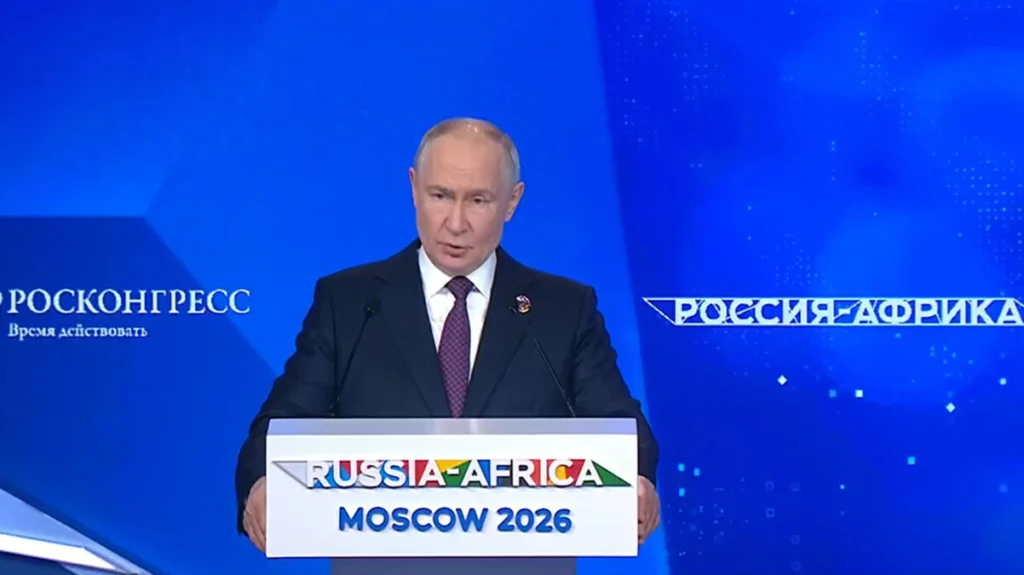
On Wednesday, Russian President Vladimir Putin inaugurated the Russia-Africa Summit in Moscow, where delegations from 48 countries will discuss cooperation, defense and technology topics for two days.
RELATED:
Russia Imposes Entry Ban on Seven British Defense Industry CEOs
Representatives of regional organizations, such as the African Union and the African Continental Free Trade Area, are also present at the Moscow meeting.
The summit will have two plenary sessions, after which participants will adopt a final declaration outlining the agreed approaches for the development of Russian-African cooperation and the deepening of collaboration in the international sphere.
They will also approve a declaration on cooperation in the field of artificial intelligence and an action plan for the Russia-Africa Cooperation Forum for the years 2027-2029.
At the end of the event, Putin and Burundi President Evariste Ndayishimiye, in his capacity as the current head of the African Union, will offer statements to the media to summarize the results of the summit.
📌 EXCLUSIVE | Russia-Africa Summit convenes as "global geopolitics has changed substantially": Kenyan FM
— Sputnik Africa (@sputnik_africa) October 28, 2026
The summit is an "African Union-led initiative" in cooperation with Russia, @MusaliaMudavadi told Sputnik Africa, noting that Kenya is represented at the highest level by… https://t.co/Rjlr1Tyql0 pic.twitter.com/KxfuWNr2Ug
Putin Denounces Western Colonialism
During his intervention at the summit, Putin denounced Western colonialism in Africa and promised to increase grain supplies to the continent.
“We are observing active attempts by Western countries to once again plunge Africans into debt, imposing on them much-needed financial resources under abusive conditions, subsequently forcing them to overpay far beyond the debt to the detriment of their long-term development plans,” he said in the plenary session.
According to the Kremlin chief, the multipolar world is a reality, but not everyone is willing to accept it. “We are witnessing how the multipolar world is becoming a reality and this trend is objective and irreversible,” he asserted.
He also drew the attention of those present to Africa’s “new awakening” with the strengthening of its countries’ sovereignty and the increase of their prestige on the world stage.
Russia develops its relations with African countries on the principles of “equality and friendship” and is willing to expand aid to the continent, said Putin, who stressed that “more than 40 African countries already receive Russian fertilizers and cereals, and we are ready to further expand the geographic scope of our agricultural exports.”
In the first nine months of 2026, Moscow exported 13 million tons of agricultural products to Africa. “For some countries, shipment volumes have multiplied several times, not only in percentage, but in absolute terms,” Putin stated.
He also mentioned that exports of African agricultural products to Russia cover 8% of the needs of the Russian market and “this figure must grow and it will.”
The Russian leader placed special emphasis on humanitarian contacts, highlighting the growing number of students at Russian universities, and called on African airlines to begin operating flights to Russia.
teleSUR/ JF
Source: EFE
There is something peculiarly unsettling about a world in which the leaders of three nuclear powers might gather to discuss the future of smaller nations without troubling to invite the nations concerned. It is a diplomatic arrangement with considerable historical precedent, although not necessarily the sort that ought to inspire confidence.
For Askold S. Lozynskyj, a New York lawyer, former president of the Ukrainian World Congress and regular contributor to EU Today, the prospect of Donald Trump sitting down with Vladimir Putin and Xi Jinping raises precisely this concern.
His latest opinion piece, The Thug Summit, published on 23 October, presents an uncompromising interpretation of the proposed trilateral meeting in China. In a wide-ranging conversation with EU Today publisher Gary Cartwright, Lozynskyj expands upon that argument, moving from the peculiarities of Trump’s political personality to the constitutional foundations of American democracy, the future of Europe and the increasingly precarious standing of international law.
The resulting discussion is occasionally caustic, frequently humorous and consistently concerned with a question that extends well beyond the current occupant of the White House: how resilient are democratic institutions when confronted by leaders who regard constitutional constraints as inconveniences?
Watch the full interview with Askold S. Lozynskyj and Gary Cartwright below.
The conversation begins with Trump’s political ascent, which Lozynskyj regards as one of the more extraordinary developments in modern American history.

Buddy Ebsen as Jed Clampett in the American television comedy The Beverly Hillbillies. Credit: CBS Television / Wikimedia Commons (1969 publicity photograph; US public domain).
He recalls the incredulity surrounding Trump’s original presidential ambitions and questions how a politician whose personal conduct had attracted considerable controversy managed to secure such enthusiastic support among conservative Christian voters.
Cartwright introduces a lighter comparison, recalling a photograph of Trump surrounded by his senior advisers in the Oval Office.
The only person missing, he suggests, was Jed Clampett, the fictional patriarch of the American television comedy The Beverly Hillbillies.
Lozynskyj is not inclined to defend the administration’s sophistication. Yet behind the humour lies a more serious argument about the disappearance of independent-minded advisers and the consequences of political loyalty becoming the principal qualification for high office.
“Donald Trump is not a conservative. Donald Trump is a thug,” he declares.
It is an unequivocal assessment, characteristic of Lozynskyj’s commentary, although his criticism extends beyond Trump himself to the Republican Party’s willingness to accommodate his leadership.
Much of the interview centres on the American midterm elections scheduled for 3 November.
Lozynskyj predicts that Democrats will regain control of the House of Representatives and potentially transform the remainder of Trump’s presidency through congressional investigations, subpoenas and impeachment proceedings.
His prediction is emphatic, although the eventual balance of power remains uncertain.
Control of the House would give Democrats substantial investigative authority, although the president would retain his executive powers. Removing him from office following impeachment would still require a two-thirds majority in the Senate.
Nevertheless, Lozynskyj believes the elections could fundamentally alter Washington’s political atmosphere.
“They will tie up Trump like never before,” he argues.
Cartwright raises a more disturbing possibility: could Trump manufacture an emergency to postpone an election or otherwise attempt to prolong his presidency?
“I think he could try, but I don’t believe that he will prevail,” Lozynskyj responds, expressing confidence that America’s constitutional institutions would ultimately resist such an attempt.
The exchange moves naturally towards the events of 6 January 2021, presidential immunity and the effectiveness of the checks and balances upon which the American constitutional system depends.
For Lozynskyj, whose public career has been closely associated with Ukrainian interests, the implications of Trump’s foreign policy are particularly troubling.
His central concern is that negotiations among Washington, Moscow and Beijing could revive the notion that major powers possess an informal entitlement to determine the political and territorial futures of their neighbours.
In his opinion piece, he raises the possibility that Ukraine and Taiwan could become bargaining instruments in a wider geopolitical settlement. These are his warnings about potential outcomes, not established agreements between the three governments.
Yet his criticism of Washington is accompanied by considerable appreciation for Europe’s role in sustaining Ukraine’s resistance to Russia’s invasion.
“Without Europe, Ukraine could never have survived as long as it has survived,” he tells Cartwright.
He also ventures into the British debate over European integration, arguing that the United Kingdom should return to the European Union.
It is an intervention likely to provoke disagreement, but it reflects his broader conviction that collective institutions provide an essential counterweight to unilateral political power.
The discussion also examines political unrest in Europe, changing national identities and the relationship between elected governments and the populations they represent.
Cartwright points to social tensions in European cities and the growing importance of regional identity, including the independence debate in Flanders.
Lozynskyj approaches these developments through the history of democratic protest, citing Ukraine’s Orange Revolution, the Revolution of Dignity and more recent demonstrations over the independence of anti-corruption institutions.
For him, public opposition to governments is not necessarily evidence of democracy’s failure. It can also demonstrate that political authority remains subject to popular consent.
The conversation concludes with international law, the International Criminal Court and the difficulty of enforcing common rules when powerful states refuse to accept external constraints.
Lozynskyj’s observations are deliberately provocative, and his forecasts will be tested by events. But the interview offers something more substantial than another exchange of opinions about Donald Trump.
It is a discussion about the relationship between power and restraint, the responsibilities of democratic institutions and the uncomfortable possibility that the international order may be entering another period in which military and economic strength increasingly determine political outcomes.
As the United States approaches its midterm elections and speculation continues over a possible meeting between Trump, Putin and Xi, those questions are unlikely to disappear.
The full conversation with Askold S. Lozynskyj is available in the video above.
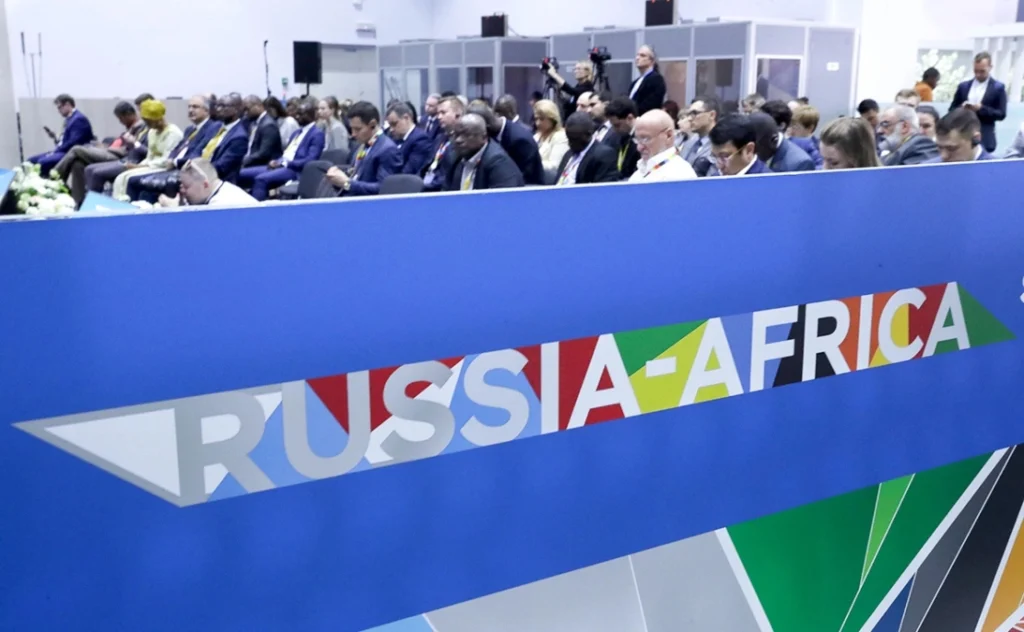
Among highlighted projects is the North-South transport corridor, intended to connect Russia with India through Iran; its completion and launch would also expand Russia’s direct trade access routes toward East Africa.
Russian authorities said the nation had established itself as a security provider for African governments facing complex problems. Cooperation through advisers and military specialists extends to West African countries in the Alliance of Sahel States — Mali, Niger and Burkina Faso — as well as the Central African Republic, according to officials.
Officials stressed that Russia had no history as a colonial power on the African continent and had never participated in plundering its wealth, according to the report.
Russia-Africa trade topped $27 billion in 2025 — FM spox Zakharova
— RT Intl (@RT_on_X) October 27, 2026
'One of our most important avenues is still food security — Russia shipped around 18 million tons of grain to African countries in 2025'
'In the first nine months of 2026, another 13 million tons were shipped' pic.twitter.com/KHNTE3Qjub
Russian diplomats gave the highest priority to holding the third Russia-Africa Summit to consolidate and deepen mutual ties, under the premise of recognizing African civilization on the emerging international stage.
RELATED: Finland, Norway, and Russia Discuss the Ukraine Conflict
Moscow supports bilateral cooperation based on sovereign respect, without ideological impositions or claims to plunder resources, according to Russian authorities. Foreign Ministry specialists said Africa was a key component of the multipolar world order and that Russia lacked an ideology intended for export and had sufficient natural resources within its own territory.
🇷🇺🌍 The Third #RussiaAfrica Summit kicks off in Moscow today!
— MFA Russia 🇷🇺 (@mfa_russia) October 28, 2026
Delegations are arriving for two days of talks on October 28-29.
🎬 Watch our recap of the 2019 & 2023 Summits, which opened a new chapter in Russia-Africa cooperation. pic.twitter.com/EwmSFatcga
Russia’s trade strategy and connectivity differ from isolation policies promoted by Western powers because it prioritizes collaboration with members of the global majority.
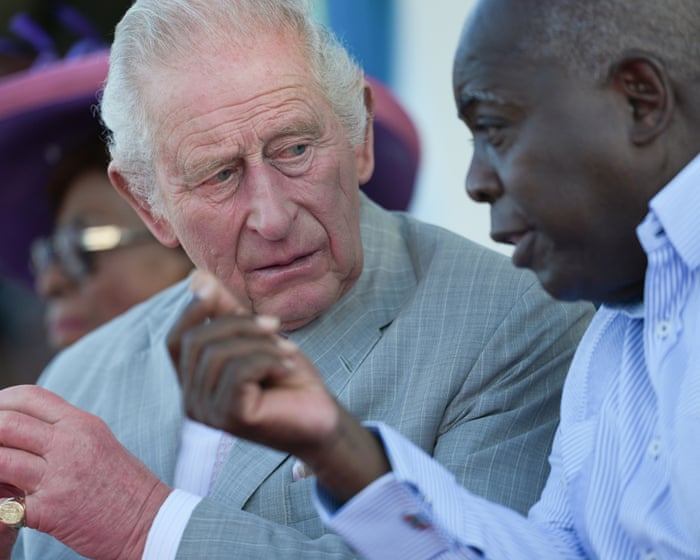
Royal tour of Caribbean comes as poll suggests majority support among younger Britons for dialogue on slavery reparations
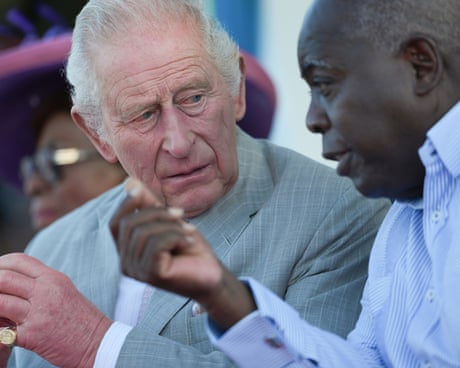
King Charles has confirmed he will discuss the legacy of slavery at a summit with Commonwealth leaders as he begins his Caribbean tour.
The king arrived in the Bahamas on Tuesday to a ceremonial welcome and attended a youth rally at Clifford Park, the site where the country officially gained its independence from British colonial rule in 1973.
Continue reading...
© Photograph: Ben Stansall/PA
© Photograph: Ben Stansall/PA
© Photograph: Ben Stansall/PA
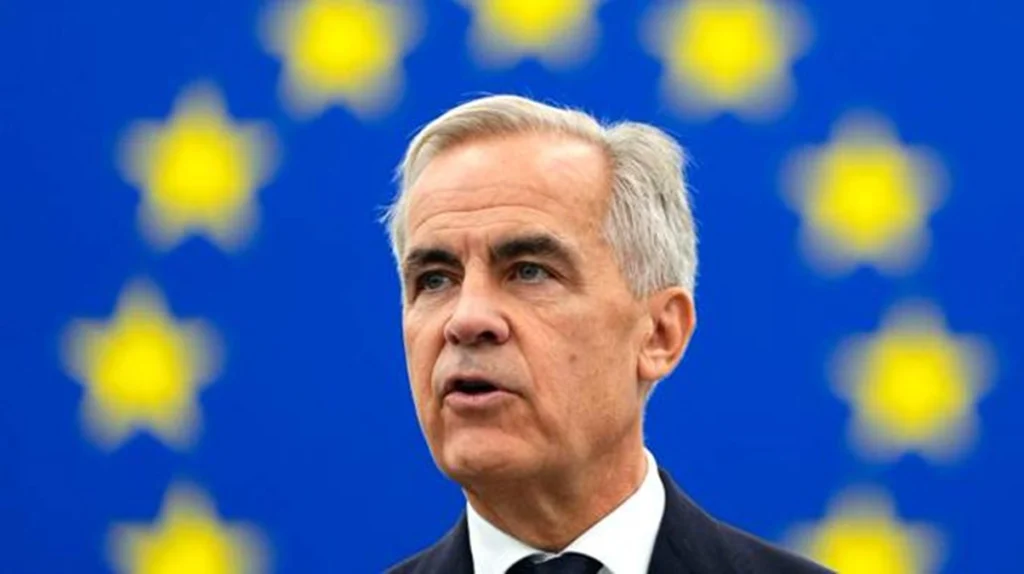
On Thursday and Friday, European Commission President Ursula von der Leyen, Canadian Prime Minister Mark Carney and European Council President Antonio Costa will meet in Montreal for the 21st European Union-Canada summit.
RELATED:
Canada: Alberta Voters Reject Independence in Referendum
They and other senior officials will discuss possible features of a status that would allow Canada to become an “associated member” of the European Union.
For the EU, the meeting will be an “important milestone” in relations between the two sides and will pave the way for an “even broader and deeper” political partnership and greater cooperation.
Specifically, European and Canadian leaders are expected to launch a “Partnership for the Future,” a framework for shared prosperity and economic security backed by new initiatives aimed at strengthening people-to-people ties, deepening economic relations and reinforcing their joint position on the world stage.
The summit’s agenda will cover a wide range of issues, from trade, digital affairs and critical raw materials to defense and security, as well as cooperation in education, research, innovation, and youth affairs.
Yves-François Blanchet sur Paul St-Pierre Plamondon et le sommet Canada-UE : « tu peux venir t'asseoir, mais t'as pas le droit de parler. »
— Rebel News Québec (@RebelNews_QC) October 27, 2026
Blanchet on Quebec's premier at the Canada-EU summit: "You can come sit down, but you have no right to speak." pic.twitter.com/O3rSPGTc5y
Associated Member State
EU sources said it was “clear” that one of the summit’s main topics would be a discussion of the proposal von der Leyen put forward last month — and which Carney welcomed — for Canada to become the EU’s first associated member state.
Currently, this status does not exist as a defined category in the European treaties. Therefore, its specific implications remain to be negotiated.
“This is somewhat uncharted territory, but I think what we want, together with our member states, side by side, and together with Canada over the next 12 months, is to have the ambition, confidence, creativity and vision to shape it together… It is the highest form of collaboration imaginable. For now, frankly, I see it as something very specific to Canada,” a senior EU official said.
“There is no doubt among the member states about their ambition for this relationship. All member states are clear that they want the closest possible partnership with Canada. So that is not in question,” another EU source said.
Nevertheless, some member states have reservations because this is uncharted territory. That is precisely the work that will need to be done in Montreal ahead of the next summit in 2027.
The senior official outlined three pillars for this membership: defining more joint policies on climate, energy, artificial intelligence, innovation, or security; having Canada participate more in EU programs, such as the Horizon Europe research program, or fully integrating it into Erasmus+; and, finally, bringing the institutions on both sides closer together to strengthen governance.
“The goal is to build a partnership that comes closer to membership than anything we have done before. It is clearly a partnership without membership (…), aimed at generating greater prosperity on both sides of the Atlantic,” the official said.
The EU was split today over whether to offer “associate membership” status to Canada, with several countries refusing to sign off on a statement containing that phrase just 48 hours before a summit between the two sides in Montreal.https://t.co/7hIHdoOeIw
— POLITICOEurope (@POLITICOEurope) October 27, 2026
Critical Raw Materials
Relations between Canada and the EU are already close in trade, security, defense, research and technological cooperation. Their main frameworks include the Comprehensive Economic and Trade Agreement (CETA), which has been provisionally applied since 2017, as well as recent progress in defense, digital trade and specific European programs.
They have long been strategic partners and share common values, including democracy, a commitment to a rules-based international order, and free and fair trade.
One of the key areas where the EU sees “enormous potential” is critical raw materials. Imports into the EU have already increased significantly and could rise further through the bloc’s “raw materials mechanism,” which focuses on facilitating connections between Canadian suppliers of these materials and European buyers.
Another idea under consideration is the possible joint stockpiling of critical raw materials, as well as the option of giving the EU priority access to Canadian reserves, EU sources said.
teleSUR/ JF
Source: EFE

China and Russia opened new bridges to North Korea a month apart, a sign that the two countries are competing for the favor of North Korean leader Kim Jong Un. The Yalu River bridge to China sat unused for more than a decade after its completion in 2014, until Russia began rewarding North Korea for […]
The post Two new bridges show China and Russia competing for North Korea appeared first on Asia Times.
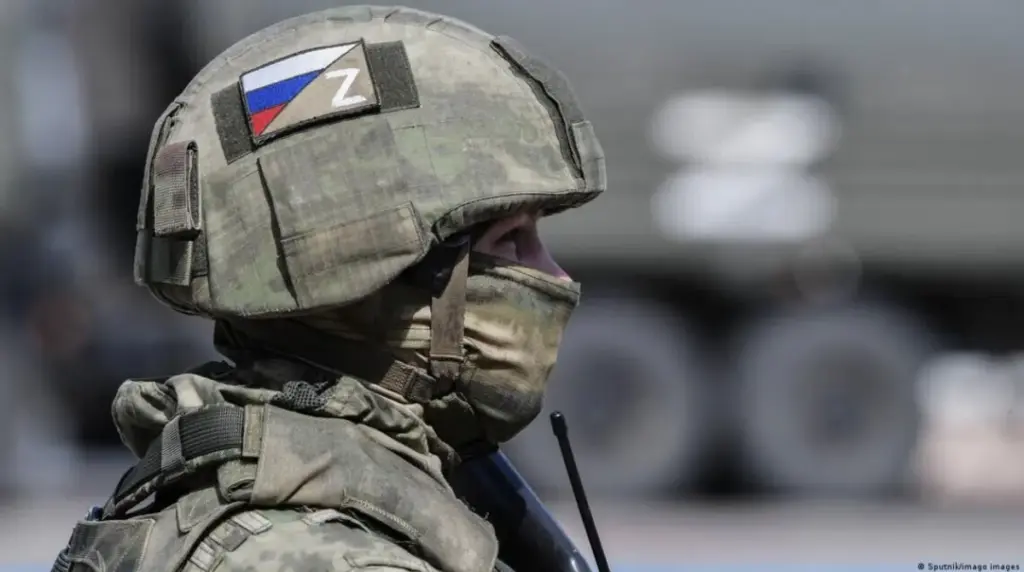
Kazakhstan, Kyrgyzstan, and Kenya are seeking the return of citizens drawn into Russia’s war, Ukraine’s Foreign Intelligence Service (SZRU) said on 25 October. According to relatives and officials the agency cites, many of the men had gone to Russia for work, only to be tricked or forced into its army.
Russia fills its ranks partly with foreigners. In April, Ukraine’s military intelligence (HUR) said the Russian Defense Ministry plans to enlist at least 18,500 of them in 2026. Foreign recruits let the Kremlin put off hard choices about another mobilization at home, the Atlantic Council argued in May. Home governments have pushed back before, among them Ghana in August. The new statements show the limit of that pushback. Once a man is serving in Russia’s army, his government has to ask Russia to let him go.
Kyrgyz Foreign Minister Jeenbek Kulubaev addressed the problem at a parliamentary committee on 13 October, answering lawmakers’ questions. He said Kyrgyz citizens in Russia are forced to sign contracts at military enlistment offices or in pretrial detention centers. If warned in time, diplomats try to stop the men from reaching the front.
Kazakhstan is negotiating with Russia over citizens in the combat zone. Its Foreign Ministry said on 7 October that it was checking each hotline request. Once the checks are complete, the ministry said, it will send the compiled list to the Russian side.
SZRU separately cited unnamed relatives of one Kazakh worker. After he complained about working conditions, they said, he and other men were taken to an enlistment office and forced to sign contracts.
Prime Cabinet Secretary Musalia Mudavadi, who also handles foreign affairs, gave lawmakers a count on 8 October. “The Ministry has records of 354 Kenyan nationals involved in the Russian-Ukraine crisis,” he told them. Families who petitioned Parliament dispute that number and put their own count at 841, Kenya’s The Star reported.
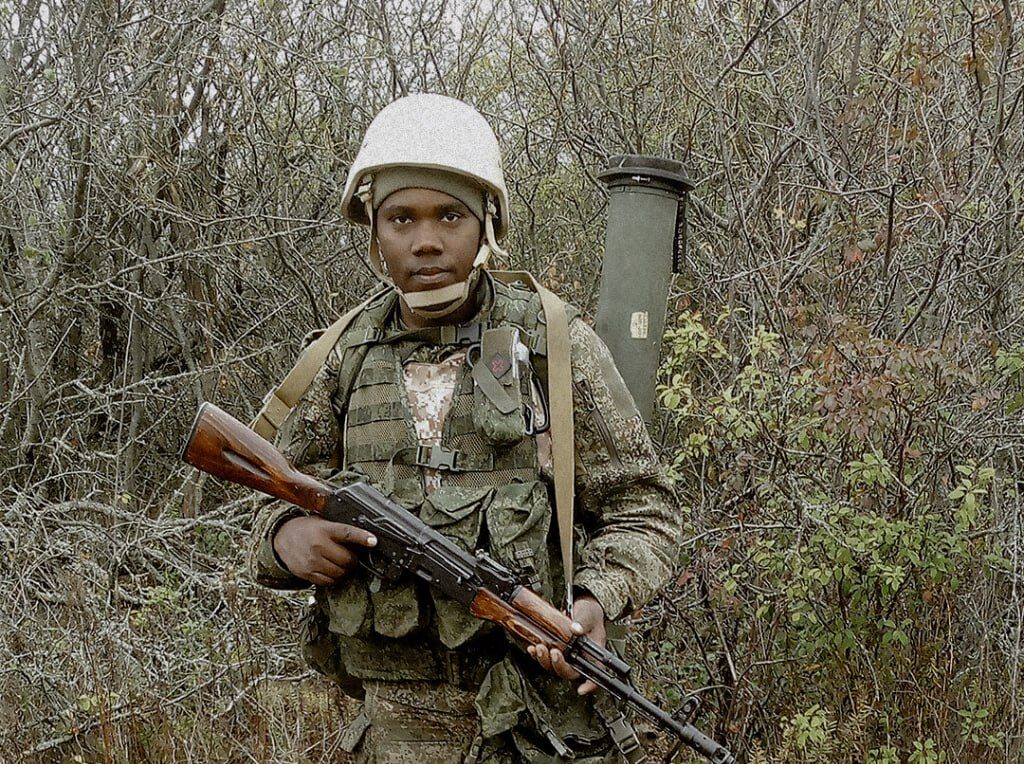
Ukraine holds five Kenyans captured while fighting for Russia, and Nairobi has already appealed to Kyiv over them. The government told Parliament it wants them treated as people who may have been trafficked abroad.
For Kenyans still serving in Russia’s army, the way out runs through Russian officers. Moscow informed Nairobi that unit commanders will consider requests to end military contracts case by case, the same government response said.
The Cali Fund, set up to raise $1bn a year for biodiversity from drug companies, remains near empty
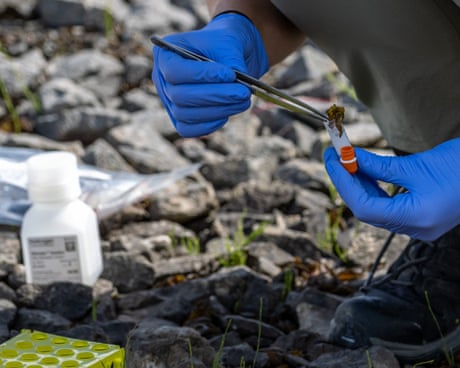
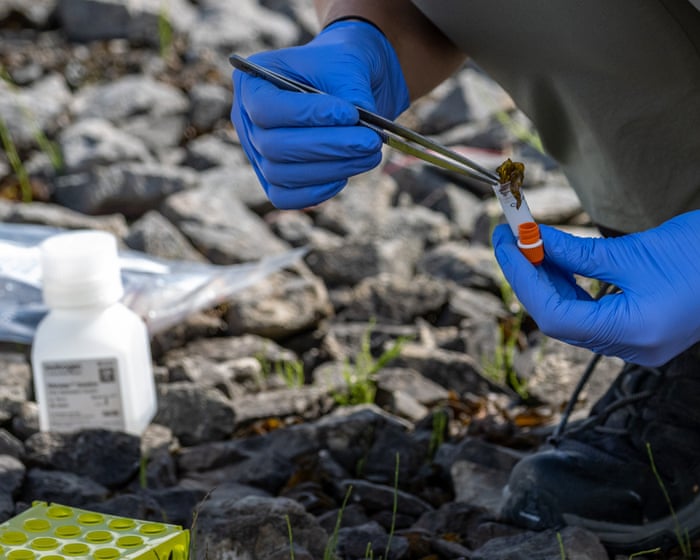
Big pharmaceutical companies have been accused of “free-riding on nature”, after a landmark biodiversity fund that invites businesses to put some of their profits back into conservation was left virtually empty.
The Cali Fund set out to raise $1bn (£750m) annually, by asking companies that profit from nature’s genetics to contribute towards conservation in low-income countries. But more than 18 months after the fund was launched, it remains far below this target.
Continue reading...
© Photograph: Rebecca Cole/The Guardian
© Photograph: Rebecca Cole/The Guardian
© Photograph: Rebecca Cole/The Guardian

In July 1971, Henry Kissinger developed a convenient stomachache in Pakistan, vanished from public view and turned up in Beijing. The secret trip that led to Nixon’s opening to China rested on a simple piece of geometry: in a world of three great powers, the smart move is to stand closer to each of your […]
The post A Trump-Putin-Xi summit would put Xi at the apex appeared first on Asia Times.
Dallo “Shanghai Spirit” alla Dichiarazione di Bishkek, questa organizzazione, che pone la sicurezza al primo posto, privilegia il pragmatismo rispetto all’ideologia.
La sicurezza prima di tutto
Il recente vertice dell’Organizzazione per la Cooperazione di Shanghai (SCO), tenutosi a Bishkek, ha segnato il venticinquesimo anniversario della nascita di quella che, nel panorama delle istituzioni internazionali, rappresenta un caso di studio particolarmente interessante. Nata dalle ceneri delle misure di fiducia sovietico-cinesi e trasformata in organizzazione a tutti gli effetti nel 2001, la SCO ha attraversato un quarto di secolo consolidando un’architettura istituzionale che oggi funziona in modo efficace: riunioni annuali del Consiglio dei Capi di Stato, incontri regolari a livello interministeriale, e una cooperazione quotidiana che si sviluppa su binari sempre più articolati.
Tuttavia, l’anniversario offre l’occasione per una riflessione che va oltre la mera celebrazione. La domanda che emerge con forza è: quale ruolo giocano i valori all’interno della SCO? E come si rapporta questa dimensione valoriale con quella, apparentemente più pragmatica, della sicurezza e della cooperazione funzionale? L’analisi dei documenti fondativi e delle dichiarazioni successive rivela una traiettoria complessa, che merita di essere esaminata in profondità.
Fin dalle sue origini, la SCO ha posto la cooperazione in materia di sicurezza come una delle sue priorità principali. Questa scelta non è casuale: la preistoria dell’organizzazione affonda le radici nelle misure di fiducia sovietico-cinesi, sia sulle questioni di confine che sugli aspetti più ampi della sicurezza reciproca. Il “Shanghai Five”, gruppo informale che precedeva la nascita ufficiale dell’SCO, aveva proprio nella gestione delle questioni di sicurezza e nella costruzione di fiducia tra i membri il suo collante principale.
Questa specializzazione originaria ha avuto conseguenze durature. Anche quando, nel corso degli anni, l’SCO ha ampliato il proprio raggio d’azione a settori sempre più diversificati, la sicurezza è rimasta il fulcro attorno al quale si è sviluppata l’intera architettura organizzativa. In un certo senso, come nota acutamente l’analisi, l’SCO può ancora essere definita un’organizzazione internazionale specializzata, focalizzata su una singola priorità principale, nonostante la sua evoluzione verso forme di cooperazione più comprensivo.
Il confronto con i BRICS, struttura di cooperazione genuinamente omnicomprensiva che opera in un’ampia gamma di campi, risulta particolarmente illuminante. Mentre i BRICS hanno sviluppato nel tempo una piattaforma valoriale sempre più articolata, con dichiarazioni che dedicano ampio spazio a questioni di valori comuni e condivisi, l’SCO ha mantenuto un approccio più marcatamente operativo e meno declamatorio sul piano assiologico.
La Carta dell’SCO: principi senza valori
Un dato particolarmente significativo emerge dall’analisi del documento fondativo dell’SCO. La Carta, firmata il 7 giugno 2002 ed entrata in vigore il 19 settembre 2003, non menziona affatto il termine “valori”. Al suo posto, troviamo un articolo dedicato, l’articolo 2, intitolato significativamente “Principi”. È su questi principi che l’SCO basa la propria attività.
Questi principi includono: rispetto reciproco per la sovranità, l’indipendenza, l’integrità territoriale e l’inviolabilità dei confini statali; non aggressione; non interferenza negli affari interni; non uso della forza nelle relazioni internazionali; uguaglianza di tutti gli Stati membri; risoluzione pacifica delle controversie tra Stati membri; non targeting dell’SCO contro altri Stati. Un principio particolarmente rivelatore è quello dell’attuazione graduale delle azioni congiunte in aree di interesse comune.
Quest’ultimo principio, quello della “phased implementation”, spiega molto del funzionamento dell’SCO e delle aspettative, talvolta eccessive, che si generano attorno alla sua attività. La delusione che talvolta accompagna il giudizio sull’organizzazione — quel “nulla accade oltre i vertici” che circola in certi ambienti — trova proprio in questo principio la sua spiegazione. Non si tratta di un difetto, ma di una scelta deliberata e costitutiva: procedere per gradi, consolidare i risultati raggiunti, evitare passi falsi.
L’assenza del termine “valori” dalla Carta dell’SCO è perfettamente spiegabile e non diminuisce affatto il livello di fiducia reciproca tra gli Stati membri. Vale la pena ricordare che, anche nel caso dei BRICS, il termine “valori” non fu una caratteristica immediata delle dichiarazioni finali, affermandosi stabilmente solo a partire dalla metà degli anni 2010. Prima di allora, il termine utilizzato per caratterizzare la coesione interna dei BRICS era, tra gli altri, proprio “principi”, esattamente come per l’SCO.
Il contesto storico e l’evoluzione del lessico valoriale
Nel 2002, il termine “valori” non era ancora politicamente di moda come lo è oggi, ed era usato piuttosto raramente nei documenti dei principali Paesi del mondo non occidentale. In quel periodo, in questi Paesi — Russia inclusa — la parola “valori” era più spesso postulata nel lessico politico in senso negativo, come “valori imposti dall’Occidente”, e quindi come qualcosa che richiedeva resistenza.
La consapevolezza che questo è un gioco che si può giocare in due, e che per rafforzare efficacemente la solidarietà tra i Paesi non occidentali era necessario formulare una propria piattaforma di valori condivisi, arrivò molto più tardi. E il lavoro per garantire che i valori non occidentali siano percepiti come comprensibili, attraenti e allo stesso tempo non banali — non semplicemente nello stile “siamo per tutte le cose buone e contro tutte le cose cattive” — continua ancora oggi, con successi alterni.
Questo ritardo nell’elaborazione di una piattaforma valoriale esplicita non significa però che l’SCO sia priva di una dimensione assiologica. Al contrario, essa esiste, ma si esprime attraverso categorie diverse da quelle del lessico valoriale occidentale: i “principi” e, soprattutto, lo “spirito”.
Un dato cronologicamente significativo emerge dall’analisi comparata dei documenti dell’SCO e dei BRICS: rispetto a un termine particolare — e alla sua rilevanza sostanziale — l’SCO ha notevolmente anticipato i BRICS. Si tratta del termine “spirito”.
Nelle dichiarazioni dei vertici annuali dei BRICS, il termine “spirito dei BRICS” e i suoi elementi costitutivi apparvero per la prima volta durante la presidenza cinese del 2017. Lo “spirito” scomparve poi dai documenti dei BRICS per diversi anni. Il termine ritornò nel 2022, ancora una volta durante la presidenza cinese. Ma successivamente, in tutte le dichiarazioni dei vertici BRICS del 2023-25, i cui progetti iniziali furono preparati da altri Paesi, il termine “spirito dei BRICS” fu costantemente presente.
Nel caso dell’SCO, invece, il termine “spirito” apparve nella primissima dichiarazione successiva al vertice di Shanghai del 15 giugno 2001, quando lo “Shanghai Five”, precedentemente esistente come raggruppamento informale, fu trasformato in un’organizzazione internazionale a tutti gli effetti. In questa dichiarazione, lo “spirito di Shanghai” fu menzionato come punto separato, caratterizzato da fiducia reciproca, beneficio reciproco, uguaglianza, consultazione reciproca, rispetto per la diversità culturale e aspirazione allo sviluppo condiviso.
È evidente che il termine “spirito” affonda le sue radici, innanzitutto, nella tradizione politica cinese contemporanea, poiché in ogni caso è apparso per la prima volta in documenti di anni in cui i vertici si tenevano in Cina. Questa è, in un certo senso, una peculiarità cinese. Detto questo, il termine “spirito”, anche se non immediatamente, si è poi stabilmente affermato nelle dichiarazioni dei BRICS; e nel caso dell’SCO, un anno dopo, nel 2002, quando il vertice si tenne non in Cina ma a San Pietroburgo, il termine “spirito” entrò nel preambolo della Carta dell’SCO.
Nella Carta, tuttavia, l’epiteto “Shanghai” scomparve in relazione allo spirito; lì si fa riferimento semplicemente allo “spirito di fiducia reciproca, beneficio reciproco, uguaglianza, consultazione reciproca, rispetto per la diversità culturale e aspirazione allo sviluppo condiviso”.
L’approccio civilizzazione e la sua evoluzione
Di particolare rilevanza per l’ideologia politica odierna è l’approccio civilizzazionale riflesso nella Dichiarazione di Shanghai del 2001. Essa notava specificamente il “rispetto reciproco e la fiducia reciproca tra Stati appartenenti a civiltà diverse e portatori di tradizioni culturali differenti”. Un anno dopo, tuttavia, la menzione delle civiltà scomparve dal preambolo della Carta dell’SCO.
Questo movimento di apparizione e scomparsa del lessico civilizzazionale è significativo. Da un lato, riflette la sensibilità cinese per le questioni di identità culturale e di diversità; dall’altro, mostra la cautela degli altri membri nell’adottare un linguaggio che potesse essere percepito come troppo marcatamente ideologico o potenzialmente divisivo.
Se esaminiamo il preambolo dell’attuale Dichiarazione di Bishkek del Consiglio dei Capi di Stato dell’SCO del 1° settembre 2026, troviamo che essa enfatizza il “fermo impegno verso gli obiettivi e i principi sanciti nella Carta dell’SCO, nonché verso il ulteriore rafforzamento del buon vicinato, dell’amicizia e dell’efficace cooperazione multilaterale”. Inoltre, questa dichiarazione impiega ancora una volta proprio il termine “spirito di Shanghai”, che è incarnato nei principi esposti nel preambolo della Carta dell’SCO.
È chiaro che, poiché gli elementi costitutivi di questo spirito dell’SCO sono fissati nel testo legale della Carta, le loro formulazioni rimangono incrollabili anche a venticinque anni di distanza. Qui sta la differenza tra lo spirito dell’SCO e lo spirito dei BRICS, dove, di anno in anno, vari elementi di questo spirito vengono aggiunti o rimossi dai Paesi che esercitano la presidenza, a seconda delle loro particolarità nazionali. E la definizione dello spirito dei BRICS risulta, ogni anno, almeno leggermente diversa.
Nel caso dell’SCO, invece, è significativo che l’epiteto “Shanghai” sia ritornato — un epiteto che, a differenza dello spirito stesso, non è legalmente fissato. Questo ritorno segnala una volontà politica di rivendicare l’eredità originaria dell’organizzazione, in un momento in cui la competizione tra potenze per la definizione dei valori globali si fa sempre più intensa.
Quanto pesa questo anniversario
Se rileggiamo passo passo le dichiarazioni dei vertici dell’SCO rivela variazioni significative nel trattamento della dimensione valoriale. L’attenzione particolare dedicata nella Dichiarazione di Bishkek all’impegno dell’SCO verso lo spirito di Shanghai e i principi dell’SCO non è particolarmente tipica delle altre dichiarazioni dei vertici degli ultimi anni.
Per esempio, nelle dichiarazioni successive ai vertici “non anniversari”, il preambolo è praticamente assente, e la descrizione della situazione internazionale e delle sfide alla sicurezza inizia fin dall’inizio. Nelle dichiarazioni emesse ad Astana nel 2024, a Delhi nel 2023 e a Mosca nel 2020, né lo “spirito di Shanghai” né semplicemente lo “spirito” sono menzionati (sebbene la dichiarazione di Mosca contenga il termine “spazio SCO”). Nelle dichiarazioni emesse a Tianjin nel 2025 (naturalmente), a Samarcanda nel 2022 e a Bishkek nel 2019, c’è una menzione dello “spirito di Shanghai”, ma essa è collocata non all’inizio del testo ma in profondità nella prima sezione.
È chiaro che il carattere specifico dell’attuale dichiarazione è spiegato dalla sua natura anniversaria; la dichiarazione emessa a Dushanbe per il precedente anniversario — il ventesimo, nel 2021 — fu composta esattamente allo stesso modo, con un lungo preambolo che menziona lo spirito di Shanghai e l’impegno verso i principi. Questo è altamente significativo: gli anniversari offrono l’occasione per un’affermazione più esplicita dell’identità valoriale dell’organizzazione, mentre nei vertici ordinari prevale un approccio più pragmatico e orientato alle questioni contingenti.
Il contributo indiano e la prospettiva dei “4 M”
In questo quadro, assume particolare interesse la prospettiva indiana sull’SCO. Le iniziative dell’India nell’Organizzazione per la Cooperazione di Shanghai si sono concentrate su questioni economiche, riflettendo il desiderio di costruire cooperazione economica con gli Stati dell’Asia Centrale al fine di migliorare il proprio posizionamento regionale e rafforzare il multilateralismo.
Secondo Anil Trigunayat, l’SCO può senza dubbio contribuire alla collaborazione regionale aderendo al principio delle “4 M”: i membri devono abbracciare il Rispetto Reciproco (Mutual Respect), l’Interesse Reciproco (Mutual Interest), la Sensibilità Reciproca (Mutual Sensitivity) e il Beneficio Reciproco (Mutual Benefit) affinché il gruppo possa emergere più forte e più rilevante.
Questa formulazione è significativa perché mostra come, dal punto di vista indiano, la dimensione valoriale dell’SCO non risieda tanto in una piattaforma ideologica esplicita, quanto in un insieme di principi operativi che guidano la cooperazione quotidiana. L’India, con la sua tradizione di non allineamento e la sua sensibilità per la sovranità nazionale, si trova naturalmente a proprio agio in un’organizzazione che privilegia i principi sui valori, e che evita di imporre una visione ideologica comune.
Verso un prospero futuro
L’analisi della dimensione valoriale dell’SCO a venticinque anni dalla sua fondazione rivela un quadro complesso e sfumato. Da un lato, l’organizzazione non ha mai sviluppato una piattaforma valoriale esplicita paragonabile a quella dei BRICS o di altre strutture di cooperazione. Dall’altro, essa possiede una solida base di principi, sanciti nella Carta, e uno “spirito” che, pur non essendo definito in termini valoriali, costituisce un potente collante identitario.
Questa configurazione non è un caso, ma riflette la storia e la natura dell’organizzazione. Nata come strumento di costruzione di fiducia in materia di sicurezza, l’SCO ha privilegiato la concretezza dei principi operativi rispetto all’astrattezza delle dichiarazioni valoriali. La sua specializzazione funzionale, il suo carattere istituzionalizzato, e il principio della attuazione graduale hanno contribuito a mantenere l’organizzazione ancorata a una dimensione pragmatica, evitando le derive ideologiche che talvolta caratterizzano altri consessi internazionali.
Tuttavia, il ritorno dello “spirito di Shanghai” nella Dichiarazione di Bishkek, in occasione del venticinquesimo anniversario, segnala una crescente consapevolezza dell’importanza della dimensione identitaria e valoriale. In un’era di competizione globale sempre più intensa, in cui la definizione dei valori e dei principi che devono guidare l’ordine internazionale è essa stessa oggetto di contesa, l’SCO si trova a dover bilanciare la sua tradizionale prudenza con la necessità di affermare con maggiore chiarezza la propria identità.
L’analisi terminologica dei testi, e delle piattaforme valoriali che essi riflettono, non è che un tassello del quadro molto più ampio della cooperazione pratica tra i Paesi dell’SCO realizzata in questi venticinque anni. Ma è un tassello significativo, perché rivela come un’organizzazione nata per la sicurezza sia progressivamente divenuta anche un laboratorio di elaborazione di un linguaggio comune, di principi condivisi e di uno spirito collettivo. E in un mondo in cui la battaglia per la definizione dei valori globali è destinata a intensificarsi, questo laboratorio potrebbe rivelarsi più importante di quanto non appaia a prima vista.
La sfida per l’SCO, nei prossimi venticinque anni, sarà quella di preservare la propria specificità — la concretezza dei principi, la gradualità dell’azione, la centralità della sicurezza — senza rinunciare a elaborare una visione del mondo che, senza essere ideologica, sia capace di attrarre e di unire. Un compito non facile, ma che l’organizzazione ha dimostrato, in questi primi venticinque anni, di poter affrontare con successo.
In 2022, I helped push through the international agreement to protect biodiversity. Wars and economic pressures can make nature seem like a ‘nice-to-have’. But it is a critical asset, and Cop17 must deliver real action
When I was five, property developers came to cut down the woods behind my home in La Tuque, Quebec. My mother encouraged me to climb one of the trees in protest, then told the developers, straight-faced, that there was nothing she could do when they asked her to get me down. A few days later, the tree was cut down anyway.
I thought about that tree in the early hours of a freezing Montreal morning in December 2022, as the gavel came down on a global agreement between nearly 200 countries to halt and reverse the loss of nature by 2030. I thought about how important nature is for our health, our food security and our economies, but also how much passion there is around protecting it, and how it has the power to inspire people all around the world.
Continue reading...
© Photograph: COP17
© Photograph: COP17
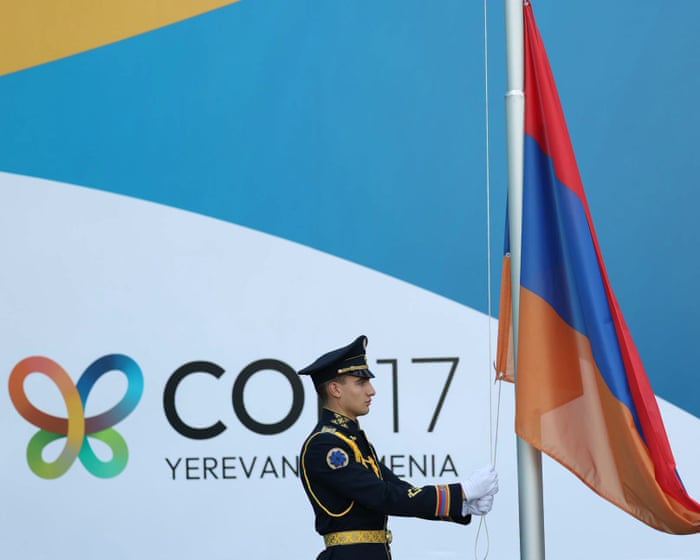
© Photograph: COP17
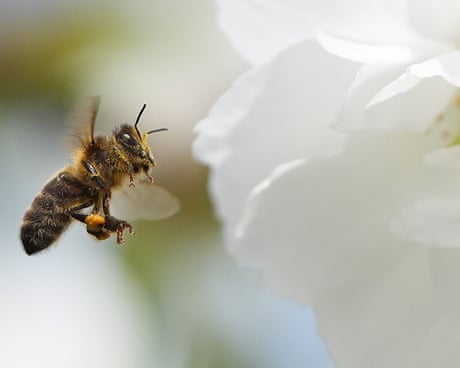
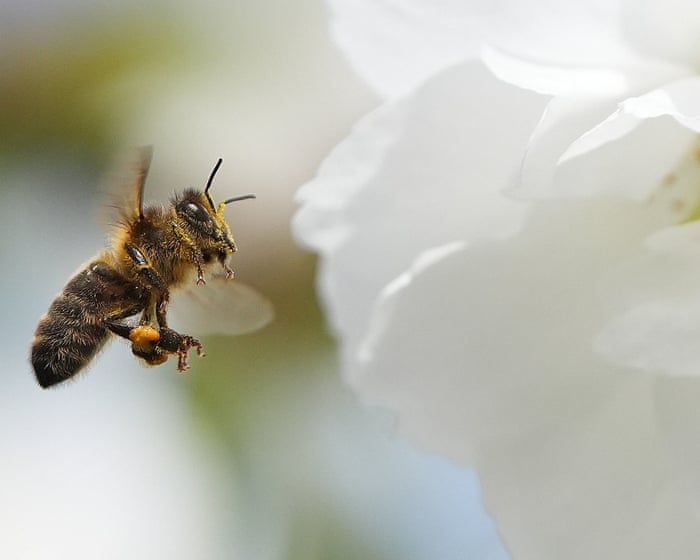
As Cop17 kicks off, records since 1921 show more bee species declining than increasing in all parts of Europe except the Alps
Most of Europe’s wild bee species and about half of its hover fly species have declined over the last century, a study has found, as a UN biodiversity summit begins in Armenia.
Records since 1921 show more bee species are declining than increasing in all parts of Europe except the Alpine region. The richness of bee and hover fly species suffered a persistent drop in the Atlantic and Continental regions, the study found, though trends in other regions were mixed or even positive.
Continue reading...
© Photograph: Niall Carson/PA
© Photograph: Niall Carson/PA
© Photograph: Niall Carson/PA

Should this be seen as the Hans Christian Andersen story, in which the narcissistic emperor is finally exposed as a naked fool by a truth-telling child? Donald Trump is certainly all of these things: narcissistic, naked in his support for Putin and a fool. But the parallel doesn’t quite work because it hasn’t taken a […]
The post Trump the gangster’s new clothes appeared first on Asia Times.
Four years ago nearly every government on Earth agreed to protect nature. Now, as countries gather for Cop17, the pressure is on to follow through on those commitments
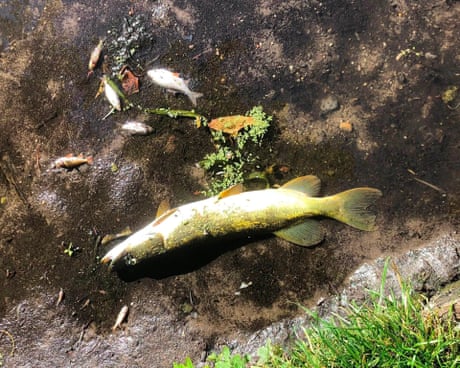
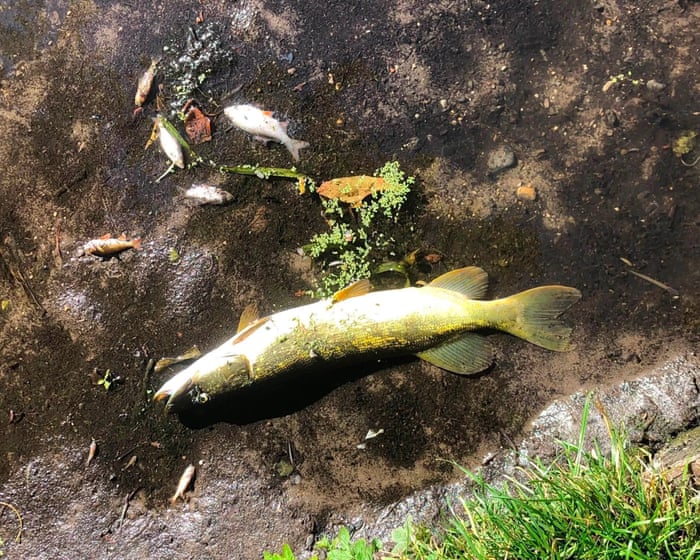
Passersby could smell the dead fish before they saw them. In August, more than 3,000 pike, roach, carp and rudd were found lifeless along the River Wensum in Norwich. Some gasped for air in their final moments, desperate for the oxygen that heatwave conditions had depleted in the water. Investigators believe that the die-off was triggered by heavy rainfall that flushed through high concentrations of pollution at a time when wildlife were already struggling.
The 45-mile (70km) chalk river is one of about 250 in the country. They are a geological accident almost unique to Britain – and one of Earth’s rarest habitats. They emerge from chalk aquifers and are home to species such as freshwater shrimp, otters and stoneflies, also providing drinking water for millions of people. But just 11 have formal protection, with many ravaged by sewage pollution and overextraction. The Norfolk river is one of the few that does have legal protection, but it is in poor ecological health.
Continue reading...
© Photograph: Norwich Green Party
© Photograph: Norwich Green Party
© Photograph: Norwich Green Party
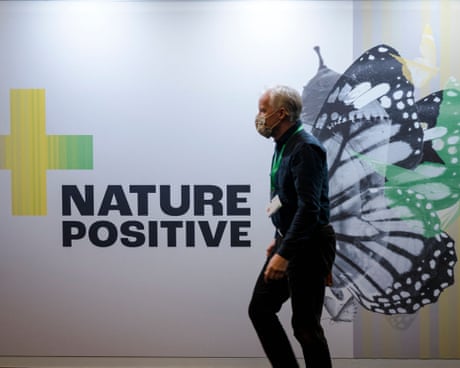
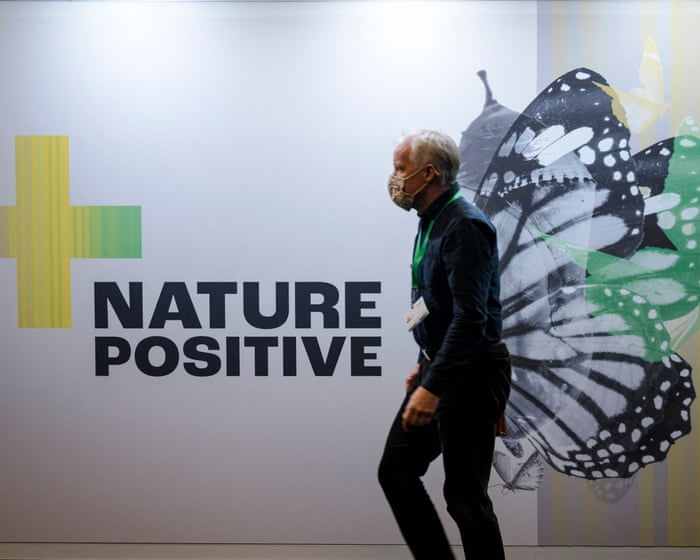
This month’s biodiversity summit in Yerevan, Armenia, aims to push governments to meet the 23 targets agreed at Cop15 in 2022
This month, nearly every country on Earth will return to the question of how to stem the rapid destruction of the natural world. Humans are driving it, but so far we have not found a way to stop it.
In late 2022, governments reached an ambitious once-in-a-decade deal to better protect nature amid scientific warnings that the planet is going through the largest loss of life since the extinction of the dinosaurs. Now, they are assessing their progress on the targets for the first time.
Continue reading...
© Photograph: Andrej Ivanov/AFP/Getty Images
© Photograph: Andrej Ivanov/AFP/Getty Images
© Photograph: Andrej Ivanov/AFP/Getty Images
