❌

Reading view

Leaked 50 Cent Doc Exposes ‘Possessed’ Beyonce Sacrificing Children in Satanic Rituals

50 Cent has pulled back the curtain on the darkest secret in entertainment. Beyoncé didn’t rise to the top on talent alone. She was trafficked as a child. By her Satanic family. Starting at age three. Passed [...]

The post Leaked 50 Cent Doc Exposes ‘Possessed’ Beyonce Sacrificing Children in Satanic Rituals appeared first on The People's Voice.

  •  

World’s Top Neurologist Blows Whistle ‘ADHD Does Not Exist, It Was Invented To Hook Kids on Drugs’

Attention Deficit Hyperactivity Disorder (ADHD) does not exist and was invented by Big Pharma in conspiracy with government regulatory agencies to hook vulnerable children on lucrative psychiatric drugs, according to leading American behavioral biologist Dr. [...]

The post World’s Top Neurologist Blows Whistle ‘ADHD Does Not Exist, It Was Invented To Hook Kids on Drugs’ appeared first on The People's Voice.

  •  

UK Gov’t Publishes Official Pamphlet Asking Migrants To Stop Raping Children

The British government has published a pamphlet for migrants to politely request they respect the customs of the United Kingdom, and stop raping women and engaging in sexual acts with children. In an apparent tacit [...]

The post UK Gov’t Publishes Official Pamphlet Asking Migrants To Stop Raping Children appeared first on The People's Voice.

  •  

Rabbi Shmuley Says Israel Must Assassinate Candace Owens and Tucker Carlson So ‘Americans Learn to Fear Jewish People’

Rabbi Shmuley Boteach has issued a public call for for Mossad-style action against US political commentators Tucker Carlson and Candace Owens, declaring “the Jewish people have to be feared.” Shmuley’s murderous rant began when he [...]

The post Rabbi Shmuley Says Israel Must Assassinate Candace Owens and Tucker Carlson So ‘Americans Learn to Fear Jewish People’ appeared first on The People's Voice.

  •  

Trump says better industry propaganda needed to make Americans embrace widely unpopular data centers

US President Donald Trump holds an image showing the size of Meta's new data center, during a cabinet meeting in the Cabinet Room of the White House in Washington, DC on August 26, 2025. Photo by MANDEL NGAN/AFP via Getty Images
Common Dreams Logo

This story originally appeared in Common Dreams on Aug. 20, 2026. It is shared here under a Creative Commons (CC BY-NC-ND 3.0) license.

President Donald Trump on Wednesday insisted that Americans should welcome artificial intelligence data centers in their communities, despite polls showing widespread opposition to their construction across the US, as well as mounting evidence of their negative impacts on the environment, public health, and Americans’ utility bills.

During a White House event with cryptocurrency and technology leaders, Trump was asked what he would say to working-class voters who backed him in the 2024 election but are skeptical about the benefits of AI.

Trump said he saw no reason why there should be opposition to building data centers, which have drawn criticism for producing pollution and forcing major spikes in utility bills thanks to their massive energy needs.

“If I were the mayor of a town or the governor of a state, and I had a chance to get a big plant in, an AI plant, or a data center, I would absolutely want it,” Trump explained. “The jobs are enormous and the money paid, the taxes paid, are enormous. And if you don’t take it, you’re going to be left behind because there are plenty of places that want it.”

The president then suggested that the only reason data centers aren’t popular is due to lack of effective propaganda from the tech industry.

“Maybe it could use a little public relations help,” he said.

Trump: "If I were the mayor of a town or the governor or a state, and I had a chance to get a big data center, I would absolutely want it" pic.twitter.com/9caqZ8L76b

— Aaron Rupar (@atrupar) August 19, 2026

An internal memo written by the National Republican Senatorial Committee that leaked to Axios on Wednesday warned Silicon Valley that data centers were massively unpopular throughout the country and were putting GOP candidates at risk.

In particular, the memo singled out the US Senate race in Ohio, where former Democratic Sen. Sherrod Brown has used incumbent Republican Sen. Jon Husted’s support for data centers as a cudgel.

“If voters’ perceptions of data centers are not fixed quickly,” the memo cautioned, “the campaign against them will expand far beyond Ohio.”

The New York Times reported on Thursday that the backlash to data centers has gotten so strong that it has inspired recall campaigns against officials who approved their construction in states including Missouri, Oklahoma, and Michigan.

Sen. Bernie Sanders (I-Vt.), who has proposed a nationwide moratorium on AI data center construction, told the Times that opposition to Big Tech should be a basic litmus test for any ambitious politician.

“People are standing up and saying, ‘Sorry, we don’t want these data centers in our communities for a number of reasons,’” Sanders said. “If you can’t have the guts to stand up to some large corporation, you should not continue serving in office.”

  •  

Federal judge blocks Trump and RFK effort to get more teens pregnant

US Secretary of Health and Human Services Robert F. Kennedy Jr. (R) speaks before President Donald Trump signs an executive order calling for more research and flexibility on vaccines, in the Oval Office of the White House in Washington, DC, on August 10, 2026. Photo by Jim WATSON / AFP via Getty Images
Common Dreams Logo

This story originally appeared in Common Dreams on Aug. 19, 2026. It is shared here under a Creative Commons (CC BY-NC-ND 3.0) license.

The Teen Pregnancy Prevention program, first authorized through bipartisan legislation in 2009, has been credited with helping to dramatically reduce the number of American teenagers who have experienced unwanted pregnancies in the past decade and a half, dropping by more than 65% over 16 years, according to one congressional report.

Despite the best efforts of President Donald Trump and Health and Human Services Secretary Robert F. Kennedy Jr., a federal judge’s ruling on Wednesday sent the message that the push to reduce teen pregnancy in the US will continue, with the administration’s limits on the program’s federal grants paused.

Judge Christopher Cooper of the US District Court for the District of Columbia granted a preliminary injunction in the case of Hennepin County, Minnesota v. US Department of Health and Human Services, in which officials joined King County in Washington state, Planned Parenthood of the Heartland, and the Sexuality Information and Education Council of the United States (SIECUS) in challenging HHS’s changes to the program’s grant policy. The plaintiffs were represented by Public Citizen and Democracy Forward.

The changes, said Cooper, were “likely arbitrary and capricious.”

LAWSUIT WIN: The court blocked the Trump admin’s attempt to turn the Teen Pregnancy Prevention Program into an abstinence-only program.

The court said the plan would seem to defy social reality, common sense, & scientific evidence alike.

A win for young Americans' wellbeing.

— Public Citizen (@Public_Citizen) August 19, 2026

The new policy, announced in June, canceled 53 of 66 active grants that had gone to public universities, health departments, and nonprofits for programming related to sex education, including information that was given to teens on contraception and communication with sexual partners.

In Trump’s 2027 budget, the grants are described as promoting “radical leftist ideology,” and officials claim there is no evidence that teen pregnancy prevention programs that go beyond educating young people about abstinence have “contributed to the historic decline in teen pregnancy, which is now at an all-time low.”

Under new guidance issued in June, Teen Pregnancy Prevention (TPP) program grantees are required to focus lessons on abstinence, deemphasize contraception, and teach teens about fertility and “body literacy.”

“HHS is perfectly entitled to formulate its own views about how to stem teen pregnancy—or even whether it is worth preventing at all—and to pursue policy initiatives consistent with its viewpoint. But it is not at liberty, under the Administrative Procedure Act (APA), to impose conditions on grant recipients that Congress did not intend or that are unreasonable or unexplained. The preliminary record suggests that HHS has done just that,” wrote Cooper in the ruling.

“Through the TPP, Congress sought to fund a range of evidence-based teen pregnancy prevention strategies, not just abstinence. According to unrebutted record evidence, programs that teach abstinence to the exclusion of all other approaches are ineffective in delaying sexual initiation and reducing adolescent pregnancy, at least as a general matter,” Cooper continued.

The judge took aim at the administration’s promotion of “body literacy,” which he called “a nebulous concept that appears to elevate fertility and marital procreation over well-tested forms of contraception and pregnancy prevention.”

Cooper also suggested that HHS had not bothered to find genuine evidence of its claims about “body literacy,” instead “remarkably” referencing “public health studies that appear either not to exist or not to support the propositions for which they are cited—a hallmark of AI-generated citations.”

The judge stopped short of reinstating the dozens of grants, amounting to about $67 million, that have been terminated, saying it was unclear whether he had the authority to do so.

The plaintiffs and other advocates of comprehensive sex education have called for a permanent injunction; Cooper called on both parties in the case to propose a schedule for next steps by September 1.

Callie Simon, executive director of SIECUS, said the group was “encouraged that the court has halted implementation of the new harmful policy” but emphasized that “the impacts of terminating existing grants remain.”

“Today’s decision sends a clear message that the Trump-Vance administration cannot replace the proven, bipartisan Teen Pregnancy Prevention program with an ideologically driven alternative that harms young people,” said Simon. “Communities across the country are still without the evidence-based programs they relied on, and we will continue fighting to ensure young people have access to the sex education they deserve.”

Sandra J. Valenciano, director and health officer for public health in Seattle and King counties, said local communities were facing a measurable loss due to HHS’ stripping of TPP grants

“This federal action threatened our ability to complete a study on a new science-based, community-informed sex education curriculum specifically for young men and boys,” said Valenciano. “This ruling gives us hope that we may still be able to get to the finish line with this study and ultimately empower more young people to build healthy families if, when, and how they choose.”

Ruth Richardson, president and CEO of Planned Parenthood North Central States, said the ruling “reaffirms the value of trusted, evidence-based education programs that help youth make informed choices and plan for their futures.”

“Attacks on the Teen Pregnancy Prevention program not only put young people at risk, they also risk increasing costs for taxpayers,” said Richardson. “No one benefits from these politically motivated attacks. It’s time for them to end.”

  •  

In the bear’s paw: How Europeans can loosen Russia’s grip on Belarus

BelaBear
Cover image: picture alliance / ASSOCIATED PRESS | Maxim Shipenkov

Summary

  • The disputed 2020 presidential election and Russia’s 2022 invasion of Ukraine accelerated Belarus’s integration into Moscow’s military strategy, with the country becoming a rear-operating base.
  • Since 2023, Russian deployments have increasingly positioned Belarus as a potential forward-operating base. Nuclear-capable systems, missile forces and military infrastructure on Belarusian territory mean that the Russian threat extends further along the EU’s eastern border.
  • Europe wants to preserve Belarus as a strategic buffer, yet sanctions and diplomatic isolation have not slowed Russian military entrenchment. Its continued path risks further binding Minsk to Moscow. Belarus has quietly become a major frontline security challenge for Europe.
  • The EU should move away from relying mostly on sanctions and economic pressure, and instead pursue a pragmatic strategy which aims to increase Minsk’s autonomy from Moscow. In the meantime, Europe must remain supportive of Belarusian exiles and its diaspora community.
  • The EU also needs to complement existing NATO deterrence with stronger support for countries on its eastern border, namely Poland, Latvia and Lithuania. This would reduce opportunities for Russian coercion and support Europe’s long-term plan for Belarus.

A satellite state

Take a map of Europe and find Belarus. Trace a finger clockwise, from the country’s northern borders and around to the east, where Russia is followed by Ukraine, Poland, Lithuania and Latvia. Belarus’s capital, Minsk, is itself almost at the exact geographic heart of the country, surrounded by hills, with vast forests sprawled out like capillaries beyond.

It is from here that Belarus’s longtime leader, Alexander Lukashenko, looks out from his “Palace of Independence” on Minsk’s Pieramozcau Avenue. To the east, in Russia, his fellow authoritarian Vladimir Putin continues to decimate Ukraine from its eastern borders and scheme to undermine European political interests. To the west, stretching hundreds of kilometres past Belarus’s western border with Poland and across Germany, lies Brussels. Faced with instability across the continent, the EU’s capital is increasingly unsure about what to do with its problematic Belarusian neighbour.

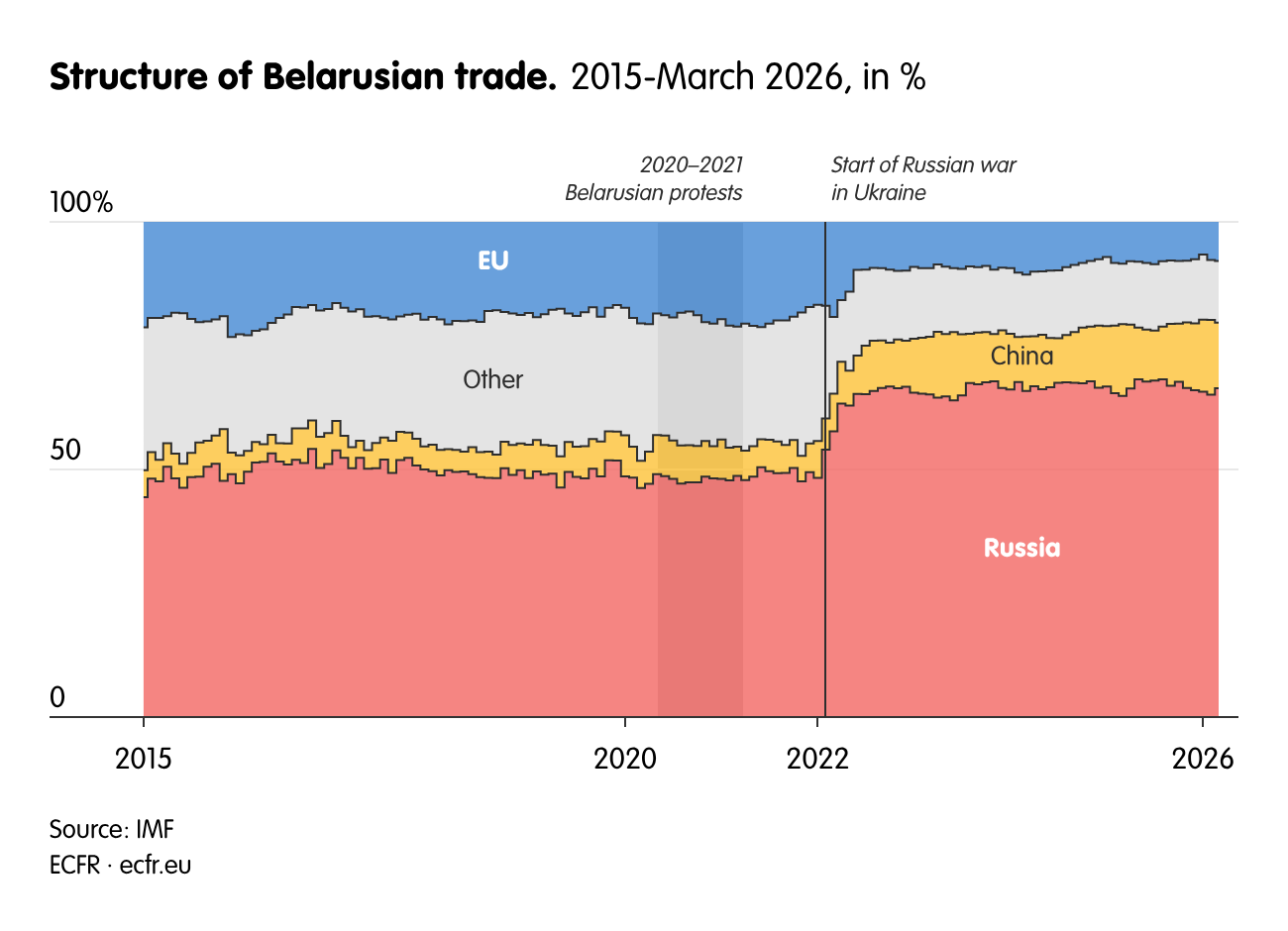
The EU downgraded its diplomatic relations with Belarus in 2020 after the latter’s disputed presidential election, which saw Lukashenko’s government violently repress protestors who took to the streets to oppose the president seizing victory by undemocratic means. Although bilateral trade between the EU and Belarus was largely undamaged in the subsequent years, the fall in trade with the bloc after Russia’s invasion of Ukraine in 2022 created an economic gap which Russia has exploited. For example, it has stepped up its own trading relationship with Belarus and become a key market for exports of Belarusian goods such as dairy products and petrochemicals—also allowing Moscow to evade EU sanctions. In doing so, Russia filled a vacuum for Belarus; Lukashenko, facing limited alternatives, deepened his dependence on Moscow.

Although Belarus did not formally commit troops to Russia’s war of aggression, it did allow the latter to house missiles, tanks, artillery, helicopters, aeroplanes and other military equipment in its territory prior to the invasion. It also provided military and civil infrastructure for Russia’s use, including airfields, hospitals and railway lines. This year alone, Russia has transferred more missiles—including dual-capable, hypersonic missiles—to Belarusian territory and conducted joint exercises encompassing the Belarusian Armed Forces. This, combined with a breakdown in dialogue between the EU and Belarus, gives Putin yet more sway in his quest to entrench Russia further into Belarusian structures.

Now that Belarus is apparently firmly committed to the supranational union of Belarus and Russia, known as the Union State, it has become a structural security concern for Europe. Russian deployment of nuclear-capable weapons on Belarusian territory makes Europe’s eastern flank more vulnerable, while Belarus’s already tense relations with neighbouring border states Poland, Latvia and Lithuania are at risk of deteriorating further. At the same time, Belarus has 879 political prisoners languishing, with Lukashenko’s regime having essentially outlawed any political or civic activity which the authorities see as a threat.

All this has compounded the breakdown in relations between Belarus and Europe. Russia is further emboldened to entrench its military deeper into Belarusian territory, tighten its economic dependencies and integrate the country further into its nuclear strategy.

This paper examines Belarus’s transformation from a problematic but stable buffer state between western Europe and Russia to a country which poses an increasing military and security threat to the EU. It argues that the EU should move away from relying solely on economic leverage and the blanket application of sanctions—which are pushing Belarus to rely more heavily on Russia—and develop a more targeted approach. Europeans need to actively contain the growing military and nuclear threat by finding new avenues of diplomatic negotiation, and by incorporating NATO-inspired approaches into its defence policy for its vulnerable eastern states.

Perhaps most importantly, Europeans need to assess to what extent they can treat Minsk as an autonomous actor capable of making decisions independently from Moscow. Europeans should take recent developments, such as Ukraine’s discovery of four signal relay stations in two Belarusian oblasts and their subsequent removal, as proof that Lukashenko retains the authority to make territorial-based decisions—especially under pressure from Russia.

However, for as long as Lukashenko remains in power, Belarus will never be entirely free of Moscow: he is an authoritarian, and Minsk remains sanctioned due to its breach of human rights clauses and mistreatment of its population. Belarus’s geopolitical position is also at least partly down to early decisions that Lukashenko made when he turned towards Moscow in the mid-1990s—a time when most other former Soviet nations chose real independence. Long before 2020, this posture led to missed opportunities with the EU, reinforced Lukashenko’s propensity to commit human rights violations and kickstarted Belarus’s deepening economic and military integration with Russia.

In its pursuit of a new strategy, the EU needs to recognise that—even if Belarus remains a stable, contained buffer zone—the country will not undergo a full democratic transformation. Europeans are thus searching for a Belarus which no longer presents an urgent security threat on its eastern border. They should aim to help shape a country whose stability reduces geopolitical risk without abandoning the EU’s long-standing commitment to democracy, human rights and the well-being of Belarusian society.

Belarus as a security actor

Belarus declared its independence from the Soviet Union in 1991. But, with what Russia perceived as the NATO and European sphere of influence shifting eastwards, Belarus became increasingly valuable to Moscow—especially because of the Suwalki Gap, which lies between the Russian exclave of Kaliningrad and Belarusian territory. The Russia-Belarus relationship became more entrenched once Lukashenko and Putin came to power in 1994 and 1999, respectively. The two leaders are hardly close personal friends—but they have nonetheless developed strong cultural and economic ties based on the similarity of their two anti-Western and authoritarian regimes, and their notion of a shared history.

Over the past 30 years, Belarus has moved closer to Russia in economy, trade and idea sharing. But it has gone beyond simply sharing a similar geopolitical outlook; now it is a militarised actor on the EU’s eastern flank. The first tipping point came with Russia’s invasion of Ukraine in February 2022. At this point, Lukashenko was already politically entangled with Moscow due to its support for Belarus’s trade network and economic sector after Minsk’s break with Europe in 2020. But the invasion meant that Belarus also became entrenched in the Russian military machine: in the early phase of Russia’s invasion, it became a launchpad for Russian ground offensives towards Kyiv and Chernihiv, and for missile strikes and combat aviation operations.

Structure of Belarusian trade.

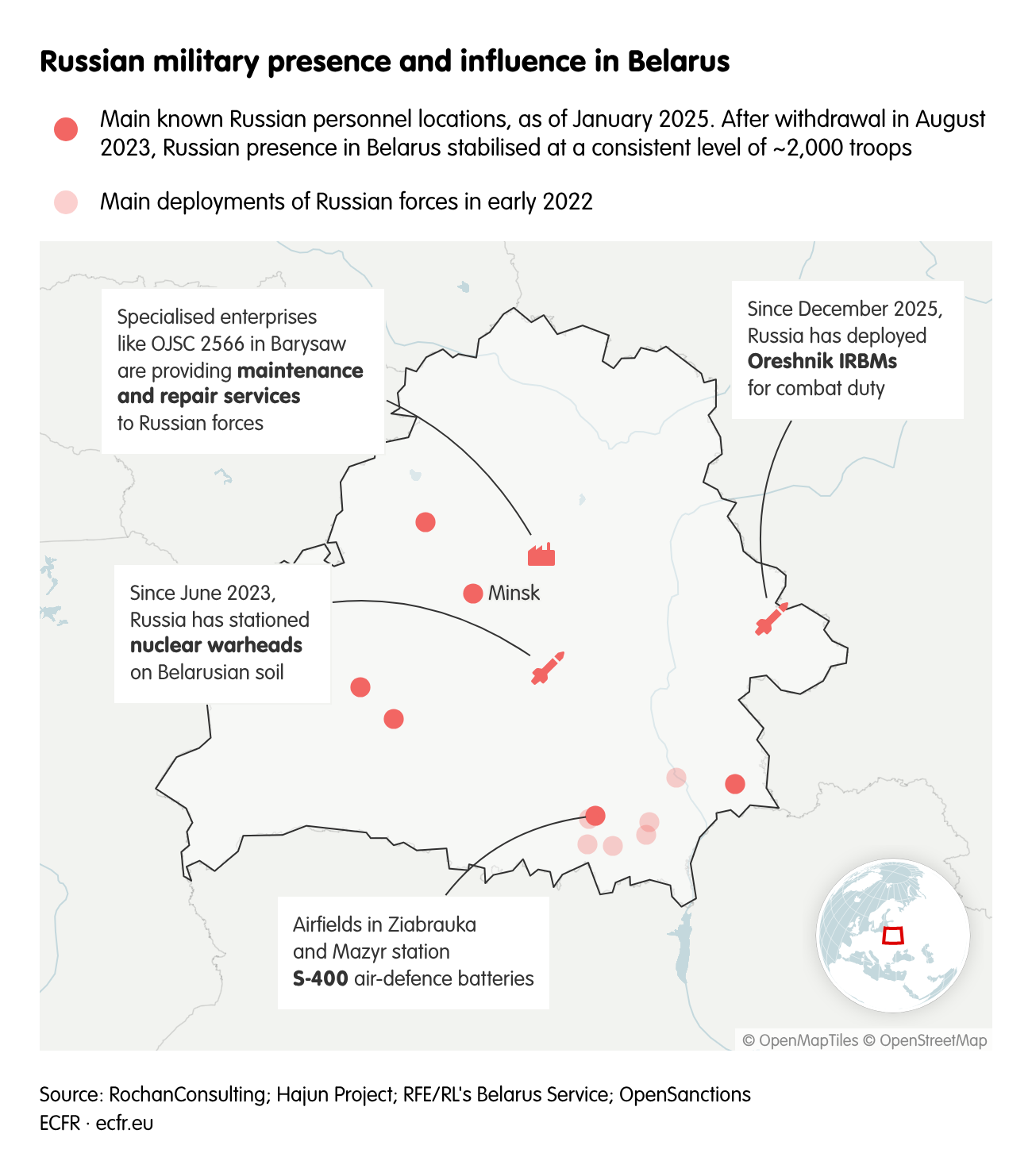
Since this period, Russia has attempted to consolidate its control even further. Now it has approximately 2,000 troops concentrated around air-defence systems, training facilities, logistics hubs and long-standing Russian military installations. Between 2022 and 2023, ammunition transfers from Belarus to Russia exceeded 130,000 tonnes. Since then, joint training centres, storage bases and transport corridors (many inherited from the Soviet period) have been repurposed and modernised under Belarus-Russia Union State programmes to support Russian operational needs. Rail-linked depots, armament storage facilities and training grounds now serve as key infrastructure for Russian forces on its western flank.

The second tipping point came with the two countries regularly staging recurring joint military exercises that institutionalise operational integration, such as the Zapad military drills which have been taking place since before 2022. Now Russia is eyeing up Belarus as a key component of its nuclear ambitions and has also deployed Oreshnik intermediate-range missile systems in Belarus. In April this year, Belarus confirmed it would no longer allow Russian conscripts who desert the military to leave via its border. Belarus is also a staging post for Russian nuclear missiles and joint military exercises.

The country has thus become Russia’s territorial, militaristic and logistical resource, achieved through durability, military routinisation and institutional embedding. The military aspect of this entrenchment is also compounded through hybrid attacks. For example, as early as November 2021 the EU condemned Belarus for facilitating the weaponisation of migrants—predominantly from conflict areas such as Iraq and Syria—who it had apparently encouraged to breach the borders of Latvia, Lithuania and Poland.

This form of hybrid warfare has continued into 2026: recent reports say that Lithuanian authorities have discovered a cross-border tunnel from Belarus to Lithuania, which they suspect is to continue to facilitate the potential movement of migrants through European territories. Now, with the Union State increasingly functioning as a homogeneous force, there is a threat that Belarus will become more emboldened to facilitate further dangerous hybrid manoeuvring. It intends to check Europe’s readiness and destabilise it from the inside.

Belarus as a threat to Europe

The difference in the threat which Belarus now poses to Europe lies in its shift—which has taken place over the past six years—from being Russia’s “rear-operating base” to Russia’s “forward-operating base”.

As Russia’s rear-operating base, Belarus functioned as a non-combat zone for logistics and maintenance. While it supported Russian military activity and provided strategic depth by shifting military infrastructure and combat flashpoints away from Russian territory, as a rear-operating base Belarus avoided deploying its own forces into Ukraine and directly engaging in combat operations. This allowed Lukashenko to avoid many of the challenges that Putin is experiencing, including politically sensitive military mobilisation, high personnel casualties and mounting internal economic pressure. This approach had previously provided Lukashenko with the degree of political deniability and diplomatic leverage necessary to continue negotiating with Western economies on economic sanctions and market access. He was able to point to Belarus’s arm’s-length approach to the war in Ukraine as proof that he was willing to engage with Europeans at a diplomatic and economic level.

Russian military presence and influence in Belarus

However, Belarus’s position has changed since 2022. Evidence collected by the author demonstrates that Russia is increasingly establishing the country as a forward-operating base. Moscow is building on its routinisation and institutional embedding of military infrastructure to deploy personnel on Belarusian territory and undertake recurring joint military exercises, lately including nuclear forces preparation. Minsk’s rhetoric is changing to match these actions. In 2022, Belarus changed its constitution to allow Russia to store nuclear missiles on its territory; in a “Militarization of Europe” meeting held in June 2026, Belarus’s deputy minister of foreign affairs Igor Sekreta said he was “deeply concerned by… military exercises on NATO’s eastern flank” and “the EU and NATO… systematically promoting a militarist agenda at all levels.”

The Belarusian government is simultaneously becoming a component of Russian forward-military position and aligning ideologically with Russia’s view that Europe (and the West in general) constitutes an existential threat. Lukashenko himself reiterated this in May 2026, when he declared that “… [Belarus is] ready in every possible way to defend our common fatherland from Brest to Vladivostok.” The change is especially worrying for Ukraine, which is already fighting a war against Russia on several fronts. Its brow-beaten army could soon be required to deploy yet more resources to another defensive line on its northern border. Belarusian state media have suggested that Putin desires to open a “second front” against Ukraine, using Belarus as a launchpad for further attacks.

Indeed, evidence suggests that Russia is already using Belarusian infrastructure to gain an advantage in its drone warfare against Ukraine: in June 2026, Ukrainian intelligence services discovered four signal relay stations in the Belarusian oblasts of Homiel and Brest. Ukraine’s president, Volodymyr Zelensky, appealed directly to Belarus to dismantle the sites or face potential Ukrainian consequences. The Belarusian president apparently acquiesced—although no public statement or confirmation has been made.

Belarus’s transformation into a forward-operating base was further bolstered in 2023, when Russia deposited tactical Iskander nuclear-capable warheads on its territory. Then, in early 2025, Russia moved Oreshnik hypersonic missiles to a location which experts estimate to be around 60km south of Minsk. This has changed the calculus for the rest of Europe. Europeans must contend with an additional nuclear threat right on its border (aside from Kaliningrad) and consider how this could compromise security along its eastern flank.

Meanwhile, as noted above, Belarus is mixing concrete actions with rhetoric that suggests it sees Europe as a threat to its own sovereignty. In the same speech, Sekreta commented that Poland, Latvia and Lithuania have a combined defence expenditure of €52bn, which is apparently “25 times more than Belarus allocates for defence”. This suggests that Belarus increasingly views European and NATO defence investments through the lens of Russian military planning. If left unchecked, Russian influence will leave EU member states more vulnerable to further hybrid attacks from Union State forces.

For Europeans, there is also potential for escalation in how these border countries respond, and uncertainty about where escalation could lead. For example, the Zapad-2025 military drills, which took place on September 12th 2025, prompted Poland to close its border with Belarus due to “heightened security concerns”. Prior to this, on September 9th and 10th, Russia had flown several drones into Polish airspace during an attack on Ukraine. Lithuania also closed its border with Belarus for a whole month in October 2025 (and refused to enter negotiations to reopen it) after meteorological balloons travelled into its airspace from Belarus. The latter responded by accusing Lithuania of “pursuing an anti-Belarus policy”. Latvia, for its part, is struggling to deal with Belarus’s tactic of sending illegal migrants over its border. As of July 21st 2026, the Latvian government had recorded 8,413 instances of migrants attempting to cross into its territory this calendar year, stirring discontent prior to the parliamentary election in October. The country has also uncovered several sabotage operations that have appear to have been carried out by Belarusian and Russian spies.

European leaders heating up their confrontations in such critical areas is further adding to NATO’s headache. Belarus’s degradation as a buffer zone between western Europe and Russia means the potential for these flashpoints to drift further west is growing, not helped by a continually deteriorating diplomatic relationship between the Lukashenko government and the governments of neighbouring EU states. The proximity of Russian missiles and personnel to European territory could compromise NATO warning systems; it also suggests that the Union State is becoming increasingly willing to test European responses to its increasingly integrated deterrent.

Now the EU needs to reconfigure its strategy towards Belarus. The goal should be to ensure that Lukashenko does not limit his room for manoeuvre so much that he has no choice but to descend into a fully armoured satellite state; and that he has no choice but to react to any order Putin gives.

What Europe is doing…

On sanctions

Since Belarus’s flagrantly undemocratic 2020 presidential election, which sparked the country’s largest political crisis since independence, the EU and Belarus have downgraded their diplomatic relations. This is a cycle which Europe and Belarus have found themselves in since at least 2006: repression conducted by the regime triggers sanctions and isolation from Europe, which are followed by limited thaws and diplomatic re-engagement, which are then interrupted by renewed crackdowns—and so on. This time, however, the diplomatic downgrading was mutual: Lukashenko made Poland and Lithuania’s ambassadors leave Minsk in October 2020, and requested the EU ambassador return to Brussels.

In 2021, following Lukashenko’s contested re-election, Europe’s approach became more actively political. Belarusian opposition leader Sviatlana Tsikhanouskaya lobbied European governments to move beyond broad economic measures, such as existing targeted sanctions, to adopt harsher and broader sectoral sanctions. These were directed at, for example, specific officials, judges, prosecutors and police officers responsible for repression of Belarusian citizens. Belarus, for its part, suspended participation in the Eastern Partnership, an initiative which aims to strengthen political and economic relations between the EU, its member states and the partner countries of Armenia, Azerbaijan, Georgia, Moldova and Ukraine.

Europe’s response remains to take a blanket approach to sanctions towards Belarus. It reinforced its sanctions cycle even after Russia’s invasion of Ukraine in 2022 and the EU’s approach to Belarus is embedded within its anti-Russia packages. This means that the EU not only targets individuals involved in conflict operations, but also bundles Minsk in together with the trade restrictions, export controls and financial measures which it aims at Moscow. Europeans have fallen into the trap of treating their Belarus policy as an extension of their Russia policy, although some politicians—including French president Emmanuel Macron and, back in 2021, former German chancellor Angela Merkel—have also pursued limited efforts to test whether targeted incentives could shape Minsk’s behaviour.

However, some EU sources say that Minsk is an unwilling negotiating partner. It remains to be seen whether it will be explicit about the desire to reshape engagement with Europe. As of 2026, EU–Belarus relations remain largely frozen. They have seen only minimal diplomatic engagement and sustained sanctions, and only limited, transactional contact has emerged—for example, in negotiations over political prisoners and technical discussions over border management. In its latest sanctions announcement, the European Council extended its sanctions regime against Belarus until 2027.

The EU is thus in a difficult position when it comes to pursuing normalisation with Minsk. Since Europe’s Belarus policy is considerably shaped by Belarus’s neighbours, Lithuania and Poland—and Vilnius is especially reluctant to open any dialogue with Minsk—other member states are less emboldened to force through normalisation policies which are at risk of simply being blocked. What is clear is that, unless Belarus makes clear improvements in its human rights conditions and clearly distances itself from Russia’s war in Ukraine, European policy will remain structured around three aspects: progressive sanctions targeting regime elites and key economic sectors; political non-recognition of the legitimacy of Lukashenko’s rule; and support for Belarusian civil society and exiles.

Another problem for Europe is that continuing to heavily limit industrial trade and the transfer of dual-use goods and military equipment to Belarus could see Lukashenko rely more heavily on Putin’s open markets. But, if Europeans do not pursue sanctions, they indirectly aid Russia: Lukashenko supports Russia’s war against Ukraine by selling military and dual-use goods to Russia, thus helping it circumvent sanctions. This, in turn, creates a cycle of obligation whereby Minsk acquiesces to future military requests from Moscow and Russia further entrenches along Europe’s eastern flank.

The EU approach broadly treats Belarus as a subsidiary of Russia and narrows Europeans’ ability to develop a tailored security policy which directly targets Belarus as a forward-operating base. As things stand, sanctions on the economy and trade are not adequately addressing the developing threat that Belarus poses to European security. And they do not help alleviate the suffering of the ordinary Belarusians at home and in exile.

On the diaspora

Since 2020, Lukashenko has stepped up his repression and exile of Belarusian civil society actors opposed to his regime. Evidence collected by the author through focus groups carried out for ECFR suggests that, for Belarusians, exile is no longer perceived as a temporary or marginal condition. Rather, it has become a structural feature of Lukashenko’s authoritarian governance. Participants consistently described forced migration as a way for the Lukashenko regime to externalise dissent to maintain internal stability. The government pushes out political activists, journalists, researchers and civic organisers to reduce domestic pressure, while the regime projects an external image of control and normalisation.

This means that Belarus has shifted much of its political contestation into European societies. As a result, the EU has faced myriad challenges related to diaspora governance, transnational repression (including surveillance, intimidation, pressure on relatives and legal harassment across borders) and social cohesion. The EU has, particularly after 2020, provided unprecedented political recognition and support to Belarus’s democratic forces, including security guarantees and sustained funding. For Lukashenko, exile therefore functions as a strategic arena.

How Europeans govern this space—through legal regimes, funding structures or protection mechanisms—directly shapes whether repression through exile succeeds as a long-term strategy.

On its foreign policy approach

The EU’s treatment of Belarus as having limited sovereignty over its foreign policy is also at odds with the US approach. Washington’s current relationship with Minsk is based on President Donald Trump recognising Lukashenko as legitimate, and the US agreeing to negotiate sanctions relief in exchange for the release of political prisoners. America still casts Belarus as a strategic adversary; but it nonetheless accepts that the country needs careful handling to safeguard American and NATO interests in Europe. EU member states, which eye Washington’s approaches to Minsk with caution, have ramped up their scepticism further since Lukashenko joined Trump’s questionable “Board of Peace” (despite the Belarusian leader lending credence to Moscow’s campaign in Ukraine).

Overall, America is searching for “visible deals” whereby it can secure humanitarian wins via economic channels. The clearest example of this is its pursuit of calibrated sanctions relief: in 2025, Belarus released 123 political prisoners in return for the US easing sanctions on the Belarusian potash industry. And it could be argued that this has paid some dividends: lifting sanctions on Belarus helps ease the domestic economic pressure on Lukashenko, which leaves him less dependent on support from Russia for trade.

However, the thaw in America’s approach does nothing to address Belarus’s increasingly entrenched role as a Russian military staging post. Indeed, no approach taken by any American president ever has. And while former president Joe Biden synchronised Washington’s policy towards Belarus with that of Brussels, under his successor, Trump, the two approaches are disparate. Of course, the US does not have the major consideration of the security challenges which Belarus poses to Europe’s borders. But this divergence between America’s prioritisation of transactionalism and the EU’s prioritisation of security will only grow in the absence of a coordinated transatlantic framework towards Belarus.

There also exists the possibility that Lukashenko could exploit the gap between America’s leverage-based approach and Europe’s risk-based approach, to play each side against the other. From the US, Lukashenko has already achieved incremental sanctions relief and diplomatic rehabilitation while continuing to align Belarusian security with Russian territorial involvement and pursuing domestic repression. As it stands, all signs point to US bargaining having no impact on Belarus’s strategic alignment or its military cooperation with Russia. Human rights abuses remain.

What Europe can do next

Europe’s continued policy of isolating Belarus and imposing sanctions is turning the country towards Russia as a more attractive option for trade and investment. However, Europeans cannot simply restore diplomatic relations, even to their pre-2020 iteration: they need to hold Lukashenko accountable for his disregard of democratic norms and civilian abuse, and accountable militarily for his assistance to Russia’s war in Ukraine.

This requires developing an alternative approach which goes beyond the current binary choice of engagement or isolation and identifies as a priority exactly the type of Belarus that Europeans want to—or are willing to—work with. Europeans need to examine existing EU and US approaches to Belarus, and discover where Lukashenko could exploit gaps in their divergence—and where room for leverage and leeway exists.

This also requires Europeans to understand the type of pressure that Russia is exerting on Belarus. It is true that Russia continues to provide loans to Belarus, open its market to sanctioned Belarusian goods and give Belarus access to infrastructure through which it can continue exporting goods to Brazil, China and India. But this is illusory: Russia exerting “real” pressure would amount to trade wars, blockades of Belarusian goods, cutting off financial aid and propaganda attacking Lukashenko. Putin has exercised similar measures before, when Moscow was unhappy with Minsk. Now, in 2026, their actions might be well coordinated, but Russia has not established any real economic, financial, military, informational or political coercion against Lukashenko and his government.

Europeans could use this distinction to consider the type of Belarus they want to shape. This should be a Belarus which has secure, meaningful economic alternatives to Russia; a Belarus which sees the geopolitical and economic sense of having a choice of trading partners; a Belarus which has functioning communication channels. Overall, Europeans should expect that their future relationship with Belarus will go beyond mere transactionalism and value the voices of those who Lukashenko continues to silence. Europeans should seek a Belarus which retains a degree of political room for manoeuvre away from Putin’s military and political influence. The following recommendations set out how it can achieve this.

Support eastern border states

The EU has already made progress in strengthening its defence security arrangements for its eastern flank. For example, the 2022 Strategic Compass aimed to prevent crises in states most vulnerable to Russian (or indeed Belarusian) encroachment, and the EU has developed a targeted “Communication on the EU’s Eastern Regions Bordering Russia, Belarus and Ukraine” (or “Strong regions for a safer Europe”) programme. This includes the five priority areas of security and resilience; growth and regional prosperity; building on local strengths; connectivity; and empowering its people. The bloc is also channelling funds into shoring up transit routes and financing, including the customs infrastructure along its eastern border which is a target for Russian and Belarusian interference.

However, the EU should more deeply incorporate its support for states that border Belarus—which are facing hybrid pressure, border incidents and spillover risks—into a defence strategy which builds on the NATO model, particularly in its approach to deconfliction. This would mean better aligning military preparedness with diplomatic signalling and crisis-management channels.

For example, NATO maintains a partnership with the Organization for Security and Co-operation in Europe which promotes risk-reduction frameworks and transparency measures among signatory states—including the Vienna Document, which has been signed by the US, all European nations and Russia. Europeans could establish a similar partnership with selected states which builds on Lukashenko’s willingness—up to now—to notify his Western counterparts about activities such as Zapad military drills, where in some instances he has even invited them as observers.

Strengthen connections inside Belarus

To go one step further, however, Europeans—and especially EU border states—should maintain established working-level diplomatic contacts in Belarus, especially those located at EU member-state embassies in Minsk. These could also be third-party intermediaries or use technical-level communication formats, such as hotlines, to relay information about military movements or developments.

This could also rely on trusting selected contacts inside the country itself: for example, there are several initiatives which hold meetings which bring speakers and thinkers together to share both Western and non-Western perspectives, including from inside Belarus and Russia. By acting as a conduit for open communication—and by remaining open and depoliticised—protecting such channels encourages a more open dialogue. This, in turn, mitigates the risk of miscalculation and helps develop a diplomatic environment in Belarus which is less dependent on the relations created through the Union State. The aim for Europeans should be to build a pro-EU constituency inside Belarus through democratic initiatives—not with the intention of overthrowing the regime tomorrow, but rather to embolden those who see it in their interest for Belarus to have normal working relations with the EU.

Europeans could also continue to financially support or work with Belarus’s small- and medium-sized businesses, both inside and outside the country. Directing economic support and capacity building to enterprises within its borders would strengthen the country’s independent economic capacity by allowing it to gradually decouple from other trade relationships. At the external level, in 2022 the EU and the European Bank for Reconstruction and Development pledged €4bn for SMEs which had relocated their businesses abroad. The EU should explore ways in which it can strengthen Belarus’s SMEs inside the country, to help build a constituency which sees partnership with the West, not just Russia, as an advantage.

Opportunities exist for cooperation at the non-profit level, too. While not directly related to European security policy, concerted work by the EU to fund Belarusian NGOs and support apolitical initiatives can help strengthen the country’s national identity and foster conditions for a more fruitful working relationship. Europeans can connect with Belarusian youth and help shape a more democratic future of Belarusian leaders through the funding of communal projects such as Erasmus+ and the European Solidarity Corps for Belarusian students.

The European Commission is funding ArtPower Belarus, in collaboration with the Belarusian Council for Culture and Danish Cultural Institute, from 2022-2028. This demonstrates how outreach in Belarus—with willing internal institutions—can forge a common sense of purpose and prevent the “othering” of either side. The EU should continue to strive for flexible support for civic and political activism, especially at the grassroots level, through institutions such as the European Endowment for Democracy.

Engage with the Belarusian diaspora

Europeans should treat the Belarusian diaspora as a “strategic constituency” and help secure their participation in national and international civil life. For example, despite Belarus’s exit from the Eastern Partnership, the country’s civil society remains active in the initiative. This political knowledge and organisational capacity are vital for educating Europeans and ensuring that Lukashenko’s approach does not condemn the country and its people for any longer than it already has. Indeed, the EU needs to ensure that the Belarusian diaspora remains at the forefront of its policies regarding safe migration and access; it must avoid inadvertently reinforcing the regime’s strategy of repression through exile, lest any temporary or fragmented protections undermine diaspora members’ political and institutional capacity.

The EU should prioritise legal stability and predictability for Belarusian exiles. Where possible, longer-term residence pathways, access to labour markets and recognition of professional qualifications should be expanded and harmonised across member states. Indeed, Europeans need to take transnational repression seriously as a security issue, not only a human rights concern. Surveillance, digital harassment, pressure on family members remaining in Belarus and alleged monitoring activities in EU states challenge European sovereignty and social cohesion. To counter this, the EU should keep pursuing democratic initiatives such as the project “Towards a Local Democracy Agency (LDA) Belarus in Exile”. Its establishment has helped reinforce the notion that exile is not a temporary condition and encourages the need for “sustainable democratic infrastructure” which supports communities in exile. Addressing these practices strengthens both diaspora resilience and internal EU security norms.

In the long term, the EU should introduce more permanent diverse and sustainable funding streams, and move away from reliance on emergency or externally volatile sources. While several exile-based civil society institutions have benefited from multi-year EU funding frameworks—and the EU has committed €200m since 2020 in supporting the Belarusian people—recent reductions in US assistance have exposed structural vulnerabilities. The EU needs to use such funding streams to support independent media, research organisations and civic initiatives in exile, since they are repositories of political memory and organisational capacity.

Europeans should also continue to engage with Belarus’s political opposition on a more formal level, rather than treating it as a protest movement. For example, they generally treat Tsikhanouskaya as the de facto leader of Belarus from her base in Warsaw. This gives Europeans access to a political figure with different views and priorities, and could see the two sides shape future engagement with Belarus via insights from the country’s more civic-minded, democratic channels. The EU should be wary of treating her as the sole alternative to Lukashenko, especially because it is unlikely that Tsikhanouskaya will be installed as his successor—but openness to her influence will bolster trust between Europeans and Belarusian exiled civic society. It will also provide EU member states with an understanding of how the Belarusian state works.

Link diplomacy with action

EU engagement should focus on areas where European interests are directly implicated and where limited leverage still exists. Recent developments, including prisoner releases secured through negotiations with the US and Lukashenko inviting Western officials to observe military drills, suggest that Minsk remains open to selective forms of engagement.

But while targeted incentives can produce limited concessions, the EU should avoid simply replicating the American model. Instead, the bloc must approach conditional engagement as a security instrument rather than simply a human rights policy. Unlike Washington, it has long-term security interests in Belarus—regional stability, border security, migration management, securing its eastern frontier—and needs engagement to be more strategic than transactional.

Europeans should therefore try to couch any diplomatic, economic or symbolic concessions (such as forming high-level diplomatic contacts, limited sanctions relief or participation in dialogue formats) in measurable and verifiable actions. These could include independent verification of the release and treatment of named political prisoners, a sustained halt to politically motivated detentions and access for international humanitarian organisations.

This could build on Lukashenko’s demands for sanctions relief in exchange for Belarus releasing political prisoners and ceasing its aggravation towards Europe’s eastern borders by making such concessions with the conditionality just described. Such engagement with Belarus could help generate durable behavioural change and address underlying sources of regional insecurity.

Untangle Minsk from Moscow

Europeans can also adapt their approach to Minsk based on how America treats it: as a viable, autonomous actor, not an extension of Moscow. The fact that negotiations between Trump and Lukashenko led to the release of prisoners—albeit with hundreds still being held—suggests that the Belarusian leader remains sensitive to economic pressure and to the optics of his own international legitimacy. Trump’s recognition of Lukashenko as Belarus’s legitimate president has only served to reinforce the latter’s willingness to reestablish closer contacts between Minsk and Washington. The US can use this thaw to its advantage to leverage selective sanctions adjustments (for example, easing restrictions on Belarusian potash exports in response to global fertiliser market pressures) and further widen Lukashenko’s limited transactional opening.

Europeans should consider whether closer coordination with Washington, whereby both camps identify common red lines and incentives for better diplomatic ties with Minsk, would deter potential coercion by Lukashenko and prevent him playing the US and Europe against each other. Indeed, the two erstwhile allies finding common ground in their strategy towards Belarus could secure further progress on humanitarian issues and demonstrate to Lukashenko that the US remains key in the protection of Europe’s eastern frontier. It is worth noting that, in this event, the EU should strongly articulate its own priorities—particularly regarding border security and societal agency—and pursue pragmatic coordination at the level of officials, agencies and technical experts.

A practical example of Belarus demonstrating more autonomy is the recent ultimatum proposed to Belarus by Ukraine. Zelensky’s bold statement over the four signal relay stations in Belarus led to their quiet removal (or they were at least turned off), suggesting that Lukashenko can roll back certain decisions—even on military issues. And, even if reports that it was in fact Ukraine which destroyed them are true, Lukashenko has accepted this development without retaliation. His response suggests that he fears the consequences of escalation from Ukraine and other Western allies. But it also supposes that Putin is not yet able to dictate Lukashenko’s every move, not even in zones which Union State forces could view as fundamental to ensuring their continued sovereignty. This episode shows that Lukashenko still retains meaningful room for manoeuvre even in matters of security, and that calibrated pressure from neighbouring states can shape his decisions.

Europeans should exploit this hint of residual agency to discover in which other areas Lukashenko retains an interest in limiting escalation or preserving his room for manoeuvre. They should determine in which other areas calibrated diplomatic and economic pressure could shape Belarusian behaviour and complicate Russian military planning. This could help decouple Belarusian decision-making from Russian power structures and isolate Lukashenko into a more favourable position for further negotiations.

Shaping stabilisation on European terms

By reducing the opportunities for Russian coercion and Belarusian-enabled hybrid pressure on the eastern flank, Europeans can better counter the impact of Russian entrenchment on their neighbour. But Europeans should not frame the recommendations as a part of a rehabilitation for the Belarusian regime. Rather, these policy suggestions should function to safeguard against further deterioration of the stable buffer zone that Belarus once provided for western Europe. Most importantly, they need to address the Belarus that has been created since 2020 and seek to prevent its further entrenchment as a Russian satellite state.

To achieve this, the most important thing Europeans can do is move beyond the false dichotomy between isolation and engagement. Europe can still rebuke Belarus as an externally managed satellite state, for example by disavowing the Lukashenko regime, while providing incentives which help it shape the conditions under which stabilisation unfolds. Europe cannot force rapid change in Minsk’s strategic alignment, but it could help prevent the complete consolidation of a security order in which Europe has no voice.

Europeans should also focus on how their approach to Belarus differs in the short and the long term. In the short term, Europeans need to prioritise preventing Russia’s military configuration in Belarus from becoming permanent and irreversible, and work to limit the extent to which Russia has entrenched itself into Belarusian military institutions. They should aim to separate Belarus from Russia as much as possible by ensuring that Moscow ceases stationing its weapons (conventional or otherwise) on Belarusian territory. At the same time, Europeans need to be aware of continued escalation, such as further military deployments on Belarus’s territory, applying hybrid pressure on member states or facilitating cross-border incidents.

In the long term, Europeans should not aim for Belarus to be aligned with the West; nor should they expect that their intervention will transform Belarus into a democratic state. But the EU should work towards Belarus becoming a country that is sovereign enough to resist becoming a permanent forward base for Russian power, and open enough to maintain a managed relationship with both Europe and Russia. Ideally, Belarus should become sovereign enough that it can make rational decisions—based on the best interests of its country and its people—regarding with which power it wants to be aligned.

As it stands, Russia’s war of aggression in Ukraine shows no signs of abating. America, for its part, is increasingly reluctant to fund deterrence in EU countries, including those which border Belarus. It is, under Trump, using economic and political posturing to exert pressure on the Lukashenko regime. But Europeans can still find the avenues of cooperation which still exist in the allies’ fractured relationship. Most importantly, the EU needs to grant a degree of agency to its most problematic neighbour.

About the author

Vasil Navumau is a former visiting fellow at the European Council on Foreign Relations. He now works as a researcher at the University of Siegen, where he focuses on civic activism in eastern European countries, particularly Ukraine and Belarus, and its transformation via information and communication technologies.

Acknowledgments

The author would like to thank Pavel Slunkin and the ECFR editorial team (in particular Amy Sandys and Portia Kentish) for their valuable input and suggestions, as well as Nastassia Zenovich for her graphics.

This work was produced as part of the project “Portrait of Exiled Belarusians and the Role of Belarus in Russia’s War on Ukraine”, financed by the European Union under the EU4Belarus – Support to Advanced Learning and Training (SALT II) programme.

This document has been produced with the financial assistance of the European Union. The contents of this document are the sole responsibility of the European Council on Foreign Relations (ECFR) and can under no circumstances be regarded as reflecting the position of the European Union.

Source

  •  

The Longreads Questionnaire, Featuring Jaya Saxena

two-panel graphic with author Jaya Saxena on left and image that reads "The Longreads Questionnaire: Jaya Saxena" on right

I was sad last fall when I read and recommended Jaya Saxena’s final story for Eater. Saxena is a food writer the Longreads editors have followed for years, and a journalist I’ve always counted on for food writing that both informs and entertains; she goes deep on aspects of cuisine, dining, the restaurant industry, and food culture in a way that’s relatable and unpretentious. (She’s also the series editor of The Best American Food and Travel Writing anthology; you can preorder the 2026 edition now.) So I was glad to hear, earlier this year, that Saxena and other former Eater writers were cooking up something new.

That something is Ravenous, a worker-owned, subscriber-supported food and culture site founded by Saxena, Amy McCarthy, Ashok Selvam, Courtney E. Smith, and Frances Dumlao. The five journalists are “sick and tired of the conversation around food being reduced to AI-generated pablum, ‘best of’ lists, and influencer-driven trends,” and are building a home for the kind of thoughtful, curious reporting that’s become harder to publish in a broken media landscape. Or, as they put it: food media with teeth.

Next week, Ravenous launches a monthlong fundraiser, so now is the perfect time to support the site. Seven dollars a month, or $70 a year, gets you access to everything they publish; higher-tier plans come with more perks. (Sign up for the Regular plan—$25 a month, or $250 a year—and you get to give the Ravenous raven a nickname, which they include in their Sunday newsletters.)

If anyone can build a publication around engaging, relevant food reporting and storytelling, it’s Saxena and this crew. Have a look around Ravenous and consider subscribing. But be warned: Don’t browse when you’re hungry.

—Cheri Lucas Rowlands


Where did you grow up?

I was born and raised in New York City, and aside from a brief stint in New Orleans for college, I’m still here. Except now I’m over in Queens instead of my hometown of Manhattan.

What places feel like home?

Aside from my actual apartment and the one I grew up in: Various NYC beaches, the backyard of my local bar, a punk show, Ray’s Pizza & Bagel Cafe on St. Mark’s Place, and one specific rock in Central Park.

Other than family members, who or what has shaped you the most?

For high school I went to a Quaker school in Manhattan, and though I don’t consider myself religious in any way, Quaker values began shaping my future politics then. It’s where I first started learning about the value of consensus-based community decision making, and given that this was in the early 2000s, anti-war and anti-violence politics. I even remember a teacher making the case that cars should be banned in Manhattan. It was a big influence on my politics and value systems.

What is your favorite time of day?

To work, right after I wake up, around 8 a.m., when my mind hasn’t filled with the noise of the day. Otherwise, early evening when it’s still light out, and everything is just beginning.

What are you really good at?

Untangling necklaces.

What’s the best gift you’ve ever received?

One year my wife bought me a Cameo of the cow from First Cow, whose handler fed her a treat in my honor. The video is one of my most prized possessions.

Describe your favorite meal.

Of course as a food writer this is tripping me up, because are we talking about a single great meal I’ve experienced, or a dish I could eat every day? If it’s the former, it’s the time my wife and I walked into a random seafood counter in Valencia, Spain, and spent the night eating sardines in garlic oil and sparkling wine from ceramic cups. If it’s the latter, my mom’s mac and cheese.

Sound or silence? (And if sound, what sound?)

I’m a city kid, so too much silence scares me. I need the background noise of people on the street to get anything done.

Where do you do your best thinking?

In the shower or walking around listening to music.

What journey—physical, creative, intellectual, or otherwise—has meant the most to you?

In 2018, my wife and I traveled with my dad to his hometown in India. It was the first time he had been back since before I was born, and being able to experience that with him was so important. We also ate absolutely the best kebab I’ve ever had in my life. Maybe I should have put that as my favorite meal.

Where do you like to read?

On the subway.

What’s the last rabbit hole you disappeared into?

My friend recently introduced me to the case of Judy Smith, a woman who went missing during a trip to Philadelphia and was discovered murdered in the woods outside Asheville, North Carolina. I have now spent a lot of time reading conspiracies about what happened to her.

Name three publications you enjoy reading these days.

Defector has fantastic culture coverage, I love every issue Cake Zine puts out, and some of the best money I’ve spent recently is on the monthly print issue of The Onion. 

What’s one longread that you can’t stop thinking about?

This piece in The New Yorker by Lauren Collins about El Mordjene, an Algerian hazelnut spread that white French people are being very racist about. It’s just such a good exploration of how something innocuous becomes the center of a culture war. I was also thrilled to find the spread at an Egyptian grocer in my neighborhood, and sorry white French people, it is better than Nutella.

What was the last book you read?

I had somehow never read Interview With the Vampire by Anne Rice, but after watching the TV series my friends and I decided to read it together. 

What piece of nonfiction are you most proud of writing?

“The Food That Makes You Gay,” for Eater. I had editors that really trusted me to follow my instincts, and I managed to thread together some things I had an inkling were related. I’m also just glad I could get a full throated defense of bodily autonomy and the right to change one’s body in a piece that started out talking about straight men being afraid to eat bananas in public.

What’s your most reliable way to get creatively unstuck?

Walk away from the computer. I just need to do something else, anything else, for a while.

Who’s a writer you turn to when you need some inspiration?

Reading just about anything will definitely help me, but I love Helen Rosner’s food writing. And I tend to listen to a lot of music when I need inspiration, so as far as lyricists go, probably Aimee Mann, Fiona Apple, Joni Mitchell, Prince, and Paul Simon.

What words do you overuse?

I write pretty conversationally, so I sprinkle in a lot of “just” and “of course” and “perhaps” that I usually have to go back and delete.

What’s your favorite guilty pleasure?

I am a firm believer that there is no such thing as a “guilty” pleasure (unless it’s like, continuing to read Harry Potter after J.K. Rowling has made it clear that doing so supports her transphobic work). No one should feel guilty about doing something that brings them joy. But in terms of indulgences that make little sense to others, I love a Hershey’s Cookies ‘N’ Creme bar.

What superpower would you like to have? 

Generously, the power to instantly heal others. Selfishly, the power to have three cocktails and sleep through the night.

What animal or nonhuman being do you most identify with?

Any time I see a photo of a magpie standing on its nest made of shiny, pretty things, that’s me.

If you have a free solitary hour in your day, what do you typically do?

Unfortunately, I’m probably looking on my phone. I have a very dumb “project” where I am trying to train my Instagram algorithm to show me the absolute worst videos out there. But I am trying to get better about doing things like taking a walk to the river, or practicing a new hobby (my latest one is trying to learn some card tricks).

What five items would you place in a time capsule?

A copy of The God of Small Things by Arundhati Roy, a bootleg Knicks champion shirt, a fortune teller fish, a bottle of 4711 cologne, and a DVD of Velvet Goldmine.

What does your writing space look like?

You should know for this photo I am standing directly against my bed, which my cats sit on all day and scream at me from. You should also know half the time I’m not even here, and instead writing with my laptop on the couch.


Jaya Saxena is an IACP Award-winning, James Beard Award-nominated writer and editor, and a lifelong New Yorker. She enjoys covering the intersections of food and immigration, business, history, policy, queerness, and just about every way we use food to say something about ourselves. She is the series editor for The Best American Food and Travel Writing. Her work has appeared in Eater, Slate, Gourmet, GQ, The New York Times, Defector, and more. You can email her at jaya@weareravenous.com.


  •  

Neoliberal policy hollowed out universities. now they are collapsing.

University of Montana Missoula summer campus scene showing University Hall and a sculpture of the UniversityÍs grizzly bear mascot, The University of Montana has about 11, 000 students and is in the city of Missoula. Photo by: Don and Melinda Crawford/UCG/Universal Images Group via Getty Images

This article was originally published by Truthout on Aug. 17, 2026. It is shared here under a  Creative Commons (CC BY-NC-ND 4.0) license.

If education is indeed the great vehicle of social and economic mobility, then higher education is no longer delivering the promise of the “American dream.” In fact, this “dream” has become a fiscal nightmare. Colleges and universities saw 9,000 job cuts and buyouts in 2025, and several college closures, mergers, and looming budget crises have already been announced in 2026. Portland State University is one of the most recent casualties, with a projected deficit of $35 million.

How did we get here?

Universities have been operating like corporations for quite some time now. Business terminologies — like return on investment (ROI), efficiency, strategic alignment, move the needle, transparency, buy-in, revenue generating, burnout, bottom line, deliverable, best practices, and others — have been normalized in strategic plans and administrative reports.

The boards of trustees and presidents running these academic corporations/factories have been boldly claiming that education is business. And just as businesses fail due to strategic missteps, poor financial decisions, and various forms of mismanagement, this “business” called higher ed is on the brink of a great collapse. This collapse has not happened overnight. It certainly did not start with the COVID-19 pandemic. It certainly did not start with blocking international students from attending U.S. universities. It certainly did not start with Donald Trump and the resurgence of McCarthyism, although the various draconian attacks on higher ed under his presidency have exacerbated the collapse.

Decades of mismanagement, fiduciary irresponsibility, a lack of shared governance and accountability, and divestment are responsible for a plethora of failures. Irrespective of these failures, university presidents and boards have been transparent about their singular mindset (at least in their visible actions). To them, growth is essential, but such growth can only take place by cutting various services and programs that are no longer deemed “essential.” Faculty and staff at many institutions have raised warning flags, insisting that universities cannot cut their way to growth. Such illusory growth will weaken programs and prevent students from truly being educated. Such short-term growth will ultimately threaten the long-term foundation of higher ed and lead to the collapse of one of the biggest arenas of 21st-century thought: the university.

There are also other reasons for this collapse. For decades, universities have overspent on real estate, building fancy residence halls, offering attractive dining services, and raising tuition for students. All of this “added value” has been accompanied by cuts to essential student services (particularly those serving the most marginalized students) and insufficient compensation for overworked faculty and staff. Recent reports by the American Association of University Professors have found that faculty salaries still have not recovered from the decreases they saw during the early COVID-19 pandemic.

While faculty salaries have declined, large investments in athletics, online courses with low completion rates, and other designer programs have drained operational costs and endowments. Decades of reduced investment in the well-being of faculty have led to widespread burnout, watered down the system of tenure and shared governance, and led to the rise of the most exploited class in higher ed: the gig hustlers called “adjuncts.” This system, which Adrianna Kezar calls The Gig Academy, has created serious inequity and contributed long-term damage to faculty morale.

The infrastructure of higher ed has been further damaged by administrative bloat, with institutions hiring consultants — like enrollment management companies — that demand hefty price tags, all while cutting essential staff and overworking the ones that remain. In 2023, Forbes reported on this “skyrocketing” bloat and warned that such exponential growth in non-instructional staff in higher ed will drive up the cost of tuition and push vulnerable institutions to the brink of financial crisis. Meanwhile, due to staff cuts, overworked and underpaid faculty and staff are being asked to meet the demands of students who are increasingly coming to them underprepared and with various issues of mental health, food insecurity, homelessness, and learning styles and disabilities requiring multiple accommodations.

But unlike corporations, there is no government backing to bail universities out of their millions of dollars in structural deficits. They are simply closing or merging, destroying the lives of faculty and staff at various ranks and causing serious educational derailments for their students. The age of “the great resignation” that we witnessed during the pandemic has been replaced by “the age of massive layoffs” in higher ed. In my own state of Oregon, sweeping academic restructuring is underway, with 36 faculty layoffs and the closure of the award-winning and nationally recognized University Studies, a general education interdisciplinary program.

Let’s face it: The greatest danger facing higher education is not the “demographic cliff” but the loss of its fundamental mission to educate students. This shift has been accompanied by the loss of public trust in higher ed to serve the public good. The greatest danger facing higher education is not in its ability or inability to provide students with “job-related skills and training,” but the increasing and crushing debt, akin to a mortgage, that students and their families will be struggling to pay for decades.

No university education should cost over $60,000 per year to deliver just an undergraduate degree, which only a handful can truly afford. And these days, some universities are charging over $90,000 per year. There is no justifiable ROI for this kind of exorbitant cost. Yet, most of us who have been in higher ed for a while now know well that the millions of dollars of structural deficits that almost every university is currently facing did not just accumulate overnight. They are a result of shifting priorities.

Universities are no longer mission-driven to create critical, thoughtful, responsible, and well-rounded citizenry to participate in democracy and serve the public good. Instead, higher ed has traded its long-term intellectual benefits for short-term market and profit-driven (sometimes predatory) programs, with the sole and narrow purpose of training a generation of students for the workforce. This focus on job training, under the umbrella of “professionalism,” may or may not even succeed given the volatility of job markets in the age of artificial intelligence. Yet the disciplines that will be necessary to combat AI, like the humanities, are routinely being devalued.

While university administrators are speculating like gamblers to gauge which revenue-generating “programs” will ultimately survive, they are reducing, cutting, or hamstringing the disciplines in the arts, humanities, and sciences that have a long and storied tradition of cultivating “critical thinking.” Yet this strategy conflicts with studies that show the liberal arts, particularly the humanities, are valuable in terms of long-term employment prospects. According to the Mellon Foundation report “Humanities Graduates Can Find a Great Job. It’s Time to Make This Fact Known”:

The American Academy of Arts and Sciences reports that, at latest count, 96.3 percent of terminal humanities bachelor’s degree holders between the ages of 23 and 32 were fully employed, a share that is on par with that for degree holders in the same age range across all fields. Further, the earnings of terminal bachelor’s degree holders in the humanities are comparable to those of their counterparts in the behavioral/social sciences and the life sciences, while the job satisfaction levels among humanities graduates are in line with those of degree holders in all fields.

This and other reports emphasize that students need to learn and practice deep critical thinking, problem-solving, and ethical reasoning as basic skills to enter and succeed in the job market.

In response to the closure of Hampshire College, Ken Burns, one of the school’s most celebrated alumni, hit the nail on its head: “The greatest danger that faces higher education,” Burns said, “is this transactional tendency that everything is about an exchange that ultimately is economic.” What is lost in this game is the mission that education should be “transformational.”

As bell hooks wrote in Teaching to Transgress: Education as the Practice of Freedom, “The classroom remains the most radical space of possibility in the academy.” These days, in the age of fascism and corporatization, any radical space is a threat, and every effort is being made to destroy those threats. Federal policies target disciplines that challenge the status quo or question power structures, like sociology, pushing for them to be eliminated from the curriculum altogether.

This transformation was underway long before the current right-wing attacks on higher education, as universities slowly eroded critical programs through the use of the terminology of “academic prioritization.” Recently, “academic prioritization” has been replaced by new terminologies of “long-term sustainability,” “strategic growth potential,” “indoctrination,” and “demand programs.”

Irrespective of these terms, the end goal is to reduce and eliminate programs, mostly in the humanities, that have created transformational spaces for generations of students, particularly those from marginalized backgrounds, those who are economically disadvantaged, and first-generation students. Colleges and universities around the country have eliminated humanities majors in art, music, theater, philosophy, history, religious studies, global languages, gender and sexuality studies, and ethnic studies, citing decreased enrollments.

In April, the University of Montana eliminated its master’s degree program in English, focused on Literature and Ecocriticism, raising serious concerns about the university’s identity. “English is such a fundamental core subject within the humanities, and it’s almost like the heart of the humanities is being cut out,” said English Department Chair Louise Economides.

The University of Montana is not the only university where the “heart of the humanities” is being cut out with little to no conversation. The attack has been relentless nationally. Eric Hayot and Matt Seybold have described this crisis as “a crisis of civil society writ large.” They write:

There is no condition in which the humanities are under attack in which the whole university is not under attack. There is no condition in which the university is under attack that the whole of educational infrastructure, public and private, from pre-K up, is not under attack. And there is no condition in which education is under attack in which civil society can remain unimperiled.

Yet none of this is a surprise. While the right-wing attacks on these disciplines and departments have been relentless in recent years, faculty have been witnessing this slow collapse of the arts, humanities, and sciences for quite some time now. The market-driven model that encourages packing students into classrooms like sardines to maximize profits is not conducive to the personal attention that students need in disciplines like the arts and humanities. Many of these departments, slated to be reduced or cut, have been deliberately hamstrung by their administrations (citing low enrollment numbers), resulting in their inability to offer a robust curriculum. The overemphasis on the number of majors these disciplines have is a deliberate strategy to discredit these disciplines. If these programs are retained, they are treated as second-class departments simply serving as the “general education requirements” for the more profitable “revenue-generating” programs.

Higher ed is on the verge of collapsing because it has lost its soul. Can this soul be restored? Perhaps. But this would require a nationwide movement to restore public trust and reclaim higher education, building an academy that is not solely transactional or profit-driven but is deeply invested in serving and collaborating with its broader communities and society writ large. If we cannot do this, then we are one step closer to witnessing the weakening of our civil society and the end of our democracy.

  •  

There’s no such thing as ‘unskilled work’: Barbara Ehrenreich’s ‘Nickel and Dimed’ 25 years later

Monica Garcia,44 of Merry Maids, cleans the home of Rubi Courtland in Burbank Friday just one of dozen of homes she and the rest of the crew will clean in a week. Photo by Carlos Chavez/Los Angeles Times via Getty Images
https://workingpeople.libsyn.com/rss

In her 2001 masterwork Nickel and Dimed, the late Barbara Ehrenreich went undercover to report on the daily realities working people in America face trying to get by on minimum-wage. After working as a housekeeper, a nursing aide, a home cleaner, a server, and more, Ehrenreich wrote that “The first thing I discovered is that no job, no matter how lowly, is truly ‘unskilled.’” It is difficult to overstate the impact that Ehrenreich’s book and body of work have had on US culture and working-class politics over the last 25 years, and the enduring relevance of her work today. In this special episode of Working People, we commemorate the anniversary of Nickel and Dimed and celebrate the life and legacy of Ehrenreich by speaking with a panel of guests who are carrying on that legacy today.

Panelists include: Deirdre English, coauthor of three books with Barbara Ehrenreich, former editor in chief of Mother Jones, and a former director of the Magazine Center at the Graduate School of Journalism at the University of California at Berkeley; Alissa Quart, editorial director of the Economic Hardship Reporting Project and author of seven books, most recently Bootstrapped: Liberating Ourselves from the American Dream; and Ann Larson, author of Cleanup on Aisle Five: Essential Work, Poverty Wages, and the View from Behind the Supermarket Register and a fellow with the Economic Hardship Reporting Project.

Additional links/info:

Featured Music:

  • Jules Taylor, Working People Theme Song

Credits:

  • Audio Post-Production: Jules Taylor
Transcript

The following is a rushed transcript and may contain errors. It will be updated.

Maximillian Alvarez:

Alright. Welcome everyone to Working People, a podcast about the lives, jobs, dreams, and struggles of the working class today. Working People is a proud member of the Labor Radio Podcast Network and is brought to you in partnership with In These Times Magazine and the Real News Network. This show is produced by Jules Taylor and made possible by the support of listeners like you. My name is Maximillian Alvarez, and today we’ve got a very special episode for you guys. And we’re talking about the work, life, and legacy of a very special person, the late great Barbara Ehrenreich. 25 years ago this year, Barbara published what is still to this day one of the most essential and impactful books about working class life in America ever. And the book is called Nickel and Dimed: On Not Getting By in America. And if you listen to this show, then chances are you’ve probably heard of it or you may have already read it.

But if you haven’t read it yet, and if you haven’t dug into Barbara’s incredible body of work, then frankly, I kind of envy you because you have a feast before you, a feast for your mind, your heart, and for your soul. And to commemorate the 25th anniversary of Nickel and Dimed, the Nation Magazine just published a really beautiful and vital forum with folks from around the worlds of labor and journalism testifying to the enduring power and relevance of Barbara Aaron Reich’s work today. As author and friend of the show, Alyssa Cort writes in that forum, “The first thing I discovered is that no job, no matter how lowly, is truly unskilled.” This is from Barbara Ehrenreich’s 2001 masterwork, Nickel and Dimed. I read it that year when I was 29. Eventually, Barbara became my good friend and colleague as we created a media organization, The Economic Hardship Reporting Project, and wrote and edited articles together.

To recap, for that book, Barbara went undercover, reporting as she worked as a housekeeper, nursing aide, a home cleaner, a waitress at Jerry’s and Hearthside Restaurants, and a Walmart worker all in her later 50s, wrestling with cleaning products, carrying huge diner orders, and sometimes living in motels. The book was a departure from her earlier acidly funny and sociological work, ranging from midwifery to middle-class anxiety, but for which she rarely interviewed a soul. It’s hard to underestimate the effect nickel and dimes vacuum cleaner’s eye view of what it means to work a minimum wage job in this country had on so many of us. For those blinded by America’s late 20th century comforts, Barbara’s book helped us to stop unseen low wage workers. It also showed us what anyone who has ever made a pizza or taking care of a child already knew, but had perhaps not articulated that there is no such thing as “unskilled work.” As Barbara wrote, “The working poor, as they are approvingly termed, are in fact the major philanthropists of our society.” And Nickel and Dimed also helped precarious creatives like me and my ilk, freelance writers, art handlers, grad students, bookstore clerks, all paid hourly and shabbily, see themselves more clearly as being on a continuum with other working people.

Now, we’ve linked to the Nation Forum commemorating Barbara Ehrenreich and the 25th anniversary of Nickel and Dimed in the show notes for this episode. And you should definitely go read it when you have some time. And it goes without saying, but I’m going to say it anyway, that you should really, really go read Nickel and Dimed. And hopefully by the end of today’s episode, you’ll see why. There’s really so much that I want to say and could say here about Barbara Ahrenreich, but to keep it short and sweet, I’m just going to say this. I never had the honor of meeting or knowing Barbara personally, but I know that I would not be here doing the work that I do on this podcast, on the Real News Network and beyond without her. Her work has inspired generations of working class journalists and non-traditional storytellers just like me.

Her advocacy and institution building has made it more possible for people like us to have places to publish our work and for working class stories and voices to be heard. And I am so grateful to Barbara for that and to all who carry on her beautiful vital legacy today. And I am so grateful to all of our amazing guests on the show today who are doing just that. Thank you all so much for being here. Please introduce yourselves to our listeners.

Deirdre English:

I’m Deirdre English. I’ve written three feminist and class-conscious books with Barbara Ehrenreich, the former editor-in-chief of Mother Jones Magazine and a professor of journalism at the University of California Berkeley.

Alissa Quart:

I’m Alissa Quart. I created the Economic Hardship Reporting Project with Barbara. I’m a journalist and a poet. I’ve written seven books and edited one anthology. My last book was called Bootstrapped: Liberating Ourselves from the American Dream. And the one before that was Squeezed: Why Our Families Can’t Afford America.

Ann Larson:

Hi, my name is Anne Larson. I’m the author of Cleanup on Aisle five: Essential Work: Poverty Wages and The View from Behind the Supermarket Register. I’m a fellow with the Economic Hardship Reporting Project, and Barbara Ehrenreich is one of my intellectual and journalistic heroes and mentors.

Maximillian Alvarez:

Hell yeah. Well, thank you all so much for being here. It really, really is an honor to be chatting with all three of you, and all three of you are my journalistic heroes, and I think you are all living testaments of the incredible legacy of the incredible Barbara Erin Reich. And I wanted to start by asking more about that. Whether you got to know her in person or through your work, tell us and our listeners more about Barbara and what she and her work have meant to you.

Deirdre English:

I got to know Barbara because we were both on the faculty of an experimental radical college called the College at Old Westbury with a mission of social justice and a very multiracial student body and teaching staff. And we taught women’s studies courses together, some of the first back in the ’70s, and then we spent seven years writing three different books together. Perhaps the one I’ll mention is called For Her Own Good: Two Centuries of the Expert’s Advice to Women, which is about the impact of health and mental health professionals on creating stereotypes about women based on gender, class, and race, and helping to authorize those stereotypes to make them seem as though they were scientifically based and authoritative. So Barbara and I were really more than friends and coworkers. We were really sisters. I lived in the same house with her for periods of time.

I’m the godmother, or as she called me, the goddess mother of her two children who I am still very close to and who are remarkable testaments to Barbara’s influence too. Her kids are both extraordinary writers and activists. I’ve had a lifelong relationship with Barbara and profoundly influenced by her. She influenced. And then when I was at Mother Jones, I became her editor and she had a column. She did a cover story on one of her books, and she was a frequent advisor. And then finally with the founding, we’ll be talking about Nickel and Dimed and that whole period. But then with the founding of the Economic Hardship Reporting Project, I certainly consulted with her then, and now I continue that role with Alyssa by being on the board. And so Barbara’s just had a profound lifelong impact on my thinking and my commitments. So

Maximillian Alvarez:

Deirdre, I got to ask from one editor to another, going from friend to editor is not an easy transition to make, especially when you’re editing Barbara Ehrenreich. How was that transition for you guys?

Deirdre English:

Pretty smooth because Barbara was such a great writer. It’s actually the best writers who are the easiest to edit. They get the big picture and they get back in the day when we had a paper publication before it was digital, sometimes you just have to cut for space and the professionals know how to do that. So no, no, no, we never had any arguments. But I’ll just say one more thing though. An editor should always remember that the piece belongs to the writer. So your role is to help the writer, not to impose yourself on the writer. So throw that in too.

Ann Larson:

I never met Barbara Ehrenreich, but I read Nickel and Dimed pretty soon after it came out. And I think I was the graduate student at that time, maybe my first year in graduate school. And this was 25 years ago, this was still sort of end of history type era. We just had Bill Clinton for eight years, and there was this sense that everything had worked out how it was supposed to work out. Capitalism was great. It had defeated all the other alternatives, and everybody got what they deserved in life. If you worked hard, you could succeed. And meritocracy was the name of the game. And so Nickel and Dimed just sort of punctured that myth so profoundly and so completely that it was so necessary at that time. I taught the book or portions of the book in a class I was teaching at the time as a graduate student.

And I remember being struck by how funny it was that students that I taught, we were reading these about poverty and low wages and living in motel rooms and cleaning shit out of toilets, and yet we’re all just laughing and hooting and hollering through the whole thing. And I just remember thinking, “What an amazing writer that you could write about these topics that are so dark, and yet we’re all laughing the whole way through.” I just think that’s a very rare talent that she had. And then we can talk about this a little bit more, but at that time I was a graduate student. I was planning on a career in academia. The idea of service work was not something that I worried about for myself, though I had come from a working class background. But a few years later, I found myself working in a supermarket.

And I remember thinking about nickel and dimed and seeing it differently once I’m doing the service work and a line from the book, I hadn’t read it in several years at that point, but I remembered a line from the book. I’m working behind the cash register and I’m tired and it’s weeks and weeks and I’m struggling to learn the job. And Barbara Arenak’s voice popped into my head and it said, “What you don’t necessarily realize when you’re selling your time by the hour is that what you’re actually selling is your life.” And I just thought how apt that was and how accurate it was that she’d really captured that I was now living, I was now experiencing. And so that influenced me and made me think I should write about this job because Barbara did it. She sort of forged a path for me.

Alissa Quart:

I read it when it came out in 2001, but my favorite book by far was Fear Falling. So I had been introduced to her earlier than that. I had been, like Ann, at CUNY Grad Center in English and Sociology and had been adjuncting. It was the introduction for me to what I would later call the middle precarious, this kind of precarious middle class where we were making, I don’t remember what it was, Anne, it was 2,000, $3,000 a class, and we were somehow supposed to also go to graduate school. So I started to see after I read Nickel and Dime, a continuum for the first time between my own experience as a kind of unstably middle-class person and the people around me who were serving food and taking out the garbage and making people’s beds in hotels. And I saw the connection, which I think had been purposely obfuscated by third wave Democrats, which is part of what Anne was saying also.

And I too had gotten lost in the aestheticism of the ’90s in its attitudes, in its stances. It was a very alluring decade for Generation X people who were into alternative culture. You could just lose yourself in Sleeter Kinney or something and in poetics and theory and get disconnected from the experience of class even when you yourself were living it. So what it was, it was both a reminder and a form of self-knowledge reading it because I suddenly was like, “Wow, my time here adjuncting at Kingsborough Community College where people are screaming at me and I can’t afford my rent even in the East Village is being stolen in a way.” And so I actually wound up dropping out of graduate school for better or worse as a result. And then years later, obviously I met her. I was working on a film called The Last Clinic, which is about the clinic at the Center of the Dobbs case in Mississippi, women’s health.

And I was the producer and the writer with the great director, Macy Crow, and I was raising money from Barbara. And I called her and it was unbelievable. I was sitting in the middle of a magazine office. She said, “Hi, Alyssa.” And she starts talking about Jane, which I believe she had firsthand experience with. And I just was like, “My God.” I mean, I fell in love, I think. I felt like I had finally found not just a mentor, but family, a mother of sorts, a spouse of sorts, a place where I belonged as a person, but also as a mind and a kind of politics, which in journalism is hard to find, let’s be frank. This is not a field filled with activists or unusual poetic people or people who are incredibly moral. And she was all those things. And also as a woman, she was incredibly generous to other women, and we can talk more about that.

I feel like she didn’t have some of the conventional gender identifications of a lot of boomer women who might see themselves as internalized masculinity and all this kind of stuff. She really was about women and about encouraging women. I mean, she had a lot of male friends and male colleagues and men in her life. But I think she wasn’t competitive and defensive in a gendered way, which really set her apart, honestly. So after this love match, I started working for her at the Economic Hardship Reporting, and she insisted we call each other co-editors, which of course was a marketing person’s nightmare. She’s like, “We have an anarchist socialist nonprofit.” I was like, “Okay, but I better not share this with our funders. Flat hierarchies.” I was like, “Okay.” But I knew also that this was the only way I could actually do this was with somebody like this.

And the idea of our organization was to fund people who were truly working class and fund people like she and I who were journalists who wanted to write entirely about income inequality and no longer had the resources. So actually, yeah, Max, you were one of the people I encountered early on.

Maximillian Alvarez:

Yeah, baby. I mean, like I said, we are all in some way or fashion living proof of Barbara’s incredible legacy, and that includes me and this show. I mean, not only would I not be doing this work, there wouldn’t be a market for this work without someone like Barbara. And on top of that, the Economic Hardship Reporting Project has sponsored episodes of the show. They’ve connected us to folks that we’ve interviewed on this show. It’s an incredible, incredible organization and legacy that you and Barbara built from the ground up. And it’s touched so many of us and helped tell so many of our stories. And I think I’m honored to be in the struggle with all of you to carry that legacy forward however we can. But I want to go backward again because I think you guys have really touched on something that is super important for folks to understand about Nickel and Dimed itself and everything in it because you can’t understand it just by reading it today.

You have to understand who we were and where we were at the time that it was published. And it was published in 2001 and written in a turn of the millennium America that feels so incredibly far away today in many respects. I mean, I was still a teenager then. I was a conservative, middle-class, dipshit, mixed race kid in Orange County in Southern California who still didn’t really know a whole lot about life and who had no idea how bad things were going to get over the next 25 years. I identify with the stories that y’all were telling because when this book came out, my family was part of the middle class in that post-Cold War boom. And then we lost our middle-class status in the post – 2008 crash Great Recession, including the house that I was raised in. And so I read the book very differently later on in life than I would have had I picked it up in 2001.

So I want to really take listeners back to that time. And I wanted to ask if you could say more about who you were then, what the country was like then, and what working in America was like then.

Deirdre English:

Barbara never bought into the boom myth. I think that certainly throughout the Reagan years, which were the 1980s, Barbara was continuously aware that wages were still stagnant for the working class. The postwar boom really ended by the ’80s, and the boom was for the business elite and corporations, and it was Reagan deregulation. And then moving forward a little bit in time, Barbara never fell in with the Clintons. And in fact, a lot of her concern with poverty came about because during Clinton’s regime, the push to eliminate welfare, welfare as we know it, and to force women mothers into jobs to justify their welfare payments, that was actually the impetus of writing nickeled and dimed. I was actually part of a group with Barbara that I think was called the Committee of 100. It was 100 feminists who were protesting Clinton-esque welfare reform, and we failed to stop it.

And then Barbara was left with the question, well, what is actually going to happen to these working women who are being pushed off welfare and into the workforce? And so if that’s supposed to be the answer, get a job. Let me go out and look and see whether you can support yourself on a low wage job. And that was the genesis of nickel and dimed. So that would be some part of my answer to your question.

Ann Larson:

I mentioned earlier this idea of the end of history and the meritocracy had went out and everything was as. We were in the best of all possible worlds and how nickel and dime sort of punctured that myth. I do think also one of the things that I remember from that period is this kind of looking back, it seems like we were all living in this myth, in this kind of dream world, and our feet weren’t really on the ground in a way. I really thought I was going to get a job in academia and be a professor. I mean, I think about that now, given my background and the fact that I went to CUNY and I studied English, and that was never going to happen. That was always a failed venture. But I believed it. I got on that path and people told me it was going to work out.

If you work hard, it’s all going to work out. And so one of the things that I think nickel and dimed does is it not only punctures the myth, and I’m talking more about Barbara’s work in general, books like Fear of Falling and Natural Causes. She wanted to see the world as it really is, not how we wish it would be. She was really a critic of delusion in all its forms. And this goes from in Bait and Switch, she talks about the myth that just by updating your personality or getting a new wardrobe is going to be the key to a new job. Or in another book that she wrote, kind of busting the myth that positive thinking can cure breast cancer. She sort of refused to succumb to that kind of thinking. She was really insistent on science, on evidence, on rational thinking.

And even in one of the last books she wrote, if not the last, she wrote about these mystical experiences that she had as a young person that sort of hinted at something supernatural beyond the realm that we live in every day. But even that didn’t change her mind about the fundamental class divide in the world and the fundamental reality that we live in. And I just find this very inspiring. To me, it’s a very kind of socialist way of thinking without. Barbara didn’t wear her socialism on her sleeve. She wasn’t out there pounding the gavel. What she showed is a way of looking at the world in a concrete and material way and an insistence that we not be diluted about how things really are. And that way of thinking, that really grounded concrete way of thinking is the foundation for political change.

Alissa Quart:

Yeah, I love that, Ann. When I think about what was going on in 2001, I mean there’d be a terrorist attack six months after Nickel and Dime came out, World Trade Center buildings falling, killing over 3,000 people. There’s the Enron scandal. There’s all those accounting crises. And Wikipedia launched that year and kind of a notion of unskilled expertise, which I think is important too, because she was really pushing in nickel and dime for rethinking what unskilled labor was. And I think the knots had a complex relationship with what skilled and unskilled labor was, especially thinking work, what had to be done by amateurs and what could be done by professionals. And I also think one of the things that was interesting about that time, not just this forcing us to see what the Democrats, the centrist Democrats were masking with the end of AFPC and so forth.

It was also a moment when people could publish these kind of books. Which is less and less common. I mean, Anne, who’s on this panel, just did. I do. A few other people do, you do Max. But I think there was a time when No Logo was a bestseller, Fast Food Nation, Michael Paulin’s early books. And these were mega sellers, as was Nickel and Dimed. There was an audience for them. And there was also a real hot critique of commercialism and a lot of these factors. I mean, my first book branded The Buying and Selling of Teenagers was in this vein. And I do see Nickel and Dimed as part of that as a kind of materialist account. The years that transpired after the Forever War would say, oh, do we have the energy to worry about the consumer economy and labor? Shouldn’t we be worried about the threat against our nation?

There was all these different enemies that have been constructed since then. But it was pretty clear in that ’90s knots period, even though it was being masked, that those were the polls. It was like this flushed consumer economy that rested on the backs of workers, that rested on the brainwashing of teenagers to buy shit, that rested on people being fed terrible meals, supersize me, and Michael Moore’s films were about that. So I think that’s part of the scene that I think of. And I also think of just the level of consumerism in that time. You can’t even imagine. It was very go-go before there was a crash.

Maximillian Alvarez:

Well, and that’s what I remember. I mean now it’s like I tell my daughter, it’s like, yeah, that was the era of what I would call free range capitalism, where we were allowed to run around as consumers and stretch our legs a little more. We had a little more buying power. And the consumer felt like an important thing in the economy, whether you were going to a restaurant or staying at a hotel. It felt like you could still vote with your wallet as the proverb goes. That we still had some power to determine what the economy looked like and get what we could from it. We could still make enough to earn a good living. Like Ann was saying, our feet weren’t even really touching the ground. But that bubble burst for me at least after 2008. And in the years that have followed, I feel like I’ve only come to see more and more what Barbara saw back then that me and my family couldn’t.

Because when we heard about worker issues like that, we saw them as consumers. And we saw them as, well, I’m the fast food consumer going in paying for my meal, or I’m the student going to get an education. Why is it my job to care about the employee on the other side? They should be doing their job kind of thing.That was such a prevalent way of thinking in America and sure as hell in conservative, middle-class, Orange County, California. But again, that really came crashing down for me and for so many of us over the next 25 years. And frankly, reading Nickel and Dimed in the America, in the world that we’ve got here and now in 2026 is quite a trip. And I wanted to ask y’all, why do you think it is still important for folks to read Nickel and Dimed and Barbara’s work in general today?

What can her work still teach us now? Or what has it been trying to teach us for years that we still haven’t learned but really need to?

Deirdre English:

Well, the economic pain has spread. And I think that Alissa really was speaking directly to that when talking about the middle-class precariot and the fact that a middle-class way of life has become increasingly unaffordable to the working class and to large parts of the middle class. I mean, of course in America, everybody thinks they’re middle-class, so it becomes very hard to talk about class for that reason. But basically the great increase in unaffordability since first the enormous crash of 2008 that wiped out so much value and showed that all that home ownership was based on a bubble economics, and then the rise of the forever war, so absorbing so much of our economy in military spending. So we’ve just seen so many social failures during this period of time. And I just want to also mention that the rise of what you were talking about, the consumer economy is also the rise of the service economy from the worker point of view.

And that was a big shift in the working class because it was largely women who got those service jobs, as Anne has written about so brilliantly in her book about grocery store work. I mean, obviously there are men working in grocery stores too, but the “opportunities for women that are often blamed on feminism,” like that feminists encourage women to go into the workforce. Well, no, economics forced women into the workforce. Feminism tried to make circumstances better for them. I don’t think we’ve succeeded. But Barbara was just very aware in nickel and dime, those are all jobs of women workers in the service economy. And so that was really burgeoning while the kind of extractive industries were all being outsourced and technology was coming in and absorbing a lot of those kinds of jobs. So Barbara was just so aware of the shifts in demographics and economic policy and economic reality so that she always saw under the surface of what people thought was going on to what was really going on.

Alissa Quart:

I sometimes see her as sort of like an ultra violet light, like forensic dusting where we can see things that we wouldn’t otherwise see. I love what you just said. That was so smart, Deirdre, and about the consumer economy being a service economy being female. And when we’ve been assigning Looking at the Economic Hardship Reporting Project, a lot of the pieces we assigned were people who have taken low wage work writing about what it’s like inside of that, including Anne, but also Joseph Williams, Danelle Alexander, Daryl Wellington, a bunch of other people. And that to me was part of what Barbara also wanted to do towards the end of her life was she didn’t want to just be the sort of co-pastoral woman underground, my man Godfrey, I’m going to go into the supermarket in a mask and become the worker. It was like she wanted to hire the person who had actually been that, who was a writer and a reporter and an active mind who could name and wasn’t doing it as a stunt.

And I think that to me, that was part of the understanding of the line between journalist and practitioner that started to expand in the knots when experts in amateur started to blend a little more. Publications like The Global Post started assigned to local reporters rather than to have white dudes fly in to cover shit. And I think she was doing the domestic version of that. Let’s not have people parachute in. Let’s have people write from their own place. And I followed that to the letter. I mean, I just thought it was really important. And also having people who could think critically. Anne here is such a great mind and you really are. And she can interpret a lot of the things that she was experiencing structurally. And that’s another thing that Barbara was really interested in.

Ann Larson:

Just wanted to note that one of the things I’m thinking about hearing this conversation is that Barbara was a baby boomer. And I don’t know, that seems important. Somehow we have this whole, hey boomer where we make fun of the boomers, God love them.

Deirdre English:

Okay, boomer.

Ann Larson:

Right, that they’re just like these clueless. And there’s some truth to it. They grew up in this time where there was more opportunity and you get education and it’s going to work out for you. And there was room for upward mobility in a lot of cases thanks to government investment and public goods. And we all know what the French call the tant glory is, these 30 years after World War II when working class was making gains. And so for Barbara to be in that generation and yet recognize all the things that people on this panel are talking about and just see through that mythology and to see, as Deirdre put it, what was under the surface, I think we should pause on how extraordinary that is. I mean, I think one of the reasons that was the case is because she had working class roots herself.

I grew up in Montana and I believe her dad was a minor. But then her dad, if I’m remembering correctly, ended up becoming an executive. He advanced in his career and ended up leaving the mines and became something of a professional. And so she got to see this upper mobility, this transformation. But it wasn’t just that she had a really good memory for that period of her life when she’d been working class, but she really just, she saw welfare being cut. As Alyssa mentioned, she saw what was happening to aid to families with dependent children. She saw free trade agreements sending jobs overseas and that expanding the service economy that she wrote about. And so it wasn’t just a good memory, although that was part of it. She just never lost her talent for recognizing the way the material world was the foundation for what was happening in people’s lives.

And in terms of what’s changed, I mean, I think there’s no better example of what stayed the same than the minimum wage has been stuck at 725 since 2009 or something like this. I mean, this is something out of just the dystopian universe that we have not raised the minimum wage since 2009. And I just think Barbara saw that this was the way things were going. And she was able to see not only through this and of the mythology that we’ve described, but even in her own generation, in which so many people had a different experience, and even in her own experience, her own family kind of crawled out of the working class. She still stayed true to her vision and to herself. And I think that’s very rare.

Deirdre English:

We baby boomers, we came of age in the ’60s and there was a vast movement to be a part of. And Barbara and I were both very much a part of it. The anti-war movement where I really came of age in my college days doing that and worked on two documentaries about the anti-war movement, about anti-war Vietnam, and working with Vietnam vets. And then the women’s movement that Barbara and I both really kind of shared our journey into that world and into what was missing in the women’s movement and what was missing in the labor movement, which was a lack of feminist consciousness and on the left. So all of those, there was this big thing, the movement, and we felt very much a part of it, supported by it, buoyed by it, but also the productive arguments that happened within it. And so Barbara wasn’t a lone figure, she was a standout figure, but I think she always felt part of a much larger community and with multifaceted elements in it from the labor movement, from the women’s movement, and many others.

Alissa Quart:

Yeah. I mean, I think it’s important to note, like you just said, she didn’t see a different distinction between advocacy and journalism, like that thick line that we’ve been taught in J schools for decades, the voice of God and NPR and neutrality and all the major newspapers. She thought it was really important to bring the movements into writing. And that I hope is also another part of her legacy. And honestly, I mean, look at the DSA. I mean, she was the first co-chair with Michael Harrington. So it’s not just what she’s done as a writer or what she’s done institutionally, it’s politically. And I think that is also a legacy within journalism to not forget politics on that level.

Maximillian Alvarez:

Yeah, I think that’s all beautifully and powerfully put. And it really reminds me of Barbara and the rare writers and people who see and fight and write the way that she did, have taught me ever since. Like y’all said, you don’t necessarily need to see the world through socialist goggles, but once you stop seeing them through the kind of capitalist goggles that are welded to our eyes from birth, then you start seeing things how they really are and you become a socialist real quick. So that’s what it was for me is I was so conditioned for so long to see the country I lived in a certain way. And it was a massive financial crash that taught me otherwise. It was our government bailing out the banks and big corporations while families like mine fell through the drain that taught me that. It was working on a warehouse and factory floors with people I had been taught to say were dumb and deserved to be in those jobs because they couldn’t do anything else.

And here I was with a degree from the University of Chicago doing the exact same job in 2010. I mean, life taught me a lot of what capitalism and America tried to keep from me for many years. And Barbara taught me a lot more about that. And I was so grateful when I kind of lost that innocence, that American innocence of realizing the world and the country that I actually did live in, instead of believing I lived in the fiction that had been presented to me. I was so grateful to have a book like Nickel and Dimed to help guide me from that point to a greater consciousness and to more answers and to more hope about what can be done about this for families like mine, for people like me, for the hundreds of people and workers that I’ve interviewed on this show over the years, their families.

I’m so, so grateful to Barbara, to Nickel and Dimed for all that they have helped provide me in my long sort of recovery from the hangover of the capitalist fiction that I and my family had lived under for the first half of my life. And I wanted to sort of turn that into our final question here because I could talk to y’all for hours, but I know I have to let you go soon. And I wanted us to sort of finish by talking about the legacy of Barbara Ahrenreich herself and of course her work, including Nickel and Dimed, whose 25th anniversary we are celebrating this year. And so I want to frame the question this way. We now have the benefit of hindsight to see in our past what we frankly could not see coming in the future that lay before us 25 years ago.

With our life experience and with all the lessons that Barbara Ehrenreich has taught us, what wisdom can we offer through the gift of foresight to ourselves today with everything that we’re facing and to our descendants 25 years from now?

Deirdre English:

Well, I mean, I would say Barbara actually foresaw herself the advent of AI on middle-class jobs. And she actually very presciently wrote in an essay in Time Magazine that I haven’t read since it came out, but it struck me so much at the time that maybe the middle class was soon going to be facing the downward mobility that the working class was experiencing. And that when the robots came, when technology came for writing jobs, journalism jobs, teaching jobs, white collar jobs, the way it was already coming for so many working class jobs, definitely factory jobs, that maybe the middle class would wake up and understand their commonality, which Alyssa has been speaking to and which Alyssa is very alive to talking about the precariot. Maybe they would begin to understand that the bosses were not their friends and that the scraps that they were getting from the owner’s table were getting less and less and that they would begin to experience a sense of unity and class consciousness and fighting spirit.

And so that’s happening. It’s going to accelerate. And one hopes that what will also accelerate is what Barbara called for, which is that unity and oppositional spirit.

Alissa Quart:

Yeah, I’m hoping for this unity. And I’ve been talking to people about how they’re affording America. I wrote a book called Squeeze Why Of Families Can’t Afford America almost 10 years ago now. And I’ve been returning to some of those topics because it seems very of the moment, the middle precarious. And what startles me is people saying things like middle-class people, people who earn six figures saying things like, “I don’t feel like America likes me.” And just that emotionalism of that, I feel like that is where this kind of emotional politics is going to start, where people feel like they’re part of a gradient, a range of class positions that are being kept down by people who are manufacturing insecurity for really the 99%. And that concept is no longer just pablem, but it’s something that people actually live and vote by and connect to each other around.

Ann Larson:

I’ll just end by, I really want to emphasize something Deirdre just said, which strikes me as really important about movements. I think just one generation after Barbara as a Gen Xer, I didn’t feel like I was part of a movement. It was like all individuals who were working hard and trying to make it work in the professional class or whatever. And I think what Barbara would want us to do is rebuild these movements that used to serve as a foundation for social action, for thinking, for camaraderie, for solidarity. I’m also the co-founder of an organization called the Debt Collective that is trying to organize the debtors to bring some sense of community and collective strength to people that are drowning in debt. It’s why I’m so proud to be part of the Economic Hardship Reporting Project where I think the organization publishes people that are writing as part of movements, that they see journalism, like Alyssa just said, is not just something that you should be objective and talk about facts, but as part of a movement building work.

And to me, this is, I think, a real key to. We can’t think of individuals. You can do your best as an individualism, but there’s a limit there unless you have a movement behind you, unless you have a culture that supports the kind of thinking and work that Barbara did and that we should all be trying to do.

Maximillian Alvarez:

All right, gang, that’s going to wrap things up for us today. I want to thank our guests, the great Deirdre English, Alissa Quart, and Ann Larson. I also want to thank the Nation Magazine and the Economic Hardship Reporting Project for all the vital work that they do and for helping us put this special episode together. Go check them out, subscribe and support them using the links that we provided in the show notes. And of course, I want to thank you all for listening, and I want to thank you for caring. We’ll see y’all back here next time for another episode of Working People. And in the meantime, go explore all the great work that we’re doing at the Real News Network, where we do grassroots reporting that lifts up the voices and stories from the front lines of struggle. Check us out across our YouTube channel, our different podcast feeds, our website, and our social media pages, and help us do more work like this by going to therealnews.com/donate and becoming a supporter today.

I promise you guys, it really does make a difference. I’m Maximillian Alvarez. Take care of yourselves, take care of each other, and rest in power, Barbara Ehrenreich. Solidarity forever.

  •  

Capitalism is killing summer

People cool off at Coney Island beach on June 29, 2026 in the Brooklyn borough of New York City. Photo by Spencer Platt/Getty Images
Jacobin logo

This story originally appeared in Jacobin on Aug. 17, 2026. It is shared here with permission.

It’s a “Hot Socialist Summer,” proclaims the New York City Democratic Socialists of America Instagram. Indeed, it has been a summer of socialist victories, with more socialists winning electoral office in June than ever, including Claire Valdez and Darializa Avila Chevalier, who are headed to Congress; and the socialist New York City Mayor Zohran Mamdani is visible everywhere, from announcements about an impending municipally owned grocery store with cheap food staples to the Knicks victory parade to announcing huge gains in back pay for the city’s deliveristas, those who deliver food for DoorDash and Uber Eats.

All this good news feels somehow related to the celebratory atmosphere of summer, a time of cookouts in the park and block parties and dips in bodies of water. But our ability to enjoy summer is deeply tied to the success of the socialist project. That’s because capitalism is ruining summer, and dear reader, only socialism can save it.

Let’s start with the worst part: the weather, brought to you by fossil fuel capitalism. When we think of summer, most of us nostalgically recall childhoods playing on the block, going to the beach, running around barefoot, families grilling at the park — all made possible by the warm, sunny weather. People are still doing all those fun things, but there have been fewer days on which to do them as of late, because the climate crisis has brought some truly horrible weather.

This summer has been marred by deadly heat waves all over the world, including in places like Spain, which used to be a summer vacation destination but at times reached 109 degrees Fahrenheit this summer. Not to mention the awful air quality, which produced many days we couldn’t go outside, caused by wildfires from Canada — a regular feature of the ongoing climate crisis. And on days that were not too hot or polluted to enjoy the outdoors, we were often pelted with flooding rainstorms. All of these forms of extreme weather, and many others, are products of or wildly exacerbated by the climate crisis.

While Democrats, amply funded by fossil fuel capitalists, run away from climate as an issue, claiming it doesn’t poll well, a rising ecosocialist movement fighting for publicly funded renewable energy and against the vampiric, energy-sucking data centers, and electing politicians who will stand up to the fossil fuel and tech polluters, is our only hope.

Of course, summer 2026 has not been an uninterrupted apocalypse. On some days, the weather has been perfect. But for many, capitalist wealth hoarding means that the places they can go to enjoy these days are limited. Since most people don’t have their own private island, the mass enjoyment of summer requires public space. In New York City — mostly because we had social democratic government and powerful unions in the middle of the twentieth century — we do have great pools, beaches, baseball fields, and shady parks. Ninety years ago this summer, as Ted Hamm recently chronicled for the Indypendent, 50,000 New Yorkers attended the grand opening of a new pool in Sunset Park.

“This is the finest swimming pool in the country,” said then Mayor Fiorello LaGuardia, who socialist Mayor Zohran Mamdani has cited as a role model, “and it’s all yours.”

That same summer, LaGuardia, who was never anti-capitalist but was closely allied with socialists and revered for his pro-worker policies, opened eleven new pools across the five boroughs, all of which are still open today.

Lifeguards getting ready at Astoria Pool in Astoria Park, Queens, New York. Photo by: Lindsey Nicholson/UCG/Universal Images Group via Getty Images

New York has continued in this tradition, and the current socialist administration has done so with enthusiasm and intention. This summer, after seventeen years of disuse, Mayor Mamdani reopened the beautiful art-deco-style Orchard Beach Pavilion, built in 1936 with funding from the Works Progress Administration, now renovated with the historic architecture preserved, with upgraded concessions and communal spaces. Mamdani also expanded the lifeguard program to improve access to its wonderful pools and beaches; the lifeguard union pushed for better pay and bonuses, and the mayor widely publicized those improvements to the job, increasing the number by 150, expanding our access to safe swimming at the city’s fourteen miles of public beaches and seventy-nine outdoor pools. This administration has prioritized summer fun for all, allowing huge free street watch parties during the Knicks playoffs and the World Cup, as well as free outdoor film screenings.

American-style capitalism and its insane work culture also robs us of the time to enjoy summer’s pleasures.

But in much of the United States, people are not so lucky. Good public swimming pools have become harder to find, thanks to austerity and privatization (as well as, in some places, the legacy of segregation). Less than half of Americans live within three miles of a forest. And tragically, 70 percent of our shoreline in the United States is privately owned, with only 10 percent protected by robust public access laws. The rich don’t want to pay taxes to make beautiful public spaces, and they’ve been allowed to not only hoard that wealth but also our most stunning natural resources.

Wrecking the weather and robbing us of beautiful spaces aren’t the only ways that capitalists deprive us of the full fruits of summer. American-style capitalism and its insane work culture also robs us of the time to enjoy summer’s pleasures. As Claire Valdez, a trade unionist and socialist assemblywoman from Queens who was elected to Congress in June, pointed out on the popular Instagram show Subway Takes, New York City has the best beaches, but most people are so busy working that they don’t have enough leisure time to go. The United States is the only rich country that does not obligate bosses to give workers paid vacations; without a union to negotiate such benefits, or fair wages, and with so little else provided — health care, housing, college — many can’t afford to stop working even for a couple weeks.

Socialism is the antidote to the wage slavery and work addiction that the boss class prefers. In fact, socialists invented summer vacation. Ninety years ago, in response to trade union demands and a “holiday movement,” Léon Blum, socialist prime minister of France, mandated paid vacation for all the country’s workers. Blum’s Popular Front government was so committed to summer vacation that it not only required the bosses to allow it but also invested in making summer getaways possible for workers, negotiating with railways to offer vacation packages that workers could afford. Communist governments were also ahead of other countries on summer vacation, requiring employers to offer time off and investing in resorts, campgrounds, and spas where workers could not only relax and return ready to work but also have adventures and experiences outside of work, whether exploring unknown places, engaging in activities like biking, or indulging in the apparently socially sanctioned “resort affair.”

New York City summer benefits enormously from our own socialist history and a current administration eager to govern in that tradition. But as Hamm pointed out in his Indypendent piece on the swimming pools, 1930s working-class New York had a freely flowing spigot of federal money to rely on through the New Deal. Mamdani is trying to do a lot with a very different federal government, one seeking to not to improve summer vacation for working-class people but actually worsen its conditions, even cutting staff and access to cherished public vacation spots like National Parks.

The vibes this summer are strong and the commitment to socialist summer fun meaningful. But it will take a much more fundamental rearrangement of our economy to address climate change, redistribute property and wealth for broadly shared public space, and rewrite labor relations to allow us the real time off that we deserve.

  •  

The student movement for Palestine is not going away, but it is adapting to a new political reality

COLLEGE PARK, MD - NOVEMBER 9: Hundreds of University of Maryland students gather on Hornbake Plaza for a pro-Palestine walk-out and protest on Thursday, November 9, 2023. Julia Nikhinson/For The Washington Post via Getty Images

In 2024, at the height of Israel’s US-backed genocide of Palestinians in Gaza, one of the most widespread waves of college campus protests since the Vietnam War exploded across the United States. Then came the repressive backlash. Over the past two years, we’ve seen a harrowing assault on free speech and the right to protest from the federal government and Zionist organizations, and universities themselves have ramped up their own internal surveillance and repression machines, weaponizing them against their own students, grad students, and faculty.

Life, learning, and activism on American college campuses looks very different today than it did in 2024, but the student-led Palestine solidarity movement is not going away. As a new school year begins, we speak with four students at different college campuses across the University System of Maryland (USM), who are all organizers and members of the USM Divestment Coalition for Palestine, about how the movement is maintaining its demands and adapting its tactics in 2026.

Additional links/info:

Credits:

  • Audio Post-Production: Alina Nehlich
Transcript

The following is a rushed transcript and may contain errors. It will be updated.
Maximillian Alvarez:

Welcome back to the Real News Network. I’m Maximillian Alvarez. Two years ago at the height of Israel’s US-backed genocide of Palestinians in Gaza, we witnessed one of the most widespread waves of college campus protests in this country since the Vietnam War. Student-led Palestine solidarity encampments exploded from Columbia University in New York to UCLA to right here in Baltimore. And as we’ve been covering continuously here at The Real News, what we’ve seen since then has been a harrowing assault on free speech and the right to protest from the federal government and Zionist organizations. And we’ve also seen universities themselves, private and public, ramp up their own internal surveillance and repression machines and weaponize them against their own students, grad students, and faculty. Life, learning, and activism on America’s college campuses looks very different today. And today we’re talking with a number of student organizers across our home state of Maryland about how they are adapting their tactics today to continue their struggle to end the slaughter and ethnic cleansing of Palestinians and to hold supporters and enablers of the genocide accountable, including their own universities.

And I am really grateful to be joined today by four students from different institutions across the University System of Maryland who are all also organizers with the USM Divestment Coalition. Thank you all so much for being here. Please introduce yourselves to our listeners.

Khadeeja:

Hi everyone. We’re so excited to be here today and grateful for the opportunity to share a little bit about what the University System of Maryland Divestment Coalition does. My name is Khadeeja. I’m a student within the USM system. I’m also a member of the USM Divestment Coalition and I’m a former member of UMBCSJP. The USM Divestment Coalition is an organizing body of students, faculty, staff, alumni, and community members of the USM and the broader Maryland community organizing for the end of our university system’s complicity in violating Palestinian human rights and upholding the settler Zionist state. Hey

Zyad:

Everyone. We’re really grateful to be here. My name is Zyad and I’m one of the members of the USM Diveston Coalition and a former member of the UMDSJP. I got involved with the coalition after we at UMD finally had successfully achieved a divestment win via our referendum in the student government elections, which over 3,000 students voted in favor for calling UMD to divest from companies complicit in the genocide in Palestine. The university refused to take action on this. However, we knew that the power of divestment was really at the USM level and recognized this led to where we are today with multiple USM schools part of the coalition.

Mohammad:

Yeah. Hi, my name is Mohammad. I’m also a student at the University of Maryland College Park, involved in the SJP. Don’t want to reiterate what Zyad said too much, but similarly, we saw that there was only so much we could do at the school level. We’ve been meeting with our school administration for years and they would always just point their fingers and say, “Hey, we don’t have power over divesting the USM’s $2 billion endowment from weapons manufacturers and companies enabling the genocide in Palestine.” So yeah, that’s why we got involved just to shift the pressure onto the people who actually have decision-making power and to hopefully shift all of our activism back to gain back the momentum that we had during the encampments and actually start negotiating with the people that have the power to divest rather than just screaming it into a vacuum.

Fi:

My name is Fi. I am Towson YDSA’s incoming co-chair. I’m a Towson University student, and I got involved with the USM Divestment Coalition following a teach-in that they had at our university.

Maximillian Alvarez:

Well, thank you all so much for being here. It really, really is incredible to have you all here on the same call together. And I wanted to ask if y’all could just explain a little bit more for our listeners what this Divestment Coalition is, how it came to be, and how you personally got involved in it.

Khadeeja:

Yeah, so I was actually one of the founding members of this Divestment Coalition around two years ago, post-October 2023. A few of us started attending Board of Regents meetings to clarify how the university system of Maryland structure works. Essentially, there’s 12 Maryland public state universities, and they’re governed by one body, which is called the Board of Regents. And these are 21 governor-appointed individuals. So they’re not elected and they’re not necessarily paid for their positions by the state, although we can kind of elaborate further on how they benefit from the structure later. But essentially, they sit above the president. So most people think that university presidents actually control all university operations, but the presidents merely form one of multiple advisory councils to this Board of Regents that ultimately have final say. And these Board of Regents also govern over a $2 billion pooled endowment that is shared between all the schools.

So essentially in that first year, post-October 2023, a few of us started attending Board of Regents meetings and speaking during the public comment portion. And in the past year, we have done a lot of outreach and organized much more with Towson and UMD students. And we’ve developed a lot more internally and externally with a social media presence, as well as developing internal and external goals, increasing our presence at board meetings, and really built up a dedicated organizing body overall.

Fi:

I do want to say one small thing. Although this coalition has sort of united around the issue of Palestine, and that will always remain the core goal is liberation of the Palestinian people and the Palestinian cause. Divestment from weapons manufacturing is an issue that has much broader implications with other imperialist struggles in the world. In countries such as the Philippines, weaponry manufactured by Lockheed Martin, a corporation that the university does a lot of business with, has sort of been used to target certain student activists that have done work in the Philippines, humanitarian work in the Philippines, which I think we’re going to elaborate on more. But divestment is an issue that has very wide-reaching implications, and we are fighting for freedom for colonized and oppressed peoples around the world.

Maximillian Alvarez:

Well, let’s talk a bit more about that and what the USM Divestment Coalition does and why. From the organizing and advocating that y’all are doing on a week-to-week campus-to-campus basis to these larger actions and campaigns like the People’s Tribunal that y’all held earlier this year. Tell us more about what this coalition does and tell us how your universities have responded to the coalition and your demands.

Mohammad:

So I was talking before about how the divestment movement has been around on USM campuses for over a decade now. There have been huge pushes. I have friends who are around now who used to come to these divestment meetings urging the USM to divest from Israel back when they were in middle school. So it’s been going on for a while, but during the encampments era, it escalated and we got to the point where the university couldn’t ignore, or at least not entirely ignore, the calls of its students who overwhelmingly wanted to divest. And at first, the way that manifested was they established an inquiry process. So before, there was no formal way to request that the USM divest its endowment from anything, but they established an inquiry process where every semester there’s a deadline and you can submit something. Usually it’s like a student government at the university that’ll submit a resolution calling on them to divest from anything, whether it be fossil fuels or from Israel, from weapons manufacturers.

Unfortunately though, it wasn’t really legitimate. It was more so just a formal way for them to tell us no, and it wasn’t really being taken. We still weren’t being taken seriously at that point, which is why I think the coalition needed to be formed because all of us, we had the three biggest universities in the USM, University of Maryland College Park, UMBC and Towson University, all pass resolutions calling on the USM to divest, and they were still ignoring it. At that point, you have a substantial portion of the 180,000 students that you represent telling you that they want you to divest, and we still weren’t actually having negotiations with them or having the demand seriously considered or given a reason as to why we can’t divest. So the USM Coalition was basically just a way for us to bridge those concerns that people had and the call for divestment to the people who actually have the power to make it happen.

And we can talk more later about how the response has been on campuses to those calls and the repression we’ve seen. Yeah, essentially what we’ve seen is just them trying to give us more creative ways to deny the calls for divestment. Yeah.

Zyad:

And to add on to that, I think Mohammed mentioned and other people mentioned it as well, and I did as well, but I want to talk more specifically about UMD, at least at UMD and the divestment campaign there, which has a history dating back to actually 2017 where the calls for divestment and specifically for Palestine were made. So it’s clear that the organizing that we’re doing now isn’t new, it’s just how the strategy has shifted. For years, organizers would bring divestment bills to the Student Government Association. And again, like mentioned before, this was done at UMD, at Taos, and then also at UMBC. But at least at UMD, they were blocked by legislatures who weren’t willing to take the stance and didn’t have any morality because they were in there for their political gain. However, like I mentioned before, in spring of 2024, the strategy changed in the sense that instead of trying to persuade the legislatures that didn’t represent the opinions of the students, at UMD, at least we ran a pro-Palestine slate that ran strictly on being pro-Palestinian and being pro-divestment, and basically almost sweeping the entirety of the student government elections and building what became the first pro-Palestine super majority in UMDSJ history.

So with that super majority, we passed our BDS resolution, which went more specific into the other aspects of BDS, boycott divestment and sanctions that followed the demand from the referendum that over 3,000 students voted for. And like we kind of mentioned before, the administration acknowledged the referendum and the resolution, but choose to ignore both. That being because of how the structure is, they actually generally don’t have the power to divest, at least at the system level. And with that, the coalition, the form of the coalition, it was a necessity because the money wasn’t sitting in a place that each individual university has a say over. In fact, the investments are managed through the USM Foundation and the Common Trust Fund, which are governed, like we mentioned, by unelected board of regents that are appointed by the governor. So the campus organizing, the campus wins, they’re real, and we saw a lot of that post-October 2023 and post the encampments because of the escalate organizing that was done specifically with the genocide in Gaza and seeing that escalate.

And over the last two and a half years, we see these wins, but the actual target this entire time was the system itself.

Khadeeja:

So I did my first two years of my undergraduate degree at University of Maryland, Baltimore County, and I spent two years heavily involved in the SJP there. UMBC was always heavily invested in divestment efforts post-October 2023 as the genocide against CASDA accelerated and public consciousness simultaneously was raising. UMBC is actually a minority-serving institution, so the majority of our student body are minorities. So we did receive a lot of support amongst the student body for divestment, and we were the first university within the system to pass a divestment resolution within the Student Government Association. And it explicitly used the Palestinian Boycott Divestment Sanction Movement Framework, which was definitely a big win, and I think set UMBC apart early on within the USM. Not only that though, hundreds of students also signed a petition urging the university’s career center to stop inviting defense contractors to recruitment events.

And two of the main war profiteers in America, Lockheed Martin and Northrop Grumman, actually did stop coming to our career fairs in 2024 and have continued to stop. So UMBC’s student population has always been relatively easy to organize around. That being said, administrations are separate from the student body. We are lucky at UMBC. We’re definitely a bit better off than UMD. UMD is definitely more repressive. Our administration was definitely willing to hear us out a little more and even remove sober homeless off campus. So that was a BDS win. However, they did charge the students wrongfully with student conduct violations in 2024, although they lost the case. The students won that case, but they did release interim time, place, manner policies, which all the universities around that time actually released post-encampments across the nation. So there’s collaboration between universities across the nation and also between the states.

So universities serve as a mouthpiece of the state to repress us. And we saw that at a national scale after the encampments, despite these restrictive efforts, the student movement is constantly adjusting and growing despite their efforts to stall our clearly winning movement. In terms of, I mentioned the Sobrahamus and other divestment efforts at UMBC, but along with divestment also comes the academic and cultural complicity that our universities play in upholding the Zionist settler ideology. So for example, at UMBC, a couple of the campaigns that we are still working on is one of the professors, his name is Eli Lieberman. He teaches Jewish studies and has taught courses that are explicitly biased against the Palestinian people and their struggle for self-determination. He has released papers on deterring terrorism where he compares Palestinian people directly to terrorist groups. There has been a call to remove him, which has not happened yet.

The administration has largely ignored those calls. And then lastly, and also very horrible and shamefully, UMBC has been in a partnership with Israel’s Minister of Agriculture for an aquatics research partnership. And like I mentioned earlier, part of the divestment within the coalition is not only cessation of financial complicity, but also a cessation of academic complicity in the apartheid occupation. So UMBC students have been appealing to university admin to end this partnership. This minister, current minister has called the current genocide in Gaza as rolling out the second NECBA, which the NECBA was the expulsion of over 600,000 Palestinians from their homes in 1948. But regardless, the university has made no effort on that.

Fi:

I can say on Towson University’s campus students, there was one specific instance of students facing very clear repression for exercising their right to free speech, being attacked under these time, place, and manner policies. A die-in was organized shortly after October 7th where students mourned in the University Square and they were threatened with disciplinary action and some were even tracked to their vehicles as they were leaving. And recently there was an IDF soldier came to Towson’s campus unregistered. They showed up, they set up a table in a kind of Kirkian way, just sort of had this sign that was like, “I’m an ex – IDF soldier, ask me anything.” And they were able to bring their own security detail that was not vetted by the university. Their presence themselves was not vetted by the university. And it was a presence that was clearly very intimidating for Arab students.

And yeah, the university responded to. They have not released a statement on this as I am aware. And even in the moment, they did not kick him off campus even as he was in violation of the same sort of jurisdictions that caused very intense discipline to students for exercising similar rights. They just allowed him to be moved back to a different area a little further off campus. So there was very little solidarity for students and tolerance for this kind of rhetoric as well.

Maximillian Alvarez:

Let’s take a step back and put all of this in the context of the past few years. From the genocide in Gaza to the student encampment movement, to the wave of repression from the Biden and Trump administrations and from university administrations themselves. Firstly, I wanted to ask y’all if you could just describe for people out there who aren’t living or working on a college campus right now, what is it like to be a student and a student activist in the US in 2026? And what does the emergence of the USM Divestment Coalition say about the evolution of tactics and goals and strategies of the student movements against war and genocide and censorship?

Mohammad:

Yeah, of course. So I think the way that we’ve seen it at USM schools, and I would say College Park is probably the worst campus when it comes to repression, is they’ve done it very sneakily. So the Maryland SJPs didn’t host an encampment on any of their campuses. They participated in the DMV wide one, which was on a DC campus. So our universities didn’t have, I don’t think they had the same pretext as many other universities did to go in and directly suppress or ban any SJPs like we saw at other campuses. So the way that they went about it, as Katija mentioned earlier, was with these time, place, and manner restrictions that they rolled out on all campuses. But like I said before, College Park probably being the worst example. Yeah, I mean, just to give a few examples, amplified sound isn’t allowed at all.

During the week, you can only use it over the weekend. That obviously makes it harder to protest. You can’t have a group of over 10 students gathering together without a reservation made because it’s then considered an event and you need a reservation to be able to do an event. You’re not allowed to talk unless outside of three designated areas on campus, and you’re not allowed to put stickers up on university property. And what’s more disappointing than just the policies themselves is how selectively enforced they are. If you take a walk around the College Park campus, you’ll see stickers for just about everything. Lots of organizations create stickers. You’ll see them all over the place. Political, not political. It is a very casual thing. But I know personally of two students who put up stickers that actually had their faces covered, but were investigated and the university tracked them down just based on their height and their skin color.

So that’s how seriously they take it when it’s a pro-Palestine sticker is they’ll track the person down, give them student conduct charges, but any other type of sticker, it’s not treated as a big deal because it shouldn’t be a big deal. And obviously we’ve called the university out on this. Why did these really strict policies come about around the same time as the encampments were blowing up? And they have claimed that it isn’t indirect response to it, but we know it is. And we see it in other places. Even in my orientation when I was preparing to. I hadn’t even had my first class on campus yet. This was my first time summer before my freshman year. And for context, I was a freshman after the encampments. And we had the police talking to us, again, first day on campus about how they had prevented any of the.

They didn’t use the word encampment, but the chaos that they saw in other campuses, they were bragging about how they prevented it at UMD and how they wouldn’t let it happen. So it was very explicit. There’s also been repression when we actually go to Board of Regents meeting, this was more recently once who created the USM coalition, which I think Tadija can speak to.

Khadeeja:

Yeah, just really briefly, I’ve been attending the Board of Regents meetings since November 2023. I’ve attended eight Board of Regents meetings and these meetings, the Board of Regents are extremely inaccessible. They basically never meet with students, the Board of Regents and the chancellor. Even though that they’re in these public serving positions to serve the students, they never meet with us. But regardless, their meetings have a public portion, the beginning section, and then they have a public comment section. And people are limited to three minutes, which I know people who have attended meetings before we started attending, and they said that they never saw the time limit being enforced. We would go up there and they would stand behind us with a timer. They would cut us off if we spoke on anything that wasn’t explicitly on the agenda for that day. And mind you, again, these are 21 people, 21 adults, grown-up adults who are meant to serve the students.

And these are young 18, 19-year-olds coming with a prepared speech just for three minutes to talk about something that they care about, something that’s an ethical concern, which the USM claims to have a commitment to global justice. So this should be directly aligned with their mission and values, but it’s become increasingly apparent in the way that they have engaged with us at these meetings that it hasn’t necessarily been in good faith. Also, their security measures have amped up. So they always have security, but they have started searching through our bags, requiring us to open any posters that we have, searching through every single pocket, turning students down from speaking just because they got there a few minutes late. Just things like that have definitely been, I wouldn’t say discouraging, but definitely disappointing.

Zyad:

Back in October 2024, the UMDSJP were planning on organizing an AXGA vigil for the martyrs in Ghaza. And that was faced by a lot of backlash from the Zionist community of UMD, which is really large. And even threats were made to the president of the university threatening to lynch him and his family using racial slurs in emails sent to him unless the event was canceled. And again, this is a peaceful vigil that was being held, not even a protest, honoring the martyrs in Ghaza. And the university folded to the threats claiming that it was not safe for the students to organize that event, which in response to that, they created a blackout date to be held instead. So no student organizations were allowed to have any event regardless of what it was about, which is obviously repressive in the sense of the Palestinian organizing, but also repressive in the forms of freedom of speech.

Any other student organization wanted to have an event they were not allowed to. And this has never been done before. There’s never been a day where you’re not allowed to have an event at all. So the response with that was that UMDSGP sued the school and it’s turned out to be the UMDSGP won the lawsuit and ended with a $100,000 settlement with majority of that being donated directly back to Gaza and the people there. And then I also wanted to mention about doxing, which is very prevalent at UMD. It’s happened at UMBC as well. I’m not too sure in terms of Taos and how common it’s there, but doxing is a method used by Zionists students and just general Zionists to target students that are speaking out against the genocide and speaking against the apartheid system. This has been something that’s been done for almost 10 years now.

And students who were on student government like myself voting for divestment were doxed. Actually, I was doxed over a resolution that condemned the university for allowing the university to host three IOF soldiers who participated in the genocide in Gaza. And for the purpose of the event was to talk about their experience committing a genocide, which was appalling. The university claimed that this was not a security threat or safety threat to the students, but having a peaceful vigil was. And it shows you that clear bias that they have against Palestine. And so in response to that, calling for the university to change their policies to not allow people that have been complicit in genocide and war crimes to be banned from university resulted in being doxed. And many other students have been doxed as well. I think actually one of the people that leads the doxxing campaigns on a popular site that is used for doxing called Canary Mission actually was a UMD alumni.

So it kind of shows you those ties that it’s peer malice targeting students who are just speaking against genocide. And I also kind of want to touch upon the Board of Regents meeting. Hadijah touched on a lot of it, but just to say for any other students here, the meetings that they do are held on Fridays at 8:30 AM. I don’t know about you, but most students are not up at 8:30 AM on a Friday, let alone being held at different campuses. So students who want to raise their voices to the Board of Regents, the people that represent them, they have to wake up at 8:30, figure out a way, drive or figure out their own transportation to get to wherever they’re holding the meeting just to speak to them, which even that is limited. Before there wasn’t a time limit, but when in past and we have spoken, we’ve been given three minutes for time limit that actually moved down to two minutes for one of the meetings for no reason at all.

And they block out only 15 minutes to hear from the people that they represent. So that kind of shows you how they use their oppression, the tactics in terms of saying that there’s only 15 minutes allocated to that, that we’re going to only allow those students to speak for that long. And there’s also double standard in terms of any other people testifying to the USM where they have allowed speakers to go beyond the time as allocated for them. Whereas when students speaking out for divestment, speaking out for the university to cut complicity with the occupation and weapons manufacturers, they are not faced with that same opportunity. And

Fi:

Zaya did bring up Towson and the use of doxing over there. Although I can’t off the top of my head name any direct examples of doxxing. During testimonies for a SGA resolution calling for a divestment, an ex-faculty member named Richard Vatz, who actually has an auditorium named after him, testified against the resolution and advocated for doxing of students, which is incredibly. It’s a very bad look for the university to say the least. And the kind of message that it sends that an ex-faculty member who the university holds very dear is willing to advocate for the doxing and potentially putting these students in real harm underlines how unprotected students are who advocate for this cause.

Mohammad:

Yeah. And I think another important thing to highlight is just that as the student movement has been more successful, I think it’s really done a good job just exposing the underlying racism and agenda that the university upholds. As a Palestinian student myself, I can speak to just the double standards in how the university functions in terms of the curriculum that’s offered. There are no classes at UMD talking about the Palestinian experience. The closest thing there is there’s a class talking about the experience of the minority of Palestinians who live under Israeli society and have Israeli citizenship. So the only class even mentioning Palestinians is taught in the context of a very biased pro-Israel perspective of a specific portion of Palestinians who live with Israeli citizenship. We have Israel studies, Hebrew studies, and Jewish studies, but there isn’t anything about. There’s Arabic studies, but there’s no, like I said before, there’s just a lack of coverage of the Palestinian story and then Palestinian voices in the academics and even looking at the guest speakers that departments invite.

The business school has regularly invited. They’ve made it almost an annual thing at this point. They invite Israeli politicians and staunch pro-Israel advocates to come speak. And actually the one time that they did invite Palestinians, it was the two most sellout one in a thousand worst of the worst Palestinians that they could find. So they just have refused to platform Palestinians in academia in general while not just normalizing, but promoting pro-Israel narratives. And then I think the other area that we see a lot of bias is in their response to hate bias incidents. So they created after October of 2023 when they observed a rise across Across the country in both Islamophobia and antisemitic hate crimes. They created one committee to address both antisemitism and Islamophobia, but there was very clear bias. I’ve spoken to people on the committee who’ve talked about this. And also reading the report they published, they published a 60-page report and in it there was a list of antisemitic incidents.

They have a list of all the hate crimes. Of course, none of the many, many instances of Palestinian students being regularly harassed by Zionist students who were listed. Any Palestinian can speak to that. It is unfortunately very commonplace, but you had a long list of incidents that were literally a sighting of a free Palestine sticker or someone hearing someone else chant free Palestine. And students would call the police and report that and label it as an antisemitic hate crime. And the police not only kept a record of that, which was crazy in and of itself, but they published it somewhere in the 60-page report. So the fact that they’re associating these very mundane examples of people expressing their opposition to the genocide and support for Palestinian people with antisemitism is alarming. And when there’s a very real rise in anti-Palestinian racism and Islamophobia on campus, we see absolutely nothing.

Actually, in the last few weeks of just this past semester, we had two very good examples that highlight just that. So there was an instance of someone who did make an antisemitic post featuring a Jewish student’s face and posting it online with antisemitic symbolism in the back. And the school responded to that very quickly and with heavy condemnation. Within 24 hours, the president of the university had sent an email to everyone. The police department had sent an email to everyone saying that they were actively investigating it. And then not even a week after that, there was a pro-Israel influencer on campus who posted a Muslim girl’s face, visibly Muslim girl. She was wearing a hijab. He posted her face and called her a terrorist and posted it online. This wasn’t an anonymous post like the other one. This was on his personal account. We know who the student is, and multiple people reported this to the administration and were told nothing could be done.

We asked them, why did you just a week ago loudly and openly condemn an antisemitic post featuring a student’s face? But now a very similar incident is happening to a Muslim student and you’re doing nothing. And the explanation was that one was a hate bias incident and one was a hate crime. So it’s using this vague technical language to justify doing nothing when Muslim, Palestinian, Autumn students are being victimized and not necessarily for others. And that same student who posted the Muslim girl’s face went and did it again a week later to another Muslim girl calling her a terrorist and posting it online, which was, I mean, no need to say it is unacceptable, but the university has been unable to condemn or even acknowledge it outside of closed door meeting. So there’s that very clear inequity in how they address that. And aside from the administration, even just the Zionist presence on campus that Zaya talked about before has just got a lot more animalistic in the past two years.

They’ve gotten a lot more bold. There are too many examples to name, but I mean just walking around on campus with a kefia on or being visibly Palestinian or talking about Palestine, I have friends who’ve been shoved, physically attacked. I personally, during my freshman year, a group of friends and I were harassed by a group of 20 Zionists who came up to us because we were playing Arabic music on a speaker and leaving notes on our backpacks, accusing us of having ties to foreign terrorist organizations, even university officials. So for example, the director of Hillel, multiple Palestinian girls specifically have spoken out about being harassed by him at protests to the extent that UMPD, the police department has had to go and talk to him and tell him to stop coming to SJPA events, which to my knowledge he has since, but the fact it got to that point was insane.

And the university allowed him to maintain his position as an adjunct professor at the university. So he still teaches a class. Last semester, there was also a case where a business professor who was organizing an event where she invited some pro-Israel speakers, was confronted. And she actually, to my face and in front of other students, was accusing us of taking money from Iran and then foreign terrorist organizations. So these are people with faculty appointments in the university. It’s not just outside agitators or even random students. These are people who the university has direct ties to going and being able to say whatever they want. And disappointingly but unsurprisingly, the university does nothing, doesn’t treat those incidents the same as they treat others. And it’s really just a general lack of, I can’t even say lack of initiative, just lack of care when it comes to addressing the needs of students who are actually being targeted, whose families are being genocided overseas.

And yeah, I guess that’s just the student experience on campus over the last few years.

Maximillian Alvarez:

Well, let me ask y’all before we have to wrap up, where do things stand now with this coalition and where do they go from here? What are your ultimate goals and what do you think it’s going to take to achieve them?

Khadeeja:

Yeah, I would say at a broader scale, student organizers across the nation have become increasingly more aware of the university system structures and how they all nationally function as an arm of America’s military industrial complex. And that has created the need for centralized campaigns. I would say this is widely reflected within the USM Divestment Coalition. It was the decentralization of all of our university’s separate divestment efforts combined with a greater understanding of the system itself that revealed the necessity for us to shift our strategy. And that was the motivating effort for us coalescing our efforts. Not only has combined efforts strengthened our campaigns through numbers and resource sharing, but this formation of a coalition has allowed us to begin actively archiving our work. Students are only part of the system for around four years, give or take, and the structures are intentionally complicated. So it’s necessary that we have increased our internal research, we’ve increased our political education, we’ve increased our base building with other USM schools, as well as local Maryland campaigns such as the Break the Bonds campaign, which was recently successful that we were an official endorser of.

We’ve collaborated with unions and the broader community at large. And along with doing that work, we’ve institutionalized all of that. We’ve institutionalized the research, the education, and the relationship so that we are not reinventing the wheel every few years. And this strategic shift has allowed us to progress beyond the post-encampment stall where many student organizers were kind of left picking up the pieces and trying to figure out how to emulate a spark, but we’re not trying to do that. Ultimately, we’re concerned with our university’s material function as financial backers of genocide, and we’re strategizing how to achieve material wins because thus far the winds have been largely symbolic. To build off of that, I think as students, like I mentioned, we understand that our universities, they serve as landlords, they serve as extensions of US capitalist imperial society and to reproduce that. They were built on stolen land and they’re sustained on the extraction and exploitation of the global community.

I think it’s important and necessary that we recognize the systems for what they are and that we reject some of the social norms that come with it. And unless we reject them, we can’t really move forward. So although the material aspect is the most important, I mentioned earlier that the US is also uniquely complicit in the Zionist state and that it’s upholding it in a way beyond material, but also ideologically and culturally. Universities are not exempt for that, and so our complicity is unique as a result. So we recognize that true divestment means a dismantling of many of these structures as we currently know them. It would mean a dissolution of the Board of Regents, for example. It would mean the replacement with a popular elective body. It would mean the end of the university’s current volatile investment structure that prioritizes growth at any cost over human rights.

There was recently a position paper put out by National SJP. It’s only about 70 pages. I recommend anyone and everyone to read it. It’s called The University and the Reproduction of Capitalist Imperial Society. It’s publicly available, but it expands upon this idea of the so-called good student where students accept their own subordination within the system and keep their head down so that they may be accepted and receive the material and social benefits that come from the university. It is ultimately our responsibility to disrupt that structure. We are aiming to empower the student and broader community. We want to understand that there’s power within us. We don’t need to rely on the structures as heavily as we have before. And lastly, I want to mention in part of moving forward is, like I mentioned, empowering the student community, but also the larger, broader community. So if the USM, when we say that they control the universities, that really does affect all of us.

So the USM has recently put forth a proposal for a over $300 million development contract basically to turn the surrounding area of UMB, so University of Maryland, Baltimore, to gentrify, essentially to turn it into a college town. An interesting link is that Steven Sabell, who sits on the Board of Regents, is one of the, I think, main financial partners for, I think it’s called Caves Valley Partners, which is I think the largest gentrifier of Baltimore. That’s not a coincidence. There’s a reason that Lockheed Martin is one of the largest employers of the USM and recruiters, and that simultaneously the chair of the Board of Regents, Linda Gooden, is the retired VP of Lockheed Martin. Lastly, also that relates to Baltimore and the broader community. There was a proposal to spend over $300 million, again, on a COP training facility at Coppin University, which is an HBCU, which just further increases the over-militarization and criminalization of the Black community and marginalized communities in Baltimore.

So divestment truly involves all of us. It’s not just the students. It’s truly all of us, students and non-students alike, and the system benefits from us not interacting with each other and not recognizing that our struggles really are interconnected.

Zyad:

Yeah, to go off of that, like I was mentioned before, we are a coalition consisting of organizations across USM, and we really won’t stop until we reach each school and all types of organizations because we know that our demands are connected and that we will continue until demands a reality. In May, we saw the system-wide student council pass a divestment resolution, which was the first of its kind in the entirety of the US, calling for the divestment of arms manufacturing. And we know that the arms manufacturing that we’re targeting don’t only supply the IOF who have been committing an escalated genocide for the last two and a half years, legally stealing land and creating settlements. But these are the same companies that are supplying the human rights violations in Sudan that are armed by Saudi Arabia and other parties by companies like Lockheed Martin or in the Philippines.

And in the Philippines, we want to name this because of people like Chantal Anikoche, who was a UMBC alumni who was kidnapped by the AFP or the Negros 19 who were murdered by weapons used, weapons made by Lockheed Martin and other manufacturing. The weapons economy that killed them is the same economy that the endowment dollars are financing through the USM Common Trust. When we stay divest, we’re not making a statement about only one particular cause. We’re withdrawing material support from a global system of militarized violence. That is a long-term project, not just resolution. It’s not just one board meeting, it’s not just one disruption, but building a coalition of students, faculty, union, and community members who understand that these struggles are structurally connected and refuse to let our institutions be complicit in any of them.

Fi:

And to piggyback off what Zyad and Khadeeja have been saying about the material consequences of the investments that the USM is making into arms manufacturing, not only does this have international ripples in the human rights violations in Sudan and Palestine and the bombing of Mindoro and capture of Chantal and Akoche by the AFP and the murder of 19 activists in Negros in the Philippines, but even domestically, the USM is making decisions that financially disadvantage their workers and the people that are keeping these institutions going. Divestment is an issue that is for the workers as well. We’re advocating for more transparency of where the money is going. I believe it was AFSCME is a faculty and staff union that just suffered mass layoffs across the USM system. And at Bowie State University, they’re in a huge deficit right now due to a misappropriation of funds that haven’t been going toward upkeeping positions for workers that have been working there for a long time, but the creation of newer higher paid consultant positions that are sort of just replicating that sort of anti-worker pro-capitalist establishment where there’s this whole class of consultants and people who are getting paid these large amounts of money and disenfranchising the people that actually run to keep this university going.

We’re talking about healthcare professionals or students with mental health problems. We’re talking about cultural centers such as Norrenborough at UMD, which has faced ongoing structural issues and has consistently been advocating for reallocation of funds to create a more sustainable university that reflects the future that the students are advocating for. And the Board of Regents as an unelected body consistently again and again with the way they allocate the funds of the USM system show very little interest in representing the people. And yeah, it’s about time that students come together and form these strong coalitions. And we stand in solidarity with unions as well that are also getting screwed over by these same misappropriations and unethical decisions. Yeah, the issue of divestment, it’s very all-encompassing.

Mohammad:

Yeah. And I think just to round that out, you described it very well. When you look at it from a broader view tying in what Zaid and Fi said, when we’re talking about divesting for Palestine, obviously that is a moral obligation in itself. We should not be financing the suffering of any people overseas, but the same endowment that is being used to reinforce the suffering of Palestinians is upholding systems of oppression all over the world. And the same Board of Regents members claiming that they can’t pay their own workers despite being allocated money by the Maryland State legislature to do so are claiming they can’t. And all of this just ties back to the issue of the American universities in general, but we can see it very clearly here in the USM, which is that we have a for-profit university system. Even though these are our public institutions, they’re supposed to serve the people of Maryland.

They do not. If you look at the makeup of the Board of Regents, it’s not made up of academics or former university administrators or leadership. All of them are business people. The head of the Board of Regents, she was the former vice president of Lockheed Martin. The chancellor currently, well, he actually was an academic, but his legacy was a partnership program he established with a medical school in Israel. And all of the Board of Regents members, most of them are really just wealthy people who were appointed not to advance the university’s mission or to benefit the people of Maryland, but just to uphold our university’s corporate ties and make sure that we’re still doing research to help develop weapons for Lockheed Martin and Northrop Garden to make sure that we aren’t divesting our endowment from war profiteers, to make sure that we’re still inviting IDF soldiers and not taking a public stand against the suffering that our university is complicit in.

And that’s just why it’s important for us to fight on the USM level, as we’ve been saying before. We are still very optimistic. I mean, if you look at where the movement is now compared to two years ago, students would’ve been shocked that we passed resolutions at all. But now we’ve passed resolutions at the SGA level. The students have made very clear where they stand. We’ve gotten around all the red tape that was set in place. We’re escalating it at a higher level now. There’s the Break the Bonds campaign that Khadija mentioned. We’re seeing divestment actually happening and taking shape now, which is why it’s just more important than ever for us to continue pushing just as hard, harder than we ever have been and making noise.

Maximillian Alvarez:

Thank you for listening to this episode of the Real News Network Podcast. And thank you to our panel of guests, Khadija, Zaid, Mohammed and Fi, who are all student organizers with the University System of Maryland Divestment Coalition. If you want to get more coverage and hear more important conversations just like this, then we need you to become a supporter of The Real News Now. Share this podcast with people in your circles, your friends, your family, your coworkers. Sign up for the Real News newsletter so you never miss a story and go to therealnews.com/donate and become a supporter today. I promise you guys, it really makes a difference. For the Real News Network, this is Maximillian Alvarez signing off from Baltimore. Take care of yourselves and take care of each other.

  •  

Authoritarians will target effective legal organizing, Minnesota defendant warns

Cameron Kennedy poses for a photo near his home in Minneapolis, Minnesota on June 18, 2026. Photo by Bridget Bennett for The Washington Post via Getty Images

This article was originally published by Truthout on Aug. 12, 2026. It is shared here under a  Creative Commons (CC BY-NC-ND 4.0) license.

The U.S. government is attempting to use conspiracy charges to imprison organizers, just as it did in its war against the Black Panther Party, New Left, and other 1960s and ‘70s radicals through its counterintelligence program, COINTELPRO. Through this method, the Trump regime shares the goal of the Nixon administration of disrupting and attempting to destroy domestic opposition to its authoritarian agenda.

Two weeks after the September 2025 murder of right-wing activist Charlie Kirk, Donald Trump issued the National Security Presidential Memorandum 7 (NSPM-7), entitled “Countering Domestic Terrorism and Organized Political Violence.” The memorandum created a category of “domestic terrorist” that, while lacking legal authority, broadly includes anyone who believes in things deemed as constituting “anti-Americanism, anti-capitalism, and anti-Christianity; support for the overthrow of the United States Government; extremism on migration, race, and gender; and hostility towards those who hold traditional American views on family, religion, and morality.” NSPM-7 openly calls for “investigative” tactics designed to “disrupt” and “dismantle” political movements and organizations.

Following the recent use of conspiracy charges to successfully convict people in both the Prairieland case in Texas and the Spokane 3 case in Washington, 15 community members in the Twin Cities were indicted on June 16 for resisting the Trump administration’s December 2025 immigration crackdown dubbed “Operation Metro Surge.” According to the indictment, all defendants are identified as “members and associates of … Direct Action Minnesota (‘DAMN’),” which helped organize Minnesota’s resistance. That organization is now defunct in light of the arrests and revelations about government infiltration.

The primary charge against these 15 community members is that each of them “did knowingly conspire, with other persons known and unknown … to prevent by force, intimidation, and threats officers and employees of the United States Department of Homeland Security from discharging the duties of their officers.” Those accused of “conspiracy” are alleged to have done such routine organizing activities as moderating meetings, engaging in fundraising, posting on social media, and communicating on the secure texting app Signal. Some are also accused of participating in an anarchist speaking tour, called “Breaking the ICE: Lessons from the Resistance in Minnesota,” which followed the collapse of the government’s campaign against the people of Minnesota.

Though the mainstream media headlines touted an “Antifa conspiracy,” anarchists are mentioned more in the 94-page indictment, with references to anarchism on 17 pages. While there are many local anti-fascist groups, and exponentially more people who identify as anti-fascist, the way the government is using “Antifa” to signify a single organization is simply false. People with a wide variety of beliefs and political commitments consider themselves anti-fascist. Anarchists historically have fought fascists as far back as the 1936 Spanish Revolution, prior to World War II, as they believe in the possibility of a cooperative world that is diametrically opposite the one that fascists envision. In painting the defendants as members of antifa and as anarchists, the government is attempting to both scare the public and to marginalize and isolate the accused. The U.S. has a long history of targeting anarchists, going back to repression against immigrant anarchist labor organizers in 1880s Chicago, when four outspoken anarchists were hanged for organizing for the eight-hour workday.

Anarchists traditionally oppose all forms of hierarchy, exploitation, and domination, while both advocating and practicing democratic decision-making. Anarchists pose an intersectionally informed opposition to the contemporary cultural, political, and economic organization of society, while offering an alternative vision of a just, cooperative, and free society.

In the interview that follows, organizer Cameron Kennedy, one of the so-called “Minnesota 15” defendants, discusses his thoughts on anarchism, the role it played in organizing opposition to Operation Metro Surge, and how other communities can organize resistance.

The interview that follows has been lightly edited for clarity.

Paul Messersmith-Glavin: What does anarchism mean to you?

Cameron Kennedy: I think anarchism is deeply misunderstood by most. To me, it’s an egalitarian blueprint for resisting oppression and building a better world that democratizes every aspect of society. That democratizes our communities and workplaces and gives each of us agency and responsibility; where resources are distributed evenly and fairly and not hoarded by the billionaire class.

This wasn’t just a movement without leaders — this was a movement where everyone became a leader.

Maybe more importantly to me personally, it’s a code of conduct that guides my actions and my thinking: to always treat others with respect and grace, to always question and adapt to my surroundings, to educate and work to better myself, to engage with my neighborhood and community, to recognize oppression in all its forms and have the courage to confront it in any capacity I can, as we struggle for a just society.

What aspects of the Twin Cities’ response to Operation Metro Surge, starting late in 2025 until earlier this year, resonate most with anarchist practices and principles?

I think the resistance we saw here in the Twin Cities is deeply and directly influenced by anarchism. There is a strong anarchist and labor history in the Twin Cities that goes back more than 100 years. Anarchists have been deeply involved in movements here, especially since the 2008 Republican National Convention, and in the many uprisings against police brutality, like those around the police murders of Jamar Clark, Philando Castile, George Floyd, and too many others. I think this involvement played a role in introducing the wider population to anarchists’ organizing.

The resistance to Metro Surge was entirely decentralized, meaning there were no leaders and everything was organized on a hyperlocal scale by average working people, connected through apps like Signal and WhatsApp, giving everyone the ability to coordinate in unison at a macro scale. Mutual aid, long associated with anarchism, became a practice that every neighborhood committed to — for instance, to get food and rent money to our immigrant neighbors who were too under threat to leave their houses.

The raids and indictments woke the Twin Cities up again.

The rapid-response loops and Whipple Watch were designed to observe and report all ICE [Immigration and Customs Enforcement] activity through this decentralized network, in which nearly 100,000 people participated at the height. [Whipple Watch is a counter-surveillance project comprised of locals using their constitutional right to observe law enforcement, specifically at the Bishop Henry Whipple Federal Building, where most ICE operations are based.] This gave us the ability to respond to ICE raids in as little as three to five minutes almost anywhere in the Twin Cities. This wasn’t just a movement without leaders — this was a movement where everyone became a leader, and that’s exactly what anarchism is. That self-agency, the air-tight community communication, confrontational nature, and adaptability are why our resistance was so successful against Operation Metro Surge.

How have the indictments of the 15 of you been received by the wider community, namely the 100,000+ people that turned out in subzero temperatures to resist ICE?

My co-defendant Cal said it best: “Homeland Security really kicked the hornets’ nest with this one.” The movement against ICE had burned out post-Metro Surge, after the state of Minnesota moved toward a strategy of local law enforcement cooperating with ICE to arrest immigrants on low-level offenses, turning folks over to ICE at county jails. This allowed ICE to quietly and more effectively carry out its work without the constant flashy confrontations of Metro Surge. The raids and indictments woke the Twin Cities up again. Hundreds have rallied at our court dates and the community is mobilizing for another wave of repression. Bluntly, the raids enraged the Twin Cities back into action.

For myself, I’ve received nothing but support here. My neighbors have offered to help my partner and I any way they can, donating money and food. People recognize me on the street and thank me for the work I’m alleged to have done. It’s very clear that the government’s claim that we are “a danger to our own community” is a load of horseshit and just about anyone in the Twin Cities will tell you as much.

Do you have any advice for how organizers can best use the Signal app for secure communication? What are the best protocols for using that app to organize securely and effectively?

The number one rule is: “Always assume there is a fed in the chat and don’t say anything you don’t want read back to you in court.” I firmly believe mass-oriented organizing is crucial, but in that type of approach, it is impossible to avoid infiltration from the state. I don’t think there is any point in vetting large rapid-response groups, but I don’t think we should then throw the baby out with the bathwater and abandon mass organizing just because of that. Smaller groups doing mutual aid in the Twin Cities, who were being directly targeted by ICE for supporting their neighbors with grocery runs and rent money, restricted their chats to small groups on a need-to-know basis with trusted individuals. There is no bulletproof way to do this work though. Right now, the State Department is using rapid-response chats that nearly 100,000 people were in as evidence of “conspiracy.” Under an authoritarian state, resisting means taking necessary risks to protect our community and even very legal methods will be targeted if they are effective.

Also in rapid-response chats, it’s really important to use the SALUTE method of reporting ICE activity. SALUTE stands for size, activity, location, uniform, time, equipment. So, for example, that might look like utilizing your constitutionally protected right to observe ICE in your neighborhood and reporting to your local rapid-response group something like: “It’s 8:17 am. There are six ICE officers armed with assault rifles, less-lethal weapons, and riot gear. At 38th and Chicago, that are currently detaining one person. No one else on scene.” By giving accurate and precise information, we avoid the rumor mill and unneeded panic that further confuses and spreads fear in the community.

What lessons have you learned from the successful resistance to the ICE surge that you can pass on to other communities that may be targeted in the future?

I think this decentralized hyperlocal organizing is key, as is being confrontational and taking risks (if you can). Protests still serve a purpose, but it’s clear our politicians aren’t listening and they aren’t protecting us; in fact, they are using local police to attack our community and protect ICE despite what they may say in speeches. This is why it’s up to us to take personal responsibility to protect our communities and not show fear when we confront the state that is murdering our neighbors in the streets.

The government’s claim that we are “a danger to our own community” is a load of horseshit and just about anyone in the Twin Cities will tell you as much.

Activating every element of society — from neighborhoods, workplaces, places of worship and even hobby groups — and then combining them in an informal alliance working together to resist ICE is also essential. Combining unions, activist groups, and rapid-response networks is what lead to the first successful general strike in the U.S. in generations. Those connections built a foundation for society to resist effectively together.

Final note: I want people to study what we did in Minneapolis with a critical lens, then apply and adapt it to where you are. The Twin Cites won the battle of Metro Surge while losing more than 1,700 people to deportations and two people to state-sanctioned street executions. The larger war ICE is waging against communities across the country is still raging and intensifying, and in the last few weeks, we have seen record amounts of families being ripped apart.

I firmly believe that solidarity with each other, including groups you might normally never work with, is key: organizing at a micro level with agency, like anarchists, instead of under the control of a large organization, taking orders from leadership like our dysfunctional political system has indoctrinated us to do. And having the courage to confront the brutality of ICE in a way that effectively protects our immigrant neighbors and isn’t merely performative.

Take responsibility, take risks, take care of each other, and never rely on the very state that is ripping our communities apart and murdering our people to solve the problem that both political parties created. Together, we will march arm-in-arm through the ruins that capitalism has brought on itself into a far better world of our own making.

  •  

West Nile virus: 45 new infections in Greece, 9 deaths in total

A significant increase in West Nile virus infections is being recorded in Greece, with 45 new locally acquired cases reported over the past week, bringing the total number to 110 since the start of the 2026 season through 12 August. Of these, 81 patients developed severe central nervous system manifestations, while nine deaths have also […]

The post West Nile virus: 45 new infections in Greece, 9 deaths in total appeared first on Keep Talking Greece.

  •  

The media’s go-to ‘electability’ experts are funded by Wall St., Amazon, and health insurance giants

Matt Bennett, Jonathan Cowan, and Jim Kessler, three of the five co-founders of Third Way. Photo By Chris Maddaloni/Roll Call/Getty Images.

As progressive, DSA, and DSA-adjacent candidates win primaries throughout the US, corporate media is rushing to prop up their favorite “centrist” and “moderate” critics—who, ostensibly, are just looking out for the wellbeing of the Democratic Party—to explain why these candidates people are voting for are actually dangerous and “unelectable.” What the media is refusing to do, on an institutional level, is disclose the glaring conflicts of interests these groups—backed by billionaires, health insurance giants, pro-Israel lobbying firms, and massive corporations —would have in attacking candidates who undermine their sponsors’ bottom lines and ideological agendas. 

As progressive, DSA, and DSA-adjacent candidates win primaries throughout the US, corporate media is rushing to prop up their favorite “centrist” and “moderate” critics—who, ostensibly, are just looking out for the wellbeing of the Democratic Party—to explain why these candidates people are voting for are actually dangerous and “unelectable.”

As I noted in TRNN in June, certain personalities and parties with blatant conflicts of interest are being boosted by US media—presented as mere neutral observers who are Deeply Concerned About Electability—to dump on insurgent candidates such as Claire Valdez, Darializa Avila-Chevalier, Melat Kiro and, most recently, Michigan Democratic Senate nominee Abdul El-Sayed. El-Sayed’s primary victory in Michigan signaled serious upward momentum for the latest progressive insurgency within the Democratic Party—and triggered a PR crisis for the Democratic establishment. That momentum was stemmed this week, if only for now, as DSA-endorsed candidate for Wisconsin Governor Francesca Hong was narrowly defeated—a defeat that was reportedly due, in part, to voter concerns over “electability.” 

But who shapes “electability” perceptions in our media? 

Let’s examine a recent article in The New York Times, which broke the news on August 6, in the wake of El-Sayed’s primary victory, about a $15-million effort by “moderate” group Third Way to attack the DSA specifically and socialism more broadly (despite El-Sayed explicitly being neither a socialist nor a DSA member, but he still champions Medicare for All and cutting US support for  Israel, so the distinction to these groups is purely academic). In response to socialist and progressive primary wins, Third Way President Jonathan Cowan told the Times he is “preparing for war” against candidates he views as insufficiently “moderate.” Central to Third Way’s argument are supposed concerns over the “electability” of Democratic candidates facing MAGA Republicans in the November midterms—a motive taken at face value by The New York Times. 

Third Way does not publish their donors and refuses to answer media inquiries about who keeps their operation financially afloat.

Not once did Times reporter Shane Goldmacher inquire about or address—much less investigate and unearth—who is funding this operation. The money is simply said to come from Third Way. But Third Way does not generate revenue. They are backed by specific interests. “Who are these interests?” seems like a fairly obvious question that a reporter should ask. Alas, it’s not one Shane Goldmacher seems the least bit interested in. 

So who is backing Third Way? 

Third Way does not publish their donors and refuses to answer media inquiries about who keeps their operation financially afloat. But reporting in The Nation in 2013 revealed the group was being backed then by the US Chamber of Commerce, Deutsche Bank, Intel, the Business Roundtable, and the Pharma lobbying giant PhRMA (Pharmaceutical Research and Manufacturers of America). More recent digging by The Sludge revealed major donors now include the Republican-run insurance industry front group Better Solutions for Healthcare, PhRMA, CVS Health, pharma giant Johnson & Johnson, and the Business Roundtable. Other major corporate backers include Entergy, Yum! Brands, Amazon, and Meta––all corporations with much to lose in the event Congress passes measures to impose higher taxes on corporations and the rich, or to provide single-payer healthcare for all. 

Additionally, Goldmacher quotes two other “centrist” groups in his Times article—the Center for New Liberalism and Welcome PAC—without noting the patronage they receive from billionaire and corporate interests. The Center for New Liberalism, as I documented in 2023, is a front group for Third Way Foundation (which also goes by the name Progressive Policy Institute) and is funded by ExxonMobil, Big Pharma, Big Tobacco, Walmart, and Amazon. (The Third Way Foundation used to be related to the aforementioned Third Way, but is now its own independent corporate front group.) 

WelcomePAC, for its part, is funded directly by mega-billionaires: LinkedIn cofounder Reid Hoffman; six different relatives and heirs of Walmart founder Sam Walton (the richest family in America); Bain Capital co-chairman Joshua Bekenstein; Rupert Murdoch’s son James Murdoch; and Mark Heising, the founder of private equity firm Medley Partners, among others.

Shouldn’t these obvious conflicts of interest at least be mentioned? Noted in passing, maybe? Especially in an article specifically about one of these groups spending $15 million to attack “the left,” shouldn’t a reporter be asking where exactly the $15 million came from?

Shouldn’t these obvious conflicts of interest at least be mentioned? Noted in passing, maybe? Especially in an article specifically about one of these groups spending $15 million to attack “the left,” shouldn’t a reporter be asking where exactly the $15 million came from? Or where the money behind these other Deeply Worried Centrist Groups comes from? Isn’t it relevant to note Third Way’s long history of being funded by Wall Street and the health insurance lobby? For a high school reporter, this would obviously be the first line of questions to ask. Presumably, Third Way didn’t just manifest the money out of thin air… So who is footing the bill? And shouldn’t potential voters know who is paying for this campaign, and others like it, to bombard them with falsely “objective” arguments about who is and isn’t “electable” in America? 

The Times isn’t alone. Recent softball coverage of, op-eds by, or interviews with Third Way and other “moderate groups” in mainstream media also did not disclose who is bankrolling Third Way, which has quickly emerged as a Sensible Voice opposed to the “radical left.” 

Shouldn’t potential voters know who is paying for this campaign, and others like it, to bombard them with falsely “objective” arguments about who is and isn’t “electable” in America? 

Last week, CBS News did a five-and-a-half-minute puff interview with Third Day’s Jon Cowan, in which Cowan was given free rein to bash the DSA and El-Sayed without mentioning that Cowan’s salary is paid by private health insurance companies and other corporate America behemoths that would all stand to lose a lot of money and power in the event Medicare For All became a mainstream Democratic position. The Washington Post, likewise, published an op-ed by Cowan and Third Way Executive Vice President Matt Bennett the next day, in which they lambast El-Sayed and other progressives’ supposed lack of “electability” without disclosing who backs their astroturf “think tank.” Earlier that same week, CNN ran an otherwise balanced segment on “The Left Insurgency” that nevertheless featured an interview with Cowan and introduced Third Way as a “Democratic centrist group” without mentioning the corporate funders paying him to go on CNN and lament about “electability concerns.”

Why is discussion of “electability” almost entirely being shaped by astroturfed corporate front groups with obvious conflicts of interest? 

It’s not that US media should never report on potential “electability” dynamics—with both the center and left––but why not turn to parties with fewer obvious conflicts of interest? Why not consult independent pollsters or academics? Why not ask Left-aligned experts as well as those on the dole of the Health Insurance lobby? Why is discussion of “electability” almost entirely being shaped by astroturfed corporate front groups with obvious conflicts of interest? 

Journalism is supposed to, at least in theory, be about questioning the motives of the powerful, following the money, and connecting the dots. It’s not supposed to be the practice of credulously reprinting the opinions of powerful people presenting themselves as having only the noblest of motivations. 

But here’s the rub: these billionaire- and corporate-backed groups, and their media mouthpieces, can’t talk about the forces propping them up, because to do so would give the game away. They can’t openly discuss or defend their attendant ideologies of capitalism, deregulation, imperialism, and Zionism because these are increasingly unpopular among the Democratic voters whose interests they allegedly care about. So what’s left? If they can’t speak openly about their elite patrons and make arguments from first principles, all that’s left is feigned concern over the “electability” of the “other guy.” That’s why it’s all they talk about. They can’t make arguments for “centrism” or against Medicare for All, so all they have is a nonstop posture of Deep Concern Over Electability, which, over time, gets repeated into becoming conventional wisdom despite no empirical basis for the narrative that “moderate” “centrists” are more electable. It apparently doesn’t matter how many times the centrist wing of the party loses Congress or blows it to Trump, they still claim, through sheer assertion and dogma and endless media spots, that they are uniquely positioned to “defeat republicans.” And this is a posture our media pundits echo without an ounce of skepticism. 

It apparently doesn’t matter how many times the centrist wing of the party loses Congress or blows it to Trump, they still claim, through sheer assertion and dogma and endless media spots, that they are uniquely positioned to “defeat republicans.”

“Moderate” groups like Third Way are fronts for corporate America and billionaire interests; they’re not just aw-shucks groups of concerned citizens with organic worries about Democrats losing in November. Those claiming to be journalists should ask deeper questions, follow the money, and provide readers essential context that the person being held up as a neutral—if vaguely ideological—expert on winning elections is sponsored by the very health insurance industry that stands to lose a great deal should the progressives they’re bashing ever ascend to positions of power.  

  •  

ICE funding approved by Susan Collins and Trump GOP to deliver electric shock gloves to agents nationwide

A protester bangs against the door of Maine Senator Susan Collins office as she demonstrates against ICE after an ICE shooting killed a man on July 13, 2026. Photo by Jessica Rinaldi/The Boston Globe via Getty Images
Common Dreams Logo

This story originally appeared in Common Dreams on Aug. 12, 2026. It is shared here under a Creative Commons (CC BY-NC-ND 3.0) license.

As Mainers continue to target Sen. Susan Collins’ office with protests following a recent killing by an immigration agent, new reporting shows how some of the $70 billion she and her GOP colleagues gave to President Donald Trump’s immigration agencies is being spent.

According to the Associated Press on Tuesday:

Immigration and Customs Enforcement (ICE) officers may soon be outfitted with gloves that can deliver painful electric shocks intended to gain compliance from combative individuals.

ICE plans to spend up to $20 million to purchase thousands of “conductive distraction and de-escalation devices” for officers and agents by March, according to a notice published Monday by the Department of Homeland Security.

The devices are known as the GLOVE, which stands for Generated Low Output Voltage Emitter, and are manufactured by Compliant Technologies LLC of Lexington, Kentucky. They have been used in recent years by some jails and police departments.

As the company’s website explains, “the discomfort associated with the stimulation is usually effective in bringing individuals into compliance in less than three seconds and leaves no burns, marks, or scars.” It describes them as a “humane, low-optics, de-escalation solution for many situations facing our men and women in uniform.”

As if ICE wasn’t sadistic enough, the agency plans to spend up to $20 million to give officers gloves that can deliver painful electric shockshttps://t.co/y5yMRYecLr

— Thomas Kennedy (@tomaskenn) August 12, 2026

John Peters, president of the Institute for the Prevention of In-Custody Deaths, told the AP that the sensation is “immediate and sharp,” comparing it to a “bee sting.”

While he said it could be an effective tool to prevent “resistance,” he warned that it should not be used as a form of punishment against those merely exhibiting “verbal defiance or belligerence” or on high-risk populations such as children, pregnant women, or elderly or disabled people.

But given the recent record of rampant civil rights abuses, extrajudicial killings, excessive use of force, and efforts to lie about misconduct, civil rights advocates are warning that these gloves are being placed into, or onto, the exact wrong hands.

“ICE spent the last year showing this country that they are willing to disregard the law and are too quick to use force, with devastating and at times fatal consequences for citizens and noncitizens alike,” Jenn Rolnick Borchetta, deputy director on policing at the American Civil Liberties Union, told Common Dreams. “Now they might be equipped with a device that allows them to deliver an electric shock with their hands by pushing a small button, in a move that might be imperceptible to those watching.”

Kica Matos, president of the National Immigration Law Center, concurred, telling Common Dreams that ICE is a “rogue agency with an $80 billion slush fund that allows them to concoct and fund new ways to visit cruelty upon our communities.”

“Arming poorly trained agents with electric shock gloves to inflict pain on our neighbors is disgusting and barbaric,” Matos added. “Congress must end the blank check to ICE, and ICE must get out of our communities.”

The shock gloves are just one way that immigration agencies are spending the $70 billion in additional funding they were given back in June, when Republicans in the Senate voted 52-47 to authorize the funding despite rampant lawlessness. Only one Republican, Sen. Lisa Murkowski (Alaska), voted against supercharging the funding.

In a July 16 letter to Democratic Gov. Janet Mills, Collins defended her vote for the increased ICE funding by pointing to “reforms” passed in April as part of the Department of Homeland Security’s broader appropriations bill, which included $20 million for body cameras and $2 million for “de-escalation” training.

Collins’ office did not immediately respond when asked by Common Dreams whether she believes electric shock gloves were a good form of “de-escalation.”

A five-term senator in the midst of a fierce reelection bid against Democrat Troy Jackson has taken fierce criticism for her vote to support ICE on the campaign trail, which has only grown in intensity since July’s fatal shooting of 25-year-old Johan Sebastián Durán Guerrero in Biddeford.

It was one of two fatal shootings of men without criminal records over the course of a week. ICE later acknowledged that the victims were not the target of their operations.

When asked after the shooting, Collins declined to say that she regretted her vote for increased ICE funding.

Protesters who gathered outside Collins’ Biddeford office on Tuesday said she should.

“$70 billion to fund the terror that left my family and community in fear,” Fernanda McLaughlin, a Maine resident and community organizer, said over the loudspeaker, according to NBC News Center Maine. “You know what that money can be really used for? To feed Mainers. To fund our schools. To fund our health system.”

“There were no guardrails included, and she still voted yes on it,” McLaughlin said. “Simple guardrails that exist in nearly every other law enforcement agency across our nation.”

  •  

Trump doesn’t rule out ‘national security emergency for elections’ floated by far-right host

U.S. President Donald Trump listens to questions from reporters during a Cabinet meeting at Camp David, the presidential retreat, on July 31, 2026 in Camp David, Maryland. Photo by Anna Moneymaker/Getty Images
Common Dreams Logo

This story originally appeared in Common Dreams on Aug. 11, 2026. It is shared here under a Creative Commons (CC BY-NC-ND 3.0) license.

A right-wing talk show host on Tuesday pushed President Donald Trump to declare a “national security emergency” that would let him meddle in the 2026 midterm elections—and the president did not rule it out.

In an appearance on Real America’s Voice, Trump listened as host Wayne Allyn Root rattled off actions he would like to see the president take ahead of the midterms.

“Let me put an idea in your head,” Root told Trump. “Because it’s so hard to get the Senate to do anything, now they’re on recess, they never get anything done. If they never get the SAVE America Act done, you have the right to declare a national security emergency for elections.”

🚨🚨🚨

WAYNE ALLYN ROOT: You have the right to declare a national security emergency for elections. If you do this in the next month, we will get photo ID, proof of citizenship, and a limit to mail ballots

TRUMP: Let me just say stranger things have happened. I'll leave it at… pic.twitter.com/SvXYoYI0lQ

— Aaron Rupar (@atrupar) August 11, 2026

Root then told the president that “if you do this in the next month” it would allow for the implementation of photo identification and proof of citizenship requirements, as well as restrictions on mail-in ballots.

“Let me just say that stranger things have happened,” Trump said in response. “I’ll leave it at that.”

The US Constitution does not give the president power to declare a “national emergency” that would allow him to unilaterally rewrite states’ election laws.

Regardless, ABC News reported in February that a group of pro-Trump attorneys were circulating a 17-page draft order that would use the purported threat of election interference from the Chinese government to declare a “national emergency” that would outright ban mail-in ballots and mandate that all ballots be hand-counted.

Trump has not yet signed such an order, but he has issued other election-related directives, including one that instructs the United States Postal Service (USPS) to not deliver ballots in any states that have not given the federal government access to their voter lists.

The USPS executive order and an order that required Americans to show proof of citizenship when registering to vote have been blocked by courts.

Regardless, some observers expressed concern that the president wasn’t yet finished in his efforts to meddle in the coming elections.

“There is zero reason,” wrote CNN host Jake Tapper, “to not take Trump at his word that he and his team are planning something alarming to disrupt the midterms and beyond.”

Criminal defense attorney Scott Greenfield observed in response to the president’s appearance on Real America’s Voice that “Trump has no legal authority to do this,” but warned “that doesn’t mean he won’t try.”

Journalist Mike Rothschild questioned what the conversation between Trump and Root said about both men’s mental stability.

“Once again, Donald Trump is not a wizard,” wrote Rothschild. “He can’t just manifest things into existence by saying them or with a tweet. There is no ‘right’ to do this in US law, nor is there any mechanism that would enable any of this to happen. Both people in this conversation are deranged.”

After losing the 2020 presidential election to former President Joe Biden, Trump refused to concede the race, lied about the election being “stolen” by nefarious actors, pressured Georgia Secretary of State Brad Raffensperger to “find” enough votes to overtake Biden in the Peach State, and pushed then-Vice President Mike Pence to reject certifying the election despite lacking constitutional authority to do so.

When these efforts to overturn the election failed, Trump encouraged his followers to march to the US Capitol, where they broke into the building, assaulted law enforcement officers, and sent members of Congress running for their lives.

  •  

First came the Flock cameras. Now local cops want autonomous drones.

A Skydio X10 drone lifts off from an automated launch station on the roof of a building in Huntington Beach, CA, on Tuesday, August 12, 2025. Photo by Jeff Gritchen/MediaNews Group/Orange County Register via Getty Images

This article was originally published by Truthout on Aug. 10, 2026. It is shared here under a  Creative Commons (CC BY-NC-ND 4.0) license.

Police in cities across the U.S. are rolling out a pro-drone PR blitz as hundreds of local police departments prepare to deploy autonomous, AI-driven surveillance drones. The drones are capable of following a single vehicle across an entire city, capturing footage through apartment windows, and generally recording daily life from the sky without being noticed.

As of February, more than 1,000 law enforcement and public safety agencies had received waivers from the Federal Aviation Administration (FAA) to operate autonomous surveillance drones as part of so-called “drone-as-first-responder” (DFR) programs, according to public records obtained by the Electronic Frontier Foundation (EFF) and released in July. While the list of waiver recipients includes fire departments and other first responders, the vast majority are law enforcement agencies, including police in cities large and small.

The automated drone push comes as resistance to mass surveillance by license plate-reading cameras goes viral. Residents are packing city council meetings across the country to demand restrictions on the data gathered by high-tech drones and cameras — or an end to mass surveillance altogether.

Scandals over digital stalking by police and other abuses are erupting as new surveillance tech empowers the state to violate privacy in entirely fresh ways. In response, people are taking direct action, sabotaging automated license plate readers (ALPRs) that are capable of building complex profiles of individual vehicles.

Flock Safety, a top surveillance tech firm, is the company most associated with ALPRs and is itself often at the center of controversy. But Flock also has a number of competitors, including Axon and Motorola Solutions. And business across the surveillance tech economy is booming.

In many cities, local cops have extra funding for surveillance from wealthy private donors, police foundations, and federal grants; surveillance companies also often offer police free trials and help with applying for grants and waivers. Those surveillance firms have expanded from offering singular technologies such as ALPRs or body-worn cameras to become one-stop shops for police seeking the latest surveillance setup — including advanced drones.

Unlike most consumer drones, which are controlled by an operator looking up from the ground, autonomous surveillance drones used for DFR programs are operated remotely, allowing police to send drones much longer distances and stream live video footage back to headquarters. Cops in many cities have launched camera-carrying drones for years, but autonomous drones guided by AI are capable of flying “beyond the visual line of sight” of the operator (also known as BVLOS drones) and can be managed from a central launch pad, freeing up police time and capacity.

“The human increasingly is not flying the drone; the drone is driven by artificial intelligence and just deployed from one spot to another spot.”

“The human increasingly is not flying the drone; the drone is driven by artificial intelligence and just deployed from one spot to another spot,” said Beryl Lipton, the senior investigative researcher at EFF, in an interview. “They don’t have a pilot, but there is often a human person who is there to manage the feed.”

Instead of attending a street parade and launching a drone overhead, for example, police can fly multiple drones with AI-driven navigation from a desk, as EFF writes:

FAA rules for police drones also required a human operator to manually fly the device to a scene, but DFR technology has become a more common and more automated police technology. DFR programs increasingly rely on artificial intelligence to automate drone flights from launchpads placed around the city, often atop municipal buildings, and make it possible for one drone operator to “fly” multiple devices at once.

Flying a BVLOS drone requires an FAA waiver. The agency streamlined the waiver process in April 2025 and approved more waivers for BVLOS drones between then and February 2026 than it had in the previous seven years combined, EFF reports.

Lipton said most law enforcement applicants are already deploying automated drones or are strongly considering a “drone-as-first-responder” program. Once police begin a relationship with a company such as Flock Safety or Axon, Lipton said, taxpayers can expect a push for purchases of additional gadgets, upgrades, and storage for video.

It’s also not surprising that these programs now seem ubiquitous. “There is a lot of this kind of peer pressure in law enforcement, you can really see it with Flock,” Lipton said. “One police department gets a new tool or signs off on Flock cameras, and then you see neighboring cities are now signing up for Flock to keep up with the latest new thing.”

Flock Safety boasts that its automated “first responder” drones carry ALPR cameras that can read license plates from above up to 2,000 feet away, allowing police to connect surveillance footage of individual vehicles to data captured on the street. Lipton said companies such as Flock and Axon bundle services like gadgets and processing software to help police compile data from multiple streams into easily searchable databases, including footage from body-warn cameras, ALPRs, automated gunshot detectors, and drones flying overhead.

While a corporate partnership between Flock Safety and Axon fell apart in early 2025, some of the most prominent companies selling drones to police departments, including Skydio, integrate their products directly with the software and data analysis tools sold by leading manufacturers of ALPRs. “People don’t realize that video analytics has really developed as much as it has in the past few years, no matter whether coming from a police body-worn camera, drones or ALPR,” Lipton said. “All of these can easily be analyzed and made searchable, and that is a really integral part of what Axon and Flock are doing.”

Amid widespread backlash to ALPRs, police across the nation are going into PR mode, releasing footage of drones in action along with statements casting the technology as a “first responder” that can arrive on the scene before police to establish “situational awareness,” help with search-and-rescue, and track down suspects and stolen property.

“It seemed much more palatable for a drone to be framed as a ‘first responder’ … But in practice it is plain old surveillance.”

“It seemed much more palatable for a drone to be framed as a ‘first responder’ going to a specific crime rather than a tool for surveillance that has a very abstract crime-fighting purpose,” Lipton said. “But in practice it is plain old surveillance.”

Audits of drone flight logs — from piloted or autonomous drones — tell a more complicated story. In places police are required to log flights, officers often record only vague justifications for launching drones without a warrant, often for what appear to be routine dispatches and training flights, the ACLU has noted. Even on mundane missions, such drones equipped with powerful zoom lenses or infrared sensors can capture significant data that can later be analyzed with AI-powered data processing and facial recognition technology.

On July 13, Wired published an investigation into hours of drone footage from the San Franciso Police Department, providing an unfiltered look at automated drones in action. The footage was accidentally released on the open internet via the website for Skydio, the company providing the drones and software behind them. Discovered by security researchers Sam Curry and Maik Robert, the leaked footage itself raised serious privacy concerns.

“In the case of San Franscisco, they are doing a lot of locking onto license plates and, particularly, people, and the drone is able to navigate itself,” Lipton said.

The innocuous scenes captured by drones — police talking to a unhoused person, an arrest at a gas station by undercover officers, two men parking a car before joining a basketball game — also raised questions about the nature and breadth of the surveillance.

In one video, a response to an alleged “prowler” incident, the drone hovers over a young person wearing headphones and apparently having a private moment on the roof of a building. The drones have powerful zoom lenses, and footage captured of living rooms in the interior of apartments and people on private rooftops raise serious constitutional questions about the level of intrusion involved, according to Jay Stanley, a privacy analyst at the ACLU.

“It’s pretty clear that a police drone hovering, say, outside a 2nd story window in a suburban backyard would violate ‘reasonable expectations of privacy’ and thus the Constitution’s Fourth Amendment, but it’s less clear what the courts would find to be a reasonable expectation of privacy in a city, where people are already susceptible to Rear Window-type observation,” Stanley wrote in a blog post on July 17.

In some cities, police launched drone-as-first-responder programs with automated BVLOS drones with little or no oversight. The city council in Nashville, Tennessee, is considering placing restrictions on automated drones after learning that police had quietly launched a trial program without a vote or hearing by the city council. After public outcry, the Metro Nashville Police Department announced on August 6 that it would end its trial drone program.

New Orleans was among the cities that received the FAA waiver for an automated drone-as-first-responder program. Police plan to expand their existing drone program to launch drones in response to 911 calls from the historic French Quarter later this year. But residents were outraged after activists discovered that the city’s police department had changed internal rules to allow police drones to carry “weapons” with prior approval from the police superintendent, according to Edith Romero, an organizer with Eye on Surveillance. Police claimed the change was only a proposal added to a draft policy, but as Verite News pointed out, the file name for the “draft” document suggests the policy was meant to go into effect on June 21.

“Nobody knew; city council didn’t know, we had to announce it, and we mobilized people to start calling and start demanding that this be rescinded,” Romero told Truthout in an interview.

Police ditched the policy on drones carrying weapons after public outcry. On August 6, the New Orleans City Council voted to require police to publicly publish regular drone flight logs and reports on usage and reasons for deployment. While the new ordinance addresses transparency, it does not place enforceable restrictions on drone use. Romero echoed residents who submitted public comments arguing the ordinance does not go far enough.

“We need to do an investigation of the policy violations that happened last year, and the change in policy that weaponized the drones before we can move toward an expansion,” Romero said, adding that there must be penalties for police who deploy drones for unapproved uses.

The city has become a testing ground for surveillance tech, including ALPRs and cameras equipped with facial recognition. Wealthy private interests have funded an expansion of policing in the French Quarter, and the nonprofit Project NOLA secretly supplied police with data from a network of facial recognition cameras in violation of local law.

Officials said the use of facial recognition was paused after a Washington Post investigation exposed the program in May 2025, but the ACLU reported in April 2026 that abuses continue. The ongoing controversy has left residents anxious about surveillance in a city where drones are already a common sight during parades and street festivals.

“We already have people coming to us saying, ‘I saw drone outside my window, we don’t know what to do, how can we even confirm that it was a police drone?’” Romero said. “But we don’t know who was manning the drone, and for what purpose.”

According to Skydio flight logs for 2025 obtained by Eye on Surveillance and reviewed by Truthout, piloted drones were overwhelmingly dispatched to respond to calls about minor incidents, including a subject who was “involved in a disturbance with the hot dog guy then fled the scene.”

Drones were twice dispatched in response to a “Black female” causing a “disturbance” on or near Bourbon Street, famously one of the rowdiest bar crawls in the world. While many entries for “Type of Incident” in the flight logs are left blank, in multiple cases, drones responded to calls about unhoused people and people with mental illness.

“This is really why they want the [drones-as-first-responder] drones in the French Quarter,” Romero said. “These business owners don’t want to see people that are houseless, and they want to harass people they think are suspicious.”

Romero said building a surveillance state is clearly not the solution to homelessness or the budget crisis facing city leaders, who may be tempted by lucrative federal grants that require cities to build out surveillance infrastructure. Romero pointed to the Trump administration’s Model Cities Initiative, which offers $300 million to cities that invest in “proactive policing” and surveillance tech.

“If cities are building the surveillance infrastructure, the risks that our data will end up in the hands of the federal government or state government in our case are really high.”

“We have to take into consideration that the federal and the state governments are trying to use all the surveillance technologies out there. And so if cities are building the surveillance infrastructure, the risks that our data will end up in the hands of the federal government or state government in our case are really high,” Romero said.

Lipton said many questions remain about how police are actually using drones as “first responders,” and advocacy around restrictions and transparency is critical. Drones are not as immediately visible to the public as traffic cameras. But as anger continues rise over the automated license plate readers sold to police by Flock and Axon, Lipton expects a similar backlash to automated drones once more people learn about the technology.

“The adoption of these tools has outpaced the public’s awareness that they exist,” Lipton said. “License plate readers have been around for a very long time at this point, but we are seeing a moment where everybody — even people who are not tech-savvy — understand what it means that these systems are accessible in real time and interconnected.”

  •  

Foreign oil giant BP locks out workers at its last unionized refinery in USA

Oil workers and members of United Steelworkers Local 7-1 picket outside British Petroleum’s oil refinery in Whiting, Indiana, on Feb. 14, 2026, to demand a fair contract. Photo courtesy of United Steelworkers Local 7-1.

For the last five months, oil giant British Petroleum (BP) has locked 800 workers out of their jobs at a crude oil refinery in Whiting, Indiana. The facility, located on the southwestern shore of Lake Michigan, is BP’s last unionized oil refinery in the United States. BP says it is pursuing “modernized job structures, training, and upskilling,” but workers and their union—United Steelworkers Local 7-1—say that the company has not bargained in good faith, that its contract proposals pose blatant existential threats to workers’ jobs, pay, and collective bargaining rights, and that the company is illegally trying to crush the union out of existence with the lockout. In this episode of Working People, we speak with three locked out workers at the BP oil refinery in Whiting: Eric Schultz, president of USW Local 7-1; Leno Miller, assistant griever for USW Local 7-1; Tim Powell, a 19-year member of USW Local 7-1, and a volunteer for the lockout assistance committee. 

Additional links/info: 

Featured Music: 

  • Jules Taylor, Working People Theme Song

Credits: 

  • Audio Post-Production: Jules Taylor
Transcript

The following is a rushed transcript and may contain errors. It will be updated.

Maximillian Alvarez:

Alright. Welcome everyone to Working People, a podcast about the lives, jobs, dreams, and struggles of the working class today. Working People is a proud member of the Labor Radio Podcast Network and is brought to you in partnership with In These Times Magazine and The Real News Network. This show is produced by Jules Taylor and made possible by the support of listeners like you. My name is Maximillian Alvarez, and today we are going to Whiting, Indiana, where for the last five months, oil giant British Petroleum or BP has locked 800 workers out of their jobs at a crude oil refinery on the southwestern shore of Lake Michigan. This is the last unionized BP refinery in the United States, and this is a really important struggle and a really important story. But with everything in the world and the news being so crazy these days, it has not gotten the attention that it deserves from national media.

But that is why we are so lucky to have someone like Sarah Lazare, a brilliant journalist and the editor of the excellent Workday Magazine going where others won’t and lifting up the stories that need to be told and heard. In her recent report titled Locked Out Refinery Workers Say BP is Trying to Starve Us and Crush the Union, which was jointly published by Workday Magazine and the American Prospect. Sarah writes, “British Petroleum, one of the 10 largest oil and gas companies on earth, kicked out its workforce at the Whiting Crude Oil Refinery, which at its peak produces 440,000 barrels a day on March 19th. The previous contract expired in January and United Steelworkers Local 7.1 declined management proposals that workers say would existentially threaten the local. The union has been locked out for over 140 days, and it says it is fighting for its survival against an employer that wants to cut pay in jobs, undermine workers’ ability to strike and tear the local away from national bargaining.

The lockout is illegal,” the union says. By late May, United Steel workers had filed 15 unfair labor practice charges with the National Labor Relations Board, alleging that the company is refusing to bargain in good faith and using threats, coercive statements, and surveillance. The fight has become a test of endurance. On one side are workers who are not receiving the equivalent of strike pay, though members can ask for help from an assistance fund financed by the United Steel workers. On the other side is an oil company that brought in $189.2 billion in revenue in 2025. In an email to Workday Magazine and the prospect, BP spokesperson Cesar Rodriguez said that the company is pursuing, “Modernized job structures, training, and upskilling.” But workers say that this is just code for greater disposability and degraded conditions, and they declare a new pay progression would make it easier for BP to fire people and harder for workers to get to the highest rates of pay.

They’re also concerned about the proposed loss of dozens of jobs from the bargaining unit. On March 2nd, management presented the local with their last, best and final offer and the union membership voted it down. A revised settlement was offered the next day, but it too was rejected. On March 17th, the union gave a counter offer. Just four hours later, the company rejected our counterproposal, issued notice of the cancellation of rolling extensions and a notice of intent to lock us out of our jobs effective at midnight on March 18th, according to the United Steel workers. To talk about all of this, I am really grateful to be joined on the show today by three guests. Eric Schultz is the president of United Steel Workers Local 7.1. Leno Miller is an assistant griever for USW Local 7.1. And Tim Powell is a 19-year member of USW Local 7.1 and a volunteer for the Lockout Assistance Committee.

Eric, Leno, Tim, thank you so much for joining me today on the show, especially with everything that you guys got going on. I really, really appreciate it. And I do wish we were meeting under less horrifying and infuriating circumstances. And we’re going to talk about the lockout and everything that’s going on right now. But before we do, I’d love for listeners to get to know you first because most people have never met or spoken to folks in your line of work. So tell us more about yourselves, how you got into this work, and the kind of jobs that you do on a day-to-day basis before this lockout began.

Eric Schultz:

Yeah, absolutely. Thank you for taking the time to have us. Again, my name’s Eric Schultz. I’m a machinist in the refinery. I hired in October of 2009. I started off in our machinist apprenticeship program. So that was a four-year apprenticeship where you learn the refinery inside and out from a mechanical standpoint. What machinists do out here? It’s kind of an amalgamated trade. It’s more like a millwright machinist. We’ll do anything from repairing pumps in the field, turbines, compressors. We have shop work where we repair relief valves, the pumps and the turbines inside the shop. So we do a lot of things from A to Z as far as a maintenance millwright mechanic would do. And then so that was 2009, about 2014, July of 2014, I came onto the union board as a divisional rep. I represented our machinists and our instrument in electrical groups.

And then about five years ago, I became president of local.

Maximillian Alvarez:

Yeah, man. You machinists need to rebrand as the MacGyver union because you’re out there fixing things that I didn’t even know existed or that are taped together and you got to have an intimate knowledge of this machinery and the kind of machinists I’ve talked to from the railroad industry to the gas and oil industry to Kellogg’s. There are just so many nuances that none of us understand. So I can only imagine the kind of stuff that you guys are doing out there in the field.

Eric Schultz:

Yeah. Especially in an oil refinery, it’s a very niche market. You run into equipment that you wouldn’t run into in many other fields. We’ve got equipment from the 1940s and 1950s all the way up to incredibly modern equipment. So you kind of need to know the gamut. And we’ve got some amazing machinists out here that they’re absolutely experts on their units. They’re the ones that our operators will turn to to ask for help troubleshooting. Even our engineers walk into the main shop where our pump mechanics are, turbine mechanics, and ask them to help diagnose what went wrong and what they could do to fix it. So we’ve got some amazing mechanics out here, machinists. Hey,

Leno Miller:

My name’s Leno Miller. I’m a operations specialist for the refinery. I grew up in the area. I’ve carried a card my entire adult life, first of which out of high school, I carried a Teamsters card for a couple years. I worked at the local UPS plant. After that, I ended up in an automotive plant. I carried a UAW card before I got into the refinery. I hired in just shy of 20 years ago. So if BP refuses to come back to the table and bargain in good faith, I can get 20 years on the outside locked out, which not a good feeling, but that’s where we’re at. Inside the refinery, like I said, it’s been almost 20 years. So I started out as an operator, which do rounds, take samples, monitor the equipment on a day-to-day basis. We work 12-hour shifts, swing shifts. From there, I became a board operator, a council operator, which is a specialist by trade what’s referred to in the refinery.

And then I ended up becoming a chief operator as well, a chief operator and a council operator, which is a cross-qualified position, which is one of the positions that the company is proposing to do away with. So I would essentially get bumped down from a chief operator and a board operator to a technician. I would lose my specialist qualification and my pay that comes with it.

Tim Powell:

I’m Tim Powell. I started almost 20 years ago. It was 19 years this January. Started at the Cats and it was spent just about 10 years.

Eric Schultz:

No one’s gonna know what the Cat is…

Tim Powell:

Yeah. So I started over at basically a gasoline processing unit. Spent 10 years there. Had an opportunity to transfer to another part of the refinery where we were basically make diesel using high pressure hydrogen and crude oil. And I was an outside operator for most of that time. About six years ago, I got onto the console board operator job as well. So specialists, we take training every year. We do training every quarter going through computer training. Now they’re trying to say that we need to interview for these jobs again and see if we’re still qualified to be there if they’re even going to keep the job. I’m third generation USW on both sides of my family. There’s been union people throughout my family from coal miners to steel workers, city bus drivers. I mean, my family has lived on a union paycheck for generations.

Maximillian Alvarez:

Well, let’s talk about that.Because I started this show eight years ago not knowing much about unions at all. I did not grow up in a union family. In fact, back in the day, we were more of an anti-union family. We didn’t know anything. And to be honest, the few union jobs that my brother had had at a Rite Aid just weren’t good. And so I think now that we’re at a point in this country where less than 10% of the workforce is actually in a union, it’s important to talk to folks out there about what being in a union means. And so I wanted to ask you guys, why is it important for workers in this industry especially, and workers in general, to have a union? Tell us more about why being in a union is important to you and your family. And then let’s sort of unpack some of the nuances of labor relations in this industry that listeners need to know about.

Because again, we’re talking about the last unionized BP refinery in the United States.

Eric Schultz:

Yeah, sure. I mean, from my perspective, the first thing that most people come to, they think about is pay. Pay, retirement, when they think of a union. For me personally, I feel like in this industry, it’s more about the ability to collectively bargain, meaning we have 800 people that get to stand shoulder to shoulder, elect representatives, the representatives, then go sit down with the company. And you’re on as close to equal footing as you’re going to get. Without a union, it’s each man or woman for themselves. So the byproduct of that collective bargaining, yeah, it gets pay and it’s retirement, but to me, most importantly, it’s having a voice on the working conditions inside the plant, safety issues. We’ve got a contractual joint health and safety committee where members of the union sit down with members of management monthly to identify safety issues and then create programs to try to address those issues.

So at the end of the day, we do make good money because we work in an incredibly profitable industry and it’s a highly complex job that all of us do out here. But what good does that do if at the end of the day, you’re going to go home and you’re not going to be the same way that you left? You’re going to go home injured or even worse. And this is an industry that when things go wrong, they can go wrong real fast. Incidences can turn into fatalities very fast in this industry. An incident that spirals out of control inside of an oil refinery is highly likely to affect the community. And if you follow along in the news in the last year or two, it seems like once a month we’re reading about a refinery fire in which the community is ordered to shelter in place because of toxic releases that are getting into the community.

So to me, the most important piece of a union is to make sure that we go home safe and that when you retire, you actually can enjoy your retirement and not be struggling with debilitating injuries or diseases, which are very prevalent in this industry. You look at the cancer rates for an oil worker versus any other line. You look at mesothelioma, different issues. We have asbestos is all over the refinery. Everywhere you look, there’s stickers on piping that say warning asbestos. So we live with these things every day. And that’s to me the biggest thing that a union could do is help protect its workforce.

Maximillian Alvarez:

Well, and just to sort of underline everything that you said in red pen, listeners are going to have the hairs on the back of their neck standing up the same way I am because I’ve interviewed on this show a worker, Leo Linder, who was on the deep water horizon when it blew in the Gulf. So if folks are wondering how bad could it get, that’s how fucking bad it can get. Pardon my French. But it can get bad in so many other ways like we’ve been covering on this show. We talked to folks in Roseland, Louisiana near the Smitty Supply Plan where that massive explosion in fire happened and people said it was raining black sludge all over the place. I mean, we’ve talked to residents of East Palestine, Ohio where that Norfolk Southern train derailed over three years ago. And you’ve heard the hell that they’re going through.

You’ve heard the hell that railroad workers are going through and how they are being crushed into oblivion while all of our communities, our supply chain are being put at long-term risk for the sake of short-term, massive profits for Wall Street shareholders and company executives. This is part of the same horrible, vicious cycle that we’re hearing about from working people in different industries in different parts of the country all over the place. So please, I beg you, pay attention to what these guys have to say. Leno, sorry to hop in there. Please hop back in.

Leno Miller:

No, you’re spot on. And the refinery operates not only in Whiting, it’s basically in the center of three communities. It operates in Hammond, Indiana as well and also East Chicago. So it’s in the middle of a very populated area that has accepted the risks of operating a large crude oil refinery in the middle of it. But the promise that was made was the community was going to get some of the benefit of that. We were going to get the jobs. And it’s like you said, that’s where they’re breaking the promise. So if you’re bringing in workers from out of state to try to replace us and you’re trying to extract wealth out of the community, not even wealth, you’re just trying to extract a basic income and a basic way of life from the area in order to send it to shareholders and wealthy executives, especially it’s a foreign oil company.

So I mean, that’s the goal, right? And that’s what people need to understand. They’re trying to take from our community and from people that actually live and work here in order to send it elsewhere.

Tim Powell:

To build on something that Eric said too about the equal footing to have when we’re talking, when we’re negotiating with this company, a union honestly to me is the only way that everybody who has a particular job is going to get that same pay. Doesn’t matter how much the guy next to you is kissing ass to the company. It doesn’t matter if you’re a bad woman or what color you are. You’re getting that pay. It’s not that your friend across the aisle is going to get an extra 20 bucks an hour because he’s buddies with the boss. Everybody gets the pay for that work. And that’s the only guarantee honestly to me in this country that you have that.

Eric Schultz:

Yeah, absolutely. One of the company’s large proposals that they have on the table is to eliminate seniority as a means for promotion. And they view it as, well, it’s a flawed system. It’s not always the best person that gets it with seniority. They want to go what they call merit-based. Well, you look at, well, let’s look at reality. Let’s look at outside of a union facility. Do women and men in this country make the exact same amount of money for doing the exact same job? Why not? Because the merit-based system is so effective. Do minorities make as much money as white men in this country for doing the exact same job? Absolutely not. I mean time and time again, no one would even argue that case. Well, is that a merit-based system? It is. So merit, they act like merit is some great system that only the best and the brightest rise to the top.

And they’re full of shit and everybody knows that. The guy who plays softball and goes to the bar with the supervisor afterwards is more likely to get the good jobs and get better pay. The executive’s nephew that gets brought right into the plant and gets to go to the front of the line, that guy is more likely to make more money than everybody else. That’s what merit-based systems are. So absolutely, that’s one of the main issues with them. And back to the safety piece, another one of their issues, and I don’t want to get too much into the nuances of the proposals because we would need a three-hour show probably. But what one of them is the reclassification of all of our jobs. So as Leno was saying, right now he’s risen to the level of an operations specialist. We have operation specialist field, operations specialist board, and then operations specialist cross qualified, which is you do them both.

That is the top of the top. So they want to eliminate those roles, but then still have us do the same work. But they want to call us tech threes and tech fours, and then the company would get to pick the tech fours. But then they also, for our operators, they want them to have to know five different jobs throughout the refinery. Places that are, it might take you 15 minutes to get from this unit to the next unit, and that’s hoping there’s not a train stopped in the middle of the refinery. So they want to spread everybody out and make them the term jack of all trades, the ace of none. Well, if you just go back a few years ago, our sister refinery in Toledo, Ohio, which BP has since sold, it’s no longer a British Petroleum facility, but there was a double fatality.

Two brothers were killed in a fire out there. And the Chemical Safety Board, when they came back, when they finally concluded their study, one of their findings that they punished the company for was rotating the operators too much so that they didn’t just get good in one area. So the company’s taking credit for, well, I’ve got this many operators that can handle this many jobs, but they can’t do it. They necessarily can’t do it well. You do it better when you specialize. So flash forward, so the Chemical Safety Board says that the company was wrong for the way that they were handling operations. So what does this management group decide to do? They decide to put a proposal on a table to do exactly here what they were doing in Toledo and spread our operators too thin. And people just saw the proposal, the average person in the community, they wouldn’t understand the implications of the company’s proposals.

And it would make it incredibly unsafe out here. Not to mention making these guys do a lot more work for less money, but again, more importantly, you’re going to have a bunch of people who just aren’t going to be as familiar with the equipment. When stuff goes wrong, you need the people that just know instantaneously, instinctively how to get out there and what to do.

Maximillian Alvarez:

Well, and I mentioned earlier that this is the sickness that we’re seeing spread to industries all across the board. And even though people may not understand the nuances of y’all’s contract, they understand that sickness of the corporate-minded Wall Street-minded obsession with cutting costs year after year, piling more work onto fewer workers, removing important layers of security to save a buck, and all at the expense of the workers who are being asked to do way too much for less than they were getting before. That leads to hazards all over the damn place. That’s the same stuff that we’ve heard from your fellow machinists at Boeing who described like, “Hey, how did job conditions and planes get so bad at Boeing over the years?” Well, this is part of it. That worker that I interviewed on the Deepwater Horizon when it blew in the Gulf, he said the same thing.

BP was pushing speed over safety and look at the results. I mean, the same thing was said to us by the railroad workers. They’ve been cutting jobs. They’ve been making the trains longer and heavier. They’ve been making workers be on call twenty four seven, running them into the ground. And it’s only a matter of time until those short-term profits run out and you end up with a massive, massive, dangerous problem that’s going to take years to fix. And that is, again, I really, really want to stress for folks, those are the stakes of what we’re talking about here, not just for frontline workers in these industries, but for fence line communities living near these industries or living near a railroad track, living near the Gulf of Mexico or any coast where your ability to go outside is basically in the hands of wealthy corporations that are making disastrous decisions that could impact you and your family.

But I don’t want to belabor the point because I know we have limited time here. And I wanted to, before we get really into the lockout itself, Eric, I wanted to ask if you could unpack for our listeners the baseline of understanding that we need to have for labor relations in this industry, how this is working with bargaining with BP. I mean, because we had to learn that four years ago when the railroad workers almost went on a national strike. I had to become a PhD in the Railway Labor Act and explain quickly that there are 13 craft unions. There are four major rail carriers. Everyone’s bargaining in sort of different fashion. So listeners of this show are a little familiar with hairy labor questions like that. But I guess just for your average lay listener, what are the things that folks need to understand about how bargaining works in this industry so that they understand everything that we’re going to talk about with the lockout?

Eric Schultz:

Yeah, sure. So in the oil industry, we bargain at a national level. Not every facility, but every USW facility is in one way or another part of the national oil bargaining pattern agreement. And that’s been since the 1960s. Since the 1960s, there’s only been. We haven’t had a national strikes. We had one in 2015. Prior to that, 1980, I believe. So there’s really, yes, how is the labor relations in the industry? National oil bargaining, it’s been a stabilizing influence for both our members and the companies. Usually when we’ve got our final settlement offer on the table, the top table will bargain it and then it gets passed out to everybody else across the country and we put it across the table locally. Typically, you always feel like, “Man, I wish we got more. It wasn’t great, but 90-something percent of the membership votes yes for it.” And that’s probably how good bargaining works is neither party walks away feeling like they absolutely got the whole hog.

Both parties feel like, yeah, we got something, we gave up a little bit of something and we move on. So that’s how it’s typically been. Now this is a lockout, and there’s only been two lockouts in the oil industry in the last 25 years that we’re aware of. And there’s one common denominator between the two lockouts is there’s one guy that was at ExxonMobil on the HR team, on the negotiating team that was part of the lockout in Beaumont, Texas. Again, it was an Exxon refinery in Beaumont, Texas. They were locked out for 10 and a half months. While they were locked out, British Petroleum liked what they saw. They hired one of the guys from that team, his name’s Jordan Marks. They hired him and he came to Whiting and started working in the background. He wasn’t at the table with us in the first round of bargaining, but he had been there looking at the contract and trying to devise a way to do here what he did in Beaumont, Texas.

And so that’s where we’re living right now. Part of the reason that we believe that we filed so many labor board charges is that it was apparent that the company was at best surface bargaining. They had no intent to get an agreement this round of bargaining. Their intent was to push us into a strike. And then eventually if we didn’t strike, then they were just going to lock us up. So this was preordained. The company had this in mind the entire time, and that’s absolutely apparent. Now, national bargaining, everybody else, every other corporation that’s a part of it agreed to the patent. There was only one other site. There’s a site in California that’s having issues too. But the rest of the country, the membership all voted yes, and the companies all voted yes on national oil bargaining. We are in an absolute different spot than our peers.

When we get together with our sisters and our brothers from other locals, people that work for Marathon, people that work for Exxon, Chevron, they don’t have these problems. Most of their negotiations were not contentious. Obviously they didn’t get everything they wanted, but they all got a deal on time. So that’s kind of where we’re at is we’re just in this spot where British Petroleum chose years ago to go down this road in an effort to break the union here, to eliminate the union.

Maximillian Alvarez:

Let’s talk a little more about that. Let’s talk about how we got to this point. And what are the key contract issues and working conditions that you’re fighting with the company over right now? And how far back does this fight go?

Eric Schultz:

So it started, I mean, they kind of tested the waters in our last round of bargaining. So our last contract negotiation period was in 2022. It was another round where the rest of the country, the companies and the unions all agreed to national pattern and moved on down the road. We had to roll our contract for weeks after the expiration of the contract because British Petroleum had a 120-day strike and lockout notice on the table, which is something that they also did. Jordan and his cronies in Beaumont, Texas, there was a little bit less, but they put a strike and lockout notice on the table for them, the previous contract. So again, it’s lazy just bringing the exact same lazy playbook. So that was last round of bargaining. And eventually we had enough people in management that had a spine and could push back against corporate interests that were pushing for that 120-day strike and lockout notice.

And they pulled it off the table and we went down the road. So really it started last round of bargaining where you could see the items on the walls. Our smaller bargaining units, we also represent a plant right across the street called White and Clean Energy, which is a British petroleum plant. We represent our plant guards, our pipeline employees. And we’ve seen the company coming just absolutely trying to gut their contracts. And that’s what we saw this round. I mean, it’s hard to answer what are the issues because it’s everything. They basically took the contract book and went from cover to cover. And they’re proposing to change pretty much anything that benefits a union worker. Again, with the job reclassifications, we have decades of memorandums of agreements, letters of understandings, side agreements that govern how our job classifications work and how they’re policed. They want to eliminate all those and start all over again and then put management’s rights on everything.

Once we ink the deal, their proposal is going forward, the company can make any changes they want that they see fit. So who would sign a contract that the very next day it’s rendered useless because the company could go and change it however they want? And that’s where our job classifications, how we’re trained, what kind of work we have to do, how they can eliminate someone, how they can terminate someone for the company’s, their interpretation of lack of ability. So that elimination of seniority for the bidding into higher positions, elimination of plant seniority for the purpose of layoffs. So right now their proposal is they could basically, once we sign the deal, if they wanted to eliminate one of our groups, our lab, we represent our laboratory employees. As soon as we sign the deal, the company could then give us a piece of paper saying, “Oh, by the way, we’re going to lay off 50 people in the lab.

And then it would just go by that. Whereas right now we have plant seniority. If they wanted to lay off 50 people, it’s the 50 junior people, which makes it painful on the company. But what it does is it forces them to come sit down and be reasonable and have a conversation about how can, okay, you have to reduce headcount. We don’t want to talk about it, but we will. We’re not afraid to have hard conversations. And then we’ll work out a way to try to help them meet their goals, but at the same time protect our members. They want to eliminate that. I mean, it just goes on and on and on. Management’s rights for the use of AI. Their original proposal was that the contract language would survive the life cycle of the contract. They said it would go into perpetuity, meaning you’re going to agree to something that forever you’ve given up your rights, your local, state and federal rights to bargain over the use of artificial intelligence forever.

And that’s just ridiculous, absolute ridiculous language. But again, it just goes on and on and on. Any one of these issues during a regular year would’ve been a very contentuous issue that could have led to a strike or a lockup. And instead, they decided to throw the entire kitchen sink at it.

Maximillian Alvarez:

And the way that they’re trying to sweeten this deal is offer one time payments to you guys. Basically blood money to say like, “Hey, take this couple thousand dollars and sign away your collective bargaining rights.” I mean, that’s nuts. And that’s me speaking. That’s just me editorializing, but this is kind of making my head spin. And I know I could talk to you guys for hours, but we don’t have that long. And so with the time that we have, I wanted to go back around the table and just ask if you guys could sort of tell listeners how this whole lockout situation has unfolded as you’ve experienced it. Give us a worker’s eye view breakdown of events on the ground since the lockout began to now. How are you guys holding up after five months of this?

Tim Powell:

Well, with me being on the assistance committee, we’re meeting at least three days a week, sometimes more, usually six to seven hours a day. And everybody brings in their necessity bills. They bring in your mortgage, your rent, your car note, your car lease, your medical bills if they’re broken down in the monthly things, insurance, our medical insurance. The things we need to live that we can no longer provide for ourselves because BP took away our paychecks. We on the assistance committee hear the sad stories every day of like, “Well, we had to cut this back. We weren’t able to do this with the kids this summer. We weren’t able to do this. I had to sell this.” And you get jaded to it because you’re hearing it all the time, but every day there’s another heartbreaking story that you’re hearing because this person put in between.

I’ve got guys who have put in two years, I’ve had families that have come in, the guys have been here 25 years and they can’t provide how they’ve been providing for their family for the last 25 years. It’s crazy.

Leno Miller:

Yeah, it hurts. And that’s by design. I mean, that’s what BP is the company that we’ve, all three of us have been here on average close to 20 years. And by design, the company that we’ve. I mean, we’ve all missed holidays, birthdays. We’ve been dedicated workers for 20 years. And in order for short-term gains to be able to take from us, this company just posted in three months they made $5.7 billion and they’re paying a bigger dividend. We’ve been here sacrificing our personal lives for 20 years and they are intentionally hurting us and our families. So it’s shameful.

Tim Powell:

Now just are the holidays we’ve missed, but you mentioned 12 hour shifts, 16, 18 hour shifts, 12 to 19 shifts in a row. I mean, yeah, it’s great money when we’re working, but you don’t see your family for 19 days. You go home and you say hey to the wife and you fall asleep. For them not to think that this is a sacrifice every day that what we’re doing for them to then make a sacrifice even farther on this, it just drives you out of your mind.

Leno Miller:

That goes back to you asked the benefits of a union. We’re the union. The union is its workforce. The union is voted by us. It represents us. It is us. It’s the workforce. A Fortune 500 company, the workers are a line item. You’re a number on a spreadsheet. You mean absolutely nothing to them. Nothing at all. So Bernie’s Petroleum has no loyalty to us whatsoever. The only thing they care about is their shareholders. That’s it. It’s short-term value. Like I said, they made $5.7 billion in three months and increased their dividend while we were locked out.

Maximillian Alvarez:

So where do things stand now? Like what can be done and what can folks listening to this do to stand in solidarity with y’all and the other 800 folks who have been locked out here?

Eric Schultz:

So unfortunately, we’re at a standstill right now. Again, as Leno just mentioned, that’s by design. They didn’t lock us out with the intent to hurry up and get a deal. They locked us out knowing that they have a number in their mind. They know how many months that they wanted this to go. They’re going to want to put as much economic stress and pain on families as possible with the intent that eventually will crack. Eventually enough of the membership will be. When they’re visiting the assistance committee asking for help, those conversations will turn from uncomfortable right now, painful, turn to hostile and panicked. That’s what the company wants. We’re not there yet. We’re not even close to there yet, but that’s their design. We don’t foresee, unfortunately, this ending anytime soon. The things that we’re trying to do, we’re hoping to make some headway is public pressure, try to make sure that the community understands what’s going on and then try to ask the community to be vocal, to stand up and support us and tell British Petroleum to end the lockout and get back to the table.

And for the first time, actually come seriously with the desire to bargain. We’re asking the same of our local leaders, whether it’s political leaders or community leaders. We’re asking the same of state officials, federal officials. We feel like if we can get enough public pressure, enough political pressure, enough economic pressure on maybe somebody in London will finally say, “All right, enough’s enough. Let’s go. Go get a deal.” So that’s kind of where we’re at right now is just in this holding pattern and doing everything we can to keep our membership and their families propped up. Just yesterday, one of our representatives, Carolina Ramsey, she’s also the one that runs our. She oversees our entire assistance committee. She helped organize a school supply giveaway and backpack giveaway. That was really well attended. We had a lot of local political leaders pitched in and put the word out to get these supplies sent in, book bags and everything that would be needed to go inside of them.

So between things like that, the food pantry, we’ve had our local food bank, Northwest Indiana Food Bank, teamed up with the United Way and we had four mobile distributions where they came out to the union hall and dropped off food. Like Tim was talking with our assistance committee. We’ had our assistance committee up and running since about maybe a month into this. And we’ve given out quite a bit of money, and we’ll continue to do so. And everything we’re doing is with the intent to try to make sure that people stay calm, that people have at least their basic needs met and just kind of supplement them while at the same time asking them to go out and find work because that’s how we’re going to win this is by being able to withhold. And we’ve had numerous people go out of state to find jobs.

It’s an interesting spot to be in. Some people had no problem right away going to find a job. It depends what field you came from. If you were in the local pipe fitters union before you came and worked here and you still paid your dues in the background and still kept your car, you probably went right back to work. Same thing if you were in the electrician’s union, carpenter’s union. But some of our operators are in a much different spot because this is such a niche field. Where do you go to the next refinery to go find a job? And that’s where people are having to go out of state to go find work. And a lot of people can’t because we’re almost, it’s like we’re toxic to them because they know, “Oh, well, why would I waste money to hire this guy or gal if they’re going to leave and go right back to British Petroleum once the lockout’s over?” So we’ve had a lot of people say, “They told me they loved me.

They loved everything about the interview and my resume. They’d hire me, but they ask that I commit to I’m not going to go back to the refinery when the lockout ends.” And when people would honestly tell them, “I can’t promise that,” then they’d say, “Well, thanks. If you change your mind, let us know.”

Maximillian Alvarez:

Well, and what you’re talking about goes the other way as well. I mean, for folks out there listening, the question of why should anyone stand in solidarity with 800 union workers who’ve been locked out by their employers? Because you stand with your fellow worker. I mean, you do it because it’s what’s right to do. That’s our policy on this show. It’s been our policies from the beginning. But on top of that, I think anyone living near this facility in Indiana or Illinois would want to know that that dangerous, complex facility is being operated by undertrained scab workers right now. And we don’t ever want to punch down and say your fellow worker is your enemy. I mean, those people who have taken those jobs have their own bargain with God that they’re going to have to kind of deal with. But the point of fact is, is that the trained specialists that you’re talking about are not operating the specialized machinery in that oil refinery right now.

Leno Miller:

Yeah. To expand on that too, one of their proposals that’s a sticking point for us, as Eric mentioned, that they brought to the table last time as well is the strike and lockout. Right now we can serve 24-hour strike notice. Currently, they want 150 days. Their BP stance publicly that they keep repeating over and over is that they need that. They need at least that 120 to 150 day strike notice to be able to continue to operate the refinery safely in the event of a work stoppage. How much notice did they give us when they locked us out? 24 hours. So both things can’t be true. Either you don’t need it or you’re lying, right? Or you are operating unsafely currently in the community. If it’s unsafe to operate without that much of a notice and preparation, then that’s how you’re currently operating unsafely.

Eric Schultz:

And to point out the 24-hour notice that we have, that’s not Wildcat 24-hour notice. That’s not mid-contract. That’s only after the contract expires. So I think a lot of people in the community don’t see that, don’t understand that. So they think just on any random Tuesday, I could just wake up in a bad mood and serve the company 24-hour strike notice. No, no. This is after you’ve spent months negotiating a contract. You knew that February 1st was the contract expiration. And our goal is to be as early as possible to hash out any issues so that by February 1st, you got a deal. You get that national agreement comes down from the top table. You take it to membership, you vote on it, and you move on. What they want to do is make that February 1st where we’re now that once February 1st comes, now we can serve notice.

And it’s something that we don’t take lightly. We could have done it this round of bargaining. And a lot of our members were upset that we weren’t serving strike notice when the contract expired because of all the ridiculous proposals that the company had on the table. So it’s something that we’re not going to just flippantly serve strike notice. We understand that people, it’s painful for us to be on strike. We’re willing to do it, just we don’t take it lightly. Well, so February 1st comes, now what they want to do with this 150-day strike and lockout notice is they won’t even start really bargaining, seriously bargaining until about 148 days into that 150-day strike and lockout notice, because that’s how they’re working it now. Our contract expires February 1st. They’re not serious about the proposals until the end of January. They just keep wanting to play mess around and they want to do this art of the deal stuff where they just put crazy things on the table knowing that, hey, we’re going to pull them off and we’ll meet in the middle type of thing.

So that’s all they’re going to do. They’re going to shift us 148 days down the road. Now maybe they’ll start to bargain. Meanwhile, the rest of the country, the national pattern folks all went back to work.

Maximillian Alvarez:

Well, and Tim, I wanted to toss it to you to have the final word here. Being a volunteer for the lockout assistance committee, any final notes that you wanted to give for folks out there listening? Folks in the area or folks listening from around the country, anything that they can do to help?

Tim Powell:

You touched on a point about not punching down on your fellow workers, whether it’s in your union or out in the community. This is 800 families who don’t have the money right now to go out to eat. They’re cutting down on all of their summer projects, their summer vacations. Things aren’t getting the jobs that you normally do around the house during the summer, like doing your deck, your fence, and that kind of stuff. We’re not able to spend that. We’re not able to employ a contractor. We’re not able to tip the waitress at the restaurant because we’re not even going to the restaurants. Everybody is seeing a reduction in the wages because we are cut out. We have a couple of websites. I’m sure that we can share those, but I can’t remember all of them right off the top of my head right now, but Eric can get to that.

But we gladly appreciate any donation that we can get. Any help is helping. I was here yesterday handing out backpacks and notebooks and all the school supplies yesterday. It’s not just taking that money off the people’s hands. It was also like your wife isn’t having to freak out at the store trying to figure out how she’s going to buy the stuff.

Eric Schultz:

Yeah, I will say to your point, the website, you ask how people can help. The easiest way is we propped up a website specifically for what we’re dealing with. It’s called supportoilworkers.com. On that website, it answers all those questions. If you wanted to send a check to help our assistance committee help pay bills or that money also goes to help just run the hall on a day-to-day basis, making sure that we have food for picketers, making sure that we’ve got the toiletries and things like that at the hall. So there’s an address and a way to send a check there. There was a link to an Amazon store for us, and that’s been fantastic. Every day we get shipments in here of diapers, formula, non-perishable food items, toiletries, things like that. They go, we stock them on the shelves and then members are free to come and take anything that they need.

So support oilworkers.com. And then today, hopefully today it’s going to start. We’ve been working with a company that we’ve used for years for all of our swag, our t-shirts and hats, ImagePoint. And today, hopefully we’ll have this store up and running. We’re going to have a pop-up store. There’s two shirts that people can pick from, and it’s going to be nationwide. We’ll be blasting this out every which way we can. It’s only going to be up for two weeks. And you can pick either of these shirt designs and a multitude of colors and styles, anything from a hooded sweatshirt to a tank top to a regular t-shirt. And then the proceeds for that will go help our strike and defense fund. So again, today I will send you that link once we get it up and running. We’re just getting the bugs ironed out of it.

There’ll be a couple of shirts. It’ll run for two weeks, then it’ll shut down. They’ll print, they’ll go into production, and they’ll start mailing out all the shirts to whoever purchased one. And then a couple weeks later, we’re going to pop up a second store with two different shirts. So all in, there’s going to be four different shirt designs for people to pick from. And we’re kind of hoping that some people that if you have the means and you really want to show some support, we hope that some people will choose to try to collect all four of those shirts.

Maximillian Alvarez:

Alright, gang, that’s going to wrap things up for us today. I want to thank our guests, Eric Schultz, President of United Steel Workers Local 7.1, Leno Miller, Assistant Griever for USW Local 7.1, and Tim Powell, a 19-year member of USW Local 7.1, and a volunteer for the Lockout Assistance Committee. And of course, I want to thank you all for listening, and I want to thank you for caring. We’ll see you all back here next time for another episode of Working People. And in the meantime, go explore all the great work that we’re doing at the Real News Network, where we do grassroots reporting that lifts up the voices and stories from the front lines of struggle. Check us out across our YouTube channel, our podcast feeds, our website, and our different social media pages, and help us do more work like this by going to therealnews.com/donate and becoming a supporter today.

I promise you guys, it really does make a difference. I’m Maximillian Alvarez. Take care of yourselves. Take care of each other. Solidarity forever.

  •  
❌