At least 82 bodies had been recovered, according to local officials and activists, while dozens of other miners were feared trapped or missing. The latest figure represents an increase from the 67 deaths earlier reported by the Sudan Doctors Network as rescue operations continued.
The collapse occurred in an area controlled by the paramilitary Rapid Support Forces (RSF), which has been fighting Sudan’s military since April 2023. The continuing war has severely weakened state institutions and access to basic services across large parts of the country.
Limited rescue efforts
In a statement, the Sudan Doctors Network said they lacked basic safety and protective measures required at mining sites. It said search and rescue operations were continuing to locate survivors and people trapped beneath the rubble, warning that the death toll could rise.
The network called out the negligence that had exposed miners to grave risks and called on the authorities controlling the area to protect mining workers, provide medical and logistical support, and prevent unregulated mining activities from continuing without adequate safety measures.
Rescue operations have themselves been severely constrained. Murtada Ahmed, spokesman for the Kordofan Human Rights Observatory, told Radio Dabanga that the operation was progressing slowly because almost no specialized equipment was available. Local residents and miners have largely been forced to rely on their own efforts and basic machinery to recover bodies and search for people trapped underground.
A wider artisanal mining crisis
The disaster in Sudan comes only weeks after another major artisanal mining tragedy in the Central African Republic, where more than 100 people were killed when an artisanal gold mine collapsed following a landslide in the western part of the country.
Informal and small-scale mining provides a livelihood for millions of people and remains an important source of income in communities where formal employment opportunities are limited. At the same time, miners frequently work in dangerous conditions, with limited regulations, protective equipment, geological assessments, and emergency rescue capacity.
In Sudan, gold mining has become particularly important following the country’s economic collapse and war. The sector includes thousands of small-scale and informal operations, while gold-producing areas have also become economically and strategically important to the rival forces fighting for control of the country.
Disaster as Sudan’s war continues
The mine collapse is taking place as the war that has devastated Sudan since 2023 continues, producing widespread displacement, hunger, and the breakdown of essential services.
West Kordofan is among the areas affected by the conflict between the RSF and the Sudanese Armed Forces. The control of mining areas by armed actors has added another layer of vulnerability for workers and surrounding communities.
On September 10, 2026, Algeria announced the severance of diplomatic relations with the United Arab Emirates. The Rupture That Was 50 Years in the Making The UAE ambassador was given 48 hours to leave the country, and as of September 11, Algerian airspace was closed to all Emirati aircraft. The official reason was “provocative and […]
La semana pasada, el 4 de septiembre, la Asamblea General de las Naciones Unidas aprobó una propuesta africana para un nuevo mapa mundial, que muestra el tamaño real de los países en relación con los demás. Su objetivo es corregir la visión del mundo moldeada por el mapa mundial ampliamente utilizado basado en la proyección de Mercator, creada por Gerardus Mercator, un cartógrafo flamenco del siglo XVI. El problema con el mapa de Mercator es bien conocido; por ejemplo, muestra a la isla de Groenlandia con el mismo tamaño que el continente africano, ¡a pesar de que África es 14 veces más grande que Groenlandia! En pocas palabras, los mapas de Mercator exageran enormemente el norte del mundo —los Estados Unidos y Europa— mientras que reducen África y la mayor parte de Asia. Tampoco trata con benevolencia al resto del hemisferio sur. Sudamérica, que tiene casi tres veces el tamaño de Europa, parece comparable a esta en un mapa típico de Mercator.
Aunque no existe ninguna razón geográfica por la que el hemisferio sur deba ser más pequeño que el hemisferio norte, los cartógrafos lo hicieron significativamente más pequeño porque tenía muy poca masa continental más allá de los 40 grados y, por lo tanto, se recortó. Esto significó que, en la mayoría de los mapas de Mercator, debido a que los cartógrafos occidentales recortaron gran parte del hemisferio sur, el ecuador quedó significativamente desplazado hacia abajo. El doble efecto de comprimir las zonas ecuatoriales, donde se encuentra gran parte de África, y desplazar el ecuador hacia abajo hizo que el norte del mundo, particularmente Europa y América del Norte, parecieran mucho más grandes de lo que realmente son. Por lo general, en la mayoría de los mapas de Mercator, el hemisferio norte parece el doble del tamaño del hemisferio sur, aunque ambos hemisferios son idénticos en tamaño.
Cualquier mapa, ya sea de Mercator o de cualquier otra proyección, presenta el problema de que se puede ser fiel al tamaño o a la forma, pero no a ambos. Se trata de un problema fundamental que surge al proyectar una superficie tridimensional sobre una hoja de papel bidimensional. No hay forma de hacerlo sin distorsiones. Solo un globo terráqueo puede representar fielmente la Tierra tridimensional. Pero entonces, ¿qué hacemos cuando queremos reproducir detalles geográficos para nuestros lectores en libros o artículos?
Las distorsiones evidentes de la proyección de Mercator y su enfoque eurocéntrico dieron lugar a varias alternativas, particularmente entre los cartógrafos de la izquierda amplia o progresista. Otros, especialmente en los Estados Unidos y Europa, se han opuesto a ella, argumentando que el tamaño no importa y que no les molesta que se les muestre mucho más grandes de lo que realmente son. Sin embargo, muchos discreparon e intentaron desarrollar proyecciones alternativas. La proyección de Gall-Peterson, que contó con el respaldo del gobierno socialdemócrata alemán de Willy Brandt, es una de esas proyecciones. La proyección de Hobo Dyer, que se encuentra en el dominio público global —lo que significa que cualquiera puede usarla sin pagar regalías—, es otra. Finalmente, las Naciones Unidas han puesto fin a las guerras de los mapas, con una victoria rotunda a favor de la moción presentada por las naciones africanas para utilizar mapas de área igual. La votación fue de 164 a favor de la moción, con los Estados Unidos como único voto en contra.
El objetivo del mapa de Mercator era facilitar la navegación de los barcos en mar abierto, donde ya no es posible orientarse reconociendo diversas características topológicas, como ríos, colinas, aldeas, pueblos, etc. En mar abierto, si identificamos nuestra ubicación en un mapa de Mercator y el destino al que deseamos llegar, podemos viajar en línea recta, tal como se muestra en el mapa. Conserva la dirección, lo que significa que, si trazamos un rumbo en un mapa de Mercator, podemos fijar nuestro rumbo según él. Es por eso que los países marítimos utilizaban proyecciones de Mercator para la navegación cuando contaban con pocos instrumentos, más allá de la brújula y el sextante, para determinar su ubicación con respecto a su destino.
Es importante señalar que la dirección que se muestra en el mapa no es la ruta más corta entre el punto de partida y el destino.
El camino más corto entre dos puntos en la superficie del globo terráqueo es el arco del gran círculo que va desde su ubicación hasta su destino. Una línea recta en un mapa bidimensional puede parecer la distancia más corta, pero no lo es, ya que no toma en cuenta la curvatura de la Tierra. En pocas palabras, el precio que pagamos por convertir una superficie curva en una plana y bidimensional es que distorsionamos la forma de la superficie. Estiramos ciertas áreas y encogemos otras. En una Tierra plana, la distancia más corta sería la que indica su brújula, pero no así en una esfera.
Anteriormente, los barcos utilizaban las estrellas y el sol del mediodía para estimar dónde se encontraban y hacia dónde debían dirigirse. Fijar un rumbo hacia su destino utilizando un mapa de Mercator y una brújula resultaba mucho más sencillo que tratar de adivinar dónde se encontraba en un océano desierto, sin puntos de referencia, y cambiar constantemente de rumbo en busca de una ruta más corta. La línea constante en el mapa se denominaba “línea de rumbo”, y seguirla ayudaba enormemente a los navegantes. Los mapas de Mercator eran populares en Europa, particularmente en Europa occidental, ya que, aparte de los árabes, eran las principales naciones marítimas.
Mientras que los árabes se enfocaban en el comercio, particularmente en el Océano Índico, los europeos occidentales se dedicaban no solo a la pesca, sino también, fuera de temporada, a la piratería, las incursiones y el saqueo de otras naciones. Los vikingos, importantes figuras románticas en Hollywood, eran particularmente brutales, ya que combinaban el saqueo con el comercio de esclavos. Por supuesto, como todos los piratas, una vez que se alcanza el poder, se puede convertir ese poder marítimo en conquista. Los hombres del norte, o nórdicos, conquistaron Francia y más tarde Inglaterra, y son conocidos por nosotros como normandos. No muy diferentes de las Compañías Holandesa y Británica de las Indias Orientales, que comenzaron con el comercio y la piratería y más tarde establecieron imperios coloniales.
No es de extrañar que los reinos marítimos de Europa occidental, para quienes la guerra, la pesca para alimentarse y la caza de focas, morsas, etc., con el fin de obtener grasa y pieles, constituían las principales fuentes de riqueza, se centraran mucho más en la navegación y la construcción naval. Esto significaba que los barcos construidos para el agitado Océano Atlántico contaban con ciertos avances de los que carecían los barcos árabes e indios, aunque la brújula, el astrolabio, los mapas astronómicos y otros instrumentos náuticos procedían todos de Asia.
Los barcos de Europa occidental contaban con cañones montados en cubierta, lo que les permitía disparar “andanadas”, es decir, disparar múltiples cañones simultáneamente, a diferencia de los cañones montados en la proa y la popa. Esa es una de las principales razones por las que un puñado de países de Europa occidental pudo aprovechar los océanos para, primero, hacerse con el comercio marítimo y, más tarde, construir sus imperios coloniales. A diferencia de los fuertes fijos, los barcos actuaban como fuertes flotantes, lo que proporcionaba a los europeos una movilidad en las guerras navales de la que carecían las fortificaciones terrestres estáticas.
Como muestra la monumental obra de Needham sobre la ciencia y la tecnología chinas, muchos avances náuticos en la construcción naval y la navegación procedían de China. Los siete viajes de los barcos de Zheng He en el siglo XV (1405-1443), que partieron de China, el sudeste asiático y la India, y recorrieron la costa árabe hasta África, demostraron que los chinos habían construido enormes barcos y una poderosa armada. En aquella época, se encontraban muy por delante de Europa y de los árabes, tanto en la construcción naval como en los buques de guerra. Las diferencias internas entre la aristocracia terrateniente y los comandantes navales condujeron a la destrucción de la armada y a la prohibición de construir cualquier buque de alta mar.
Aunque la India suministraba a los árabes la madera necesaria para la construcción naval y en algún momento contó con una poderosa armada, cedió el comercio de alta mar a los comerciantes árabes. Ni China, ni la India, ni los árabes consideraban que la armada tuviera importancia militar. Como dijo un emperador mogol: “Los océanos son para los comerciantes, no para nosotros, los guerreros”. Las divisiones de castas en la India también llevaron, en un momento dado, a prohibir a las castas superiores emprender viajes oceánicos. La travesía del Kala Pani, siempre prohibida por los brahmanes, no se respetó de manera estricta. La India experimentó una gran expansión marítima en el período budista, no a través de la guerra, sino mediante el comercio y la labor de proselitismo de los monjes budistas. Tras el resurgimiento del hinduismo en el sur, el tabú que prohibía a las castas superiores viajar a través de los océanos se aplicó de manera más estricta, dejando los océanos en manos de comerciantes y mercenarios. Por ejemplo, las principales flotas de los reyes indios – ya fuera el rey de Calicut, también conocido como Samundri o Zamorin, o Shivaji – dependían de comandantes navales y buques mercenarios, muchos de ellos al mando de árabes.
Como demuestra la historia, los mapas, el comercio marítimo y la guerra están íntimamente relacionados. Los viajes marítimos y las guerras navales confieren a los mapas una importancia estratégica. No es simplemente la ubicación de las fronteras de cada país lo que importa, sino también su visión estratégica del mundo. Podemos observar cómo esto se está manifestando actualmente en Bab el Mandeb y en el Golfo Pérsico. Un vistazo rápido a un mapa habría convencido a los líderes estadounidenses de que Irán cuenta con una clara ventaja estratégica en el Estrecho de Ormuz, al igual que los hutíes en el Mar Rojo y el paso hacia el Canal de Suez. Descuidar los océanos repite los errores que cometió Asia en una época diferente, errores de los que ha aprendido. Debemos tener esto presente también hoy en día.
Prabir Purkayastha es el editor fundador de Newsclick.in, una plataforma de medios digitales. Es activista en favor de la ciencia y del software libre.
On September 4, the United Nations General Assembly adopted an African proposal for a new world map, which shows countries’ true size relative to one another. It aims to correct the view of the world shaped by the widely used world map based on the Mercator Projection, created by Gerardus Mercator, a 16th-century Flemish cartographer. The problem with the Mercator Map is well known; for example, it shows the island of Greenland as the same size as the African continent, even though Africa is 14 times the size of Greenland! Simply put, Mercator maps greatly exaggerate the global north – the US and Europe – while shrinking Africa and most of Asia. Nor does it treat the rest of the Southern Hemisphere kindly. South America, nearly three times the size of Europe, looks comparable to it on a typical Mercator map.
Though there is no geographical reason the Southern Hemisphere should be smaller than the Northern Hemisphere, mapmakers made it significantly smaller because it had very little landmass beyond 40 degrees and was therefore cropped out. This meant that on most Mercator maps, because Western mapmakers cropped out much of the Southern Hemisphere, the equator was significantly displaced downward. The double whammy of squeezing the equatorial areas, where much of Africa lies, and shifting the equator down made the global north, particularly Europe and North America, seem much larger than they actually are. Typically, on most Mercator maps, the Northern Hemisphere looks twice the size of the Southern Hemisphere, though the two hemispheres are identical in size.
Alternatives to the Mercator projection
Any map, whether Mercator or any other projection, has the problem that you can be true to either size or shape, but not both. The problem is a fundamental one of projecting a three-dimensional surface to a two-dimensional piece of paper. There is no way of doing this without distortions. Only a globe can truly represent the three-dimensional earth faithfully. But then what do we do when we want to reproduce geographical details for our readers in books or articles?
The blatant distortions of the Mercator projection and its Eurocentric approach gave rise to several alternatives, particularly among broad-left or progressive cartographers. Others, particularly in the US and Europe have opposed it, arguing that size does not matter and that they were comfortable being shown much bigger than they actually are. But many dissented and tried to work out alternate projections. The Gall-Peterson projection, which was backed by the German social democratic government of Willy Brandt, is one such projection. The Hobo Dyer projection, which is in the global commons, meaning anybody can use it without paying royalties, is another one. Finally, the United Nations has ended the map wars, with a resounding victory for the motion moved by the African nations for using equal area maps. The voting was 164 in favor of the motion with the US casting the only nay vote.
The objective of Mercator map was for ships navigating in open seas, where we can no longer navigate recognizing various topological features, rivers, hills, villages, towns, etc. On the open ocean, if we identify where we are on a Mercator map and the destination we want to reach, we can travel in a straight line, as shown on the map. It conserves direction, meaning if we plot a course on a Mercator map, we can set our course by it. That is why ocean-going countries used Mercator projections for navigation when they had few instruments beyond the compass and the sextant to determine where they were relative to their destination.
It is important to note that the direction shown on the map is not the shortest path between where you start from and your destination. The shortest path on two points on the surface of the globe is the arc of the great circle from where you are to your destination. A straight line on a 2-dimensional map may look like the shortest distance, but it is not as it does not account for the Earth’s curvature. Simply put, the price we pay for converting a curved surface to a flat 2-dimensional one is that we distort the shape of the surface. We stretch certain areas and shrink others. On a flat earth, the shortest distance would be what your compass shows, but not on a sphere.
Earlier, ships used stars and the midday sun to estimate where they were and where they needed to go. Setting a course to your destination using a Mercator map and a compass was much easier than trying to guess where you were on an empty ocean with no landmarks and constantly changing course for a shorter route. The constant line on the map was called the thumb line, and following it greatly helped the seafarers. Mercator maps were popular in Europe, particularly in Western Europe, because, apart from the Arabs, they were the major ocean-going nations.
Trade and piracy in the colonial era
While the Arabs focused on trade, particularly in the Indian Ocean, Western Europeans focused not only on fishing but, in the off-season, on piracy, raiding, and looting other nations. The Vikings, major romantic figures in Hollywood, were particularly brutal, combining loot with slave trade. Of course, like all pirates, once you become powerful, you can convert that ocean power into conquest. The northern men, or Norsemen, conquered France and later England, and are known to us as Normans. Not very different from the Dutch and the British East India Companies, starting with trade and piracy and later establishing colonial empires.
Not surprisingly, the ocean-going kingdoms of Western Europe, for whom war and fishing for food and hunting seals, walrus, etc., for blubber and skins were major sources of wealth, focused much more on seafaring and shipbuilding. This meant ships built for the rougher Atlantic Ocean had certain advances that Arab and Indian ships did not, though the compass, astrolabe, astronomical maps, and other nautical instruments all came from Asia.
Western European ships had deck-mounted cannons, which allowed them to fire “broadside,” meaning multiple cannons firing simultaneously, unlike the front- and rear-mounted cannons. That is one of the major reasons a handful of West European countries could use the oceans to first capture the ocean trade and later build their colonial empires. Unlike fixed forts, ships acted as floating ones, giving Europeans mobility in naval wars that static ground fortifications lacked.
Ocean navigation and development in Asia
As Needham’s monumental work on Chinese science and technology shows, many nautical advances in shipbuilding and navigation came from China. Seven voyages by Zheng He’s ships in the 15th century (1405-1443), which traveled from China, Southeast Asia, India, and down the Arab coast to Africa, showed that the Chinese had built huge ships and a powerful navy. At that time, they were well ahead of Europe and the Arabs, in both shipbuilding and warships. Internal differences between the landed aristocracy and the naval commanders led to the navy’s destruction and a ban on building any oceangoing ships.
Although India supplied the timber necessary for shipbuilding to the Arabs, and once had a powerful navy, it ceded the oceangoing trade to Arab merchants. Neither China, India, nor the Arabs saw the navy as militarily important. As one Mughal Emperor said, Oceans are for traders, not us, the warriors. Caste divisions in India also led, at one point, to barring upper castes from undertaking ocean voyages. Crossing Kala Pani, always forbidden by the Brahmins, was not strictly followed. India saw major maritime expansion in the Buddhist period, not by war but through trade and proselytizing Buddhist monks. After the revival of Hinduism in the South, the taboo against upper-caste travel across oceans was enforced more strictly, leaving the oceans to traders and mercenaries. For example, the major fleets of the Indian kings, whether the King of Calicut, also known as Samundri or Zamorin, or Shivaji, relied on mercenary naval commanders and ships, many commanded by the Arabs.
As history shows, maps, ocean trade, and war are intimately connected. Ocean voyages and naval wars make maps strategically important. It is not simply where each country’s borders lie that is important, but also how it strategically views the world. We can see this currently playing out in the Bab-al-Mandeb and the Persian Gulf. A quick look at a map would have convinced US leaders that Iran has a clear strategic edge in the Strait of Hormuz, just as Ansar Allah do in the Red Sea and the passage to the Suez Canal. Neglecting the oceans repeats the mistakes Asia made in a different age, mistakes from which it has learned. We need to bear this in mind today as well.
Prabir Purkayastha is the founding editor of Newsclick.in, a digital media platform. He is an activist for science and free software.
Protests rocked the Democratic Republic of Congo on Tuesday, September 15, as opposition supporters took to the streets in Kinshasa and several other cities to oppose proposed constitutional changes that they say could allow President Félix Tshisekedi to seek a third term.
The demonstrations were called by the opposition coalition C64 (Coalition Article 64), which has campaigned against changes to the Constitution and what it considers an attempt to remove the existing two-term presidential limit.
The demonstrations were also reported in several cities. In Kinshasa, hundreds of protesters gathered around the Limete area before the march was disrupted by clashes involving demonstrators and people identified as members of the Force du Progrès, a group affiliated with Tshisekedi’s ruling UDPS party. Police used tear gas and warning shots to disperse the crowd. At least 10 people were arrested in Kinshasa.
Opposition accuses authorities of an “ambush”
Martin Fayulu, leader of the Engagement for Citizenship and Development (ECiDé) and a leading C64 figure, accused authorities of deliberately allowing pro-government militants to attack the opposition march.
In a post following the confrontation, Fayulu said the C64 had agreed on its route with Kinshasa’s city authorities before the march. He alleged that protesters were then confronted in Limete by armed members of the Force du Progrès while police used tear gas against the marchers.
Fayulu wrote that the C64 had been “the victim of an ambush” and accused the authorities of using a political militia alongside security forces. He called on Kinshasa’s city authorities and the national government to explain what happened.
The confrontation prevented the C64 march from reaching its planned destination and from delivering its memorandum to the authorities at the People’s Palace.
Opposition resistance has been building
Tuesday’s demonstrations were the latest escalation in an opposition campaign that has been building since June, when there were protests after Congo’s parliament approved legislation allowing constitutional amendments to be submitted to a referendum.
The National Assembly and Senate have both backed the referendum legislation. Critics argue that the process could eventually open the way for amendments to the presidential term-limit provisions.
Tshisekedi was first elected president in 2018 and re-elected in 2023. Under the current Constitution, the president serves a maximum of two five-year terms. His current term runs until 2028.
The proposed constitutional changes have therefore become a major point of confrontation between the government and opposition. The C64 says it is defending the existing constitutional order and has rejected any change that could enable Tshisekedi to seek another term.
The protests and the crisis is happening as the government faces other major challenges, including conflict in eastern Congo and an Ebola outbreak.
At the end of August, at the Silverbird Cinema in the Accra Mall in Ghana, two Israeli feature films were screened alongside Ghanaian student productions.
For the second year running, the seats for this Israeli film festival were empty. Ordinary Ghanaians declined the Israeli Embassy’s films, and a peaceful demonstration outside held placards for Palestine and against the continued killing of civilians in Gaza.
There is another screen Ghanaians must refuse to look away from, protestors asserted. The screens on which we have watched Gaza reduced to rubble, families displaced again and again, hospitals and schools destroyed, and children carried from the wreckage of a war that, despite the ceasefire announced in October 2025, has not stopped killing them.
However, something else walked through the doors of the film festival: schoolchildren. In uniform. On a Sunday.
Students from Achimota School and Accra Girls Senior High School, two of Ghana’s most prominent public secondary schools, were brought into an embassy-sponsored event at the center of a serious political controversy. Those of us who were there saw them. We have photographs and videos. The question Ghana must now answer is not about cinema. It is about who sent our children, and why.
The 2025 Israeli Film Festival
Last year, the Embassy staged a week-long Israeli Film Festival at the same venue and called it an exercise in “dialogue and mutual understanding.” Nearly 400 Ghanaian organizations, student movements, trade unions, faith communities, civil-society groups, signed one statement calling for a boycott. Protesters gathered outside. Sponsors pulled out. The Embassy still declared the event a success.
The veteran editor Kwesi Pratt Jnr., who joined the picket, recalled what that “success” looked like a year ago for the “Alhaji and Alhaji” program:
“This is the first time in my life that I’ve seen 400 organizations come together to sign one statement calling for a boycott of the film festival. I joined the picket at the Silverbird Cinema, and a few, very, very few, prominent Ghanaians, including Afenyo-Markin, attended in spite of the protest. But it was a fiasco. The room was empty. Ghanaians rejected the film festival completely.”
So the Embassy returned smaller: two Israeli films on a single Sunday, free entry, free popcorn, raffle prizes, and an invitation aimed squarely at young people. When adults again refused to fill the room, uniformed students appeared. If Ghanaian adults will not lend legitimacy to this event, should Ghanaian children be made to supply it?
The timing makes it harder to dismiss as a routine outing.
President John Dramani Mahama has publicly described what is happening in Gaza as genocide. The Israeli Ambassador to Ghana has publicly rejected that position and defended his government’s conduct. He is entitled to make his case, but he is a guest of a sovereign state, not the author of its policy.
Against that backdrop, the presence of uniformed students inside an embassy program, days after this very public disagreement, demands an accounting. Pratt put the question bluntly:
“At the time that the ambassador was attacking our president, some authorities in our secondary schools decided to side with [the embassy]. What judgment was exercised by the school authorities when they agreed to bus their students to this film festival? What were they expecting? What checks did they do on the quality of the films?”
Ghanaian activists picket the Israeli Film Festival. Photo via PATV
Those are the right questions, and they are not rhetorical. They have not yet been answered and there has been no investigation.
What the students deserve
None of this is an accusation against the children. They may have had little understanding of the political purpose around the event. The responsibility belongs to the adults who placed them there.
Ghana rejected the Israeli film festival not because cinema or cultural exchange is evil. Not because Israeli artists have no right to make films. The rejection is not an attack on Jewish people. Antisemitism is hatred and must also be rejected.
The problem is that this festival is not an example of artists meeting freely across borders. It is an Israeli Embassy-backed initiative staged while the Palestinian people continue to pay with their lives. Amid the killing of civilians and the destruction of Palestinian life, the use of state diplomacy to manufacture an appearance of normality while those questions remain unresolved is nothing less than political soft power.
Ghanaian children are not diplomatic props, and Ghanaian schools must never become extensions of a foreign embassy. Teach them, yes. Teach them the Holocaust, the Nakba, occupation and international law, and give them the evidence to think critically. That is education. Busing uniformed children into a controversial embassy function, and letting their presence become evidence of Ghanaian acceptance, is the opposite.
That is why the demand is simple, and now directed at the Ministry of Education and the Ghana Education Service: did you know? If yes, explain. If not, investigate. And if any official bypassed procedure or abused authority to place schoolchildren inside a foreign government’s public-relations exercise, hold them accountable.
Ghana’s revolutionary legacy
There is a longer tradition at stake. Ghana is the country from which Kwame Nkrumah declared that our independence was meaningless unless linked with the total liberation of Africa. Africa understands what cultural normalization is for: domination has rarely arrived only with rifles. It seeks respectability, the reception, the festival, the partnership, until oppression becomes a disagreement to be discussed politely while business continues.
Palestine poses that old question to the African conscience once more. And a small part of the answer is being written by who walks into a cinema in Accra Mall, and who is made to walk in.
For the second year, the empty seats have spoken. Now Ghana’s own institutions must speak. Our children deserve education, not enlistment. And a sovereign state deserves to decide, in the light of its own conscience, what its schools lend themselves to.
Stay away. Let the empty seats speak, for the Palestinian child who will never again enter a classroom, and for the proposition that human life is worth more than diplomatic image-building.
Before Rome existed, before Phoenician ships ever reached the western Mediterranean, and around the same time the first fortified villages of the Argaric culture were rising in southeastern Iberia, a farming community on a rocky ridge in inland Morocco was already digging a ditch and piling up earth. What they were defending against is still […]
In August 2026, the Ethiopian government declared Sam Fabrizi, the Italian ambassador, persona non grata. Rome chose to remain silent. This incident is not merely a diplomatic incident, but a striking example of the new balance of power between Africa and the former colonial powers. It is significant that, on February 13, 2026, Giorgia Meloni […]
For decades, African economies have operated within a system of rules established without their participation. Credit ratings, which dictate the cost of borrowing, are assigned by three Western agencies. Trade is conducted in dollars via SWIFT—a system that, as it turns out, can be switched off for political reasons. Today, that order is no longer […]
Cover image: picture alliance / Sipa USA | JNA PRESS
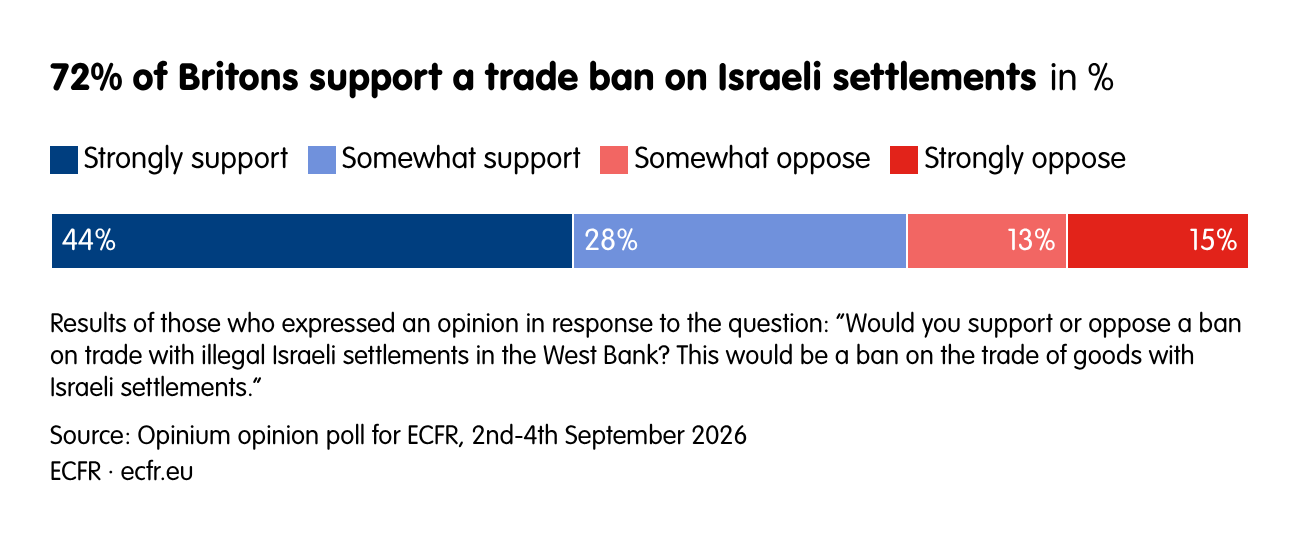
With the British government set to announce new measures targeting Israel’s settlement project, polling by Opinium for ECFR shows that just 18% of UK adults oppose a ban on trade in goods with Israeli settlements in the West Bank and East Jerusalem, compared to 46% who back it. Support rises to nearly three quarters—72% versus 28%—when excluding those who did not voice an opinion.
To date, the UK has sanctioned some two dozen organisations and individuals linked to settler violence. It has also excluded settlement goods from the preferential trade tariffs applied to Israeli products, though stopped short of an outright ban. However, settlement expansion is a state-driven project sustained by domestic economic incentives and foreign financial linkages. Rather than focusing only on its most violent manifestation, a settlement trade ban would challenge these underlying drivers.
Last week, foreign secretary Ed Miliband pledged to go further in challenging Israeli actions that are destroying the possibility of a two-state solution, like the recent construction of the “doomsday” E-1 settlement on the outskirts of East Jerusalem. The settlement ban expected to be announced later today also gives practical meaning to the UK’s recognition of Palestine last year—as demanded by Palestinians themselves. Such action by the British government commands broad support across Britain’s political and regional divides, while opposition is limited.
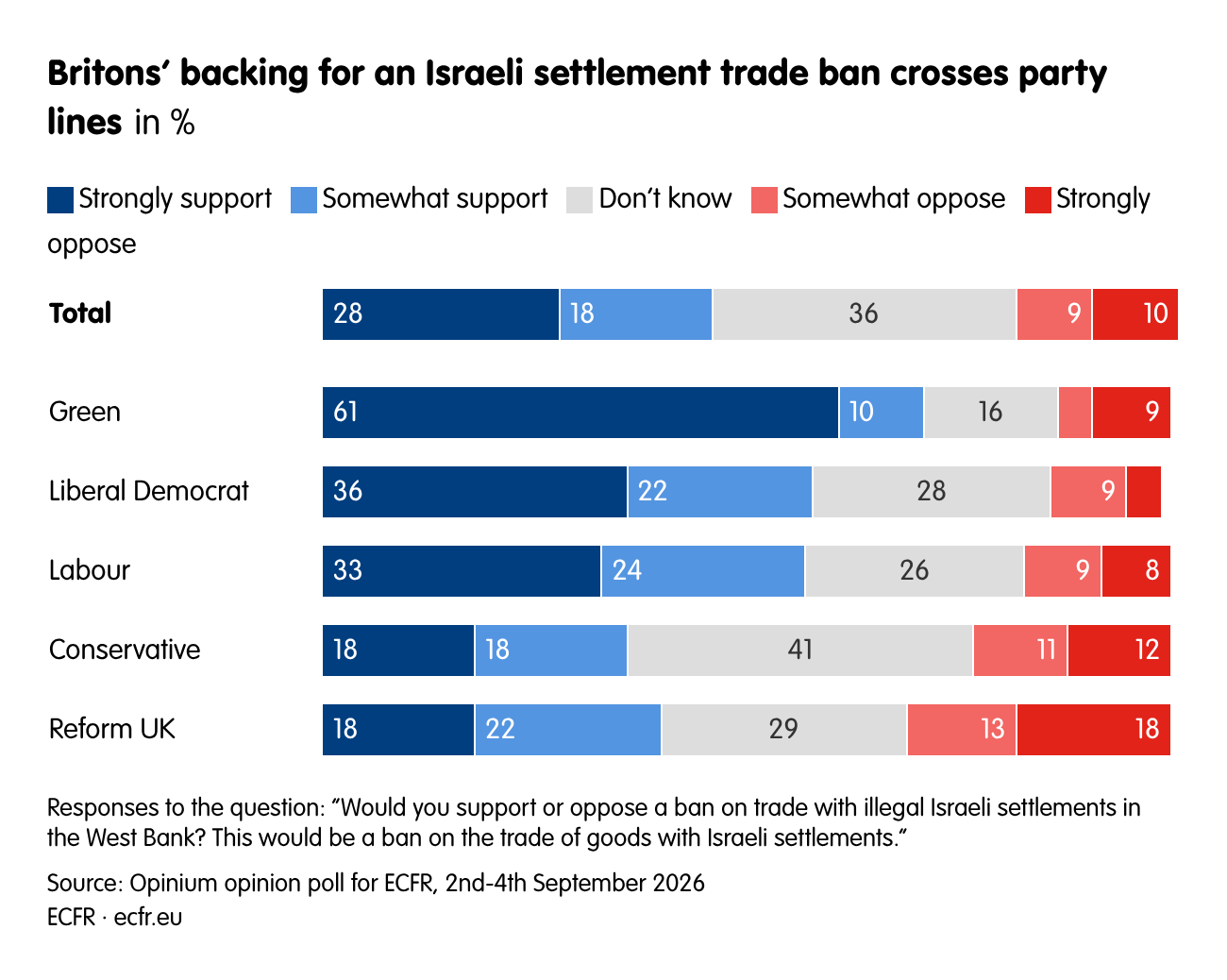
Labour, Liberal Democrat and Green voters decisively favour the proposed ban. It is also strongly supported by voters who have moved away from Labour, many of whom defected to the Green Party amid dissatisfaction with prime minister Keir Starmer’s response to Israeli actions in Gaza and the West Bank. But backing for the measure extends across party lines: Conservative and Reform voters are also more likely to support than oppose it.
The findings cross the Brexit divide too, with supporters clearly outnumbering opponents among both Remain and Leave voters. The same pattern is evident geographically. Support is highest in London and Scotland, closely followed by Northern Ireland, while supporters also outnumber opponents in every English region and in Wales. Indeed, across every political, regional, age and gender group reported in the survey, support exceeds opposition.
The polling also finds that only 16% of British adults consider it antisemitic to target Israeli settlements. Meanwhile, a two-state solution remains by far the most popular outcome for Israel and Palestine with 40% favouring a Palestinian state alongside Israel, compared with 12% who favour a single shared state and just 8% who prefer the status quo of Israel without a Palestinian state.
ECFR’s polling shows a clear public mandate for the UK to take a leadership role in strengthening international efforts against Israel’s settlement project
ECFR’s polling shows a clear public mandate for the UK to take a leadership role in strengthening international efforts against Israel’s settlement project and to defend the viability of a two-state solution. This would build on similar moves by Belgium, Ireland, the Netherlands and Spain in recent months.
The results also suggest the UK government has the public support to go further: extend the ban to investment and financial services, exclude settlements from all UK agreements with Israel (including the convention for the avoidance of double taxation) and prohibit all British business dealings with settlements (including the purchase of settlement real estate). This should go hand-in-hand with additional sanctions targeting organisations that play an instrumental role in funding and sustaining Israel’s settlement project, such as Ateret Cohanim, the Jewish National Fund’s Himnuta real-estate subsidiary, and the Settlement Division of the World Zionist Organization.
At the heart of the new UK government’s policy reset should be a collective push with its Western partners to finally implement the International Court of Justice’s 2024 advisory opinion on Israel’s occupation. The court underscored the duty of states to “take steps to prevent trade or investment relations that assist in the maintenance of the illegal situation created by Israel in the Occupied Palestinian Territory”. To uphold this approach would also help give effect to the 2016 UN Security Council Resolution 2334, which calls on states to distinguish, in their relevant dealings, between Israel and the Palestinian territories it has occupied since 1967.
A settlement trade ban should mark the beginning of a more consequential British policy towards Israeli settlements. The polling shows that British public opinion is supportive. Having recognised Palestine in principle, the UK must now use its economic weight and diplomatic leadership to preserve it in practice.
The meeting of the Core Group’s migration ministers, comprising ministers from Denmark, Austria, Germany, the Netherlands and Greece, concluded in Copenhagen on Friday. Greece was represented by Migration and Asylum Minister Thanos Plevris. According to state-run news agency amna.gr, the ministerial meeting marked an important milestone for European migration policy, with the participating countries advancing […]
This week, Mark Leonard is joined by Ellie Geranmayeh, deputy director of ECFR’s Middle East and North Africa programme, to unpack a volatile new chapter in the confrontation between the United States and Iran. After months of managed escalation, military strikes have resumed and President Donald Trump has launched an ambitious new sanctions package, dubbed an economic “D-Day”, aimed at squeezing Tehran into submission.
Ellie argues that Washington has returned to a familiar strategy of maximum pressure, betting that unprecedented economic isolation and a blockade of Iranian exports will either force the regime to make major concessions or trigger domestic unrest. But Tehran appears determined to hold out, relying on sanctions-evasion networks, regional diplomacy and the belief that the US will struggle to sustain its campaign over the long term. As both sides continue limited military operations while keeping channels for negotiation open, the prospect of a comprehensive deal remains elusive.
The conversation also explores the domestic pressures facing Iran’s leadership, from a shrinking economy and growing public dissatisfaction to the threat of renewed nationwide protests. Mark and Ellie examine whether economic hardship could destabilise the regime, why Iranian leaders remain sceptical of American commitments and how internal politics in both Washington and Tehran are shaping the path ahead.
Finally, they discuss the wider regional and European implications of the conflict. How are Gulf states positioning themselves between the US and Iran? What risks does the confrontation pose to global shipping through the Strait of Hormuz? And can European governments still play a meaningful diplomatic role as tensions rise and fears grow that the Iran conflict could become increasingly entangled with the war in Ukraine?
This podcast episode was recorded on September 3rd 2026.
Joël Kyaviro is a professional cyclist from the Democratic Republic of the Congo who has risen above government instability, war, violence, poverty, and Ebola, overcoming every “tack in his path” to become the first rider from the DRC to win a Union Cycliste International race. What’s more, he’s used his success to get the next generation of kids interested in the sport by founding Tumaini Academy, “a cycling program aimed at transcending war by getting Goméen kids on bikes and in school.”
He rolled into the finish zone alone, a full ten seconds ahead, the cushion so big that he was able to victoriously throw his arms in the air. He coasted the last few meters no hands, grinning ear to ear, as his old club president, Charles Guy Makongo, leapt up and down on the sidelines.
Makongo’s sneakers got soaked in the puddles, but he did not care. In the entire 126-year run of the Union Cycliste International, no Congolese rider had ever won a UCI race. On Instagram that night, a picture of Joël ran with a banner header reading, “A historic moment in Congolese cycling.” Posting on an African cycling forum, Makongo proclaimed, “Today’s victory is much more than a sporting result.” It showed, he said, “that talent can flourish even in the most challenging environments.”
Cover image: picture alliance / Hans Lucas | Imen Ben Youssef
The profile of social activism in North Africa is changing. Young people in the region shifted away from demanding regime change after the thwarted hopes of the 2011 Arab uprisings and the 2019 Hirak movement in Algeria. Now, they tend to seek practical improvements in their social and economic conditions rather than wholesale political reform.
Many of these new social movements focus on environmental concerns, and increasingly on the impact of global warming. North Africa is among the regions in the world most affected by climate change. But its countries are also some of the most promising sites for renewable energy generation, given their abundant sunshine and proximity to the European market. Activists have targeted some renewables projects, testifying to a feeling that authorities are failing to ensure energy transitions are fair and meaningful.
These trends in activism in North Africa match a recent turn in European engagement with the region, away from support for political reform and towards socioeconomic issues. This includes cooperation on clean energy projects. But Europeans should bear in mind that cooperation with North African governments on projects that ignore local interests will fall short of the objective of promoting greater opportunity and long-term stability in the region. This underlines the importance of including local businesses and civil society representatives in initiatives from the very start.
Changing social movements
The Arab uprisings and Hirak protests were driven in large part by social and economic concerns, and sought a political remedy by calling for a change of government. But hopes for better politics have since foundered across North Africa. The region’s protests and social movements now tend to focus on practical and often locally based demands for a more effective state and better services for communities. The 2025 Gen Z protests in Morocco, for example, began as a response to failings in maternity health care before swelling into wider calls for social justice. The shift to more issue-based activism reflects North Africans’ disappointment in past attempts at political reform as well as long-simmering social tensions. These include anger at poor governance and the strain rapid urbanisation puts on jobs and housing.
The shift to more issue-based activism reflects North Africans’ disappointment in past attempts at political reform as well as long-simmering social tensions
But climate change is also encroaching ever more on North Africans’ quality of life. Historically a water-scarce region, North Africa is now experiencing extreme temperatures, rising sea levels, drought and desertification. Once-fertile agricultural land is becoming barren, and flooding from extreme weather events exacerbates the problems for farmers and food supplies. Climate change is also contributing to power cuts and water shortages, as well as catastrophes from flash floods to wildfires. One opinion poll in 2024 showed that one in six people in North Africa had experienced harm from climate change in the previous two years (or knew somebody who had), and that 71% of North Africans saw it as a threat.
With governments often failing to implement policies to mitigate climate impacts, social movements have adopted an environmental focus. These movements sometimes blend protest with community self-help initiatives, and are often local rather than national. Their less explicitly political nature brings them a measure of tolerance by authorities, as does the fact that the movements often pursue environmental objectives that governments also embrace. But activists still face similar restrictions to all civil society movements in North Africa, at times drawing surveillance and repression.
Changing the environment
Such climate-related movements have sprung up across North Africa. In Morocco, a group of Tangier-based NGOs and unions halted a building development that would have involved deforestation, and they now publish an annual report on local environmental issues. Youth for Climate Tunisia trains young people to mobilise on climate issues and organises digital campaigns. The Egyptian group Greenish promotes climate education and capacity building for local communities. Algeria has several community-based groups that work on improving access to water and countering desertification.
Other groups focus on wider environmental concerns. Egypt’s VeryNile pioneered efforts to work with local fishers to collect and recycle plastic pollution from the Nile. In Tunisia, local protests against the impact of phosphate processing in Gabès snowballed after a series of toxic gas leaks in October 2025, becoming a mass movement that continues almost a year later.
But North African social movements also mobilise when green transitions disadvantage local communities and marginalised groups. As North African countries increasingly seek foreign investment in renewable energy projects, some communities worry that land and water resources will be diverted to benefit wealthy elites and foreign investors. In Tunisia, solar projects have aroused local opposition because they take land out of community use and reinforce regional inequalities. In Morocco, solar megaprojects such as the plant in Ouarzazate have prompted anger in nearby communities because of the amount of water they consume.
Changing European policy
One thing that unites these disparate movements is that activists seek concrete improvements in quality of life, as well as a bigger role in determining their countries’ futures. This aligns with an increasing sense in Europe that the best way for the EU and member states to promote rights and opportunity in North Africa is through a focus on socioeconomic development.
As the EU’s 2025 Pact for the Mediterranean showed, European policymakers aim to cooperate with North African partners on tangible initiatives that match local government priorities, including in green energy and water management. But the environment-focused social movements should remind European policymakers that working only with governments is not enough to ensure progress on economic and social rights, as I argued in an ECFR policy brief last year. The EU must frame its projects in a way that gives local populations as much agency as possible, by breaking down barriers for small businesses and including civil society in project design and planning.
The EU must also ensure that the projects it supports genuinely offer mutual benefit. In climate policy, the pact’s logic of “a partnership of equals” means European support for renewable energy projects including solar and wind power and the production of green hydrogen. Such projects would then supply clean energy for Europe and promote North African development as well as reduce local energy costs. In turn, greater opportunities and lower prices in the region could help promote the stability that European policymakers also seek.
But not all climate and environmental projects meet these goals—as the local criticisms show. To fulfil the promise of clean energy projects for both sides, Europeans must complement their investment in power generation with other measures to limit environmental trade-offs and to help benefits to flow to local communities. These should include infrastructure development and technology transfer to build up a local clean energy ecosystem. That is the best way for Europe to help ensure that the aspirations expressed in North African environmental movements are met.
Apparently, African wild dogs enjoy knocking around balls of elephant dung like a football. It’s this playfulness that has endeared them to researchers—but, as Helen Sullivan points out, they have their work cut out for them trying to protect this persecuted big predator. Sullivan follows conservationists in southern Africa who are carefully managing tiny, isolated populations and attempting to introduce genetic diversity. The story of the three sisters who are flown over from Mozambique to be introduced to Waterberg—a South African municipality three hours from Johannesburg—is heart-wrenching. Yet in such a harsh environment, individual tragedies have to be endured while staying focused on the bigger picture: the fragile recovery of the species as a whole.
As we help Greyling and Hlako lift a crate off the pickup, a dusty paw flops out of one corner, and I think of something my uncle says: “You can smell the world in a dog’s paw.” Mooney and I back away, watching from inside a container as Hlako moves the car so that the overheating dog is in the shade. Though it is late afternoon, the temperature is still around 90 degrees.
Hlako and Greyling release the dogs one at a time, opening the crate and waiting until a dog walks, then trots, out. The first is less sure on her feet, the second seems almost normal, until Mooney points out that she would have run much faster from the crate and people had she not still been a bit dozy. The sisters stand together in a grassy area, point their noses in the air, move their satellite-dish ears and lie down under a thorn tree; it has been a long day.
This week, Mark Leonard is joined by Hugh Lovatt, senior policy fellow at ECFR, to unpack a turbulent summer in Israel and the Palestinian territories. While Palestinian factions in Gaza have agreed in principle to decommission their weapons , the proposal faces significant obstacles, not least opposition from the Israeli government. Meanwhile settler violence is surging and settlement construction is spreading, redrawing the map faster than any negotiation could.
Hugh explains why a sustainable ceasefire cannot rely on disarmament alone but requires a broader political process that addresses the future governance of Gaza and creates a pathway towards a two-state solution. He also explores why developments in the West Bank could prove just as decisive as those in Gaza, and what role Europe can play in responding to settlement expansion and growing instability.
Against this backdrop, Israelis are preparing to head to the polls on October 27th . Mark and Hugh examine the state of the race, the challenge facing Binyamin Netanyahu, Israel’s prime minister and whether a new government would bring meaningful policy change, or simply a different style of leadership. How much do Gaza and the West Bank matter to Israeli voters? Could an opposition victory create space for greater pragmatism? And what would that mean for Europe’s approach to the conflict?
This podcast episode was recorded on August 24th 2026.
Previously operating as NetGuardians, Vyntra has spent a decade helping East African banks fighting financial crime, screening more than two billion transactions annually across the region and expanding its capabilities into broader transaction intelligence.
Vyntra’s presence in East Africa began with its Nairobi operations as NetGuardians in 2016 and has since grown into a Service Excellence Center, supporting banks across the region. The company marked the milestone with a private reception at its Nairobi office, bringing together senior executives from banks across the region and members of the local team. The event also highlighted how the offering has evolved following the 2025 merger, bringing fraud detection, payments compliance, AML transaction monitoring and end-to-end transaction visibility together within one transaction intelligence platform.
East Africa’s payments market has changed significantly over the past decade, driven by the early adoption of mobile-first payments such as M-Pesa. Vyntra’s work in the region has evolved with it, from IT log monitoring and behavioural fraud analytics to broader financial crime and payments capabilities.
Fraud patterns have also changed. Earlier cases often involved internal fraud, while the Covid-19 time period saw a sharp rise in social media scams targeting bank customers. Today, banks across the region face threats including SMS impersonation, fraudulent investment schemes, SIM swaps and organised money mule networks. As fraud has become more organised and regulatory scrutiny has increased, real-time monitoring and stronger financial crime controls have become a greater priority for banks across the region. Kenya’s inclusion on the Financial Action Task Force grey list accelerated that shift, bringing financial crime further into board-level discussions.
In response to these shifts, Vyntra is expanding its capabilities across fraud prevention, AML monitoring and payment operations, including a new case manager, executive dashboard, fraud detection algorithms and frontline case view designed to give teams more context during investigations.
Wycliffe Muma, Director Service Delivery and Country Manager at Vyntra, said: “Ten years in East Africa is an important milestone for us because the business we have built here has grown alongside our customers and the market. The fraud landscape is very different from when we first arrived, and banks are now dealing with faster, more organised threats across more complex payment environments.”
“The merger with Intix was an important part of that evolution. It gave us a much broader view of the transaction journey, which matters when fraud moves across channels, systems and institutions. The anniversary was a chance to recognise the customers and colleagues who have been part of that journey, but also to show how we are continuing to develop the platform around the challenges banks are facing now.”
Joël Winteregg, CEO of Vyntra, added: “Transaction Intelligence in Africa is moving beyond financial crime detection and transaction visibility toward something more fundamental: understanding a bank’s customer identity. That will shape how banks detect risk and respond to increasingly complex financial crime.”
Vyntra, created from the union of Intix and NetGuardians, is the new global force in AI-powered Transaction Intelligence, combining deep expertise in Financial Crime Prevention and end-to-end visibility, Vyntra equips over 130 financial institutions in 60+ countries with tools to detect fraud, ensure AML compliance, and gain real-time visibility into every transaction risk and respond accordingly.
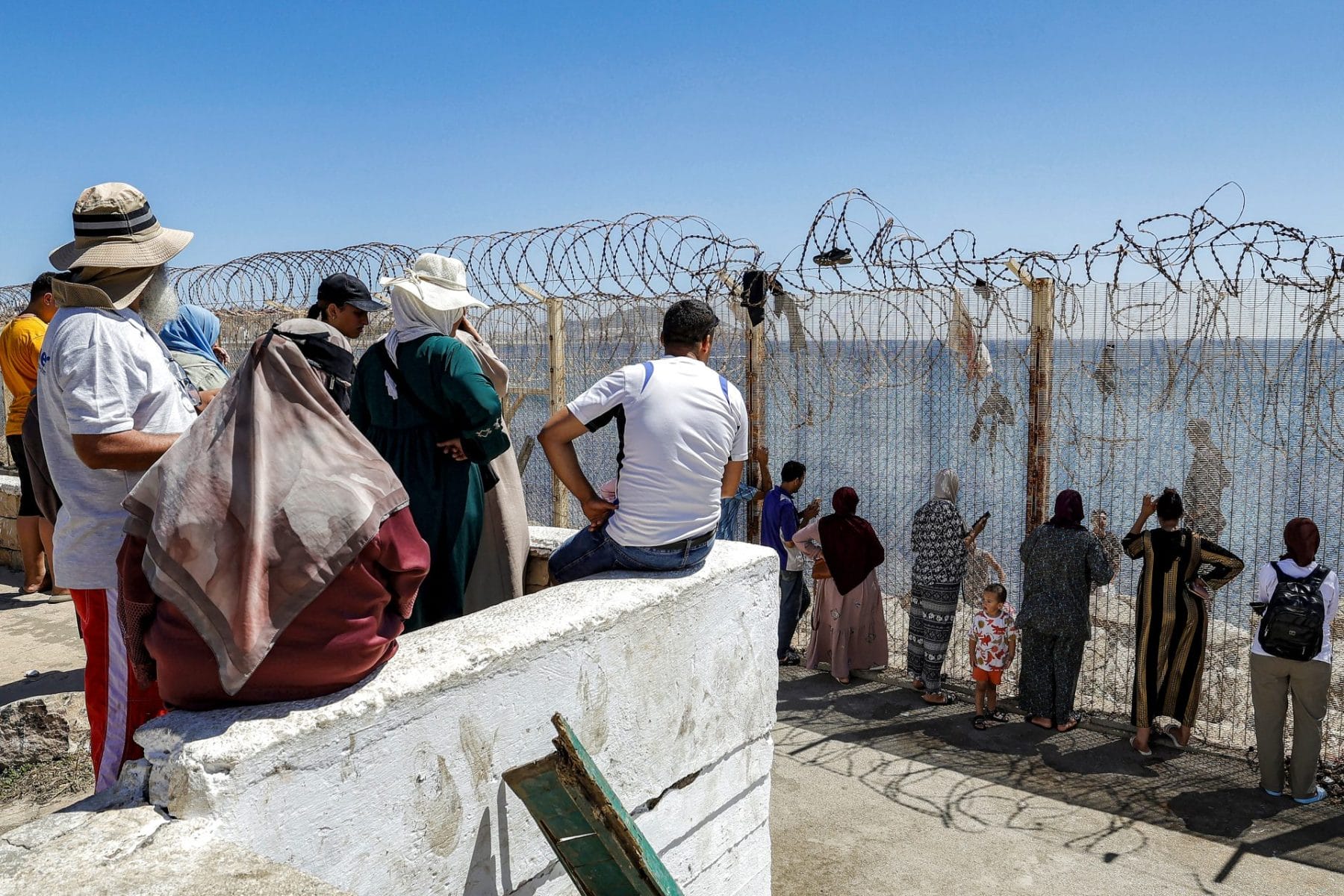
A ride from Tangier, the largest city in northern Morocco to the Spanish enclave of Ceuta takes less than two hours. The border crossing has its own, sleepier rhythm, quite different from the tourist-driven bustle of Tangier. In Ceuta, traders run their errands, Morocco-based expats make visa runs and Spanish people catch ferries to the mainland. On most days, the border crossing seems almost ordinary. The fences, though menacing and topped with razor wire, are less imposing up close and officers make small talk with the expats waiting to get their visas stamped.
Then there are those days when the routine collapses and Ceuta becomes the center of Europe’s migration debate.
The territory is a geographic and political paradox. Despite falling under Spain’s — and the European Union’s — jurisdiction, it sits on the northern edge of Africa, surrounded by Morocco and separated from the Spanish mainland by the Strait of Gibraltar. It is an entry point to Europe, yet not fully part of the Schengen zone, requiring additional immigration checks for travelers crossing to the mainland.
When more than 60,000 people — mostly Moroccan men and teenagers — rushed into Ceuta (almost doubling the coastal city’s population), the images reverberated across Europe. There seemed to be no dramatic buildup to the incident, nor any obvious explanation why thousands of people chose that day to make their way to Spain.
Europe’s far-right politicians seized the narrative, portraying the influx as an imminent invasion, warning that the men were on their way to “Calais” and “Germany.” Italy temporarily suspended the Schengen free movement regime with Spain, meaning travellers arriving by sea and air would now be subject to border checks. Spain threatened to take “proportional measures” in response and did so at midnight on August 8, when it imposed similar checks for visitors from Italy.
The standoff between European governments — led by socialist Pedro Sánchez in Spain and conservative Giorgia Meloni in Italy — is not simply a test for European border security. Instead, what transpired in Ceuta poses bigger questions about the shifting nature of state sovereignty itself: How are we to understand borders, if they’re shaped by forces beyond the state’s reach?
Borders are not just lines separating geographic entities. They are systems built on surveillance, diplomatic bargains and digital networks. Ceuta is the place where all three converge. Its borders, already protected by the sea, have been fortified with steel, outsourced through diplomacy and tested by coordinated rumors.
Steel
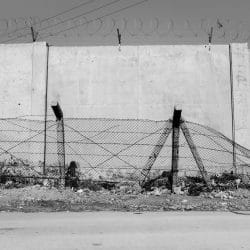
The crossings into the enclave are blocked by a multi-layered barrier of fences and wire. Morocco administers a fence separating it from the neutral area between the two countries. Two fences on the Spanish-controlled territory follow, creating an enclosure monitored by the Spanish Civil Guard. The physical infrastructure is reinforced with motion sensors, thermal and CCTV cameras, maritime communication systems and facial recognition technology.
Even the sea has now been incorporated into the border system. Just three days after the Ceuta border chaos, Spanish authorities installed a 500-metre floating barrier and anchored naval buoys to create another monitored enclosure.
The EU has funded most of the fortifications. The Border Violence Monitoring Network’s report says that since the construction of Ceuta’s border barrier in the 1990s, the EU has spent tens of millions of dollars to make the Spanish-Moroccan frontier more secure, technologically up-to-date and heavily surveilled. With the recent mass crossing, Spain will now receive additional emergency financial aid.
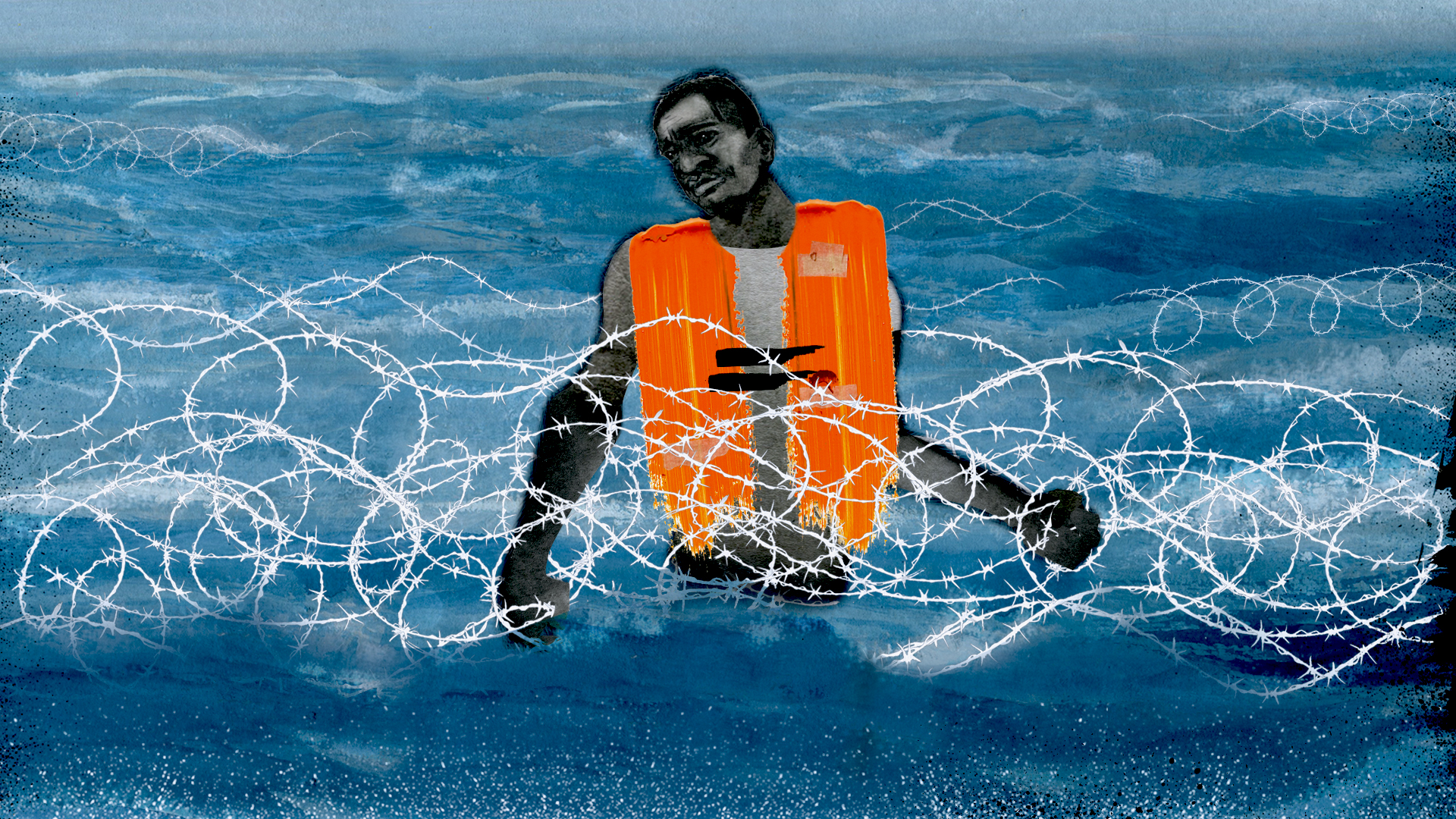
Yet, the architecture of physical surveillance, built and re-built with European money for decades, cannot prevent the human cost of attempting to cross a border. In Ceuta alone, at least 100 people died according to local authorities. “The rationale behind increasing surveillance is that you'll be able to save lives and smash the [people trafficking] gangs, right?” asked Nathan Akehurst, who has written about Ceuta’s border for Jacobin. “Where was that in this case?”
Diplomacy
Akehurst’s question touches upon the human-centered rationale for heavy border surveillance. But there is also a political one. It is not only Spain, as a EU member, that receives funds to manage migration. Morocco has received €427 million since 2015, for migration-related expenses, including technology and training. That’s part of Europe’s wider strategy of border externalization, a practice where Europe moves border control beyond its own territory.
The practice has been around for decades, but went into overdrive after 2015, when approximately 1.3 million people, mostly from Syria, came to the continent seeking asylum. Many of them reached Europe through Turkey, prompting the EU to strike a deal with Ankara: €6 billion in funds, visa liberalization and EU-ascension negotiations in exchange for stricter border controls and curbing irregular arrivals to Greece. The EU also agreed to resettle within Europe one Syrian from Turkey for every Syrian returned to Turkey from Greece. But by 2020, when the EU failed to resettle Syrians, Turkey’s president Recep Tayyip Erdoğan declared he would no longer prevent migrants from crossing Turkey en route to the EU.
“Border externalization is basically paying other countries, but also subjecting them, through a carrot and stick approach, to performing functions that are usually performed by a state itself at their borders,” explained Josephine Solanki from the Transnational Institute, an Amsterdam-based think tank. It leaves space for leaders like Erdoğan, Solanki added, to bargain for influence by turning migrants “into political leverage.”
The cost of outsourcing borders is not just material. It is measured in control that Europe cedes to the foreign governments it relies on for migration policy enforcement.
Relatives and friends waited by a fence topped with barbed-wire for the return of people who had previously crossed into Ceuta. Spanish authorities claim to have sent almost everyone back to Morocco. Abdel Majid BZIOUAT / AFP
In Ceuta, migrants claimed local authorities did not stop them from crossing the border. A young Moroccan man told the New York Times a day after the event: “They opened the border and let everyone go by.”
Border outsourcing agreements were made, among others, with authoritarian regimes in Tunisia, Egypt and Libya, where EU funds were used to detain migrants and quell domestic protests, rights organizations say. Alliances with “deeply unreliable and authoritarian actors” in the name of stability, said Nathan Akehurst, “is short-termist, insane and loses Europe any credibility it has left.” These alliances also allow Europe to “shift the blame to the Moroccans, the Eastern Libyans, the Turkish or whoever decides to take advantage of that moment.”
Rumors
It is yet to be revealed who, if anyone, has taken advantage of the mass crossing into Ceuta. Local and international media have uncovered now-deleted posts that shared tips on routes and equipment for the journey. One of the main networks was called Hrig Sebta network — “Sebta” being the Arabic name of Ceuta and “hrig” being the Maghrebi term for undocumented migrants, literally referencing the burning of identity papers.
In the wake of Ceuta, European ministers pledged to tackle online misinformation to avoid migration crises, but remained cautious when asked about thousands of posts reportedly linked to Russia. Other theories attributed the crossing to Morocco’s tensions with Spain over its closer ties with Algeria, or to Spain’s position on Palestine.
But those rumors, and what appears to be a weeks-long coordinated online campaign behind them, reveal something deeply human that fences can’t deter: movement that is spurred by hopes for a better life.
“[The crossing] would have happened anyway at some point,“ Akehurst argues. “There would have been a crossing because all of the circumstances that generate that are already there before someone with a twitter account throws a match on the fire.”
Yet, let’s pause at the match. It’s not about someone with a social media profile creating chain messages. It is about the ecosystem that can jeopardize borders by creating information flows, turning rumors into perceived opportunities.
Moroccan newspaper TeleQuel already published a report about social media posts amplifying the next hrig — another attempted crossing into Ceuta — on August 15.
When packaged to a hungry audience, rumors carry the currency of truth. They’ve driven migration long before social media was even conceptualized. Now those rumors speed through digital space owned and operated by private companies not prone to accountability and sitting well outside the reach of any single state.
And the EU has understood that for years. “It is necessary to structure the information space, as we have organized in the past the territorial space, the maritime space and the air space,” Thierry Breton, the European Commissioner for Internal Market of the EU said back in 2018. He warned about Big Tech companies treating digital space as a no-man’s-land that they would write rules for.
The no man’s land between Morocco and Spain appears calmer now. But the turmoil of the crossing revealed a new, digital dimension to border governance. Information has always found a way to spread; digital platforms have given it new channels: ones which allow those behind the information to remain faceless, while the information itself passes from screen to screen. It reaches a boiling point, spills over from the digital space and then can be disappeared, even before anyone has had a moment to scroll back.
Cover image: picture alliance / NTB | Fredrik Varfjell
Recycling is no longer just an environmental obligation. It has become a geoeconomic imperative directly linked to Europe’s energy security and industrial competitiveness. The European Commission’s Critical Raw Materials Act reflects this change—it has set an ambitious target to source at least 25% of the EU’s annual consumption of strategic raw materials from recycling by 2030.
Europe, however, is making little progress. A recent European Court of Auditors’ report suggests that seven of 26 energy-transition-related minerals have recycling rates between 1% and 5% in the EU. This means, for example, that Europe is recovering just three tonnes from every 100 tonnes of natural graphite contained in batteries. According to the report, there are another ten minerals that Europe does not recycle at all, including lithium, gallium and silicon metal.
As such, recycling battery materials warrants far more attention. This valuable source of critical minerals could lower the continent’s dependence on Chinese mineral value chains; recycling battery materials is also much quicker than relying on the development of mines elsewhere that produce the same materials. However, fragmentation, red tape and unfavourable economics are hampering Europe’s recycling efforts, in part due to a regulatory framework that still treats battery materials as hazardous waste rather than a source of strategically important minerals.
Europeans need to focus on battery materials regulation with an industrial policy lens and pursue strategic partnerships with African countries to make gains in material recovery.
Using black mass and EVs
Recovered minerals from Europe’s waste—including end-of-life electric vehicle (EV) batteries, wind turbines, industrial parts and electrical wiring—are insufficient to meet all of Europe’s mineral needs. However, they can substitute for a share of primary minerals from mining, which would help Europeans derisk from Chinese mineral supply chains far quicker than new mines can come into production.
Europe will have relatively significant EV battery feedstock for recycling in coming years. Europeans were early adopters of EVs and European countries are global leaders in terms of EV sales as a share of total car sales: in Sweden, Denmark and the Netherlands, for example, EVs account for 58%, 56% and 48% of passenger-vehicle sales respectively, while fully electric vehicles comprise 22.6% of cars registered in the EU. High EV adoption means Europe should have a solid supply of EV battery feedstock for recycling facilities, provided it keeps this within the EU for recycling.
In March 2025, the EU re-classified “black mass” (the shredded EV battery waste processed to recover critical minerals) and end-of-life lithium-based, nickel-based and zinc-based batteries as “hazardous waste”. Black mass is important because it contains valuable critical minerals; if Europeans can process this within its borders, it can feed recovered minerals into European industry. This new classification prohibits export of black mass to non-OECD countries, while requiring that shipments within the EU and the OECD have prior notification and consent from the import, export and transit countries involved.
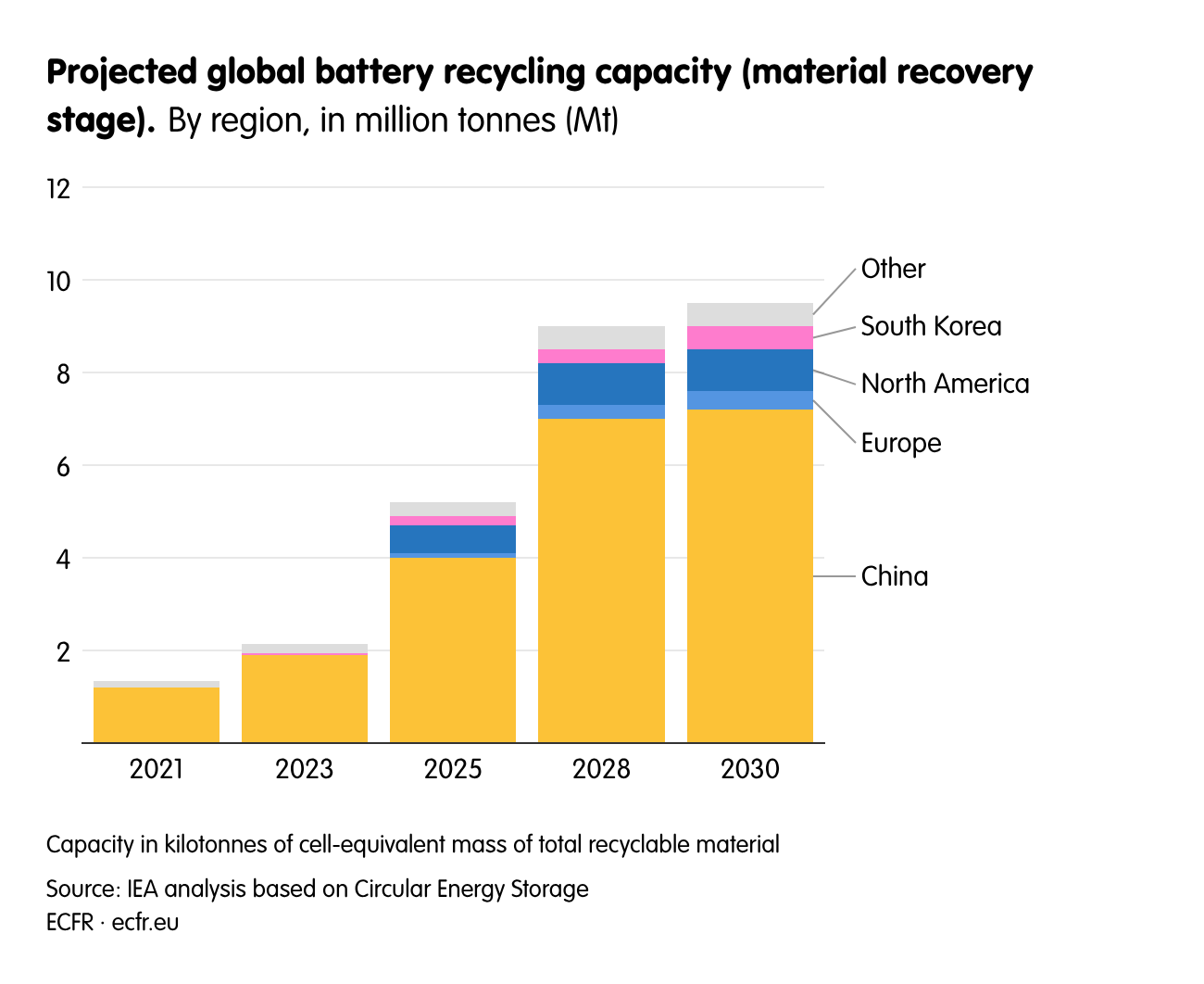
Europe currently exports around 80% of its black mass for refining elsewhere, mostly in Asia; South Korea’s OECD status and cheap recycling capacities make it a key destination, for example. The reclassification of black mass raises bureaucratic barriers to exporting out of the EU, contributing to efforts to prevent recycling feedstock leaking out. However, black mass is now more difficult to move within Europe, too, which makes aggregating feedstock for recycling within the EU a challenge. While Europe has some battery shredding (or pre-treatment) capacity to produce black mass, its refining capacity to recover minerals from black mass has lagged significantly.
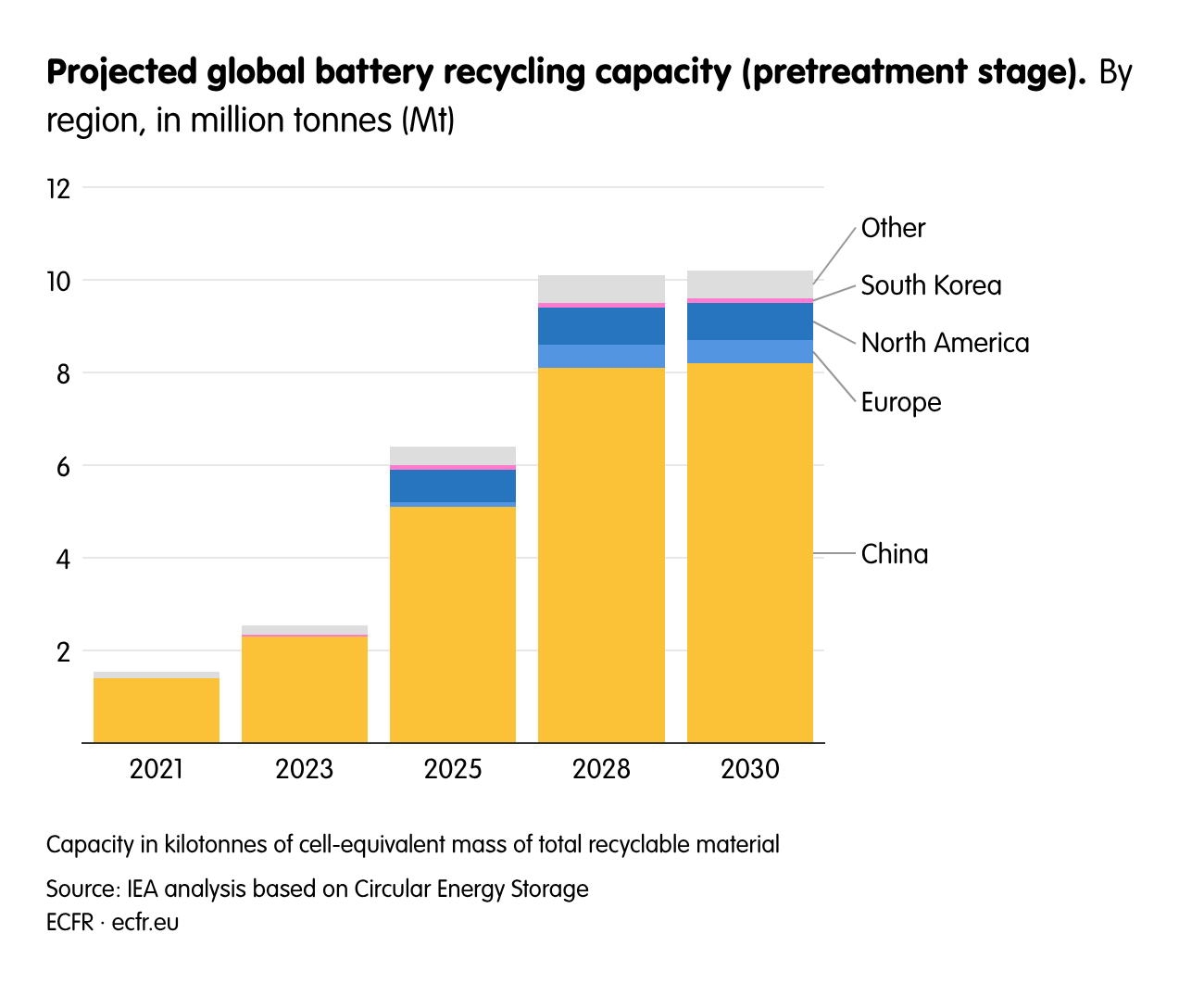
Although forecasts suggest that Europe will slightly raise its material-recovery capacity in the coming years, it remains a minor player. China’s dominant share in global battery recycling capacity for the shredding and material recovery stages, which exceeded 80% in 2025, is set to continue.
Recent analysis estimates that the costs of hydrometallurgical recycling for nickel manganese cobalt (NMC) and lithium iron phosphate (LFP) batteries are respectively 70% and 67% higher in France than in China due to higher labour, energy, environmental compliance, dismantling and transport costs in Europe. China’s scale of feedstock—domestic supply of end-of-life batteries, scrap metal from the local automobile industry, and imported batteries and black mass—has further lowered their recycling costs.
Making battery recycling happen in Europe
The EU can take three clear steps to increase recycling black mass in Europe.
First, Europeans should implement stricter export restrictions on black mass and batteries to fully close off exports and retain the products for material recovery domestically.[1] The US took this position in July 2026, with President Donald Trump empowering federal officials to block exports of end-of-life batteries and electronic waste to contain these products for recycling within the US.
Second, Europeans need to urgently build more recycling capacity to refine black mass: Europe’s hydrometallurgical recycling capacity is less than 3,000 tonnes, which is around one-sixtieth of China’s. Estimates suggest that Europe needs the capacity to recycle 120,000–135,000 tonnes of black mass per year by 2030.
Third—and perhaps most challenging—Europeans need to ensure recycling in Europe becomes more economically viable. Failing this, tough export restrictions will lead to battery waste being stockpiled rather than recycled.
To achieve the above, Europeans need to develop new financing mechanisms—such as building recycling costs into the purchase price of products and using public finance to help offset recyclers’ higher costs in Europe—to make recycling more economically viable. This would be particularly timely as battery technology shifts from NMC to LFP batteries: since the latter are comprised of less valuable minerals, recyclers earn less from the sale of recovered minerals, necessitating support for project viability.
The provision of public finance, preferably at both the EU and member-state level, would help in the development of new technologies and processes that lower recycling costs by reducing energy requirements and improving recovery rates. Patent filings in battery recycling are growing significantly, with 2026 figures showing a 103% growth in filings (adjusted for lag). China leads in patent applications, although US and European companies—notably Belgium’s Umicore—are also active. To make Europe more globally competitive in recycling, Europe must increase its investments in innovation using public finance support.
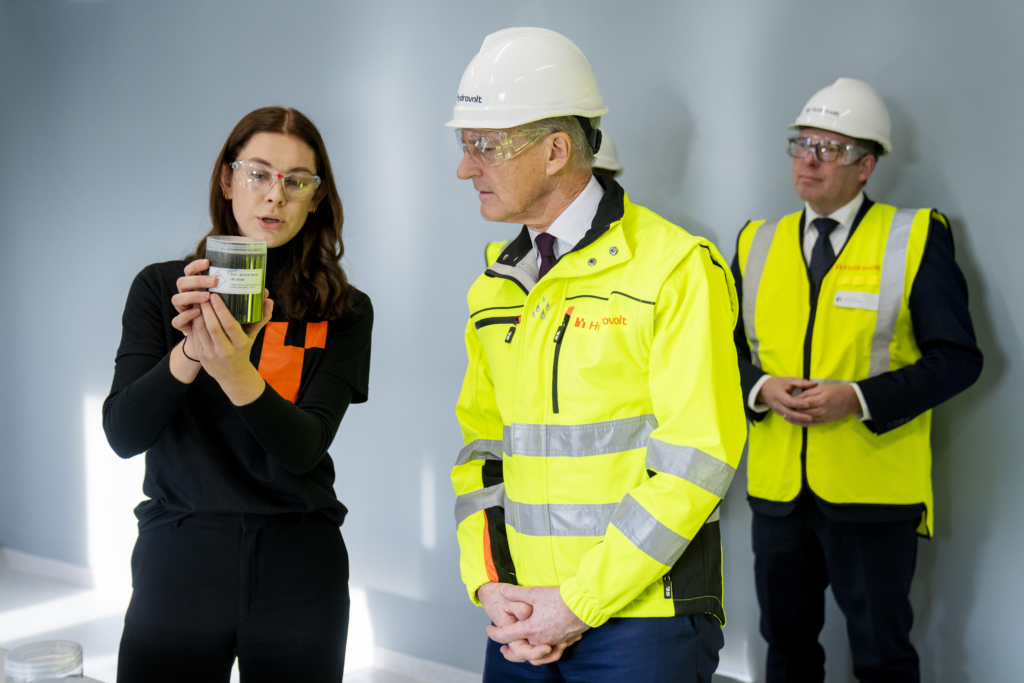
Europeans also need to establish a strong domestic value chain. European battery recyclers, such as Germany’s Cylib and Tozero and Norway’s Hydrovolt, should identify and establish commercial agreements with EU-based offtakers for the minerals they recover—after all, if Europe has to export recovered minerals outside its borders for want of domestic offtakers, gains in recycling will be for nothing. Specifically, this requires European industry that uses recovered minerals (alongside primary source minerals from mining) to refine precursor cathode active material (pCAM) and cathode active material (CAM) stages for EV batteries.
Pursuing EU-Africa partnerships
Europeans should also look internationally to ensure recycling can feasibly reduce existing mineral supply chain dependencies. The EU needs to tap into other recycling feedstock markets and diversify its mineral supply chains by establishing recycling partnerships with OECD and non-OECD countries.
Indeed, the EU has explicitly included recycling within the remit of some strategic partnerships on critical minerals that it has signed with partner countries, including several African countries such as Namibia. By locating recycling and mineral-processing facilities in African countries, they can tackle the cost disadvantages Europeans face with regard to energy, land and labour costs on home soil. Namibia and Kenya are ideal partners: both have transport corridors and port infrastructure that make them well positioned to aggregate regional battery and electronic waste (e-waste); they can harness their abundant renewable energy resources can power material recovery facilities.
EU-Africa cooperation on recycling would also be advantageous to African countries. Joint operations create jobs, expand African mineral processing capabilities and link African mineral supply chains with European industry. Africa-based recycling facilities could also manage the growing quantity of end-of-life batteries and e-waste generated by African countries, notably from solar panels, energy-storage batteries and EV batteries from smaller two- and three-wheeler vehicles.
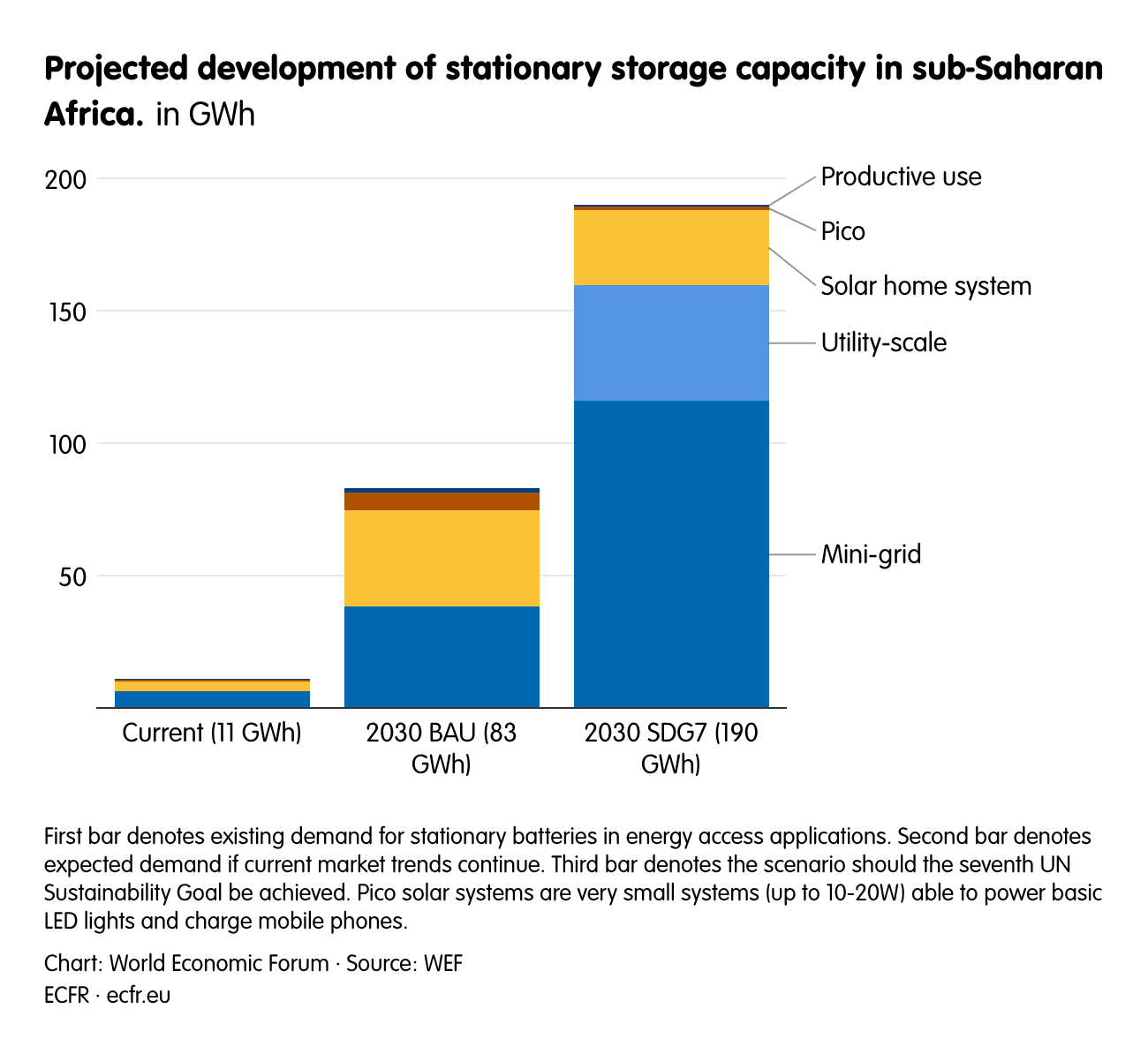
Sub-Saharan Africa’s projected growth in stationary storage capacity alone is significant: following current market trends, it will expand dramatically by 2030, with a storage capacity increase from 11 GWh to 83 GWh. If the region achieves universal access to electricity (SDG7), demand could more than double that, reaching a storage capacity of 190 GWh.
Europe’s road ahead
More recycling facilities are required to handle Africa’s growing volume of end-of-life battery feedstock. This presents an opportunity for growth both in Africa-based recycling, and in Africa-Europe recycling cooperation. However, this is not straightforward. Africa-Europe recycling partnerships need to invest in formalising supply chains for collection and storage; they need to build facilities for shredding batteries and e-waste; and they need to ensure that they can refine black mass to recover valuable materials. They would also need to develop the workforce skills and local-firm capabilities needed for efficient, environmentally-sound operations throughout the supply chain.
For African countries like Namibia and Kenya, such cooperation creates jobs and builds recycling capacity and expertise while integrating African mineral industrialisation into EU mineral supply chains. Recycling operations could also serve as anchor customers for increasing electricity generation and transmission investments in African countries, while local populations also benefit from improved electricity availability. Additionally, recycling in African countries helps address the continent’s growing e-waste management challenges.
For Europe, the increased recovery of critical minerals both domestically and through recycling partnerships with African countries offers greater supply chain diversification, access to minerals from non-OECD black mass and de-risking from Chinese mineral supply chains. All of this will happen faster than if Europeans continue to rely on global mine development. Europeans need to extend their strategic thinking beyond their borders, advancing recycling cooperation through critical minerals partnerships.
[1] Interview with a representative of a mineral analytics company, February 19th, 2026.

 Login