 Login

UAE Rescues 22 Crew Members After Oil Tanker Catches Fire In Gulf
Oct 10 (Reuters) – The United Arab Emirates National Guard said on Saturday it had rescued 22 Asian crew members after a fire broke out aboard an oil tanker in Gulf waters....

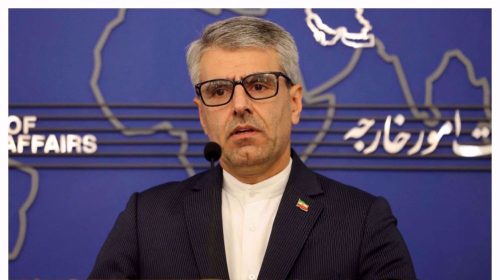
Press TV – October 7, 2026
Iranian Foreign Ministry spokesman Esmaeil Baghaei says the United States and the Israeli regime have a history of manufacturing false-flag incidents only to clean up their messes around the world.
In a Wednesday post on his X account, the Iranian official said such scenarios would not save them from the quagmire of the aggression against Iran.
Baghaei said telling lies about Iran and accusing it of having a role in security incidents would fail to justify the US-Israeli aggression against the Islamic Republic.
“In a world where the American and international public is weary of an unlawful war of aggression against Iran, and where the aggressors have no honest way to justify a war of choice, even a raft made of lies can look like salvation to those who are drowning,” he said in the post.
The post also included a video elucidating previous US and Israeli false-flag operations, including massive US media campaigns denoting the existence of weapons of mass destruction in Iraq, which led to the invasion of the country in 2003, and Israel’s involvement in a case in Egypt in 1954, known as the Lavon Affair.
“False flags are an old craft: manufacture the incident, assign the blame, and harvest the consequences,” said Baghaei.
The post came after officials in the US and allied countries suggested that Iran may have had a role in recent security incidents, including on a Flydubai flight from the United Arab Emirates to the Israeli-occupied territories and in a suspected plot against an American base in Britain.
Iran has roundly rejected the accusations, calling them a pretext for launching renewed aggression against the country, months after the US and the Israeli regime were forced to end a previous offensive under a ceasefire reached in mid-April.
A major new investment commitment announced during President Sheikh Mohamed bin Zayed Al Nahyan’s (pictured) state visit to Berlin signals a deeper economic relationship between two countries looking for reliable partners in an increasingly uncertain world.
The United Arab Emirates has announced plans to invest an additional €40 billion in Germany, one of the most substantial signals yet that the economic relationship between Europe’s largest industrial economy and the Gulf state is entering a new phase.
The commitment, announced during President Sheikh Mohamed bin Zayed Al Nahyan’s state visit to Germany, will target sectors including industry, advanced technology, artificial intelligence, digital infrastructure and energy. Of the total, €10 billion is set to be invested in the German state of Bavaria.
The headline figure is striking. But its significance goes well beyond the amount involved.
The UAE has already invested around €34 billion in Germany. The new commitment therefore represents not simply another large capital allocation, but an attempt to deepen a relationship increasingly built around the industries and technologies that both countries see as central to their future competitiveness.
As Dr Sultan Ahmed Al Jaber, UAE Minister of Industry and Advanced Technology and Envoy of the Minister of Foreign Affairs to Germany, put it: “The UAE invests for the long term and builds partnerships that endure.”
For Germany, the fresh injection of long-term capital arrives at an important moment.
The country has formidable strengths in engineering, manufacturing, chemicals, industrial technology and applied research. Yet maintaining that industrial position is becoming ever-more expensive. Artificial intelligence, digital infrastructure, advanced manufacturing, energy systems and industrial decarbonisation all require substantial investment at a time when German companies are also confronting higher costs, geopolitical uncertainty and growing international competition.
The UAE brings a different set of strengths: investment capacity, energy expertise, digital infrastructure and commercial connections across the Gulf, Asia and Africa. The logic of the partnership is therefore not simply that one country has money while the other needs investment. It is that their economic capabilities are increasingly complementary.
This synergy is reflected in the sectors identified for the new commitment. Rather than focusing narrowly on established assets, the investment is intended to support areas expected to shape industrial competitiveness over the coming decades.
Al Jaber said the intention was to support “the industries, technologies and skilled jobs that will drive future growth and competitiveness”, while strengthening energy security and supply chains and helping German companies continue to grow internationally.
That last point matters because the relationship works in both directions.
Germany gives Emirati investors access to one of the world’s deepest industrial and technological ecosystems. German companies, meanwhile, increasingly see the UAE not simply as a domestic market but as a platform from which to reach faster-growing economies across the Middle East, Africa and Asia.
The two countries’ economic relationship has already strengthened significantly in recent years, with a number of notable examples of cooperation. Emirati investment has reached sectors including chemicals and offshore wind, while leading German companies have become increasingly embedded in the UAE economy, with bilateral trade worth more than €13 billion last year, an increase of 15% compared to the previous year.
The new €40 billion investment marks a significant new phase of this deepening relationship, and the timing of the announcement also gives it a wider geopolitical significance.
German President Frank-Walter Steinmeier captured the mood during the state visit when he observed that “the world has become a more turbulent place; old certainties are crumbling.” Against that backdrop, he argued that reliable and rational partners mattered more than ever, telling Sheikh Mohamed: “Germany is that kind of partner for you; you are that kind of partner for us.”
Those comments go to the heart of why Germany and the UAE’s economic relationship now matters far beyond the balance sheet.
Russia’s invasion of Ukraine exposed the risks created by concentrated energy dependencies for Germany and countless other countries in Europe and around the world. Conflict in the Middle East has again demonstrated the vulnerability of trade routes, energy markets and supply chains. Global competition over AI and other critical technologies has made industrial capacity a highly strategic question as well as an economic one.
Both Germany and the UAE have reasons to diversify their partnerships in response.
Germany needs capital, energy relationships, technology partnerships and access to growing markets. The UAE is seeking to diversify an economy historically built around hydrocarbons while deepening its position in advanced technology, industry and global investment.
The €40 billion investment is a powerful statement of intent and a reaffirmation of a long-standing partnership between the two countries that could transform their industrial and technological strategies for years to come.
Al-Dhaheri added that the exhibition also works to protect falconry traditions for future generations.
The post Rare white falcon’s Dh1.5 million sale at ‘ADIHEX’ 2026 breaks the internet appeared first on BOL News.
Greece is considering to deploy two Apache attack helicopters to the United Arab Emirates with the aim to hunt drones. The two AH-64D Apache attack helicopters will provide support for the protection of military bases and critical infrastructure against drone attacks. Under the mission, Greek pilots and technical personnel are planned to serve at a base […]
The post Greece to deploy two Apache helicopters in United Arab Emirates appeared first on Keep Talking Greece.

