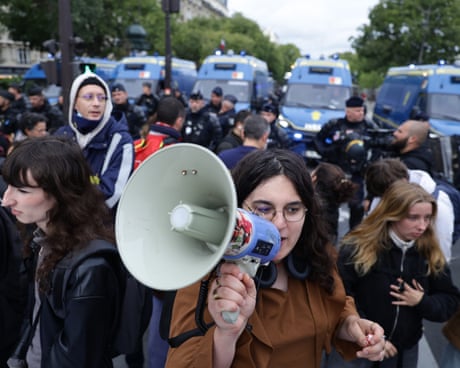
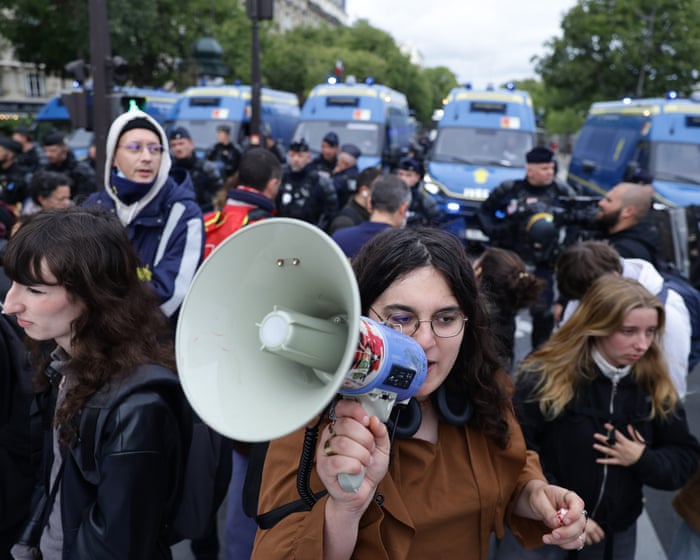
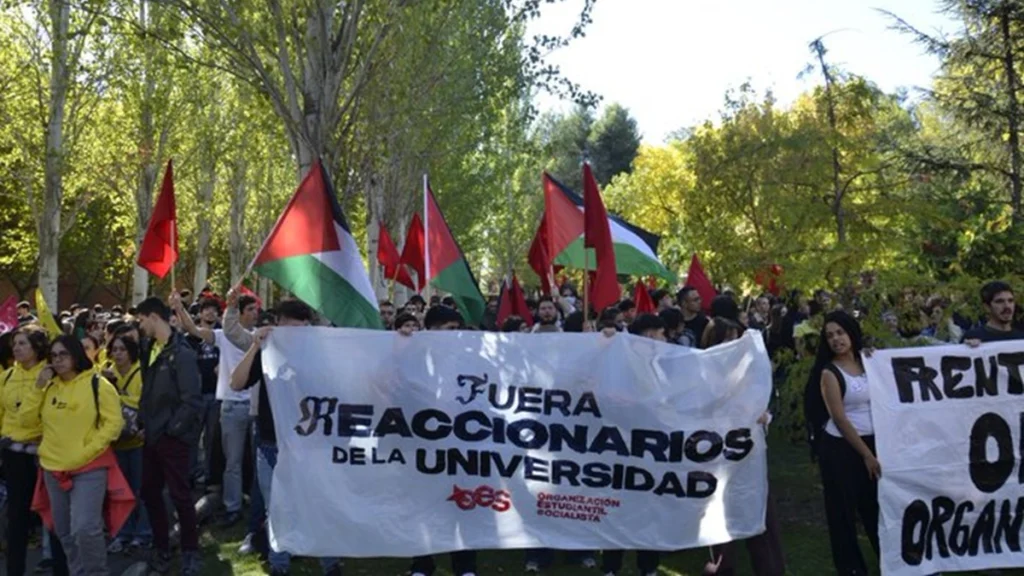
The months-long protests in Albania have reached a new escalation, with university students strengthening their mobilization since mid-October.
Concerns about study expenses, poor employment prospects, and low wages have added impetus to a movement that has demanded the resignation of Prime Minister Edi Rama and urgent action on the widespread corruption weighing on the country.
“Students have brought the Flamingo Revolution into a new phase,” wrote the Solidarity Albania platform. “In a capital where living costs devour 170% of the median net wage, public universities are starved to force youth into economic exile.”
“When a generation rises for its basic rights, the only legitimate response is total solidarity,” they added.
“Tirana’s struggle stands shoulder-to-shoulder with student strikes in France and India, and with liberation struggles in Palestine, Sudan, and the Congo, and elsewhere.”
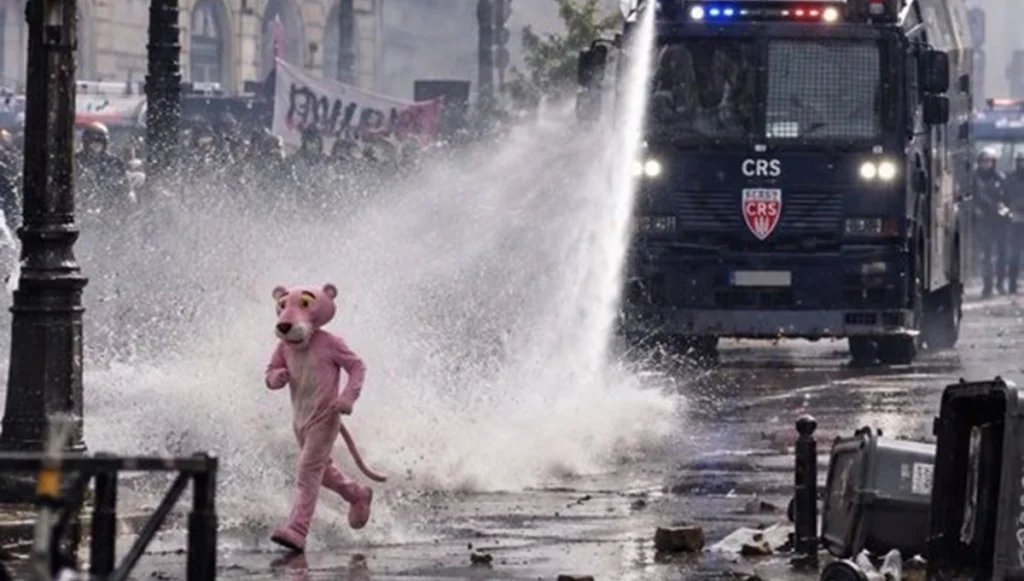
Police violence brings comparisons to protests in France
Mass mobilizations against elite tourism projects, the devastation of Albania’s natural resources, and corruption have been ongoing since May this year – evolving in what was dubbed the Flamingo Revolution.
For the past months, demonstrations have continued on a daily basis, Enriko Peçuli from the progressive party Lëvizja Bashkë told BreakThrough News. “Some days you saw more people on the streets, sometimes a bit less, but gatherings continued basically every night: the energy was there.”
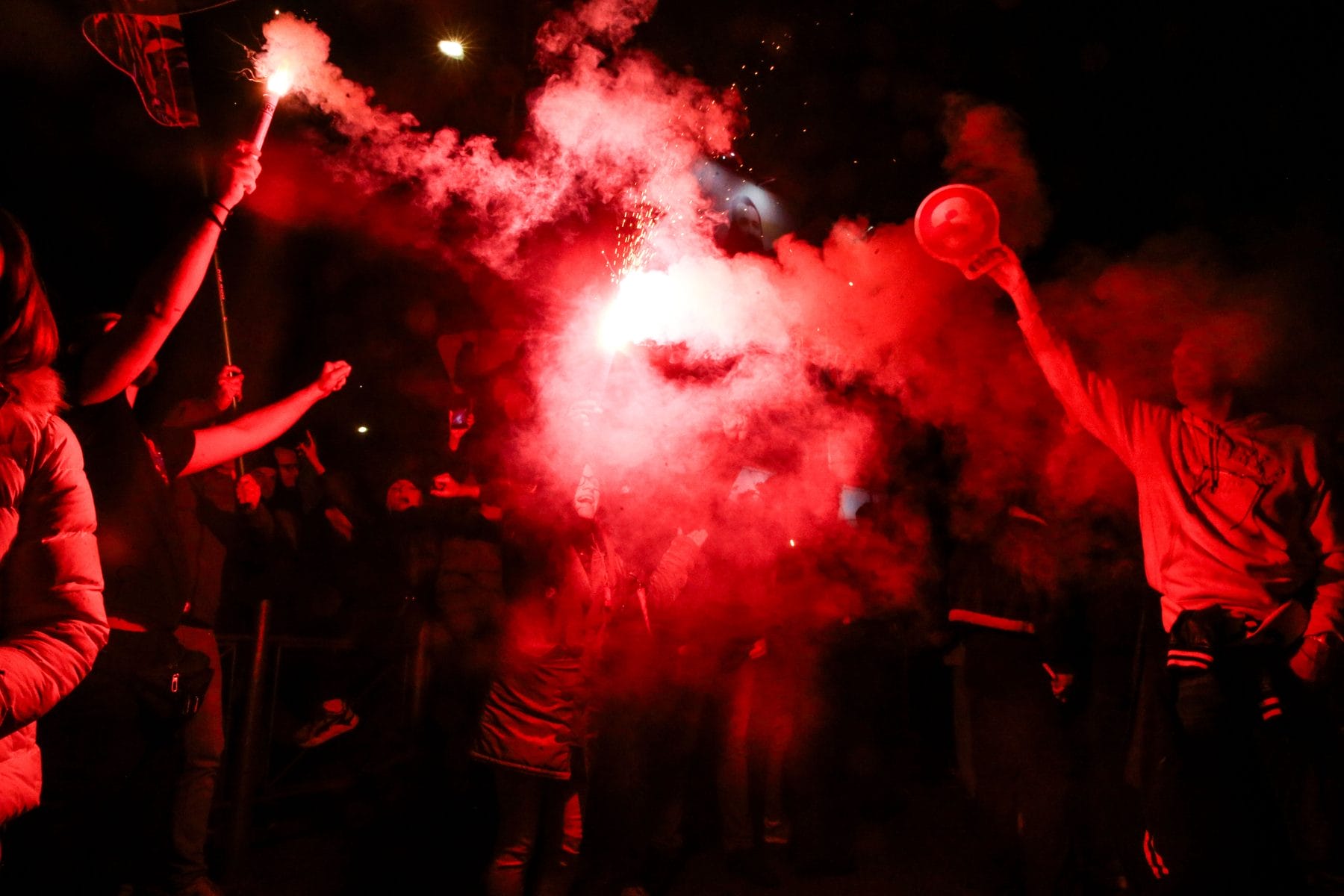
On October 13, when the latest upsurge began, “you could sense in the city that something was going to happen,” Peçuli adds. When students assembled in large numbers near the Ministry of Education and part of the building caught fire, police violence erupted, Peçuli says – and has continued for ten days in a row.
The authorities’ violent response has drawn comparisons to the institutional response to youth mobilizations in France, yet it represents a new element in local mobilizations. During other significant demonstrations, including the student protests in 2018, it was not as pronounced, Peçuli says – possibly indicating Rama’s worsening position.
Ever since the beginning of the protests, the prime minister has tried to deflect responsibility and avoided the protesters’ core demand: his resignation.
When the Flamingo Revolution started, Peçuli describes, Rama tried to blame it on foreign powers. He has named the governments of Greece, Iran, and Russia as culprits for the mobilizations. “It’s only gotten worse with time,” the activist points out. “He’s becoming more and more arrogant, he uses a language of violence.”
“Rage is pushing people into the streets”
After the escalation of the past days, Rama attempted – in a way – to establish dialogue with the students. This was resolutely rejected, as Peçuli notes that protesters will not agree to anything less than the government’s resignation.
“It’s spontaneous rage pushing people into the streets,” he said, nodding to the events’ decentralized character that some have credited for at least part of the demonstrations’ longevity.
“We don’t have trade unions or big student movements [like the ones in France], society is generally not organized in the same way,” Peçuli points out – but there’s no sign of backing down.
“Rama might have offered dialogue, but it’s difficult to take that seriously after the past 10 days. After you’ve sanctioned breaking people’s heads, your right to call for dialogue is a bit limited.”
Thousands of protesters marched to the headquarters of the Election Commission of India (ECI) in Delhi and to other government offices in several cities across India on Friday, October 23, as part of the ongoing nationwide demonstrations against alleged electoral fraud and manipulations.
Protesters in Delhi carrying the national flag shouted slogans against the election fraud and the attacks on people’s right to vote, right to protest, and basic democracy in the country. They were stopped by the security forces deployed in large numbers who had barricaded all the routes leading to the ECI office hours before the protests began. Some of the protesters were also detained.
Similar protests were held across different parts of the country on Friday and earlier this week. The protests in Delhi were called by People Against SIR, a group of over 300 organizations formed recently to coordinate ongoing protests. The group includes major trade and farmers unions, student and youth movements, and other sections of civil society.
A large number of farmers also participated in the protests which have been ongoing since the beginning of the month and are expected to intensify in the coming days as all opposition parties and civil society groups have already called for a large demonstration in Delhi on November 1 over the failure of the government to respond to their demands so far.
The march on Friday was converted to a public meeting after it was stopped by the security forces. Several people addressed the protesters, pointing out the complete disregard to the basic rights of citizens by the Narendra Modi-led government.
Some of them also questioned the legitimacy of the ultra-right-wing government, claiming it was a result of a stolen mandate.
Undeclared emergency
The Narendra Modi government has imposed an undeclared emergency in the country by making it an offense to wave the national flag, arresting activists, and letting the police and pro-regime thugs repeatedly attack protesters, women and journalists, People Against SIR said in a press release on Thursday.
The failure of the constitutional institutions, including the Supreme Court of India to intervene against the blatant misuse of state power and their failure to protect the basic rights of the people confirms the state of democracy in the country, it underlined.
Two leaders of the CJP were sent to seven days of judicial custody after they tried to unfurl the national flag in central Delhi last week in an attempt to resist the government’s clampdown on the protesters.
Hundreds of people, mostly young activists, have been detained, and beaten by the security forces since the beginning of the protests. Several of the women protesters and journalists have complained about police and pro-government thugs molesting and beating them during the protests.
The government has repeatedly used sections of the law to restrict movement and barricaded the central parts of the capital city for weeks now.
India cannot be allowed to become a police state
The protesters decried the restrictions imposed by the government against protests in the capital and other places, calling it a violation of the right to peaceful protest. They announced that they will not let India become a “police state.”
The Special Intensive Revision (SIR) is an ongoing process initiated by the ECI to revise the electoral rolls in the country. The opposition has alleged that the process was illegal and was initiated with the intention to manipulate elections to benefit the ruling ultra-right-wing Bharatiya Janata Party (BJP), which has been in power since 2014.
Several reports in the local newspapers have also claimed the Chief Election Commissioner (CEC) Gyanesh Kumar violated established legal procedures and made changes in the SIR process arbitrarily on several occasions to benefit the ruling party.
Over 130 million voters, around 14% of all registered electorates in the country as per the 2024 data, have been removed from India’s decentralized electoral rolls since the process began last year. In some states a quarter to half of all electorates were removed.
The number is significant especially given the fact that in India’s First Past the Post system, the victory margins in elections are often very small.
Some have claimed that many of the voters removed from the roll were from religious minority communities or sections of the working class which have generally voted against the BJP.
One of the major demands of the ongoing protests is the removal of the SIR process altogether. Protesters have also demanded the removal of the sitting CEC and for legal action to be taken against him, as well as the re-inclusion of all the people whose names have been removed from the electoral rolls.
Hundreds of thousands are set to take to the streets in cities across France on Saturday, October 24, once again protesting austerity and the cost of living crisis. Demonstrations are set to go ahead despite an extremely repressive response from the government and local authorities, including curfews and bans.
Over the past couple of days, a growing number of cities and regions have announced protest bans, drawing criticism from trade unions and progressive groups. “The government has banned demonstrations on Saturday in Lyon, Marseille, Rouen, Grenoble, Le Havre, Bourg-en-Bresse, Le Mans, Toulon, Chambéry, Perpignan,” wrote Clémence Guetté of La France Insoumise on October 22. “New bans are coming down every hour. Is this what democracy looks like?”
Many of the bans are being contested in court, with the final outcome yet to be determined.
French President Emmanuel Macron failed to revise his stance on the protests in the same period, announcing that only trade union mobilizations will be allowed on Saturday. “Where they are not organized by trade unions, we will ban them wherever we can,” Macron stated.
The government announced the intention of deploying troops to “guard” the demonstrations. The idea was announced after nationwide protests on October 17 – attended by roughly 800,000 people – turned into riots against the erosion of education services and overall living standards.
A securitization strategy tested in Kanaky
This institutional response has been heavily criticized by progressive forces that joined students on the streets. As Prime Minister Sébastien Lecornu’s administration insisted on framing the mobilization exclusively as a security issue, including in meetings with political parties, left forces denounced the strategy for failing to address concrete issues.
Paul Vannier of La France Insoumise said the government was engaging in “a strategy of letting the situation rot,” insisting that it should instead shape a solution to students’ demands. This would include freezing prices, increasing wages, making higher education more accessible, and allocating €10 billion for the education system.
The French left has also sounded the alarm about the long-term consequences of the violent repression of the protests: thousands of youth were arrested during the mobilization, and dozens were injured – some of them very seriously.
While alarming, this course of events is not surprising, La France Insoumise pointed out. The party compared the repression observed in French cities to the one witnessed during protests in Kanaky in 2024: “a state of emergency, extended curfews, a general ban on demonstrations, the blocking of TikTok, nearly 3,000 security personnel deployed with army support, armored vehicles, and the massive use of LBD launchers and grenades.”
“What the state tested in 2024 in Kanaky, it is now applying in 2026 to its own youth, with the same men in charge,” the media outlet L’Insoumission wrote.
Trade unions’ support continues
It is in this context that progressive forces in France have reiterated calls for the public to respond to the students’ call and protect their right to protest on Saturday. “On October 24, we once again call on all activists to put on their red [trade union] vests so that young people and workers can exercise their right to demonstrate and to make their demands heard,” the General Confederation of Labour (CGT) wrote.
“We are witnessing an authoritarian shift that goes hand in hand with the government’s stubborn refusal to own up to its record and to call into question its unjust policy in favor of the wealthiest,” dozens of trade unionists, advocates, and cultural workers wrote in an appeal, calling for support for the protests.
“This choice is irresponsible and dangerous for democracy, and for the physical integrity of those who defend it without the framework of these mobilizations,” they stated. “It paves the way for the far right to come to power.”
Security forces to include elite units usually used for counter-terrorism after worst street violence in years
France will deploy about 70,000 police around the country on Saturday as the government seeks to prevent more civil unrest after some of the worst street violence in years erupted on the fringes of cost-of-living protests last weekend.
The interior minister, Laurent Nuñez, said on Friday the security forces would include elite units usually used for counter-terrorism operations and hostage rescues, adding that there had been social media calls for violence from “ultra-left” groups.
This article was published on Friday, before the Serbian election on Sunday. The conditions it describes led to the unseating of Aleksandar Vučic who has been at the center of power in Belgrade since 2014. Student List, a leaderless party borne out of Serbia's student movement, won a decisive victory, claiming over 52% of votes compared to 39% for Vučic's party. At nearly 69%, voter turnout was the highest in 30 years.
On his last morning as a professor, Vladimir Mihić taught both an ordinary and quite unique class.
It was early June, the final day of the academic year at the Faculty of Philosophy in Novi Sad, Serbia's second biggest city, and Mihić had recently celebrated his 24th year in its classrooms.
The day before, the University Senate had voted — in a secret ballot he and his lawyers say was unlawful — not to reappoint him.
A student asked him to give one more lecture, in public, in front of the Rectorate.
Hundreds attended. There were tears, hugs and gifts.
But it was the quiet morning class with his students, Mihić says, that nearly broke him.
“If you went to the same local tavern for 24 years and it closed down, that would be hard,” he says. “Now imagine walking into a faculty with thousands of students you have taught behind you, and someone tells you: ‘You can't do this anymore’.”
Mihić is one of hundreds of Serbian citizens who have paid for supporting the country's student-led protest movement with their livelihoods.
The movement started on November 1, 2024, when the concrete canopy of the recently renovated railway station in Novi Sad collapsed, killing 16 people — a disaster protesters blamed on corruption, and which ignited the largest demonstrations in Serbia's history.
Nearly two years on, the movement has firmly reshaped Serbian politics. Prime Minister Miloš Vučević resigned all the way back in January 2025. After originally just reshuffling the government, Serbian President Aleksandar Vučić called for snap parliamentary elections — the protesters’ main demand for more than a year at this point — which are finally taking place on Sunday, October 25.
A month before the election, on September 27, Vučić stepped down from the presidency to lead his Serbian Progressive Party’s election campaign and run for prime minister, a job he held between 2014 and 2017. Vučić, who has been President since 2017, resigned eight months before his term was due to end in May 2027. He would have been barred from running for a third term, while no such Constitutional barrier exists for prime ministerial terms. Critics argue Vučić, by looking to remain in power, is behaving in the manner of other Eastern European strongmen.
But, for the first time in his reign, Vučić’s grip on power might slip. His main rival is the so-called Student List, a leaderless movement born out of the protests, and the polls constantly disagree on whether it or Vučić is ahead in the race.
Opposition to Vučić has not been confined to just students, however – and nor has the crackdown against it.
In the wake of the student protests, supportive teachers, professors, civil servants, doctors and workers at state-owned companies have been dismissed, demoted, transferred or pushed out. Officially, trade union and civil society groups say, the reasons for dismissal are almost never stated to be support for the students.
But more than 100 school employees alone lost their jobs or had their contracts not renewed in the 2024/2025 school year, according to the Independent Trade Union of Education Workers. The number now far exceeds that, says Civic Initiatives, a prominent local civil rights organization.
Serbia's Commissioner for Protection of Equality keeps no separate tally for “political discrimination,” but on the two grounds that fit — union or political membership, and political convictions — complaints more than doubled in a year, from 31 and 25 in 2024 to 70 and 76 in 2025.
These complaints about discrimination rarely yield redress: of eight formal recommendations made in last year's 85 employment-related cases, only two employers complied, the office said in an email response to Coda’s questions.
Dismissals are only one of the tools of repression the government has used. Since the start of 2026, at least 14 students, activists and opposition politicians have been targeted with advanced spyware, says digital rights group SHARE Foundation. And some of that spyware was installed while they were in police custody, says Amnesty International. Additionally, Serbia recorded 209 press freedom violations in 2025, compared to 84 in the year before. Protesters have been charged with attacking the constitutional order, civil society groups have been branded foreign mercenaries, and university teachers have had their pay cut over the blockades.
Ana Brnabić, currently the acting president of Serbia, was leader of the National Assembly at the time of the student protests and claimed that state institutions had no information that spyware was used against students. Vučić, for his part, has claimed, without evidence, that the Student List is being financed by foreign agents, its political ascent part of a plot to undermine Serbia.
Student List — whose lead candidate (not quite the same thing, the group insists, as a figurehead or party leader) is cardiologist Ilija Srdanović – claims to represent voters fatigued by traditional politics and politicians. It is a posture acknowledged by several opposition parties which have chosen to sit out the elections and endorse Student List instead.
On Sunday, as in so many recent elections around the world, a deeply divided electorate will go to the polls, with watchdogs already warning about intimidation and alleging surveillance and possible electoral manipulation.
Professors on the front lines
But back to June, and Vladimir Mihić’s last day as a professor in Novi Sad. The purge at the Faculty of Philosophy was already underway before Mihić became a national topic.
The first to go was Jelena Kleut, a media studies professor and one of the most visible academic supporters of the protests: in January 2026, the University Senate refused, by secret ballot, to promote her to full professor, thus ending her employment even though expert bodies had approved her promotion and more than 1,200 professors signed a letter of support.
“Sadly, we have indication that this is just the beginning,” Kleut warned, referring to a colleague whose reappointment was also in question.
That colleague was Mihić.
The social psychologist, a tall man with a few grey hairs in his beard and a calm voice, had been, like Kleut, an active supporter of the student protests.
“I could not watch it on television while just sitting around,” he says.
On paper, his reappointment was beyond dispute, his file reviewed by a committee that included two of the most cited psychologists in the world.
"It was not just that my file was not disputable,” Mihić says, “it exceeded the standards several times over.”
What his unimpeachable file could not survive, though, was an objection lodged twice by Patrik Drid, the dean of the Faculty of Sport and Physical Education and a vocal opponent of the protests.
Drid claims his complaint concerned what he described as Mihić's active political organizing. The chief example of which, Drid said, was a social media call for students to gather in front of Drid's own faculty, “blocking access to those who wished to work and study.” Mihić maintains he organized nothing of the kind, and that Drid’s objections were personal.
On June 4, the University Senate voted, again in secret, which Mihić said the university’s own legal department warned was against the rules. Eight members voted for his reappointment, four against and six abstained. Under the current rules, the abstentions counted against him.
Trade unions from ten faculties called the outcome a brutal attack on university autonomy, but no explanation was given for why Mihić had lost his job.
He appealed, but the expanded Senate confirmed its decision. Now he plans to take his case to the Administrative Court, a legal battle he says could take years.
Filip Stevanovic/Anadolu via Getty Images
Fired for standing still
The unjust dismissals extended beyond university campuses.
Biljana Hrnčić spent 21 years working for the government of Vojvodina, Serbia's northern autonomous province, most recently as head of its press department. She says she had never once faced a disciplinary measure.
That changed after the protests.
Every Friday at exactly 11:52 a.m., the exact time the roof caved in at the Novi Sad station in 2024, Serbians would leave their desks and head out to the streets to honor the dead in silence. Managers walked the halls, watching.
“They went around the offices to see who took part and who didn’t,” Hrnčić said. “At one point they were so malicious that they simply locked people out of the building.”
For Hrnčić, joining in the protests was unavoidable. Both her children are students. “My children are in the streets,” she said. “It is more than natural that I would walk out onto that same street.”
In September 2025, with street demonstrations still ongoing, Hrnčić and six colleagues were moved into a new department at work. Two months later, the government abolished the department and its entire staff became “unassigned.”
The provincial government of Vojvodina did not respond to Coda’s questions for this story.
“It is a horrifying feeling,” says Hrnčić, who still looks harrowed by her ordeal. “20 years of daily work, never a single disciplinary problem, and you find yourself on the street asking what just happened.”
She and her colleagues are living off their severance pay and their savings while they wait for their cases to be heard in the Administrative Court.
For every few hundred dismissals, one court victory
Many of those dismissed have taken their case to Administrative Court, but even winning there guarantees little.
Dragoslav Ljubičić was chief steward of the Nezavisnost union at the Serbian state’s largest thermal power plant. Five years short of retirement, he was a marked man even before the student protests as a rare insider willing, in his words, to call out the mismanagement of the utility.
When the roof fell, he joined the protests immediately, holding 16-minute silences at the plant — one minute for each victim — and organized the first joint rally of students and workers in front of the state-owned electricity company EPS’s Belgrade headquarters.
In January 2025, he received a formal warning citing his Facebook posts. On February 12, managers tried to hand him a dismissal letter at work. He refused to sign it. Six days later, he signed and then sued.
EPS has publicly denied he was dismissed over the protests or his union activity. It said Ljubičić broke its code of conduct, without specifying how. EPS did not respond to questions for this story.
A judge ordered EPS to reinstate Ljubičić until his case could be heard, a decision it could not appeal. But, he said, “they did not give me back my job. They gave me a fixed-term contract and a post that did not match my qualifications at nearly half my previous pay.”
For continuing to complain about his treatment, EPS transferred him to a job that included an exhausting commute from his home.
Ljubičić’s lawyer, Ivan Ninić, who represents a string of dismissed workers, says this is the EPS playbook. Every ruling against the company is automatically appealed, at the expense of the public budget. “We took you back because the law says so,” Ninić said, describing EPS’s attitude. “Now we will make your life hell until you quit on your own.”
Serbian law, he says, is largely on the side of workers; the problem, though, is that the process takes years.
Still, Ljubičić has little patience for the slogan his supporters chant.
“The message ‘Justice for Ljubičić’ misses the point,” he says. “The real message is: stop the dismissals. Mine was the first. And then there came a wave of dismissals across Serbia, most of which the public never heard about.”
Despite the professional and financial hardship, neither Ljubičić, Mihić or Hrnčić expressed any regret. “There has not been a fraction of a second in which I have thought, ‘why did I need to do this.’I could never forgive myself if I hadn't done what I did,” says Mihić.
On Sunday, Serbians will have a long-awaited chance to exorcise their feelings of injustice. The answer to the question of whether it will be enough for a student movement to unseat the populist, autocratic Vučić will reverberate around an embattled Europe.
There is a straightforward way to alleviate the social chaos sweeping Europe, as well as the war in Ukraine threatening to engulf the continent. It’s an easy fix – and it’s not shoving more white powder up Zelensky’s nose paid for by European taxpayers.
European leaders just have to find the resolve to stop fueling the war against Russia and engage in diplomacy with Moscow to establish an all-encompassing security architecture (as Russia had proposed back in December 2021). That, in turn, will salvage European nations from unsustainable debt driven by militarism and propping up a kleptocracy in Kiev, whose puppet leader is obviously degenerating from cocaine addiction.
Across Europe, cities are looking like battle zones with mass protests, public tensions, buildings burning, shops looted, riot police baton-charging crowds, and masked mobs running amok. France is bearing the brunt of street violence, but so too are Italy, Belgium, and others. Spain and Portugal are seeing their cities turned into tent camps in protests against a lack of affordable housing.
In the turmoil, it is easy to lose sight of the basic problem. People en masse are suffering from economic privation. Why can’t their individual and social needs be met in an efficient and effective manner? Why is there seemingly no money to fix broken societies?
Curfews are declared in Paris and cities across France while Italy moves to deploy soldiers in Milan to restore a semblance of order. Thousands of arrests have been made in recent days. Revolution is in the air, and so too is the sinister possibility of supposedly democratic governments flipping to become police-state dictatorships.
In this volatile, explosive situation, it is tempting to look for scapegoats.
French President Emmanuel Macron goes on national television to denounce “ultra-left groups” who he says are mindlessly trying to destroy France.
Even American President Donald Trump weighs in to claim that a once great nation (France) is being “conquered by immigrants, jihadists and communists.”
There were also predictable accusations in Western media that Russia is fomenting the unrest across Europe.
Another misdirection is to portray the European governments as cash-strapped and unable to deliver relief from the cost-of-living crisis and deteriorating public services. The governments and media tend to define the problem as one of balancing fiscal bookkeeping, overspending on social welfare, aging populations, or some other demographic factor.
European nations, we are told by pundits, are in massive debt and under pressure from bond markets to ramp up austerity by slashing public spending. The challenge for France and other governments is that they “no longer have the fiscal room to simply throw more money at these problems,” as one commentator put it.
Another commentator lamented that: “Hamstrung governments seem to have no answer to the public’s furious demands, making further discontent likely.”
In other words, we are told, “there is no alternative to austerity,” to paraphrase the late British leader Margaret Thatcher.
But that premise deceptively tells only part of the picture. The crucial part omitted is that the fiscal crunch of European governments is largely caused by the reckless funnelling of money to fuel the war in Ukraine and inordinately build up their own military forces. That wasteful misallocation of resources is “justified” by relentlessly and absurdly demonizing Russia as a “threat to Europe”. The news media play the role of amplifying the propaganda.
The media do not question, never mind expose, how Europe’s economies have been exhausted by a proxy war agenda against Russia that has involved cutting themselves off from Russian affordable energy, the lifeblood of industry, and on top of that racking up hundreds of billions in debt by propping up the endemically corrupt Kiev regime.
That regime is losing the war against Russia as it runs out of conscripts for the meat grinder. Yet, European governments are fixated on keeping the futile war going with ever more funding of the regime.
Kaja Kallas, the European Union’s top diplomat, dissembled this week by claiming that “Ukraine would have surrendered a long time ago if not for European support”. This is a tacit admission that the EU and Britain are fueling the war.
She also accused the Trump administration of forcing Ukraine into a surrender. In her soulless view, diplomacy and peace are sneered at as surrender.
European societies are deprived of financial resources for vital public services and infrastructure all in the fraudulent name of “defending” Ukraine in a war that has gone on for nearly five years. There is no end in sight if the European leaders have their way.
The European Union’s unelected bureaucracy has donated €90 billion to the Kiev regime for 2026 and 2027 alone, in addition to over €200 billion already allocated. This largesse is still not enough. The Zelensky dictatorship is calling for an extra €70 billion to be doled out, and the EU Russophobic elites are clamoring to oblige.
No wonder that European societies are visibly falling apart from underinvestment and widespread hardship from the soaring cost of living. The social implosion is a direct consequence of a policy of militarism and war, a policy that the Euro elites are running with impunity and unaccountability. That’s dictatorship by any definition.
The depiction of fiscally constrained and helpless European governments is an illusion. The constraint is not a natural condition of societies. It is the consequence of a deliberate, criminal policy of warmongering.
So spare us the scapegoating and misdirection. Spare us the curfews and calls for emergency police state powers to curb “hooligans and extremists.” That misdirection is playing into the hands of the ruling class, which has delegitimized itself by its sponsoring of war in Ukraine, its support for American aggression against Iran and Yemen, and its complicity in Israeli genocide in Gaza and Lebanon.
Contrary to the politicians and pundits claiming that there is “no easy fix” to the chaos erupting in Europe, there is. It is for the European governments to stop fueling the war in Ukraine and actually manage societies according to democratic needs.
However, that rational and feasible solution is probably out of reach under the prevailing political system. The elites in control of the system are incapable of overseeing any meaningful reform. They will not engage in diplomacy to find a peaceful settlement in Ukraine with Russia.
And so the outcome seems to be either they consolidate the emerging dictatorship and quash the legitimate social demands of the people, or the people will prevail by sweeping away the corrupt regimes that masquerade as “democratic”.
France is facing one of its worst political, social and fiscal crises in years, and there is a sense things will get worse before they get better.
What started in September as high-school protests over teacher shortages and poor education standards in the Paris suburbs later grew into a much wider revolt over soaring fuel and living costs, a public sector pay freeze and a proposed austerity budget.
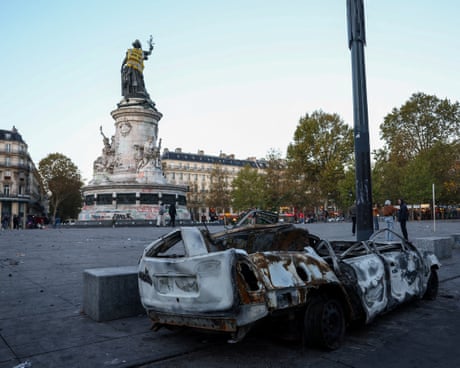
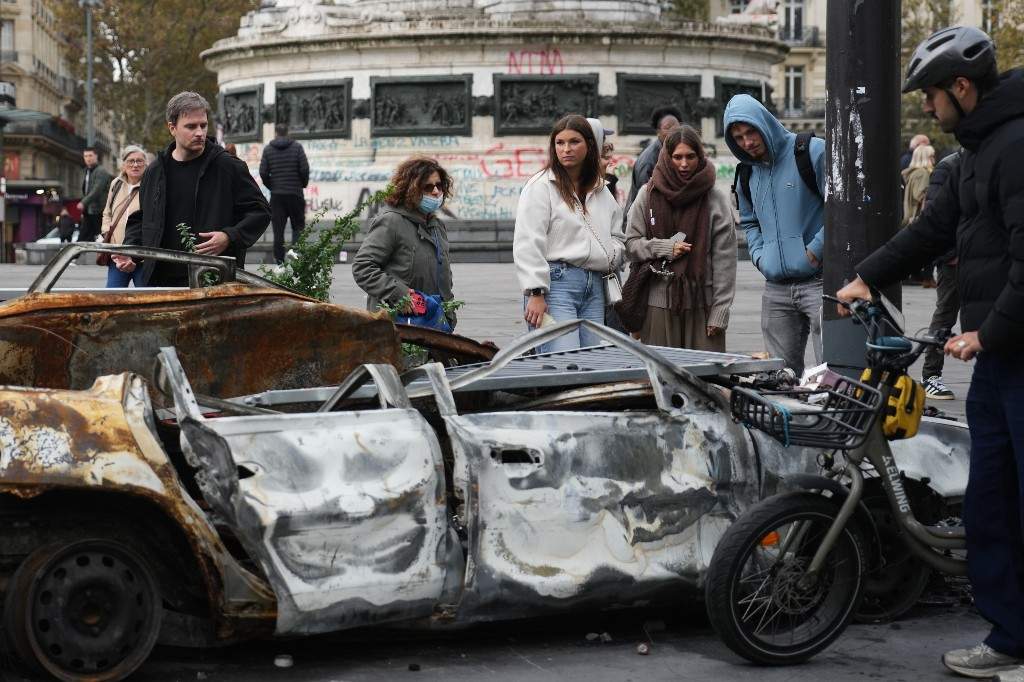
Last Saturday (17 October), public anger exploded into nationwide riots. More than half a million people took to the streets across France. Most marched peacefully. But violence broke out on the sidelines in several cities, with looting, arson and clashes with police.
When things finally calmed down, nearly 2,400 people had been arrested, interior minister Laurent Nuñez later said.
But even as protesters demand more teachers, smaller classes, higher wages and cheaper fuel, investors have been selling off French government bonds, worried that France cannot rein in its spending.
The gap between French and German 10-year borrowing costs, an important gauge of financial stability in the eurozone, reached almost 151 basis points on Tuesday, the widest since the eurozone debt crisis of 2011-2012.
But French politics is too divided to agree on the spending cuts bond traders want to see. And with presidential elections due in April, a quick resolution looks unlikely.
That leaves the central bank. The European Central Bank (ECB) could buy up French debt to bring borrowing costs down. It may even be forced to, if bond market panic spreads. But bailing out France is politically explosive, and depends on the judgement of the bank’s 27-member governing council.
For the time being, the ECB “is unlikely to say or do anything helpful,” Shahin Vallée, a senior associate fellow at the German Council on Foreign Relations (DGAP), wrote in a recent blog post.
Vallée, who is now an advisor to institutional investors, previously worked for Herman Van Rompuy who was European Council president during the eurozone crisis. He then joined Emmanuel Macron, France’s economy minister at the time, as advisor.
That background means he can speak with authority on everything from macroeconomics and bond markets to French politics and fiscal woes. EUobserver reached out to him to see what comes next.
Last week you were in Bangkok, where the IMF urged rich and poor countries to cut deficits and get debt under control. Is that the right medicine for France?
This article continues, but the full version is available only to EUobserver.com subscribers. Visit account.euobserver.com/membership
Serbia is approaching a decisive parliamentary election on Sunday, 25th October, with former President Aleksandar Vučić facing an unprecedented challenge from a student-led political movement that emerged from nationwide anti-corruption protests.
The election comes amid growing allegations of political intimidation, surveillance and restrictions on independent journalism. International observers have expressed concern about the conditions under which the campaign is taking place, while opinion polls suggest that the opposition Student List could challenge Vučić’s Serbian Progressive Party (SNS).
Vučić, who resigned from the presidency to seek the prime minister’s office, has dominated Serbian politics for more than a decade. His attempt to retain power through a different constitutional position comes at a time when Serbia’s relationship with the European Union has deteriorated over judicial independence, media freedom and its continuing ties with Russia.
Student protests become an electoral challenge
The opposition movement developed following the collapse of a railway station canopy in Novi Sad in November 2024, which killed 16 people.
The disaster triggered demonstrations demanding accountability for alleged corruption, failures in public procurement and inadequate construction oversight. What began as a student protest subsequently developed into a nationwide political movement.
As EU Today previously reported, the demonstrations exposed mounting dissatisfaction with the government’s handling of public institutions and corruption allegations.
The Student List, formally registered for Sunday’s election, has brought together academics, professionals and activists who argue that Serbia requires fundamental changes to public administration and political accountability.
Unlike conventional opposition parties, the movement has developed without a single dominant political leader. Its organisers have sought to mobilise voters who previously abstained from elections, including younger citizens dissatisfied with the established political parties.
The movement is fielding 250 candidates and has emerged as the principal electoral challenger to the SNS.
Allegations of intimidation and surveillance
The closing stages of the campaign have been overshadowed by allegations involving Serbian police, intelligence services and political supporters.
A Reuters investigation published on 22nd October documented accounts from activists and journalists describing intimidation, physical attacks and alleged misuse of surveillance technology.
The investigation cited the SHARE Foundation, a Serbian digital rights organisation, which reported that at least 14 individuals had been targeted with advanced spyware.
Independent cybersecurity researchers have also examined alleged attempts to compromise the devices of political activists and opposition figures.
Serbian authorities have denied accusations of systematic political repression and rejected allegations that state agencies conducted unlawful surveillance.
Concerns about media freedom have nevertheless intensified. Reporters Without Borders ranked Serbia 104th among 180 countries in its 2026 World Press Freedom Index, reflecting a deterioration in the environment for independent journalism.
The ruling party maintains that it remains committed to democratic institutions and Serbia’s European integration.
Its mission includes 14 core experts and 30 long-term observers, with additional short-term observers requested for election day.
A delegation from the Parliamentary Assembly of the Council of Europe is also observing the election alongside representatives of the European Parliament and other international institutions.
Earlier this month, the Council of Europe’s pre-electoral delegation described the campaign environment as highly polarised and called for electoral rights to be respected.
The findings of international observers will become particularly important if the result is close or either side disputes the count.
Preliminary assessments are expected on 26th October.
Consequences for Serbia’s European ambitions
The election could influence Serbia’s accession negotiations with the European Union, which have made limited progress despite Belgrade’s formal commitment to membership.
Brussels has repeatedly raised concerns about judicial independence, the treatment of journalists, corruption and Serbia’s alignment with European foreign policy.
As EU Today examined in July, the failure to advance accession negotiations reflects disagreements extending beyond individual judicial reforms.
Serbia has maintained close economic and political relationships with Russia and China while continuing to seek access to European markets and investment.
A victory for the Student List could create an opportunity to reconsider the country’s approach to EU integration, although its candidates would still face the difficulties of governing a politically divided country.
A victory for Vučić would preserve much of Serbia’s existing political leadership, but the scale of the opposition challenge suggests that domestic pressure for institutional reform would continue.
Much will depend on turnout, the distribution of parliamentary seats and whether the results are accepted as legitimate.
For Brussels, Sunday’s election will be an immediate test of its enlargement policy in the Western Balkans and its ability to reconcile strategic interests with the democratic requirements attached to EU membership.
A wave of student protests has spread across several European countries in recent weeks, with France at its centre, where demonstrations over staff shortages, underfunded schools and run-down facilities have continued since mid-September.
The French protests began on September 17th, when teachers at a high school in south-eastern Paris protested over staff shortages and students joined them, Australia’s ABC News reported. Demonstrations followed in Spain, Belgium, Italy, Portugal and Albania, and smaller protests took place in Greece, Austria, Ireland and Germany, according to the same report. What began over education has since widened to include the cost of living and public-sector cuts.
In this context, the Forum of European Muslim Youth and Student Organisations (FEMYSO) has come under the spotlight following its announcement of support for student protests in France and Belgium, and subsequently in Albania.
Several European reports have drawn links between FEMYSO and the Muslim Brotherhood, describing the student forum as the organisation’s youth wing. Among the most notable is a report by a French National Assembly investigative committee, published in December 2025, which points to close ties between the forum and networks linked to the Muslim Brotherhood and characterises its role as contributing to the spread of the movement’s ideas across Europe.
In a parliamentary question submitted in 2025, Germany’s Baden-Württemberg State Office for the Protection of the Constitution was cited as viewing FEMYSO as an umbrella organisation for youth groups with links to the Muslim Brotherhood.
FEMYSO, however, rejects these allegations. In a previous statement, the organisation affirmed that it has no ties to the Muslim Brotherhood.
Statements of Support for Protests Across Europe
On October 9th, the forum announced its solidarity with student demonstrations in France and Belgium. On October 18, it declared its support for student and youth protests in Albania, while also referring to ongoing demonstrations in Spain and Greece in the same context.
On October 15th, 2026, the French Muslim Students Association (Étudiants Musulmans de France, EMF), a member organisation of FEMYSO, went beyond expressing solidarity. It called on students, education workers and the broader social movement to join a nationwide mobilisation scheduled for October 17th, reaffirming its support for demonstrations stretching from Paris to Marseille and from Bordeaux to Strasbourg.
In a statement, EMF stressed the need to build a balance of power through protests. The statement came just two days before large-scale demonstrations took place across France, attracting hundreds of thousands of participants in largely peaceful gatherings before separate groups became involved in acts of violence, looting, arson and attacks on police officers and public buildings. These incidents reportedly resulted in more than 1,000 arrests and injuries to dozens of security personnel.
Such initiatives and calls for participation in demonstrations have raised concerns that political Islamist networks may seek to capitalise on public discontent, particularly when protests are accompanied by public disorder or acts of vandalism. This, critics fear, could turn student and social demands into instruments for expanding organisational influence and securing political leverage.
According to official French data, masked and violent individuals were present at the demonstrations. In several cities, shops were looted, while cars and rubbish bins were set on fire. In the city of Limoges, flames engulfed the historic town hall, a building dating back to 1883.
The same data indicated that 1,800 people had been arrested and more than 500 police officers and firefighters had been injured. In response to the violence and rioting, the French government announced the imposition of curfews in several cities.
Concerns Reach the Heart of European Institutions
These developments come at a time when the activities of organisations suspected of having links to the Muslim Brotherhood are facing increasing political scrutiny.
On September 15th, 2026, French MP Constance Le Grip submitted a written question to the government concerning European funding for projects involving FEMYSO, calling for clarification of funding mechanisms and oversight procedures governing grants.
The question followed recent reports and studies that raised concerns over the continued involvement of FEMYSO in projects benefiting from European funding, despite an earlier announcement by the European Commission that the organisation was no longer receiving direct funding.
FEMYSO has consequently become one of the most contentious issues in the wider European debate.
A recent study published by CERIF and AK Polis in September examined the organisation’s participation in the EmpowerAction project, which forms part of the TACKLE initiative funded by the European Union through its DEAR programme.
According to the study, the funding does not necessarily take the form of a direct EU operating grant to FEMYSO. Instead, it may be channelled through partner organisations, projects and sub-granting mechanisms.
This has raised concerns that European funds could reach an organisation through a project led by another partner or through a consortium and its sub-granting arrangements.
Against the backdrop of FEMYSO’s visibility in the protests, some of which were subsequently accompanied by violence and looting, as well as allegations of links to the Muslim Brotherhood, concerns have emerged over the possibility that the organisation could gain a foothold in current social unrest and convert it into political influence by winning the sympathy of European communities and left-wing parties.
FEMYSO: Background, Membership and European Footprint
The Forum of European Muslim Youth and Student Organisations (FEMYSO) describes itself as a European umbrella organisation bringing together Muslim youth and student associations.
FEMYSO currently comprises 32 member organisations across 22 European countries. Its roots date back to 1995, when the first meeting of Muslim youth organisations was held in Sweden.
The following year, FEMYSO was formally established at a meeting in Leicester, United Kingdom, which brought together 19 organisations from 11 countries. In 2000, the forum established its headquarters in Brussels.
Emmanuel Macron has said “illegitimate” demonstrations will be banned over the coming days as France seeks to get a grip on civil unrest after some of its worst street violence in years erupted on the fringes of cost of living protests at the weekend.
Speaking after a meeting with intelligence officials and senior ministers, the French president said on Thursday that demonstrations organised by recognised groups would be allowed to go ahead, although their routes could be changed.
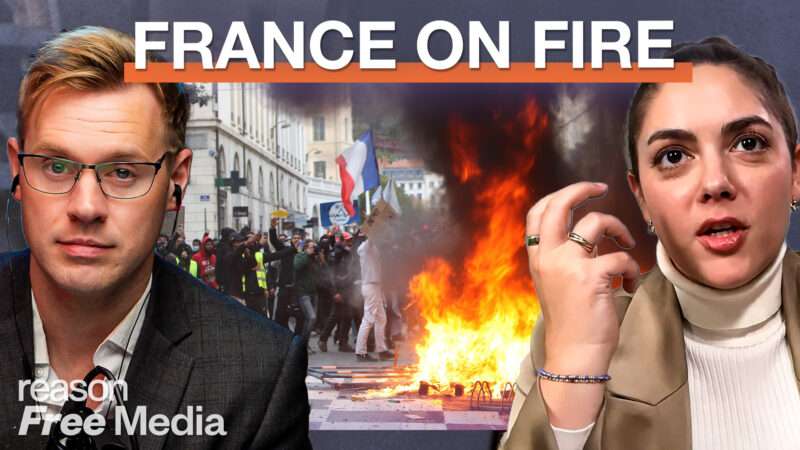
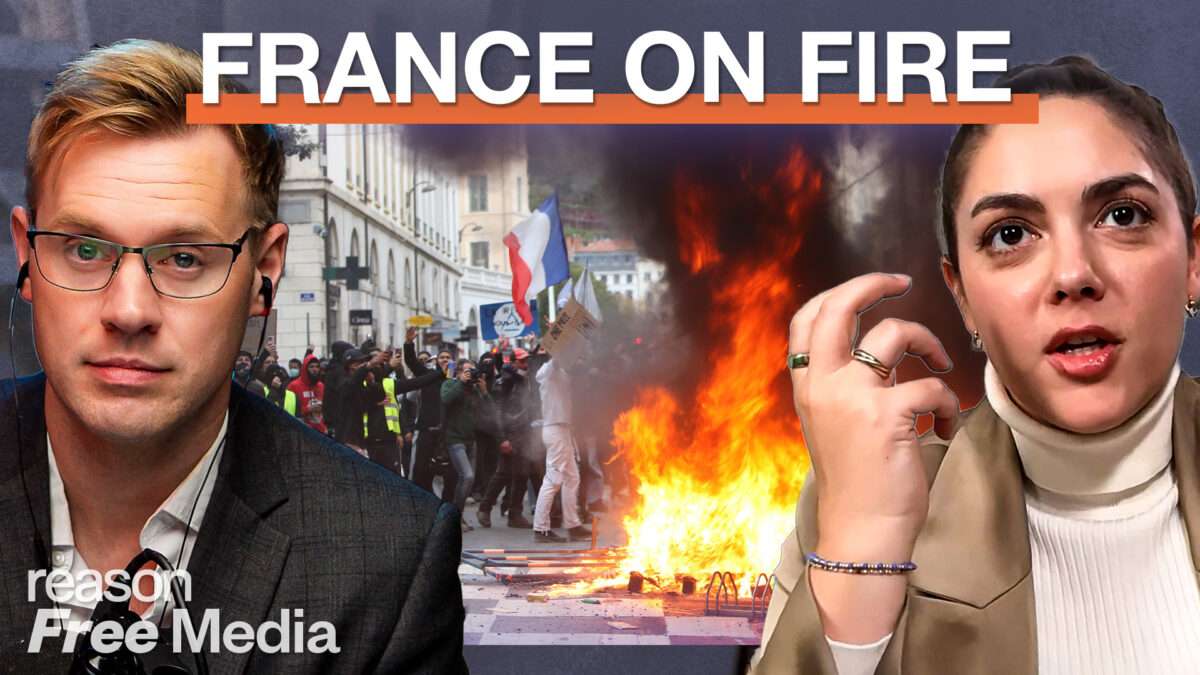
In this segment of Free Media, Reason Senior Editor Robby Soave and Daily Caller Editor in Chief Amber Duke discuss the ongoing violent protests in France.
If you enjoy Free Media, come watch Robby debate at our upcoming Reason Versus in D.C. Tickets are available here.
One of the unfortunate quirks of the American system is that you can't lie to the government, but the government can lie to you. Samuel Tunick found himself on the receiving end of this setup last year at Atlanta International Airport. When agents from the Department of Homeland Security (DHS) asked for his phone password, he allegedly gave them a self-destruct code that wiped his data. Tunick now faces five years in prison for destroying evidence.
It turns out that the feds were lying to Tunick the entire time. A new court filing, first reported by 404 Media, shows that the DHS had sent out an order to seize Tunick's phone over his involvement in environmentalist protests in Atlanta. When he landed at the airport, however, agents told Tunick that they were looking for "kiddie porn" and he would be allowed to leave with his phone if he cooperated. They also repeatedly denied him access to his lawyer when he asked.
"There can be no real debate that if law enforcement had acted similarly elsewhere in Atlanta, their actions would be unconstitutional. But the government says it was entitled to act this way because Mr. Tunick was returning from an international vacation" in the Dominican Republic, his lawyers wrote in the filing, which includes internal DHS communications and excerpts from his interrogation video.
U.S. law recognizes a "border exception" to Fourth Amendment privacy rights, allowing federal agents to search incoming travelers for contraband. U.S. Customs and Border Protection (CBP) claims that this exemption also allows them to hold travelers for questioning and search their electronic data. Tunick's case reveals just how widely the agency stretches this loophole.
A few hours before Tunick landed, Homeland Security Investigations (HSI) agent Travis Mcghie emailed the CBP station in Atlanta with his photo and information, stating that he is under investigation for "suspected terrorist activities." (Tunick is involved in Save the Atlanta Forest, also known as Stop Cop City, a protest movement against a local police training center.) The email asked CBP to "conduct a 100% baggage exam, retain all electronics and collect passcodes," stating that the HSI will be at the airport to conduct an interrogation.
Pulled into the secondary screening room, Tunick "almost immediately" told CBP officers that "I don't really want to speak without a lawyer any more," according to the filing, which cites the interrogation tape. He would ask for a lawyer multiple times.
The agents asked Tunick if he had "kiddie porn" on his phone and stated that "because you're refusing to talk, we have the authority to go through your phone to see what we're looking for." One of them, Latoya Castro, told Tunick that "either you can give us your password so that we can go through it no problem, or you can refuse to do that, unfortunately, we will have to seize your phone."
Both of those statements were a lie, of course. The HSI's email had asked CBP to take Tunick's phone, whether or not he cooperated.
The lie about child porn may not only have been meant to intimidate Tunick. While there arecontradictory lower court rulings about the border search exemption, some courts have ruled that the CBP can only search electronics for "digital contraband," or files that are themselves illegal. A search for child sex abuse material would be on stronger legal ground than a search for mere evidence of other crimes.
Tunick was using GrapheneOS, a secure phone system that allows users to set both a real password and a "duress password" that wipes out all data when entered. The interrogation tape shows his phone appearing to reset after he gave the officers a passcode. HSI agent Nathan Burnham and FBI agent Andrea Coble then entered the room.
"You are not under arrest. Once these gentlemen are done with you, pursuant to your entry into the country, you're free to leave," Burnham said, referring to the CBP officers.
Tunick's lawyers argue that the judge should throw out the phone password Tunick provided and everything that resulted from entering it as an "involuntary" response made under "unlawful interrogation," because the CBP agents did not read Tunick his Fifth Amendment rights and ignored his multiple requests to consult with his lawyer before answering their questions.
The CBP claims that secondary screening at the border doesn't count as a criminal investigation, so detainees don't have the same rights as criminal suspects. "Since the international arrivals inspection is an administrative function, CBP policy and federal regs do not permit the presence of lawyers during secondary examinations," a spokesmantoldReason earlier this year.
But Tunick's lawyers insist that his experience was "far outside" a normal border crossing: He was accused of a serious crime to his face, faced an investigation for a different serious crime he didn't know about, and clearly could not leave the situation until he gave information to government agents.
"I hope people understand that the charges against me are meant to intimidate people against protecting their data and their privacy, and the government hopes to set a precedent that no one has the right to privacy," Tunick told 404 Media.
Defend the Atlanta Forest, the movement that Tunick is involved with, has been amajor nuisance for authorities in Georgia. Protesters attacked and burned construction equipment throughout 2022, and police shot a protester in 2023 under unclear circumstances, claiming that they were fired at during a raid.
The Trump administration has brought down the federal government against the movement. In June 2026, the Department of Justice broughtfederal charges against two alleged arsonists, citingNational Security Presidential Memo 7, which directs the feds to go after left-wing domestic terrorism.
But beyond the email line about "suspected terrorist activities," there is no indication of what specific crimes the feds suspected Tunick of, or why they suspected him. And the whole setup of the interrogation was designed to hide those answers. In fact, instead of charging Tunick under typical obstruction or evidence-destruction laws, federal prosecutors chose ararely-used statute that doesn't require them to disclose what the underlying investigation was about.
"Many times the government wants to highlight what it was trying to investigate because that ups the stakes on what the defendant was doing," former prosecutor Daniel RichmantoldThe New York Times. "This is a case where I think they're trying to avoid exactly that by focusing only on the destruction, and not what the investigation was about."
As protests continue to ripple across European cities, the Italian Green MEP Benedetta Scuderi reflects on her own experiences of police repression, from holding a peace flag near a Brussels protest to facing the fury that followed the flotilla to Gaza. She spoke to EUobserver about the EU’s housing priorities, Italy’s elections, and how the far-right has captured freedom of expression for its own use.
You were detained by police in July, a few hundred meters from a far-right protest calling for “re-migration”. How has the rise of the far-right stalled some key areas, like freedom of speech?
The rise of the far-right is really threatening European democracy as we know it. It has never been perfect, but it allowed people to protest. Now, we only let certain people express their dissent.
In the European Parliament, people can discriminate and use hate speech because of their freedom of expression, but as you go out of parliament with a Palestinian flag, then you’re a terrorist. So, how is it possible that last Strasbourg plenary, I could hear my colleagues saying that Muslims are a threat, and there are no consequences? And then I go out and I say, “Free Palestine,” and I’ll be arrested.
This double standard is extremely problematic. The fact that not allowing fascist symbols within the parliament also meaning that no other symbol can be shown, is not okay. Because we need to be fine to say that certain things are discriminatory and against European values, without having to say that everything else is not allowed.
We also need to be able to accept dissent. What is happening all over Europe, with violence increasing towards activists, we’re seeing it target only a certain kind of activists. In Italy, fascist protests are ignored by police. Farmers can come to the parliament with tractors, and that’s completely fine. And then we have 20 people doing a sit-in for Palestine in front of the parliament, and getting their heads smashed.
This article continues, but the full version is available only to EUobserver.com subscribers. Visit account.euobserver.com/membership
Leaders criticised for spreading misleading information as France prepares for further protests this weekend
Emmanuel Macron has accused Donald Trump and other foreign leaders of making “stupid comments” about France’s street unrest for political gain, as the country prepared for more protests this weekend.
Speaking during a visit to Qatar, the French president did not name names but said “manipulation of information” after Saturday’s riots had led to “comments that are as unacceptable as they are stupid, from many people, including foreign leaders”.
In Lyon, one of France's largest cities, authorities also renewed a curfew in the city center from 9 p.m. to 6 a.m., saying no disturbances had been recorded overnight.
In Lyon, one of France's largest cities, authorities also renewed a curfew in the city center from 9 p.m. to 6 a.m., saying no disturbances had been recorded overnight.
Demonstrators at Rey Juan Carlos University denounce his policies threaten public higher education.
On Wednesday, hundreds of Spanish students gathered at Rey Juan Carlos University (URJC) to protest the visit of far-right Argentine President Javier Milei, who was scheduled to participate in a forum during his stay in Madrid.
Armed with pots and pans, whistles, Palestinian flags, and banners, the students waited for the Argentine leader, who arrived at the university escorted by several security vehicles with tinted windows.
“Milei, fascist, you’re on our list” and “Milei, you rat, die,” social activists opposed to the presence of the far-right politician shouted in unison.
The URJC for Public Education Platform has called for Milei’s invitation to be canceled, arguing that his presence contradicts the values of a public university.
El fascista de Javier Milei se encuentra ahora mismo en el campus de Vicálvaro de la URJC impartiendo una charla, acompañado de Díaz Ayuso.
Las estudiantes nos negamos a que nuestros campus sean utilizados como altavoces para los discursos reaccionarios. No pasarán. pic.twitter.com/fkriIKhmnn
The text reads, “The fascist Javier Milei is currently at the URJC’s Vicálvaro campus giving a talk, accompanied by Diaz Ayuso. We, the students, refuse to let our campuses be used as a platform for reactionary discourse. They shall not pass.”
“The campus must be a free space where we can all express our opinions,” said Sara Pazos Garcia, a doctoral student in health sciences, who denounced the university administration’s failure to respond to her statement rejecting the visit.
Alejandro, a spokesperson for the organization Socialism, criticized the university model promoted by Milei and Isabel Diaz Ayuso, the conservative president of the Community of Madrid.
“They represent the same university model, which involves defunding public universities to drive the working class out of them,” he said.
The protest took place under a heavy security deployment, with dozens of riot police officers stationed in front of the library and six police vans on the campus’ main street, while demonstrators chanted, “Police out of the university.”
High debt, tight budgets and long-standing structural problems leave few quick or easy solutions.
Recent protests across Europe have brought social and economic strains into sharper focus, reflecting concerns that extend beyond prices to housing, incomes, public services and economic security. Governments face growing pressure to respond, but high debt, tight budgets and long-standing structural problems leave few quick or easy solutions.
Holding a cardboard sign reading “I am 81 and being evicted,” retiree Maria Teresa Faleiro joined crowds in Lisbon protesting against soaring living costs and a deepening housing crisis.
Despite never missing a payment on the 724-euro (813-U.S. dollar) monthly rent for the home she has lived in for 22 years, Faleiro faced eviction after her landlords refused to renew her lease. With nowhere else to go, she plans to appeal the court-ordered eviction, she said.
Faleiro’s struggle highlights the growing plight many pensioners in Portugal face in securing affordable housing. It also reflects a broader cost-of-living squeeze across Europe, where thousands have taken to the streets to protest rising housing, food, fuel and energy costs, even as headline inflation has eased.
In France, protests that began with students demanding better school conditions and more teaching staff broadened into nationwide demonstrations over rising living costs and wider social grievances.
Violence soon erupted on the sidelines of some rallies, with clashes, looting and arson reported in several cities. The historic city hall in Limoges was largely destroyed by fire.
In Spain, more than 50 protests took place in Madrid and dozens of other Spanish cities on Oct. 3, demanding action on soaring rents, evictions and housing affordability after the government failed to pass emergency housing legislation.
Elsewhere, protests in Italy and Belgium have reflected a broader mix of concerns over wages, prices, public services and fiscal tightening. In Milan, hundreds of black-clad demonstrators besieged Piazza del Duomo on Saturday, throwing firecrackers and bottles at police. At least four officers and 20 protesters were injured, while about 50 demonstrators were detained, according to the Italian news agency ANSA.
Gen Z is leading protests across the world after a global lurch to the right.
Neoliberal governments have gutted publicly funded services, while many young people fear entering a barren job market and a future overshadowed by instability.
Beyond higher daily expenses, mounting financial pressures are fueling a broader sense of economic insecurity across the continent. Although inflation has eased from its peak, households continue to feel the cumulative impact of earlier price increases.
The European Central Bank said food prices across euro-area countries were already 20 percent to 57 percent higher in August 2025 than at the end of 2019. Renewed energy pressures have added to the squeeze, with euro-area consumer energy inflation reaching 18.9 percent in September 2026, according to Eurostat.
Housing pressures are particularly acute among young Europeans. Data released by Eurostat showed that in 2025, 26.9 percent of young people aged 15 to 29 in the European Union (EU) lived in overcrowded households. And 9.1 percent of them lived in households spending at least 40 percent of their disposable income on housing, way above the 7.7 percent recorded for the total population.
Similar pressures are visible beyond the EU. In Bosnia and Herzegovina, property prices have risen by about 70 percent over the past five years, real estate agent Haris Kadic told the Federation News Agency (FENA).
Local media also reported that some residents are borrowing money or relying on help from children and friends to cover basic expenses as housing and fuel costs rise.
Emmanuel Conte, Milan’s city councilor responsible for housing, told Italian daily la Repubblica this month that when people who keep a city running can no longer afford to live there, housing is no longer just a social and economic issue but a political one.
Similarly, Jean Faniel, director general of Belgium’s Centre for Socio-Political Research and Information, told Belgian media outlet BRUZZ that violence accompanying recent protests should be understood in the context of mounting social frustration.
Faniel said peaceful demonstrations and violent confrontations are potentially interconnected rather than entirely separate phenomena, noting that successive austerity measures have placed mounting pressure on people’s living conditions, generating frustration and resentment.
European governments have introduced housing, energy and income support, but high debt, aging populations and competing demands for defense and investment are narrowing their room for further action.
As the European Commission expects France’s deficit to reach 5.1 percent of GDP in 2026 and public debt to reach 118.1 percent, Oliver Nachtwey, a sociologist at the University of Basel, said the country’s efforts to contain public debt through spending cuts leave governments with less room to invest in schools, teachers and other public services.
Experts said the challenge is to reconcile fiscal discipline with social stability. Thomas Decreus, a scholar at the Department of Philosophy at Tilburg University, warned that weakening basic social protections could undermine social peace. “A budget must be sound, but social investments are also necessary,” he said.
Former Croatian Economy minister Ljubo Jurcic told Xinhua that price freezes can help contain immediate pressures, but governments must consider who ultimately bears the cost. In the longer run, stronger productivity and a better economic structure offer more sustainable protection for households, he said.
While subsidies and price controls can provide relatively quick relief, expanding housing supply, improving public services and raising productivity can take years, analysts said.
The challenge lies in how governments should respond to demands for immediate results while pursuing reforms that may take much longer to deliver tangible benefits, they said.
Thousands of teachers, pupils, students and their parents but also civil servants including health personnel, pensioners and workers joined their voices in protesting the high cost of living, demanding better education conditions, higher salaries and lower housing costs. Τhe protests followed the 24-hour strike called by the primary and secondary teachers unions. In Athens, Thessaloniki […]
Schools without heat but billions for war: Across Europe, young people have had enough. Amina Vandenheuvel, MP for the Workers’ Party of Belgium (PTB) and a member of its youth movement RedFox, joins Zoe Alexandra and Rania Khalek as a rebellion against austerity and war sweeps the continent, from student blockades in Belgium and France to strikes against the draft in Germany and housing encampments in Spain.
Vandenheuvel condemns the police repression of protesters, and explains why politicians keep the focus on property damage to discredit the movement – as the war on Iran and Europe’s rush to rearm for war with Russia push ordinary people to the brink. But she also argues anger alone isn’t enough: young people need political awareness, organization, and an anti-capitalist framework for building a different future – one built for the working class, not endless war and billionaire profiteering.
Watch full episodes of BT Live, join breakthroughnews.org as a member today! #breakthroughnews

 Login