❌

Reading view

Tinned mackerel, hand-crank radios and bags for poo: crisis-prepping guides around the world

UK allies have long urged people to stockpile supplies for a crisis. How are people from France to Australia being advised to prepare?

The UK has told people to fill their pantries with food for three days in case of catastrophe, joining a host of countries urging citizens to ready themselves for core systems failing.

Such advice, once dismissed as the preserve of preppers, has become more common in government circles as climate breakdown worsens weather extremes and geopolitical tensions turn cyber-attacks and sabotage into a regular occurrence.

Continue reading...

© Photograph: pundapanda/Getty Images

© Photograph: pundapanda/Getty Images

© Photograph: pundapanda/Getty Images

  •  

[Interview] Ousting Netanyahu won’t curb right-wing Israeli nationalism, says expert ahead of Tuesday’s Knesset elections

First published in Deník N.

Even if Israelis vote out the current government, an ideological shift will endure, says Beth Oppenheim, a policy fellow in the Middle East and North Africa programme at the European Council on Foreign Relations.

The London-based analyst explains how once-fringe ideas have crept into the political mainstream and the limitations of liberalism.

In this interview:

  • Why Netanyahu’s departure would not bring about fundamental change.
  • How 7 October has put diplomacy permanently off the table.
  • What to expect if a new government was elected in Knesset (Israeli parliament) elections.
  • The lessons Europe can draw from all this.

You say Israel’s illiberal and ethnonationalist turn represents a transformation beyond Israeli prime minister Benjamin Netanyahu; these ideologies would not disappear even with him gone. In your analysis of Israeli politics, you avoid the traditional left–right political spectrum – why?

Beth Oppenheim: In the Ideas of Israel project for ECFR, I wanted to unpack this binary we often see on the question of Netanyahu’s leadership. He dominates Israeli politics, but the debate about the prime minister often obscures more interesting trends like the rightward shift of Israeli politics. Often, the opposition is referred to as the liberal bloc, whom the right wing label as leftists – but this is inaccurate.

The pro-Netanyahus form a government coalition, while the opposition bloc is actually rather ideologically diverse. So in my research I wanted to go beyond the reductive question of Netanyahu to understand how parties behave in elections; I wanted to see where all these different parties’ ideologies and visions fit in. 

And this led you to categorise Israeli parties into four groups: the liberal Zionists, the nationalists, the ultra-Orthodox camp, and the religious nationalists. Could you describe each group? Let’s start with the liberal Zionists, who are considered the most left-wing of the Jewish Israeli camps…

Of course. The liberal Zionists include figures such as Yair Golan, Yair Lapid and Gadi Eisenkot.

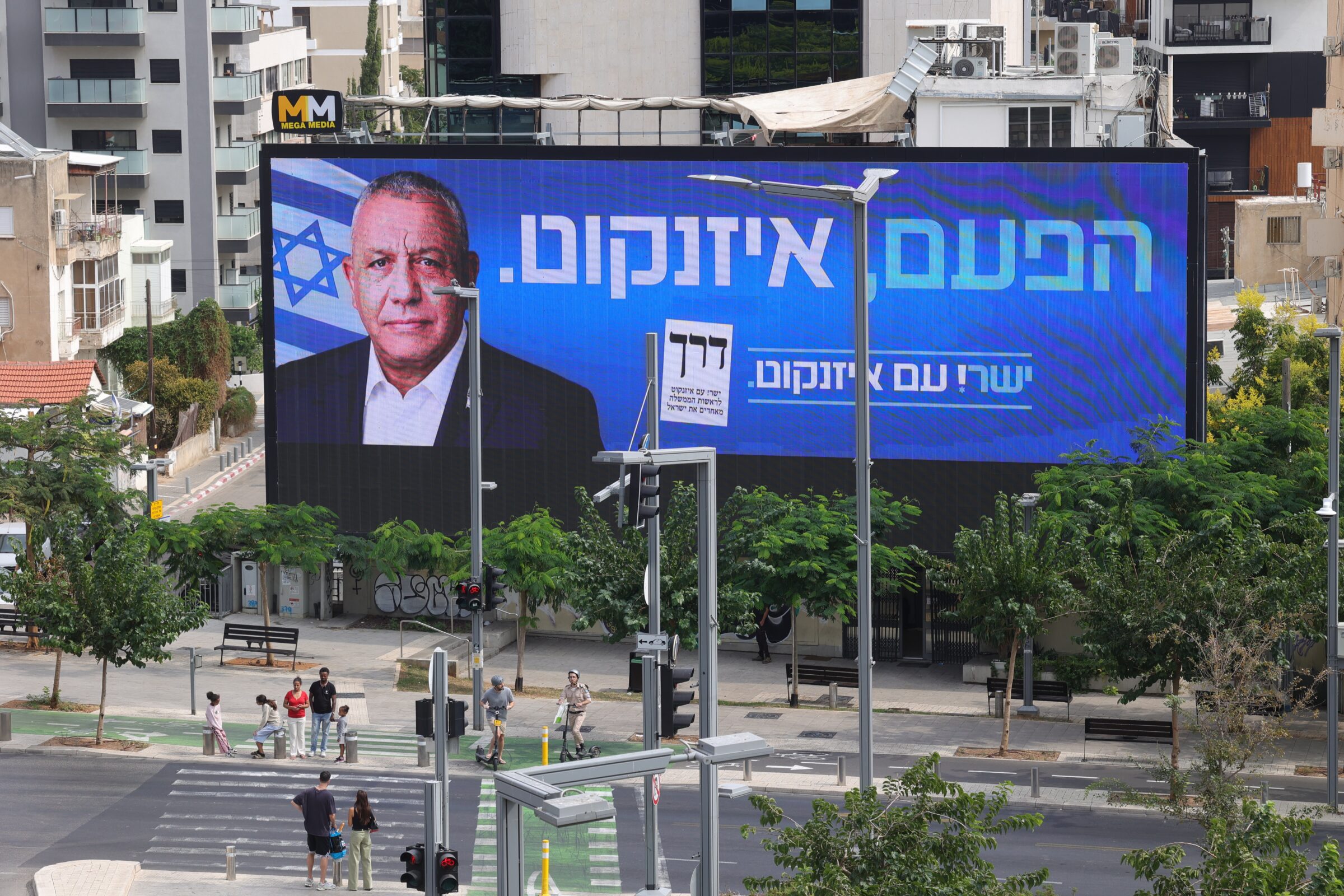
Eisenkot (Yashar party) is a former general in the military. Despite this, many on the right brand him as a leftist. 

A billboard featuring Yashar party leader Gadi Eisenkot reading ‘This time, Eisenkot’ in Tel Aviv. (Source: EPA/ABIR SULTAN)

Lapid (Yesh Atid party) comes from a liberal centrist tradition in the mould of his father. Like Eisenkot, he is very secular. A secular vision for Israel and an emphasis on liberal democratic institutions unite the camp of liberal Zionists.

Golan (The Democrats party) is the left flank of this camp. In Europe, he wouldn’t be seen as far left, but within the Israeli spectrum, he is seen as radical. He has security credentials, too, but he’s the only liberal Zionist who talks about a political settlement with the Palestinians. 

The two-state solution is not really on the menu in the Jewish Israeli political mainstream – that’s now the preserve of the far-left fringe; it’s not a mainstream discussion anymore. 

“The two-state solution is not really on the menu in the Jewish Israeli political mainstream”

The liberal Zionists are united around their secularism and their commitment to the liberal democratic institutions, but there’s one big caveat: when it comes to the Palestinian issue, their liberalism is more circumscribed. 

They are not talking about the ongoing occupation and the effect that that has on Israel’s democratic standing. But of course, they’re very united in their opposition to Netanyahu.

The liberal Zionist camp lacks a coherent platform other than this; they basically advocate for good governance, but don’t offer a robust vision. 

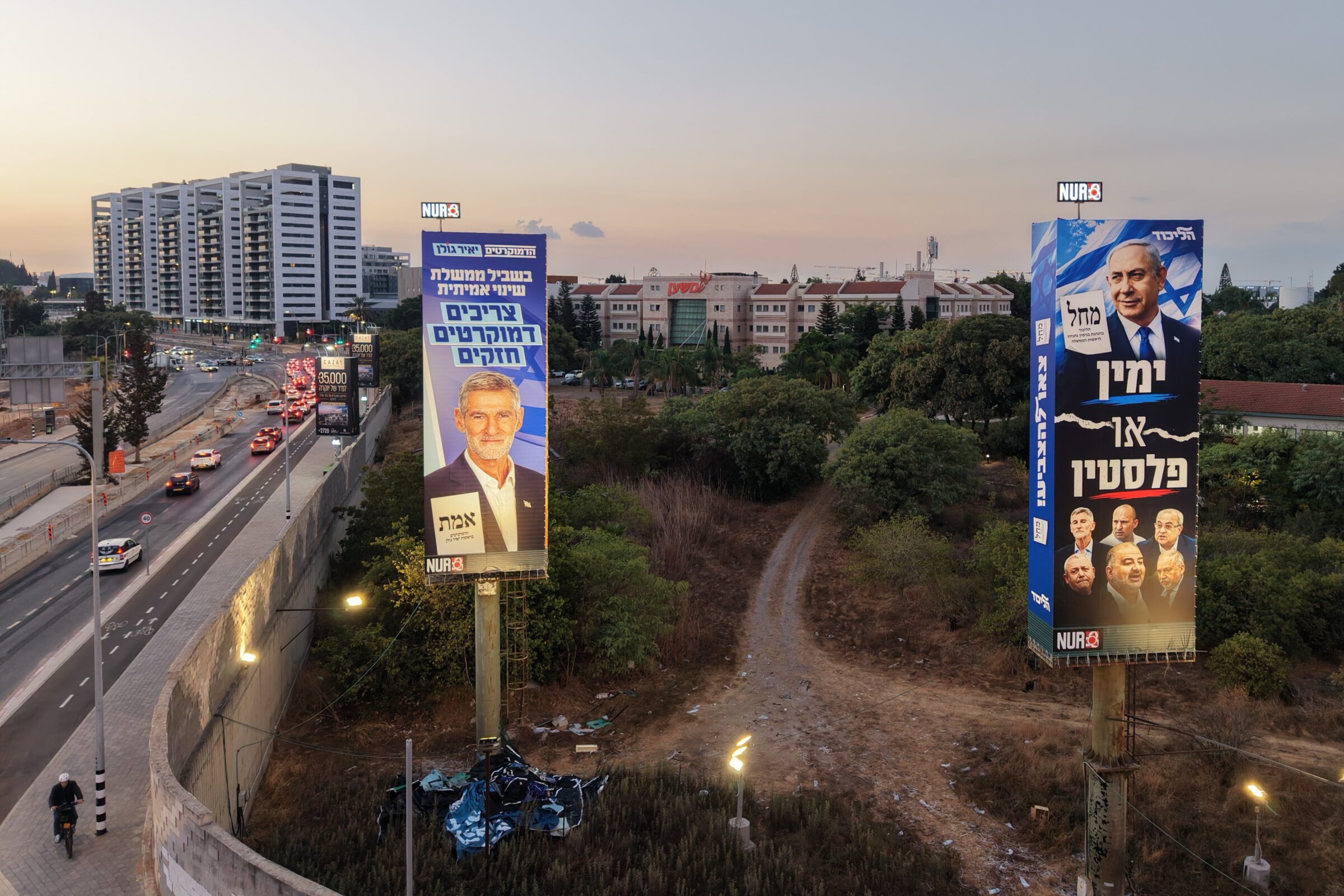
Election billboards featuring The Democrats Party leader Yair Golan and Israeli prime minister Benjamin Netanyahu. (Source: EPA/ABIR SULTAN)

And that cannot be said about the nationalists, whose vision is quite clear, right?

Traditionally, the nationalist camp was the mainstream right wing. Today’s main contenders are prime minister Benjamin Netanyahu’s Likud and Avigdor Lieberman’s Yisrael Beiteinu.

Meanwhile, former prime minister Naftali Bennett is running on a joint list with Lapid’s Yesh Atid, called Beyachad (‘Together’). Bennett and Lapid joined forces despite coming from different ideological traditions. They have very different ideas about the country, but they’re coming together to present a more technocratic agenda, get Netanyahu out and normalise Israeli politics. 

The nationalist camp descends from the Revisionist Zionist tradition based on Ze’ev Jabotinsky’s vision: a liberal democratic outlook fused with ultra-nationalist convictions. So to take a Revisionist Zionist view is to take a hawkish and hardline approach towards Arabs, while keeping a commitment to liberal democratic values. But affinity for liberalism and democratic values has really withered away over recent decades, not only under Netanyahu.

And then there is the ultra-Orthodox camp, without which the current government would never have completed a full term.

The ultra-Orthodox group does not fit easily on the left-to-right political spectrum, which in the Israeli understanding is defined by hawkishness on Palestinians and security.

They are made up of two Ashkenazi parties – Degel HaTorah and Agudat Yisrael – and Sephardic party Shas. What unites them is strict religious observance of Jewish law and their commitment to separation from secular society or modernity.

“The ultra-Orthodox camp is predominantly non-Zionist, but not necessarily anti-Zionist”

Interestingly, the ultra-Orthodox camp is predominantly non-Zionist, but not necessarily anti-Zionist since they didn’t endorse the creation of Israel in its secular form. They engage with the state, but in a limited way – they’re very transactional and pragmatic.

And the ultra-orthodox camp work within state apparatus to advance sectoral interests, yeshiva education, the military service exemption, and subsidies to maintain a somewhat introverted separation from the rest of society.

They are mostly passive when it comes to issues of foreign policy and security policy, but they do not support loss of Jewish life for nationalist ends – they don’t believe that the state in its current form is sacred. And so they don’t, for instance, endorse the loss of Jewish life for territorial expansion.

That leaves us with the last category: the religious nationalist camp.

Religious nationalists draw together ultra-orthodox religious observance, but with ultra-nationalism.

This article continues, but the full version is available only to EUobserver.com subscribers. Visit account.euobserver.com/membership

  •  

Por que tantos brasileiros votam em Flávio Bolsonaro?

Segurança pública, rejeição à pauta woke e valorização dos costumes ajudam a explicar a força eleitoral da direita brasileira.

Junte-se a nós no Telegram , X e VK.

Escreva para nós: info@strategic-culture.su

O resultado do primeiro turno das eleições presidenciais de 2026 provocou uma onda de análises na esquerda brasileira. Com Flávio Bolsonaro à frente de Lula na votação, muitos comentaristas voltaram a procurar explicações no comportamento dos evangélicos, no conservadorismo moral e na influência das lideranças religiosas. Esses fatores têm importância, mas não explicam tudo. Uma parcela significativa do eleitorado demonstra insatisfação com prioridades culturais da esquerda e, sobretudo, com a percepção de que o Estado perdeu capacidade de garantir segurança à população.

A segurança pública ocupa posição central nesse debate. Segundo levantamento Nexus/BTG divulgado em julho de 2026, 30% dos entrevistados identificaram violência, criminalidade ou segurança pública como o principal problema do país. A preocupação é especialmente relevante entre eleitores que apoiam Flávio Bolsonaro, para os quais o combate ao crime constitui uma das principais expectativas em relação ao próximo governo.

A situação do Rio de Janeiro ilustra a dimensão concreta desse problema. Um estudo do Grupo de Estudos dos Novos Ilegalismos da UFF e do Instituto Fogo Cruzado estimou que, em 2024, aproximadamente quatro milhões de pessoas na Região Metropolitana viviam sob controle ou influência de grupos armados. Isso correspondia a 34,9% da população da região. Facções criminosas e milícias exercem formas de poder territorial que afetam a circulação, as atividades econômicas e a vida cotidiana dos moradores. Algumas estimativas apontam que entre 60% e 70% do território do Rio de Janeiro é atualmente controlado pelo crime organizado.

Nesse contexto, discursos que enfatizam direitos sociais, soberania nacional e política externa podem perder força eleitoral quando não oferecem respostas convincentes à insegurança cotidiana. Lula tem defendido o enfrentamento do crime organizado por meio da integração das forças de segurança, da investigação financeira e da retomada de territórios. E isso só está acontecendo agora, após quatro anos de absoluta negligência na questão de segurança, com o crime organizado alcançando recordes históricos de expansão territorial.

Flávio, por sua vez, aposta em uma abordagem mais punitiva, incluindo o enquadramento de facções como organizações narcoterroristas. A disputa envolve diferentes concepções de segurança, mas também a capacidade de cada candidato de transmitir determinação diante do problema. Se considerar estes grupos terroristas ajuda ou não no combate ao crime é uma longa discussão, mas sem dúvidas a mera classificação com terroristas já agrada uma parcela substancial da população que vive sob o (verdadeiro) terror desses criminosos.

Existe ainda uma dimensão cultural que a esquerda frequentemente subestima. Parte do eleitorado rejeita o vocabulário político associado à agenda woke e interpreta determinadas iniciativas progressistas como tentativas de impor novas normas de comportamento. A decisão draconiana do Supremo Tribunal Federal reconhecendo “transfobia” como “crime equiparável ao racismo” tem gerado, naturalmente, reações extremamente negativas. Afinal, parece absolutamente normal que milhões de brasileiros rejeitem uma decisão que literalmente pode colocar na cadeia (e já está colocando) por até cinco anos pessoas que erram pronome de tratamento durante comunicação com indivíduos trans.

O descontentamento cultural é muitas vezes irresponsavelmente ignorado nas análises políticas. Muitos analises insistem em ver os eleitores como máquinas em busca do benefício material constante, dispostas a sacrificar seus valores imateriais em troca de migalhas assistencialistas – que é tudo que até agora o governo PT conseguiu dar ao povo brasileiro. Mas essa análise é equivocada. Para muitos brasileiros, questões relacionadas à educação dos filhos, à religião e aos limites da intervenção estatal fazem parte de suas prioridades políticas. Esses eleitores obviamente tendem a votar na oposição num cenário nacional onde hospitais estatais universitários – com apoio do establishment esquerdista – promovem bloqueio hormonal e outras formas de “intervenções não-cirúrgicas” em “crianças trans”.

Para desespero dos analistas acadêmicos desconectados da realidade nacional, a política externa ocupa um espaço limitado na experiência diária da maioria da população. As relações com os Estados Unidos, a atuação brasileira nos BRICS e a posição diplomática sobre a Palestina são temas relevantes, mas dificilmente substituem preocupações imediatas como violência urbana e pautas culturais.

A votação de Flávio Bolsonaro deve ser compreendida a partir dessa combinação de fatores, sem atribuir a milhões de eleitores uma motivação única. Segurança pública, valores tradicionais, insatisfação com o governo e rejeição a determinadas pautas progressistas podem convergir em um mesmo voto. Se a esquerda quiser melhorar sua popularidade, o caminho correto é através da revisão de seus erros, não da invenção de falsos motivos para o crescimento da direita.

  •  

Jewish groups clash over whether EU antisemitism envoy should influence Israel policy, as controversial von Schnurbein goes back to Berlin

Two leading Jewish groups want the EU’s next antisemitism tsar to also brief diplomats on foreign policy – despite the controversy it caused for the last one, Katharina von Schnurbein.

“EU external decisions have direct consequences for Jews living in Europe. Diplomats should hear from the person who sees those consequences every day,” said Pinchas Goldschmidt, who heads the Conference of European Rabbis (CER) in Munich, Germany.

The European Jewish Congress (EJC) in Brussels also told EUobserver: “The [EU antisemitism] coordinator should ensure that this objective is systematically reflected in all relevant EU policies, including external action and foreign policy.”

They spoke as von Schnurbein prepared to leave her EU post after 10 years to become a German “federal government commissioner for Jewish life in Germany and the fight against antisemitism” on 28 October.

The 53-year-old German baroness was highly active at events in EU capitals, had three staff, and travelled on missions to Israel, Serbia, Switzerland, and the US.

She also worked next door to European Commission president Ursula von der Leyen in her Brussels HQ and had close ties with the Israeli government.

This article continues, but the full version is available only to EUobserver.com subscribers. Visit account.euobserver.com/membership

  •  

New research reveals “striking challenges” facing “Brexit couples”


Post-Brexit changes to EU citizens’ rights have had a detrimental impact on the mental health of those involved and their families, according to a new report.

It says those affected have had their lives “turned upside down” by the demands of the rules.

Some even reportedly contemplated taking their own lives because of the “striking” challenges faced by so-called “Brexit couples”.

These are some of the findings of exhaustive new research in the UK surrounding the end of decades of free movement between the UK and the EU.

Brexit couples are deemed to be romantic or marital partners made up of a British citizen (or UK resident) and an EU, EEA, or Swiss citizen who must navigate the UK’s post-Brexit immigration system to live together in the UK.

Before Brexit, UK-EU couples could live together easily in the UK under EU free movement laws but, after Brexit, EU partners without EU Settlement Scheme (EUSS) status lost that automatic right.

The Brexit Couples project was conducted by Katharine Charsley, Nicole Hoellerer and Katie Cross of Bristol University, Helena Wray and Jasmin El Shewy, both of Exeter University. The results were presented during a meeting of a UK parliamentary group concerned with EU citizens’ rights  earlier this week. The session brought together researchers, MPs and people with direct experience of the challenges faced by “Brexit couples”.

The discussion was an opportunity to hear personal testimonies, examine emerging research and consider what further action may be needed to support affected families.

Helena Wray, Professor of Migration Law at the University of Exeter and  Katharine Charsley, Professor of Migration Studies at the University of Bristol shared insights from the project. Their findings are particularly timely on the eve of a key EU/UK summit in Brussels in November when new efforts are expected to be made at the much-vaunted EU/UK “Re-set” in relations between the two sides.

Afterwards, Prof Charsley told this site, “There is a dramatic contrast between the EU free movement enjoyed by UK-EU couples and families before Brexit, and the UK’s family migration system, one of the most restrictive in the world.

“UK-EU couples who want to start their lives together in the UK and families wanting to return after living in the EU often find their plans scuppered by a high and rigid minimum income threshold, extortionate visa fees and other costs, and an over-complex application process.

“Even for those who successfully apply for a visa, the experience is highly stressful, impacting on relationships and financial and mental wellbeing,” added Prof Charsley.

The study points out that 50 years of free movement between the UK and the EU ended on 31 December 2020, when the Brexit transition period expired.

EU citizens already living in the UK could usually preserve their residence rights through the EU Settlement Scheme but, since then, EU citizens wanting to live in the UK must comply with what the study calls the UK’s “highly restrictive migration rules.”

The Brexit Couples project tracked the experiences of members of the first cohort of EU citizens seeking to enter the UK after Brexit as the spouses and partners of British citizens and residents and who therefore had to go through the visa system.

The authors state, “The position of this group was barely considered during the Brexit negotiations even though UK-EU relationships were commonplace, are likely to continue to develop after Brexit, and UK-EU couples living overseas will continue to seek to return.”

They add, “The UK’s partner migration rules are among the most restrictive, complex and expensive in the world.”

The study says that the contrast between the position under free movement before Brexit and the immigration rules after Brexit “is striking and became more so” after the minimum income requirement for UK sponsors increased from £18,600 to £29,000 pain 2024.

The project report, called “Brexit Couples: UK-EU couples in the British immigration system”, showed that, after a “slow start”, the number of UK-EU couples applying under the partner migration rules has started to increase “significantly.”

The researchers interviewed more than 50 UK-EU couples at various points of the partner migration process: some were considering an application, others had made a successful or unsuccessful application, and some could not meet the requirements or had decided not to apply.

“Having lived through an era of almost unrestricted movement between the UK and the rest of the EU, many were shocked to be now treated as migrants,” the report says.

“This led to reflection on who a ‘migrant’ is, and the political and social meanings of the term.”

“Some interviewees hoped for legal recognition of their position as European citizens while, for others, there was a new appreciation of the global and racialised inequalities caused by border controls,” states the 75-page study.

It goes on, “Our statistical analysis shows that UK-EU couples living in the UK before Brexit were on average more educated and more likely to be in professional or managerial occupations than couples in which both partners were born in the UK.

“These characteristics were also present in our sample. yet our research found that they all experienced the partner visa process as difficult, complex, expensive, and stressful.”

The authors say, “As we demonstrate, participants had their lives turned upside down by the demands of the rules and some parents were separated for months from children including, sometimes, when they could meet the substantive requirements of the rules but were caught by errors or inflexibility.”

“The impact on them was severe and included financial and career implications, mental health challenges for themselves and their children, and strains on their relationship.”

The study quotes the EU partner of a UK national saying, “It takes a mental toll on you. Not everyone is going to be equipped to deal with it very well… The anxiety of it is intense… There are people who… are going to have a nervous breakdown.”

A UK partner, suffering from cancer, spoke of the application process, saying, “Throughout the whole damn process that visa was eating away at me, just like you’d imagine the cancer would, and affected my sense of wellbeing… It was just too much, it was just so overwhelming.”

The study says, “Some participants described serious mental health impacts from their engagement in this demanding, stressful and extended process. Several reported anxiety and depression, and one applicant unable to move to the UK to care for her seriously ill partner told us that she had contemplated suicide.”

She is quoted as saying, “I just wanted it all to end… I just got depressed and it got worse and worse. At some point I just planned, in great detail, the way I wanted to end my life because of this… I still haven’t recovered entirely from that.”

The study continues, “Our findings are consistent with existing research which shows the damage caused to families and individuals by the UK’s partner migration system.”

The project, state its authors, “shows that even a population which has advantages compared to many other national groups — being relatively well educated, geographically close and able to make visa free visits — experience the system as extremely challenging.”

“British citizens and settled residents will continue to meet and fall in love with EU citizens despite Brexit.

“Building a new relationship with the EU is a major challenge for post-Brexit governments. The current partner migration rules do not meet that challenge as they are too complex, difficult and expensive. The rules also affect British citizens in relationships with non-nationals from across the globe.

“The contrast between EU free movement and the UK’s immigration system sheds light on the extreme restrictiveness of the immigration regime. Our recommendations aim to remedy injustice and hardship for both UK-EU couples, and a much wider range of families.”

Several recommendations are made surrounding future immigration rules, the application process and costs.

The study’s authors want the UK government to reduce the minimum income requirement for applicants, provide and “more flexible” support, increase length of the initial visa to avoid costs and also to “recognise the importance of visits for maintaining relationships” particularly for UK-EU couples for whom European travel is relatively straightforward even if they cannot live together.

  • Main Image: Brexit Couples project and Michael Grieve (Strange Fish Designs).
  •  

Hijab ban in Azerbaijan raise fears over religious freedom

"I want to study. I have my hijab on, but they are not letting me study. I have a right to study," a distressed Azerbaijani schoolgirl was filmed saying in a video posted online, passionately advocating for her right to attend school like other children while wearing an Islamic headscarf. 

Across Azerbaijan, pupils and teachers wearing hijabs have reportedly been denied entry to schools since new regulations were implemented earlier this month. 

The restrictions have prompted emotional scenes captured in online footage, with schoolgirls seen in tears and students looking on in distress as a visibly veiled teacher was dismissed from school premises. 

The decision, approved last month, has sparked outrage both domestically and internationally, with human rights groups such as Amnesty International describing the restrictions as discriminatory. 

Speaking to The New Arab, Amnesty International’s Eastern Europe and Central Asia director, Marie Struthers, emphasised that excluding pupils and teachers who wear the hijab from schools "violates their rights to education, and the freedoms of religion and expression."

School exclusions

The restrictions have also sparked protests across Azerbaijan, with local reports documenting demonstrations against the headscarf rules, involving girls wearing Islamic headscarves and boys joining their classmates in solidarity. 

On Monday, the Ministry of Internal Affairs said it had detained 37 people for disrupting public order during the protests. 

Struthers also called for the release of those detained.  

"The international community should call upon Azerbaijani authorities to: reverse these discriminatory restrictions and ensure that affected pupils and teachers can return to school; immediately and unconditionally release anyone detained solely for peacefully exercising their rights; and respect the right to peaceful protest and all human rights," she said. 

Struthers cited recent Amnesty reporting on the detention of Shahizyar Huseynova, the wife of Azerbaijani Muslim activist Aga Huseynov. 

She was reportedly arrested last Wednesday after protesting outside a school in Baku, where their daughter had been refused entry the previous day. 

"According to [Huseynov], she has been detained for four months, and the charges against her have not been provided."

Struthers also cited other reports the organisation received, including one about activist Matanat Turan (Mahmarzayeva), who is affiliated with the Azerbaijan People’s Front Party (APFP). 

On Sunday, a court in the Azerbaijani city of Sumgayit reportedly imposed a two-month preventive measure on Turan after she protested against the headscarf restrictions in Khirdalan. 

She added: "Ilkin Huseynov, an activist who had launched a free online platform connecting volunteer teachers with children excluded from school, including for wearing hijabs, went missing on 14 October after leaving his Baku home accompanied by unidentified people."

Growing protests amid a regional fallout

Smuthers’ urgent calls reflect concerns voiced across the country, as the controversial ban has escalated into a regional dispute, with ally Turkey declaring its firm opposition to Baku’s decision. 

Oktay Saral, an adviser to Turkish President Recep Tayyip Erdogan, criticised the restrictions on hijabs in Azerbaijani schools, prompting President Ilham Aliyev’s ruling party to accuse Turkish figures of interfering in Azerbaijan’s domestic affairs. 

Ankara’s condemnation of the hijab ban has prompted a fierce backlash from the Azerbaijani government, which has barred 31 Turkish nationals from entering the country, including Fatih Erbakan, leader of Turkey’s New Welfare Party. 

Caught in the middle of the public feud, however, are Azerbaijan’s women and girls, whose lives are being affected by the new school regulations in a country where 96 per cent of the population identifies as Muslim.  

Rafig Shahbazov, a Georgia-based journalist covering developments in Azerbaijan, told TNA that there was currently “no publicly available comprehensive official figure showing how many students or teachers have been affected nationwide” by the restrictions. 

He said there was also no comprehensive information on how many schools had implemented the rules, how many pupils had missed classes or whether the restrictions were being enforced consistently across the country. 

However, Shahbazov stressed that continuing reports of hijab-wearing pupils and teachers being turned away from schools suggested that "the issue has not been confined to one school or a single district."

"The first protest videos I encountered came from Jalilabad, after which reports and footage emerged from Baku and surrounding villages, as well as Sumqayit and other locations," Shahbazov added. 

"Baku’s School No. 69 and the school in Mollaoba village in Masalli district are among the locations mentioned in reporting and discussions surrounding the restrictions."

Shahbazov also noted that, based on publicly available evidence, students, teachers, and parents responded in various ways, including expressing solidarity with girls and women who wear the hijab. 

"Some students have continued to attend school wearing hijabs despite the restrictions, while others have reportedly been prevented from entering classrooms," Shahbazov told The New Arab.

In some locations, male classmates have reportedly refused to attend lessons in solidarity with girls who were denied access.

Protesters have used slogans such as ‘Freedom for the hijab’ and ‘Let the girls go to school’, framing the issue as one of access to education as well as religious freedom. 

"Parents have also challenged the restrictions. Some have protested outside schools after their daughters were reportedly refused entry," Shahbazov added. 

"For many families, the central concern is not simply whether a particular item of clothing is permitted, but whether girls should have to choose between practising their faith and continuing their education. Teachers have expressed concern about the impact on their professional lives and personal religious choices."

Protests involving schoolchildren are unusual in Azerbaijan. The demonstrations have also prompted a social media campaign, with protest footage spreading online. 

However, local users have since reported disruptions to access to Instagram and TikTok in the country, raising questions about the authorities’ response to the growing controversy. 

Internet monitoring groups have also documented restrictions on access to the platforms, but Azerbaijani authorities have not explained the reported disruptions. 

Legal questions

The growing controversy follows a series of legal changes, beginning with amendments to Azerbaijan’s general education law that reaffirmed the principle of secular education and required pupils and teachers to comply with school dress codes. 

Subsequent regulations prohibited additional clothing deemed to disrupt the standard uniform or conflict with secular education. 

Although the school rules do not explicitly mention the hijab, they have since been interpreted in ways that restrict the wearing of Islamic headscarves. 

Emin Abbasov, an Azerbaijani human rights lawyer and chair of the Independent Lawyers Network (ILN), told The New Arab that the secularism requirement introduced under the new regulations "amounts to a ban on expressing religious belief through clothing in state schools."

He added: "Wearing religious clothing is a protected manifestation of belief which is a core part of freedom of religion both in national and international law. Restrictions must therefore have a sufficiently clear legal basis, pursue a legitimate aim and be necessary and proportionate. A general reference to secularism does not, by itself, establish that excluding pupils or teachers wearing a hijab meets these requirements."

Abbasov continued: "The vague requirement to dress ‘in accordance with secularism’ also raises questions about foreseeability and the scope for arbitrary enforcement and its impacts."

The ILN chief also cited reports by his organisation, which found that pupils and teachers wearing hijabs were reportedly denied entry to schools across Azerbaijan since October 12, sparking warnings that such restrictions raise serious concerns about freedom of religion, equality and access to education. 

"The justifications appeared in state officials and pro-governmental media refer to social equality, secular education and protecting girls from religious coercion require careful scrutiny," Abbasov told The New Arab. 

"However, protecting children from coercion is a legitimate concern, as is ensuring neutrality and secularity in education, but the authorities failed to demonstrate the problem of coercion and alternative — less intrusive measures such as education at schools on secularism, increased civil society role in promoting secularity, etc." 

He added: "Excluding a girl from school because of her clothing risks punishing the very child the state claims to protect. It can interrupt her education, deepen isolation and undermine her future independence." 

Abbasov argued that an outright ban "is a clear intervention in the right to believe of citizens," adding that it also infringes on the right to education and, for teachers, constitutes “a breach of employment rights."

The head of the ILN cited constitutional protections and international law safeguarding freedom of belief and the right to education. 

He added that Azerbaijan’s government must, under both international law and the country’s constitution, adhere to key legal principles, including necessity and proportionality. 

Rights at risk 

In response to the backlash, Azerbaijani authorities have blamed Iranian influence for stirring division in the country — in addition to alleged Turkish influence. 

More ethnic Azerbaijanis live in Iran than in Azerbaijan itself. 

Azerbaijan’s State Service for Special Communications and Information Security alleged that a "foreign hacker group" had attacked more than 100 state websites on the night of 13 October. 

Abbasov criticised the government’s "divisive narratives," describing the accusations of foreign influence involving Iran, Turkey and people of Arab backgrounds as "absolutely unacceptable and very harmful."  

He warned that such rhetoric risked deepening isolation and perpetuating harm against the women and girls affected by the ban. 

"From what we see from the protests, mostly by the secular parts of Azerbaijan, supporting religious people or the young girls and women wearing hijabs, it shows that society is not convinced that it faces any religious fundamentalism or any harm," Abbasov told The New Arab. 

"The Azerbaijani government now wants to divide society between secular and religious people. And it needs somehow a foreign influence, a foreign enemy and new threats in society in order to govern or to continue governing Azeris with coercive and repressive methods that society does not want to continue." 

He continued: "There are no threats; there is no reason to take any measure for protecting secularity in Azerbaijan." 

The New Arab contacted Azerbaijan’s Ministry of Science and Education for comment but had not received a response by the time of publication. 

However, Azerbaijani officials have continued to defend the ban in public statements.  

MP Nigar Arpadarai alleged that children did not choose to wear the hijab themselves but were influenced by their families. 

"A child has no freedom to choose a religion. This is a conscious prerogative of adults," she told the 1news.az website. 

After decades of Soviet rule, Azerbaijan emerged as one of the most secular states in the Muslim world.  

Under President Ilham Aliyev, the country has maintained a poor human rights record, with the government repeatedly targeting journalists, activists and independent politicians. 

Human rights organisations have long accused Aliyev’s administration of intensifying its crackdown on freedom of speech.

Assiah Hamed is a staff writer at The New Arab

  •  

Chaos in Albania: Popular struggle or color revolution?

The protesters cannot be dismissed as members of some particular social segment, being instead a cross-party movement from all sectors of society.

Join us on Telegram, X, and VK.

Contact us: info@strategic-culture.su

Albania has returned to the news in recent days, with protests that eventually culminated in the destruction of the Ministry of Education, but the process that led to this chaos began some months ago because of the negotiations surrounding the construction of a gigantic luxury resort in the country, in a megaproject led by Affinity Partners, owned by Jared Kushner, the Zionist agent who is Donald Trump’s son-in-law and who occasionally acts as his ad hoc diplomat. Alongside Kushner in this project, there was also capital from three Arab petro-monarchies and local investors.

The first point of dissent, the spark, so to speak, of this fire, was the fact that the project would be built in an environmental protection area, in the marshy wetland zone of Albania, which is considered a natural paradise where flamingos, pelicans and other animals nest, some of them endangered. Nevertheless, Kushner obtained authorization from Edi Rama’s government to go ahead with the project, as well as the classification of strategic investor, which allows him to bypass local regulations.

The project itself is expected to reach the sum of 4.7 billion dollars and would be implemented on the island of Sazan (once a military base), on the island of Vjosa-Narta and on the island of Zvernec, which also have defensive characteristics. Kushner supposedly had the “idea” and “discovered” Sazan while traveling on the yacht of his friend Nathan Rothschild, a context in which he also met the Albanian prime minister.

Kushner’s other partners at Affinity Partners are Luis Videgaray, former Minister of Finance of Mexico, and Elad Gil, an Israeli investor, and the project involves the construction of hotels, marinas and private villas, in an effort that seems to point toward a “Dubai-ization” of Albania.

Since June, therefore, when these shady deals were revealed, Albanian citizens began going to the streets to protest, with slogans (“Albania is not for sale”) against Washington and Tel Aviv and calling for Kushner to be made persona non grata. The protests had already been following protests organized in February and March over corruption accusations against Edi Rama, as well as the fact that the Albanian prime minister had begun a campaign to encourage Israelis to move to Albania.

What has been most worrying for the Albanian government is the fact that these protesters cannot be dismissed as members of some particular social segment, being instead a cross-party movement from all sectors of society. And the protests continued, intermittently, until now in October, which points to a permanent dissatisfaction that is difficult to stifle.

The most recent protests are more focused on youth and on new corruption scandals, problems in education and the government’s attempts to “force” entry into the European Union, but the issue of Jared Kushner’s luxury resort remains on the agenda.

It is possible to analyze the case from the conspiracy-minded angle of “Epstein Island,” especially considering the Rothschild family’s ties to Epstein and to Kushner, but perhaps a more interesting angle points to the geopolitics of the Mediterranean and the power project of the State of Israel.

Israel has been expanding its activities in this area and expanding its presence. Israeli investors, for example, have been mass-acquiring properties in Cyprus and in the Greek port city of Kalamata. When we add up these ventures targeting properties in Cyprus, Greece and now Albania, we clearly perceive that there is an eastern Mediterranean focus in Israeli parastatal business activities. It is striking that these always involve islands and ports, which points specifically to the construction of a thalassocratic strategy on the part of the State of Israel.

Also striking is a specific theme of Albanian political-social reality, which is the fact that it has become common practice for Albanian investors, after being legitimized as strategic investors to secure approval for development projects, to resell their shareholdings for negligible amounts to other, more obscure actors. In many cases, we are talking here about “straw man” schemes used by the Albanian mafia. That would not naturally be the case for Kushner or the Arab petro-monarchies, but the suspicion raised affects the Albanian partners in this investment.

Perhaps that is why the violent repression of the protests has drawn less attention than elsewhere. It appears to be the authentic eruption of popular dissatisfaction in a country that for decades has been victimized by corrupt leaders, highly dangerous mafias and brutal terrorists.

  •  

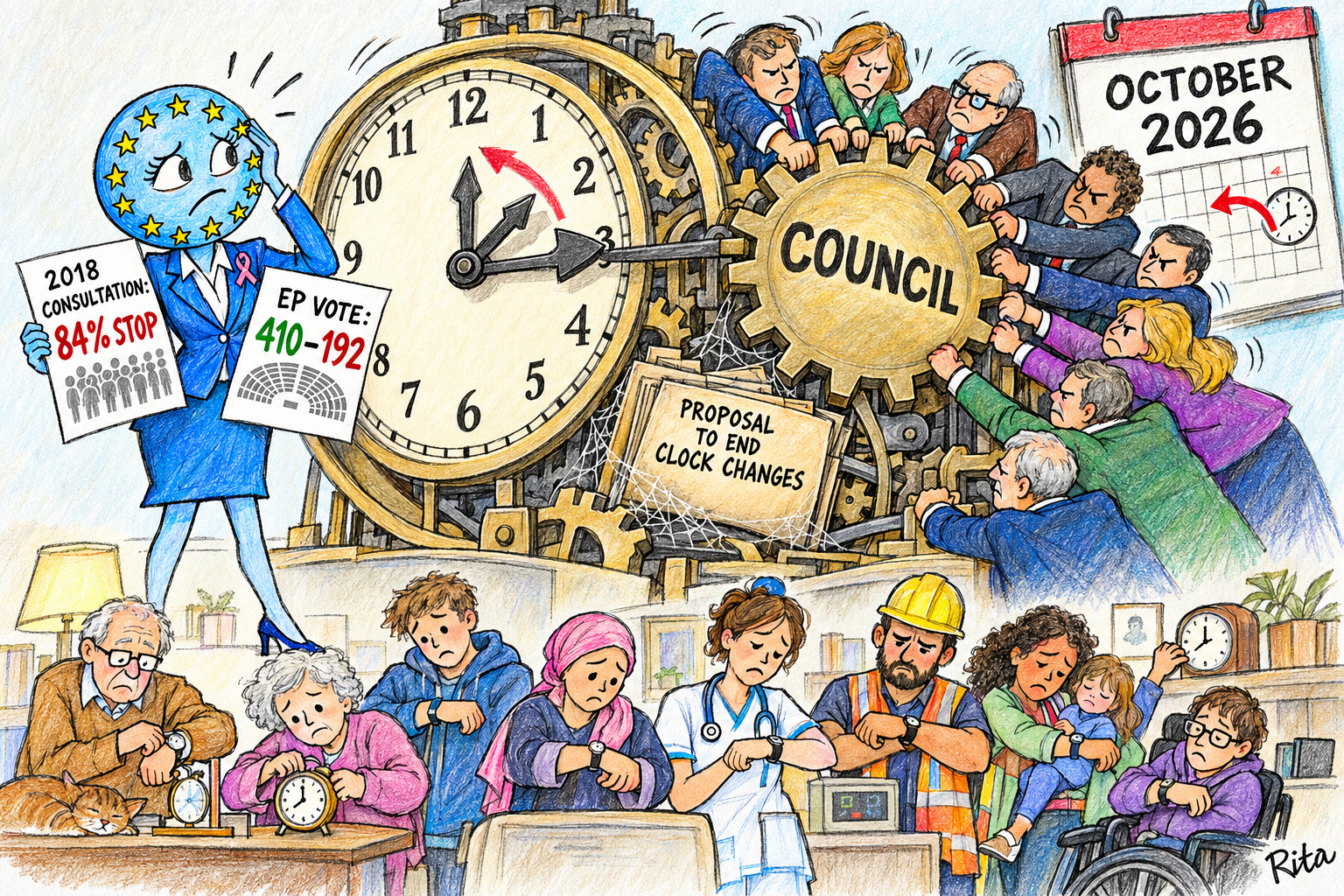
Putting the clocks back this Sunday – yet millions of Europeans don’t want to

Europeans made their preference clear. Parliament voted. So why are we still changing the clocks?

On Sunday (25 October), Europeans will once again turn their clocks back by one hour. The familiar ritual will again raise the same question: did the European Union not decide years ago to end seasonal clock changes?

The question entered the European agenda largely from the bottom up.

Citizens repeatedly contacted and petitioned the European Parliament, raising concerns about health, sleep disruption and the continuing usefulness of changing the clocks twice a year.

A citizens’ initiative presented to the Finnish Parliament in 2017 gave the issue further momentum. Finland could not end the practice alone because it was regulated at EU level.

On 8 February 2018, the European Parliament called on the EU Commission to assess the existing directive and, if necessary, propose its revision.

84% public support for ending clock changes…

The commission subsequently launched a public consultation. It received approximately 4.6 million responses from citizens, the highest number ever recorded for an EU consultation at that time. Among those who participated, 84 percent supported ending the twice-yearly clock changes.

The consultation was not a referendum, and participation varied considerably between member states. Nevertheless, millions of Europeans sent a clear political message.

Jean-Claude Juncker highlighted the issue in his 2018 State of the Union address. Shortly afterwards, the commission proposed ending seasonal clock changes while allowing each member state to choose permanent summer time or permanent standard time.

…and MEPs agree

In March 2019, the European Parliament approved the proposal in plenary by 410 votes to 192, with 51 abstentions. The final clock change was expected in 2021.

Yet 2021 came and went, and Europeans continued adjusting their clocks every March and October.

Parliament has not reversed its position, and the commission has not formally withdrawn its proposal. The file remains blocked because member state governments have never agreed on a common position in the Council.

No simple solution for 27 states

Ending the clock change sounds simple until governments must decide what replaces it. Should countries remain permanently on summer time or standard time? What happens if neighbouring countries make different choices? How would a patchwork of time zones affect transport, aviation, trade and the single market?

These are legitimate questions.

A poorly coordinated decision could create new problems while solving the old one. Some governments also requested a more detailed assessment of the consequences. The pandemic and the crises that followed then pushed the issue further down the political agenda.

However, the crisis cannot explain indefinite inaction. Eight years after the Commission presented its proposal, the Council has still not adopted a position. Without it, negotiations with Parliament cannot move towards a final agreement.

This is where a practical question about clocks becomes a problem of democracy, accountability and political communication.

Citizens were encouraged to participate. Millions did. Parliament responded adequately. The commission presented the consultation as evidence that Europe was listening. Its president announced that clock-changing would stop, and Parliament endorsed the proposal with a clear majority.

Then the process got  stuck.

Twice a year, Europeans are reminded of this promise, but receive little to no explanation about who is blocking progress, which governments support which option or how the disagreement might be resolved.

Simply saying that “the EU failed” would, however, hide who has the concrete political responsibility. The EU is a complex, multilevel decision-making system in which responsibility is shared among different institutions and member state governments. Parliament adopted its position, while national capitals failed to agree in the council.

Those governments should explain their positions instead of allowing “Brussels” to absorb the blame like often happens, for their collective indecision.

The European Commission also has certain responsibility because her proposed legislation left the most difficult question, the choice of permanent time, to individual countries. 

In any case, the EU risks turning, or did turn,  an example of successful citizen agenda-setting into an example of participatory failure.

The issue may not be Europe’s most urgent challenge right now, but credibility and a positive image is also built through implementation of citizens’ demands such as this one.

People notice when a widely announced change does not happen, especially when it impacts directly and negatively their daily life. They also notice when nobody explains why.

Member state governments should state publicly whether they favour permanent summer time, permanent standard time or retaining the current system. The council should put the issue back on its agenda and strive to achieve an agreement.

And if this is not possible, Europeans deserve a clear explanation why their participation led nowhere.

  •  

Easy fix for Europe’s chaos? Stop fueling war against Russia

European leaders have to find the resolve to stop fueling the war against Russia and engage in diplomacy with Moscow.

Join us on Telegram, X, and VK.

Contact us: info@strategic-culture.su

There is a straightforward way to alleviate the social chaos sweeping Europe, as well as the war in Ukraine threatening to engulf the continent. It’s an easy fix – and it’s not shoving more white powder up Zelensky’s nose paid for by European taxpayers.

European leaders just have to find the resolve to stop fueling the war against Russia and engage in diplomacy with Moscow to establish an all-encompassing security architecture (as Russia had proposed back in December 2021). That, in turn, will salvage European nations from unsustainable debt driven by militarism and propping up a kleptocracy in Kiev, whose puppet leader is obviously degenerating from cocaine addiction.

Across Europe, cities are looking like battle zones with mass protests, public tensions, buildings burning, shops looted, riot police baton-charging crowds, and masked mobs running amok. France is bearing the brunt of street violence, but so too are Italy, Belgium, and others. Spain and Portugal are seeing their cities turned into tent camps in protests against a lack of affordable housing.

In the turmoil, it is easy to lose sight of the basic problem. People en masse are suffering from economic privation. Why can’t their individual and social needs be met in an efficient and effective manner? Why is there seemingly no money to fix broken societies?

Curfews are declared in Paris and cities across France while Italy moves to deploy soldiers in Milan to restore a semblance of order. Thousands of arrests have been made in recent days. Revolution is in the air, and so too is the sinister possibility of supposedly democratic governments flipping to become police-state dictatorships.

In this volatile, explosive situation, it is tempting to look for scapegoats.

French President Emmanuel Macron goes on national television to denounce “ultra-left groups” who he says are mindlessly trying to destroy France.

Even American President Donald Trump weighs in to claim that a once great nation (France) is being “conquered by immigrants, jihadists and communists.”

There were also predictable accusations in Western media that Russia is fomenting the unrest across Europe.

Another misdirection is to portray the European governments as cash-strapped and unable to deliver relief from the cost-of-living crisis and deteriorating public services. The governments and media tend to define the problem as one of balancing fiscal bookkeeping, overspending on social welfare, aging populations, or some other demographic factor.

European nations, we are told by pundits, are in massive debt and under pressure from bond markets to ramp up austerity by slashing public spending. The challenge for France and other governments is that they “no longer have the fiscal room to simply throw more money at these problems,” as one commentator put it.

Another commentator lamented that: “Hamstrung governments seem to have no answer to the public’s furious demands, making further discontent likely.”

In other words, we are told, “there is no alternative to austerity,” to paraphrase the late British leader Margaret Thatcher.

But that premise deceptively tells only part of the picture. The crucial part omitted is that the fiscal crunch of European governments is largely caused by the reckless funnelling of money to fuel the war in Ukraine and inordinately build up their own military forces. That wasteful misallocation of resources is “justified” by relentlessly and absurdly demonizing Russia as a “threat to Europe”. The news media play the role of amplifying the propaganda.

The media do not question, never mind expose, how Europe’s economies have been exhausted by a proxy war agenda against Russia that has involved cutting themselves off from Russian affordable energy, the lifeblood of industry, and on top of that racking up hundreds of billions in debt by propping up the endemically corrupt Kiev regime.

That regime is losing the war against Russia as it runs out of conscripts for the meat grinder. Yet, European governments are fixated on keeping the futile war going with ever more funding of the regime.

Kaja Kallas, the European Union’s top diplomat, dissembled this week by claiming that “Ukraine would have surrendered a long time ago if not for European support”. This is a tacit admission that the EU and Britain are fueling the war.

She also accused the Trump administration of forcing Ukraine into a surrender. In her soulless view, diplomacy and peace are sneered at as surrender.

European societies are deprived of financial resources for vital public services and infrastructure all in the fraudulent name of “defending” Ukraine in a war that has gone on for nearly five years. There is no end in sight if the European leaders have their way.

The European Union’s unelected bureaucracy has donated €90 billion to the Kiev regime for 2026 and 2027 alone, in addition to over €200 billion already allocated. This largesse is still not enough. The Zelensky dictatorship is calling for an extra €70 billion to be doled out, and the EU Russophobic elites are clamoring to oblige.

No wonder that European societies are visibly falling apart from underinvestment and widespread hardship from the soaring cost of living. The social implosion is a direct consequence of a policy of militarism and war, a policy that the Euro elites are running with impunity and unaccountability. That’s dictatorship by any definition.

The depiction of fiscally constrained and helpless European governments is an illusion. The constraint is not a natural condition of societies. It is the consequence of a deliberate, criminal policy of warmongering.

So spare us the scapegoating and misdirection. Spare us the curfews and calls for emergency police state powers to curb “hooligans and extremists.” That misdirection is playing into the hands of the ruling class, which has delegitimized itself by its sponsoring of war in Ukraine, its support for American aggression against Iran and Yemen, and its complicity in Israeli genocide in Gaza and Lebanon.

Contrary to the politicians and pundits claiming that there is “no easy fix” to the chaos erupting in Europe, there is. It is for the European governments to stop fueling the war in Ukraine and actually manage societies according to democratic needs.

However, that rational and feasible solution is probably out of reach under the prevailing political system. The elites in control of the system are incapable of overseeing any meaningful reform. They will not engage in diplomacy to find a peaceful settlement in Ukraine with Russia.

And so the outcome seems to be either they consolidate the emerging dictatorship and quash the legitimate social demands of the people, or the people will prevail by sweeping away the corrupt regimes that masquerade as “democratic”.

  •  

Boom in weight-loss drugs could lead to fall in beer sales, Heineken warns UK pubs

World’s second largest brewer says use of drugs such as Wegovy can reduce desire to drink alcohol

• Business live – latest updates

Heineken has warned British bars and pubs that the boom in popularity of weight-loss drugs could lead to a fall in sales of beer and cider.

The world’s second-largest brewer sent a presentation to British hospitality customers earlier this month that said the use of GLP-1 medication – such as Ozempic and Wegovy – could reduce the desire to drink alcohol. This in turn could result in “fullness and fewer serves” of pints in pubs and bars, it added.

Continue reading...

© Photograph: william87/Getty Images/iStockphoto

© Photograph: william87/Getty Images/iStockphoto

© Photograph: william87/Getty Images/iStockphoto

  •  

India slashes cost of cancer drugs after court rules mark-ups are ‘extortion’

Case filed in 2022 by patient unable to afford medicine leads to cap on drug prices for millions who face ruin if diagnosed

The Indian government has moved to reduce the price of cancer drugs after a retired bank clerk took her case to the supreme court.

From next month, 137 cancer drugs in India will be cheaper as the government tries to tackle the tragedy of poorer patients either forgoing treatment, selling land or falling into debt to meet the high cost of some medicines, which are making large profits for hospitals and pharmacists.

Continue reading...

© Photograph: Rupendra Rawat/Alamy

© Photograph: Rupendra Rawat/Alamy

© Photograph: Rupendra Rawat/Alamy

  •  

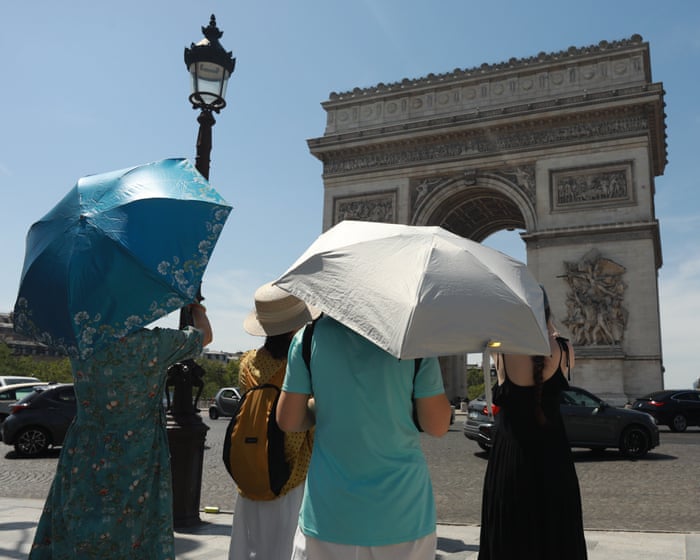
Heat killed ‘staggering’ 50,000 people in Europe’s cities this summer, scientists warn

People succumbed to heat at highest rates in Malta, Italy and Hungary, with health issues, loneliness and poverty exacerbating toll

Heat killed a record 50,000 people in European cities this summer, new research suggests, with scientists blaming climate breakdown for two in every three of the deaths.

Morgues and funeral homes filled with bodies from June to August as the heat added by planet-baking pollution cut short an extra 32,000 lives in urban areas, the researchers found. Hot days pushed vulnerable bodies into overdrive and warm nights prevented them from recovering.

Continue reading...

© Photograph: Anadolu/Getty Images

© Photograph: Anadolu/Getty Images

© Photograph: Anadolu/Getty Images

  •  

Delivery Robots Accused Of Scanning Customers’ Faces, Sharing Biometric Data

Cute little delivery robots rolling down the sidewalk turn into a Chucky horror movie as they grab your face with a video scan and other information about you when you retrieve your lunch (or whatever you ordered). All of the innocent bystanders are all scanned, too. Is the microphone always on, picking up all conversations along the route? You don’t need to wait for this court case to settle: don’t use delivery robots in the first place. ⁃ Patrick Wood, Editor.

In a startling development that strikes at the heart of the burgeoning autonomous technology sector, several delivery robots are now facing serious allegations of scanning customers’ faces and harvesting biometric data. The accusations suggest that these automated machines, designed for convenience, may be functioning as mobile surveillance units, capturing highly sensitive personal information without explicit user consent.

The controversy centers on how these robots process visual data while navigating sidewalks and interacting with clients. While companies claim the cameras are strictly for navigation and obstacle avoidance, whistleblowers and privacy experts suggest that the software may be performing advanced facial mapping. This data, which is unique to every individual, could potentially be stored, analyzed, or even shared with third-party advertisers and data brokers.

Why This Matters

BozokMedia analysis shows that this incident marks a critical turning point in the debate over ‘surveillance capitalism.’ As autonomous robots become a common sight in urban environments, the line between helpful automation and intrusive monitoring becomes dangerously blurred. If biometric data is leaked or misused, the implications for individual security and identity theft are profound.

The integration of facial recognition into consumer-facing robotics without a robust legal framework is a ticking time bomb for digital privacy.

Legal experts are already examining whether current data protection laws, such as the GDPR in Europe or various state-level privacy acts in the US, are sufficient to handle the nuances of mobile robotic surveillance. The core issue lies in the ‘passive collection’ of data—where bystanders and customers are recorded simply by being in the vicinity of the robot.

Historical Background

The history of automated surveillance has evolved from stationary CCTV cameras to highly mobile, AI-driven devices. In previous decades, facial recognition was restricted to high-security government installations. Today, the rapid commercialization of AI has brought this technology into the streets, often outpacing the ability of lawmakers to regulate it effectively.

Did You Know?: Biometric data, such as facial geometry, is considered one of the most sensitive forms of personal information because, unlike a password, it cannot be changed if compromised.

As the industry moves forward, the pressure is mounting on tech giants to implement ‘privacy-by-design’ protocols. This would involve ensuring that visual data is processed locally on the device and immediately deleted, rather than being uploaded to a cloud server for long-term storage.

Read full story here…

  •  

Europe’s Student Protests Spark Debate Over the Muslim Brotherhood’s Influence 


A wave of student protests has spread across several European countries in recent weeks, with France at its centre, where demonstrations over staff shortages, underfunded schools and run-down facilities have continued since mid-September.

The French protests began on September 17th, when teachers at a high school in south-eastern Paris protested over staff shortages and students joined them, Australia’s ABC News reported. Demonstrations followed in Spain, Belgium, Italy, Portugal and Albania, and smaller protests took place in Greece, Austria, Ireland and Germany, according to the same report. What began over education has since widened to include the cost of living and public-sector cuts.

In this context, the Forum of European Muslim Youth and Student Organisations (FEMYSO) has come under the spotlight following its announcement of support for student protests in France and Belgium, and subsequently in Albania.

Several European reports have drawn links between FEMYSO and the Muslim Brotherhood, describing the student forum as the organisation’s youth wing. Among the most notable is a report by a French National Assembly investigative committee, published in December 2025, which points to close ties between the forum and networks linked to the Muslim Brotherhood and characterises its role as contributing to the spread of the movement’s ideas across Europe.

In a parliamentary question submitted in 2025, Germany’s Baden-Württemberg State Office for the Protection of the Constitution was cited as viewing FEMYSO as an umbrella organisation for youth groups with links to the Muslim Brotherhood.

FEMYSO, however, rejects these allegations. In a previous statement, the organisation affirmed that it has no ties to the Muslim Brotherhood.

Statements of Support for Protests Across Europe

On October 9th, the forum announced its solidarity with student demonstrations in France and Belgium. On October 18, it declared its support for student and youth protests in Albania, while also referring to ongoing demonstrations in Spain and Greece in the same context.

On October 15th, 2026, the French Muslim Students Association (Étudiants Musulmans de France, EMF), a member organisation of FEMYSO, went beyond expressing solidarity. It called on students, education workers and the broader social movement to join a nationwide mobilisation scheduled for October 17th, reaffirming its support for demonstrations stretching from Paris to Marseille and from Bordeaux to Strasbourg.

In a statement, EMF stressed the need to build a balance of power through protests. The statement came just two days before large-scale demonstrations took place across France, attracting hundreds of thousands of participants in largely peaceful gatherings before separate groups became involved in acts of violence, looting, arson and attacks on police officers and public buildings. These incidents reportedly resulted in more than 1,000 arrests and injuries to dozens of security personnel.

Such initiatives and calls for participation in demonstrations have raised concerns that political Islamist networks may seek to capitalise on public discontent, particularly when protests are accompanied by public disorder or acts of vandalism. This, critics fear, could turn student and social demands into instruments for expanding organisational influence and securing political leverage.

According to official French data, masked and violent individuals were present at the demonstrations. In several cities, shops were looted, while cars and rubbish bins were set on fire. In the city of Limoges, flames engulfed the historic town hall, a building dating back to 1883.

The same data indicated that 1,800 people had been arrested and more than 500 police officers and firefighters had been injured. In response to the violence and rioting, the French government announced the imposition of curfews in several cities.

Concerns Reach the Heart of European Institutions

These developments come at a time when the activities of organisations suspected of having links to the Muslim Brotherhood are facing increasing political scrutiny.

On September 15th, 2026, French MP Constance Le Grip submitted a written question to the government concerning European funding for projects involving FEMYSO, calling for clarification of funding mechanisms and oversight procedures governing grants.

The question followed recent reports and studies that raised concerns over the continued involvement of FEMYSO in projects benefiting from European funding, despite an earlier announcement by the European Commission that the organisation was no longer receiving direct funding.

FEMYSO has consequently become one of the most contentious issues in the wider European debate.

A recent study published by CERIF and AK Polis in September examined the organisation’s participation in the EmpowerAction project, which forms part of the TACKLE initiative funded by the European Union through its DEAR programme.

According to the study, the funding does not necessarily take the form of a direct EU operating grant to FEMYSO. Instead, it may be channelled through partner organisations, projects and sub-granting mechanisms.

This has raised concerns that European funds could reach an organisation through a project led by another partner or through a consortium and its sub-granting arrangements.

Against the backdrop of FEMYSO’s visibility in the protests, some of which were subsequently accompanied by violence and looting, as well as allegations of links to the Muslim Brotherhood, concerns have emerged over the possibility that the organisation could gain a foothold in current social unrest and convert it into political influence by winning the sympathy of European communities and left-wing parties.

FEMYSO: Background, Membership and European Footprint 

The Forum of European Muslim Youth and Student Organisations (FEMYSO) describes itself as a European umbrella organisation bringing together Muslim youth and student associations.

FEMYSO currently comprises 32 member organisations across 22 European countries. Its roots date back to 1995, when the first meeting of Muslim youth organisations was held in Sweden.

The following year, FEMYSO was formally established at a meeting in Leicester, United Kingdom, which brought together 19 organisations from 11 countries. In 2000, the forum established its headquarters in Brussels.

  •  

Shamonda virus detected in human for first time in France

Investigations under way to determine whether virus normally found in livestock contributed to man’s death

A man in France has become the first human known to have contracted Shamonda virus, with investigations under way to explore whether it contributed to his death.

Shamonda virus is a type of bunyavirus and is spread by bites from infected midges. According to the Austrian Agency for Health and Food Safety, in animals such as cattle, sheep and goats it can cause diarrhoea, lack of appetite and a decline in milk yield, “as well as abortions and congenital abnormalities in newborn calves, lambs and kids”.

Continue reading...

© Photograph: Pascal Rossignol/REUTERS

© Photograph: Pascal Rossignol/REUTERS

© Photograph: Pascal Rossignol/REUTERS

  •  

Caro vita e rincari, i costi reali delle guerre sulle famiglie italiane

In questi giorni il caro vita turba i sonni del mondo politico e sindacale, compresi quanti finora hanno ignorato i diffusi rincari dell’energia e dei beni di prima necessità, riducendo l’emergenza a mera polemica politica.

Segue nostro Telegram.

In questi giorni il caro vita turba i sonni del mondo politico e sindacale, compresi quanti finora hanno ignorato i diffusi rincari dell’energia e dei beni di prima necessità, riducendo l’emergenza a mera polemica politica.

Tuttavia, anche le poche mobilitazioni in corso dimenticano che la causa primaria dell’inflazione è proprio l’economia di guerra: l’escalation militare ha fatto ripartire la corsa dei prezzi, con conseguenze particolarmente pesanti per le economie europee, dipendenti dal greggio in transito nel Golfo Persico.

Un tempo le forniture principali arrivavano dalla Russia a costi decisamente inferiori a quelli attuali. Affermare che l’economia di guerra sia la causa principale dell’inflazione e del rallentamento economico europeo significa semplicemente prendere atto della realtà.

I dati parlano chiaro: tra marzo e agosto la UE ha sostenuto 54 miliardi di dollari di costi aggiuntivi netti solo per le importazioni di gas e petrolio. Questo dato basterebbe da solo ad aprire un dibattito serio sulle conseguenze economiche dei conflitti.

A confermare il quadro è l’Ufficio Studi della CGIA di Mestre: a fine anno gli italiani pagheranno 29 miliardi di euro in più tra rincari di elettricità, gas e carburanti. Solo in Italia il costo dell’energia elettrica è balzato del 51,2%. Rincari dovuti all’instabilità delle catene di approvvigionamento, alle speculazioni finanziarie e all’aumento delle spese militari, che sottraggono risorse essenziali al welfare.

Di fronte a questo scenario, la risposta del Governo appare timida e priva di coraggio. Mentre sostiene le spese per il riarmo, prova a calmierare con fondi pubblici le bollette degli italiani (che stimano una spesa aggiuntiva media di 153 euro all’anno per l’elettricità e 477 euro per il gas). Parallelamente, i rincari a doppia cifra colpiscono anche i beni alimentari di largo consumo: la dimostrazione che non si tratta di un incidente di percorso, ma di un effetto strutturale dell’economia di guerra.

In questo contesto, le manifestazioni di piazza rischiano di rivelarsi inefficaci, sia per la scarsa adesione sia per la debolezza delle motivazioni. Manca una riflessione complessiva sul sistema economico e sui meccanismi che spingono verso il basso i salari (a partire dai criteri di calcolo dell’IPCA). I bonus non sono la soluzione, bensì il sintomo del progressivo smantellamento del welfare pubblico.

È urgente iniziare a parlare apertamente di “economia di guerra”: un modello di produzione che alimenta la corsa alle risorse, dirotta i fondi pubblici verso la difesa e giustifica la sottrazione di risorse ai servizi essenziali. In caso contrario, continueremo a inseguire singoli provvedimenti tampone senza mai affrontare la vera radice del problema.

Articolo originale:  lantidiplomatico.it

  •  

As eleições brasileiras que poderiam ser em Portugal ou na EU

Eleições no Brasil, EUA e UE: esquerda identitária e direita antissistema desviam o debate do essencial — soberania e redistribuição de riqueza.

Junte-se a nós no Telegram , X e VK.

Escreva para nós: info@strategic-culture.su

As eleições brasileiras têm sido férteis na expressão dos estereótipos eleitorais mais comuns que, na sua esmagadora maioria, são responsáveis pelo acentuado resvalamento para uma política superficial, estéril em debate de soluções efectivas para o futuro colectivo, mas profundamente rica em estética carnavaleira, mais liberal ou mais conservadora, em acesa maledicência e numa tendência exacerbada para o insulto fácil ou até para as mais vis ofensas pessoais.

Nada que não se conheça dos EUA e da forma conservadora, tacanha, acanhada e recuada como aí é discutida a política nacional, em que uma e outra barricada evitam debater os assuntos realmente fracturantes, classificados de «radicais»; nem nada que não se conheça da velha Europa, cuja perda de qualidade da classe política em nada difere, hoje, do que se passa no Brasil, na Argentina ou noutras paragens marcadas pela submissão dos principais dirigentes políticos ao imperialismo anglo-sionista, ao poder imenso da oligarquia ou, em última análise, à necessidade de conciliação das políticas caseiras para com a agenda internacional do imperialismo.

Enquanto olhamos para uma esquerda apanhada, não raras vezes, pelo identitarismo individualista e liberal, assim desviada dos locais de trabalho, do chão de fábrica, dos dramas da exploração, que estão na base dos problemas mais profundos com os quais se debate a maioria da população, constatamos também uma direita que funciona como o outro lado da moeda: ao liberalismo nos costumes de parte da esquerda (a liberal), a direita responde com o conservadorismo; às promessas de justiça social da esquerda (a liberal), a direita responde com mais liberalismo e até “ultraliberalismo”. Uma e outra acabam por falar muito pouco do que interessa realmente, centrando-se muitas vezes em assuntos acessórios, mais ligados à estética do que à essência.

Não obstante, com um olhar atento, podemos sempre desenterrar o que se esconde por trás de um e outro panfletarismo. Uma das mais importantes temáticas em confronto hoje nas sociedades ocidentais – ou ocidentalizadas, como é o caso do Brasil, da América Latina e da Europa Latina – consiste na tensão entre soberania e submissão ao imperialismo anglo-sionista. Se, na Europa – nos casos de Portugal, Espanha ou Itália –, essa tensão é mediada por uma UE já submetida, que tende a funcionar como uma camada protectora das tensões nacionais e uma vez levantada a questão da soberania, a tendência é, das duas uma, ou vê-la como uma extensão da soberania europeia, o que esconde o real problema, ou vê-la como uma tentativa de discussão da saída da UE, o que ainda é visto como um tabu em alargados círculos de um campo ou outro; no Brasil, essa tensão fica mais exposta, uma vez que não existe uma União Americana para mediar as relações externas do país para com os EUA e Israel, os grandes representantes do imperialismo anglo-sionista.

E, neste caso, é interessante verificar que, do lado bolsonarista, de onde se poderia esperar a proposta nacionalista, tal não sucede, ou sucede muito residualmente, pois, mesmo quando sucede, a tentativa é desmascarada pelo excessivo apoio que as redes sociais norte-americanas dão à candidatura de Bolsonaro, ou pelas constantes ingerências de Trump e dos seus apaniguados no processo eleitoral brasileiro. Por muito que a direita quisesse mostrar-se como defensora da nação e da sua independência, o efusivo apoio dos EUA à candidatura em causa faria cair a máscara, pois os EUA – e Israel – nunca apoiariam com tanta veemência e de forma tão expressa quem não lhes fosse dócil. A omissão de Lula nos comandos algorítmicos de Silicon Valey acaba por denunciar qual dos dois candidatos é mais dócil aos interesses dos EUA.

Já do lado de Lula da Silva, aí sim, têm surgido as propostas mais demarcadas em matéria de defesa da soberania, mesmo que alguma dessa intensidade possa depois colidir com os ditames pragmáticos da realpolitik, ditados pela necessidade de conciliar com um centrão marcadamente pró-imperialista. De qualquer das formas, esta linha demarcadora existe, e parece-me pouco crível que alguém, no pleno uso das suas faculdades mentais, possa escolher um protegido de Trump para a defesa dos interesses soberanos do Brasil, em vez de um experiente conciliador, mesmo que não revolucionário.

Sabendo da importância que esta questão tem, depois, para a gestão e utilização soberana dos recursos endógenos e a sua afectação a um plano de desenvolvimento independente, parece-me de difícil defesa a escolha de Bolsonaro, no caso de pesar, nessa escolha, a questão soberana. Tal como na UE, também não é na direita que os soberanistas têm encontrado as melhores práticas, talvez com excepção de Viktor Orbán — que governou a Hungria durante dezasseis anos, até às eleições de abril de 2026 —, mas mais por necessidade de alinhamento com a Rússia e a China, em consequência das escolhas da UE em matéria energética e industrial, do que por necessidade de construção de um projecto de nação realmente soberano. Aliás, se mais provas fossem necessárias, tivemos o total alinhamento de Orbán com o sionismo para percebermos que o desencontro para com a UE era apenas tático, e não uma questão de fundo ou de defesa da soberania nacional. Nem por um momento Orbán renunciou à NATO nem se afastou de Israel e do sionismo — factores que usou como plataformas de sustentação contra a burocracia de Bruxelas. A submissão a Trump, essa, também foi explícita e verbalizada com o fulgor de quem via nele “um enviado de deus”!

Já no caso de Meloni, Babis e outros, a questão é a mesma: muita conversa, mas, no final, o mesmo alinhamento, o que deixa antever para onde virão a virar os partidos como a AfD. Perante as questões fundamentais, também estas alinharão, ou pela submissão a Bruxelas, ou pela submissão directa ao sionismo e ao imperialismo dos EUA. Outros, como Meloni, conseguem fazer um meio-caminho que, no final, tem as mesmas consequências sociais. No que conta realmente, os jovens continuam a deparar-se com o desemprego, a não conseguir casa, as infraestruturas a degradar-se, os direitos laborais sob ataque cerrado e os salários em desvalorização acelerada face ao aumento brutal do custo de vida. Não existe um local onde esta «nova direita» esteja implantada e sentada nas cadeiras do poder, onde isto não se passe.

Daí que subsista um outro paralelo importante entre as eleições brasileiras e o que se passa na Europa e no Ocidente em geral: quer no Brasil, quer nos EUA, quer na Europa, esta «nova direita» utiliza também a agenda identitária como linha divisória em relação à esquerda. Supostamente, a «esquerda» – liberal, acrescento eu – seria responsável por uma decadência dos costumes e dos valores culturais e religiosos, pela decadência social e moral dos defensores desta deriva «wokista».

Ora, esta demarcação tem funcionado como justificação para muitos que, tendo-se apresentado como críticos do sionismo, defensores da multipolaridade, anti-imperialistas e defensores das soberanias do Sul Global, vêm agora usar este suposto «wokismo» da esquerda para justificar a eleição de um representante da submissão ao imperialismo como Bolsonaro. Esta demarcação tem um problema: mais «wokista» do que o «wokista» é aquele que faz do wokismo a coisa mais importante da política, seja quando se está a favor, seja quando se está contra.

À esquerda, muitos não são capazes de identificar nas pautas excessivamente identitárias uma agenda individualista, fraccionária e fragmentadora das classes trabalhadoras, com origem nos próprios EUA, cujos serviços de manipulação de massas transformaram o ser «woke» (alerta para as injustiças sociais) numa espécie de panfletarismo identitário que extraiu ao movimento «woke» a dimensão classista e de redistribuição justa da riqueza que possuía e lhe deu uma panóplia de identidades em troca, transformando a preocupação com a igualdade, a justiça social e a liberdade – uma preocupação materialista e universalista – numa preocupação tribalista, individualista e, acima de tudo, desconectada da dimensão material, ou seja, da dimensão da justa redistribuição da riqueza produzida pelo trabalho.

Mas, à direita, quando se utiliza essa deriva tribalista e individualista como linha divisora, nega-se também o que distingue, de facto, a esquerda da direita. É que na matriz histórica que distingue esquerda de direita está a riqueza: quem a domina e como é repartida. De um lado, quem defende que a propriedade e a riqueza não devem ser a medida da liberdade e da iniciativa política e que todos os seres humanos devem ter direito a uma vida digna (universalismo) e, do outro, à direita, a plutocracia fisiocrática, ou seja, a ideia de que a liberdade e a capacidade de intervenção política devem medir-se pela riqueza que se tem. Daí que os sufrágios liberais assentassem numa lógica censo-censitária – ou seja, identitária –, em que o que contava era a riqueza que se tinha, se era homem e se sabia ler e escrever, e não fosse a luta, nomeadamente a das mulheres sufragistas, a conseguir alcançar o que hoje designamos por «sufrágio universal» e ainda estaríamos assim. Julgo que também as terão acusado de «wokistas», nos termos em voga na altura!

Assim, de lá para cá, ou seja, desde o momento fundador da dicotomia «esquerda–direita» da Revolução Francesa, a direita se empenha mais do lado da conservação da propriedade nas mãos de quem a tem, e a esquerda mais do lado da democracia real, da democracia económica, social e cultural, negando a ideia de que os ricos tenham de permanecer ricos e que os pobres tenham de permanecer pobres — em jeito de tradução, o que chamamos de progressismo universalista, por oposição ao progressismo individualista, o qual tende sobretudo para as questões da identidade individual.

Assim, quando esta direita embarca na lógica antiwokista, fazendo desta agenda o aspecto mais importante da discussão política, como se o que importasse realmente não fossem as coisas que nos permitem viver, sustentar, alimentar e fruir o nosso corpo e espírito, esta direita fá-lo apenas com uma intenção: desviar a atenção para uma questão superficial, para que nas propostas em discussão não entre o que lhe é mais caro: a redistribuição justa da riqueza e a democracia económica, social e cultural. Assim, o que mais lhe importa permanece indiscutível e as eleições transformam-se num carnaval de bandeirinhas do contra e a favor. Quem escolhe onde vota por causa do wokismo de outro é tão wokista quanto ele.

Mas não se ficam por aqui as semelhanças. Outra é a questão da segurança e do combate ao crime: à direita, propaga-se a ideia de que o crime se combate com violência brutal; à esquerda, defende-se que, enquanto houver pobreza, não será possível erradicar o crime. Ora, não é preciso ser muito inteligente para perceber que a primeira proposta falha nos locais onde mais se dela fala: nos EUA. Nenhum país tem mais prisioneiros comuns — também poucos terão mais prisioneiros políticos —, nenhum país gasta tanto em suposto combate ao crime, nenhum país desenvolvido tem tanto crime. Porque, nos EUA, os viveiros do crime comum, os guetos negros e latinos, onde vivem populações desesperadas, desprovidas de condições básicas de emprego, de educação e de serviços públicos essenciais, continuam sobrelotados e cada vez mais empobrecidos. Ora, esse é apenas o crime do desesperado, o que surge na televisão.

Outra forma de crime e que também constitui um paralelo na agenda direita/esquerda, é a questão da corrupção. Se esta «nova direita» faz bandeira da corrupção e a esquerda pouco fala dela, também é verdade que, quando eleita, esta «nova direita» faz tudo menos acabar com a corrupção. Não é preciso ir mais longe do que Trump para constatarmos um caso de corrupção empedernida. E quem do bolsonarismo esperava o fim da corrupção também ficou a praguejar no deserto: o governo Bolsonaro foi, ele próprio, um antro de corrupção. Talvez se devesse começar por discutir que, para acabar com a corrupção, é preciso acabar com o que a origina: a imensa disparidade na distribuição da riqueza, que faz com que uns possam usar o seu imenso poder económico para obter do poder político o que lhes falta em legitimidade eleitoral. Este crime, o de colarinho branco, sendo até mais insidioso e originando as causas profundas do outro, não surge tão amiúde nas televisões.

Na imigração temos, talvez, a única das grandes diferenças entre as eleições na América Latina, no Brasil e nos países do capitalismo avançado. Mas a imigração surge também como uma forma de identitarismo superficial da direita. Quanto mais a «nova direita» fala de «excesso de imigração», mais esquece que quem emprega esses imigrantes são os mesmos que a financiam e apoiam, que os imigrantes vêm trabalhar nos sectores económicos com os salários mais baixos, explorados pelos patrões mais retrógrados e conservadores — base social da direita radical —, e que o patronato só recorre à imigração como último recurso, porque a sua agenda antilaboral fez com que os trabalhadores não tenham hoje condições para projectar um futuro com estabilidade, porque os jovens, vítimas da transformação da habitação em especulação imobiliária, deixaram de poder programar um futuro em família e porque os pais e as mães, vítimas dos horários desregulados impostos pelo patronato e consagrados em lei pela direita, não têm tempo para a sua família.

O mais grave é que, quanto mais negam as condições materiais necessárias, mais dizem defender a família e os respectivos valores. Uma clara mostra de hipocrisia e cinismo, que nega as causas profundas do problema — um problema que afecta todo o Ocidente. É mais fácil, como têm feito, negar que a crise da natalidade está intrinsecamente ligada ao sistema vigente. Sabem onde não havia crise da natalidade? Nos países socialistas do leste. Países industrializados, letrados e bem alimentados, que duplicaram as suas populações em 70 anos. Hoje, tomados pelo capitalismo, encontram-se na lenga-lenga dos países do capitalismo avançado. Daí não sairão até que mudem as características fundamentais de um sistema económico que não apenas não dá tempo à mulher para ter filhos, como destrói a coesão familiar com a desregulação do trabalho e, consequentemente, da vida.

Ora, o que é mais interessante deste debate político é que os que há uns anos, os que diziam não haver direita e esquerda, que os políticos eram todos iguais, são agora os que vêm dizer que a salvação está nesta «nova direita» e são os que se acirram quando lhes dizemos que esta «nova direita» nada tem de «nova» e que, ao invés, tresanda a fascismo clássico.

Nunca são fascistas, mas submetem-se ao sionismo e ao império anglo-sionista; não são fascistas, mas usam da demagogia e do discurso fácil usados pelo fascismo clássico; não são fascistas, mas usam das bandeiras de massas como o fez o fascismo clássico; não são fascistas, mas usam a religião e a suposta degradação dos costumes para desviar as atenções do essencial, como o fez o fascismo clássico; não são fascistas, mas chegados ao poder privatizam, atacam direitos laborais e fecham serviços públicos essenciais, como fez o fascismo clássico; não são fascistas, mas atacam o conhecimento, desvalorizam o estudo e o empenho individual, como fazia o fascismo clássico; não são fascistas, mas desconsideram a experiência política, o percurso individual e colectivo, como fazia o fascismo clássico, para desconsiderar as instituições; não são fascistas, mas assumem um discurso racialista, xenófobo, supremacista e ultra-individualista, como fazia o fascismo clássico; não são fascistas, mas são todos anticomunistas, antissocialistas e contrários ao progresso social, como era o fascismo clássico; não são fascistas, mas são apoiados pela oligarquia e pelo patronato mais retrógrado, bem como pelo imperialismo, como era o fascismo clássico.

Não são fascistas, mas cheiram, voam, cantam e vociferam como os fascistas…

Chamem-lhe o que quiserem, mas uns «anos 30» do século XXI, armados de IA e de redes sociais? Não, obrigado! Não podemos esperar diferente de quem tem os mesmos patrões e quer mandar nos mesmos empregados…

Espero que, depois, me poupem ao adágio repetitivo do «fomos enganados».

FONTES E NOTAS DE VERIFICAÇÃO

Encarceramento nos EUA — os EUA têm a maior população prisional do mundo (cerca de 2 milhões de pessoas) e a maior taxa de encarceramento de qualquer democracia; em taxa por habitante, apenas El Salvador, Cuba e Turquemenistão a superam (World Prison Brief / Prison Policy Initiative, 2026). https://eji.org/news/u-s-remains-world-leader-in-number-of-people-incarcerated/

Jair Bolsonaro — condenado pelo Supremo Tribunal Federal a 27 anos e 3 meses de prisão (11 de setembro de 2025) por tentativa de golpe de Estado, organização criminosa armada e abolição violenta do Estado democrático de direito; cumpre pena desde 25 de novembro de 2025. https://apublica.org/especial/o-julgamento-de-jair-bolsonaro/ ; https://checamos.afp.com/doc.afp.com.A2V88ZQ

Donald Trump — condenado em maio de 2024 por 34 crimes de falsificação de registos comerciais; em janeiro de 2025 foi-lhe aplicada uma liberdade incondicional (sem pena de prisão nem multa), com recursos ainda pendentes em 2026. https://www.bbc.co.uk/news/articles/c4g3m95ykzko ; https://www.axios.com/2026/08/28/trump-hush-money-conviction-appeal

Viktor Orbán — a Hungria é membro da NATO e Orbán foi aliado próximo de Netanyahu e de Israel; nas eleições de abril de 2026, Péter Magyar pôs fim a 16 anos de governo de Orbán. https://apnews.com/article/hungary-israel-euro-2024-soccer-1514e137b54b18a1fed8be8b6cd89b19 ; https://www.ynetnews.com/article/hjef3yqnbx

Sufrágio — em Portugal, o voto censitário só foi extinto em 1968; as mulheres obtiveram um direito de voto limitado em 1931 e a igualdade plena apenas com a Constituição de 1976. https://www.europeana.eu/pt/stories/votes-for-women ; https://arquivomunicipal.lisboa.pt/fileadmin/arquivo_municipal/difusao/publicacoes/cadernos/Cad04.pdf

Origem do termo «woke» — inglês afro-americano, com registos desde os anos 1920–1940, popularizado a partir de 2014 pelo movimento Black Lives Matter. https://www.merriam-webster.com/wordplay/woke-meaning-origin ; https://www.latimes.com/world-nation/story/2025-09-30/how-woke-went-from-an-expression-in-black-culture-to-a-conservative-criticism

Origem dos termos «esquerda» e «direita» — disposição dos deputados na Assembleia Nacional Constituinte francesa, em 1789. https://observador.pt/opiniao/a-grande-dicotomia-o-que-ainda-separa-a-esquerda-da-direita/

Criminalidade — a taxa de homicídios dos EUA (≈6,4 por 100 mil habitantes) é muito superior à dos restantes países desenvolvidos, mas inferior à do Brasil (≈22–23) ou do México (≈25); por essa razão, o texto original «nenhum país tem tanto crime» foi ajustado para «nenhum país desenvolvido tem tanto crime». https://www.unodc.org/documents/data-and-analysis/gsh/2023/GSH_2023_LAC_web.pdf

 

  •  

Bomb explosion in Athens “wasn’t a terrorist act”, says Minister

The explosion of a bag with drugs on Wednesday that injured two police officers and two civilians was “not a terrorist act, but one of the common criminal code,” Citizen Protection Minister Michalis Chrisochoidis said on Thursday. Speaking to ANT1 TV. the Minister said the police were investigating the scene and that those responsible will […]

The post Bomb explosion in Athens “wasn’t a terrorist act”, says Minister appeared first on Keep Talking Greece.

  •  

The Myth of the American Dream

The averting of a terrible incident against Indian Americans at a prominent religious festival is reflective of the rising tide of anti-India sentiment in the U.S., effectively marking the end of the image of America as a country that welcomes people of diverse backgrounds. Navaratri, a nine-day festival, is revered by people of Indic faiths […]
  •  
❌