❌

Reading view

Hundreds of thousands march across France in protests over schools and policing

Almost 1,000 arrested as police charge crowd in Paris and teargas used to stop protesters reaching other city centres

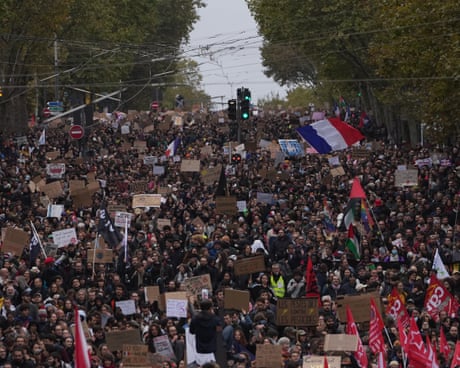
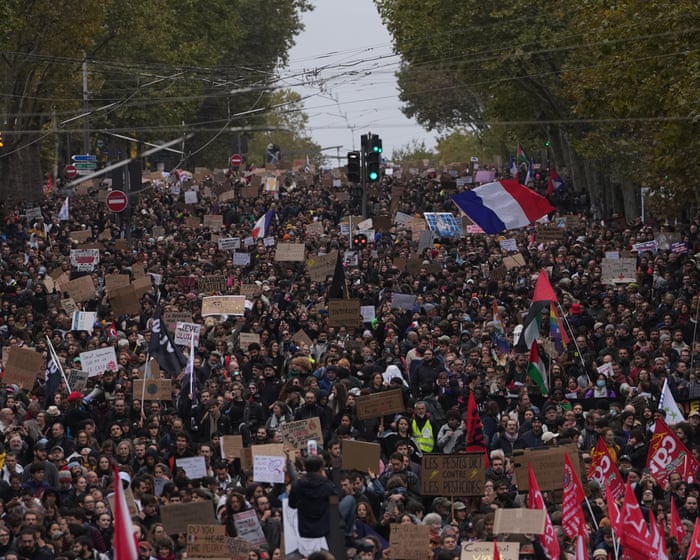
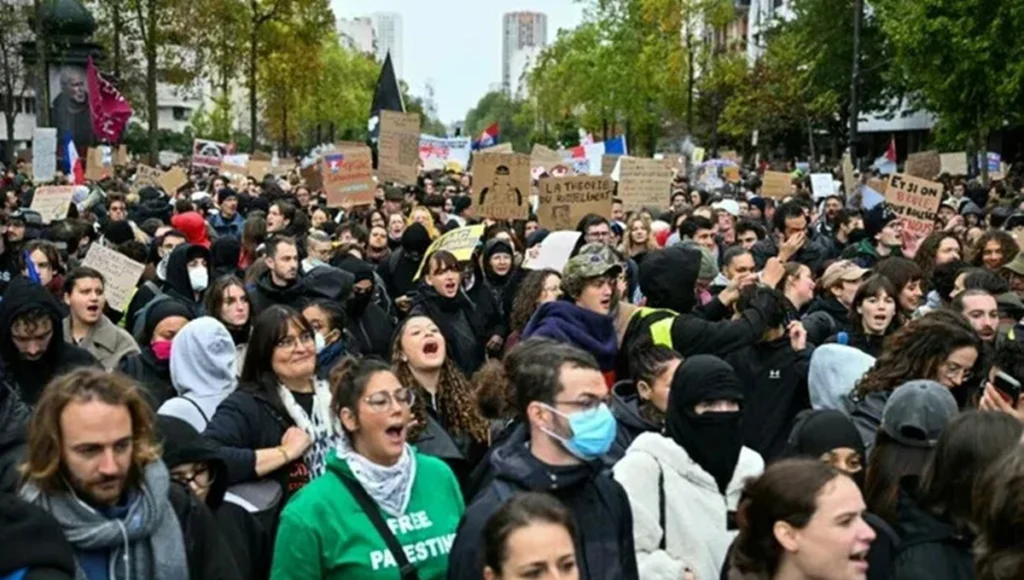
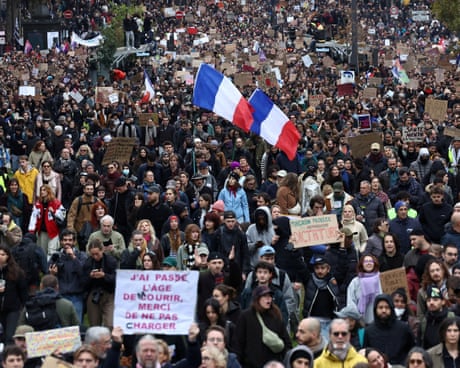
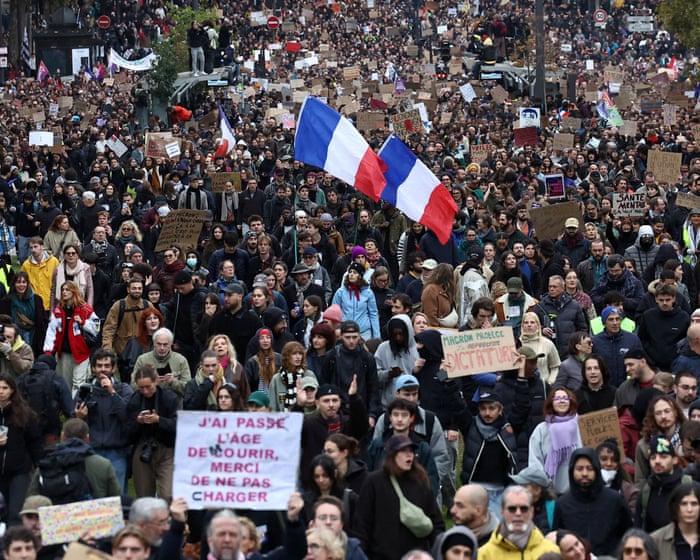
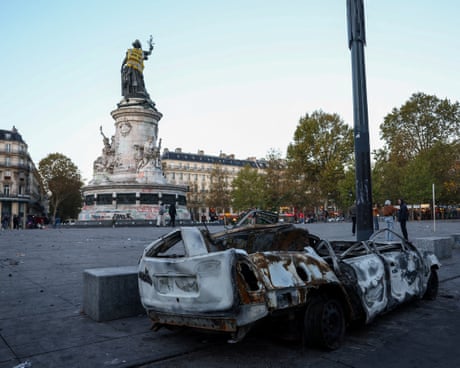
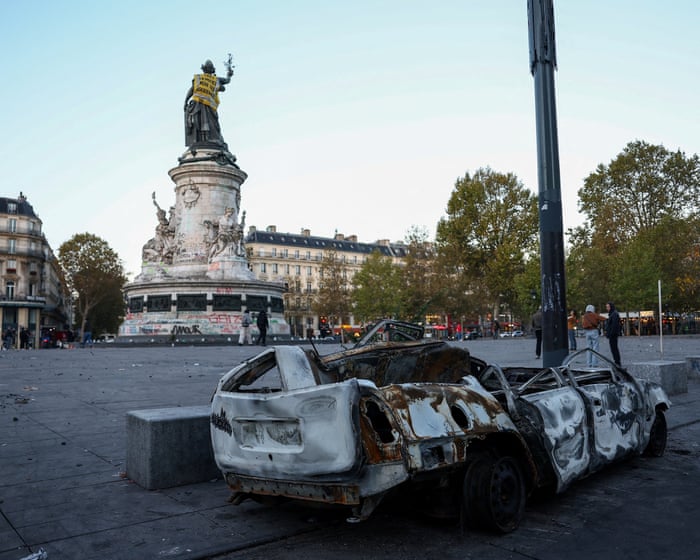
Hundreds of thousands marched in cities across France on Saturday in largely peaceful protests to support schoolchildren’s demands for more teachers and repairs to dilapidated buildings, as Emmanuel Macron faces a social and political crisis in his final months as president.

The prosecutor’s office in the southern city of Nice said on Sunday that 59 people had been taken into police custody, including 11 suspected of belonging to extreme-right groups. They were alleged to have gathered with the intent of committing violence. Some were arrested in two vehicles with masks, gloves, gas sprays and truncheons, the prosecutor’s office said in a statement to public broadcaster FranceInfo.

Continue reading...

© Photograph: Thibault Camus/AP

© Photograph: Thibault Camus/AP

© Photograph: Thibault Camus/AP

  •  

How a Small Student Protest Spread Across France

A movement that began with a few high schools has broadened to encompass labor unions and other activists.

© Dimitar Dilkoff/Agence France-Presse — Getty Images

Protesters in Paris this month during a nationwide day of actions called by high school students and joined by unions and teachers.
  •  

Melenchon Urges Macron to Meet Protesters’ Demands Before Leaving Office

French leftist leader warns of weekly demonstrations and an impending general strike.

On Saturday, French radical left leader Jean-Luc Melenchon urged French President Emmanuel Macron to yield to protesters’ demands before leaving office in May 2027.

RELATED:

Two French Protesters Arrested for the Burning of the Limoges Town Hall

“You still have time to give in; afterward, you will have no choice but to leave. Give in and stop wasting our time,” Melenchon, a four-time presidential candidate, said as he marched in the Paris demonstration, which proceeded between Porte d’Italie and Porte de Vincennes.

Melenchon, leader of France Unbowed (LFI), warned Macron that if social demands go unanswered, mobilizations such as the one taking place in France for the second consecutive Saturday “will be repeated every week.”

“This is a very important moment in the history of popular movements in our country,” Melenchon said, convinced that “a general strike is coming” for the authorities.

Victoire totale du mouvement social. La marche s'est rassemblée au nouveau point autorisé et déferle dans le calme sur plus de quatre kilomètres. Les provocations aux désordres du préfet de police et de Lecornu sont un échec total. Pour les autorités, il est temps de céder, sinon… pic.twitter.com/S3d6k2DWf3

— Jean-Luc Mélenchon (@JLMelenchon) October 24, 2026

Jean-Luc Mélenchon’s text states: “A total victory for the social movement. The march has gathered at the newly authorized location and is proceeding calmly along a route over four kilometers long. The provocations intended to incite disorder—orchestrated by the police prefect and Lecornu—have failed completely. It is time for the authorities to yield; otherwise, they will soon have no choice but to head for the exit.”

Macron must decide whether to yield to the demands now or do so later under much more unpredictable circumstances, Melenchon said. He also accused the French president of adopting an attitude characteristic of an “absolute monarchy” by claiming to be “always right” in his dealings with others.

Melenchon said Macron had taken advantage of the state of shock caused by the racist terrorist attack in Trappes, on the outskirts of Paris, to change the route of the protest through the French capital, creating confusion among demonstrators.

“Everything is being prepared to provoke an explosion” and spark unrest, he said. He questioned the deployment of military personnel to protect public buildings and authorities’ recommendations that business owners turn to private security services, arguing that both measures contribute to rising tensions.

“They are doing absolutely everything to provoke an incident,” Melenchon insisted, urging demonstrators to remain calm, follow union instructions and maintain collective discipline “so that everything goes smoothly.”

Immense cortège à Paris pour demander l’abrogation de parcoursup, 10 milliards pour les lycéens, la hausse du SMIC et des salaires.

Et pour défendre notre liberté de manifester !

Les manœuvres de Nunez et Lecornu ont échoué. pic.twitter.com/eGJIiVKkH8

— Paul Vannier (@PaulVannierFI) October 24, 2026

The text reads, “A massive procession in Paris calling for the repeal of Parcoursup, 10 billion euros for high school students, and an increase in the minimum wage and salaries—as well as the defense of our right to protest! The maneuvers by Nunez and Lecornu have failed.”

For all these reasons, the leftist leader called on the French government to “stop provoking” demonstrators and “adding fuel to the fire,” and to listen to “demands that are not so difficult to meet.”

Melenchon also criticized meetings held during the week between the Macron administration and political parties, describing them as useless and theatrical.

“They live in a bubble, make decisions that have no connection to reality and are not even coordinated among themselves. That is why they are dangerous,” he said.

On Saturday, France faced a second day of nationwide demonstrations called by unions, students and the Yellow Vests movement to protest the rising cost of living and demand more public funding for education.

Following serious incidents on Saturday, Oct. 17, authorities deployed a major security operation on Saturday and banned demonstrations in several French cities, particularly those not organized by unions.

teleSUR/ JF

Source: EFE

  •  

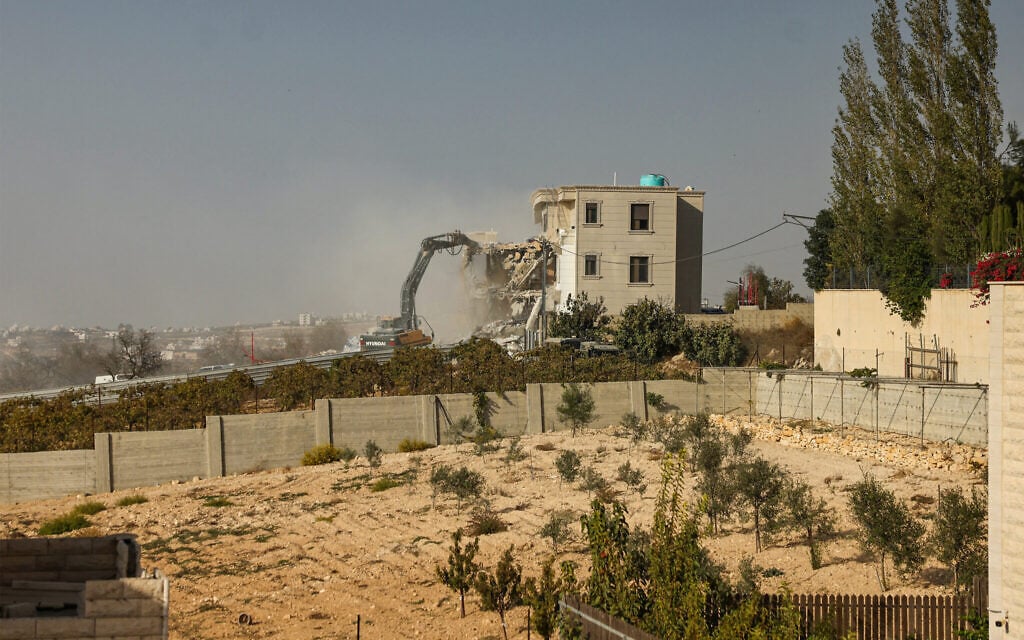
IDF op in Hebron after soldiers’ killing displaces 2,000, Katz says; PM vows ‘big surprise’ for PA

Palestinian officials declare state of emergency, say another 2,500 face evacuation; op comes day after two Palestinian gunmen from the area killed two IDF soldiers; settler attacks continue amid annual olive harvest
  •  

France’s Unrest Exposes a New Front in Russia’s Information War Against Europe

The violence accompanying France’s October protests has revealed how foreign influence networks can exploit domestic grievances to undermine governments and European support for Ukraine. New evidence suggests Russian-linked operations were active before the riots, raising questions about whether information manipulation is moving beyond propaganda towards the mobilisation of political unrest.

France’s violent protests have exposed a vulnerability in European security that conventional policing cannot easily address: the ability of foreign information networks to exploit domestic political crises, amplify social divisions and transform legitimate grievances into instruments of geopolitical pressure.

President Emmanuel Macron has acknowledged foreign manipulation of information surrounding the disturbances of 17–18 October but insists there is no evidence that foreign actors organised the violence itself. His assessment reflects the evidence currently available, although new investigations indicate that Russian-linked networks were actively exploiting the protest movement weeks before the worst disorder began.

On 24 October, France deployed approximately 70,000 police officers and gendarmes to prevent further violence. Yet the security operation addresses only the physical consequences of a crisis whose online dimension extends across national borders.

Russia’s operations began before the riots

An investigation published on 22 October by Alliance4Europe provides evidence that Russian-linked information networks were exploiting French discontent well before the disturbances.

Researchers examined 547,471 posts and articles across nine languages. They identified 639 coordinated messages attributed with high confidence to Russia’s Doppelgänger operation, generating approximately 7.4 million views in the six weeks preceding 17 October.

The campaign used genuine concerns about living costs and public expenditure to promote a particular political argument: money allocated to Ukraine was being taken from European citizens.

This was not a random selection of grievances. France’s budget difficulties, public-service pressures and disagreements over defence expenditure provided material through which Moscow could seek to weaken support for Kyiv.

The researchers found that the operation targeted pro-European and pro-Ukraine politicians across the political spectrum. It praised selected proposals associated with Jean-Luc Mélenchon while also promoting nationalist narratives, illustrating a strategy driven less by ideological consistency than by opposition to existing European policies.

From manipulating opinion to encouraging mobilisation

An earlier investigation by EK Strategies, published on 8 October, identified an additional development.

Russian-linked channels were not merely commenting on existing demonstrations. They were circulating protest dates, identifying organisers and encouraging French audiences to follow the example of demonstrators in Germany.

On 28 September, the International Reporters network published an appeal urging French audiences to take to the streets. Other channels subsequently reproduced information about planned school blockades and demonstrations.

In one instance, a channel identified as Gavroche published rhetoric encouraging an attack on France’s Education Ministry.

Such activity goes beyond retrospective propaganda. It attempts to influence participation and behaviour while events are developing. Nevertheless, evidence that a network encouraged protests does not establish that it controlled the organisers or directed subsequent violence.

The original demonstrations arose from domestic grievances over schools, prices and government policy. The significance of the foreign activity lies in attempts to redirect and intensify an existing movement.

How France’s crisis was rewritten abroad

Once violence erupted, the information campaign acquired an international audience.

Alliance4Europe found that claims blaming migrants or Islam for the disturbances appeared in approximately one in 33 French-language posts, compared with nearly one in five English-language posts.

False allegations that immigrants had burned Limoges town hall circulated substantially more frequently in English than in French.

The same report identified 1,018 articles distributed through 28 websites associated with the Russian Pravda network. Their rapid republication across languages enabled a common narrative to reach audiences far beyond France.

The operation also presents a longer-term technological problem. Repeated publication of manipulated accounts can contaminate material subsequently retrieved or reproduced by artificial-intelligence systems, allowing false narratives to persist beyond the original campaign.

The political effects were visible when President Donald Trump and other foreign leaders portrayed France’s unrest principally through immigration and cultural conflict.

Speaking in Qatar on 21 October, Macron rejected these portrayals and criticised the circulation of fabricated AI-generated images. His remarks identified foreign manipulation after the riots but stopped short of alleging foreign responsibility for their organisation.

The Heritage Foundation and transatlantic networks

The transcript raises a more substantial allegation: that the American Heritage Foundation and Russia’s FSB have participated in a coordinated effort to destabilise France.

There are documented connections between the Heritage Foundation and political institutions associated with Hungary’s former prime minister Viktor Orbán.

A 2026 investigation into Hungarian-funded international influence networks established that the Danube Institute had channelled substantial public funding towards foreign researchers and commentators. The institute also maintained a formal relationship with Heritage.

Heritage has acknowledged its cooperation with Hungarian conservative institutions but denied receiving funding or direction from foreign governments.

These relationships demonstrate the development of transatlantic political networks capable of circulating common ideas about sovereignty, migration and European integration.

They do not establish operational cooperation with Russian intelligence. Nor has credible evidence emerged connecting Heritage to the organisation or financing of France’s October riots. Ideological convergence, institutional cooperation and participation in a clandestine operation require separate evidential assessments.

The implications for European security

The European Union’s response has exposed a regulatory problem.

Under the EU’s Digital Services Act, major online platforms must address systemic risks arising from their services, including the amplification of illegal content and threats to public security.

On 23 October, the French government announced enhanced cooperation with digital platforms. More than 100 priority reports had been submitted ahead of the weekend demonstrations, approximately half resulting in account suspensions.

These measures targeted unlawful online activity, particularly incitement to violence and looting. They did not constitute findings that the suspended accounts belonged to foreign intelligence networks.

The European Commission has likewise refrained from activating emergency measures under the Digital Services Act without sufficient evidence connecting foreign manipulation to the violence.

The broader security concern is that foreign operations can exploit the interval between the emergence of social unrest and the establishment of reliable information about its causes.

Russia need not organise an entire protest movement to advance its strategic interests. By amplifying domestic grievances, promoting hostility towards support for Ukraine and circulating distorted accounts internationally, it can attempt to convert France’s internal political difficulties into pressure on European policy.

With France approaching its 2027 presidential election, these operations warrant continuing scrutiny. The central investigative question is no longer simply whether foreign networks spread false information after violence occurred, but whether their activities before and during demonstrations materially influenced mobilisation, radicalisation or political responses.

The evidence currently demonstrates organised manipulation and attempts at amplification. Establishing direct responsibility for violence would require a further evidential step, involving financial records, communications, operational instructions or connections with identifiable perpetrators.

France’s experience illustrates how contemporary information warfare can operate within a democratic society without necessarily directing events on the ground. Its immediate objective may be to alter the political interpretation of a crisis; its longer-term consequence may be to influence the policies adopted in response.

  •  

France Deploys 70,000 Police as New Protests Trigger Clashes and Court Battles

French authorities have imposed extensive restrictions on demonstrations following last weekend’s violence. Courts have overturned some bans, while unions have accepted a last-minute change to the Paris protest route.

French police used tear gas to disperse demonstrators in Lyon on Saturday morning, 24 October, as 70,000 police officers and gendarmes were deployed nationwide to prevent a repetition of the violence and looting that accompanied last weekend’s mass protests.

In Paris, trade unions agreed to a revised demonstration route after the administrative court rejected their challenge to a last-minute police order. The march will proceed from Porte d’Italie to Porte de Vincennes, rather than between Bastille and Nation as originally agreed, with the procession scheduled to begin at 2pm.

Elsewhere, emergency judicial decisions have complicated the government’s security arrangements. Courts have suspended restrictions in Limoges and several municipalities around Marseille, while other cities remain subject to extensive bans on public gatherings.

The developments follow last weekend’s nationwide unrest, when approximately 550,000 people demonstrated against rising living costs, deteriorating public services and conditions in French schools. Violence erupted in several cities, leaving businesses looted, public buildings damaged and police officers injured.

Security operation on an unprecedented scale

Interior Minister Laurent Nuñez has ordered the deployment of 10,000 additional officers compared with 17 October. The operation includes specialist police units, armoured vehicles, helicopters and water cannon.

According to the government’s official security instructions, prefects must examine proposed demonstration routes, assess the reliability of organisers and take preventive measures where there is evidence of a risk to public order.

The authorities are particularly concerned about organised groups exploiting otherwise peaceful demonstrations to attack commercial premises and government buildings.

Security services expect between 400,000 and 500,000 people to participate in Saturday’s mobilisation. The government has warned that calls for renewed violence and looting have circulated online.

The previous weekend’s disturbances resulted in thousands of arrests. Justice Minister Gérald Darmanin said 217 people had already received prison sentences, with approximately half described as first-time offenders.

Courts challenge sweeping restrictions

The government’s measures have prompted an increasingly contentious legal dispute over the constitutional protection of public demonstrations.

The French Human Rights League has challenged restrictions in several cities, including Brest, Quimper, Caen, Marseille, Lille and Montpellier. It argues that extensive prohibitions interfere with freedom of assembly, expression and movement.

In Marseille, negotiations between local authorities and trade unions resulted in permission for a demonstration along an agreed route through the city. A separate administrative court decision subsequently suspended parts of the wider departmental ban, allowing gatherings in Gardanne, Istres, Martigues, Miramas and Tarascon.

The administrative court in Limoges also suspended restrictions on gatherings of more than ten people in the city centre and overturned an associated curfew.

In Lyon, however, restrictions remained in force across a large central area. Police dispersed approximately 150 demonstrators near Lyon III University shortly before 11am after participants blocked traffic close to the prohibited perimeter.

Macron faces a constitutional and political challenge

President Emmanuel Macron has argued that protecting public order must take priority following the destruction witnessed on 17 October.

His suggestion on Thursday that demonstrations not organised by recognised trade unions should generally be prohibited prompted legal challenges from opposition parties and civil liberties organisations.

In a ruling delivered on 23 October, the Conseil d’État rejected challenges to Macron’s remarks, finding that they did not themselves constitute a binding nationwide prohibition. The court nevertheless reaffirmed that prefects must assess individual demonstrations according to the circumstances and risks involved.

The ruling leaves local restrictions subject to judicial scrutiny rather than providing the government with unrestricted authority to prohibit protests.

Meanwhile, the movement’s original demands remain unresolved. What began with secondary-school students protesting against staff shortages, overcrowding and educational conditions has expanded into a broader mobilisation involving trade unions, university students and Yellow Vest campaigners.

Macron met representatives of secondary-school students on Friday, but participants subsequently called for demonstrations to continue until concrete proposals were presented.

Growing pressure ahead of the presidential election

The renewed mobilisation comes six months before France’s presidential election, in which Macron cannot seek a third consecutive term.

Political tensions are also evident in Orléans, where thousands of demonstrators gathered on Saturday to oppose the National Rally’s weekend party congress. Authorities deployed additional security personnel and restricted the location of the protest.

For the government, the immediate objective is to prevent another outbreak of large-scale violence. For unions and civil liberties organisations, the dispute increasingly concerns the conditions under which public protest may legitimately be restricted.

As EU Today reported ahead of Saturday’s demonstrations, the central legal question is whether prohibitions are proportionate to identifiable security risks.

The courts have now begun answering that question differently across France, leaving the authorities to enforce a patchwork of restrictions as the country’s social and political confrontation continues.

  •  

Hundreds of thousands march in France as protests take place across Europe – as it happened

French police have made 1,000 arrests and Italian officers have raided homes in Milan, with protests also taking place in Spain and Albania

Jesse, 40, a charity worker from the north of Paris, had turned out for the street march.

She said: “I’m so angry. I’m here to support schoolchildren’s demands for better conditions. I’m so proud of them and we have to stand together.”

Continue reading...

© Photograph: Abdul Saboor/Reuters

© Photograph: Abdul Saboor/Reuters

© Photograph: Abdul Saboor/Reuters

  •  

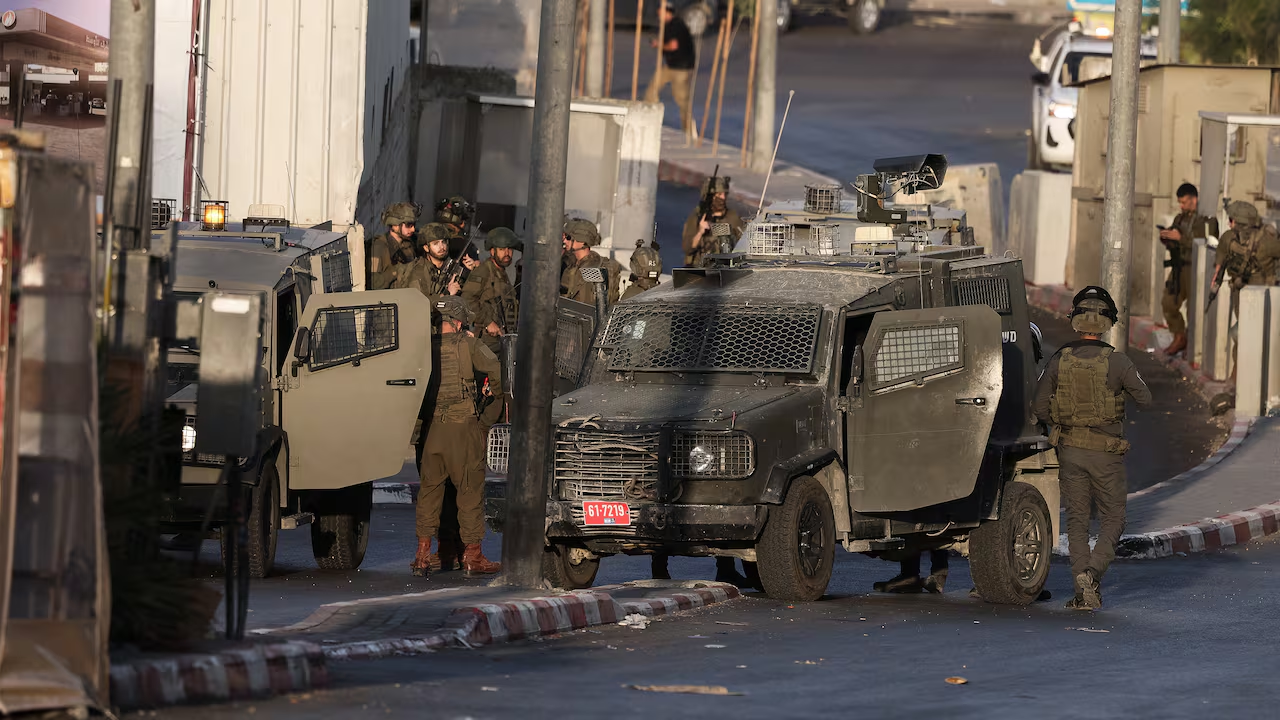
Netanyahu vows vast West Bank invasion in response to 20-minute skirmish that left 2 Israeli soldiers and 2 Palestinian fighters dead

After an attack on a military checkpoint near Hebron, Netanyahu ordered a lockdown of the West Bank and what he said would be the most intense military campaign in the Israeli-occupied West Bank in decades

  •  

Protests banned and curfews declared ahead of next major mobilization in France

Hundreds of thousands are set to take to the streets in cities across France on Saturday, October 24, once again protesting austerity and the cost of living crisis. Demonstrations are set to go ahead despite an extremely repressive response from the government and local authorities, including curfews and bans.

Over the past couple of days, a growing number of cities and regions have announced protest bans, drawing criticism from trade unions and progressive groups. “The government has banned demonstrations on Saturday in Lyon, Marseille, Rouen, Grenoble, Le Havre, Bourg-en-Bresse, Le Mans, Toulon, Chambéry, Perpignan,” wrote Clémence Guetté of La France Insoumise on October 22. “New bans are coming down every hour. Is this what democracy looks like?”

Many of the bans are being contested in court, with the final outcome yet to be determined.

Read more: Italian government to deploy troops to Milan after anti-austerity protests

French President Emmanuel Macron failed to revise his stance on the protests in the same period, announcing that only trade union mobilizations will be allowed on Saturday. “Where they are not organized by trade unions, we will ban them wherever we can,” Macron stated.

The government announced the intention of deploying troops to “guard” the demonstrations. The idea was announced after nationwide protests on October 17 – attended by roughly 800,000 people – turned into riots against the erosion of education services and overall living standards.

A securitization strategy tested in Kanaky

This institutional response has been heavily criticized by progressive forces that joined students on the streets. As Prime Minister Sébastien Lecornu’s administration insisted on framing the mobilization exclusively as a security issue, including in meetings with political parties, left forces denounced the strategy for failing to address concrete issues.

Paul Vannier of La France Insoumise said the government was engaging in “a strategy of letting the situation rot,” insisting that it should instead shape a solution to students’ demands. This would include freezing prices, increasing wages, making higher education more accessible, and allocating €10 billion for the education system.

Read more: Students in France are fighting for stronger public education

The French left has also sounded the alarm about the long-term consequences of the violent repression of the protests: thousands of youth were arrested during the mobilization, and dozens were injured – some of them very seriously.

While alarming, this course of events is not surprising, La France Insoumise pointed out. The party compared the repression observed in French cities to the one witnessed during protests in Kanaky in 2024: “a state of emergency, extended curfews, a general ban on demonstrations, the blocking of TikTok, nearly 3,000 security personnel deployed with army support, armored vehicles, and the massive use of LBD launchers and grenades.”

“What the state tested in 2024 in Kanaky, it is now applying in 2026 to its own youth, with the same men in charge,” the media outlet L’Insoumission wrote.

Trade unions’ support continues

It is in this context that progressive forces in France have reiterated calls for the public to respond to the students’ call and protect their right to protest on Saturday. “On October 24, we once again call on all activists to put on their red [trade union] vests so that young people and workers can exercise their right to demonstrate and to make their demands heard,” the General Confederation of Labour (CGT) wrote.

“We are witnessing an authoritarian shift that goes hand in hand with the government’s stubborn refusal to own up to its record and to call into question its unjust policy in favor of the wealthiest,” dozens of trade unionists, advocates, and cultural workers wrote in an appeal, calling for support for the protests.

“This choice is irresponsible and dangerous for democracy, and for the physical integrity of those who defend it without the framework of these mobilizations,” they stated. “It paves the way for the far right to come to power.”

  •  

Cisgiordania, Tajani: “Inaccettabile l’arresto delle 5 donne prese dall’esercito israeliano”. Previsto il rientro sabato

”Chiediamo la liberazione immediata delle 5 donne che sono state prese dall’esercito israeliano” in Cisgiordania, ”speriamo che possano essere rimandate in Italia nelle prossime ore. È inaccettabile quello che è successo, non stavano commettendo alcun reato”. A parlare è il vice premier e ministro degli Esteri Antonio Tajani che in un punto stampa a Istanbul ha commentato il fermo ieri vicino a Hebron di cinque attiviste italiane da parte dell’esercito israeliano. Il ministero ha poi annunciato che le attiviste rientreranno sabato.

“Non siamo d’accordo. Noi siamo perché il popolo palestinese possa finalmente realizzare il proprio sogno” di uno Stato, “vivendo in pace con Israele che deve avere garantita la propria sicurezza. Ma non è colpendo la popolazione palestinese, soprattutto i pacifici villaggi cristiani, che si risolve il problema della sicurezza di Israele“, ha spiegato poi Antonio Tajani a Istanbul commentando l’annuncio di Netanyahu di una “chiusura totale” della Cisgiordania. “Bisogna disarmare Hamas, bisogna che ci sia stabilità a Gaza, bisogna che i terroristi vengano messi fuori gioco disarmandoli totalmente e questo è un aspetto importante, ma noi non possiamo non riconoscere l’importanza di dar vita ad uno Stato palestinese“.

Ieri la polizia israeliana aveva affermato che alcuni dei fermati sarebbero stati coinvolti nella “promozione del terrorismo” e nell’”esaltazione di attentatori”. L’annuncio era arrivato dopo che la Farnesina ha chiesto chiarimenti urgenti alle autorità israeliane sul fermo delle connazionali, avvenuto mentre accompagnavano agricoltori palestinesi impegnati nella raccolta delle olive. Secondo la polizia israeliana, gli attivisti “hanno violato la legge e si sono nascosti dietro la raccolta delle olive”. Sarebbero entrati “senza coordinamento in una zona militare chiusa”, rifiutando gli ordini delle Forze di difesa israeliane (Idf). Il comunicato riferisce del fermo di undici attivisti stranieri e un palestinese a Hebron, sostenendo che alcuni sarebbero coinvolti anche in “attività di organizzazioni ostili a Israele”.

L'articolo Cisgiordania, Tajani: “Inaccettabile l’arresto delle 5 donne prese dall’esercito israeliano”. Previsto il rientro sabato proviene da Il Fatto Quotidiano.

  •  

France to deploy 70,000 police on Saturday to prevent civil unrest

Security forces to include elite units usually used for counter-terrorism after worst street violence in years

France will deploy about 70,000 police around the country on Saturday as the government seeks to prevent more civil unrest after some of the worst street violence in years erupted on the fringes of cost-of-living protests last weekend.

The interior minister, Laurent Nuñez, said on ⁠Friday ⁠the security forces would include elite units usually used for counter-terrorism operations and hostage rescues, adding that there had been social media calls for violence from “ultra-left” groups.

Continue reading...

© Photograph: Abdul Saboor/Reuters

© Photograph: Abdul Saboor/Reuters

© Photograph: Abdul Saboor/Reuters

  •  

How the Decline of Western NY Defined Kathy Hochul’s Politics

Gov. Kathy Hochul’s vision for New York has been largely shaped by her upbringing in a failing western New York town and her family’s move up from a trailer park to affluence.

© Hiroko Masuike/The New York Times

Gov. Kathy Hochul has won over the real estate community in New York City, but her politics and worldview remain products of her life in western New York.
  •  

France Restricts Weekend Demonstrations as Protest Violence Sparks Civil Liberties Dispute

Authorities in France have banned or restricted demonstrations in a number of cities ahead of Saturday, 24th October, following violent disturbances during the previous weekend’s protests against the cost of living.

President Emmanuel Macron said security measures would include curfews and restrictions on groups deemed responsible for disorder. Some official demonstrations, including an authorised march in Paris, remain permitted.

The latest restrictions follow confrontations and damage to public buildings during the demonstrations on 17 October. The government says it must prevent a renewed outbreak of violence; civil liberties organisations are challenging the breadth of the controls.

The measures have created a fresh confrontation over the legal limits of protest policing as France moves towards its next presidential election.

The developments are detailed in the latest reporting and official material, against the background of EU Today’s earlier coverage.

Different rules across France

Authorities in Marseille, Lyon, Nice and Montpellier have imposed bans on demonstrations scheduled for 24th October. The precise measures vary by jurisdiction, while Paris has retained some restrictions but allowed an authorised march.

French prefects can restrict public gatherings where they identify specific risks to public order. Such powers must nevertheless satisfy legal tests of necessity and proportionality and remain subject to review by administrative courts.

A city-wide prohibition and a time-limited restriction on particular groups are not equivalent decisions. Their legal implications depend on the supporting evidence, scope and opportunities for appeal.

The government’s security argument

Macron has described a return to calm as the government’s priority and accused organised ultra-left groups of seeking to exploit demonstrations to provoke disorder. Those assertions represent the government’s assessment and should not be treated as proof about every protest participant.

Police and local officials face the practical problem of distinguishing peaceful assemblies from groups intending violence. Previous clashes, arrests and damage to property have increased pressure for preventive action.

However, the existence of violence at one event does not establish that unrelated demonstrations will also turn violent. This is among the central objections raised by rights groups.

Courts and political consequences

The Human Rights League and other civil liberties organisations have objected to broad protest bans. Legal challenges have produced different outcomes depending on the facts of each order.

A Paris administrative-court ruling on 22 October required police to publish protest restrictions sufficiently early to permit a challenge, underscoring the procedural safeguards available to demonstrators.

EU Today has previously reported the scale of France’s October unrest. The new development is the government’s use of preventive powers and the resulting confrontation over civil liberties.

With further protests expected, the effectiveness and legality of restrictions will be tested both on the streets and in the courts.

  •  
❌