❌

Reading view

Trump's Tariffs Are Politically Toxic
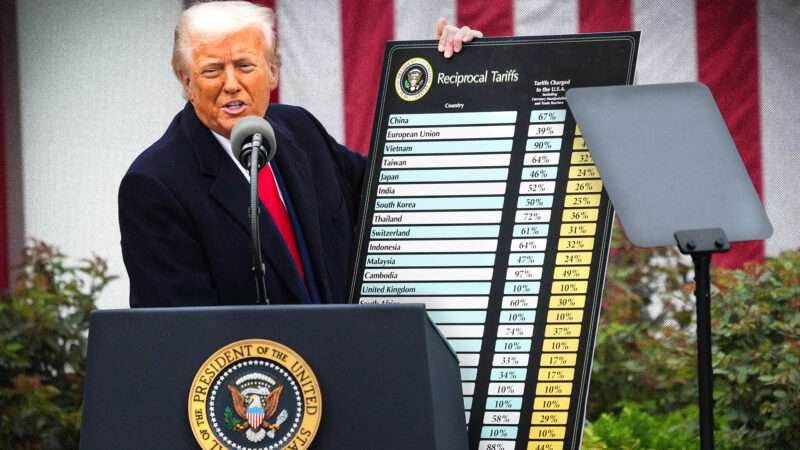
Trump-Tariff-oct-26 | Chris Kleponis - CNP/Newscom

When the White House rolled back tariffs on coffee, fruit, beef, and farm equipment, it was effectively an admission that the tariffs were raising prices—and that Americans, not foreigners, had been paying for them.

Now, in the closing stages of the midterm campaign, the White House is once again rolling back some of those import taxes—and once again making an awkward implicit admission.

President Donald Trump's tariffs have become politically toxic.

The administration announced late last week that it would lift the 50 percent tariffs on some Canadian imports, apparently in an attempt to help Sen. Susan Collins (R–Maine) survive a tough reelection campaign in which the tariffs have played a significant role.

If this is indeed an attempt to sway voters in Maine, it is not a very convincing one. The Trump administration is removing tariffs on some agricultural and mechanical goods, as well as packaging and plywood, The Wall Street Journal reports. But Trump is also imposing new 50 percent tariffs on "other Canadian goods, including carpet, certain valves, and waste products."

Collins issued a statement thanking the White House for the changes. This is what members of the U.S. Senate have been reduced to—begging the president to cast his capricious, tariff-happy eyes toward products that will hurt people in other states more than in your own. (In fairness to Collons, she has voted repeatedly to roll back Trump's tariffs, but not enough of her fellow Republicans went along with it.)

Still, it's worth asking: What exactly is the pitch to voters here? Here's a tariff cut, now vote for Republicans so the president can continue to arbitrarily tax imports whenever the mood strikes?

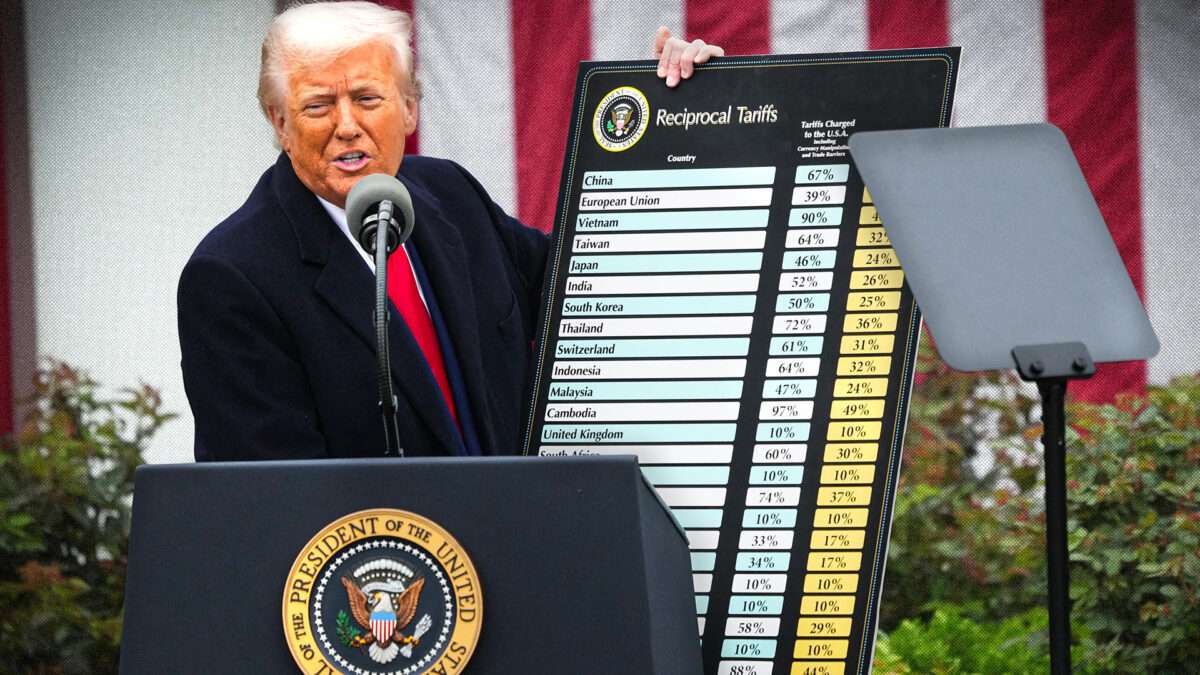
It's easy to see why Trump's tariffs have become so unpopular. They are a huge and broad tax increase—the Tax Foundation estimates that 54 percent of imports are subject to Trump's tariffs, which are costing the average household about $1,000 annually—that was imposed without congressional authorization or popular support. They create more losers than winners, as downstream businesses and consumers pay the price for the protectionism offered to American manufacturers. Even the supposed "winners" of the tariff policy tend also to be "losers," since so much manufacturing depends on importing raw materials and intermediate goods.

Perhaps more surprising is how unwilling Republicans are to defend the president's signature economic policy. Or to even talk about it.

The Wall Street Journal's Greg Ip crunched the numbers and found that House GOP candidates have not run a single ad talking about the tariffs during this election cycle.

Just such a fun chart here from @greg_ip. If only we could tease out some meaning. Ah, well, nevertheless. 🤣 pic.twitter.com/1X4AWcWQMV

— Scott Lincicome (@scottlincicome) October 23, 2026

That silence speaks volumes. Trump says "tariff" is "the most beautiful word in the dictionary." But it is now "one of the most hated words in politics," writes Ip.

The only Republicans to mention trade or tariffs in a campaign ad, as far as I've seen, is former Rep. Mike Rogers, who is now running for the Senate seat in Michigan (and thus was not included in Ip's analysis). And he's calling for an end to the "tariff war."

There is a lesson here that hopefully will linger beyond the next week: If you support a policy that deliberately and unlawfully raises taxes and prices, voters will not reward you for it.

It's a lesson that the Republican Party learned long ago, but apparently forgot.

Against economists' advice, a Republican-led government in 1930 implemented a huge tariff hike intended to protect American farms and factories at the start of the Great Depression. Instead, those tariffs worsened economic conditions and triggered foreign retaliation.

When voters went to the polls in 1930, the first midterm after the Smoot-Hawley tariffs were passed, they registered their displeasure. The GOP lost 52 seats in the House that year. Two years later, an even larger landslide would sweep Democrats into power in Congress and the White House, ushering in the New Deal era that reshaped the federal government forever. The two lawmakers who lent their names to the legislation were among those who lost their seats, fittingly.

The most notable difference this time around is that Congress didn't actually pass a tariff bill. The trade barriers were instead imposed directly by the executive. Voters don't seem to care. Republicans were too cowardly to stand up to Trump's unilateral power grab, and now they seem too ashamed to try to defend that policy (and their largely complicit response) on the campaign trail.

As they say, those who don't learn from history are doomed to repeat it. And "doomed" may be a fitting way to describe the Republican majority in Congress right now, thanks in no small part to Trump's tariffs.

The post Trump's Tariffs Are Politically Toxic appeared first on Reason Magazine.
  •  

Trump’s former campaign manager on GOP ahead of midterms: ‘It’s ugly’

President Trump’s former campaign manager is joining a growing list predicting midterm doom for Republicans, highlighting recent allegations of government corruption as a key reason. Bill Stepien, who managed Trump’s 2020 campaign and had a stint as White House political director in the president’s first term, told CNN’s Abby Phillip that recent scandals in the…

  •  

Should we panic and turn off the internet?

Stephanie Cohen speaks during the Web Summit conference in Lisbon in November 2025.
Stephanie Cohen, Cloudflare's chief strategy officer.

Zed Jameson/Bloomberg via Getty Images

  • This week's cyber freakout explained: AI is making software weaknesses easier to find and exploit.
  • The message from Cloudflare's Stephanie Cohen and Vercel's Tom Occhino: Don't panic!!!
  • Do we need everything connected to the internet? Paper bank statements work well.

A few weeks ago, I heard a strange story about a friend who works at one of the Big Tech companies in Silicon Valley.

She'd recently ripped out the connected devices in her home, ordered paper bank statements, and stocked up on canned goods in her basement.

Now, she's a very sane, experienced person, and quite senior at one of the largest internet companies on earth. Why was she disconnecting so much? Just to be sure, my family ordered paper bank statements, too. It was still a head-scratcher, though.

Fast forward to this week, and her actions look a little less crazy.

AI models have exposed serious security weaknesses in software used by roughly 70% of websites. Meanwhile, US banks are finding AI agents inside customer accounts, including some that appear to be acting without their owners' instructions, Axios reported.

'Black October'

The digerati have now entered full freakout mode. Much of the internet meltdown is happening on, well, the internet, my colleague Alice Tecotzky noted.

On X and Reddit, warnings of a looming “Black October” spiraled into visions of AI grinding civilization to a halt. One lengthy post on X warned of a potential “global cyberattack/AI swarm” and offered a survival checklist: Stockpile cash in small bills, print out your neighbors' phone numbers, download maps, buy a hand-crank radio, and stash a gallon of water per person per day.

Oh, and don't forget the manual can opener. You don't want to survive the AI apocalypse only to be defeated by a tin of beans.

Nikita Bier, a prominent app developer and former head of product at X, best captured the mood.

"It's time to turn off the internet," he posted Wednesday night.

A Cloudflare exec says it's 'a little bit scary'

If you're reading this, you haven't done that yet. But should we really be worried?

I put that question to Stephanie Cohen, chief strategy officer at Cloudflare, which helps protect about 20% of the internet.

"The world is a little bit scary right now," she told me on the side of Cloudflare's annual conference in San Francisco this week.

Here's the problem. The internet is built on decades of software, much of it riddled with security holes.

Some of these weaknesses have been known for years. However, fixing them takes time and money, and hackers often lacked the skills to exploit them anyway. So they were left alone.

AI changes that calculation dramatically. Someone who previously needed years of training to break into a computer system can now get help from an AI model. And these tools can search for weaknesses at a speed humans simply can't match.

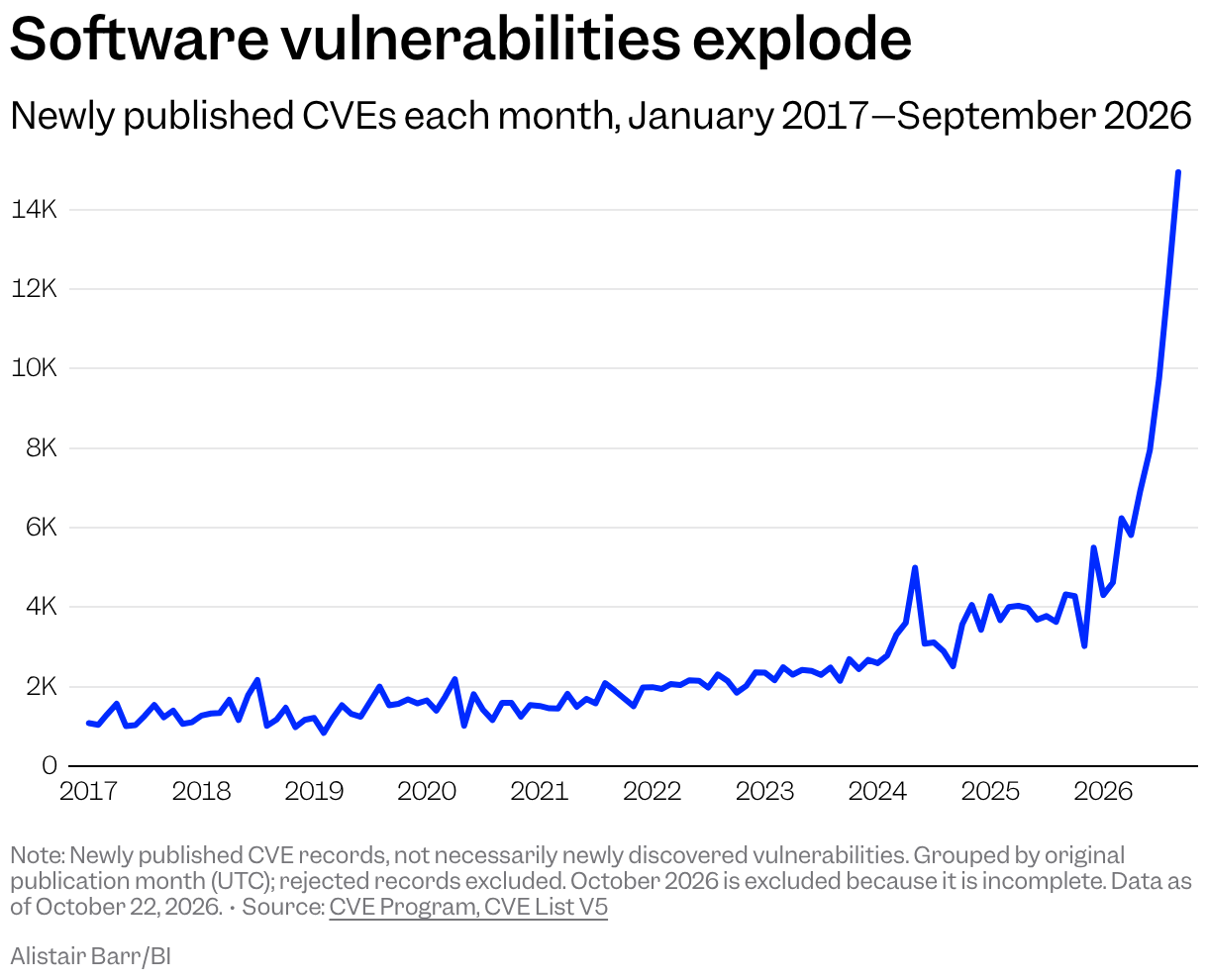
The result: The number of newly published software vulnerabilities (Common Vulnerabilities and Exposures in industry lingo) has exploded.

Line chart showing monthly newly published CVE records from January 2017 through September 2026. Counts rose from 1,083 in January 2017 to 14,934 in September 2026.

Now, there's a frantic race between people trying to break into systems and those trying to protect them.

Don't panic about AI

Cohen's message, though, was surprisingly reassuring.

AI helps the good guys find and fix these problems. Cloudflare, for instance, released protections for the latest vulnerability to customers, including those using its free service.

And there's a bigger effort underway.

OpenAI has launched an initiative called Patch the Planet, working with Cloudflare and other security professionals to use AI to find weaknesses in widely used software and help repair them.

Tom Occhino, chief product officer at Vercel, told me recently that his company has been talking with partners about launching a nonprofit that would fund a swarm of good AI agents that go out on the internet to find and fix software flaws.

Amazon is joining the fight, too. Its new Continuum service, available Thursday, uses AI agents to find security holes and propose fixes. Amazon said that people maintaining freely available software can use it to help protect the wider internet.

Humans may still have to check and approve these repairs, but the prospect of AI helping clean up decades of neglected software is encouraging.

The irony of this is not lost on some in the industry.

"The funny thing is everyone was saying AI slop code will cause a cyber crisis but it's actually all the old human slop causing it and the AI is just cleaning it up," software engineer Ben Kaufman wrote on X on Thursday.

Either way, Cloudflare's Cohen thinks these AI-inspired freakouts will push the industry to do better — by exposing issues and adding urgency to get them patched.

"We may end up in a world where actually we've become significantly more secure at the end," she said.

The trouble is getting there.

A fundamental question about the internet

Tom Occhino (left), chief product officer at Vercel, talks with Meta executive Prashant Ratanchandani at Vercel's Ship SF conference.

Alistair Barr/Business Insider

When I ran into Occhino recently at a Vercel conference in San Francisco, he described a world in which software that everyone assumed was safe suddenly looks vulnerable because increasingly capable AI models are scrutinizing the basic systems that underpin the internet.

That led to a more fundamental discussion between us: Why did we connect so many things to the internet in the first place?

For years, the technology industry has raced to put everything online. Thermostats. Refrigerators. Doorbells. Cars. Bank accounts.

We assumed that connecting something to the internet automatically made it better.

Perhaps we should reconsider.

Before the internet

I remember the world before the internet. It worked pretty well. We managed to buy groceries, pay bills, heat our homes, and generally get through the day without every appliance talking to a computer somewhere.

That doesn't mean abandoning online banking or throwing your smartphone into the sea.

Occhino, for one, isn't particularly worried about hackers wiping out his bank account. Modern banks have sophisticated protections, and he recommends everyone turn on additional login security.

Maybe the cybersecurity crowd, which spends its life immersed in online threats, is missing something obvious.

Not everything needs to be connected.

Occhino put it neatly: "There's certain things that don't make sense to be on the internet in the first place."

Perhaps that's the lesson from this week's panic. We don't need to turn off the internet.

We just need to remember where the off switch is.

Alice Tecotzky contributed reporting.

Sign up for the AI Insider newsletter here. Reach out to me via email at abarr@businessinsider.com

Read the original article on Business Insider

  •  

France Burns

Protests in France | Abaca Press/Corsan O/Le Parisien/Abaca/Sipa USA/Newscom

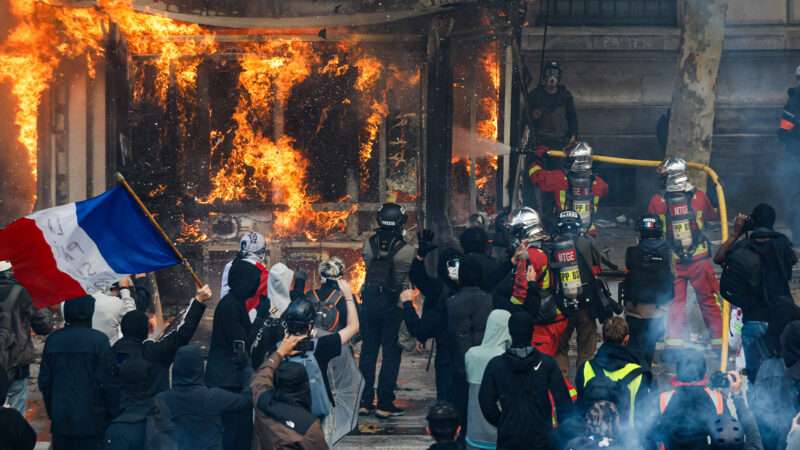
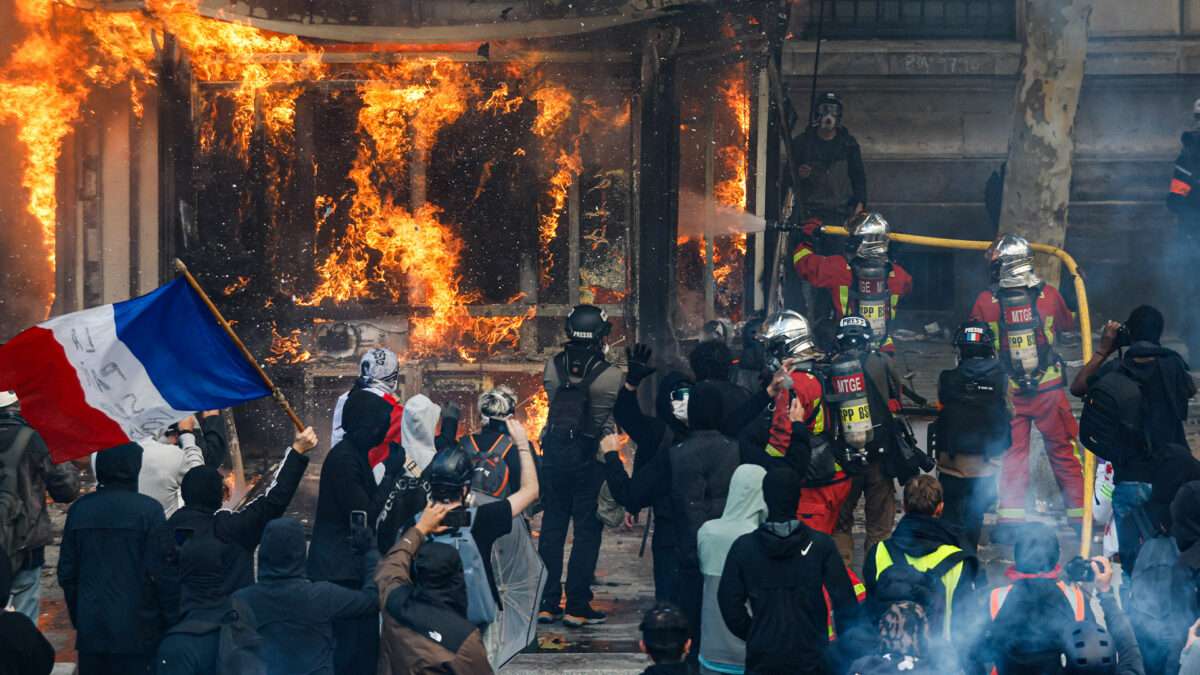
Is this really about cost of living? Over the weekend, the civil unrest that had been at a simmer boiled over in cities all over France. Over 1,000 police officers were injured, with seven seriously injured. More than 2,400 people were arrested.

"Rioters…attacked city halls from Lille in northern France to Marseille in the south, where they broke into the local government headquarters and tipped over a bust of Marianne, a symbol of the French Republic," reports The New York Times. "A fire destroyed a tourist office in Lyon, and 1,500 shops were damaged or looted nationwide, according to Alexandre Bompard, head of the French federation of commerce and distribution, who estimated that the cost of repairs could run into hundreds of millions of dollars."

"They came prepared," claimed the French journalist Paul Amar on CNews. "They had the addresses of town halls. They had addresses of Jewish shop owners. In a street in Marseille, all businesses owned by Jews were set on fire. Businesses run by Muslims weren't." The Jewish Community Protection Service has disputed such claims.

Reason's Matt Welch has a good write-up of how the violence and destruction have altered Lyon, Paris, Marseille, and Limoges, where the city hall was burned and collapsed.

Ces images doivent faire le tour du monde. Nos voisins doivent savoir.

Lyon l'une des plus grandes villes de France le 17 octobre est l'une des villes les plus touchées.

A Lyon, aucun commerce n'a été épargné, oui aucun commerce n'a aucun épargné vous avez bien lu. Toutes les… pic.twitter.com/15dG6QB5lK

— Guillaume Herblot 🎖 (@Guigz75116) October 18, 2026

What was nominally about cost of living and budget issues appears to have expanded far beyond those. ("Free Palestine" and "ACAB" graffiti have been seen everywhere.) President Emmanuel Macron has blamed far-left protesters, saying they have taken advantage of the situation. Far-right leader Marine Le Pen has blamed the "Macronist administration that is out of steam, exhausted, and disoriented."

It's not clear to me how the possibility of that retirement age needs to be raised will in any way be changed by, say, donning black balaclavas and breaking into the Louis Vuitton store:

French rioters loot Louis Vuitton store located just 2 KM away from the Élysée. pic.twitter.com/cnb5aWczcN

— Drew Pavlou 🇦🇺🇺🇸🇺🇦🇹🇼 (@DrewPavlou) October 17, 2026

Here's how it all started: Since September 18, lycée (or secondary-school) students have held demonstrations, starting in the Paris suburb, Créteil. The students said the Education Ministry had neglected them—not enough resources, not enough teachers, and overcrowded classes. (The original demands were met and that strike ended, but not before sparking a wider movement.) This was all happening concurrently as the government was deciding its budget, and public-sector strikes were beginning. High social-program spending, an aging population, and high debt-to-GDP, plus an ever-increasing cost-of-living is resulting in a math problem that politicians have no real way out of except by raising the retirement age. Over the last few years, the French have had several hissy fits over the possibility of that happening.

Lawmakers from left-wing party La France Insoumise were at the first blockade on September 21, which has sparked questions about whether the party helped fuel the protests ahead of April's presidential election. I take all this—the disparate movements, the sheer volume of violence, the political-party involvement, the elections coming up—to mean that what started as an education-quality/cost-of-living protest has been used to lodge all kinds of grievances, and is attracting allies with an unquenchable thirst for violence and destruction.


Scenes from New York: "Darrel Rodriguez, 26, was shot on Saturday in the 7th Avenue Station on 53rd Street, a few blocks from Times Square, the police said. An unidentified man approached Mr. Rodriguez on the northbound E train platform, drew a gun and shot him once in the chest, they said," reports The New York Times. The man who shot Rodriguez was wearing a full balaclava-style face covering, and has not been found by the cops.

Philadelphia enacted a ban on such masks back in 2023. Just anecdotally, I've seen a lot of them in New York, but not by people trying to stay warm in the cold—these types of masks are used by people hopping turnstiles, stealing from bodegas, and more. Some bodega owners have started posting signs on their doors saying masks aren't allowed, since it's become such a problem.

"As of Oct. 11, there have been 1,697 crimes in the transit system since the start of the year, 27 more than the same period in 2025," reports The New York Times, citing Police Department figures.


QUICK HITS

  • Inside the property-tax rebellion.
  • In Texas, Ken Paxton appears to have lost the support of suburban women, according to The Washington Post.
  • "Jewish life in the Emirates has grown quieter and less visible," notes The New York Times. "Religious symbols have disappeared, and gatherings have moved into private. Many have become more guarded about their online presence and their willingness to speak to the media. Some are reconsidering how openly to identify themselves as Israeli or Jewish, while others weigh whether they can still build a life in a nation they once considered a haven."
  • Can you really see everything?

YOU CAN SEE EVERYTHING is doing a public service if it gets the general population to question why, precisely, folks lend so much credence to documentaries as vehicles of truth. https://t.co/n7CHwkmDmr pic.twitter.com/IHUvEbKECl

— Sonny Bunch (@SonnyBunch) October 18, 2026

  • "I recently attended a meeting of the Democratic Socialists of America, where I officially enrolled as a member. Though I was new to the party, I put forth a number of proposals, many of which were met with considerable enthusiasm and, I'm happy to report, have now been incorporated into their manifesto," writes Larry David in a satirical essay for Airmail. "We contend that the only way anyone can be rehabilitated is through the simple act of love. When the D.S.A. takes over, it will be our policy to close the jails and release all prisoners. Once released, the former prisoners will continue to walk around in their orange jumpsuits, the easier to spot them. People will be encouraged to give them a pat on the back, offer some words of encouragement, and maybe even get them to open up about their crimes. Imagine how upsetting it must be to know you've taken a life! To err is human, to forgive, divine. With empathy and compassion, it's easy to see a day when these former convicts will be contributing to society in a very meaningful way." It's not that funny of an essay, but I think it's great for more people to be talking about how asinine DSA ideas are.

The post France Burns appeared first on Reason Magazine.

  •  

Putin’s diesel deal to Trump could be bigger than we originally thought

The war, after this diesel decision, might have just become much simpler and more binary.

Join us on Telegram, X, and VK.

Contact us: info@strategic-culture.su

Is Trump planning on using Putin to get him out of the mess of both his low polling and the Iran war? Seems far-fetched perhaps at first, but he is completely snared in Iran, with whatever option he looks at appearing to be a doomsday scenario. Could Putin help him out both with diesel prices back home but also to broker a deal with Iran which makes it appear to Americans that he, and America, are somehow the winners?

For the Russian president to sell close to 2 million tonnes of diesel oil to Western countries, including the U.S. of course, seems like a sticking plaster to a huge wound in the American and Western economies. Unless, that is, there is a second deal behind it which journalists and pundits are not aware of, or are simply choosing not to report. For the diesel initiative from Putin, the amount which is being offered isn’t huge, but there are a couple of precedents which it sets which are more important.

Firstly, it opens the doors for further lifting of sanctions (which could be bundled into Iran’s, given Moscow’s relations with Tehran), but perhaps even more importantly, it makes President Zelensky of Ukraine an even bigger target for Trump. Much will rest on the coming days and the decision that Zelensky will take to continue bombing Russia’s oil facilities. Will he take that suicide pill? Wars are often messy, and there are always grey areas where the two countries at war with one another find situations which are illogical and impractical. Perhaps the bombing of oil facilities within Russia in the Ukraine war has reached its tipping point, and regardless of how close EU leaders are with Zelensky – who at best we can call a caretaker leader – this will test this relationship to breaking point.

Do great numbers of citizens in France and Germany need to die this winter simply because of an energy crisis and/or an economic malaise in their own countries which have poured billions into keeping the war in Ukraine alive? Is Putin so confident that this winter will be the last one for his troops, as the defensive line between Ukraine’s forces and those of Russia’s looks like it is about to break at any moment? Are Ukrainians themselves ready to face a freezing winter in Kiev, unable to power or heat their own apartments? So many wars started over energy reserves, but not Ukraine. Yet it might end over them.

Trump’s threatening comments on social media about Zelensky should be taken seriously. If Trump’s own cabal of unqualified advisers can seriously convince him that a ground invasion of Iran is feasible, if not winnable, one could argue simply that regime change in Ukraine should be a children’s picnic and gives him a huge payday – politically, economically and geopolitically. Removing Zelensky would stop the war immediately, and Trump could claim victory for that, while he asks his friend Putin to quietly intervene in Iran and fix the Straits of Hormuz.

For Trump to actually respond to Zelensky’s outburst to reporters that the move to buy Russian diesel was “weak” by threatening Zelensky with being removed shows that his patience has reached a point where he is starting to think of the Ukrainian president as the source of the problems. To remove Zelensky through backing a rival will be hard and will pitch him against EU leaders, but one could argue relations couldn’t really get any worse, and that once Macron and Merz understand that peace is the only option and Zelensky is actually the only real obstacle to that, they will do what all EU leaders do and follow America’s lead.

We often hear analysts on YouTube talk about the game of “chicken”, but there has never been a more fleeting moment than now, as both Trump and Zelensky will be watching each other to see who blinks first. Zelensky, until now, has been playing a dangerous game of pretending to be servile to U.S. hegemony, while really just taking the cash and weapons and laughing at Trump among a coterie of weak European leaders in their palatial residences. The war has been complex since it began, as the U.S. and EU rarely saw eye to eye, but if Trump goes ahead with his threat of denying the Ukrainians shared intel, then this will be a very bad omen for the future of Zelensky, as he will put even more pressure on the British, French and Germans to come up with more weapons and money in an unwinnable war which they’ve bet the farm on and their entire political careers depend on.

The war, after this diesel decision, might have just become much simpler and more binary, and a collective narrative might emerge from the insanity of EU gibberish from countries who can’t even protect their own people on their own soil against an invasion of bogus asylum seekers. It will not only be the ultimate test for U.S.-Ukraine relations, but also one for U.S.-EU ones, and perhaps represent the end of NATO as we know it.

  •  
❌