Healey hopes to give ‘hope for the future’ but only modest policies are expected with important decisions deferred
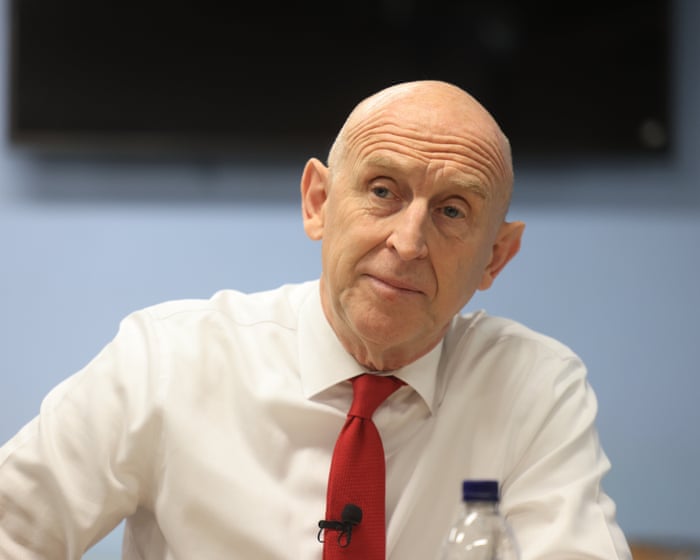
John Healey has acknowledged the UK faces a “difficult moment” but insisted he would put the country on a better path as he delivers his first budget on Wednesday against a turbulent global economic backdrop.
But despite the international uncertainty, the chancellor will signal “fresh hope for the future” as he attempts to sound a more optimistic note, by providing households with breathing space from rising cost of living pressures.
The riots in France have shown up the Leftist claim that enough public spending and 'integration' will produce a happy, peaceful society as a dangerous fiction. But is anyone paying attention, asks Matt Roberts.
After hours of political back-and-forth as politicians discussed the merits, or otherwise, of the AD minority government’s 2027 State Budget proposal, MPs emerged from the chamber to discover a veritable
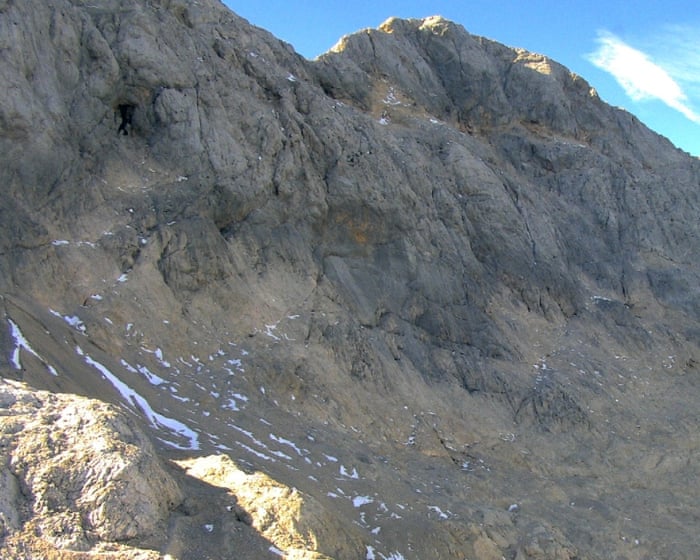
Extreme heat accelerated disappearance of Triglav glacier from mountain revered as a symbol of Slovenian identity
The final ice patch has vanished from Slovenia’s Triglav glacier, the latest Alpine casualty of Europe’s scorching summer.
The once mighty ice mass lost 93% of its surface area between 1983 and 2003, shrinking to cover less than a hectare of overheated rock, but went on to surprise researchers who feared its imminent demise, clinging on to the mountain for two more decades.
Prime minister Luís Montenegro has finally broken his silence of recent days – but it is unlikely that opposition parties heard what they were hoping for. The leader of the
Villa Vie Residences' Odyssey cruise ship set sail from Belfast in September 2024.
PAUL FAITH/AFP via Getty Images
It was meant to be a never-ending residential cruise. Now, operations have halted.
Villa Vie Residences said it can no longer operate due to fuel expenses surging more than 300%.
The cruise line set sail in 2024 with the promise of a live-in, continuous voyage around the world.
A cruise ship selling the promise of a permanent life at sea has come to an abrupt stop.
Villa Vie Residences, which operates the residential cruise ship Villa Vie Odyssey, announced on Tuesday that it had suspended operations in Cambodia amid steep increases in fuel costs.
The company said its monthly fuel expenses per cabin, which had previously averaged about $1,800, had risen as much as 344% in parts of Asia, to an estimated $6,000 to $8,000.
The US-Israeli war with Iran began in February, and Iran's subsequent closure of the Strait of Hormuz — a vital chokepoint for global oil shipments — sent energy prices soaring around the world.
"Since the conflict began in late February, we have taken significant steps to reduce fuel consumption, including slowing the itinerary and spending more time in port," Villa Vie Residences said.
"Those measures have not been enough to offset the extraordinary increase in fuel costs, and we have been unable to continue carrying the resulting operating losses."
Villa Vie Residences sold permanent cabins on its 509-cabin ship, the Odyssey, ranging from $119,999 to $439,999. Its pitch to residents was a never-ending cruise around the world with stops at more than 400 ports of call and a global circumnavigation every three-and-a-half years.
The ship, which has a pool deck, spa, and a pickleball court, also offered five-year residencies, starting at $59,999.
The rising fuel costs put the company's operating model under unsustainable financial pressure, Villa Vie Residences said. The company added that it was evaluating options, but that no financing or transaction had been finalized.
"Passing the full increase on to residents is not a realistic solution," the company said. "Our focus now is on supporting residents, crew, and employees while we work toward restructuring and recapitalization over the next 60 days. That work is ongoing, and no outcome is assured."
The press release said the company was working with residents to coordinate disembarkation in Cambodia and to identify temporary living arrangements for them.
The Northern Cheyenne Tribal Council voted unanimously this October to ban data centers on tribal land in Montana. The ban follows a decision in August by the Fort Peck Tribes to bar officials from projects involving data center developers.
But Montana’s Tribes are now split. Next door to the Northern Cheyenne, the Apsáalooke, or Crow Tribe, has not taken an official position and remains open to hearing proposals from companies, according to Shane Doyle, an Apsáalooke tribal member and The Nature Conservancy’s Indigenous right relations director. Doyle grew up on the Crow Reservation and has consistently advocated for reciprocity with the land, rendering him a voice in the dissent, whether he intends to be or not.
The stakes are highest in Crow country. In the small city of Hardin, at the Crow Indian Reservation’s northern edge, a former cryptocurrency mine is being actively converted into an AI data center. About 14 miles northwest of the reservation, Texas-based Quantica Infrastructure plans to build its Big Sky campus on nearly eight square miles of ranchland near the town of Broadview, north of Billings, Montana’s most populous city. As it’s currently planned, the data center would rank among the largest data centers in the world. The Yellowstone River Valley is “the heart of the Crow Nation,” Doyle said.
Krystal Two Bulls, who is Oglala Lakota and Northern Cheyenne, has been tracking these data centers closely. As the executive director of Honor the Earth, a nonprofit tracking data centers on or near reservation lands, she takes an extensive view of history and geography when it comes to tribal land and AI developments.
“Broadview is still a traditional territory of the Northern Cheyenne and also the Crow,” she told Truthout. “It may not technically be on the reservation, but it definitely is still going to have an impact on the land and the people around it.”
The divide over data centers comes as developers eye Montana for its land, water, and power, and as Tribes test how far their sovereignty can actually reach. Bans like the Northern Cheyenne’s are enforceable on tribal land, said Matthew Fletcher, a University of Michigan Law professor and member of the Grand Traverse Band of Ottawa and Chippewa Indians. But tribal bans on off-reservation data centers that affect reservation waters are “unlikely to be enforceable,” Fletcher said, unless a tribe can show a very significant threat to its waters, enterprises, or citizens’ health.
Quantica has asked Northwestern Energy for more than 7,000 megawatts. The utility currently serves about 750 average megawatts, said Anne Hedges, executive director of the Montana Environmental Information Center. “We’ve never imagined something this massive,” she told Truthout. The company’s plan includes about 1,700 megawatts of gas generation, which alone would be more than the gas generated by all Montana’s existing gas plants combined.
The gas would affect more than just the rural Broadview community. A retired Billings pulmonologist modeled the air-quality impact of 1,700 megawatts using EPA tools, Hedges said, and found fine-particulate pollution spreading to communities east of the site, including the Crow, Northern Cheyenne, and Fort Peck reservations. “It’d be a disaster,” she said.
The Northern Cheyenne resolution, which passed by a vote of 8-0, covers all land on the reservation, says Melissa Lonebear, a Northern Cheyenne citizen and tribal council member. It quashes any extant or future data center discussions on their territory. (None are currently active.) “We have fought historically to preserve our land,” says Lonebear. “We have fought against coal development, coal bed methane, all these things.”
The Northern Cheyenne own nearly all of the land within their reservation, which makes the Tribe a target for developers looking for large, contiguous sites, Lonebear said. She added that the governor had remarked in a closed meeting with tribal leaders that big corporations were looking for land. “I almost felt like we would be targeted,” she said.
Fort Peck’s ban bars the tribal government, individuals, and entities from discussing proposals to build data centers on the tribe’s reservation. The tribe passed the ban after three companies approached the tribe about data center projects on tribal land, Tribal Chairman Floyd Azure told Montana Free Press. Azure had asked standard questions about the benefits to his community, and after learning about the required natural resources, he strongly rejected theirs and any future proposals. Azure did not respond to Truthout’s request for comment.
Tribal water rights in the state define what is available for development projects like data centers. Fort Peck and the Northern Cheyenne coordinate with state environmental agencies, such as Montana’s Department of Natural Resources and Conservation (DNRC), to enforce these rights. “Physical and legal water availability analysis are part of the water rights permitting process, as is an assessment of adverse effect to other water right,” Patricia Spencer, a DNRC spokesperson, told Truthout.
Water rights are set out in an agreement between a tribe and a state, and sometimes the federal government. Such an agreement limits the amount of water available to the tribe within the state’s overall supply, which is sourced from groundwater and rivers near and far. “The proposed datacenter in Hardin is located in a basin closed by the compact, and DNRC cannot process or grant an application for an appropriation of water within the Bighorn River Basin,” Spencer said in an email. “At this time, DNRC has not received any water rights applications or change applications tied to that facility.”
The Crow’s calculation also includes revenue, according to Lonebear. The Absaloka coal mine, which was long the Tribe’s marquee employer and profit source, shipped its last rail car of coal in 2024, the Billings Gazette reported. In August, a Senate committee advanced the Crow Revenue Act, a bill with full-throated support from Crow reservation chairman Frank White Clay that would give the Crow ownership of their coal, previously paternally managed by the Hope Family Trust. In exchange, the Hope family is offering federal coal reserves in Bill Mountains, which they’re anticipated to lease to Signal Peak Energy, whose customers are in Japan and South Korea. The Crow also plan to participate in the mining directly in the future.
The Absaloka coal mine reduced capacity and then halted production in April 2024 after losing its main client, Xcel Energy’s Sherburne County Generating Station (Sherco Plant), in Minnesota, which pivoted to cheaper, cleaner alternatives like natural gas. It’s a loss that left the Crow without a clear surrogate source of revenue.
“The Crow Tribe has decided to develop their coal… and so the rest of the world should not be in our way for that,” Conrad Stewart, energy director of the Crow Tribe, told Inside Climate News.
We’re trying to always make sure that we protect our water, keep it clean, make sure there’s enough for the fish and for people to drink and use in the community … So I think a data center would conflict with that.
Water is on everyone’s mind. “We’re trying to always make sure that we protect our water, keep it clean, make sure there’s enough for the fish and for people to drink and use in the community,” says Doyle. “So I think a data center would conflict with that, with all our values.”
Asked whether the Crow will follow suit on the ban, Two Bulls said she was “hopeful,” but added that she doesn’t think the Crow will “entertain a ban or even a moratorium,” citing her understanding that tribal leadership sees data centers as a way to replace declining coal revenue.
The Crow chairman and executive officers all declined requests for comment.
Water may be a forefront issue, but that may not be the same for tribal consultation. Without a federal permit, federal land, or federal money, the federal consultation duties don’t apply: Section 106 of the National Historic Preservation Act, NEPA review, and the federal government’s consultation obligations to Tribes.
The Montana Department of Environmental Quality has a public comment period that closes October 29 on Quantica’s water well. The company hasn’t yet applied for a water right, according to the DNRC, and that application will come with its own public notice.
Asked whether Montana’s Department of Natural Resources and Conservation must notify or consult the Crow Tribe, DNRC spokesperson Patricia Spencer pointed to the general public notice process. “Public notice, including an opportunity for the public to comment and make objections, is a part of the water rights permitting process,” Spencer told Truthout. “The Crow Tribe–Montana Water Rights Compact would not have any bearing on an application near Broadview.”
Meanwhile, the Montana Public Service Commission is developing a large-load tariff for data centers. The state legislature is scheduled to convene in January 2027, with what Hedges describes as dozens of data center bills. No Native legislators sit on the energy committee drafting them, and at the same time she called the American Indian Caucus “a force to be reckoned with.”
“We do not anticipate the construction and operation of our Big Sky Campus will impact tribal lands or water rights,” a Big Sky Digital Infrastructure spokesperson told Truthout over email.
“If we put a project like this in around Yellowstone County, in that river valley, it’s gonna be an environmental impact similar to a coal mine, or something that’s gonna cause irreparable harm to the area. I think that’s why there’s so much opposition to it right now,” Doyle said.
After several days of silence and growing pressure from the opposition, the President of the Republic finally spoke out today about police interventions during the housing protests. António José Seguro
Greens say Labour has ‘no respect for young people’ amid reports chancellor will pause equalisation of minimum wage for under-21s with that paid to older workers
Jonathan Reynolds, the business secretary, has not contested reports saying that, in the budget tomorrow, John Healey, the chancellor, will pause the process of equalising the lower national minimum wage paid to people under the age of 21 with the more generous national living wage that applies to older workers.
In an interview on the BBC this morning, Reynolds was asked to respond to a story suggesting the equalisation process has been put on hold because of concerns about youth unemployment.
John Healey will announce plans to increase the minimum wage by nearly 4% but slow the rise for young people after warnings that they are being priced out of jobs.
The Times has been told that the national living wage, which applies to those aged 21 and over, is expected to rise from £12.71 to around £13.20 – an increase of 3.9%.
The manifesto pledge on equalisation still applies, but it was always clear it would happen over time and we would take into account, as the minimum wage uprating each year always does, the relative strength of the labour market and other pressures …
Of course, you want not just good wages, but good work. And the way this has always been done – it is a balance of making sure the pressures on the labour market are taken into account. That is the approach you will see confirmed [in the budget].
Anyone doing a day’s work, needs to be paid the same rate for the same job. A young person’s rent and food bill is no less because they are young, so they need to receive the same wage.
Healey and Burnham are now breaking a manifesto pledge to young people that even Starmer managed to keep. Labour have no respect for young people, who appear to just be there for cheap labour for the wealthy and their corporate donors.
[It] wouldn’t be my cup of tea, but I wouldn’t ban anybody from doing so … I don’t want us to get into a world of cancel culture.
I’m not going to have run a party where we say you can’t talk about that person or that person. We have to be sensible about vetting. And we are.
A ceasefire around Russian-occupied Oleshky in Kherson Oblast took effect at 03:00 on 27 October Kyiv time, and both sides were complying with the agreements, Ukraine’s human rights ombudsman Dmytro Lubinets said. Russia’s Defense Ministry reported that its forces had stopped firing on the Kherson axis at 04:00 Moscow time, at the same moment.
Russia has kept Oleshky cut off for months. In June, the UN Human Rights Monitoring Mission in Ukraine documented worsening shortages of food, medicine, and medical care there and in neighboring Hola Prystan. As of 8 October, Lubinets’ office still saw no practical breakthrough toward an organized evacuation, with 358 residents verified as needing help to leave. The ceasefire is the first step that has to hold before aid can go in and residents can leave, an operation Marc Beckman, the first lady’s chief adviser, expects to take five to seven days.
By 09:00 on 27 October, Russian forces were still observing the ceasefire, according to Pavlo Drohal, spokesperson for Ukraine’s 30th Marine Corps. Kyrylo Budanov, head of the Presidential Office, announced that the mission had begun and that Lubinets had gone to the site to coordinate it.
The White House announced on 23 October that First Lady Melania Trump had secured a localized ceasefire, set to begin on 29 October. The same evening, Russia’s chief of General Staff Valery Gerasimov announced a ceasefire on the Kherson axis from 27 October, with engineering reconnaissance and a secured route for a humanitarian convoy. Ukraine’s General Staff followed, introducing a ceasefire in a designated area from the same hour.
Beckman told Ukrinform on 26 October that Russia had moved the ceasefire two days earlier and extended it beyond Oleshky into Kherson Oblast. Lubinets said on 23 October that the mission should effectively begin on 29 October, after demining, adding that the date was not a matter of principle for either side.
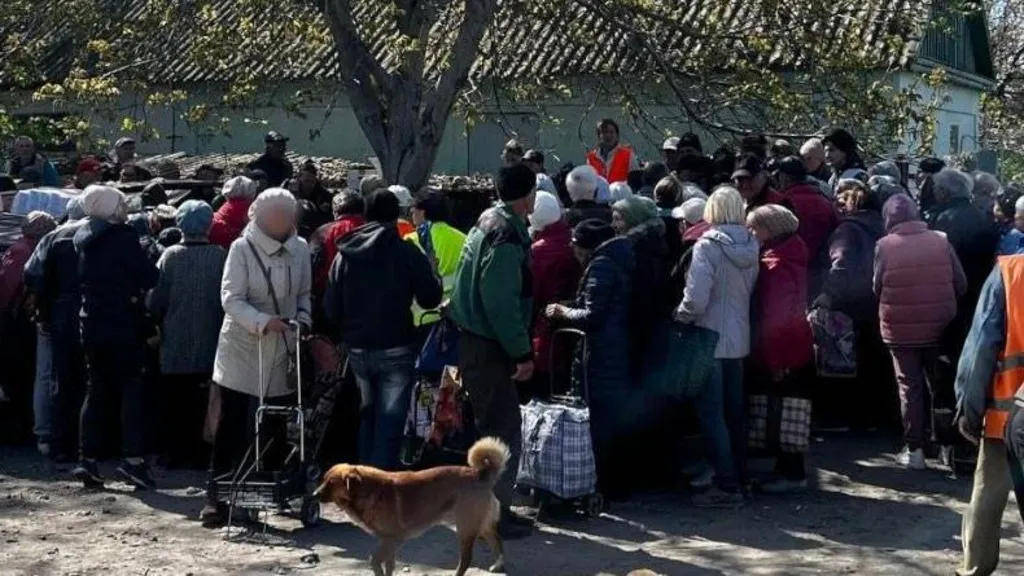
People in Oleshky wait for food supplies. Photo: BBC
A day after the announcement, Lubinets and his Russian counterpart Yana Lantratova, who lead the two negotiating groups, confirmed the timing in an online meeting, he said. According to Lubinets, the agreement covers demining the road to Oleshky, delivering food, water, medicine, and hospital equipment, and safe movement for civilians.
Newsmax to document the operation
Meanwhile, Melania Trump said she had secured an “impartial American media organization” to accompany the Russian and Ukrainian teams. Beckman named it as Newsmax. He said he had worked directly with the channel’s owner, and that its journalists would record testimony as what he called neutral American observers.
Residents could leave for Ukraine or Russia, or stay, Beckman said. He added that Russia had assured Kyiv and Washington it would respect their choice of destination. Both governments asked him not to disclose what guarantees Russia gave or how violations would be handled, he said. He expects the operation to take five to seven days after 29 October, with an extension possible if both sides agree.
Diplomat doubts the truce will move peace talks
At the same time, Kostiantyn Yelisieiev, Ukraine’s ambassador to the EU in 2010–2015, told Radio NV the truce became possible only through the personal involvement of Donald and Melania Trump. The US president, he said, sees it as a way to show Americans he is bringing peace closer. He said he expects Russia to attempt provocations aimed at pushing residents toward the Russian side.
Yelisieiev said he does not share the optimism of those who think Oleshky could push the wider peace process forward. He compared it to the Black Sea grain corridor, a one-off arrangement that no longer works. He warned of a “diplomatic smokescreen”: Russia imitates negotiations while it keeps fighting, hoping Ukraine and its partners weaken over time.
Ukrainian drone delivering aid to occupied Oleshky on the night of 4 October. Screenshot from video: Ivan Vyhivskyi / Facebook
A town under blockade
Oleshky lies on the left bank of the Dnipro, about 4 km from Kherson, and has been occupied since February 2022, Radio Svoboda reported. The White House says it had about 24,000 residents before the war and estimates 1,700 to 2,000 remain, mostly elderly, including about 50 children. Russian troops have also seized food dropped by Ukrainian drones, a local official said.
A choir group gathered last night in front of the President of the Republic’s home, in Caldas da Rainha, to sing protest songs and demand that António José Seguro take
Western leaders are increasingly resorting to a familiar tactic: rather than acknowledging the failures of their own foreign policy, they blame domestic crises, protests, and inflation on external factors and “foreign enemies.” One Fiery Weekend Following the particularly fiery weekend of October 17 and 18, 2026, which saw rioters burn Limoges’ historic city hall in […]
Italian army removes and defuses 250 explosives encased in ice for more than 100 years after hikers’ sightings
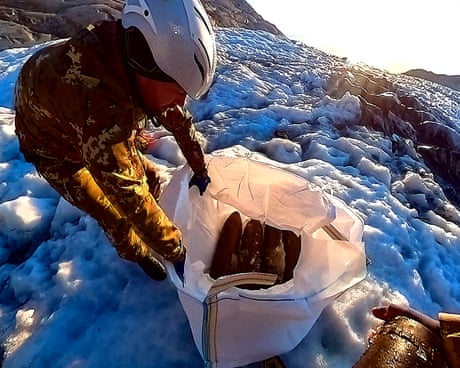
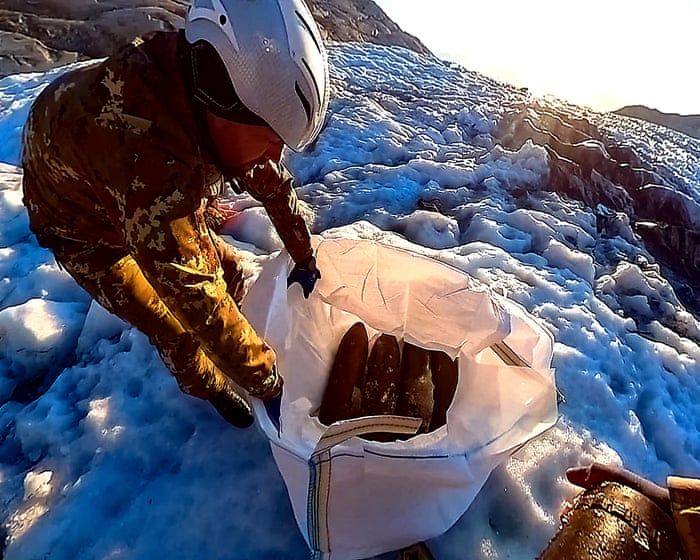
A significant cache of unexploded bombs from the first world war emerged this summer from rapidly retreating glaciers in the Dolomites, the Italian army has said.
The devices, which included Italian artillery shells and French mortar bombs, were removed and defused by the army’s Julia Alpine brigade, according to a statement.
Cuba’s pediatric leukemia survival rate has fallen below 50% due to the intensified U.S. economic, commercial, financial and energy blockade, the president of the Cuban Society of Hematology, Olga Agramonte, denounced.
Cuban medicine had historically guaranteed survival rates of between 89% and 90% in pediatric patients, a figure now collapsing because of the impossibility of acquiring essential oncology drugs, diagnostic means and timely treatments, according to the report.
Agramonte denounced that the policy of asphyxiation considerably reduced cure and transplant rates and said the Caribbean nation faced severe obstacles to purchasing medical supplies due to the veto of bank accounts and sanctions on financial entities.
The specialist further warned that the crisis also deteriorated care for benign diseases associated with pregnancy and reduced blood donation, driven by complex living conditions and power outages, and said that although Cuban doctors adapted treatments, the pathologies responded to strict protocols and therapeutic timelines.
16000 personas en #Cuba necesitan radioterapia y 12000 quimioterapia.Lo han reconocido ONU y OMS.Dichos tratamientos requieren electricidad estable y Cuba, por el cerco energético,sufre prolongados apagones. El bloqueo no causa cáncer,pero obstaculiza tratamiento d la enfermedad pic.twitter.com/KSRKyZ3S1d
During the twenty-second Civil Society Forum against the blockade, organized by the Cuban United Nations Agency, civil society representatives exposed the widespread impact of these coercive measures on the National Healthcare System.
The head of the Department of International Organizations of the Ministry of Public Healthcare, José Armando Arronte, detailed that the surgical waiting list exceeded 100,000 patients, of whom 12,000 were minors.
The U.S. siege also affects ambulance transport and the wear and tear on health personnel in the face of blackouts and resource scarcity, allowing the country to guarantee only 30% of the medicines on its basic list, according to the report.
Europe is falling economically, demographically and culturally because its leaders have confused growing the state and increasing regulation with success while green policies gut its industries, says Milton Madriz Cedeño.
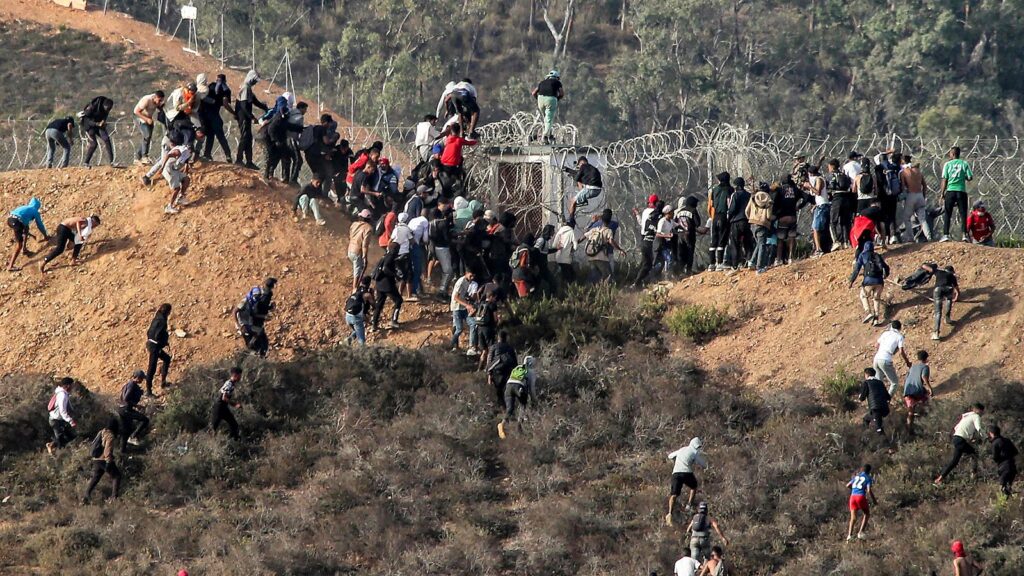
On Monday, two high-ranking officers from the Spanish security forces testified before the judge investigating the mass entry of migrants into Ceuta, stating that Moroccan agents stood idly by during the events of July 30 and 31, and that some actively facilitated the passage of people into the Spanish city. According to legal sources cited by EFE, more than 72,000 people entered from Morocco over those two days.
A lieutenant colonel of the Guardia Civil—who serves as head of operations for the Ceuta Command—and a chief inspector of the National Police in the autonomous city provided testimony to the magistrate overseeing the case regarding the migration crisis. Both linked the actions of the Moroccan authorities to the mass influx of migrants.
The National Police chief inspector asserted that Moroccan agents facilitated the crossing into Ceuta. He described uniformed personnel—dressed in gray and khaki—as well as individuals in plainclothes, gesturing for the migrants to move forward. He also claimed to have seen people directing a very long line from Morocco toward Spain.
For his part, the Guardia Civil lieutenant colonel maintained that Moroccan military personnel stood by with their arms at their sides during the influx. He noted that while they took an active stance toward sub-Saharan migrants attempting to cross, they remained passive when it came to their own compatriots.
The Guardia Civil officer recounted that other agents allegedly directed people from the beach toward the breakwater that separates Ceuta from Morocco. He indicated that the Moroccan military steered migrants into the water, forcing Spanish security personnel to pull individuals from the sea to save their lives.
MASS MIGRATION: Insane footage shows thousands of migrants entering Spain from Morocco pic.twitter.com/WHDbDEmPML
Furthermore, he claimed to have seen Moroccan vessels picking up people during the influx and subsequently dropping them off on the beach. He explained that these were small craft, as larger vessels could not approach the coast.
On the night before the mass entry, the lieutenant colonel stated that he had spotted six Moroccan vessels: two patrol boats, two interceptors, and two smaller craft. The officer noted that it was striking that, on a day with fog, there were six Moroccan Navy vessels in the area.
He also stated that he had received no warning regarding a mass entry planned for July 30. He pointed out that prior coordination meetings were not held for that purpose, and that it was never communicated to him that there was a planned influx for Throne Day—a national holiday in Morocco.
A National Police inspector explained that, overall, the arrival of migrants had increased three- to fourfold compared to previous years. However, he noted that in the days leading up to the events, the increase had been exponential.
The investigation seeks to clarify the circumstances surrounding the mass entry of migrants into Ceuta—one of the most significant border crises between Spain and Morocco in recent years.
"The worst thing would be if the whole world came to believe that everyone had been evacuated from Oleshky, whilst (people) were still there. And (they) would simply be forgotten," evacuation volunteer Kseniia Arkhipova said.

 Login