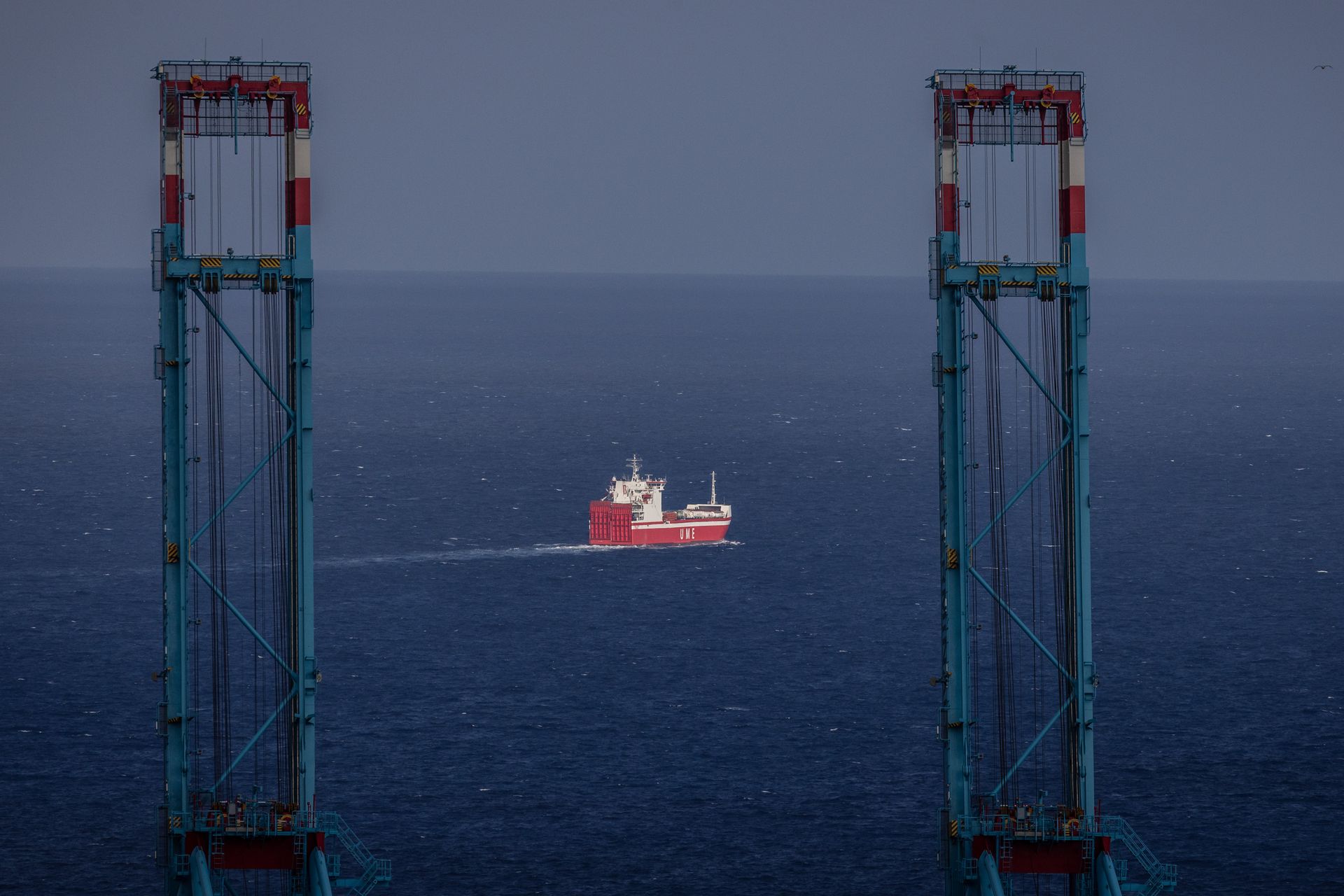
Villa Vie Residences has suspended operations of its residential cruise ship Villa Vie Odyssey in Cambodia, forcing residents to disembark as soaring fuel costs push the company toward financial restructuring....
My partner and I often joke that we're in a 'middle-distance' relationship.
Lindsey Galloway
My partner lives in a spacious house in rural Colorado, and I live in a condo in Boulder.
We haven't found a place that fits both of our needs yet, so we're content living 45 minutes apart.
There are challenges, but we enjoy spending lots of time at each other's homes.
Every weekend, my partner makes the best breakfast: over-medium eggs, handmade tortillas, and fresh hash browns.
We often eat outside thanks to Colorado's bright, sunny days, then we'll walk around the lake, watch some football, and spend the evening roasting marshmallows over the fire pit.
Then, when Sunday night arrives, I get in my car and drive the 45 minutes back to my dream condo to get ready for the week ahead.
My partner and I met at work 13 years ago, and we intend to spend the rest of our lives together, but we still live apart. We know each other's rhythms, quirks, and needs, and have no secrets, just separate addresses.
I often joke that we're in a "middle-distance" relationship. At least we're in the same state, but it's also not always easy or convenient to drop by for dinner.
Living apart lets us each keep a home we love
Both of us are divorced, and we both love the houses we have.
My partner lives in rural northeastern Colorado and bought his home after his divorce. It's bigger than mine, with a huge yard and a custom-designed patio built for entertaining.
His neighborhood isn't exactly walkable, but he's originally from a small town in Texas, so he doesn't mind driving longer distances to get to places he wants to go.
Meanwhile, after my divorce, I moved back into the Boulder condo I had been renting out while married. My unit is smaller than my partner's, but I love its mountain views and proximity to all my favorite places, like my go-to local bakery.
It needed a lot of work when I moved back in, but I invested in new paint and flooring to really make it mine again.
I want to stay close to Boulder, and he wants a big house. The tight, expensive housing market has made it tough to find a new place we both love.
Though we've toured many houses together over the last six months, we haven't been impressed by any of them enough to leave the places we've already made our own.
Our setup isn't as tough as people think
We've built a routine that works well for us.
Lindsey Galloway
One thing that has made this arrangement easier is that we're used to living out of our suitcases. I'm a professional travel writer, and he works for a company based on the East Coast. We also love to explore new places together whenever we can.
When we are both home in Colorado, we've found a routine that has worked pretty well for us. My partner often spends some weeknights here, where we're close to restaurants, friends, walkable downtown Boulder, and other things to do after work.
Then, I'll go up to his house for quiet, relaxed weekends, and to watch my favorite team on the 100-inch screen (go Raiders!). We also tend to entertain at his bigger house.
Both of us get bored easily, so having a change of scenery and routine keeps life feeling fresh. My 14-year-old pug has adapted, too, and travels with me between places.
To make things easier, I've bought duplicates of staples like deodorant and an electric toothbrush, so I'm not schlepping them (or forgetting them!) every weekend.
That said, there are challenging things about our setup. Packing up every few days can be a hassle, and it can be stressful to land at the airport and decide which house to go to, especially when I miss both my partner and the feeling of being "home."
We always make an effort to overcommunicate our plans and extend understanding whenever one of us just needs to get home to do a load of laundry.
We'll find our dream home eventually
We plan to move in together eventually.
Lindsey Galloway
Every day, I'm scrolling listings that meet both our picky criteria and calling up agents for showings, but so far, we haven't loved anything as much as our current homes.
It sounds frustrating, but we both think this is a pretty good problem to have: It gives us more leverage in the homebuying process and means we don't have to settle for something that is only half-right or makes just one of us happy.
We're confident that we'll find a home that fits us both, but in the meantime, navigating the middle-distance has only made our relationship stronger.
Olympic gold medalist takes third place in floor exercise final, adding to string of victories this year, after being barred from competing at last year's Indonesia championships
The author and her husband have a 23-year age gap.
Courtesy of Caroline Chirichella
My husband is 23 years older than I am, but our age difference never bothered me before.
Now that he's 61 and we're raising two young kids, I'm noticing our different energy levels.
I love our life together, but I'm struggling with the realities of our age gap.
When my husband and I first met back in 2014, we had what many would consider a whirlwind romance. We met, fell in love almost instantly, moved in together after a year, got engaged six months later, married a month after that, and a little over a year later, welcomed our first child.
It was all very exciting, rushed, and filled with emotion and love.
I'm also a very rational person who doesn't get easily swept up in the moment. So we talked about a lot of the "hard" decisions that couples so often neglect to discuss at the beginning of a relationship. We talked about children, our future, and what we wanted our lives to look like. That's why, now, more than 12 years later, it's surprising to find myself struggling with something I thought I had already made peace with: our age gap.
He is 23 years older than me
My husband and I have a 23-year age difference. Yes, I was always aware of it. And, to be honest, it never really made a difference to me.
The author's husband is now in his 60s and the couple has two young kids.
Courtesy of the author
Especially when it came to the big life decisions, including having children, we had those conversations before we even got engaged. I knew exactly how old he was. I knew there would be things about growing older together that would be different for us.
But I guess there's a big difference between being aware of something that could eventually happen and actually living it.
Our age difference has been showing up in more ways than one lately, and there's a part of me that's angry with myself for being surprised by it.
It's not like my husband was always going to be the 48-year-old I met when I was 25. I knew he would age. I knew things would change as he got older. I knew there would eventually be a point when the difference between us became more noticeable.
I just don't think I ever wanted to admit to myself exactly how much.
He's in his 60s now
I knew he was going to be an older father. I knew all of this. But knowing something and seeing it firsthand are two very different things. Lately, I've seen just how much his 61 years are catching up to him, and it's been putting me in a strange place.
I keep a lot of things together for my family. We have two young children, and I have my own business. There is already a lot that weighs on me. But what I've noticed recently is my husband's physical health beginning to catch up with his age.
Courtesy of the author
Don't get me wrong — my husband is in great shape for a 61-year-old. But at the same time, most 61-year-olds aren't running after toddlers or handling the daily insanity of school drop-off and pick-up.
And that difference is becoming harder for me to ignore. What bothers me most is how naive I feel. I knew this was a possibility. Quite frankly, my husband knew it, too. When we discussed having children, we were always on the same page, but he expressed his concerns about being an "old" dad. I heard him. We talked about it. We made the decision together.
And yet, now that I'm watching the reality unfold in front of me, I'm beginning to feel guilty. As though I've been selfish. As though somehow this isn't fair to my kids.
I see how much fatherhood — and, frankly, being a husband — can weigh on him.
The everyday insanity of being part of a household with a high-maintenance 8-year-old and a very independent 3-year-old is a lot for anyone, myself included. But it's especially a lot for a 61-year-old.
Sometimes he physically can't keep up with our 3-year-old, who runs at a pace that could outrun the best of us. Sometimes he mentally can't keep up with our eight-year-old, who talks at about a million miles a minute.
And those moments make the age difference feel very real.
It's not just the fatherhood aspect
I feel his patience with me beginning to waver, too, and I wonder how much of that is because we're simply in such different phases of life.
I have a thriving public relations firm, and I feel like I'm just getting started. I have energy and ambition and a feeling that there is still so much ahead of me.
He had a contracting firm for many years, but that chapter of his life is well behind him now. At his age, he should be enjoying retirement. Instead, he's a stay-at-home dad and handles a huge amount for our family. But he's far from retired.
He's the only one who drives, so he's the family's chauffeur. He makes appointments and handles logistical things. He oversees the renovations on our house. He does the grocery shopping. He does so, so much.
And the truth is, at this age, maybe he shouldn't have to.
Our relationship itself hasn't really changed. We are still very lucky to have an incredibly open and loving relationship. We talk about these things. We try to give each other space and understand where one another is coming from. We each do what we can mentally and physically for each other, for our children, and, just as importantly, for ourselves.
I think what we're realizing is that neither of us has ever been here before.
We knew there was an age gap when we met. We knew what it meant on paper. We talked about the difficult possibilities before we got married and before we had children.
At 25, I could understand that my husband was 23 years older than me. At 38, I can feel it.
Recent midlife upgrades to China’s older surface combatants highlight an ongoing debate over whether preserving naval fleet mass provides an operational edge over purely qualitative technological modernization in naval warfare. This month, the South China Morning Post (SCMP) reported that the People’s Liberation Army Navy (PLAN) has carried out an extensive midlife refit of its […]
A ship called the Agioi Fanendes, which had just left Russia's Baltic Sea port of Primorsk, was carrying 40,000 metric tons to New York and had been traveling westwards through the Baltic Sea ever since.
I've seen all kinds of weddings over the past decade, but many couples make the same mistakes.
Courtesy of Cameron Dever
I've worked as a wedding photographer for years, and I've seen couples make the same mistakes.
Too many people schedule the day to the minute and don't get the chance to enjoy their wedding.
Not budgeting for the right photographer and videographer can lead to disappointing results.
I've been photographing weddings for over a decade, so I've witnessed countless ceremonies and receptions — some disastrous, others impeccable.
Throughout the years, I've also watched couples make the same mistakes over and over. Here are a few I wish they'd avoid.
Filling the day-of schedule with way too much
Couples have to find time for the ceremony, photos, eating and drinking, dancing, talking to the people they invited, and connecting with each other.
When you try to fit too many things into the day, no one — especially the married couple — has time to breathe and relish the moments. The day can feel rushed and more focused on activities than the celebration of love.
A packed schedule often leaves couples stressed, with no time to eat because they've been pushed from one 15-minute window to the next.
However, your wedding day shouldn't be a blur. You should have time to soak in every moment. When you map out your day, prioritize traditions you love and estimate how long each will take … then add buffers.
I also recommend working with a wedding planner or coordinator to plan your timeline, or consulting with your photographer and other vendors when arranging your schedule. They've experienced countless weddings and know firsthand how much time each activity usually takes.
Letting small mishaps and issues ruin the whole day
Learning how to laugh off the small mishaps is absolutely key.
Courtesy of Cameron Dever
One of the things I always tell my couples right before their wedding day is that something will go wrong.
I don't say this to scare them or make them worry, but mostly to adjust their expectations. No matter how much planning you do, people are imperfect, the weather can be unpredictable, and life happens.
By the time the day comes, couples have done all they can to make sure it's how they pictured it. All that matters after that is that they enjoy their wedding.
Missing flowers or a cake that's the wrong flavor can throw off your day — but these unexpected mishaps shouldn't be so consuming that they're all you remember from your wedding.
I don't want to witness any more miserable couples desperately trying to fix details that will never be exactly right. Please try to roll with the punches on your wedding day.
Hiring the wrong photographer or videographer
I may be a bit biased, but I strongly believe having important memories properly documented in photo and video form is priceless.
I've also heard from countless married couples who regret booking a subpar photographer or skipping a videographer.
When hiring any vendors — especially these — choose carefully. You're paying someone to use their physical and creative energy to tell the story of your wedding.
Ask a ton of questions and make sure you love their style by viewing their portfolios and websites. It can also help to hop on a phone call or video meeting — couples should esnsure they vibe with their photo and video team on a personal level because they'll be spending a lot of time with them on the big day.
Planning the wedding they think they should have instead of the one they actually want
You don't have to have a cookie-cutter wedding.
Courtesy of Cameron Dever
Weddings are for the couple, so they should do what they want.
I see so many of them spend thousands of dollars and devote countless hours to planning, only to celebrate their love the way they think they're supposed to — not how they'd actually like.
Your wedding should be unique to you, and it doesn't need to look like everyone else's. If you wish to elope in the forest or plan a ball inspired by "Bridgerton" in a mansion, go for it.
The couple is at the core of the celebration, so why shouldn't everything be based on who they are and what matters most to them?
Consider this my official public service announcement: Your wedding can — and should — be fun, unique, and meaningful to you.
This story was originally published in June 2021 and most recently updated on October 23, 2026.
In our Divorce Diaries series, we speak to people in Ireland about their experience of marriage and divorce. This week, a woman in her 40s with two children talks about separation from her perspective
By Chris Servello (OpEd) After years of testing and debating how unmanned surface vessels fit into the fleet, the Navy is starting to show what these systems can do. And...
"Allies have or will send additional maritime patrol aircraft, radar systems, explosive exploitation teams, intelligence personnel, drones, and more to the Black Sea," U.S. Army Col. Martin O'Donnell, a NATO military spokesperson, said in a statement.
European regions and cities demand clear rules and solid financial backing to help Europe’s ailing car industry through the shift to electric vehicles (EVs). The European Committee of the Regions (CoR) on Wednesday adopted an opinion on the European Commission’s Automotive Package, arguing that the transition will only succeed if regions are adequately equipped to carry it.
Regions said electrification is crucial to achieving climate-neutral road transport, but that success depends on affordability and access. They called for charging infrastructure across regions, funded by European, national and regional budgets, as well as targeted demand support in lower-income regions.
“Europe’s regions and cities have spoken with one voice: competitiveness and electrification by 2035 go hand in hand,” said María Chivite, President of the Navarre region in Spain, who drafted the opinion. Europe can only lead the transition, she argued, if regions receive “real financing”.
The Commission proposed the Automotive Package in December. It suggests a 90-percent-cut in tailpipe emissions from 2035, with the remaining 10 percent offset through low-carbon steel or e-fuels and biofuels. The CoR welcomed these temporary flexibilities but warned that they must not delay zero-emission mobility.
Brigitte Torloting, Chair of the Automotive Regions Alliance (ARA) and Vice-President of France’s Grand Est region, warned that time is short and “global competition will not wait for us”. She called for a strategy that protects automotive production in the regions, backed by strong European instruments such as “European preference.” Without a clear framework and targeted investment, she said, Europe risks losing its industrial base, from small and medium-sized enterprises (SMEs) to major suppliers.
Made in the EU
“European preference” is an approach first introduced in the Commission’s proposal for an Industrial Accelerator Act in March and is designed to prioritise EU-based manufacturing. The Commission suggests public procurement contracts and state-subsidised industrial projects to source a minimum percentage of materials or components from European producers. For EV production, the Commission proposed that 70% of components for new cars – excluding the battery – must originate within the EU.
CoR members also welcomed the “Made in the EU” approach to strenghten European production but insisted it must be proportionate, so that SMEs and regional supply chains are not buried in red tape.
With automotive production concentrated in specific territories, the opinion also calls for targeted cohesion funding, skills and quality jobs.
According to EU figures for 2024, the automotive industry contributed 7 percent of EU gross domestic product (GDP), about EUR 170 billion in exports and supported around 13.8 million jobs, 3.5 million of them in manufacturing. According to CoR figures, the 41 regions organised in the Automotive Regions Alliance (ARA) generate more than 40 percent of EU GDP.
This story was produced by the European Newsroom (enr) in cooperation with the European Committee of the Regions (CoR). The editorial responsibility lies with the enr.
A week after two cargo ships were struck by drones off the Bulgarian coast, the attack was repeated even closer to our territorial waters with a similar outcome: one vessel was sunk, and another was abandoned by its crew, resulting in injuries and likely numerous fatalities. This is already having tangible consequences for Bulgaria. “Attacks […]
European regions and cities are calling on the EU to give millions of displaced Ukrainians legal certainty and a genuine choice between building a future in Europe and returning home safely. Their appeal comes as Russian attacks on Ukraine’s critical energy infrastructure intensify ahead of what is expected to be another harsh winter for the war-torn nation.
Temporary protection for displaced Ukrainians was set to end in March 2028. Eurostat data from July shows that almost 4,5 million non-EU citizens who fled Ukraine were benefiting from the mechanism, which was established shortly after Russia’s full-scale invasion in 2022.
“Temporary protection was the right emergency response, but it cannot be the long-term answer,” said Antje Grotheer, Chair of the European Committee of the Regions’ (CoR) Working Group on Ukraine. “People forced to flee Ukraine because of Russia’s war need certainty about their future,” the President of the Bremen State Parliament added.
An opinion drafted by Grotheer and adopted by CoR members on Tuesday calls for timely, accessible information on legal options beyond temporary protection so that people can make informed decisions.
It notes that decisions on legal status are taken mainly at EU and national level, while their practical consequences are managed in cities and regions. Local authorities need predictable funding and administrative capacity to keep public services running and respond to housing pressures, the CoR said.
Grotheer demanded that cities and regions are given a voice in shaping the transition after the EU’s temporary protection runs out.
Preparing for winter
The opinion sets out three parallel priorities: supporting the inclusion of displaced Ukrainians in European communities, investing in their education and skills for the benefit of host societies and Ukraine’s recovery, and enabling voluntary, informed and safe return when conditions allow.
“It’s time now to realise that we should not only treat Ukrainians as vulnerable refugees; we should treat them as our partners,” said Ylva Johansson, EU Special Envoy for Ukrainians in the EU. “Their future is part of Ukraine’s future, and that future is in the European Union,” she added.
“The millions of Ukrainians currently living outside the borders of our country are a huge human potential that Ukraine cannot afford to lose,” said Tetiana Yehorova-Lutsenko, President of the Ukrainian Association of District and Regional Councils (UAROR) and Chair of Kharkiv Regional Council.
The UN Refugee Agency (UNHCR) reported that 49 percent of Ukrainian refugees – down from 61 percent in 2024 – have expressed hopes or intentions to return one day, with security, housing and essential services among the key conditions.
Protecting Ukraine’s energy infrastructure has been a central part of the EU’s support since 2022. In a letter to CoR members, President Kata Tüttő and Grotheer warn that the attacks risk depriving communities of basic living conditions. The letter recalls that the European Commission President Ursula von der Leyen had described the attacks as “a strategy of terror”.
“Cities and regions must act before the arrival of the cold further aggravates the already difficult humanitarian situation,” the letter warned. It said regions and cities can deliver support in the form of energy equipment, used municipal vehicles, medical supplies or IT equipment.
This story was produced by the European Newsroom (enr) in cooperation with the European Committee of the Regions (CoR). The editorial responsibility lies with the enr.
Matson has christened the first of three new Jones Act containerships at Hanwha Philly Shipyard, marking another milestone in the carrier’s $1 billion fleet renewal program as the Philadelphia yard...
A powerful reflection on the pull of nostalgia, on learning to accept that a past life is gone even as you tentatively reach back for it. Tiffany Huang captures the ache of lost opportunities and regretted paths, of staying a course out of duty and responsibility even as your sense of home erodes. It’s a gorgeous, bittersweet read about what it means to move on long before you’ve fully let go.
You unmasked for the first time, revealing smooth cheeks, a sharp chin, and a long nose. You talked about your book, in progress for several years now, about a Hong Kong man drifting aimlessly around the world. I asked you how you felt about the protests and noted the resignation in your tone. You wanted to write a book about what it meant to be a man from Hong Kong; if Hong Kong disappeared, what would happen to the man? You told me about your family, and it was clear we were not meeting to talk about writing anymore. When you spoke, you chose your words carefully. You didn’t ask me about my boyfriend, only how I felt about returning to America. When I hesitated, you did not ask why, and when I spoke, you listened instead of interrupting me. I didn’t want to leave.
Forty years ago, archaeologist Lucien Basch and researcher Michal Artzy published a set of 19 ship graffiti carved into the walls of Kition Kathari, an archaeological site beneath the modern city of Larnaca on Cyprus’s southern coast. Ever since, those images have been cited as textbook examples of Late Bronze Age maritime iconography in the […]
Greek long jump athlete Miltos Tentoglou won gold during the European Athletics Championships in Birmingham on Tuesday night. His jumps ranged between 8.19 and 8.44, clinching his victory with 8.44, his highest score during his fourth and last attempt. 28-year-old Tentoglou added his fourth gold medal at successive European championships, securing a position as the […]
Brussels (enr) – Local and regional leaders raised concerns that the next multiannual EU budget risks undermining investment in affordable homes needed to alleviate Europe’s deepening housing crisis.
“Europe’s housing challenge is not simply about building more housing units,” said Kata Tüttő, President of the European Committee of the Regions (CoR), an EU advisory body home to democratically elected regional and local representatives from all 27 Member States.
At a gathering in Brussels on Thursday, they demanded the EU “move from political ambition to concrete investment and delivery,” arguing that failing to invest now will only put affordable housing further out of reach for millions of Europeans.
As negotiations over the EU’s next long-term financial framework gather pace, cities and regions fear that affordable housing could become a casualty of competing spending priorities as several EU member states seek to cut the European Commission’s proposed €2 trillion budget for 2028-2034.
Tüttő called on the European Investment Bank (EIB), the EU’s lending arm, to “mobilise the scale of investment” that cities and regions need to “make communities liveable” by providing essential infrastructure. She cited public transport, as well as energy and water infrastructure, as key examples.
Italian MEP Irene Tinagli, Chair of the European Parliament’s Special Committee on the Housing Crisis (HOUS), said addressing the housing crisis “requires investment, better coordination across all levels of government and a shared commitment from European institutions, Member States, regions and cities”.
The CoR and EIB on Thursday agreed on closer cooperation in key areas including social infrastructure, housing, and energy. The European Investment Bank’s president, Nadia Calviño, said “investing into resilient cities and regions, into cohesion and housing” was a strategic priority.
According to EIB figures, the world’s largest multilateral development bank provided a record €5 billion in financing for housing projects across Europe in 2025. The EIB is targeting an increase to €6 billion this year, Calviño confirmed.
The investments are a contribution to the European Commission’s Affordable Housing Plan, which was launched in December and aims to boost housing supply, mobilise public and private investment, and support Member States and regions in expanding social and affordable housing.
According to the Commission’s estimates, however, the EU needs to build 2 million homes each year to meet current demand, which amounts to an investment of approximately €153 billion per year.
This story was produced by the European Newsroom (enr) in cooperation with the European Committee of the Regions (CoR). The editorial responsibility lies with the enr.

 Login