
❌

Reading view

Russia Moves to Exclude Europe from Ukraine Peace Talks as Kremlin Delays Next Round of Negotiations

Moscow has indicated that European governments will not participate in the next round of negotiations over the war in Ukraine, despite their central role in financing Kyiv, supplying military assistance and shaping the continent’s security arrangements. The Kremlin’s position raises questions about whether any agreement negotiated principally by Washington, Moscow and Kyiv could be implemented without substantial European involvement.

Russia has ruled out European participation in the next round of trilateral talks with Ukraine and the United States, while suggesting that the negotiations could be delayed by developments on the battlefield and the continuing conflict in the Middle East.

Yuri Ushakov, foreign policy adviser to Russian President Vladimir Putin, said on 29 October that Moscow had not agreed to a specific date for further consultations and that European representatives were not being considered for inclusion.

Ushakov maintained that preparations concerned representatives of Russia, Ukraine and the United States.

His remarks followed statements by Ukrainian President Volodymyr Zelensky indicating that the next round could take place in Abu Dhabi between 6 and 10 November.

The Kremlin has not confirmed those dates.

The disagreement comes as European governments seek a more substantial role in diplomatic efforts concerning a conflict whose eventual settlement would have direct consequences for their security, defence expenditure and relations with Russia.

Moscow Sets Its Conditions

Ushakov’s position was particularly explicit when discussing European participation.

Speaking to Russian media on 28 October, he suggested that European representatives were free to travel to the proposed venue but would not be invited to join the negotiations.

His remarks were subsequently reinforced by a statement that European involvement was not under consideration.

The Kremlin adviser also linked the timing of the next meeting to developments in the Middle East, where the US-Israeli conflict with Iran has complicated Washington’s diplomatic and military priorities.

Ushakov said that conditions on the Ukrainian battlefield would also influence when negotiations could resume.

These explanations give Moscow considerable latitude over the timetable while leaving uncertainty about the practical arrangements for the next meeting.

They do not, however, establish that Washington and Kyiv have accepted Russia’s preferred arrangements for every subsequent stage of negotiations.

Technical consultations between three parties and broader discussions over a European security settlement are not necessarily the same diplomatic process.

Europe Wants a Place at the Table

The Russian position contrasts with statements from the leaders of Britain, France and Germany, who have maintained that European governments must participate in discussions concerning Ukraine’s future security.

Their argument rests partly on the responsibilities that European countries would be expected to assume after any agreement.

European states have provided substantial financial, military and humanitarian assistance to Ukraine since Russia launched its full-scale invasion in February 2022.

They have also introduced successive sanctions against Russia, expanded defence expenditure and debated arrangements for security guarantees intended to discourage renewed hostilities.

Any settlement that required changes to European sanctions, military deployments or financial assistance would therefore depend on decisions taken by European governments and institutions.

Neither Moscow nor Washington could independently commit the European Union to lifting sanctions or authorise European states to deploy forces.

This distinction limits the practical significance of excluding European officials from a negotiating session.

An agreement could be discussed without European participation, but implementing provisions that require European action would demand further negotiations.

The Donbas Question Remains Unresolved

The principal obstacle continues to concern territory and the conditions under which military operations would end.

Russia has maintained its demand that Ukraine relinquish territory in the eastern Donbas region, including areas remaining under Ukrainian control.

Kyiv has rejected the surrender of territory as a precondition for ending the war.

The proposed negotiations are consequently expected to concentrate on technical issues where limited agreements may be more achievable.

These include possible arrangements concerning energy infrastructure, maritime security, the exchange of prisoners and the return of Ukrainian children taken to Russia or Russian-controlled territory.

Such measures could produce humanitarian or economic benefits without resolving the central territorial dispute.

However, their implementation would require monitoring arrangements and sufficient confidence that the parties would honour their commitments.

The temporary humanitarian ceasefire around Oleshky, in the Kherson region, offers a narrowly defined example of cooperation between Russian and Ukrainian representatives.

It does not demonstrate that a broader political agreement is within reach.

The American Role

Washington remains the principal external mediator in the current negotiating format.

That position reflects American diplomatic influence and its capacity to engage directly with both Moscow and Kyiv.

However, the United States is simultaneously managing military commitments in the Middle East and domestic political pressures ahead of the 3 November congressional elections.

These competing priorities may affect the pace of diplomatic engagement.

For Russia, a negotiating framework centred on Washington offers the possibility of addressing wider bilateral issues alongside the conflict in Ukraine.

For Ukraine, American participation remains important because US decisions concerning military assistance and security commitments could influence the durability of any settlement.

Europe’s position is more complicated. Its governments possess substantial economic leverage, but their influence over the negotiating agenda depends on coordination with Washington and Kyiv.

Negotiating Without Europe Has Practical Limits

The immediate dispute concerns who participates in the next round of talks.

The longer-term question is which parties would be responsible for implementing a settlement.

A ceasefire might initially involve arrangements agreed by military and diplomatic representatives of Russia and Ukraine, supported by the United States.

A more comprehensive agreement could involve sanctions, reconstruction finance, security guarantees, troop deployments and Ukraine’s future relationship with European institutions.

Those issues cannot be settled on behalf of European governments without their consent.

Moscow’s attempt to restrict participation may therefore succeed at the level of an initial negotiating format while proving more difficult to sustain during discussions about implementation.

For the moment, neither the date nor the outcome of the proposed Abu Dhabi meeting is certain.

What has become clearer is the divergence between Russia’s preferred negotiating structure and Europe’s determination to influence the security arrangements that would follow the war.
  •  

Poland Wins European Patriot Missile Maintenance Hub as NATO Confronts Interceptor Shortages

Washington has selected Poland to host a European servicing centre for PAC-3 interceptors, strengthening the country’s role in NATO’s air defence infrastructure. The investment comes as wars in Ukraine and the Middle East expose the difficulties of sustaining missile stocks during prolonged conflicts.

Poland has been selected to host a major European maintenance centre for Patriot air defence interceptors, marking a further expansion of the country’s role in NATO’s military infrastructure and the transatlantic defence industry.

The decision, announced on 27 October by the United States government and American defence manufacturer Lockheed Martin, will establish a dedicated facility for PAC-3 missiles used in Patriot air and missile defence systems.

The investment is estimated at approximately one billion zlotys, equivalent to around €227 million.

Poland secured the project following competition with Germany, the Netherlands and Norway.

The facility is intended to provide maintenance, repair, refurbishment and technical recertification services to European operators of PAC-3 interceptors.

Its importance extends beyond the immediate economic benefits for Poland.

The wars in Ukraine and the Middle East have exposed pressure on the availability of advanced air defence missiles, raising questions about Europe’s ability to sustain military operations when demand for interceptors exceeds existing supply.

A new role for Poland’s defence industry

Deputy Defence Minister Magdalena Sobkowiak-Czarnecka announced the selection of Poland as the location for the maintenance centre.

According to Lockheed Martin’s official announcement, the facility will support NATO allies operating PAC-3 interceptors through repairs, lifecycle maintenance, refurbishment and recertification.

The centre will also provide testing capabilities intended to improve operational readiness and reduce the time required to return missiles to service.

The exact location and final implementation arrangements remain subject to further negotiations.

Polish officials have indicated that the centre could become operational in approximately a year, although the schedule will depend on the conclusion of agreements and construction or adaptation of the necessary facilities.

The project is expected to create specialised employment and increase opportunities for Polish defence suppliers.

It also reinforces Poland’s position as a manufacturing and logistics centre on NATO’s eastern flank.

Maintenance is not missile production

An important distinction concerns the facility’s actual purpose.

The Polish centre will maintain and service PAC-3 missiles. It is not being presented as a new production line capable of manufacturing large quantities of additional interceptors.

Modern air defence missiles contain complex guidance systems, propulsion components and other equipment requiring specialised inspection and maintenance.

Their operational availability depends not only on the number produced but also on the ability to store, test, maintain and recertify existing stocks.

When these services are concentrated outside Europe, operators may face lengthy transport and servicing arrangements.

Locating maintenance capacity closer to European users should reduce some of those delays.

However, the facility will not independently resolve shortages caused by the consumption of missiles during military operations.

Additional manufacturing capacity, access to components and long-term procurement agreements remain necessary to increase overall inventories.

Ukraine and the Middle East increase demand

Patriot systems have become particularly important because of their role in defending military facilities, population centres and critical infrastructure against aircraft and missiles.

Ukraine has repeatedly requested additional Patriot interceptors to protect cities and energy installations from Russian attacks.

At the same time, the conflict in the Middle East has increased demand for advanced air defence capabilities.

Both theatres place pressure on supply chains whose production capacity cannot be expanded immediately.

Manufacturing sophisticated interceptors involves specialised components, qualified suppliers, extensive testing and demanding certification procedures.

The result is a gap between the speed at which missiles can be expended during sustained operations and the time required to replace them.

The United States has undertaken efforts to accelerate PAC-3 production.

Lockheed Martin announced that it had received a major US government contract in 2026 to support further expansion of PAC-3 MSE manufacturing.

The planned maintenance centre in Poland represents a complementary investment, intended to improve the availability of missiles already held by European forces.

A transatlantic industrial project

Although Poland will host the facility, the project has a wider European dimension.

Germany, the Netherlands and Sweden are expected to participate in important elements of supply-chain integration.

These countries were among the original participants in the industrial cooperation arrangements alongside Poland and the United States.

The structure reflects NATO’s increasing emphasis on dispersing critical maintenance and logistical capabilities across allied territory.

A geographically distributed system can reduce dependence on individual sites and make it easier to sustain equipment during periods of disruption.

It can also help European defence companies develop technical expertise through cooperation with American manufacturers.

However, the arrangement will remain part of a transatlantic supply chain, with significant industrial and technological responsibilities retained by the United States.

The project therefore illustrates both Europe’s expanding defence-industrial role and its continuing dependence on American missile technology.

Poland’s expanding air defence network

The decision complements Poland’s broader investment in integrated air and missile defence.

Under the Wisła programme, Warsaw has been acquiring Patriot systems and associated interceptors as part of a wider modernisation of its armed forces.

Two Patriot batteries reached operational readiness in December 2025, according to Euronews’ reporting on the project.

Poland has also ordered additional batteries and substantial quantities of PAC-3 MSE missiles, with deliveries continuing through the remainder of the decade.

These investments are intended to improve protection against aircraft, cruise missiles and ballistic missile threats.

The maintenance centre should complement those acquisitions by strengthening technical support for the interceptors.

Readiness depends on more than procurement

The Polish investment demonstrates how NATO’s air defence priorities are changing.

For many years, procurement discussions concentrated primarily on purchasing new weapons systems.

The experience of prolonged conflicts has placed greater emphasis on ammunition availability, repair facilities, spare parts, storage and industrial capacity.

Those supporting capabilities determine how long military forces can sustain operations.

The new centre will not eliminate the need for additional missiles, but it could reduce servicing delays and improve the readiness of European stocks.

Its effectiveness will ultimately depend on the scale of operations, access to components and the speed with which maintenance services can be delivered.

For Poland, hosting the facility strengthens its position within NATO’s defence-industrial network.

For the Alliance, it represents an attempt to address one of the practical weaknesses exposed by recent conflicts: acquiring advanced weapons is only part of the challenge; keeping them available for use is equally important.

  •  

Romania Accuses Russia of Coordinating Sabotage Network Targeting European Defence Industry

Romanian intelligence services say a Russian-directed network was responsible for a fire near an arms manufacturing facility in Brașov. Investigations involving Germany and Poland have exposed what authorities describe as a wider operation targeting military and industrial defence infrastructure across Europe.

Romania has accused Russia of coordinating a cross-border sabotage network responsible for an industrial fire near an arms manufacturing facility, prompting a diplomatic confrontation with Moscow and investigations involving several European countries.

Romanian intelligence and prosecutors announced on 26th October that they had identified three foreign nationals allegedly involved in the operation, which caused a fire on an industrial site in Brașov on 14th September.

The suspects, two Belarusian nationals and one Ukrainian, are alleged to have participated in a network directed by individuals operating from Russia.

Two suspects have been detained in Germany, while a third has been located in Poland.

Romania is seeking their extradition as investigators examine possible connections to other attempted attacks against military and industrial installations.

Russia has rejected the allegations.

The case has drawn attention to the security of European defence production facilities at a time when NATO governments are seeking to increase military manufacturing capacity and sustain assistance to Ukraine.

Fire near a Romanian arms manufacturer

The investigation concerns an industrial complex in Brașov, a city with an established defence manufacturing sector.

The fire occurred on 14th September at premises situated close to CARFIL SA, a subsidiary of Romania’s state-owned defence company ROMARM.

According to the Romanian Intelligence Service, the incident was caused by individuals belonging to a sabotage network coordinated from the Russian Federation.

The fire damaged premises occupied by several commercial businesses.

Although the industrial site is associated with the CARFIL complex, authorities have not established publicly that the arms manufacturing facility itself sustained damage.

That geographical distinction is important when assessing the consequences of the operation.

CARFIL manufactures military equipment and ammunition and has pursued partnerships involving drones, explosives and other defence technologies.

Its proximity to the incident has heightened concerns about the security of industrial facilities supporting Romania’s armed forces.

Suspects identified in three countries

Romania’s Directorate for Investigating Organised Crime and Terrorism, known as DIICOT, says the evidence connects three individuals to the incident.

According to Romanian national news agency AGERPRES, the Bucharest Court of Appeal issued European arrest warrants following the investigation.

Two suspects were detained in Germany while allegedly preparing similar operations.

The third was located in Poland, where authorities received a further European arrest warrant issued on 26 October.

Romanian prosecutors are pursuing extradition procedures.

The nationalities of the suspects do not establish responsibility on the part of Belarus or Ukraine. Romanian authorities attribute the alleged coordination to individuals based in Russia.

The investigation also indicates that the Brașov incident may not have been an isolated operation.

Romanian intelligence claims the network’s potential targets included government-owned and private arms manufacturers, military-related facilities and other strategic industrial sites in several European countries.

Those claims remain subject to ongoing criminal investigation.

Bucharest summons Russian ambassador

The Romanian government escalated the matter diplomatically on 27th October.

Foreign Minister Dan Neculăescu summoned Russia’s ambassador, Vladimir Lipaev, to deliver a formal protest concerning the alleged operation.

According to the Romanian Foreign Ministry’s account reported by AGERPRES, Bucharest stated that evidence gathered during the investigation demonstrated Russian responsibility.

The ministry described the operation as part of a broader pattern of hostile activity affecting European states.

President Nicușor Dan also condemned the alleged sabotage, linking it to attempts to undermine European security and solidarity.

Moscow rejected the accusations.

The Russian Embassy maintained that the allegations were unfounded and disputed Romania’s account of the evidence presented during the diplomatic meeting.

The conflicting positions mean the attribution remains contested, notwithstanding the conclusions announced by Romania’s intelligence authorities.

A recruitment model designed for deniability

The Romanian Intelligence Service has provided details about how it believes the wider network recruits and directs participants.

According to its statement, recruitment can begin through social media with offers of payment for apparently minor activities, such as photographing or observing particular locations.

Subsequent assignments may become more serious, involving property destruction, arson or other acts of violence.

Individuals may be targeted because of financial difficulties or other personal vulnerabilities.

The service also identified methods allegedly used to conceal movements, payments and communications.

These include encrypted messaging applications, telephone numbers registered outside the country of operation and accommodation or transport arrangements booked under other identities.

Such methods can complicate investigations because the individuals physically carrying out an operation may have limited knowledge of the organisers.

Romanian authorities emphasised that individual indicators should be assessed in context and do not themselves prove involvement in sabotage.

Defence factories become a security concern

The case has implications beyond Romania.

European governments are investing in ammunition production, air defence systems and military technologies, partly in response to the continuing war in Ukraine.

The resulting expansion of manufacturing capacity creates additional infrastructure requiring protection.

Industrial sites may be vulnerable not only to direct attacks but also to disruption affecting nearby businesses, transport networks, power supplies and specialist contractors.

The Brașov investigation illustrates how an incident outside a defence factory’s perimeter can nevertheless raise questions about the security of the wider industrial complex.

It also demonstrates the importance of cooperation between European intelligence services and criminal investigators.

The detention of suspects in Germany and the identification of another in Poland show that investigations into alleged sabotage may cross several jurisdictions.

The wider European response

Romania’s allegations come amid growing concern over hostile activities involving cyberattacks, disinformation, surveillance and physical sabotage.

Attributing such incidents to a foreign government requires intelligence assessments, criminal evidence and international cooperation.

The public allegations against Russia do not replace the judicial process concerning the three suspects.

However, the investigation has already prompted a diplomatic response and additional scrutiny of industrial security.

For European governments seeking to expand their defence industries, the immediate challenge is protecting production facilities and associated infrastructure without allowing relatively small-scale disruptive operations to undermine wider manufacturing programmes.

The outcome of Romania’s criminal proceedings will be important in establishing the responsibility of those accused and clarifying how the alleged network operated across national borders.

Main Image: By MAPN – http://www.mapn.ro/fotodb/20051020_expomil?page=1, CC BY-SA 3.0, https://commons.wikimedia.org/w/index.php?curid=14997305

  •  

Europe must finally hold Russia accountable for hybrid attacks

Europe has already learned to better recognize hybrid threats, which is definitely a good thing, but recognition alone is not enough and doesn't serve as sufficient deterrence.

European officials have grown accustomed to scenarios where a cyberattack disrupts public services and critical infrastructure, drones appear over sensitive sites,

  •  

Why Putin Demands Donbas: The Territorial Ultimatum That Could Shape Ukraine’s Next War

Vladimir Putin’s insistence that Ukraine surrender its remaining positions in Donetsk is not simply a dispute over territory. It is a demand that could dismantle Ukraine’s principal defensive barrier in the east, hand Moscow a military advantage it has struggled to achieve through years of fighting, and establish a precedent for further territorial concessions. The latest diplomatic contacts with European leaders have brought this question back to the centre of negotiations.

There are two ways for Russia to capture the remaining Ukrainian-held cities of Donbas. One is to fight its way through heavily fortified defensive positions, accepting substantial casualties, equipment losses and an uncertain timetable. The other is to secure their evacuation through diplomatic negotiations.

The second would achieve an important Russian military objective without requiring Moscow to bear the full cost of a prolonged offensive.

This distinction helps explain why Vladimir Putin continues to insist that Ukrainian forces withdraw from the remaining government-controlled territory of Donetsk region before a comprehensive settlement can be negotiated.

It also raises a more consequential question: would surrendering Donbas bring the war closer to an end, or would it improve Russia’s position in any subsequent confrontation?

A diplomatic opening without a strategic concession

The issue returned to prominence on 27 October when Finnish President Alexander Stubb and Norwegian Prime Minister Jonas Gahr Støre held a rare telephone conversation with Putin.

According to the Finnish president’s official statement, the call followed discussions in Oslo on 20 October involving Ukrainian President Volodymyr Zelenskyy and US presidential envoy Steve Witkoff.

The Nordic leaders sought to advance preparations for renewed American-mediated negotiations, expected in Abu Dhabi in November. They emphasised that they were acting on behalf of their respective countries rather than representing Europe collectively.

Stubb described the exchange as “frank and substantive”, arguing that direct communication with Moscow was necessary to address the security consequences of the war.

However, the Kremlin’s account offered little indication of movement on the fundamental disagreements.

Moscow insisted that any durable peace must fully accommodate Russian interests. A source close to the Kremlin told Reuters that Putin had reiterated his refusal to compromise on the objective of controlling the entire Donbas.

Following the conversation, Zelenskyy confirmed that the Nordic leaders had briefed him and stressed to Putin the need for concrete measures to reduce attacks on Ukrainian energy infrastructure.

The diplomatic process has therefore resumed without resolving the territorial dispute at its centre.

The military significance of the remaining Donbas

The territory Russia is demanding includes some of Ukraine’s most important surviving defensive positions.

Since fighting began in eastern Ukraine in 2014, Ukrainian forces have constructed and reinforced an extensive defensive system centred on Sloviansk, Kramatorsk, Druzhkivka and Kostiantynivka.

Known as the fortress belt, this network combines urban areas, industrial facilities, transport infrastructure, prepared defensive positions and terrain that complicates offensive operations.

The military importance of this system extends far beyond the administrative boundaries of Donetsk.

According to the Institute for the Study of War, surrendering these positions would allow Russian forces to occupy heavily defended territory without undertaking the prolonged operations otherwise required to capture it.

In its 26 October battlefield assessment, the institute continued to identify the capture of this defensive belt as Russia’s principal military objective in Donetsk. Ukrainian forces retained positions in parts of Kostiantynivka, while Russian operations towards other major cities remained contested.

The implications of a negotiated Ukrainian withdrawal would be substantial.

Russia could occupy the fortified urban corridor, reorganise its forces, establish new logistics routes and potentially redirect formations towards other sectors.

Ukraine, meanwhile, would have to construct or reinforce defensive positions further west, potentially under pressure and in less favourable terrain.

The resulting military imbalance would not necessarily lead to another Russian offensive. But it would change the conditions under which any renewed hostilities might take place.

That is why territory cannot be assessed solely by its surface area. A relatively small section of the front can possess strategic value disproportionate to its size.

Why Moscow prefers a negotiated withdrawal

Russia’s insistence on Donetsk also reflects the limits of what its military has achieved.

Despite years of fighting, Moscow has not secured complete control of the region. Successive offensives have produced territorial gains, but at considerable cost and without the rapid breakthrough originally anticipated.

US Secretary of State Marco Rubio recently acknowledged the central importance of the remaining Ukrainian-held territory.

In an interview published by the US State Department, Rubio characterised the dispute as centred on territory Russia wants but has been unable to capture militarily, while recognising Ukraine’s sovereignty and long-term security concerns.

His remarks demonstrate how Donbas has become the principal territorial obstacle in Washington’s diplomatic calculations.

For Moscow, however, concentrating negotiations on this specific demand offers an additional advantage.

If Ukraine refuses to withdraw, the Kremlin can argue that Kyiv is preventing progress towards peace. If Ukraine agrees, Russia obtains strategically valuable territory without the military costs associated with conquering it.

The demand therefore serves a dual purpose: it establishes a public explanation for the absence of an agreement while offering Russia an immediate military benefit should negotiations succeed on its terms.

The problem with treating Donbas as the final concession

The central weakness in any settlement built around a Ukrainian withdrawal is the assumption that control of Donbas represents the limit of Russia’s territorial ambitions.

Moscow’s previously declared objectives suggest a more complicated picture.

In June 2024, Putin demanded Ukrainian withdrawal from four regions claimed by Russia: Donetsk, Luhansk, Zaporizhzhia and Kherson. Moscow does not fully control these regions, despite claiming to have annexed them in September 2022.

Russia has also demanded restrictions on Ukraine’s military capabilities and future security relationships.

As EU Today previously reported, renewed diplomatic engagement has not produced a clear abandonment of the Kremlin’s wider objectives.

Consequently, transferring the remaining territory of Donetsk would not necessarily satisfy Moscow’s other demands.

There is a significant difference between conceding territory as part of an enforceable settlement and withdrawing from defensive positions as a precondition for negotiating one.

In the first case, territorial arrangements form part of a wider agreement establishing obligations, verification procedures and security guarantees.

In the second, one party makes a potentially irreversible military concession before knowing whether an agreement will ultimately be reached.

This asymmetry is particularly important where the proposed concession directly affects the withdrawing country’s ability to defend itself.

The strategy of incremental gains

One interpretation of Moscow’s approach is that it reflects a strategy of incremental territorial expansion rather than an attempt to achieve all its objectives through a single decisive offensive.

After Russia failed to capture Kyiv in 2022, its military campaign increasingly concentrated on taking territory through successive, often prolonged operations.

The diplomatic equivalent would involve securing one concession, consolidating the resulting advantage and subsequently presenting additional demands.

Under such a scenario, Russia could obtain control of the remaining Donetsk territory, establish new positions closer to Dnipropetrovsk region and later argue that further territorial or security arrangements were necessary to protect its newly acquired frontier.

Moscow has already used the language of protective buffer zones to justify military operations elsewhere in Ukraine.

There is no evidence establishing that such a sequence would inevitably follow a Donbas settlement. Nevertheless, the possibility must be considered when assessing the military consequences of a withdrawal.

The concern is not merely that Russia might violate a future agreement. It is that the agreement itself could alter the strategic balance in ways that make renewed military pressure more effective.

There is also an internal Ukrainian dimension.

An agreement requiring the evacuation of cities defended for years would create substantial political controversy. Disagreements over territorial concessions, security guarantees and the credibility of Western commitments could complicate domestic political stability.

For Moscow, such divisions might provide another means of influencing Ukraine without immediate military escalation.

Donbas and the wider question of Ukrainian sovereignty

Donbas has considerable political significance for Putin beyond its military value.

The conflict in eastern Ukraine began in 2014, following Russia’s annexation of Crimea. Donetsk and Luhansk became central to the Kremlin’s justification for intervention, and their incorporation into Russia was later proclaimed as part of the 2022 annexations.

Control of the entire region would allow Putin to present a tangible achievement after years of warfare.

Yet the Kremlin’s objectives have never been confined exclusively to Donbas.

Putin has repeatedly questioned Ukraine’s historical and political independence, while Russian negotiating demands have extended to the country’s military posture, international alliances and internal political arrangements.

These positions suggest that territorial control forms part of a broader attempt to determine Ukraine’s strategic orientation.

A settlement that ends fighting in Donetsk without resolving these wider disagreements might therefore suspend the conflict rather than settle its underlying causes.

What the next negotiations must establish

The planned talks in Abu Dhabi will test whether Moscow is prepared to distinguish between its territorial demands and the conditions necessary for a sustainable ceasefire.

An immediate halt to hostilities along existing lines would preserve the military status quo while allowing negotiations to proceed.

Russia has resisted this approach, arguing that a temporary ceasefire could enable Ukraine to rebuild its forces without resolving the conflict.

Ukraine, by contrast, argues that withdrawing from fortified territory without credible guarantees would expose it to renewed attack.

Neither side can be expected to disregard the military implications of the proposed arrangements.

For European governments, the principal question is consequently not simply whether Ukrainian and Russian representatives can be brought back to the negotiating table.

It is whether any agreement can prevent the territorial settlement from becoming the starting position for another war.

Stubb and Støre’s conversation with Putin demonstrated that diplomatic communication remains possible. It did not establish that Moscow is prepared to abandon its existing territorial objectives.

The distinction matters.

Putin’s demand for Donbas offers Russia two potential advantages: a justification for continuing the war if Kyiv refuses, and a substantial military gain if Kyiv accepts.

That does not prove the Kremlin has already decided to resume hostilities after a negotiated withdrawal. It does, however, explain why the terms, sequencing and enforceability of any agreement are as consequential as the territory itself.

The essential question facing negotiators is therefore not only whether Russia can obtain Donbas through diplomacy rather than force.

It is whether the price of that concession would be a lasting peace — or a weaker Ukrainian defensive position if peace fails.

  •  

Finland and Norway Hold Direct Talks with Putin Ahead of Ukraine Peace Negotiations, Exposing European Divisions

Finnish President Alexander Stubb and Norwegian Prime Minister Jonas Gahr Støre have spoken directly with Vladimir Putin before briefing Volodymyr Zelenskyy. The initiative, undertaken in consultation with Ukraine, comes ahead of planned negotiations in Abu Dhabi but has drawn criticism from other Nordic leaders.

Finnish President Alexander Stubb and Norwegian Prime Minister Jonas Gahr Støre held a telephone conversation with Russian President Vladimir Putin on Tuesday, 27 October, marking an unusual direct diplomatic engagement between Moscow and two European NATO members since Russia’s full-scale invasion of Ukraine in February 2022.

The conversation, initiated by the two Nordic leaders from Helsinki, was followed by a separate call with Ukrainian President Volodymyr Zelenskyy. According to a joint statement released by the Norwegian government, the initiative had been prepared in consultation with Kyiv.

The objective was to communicate directly with Putin about efforts to end the war and the forthcoming negotiations involving Ukraine, Russia and the United States.

Stubb described the exchange as frank and substantive, arguing that Finland and Norway had particular reasons to participate in discussions concerning European security.

“We are neighbouring countries to Russia,” he said, adding that the war’s outcome would directly affect European security.

Both leaders reaffirmed their governments’ continuing support for Ukraine while calling for renewed negotiations. Støre emphasised the humanitarian and economic consequences of the conflict and the need for de-escalation.

Importantly, their statement specified that they were acting as national leaders rather than representatives of Europe collectively.

Zelenskyy briefed after discussions with Moscow

Following the conversation with Putin, Stubb and Støre spoke with Zelenskyy, who confirmed the exchange in a statement issued by his office.

The Ukrainian president thanked them for their detailed briefing and diplomatic engagement.

According to Zelenskyy, the two leaders had communicated Ukraine’s demand for concrete steps to reduce attacks against its energy facilities and other infrastructure.

The discussion also covered preparations for trilateral negotiations involving Ukrainian, American and Russian delegations, provisionally planned for November.

Kyiv’s confirmation that it had been consulted before the Putin conversation is significant. Ukraine has consistently maintained that decisions concerning its sovereignty, territory and security cannot be negotiated without its participation.

Oslo talks establish new diplomatic channel

Tuesday’s telephone diplomacy followed a meeting in Oslo on 20 October involving Zelenskyy, Stubb, Støre and representatives of US President Donald Trump.

American special envoy Steve Witkoff participated in person, while Jared Kushner joined remotely. European and NATO representatives also attended related discussions.

According to the Ukrainian presidency’s account, the consultations addressed possible steps towards ending the war and establishing security arrangements after a settlement.

Witkoff subsequently travelled to St Petersburg on 21 October for discussions with Putin.

The diplomatic contacts have produced plans for another round of talks in Abu Dhabi, expected after 4 November, although the precise date and representation remain subject to confirmation.

The European Commission has also sought involvement. During its 21 October press briefing, the Commission confirmed its participation in the Oslo consultations, which addressed territorial questions, security guarantees and post-war economic arrangements.

As EU Today previously reported, discussions about appointing a European representative to negotiations have exposed disagreements over who should speak for European governments and what authority such a representative would possess.

Moscow maintains its negotiating position

The Kremlin’s account of Tuesday’s conversation offered little indication of a change in Russia’s principal demands.

According to reports citing the Kremlin’s statement, Putin insisted that a lasting settlement would require what Moscow described as full recognition of Russia’s legitimate interests.

He also accused NATO and European Union countries of pursuing confrontational policies that prolonged the conflict.

These statements indicate that the reopening of direct communication has not, by itself, resolved the differences between the negotiating parties.

Russia continues to seek arrangements concerning Ukrainian territory and the European security order, while Kyiv maintains that its sovereignty and territorial integrity must be respected.

Denmark questions independent Nordic diplomacy

The initiative has also revealed differences among European governments over direct engagement with Moscow.

Danish Prime Minister Mette Frederiksen criticised the Finnish-Norwegian approach, saying it had not been coordinated with Denmark and warning against individual European countries pursuing separate diplomatic initiatives.

Swedish Prime Minister Ulf Kristersson also expressed reservations about contacts that might undermine a common European position.

Their objections highlight a distinction between consultation with Ukraine and agreement among European governments on the organisation of negotiations.

For Finland and Norway, both of which share borders with Russia, the outcome of the conflict carries direct implications for security in the Baltic Sea region and the High North.

The immediate question is whether their intervention can facilitate substantive negotiations without weakening coordination between Kyiv and its European partners.

With the next US-mediated talks expected in November, Tuesday’s contacts establish another channel of communication with Moscow. Whether that channel produces movement on territorial disputes, security guarantees or an eventual ceasefire remains unresolved.

  •  

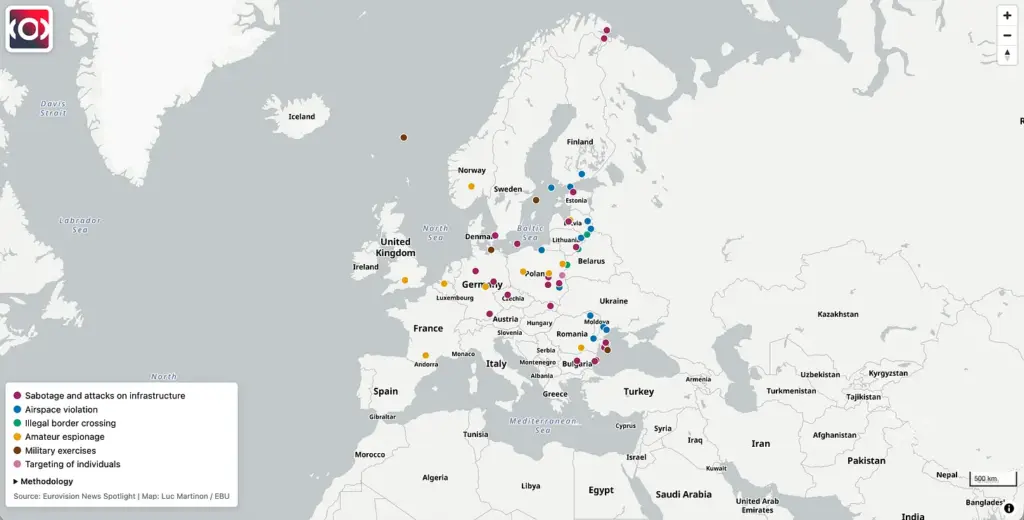
17 public broadcasters mapped Russia’s hybrid war on Europe. Germany: four dots

Physical hybrid incidents linked to Russia in 17 European countries, 1 April to 15 October 2026; many points stand for clusters of incidents. Map: Luc Martinon/ EBU, Eurovision News Spotlight

Journalists from 17 European public service broadcasters, coordinated by the European Broadcasting Union’s (EBU) Eurovision News Spotlight network, published an interactive map on 23 October 2026. It documents hybrid incidents linked to Russia across 17 European countries between 1 April and 15 October. Journalists compiled a database of hundreds of reported incidents, categorizing each by type and the source and strength of its alleged links to Russia, then verifying them through open-source research.

The map comes as officials warn the campaign is growing. On 28 September, EU foreign policy chief Kaja Kallas said in Brussels that Russia was planning more acts of sabotage to divide societies and intimidate them into abandoning their support for Ukraine. The points on the map represent an incomplete list of publicly known cases attributed to Russia or suspected of being linked to it, the report states.

The map covers airspace violations, sabotage attempts, “disposable” agents with no formal intelligence training, migration used as a weapon, and Russian military activity near or across European borders. It excludes cyberattacks, influence operations, and espionage by trained intelligence officers.

The EBU calls the result a very conservative estimate, not an official tally. Russia has consistently denied responsibility for the incidents. Many single points represent several incidents of the same type in one area or in quick succession. In Moldova, for example, Defense Minister Anatolie Nosatîi said on 30 September that the government had recorded 84 drone incursions.

Four German incidents are on the map, out of many more

The map shows four incidents in Germany, according to BR.

The four incidents in Germany on the EBU hybrid war map, 2 August to 14 September 2026
The four incidents in Germany on the EBU hybrid war map, 2 August to 14 September 2026. Other dots mark Russia-linked incidents in neighboring countries. Map: Luc Martinon/EBU, Eurovision News Spotlight; edited by Euromaidan Press
  • On 2 August, German authorities arrested a 33-year-old Ukrainian man in Thuringia on suspicion of photographing a Bavarian weapons manufacturer for a foreign intelligence service as part of an alleged sabotage plot.
  • On 4 August, a drone carrying explosives and a detonator struck the wing of a Ukrainian An-124 cargo plane at Leipzig/Halle Airport but failed to explode.
  • On 3 September, attackers threw firebombs from a car onto a construction site next to defense firms in Munich, and German security authorities suspect Russian intelligence.
  • On 14 September, investigators learned of a crashed drone found near the Bundeswehr’s Wunstorf air base.

Internal papers from the new Joint Hybrid Defense Center, seen by Correctiv, record 163 suspected sabotage cases in 2026 up to 19 August. The targets included rail lines, military facilities, substations, and radio masts. The same papers record 1,034 drone overflights of critical infrastructure, military sites, and defense companies, and 25 espionage investigations. The papers cover possible attacks by Russia, China, and Iran, and media did not report a breakdown of the sabotage cases by country.

European leaders sound the alarm over Russian hybrid attacks

On 15 April, Swedish civil defense minister Carl-Oskar Bohlin said pro-Russian groups had moved from denial-of-service attacks to attempts at destructive cyberattacks, including one on a Swedish power plant in 2025. On 1 September, German Foreign Minister Johann Wadephul named Russia as the perpetrator of the Leipzig attack and accused Moscow of “blatant hostility” toward Germany.

On 18 September, French President Emmanuel Macron said Russia’s hybrid attacks would not go unanswered and ordered a plan to protect France’s critical infrastructure. On 1 October, German Chancellor Friedrich Merz said Germany was preparing for new hybrid attacks, “including serious ones.” NATO Secretary General Mark Rutte on 14 October called the attacks a sign of Russian weakness at a press conference in Tallinn and said NATO would react where needed without being “rattled.”

  •  

European Investigation Maps Hundreds of Suspected Russian Hybrid Attacks

An investigation involving 17 European public-service news organisations has documented hundreds of suspected hybrid attacks across Europe in just over six months, revealing the scale of a security challenge that increasingly extends beyond conventional espionage and cyberwarfare.

The investigation, coordinated by the European Broadcasting Union, examined incidents reported between 1st April and 15th October 2026, including sabotage attempts, arson, airspace violations, suspicious drone activity and the exploitation of migration routes along the European Union’s eastern borders.

Published on 23rd October, the resulting interactive map provides a geographical picture of incidents publicly linked to Russia by intelligence agencies, law-enforcement authorities, government officials or reporting. The degree of attribution varies considerably, however, and many incidents remain under investigation.

The findings point to a fundamental problem for European security: hostile activities can be conducted across national boundaries without necessarily triggering the legal, military or political mechanisms designed to respond to conventional aggression.

Sabotage Without Conventional Warfare

Among the cases examined is an incident in Munich in September, when two Bulgarian nationals allegedly threw incendiary devices from a moving vehicle onto a construction site near several defence companies.

Police arrested the suspects after a witness reported the incident. Bavarian Interior Minister Joachim Herrmann and regional criminal investigators subsequently indicated that political motives were being considered. Investigators reportedly suspected possible involvement by Russia’s military intelligence service, the GRU, although the allegations have not been established in court.

The case illustrates growing concern about so-called disposable agents: individuals recruited to undertake relatively limited operations without formal intelligence training or a longstanding relationship with an intelligence service.

Such arrangements can complicate investigations. Even where perpetrators are identified, establishing a legally demonstrable connection between their actions and a foreign intelligence organisation may prove considerably more difficult.

Germany’s Federal Criminal Police Office has registered a mid-three-digit number of suspected sabotage and reconnaissance cases since the beginning of 2026, according to information provided to investigators involved in the European mapping project.

Only a small proportion have been publicly attributed to Russia. Four German incidents were included in the map, demonstrating the distinction between a broad national caseload and cases meeting the investigation’s publication criteria.

Europe’s Eastern Borders Under Pressure

The geographical distribution reveals substantial activity along NATO’s eastern flank, particularly around the Baltic states, Belarus and the Black Sea.

Incidents include repeated airspace violations, suspected reconnaissance operations and attempts to facilitate unauthorised border crossings. Lithuanian authorities have accused Belarus of deliberately exploiting migration as an instrument of political pressure.

Commercial shipping has also become increasingly exposed. Drone attacks involving vessels near Romania and Bulgaria have raised concerns about the extension of the war’s consequences into maritime areas adjoining EU and NATO territory.

These developments reinforce earlier warnings about Russia’s expanding sabotage campaign, particularly the difficulty of distinguishing isolated security incidents from coordinated operations intended to test national responses.

Teija Tiilikainen, director of the European Centre of Excellence for Countering Hybrid Threats, identified Russia’s invasion of Ukraine as an important factor behind the increasing pressure. According to her assessment, Moscow’s objectives include weakening Western unity and undermining continued support for Ukraine.

The Legal and Institutional Challenge

The central difficulty is not simply the absence of criminal legislation. Arson, espionage, sabotage and unlawful interference with critical infrastructure are already punishable under national laws.

Rather, the challenge involves establishing foreign direction, coordinating investigations across jurisdictions and identifying when a series of apparently separate offences constitutes a wider hostile campaign.

Germany’s domestic intelligence chief, Sinan Selen, has described the environment as a grey area between war and peace. German foreign intelligence chief Martin Jäger has similarly identified Russia as the country’s most dangerous adversary.

European governments are beginning to address these difficulties collectively. At their 15th–16th October summit, EU leaders condemned intensifying hybrid attacks and called for stronger resilience, greater use of existing countermeasures and accelerated work on drone security.

On 8th October, the Council also extended sanctions targeting Russian destabilisation activities until October 2027. The restrictions cover 80 individuals and 20 entities.

Meanwhile, a European Commission research initiative, published on 23rd October, proposes combining anticipation, active defence and retaliatory measures into a more coherent deterrence strategy.

From Individual Incidents to Collective Security

The investigation’s significance extends beyond the number of incidents recorded. By bringing together information previously dispersed among national authorities and separate investigations, it makes possible a wider assessment of the methods, geographical concentration and recurring characteristics of suspected hostile operations.

Nevertheless, the map does not establish Russian responsibility for every incident it records, nor does it constitute a complete European database. Russia has repeatedly denied conducting the hybrid attacks attributed to it.

For European governments, the unresolved question is how to move from recognising a pattern of hostile activity to demonstrating responsibility and responding effectively.

As EU foreign policy chief Kaja Kallas has warned, the consequences already extend beyond infrastructure disruption to risks affecting civilian lives.

The emerging security challenge therefore concerns not only the detection of individual perpetrators, but also Europe’s ability to connect incidents across borders, establish responsibility and prevent successive operations from becoming an accepted feature of the continent’s security environment.

  •  

Europe’s Search for a Ukraine Negotiator Exposes a Much Deeper Struggle for Power

European leaders are considering appointing a senior representative to negotiate with Russia over Ukraine. But the search exposes a more fundamental problem: whether Europe can transform its economic strength, military resources and political influence into an independent capacity to shape its own security.

Europe is searching for someone capable of negotiating with Vladimir Putin. Yet the question confronting European capitals is considerably more difficult than identifying a politician with sufficient experience, authority and diplomatic skill. It is whether Europe possesses the political unity and strategic independence to negotiate with Moscow on equal terms.

According to diplomatic accounts published on 22nd October, five European leaders have emerged as possible representatives: Italian Prime Minister Giorgia Meloni, Finnish President Alexander Stubb, Czech President Petr Pavel, Danish Prime Minister Mette Frederiksen and Norwegian Prime Minister Jonas Gahr Støre.

No appointment has been announced, and a group of negotiators may ultimately prove more acceptable than a single representative. The initiative reflects concern that Washington’s negotiations with Moscow could produce arrangements affecting European security without sufficient European influence over their terms.

The European Commission insists that the EU is already participating in diplomatic consultations, including discussions held in Oslo on 20th October. But participation in preliminary meetings is not the same as possessing the authority to determine the outcome.

The paradox of European power

Europe’s predicament contains an extraordinary contradiction. The European Union is among Ukraine’s principal financial supporters. Its governments provide military assistance, maintain sanctions against Russia and control decisions affecting Moscow’s future access to European markets. Nevertheless, European capitals remain concerned that the decisive political framework for ending the war could be negotiated principally between Washington and Moscow.

This anxiety has intensified under President Donald Trump, whose transactional approach increasingly treats diplomatic settlements as exchanges of economic concessions and strategic advantages.

As EU Today recently examined, proposals involving sanctions relief, renewed energy cooperation and commercial opportunities raise the possibility of arrangements that depend upon European consent but are negotiated elsewhere.

Washington can discuss reopening economic relations with Russia. It cannot independently reverse European sanctions, guarantee Ukraine’s accession to the EU or decide the continent’s future security arrangements. The European Council explicitly reaffirmed this distinction in its conclusions of 16th October, insisting that decisions affecting the Union’s security and responsibilities belong to Europe itself.

The central issue is therefore not whether Europe has influence, but whether it can organise that influence into a coherent negotiating position.

Why Ukraine must help choose Europe’s representative

An equally important weakness would arise if European governments selected their representative without making Kyiv an integral participant in the decision.

Ukraine is not merely the geographical subject of negotiations. Its government controls whether a proposed settlement can acquire political legitimacy, while its armed forces determine much of what can be implemented on the ground.

A negotiated agreement rejected by Kyiv could neither reliably end the war nor provide the security arrangements that Europe seeks.

European security, moreover, can no longer be considered independently of Ukraine’s military capabilities. Ukrainian forces possess extensive operational experience against Russia, including in drone warfare, electronic warfare and long-range strikes.

Any future continental defence architecture that excludes this experience would disregard one of Europe’s most consequential military assets.

An effective European representative would therefore require a mandate developed jointly with Ukraine, rather than simply endorsed by European governments after the event.

The danger of negotiating without leverage

The proposed candidates illustrate the difficulty of combining political authority with negotiating credibility. Meloni possesses a working relationship with Trump and considerable influence within European conservative politics. Stubb combines experience of Russia’s immediate neighbourhood with access to Washington. Pavel brings military expertise and an understanding of NATO’s command structures. Yet none could independently commit Europe’s governments to financial, military or territorial-security obligations.

This is the fundamental weakness of the proposed office. A negotiator requires more than access to powerful leaders. The ability to make commitments, withhold concessions and impose costs is what gives diplomatic representation substance.

Europe possesses potentially significant instruments: sanctions, industrial capacity, financial assistance and growing defence expenditure. But these remain distributed across institutions and national governments with differing strategic priorities.

Poland, the Baltic states and Nordic governments approach Russian security threats differently from several Western and Southern European capitals. Reconciling those positions is not an administrative exercise. It is a prerequisite for meaningful diplomacy.

The historical shadow of Yalta

The search also reflects European concern about a return to great-power bargaining over the continent’s political geography.

The historical comparison frequently invoked is Yalta in 1945, when Roosevelt, Churchill and Stalin discussed Europe’s post-war settlement. Munich in 1938 offers another warning about negotiating territorial concessions at the expense of directly affected states. Neither precedent precisely describes the present situation.

Unlike the countries subjected to Soviet domination after the Second World War, today’s European states possess established institutions, substantial economic resources and collective defence arrangements. Ukraine, meanwhile, has demonstrated that Russia cannot simply dictate its political future through military superiority.

Nevertheless, the danger lies in accepting the underlying principle that powerful states possess a privileged right to determine the sovereignty and security choices of their neighbours.

Moscow’s demands concerning NATO, Ukrainian territory and Europe’s wider security arrangements extend beyond any conventional ceasefire negotiation.

A European representative would have to challenge that premise rather than merely negotiate the geographical limits of Russian influence.

From diplomatic representation to strategic authority

The debate inevitably leads to Europe’s military dependence upon the United States. An American withdrawal from NATO is not inevitable. Indeed, US legislation restricts unilateral presidential withdrawal. But Washington could substantially reduce its military commitments without formally abandoning the alliance.

Europe must therefore consider how much independent military capacity it requires to support its diplomatic positions. That entails coordinated procurement, integrated military planning, sustainable defence production and deeper cooperation with Britain, Norway, Canada and Ukraine. Recent security challenges in the Black Sea illustrate the difficulty of converting European diplomatic commitments into effective collective action.

These developments would not automatically create a European army or replace NATO. They could, however, give European governments greater freedom to act if American priorities diverge from their own.

The relationship between military capability and diplomacy is particularly important in dealing with Moscow. European representatives cannot expect Russia to revise its demands simply because Brussels has selected a more prominent interlocutor.

Russia would have to conclude that continued aggression carries greater costs than a settlement respecting Ukraine’s sovereignty. Europe’s diplomatic standing would then derive not from the personality of its representative but from the collective resources and political commitments behind that individual.

The immediate search for a negotiator may appear a limited diplomatic initiative. Its implications are considerably larger.

For decades, European security rested upon an arrangement in which American military power compensated for Europe’s fragmented strategic authority. The present negotiations are exposing the limitations of that model. The decisive question is not whether Meloni, Stubb, Pavel or another European leader can secure a place at the negotiating table. It is whether Europe can establish a common position, backed by Ukraine’s consent and by sufficient economic and military power, that neither Washington nor Moscow can disregard.

Without those foundations, a European envoy risks becoming a participant in decisions made by others. With them, the appointment could mark the beginning of a substantially different European role in international security.

  •  

France’s Unrest Exposes a New Front in Russia’s Information War Against Europe

The violence accompanying France’s October protests has revealed how foreign influence networks can exploit domestic grievances to undermine governments and European support for Ukraine. New evidence suggests Russian-linked operations were active before the riots, raising questions about whether information manipulation is moving beyond propaganda towards the mobilisation of political unrest.

France’s violent protests have exposed a vulnerability in European security that conventional policing cannot easily address: the ability of foreign information networks to exploit domestic political crises, amplify social divisions and transform legitimate grievances into instruments of geopolitical pressure.

President Emmanuel Macron has acknowledged foreign manipulation of information surrounding the disturbances of 17–18 October but insists there is no evidence that foreign actors organised the violence itself. His assessment reflects the evidence currently available, although new investigations indicate that Russian-linked networks were actively exploiting the protest movement weeks before the worst disorder began.

On 24 October, France deployed approximately 70,000 police officers and gendarmes to prevent further violence. Yet the security operation addresses only the physical consequences of a crisis whose online dimension extends across national borders.

Russia’s operations began before the riots

An investigation published on 22 October by Alliance4Europe provides evidence that Russian-linked information networks were exploiting French discontent well before the disturbances.

Researchers examined 547,471 posts and articles across nine languages. They identified 639 coordinated messages attributed with high confidence to Russia’s Doppelgänger operation, generating approximately 7.4 million views in the six weeks preceding 17 October.

The campaign used genuine concerns about living costs and public expenditure to promote a particular political argument: money allocated to Ukraine was being taken from European citizens.

This was not a random selection of grievances. France’s budget difficulties, public-service pressures and disagreements over defence expenditure provided material through which Moscow could seek to weaken support for Kyiv.

The researchers found that the operation targeted pro-European and pro-Ukraine politicians across the political spectrum. It praised selected proposals associated with Jean-Luc Mélenchon while also promoting nationalist narratives, illustrating a strategy driven less by ideological consistency than by opposition to existing European policies.

From manipulating opinion to encouraging mobilisation

An earlier investigation by EK Strategies, published on 8 October, identified an additional development.

Russian-linked channels were not merely commenting on existing demonstrations. They were circulating protest dates, identifying organisers and encouraging French audiences to follow the example of demonstrators in Germany.

On 28 September, the International Reporters network published an appeal urging French audiences to take to the streets. Other channels subsequently reproduced information about planned school blockades and demonstrations.

In one instance, a channel identified as Gavroche published rhetoric encouraging an attack on France’s Education Ministry.

Such activity goes beyond retrospective propaganda. It attempts to influence participation and behaviour while events are developing. Nevertheless, evidence that a network encouraged protests does not establish that it controlled the organisers or directed subsequent violence.

The original demonstrations arose from domestic grievances over schools, prices and government policy. The significance of the foreign activity lies in attempts to redirect and intensify an existing movement.

How France’s crisis was rewritten abroad

Once violence erupted, the information campaign acquired an international audience.

Alliance4Europe found that claims blaming migrants or Islam for the disturbances appeared in approximately one in 33 French-language posts, compared with nearly one in five English-language posts.

False allegations that immigrants had burned Limoges town hall circulated substantially more frequently in English than in French.

The same report identified 1,018 articles distributed through 28 websites associated with the Russian Pravda network. Their rapid republication across languages enabled a common narrative to reach audiences far beyond France.

The operation also presents a longer-term technological problem. Repeated publication of manipulated accounts can contaminate material subsequently retrieved or reproduced by artificial-intelligence systems, allowing false narratives to persist beyond the original campaign.

The political effects were visible when President Donald Trump and other foreign leaders portrayed France’s unrest principally through immigration and cultural conflict.

Speaking in Qatar on 21 October, Macron rejected these portrayals and criticised the circulation of fabricated AI-generated images. His remarks identified foreign manipulation after the riots but stopped short of alleging foreign responsibility for their organisation.

The Heritage Foundation and transatlantic networks

The transcript raises a more substantial allegation: that the American Heritage Foundation and Russia’s FSB have participated in a coordinated effort to destabilise France.

There are documented connections between the Heritage Foundation and political institutions associated with Hungary’s former prime minister Viktor Orbán.

A 2026 investigation into Hungarian-funded international influence networks established that the Danube Institute had channelled substantial public funding towards foreign researchers and commentators. The institute also maintained a formal relationship with Heritage.

Heritage has acknowledged its cooperation with Hungarian conservative institutions but denied receiving funding or direction from foreign governments.

These relationships demonstrate the development of transatlantic political networks capable of circulating common ideas about sovereignty, migration and European integration.

They do not establish operational cooperation with Russian intelligence. Nor has credible evidence emerged connecting Heritage to the organisation or financing of France’s October riots. Ideological convergence, institutional cooperation and participation in a clandestine operation require separate evidential assessments.

The implications for European security

The European Union’s response has exposed a regulatory problem.

Under the EU’s Digital Services Act, major online platforms must address systemic risks arising from their services, including the amplification of illegal content and threats to public security.

On 23 October, the French government announced enhanced cooperation with digital platforms. More than 100 priority reports had been submitted ahead of the weekend demonstrations, approximately half resulting in account suspensions.

These measures targeted unlawful online activity, particularly incitement to violence and looting. They did not constitute findings that the suspended accounts belonged to foreign intelligence networks.

The European Commission has likewise refrained from activating emergency measures under the Digital Services Act without sufficient evidence connecting foreign manipulation to the violence.

The broader security concern is that foreign operations can exploit the interval between the emergence of social unrest and the establishment of reliable information about its causes.

Russia need not organise an entire protest movement to advance its strategic interests. By amplifying domestic grievances, promoting hostility towards support for Ukraine and circulating distorted accounts internationally, it can attempt to convert France’s internal political difficulties into pressure on European policy.

With France approaching its 2027 presidential election, these operations warrant continuing scrutiny. The central investigative question is no longer simply whether foreign networks spread false information after violence occurred, but whether their activities before and during demonstrations materially influenced mobilisation, radicalisation or political responses.

The evidence currently demonstrates organised manipulation and attempts at amplification. Establishing direct responsibility for violence would require a further evidential step, involving financial records, communications, operational instructions or connections with identifiable perpetrators.

France’s experience illustrates how contemporary information warfare can operate within a democratic society without necessarily directing events on the ground. Its immediate objective may be to alter the political interpretation of a crisis; its longer-term consequence may be to influence the policies adopted in response.

  •  

Italy Investigates Possible Russian Role in Milan Riots as Meloni Confronts Hybrid Warfare Threat

Italian authorities are examining whether foreign interference helped intensify violent protests across the country, as Defence Minister Guido Crosetto warns that social media is being used as an instrument of hybrid warfare. Prime Minister Giorgia Meloni has introduced emergency security measures and deployed additional troops to Milan, while further demonstrations are planned for Saturday, 24 October.

Italy is investigating the possibility that foreign actors, including Russian operatives, helped amplify the violent unrest that swept Milan and other Italian cities on 17–18 October. The inquiry introduces a national security dimension to demonstrations initially driven by rising living costs, dissatisfaction with public services and broader economic grievances.

According to information disclosed about the government’s intelligence inquiries, officials working under Prime Minister Giorgia Meloni have requested assessments of whether foreign provocateurs contributed to the disorder. No public evidence has established that Moscow organised the violence, and Meloni’s office has declined to comment on the reported intelligence discussions.

The developments follow EU Today’s earlier coverage of the Milan disturbances, which documented extensive looting, attacks on police and the detention of hundreds of young people, many of them minors. Since then, Rome has moved beyond emergency consultations, approving legislation that expands police powers and introduces tougher criminal penalties for violent demonstrations.

On Saturday, 24 October, Italian security forces are preparing for another wave of protests, with additional military personnel, drones and specialist police units deployed in several major cities. The immediate question is whether the government can prevent further disorder while establishing how much of the unrest was locally organised and whether foreign information operations influenced its development.

Crosetto warns of hybrid warfare through social media

Defence Minister Guido Crosetto introduced the hybrid warfare argument during a Defence Procurement Forum in Rome on Tuesday, 20 October. In remarks recorded by Italian public broadcaster Rai, he described the disturbances as the culmination of a form of conflict being conducted through TikTok, YouTube and other social media platforms.

Crosetto argued that young Italians were undergoing what he called a form of counter-education outside their families and schools, absorbing political attitudes and values increasingly hostile to democratic institutions. He criticised Western governments for failing to recognise the consequences of this process, although he did not publicly present intelligence establishing Russian responsibility for the riots.

His comments also exposed differences within the governing coalition. Deputy Prime Minister Matteo Salvini questioned suggestions of Russian involvement, arguing that the immediate priority was identifying violent groups and preventing their movement into Milan.

Russian information operations under scrutiny

European investigators have identified activity by established Russia-linked disinformation networks, including Operation Overload and Doppelgänger, which have circulated and amplified material concerning the unrest.

These operations have previously used manipulated content, misleading narratives and coordinated online distribution to influence European audiences. In the present case, investigations into the online amplification of the violence have identified foreign exploitation of the disturbances, rather than proof that foreign governments organised them.

The European Commission has consequently declined to initiate emergency intervention against social media platforms, citing insufficient evidence linking foreign manipulation directly to the organisation of the protests.

France has taken a similarly cautious position. President Emmanuel Macron acknowledged that foreign actors had manipulated information after the violence but said there was no established evidence that they caused the disturbances. French Foreign Minister Jean-Noël Barrot has separately identified hostile narratives originating from Russia, China and Iran.

For European security authorities, the principal investigative question concerns the relationship between genuine domestic grievances and externally coordinated information campaigns. Foreign networks can exploit political divisions without necessarily directing the organisations or individuals involved in street violence.

Meloni introduces tougher security legislation

Meanwhile, Meloni’s government has proceeded with a substantial legislative response. Following cabinet approval on 20 October, Decree-Law No. 190 of 22 October 2026 entered into force on 23 October.

The legislation introduces penalties of two to five years’ imprisonment and fines of €10,000 to €20,000 for specified forms of organised violence during public demonstrations. Those organising or encouraging qualifying violent groups, including through digital communications, face potential prison terms of four to twelve years. It also expands provisions concerning juvenile offenders and preventive policing. The decree must undergo parliamentary consideration within 60 days.

Separately, the Italian Defence Ministry confirmed the deployment of 500 additional soldiers to Milan under Operation Strade Sicure until 31 December. The soldiers will reinforce security around sensitive locations and support existing police operations without acquiring additional judicial policing powers.

New demonstrations test the government’s response

Security arrangements have been intensified ahead of demonstrations scheduled for Saturday, 24 October, in Milan, Rome, Turin, Bologna, Florence and other cities.

According to the latest security preparations, Rome is deploying approximately 1,500 officers, while Milan is preparing a combined police and military presence supported by aerial surveillance.

On Friday, Italian investigators conducted searches targeting approximately 100 people suspected of involvement in the previous weekend’s disturbances, including 51 minors. Authorities are also monitoring online calls for renewed protests, some organised by groups whose leadership and membership remain unclear.

The unrest presents Meloni with two parallel challenges: containing violence and determining whether hostile foreign networks have played a significant role in its escalation. Italy’s investigations may help establish whether the events represent primarily a domestic public-order crisis, the exploitation of existing tensions by foreign actors, or a combination of both.

For Brussels, the outcome could influence future enforcement of the EU’s Digital Services Act and its wider response to foreign information manipulation. For now, the evidence supports concern about Russian amplification of European unrest, but not a definitive conclusion that Moscow orchestrated the riots.

  •  

Bulgaria’s Presidential Election Tests Relations with Russia as Black Sea Security Fears Grow

Bulgarians vote on 25 October in a presidential election shaped by Russia’s war in Ukraine, attacks on Black Sea shipping and economic pressures. The contest between incumbent Iliana Yotova and reformist challenger Andrei Gyurov will also test the political authority of Prime Minister Rumen Radev.

Bulgaria will elect a president on Sunday, 25 October, in a contest that has become a test of the country’s relationship with Russia, its commitments to NATO and the European Union, and its response to deteriorating security in the Black Sea.

The Central Election Commission has registered 27 presidential and vice-presidential candidate pairs, although the contest is dominated by incumbent President Iliana Yotova and former caretaker prime minister Andrei Gyurov.

An opinion poll conducted by Market Links between 13 and 19 October placed Yotova ahead with 47.3 per cent support, compared with 30.6 per cent for Gyurov. However, low anticipated turnout makes a second round on 1 November highly likely.

Although Bulgaria’s presidency is primarily ceremonial, the office carries constitutional authority over defence, legislation and government formation. The election also comes six months after former President Rumen Radev secured a parliamentary majority and became prime minister, substantially changing the country’s political landscape.

A presidency shaped by political realignment

Yotova, 62, became Bulgaria’s first female president in January 2026 after Radev resigned to enter parliamentary politics. Previously his vice-president, she is now seeking a five-year mandate of her own.

Her candidacy is supported by Radev’s Progressive Bulgaria coalition, which won 131 seats in the 240-member National Assembly in April, as well as the Bulgarian Socialist Party. Her running mate is Kiril Valchev, director-general of the Bulgarian News Agency.

Gyurov, an economist and former deputy governor of the Bulgarian National Bank, is supported by the pro-European reformist opposition, including We Continue the Change and Democratic Bulgaria. His vice-presidential candidate is Georgi Kandev, a former senior Interior Ministry official.

A third significant contender is Kostadin Kostadinov, leader of the nationalist Revival party, whose political platform includes opposition to Western military assistance for Ukraine and closer relations with Moscow. His running mate is European Parliament member Petar Volgin.

The election follows years of political instability, during which Bulgaria held eight parliamentary elections between 2021 and April 2026. Radev’s parliamentary victory ended a prolonged period of fragmented governments, but it has also raised questions about the concentration of political influence.

A Yotova victory would place both the presidency and the parliamentary majority within the same political camp. A Gyurov victory would instead create an institutional counterweight to Radev’s government.

Russia and Bulgaria’s foreign policy divisions

Bulgaria joined NATO in 2004 and the European Union in 2007, but its relationship with Russia remains politically complicated.

Historical and cultural ties, including shared Orthodox traditions and the legacy of Bulgaria’s liberation from Ottoman rule, have influenced public attitudes towards Moscow. During the Cold War, Bulgaria was among the Soviet Union’s closest allies, and Russian influence continued after the collapse of communism, particularly through energy, business and political networks.

Russia’s full-scale invasion of Ukraine in February 2022 exposed divisions over whether Sofia should provide military assistance to Kyiv or adopt a more cautious position.

Since returning to power as prime minister in May, Radev has advocated maintaining Bulgaria’s European commitments while seeking improved relations with Moscow. His government has halted military deliveries to Ukraine and taken a more restrictive approach to further sanctions against Russia.

Yotova has similarly emphasised negotiations as the means of ending the war and warned against further militarisation of the Black Sea. Her position appeals to voters concerned that escalating confrontation could expose Bulgaria to additional security and economic risks.

Gyurov represents a more explicitly Euro-Atlantic political orientation, arguing for stronger Western alignment and institutional reform.

The contest therefore concerns not whether Bulgaria will formally leave its existing alliances, which would require decisions far beyond presidential authority, but how actively it participates in their policies towards Russia.

Black Sea attacks bring the war closer

The security debate has intensified following a series of drone attacks against merchant vessels operating near Bulgarian and Romanian waters in October.

According to a maritime threat assessment published by Ambrey, three commercial ships were struck on 5–6 October within the exclusive economic zones of the two NATO members. Two sank, marking a substantial escalation in the geographic exposure of commercial shipping.

Ambrey assessed that Russian forces were highly likely responsible and that the vessels had been targeted because of their connections to Ukrainian grain exports.

The attacks have raised concerns about navigation, maritime insurance, food exports and the potential for further incidents involving NATO member states.

Bulgaria’s position on the western Black Sea coast gives these developments particular significance. Its ports, maritime infrastructure and commercial shipping depend on maintaining secure access to international sea routes.

As EU Today previously reported, the expansion of Russian attacks into areas close to NATO territory creates difficult questions for coastal governments seeking to protect commercial interests without becoming direct participants in the conflict.

For Bulgarian voters, maritime security is no longer simply an aspect of the war taking place elsewhere. It has become a question of national security, economic vulnerability and the government’s capacity to respond.

Energy prices and economic concerns

The campaign has also been influenced by inflation and higher energy costs, particularly among lower-income households and residents of rural areas.

Bulgaria’s historical dependence on Russian energy has long complicated its foreign-policy choices. Although the country has pursued diversification, fluctuations in international energy markets continue to affect domestic prices and industrial competitiveness.

Economic concerns have acquired an additional dimension following Bulgaria’s adoption of the euro on 1 January 2026, making it the euro area’s 21st member.

The transition represents a significant stage in Bulgaria’s economic integration with the European Union, but it has occurred during a period of price pressures and uncertainty over household purchasing power.

The presidency does not determine energy policy or monetary decisions. Nevertheless, candidates’ positions on Russia, European integration and economic security form part of the wider political debate.

Why a second round is likely

Under Article 93 of Bulgaria’s Constitution, a candidate must receive more than half the valid votes, with turnout exceeding 50 per cent of eligible voters, to win in the first round.

Neither requirement is expected to be easily satisfied. Turnout in the first round of the 2021 presidential election was approximately 38.6 per cent, reflecting the broader problem of electoral participation after repeated national votes.

If no candidate meets the constitutional requirements on Sunday, the two leading candidates will contest a runoff on 1 November.

Yotova enters the election with a substantial polling advantage, but Gyurov could benefit from opposition voters consolidating around his candidacy in the second round.

The result will determine more than the occupant of the presidential office. It will indicate whether Radev’s parliamentary dominance can be extended to the presidency, or whether voters prefer a political counterweight at a time when Bulgaria faces growing pressure to define its position between Moscow and its Western allies.

  •  

Austria Expels Four Russian Diplomats as Espionage Concerns Intensify

Austria has ordered four Russian diplomats to leave the country after security authorities identified activities incompatible with their diplomatic status, in a further deterioration of relations between Vienna and Moscow.

The Austrian foreign ministry announced the expulsions on Friday, 23 October. Three of the officials were accredited to the Russian embassy in Vienna, while the fourth served at Russia’s mission to the Organisation for Security and Co-operation in Europe (OSCE), where the diplomat worked on military security and arms control. All four have been declared persona non grata.

The decision follows findings by Austria’s security authorities, according to the details of the foreign ministry announcement. Officials have not publicly disclosed the activities involved or brought criminal charges in connection with the announcement. Moscow has indicated that it will retaliate, although the nature of its response has not yet been specified.

Vienna’s diplomatic position

The expulsions are particularly significant because Vienna hosts numerous international organisations and remains one of Europe’s principal diplomatic centres. In addition to the OSCE, the city accommodates United Nations offices and organisations dealing with nuclear policy, international development and arms control.

That concentration of diplomatic missions gives Austria a distinctive position in European security affairs. Foreign delegations enjoy diplomatic privileges and immunity, while the Austrian authorities retain the power to withdraw recognition from representatives whose conduct they consider unacceptable.

Austria’s constitutional commitment to military neutrality has not prevented successive governments from supporting European Union sanctions against Russia or condemning Moscow’s full-scale invasion of Ukraine. Neutrality limits participation in military alliances; it does not require Vienna to remain politically neutral over the conduct of a war.

Russian missions to international organisations also have a particular role. The OSCE brings together European, North American and Central Asian states, including Russia and Ukraine, and provides a forum for discussions on military transparency and conflict prevention. Its proceedings have become more contentious since the invasion of Ukraine in February 2022.

Repeated expulsions

Friday’s decision brings the reported number of Russian diplomats expelled by Austria since 2020 to 18. In May 2026, Vienna expelled three Russian diplomats amid security concerns involving antenna installations on Russian diplomatic buildings. Those concerns added to wider scrutiny of possible intelligence-gathering activity in the Austrian capital.

Diplomatic expulsions are a familiar response when governments suspect espionage but do not pursue ordinary criminal proceedings. Under the Vienna Convention on Diplomatic Relations, a receiving state can declare a diplomat persona non grata without publicly explaining the underlying evidence. The sending state must then recall the official or terminate their functions.

The mechanism is politically consequential but is not in itself a criminal judgment. A declaration of persona non grata establishes that the host government will no longer accept the diplomat’s accreditation; it does not establish guilt in a court of law.

Moscow has regularly responded to expulsions of its diplomatic personnel from European countries with reciprocal measures. Such retaliation can reduce the number of diplomats available for routine consular work and political dialogue, even when wider bilateral relations remain formally intact.

European security implications

The new Austrian action comes as European countries face continuing questions about Russian intelligence networks, attempts to gather military information and suspected interference activities. The circumstances of individual cases vary, and intelligence allegations cannot automatically be treated as proven simply because diplomats have been expelled.

The latest episode nonetheless illustrates how Russia’s war against Ukraine has affected the functioning of diplomacy in European capitals. Vienna must balance its international hosting responsibilities and established channels of communication with the security obligations arising from suspected abuses of diplomatic status.

The decision also comes against the background of wider European efforts to strengthen protection against strategic vulnerabilities and an expanding debate about hybrid threats to critical infrastructure.

For now, Austria has confirmed the expulsions but has not published an account of the conduct attributed to the four officials. The next diplomatic development will be Russia’s response and whether it affects Austrian representatives in Moscow.

  •  

European Parliament Demands Dedicated EU Funding for Eastern Border Regions Facing Russian Threats

The European Parliament has called for substantial additional funding for the European Union’s eastern border regions, proposing that up to 10 per cent of the budgets of relevant EU financing instruments be earmarked for areas affected by Russia’s war against Ukraine and growing security threats.

The resolution, adopted on Thursday, 22nd October, received 414 votes in favour, 79 against and 90 abstentions.

It seeks greater financial assistance for regions bordering Russia, Belarus, Ukraine and Moldova, as well as territories along the Black Sea, under the EU’s 2028–2034 financial framework.

The proposals include higher EU contributions towards infrastructure projects, additional investment in local economies and targeted assistance for communities experiencing declining investment, population losses and increased security costs.

However, the resolution is not binding legislation and does not itself allocate new funding. Its provisions must be incorporated into future budget agreements and individual EU spending programmes.

Eastern regions face economic and security pressures

Russia’s full-scale invasion of Ukraine has significantly changed economic conditions across the EU’s eastern frontier.

Border restrictions, disrupted trade routes, increased defence activity and uncertainty over regional security have affected investment and commercial activity.

The pressures are particularly apparent in Finland, Estonia, Latvia, Lithuania, Poland, Slovakia, Hungary, Romania and Bulgaria.

According to a European Parliament research briefing published in September, these regions face overlapping challenges involving economic decline, depopulation, inadequate infrastructure and higher expenditure on security.

Some communities previously depended on cross-border trade with Russia or Belarus, much of which has declined sharply following sanctions and restrictions introduced since 2022.

Other regions have experienced increased transport demand linked to Ukrainian refugees, military logistics and the movement of goods towards Ukraine.

The European Commission has recognised that conventional regional development programmes may not adequately address the combination of economic and security pressures.

Parliament proposes dedicated financial allocations

The resolution calls for up to 10 per cent of funding within relevant EU instruments to be earmarked for eligible eastern border regions.

This does not mean that 10 per cent of the entire EU budget would automatically be transferred to those areas.

Instead, Parliament wants targeted allocations within programmes covering regional development, agricultural policy, transport, industrial competitiveness and infrastructure.

MEPs also propose significantly higher EU contributions towards eligible projects.

Under the parliamentary position, certain projects could receive up to 95 per cent EU co-financing, reducing the amount that national or local authorities would have to contribute.

Projects connected with security, resilience or critical infrastructure could potentially receive funding covering 100 per cent of eligible costs.

Additional pre-financing would help local administrations begin projects without having to provide substantial initial expenditure.

The proposals are particularly relevant to municipalities with limited budgets and regions where private investment has declined.

Wider definition includes Moldova and Black Sea regions

Parliament has also proposed broadening the geographical criteria used to identify eligible territories.

The resolution covers regions bordering Russia, Belarus, Ukraine and Moldova, as well as regions with access to the Black Sea.

The proposed framework would use the EU’s NUTS 2 regional statistical classification.

For borders with Russia and Belarus, the parliamentary proposal includes geographical thresholds concerning the length of land or maritime frontiers.

For Romania, the revised approach could extend support to regions connected with Moldova, Ukraine and the Black Sea.

The proposals would also have implications for transport corridors linking Ukraine with the EU, including railways, ports, roads and border-crossing facilities.

Such infrastructure serves both civilian trade and military mobility requirements.

Existing programmes and new investment plans

The Commission has already introduced measures intended to support Europe’s eastern regions.

Its February 2026 strategy identified security, economic growth, connectivity, local industries and demographic resilience as principal areas requiring action.

A proposed investment initiative, EastInvest, is intended to facilitate financing through European and national financial institutions, with the potential to mobilise up to €28 billion by the end of 2027.

This would principally involve lending and investment support, rather than direct grants equivalent to the total facility value.

The Commission has also identified approximately €5.6 billion in cohesion funding redirected towards eastern border regions under the current financial framework.

Those reallocations form part of approximately €34.6 billion redirected towards new priorities across participating member states.

Parliament’s latest demands concern the period after 2027 and would operate separately from these existing arrangements.

Budget negotiations will determine the outcome

The proposal places additional pressure on governments negotiating the EU’s next long-term budget.

Agricultural policy, regional development and industrial investment are already competing for funding alongside increased European defence expenditure.

As EU Today reported in its coverage of the agricultural budget negotiations, member states remain divided over the allocation of resources under the next financial framework.

Eastern border governments are likely to argue that infrastructure and economic development in their territories contribute directly to the EU’s wider security.

Other member states may resist dedicated allocations if these require reductions in existing regional development programmes elsewhere.

Parliament has proposed that additional assistance should not come at the expense of support for other less-developed regions.

The negotiations will determine whether that position is financially achievable.

The next stage will involve discussions over the overall EU budget and the individual programmes through which eastern border assistance could be delivered.

For now, Thursday’s vote establishes Parliament’s demand for a larger and more clearly defined financial commitment to Europe’s eastern frontier, without creating an immediate entitlement to additional EU funding.

Main Image: Denis LOMME: © European Union 2023

  •  

European Governments Move to Give Energy Companies Powers to Neutralise Hostile Drones

France, Germany, Austria and Poland are expanding or reviewing the authority of critical infrastructure operators to defend facilities against drones, raising legal and operational questions over the growing role of civilian companies in national security.

European governments are reconsidering who should be authorised to intercept hostile drones as energy companies and critical infrastructure operators confront an increasingly serious threat to electricity networks, transport systems and other essential facilities.

France has already introduced legislation permitting approved operators to deploy counter-drone systems, while Germany is reviewing similar arrangements and Austria has announced plans to extend certain protective powers to infrastructure companies.

Poland has moved further by authorising designated security units to disable or destroy drones entering restricted areas around important energy installations.

The changes reflect concerns that national police and armed forces cannot provide permanent protection for every substation, power station, railway facility or pipeline against relatively inexpensive unmanned aircraft.

France establishes a new approach

In August 2026, the French parliament approved legislation allowing authorised operators of critical infrastructure and their contractors to detect, jam and intercept drones near designated facilities.

The legislation followed a series of reported drone incursions over sensitive locations, including military installations.

Under the French approach, operators of strategically important infrastructure may eventually use approved counter-drone systems without relying exclusively on the immediate intervention of military personnel.

Potential beneficiaries include electricity operators and organisations responsible for transport infrastructure.

French authorities are testing detection equipment, electronic countermeasures and interceptor drones at Brétigny-sur-Orge, south of Paris.

The programme examines systems capable of identifying approaching aircraft, determining whether they present a threat and initiating an appropriate response.

France intends to expand the protection of sites classified as strategically important, with further deployment planned during 2027.

The initiative would introduce responsibilities traditionally associated with military or police operations into the management of civilian infrastructure.

Germany and Austria reconsider existing restrictions

Germany is examining the legal conditions under which private companies and infrastructure operators could participate in active counter-drone operations.

At present, responsibility for neutralising threatening aircraft remains primarily with the competent public authorities.

The debate has intensified following security incidents involving unmanned aircraft, including the discovery of an explosives-laden drone near a Ukrainian cargo aircraft at Leipzig/Halle airport in August.

German authorities attributed the incident to Russia, an allegation Moscow denied.

The German government’s review concerns not only the equipment that companies may possess but also whether trained security personnel should be permitted to deploy countermeasures without waiting for a separate police authorisation.

Austria announced plans in September to extend comparable powers to selected critical infrastructure operators, including major energy companies.

The government has acknowledged the practical limitations of protecting a large number of widely dispersed installations using state security personnel alone.

Poland has already established restricted drone zones around sensitive energy facilities, with designated security units authorised to intercept aircraft entering those areas under applicable national rules.

Electricity networks face particular risks

Electricity infrastructure presents a difficult security problem because essential installations are distributed across extensive geographical areas.

Transmission operators manage thousands of kilometres of high-voltage lines, while substations, transformers and switching stations connect generation facilities to consumers.

A successful attack against critical equipment can produce consequences extending well beyond the immediate site.

Large power transformers are particularly difficult to replace. Manufacturing, transporting and installing specialised equipment can require lengthy preparation, making rapid recovery uncertain after serious damage.

European utilities have traditionally concentrated on physical security, maintenance and restoring services after technical failures or accidents.

The spread of drones creates additional demands for surveillance, early warning and the ability to respond before an attack reaches its target.

Russia’s repeated strikes against Ukraine’s electricity infrastructure have demonstrated the extensive disruption that attacks on power systems can cause.

European governments are now evaluating how comparable vulnerabilities could be exploited against their own networks.

Who bears responsibility for an interception?

Giving civilian operators access to counter-drone equipment raises unresolved legal questions.

Electronic jamming can interfere with communications and navigation systems beyond the targeted aircraft. A drone brought down over an industrial or residential area could injure members of the public or damage surrounding property.

Security personnel must also determine whether an unidentified drone is hostile, operating unlawfully or simply present because of an error by its operator.

A mistaken interception could expose infrastructure companies to compensation claims and other legal consequences.

European governments must therefore establish who can authorise an intervention, which countermeasures are permitted and how responsibility is allocated when damage occurs.

There is no uniform European approach.

Some operators support expanding their protective powers, while others argue that the use of force should remain the responsibility of the state.

Finland’s national electricity transmission operator, Fingrid, has expressed reservations about transferring such authority to energy companies.

The position reflects a wider concern that infrastructure operators should concentrate on maintaining essential services rather than assuming responsibilities for armed or coercive security operations.

A growing European security market

The regulatory debate is developing alongside a rapidly expanding market for counter-drone technology.

Manufacturers are offering equipment that integrates radar, optical sensors, electronic detection and software capable of classifying possible threats.

Interceptor drones and electronic countermeasures are increasingly being designed for use around civilian infrastructure rather than exclusively on military installations.

German defence company Rheinmetall has reported growing interest from private infrastructure operators in counter-drone protection.

However, the technology is advancing faster than the legal frameworks governing its use.

The immediate challenge for European governments is to establish protective arrangements that allow rapid intervention while preserving clear accountability.

A counter-drone system can identify an approaching aircraft within seconds. Determining who is authorised to stop it remains a matter for national law.

  •  

Trump Presses Ukraine Towards a Settlement Putin May Have No Intention of Accepting

Talks in Oslo have restored diplomatic contact between Kyiv and Washington, but Donald Trump continues to demand concessions from Ukraine while Moscow shows little willingness to compromise. Steve Witkoff’s forthcoming meeting with Russian officials will expose the limits of the American peace initiative.

The latest negotiations over Russia’s war against Ukraine have produced a renewed diplomatic initiative, with US presidential envoy Steve Witkoff preparing to travel to St Petersburg on Wednesday, 21 October, following consultations with Ukrainian and European leaders in Oslo.

President Volodymyr Zelenskyy met Witkoff alongside Norwegian Prime Minister Jonas Gahr Støre and Finnish President Alexander Stubb on Tuesday. Jared Kushner, Donald Trump’s son-in-law, participated remotely. The discussions covered territorial questions, security guarantees, sanctions and proposals for a partial ceasefire.

The meeting concluded with cautious expressions of optimism. Stubb suggested that the negotiating process was back on track, while Støre confirmed that Witkoff would present proposals developed by American, Ukrainian and European representatives to the Russian leadership.

However, the diplomatic improvement contrasts with Trump’s renewed public pressure on Zelenskyy, raising questions about Washington’s negotiating strategy and whether Moscow has any intention of accepting the proposed settlement.

Washington’s contradictory signals

Speaking in the Oval Office on Tuesday, Trump again insisted that Ukraine must reach an agreement with Russia, portraying Moscow’s military position as increasingly advantageous.

His remarks closely resembled arguments advanced during earlier disputes with Zelenskyy, when Washington pressed Kyiv to accept territorial concessions rather than increase pressure on the Kremlin.

Meanwhile, Secretary of State Marco Rubio sought to reassure the Ukrainian leadership that American military cooperation had not been deliberately restricted.

Rubio denied that Trump had ordered changes to intelligence-sharing or weapons assistance. Zelenskyy subsequently confirmed that Ukraine was again receiving American early-warning intelligence concerning Russian ballistic missile attacks.

Nevertheless, serious problems remain. Ukraine has reported delays in deliveries of American-made Patriot interceptors purchased by European allies, while restrictions affecting the military Starshield satellite communications system have not been fully resolved.

These difficulties are particularly serious as Russia intensifies attacks against Ukrainian electricity infrastructure, attempting to undermine civilian services ahead of winter.

The conflicting signals leave Kyiv negotiating with an administration whose diplomatic representatives promise continued cooperation while its president publicly demands Ukrainian concessions.

Security guarantees without NATO membership

Among the proposals discussed in Oslo were security arrangements intended to provide Ukraine with protection comparable to NATO’s Article 5 collective-defence provision.

Zelenskyy acknowledged that American representatives had discussed such guarantees, although their precise obligations and enforcement mechanisms remain undisclosed.

The proposal presents a fundamental negotiating problem.

Russia has consistently opposed Ukrainian NATO membership, partly because the alliance’s collective-defence commitments would increase the consequences of any renewed Russian aggression.

An alternative arrangement offering genuinely comparable protection would consequently encounter many of the same Russian objections.

Conversely, guarantees lacking a credible enforcement mechanism would leave Ukraine exposed to another attack after a ceasefire.

Moscow’s record provides little reassurance. Russia violated Ukraine’s internationally recognised borders in 2014 and launched its full-scale invasion in 2022 despite previous commitments to respect Ukrainian sovereignty.

The Kremlin’s objectives extend beyond territory

Washington’s approach appears increasingly concentrated on securing an agreement involving territorial concessions and restrictions on Ukraine’s future security arrangements.

Yet Putin’s objectives have consistently extended beyond the territories occupied by Russian forces.

The Kremlin has demanded constraints on Ukraine’s military capabilities, international alliances and strategic independence. Accepting territorial gains alone would not necessarily satisfy Moscow’s wider political ambitions.

Russian Foreign Minister Sergei Lavrov has maintained that Moscow is unwilling to make substantial political concessions, while the Kremlin continues to insist that any agreement must address what it describes as the underlying causes of the conflict.

Those conditions have previously included demands that would substantially restrict Ukraine’s sovereignty.

Consequently, even a Ukrainian willingness to consider elements of Washington’s proposals would not guarantee Russian acceptance.

The political calculation behind an energy ceasefire

One possibility under consideration is a limited ceasefire protecting energy and potentially food-related infrastructure.

Zelenskyy has indicated that Ukraine could suspend attacks against Russian energy facilities if Moscow stopped striking Ukrainian infrastructure.

Such an arrangement could reduce immediate civilian suffering. It would also have military and economic consequences.

Ukrainian attacks against Russian refineries, oil terminals and other energy installations have increasingly targeted infrastructure supporting Moscow’s war economy.

A temporary suspension could allow Russia to repair damaged facilities, restore production and stabilise export revenues. Without credible monitoring and enforcement, Moscow could exploit a limited agreement while leaving the wider conflict unresolved.

Trump has additional reasons to seek a rapid diplomatic result. With American congressional elections scheduled for 3 November, his administration is attempting to contain domestic fuel prices and demonstrate progress towards ending the war.

His recent decision to ease restrictions on Russian diesel exports has already provoked concern in Kyiv and European capitals over the potential financial benefits to Moscow.

The danger for Ukraine is that an agreement presented as a diplomatic achievement in Washington could provide Russia with economic relief without altering its military objectives.

The decision awaiting Washington

Witkoff’s visit to St Petersburg will establish whether Moscow is prepared to engage with the proposals developed in Oslo.

Putin could accept a temporary arrangement, particularly one suspending Ukrainian strikes on Russian energy infrastructure, while postponing discussions over territorial and political questions.

Alternatively, Moscow could reject the initiative and maintain its existing demands.

In either case, Washington will face a decision over the consequences of Russian intransigence.

For Kyiv, continued engagement with the United States remains essential because American intelligence, satellite communications and advanced air-defence weapons cannot readily be replaced.

But the prospects for a negotiated settlement will depend less on further Ukrainian concessions than on whether Russia faces sufficient political, military and economic pressure to abandon its maximalist demands.

The Oslo negotiations have restored cooperation between Ukraine, Europe and American mediators. They have not established that Putin is prepared to end the war on terms compatible with Ukraine’s continued independence.

  •  

Oslo Ukraine Talks Expose Growing Tensions Between Washington, Kyiv and Europe

US envoy Steve Witkoff is joining negotiations in Norway before an expected visit to Moscow, but American pressure on Ukraine, uncertainty over military assistance and renewed economic dealings with Russia raise questions about Washington’s approach to ending the war.

The latest American diplomatic initiative on Ukraine comes at a particularly difficult moment in relations between Washington and Kyiv. President Donald Trump’s special envoy, Steve Witkoff, is taking part in talks in Oslo on Tuesday, 20 October, with Ukrainian President Volodymyr Zelenskyy and European leaders, before an anticipated visit to Moscow for discussions with Vladimir Putin.

The Norwegian government has confirmed that the meetings will include Prime Minister Jonas Gahr Støre and Finnish President Alexander Stubb. Trump’s son-in-law, Jared Kushner, will participate remotely. The meeting was requested by Zelenskyy, with Norway and Finland providing the diplomatic setting.

Yet the significance of the Oslo discussions lies less in the gathering itself than in the political circumstances surrounding it. Washington is seeking an agreement with Moscow while simultaneously becoming more confrontational towards Kyiv. Recent American decisions affecting military assistance, intelligence cooperation and Russian energy exports have introduced serious doubts about how the administration intends to use its considerable negotiating leverage.

Washington’s pressure on Kyiv

The immediate difficulty concerns the growing discrepancy between American diplomatic assurances and the practical conditions under which Ukraine is expected to negotiate.

Zelenskyy has accused Washington of delaying military deliveries, restricting intelligence sharing and limiting access to the Starshield satellite communications system. The Ukrainian president suggested that these developments reflected a political decision to reduce support at a particularly sensitive stage of the war. American officials have disputed allegations that assistance is being deliberately restricted.

Among the disputed deliveries are Patriot air-defence interceptors purchased by European NATO members through the Prioritised Ukraine Requirements List programme. Zelenskyy has indicated that shipments remain subject to authorisation by US Defence Secretary Pete Hegseth.

These are operational matters with immediate consequences. Ukraine relies on American intelligence, communications infrastructure and air-defence equipment to counter Russian missile attacks. Any interruption affects Kyiv’s military calculations, irrespective of whether Washington formally acknowledges a change in policy.

The political message is equally consequential. Trump has publicly questioned Zelenskyy’s willingness to negotiate and suggested that Ukraine might need somebody else to conduct talks with Russia. Such remarks place additional pressure on the Ukrainian leadership while leaving Moscow’s territorial demands largely untouched.

Russia’s incentives remain unchanged

The central weakness in the American diplomatic approach is the assumption that renewed engagement with Putin will necessarily produce meaningful Russian concessions.

Moscow has repeatedly treated negotiations as an opportunity to pursue political objectives that its armed forces have not achieved on the battlefield. Russian demands concerning Ukrainian territory and restrictions on Kyiv’s future security arrangements remain incompatible with Ukraine’s sovereignty.

An agreement reached under these conditions could suspend hostilities without resolving the underlying conflict. Russia would retain the capacity to rebuild its forces, while Ukraine could find its military options constrained by commitments made in exchange for an uncertain ceasefire.

The Trump administration’s recent economic dealings with Moscow further complicate the negotiations. Washington’s arrangements concerning Russian diesel have attracted criticism from Kyiv and European governments, particularly because Russian energy revenues remain an important source of financing for the war.

Trump has also pressed Ukraine to curtail attacks on Russian oil infrastructure, reflecting American concerns about fuel prices. For Moscow, relief from attacks on refineries would preserve economically important facilities that Ukraine has demonstrated an increasing ability to reach.

Any arrangement limiting such operations without corresponding Russian concessions would alter the military and economic balance in Moscow’s favour.

The broader American proposals reportedly include possible post-war economic cooperation with Russia. Their implications extend beyond Ukraine: commercial normalisation could offer the Kremlin substantial benefits before the conditions for a stable European security settlement have been established.

Europe’s influence depends on its willingness to use it

European participation in the Oslo process is therefore more substantial than a question of diplomatic representation.

Britain, France, Germany and Poland, alongside the European Union and NATO, are expected to be involved in the wider discussions. European governments would almost certainly bear much of the financial and military responsibility for implementing any settlement, including Ukraine’s reconstruction and long-term security.

They also possess considerable economic leverage through sanctions, financial restrictions and decisions concerning frozen Russian assets. Those instruments would form part of any serious negotiation over Moscow’s future relations with Europe.

However, European influence remains constrained by continuing dependence on American military technology and equipment. The controversy surrounding Patriot deliveries illustrates the problem: European governments can finance weapons for Ukraine without necessarily controlling when those weapons are released.

As EU Today previously examined, Washington’s negotiations with Moscow have consequences for European security that cannot be separated from the future of Ukraine.

European governments consequently face a difficult calculation. They wish to preserve American involvement, but excessive accommodation of Washington’s demands could leave them financing security arrangements over which they exercise limited control.

Norway and Finland have helped bring the Ukrainian and American delegations together at a moment when their relationship is deteriorating. Whether that produces progress will depend partly on Moscow’s response, but also on whether Washington is prepared to maintain the military and economic pressure necessary to make Russian concessions possible.

Witkoff’s anticipated journey from Oslo to Moscow will offer an early indication of the administration’s priorities. Putin will be assessing the terms Washington is prepared to offer, while Kyiv remains concerned about restrictions affecting equipment it needs to defend its cities.

For the Ukrainian leadership, the danger is that negotiations intended to end Russia’s invasion could become a process in which the country resisting that invasion is asked to make the most immediate concessions.

  •  

Zelenskyy Breaks with Trump as Washington’s Ukraine Policy Hands Putin the Advantage

Volodymyr Zelenskyy’s unusually direct criticism of Donald Trump marks a turning point in relations between Kyiv and Washington. With American satellite restrictions disrupting Ukrainian military operations, intelligence cooperation under scrutiny and the White House easing pressure on Russian energy exports, Ukraine faces a fundamental question: how can it defend itself when its most powerful partner is increasingly willing to accommodate Moscow?

President Volodymyr Zelenskyy has abandoned much of the diplomatic restraint that characterised his dealings with Donald Trump since their confrontation in the Oval Office in February 2025. In an interview on 14 October, the Ukrainian president accused his American counterpart of moving towards Russia and choosing the wrong side of history.

His intervention followed a series of American decisions that have increased pressure on Kyiv while offering Moscow economic and diplomatic advantages. A controversial agreement involving Russian diesel exports, uncertainty surrounding the provision of American intelligence and sudden restrictions on military satellite communications have brought relations between the two countries to their most difficult point since Trump’s return to the White House.

Zelenskyy’s criticism was unusually personal. Questioned about whether he felt betrayed by Washington’s recent decisions, he acknowledged the sense of betrayal but emphasised that Ukraine’s survival could not be treated as a commercial negotiation. He said Ukraine was not selling its country and argued that an American president claiming to act as an intermediary must not favour one of the belligerents.

The shift reflects the apparent exhaustion of a strategy Kyiv has pursued for more than a year: avoid openly challenging Trump, maintain personal contact with the White House and hope that American support can be preserved through diplomatic accommodation. That calculation is becoming increasingly difficult to sustain as Washington’s demands threaten to constrain Ukraine’s military operations without producing corresponding concessions from Russia.

American leverage becomes a Ukrainian vulnerability

The immediate demonstration of Ukraine’s dependence on American technology came during the night of 13–14 October, when SpaceX imposed restrictions on Starshield, the military-grade version of its Starlink satellite communications service.

According to accounts provided by Ukrainian frontline commanders, the changes disrupted connections to terminals travelling above approximately 160 kilometres per hour, forcing the abandonment of several drone missions. The restrictions affected systems used for reconnaissance, interception and strikes against Russian military targets.

As EU Today reported on 14 October, the disruption exposed a weakness extending beyond individual drone missions. Satellite communications form part of Ukraine’s operational infrastructure, supporting the movement of battlefield information, remote weapons control and communications across areas where conventional networks are vulnerable to Russian electronic warfare.

An interruption imposed remotely by a commercial provider can therefore affect military capabilities without any physical attack on Ukrainian equipment. Decisions taken outside Ukraine’s military command structure can alter the effectiveness of systems already deployed on the battlefield.

Ukraine’s Defence Ministry subsequently opened discussions with American officials, SpaceX and NATO partners while examining alternative communications arrangements.

Later on Wednesday, former Ukrainian defence minister Mykhailo Fedorov announced that Starlink functionality at speeds up to 160 kilometres per hour was being restored. Work was still required to remove the restrictions on Starshield altogether. The partial reversal offered immediate operational relief but did not resolve the underlying dependency.

There is no established evidence that the Trump administration ordered SpaceX to impose the restrictions. Nevertheless, their timing, amid mounting disagreements over Ukraine’s military operations, has reinforced Kyiv’s concerns about relying on communications infrastructure controlled by an American company.

Intelligence warnings and the protection of civilians

The dispute over satellite access coincides with growing uncertainty about American intelligence cooperation.

Following Russian ballistic missile strikes on Kyiv on 12–13 October, Zelenskyy complained that Ukraine had received no advance warning from its international partners. The attacks damaged residential buildings and energy infrastructure, while Ukraine’s authorities raised concerns about the absence of advance intelligence.

Advance information about Russian missile launches is particularly important when ballistic weapons leave civilians only minutes to reach shelters. Intelligence cooperation also supports Ukrainian air-defence units in assessing threats and preparing interceptions.

Trump denied on 13 October that Washington had stopped sharing intelligence with Ukraine. Ukrainian Foreign Minister Andrii Sybiha likewise confirmed that cooperation continued. The absence of warnings about particular attacks therefore cannot be equated with a complete suspension of American assistance.

Yet the consequences of unreliable warning arrangements remain serious. For Ukraine, the distinction between information withheld, delayed or simply unavailable offers little protection when Russian ballistic missiles reach civilian neighbourhoods without sufficient warning.

The wider concern is that intelligence provision could become another instrument of diplomatic pressure. Accounts of negotiations over Ukrainian attacks on Russian refineries have raised the possibility that Washington might use such assistance as leverage. Reports of explicit threats have been disputed, but the controversy has increased uncertainty surrounding a capability central to Ukraine’s defence.

Why the diesel agreement changes the strategic calculation

The confrontation has also exposed a contradiction in Washington’s approach to the war.

Trump’s agreement allowing Russian diesel to return to international markets offers Moscow additional export opportunities at a time when Ukrainian attacks have damaged refining capacity and disrupted domestic fuel supplies.

The American administration has justified the arrangement partly through the need to ease fuel prices. Yet the initially announced quantities are modest in relation to international petroleum markets, raising questions about how much immediate relief the measure can realistically provide.

For Putin, its diplomatic significance may be considerably greater. Russia has secured a relaxation of American economic restrictions while Washington simultaneously presses Kyiv to limit attacks on the infrastructure that generates revenue for Moscow’s war economy.

The commercial implications of Washington’s sanctions reversal extend beyond the initial shipment volumes. The Treasury authorisation permits certain transactions involving Russian-origin diesel until April 2027, creating opportunities for international traders and financial intermediaries while leaving the broader sanctions framework formally intact.

Trump’s proposed energy ceasefire has compounded the difficulty. As EU Today examined earlier this week, Kyiv has offered to suspend strikes against Russian energy facilities if Moscow reciprocates. Russian attacks on Ukrainian power infrastructure have nevertheless continued.

An arrangement in which Ukraine stops targeting Russian refineries while Russia retains the ability to strike Ukrainian electricity generation would remove an important source of pressure on Moscow without protecting Ukrainian civilians.

Such an outcome would change the military and economic conditions of the war in Russia’s favour, regardless of how Washington describes its diplomatic objectives.

The White House, Congress and the limits of presidential power

Zelenskyy’s sharper language also reflects a possible reassessment of where influence over American policy can be exercised.

For much of Trump’s second presidency, Kyiv’s diplomacy has concentrated on preserving a workable relationship with the president himself. That approach assumes that personal engagement can influence White House decisions even when Trump’s broader political instincts favour accommodation with Putin.

The events of October suggest that this strategy has reached its limits.

Ukraine’s alternative is not necessarily an outright confrontation with Washington. Rather, it involves placing greater weight on Congress, the American defence establishment and the institutional relationships that have supported Ukraine since Russia’s full-scale invasion in February 2022.

There is a historical precedent. During Trump’s first presidency, Congress supported military assistance to Ukraine despite differences within the administration over relations with Russia. Under Joe Biden, congressional resistance also demonstrated how domestic American politics could determine the timing and scale of weapons deliveries.

The months-long delay in approving the 2024 military assistance package contributed to severe ammunition shortages at a critical stage of Russia’s offensive operations. Ukraine’s loss of Avdiivka illustrated the danger of making battlefield planning dependent on political negotiations in Washington.

The congressional elections on 3 November 2026 could alter the balance of power. A change in control of either chamber would increase opportunities for oversight, investigations and legislative pressure on the administration, although Congress cannot independently direct every aspect of intelligence sharing or presidential diplomacy.

A less compliant Congress could nevertheless make it politically harder for the White House to restrict Ukrainian assistance without explanation.

Europe confronts a more permanent problem

For European governments, the dispute carries implications extending well beyond the immediate confrontation between Trump and Zelenskyy.

The transatlantic security relationship has historically depended on the assumption that American military capabilities, intelligence networks and political commitments would remain available to European allies during a major security crisis.

That assumption is increasingly difficult to reconcile with an American administration prepared to link assistance to Ukraine with wider commercial negotiations and domestic political objectives.

The consequences are particularly acute in areas where European capabilities remain insufficient to replace American systems quickly, including satellite intelligence, strategic reconnaissance, missile defence and specialised communications.

Europe can expand weapons production, finance Ukrainian purchases and develop alternatives to American technology. Replacing the full range of capabilities provided by the United States, however, requires investment measured in years rather than months.

The problem will not necessarily disappear when Trump leaves office. His return to power demonstrated that the American foreign-policy consensus which supported European security for decades can be challenged through the electoral process.

Future American administrations may seek to restore traditional alliances, but European governments must now account for the possibility that another election could reverse those commitments.

For Zelenskyy, the immediate calculation is exceptionally difficult. Public criticism risks provoking further retaliation from a president whose administration still controls capabilities essential to Ukraine’s defence. Continued diplomatic restraint, however, has not prevented Washington from offering concessions to Russia or introducing uncertainty into Ukraine’s military planning.

His latest intervention suggests that Kyiv is no longer convinced that avoiding confrontation will preserve American support. The question is whether greater political scrutiny of Washington’s decisions can prevent a further erosion of assistance before Russia turns the resulting military advantages into territorial gains.

  •  

Poland’s ‘Bloody Friday’: School Killings, Mass Arrests and Fears of Russian Disinformation

Poland has launched a nationwide security operation after three knife attacks at educational institutions left one woman dead and more than a dozen people injured. Police have detained 117 people amid a wave of online threats, while intelligence officials are examining whether Russian disinformation networks exploited the violence to spread panic.

Poland is confronting an unprecedented school security crisis after a succession of violent attacks by young people triggered widespread fear, school closures and a nationwide police mobilisation. By Sunday, 11 October, officers had detained 117 people and conducted nearly 64,000 security checks at educational establishments, as the authorities attempted to contain both genuine threats and an escalating campaign of intimidation on social media.

The crisis reached its height on Friday, 9 October, when warnings circulated about a supposed nationwide killing campaign known as “Bloody Friday”. Videos, threatening messages and lists of potential targets spread through TikTok, messaging platforms and school discussion groups, prompting parents to keep children at home and several local authorities to suspend classroom teaching.

Although police have found no evidence of an organised nationwide conspiracy, the violence that preceded the rumours was real. Three separate attacks took place between 7 and 10 October, while investigators are examining hundreds of other incidents involving threats or suspected criminal activity.

Two attacks that triggered nationwide panic

The first major incident occurred on Wednesday, 7 October, at a vocational school in Ostrołęka, north-east of Warsaw. A 19-year-old student armed with a machete attacked pupils, teachers and other people in and around the building, injuring nine victims before harming himself.

Investigators subsequently discovered a homemade explosive device inside his backpack. The suspect was arrested, and prosecutors brought nine charges against him, including attempted murder. The discovery of explosives raised further questions about the extent of his preparations and the possibility of a substantially higher death toll.

The following day, a 15-year-old former pupil entered a primary school in Leszczydół-Nowiny, near Wyszków, and attacked three members of staff with a knife. A 37-year-old caretaker died from her injuries, while two teachers, including the headteacher, were wounded.

According to investigators, the teenager wore a helmet-mounted camera, raising suspicions that he intended to record the assault. The official prosecution statement confirmed the victim’s death and the detention of the suspect.

The attacks were followed by threatening messages from other teenagers, including a video attributed to a 17-year-old in the Przasnysz district who claimed to be participating in a competition involving killings. Police subsequently detained him. In Sierpc, another 17-year-old was arrested after allegedly discussing plans for violence at school; officers discovered two knives.

Thousands of schools under police surveillance

The rumours produced an immediate reaction. Schools in Wyszków, Ciechanów, Pułtusk and other municipalities cancelled classroom teaching or introduced remote lessons. Elsewhere, parents independently withdrew their children, leaving some classrooms largely empty.

Police launched an extensive preventive operation, deploying additional officers around schools and investigating online threats.

According to the figures released on 11 October, the authorities had recorded 275 incidents requiring investigation, detained 117 people and carried out nearly 64,000 checks at schools, nurseries and other educational facilities.

The situation deteriorated further on Saturday, 10 October, when a 21-year-old student attacked three people at a post-secondary educational institution in Warsaw. Two 17-year-old girls and a 24-year-old woman were injured. One victim required hospital treatment, although none of the injuries was considered life-threatening.

Interior Minister Marcin Kierwiński subsequently stated that investigators had established no links between the recent attacks. The authorities nevertheless remain concerned about imitation offences, particularly where threatening material circulates among teenagers through closed online communities.

Russia’s possible role in spreading panic

The events have also raised questions about whether hostile foreign actors deliberately amplified the crisis. Tomasz Siemoniak, Poland’s minister responsible for coordinating the intelligence services, warned that Russian organisations routinely exploit domestic emergencies to spread disinformation and undermine confidence in public institutions.

In his statement on 9 October, Siemoniak acknowledged the possibility of foreign involvement but stressed the need for evidence before assigning responsibility.

There is, at present, no publicly established evidence that Moscow organised the school attacks or directed the subsequent threats. Nevertheless, the rapid circulation of alarming videos, fabricated warnings and unverified target lists illustrates how genuine violent incidents can be exploited to disrupt everyday life without further physical attacks.

The episode also presents a challenge for European regulators. Poland is examining measures against dangerous online content, while its existing obligations under the EU Digital Services Act provide a framework for addressing systemic risks associated with major platforms.

For Donald Tusk’s government, the immediate priority is preventing further attacks as schools reopen under heightened security. The longer-term challenge concerns the interaction between online radicalisation, copycat violence and disinformation capable of transforming isolated crimes into a national emergency.

  •  

Ukraine’s Winter of Pressure

This week, Mark Leonard is joined by Jana Kobzova, co-director of ECFR’s European Security programme, to discuss the mounting pressures facing Ukraine as it enters another wartime winter. Despite Ukraine’s success in disrupting Russian logistics and energy infrastructure, Russia has intensified its attacks on cities, energy networks and civilian targets, while Kyiv faces growing domestic political and economic strains.

Jana explains how shortages of air-defence interceptors, political infighting, corruption investigations and economic challenges are converging at a particularly difficult moment for Ukraine. She also examines Russia’s escalating hybrid attacks across Europe and how Europeans can strengthen their resilience—and Ukraine’s defences.

Together, Mark and Jana assess Ukraine’s ability to withstand these overlapping crises, the future of European support and the role Ukraine could play in Europe’s long-term security architecture. As Russia raises the pressure both on and off the battlefield, can Ukraine and its allies maintain the unity needed to hold the line?

This podcast episode was recorded on September 16th 2026.

Bookshelf
Motherland: A Feminist History of Modern Russia, from Revolution to Autocracy, by Julia Ioffe.

Source

💾

  •  
❌