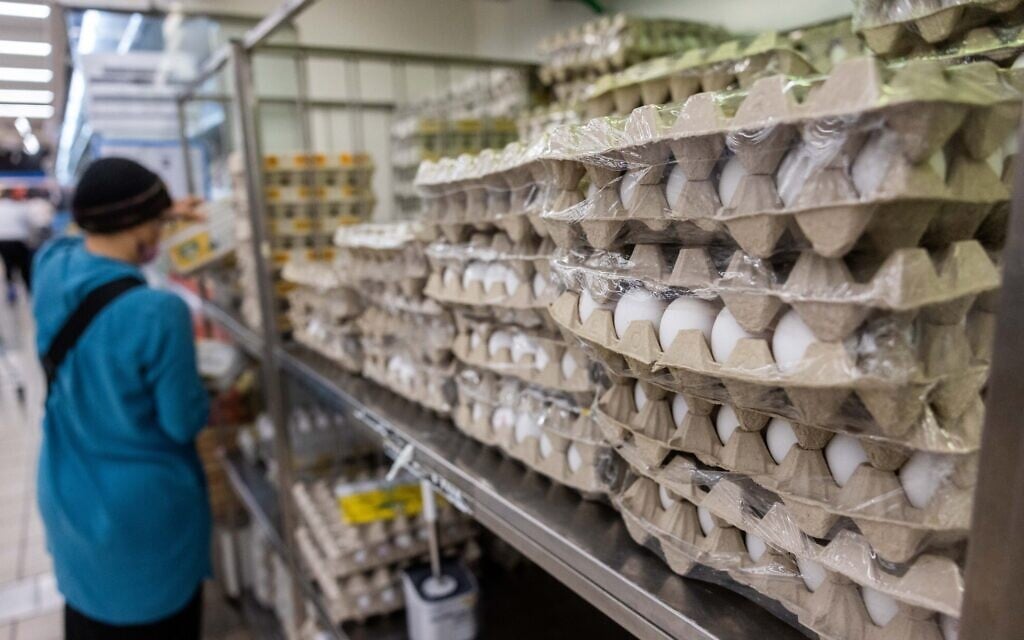
Egg prices go up 2.1% on Sunday; flour is reportedly set to rise by as much as 14%, with bread, pasta and other staples likely to follow, in fresh blow to households stretched thin by cost-of-living crisis
Youth-led demonstrations across Europe are bringing together concerns about housing, education, employment and political accountability. Although the movements differ considerably between countries, their emergence reflects growing dissatisfaction among younger Europeans over economic prospects and their influence on political decisions.
A series of demonstrations involving young people across Europe has developed into a wider political phenomenon, as students and younger workers challenge governments over living costs, public services and their expectations for the future.
Protests have taken place in France, Belgium, Italy, Albania and several other countries, while a student-led movement in Serbia has achieved a particularly consequential political outcome.
In Serbia, nearly two years of demonstrations culminated in a parliamentary election victory for a student-backed political movement, ending the electoral dominance of President Aleksandar Vučić’s Serbian Progressive Party.
The outcome, reported by Reuters on 29 October, has given the movement a prospective parliamentary majority, although final certification of the election results remains outstanding.
Elsewhere, protesters have secured fewer immediate political concessions.
Nevertheless, their campaigns share a recurring concern: that conventional channels of political representation have failed to address problems affecting younger generations.
Economic Pressures Behind the Demonstrations
The grievances vary between countries, but housing affordability, insecure employment, education funding and living costs feature prominently.
Almost one-third identified economic conditions and job creation as a principal concern, while education also ranked prominently.
More recent figures illustrate the financial pressures confronting younger Europeans.
According to Eurostat data published in June 2026, 24.2 per cent of EU residents aged 15 to 29 were at risk of poverty or social exclusion in 2025.
That compares with 20.9 per cent for the population as a whole.
These figures do not establish that economic hardship is the cause of every protest. They do, however, provide context for the dissatisfaction expressed by participants.
Belgium’s Students Demand Better Education
In Brussels, demonstrations have focused partly on the condition of schools and the availability of educational resources.
Students have criticised deteriorating facilities, shortages of teachers and government decisions affecting education funding.
Nineteen-year-old student Maya Gourdel told Reuters that peaceful attempts to draw attention to these concerns had attracted little response from political leaders.
Her account reflects a wider frustration among demonstrators who believe that public attention has increased only after protests became more disruptive.
Belgium’s education system is organised primarily at community level, meaning decisions concerning funding, staffing and school infrastructure are divided among different authorities.
The demands of protesters consequently involve both national political debates and decisions taken by regional and community institutions.
France and Italy Face Wider Social Unrest
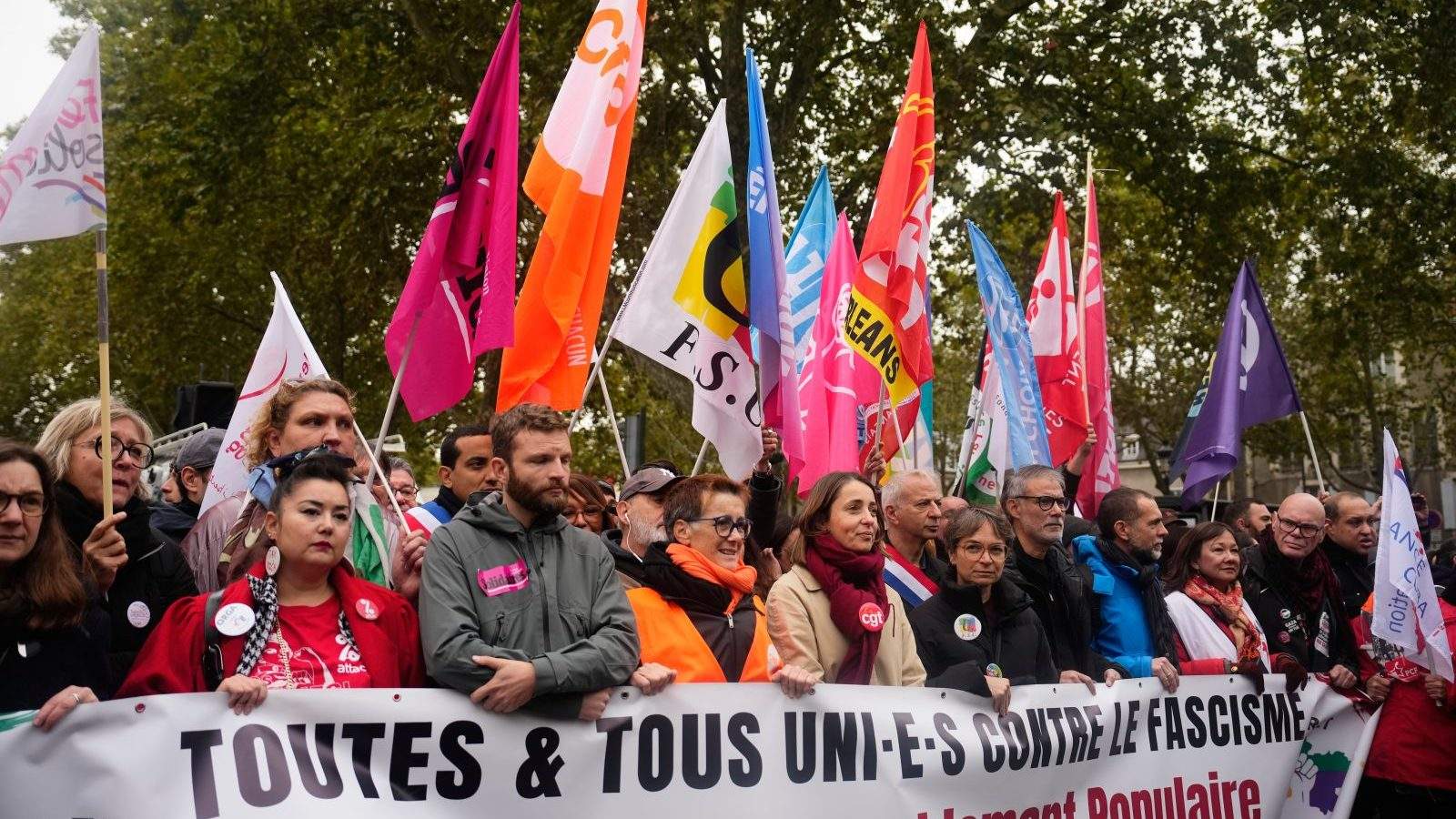
In France, demonstrations concerning the cost of living and public services have involved students alongside trade unions and other organisations.
Recent protests have also been accompanied by violence, including attacks on commercial premises and confrontations with police.
The involvement of younger demonstrators does not mean that every participant supports violent tactics.
Rather, the events illustrate how movements with economic and political grievances can encompass groups with different objectives and methods.
Italy has experienced similar tensions, particularly in Milan, where demonstrations against rising living costs have followed earlier episodes of unrest.
The Italian government has faced pressure over household expenditure, wages and the affordability of essential services.
These disputes have developed against a background of high energy prices and concerns about the broader economic outlook.
Albania’s Frustration With Political Institutions
In Albania, student-led protests have challenged Prime Minister Edi Rama’s government over alleged corruption, limited employment opportunities and education standards.
Demonstrations that began in Tirana have spread to other cities.
On 29 October, opposition lawmakers disrupted proceedings in parliament following weeks of protests and confrontations between demonstrators and police.
The government has offered measures intended to address economic concerns while condemning violence associated with the demonstrations.
For many younger Albanians, employment prospects are closely connected to the possibility of emigrating.
The perception that professional opportunities depend on political connections or personal networks has become another source of dissatisfaction.
However, the Albanian movement cannot be treated as identical to protests in EU member states, given the country’s different economic conditions and political institutions.
Serbia Shows the Political Potential of Student Movements
Serbia provides the most substantial example of youth-led protest translating into electoral change.
The movement emerged after the collapse of a railway station canopy in Novi Sad in November 2024, which killed 16 people and prompted allegations of corruption and negligence.
Students organised prolonged demonstrations demanding accountability and institutional reform.
Their campaign subsequently developed into an electoral challenge to the governing Serbian Progressive Party.
Preliminary results from the October 2026 parliamentary election indicate that the student-backed list has secured a majority of seats.
However, electoral certification and the formation of a new government remain incomplete.
The movement now faces a different challenge: converting protest demands into administrative decisions, legislation and economic policy.
Its success will be judged not only by the election result but also by its ability to govern.
A Generational Shift, But Not a Single Movement
It would be misleading to describe Europe’s demonstrations as a unified political campaign.
Participants have different objectives, national circumstances and ideological positions.
Some demand increased public expenditure, while others concentrate on corruption, political accountability or employment opportunities.
What connects them is a recurring concern about whether established institutions respond adequately to younger citizens.
The political consequences will depend on whether demonstrations produce lasting organisations, influence elections or secure changes in government policy.
Serbia suggests that student mobilisation can translate into substantial political change.
For governments elsewhere in Europe, the question is whether the grievances driving these movements can be addressed through existing political institutions before dissatisfaction generates further unrest.
My wife and I couldn't afford to buy a home on our own, so we bought one with our in-laws instead.
Bill Coberly
To become homeowners sooner, my wife and I bought a house with her parents.
At first, navigating the space wasn't easy, but we're still able to have ample privacy.
Living with my in-laws has its challenges, but I can't imagine living anywhere else.
I've known my wife's parents for nearly a decade, and we've always gotten along, but I never imagined sharing a roof with them. That all changed last year, when my wife suddenly popped the question: "How would you feel about buying a house with my mom and dad?"
We knew it would be years before we could afford the down payment on a house, particularly anywhere near Frederick, Maryland, where we wanted to live.
Even though we were both lawyers in our late 30s, we didn't have as much saved as we should have. We had each chosen lower-paying work over big-firm jobs and lost financial ground during our divorces in the late 2010s.
Without the help of my in-laws, my wife and I would've had to wait another decade or so to buy a house. But if we purchased a place together, her parents would provide the down payment, and we would cover more than half of the mortgage.
So, just like that, I agreed to become roommates with my in-laws.
The house gave all of us the space we needed, but we still had to learn how to share it
This one-story house, with an added-on second floor and a finished basement, was perfect for all four of us.
Bill Coberly
When we began our search, we envisioned a duplex — two separate living spaces joined together — but we had a hard time finding one.
We struggled even more to find a house with bedrooms on both the first and second floors, something crucial for my in-laws, since they're in their late 60s, and we didn't want them worrying about climbing stairs now or as they get older.
After several months of looking, we finally found a place that checked all the boxes: a 1950s one-story house that the previous owner had renovated to add a second floor and a finished basement.
The upstairs, where my wife and I would live, had three bedrooms, two bathrooms, and a laundry space. Downstairs, where my in-laws would live, was the main kitchen and living room, a small den, a bedroom, a bathroom, and a small back kitchen.
There was enough space for all four of us — along with our two cats, our dog, and their dog — so we put in an offer.
For the first couple of months after moving in, the house was a sea of boxes, and it seemed almost impossible that we could cram all four lives into one place.
My wife and mother-in-law argued about the furniture we needed to get for the shared spaces, and we debated back and forth about what to do with the back kitchen, which we ultimately decided to convert into a laundry/mud room.
As time went on, we also had to get used to the quirks of living together. My wife works from home, which means she has to go downstairs to the main kitchen and interact with her parents before she can fully wake up. Luckily, we've just converted the upstairs laundry space into a little kitchenette, so now she can make her morning smoothie in peace.
Additionally, I learned to put on my dress shoes only when I'm on my way out of the house in the morning, as I had previously been startling my in-laws awake by clomping around in the closet just above their bedroom.
My wife and I love spending time either in our bedroom or in the basement, where we built a library.
Bill Coberly
But even though we're all in the same house, my wife and I still feel like we have ample privacy. Our bedroom is large, and my in-laws don't really spend much time in the basement, so sometimes, we like to hang out there as well.
Thankfully, expenses haven't been an issue, since we split most day-to-day purchases right down the middle by contributing to a joint bank account.
Living together has made everyday life easier in ways I didn't expect
My mother-in-law makes dinner for all of us most nights.
Bill Coberly
Despite the challenges, sharing a home with my in-laws for the past eight months has been great.
My mother-in-law graciously offered to make dinner most nights, so we can all sit down and have a home-cooked meal as a family. When we go out of town, my in-laws watch our dog and our cats.
Once we have children, grandma and grandpa will be right there to help, and as my in-laws get older, we'll be right there to assist them.
Obviously, there are times when we annoy each other, but I've gotten to know my in-laws much better since we became roommates. The arrangement has turned us into a family and given us more financial security, and the plan is never to move again.
US News & World Report analyzed over 850 cities based on quality of life, affordability, healthcare, retiree taxes, job market, and population and migration for retirees 55 and older to rank what cities work best for retirees.
"It's no secret that affordability is top of mind for Americans this year, which is why US News updated its weighting criteria to better align with what retirees prioritize," US News & World Report assistant managing editor Megan Wood said. "The 2027 rankings reflect key metrics used to highlight the places that best suit retiree needs."
The six factors used when ranking each city came from a survey of Americans 45 and older to determine what mattered most to them when considering where to retire.
"Retirees are seeking a place that gives them a sense of security and comfort as they live out their golden years," Wood said.
While cities in Florida and Texas account for more than half of the top 15, neither city holds the top spot. Below, the best cities to retire in for 2027.
15. San Angelo, TX
San Angelo, Texas.
DenisTangneyJr/Getty Images
Housing costs 2025: $191,261
Value index: 9
Population 65+: 17%
14. Conroe, TX
Conroe, Texas.
Photosbyjam/Getty Images
Housing costs 2025: $323,622
Value index: 7.9
Population 65+: 15%
13. Pearland, TX
Pearland, Texas.
halbergman/Getty Images
Housing costs 2025: $343,369
Value index: 8
Population 65+: 13%
12. Victoria, TX
Victoria, Texas.
ianmcdonnell/Getty Images
Housing costs 2025: $200,767
Value index: 9.3
Population 65+: 17%
11. Bismarck, ND
Bismarck, North Dakota.
halbergman/Getty Images
Housing costs 2025: $290,274
Value index: 6
Population 65+: 21%
10. Palm Coast, FL
Palm Coast, Florida.
Jeff Cassetta/Getty Images
Housing costs 2025: $380,019
Value index: 7.5
Population 65+: 30%
9. Lynchburg, VA
Lynchburg, Virginia.
SeanPavonePhoto/Getty Images
Housing costs 2025: $222,789
Value index: 7.5
Population 65+: 15%
8. Paducah, KY
Paducah, Kentucky.
larrybraunphotography.com/Getty Images
Housing costs 2025: $161,025
Value index: 9.2
Population 65+: 19%
7. Altoona, PA
Altoona, Pennsylvania.
catnap72/Getty Images
Housing costs 2025: $115,035
Value index: 8.1
Population 65+: 19%
6. Rio Rancho, NM
Rio Rancho, New Mexico.
DenisTangneyJr/Getty Images
Housing costs 2025: $311,135
Value index: 6.2
Population 65+: 19%
5. Spring, TX
Spring, Texas, is a suburb about 25 miles outside Houston.
John Coletti/Getty Images
Housing costs 2025: $249,404
Value index: 8.6
Population 65+: 12%
4. The Woodlands, TX
The Woodlands, Texas.
raeva/Getty Images
Housing costs 2025: $472,814
Value index: 6.6
Population 65+: 15%
3. Weirton, WV
Weirton, West Virginia.
Katherine Frey/The Washington Post via Getty Images
Housing costs 2025: $124,681
Value index: 7.6
Population 65+: 26%
2. Homosassa Springs, FL
Homosassa Springs, Florida.
: Jeffrey Greenberg/Universal Images Group via Getty Images
Even though we live so close to each other, we have boundaries and our own separate lives.
In 2024, my husband and I began building our own house on the same property as my parents, siblings, and sister-in-law, creating a "family compound." In total, there are two separate houses, nine family members, and three adorable golden retrievers on the property.
Our family has always spent a lot of time together, but before moving into our new home in April, I don't think I truly understood what day-to-day life would be like.
Here are the biggest surprises I've encountered so far.
My family and I still have our own separate lives.
Taylor Bunting
Although my husband, daughter, and I live next door to the rest of my family, we still have our own houses, routines, and lives. Some days, when we all happen to be on different pages, we don't see each other at all.
I think this balance is a huge part of what makes our setup successful. No one feels as though they are on top of each other, and my husband and I can simply take our daughter to our house, close the door, and be our own little family.
Privacy and boundaries are still possible, even when living so close together.
Taylor Bunting
For us, one of the keys to making our living arrangement successful is respect for personal space and boundaries.
For example, my younger siblings don't come over to my house after about 8:00 p.m. because they know my daughter is asleep and my husband and I are likely settling in for the night. This isn't something we ever had to ask them to do, they just respect our privacy and nightly routine.
The same goes for my parents. They text my husband and me before popping over to visit and always avoid walking into our house unannounced.
A lot of people don't seem to understand multigenerational living.
Taylor Bunting
Since sharing our family compound on social media, I was taken aback by how many people assumed that our family was part of a religious group or separate "community," rather than our setup being an example of multigenerational living.
I knew that "family compounds" aren't incredibly common nowadays, at least in the United States, but I definitely didn't think they were so widely misunderstood.
People appear to confuse our setup with communal living, rather than our family simply living as neighbors next to each other.
Casual get-togethers and dinners happen spontaneously.
Taylor Bunting
I've been pleasantly surprised by how much easier casual get-togethers, dinners, and hangouts are.
I can just pop over to my parents' house and then "head home" whenever I want to. I don't need a reason to leave or an excuse to use if I'm just not feeling social.
We also don't typically find ourselves planning get-togethers; they just kind of happen. I can wake up on a Saturday morning with no plans, and within an hour, everyone is hanging out by the pool, playing yard games, and cooking food together.
Having my family around has really improved my mental health.
Taylor Bunting
As a stay-at-home mom, having my siblings and parents around throughout the week makes day-to-day life with a toddler so much more enjoyable.
Our setup gives me other adults to interact with, another set of hands when I need them, and simply remedies any of the aspects of motherhood that can otherwise feel lonely.
It's also a game changer for me to have my own mom as a resource. Rather than turning to Google, I can walk across the driveway and pick my mom's brain for parenting advice as a first-time mom.
My marriage has actually gotten even stronger since living here.
Taylor Bunting
One of the many perks that I did not anticipate was how much the support of a village would benefit my relationship with my husband.
With other people around to lend a hand with our daughter, direct access to girl time with my mom and sister, and my husband having the ability to go watch a football game with my dad or play basketball with my brothers, we have easier access to hobbies and self-care outlets as parents. This leaves more quality time for us as a couple.
Our setup felt 'normal' pretty quickly.
Taylor Bunting
It's taken me by surprise how after only living in our home for six months, this setup already feels so natural and "normal." I can't imagine going back to living even 15 minutes down the road from our family.
Sometimes it takes people asking questions or sharing their opinion on our living arrangements to remind me that our setup is a whole lot less common than I think.
When I think back to my expectations surrounding a 'family compound' prior to moving into our home, I had only really envisioned the more overarching concepts such as family dinners, lots of quality time and no longer having to drive to visit each other.
However, I didn't realize how many of the small details would make such a positive impact on our day-to-day lives.
Thousands of demonstrators have gathered outside Portugal’s parliament as rising property prices, disputed eviction legislation and police operations bring the country’s housing problems into direct confrontation with the government.
Thousands of protesters gathered outside Portugal’s parliament in Lisbon on 27 October, demanding action over soaring housing costs and criticising police operations against housing activists, as the country’s long-running property crisis developed into a broader political confrontation.
The demonstration coincided with parliamentary debate on the government’s proposed 2027 budget and followed several days of protests in Lisbon and Porto.
At the centre of the dispute is an increasingly familiar European contradiction: property values continue to rise, while wages and household incomes have failed to keep pace with the cost of obtaining accommodation.
For Portugal, the problem has become particularly pronounced.
House prices have more than doubled since 2017, while rents for newly agreed tenancies have almost doubled over the same period.
According to figures reported during the demonstrations, the cost of housing in Portugal increased by 147 per cent between 2015 and 2025, compared with an EU average of 60.5 per cent.
The result is a growing disparity between earnings and the cost of independent living, particularly among younger adults.
A property market detached from wages
In Lisbon, a one-bedroom flat can routinely command monthly rent of approximately €1,500.
Portugal’s minimum wage stands at €920 per month before tax.
Although these figures do not represent every household or property, they illustrate the scale of the affordability problem for lower-paid workers.
Between the first quarters of 2025 and 2026, Portuguese house prices increased by almost 20 per cent, according to national statistical figures cited in recent reporting.
Rental costs have also continued rising, recording an increase of approximately 68 per cent since 2020.
The country’s attractiveness to foreign investors, retirees and remote workers has contributed to demand, particularly in Lisbon, Porto and coastal areas.
Tourism has introduced additional competition for residential property, with some homes converted into short-term accommodation.
However, investment and tourism are only part of the explanation.
Restrictions on construction, administrative delays, limited affordable housing supply and the geographical concentration of employment have also contributed to pressure on the market.
These conditions have produced a widening gap between those who already own property and those seeking to purchase or rent their first home.
Disputed eviction legislation
The immediate political confrontation concerns government proposals that would accelerate certain eviction procedures and remove restrictions on rents for new tenancy agreements.
The legislation passed its first parliamentary reading, with the right-wing Chega party abstaining.
Housing campaigners argue that removing protections without first increasing affordable supply could leave tenants more exposed to rising rents and displacement.
The minority centre-right government, led by Prime Minister Luís Montenegro, has pursued measures intended to encourage construction and increase the availability of housing.
These include tax reductions for new building projects and a commitment to deliver 145,000 homes.
Such measures, however, require time before additional properties become available, while many households face immediate financial pressures.
Police operations become a second controversy
The housing dispute intensified following police operations to remove protest encampments in Lisbon and Porto during the weekend.
Police used batons during the clearances, while campaigners alleged excessive force.
Portugal’s internal affairs watchdog has opened an inquiry, while prosecutors are conducting a separate investigation into officers’ conduct.
Montenegro defended the police response in parliament, arguing that officers had acted according to the principles of necessity, proportionality and adequacy.
President António José Seguro has convened a meeting of the Council of State to consider the growing protests.
The dispute has consequently expanded beyond housing economics to include questions about policing, public demonstrations and political accountability.
A European problem with national consequences
Portugal’s demonstrations follow similar protests in Spain and growing political scrutiny of housing affordability elsewhere in the EU.
The European Commission has begun addressing the issue through initiatives intended to encourage construction, facilitate investment and give authorities greater legal certainty over short-term rental restrictions.
As EU Today recently reported, the proposed European Affordable Housing Act would provide additional regulatory tools for areas facing severe housing pressure.
Yet the principal responsibilities for housing supply, planning and tenancy law remain with national and local governments.
This division creates a political challenge: Brussels can support investment and coordinate legislation, but the most immediate decisions affecting rents, construction and evictions are taken elsewhere.
For Portugal, the next test will be whether the government’s housing measures can deliver sufficient additional supply while responding to demands for immediate tenant protection.
The demonstrations outside parliament show that housing affordability has become more than a question of property prices. It now affects the government’s legislative agenda, the 2027 budget debate and the relationship between the authorities and an increasingly organised protest movement.
Maya Gourdel, a 19-year-old student in Brussels, sits at a desk writing slogans against those running her country: “If we burn, you burn with us!” The slogan, taken from the 2012 film “The Hunger Games” that has been adopted as a symbol by many youth movements globally, reflects the anger, frustration and desire for change driving Gen Z-led protests around Europe.
From the suburbs of Paris to the squares of Belgrade, thousands have taken to the streets.
The demands are various but often overlapping – frustrations with shabby schooling facilities, perceived lack of economic opportunity, cost of living, corruption, housing and a sense of not being listened to. At times those protests triggered violence – with thousands of shops in France alone being damaged or looted in recent weeks – and police firing stun grenades and water cannons.
This weekend they also brought real change – student-led protests culminated in the toppling in an election of Serbia’s long-time leader Aleksandar Vucic after nearly two years of demonstrations against perceived corruption and creeping authoritarianism.
“Waking up, the first thing we felt was certainly a sense of relief and freedom,” said student protester Stasa Piletic. “Personally, I feel a sense of victory. I feel that we finally moved from protests to responsibility.”
A generation struggling to imagine a future
Chiara, a 21-year-old student in protest-hit Milan, believes “it’s vital to take part in people’s spontaneous movements born from an explosion of rage that made collective action possible.”
“I think the worst damage this ruling class has done to my generation is stealing even the ability to imagine a future, to dream,” she said.
She said Italian students were confronting a reality of schools without enough teachers and crumbling buildings.
“And all of this with the prospect of an underpaid job which we didn’t qualify for and the prospect of living in a tiny, overpriced house, probably away from our city, which we didn’t want to live in.”
Protests led by Gen Z have caused ructions globally as the generation born roughly between 1997 and 2012 found its voice, from Bangladesh in 2024 and Nepal in 2025, to India this year. Now Europe has become a focal point.
Rising costs deepen Europe’s generational divide
Rising prices and the cost of living are a concern for 40% of 16-30-year-olds, according to a European Union survey published in 2025.
Among the 92.7 million people in the EU who faced the risk of poverty or social exclusion in 2025, the highest risk was recorded for young adults aged 18-24 years, at 26.3%, while the lowest was recorded for adults aged 65 years or over, at 18.8%.
Younger people are also wary of shouldering the financial burden of an older generation that tends to vote in greater numbers. People over 60 in France make up a quarter of the population but own 60% of France’s wealth, according to the OFCE think tank.
French pensions are by far the biggest public expense, on track to reach 14% of economic output, as the population ages and voters resist raising the retirement age or reducing benefits. That is still less than Greece or Italy, which spend the largest proportion of national income on public pensions among OECD countries, at around 16% of GDP, according to OECD figures in 2025. But it is much more than Australia, Chile, Iceland, Ireland or South Korea, which spent less than 4% of GDP on public pensions, according to the OECD.
Young protesters unite over failing schools
Bilal Narjissi, a 17-year-old high school student in a suburb north of Paris, has been protesting against “deplorable” conditions and staff shortages at his school. “There used to be rats,” he said. Students were evacuated last year when a roof collapsed on the courtyard, though no one was hurt, he said.
Protests showed “that young people in Europe are united”, he said, adding, “we all agree on one point: that young people are treated like children, far too much, and that they aren’t listened to enough.”
A French government report in October said pension spending had risen by 2.5 percentage points of GDP between 2000 and 2023 while that for education had declined 0.5. It also showed 32% of the education ministry’s budget went towards pensions, crowding out money for other areas.
Gourdel, too, has been protesting for better conditions in schools in Belgium.
“We tried to do it passively. Nobody heard us. It’s only when people started to burn trash or that kind of stuff that the media and cameras started showing us,” she said.
The protests are still spreading, with a demonstration planned in Germany this weekend over cost of living, inequality, war and the state of schools.
Unrest has also hit Albania, where student-led demonstrations against Prime Minister Edi Rama’s government, fuelled by anger over perceived corruption, a lack of jobs and poor education standards, engulfed Tirana and spread to other cities.
“Our Prime Minister spent 130 days not listening to us,” said Xyke Kurti, a 19-year-old architecture student.
“If you ask a student in Albania, ‘where do you see your future?’ Everyone says ‘outside this country’,” she said, arguing that at home, even if you have talent, someone with “connections is always going to beat you”.
Serbia’s student movement turns protests into political change
Serbia’s student movement did what demonstrators in other European capitals can only dream of.
Now, though, comes the gritty business of governing – something neither the students nor their candidates have any experience of. Luka Stojakovic, another protester, brushes that aside. “We have seen where people with political experience have brought us.”
British finance minister John Healey said he would help most households with their gas bills by enabling those who use the least to pay less as part of his first budget which is due to be announced in full later on Wednesday.
Healey – who has promised to give “breathing space” to families hit by the high cost of living – said he would abolish standing charges which are fixed daily fees that cover the costs of connecting a home to a gas supply and are charged on bills regardless of whether energy is being used.
“Gas standing charges are unfair and outdated so I am scrapping them to give millions of households a bit of breathing space,” Healey said in a statement issued by the Treasury.
He will ask regulators to remove the charges – which cost £108 ($143.78) a year for the typical household on average – in 2027 or as soon as possible after that, the Treasury said.
The costs will be shifted to the price of gas consumed which could save 60% of account-holding households around an average of £45 on their annual bill, the statement said.
Healey said his budget would “draw a line in the sand on an energy policy that has failed British billpayers for years, letting extra costs on bills pile high and leaving households even more exposed to global shocks”.
Earlier this month, the government cut value added tax on electricity bills which surged following Russia’s invasion of Ukraine and have risen again due to the Iran war.
Previous governments have imposed a price cap on energy prices and removed other levies.
Despite that, Britain’s regulated domestic price cap rose 4% in October, and some forecasts are predicting a rise of around 20% to over £2,000 pounds a year in January for an average domestic energy bill including electricity.
British households pay a standing charge on electricity bills which costs around £200 a year on the current price cap.
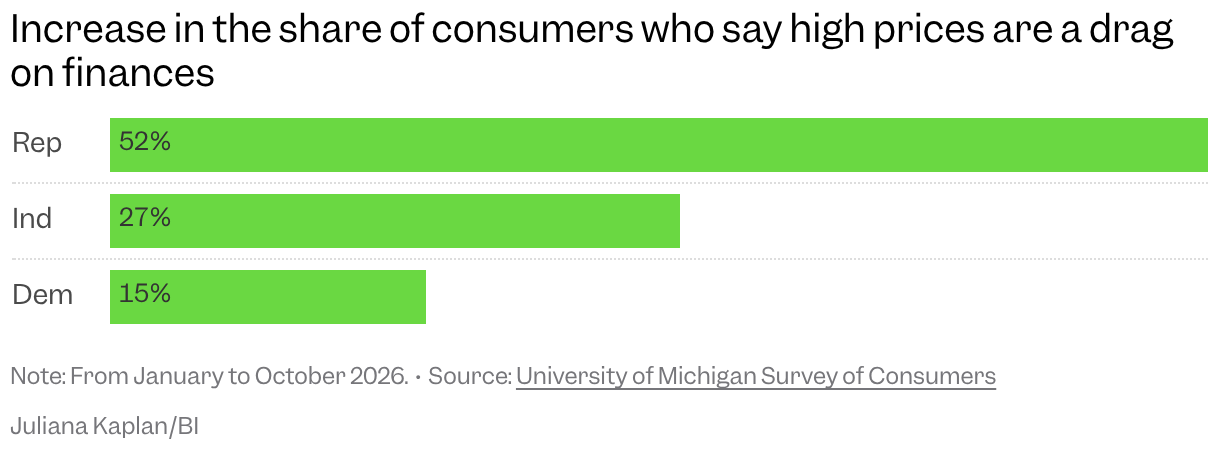
The latest consumer sentiment reading out of the University of Michigan finds that, across the board, Americans are still feeling bad. While self-identified Republicans still feel better than their Democratic and Independent counterparts, they're increasingly feeling the pinch of rising prices.
From January to October 2026, the share of Republicans citing high prices as a drag on their finances rose the most out of all political factions. It's a sign that, even as their party holds Congress and the White House, Republican voters might still be feeling the heat — especially as inflation continues to rise.
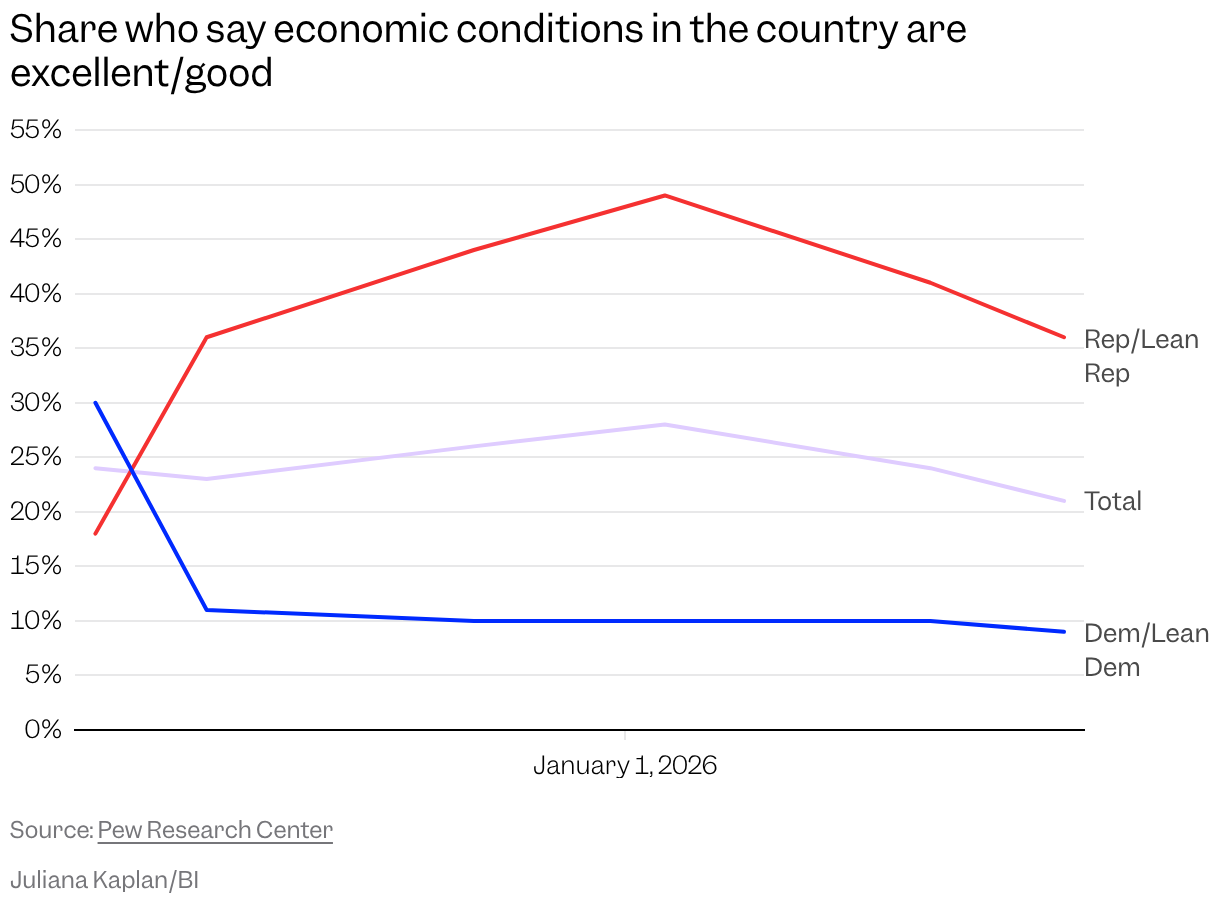
And, more broadly, Republicans seem to be souring on economic conditions. A Pew Research survey of 5,062 American adults from September 28 to October 4 found that Republicans, and those who lean Republican, were becoming less likely to say that economic conditions in the country are good.
Historically, consumer sentiment and surveys asking voters about economic conditions tend to have strong partisan correlations. Democrats are more likely to say that the economy is doing well and they're optimistic about the future when a Democrat is president; Republicans do the same when the GOP holds the White House.
The shift in Republican sentiment illustrates just how bad Americans at large are feeling about the economy. A similar downshift happened among Democrats amid the inflationary spike during President Joe Biden's term.
"President Trump has implemented an aggressive, pro-growth economic agenda that has blunted Biden's historic 40-year high inflation crisis, driven economic growth, increased wages and created private-sector jobs in areas that had been hollowed out and shipped overseas," White House spokesman Matthew Middleton said in a statement. "The President has always been clear about temporary disruptions as a result of the Iran conflict, but this administration will continue to deliver economic wins for the American people over the next two years."
While 18% of Republicans surveyed by Pew in January 2026 said that President Donald Trump's economic policies have made economic conditions worse, that share grew to 35% in October 2026. Similarly, an increasing share — 14% in January versus 25% in October — said that they expect economic conditions to be worse a year from now.
Similarly, polling from SSRS's Economic Attitudes Tracker found that Republicans are now more likely to describe the economy as bad than good — and the share of Independents who think the economy is good has plummeted to 12%, compared to a high of 25% in August 2025.
The cost concerns come as Iran War volatility — and the resulting fallout on energy prices — kept inflation high. In September, the consumer price index accelerated more than anticipated, with skyrocketing energy prices driving the increase. That means that, for the sixth month in a row, inflation has outpaced wage increases. Meanwhile, the labor market is floundering, with the country adding a paltry 29,000 payrolls in September — a far cry from the 90,000 roles economists predicted.
Midterm Election Day is a week away, and partisan sentiment around prices is shaping up to be especially important at the ballot box. Affordability messaging has become a touchpoint in swing state elections, with lawmakers on both sides of the aisle clamoring to show how their policies have and will bring down everyday costs.
But the declining sentiment among even the Republican base could be a warning sign for conservatives: An Ipsos/Washington Post/ABC News poll found that, in April, 34% of respondents said they trusted Republicans to do a better job of handling the economy, compared to 33% saying the same of Democrats. As of October 13, that had flipped. Just 28% of respondents said they'd trust Republicans to handle the economy better, while 37% said they'd trust the Democrats.
Marine Le Pen could scarcely have chosen a more favourable backdrop for her presidential campaign. A weakened president approaches the exit, demonstrations expose deep public frustration, and scenes of disorder reinforce her central argument: France’s governing establishment has lost control. The cards are all falling in her favour. Whether she can play them successfully remains the question.
Launching her campaign in Orléans, Le Pen promised national renewal and tougher policing. Reuters reported a poll placing her at 32–33.5 per cent, against 17 per cent for Jean-Luc Mélenchon. Those numbers are a snapshot, but they suggest something politically consequential: the candidate once treated as an outsider now occupies the strongest starting position.
Emmanuel Macron, meanwhile, increasingly resembles a lame-duck president. Constitutionally unable to seek another consecutive term, he faces a succession contest in which his endorsement may carry limited weight. His admission of failures in anticipating the unrest compounds the damage. A presidency built around authority and personal command is approaching its conclusion with both visibly diminished.
For Le Pen, the advantage is obvious. Every confrontation between police and rioters supplies another opportunity to ask whether the government can perform its most basic duty: protecting the public. Citizens do not need to endorse her entire programme to find that question persuasive. They need only conclude that those already governing have exhausted their answers.
Yet the origins of the demonstrations matter. The Associated Press describes a movement rooted in education funding, rising living costs and inequality. Peaceful protesters cannot reasonably be bundled together with looters. Nor does the reporting establish that these disturbances are an expression of Islamism or Muslim demographic change. Misdiagnosing the crisis would weaken any serious argument for restoring order.
The broader integration debate nevertheless deserves frank treatment. A republic cannot function confidently if its citizens believe that common laws, civic obligations or freedom of expression are negotiable. Governments should confront Islamist intimidation, religious coercion and deliberate separatism wherever evidence establishes them. They should also expect newcomers to learn the language, respect constitutional principles and participate in national life.
Those expectations are legitimate. Treating an entire Muslim population as inherently unintegrated is not. Religious identity alone establishes neither hostility to France nor unwillingness to belong. The useful political distinction is between citizens who uphold democratic rules and individuals or organisations that seek to undermine them. That standard should apply consistently, whatever the religion or ideology involved.
Across Europe, political leaders would be wise to recognise the electoral danger of appearing evasive about integration. Voters seeking enforceable rules should receive practical answers: effective language teaching, access to employment, credible policing and action against extremist networks. When mainstream parties substitute moral lectures for measurable results, they leave an opening for opponents promising clarity and control.
Le Pen’s opportunity is to connect these concerns with a wider sense of abandonment. Disorder, strained services and anxiety about belonging can become parts of one political story: the state demands obedience and taxation but delivers too little security or reassurance. Her opponents will struggle if their response consists principally of explaining why voters should fear her.
But favourable circumstances do not eliminate her weaknesses. Her conviction over European Parliament funds, which she is appealing, sits awkwardly beside a campaign demanding accountability and respect for law. Her promises of spending restraint, lower business taxes and resistance to further retirement-age increases also invite scrutiny. Winning confidence requires explaining how competing commitments can be reconciled.
The challenge for her rivals is therefore substantive. They must demonstrate that public order and legitimate protest can coexist, that integration involves shared duties, and that economic grievances deserve workable remedies. Simply rebuilding an electoral barricade against Le Pen may prove insufficient if voters associate its defenders with the failures that brought France here.
For now, momentum belongs to her. Macron looks depleted; the streets convey insecurity; the establishment struggles to offer a convincing successor or a persuasive account of renewal. None of this guarantees a Le Pen presidency. It does mean that her opponents can no longer rely on her reputation to defeat her. They must recover the public’s confidence in their own capacity to govern. Otherwise, France’s crisis may become her decisive electoral advantage.
I moved back home at 40 and live in my mom's small apartment with my husband and our son.
Yaritza Betancourt
After my husband lost his job, we moved across the country and into my mom's one-bedroom apartment.
My husband, toddler, and I live in her living room, and it's not always easy sharing a small space.
However, the arrangement has come with lots of benefits and we've been able to get back on our feet.
7:30p.m. marks the start of my son's bedtime routine.
First, I pull out our pillows and bedding from under the chaise sofa bed, which I share with my son.
Once our makeshift bed is set,I close the curtains separating it from the rest of the one-bedroom apartment. The tiny living room becomes our private oasis.
I can almost forget we're at my mom's place, sleeping on a convertible sofa she'd originally bought for our annual visits, while my 6-foot-3 husband sleeps on his own air mattress on the ground right next to us.
After my husband lost his job, moving in with my mom seemed like the right decision
We booked one-way tickets to Logan Airport and never looked back.
Yaritza Betancourt
Squeezing into my mom's small Boston apartment was never the plan.
Right after I graduated from college, I had moved to California to chase my Hollywood dreams of becoming an actor. During my two decades of living on the West Coast, I met my husband, got married, and became a stay-at-home mom.
However, our lives were turned upside down in 2025 when my husband lost his job. For the first time, we really started thinking about moving to Boston, where I had grown up and my family still lived.
I figured it would give us more flexibility with childcare, and a fresh start in a new city might be what we needed.
When I called my mom to tell her about our plans, she was thrilled. She'd been telling us to move to Boston for years, and said we could stay with her in her one-bedroom apartment until we found a new place.
So, we booked one-way tickets to Logan Airport and moved in with my mom.
It's been challenging for all of us to share a one-bedroom apartment
A curtain separates the living room from the rest of the apartment.
Yaritza Betancourt
Arriving in Boston was exciting, but the transition to sharing a one-bedroom apartment was trying — we took over the entire living room. The room became cluttered, with our clothes and suitcases spilling into the hallway.
My mom expressed concern about the mess, so we rented a nearby storage unit for most of our belongings. Still, though, the things we need daily seem to take up a lot of space.
We ended up renting a storage unit to help keep the clutter at bay.
For example, my son's early bedtime closes the living room off to my mom's nightly TV watching. Honestly, it still feels awkward to kick my mom out of her own living room because I have to put my toddler to sleep.
The chaise sofa turns into a bed.
Yaritza Betancourt
Plus, my mom is an early riser, often getting up at 6:30 a.m. to clean and run errands.
I can hear the sounds of domestic life filtering through the curtains that separate our "room" from the rest of the home. Cupboards opening, dishes being put away, and the smell of morning coffee lingering in the air like a wake-up call.
When tension rises because of our conflicting schedules and differing routines, I've learned to take a breather and step outside with my son to go for a walk or a drive. It often helps to ease the tension and remember this arrangement is only temporary.
However, it's also nice having my mom's support, and my son has gotten to know his abuela in ways that wouldn't have been possible from across the country. She watches him while I take a shower and go to in-person or Zoom job interviews.
Every night, while I'm getting the living room ready for bedtime, he goes into her room and cuddles up next to her while she watches TV.
Even though things aren't perfect, the arrangement is worth it
My son gets to spend more time with his abuela.
Yaritza Betancourt
At first, being back at my mom's house after so many years of independence honestly made me feel like I somehow failed at life. By 40, I thought I'd have a successful career and a home of my own.
Now, though, it's been seven months since we arrived in Boston, and honestly? We're thriving. My husband found work, my son loves his preschool, and I've been able to focus on my career aspirations.
What I've learned through this whole process is that it's OK to lean on family when necessary, and even though we're still hoping to get our own place sooner rather than later, I know moving back to Boston was the right decision for me and my family.
Hayley and Mo Molina moved onto Hayley's family's 400-acre ranch in Oklahoma.
Courtesy of Hayley and Mo Molina
Hayley and Mo Molina built a house on Hayley's parents' 400-acre family ranch in Oklahoma.
Now they live steps away from Hayley's parents, grandparents, and brother and sister-in-law.
They both enjoy spending time with the family, and everyone has grown closer.
This as-told-to essay is based on a conversation with Hayley and Mo Molina, 30 and 49, a married couple who live on a 400-acre ranch in Claremore, Oklahoma. Hayley's parents bought the ranch in 2021, and now four generations of family live there. The following has been edited for length and clarity.
Hayley: I was born in Bluffton, Indiana. Then my family moved to Oklahoma when I was three.
We always lived in town, and my family knew nothing about ranching. They were golfers; I didn't listen to country music until I was in high school — we were city people. But then my parents sold their house and were looking for something new, something different.
They were actually looking for something smaller and with not as much land to take care of, but we started talking about a family compound, found Hook Ranch, and just jumped in headfirst.
When my parents first found the property, it was about 170 acres, give or take, and they just kept buying more land and growing it bigger and bigger until it landed on what it is now.
When my parents were talking about doing this, the future goal was for me to be out here. For me, it wasn't the goal right away. I wanted that in the future, but I didn't know what the future looked like for me.
My grandparents ended up moving out here and living in the barn, where they live now, because I wasn't planning on moving out there or building anytime soon.
They were like, "OK, well we'll just take your spot then."
Then Mo and I met, and honestly, I don't even know if we ever had the conversation about living out here.
Hayley and Mo Molina.
Courtesy of Hayley and Mo Molina
Mo: We really didn't bring it up early on. And when we first thought about it, I was like, "There's no way I'm living out there with all them family. There's no way." Not because I didn't like them; it just wasn't in the plan.
But then, as I got to know them, loved them, and we hung out with them almost every weekend, we were like, "Wait a minute, we love it out here."
I proposed out here, and after that, it took off from there. And then it was normal.
It's not weird to be living this close to my family
Hayley: On the property, there's us, my parents, my mom's parents, and then my brother and sister-in-law and their two daughters.
My family's always been so close. We're the type of people who always hung out on the weekends. We always went to my parents' house Friday night. It was so normal to be so close and always together.
Mo: For me, it was just my mom and me growing up, and we lived in the city, but I'm a country boy. I knew I always wanted to be out in the country. But it looked like I was going to be in the city the whole time. But with Hayley being close to her family, it all came together.
Hayley: We actually moved in with my parents first. We sold my house in March 2025, and then moved in with my parents.
One of the homes on Hook Ranch.
Courtesy of Hayley and Mo Molina
Mo: We lived there while we were building our house.
Hayley: We got married in September, moved in with my parents in March, and lived there for seven months. We moved into our house in October of 2025.
Our house is only about 100 yards away from the barn, which is where my parents and grandparents live.
My brother and sister-in-law are about 200 yards away from the barn — it's like a seven-minute walk. It's literally a one-minute walk from my house to my parents' house.
Mo: I didn't know if there were going to be any benefits to living that close or not, especially when my father-in-law built a trail that goes right from the barn to our house.
It's kind of cliché, but if we don't have any eggs, we can literally walk down there.
Hayley: But honestly, we have so much privacy. You wouldn't think that, but I can't even see my parents' house or my brother's house from my house.
Another home on Hook Ranch.
Courtesy of Hayley and Mo Molina
We can be in the backyard, the front yard, and I have no idea what's going on at their houses ever.
We can go weeks without seeing anybody. There's a lot of privacy out here because everybody respects each other's privacy.
Mo: It is weird knowing that we're this close and then a couple weeks go by, and I'm like, "Man, I haven't seen anybody," or "We haven't gone down there," and they're 100 steps away.
We've built closer relationships by living on the same property
Mo: When we first started dating, she was always hanging out with her parents almost every weekend, and I was living my single life, and I was hanging out with my buddies, and we would go out almost every weekend.
Hayley: Friday nights, we know what my parents are doing, because they do the same thing pretty much every Friday night.
So if we don't have anything to do, we are just going to go join them. Sometimes I just want to hang out with people, but I don't want to have to drive anywhere, and I don't want to have to get ready. So we'll have a game night at the barn with the whole family: my grandparents, us, my parents, and my brother and his family.
Mo: Hayley used to come and hang out with my friends, and then it didn't take very long before I went over to her family's place and hung out with them. I was like, "Man, this is kind of cool." They're awesome to hang out with.
At first, I was like, "I'm not hanging out with your parents. This is not a cool Friday night." In less than a month, I would say we were literally hanging out every weekend with her parents.
Hayley: I think we all have gotten so much closer. I have learned so much about my grandparents and gotten closer with my grandma.
Hayley and Mo's wedding on Hook Ranch.
Courtesy of Hayley and Mo Molina
My grandma comes over to our house every Monday morning and washes our sheets for us. While the sheets are washing and drying, she cleans the floors for me, and while she's doing that, she and I chat.
That's been really nice because I get to connect with her whenever. Before, I couldn't really do that because we only saw them every once in a while. Now I can do that every week. And she goes to my brother's house and does their laundry on Tuesdays.
Mo: Getting to know her family more and seeing how they do things and what they like and what their everyday looks like has been a benefit.
Her family works so hard. Her mom is the hardest worker on the ranch, and I would've never known that when I met her.
Her parents run a business, and her dad is constantly not in the house — except to watch college football.
I've learned so much from him.
I think getting to know that part of her family was huge for me. That's what's different. If we lived where we lived before, I probably would've never learned, or wanted to learn, that. So that was big for me.
French authorities have imposed extensive restrictions on demonstrations following last weekend’s violence. Courts have overturned some bans, while unions have accepted a last-minute change to the Paris protest route.
French police used tear gas to disperse demonstrators in Lyon on Saturday morning, 24 October, as 70,000 police officers and gendarmes were deployed nationwide to prevent a repetition of the violence and looting that accompanied last weekend’s mass protests.
In Paris, trade unions agreed to a revised demonstration route after the administrative court rejected their challenge to a last-minute police order. The march will proceed from Porte d’Italie to Porte de Vincennes, rather than between Bastille and Nation as originally agreed, with the procession scheduled to begin at 2pm.
Elsewhere, emergency judicial decisions have complicated the government’s security arrangements. Courts have suspended restrictions in Limoges and several municipalities around Marseille, while other cities remain subject to extensive bans on public gatherings.
The developments follow last weekend’s nationwide unrest, when approximately 550,000 people demonstrated against rising living costs, deteriorating public services and conditions in French schools. Violence erupted in several cities, leaving businesses looted, public buildings damaged and police officers injured.
Security operation on an unprecedented scale
Interior Minister Laurent Nuñez has ordered the deployment of 10,000 additional officers compared with 17 October. The operation includes specialist police units, armoured vehicles, helicopters and water cannon.
According to the government’s official security instructions, prefects must examine proposed demonstration routes, assess the reliability of organisers and take preventive measures where there is evidence of a risk to public order.
The authorities are particularly concerned about organised groups exploiting otherwise peaceful demonstrations to attack commercial premises and government buildings.
Security services expect between 400,000 and 500,000 people to participate in Saturday’s mobilisation. The government has warned that calls for renewed violence and looting have circulated online.
The previous weekend’s disturbances resulted in thousands of arrests. Justice Minister Gérald Darmanin said 217 people had already received prison sentences, with approximately half described as first-time offenders.
Courts challenge sweeping restrictions
The government’s measures have prompted an increasingly contentious legal dispute over the constitutional protection of public demonstrations.
The French Human Rights League has challenged restrictions in several cities, including Brest, Quimper, Caen, Marseille, Lille and Montpellier. It argues that extensive prohibitions interfere with freedom of assembly, expression and movement.
In Marseille, negotiations between local authorities and trade unions resulted in permission for a demonstration along an agreed route through the city. A separate administrative court decision subsequently suspended parts of the wider departmental ban, allowing gatherings in Gardanne, Istres, Martigues, Miramas and Tarascon.
The administrative court in Limoges also suspended restrictions on gatherings of more than ten people in the city centre and overturned an associated curfew.
In Lyon, however, restrictions remained in force across a large central area. Police dispersed approximately 150 demonstrators near Lyon III University shortly before 11am after participants blocked traffic close to the prohibited perimeter.
Macron faces a constitutional and political challenge
President Emmanuel Macron has argued that protecting public order must take priority following the destruction witnessed on 17 October.
His suggestion on Thursday that demonstrations not organised by recognised trade unions should generally be prohibited prompted legal challenges from opposition parties and civil liberties organisations.
In a ruling delivered on 23 October, the Conseil d’État rejected challenges to Macron’s remarks, finding that they did not themselves constitute a binding nationwide prohibition. The court nevertheless reaffirmed that prefects must assess individual demonstrations according to the circumstances and risks involved.
The ruling leaves local restrictions subject to judicial scrutiny rather than providing the government with unrestricted authority to prohibit protests.
Meanwhile, the movement’s original demands remain unresolved. What began with secondary-school students protesting against staff shortages, overcrowding and educational conditions has expanded into a broader mobilisation involving trade unions, university students and Yellow Vest campaigners.
Macron met representatives of secondary-school students on Friday, but participants subsequently called for demonstrations to continue until concrete proposals were presented.
Growing pressure ahead of the presidential election
The renewed mobilisation comes six months before France’s presidential election, in which Macron cannot seek a third consecutive term.
Political tensions are also evident in Orléans, where thousands of demonstrators gathered on Saturday to oppose the National Rally’s weekend party congress. Authorities deployed additional security personnel and restricted the location of the protest.
For the government, the immediate objective is to prevent another outbreak of large-scale violence. For unions and civil liberties organisations, the dispute increasingly concerns the conditions under which public protest may legitimately be restricted.
The courts have now begun answering that question differently across France, leaving the authorities to enforce a patchwork of restrictions as the country’s social and political confrontation continues.
Italian Prime Minister Giorgia Meloni has convened an emergency government meeting following two days of violent unrest in Milan and other northern cities, where demonstrators clashed with police, looted shops and damaged public property during protests over living costs and deteriorating public services.
Police brought 271 people to police headquarters following Sunday’s disturbances in Milan, including 220 minors. Of those detained, 32 were formally arrested and another 28 were reported to the judicial authorities, according to figures released on Monday, 19th October.
The violence has prompted the Italian government to consider further restrictions on those involved in violent demonstrations, potentially introducing additional powers directed at organised disorder and juvenile offenders.
Milan city centre hit by looting
The disturbances began during demonstrations on Saturday, 17th October, organised amid growing dissatisfaction over household expenses, public services and wider political grievances.
Although the protests initially included peaceful participants, groups of masked individuals subsequently confronted riot police in central Milan. Officers used tear gas and water cannon as demonstrators erected burning barricades and threw objects at security personnel.
The unrest continued on Sunday, when shops were attacked close to Piazza del Duomo, one of Milan’s principal commercial and tourist areas.
Among the premises targeted were branches of Decathlon, Arc’teryx and Vodafone. Television footage showed damaged shopfronts, overturned street furniture and burning rubbish containers.
According to police figures reported on Monday, 174 of those taken to police headquarters were subjected to preventive detention measures introduced under recent Italian security legislation.
Fourteen members of the security services were reported injured during Sunday’s disturbances, including ten police officers and four members of the municipal police.
The judicial authorities are examining the conduct of individuals suspected of taking part in attacks on businesses and confrontations with officers. Prosecutors have sought custodial measures against several adults accused of offences including devastation, looting and aggravated resistance.
The large proportion of minors among those detained has become a central issue in the political response.
Violence spreads across northern Italy
Milan was not the only city affected by disorder. Saturday’s demonstrations also produced confrontations in Turin, Bologna, Brescia and Bergamo.
Italian police reported arrests across the affected cities, while the scale and organisation of the disturbances have raised questions about whether different groups were acting independently or using demonstrations as opportunities for coordinated violence.
There is not yet sufficient publicly established evidence to attribute the disorder to a single organisation or political movement.
The clashes coincided with major protests in neighbouring France, where similar concerns over living costs and public administration have contributed to increasingly confrontational demonstrations.
Although the grievances overlap, the Italian and French movements have different political backgrounds and organisational structures.
Government considers emergency legislation
Following a meeting at Palazzo Chigi on Monday, Meloni’s government indicated that it was considering a legislative response, potentially through an emergency decree.
According to details of the government discussions, proposals under examination include additional measures against violent offences, changes to preventive policing and possible restrictions addressing road blockages.
Some measures could be drawn from security legislation already under consideration in the Italian Senate. Ministers have also discussed the need for more effective intervention against juvenile offenders.
The meeting included Deputy Prime Ministers Matteo Salvini and Antonio Tajani, Interior Minister Matteo Piantedosi, Defence Minister Guido Crosetto and senior officials from the police, Carabinieri and intelligence services.
The government has stressed that peaceful demonstrations must remain protected while arguing that violence and organised destruction require a stronger response.
No final legislative text had been adopted at the conclusion of Monday’s meeting. A decree could be considered by the Council of Ministers as early as Tuesday, although the precise content remains subject to further examination.
Dispute over responsibility for policing
The unrest has also produced a dispute between Milan’s municipal authorities and the national government.
Mayor Giuseppe Sala questioned the adequacy of the policing arrangements, arguing that the number of officers initially deployed was insufficient to control the disturbances.
Interior Minister Matteo Piantedosi rejected that criticism, while senior government figures accused local political leaders of failing to condemn the violence unequivocally.
The disagreement reflects a wider question over how responsibility for anticipating and containing serious public disorder should be divided between local administrations and national security authorities.
Italy’s opposition has also challenged the government’s handling of the disturbances. Former Prime Minister Matteo Renzi criticised Meloni and Piantedosi over their failure to prevent the violence, calling for a change in leadership at the Interior Ministry.
The political argument is likely to intensify if the government proceeds with emergency legislation. Supporters of stronger police powers argue that the existing framework is insufficient to deal with rapidly organised disturbances, while opponents will scrutinise the proportionality of new restrictions and their effect on peaceful protest.
The immediate test for the government will be whether additional legal powers can improve public-order operations without replacing effective policing, intelligence gathering and judicial enforcement.

 Login