❌

Reading view

Defiance Has Limits: Kyiv’s Red Lines Meet Battlefield Reality

Kyiv has shown that Washington’s leverage over it is limited, at least for now. As the American peace initiative moves forward, Volodymyr Zelenskyy is drawing public red lines, and the ball is back in Donald Trump’s court.

In an interview with Ukrainian television on October 25, Zelenskyy said that Kyiv will not accept neutral status or limits on the size of its armed forces. Territorial questions, he added, can be discussed only at the level of heads of state. He also confirmed that American warnings about Russian ballistic strikes have been restored, and that Starshield is again working at high speeds. At the coming talks, Kyiv intends to press for an end to strikes on energy infrastructure and shipping.

Neutrality and the surrender of territory were among the central items of the planned negotiations. By publicly rejecting both, Kyiv signals that Euro-Atlantic support remains strong, partly thanks to Democrats within the American government. Since Trump launched the initiative, the next move belongs to him.

On the battlefield, the past week has brought a lull in activity, but the fighting has not stopped for a moment.

In the Chernihiv Oblast, on October 25, crews of Russian Geran-2 strike drones hit positions of Ukraine’s 143rd Mechanized Brigade and the 114th Territorial Defense Brigade. Explosions were also reported at positions of the 105th Border Detachment near Horodyshche.

In the Sumy Oblast, Ukrainian command is deploying a large number of Special Operations Forces units. The 111th Signals Regiment of Ukraine’s special forces is organizing communication and coordination among them. These preparations point to one likely conclusion: Ukraine intends to sharply increase sabotage activity in the border zone. Ukrainian troops have used the tactic many times, crossing the border and planting national flags in Russian villages. Such raids serve mainly online publicity. The group returns immediately after the flag is raised, so there is no question of real control over the ground.

On the Slavyansk axis, the main fighting has moved south of Druzhkivka. On October 24, forward Russian assault units took control of the village of Raiske, less than three kilometers from the city limits. A day later, neighboring Novoandriivka was fully cleared. The defenses of Ukraine’s 93rd Mechanized Brigade, 4th Heavy Mechanized Brigade, and 107th Territorial Defense Brigade, which face the Russian advance, are likely to come under assault soon.

Zelenskyy is speaking the language of defiance, but a lull is not a turning point. Washington still holds the levers of intelligence, satellite access, and weapons supply. Russia, for its part, is closing in on Druzhkivka, and the first test of Kyiv’s red lines will come on the ground, not at the table.

______________________________________________________________________________________________________________________

DEAR FRIENDS. IF YOU LIKE THIS TYPE OF CONTENT, SUPPORT SOUTHFRONT WORK:

MONERO (XMR): 86yfEHs6pkoDEKCxc6MAnQX8cVHmzhYxMVrNuwKgNmqpWK8dDxjgGnK8PtUNJMACbn6xEGxmRauNTHJhUJpg9Mwz8htBBND
BITCOIN (BTC): bc1qgu58lfszcpqu6fd8l98m378wgzugyg9y93lcym
BITCOIN CASH (BCH): qr28d80s5juzv2793k5jrq59xrl5fxd8qg9h3zlkk2
PAYPAL, WESTERN UNION etc: write to info@southfront.press , southfront@list.ru

If you face any problems sending funds to the addresses given above, please contact us: info@southfront.press and southfront@list.ru. Also be aware that many email services such as Hotmail, Yahoo etc. may block correspondence from info@southfront.press and some others put it in spam.

If you want to support SouthFront but have no opportunity to do it via cryptocurrency, please contact us: info@southfront.press and southfront@list.ru.


SouthFront: Analysis and Intelligence
NOW hosted at southfront.press
Previously, SouthFront: Analysis and Intelligence was at southfront.org.
The .org domain name had been blocked by the US (NATO) (https://southfront.press/southfront-org-blocked-by-u-s-controlled-global-internet-supervisor/) globally, outlawed and without any explanation
Back before that, from 2013 to 2015, SouthFront: Analysis and Intelligence was at southfront.com

SOUTHFRONT.PRESS

The post Defiance Has Limits: Kyiv’s Red Lines Meet Battlefield Reality appeared first on South Front.
  •  

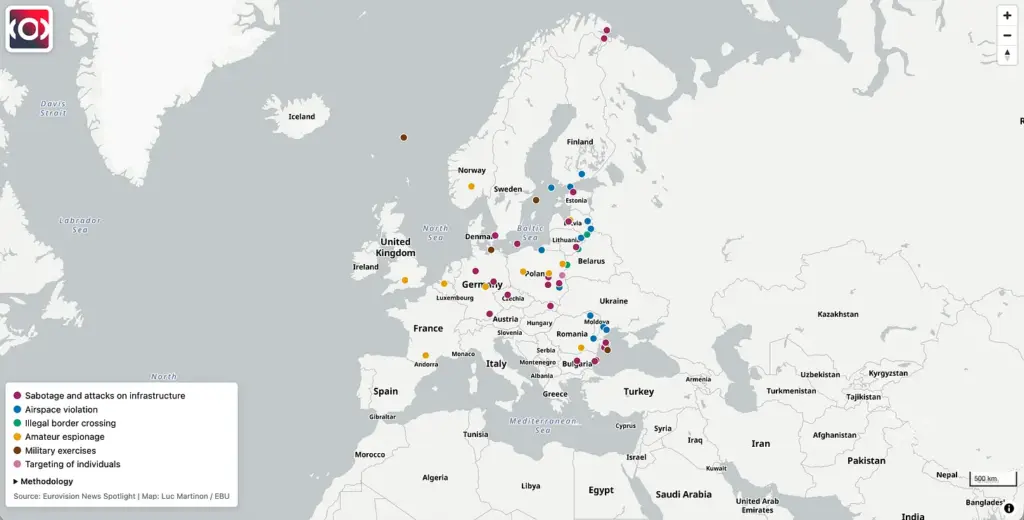
17 public broadcasters mapped Russia’s hybrid war on Europe. Germany: four dots

Physical hybrid incidents linked to Russia in 17 European countries, 1 April to 15 October 2026; many points stand for clusters of incidents. Map: Luc Martinon/ EBU, Eurovision News Spotlight

Journalists from 17 European public service broadcasters, coordinated by the European Broadcasting Union’s (EBU) Eurovision News Spotlight network, published an interactive map on 23 October 2026. It documents hybrid incidents linked to Russia across 17 European countries between 1 April and 15 October. Journalists compiled a database of hundreds of reported incidents, categorizing each by type and the source and strength of its alleged links to Russia, then verifying them through open-source research.

The map comes as officials warn the campaign is growing. On 28 September, EU foreign policy chief Kaja Kallas said in Brussels that Russia was planning more acts of sabotage to divide societies and intimidate them into abandoning their support for Ukraine. The points on the map represent an incomplete list of publicly known cases attributed to Russia or suspected of being linked to it, the report states.

The map covers airspace violations, sabotage attempts, “disposable” agents with no formal intelligence training, migration used as a weapon, and Russian military activity near or across European borders. It excludes cyberattacks, influence operations, and espionage by trained intelligence officers.

The EBU calls the result a very conservative estimate, not an official tally. Russia has consistently denied responsibility for the incidents. Many single points represent several incidents of the same type in one area or in quick succession. In Moldova, for example, Defense Minister Anatolie Nosatîi said on 30 September that the government had recorded 84 drone incursions.

Four German incidents are on the map, out of many more

The map shows four incidents in Germany, according to BR.

The four incidents in Germany on the EBU hybrid war map, 2 August to 14 September 2026
The four incidents in Germany on the EBU hybrid war map, 2 August to 14 September 2026. Other dots mark Russia-linked incidents in neighboring countries. Map: Luc Martinon/EBU, Eurovision News Spotlight; edited by Euromaidan Press
  • On 2 August, German authorities arrested a 33-year-old Ukrainian man in Thuringia on suspicion of photographing a Bavarian weapons manufacturer for a foreign intelligence service as part of an alleged sabotage plot.
  • On 4 August, a drone carrying explosives and a detonator struck the wing of a Ukrainian An-124 cargo plane at Leipzig/Halle Airport but failed to explode.
  • On 3 September, attackers threw firebombs from a car onto a construction site next to defense firms in Munich, and German security authorities suspect Russian intelligence.
  • On 14 September, investigators learned of a crashed drone found near the Bundeswehr’s Wunstorf air base.

Internal papers from the new Joint Hybrid Defense Center, seen by Correctiv, record 163 suspected sabotage cases in 2026 up to 19 August. The targets included rail lines, military facilities, substations, and radio masts. The same papers record 1,034 drone overflights of critical infrastructure, military sites, and defense companies, and 25 espionage investigations. The papers cover possible attacks by Russia, China, and Iran, and media did not report a breakdown of the sabotage cases by country.

European leaders sound the alarm over Russian hybrid attacks

On 15 April, Swedish civil defense minister Carl-Oskar Bohlin said pro-Russian groups had moved from denial-of-service attacks to attempts at destructive cyberattacks, including one on a Swedish power plant in 2025. On 1 September, German Foreign Minister Johann Wadephul named Russia as the perpetrator of the Leipzig attack and accused Moscow of “blatant hostility” toward Germany.

On 18 September, French President Emmanuel Macron said Russia’s hybrid attacks would not go unanswered and ordered a plan to protect France’s critical infrastructure. On 1 October, German Chancellor Friedrich Merz said Germany was preparing for new hybrid attacks, “including serious ones.” NATO Secretary General Mark Rutte on 14 October called the attacks a sign of Russian weakness at a press conference in Tallinn and said NATO would react where needed without being “rattled.”

  •  

Riarmo, ad Augusta la Flotilla blocca una nave che rifornisce la base Usa di Sigonella. Poi il blitz della Finanza

Per oltre sei ore, nella mattinata di lunedì 26 ottobre, due barche a vela della Global Sumud Flotilla hanno impedito l’accesso al porto siciliano di Augusta alla Sunaid X, una nave cargo di 129 metri battente bandiera portoghese che deve scaricare materiali destinati alla base Usa di di Sigonella. Il blocco è iniziato alle 5 del mattino, sono intervenute la Guardia di finanza e la Guardia costiera. Poco prima delle 11.30, raccontano gli attivisti, la nave “è ripartita a tutta velocità” e i finanzieri “hanno minacciato di salire a bordo” delle due barche, che hanno preferito seguire la motovedetta in porto.

“Su quella nave sono materiali dual use, civile e militare, prodotti chimici, roba destinata ai doni che partono da lì a supporto delle operazioni militari di Stati Uniti e Israele”, dicono gli attivisti. Secondo la campagna “No Harbour For Genocide” la nave avrebbe preso il posto della Vm Vita nei trasporti per la Defence Logistics Agency (Dla), l’agenzia del Dipartimento della Difesa Usa che gestisce gli approvvigionamenti per le basi statunitensi nel mondo. Il supporto almeno logistico fornito da Sigonella alle forze armate israeliane che hanno devastato Gaza e alla guerra israelo-statunitense contro l’Iran è largamente documentato.

La Sunaid X è la stessa nave fermata giovedì 22 per quattro ore davanti al porto di Livorno, in un’azione organizzata dagli attivisti della Flotilla con il Gap (Gruppo autonomo portuali) e l’Usb (Unione sindacale di base), che per venerdì 30 ha proclamato lo sciopero generale in Italia a supporto della giornata mondiale di lotta dei portuali contro i traffici d’armi. Coinvolgerà un centinaio di scali marittimi in 17 Paesi di tutto il pianeta, da San Francisco all’India passando per numerosi porti europei.

A bordo delle due barche, con le bandiere palestinesi e le vele e gli scafi dipinti secondo la tradizione della Flotilla per Gaza, c’erano attivisti italiani e di altri Paesi europei. Tra gli altri Spagna, Grecia e Regno Unito. In un filmato diffuso su Instagram uno di loro, con la kefiah, chiama la nave, che si vede in lontananza, sulla radio Vhf: “Sunaid X, Sunaid X, qui è Sumud, mi ricevete?”. Dal cargo rispondono e l’attivista avverte: “State trasportando forniture a una base militare che è profondamente coivolta nella guerra sionista e nel genocidio del popolo palestinese, il porto è bloccato per voi, non siete i benvenuti qui, siamo contro la macchina della guerra. I lavoratori portuali – aggiunge l’attivista della Sumud – sono in sciopero e non scaricheranno i vostri materiali, non vogliono essere complici di un genocidio, lavorano per dare da mangiare alle loro famiglie, non per uccidere bambini innocenti”.

Le altre navi, ovviamente, entravano e uscivano liberamente dalla grande rada del Porto Megarese di Augusta, dove c’è la base della Marina militare oltre ai terminal del Petrolchimico di Priolo. Per oltre sei ore la Guardia di Finanza e la Guardia costiera hanno chiesto agli attivisti di togliere il blocco, poi la minaccia di un’azione di forza. A Livorno è finita con il sequestro di tre barche e la denuncia dei partecipanti all’azione per interruzione di pubblico servizio.

L'articolo Riarmo, ad Augusta la Flotilla blocca una nave che rifornisce la base Usa di Sigonella. Poi il blitz della Finanza proviene da Il Fatto Quotidiano.

  •  

More than a US briefing: Brussels security talks on Ukraine planned for 27 or 28 October, Kyiv says

Ukrainian President Volodymyr Zelenskyy, 20 October 2026. Photo: Zelenskyy / Telegram

Ukraine, the US, the EU, and NATO plan to meet in Brussels this week to discuss security for Ukraine, President Volodymyr Zelenskyy told Ukrainian TV. The meeting would follow last week’s talks in Oslo and a US envoy’s visit to Russian President Vladimir Putin.

Guarantees are what would oblige Ukraine’s allies to act if Russia attacks again. The Paris Declaration laid plans for that commitment in January. Kyiv had a briefing from the Americans, and now the partners want a broad discussion of security and guarantees, Zelenskyy said. Brussels comes ahead of three-way talks with Russia, which the Kremlin says Putin is ready in principle to resume in mid-November.

Zelenskyy: meeting planned for Tuesday or Wednesday

The meeting is planned for Tuesday or Wednesday, 27 or 28 October, Zelenskyy said in the interview, aired on 25 October. The EU would take part at the presidential level and NATO at the level of its secretary general. He did not know whether anyone else would join. He also said Ukraine’s neutrality and limits on its army are not up for discussion.

After Oslo, Witkoff briefed Putin in St. Petersburg

Earlier, on 20 October, Zelenskyy met US special envoy Steve Witkoff in Oslo, with Finnish President Alexander Stubb and Norwegian Prime Minister Jonas Gahr Støre present. According to Zelenskyy, a wider round there included national security advisers from Germany, the UK, France, and Italy, the chief of staff of the European Commission president, and NATO representatives.

A day later, Witkoff met Putin in St. Petersburg and said he had brought papers setting out possible paths to a settlement. He told Putin the Oslo talks had been productive. However, Kremlin aide Yuri Ushakov claimed the new ideas from the Europeans and Kyiv that Witkoff relayed held little of use for a settlement.

  •  

Bulgaria’s Iotova Leads Presidential Vote, Faces Runoff

Bulgarian President Iliana Iotova during the first round of Bulgaria's presidential election.

A low turnout and security concerns shaped the first round, setting up a close contest between Iotova and pro-Western rival Andrey Gyurov.


Outgoing Bulgarian President Iliana Iotova led the first round of presidential elections on Sunday with between 35% and 36.5% of the vote, according to exit polls, but fell short of the result expected by her supporters. She will face former caretaker prime minister Andrey Gyurov, backed by the pro-Western opposition, in a runoff scheduled for Nov. 1.

RELATED: Serbia’s Student Opposition Wins Decisive Parliamentary Victory

Gyurov secured between 32.2% and 32.5% of the vote, according to the same exit polls, putting him within reach of Iotova ahead of the second round.

The election took place amid security concerns following a series of drone attacks on merchant vessels in the Black Sea. Voter turnout stood at around 20%, as some political parties called for a boycott.

Iotova, 62, has campaigned on dialogue with Russia and opposed military assistance to Ukraine. She has made ending the war in Ukraine a central theme of her campaign, presenting herself as a “president of peace.”

#Bulgaria’s presidential vote delivered a result few polls anticipated. Exit polls gave incumbent Iliana Iotova, who favors dialogue with Moscow and opposes military aid to Ukraine, up to 36.5 percent, a far narrower lead than surveys had suggested.https://t.co/rqlYf7ehlZ

— Al Mayadeen English (@MayadeenEnglish) October 25, 2026

After casting her ballot, she called for a government capable of tackling poverty and regional inequalities. “I believe there must be peace, stability and security,” Iotova said.

Gyurov, meanwhile, called for a Bulgaria oriented toward Europe and the future, emphasizing economic security and effective governance.

He said he had voted for “a European, free and proud country, where incomes are sufficient, where we feel secure about tomorrow and where the state functions as it should.”

Iotova assumed the presidency earlier this year after Rumen Radev resigned to contest parliamentary elections, seeking to become prime minister. Bulgaria is a member of both the European Union and NATO.

If Iotova wins the Nov. 1 runoff, she would become the first woman elected president of Bulgaria, a country of 6.4 million people with the lowest per capita gross domestic product in the European Union.

  •  

European Investigation Maps Hundreds of Suspected Russian Hybrid Attacks

An investigation involving 17 European public-service news organisations has documented hundreds of suspected hybrid attacks across Europe in just over six months, revealing the scale of a security challenge that increasingly extends beyond conventional espionage and cyberwarfare.

The investigation, coordinated by the European Broadcasting Union, examined incidents reported between 1st April and 15th October 2026, including sabotage attempts, arson, airspace violations, suspicious drone activity and the exploitation of migration routes along the European Union’s eastern borders.

Published on 23rd October, the resulting interactive map provides a geographical picture of incidents publicly linked to Russia by intelligence agencies, law-enforcement authorities, government officials or reporting. The degree of attribution varies considerably, however, and many incidents remain under investigation.

The findings point to a fundamental problem for European security: hostile activities can be conducted across national boundaries without necessarily triggering the legal, military or political mechanisms designed to respond to conventional aggression.

Sabotage Without Conventional Warfare

Among the cases examined is an incident in Munich in September, when two Bulgarian nationals allegedly threw incendiary devices from a moving vehicle onto a construction site near several defence companies.

Police arrested the suspects after a witness reported the incident. Bavarian Interior Minister Joachim Herrmann and regional criminal investigators subsequently indicated that political motives were being considered. Investigators reportedly suspected possible involvement by Russia’s military intelligence service, the GRU, although the allegations have not been established in court.

The case illustrates growing concern about so-called disposable agents: individuals recruited to undertake relatively limited operations without formal intelligence training or a longstanding relationship with an intelligence service.

Such arrangements can complicate investigations. Even where perpetrators are identified, establishing a legally demonstrable connection between their actions and a foreign intelligence organisation may prove considerably more difficult.

Germany’s Federal Criminal Police Office has registered a mid-three-digit number of suspected sabotage and reconnaissance cases since the beginning of 2026, according to information provided to investigators involved in the European mapping project.

Only a small proportion have been publicly attributed to Russia. Four German incidents were included in the map, demonstrating the distinction between a broad national caseload and cases meeting the investigation’s publication criteria.

Europe’s Eastern Borders Under Pressure

The geographical distribution reveals substantial activity along NATO’s eastern flank, particularly around the Baltic states, Belarus and the Black Sea.

Incidents include repeated airspace violations, suspected reconnaissance operations and attempts to facilitate unauthorised border crossings. Lithuanian authorities have accused Belarus of deliberately exploiting migration as an instrument of political pressure.

Commercial shipping has also become increasingly exposed. Drone attacks involving vessels near Romania and Bulgaria have raised concerns about the extension of the war’s consequences into maritime areas adjoining EU and NATO territory.

These developments reinforce earlier warnings about Russia’s expanding sabotage campaign, particularly the difficulty of distinguishing isolated security incidents from coordinated operations intended to test national responses.

Teija Tiilikainen, director of the European Centre of Excellence for Countering Hybrid Threats, identified Russia’s invasion of Ukraine as an important factor behind the increasing pressure. According to her assessment, Moscow’s objectives include weakening Western unity and undermining continued support for Ukraine.

The Legal and Institutional Challenge

The central difficulty is not simply the absence of criminal legislation. Arson, espionage, sabotage and unlawful interference with critical infrastructure are already punishable under national laws.

Rather, the challenge involves establishing foreign direction, coordinating investigations across jurisdictions and identifying when a series of apparently separate offences constitutes a wider hostile campaign.

Germany’s domestic intelligence chief, Sinan Selen, has described the environment as a grey area between war and peace. German foreign intelligence chief Martin Jäger has similarly identified Russia as the country’s most dangerous adversary.

European governments are beginning to address these difficulties collectively. At their 15th–16th October summit, EU leaders condemned intensifying hybrid attacks and called for stronger resilience, greater use of existing countermeasures and accelerated work on drone security.

On 8th October, the Council also extended sanctions targeting Russian destabilisation activities until October 2027. The restrictions cover 80 individuals and 20 entities.

Meanwhile, a European Commission research initiative, published on 23rd October, proposes combining anticipation, active defence and retaliatory measures into a more coherent deterrence strategy.

From Individual Incidents to Collective Security

The investigation’s significance extends beyond the number of incidents recorded. By bringing together information previously dispersed among national authorities and separate investigations, it makes possible a wider assessment of the methods, geographical concentration and recurring characteristics of suspected hostile operations.

Nevertheless, the map does not establish Russian responsibility for every incident it records, nor does it constitute a complete European database. Russia has repeatedly denied conducting the hybrid attacks attributed to it.

For European governments, the unresolved question is how to move from recognising a pattern of hostile activity to demonstrating responsibility and responding effectively.

As EU foreign policy chief Kaja Kallas has warned, the consequences already extend beyond infrastructure disruption to risks affecting civilian lives.

The emerging security challenge therefore concerns not only the detection of individual perpetrators, but also Europe’s ability to connect incidents across borders, establish responsibility and prevent successive operations from becoming an accepted feature of the continent’s security environment.

  •  

2 Wochen warten auf Wahlen…

Derzeit gibt es zwei, oder sogar drei, Themen, die die internationale Politik beherrschen: Erstens der Ukraine-Konflikt, um den im November wieder trilaterale Gespräche zwischen Moskau, Kiew und Washington geplant sind, zweitens der Iran-Krieg, bei dem Netanjahu und Trump wieder mit Eskalation drohen, und drittens der mögliche Gipfel von Trump, Putin und Xi Jingping in China. […]
  •  
❌