❌

Reading view

Obama’s Cheesecake Factory jab spurs a midterm spat

Welcome to The Hill’s Business & Economy newsletter {beacon} Business & Economy Business & Economy   The Big Story  Obama’s Cheesecake Factory jab spurs a midterm spat A Cheesecake Factory jab from former President Obama quickly spiraled into a midterm spat between the GOP and Democrats as the competitive election cycle nears its end.  ©…

  •  

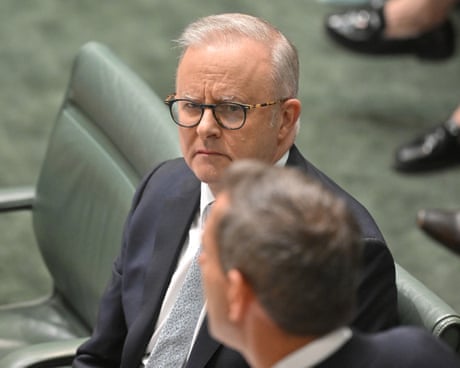
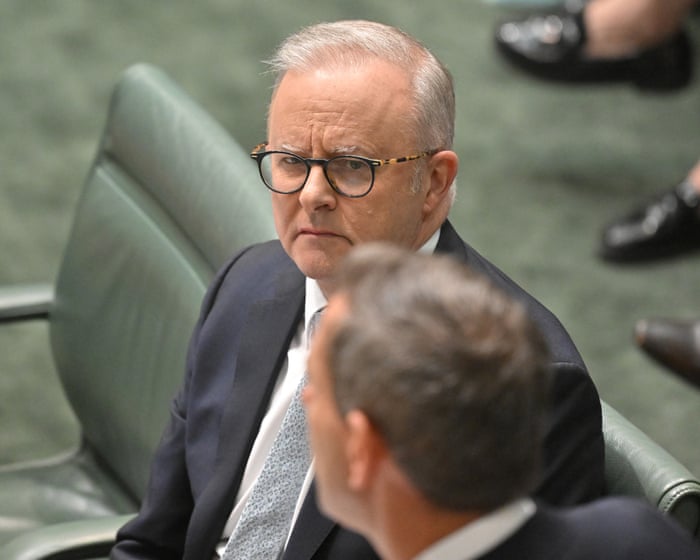
Coalition MP ejected from question time after swearing at PM – as it happened

Online hate is spilling into the real world, AFP warns

AFP Commissioner Krissy Barrett began her late-night appearance at the Senate estimates hearing noting “a heaviness that hangs across Australia” after the alleged attack on independent MP Helen Haines.

Lone actors are being motivated by a convergence of personal grievances, mental health vulnerabilities and ideological concerns …

What helped keep us safe in recent times, such as our geography, analogue systems and far away criminals, has been impacted by fully integrated technology, social media and artificial intelligence.

We hear about the devastating impacts of racism from communities every day. But many experiences go unreported or uncounted, and our systems often do not capture the full picture.

This is not about collecting more data to prove racism exists. We already know it does. It is about making inequality visible, holding institutions to account and giving communities greater agency over their data to drive real change.

Continue reading...

© Photograph: Mick Tsikas/AAP

© Photograph: Mick Tsikas/AAP

© Photograph: Mick Tsikas/AAP

  •  

4 in 10 say personal finances worsening: Survey

Four in 10 Americans say their personal finances are deteriorating, according to a new poll released shortly before November’s midterm elections. In the NPR/PBS News/Marist Poll, 40 percent of people said their “personal family finances” have declined in the last 12 months, while 16 percent said the opposite. Forty-one percent said their personal family finances…

  •  

Republican voters are getting worried about high costs as inflation stings and the midterms approach

A hand in a plaid shirt holding a fuel nozzle refueling a car at a gas station pump. Bright day with a visible station backdrop.
Rising costs are weighing on Republican voters.

Lajst/Getty Images

  • Republicans are feeling the strain of rising costs, with more saying it's a drag on their finances.
  • Those voters are feeling generally bad about the economy as key midterm elections loom.
  • Voters not approving of the party in power is common; what's unclear is how it'll play out.

Republicans are feeling the high-cost crunch.

The latest consumer sentiment reading out of the University of Michigan finds that, across the board, Americans are still feeling bad. While self-identified Republicans still feel better than their Democratic and Independent counterparts, they're increasingly feeling the pinch of rising prices.

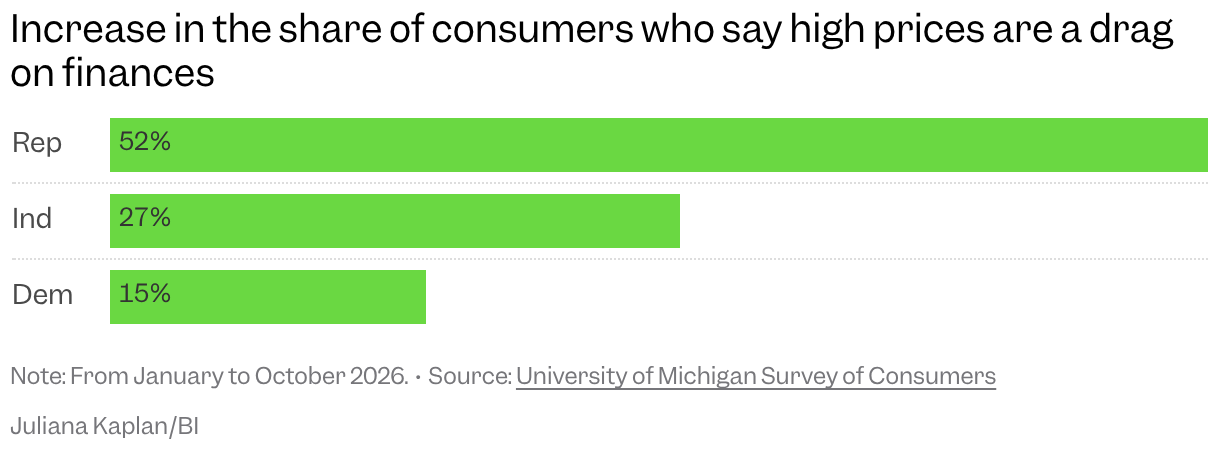
From January to October 2026, the share of Republicans citing high prices as a drag on their finances rose the most out of all political factions. It's a sign that, even as their party holds Congress and the White House, Republican voters might still be feeling the heat — especially as inflation continues to rise.

Bar Chart

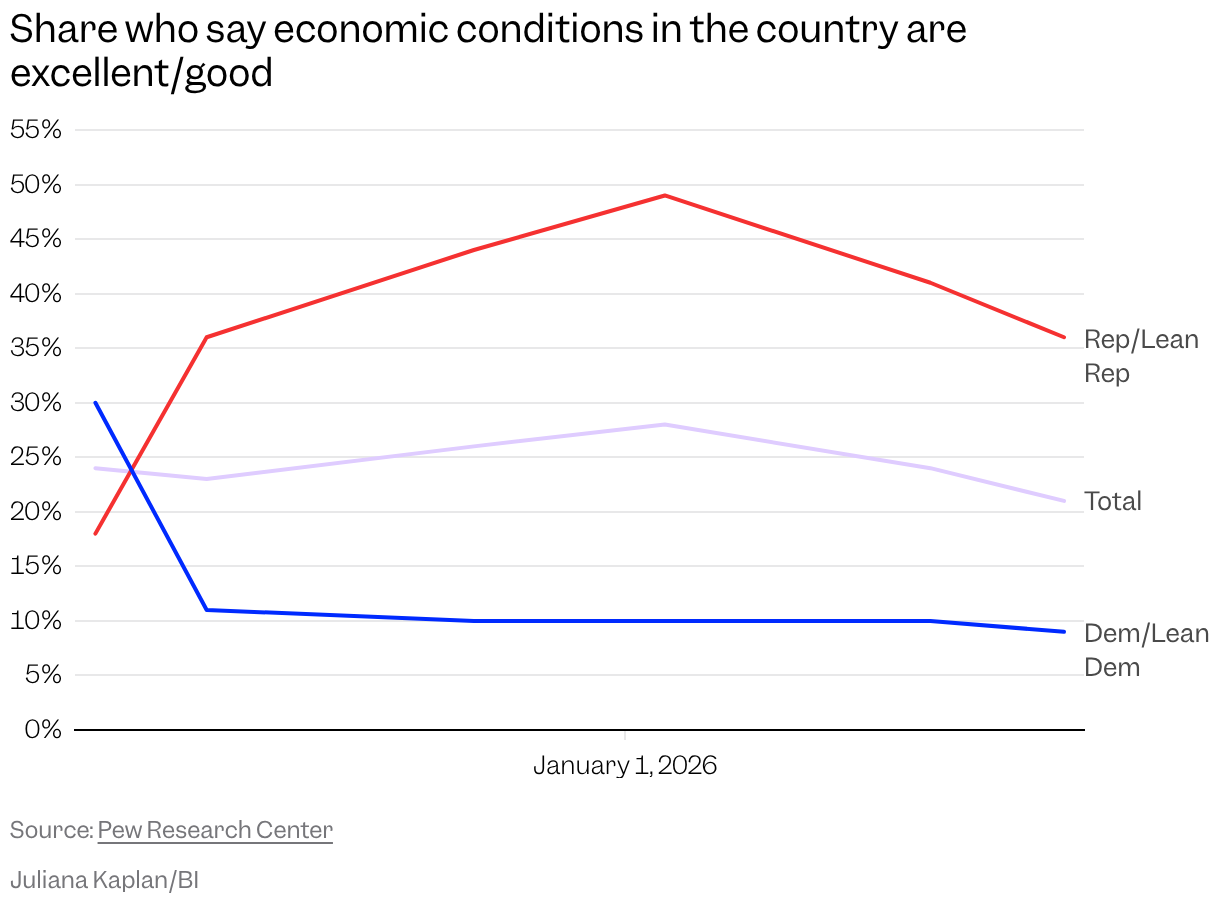
And, more broadly, Republicans seem to be souring on economic conditions. A Pew Research survey of 5,062 American adults from September 28 to October 4 found that Republicans, and those who lean Republican, were becoming less likely to say that economic conditions in the country are good.

Line chart

Historically, consumer sentiment and surveys asking voters about economic conditions tend to have strong partisan correlations. Democrats are more likely to say that the economy is doing well and they're optimistic about the future when a Democrat is president; Republicans do the same when the GOP holds the White House.

The shift in Republican sentiment illustrates just how bad Americans at large are feeling about the economy. A similar downshift happened among Democrats amid the inflationary spike during President Joe Biden's term.

"President Trump has implemented an aggressive, pro-growth economic agenda that has blunted Biden's historic 40-year high inflation crisis, driven economic growth, increased wages and created private-sector jobs in areas that had been hollowed out and shipped overseas," White House spokesman Matthew Middleton said in a statement. "The President has always been clear about temporary disruptions as a result of the Iran conflict, but this administration will continue to deliver economic wins for the American people over the next two years."

While 18% of Republicans surveyed by Pew in January 2026 said that President Donald Trump's economic policies have made economic conditions worse, that share grew to 35% in October 2026. Similarly, an increasing share — 14% in January versus 25% in October — said that they expect economic conditions to be worse a year from now.

Similarly, polling from SSRS's Economic Attitudes Tracker found that Republicans are now more likely to describe the economy as bad than good — and the share of Independents who think the economy is good has plummeted to 12%, compared to a high of 25% in August 2025.

The cost concerns come as Iran War volatility — and the resulting fallout on energy prices — kept inflation high. In September, the consumer price index accelerated more than anticipated, with skyrocketing energy prices driving the increase. That means that, for the sixth month in a row, inflation has outpaced wage increases. Meanwhile, the labor market is floundering, with the country adding a paltry 29,000 payrolls in September — a far cry from the 90,000 roles economists predicted.

Midterm Election Day is a week away, and partisan sentiment around prices is shaping up to be especially important at the ballot box. Affordability messaging has become a touchpoint in swing state elections, with lawmakers on both sides of the aisle clamoring to show how their policies have and will bring down everyday costs.

But the declining sentiment among even the Republican base could be a warning sign for conservatives: An Ipsos/Washington Post/ABC News poll found that, in April, 34% of respondents said they trusted Republicans to do a better job of handling the economy, compared to 33% saying the same of Democrats. As of October 13, that had flipped. Just 28% of respondents said they'd trust Republicans to handle the economy better, while 37% said they'd trust the Democrats.

Read the original article on Business Insider

  •  

EU Cybersecurity Revision Could Cost the Netherlands Up to 2.2 Bln Euros in First Year

Restrictions on suppliers, changes in procurement policies and replacement of existing ICT infrastructure affect supply chains.

On Tuesday, SEO Amsterdam Economics reported that a proposed revision of the European Union’s Cybersecurity Act, known as CSA2, could lead to losses ranging from 290 million euros (US$324 million) to 2.2 billion euros (US$2.46 billion dollars) for Dutch businesses in the first year of implementation.

RELATED:

Artificial Intelligence Pioneers Call for International Body to Oversee Cybersecurity Standards

The report, titled The Price of Security and commissioned by the Netherlands China Business Council (NCBC), cautions that the impact could extend beyond businesses directly affected by the restrictions, spreading through supply chains and hitting firms in other sectors of the Dutch economy.

The legislation was proposed by the European Commission at the beginning of this year. The draft introduced “non-technical risks” in the name of cybersecurity and supply chain security.

In particular, the draft would identify “countries posing cybersecurity concerns” and “high-risk suppliers,” and exclude listed countries and suppliers from relevant EU supply chains across 18 sectors, including energy, transport, and information and communications technology.

However, the economic implications of restricting suppliers could be substantial, particularly for businesses that rely on existing information and communications technology infrastructure and have limited short-term alternatives, according to the report.

🚨🇪🇺 BREAKING: Critical software vulnerabilities trigger government website shutdowns across at least SIX European countries, affecting public authorities, hospitals, schools and critical infrastructure.

Two severe security flaws have been discovered in PHP, one of the world's… pic.twitter.com/Z89nsKbVsK

— Coffe Report (@CoffeReport) October 21, 2026

Companies may also need to modify existing systems, adjust production processes and reorganize supply chains to accommodate replacement products. These changes could generate additional costs beyond the losses estimated in the report.

“Security measures do not exist in an economic vacuum,” NCBC Chairman Jochum Haakma said at a seminar on the report on Monday, adding that restrictions on suppliers, changes in procurement policies and the replacement of existing ICT infrastructure can affect entire supply chains, investment decisions and ultimately the competitiveness of the European economy.

In a letter to parliament on June 19, Dutch Minister of Justice and Security David van Weel said the government was concerned about the European Commission’s proposed power to designate entire countries and suppliers as high-risk, citing potentially far-reaching economic, legal and geopolitical consequences, as well as insufficiently clear and detailed criteria and procedures.

The report notes that restrictions on supplier choice could also yield other adverse consequences, as diminished competitive pressure may result in higher prices, lower quality and reduced innovation.

“Strategic autonomy is an important European ambition, but autonomy should not lead to isolation,” Haakma noted.

teleSUR/ JF

Source: Xinhua

  •  

EU plans massive investment in Australia’s critical minerals to cut dependence on China

The EU plans ‘massive’ investment in Australia’s critical minerals sector as it seeks to make Canberra a major partner in reducing the bloc’s current reliance on China. 

“Since we wish to diversify away from China, then one of the most likely partners has to be Australia,” said the EU’s ambassador to Australia, Lawrence Meredith, who added that the bloc’s security and defence partnership, agreed with Canberra earlier this year, also relies on co-operation on critical minerals. 

Speaking at the International Mining and Resources Conference in Sydney on Tuesday (27 October) Meredith said that the bloc would be “massively investing in critical minerals.” 

EU and Australian trade officials are currently working on a bilateral trade agreement, with a view to concluding negotiations in early 2027, and a Memorandum of Understanding on critical minerals access is set to be part of it. 

Australian officials appear eager to partner with the EU. 

On Tuesday, Australia’s resources minister Madeline King said that it would revamp its own critical minerals strategy to put greater emphasis on refining and processing in an attempt to curb China’s dominance. 

This article continues, but the full version is available only to EUobserver.com subscribers. Visit account.euobserver.com/membership

  •  

Over 28 million tourists visited Greece in Jan-Aug; revenues up by 9.4%

The number of tourists visiting Greece surpassed 28 million in the period January-August 2026, marking a 10% increase compared to the corresponding period last year. According to data released by the Bank of Greece (BoG), this development resulted in tourism revenues rising by 9.4% this year, exceeding €18.1 billion. Receipts from residents of EU-27 countries […]

The post Over 28 million tourists visited Greece in Jan-Aug; revenues up by 9.4% appeared first on Keep Talking Greece.

  •  

The Fed Is Expected to Hold Rates Steady. Warsh Will Have to Explain Why.

Inflation is moving in the wrong direction and the labor market remains stable, a combination that bolsters the case for higher interest rates.

© Athit Perawongmetha/Reuters

Kevin M. Warsh, chairman of the Federal Reserve, said that the central bank had more work to do to tame inflation, but that there was no urgency to raise rates at consecutive meetings.
  •  

Pragmatism and Strategic Autonomy: The Future of Russia-India Economic Cooperation

Russia-India relations traditionally rest on long-term political confidence. At the same time, the priority is currently transferring this political confidence to the commercial sector. Future cooperation will be determined not so much by declarations of friendship as by the ability of the two countries to create reliable banking channels, efficient settlements in national currencies, predictable […]
  •  

Italy: Employment hits record high as Meloni touts tourism, ‘Made in Italy’

Italy has hit record-high employment of over 63 percent and historic low unemployment of 6.3 percent amid a major welfare overhaul led by Prime Minister Giorgia Meloni. By Q2 2026, the workforce expanded to 24.36 million people.

In January 2024, Italy completely replaced its old guaranteed minimum income with two targeted programs. Averaging €672/month for 690,000 vulnerable households (elderly, disabled, families with kids), as of June 2026, active benefits are tied to mandatory job training, covering over 84,000 individuals, writes La Gaceta, citing data out of Istat.

Of former welfare recipients, 60 percent transitioned to the new benefits, and 26 percent of these households had at least one member find a job in 2024. However, around 850,000 families saw their income drop by an average of €2,600 per year due to stricter welfare criteria.

Especially in historically lagging Southern Italy (Mezzogiorno), the results have been impressive. The region grew 8.5 percent between 2021 and 2024 and creating nearly 500,000 jobs via tourism, construction, and EU funds.

Italy’s employment rate still lags 8 percentage points behind the eurozone average, bogged down by low youth and female workforce participation.

Backed by strong employment and business resilience, Scope Ratings affirmed Italy’s BBB+ rating with a positive outlook. The agency forecasts 1 percent GDP growth, 3 percent inflation, and a reduced public deficit of 2.9 percent for 2026, noting positive consumption while low productivity remains a weak spot for the country.

Real GDP growth for 2026 for all of the EU is forecasted at 1.1 percent.

Last month, Italian PM Giorgia Meloni touted tourism and “Made in Italy” exports as key factors for helping the economy stay resilient.

The post Italy: Employment hits record high as Meloni touts tourism, ‘Made in Italy’ appeared first on Remix News.

  •  

Trump approval ticks up to 32 percent: Survey 

President Trump’s approval rating inched up by 1 point from a record low last week, according to a new poll. The Reuters/Ipsos survey, released Monday, found 32 percent of U.S. adults support the president’s job performance, while 66 percent disagreed. This is a slight uptick from the pollster’s previous findings, which showed Trump with a…

  •  

Farming ministers agree on more national control of EU funds as part of CAP reforms

Ministers want to speed up and simplify the payment of farming subsidies by taking control of the EU’s multi-billion euro farming payment schemes, under a deal reached late on Monday night (26 October).  

The agreement at a meeting of EU agriculture ministers in Brussels finalises the negotiating position of EU governments on the future of the bloc’s Common Agricultural Policy in its next seven-year budget. 

The ‘negotiating box’ prepared by the Irish EU council presidency earlier this month for the 2028-34 multi-annual financial framework spared agricultural subsidies provided by the common agricultural policy from cuts worth a total of €141bn but proposed three-percent cuts, worth €24.6bn, to funding for National and Regional Partnership Plans (NRPP), which are intended to streamline the distribution of EU cash to governments for a variety of different policies including agriculture and fisheries. 

The idea behind the NRPPs is to set up one single fund to provide support for farmers.

Each EU country would be expected to develop a single comprehensive plan outlining the reforms and investments it intends to implement from 2028 to 2034 and how it plans to use EU funds. 

EU governments agreed on Monday that this planning process should be designed to give them far greater autonomy. They say that the recommendations the commission makes to member states regarding the design of support programs should not be binding.  

The new system is set to prioritise ‘active farmers’, which sets a threshold of a minimum level of agricultural activity for farmers, as well as young farmers and small farmers. 

This article continues, but the full version is available only to EUobserver.com subscribers. Visit account.euobserver.com/membership

  •  

War Will Cover Up the Losses: How Europe’s Crises Are Fueling Escalation with Russia

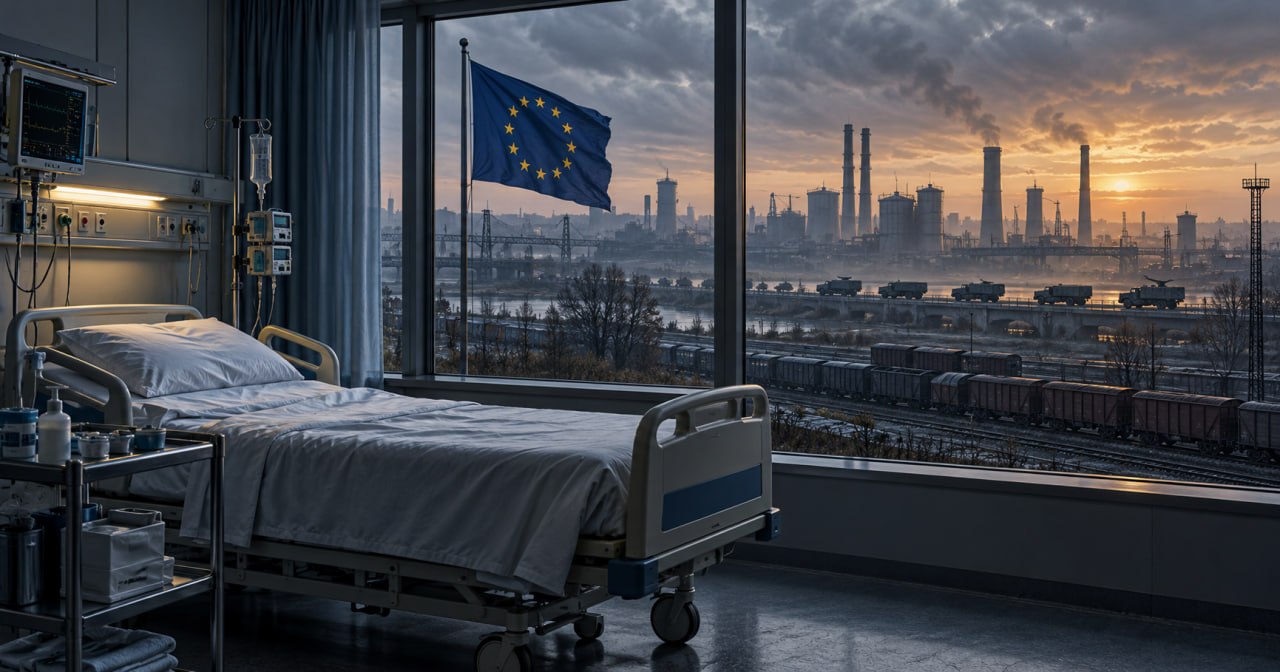
Click to see the full-size image

Europe and Russia are entering a phase in which diplomatic expulsions and explosives-laden drones at airports are no longer treated as exceptions. Germany is openly preparing its hospitals for an influx of wounded personnel, while the assessed threat of sabotage has officially been raised. Meanwhile, expensive energy and competition are costing European industry production capacity and jobs. Under these conditions, an external conflict offers a convenient way to blame economic failures on a foreign enemy. The question is no longer whether escalation is taking place, but how far the two sides are prepared to go before it slips beyond their control.

The autumn of 2026 has brought a series of developments that take the confrontation between Russia and Europe beyond the familiar boundaries of ‘hybrid warfare’. In August, drones carrying explosives were discovered at Leipzig/Halle Airport. The German authorities formally blamed Russia, describing the incident as ‘crossing a red line’ with potentially lethal consequences. Berlin closed Russia’s consulate-general in Bonn and its cultural center. Moscow responded by closing the German consulate in St. Petersburg.

In September, another drone carrying explosives was found near Wunstorf airbase. The Bundeswehr subsequently raised its assessment of the threat from Russian sabotage to ‘significant’, the second-highest level, for the first time. German intelligence services warn that further attacks are likely. Meanwhile, arson attacks have been reported at drone manufacturing facilities in Estonia, Poland and Slovakia, alongside drone incidents over military installations and civilian airports across Europe.

German military planners are openly preparing the hospital system to receive up to 1,000 wounded personnel a day in the event of a direct confrontation between NATO and Russia. Underground medical bunkers are being brought back into service, including one in Ulm with capacity for 2,000 people. Civilian surgeons are being trained to treat blast injuries and burns, while coordination between military and civilian hospitals is being strengthened. Diplomatic expulsions, consular closures, accusations of sabotage and preparations for mass casualties together suggest that both sides are already operating according to the logic of an ‘undeclared war’.

Military and diplomatic tensions, however, are only one part of the picture. The economic conditions in which this escalation is unfolding, and the political purpose it serves, are more consequential.

Europe’s economy is facing a deep structural crisis that can no longer be concealed behind reports celebrating the ‘green transition’. TTF benchmark gas prices are hovering around €87–88 per MWh, approximately 174% higher than a year earlier. EU gas storage facilities are just 71–74% full, among the lowest mid-October levels of the past decade, compared with around 83% last year. Germany’s position is even weaker, with storage levels fluctuating around 57–60%.

Electricity and fuel costs are putting pressure on the entire supply chain. Annual energy inflation reached almost 19% in September, while average diesel prices across the EU climbed to €2.14–2.23 per liter. Industrial energy costs are four to five times those faced by American competitors. Chemical plants and metal producers, particularly in Germany and northern Italy, are being forced to cut output or shut down production facilities. Industrial production in the eurozone continues to fall; in Germany, it is already almost 10% below its 2021 level. Industry’s share of EU GDP has declined from 17.4% to 14.3%.

The pressure extends to agriculture. Fertilizer prices have risen by more than 13%, while farmers’ energy costs have increased by around 22%. At the same time, the prices farmers receive for their produce are falling. This raises the risk of a poorer harvest in 2027 and a second wave of food inflation. Farmers in several countries are already warning that their operations are becoming commercially unviable, while transport costs are making many deliveries unprofitable.

The situation resembles a familiar scheme: a warehouse owner who has spent years stealing stock eventually sets fire to the building and tells investigators that everything was destroyed ‘by accident’. European governments have spent years pursuing policies that have made energy expensive, imposed excessive regulation and applied sanctions whose heaviest impact has fallen on their own industry and agriculture. Now, as gas, electricity, diesel and fertilizer bills squeeze businesses and households, and Chinese competitors capture market share, an external conflict offers a convenient excuse.

War, or even the prospect of war, allows rising prices, factory closures, cuts to social spending and budget shortfalls to be blamed on an ‘external aggressor’. Instead of acknowledging mistakes in energy and industrial policy, governments invoke the ‘price of freedom’ and the ‘defense of democracy’. The further tensions escalate, the easier it becomes to explain to the public why housing, food and heating cost more, and why industrial jobs are disappearing.

The current situation brings together two parallel developments. Tensions are rising through sabotage incidents, diplomatic expulsions, higher threat assessments and preparations for hospitals to receive large numbers of wounded personnel. At the same time, European elites need a convenient external explanation for economic failure. High gas and electricity prices, low storage levels, expensive diesel, rising fertilizer costs and shrinking industrial output are already a reality. Escalation creates political capital for those responsible for costly mistakes in energy and industrial policy over recent years. It allows them to shift the discussion from domestic policy failures to an ‘external threat’, postponing accountability.

This logic itself increases the risk of an uncontrolled shift from ‘hybrid’ operations to direct confrontation. As long as European governments prefer preparing hospitals for thousands of casualties to reconsidering their energy and industrial policies, the practice of ‘burning down the warehouse to conceal the missing stock’ continues. The remaining question is how far the two sides are prepared to go before the cost becomes too high for European societies themselves.


MORE ON THE TOPIC:

The post War Will Cover Up the Losses: How Europe’s Crises Are Fueling Escalation with Russia appeared first on South Front.

  •  

Europe’s Electricity Price Divide Exposes Limits of the Single Energy Market

Europe’s electricity market recorded substantial regional differences on Tuesday, 27 October, with average wholesale prices ranging from approximately €6 per megawatt-hour in northern Sweden to more than €255 in Romania.

The figures reveal a persistent difficulty for European energy policy: although the continent has an increasingly interconnected electricity market, businesses and consumers remain exposed to very different underlying wholesale costs depending on location.

According to European day-ahead electricity market data, Sweden’s SE2 bidding zone recorded an average of €6.23 per megawatt-hour, while Finland stood at approximately €6.65. Romania reached €255.20, roughly 41 times northern Sweden’s price. Bulgaria registered approximately €254, Hungary €241 and Greece €225. Germany recorded approximately €155, Belgium €160 and France €162.

These are wholesale prices for delivery on 27 October, not final bills for households or businesses. Their differences nevertheless raise questions about how effectively Europe’s electricity networks distribute power from areas of lower-cost generation to those facing greater costs.

Why a common market produces different prices

European electricity trading is organised through interconnected national and regional markets. Cross-border capacity allows relatively inexpensive power to reach regions where demand is greater or local generation is more expensive.

When transmission capacity is adequate, neighbouring prices can converge. Physical networks, however, have limits. Congested interconnectors can prevent additional imports even when large price differences exist.

Other influences include availability of power stations, renewable output, fuel prices, consumption and system stability. Regions with substantial hydropower, nuclear generation or strong renewable production may experience comparatively low prices. Markets relying on gas-fired generation can be more expensive when gas plants are needed to satisfy the final increment of demand.

The result is a market responding to common European conditions but still shaped by local generation and transmission constraints.

Southeastern Europe’s structural constraints

The European Union Agency for the Cooperation of Energy Regulators, ACER, has repeatedly examined the causes of regional price divergence. In its 2026 assessment of cross-zonal electricity trade, the agency considered unusually high prices and limited access to lower-cost power in southeastern Europe.

Constraints include available cross-border capacity and shortages of flexible generation able to respond to changing renewable output, especially in the evening. Countries including Greece, Bulgaria, Romania, Hungary, Croatia and Slovenia have encountered substantial regional differences.

Those findings do not prove the cause of each price movement on 27 October. They do, however, explain why disparities can persist despite common market rules. ACER has advocated improved coordination among transmission operators, more effective use of existing networks and additional flexibility through storage and demand management.

Industrial consequences of expensive electricity

Energy-intensive industries, including steel, chemicals and fertiliser production, are particularly sensitive to electricity costs. Where contracts are exposed to wholesale markets, sustained regional price differences can influence output and investment decisions.

The relationship between wholesale prices and bills is not immediate. Firms may hedge prices, use long-term contracts or produce their own power. Network charges, taxes and government support also affect the amount paid. Still, persistent market differences can shape industrial competitiveness.

As EU Today reported, EU energy ministers are due to examine proposed changes to electricity network charges and market administration on 29 October. Network tariffs are distinct from wholesale prices, but both affect total electricity costs.

Renewables and the need for flexible networks

According to ACER’s energy-market monitoring, renewable sources represented around half of EU electricity generation in 2025. Solar energy can reduce prices during the day, but output falls sharply towards evening, sometimes requiring more expensive power stations to increase generation.

This increases the value of storage, flexible production, responsive demand and international connections that can balance surpluses and shortages between regions. Yet major transmission lines can take years to complete owing to planning, permitting, investment and construction requirements.

The priority is therefore not simply to install more renewable capacity. Europe’s grids and supporting technologies must be capable of moving and using that output efficiently.

What the price divide reveals

A single day’s wholesale prices should not be mistaken for long-term average electricity costs or a permanent competitive advantage. Nevertheless, the persistence of regional disparities documented by regulators shows the problem extends beyond isolated daily volatility.

For EU institutions, the question is whether further market integration can make energy more affordable while preserving incentives to invest in generation and transmission. National governments must balance security of supply, infrastructure financing and industrial competitiveness.

Electricity trading across Europe is increasingly integrated. The physical systems supplying it remain considerably less uniform. Until those constraints are addressed, the price of power will continue to reflect geography as well as the underlying cost of energy.

  •  
❌