Obamacare Dealt Yet Another Blow as Premiums Rise Again

© Scott McIntyre for The New York Times

© Scott McIntyre for The New York Times

Large numbers of Sahrawi citizens took to the streets in El Aaiún, the largest city in Western Sahara, on Monday, to demand a just United Nations-sponsored solution that guarantees their right to freedom, self-determination, and independence. The demonstrations come as the United States allegedly pushes a draft UN Security Council resolution that would make Morocco’s autonomy plan the sole basis for negotiations over the future of the territory.
The US-drafted text, reportedly circulated among Security Council members on October 22, has drawn strong objections from the Polisario Front, the Sahrawi independence movement, as well as human rights and solidarity organizations. Arguing the proposal risks predetermining the outcome of negotiations by placing Morocco’s plan over Western Sahara at the center of the process, rather than allowing the Sahrawi people to freely decide their political future.
The dispute comes as the Security Council considers the future of the United Nations Mission for the Referendum in Western Sahara (MINURSO), established in 1991 to support the UN-OAU Settlement Plan, which included a referendum on self-determination.
In a letter from October 22 to Aglaia Balta, Greece’s permanent representative to the United Nations and current president of the Security Council, Dr Sidi Mohamed Omar, the Polisario Front’s representative to the UN, strongly rejected the US zero-draft.
Omar said the text “fully reflects the national position of the penholder as well as that of Morocco, the occupying state,” describing it as “another extremely dangerous, unprecedented departure” from international law and the UN framework governing Western Sahara’s decolonization.
He added that the process cannot be reduced to Security Council Resolution 2797 (2025), but must be understood within the wider body of relevant UN resolutions and the original agreement underpinning MINURSO. The mission was established under Resolution 690 (1991), following an agreement between the Polisario Front and Morocco, based on the UN-OAU Settlement Plan.
According to the Polisario Front, changing the framework unilaterally would align the mission with Morocco’s position and undermine international efforts to resolve the territory’s status through decolonization.
“The non-compliance of Morocco, the occupying state, with its commitments under the UN-OAU Settlement Plan, which was adopted unanimously by the Security Council, cannot justify any infringement upon the inalienable right of the Sahrawi people to self-determination and sovereignty over their homeland,” Omar wrote.
Emphasizing that the text “cannot constitute a basis for any deliberations on MINURSO or the peace process in Western Sahara” and warned that, if it passed without “substantive and meaningful changes,” the movement “would have no choice but to disengage from the peace process as a whole.” But remains committed to a just, lasting, and definitive peace.
One of the main concerns raised by the Western Sahara Research Watch (WSRW) is the reported change in the language of the draft. The text reportedly describes Morocco’s autonomy proposal as the “only basis” for negotiations, strengthening the language of the 2025 resolution, which referred to it as “a basis.”
The WSRW argues that the difference is substantial. While autonomy could theoretically be one option freely chosen by the Sahrawi people, making Morocco’s proposal the sole basis in advance risks narrowing the political choices available to them.
The organization asks, “How can the people freely determine the territory’s future if negotiations may only take place within a model that presupposes Moroccan sovereignty?”
Going farther, the draft describes autonomy under Moroccan sovereignty as the most feasible solution. This shifts the purpose of negotiations away from determining Western Sahara’s status and towards negotiating the terms of Moroccan control.
The WSRW also warns that the draft’s references to consulting Sahrawis in the territory, in refugee camps, and throughout the diaspora do not guarantee that they will have a decisive role in determining the outcome.
“Being heard is not the same as being allowed to decide,” the organization argues.
The European Association of Lawyers for Democracy and World Human Rights (ELDH) has also called on the United Nations to uphold international law and the Sahrawi people’s right to self-determination.
The Campaign for the Right to Self-Determination of the People of Western Sahara (CODESA) has also rejected the premise that international recognition of Morocco’s claim can determine the territory’s legal status.
“Recognition by third states cannot turn occupation into sovereignty,” the organization argues.
Western Sahara remains on the UN list of Non-Self-Governing Territories. In its 1975 advisory opinion, the International Court of Justice found that the materials and information presented to it did not establish any tie of territorial sovereignty between Western Sahara and Morocco that would displace the application of self-determination through the free and genuine expression of the territory’s people.
CODESA also points to the UN General Assembly Resolution 34/37, adopted in 1979, which deplored Morocco’s continued occupation of Western Sahara and reaffirmed the right of the Sahrawi people to self-determination and independence. It further cites the UN Legal Counsel’s 2002 opinion on the legality of resource exploration in the territory and the 2024 rulings of the Court of Justice of the European Union, reaffirming Western Sahara’s separate and distinct status from Morocco.
CODESA maintains that a political outcome cannot be declared in advance and then presented as self-determination. It invokes UN General Assembly Resolution 1541 (XV), which sets out principles relevant to the exercise of self-determination, including that integration with another state must result from the freely expressed wishes of the people through an informed and democratic process.
The organization also objects to the United States’ prominent role as facilitator, arguing that a mediator that has already recognized Morocco’s claim cannot be assumed to be impartial. It maintains that negotiations must allow the parties to present their positions without imposing one party’s proposal as the only acceptable framework.
“Negotiations in which only the occupying power’s proposal may be discussed are not negotiations; they are terms of surrender offered to the occupied people,” CODESA says.
Over the years, Morocco’s autonomy plan for Western Sahara has gained diplomatic support as several countries have shifted their positions towards recognizing Moroccan sovereignty over the disputed territory rewarded by trade deals. But these diplomatic changes have not resolved the central question of Western Sahara’s future, and the right of the Sahrawi people to determine their own political status.

RT | October 30, 2026
Dockworkers across five continents have launched a coordinated anti-war strike, targeting Israeli arms shipments, US military cargo, and the growing militarization of civilian ports.
Organizers say more than 25 unions are mobilizing across 113 ports in 22 countries and regions on Friday in an unprecedented international action. The campaign includes 24-hour strikes, shorter walkouts, blockades, and solidarity rallies.
Major European ports joining the action include Genoa, Marseille, Le Havre, Hamburg, Valencia, Barcelona, and Piraeus. Beyond Europe, protests are planned at Tangier Med in Morocco, Nhava Sheva and Chennai in India, and Oakland and San Francisco in the US, with further actions across Türkiye, Cyprus, Sweden, Denmark, Ireland, Portugal, Brazil, Mexico, and Australia.
France’s CGT Ports et Docks has called 24-hour strikes across 24 ports, while Italy’s USB has declared a nationwide general strike, with protests in more than 40 cities. Unions in Germany, Greece, Spain, India, and the US are also taking part.
Dockworkers at Piraeus, Greece’s largest port, were among the first to join the action, with a three-hour stoppage scheduled from 08:00 to 11:00 GMT. Other Greek maritime unions announced 24-hour strikes affecting seven ports, threatening ferry services to the country’s islands.
Videos of demonstrations and gatherings at other ports have emerged online, although the full extent of the disruption to shipping operations remains unclear as actions are taking place at different times.
What do the dockworkers want?
The unions demand a halt to weapons, ammunition, military equipment, and troop shipments through commercial ports, targeting both Israeli and US military supply chains. They also oppose turning civilian ports into military hubs and diverting public funds into rearmament while workers face stagnant wages, job insecurity, and worsening conditions.
“From planes to tanks, guns to bullets, explosives to ammunition, uniforms to boots, our ports have become replenishing and forwarding bases for war and genocide,” the organizers said at a press conference on October 15 in Rome.
The unions accused governments and shipping companies of keeping military supply routes open despite the Gaza ceasefire announced over a year ago, which they say has been rendered largely meaningless by continued Israeli strikes.
‘No Harbour for Genocide’, the campaign coordinating the action, claims that it tracked 315 shipments of components for Israeli arms manufacturer Elbit Systems through 56 ports in 29 countries over 14 months. It says it identified 3,400 shipments of US military cargo through 67 ports in 42 countries over ten months. The group also says US military cargo volumes at some European ports rose as much as tenfold following the start of the US-Israeli war against Iran. The figures have not been independently verified.
Organizers estimate the action could delay 40,000 containers carrying cargo worth over $2 billion, potentially costing shipping companies up to $43 million.
Is it the first strike of this kind?
Dockworkers have challenged military shipments for years, though resistance was largely scattered and localized. Since 2019, workers in Italy, Greece, Morocco, and France have staged sporadic blockades and stoppages, targeting arms shipments to Israel, US bases, and other conflict zones.
The movement gained momentum in late 2025 after Israel intercepted the Global Sumud Flotilla, a 40-plus-vessel convoy attempting to deliver aid to blockaded Gaza. Hundreds of activists were detained, sparking strikes and port blockades across Europe. The flotilla campaign also pledged to join the action on Friday with “coordinated, strategic actions on the water.”
International coordination intensified in February, when dockworkers at more than 20 ports across seven countries staged their first joint day of action, reportedly stopping five suspect ships.
In May, dockworkers’ unions from France, Greece, Italy, Türkiye, Morocco, and Spain’s Basque Country adopted the Istanbul Declaration, in which they pledged to block military cargo and troop shipments to war zones, including those supporting Israel and US military operations. The agreement laid the groundwork for Friday’s global strike.
If Western nations keep attempting to "inflict a strategic defeat" on Moscow they may get a war instead, Putin threatened.
The post Putin Warns Russia is Ready For War With Europe, Would Turn Baltic Sea Into Second Strait of Hormuz appeared first on Breitbart.

The US is delaying PAC-3 interceptors for Ukraine’s Patriot air defense systems while older PAC-2s keep arriving, a NATO source told Radio Svoboda on 29 October. PAC-3 is the Patriot missile built mainly to stop ballistic missiles.
The delay comes as Russia leans on ballistic missiles against the capital. In two weeks, Russia launched more than 100 at Kyiv and Kyiv Oblast, President Volodymyr Zelenskyy said in his 27 October evening address. “And above all, we do not have enough missiles for Patriots,” he added. On 29 October, Zelenskyy said Ukraine has intelligence that Russia is preparing new ballistic missile attacks. Kyiv is “awaiting the relevant decisions” on interceptor packages, “primarily for Patriots,” he said.
The PAC-2s, used mostly against aircraft and cruise missiles, arrive through PURL, the NATO mechanism under which allies pay for US weapons for Ukraine. The PAC-3 delay is under discussion at a high political level, the NATO source said. It is unclear when the situation will change.
On 20 October, Hegseth said in Wisconsin: “We haven’t changed our posture in any way toward the Ukrainians, but certainly with things like interceptors, we want to make sure our guys have the most possible as well.”
“We haven’t changed our posture in any way toward the Ukrainians, but certainly with things like interceptors, we want to make sure our guys have the most possible as well.” Hegseth said in Wisconsin
The same day, Secretary of State Marco Rubio conceded that some interceptors bought for Ukraine through PURL may not have been delivered, Reuters reported. “There’s nothing being deliberately denied to Ukraine,” he said, adding: “We have our own needs, too.”

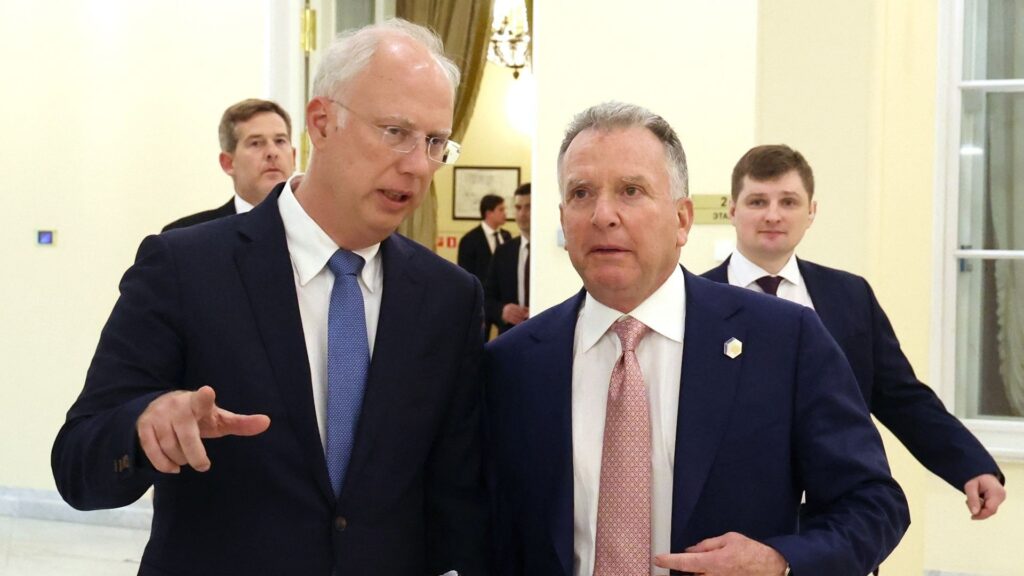
The Trump administration is assessing an application from the Russian Direct Investment Fund (RDIF) to be removed from the US sanctions list, a US official told The New York Times (NYT). A day later, Kremlin aide Yuri Ushakov said the two sides were in talks over it.
Washington has been easing pressure on Moscow piece by piece. On 9 October, the Treasury issued a general license allowing sales of Russian diesel, including into the US. A week later, President Trump waived new sanctions under the Graham Act, a Russia sanctions law he had signed on 18 September. Meanwhile, Kyiv is still waiting for the next round of three-way peace talks. Freeing a Kremlin fund now would lift another cost from Moscow before any settlement on Ukraine.
The fund is run by Kirill Dmitriev, Vladimir Putin’s envoy in talks with Washington. The official said the administration was weighing the application through established procedures, as part of an effort to “improve US-Russia relations and help end the war.”
The official also praised Dmitriev as “a helpful envoy.” Russian officials pushed for delisting during talks on the fund’s role in shipping Russian diesel to the US, people familiar with the negotiations told the NYT. The Treasury, however, held that its 9 October license already let the fund handle diesel transactions, the paper reported.
Ushakov described a two-way conversation rather than a review. He said on 28 October that it had been going on for some time and that he did not know the outcome. He pointed in particular to Dmitriev’s active contacts, saying that was why the issue had come up.
The Treasury fully blocked the fund and Dmitriev on 28 February 2022, four days after Russia launched its full-scale invasion. At the time, it said the fund was widely considered a slush fund for Putin. The Treasury is handling the new request under its normal process, and the fund will have to prove the grounds for its sanctions no longer apply, people familiar with the process told the NYT.
Eric Green oversaw Russia policy at the White House National Security Council under President Joe Biden. He told the paper that lifting the sanctions would send a strong message. In his view, Washington would be relaxing its position of not easing sanctions and other costs until a settlement in Ukraine.
This is not Dmitriev’s first push this year. On 7 February, Zelenskyy said Ukrainian intelligence had shown him a so-called “Dmitriev package” of US-Russia cooperation, worth about $12 trillion, that Dmitriev presented in the US. In April, he arrived in Washington as a US oil waiver for Russia neared expiry. US delisting would not touch UK and EU restrictions on the fund. But it would reopen American finance to a fund the Treasury said Putin’s inner circle relied on to raise money abroad.
par Francesca DE VILLASMUNDO
Le président ukrainien Volodymyr Zelensky a fermement mis en garde les dirigeants européens contre toute tentation de lever ou d’alléger les restrictions visant Moscou.
La côte du président ukrainien Volodymyr Zelensky est en chute libre aux États-Unis
Lors du sommet européen tenu à Bruxelles les 15 et 16 octobre 2026 et dans un entretien vidéo de ce même mois octobre, le président ukrainien Volodymyr Zelensky, dont la côte aux États-Unis est en chute libre, a mis fermement mis en garde les dirigeants européens, ses derniers alliés sur la surface de la terre. Alliés de plus en plus esseulés et eux aussi dans la ligne de mire de Donald Trump, qui peut leur couper les vivres énergétiques comme bon lui semble en raison de leur obstacle à la paix en Ukraine. Car, après s’être coupés du gaz et pétrole russes, à peu près 50% de leurs ressources énergétiques, les Européens se sont tournés vers le géant américain, dont ils dépendent maintenant pour une trop large part.
Sentant le vent tourné contre lui, Zelensky a donc menacé les Européens, si ceux-ci venaient à lever les sanctions contre la Russie, sans tenir compte qu’il dépend cependant grandement d’eux pour le financement de son pays ruiné et les armes.
Menaces de Zelensky contre les Européens s’ils suivaient les traces des États-Unis : «Nous réagirions définitivement»
Ainsi, ce dernier a-t-il déclaré lors de ce sommet et dans cet entretien vidéo :
«Pour l’instant, je ne vois aucun grand pays européen sérieux — et je le dis sérieusement pour tous les pays — dont l’économie européenne soit au point mort. Les pays à forte économie ont une plus grande influence aux États-Unis. C’est pourquoi je ne vois aucune demande immédiate de leur part concernant la levée des sanctions et le rétablissement des alliances énergétiques avec la Fédération de Russie. Je ne le vois pas car nous réagirions. Je réagirais».
«Nous réagirions définitivement», a-t-il lancé avec gravité à l’adresse de l’Europe si une telle décision venait à être prise.
En résumé, le président déchu affirme qu’à l’heure actuelle, aucun pays européen majeur et sérieux ne lèvera les sanctions contre la Russie ni ne rétablira les partenariats énergétiques avec Moscou. Cependant cette hypothèse doit tout de même être discutée dans les couloirs feutrés des chancelleries, et entre Washington et l’Union européenne, pour qu’il se permette de lancer des menaces, vagues et donc potentiellement dangereuses, envers les Européens dont qu’il dépend cependant grandement pour le financement de son pays ruiné et les armes. Mais l’impudence est le fait des ingrats et des corrompus, ce qu’est décidemment le président ukrainien…
source : Médias-Presse-Info
Publié à l’origine par Réseau International
Flávio, un cascarón vacío, puede haber perdido unas elecciones. Sin embargo, la máquina infernal que lo respalda nunca se dará por vencida.
Pepe ESCOBAR
Únete a nosotros en Telegram
, X
y VK
.
Escríbenos: info@strategic-culture.su
No significa nada si no tiene ese ritmo brasileño. Lo que está en juego no podría ser más alto: es una cuestión de vida o muerte. Así que los brasileños salieron a las calles —y a las casillas electorales— y lograron salir adelante.
No hicieron nada menos que domar a la Madre de Todas las Guerras Híbridas y derrotar, aunque fuera momentáneamente, a una coalición poderosa y tóxica que incluía toda la fuerza de la administración de la «Doctrina Donroe»; el tecnofeudalismo de Silicon Valley, especialmente impulsado por Meta; Wall Street y la Diosa del Mercado; los múltiples tentáculos de Zionism Inc.; las viejas élites reaccionarias —y sus medios de comunicación—; las nuevas élites ostentosas; la demencia evangélica; y, por último, pero no menos importante, una mediocre dinastía neofascista empeñada en convertir a Brasil en una neocolonia extractivista en beneficio de «La Voz de Su Amo».
El efecto —tranquilizador— es similar al de un himno de bossa nova de Antônio Carlos Jobim cantado por Frank Sinatra.
Sí, Brasil es demasiado grande —y demasiado indómito— para ser el patio trasero de nadie. Y qué giro tan radical, en lo que respecta a Lula personalmente: la geopolítica no ha visto un regreso como este desde la Batalla de Stalingrado.
Perdimos: así que la elección estuvo «amañada»
El día de las elecciones amaneció en un clima de gran tensión —pero con Flávio Bolsonaro aún con un 82 % de posibilidades de ganar, según Polymarket, los favoritos de la DARPA. Es como si el Estado profundo supiera el resultado de antemano —tal como en la primera ronda de votación—.
Sin embargo, al final Lula ganó por 4.4 millones de votos. No sin mucho drama. Justo antes de que cerraran las urnas, un juez de la Corte Suprema —quien anteriormente había sido el abogado personal de Lula durante el caso de corrupción «Lava Jato»— extendió el horario de votación en todo el país por dos horas.
El tribunal electoral debería haber tomado una decisión al respecto. No lo hizo porque otro juez de la Corte Suprema —nombrado por Bolsonaro— estaba demorando el proceso.
La prórroga fue vital, porque para entonces ya se había demostrado que los alcaldes bolsonaristas estaban obstaculizando deliberadamente el transporte público, especialmente los autobuses, en bastiones de Lula como Salvador, en Bahía: una táctica sacada directamente del manual de sabotaje oligárquico, utilizada para suprimir el voto popular.
El dato clave es que ambas campañas habían solicitado una extensión del horario de votación. Y eso desmiente por completo las afirmaciones de los imbéciles bolsonaristas y vinculados al movimiento MAGA de que la elección estuvo «amañada».
Como era de esperarse, Flávio Bolsonaro se niega a reconocer la derrota y quiere que se anule la elección. Eso no sucederá —según el mismo juez designado por Bolsonaro que, para empezar, estaba dando largas al asunto—.
En la segunda vuelta, Lula aumentó su total de votos en más de 10.1 millones, mientras que Bolsonaro solo obtuvo 3.6 millones más. A eso se suma algo casi improbable: hubo más de 1.8 millones menos (cursiva mía) votos nulos y nulos en comparación con la primera vuelta —y la abrumadora mayoría fue para Lula.
Varias razones explican el desempeño del «niño del regreso» —o del «abuelo»—. Empezando por una movilización popular masiva: la abstención bajó del 21,08 % al 19,21 %. Casi 3 millones de personas más acudieron a las urnas.
Lula amplió sus márgenes donde era fuerte —en el noreste— y redujo sus pérdidas en el acaudalado sureste.
La campaña de Lula llevó a cabo una importante autocorrección: en lugar de enfocarse en el pasado —los resultados concretos de su gobierno—, comenzó a hablar de la cruda realidad actual: la economía familiar; los enormes niveles de endeudamiento; el costo de vida; los salarios; e incluso presentó propuestas concretas para los próximos cuatro años.
La campaña de movilización digital fue digna de atención, con un arma letal desatada en WhatsApp: el canal «El Ejército de Lula», que pasó de unos 50 000 seguidores a la impresionante cifra de 10 millones en menos de tres semanas: una infantería digital de facto. Brasil es una de las naciones más conectadas del planeta.
Encabezada por el recién elegido diputado André Janones, la campaña demostró cómo Lula venció al hegemón tecno-feudalista Meta en su propio terreno: la estrategia será estudiada en los anales de la ciencia política por generaciones.
Y luego está la asombrosa incompetencia de Flávio Bolsonaro: una mezcla letal de arrogancia e ignorancia que simplemente no se podía vender como una alternativa moderada.
Apenas dos días antes de la segunda vuelta, durante el último y crucial debate, Bolsonaro, en vivo, frente a toda la nación y a millones de votantes indecisos, llamó a Lula «el de los nueve dedos», burlándose de su discapacidad física.
Lula preparó la respuesta en tiempo real como una cobra. Recordó cómo perdió su dedo meñique a los 19 años en una prensa de metal, víctima de la precariedad y la falta de seguridad que sufren millones de trabajadores en Brasil: «Algo muy diferente a ti, Bolsonaro, que nunca has trabajado».
Eso lo selló todo: el dedo meñique perdido como el símbolo definitivo de la dignidad frente al privilegio.
Esto se va a poner muy feo
Gobernar Brasil será una tarea sisífica para el cuarto mandato de Lula. El Senado (81 escaños) está controlado por la extrema derecha (48 escaños): una mayoría absoluta. En el Congreso, la extrema derecha cuenta con 303 escaños (muy por encima de la mayoría, que es de 257), el centro tiene 86 escaños y la izquierda solo 124. Cualquier reforma, presupuesto o ley se enfrentará a un muro de hierro.
Podría decirse que la mejor definición de Lula la ofreció en su momento el difunto y gran El Comandante, Fidel Castro:
Nunca fue un extremista de izquierda, ni alcanzó el estatus de revolucionario desde posiciones filosóficas, sino desde las de un trabajador de origen muy humilde y fe cristiana, que trabajó duro creando plusvalía para otros.
Lula, ahora en sus ochenta, parece haber recuperado esa chispa. No hay duda de que sabe muy bien cómo esta derrota masiva para Trump, el MAGA y la Doctrina Monroe lo obligará a movilizar todas sus fuerzas: para organizar a Brasil mientras contiene la furia descontrolada del Imperio.
Sean cuales sean los resultados de las elecciones intermedias de EE. UU. la próxima semana, Trump inevitablemente intensificará las sanciones y/o los aranceles contra Brasil y seguirá haciendo todo lo posible y lanzando operaciones sucias para desestabilizar al país.
La CIA y el Estado profundo están profundamente enredados en la realidad brasileña y son capaces de desatar un sinfín de trucos sucios.
Lula lo sabe: esto se pondrá muy feo.
En resumen, se podría decir que Lula personifica un Brasil católico, tradicional, lusófono, mestizo y progresista.
Esto entra en un choque frontal con el eje reaccionario, evangélico, neopentecostal y sionista angloamericano. Después de todo, los neopentecostales defienden la lunática teología del Fin de los Tiempos que dio forma al sionismo cristiano angloamericano.
Flávio Bolsonaro —como todos los miembros del clan— prometió trasladar la embajada de Brasil a Jerusalén; desestimó al BRICS calificándolo de «altamente ideológico»; y atacó la relación de Lula con Irán (también miembro del BRICS).
Flávio, un cascarón vacío, puede haber perdido unas elecciones. Sin embargo, la máquina infernal que lo respalda nunca se dará por vencida.
Traducción: Observatorio de trabajador@s en lucha

In recent weeks, the Pentagon has urged several NATO allies, among them Lithuania, Latvia, and Estonia, to tone down their public warnings about the threat from Russia, four people familiar with the matter told Reuters. Pentagon officials argued that some European statements undermined Europe's security, the sources said. Pentagon policy chief Elbridge Colby recently advised a Baltic official against any "poking" of the Russians, one of the people said.
Russia's full-scale war on Ukraine is in its fifth year, and Moscow has spread a deniable arson and sabotage campaign across Europe. As Washington offers Moscow sanctions relief and presses Kyiv to stop hitting Russian energy, the restraint it seeks appears to fall on those Russia threatens, first Ukraine and now NATO's eastern flank.
As an example of unhelpful rhetoric, Colby cited Europeans' public suggestions that Russia was "cornered like a rat," the person said. Reuters could not determine whose words he meant. In late September, Estonia said Russia had ordered the arson at Milrem Robotics, a Tallinn company supplying ground robots to Ukraine, and Estonian Prime Minister Kristen Michal likened Putin to a "rat in the corner." Michal said Putin was stepping up activity in Europe to erode the West's backing for Kyiv, and that the surest deterrent was to "back Ukraine."
At another meeting, Pentagon officials asked an Estonian delegation to keep its communications "measured," a person briefed on the encounter said. Another European official described the Pentagon's private messaging this way:
"We are helping you. The Americans are there… Just don't be loud. Don't make noise."

One European official called the advice cordial but baffling, since the Baltic states' own intelligence services have repeatedly judged it unlikely in recent months that Russia would test NATO's mutual defense provisions.
The Pentagon refused to discuss "private conversations among allies," and the Baltic defense ministries did not reply.
Colby is a key figure in the Pentagon's ongoing review of US force posture in Europe, which could lead to a sharp troop drawdown. In September, the Pentagon was weighing pulling up to 40,000 troops from Europe.
Russia has lately stepped up its deniable attacks on NATO members, Western intelligence officials say. Its suspected arson campaign against Starlink sites serving Ukraine has reached Lithuania, and on 28 October German prosecutors announced the arrest of two Belarusians suspected of plotting arson near Nuremberg. Russia denies running a sabotage campaign. Meanwhile, US officials have discussed business deals with Russia, which many European officials oppose.
Paul Hawthorne/Getty Images
It's spooky season, and nothing screams Halloween like a haunted house.
In the US, haunted homes are not only a seasonal staple but also a highly lucrative industry, often raising a town's profile as a tourist destination.
Haunted houses can make paranormal tourism a profitable economic strategy for cities. American Haunts, an industry trade group, estimated that the haunted-homes industry generates between $300 million and $500 million in annual ticket sales.
However, some homes have such dark histories that they're better left alone.
To find the most haunted home in every US state, Business Insider considered properties known locally for spooky occurrences, ghost sightings, or with horrifying backstories.
Some of these properties are open to the public, while others have been transformed and are now private residences.
From abandoned mansions to historic hotels, here's where the spookiest haunted building is hiding in every US state.
Lucy Yang contributed to a previous version of this article.
Library of Congress
Located on Sweetwater Avenue in Florence, Alabama, this plantation home was built in 1835 by Gen. John Brahan and first occupied by Robert Patton, Brahan's son-in-law and, eventually, the governor of Alabama.
Many spooky stories are associated with this mansion, including one about the home's caretaker, who one day witnessed a casket appear out of thin air. Inside, she found a man dressed in a Confederate uniform, believed to be one of General Brahan's sons who died in the Civil War, AL.com reported.
Other examples of reported supernatural activities include distant voices of children's giggles and a woman in old clothes wandering the halls, as reported by Forbes.
Property records indicate that the private home, which was added to the National Register of Historic Places in 1976, was sold to a hospitality group in 2023. The Willingham, a graduate student magazine at the University of North Alabama, reported that although the sale was part of a hotel investment, the owners have since worked with the Sweetwater Foundation to restore the mansion and find a new purpose for it.
The foundation is led by a descendant of the original owners and also works with descendants of the estimated 300 enslaved people once connected to the property.
US National Archives and Records Administration
Opened in 1926 as a sanctuary for orphaned children, this property was damaged in a 1964 earthquake and has remained abandoned since.
According to a widely reported urban legend, the spirits of several children are said to roam the hallways of the home after it closed as an orphanage. Visitors reported experiencing "dread and despair" when they walked inside and hearing giggling children and the sounds of jump ropes and bouncing balls, per Haunted Rooms, a ghost tour company.
By 2021, the home was mostly demolished by Seward City, with future plans still under discussion, KDLL reported.
Everett Collection/Shutterstock
In 1931, a 26-year-old medical secretary named Winnie Ruth Judd fatally shot two of her friends in this bungalow.
Dubbed the "Trunk Murderess," Judd was caught trying to dispose of her victims' corpses in Los Angeles after she stuffed their bodies into two trunks and other luggage.
After a jury found her legally insane, she was held at a mental health facility, but she escaped in 1962, vanishing for almost seven years before she was found in California, The New York Times reported. Her sentence was commuted in 1971, and she was paroled.
The house remains infamous in the area. Today, it serves as a working office for attorney Robert Warnicke, according to the local outlet KJZZ.
Google Maps
Built in 1906 by local businessman Joe Lee Allen, this eye-catching home is said to be haunted by several spirits.
Local legend says Allen's daughter killed herself by consuming mercury cyanide on Christmas Day in 1948, according to the Arkansas Department of Parks, Heritage, and Tourism. Since then, her ghost is said to have haunted the two floors of this mansion.
While the house used to host ghost tours and haunted mazes, in 2024 the company running the tours announced it would no longer offer them because it was a private residence.
In 2023, the house was listed for $488,000. The listing was removed in March 2024, per Zillow.
Library of Congress
This eerie mansion has an even creepier backstory. The home was built by Sarah Winchester after her husband, the creator of the Winchester rifle, died in 1881.
Since then, many have claimed, including Sarah herself, that the building is haunted by the spirits of those killed with her husband's invention, per Smithsonian Magazine.
She built the home to escape the angry spirits, and it has many quirks, including "a staircase that leads to nowhere, cabinets that open into walls, and a door that opens up to a 12-foot drop," Business Insider previously reported.
Today, it is open to visitors.
National Park Service
The history behind this quaint 1885 building, which is also known as Pioneer Park, is much darker than you'd think.
Henry Webber, a shoe and boot merchant who moved to Aspen in 1880, decided to build this home after making huge profits from his mining investments, per History Colorado.
The spooky story, though, involves Webber's wife, Harriet Webber, who died under "mysterious circumstances" and is said to haunt the house, The Aspen Times reported.
Today, the property is part of Pioneer Park and has been listed in the National Register of Historic Places since 1987, although the house itself — which was sold in 2021 for $11.5 million — remains a private residence.
Rachel Rose Boucher/Shutterstock
Formerly known as the Seaside Sanatorium, this building opened in the 1930s to treat children with tuberculosis.
In the 1950s, the property was renamed the Seaside Geriatric Hospital and served as a home for older patients for three years. After that, it reopened as the Seaside Regional Center, a home for people with mental illness, until it was closed in 1996.
Today, the abandoned spot is a popular destination for paranormal researchers, who claim to have seen ghostly orbs and other spooky phenomena, as reported by The New York Times.
In recent years, a developer has been fighting plans to demolish the property, which has been on the National Register of Historic Places since 1996, according to the Connecticut Mirror.
Library of Congress
Also known as Poplar Hall, this plantation home was the childhood home of John Dickinson, one of the Founding Fathers of the US.
Local lore says the home is haunted by Dickinson himself, and visitors have reported hearing the "sound of a quill pen scratching across parchment paper," Delaware Today reported.
The house is owned by the State of Delaware and serves as a park where visitors can learn about Dickinson's life and the stories of the 59 enslaved people who once lived and worked on the plantation, per the National Park Service.
Google Maps
Located in West Palm Beach, this private residence was first used as a funeral parlor in the early 1900s.
Legend has it that one of the homeowner's employees fell into financial hardship and hanged himself in the attic, the Palm Beach Post reported. His spirit is reportedly just one among many that haunt the home, said to be one of the most active haunted locations in South Florida.
Today, the house is part of the Yesteryear Village park and offers occasional ghost tours.
Doug Nurnberger/Shutterstock
Also known as the Johnston-Felton-Hay House or the "Palace of the South," this historic residence was built in the late 1850s. Since then, various sightings of spooky figures and swinging chandeliers have been reported.
Today, the mansion is owned by the Georgia Trust for Historic Preservation and serves as a museum. The property has been in the National Register of Historic Places since 1974.
In 2010, a photographer claimed he captured a ghost on camera — wearing a top hat, no less — while snapping pictures of a wedding at the Hay House, as reported by Macon's The Telegraph.
Faina Gurevich/Getty Images
Located in Honolulu, this residence was home to the island's last royal family until the monarchy was overthrown in 1893.
Since then, visitors and staff members have reported hearing footsteps and seeing the figure of a woman believed to be Queen Lili'uokalani, Honolulu Magazine reported.
Most recently, the National Historic Landmark, which is owned by the state, has become a tourist attraction.
Carol M.Highsmith/Library of Congress
Built by a judge named D.W. Standrod in 1902, this mansion has a tragic backstory. Both of the Standrods' children died at a young age, and the home is said to be haunted by their spirits.
In 2020, the Idaho State Journal reported that a new owner, Barbara Magin, originally from New Jersey, revamped the property and brought it back to life.
Magin shared with the publication that when she visited the home, she felt it was trying to communicate with her, saying, "Help me."
"There are ghosts. I've had experiences with them. And I just told them that I was here to take care of the mansion," she said in the interview. "[They're] welcome to stay."
US Department of Transportation
Built in 1869 for local businessman Henry McPike, this three-story, 16-room brick house is said to be haunted by several spirits.
People have reported hearing children laughing when no one was present, seeing faces appear randomly in the home's windows, feeling touched, and more, according to the mansion's website.
Today, the private mansion is owned by Sharyn and George Luedke and regularly offers ghost tours.
A 2014 feature by Business Insider reported that many locals believe the ghosts of the home's former owners and their servants still surround it.
Thomas Kelley/Getty Images
The former home of William Culbertson, once the richest man in Indiana, this mansion and its carriage house are said to be haunted.
The carriage house burned down in 1888 after a lightning strike, killing everyone inside. Some believe their spirits roam the property, the Courier Journal reported.
Today, the historic site is owned by the state and offers haunted mansion tours in October.
University of Illinois at Urbana-Champaign Library/Library of Congress
In 1903, Josiah Moore moved into this residence with his family.
On the night of June 9, 1912, Moore, his five family members, and two guests were brutally murdered in the home. All eight victims were bludgeoned to death with an ax.
The horrific crime was never solved, and the home — per multiple reports — remains haunted by the spirits of the victims.
As of 2024, the private home is owned by Lance Zaal and serves as a local attraction, the Villisca Axe Murder House, which offers tours and even overnight stays for $199 per night, according to its website.
AP
On the morning of November 15, 1959, wheat farmer Herbert Clutter, his wife, and his two teenage children were found bound and shot to death in this home.
Ex-convicts Perry Smith and Richard Hickock were later arrested, convicted, and executed for the crime. American author Truman Capote eventually immortalized the Clutter tragedy in his non-fiction bestseller, "In Cold Blood."
The home, which has been owned by Leonard and Donna Mader, was previously open to tours but is now closed to the public.
Library of Congress
A shining example of Gothic Revival architecture, this elegant home was built in 1851 for Francis Key Hunt.
Some visitors have reported seeing a ghostly woman and capturing orbs in pictures, per Paranormal Traveling.
Today, the mansion is owned by the City of Lexington and is the home of the Lexington Art League and its galleries.
wanderluster/Getty Images
The Myrtles Plantation has been haunted by a series of deaths on its property, including that of two of the owner's children in the 1820s, per Nola.com.
Since then, the plantation has been said to be one of the most haunted homes in the US.
Today, the plantation functions as a hotel with restaurants on-site. The plantation also offers a variety of tours, including an evening "mystery" tour, per the hotel's website.
Chausa Tra/Shutterstock
The 11th-oldest lighthouse in the US, Wood Island Light, was built in 1808 under the orders of then-President Thomas Jefferson.
According to one urban legend shared by the lighthouse's website, it is haunted by the ghost of a fisherman named Howard Hobbs. In 1896, Hobbs shot and killed his landlord, Frederick Milliken, before turning the gun on himself.
Today, the lighthouse is owned by the US Coast Guard and is maintained by the Friends of Wood Island Lighthouse, who run a variety of tours on the property.
Alejandro Guzmani/Shutterstock
This stone house, constructed in the mid-1700s, was built by German immigrant Jonathan Hager, the founder of Hagerstown.
The property is reportedly haunted by as many as 13 ghosts of former residents who died in the home. Visitors have reported hearing disembodied voices and footsteps, seeing objects move on their own, and other paranormal activity, per the Herald-Mail.
Today, the house is owned by the City of Hagerstown and serves as a museum that offers guided tours.
AlessandroV/Shutterstock
Known as the Witch House, this structure is the only remaining building with direct ties to the Salem witch trials.
It is the former residence of Jonathan Corwin, who served as a judge during the hearings that led to the executions of 20 innocent people, falsely accused of witchcraft.
Today, the building is owned by the City of Salem and opens seasonally as a museum, per its website.
Google Maps
Built by lumber baron John G. Bruce in 1876, this building has been a popular destination for paranormal investigators.
The house, which at some point served as a location for church events and funerals, saw multiple of its owners die on the property, including John Walker, who is said to have hanged himself in the mansion's central tower after running over a pedestrian and burying him in the backyard, the County Press reported.
Since then, multiple tenants in the house have moved out due to paranormal activity, the County Press also reported.
These days, the home is privately owned and hosts mystery tours, per its website.
GummyBone/Getty Images
On June 27, 1977, an 83-year-old millionaire heiress named Elisabeth Congdon and her nurse, Velma Pietila, were murdered in this massive mansion, as reported by Minnesota Public Radio.
Roger Caldwell, the husband of one of Congdon's adopted daughters, Marjorie, was later arrested and convicted of the crimes. Marjorie herself was charged, but acquitted, of aiding and abetting and conspiracy to commit murder.
In 1982, Caldwell's conviction was overturned based on new evidence introduced during Marjorie's trial. Although Caldwell was offered a new trial, he confessed to the murders after prosecutors cut him a deal.
However, Caldwell only served a little over five years before he was released from prison. He died by suicide in 1988.
Today, the mansion serves as a museum, venue, and beer garden, and offers a variety of tours, per its website.
Library of Congress
Also known as Bellevue, this building was built in 1850 as a private home for slave trader and pirate Daniel Smith Graham.
According to local legend, the building is haunted by the ghosts of the men, women, and children who were abused by Graham, who is said to have been sadistic and cruel, per the house's historical marker.
Today, the private residence is one of the last antebellum houses on the Mississippi Gulf Coast.
Google Maps
Now part of the University of Missouri-Kansas City, this four-story building is known for its many secret passageways and reported hauntings.
Built by businessman Uriah Epperson in 1923, the 54-room house was donated to the university in 1942 after Epperson's passing over a decade earlier, and it briefly served as a Navy dormitory during World War II, per Fox 4 News in Kansas City.
Since then, the house has gathered local legends of paranormal activity, with reports saying people have heard footsteps and music.
Today, the house is planned to be renovated and turned into a boutique hotel, as reported by Fox 4 News.
Tara Krauss/Getty Images
This mansion was bought in 1886 by businessman Marcus Daly, one of the three "Copper Kings" of Montana during the Gilded Age.
Staff have reported paranormal activity in the mansion, such as the smell of roses when none are around and fire alarms going off inexplicably, the Missoulian reported.
Today, the property is owned by the State of Montana and run by the Daly Mansion Preservation Trust. The mansion can be rented for events like weddings and offers seasonal tours inside the property.
Google Maps
In 1975, the Lincoln Journal Star published a story titled "A Ghost at Ft. Sidney? Well..." which tried to determine whether the ghost of a young officer's wife still roamed the home.
According to local legends, this historic building, which was once a supply station and trailhead for gold-seekers, is haunted by the ghost of a young officer's wife, who broke her neck in 1885 after falling down a staircase.
Upon her death, the husband boarded up the staircase. However, visitors have said they've heard noises of a person walking up or down the staircase and falling.
Today, the property is privately owned and operates as a museum, opening seasonally and offering tours, according to its website.
Hank Shiffman/Shutterstock
Built in 1863 by millionaires Lemuel "Sandy" Bowers and his wife, Eilley, this historic building is said to be haunted by Bowers himself.
According to locals, after Mrs. Bowers' death, many people saw a green light floating around the grounds, along with shadows and the voices of spirits.
Today, the mansion is owned by Washoe County Parks and operates as a seasonal museum.
Library of Congress
According to local lore, this home is haunted by a woman named Mary Wallace, a folklore figure more commonly known as "Ocean-Born Mary." Her spirit is said to protect the property, where her husband was murdered over a pirated treasure, per New Hampshire Magazine.
Today, the house is a private residence.
Andrew F. Kazmierski/Shutterstock
Also known as the Spy House, this property dates back to 1650, when it was a popular drinking spot for both British and Colonial soldiers.
Now, some say the old tavern is home to as many as 22 different ghosts, from a "devil-worshiping sea captain" to a "blood-thirsty pirate" in the basement, according to the Best of NJ.
Google Maps
Formerly a steakhouse, the Luna Mansion is said to be haunted by as many as four ghosts. The most famous is Josefita, who was once the lady of the opulent home, per local news outlet KOAT.
Patrons of the restaurant claimed to have seen an empty rocking chair move back and forth as Josefita appeared and watched them eat.
Today, the building operates as a historic event venue that hosts haunted house tours, according to its website.
Paul Hawthorne/Getty Images
In 1974, this expensive estate became the site of a horrific mass murder when 23-year-old Ronald J. DeFeo Jr. fatally shot his parents and four siblings.
One year later, George and Kathy Lutz moved into the home with their three children. After only 28 days, however, the Lutz family left, claiming that they had been terrorized by paranormal phenomena such as strange odors, slamming doors, and a voice that screamed: "Get out."
Their claims eventually became the subject of Jay Anson's best-selling book, "The Amityville Horror: A True Story."
Wirestock/Getty Images
Among the largest private homes in the US, the massive 8,000-acre Biltmore Estate is said to be haunted by Edith, the wife of its original owner, George Washington Vanderbilt II, of the wealthy Vanderbilt family.
Visitors have reported hearing her laughing and calling for her husband inside the property, per Explore Asheville.
Today, the historic mansion serves as a museum, an attraction, and a winery.
GummyBone/Getty Images
Originally built in 1883 as a summer home for Antoine de Vallombrosa, the Marquis de Mores, the 26-room, two-story home is now a museum. However, some people believe this historic building is haunted by a female spirit, the Minot Daily News reported.
Today, the house is a historic site open to the public.
ullstein bild Dtl./ullstein bild via Getty Images
Built in 1896, the Ohio State Reformatory was designed as a middle-tier prison for criminals too old for a juvenile detention facility but who had committed lesser offenses than those sent to the state penitentiary, according to the building's website.
The state began withdrawing funding from the facility in the 1960s, and by the 1980s, the building had severely deteriorated, leading to its closure in 1990.
In 1994, the film "The Shawshank Redemption" was filmed on the property.
Once filming wrapped, the Mansfield Reformatory Preservation Society, a nonprofit organization, purchased the property for $1 and opened its doors to the public for ghost tours. The home now attracts more than 120,000 visitors each year, and ticket sales help fund property restoration.
Visitors can tour the facilities during regular times or visit during the seasonal "Blood Prison" offerings, which include themed tours and escape rooms.
Aaron Yoder/Getty Images/iStockphoto
While Oklahoma has its fair share of haunted homes, the Skirvin Hotel is one of its most famous.
Over the years, many of the hotel's guests, including several NBA players, have claimed to see a ghost named Effie, who is said to have died at the hotel, The New York Times reported.
Bob Pool/Shutterstock
Now a museum, this mansion was built by American newspaper publisher Asahel Bush in the 1870s in Salem, Oregon.
Legend has it that Bush's youngest daughter, Eugenia, still haunts the home. Visitors have claimed they've heard female voices and described random cold spots when visiting the mansion, per the Oregonian.
George Sheldon/Shutterstock
This bed-and-breakfast is said to be haunted by the ghosts of Confederate soldiers, a nurse named Mary, several other women and children, and even some cats, as reported by Fox 43.
These days, the privately owned home is popular for its group dining experiences and ghost tours.
AlexandreFagundes/Getty Images
The Breakers in Newport is the second Vanderbilt property on this list. The estate, which served as a summer home for Cornelius Vanderbilt II in the late 19th century, is said to be haunted by his wife, Alice, per Visit Rhode Island.
Today, the historic mansion is a museum open to the public.
Thomas J Crawford/Getty Images
Originally acquired by Stephen Fox in the early 17th century and passed down to his son-in-law Thomas Drayton, the Magnolia Plantation encompassed more than 1,700 acres of land cultivated by enslaved people prior to the Civil War.
The property still has four preserved slave cabins on its grounds.
Various reports of creepy voices, growls, and the sound of music have shrouded this Charleston plantation in mystery over the years, per CBS News.
Today, the plantation is a museum and is open to the public.
GummyBone/Getty Images
Some believe this building is haunted by its original owner, Seth Bullock, per Legends of America.
Guests have reported feeling a "ghostly presence" on the second and third floors of the hotel, while others have said they've smelled a cigar burning, heard boots and ragtime music, or seen floating glasses.
Mariusz S. Jurgielewicz/Shutterstock
This plantation served as a field hospital on November 30, 1864, during one of the bloodiest battles of the Civil War. The site is said to be haunted by the ghosts of fallen Confederate soldiers, per a town website.
Gerald Zaffuts/Getty Images
The Menger Hotel, which opened its doors in 1859, is among the oldest hotels in San Antonio.
Its founder, William Menger, a brewer from Germany, began by opening a tavern, only to realize that those who came to drink there often needed a place to sleep afterward. That's when he and his wife, Mary Menger, launched a small inn next to the tavern.
Soon after, the place became successful and was revamped into a bar similar to the House of Lords Pub in London, according to local news outlet KSAT. It was frequented by famous figures, most notably Theodore Roosevelt.
Legend has it that this historic hotel is haunted by several spirits, from a murdered maid named Sallie White to famed riverboat captain Richard King, per Texas Monthly.
todamo/Getty Images
The construction of this Victorian mansion began in 1898 and was completed in 1901.
In 1999, the McCarthey family purchased it and helped restore it to its original architectural style. Since then, many people have booked the place for private events such as weddings.
However, according to local reports, this popular wedding venue is said to be haunted by two spirits: a man believed to be Alfred McCune and a young girl, per Only In Utah.
Google Maps
James Hartness, a politician, inventor, and astronomer, built the Hartness House in the early 1900s. During that time, several underground tunnels were built on the estate to support the former owner's work and create private office space for him.
In the 2000s, the small hotel underwent renovation and reopened as a boutique inn.
Since then, many locals have reported several paranormal activities, suggesting that the underground tunnels are home to several ghosts, per NewEngland.com.
Bill Chizek/Getty Images
Built in the 1640s, this plantation is reportedly home to 11 spirits, including that of Henry, an enslaved man who was likely born on the plantation, per WHRO, Norfolk, Virginia's public radio.
Today, the historic house is owned by the City of Virginia Beach and run by The Friends of the Ferry Plantation House. The house offers a variety of paranormal tours.
National Park Service
Local legends claim that this estate, located in the town of Lakewood, is haunted by the ghosts of several former residents.
Interestingly, in 2002, the castle was featured as a haunted mansion in Stephen King's miniseries, "Rose Red."
Library of Congress
This creepy site operated as a prison for the state of West Virginia from 1876 to 1995.
The Gothic-style building is said to be haunted by numerous spirits, and visitors have reported feeling their hair being pulled and hearing voices telling them to leave, local news station WTRF reported.
The building, owned by the state, operates today as a tourist facility, offering a variety of tours.
Google Maps
This charming bed-and-breakfast is also a popular destination for ghost hunters and paranormal investigators.
The property is said to be home to at least three known spirits, and visitors have reported seeing shadowy figures and moving chairs, per Paranormal Milwaukee.
Today, the 1910 privately owned building serves as a bed-and-breakfast and event venue.
Maisna/Getty Images
Over the years, this historic 1880 hotel has been home to gold miners and criminals, and it even served as a brothel.
Guests reported sightings of a female ghost on the first floor as early as the 1880s, according to the hotel's website.
Lindsay Graham is just another example of how the Western-style electoral system ‘doesn’t work’ in the interests of anyone.
Join us on Telegram
, X
, and VK
.
Contact us: info@strategic-culture.su
Judging by his extreme lisp and mannerisms, it was obvious to myself and anyone with a reasonable understanding of how the world works, that one of the key authors of the grandest Russophobic sanctions package of all, Lindsey Graham*, was a homosexual. And now that he is safely 6 feet below American soil gay-prostitutes are coming out of the woodwork to say they ‘worked’ for Graham. This ‘October Surprise to no one’ is at least food for thought as to just how an individual like Lindsay could wield so much power in the Senate for so many years. What could his electoral appeal possibly have been in the Bible Belt of America?
Recently, it seems like President Trump has been able to work around the masterpiece of the late senator “H.R. 5334: Lindsey O. Graham Sanctioning Russia and Iran Act of 2026“ and is making diesel deals with Putin regardless. This is another aspect of the weirdness of the Trump presidency; sign into law a bill that puts insane sanctions on Russia and those who use their products to appease some, then just work around it to appease others and perhaps save the day before midterms in regards to fuel prices. Nothing about Trump’s leadership is truly straightforward, we can only hope that there is a method to the American Emperor’s seeming madness. But regardless, the Multipolar World desperately wants Trump to succeed in his formal vision for American foreign policy and a return to the Monroe Doctrine, we wish you luck Sir.
Of course the Russians and Iranians, the victims of Graham’s finance fueled hate-based legislation, are rejoicing even more so now, than at the moment of his mysterious death, which many believe was actually due to Russian strikes while Graham was in Ukraine. Larry Johnson from Sonar 21 said the following on the issue:
“Lindsey Graham died in Kiev, not Washington, DC. He arrived in Kiev on the morning of 10 July. The trip to Kiev entails flying to Poland and then taking a 8-10 hour train ride. He was visiting a drone factory in Kiev that was hit by the Russians. He did not have enough time to depart Ukraine on Saturday morning, take the train to Poland and then catch a flight back to DC.”
If Graham was killed in Kiev for his support for Ukraine then he was a truly unique Senator (except for John McCain who actually fought against the ‘Commies’ in Vietnam) who really did put their body on the line for the glorious victory they demanded the U.S. taxpayer finance.
Of course the Persian and Russian media are pushing the narrative that Senator Graham was a pedophile because one of the gay male prostitutes in question was 17. Their headlines with the words “pedophile Graham” in a bold type face mislead one into thinking that the senator was on the hunt outside of elementary schools. We must be clear that this is not the case. But who knows what could be found when further Epstein Files get exposed to the public redaction free?
Graham, was so obviously homosexual that I referred to him in my political writings sarcastically as the “Southern Belle” as constant news about his Russophobic and bloodthirsty foreign policy plans made headlines over-and-over again. But this sort of makes one wonder, if Graham was a closeted homosexual who pushed for an America-destroying foreign policy of endless wars, how could he possibly keep getting elected. If you think about it, he should actually appeal to no one right?
If a politician is gay, then that must be part of their agenda in order to appeal to the Left. Being LGBT* means they are brave heroes of the men’s room floor or something. But, Graham stayed in the closet and sat on the Right, and on the Right people want manly-men who talk a conservative game like Trump, Schwarzenegger, Chuck Norris etc. Graham was obviously, in all of his mannerisms and speech patterns, no ‘man’s man’ for sure. So how did he keep getting elected?
I think the answer lies in the fact that both men and women vote and that Democracy creates a sort of weird compromise position between the genders to produce an ideal broad-spectrum candidate that is something like a Macron/Obama/Magyar archetype that ultimately pleases no one. Please allow me to explain.
No matter how much Feminist propaganda they pump into our minds in America only 55% of people will say openly that gender doesn’t matter for a presidential candidate. That is to say, publically, when potentially virtue-signaling, only half of 21st century Americans say it would be acceptable to have a female ruler. This is genetic, as the male ways of thinking and speaking are much more appealing for a prime leadership position. Thus, most successful female leaders tend to become like srhill-voiced men in pantsuits, like Hillary Clinton or Margaret Thatcher. Kamala Harris, was not particularly masculine and thus got crushed. No matter how much some people think we should have a female President, in general, humans are genetically inclined to not want to do so or at least see a female candidate as non top-tier choice.
Thus, we can see there is a natural skew towards male politicians being more appealing in general, but there is a huge nuance to this.
If you ask both men and women to draw ideal versions of each gender, an interesting thing occurs. Men drawing women tend to make them more sexualized, almost aggressively so, that is to say they make them more masculine by being overtly sexual. Women do the opposite, their ideal man is much more of a lean somewhat effeminate gentleman, a womanized man. Perhaps you could say it this way; men see a great man as being Conan the Barbarian or Rambo and women see a great man as being James Bond or one of the cookie-cutter male lead roles in a romantic comedy. The men that women like are not the men, that males find to be cool or leadership worthy. Our ‘tastes in men’ are completely different.
Thus, probably the most broadly appealing type of generic politician would be an effeminate man, who is still male, thus has the default appeal, but is favorable to female taste. Straight men won’t vote for a female candidate en masse. Women en masse won’t vote for a man’s man, they vote for a woman’s man. The old adage that ‘you want a President you could have a beer with’ only applies to men. Women want a president who could be the lead role in a chick flick or at least they could appear sensitive or understanding or something. The overt bisexual vibes of pseudo-men like Obama and Macron are utterly disgusting to straight men, but women often find this appealing or at least acceptable. Men want a warlord king, women want a caring gentleman.
And this is how we get to Lindsay Graham, an obviously gay man that won over-and-over again in the Deep South. He was both male enough and soft enough to be in that golden zone of ‘votability’. He sprinkled on some Conservative/Protestant talking points to not seem like an outsider and that was enough for him to be a viable candidate. That is the sad reality of things.
Democracy as time goes on seems to become more a more of a joke, as candidates that have to appeal to everyone, wind up ultimately being for no one and achieving nothing. The femboys of politics, Trudeau, Macron, Obama, Starmer only exist because their nature lines up with our human instincts in the context of the system of universal suffrage voting that we have today. Thus, underage gay prostitute using, Russophobia peddling, America corrupting, human swine, Lindsey Graham is exactly the type of person that will continue to win elections in regions like South Carolina pending they pander to Protestantism and some other Right-wing talking points. Human genetics + Current Voting System + Lobbyists = Our Doom.
It also must be mentioned that since homosexuals have no families they have a vast competitive edge when it comes to the types of blogging and PR needed to get into office and climb their way up the media ladder. This excess of free time, and perhaps natural showmanship, is one other reason for the success of so many gay politicians, entertainers, etc., they have unlimited resources by comparison to parents of children. Tranny bloggers have infinite time to create content against Middle-American Dad with 4 kids. Graham lived the lifestyle of a truly great 21st century ‘career politician’ it would seem.
Lindsay Graham is just another example of how the Western-style electoral system ‘doesn’t work’ in the interests of anyone, and it seems like politicians please no one but their donors, while ticking certain check boxes to get elected in a ‘two-party’ system. His legacy will be of the embodiment of the failure of the Enlightenment, Liberalism and Western-style Democracy, along with hysterical Russophobia and Gay Prostitution. What a legend!
* In accordance with the laws of the country in which I reside I must make it clear that the LGBT movement is ‘extremist’ and that Lindsey Graham is considered a ‘terrorist’.

© Laura Boushnak for The New York Times
Il 24 ottobre, l’Ucraina ha annunciato che i suoi sistemi Starlink e Starshield erano di nuovo pienamente operativi dopo oltre una settimana di restrizioni. Nello specifico, il Ministero della Difesa ucraino ha rilevato che la connessione è tornata stabilmente a velocità superiori a 400 km/h, a fronte dei 160 km/h a cui era precipitata giorni prima.
La limitazione, hanno spiegato diversi funzionari ucraini, aveva compromesso la capacità ucraina di intercettare i droni russi in fase di attacco, costringendo le forze armate di Kiev ad annullare alcune operazioni già pianificate.
Tuttavia, a brevissima distanza dal ripristino della piena operatività dei sistemi Starlink a disposizione di Kiev, Elon Musk, amministratore delegato di Space-X, ha accusato l’esercito ucraino di aver violato i termini di servizio.
In un post sul suo profilo X, il magnate di origini sudafricane ha affermato che: «l’uso di Starlink, un servizio commerciale civile, per attacchi con droni offensivi volti a uccidere persone non è mai stato consentito, né dovrebbe esserlo. Starshield è un sistema diverso ed è controllato dal governo degli Stati Uniti. Ciò che decidono di fare spetta a loro».
L’esercito ucraino «ha violato i termini di servizio di Starlink e lo ha utilizzato per attacchi con droni offensivi volti a uccidere persone. Quella falla è stata chiusa la settimana scorsa».
Starlink «rimane cruciale per la difesa dell’Ucraina, poiché è l’unico sistema che non può essere disturbato o distrutto, almeno per ora. Se Starlink venisse spento, il fronte ucraino collasserebbe immediatamente. Questa non è una minaccia, è semplicemente un dato di fatto.
Il sistema si è rivelato cruciale per «impedire alla Russia di sopraffare l’Ucraina nei primi giorni della guerra, poiché tutti gli altri mezzi di comunicazione erano stati distrutti o disturbati dalla Russia».
Space-X «ha fatto molto di più per difendere l’Ucraina di qualsiasi altra azienda privata sulla Terra. Detto questo, non provo che disprezzo assoluto per i guerrafondai che fanno la morale e spingono per un massacro senza fine, senza offrire alcuna soluzione realistica al conflitto. Che possano bruciare all’inferno. Fine della storia».
Starlink è un sistema internet satellitare gestito da Space-X, mentre Starshield è una versione che si avvale della tecnologia Starlink per scopi militari gestita dal governo degli Stati Uniti.
Questa integrazione rende quantomeno ambigua la posizione di Starlink, mettendo in seria discussione la natura privata della casa madre Space-X.
Quella del connubio pubblico-privato negli Stati Uniti è una storia vecchissima, ma che trova negli anni Cinquanta uno dei suoi momenti decisivi.
All’epoca, in piena Guerra Fredda, lo spauracchio sovietico, agitato con cieca ossessività specialmente in seguito allo shock generato dal lancio dello Sputnik (1957) e all’entrata in servizio del bombardiere strategico Tupolev-95, si rivelò determinante a costruire un robusto consenso politico attorno alla decisione dell’amministrazione Eisenhower di destinare una quota crescente di risorse al rafforzamento della marina e al potenziamento dei settori di ricerca e sviluppo.
L’onere di gestire le risorse e coordinare gli sforzi in questo senso ricadde sulla Defense Advanced Research Projects Agency (Darpa), un organismo facente capo al Pentagono fondato, al pari della National Aeronautics and Space Administration (Nasa), nel 1958 in conformità all’esigenza di colmare il divario tecnico-scientifico con l’Unione Sovietica.
Mentre il governo moltiplicava le misure di stimolo alle imprese (assegnazione di commesse pubbliche agli atenei, concessione di agevolazioni fiscali, ecc.), la Darpa elaborava una rete di ricerca e condivisione a maglie strettissime, in grado di interconnettere decine di università, start-up e laboratori di ricerca e portare gli Stati Uniti all’avanguardia nel campo cruciale della scienza. Il lancio dei programmi Gemini e Apollo, lo sviluppo dei missili balistici a medio e lungo raggio, la realizzazione dei sottomarini e delle portaerei a propulsione nucleare si devono al contributo determinante apportato dalla Darpa.
Nel 1982, il Congresso approvò il programma di sostegno alle start-up Small Business Innovation Research (Sbir), affidandone la gestione alla Small Business Administration, predisponendo parallelamente la trasformazione della Darpa nel fondamentale canale di collegamento tra imprese e dipartimenti universitari, in grado di assolvere ai compiti di mediazione tecnologica e imprenditoriale necessari alla commercializzazione delle innovazioni che venivano realizzate nei settori di punta (informatica, telecomunicazioni, biotecnologia, semiconduttori, ecc.) dalle società hi-tech a cui il complesso militar-industriale aveva subappaltato parte delle mansioni legate ai comparti di ricerca e sviluppo, nell’ambito della celeberrima Strategic Defense Initiative (Sdi).
Il progetto, concepito dall’amministrazione Reagan e annunciato urbi et orbi nel marzo 1983, puntava alla creazione di un sistema di difesa aerea multistratificato basato su intercettori spaziali in grado di colpire i missili balistici nemici prima che colpissero il suolo statunitense, “superando” così il principio della mutua distruzione assicurata su cui si era imperniata la Guerra Fredda fino a quel momento.
La Sdi, recita un documento del dipartimento di Stato, «si basava su tecnologie avveniristiche, inclusi sistemi laser spaziali non ancora realizzati», il cui sviluppo assorbì enormi risorse pubbliche in larga parte ridistribuite a beneficio delle aziende private sotto il coordinamento della Darpa.
Una volta convertite all’uso civile, le nuove tecnologie ad elevata intensità di capitale messe a punto contestualmente alla Sdi assunsero rapidamente un grado di pervasività – inteso come capacità di trovare applicazione in un numero sbalorditivo di campi sconvolgendone il funzionamento e i rendimenti – tale da scompaginare il vecchio sistema di produzione fordista ad elevata intensità di manodopera riducendo drasticamente la presenza umana sia nella manifattura che nel settore di servizi.
«Non si tralasciò occasione – osserva Giuseppe Guarino – che si prestasse per la stimolazione e la promozione della Information Technology per finalità militari. Ognuna delle sue fasi essenziali, con successiva trasformazione e utilizzazione dei prodotti a fini commerciali, è stata in pratica resa possibile dal sostegno del Dipartimento della Difesa, dalla Nasa e degli altri dipartimenti militari, compresa la Cia […]. Il merito dell’intervento pubblico non è di aver assorbito l’intera produzione della Information Technology, ma di aver contribuito in maniera determinante con i propri acquisti iniziali a far scendere i prezzi a livelli che avrebbero consentito la diffusione civile e commerciale delle innovazioni, nonché con quelli successivi che hanno favorito l’utilizzazione delle nuove tecnologie nell’organizzazione pubblica, anche civile, e la diffusione delle stesse» (1).
La progressiva affermazione del nuovo modello in tutti i comparti dell’economia ha accelerato il processo di “terziarizzazione” dell’economia statunitense, e palesato il ruolo cruciale giocato dallo Stato rispetto al finanziamento dello sviluppo tecnologico realizzato da aziende private.
Negli anni ’90, sotto la direzione del direttore George Tenet, la Cia iniziò a finanziare generosamente le piccole aziende intente a sviluppare tecnologie applicabili a fini di intelligence aggirando le lungaggini che caratterizzano la mastodontica macchina burocratica statunitense. A questo scopo, la Casa Bianca e il Congresso approvarono la creazione di In-Q-Tel, oscura società di venture capital senza scopo di lucro incaricata di finanziare la messa a punto di tecnologie d’avanguardia per conto – o quasi – della Cia. Come riporta il «Wall Street Journal»: «i vertici In-Q-Tel considerano l’azienda come indipendente, nonostante i legami molto stretti con la Cia e il fatto che quasi tutte le decisioni di investimento sono gestite dall’agenzia di spionaggio […].La presenza di intricati legami è endemica nel venture capital, in cui la conoscenza intima del settore è essenziale per il successo. Le altre società, tuttavia, giocano con il proprio denaro, o quello di privati».
In-Q-Tel «utilizza denaro pubblico, soggetto a severe norme sul conflitto di interessi e, secondo fonti vicine, si tratta di almeno 120 milioni di dollari all’anno. A volte impegna questo capitale secondo modalità che, anche se non intenzionalmente, avvantaggiano gli stessi amministratori dell’azienda in virtù di altre cariche nel settore hi-tech».
Quasi sempre, le scelte di In-Q-Tel «attraggono altri finanziamenti. Ogni dollaro investito in una piccola impresa in genere è accompagnato da 15 dollari provenienti da altre fonti. Questo aumenta le probabilità di successo del piccolo business in questione e rende le sue stock option più preziose».
Nel 2000, In-Q-Tel ha investito somme piuttosto rilevanti in alcune imprese che producevano satelliti e che si occupavano di raccogliere, classificare e analizzare dati sensibili. In breve tempo, la società ha accumulato quote azionarie di maggioranza di decine compagnie hi-tech, così da dettarne gli indirizzi e allinearle alle esigenze di Washington. Opportunamente orientata dai fondi di In-Q-Tel, una compagnia specializzata nell’elaborazione di soluzioni chimiche adatte alla fabbricazione di tappeti sviluppò in breve tempo una specie di sonda in grado di rilevare la presenza di veleni ed altre sostanze chimiche letali in ambienti chiusi, poi sistematicamente impiegata nei teatri di guerra afghano e iracheno.
Parallelamente, In-Q-Tel investì in un’azienda operante nel settore delle antenne satellitari, ricavando sistemi di localizzazione portatili di cui le truppe e le forze speciali Usa si sono servite per segnalare la propria posizione ai centri di comando.
Più recentemente, i capitali di In-Q-Tel hanno finanziato aziende cruciali come Anduril e, soprattutto, Palantir, saldamente integrata nelle macchine militari statunitense, israeliana e ucraina oltre che nella pubblica amministrazione britannica e in molti altri comparti critici.
L’altissimo livello di “collaborazione pubblico-privato” raggiunto negli Stati Uniti grazie a entità come In-Q-Tel è emblematizzato dal cosiddetto “scandalo Datagate”, scoperchiato nel 2013 grazie alle rivelazioni dello “spifferatore” Edward Snowden. In qualità di tecnico impiegato per una società appaltatrice della National Security Agency, Snowden ha documentato con dovizia di particolari l’esistenza di una rete di sorveglianza capillare e massiccia sui miliardi di comunicazioni sia interne che esterne agli Stati Uniti gestita dalla Nsa stessa attraverso Prism. Vale a dire un sistema in grado di assicurare all’intelligence nazionale la possibilità di accedere in maniera diretta ai server di cui si servivano le aziende operanti nel settore dell’alta tecnologia per ottenere qualsiasi tipo di informazione (messaggi, fotografie, e-mail, ecc.).
Entrato in vigore nel 2007 e beneficiando nel corso degli anni della collaborazione di colossi del calibro di Microsoft, Yahoo, Google, Facebook, PalTalk, Skype, AoL, YouTube e Apple, Prism ha posto la Nsc e anche il Gchq britannico nelle condizioni di acquisire i metadati in transito attraverso i cavi in fibra ottica collegati ai server centrali di Yahoo e Google.
Space-X non ha beneficiato dei fondi di In-Q-Tel, ma del subappalto sistematico ad opera di agenzie statali come la Nasa o dello stesso Pentagono, che come contropartita gode di libero e completo accesso alla tecnologia Starlink. Al punto da garantirlo a Paesi alleati come l’Ucraina.
La decisione di ridurre prima e ripristinare poi il servizio Starlink a Kiev non fa quindi capo a Elon Musk, ma sui vertici del potere pubblico statunitense a cui Space-X – così come le altre grandi aziende hi-tech statunitensi – rispondono più o meno indirettamente.
NOTE
1) Guarino, Giuseppe, I soldi della guerra. Gli Stati Uniti: spesa militare, innovazione, economia globale, Mondadori, Milano 2003, pp. 67-80.

© Doug Mills/The New York Times

© The New York Times
By Brett WILKINS
“This reveals the DNA of Bolsonarism,” said one critic. “Bolsonarism is made of cowardice.”
Join us on Telegram
, X
, and VK
.
Contact us: info@strategic-culture.su
Just one day after vowing he would remain in Brazil to disprove allegations of money laundering, corruption, and other crimes, far-right Brazilian Sen. Flávio Bolsonaro followed in his disgraced father’s footsteps by fleeing to the United States after losing a presidential election.
Bolsonaro, his wife Fernanda Bolsonaro, and their two daughters, ages 14 and 12, left Brazil for an unknown location in the United States, according to initial reporting by Isadora Teixeira at the Brasília-based news site Metrópoles, which was subsequently confirmed by other Brazilian and international media.
The Argentinian site Infobae reported that Bolsonaro and his family may have crossed into Argentina—which is run by his ally, far-right President Javier Milei—and then traveled to the US in a private jet. It is not known where the family went in the US.
Bolsonaro’s brother, Eduardo Bolsonaro, lives in Texas while facing criminal punishment in Brazil after trying to use the Trump administration to pressure Brazilian authorities over the prosecution of his father, former President Jair Bolsonaro, who last year was convicted of conspiring to violently remain in power following leftist President Luiz Inácio Lula da Silva’s 2022 election win.
Flávio Bolsonaro, a 45-year-old senator representing Rio de Janeiro, was defeated by Lula in Sunday’s second-round election, but refused to accept the results and groundlessly demanded an annulment. The following day, Supreme Court Justice Alexandre de Moraes ordered the seizure of Bolsonaro’s passport. He was supposed to have turned in the document Tuesday, but he didn’t.
US President Donald Trump also cast doubt on the election’s outcome, saying the contest appeared to be “rigged.”
Jair Bolsonaro also fled to the United States while refusing to acknowledge his own 2022 defeat, which occurred during the administration of former President Joe Biden.
Like Trump, Bolsonaro incited a violent insurrection in his nation’s capital following his loss.
Unlike Trump, Bolsonaro was held accountable for his crimes, and, in addition to a 27-year prison sentence—now being served under house arrest—is banned from running for any political office for the rest of the decade.
Now, with Trump back in the White House and Secretary of State Marco Rubio in charge at Foggy Bottom, Bolsonaro and his relatives are set to be issued US visas, a senior State Department official told The Associated Press.
The younger Bolsonaro’s flight—which may have been aided by his obtaining an Italian passport in 2023—contradicts his pledge on Monday, when he said, “I have never thought about leaving the country” and “I will hand over my passports and defend myself against this travesty.”
He was referring to de Morães’ order to surrender his passport amid accusations of corruption, money laundering, tax evasion, and foreign currency violations.
Bolsonaro is also the subject of an inquiry pertaining to the millions of dollars he raised from a disgraced banker implicated in a massive corrupt plot to finance a biopic of Jair Bolsonaro.
The senator has not been charged and denies any wrongdoing.
Bolsonaro’s flight stands in stark contrast to Lula, who spent 580 days in prison after being convicted in corruption cases stemming from the sprawling Operation Car Wash investigation.
In 2021, Brazil’s Supreme Federal Court annulled Lula’s convictions on procedural grounds, ruling that the court in Curitiba lacked jurisdiction over the cases and separately finding that former judge Sergio Moro had acted with bias in one of them. The decisions restored Lula’s political rights and eligibility to run for office, paving the way for his 2022 presidential victory over Bolsonaro.
Lula responded to the senator’s departure by saying, “Unfortunately, the Bolsonaro family is like that.”
“Brazil is his second homeland,” the president continued, accusing Bolsonaro of “bootlicking in the United States.”
Secretary-General of the Brazilian Presidency Guilherme Castro Boulos ripped Bolsonaro, saying: “Leaders face things head-on! Rats run away!”
“It is a shameful thing, which should make Brazilian society as a whole reflect, especially those who supported and voted for Flávio Bolsonaro,” Boulos asserted. “He slapped his supporters in the face and left them on the side of the road.”
“Almost 60 million Brazilians trusted him as political leadership to run the country, and 24 hours later, he flees,” he continued. “And it’s no use coming up with this talk of persecution, of dictatorship. He ran away because he must.”
“This reveals the DNA of Bolsonarism,” Boulos added. “Bolsonarism is made of cowardice.”
Erika Hilton, a member of the Chamber of Deputies—the lower house of Brazil’s Legislature—representing São Paulo for the Socialism and Liberty Party, weighed in on social media, calling Bolsonaro “a traitor to the homeland.”
In the United States, Congressman Joaquin Castro (D-Texas) said on X that “losing an election is not grounds for asylum.”
“Yet the Trump administration is giving Flávio Bolsonaro safe haven in the United States,” he continued. “The Trump administration owes Congress answers on its role helping Bolsonaro flee Brazil in contravention of Brazilian law.”
Mark Weisbrot, co-director of the Center for Economic Policy and Research (CEPR), told Common Dreams:
Trump is now the most corrupt president in US history, raking in billions from his presidency. It’s no surprise when the most powerful corrupt authoritarian government in the hemisphere uses international law designed to protect the persecuted to shield another corrupt authoritarian government from criminal prosecution. Perhaps this is what is meant by the Trump-led ‘Shield of the Americas.’
Francesca Emanuele, senior international policy associate at CEPR, noted that “the United States has long served as a destination for numerous right-wing Latin American political figures who fled their home countries while facing corruption allegations, criminal investigations, or accusations of grave human rights violations, including crimes against humanity.”
“The list is extensive,” she added, “ranging from former presidents such as Panama’s Ricardo Martinelli and Bolivia’s Gonzalo Sánchez de Lozada to dictators such as Nicaragua’s Anastasio Somoza.”
Emanuele also contrasted the actions of the Bolsonaros and Lula, arguing that the latter’s decision to remain in Brazil “reflected a commitment to the Brazilian people and a determination to defend his rights through the country’s own institutions, even when those institutions failed to uphold them.”
“Rather than leaving Brazil,” she told Common Dreams, “Lula stayed, fought to clear his name, and continued his political struggle alongside the people he sought to represent.”
Original article: www.commondreams.org
The war in Ukraine is one of several violent attempts by the United States and its NATO allies to shore up crumbling Western hegemony.
Join us on Telegram
, X
, and VK
.
Contact us: info@strategic-culture.su
The war in Ukraine is not an isolated conflict. It is one of several violent attempts by the United States and its NATO allies to shore up crumbling Western hegemony.
Former U.S. Army Lt. Col. Earl Rasmussen says the war in Ukraine is one front in a broader international conflict that is aimed at preserving a world order once dominated by a global minority of Western powers, primarily the United States.
Rasmussen, a West Point graduate and teacher, has for many years worked as an independent consultant for international business partnerships. Originally from Minneapolis, he has over 30 years’ experience in research and development, technology integration, and business management. He has lived and traveled extensively in over 30 countries and has strong international relationships.
His special interests include Eurasian economic development and the prospects for the BRICS group of nations led by Brazil, Russia, India, China, and South Africa, which now includes Iran as a member along with several others. The BRICS+ comprises about half of the globe’s population and economy.
Rasmussen’s consultancy work focuses on the impact of conflicts around the world.
He contends that the U.S. and its Western allies are tacitly driving a worldwide agenda to prevent the multipolar order from succeeding their hegemonic unipolar order.
Rasmussen says it is not a coincidence that the U.S. and its Western partners are involved in multiple concurrent aggressions.
Ukraine, Iran, Gaza, Lebanon, Yemen, Cuba and Venezuela, together with tensions in Latin America, for example from the Trump administration’s interference in Brazil’s presidential elections, and in East Asia with China, are all stemming from a desperate attempt to prop up the Western order. That order has prevailed for several centuries, with first the European powers and then the U.S. taking over as the lead hegemon since the Second World War.
But that old order is failing and falling as a new multipolar order emerges, as illustrated by the growing importance of the BRICS, Eurasia, Africa, and, in general, the Global South. A world majority is more assuredly asserting itself, demanding equitable development based on win-win partnerships and mutual co-development in contrast to the exploitative Western order.
Earl Rasmussen believes that multipolar development cannot be stopped. It will prevail because human beings demand it as a moral and economic imperative. But he warns that the world is undergoing violent resistance by the U.S.-led Western powers.
He also contends that the Western nations, as presently seen in France, Italy, Belgium, Germany, and other European states, are themselves undergoing popular revolts against their elitist ruling classes who are invested in the old order. The political crises in Western nations are due to the loss of moral authority of establishment parties. People can see their corruption and duplicity and how these parties are servants of corporate power, the Zionist lobby, the military-industrial complex, and so on.
The end of the Ukraine war will mark the end of Western hegemony. The U.S.-led NATO proxy war is facing a historic defeat by Russia. Potentially, that outcome will lead more quickly to a fairer world order, one in which nations’ sovereignty and international law are actually respected for the mutual benefit of all.
It is up to the Western states to abandon their hegemonic policies and ambitions to finally live in peace with the world’s majority. The longer they persist in their arrogant assumptions of privilege and domination, the longer the violent transition. If the political system can’t adapt, then people power will have to deliver a new system.
Sergei Lavrov’s arrival in the United States for the G20 foreign ministers’ meeting is unlikely to transform the prospects for peace in Ukraine. For Moscow, however, the visit offers opportunities extending well beyond the formal agenda.
Russia’s veteran foreign minister will participate in discussions alongside representatives of the world’s major economies, including governments that have imposed extensive sanctions on Moscow and others that have maintained profitable commercial relationships with it.
The meeting, chaired by US Secretary of State Marco Rubio on 30–31 October, takes place as Washington pursues another diplomatic initiative concerning Ukraine.
Lavrov’s presence has attracted criticism from American lawmakers, including Republican Congressman Don Bacon, who has questioned why a senior representative of a government conducting military operations against Ukrainian cities should be welcomed in the United States.
Yet the more consequential issue is not whether Lavrov should attend. It is what Moscow hopes to achieve through renewed access to Western diplomatic forums, and what the United States expects to obtain in return.
The Kremlin has spent much of the war arguing that Western attempts to isolate Russia have failed.
There is some substance to that argument, although it requires qualification.
Russia has suffered extensive restrictions on access to Western finance, technology and markets. Its economic relationships with Europe have been severely reduced, and its dependence on alternative trading partners has increased.
Nevertheless, Moscow has preserved important commercial and diplomatic connections with China, India and other countries unwilling to participate fully in Western sanctions.
For these governments, relations with Russia are often determined by energy requirements, commercial opportunities and their own strategic calculations rather than European security priorities.
The G20 provides Moscow with an opportunity to exploit those differences.
Lavrov can challenge Western sanctions, defend Russia’s diplomatic positions and hold bilateral discussions without demonstrating any willingness to compromise over occupied Ukrainian territory.
That does not make the meeting a Russian victory. Attendance at a multilateral gathering is not equivalent to the removal of sanctions or recognition of territorial claims.
But it offers Moscow something useful: opportunities for engagement without the conditions that would normally accompany substantive negotiations.
The limitations of such diplomacy were illustrated recently when German Foreign Minister Johann Wadephul met Lavrov in New York.
As EU Today examined in its analysis of that encounter, the meeting reopened a channel of communication but produced no visible movement in Russia’s position.
Germany restated its support for Ukraine. Moscow reiterated its established arguments.
The encounter demonstrated that diplomatic access and diplomatic progress are not necessarily the same thing.
The Trump administration approaches Russia from a different perspective.
Washington appears increasingly interested in identifying economic and political incentives that could make a negotiated settlement possible.
The calculation is understandable. Sanctions alone have not ended the war, and continued fighting imposes enormous costs on Ukraine while consuming Western military resources.
However, negotiations depend on more than establishing contact.
A settlement requires agreement over territory, security arrangements, enforcement mechanisms and the consequences of renewed hostilities.
Russia’s willingness to participate in discussions does not establish its willingness to accept terms compatible with Ukrainian sovereignty.
Nor does the prospect of economic cooperation necessarily create sufficient leverage to change Moscow’s calculations.
The administration must also consider how concessions offered to Russia would affect Ukraine’s ability to negotiate.
If Moscow expects economic benefits merely for remaining at the negotiating table, it has an incentive to prolong discussions while preserving its military position.
Conversely, a credible offer tied to verifiable Russian actions could provide a basis for substantive bargaining.
The difference lies in the conditions attached to any concessions and the mechanisms available to enforce them.
For European governments, the Atlanta meeting exposes a familiar weakness.
The EU is a major provider of financial assistance to Ukraine, maintains extensive sanctions against Russia and would face the consequences of any settlement that failed to establish lasting security arrangements.
Yet European influence over direct American-Russian negotiations remains limited.
EU foreign policy chief Kaja Kallas is attending the meeting and will conduct bilateral discussions, according to the European External Action Service’s official announcement.
Her participation gives Brussels an opportunity to communicate its position. It does not guarantee a role in determining the terms of any eventual agreement.
Ukraine itself is not participating in the gathering, although the G20 meeting is not formally a peace negotiation.
The danger for Europe is not simply exclusion from particular meetings. It is the possibility that decisions affecting European security will emerge from negotiations in which European governments possess limited influence over the agenda.
The EU retains important instruments of leverage, particularly sanctions, financial assistance and access to its markets.
But those instruments are less effective when member states disagree over their use or when Washington pursues a separate diplomatic strategy.
The meeting also takes place amid serious tensions over Iran, maritime security and international trade.
Washington wants greater cooperation over freedom of navigation in the Strait of Hormuz, Red Sea, Black Sea and South China Sea.
These priorities intersect with European interests, particularly energy security and the protection of commercial shipping.
Yet the participating governments approach these disputes from markedly different positions.
China has little interest in endorsing an American interpretation of maritime security that could constrain its own regional ambitions.
Russia is unlikely to support arrangements that weaken its position in the Black Sea.
Meanwhile, disagreements over American tariffs complicate Washington’s efforts to secure cooperation from traditional economic partners.
The G20 remains useful precisely because governments with conflicting interests can communicate through it.
But communication should not be mistaken for agreement.
For Moscow, Lavrov’s visit offers another opportunity to demonstrate that Russia remains engaged in international diplomacy despite its war against Ukraine.
For Washington, the challenge is to show that renewed engagement can produce something more substantial than another meeting.
Europe’s concern is more immediate: any settlement negotiated with Moscow will have to be sustainable on European territory, with European resources and against the possibility of renewed Russian aggression.
Diplomatic access may be relatively easy to restore. Establishing credible security arrangements will be considerably harder.
The Trump administration wants European allies to assume greater responsibility for their defence. It also appears to want some of those allies to be rather less outspoken about the country against which much of that defence is being organised.
American defence officials have privately urged Estonia, Latvia and Lithuania to moderate their public warnings about Russia, according to accounts of recent Pentagon discussions.
The requests reportedly came from senior officials, including Elbridge Colby, the Pentagon’s Under Secretary of Defence for Policy, who is involved in reviewing America’s military commitments in Europe.
The conversations were described as cordial. There is no evidence that Washington demanded changes to Baltic defence policies. Nevertheless, their timing is revealing.
The United States is pursuing renewed negotiations with Moscow, examining potential economic incentives and pressing Ukraine to restrict attacks on Russian energy infrastructure. Simultaneously, American defence planners are considering reducing their military presence in Europe.
The Baltic governments are therefore being asked to assume greater responsibility for their security while exercising greater restraint in describing the threat they believe makes that responsibility necessary.
Colby’s involvement gives the episode significance beyond an argument over diplomatic etiquette.
He has long advocated concentrating American military resources on the Indo-Pacific, where China represents the principal long-term challenge to US strategic predominance.
His argument is not inherently unreasonable. American military resources are finite, European NATO members possess substantial economic capacity, and Washington cannot indefinitely remain the principal provider of conventional security across several continents.
Indeed, Europe’s excessive dependence on American military capabilities has been recognised in European capitals for years.
The difficulty lies in reconciling this strategic redistribution with Washington’s approach towards Russia.
If the United States intends to reduce its European military commitments, European governments will require more accurate threat assessments, greater investment in intelligence and defence, and clearer public explanations of the expenditure involved.
Discouraging those governments from discussing Russian threats could make that transition politically harder.
One justification reportedly offered by American officials is that confrontational language risks provoking Moscow or reinforcing the Kremlin’s attempts to spread fear.
There is a legitimate argument for avoiding theatrical warnings unsupported by intelligence. Governments can undermine their credibility by repeatedly presenting hypothetical threats as imminent.
But Baltic intelligence assessments have often been more measured than the public debate suggests.
Estonian and Latvian security officials have distinguished between Russia’s current military limitations, caused partly by its war in Ukraine, and the longer-term danger of Moscow rebuilding its forces.
Such assessments are not evidence of an intention to provoke Russia. They are part of the ordinary work of national security institutions.
The reported exchanges also expose an uncomfortable contradiction in Washington’s negotiating strategy.
The administration is considering incentives intended to encourage Moscow towards a settlement while asking European allies to avoid language that might complicate those negotiations.
Yet Russia’s conduct towards NATO members has not been confined to diplomatic disagreements.
European governments have reported suspected sabotage, cyber operations, intelligence activity and interference involving critical infrastructure.
German authorities recently announced arrests connected with a suspected arson plot in the Nuremberg area. Berlin has also accused Moscow of involvement in a drone incident at Leipzig/Halle Airport, an allegation Russia denies.
These activities form part of the wider security environment that European governments must address, irrespective of Washington’s diplomatic timetable.
The question is whether restraint by NATO members would encourage reciprocal restraint from Moscow.
There is little publicly available evidence that Russia has made such a commitment.
Nor has Moscow demonstrated that its objectives concerning Ukraine have fundamentally changed.
A diplomatic strategy based on reducing tensions can be sensible. A strategy that asks one side to moderate its conduct without establishing corresponding obligations for the other risks creating an imbalance.
For the Baltic states, that imbalance is especially difficult to accept.
Their geographical position, historical experience and exposure to Russian intelligence operations give them reasons to approach Moscow differently from governments separated from Russia by several countries.
That does not make every Baltic political statement wise. It does mean that their security concerns cannot reasonably be dismissed as a communications problem.
The larger issue is not whether an Estonian prime minister should describe Vladimir Putin as a cornered rat.
It is whether European governments can continue to define their security requirements independently when those assessments complicate American foreign policy.
NATO’s collective defence arrangements depend on credible military capabilities, political cohesion and the willingness of member states to act.
They also depend on governments being able to explain why those capabilities are necessary.
Europe’s defence spending increases will require difficult budgetary choices, industrial investment and sustained public support. Governments cannot make those decisions convincingly while treating the underlying security threat as something best discussed discreetly.
Washington is entitled to pursue negotiations with Moscow. European governments are equally entitled to assess the consequences for their own security.
The United States may ultimately conclude that a reduced military presence in Europe serves its wider strategic interests. European allies will then have to adjust, whether or not they welcome that decision.
What they cannot afford is to confuse American diplomatic preferences with an objective assessment of Russian capabilities and intentions.
The Pentagon’s reported advice may have been intended to reduce unnecessary friction. But if Washington expects Europe to carry more of the burden of deterrence, it will also have to accept that Europeans will increasingly make their own judgements about the threats they face.