The EU is shying away from triggering rules that would shield people and companies working at or with the International Criminal Court (ICC) in The Hague from US sanctions, preferring instead months-long diplomatic outreach.
The European Commission on Wednesday (14 October) told reporters in Brussels that it was doing everything to seek “practical solutions”, while hoping that its diplomacy will help the court, which prosecutes people for war crimes, genocide, and other atrocities.
“We haven’t made any decisions yet. But we continue to discuss at every level,” said a commission spokesperson, when pressed on whether a little-known blocking statue, which would presumably damper the impact of the US sanctions, remains an option.
And an EU summit in Brussels on Thursday is expected to ask the US to reverse the decision, according to draft conclusions seen by EUobserver.
The EU’s little-known “blocking statute” would prevent EU companies and banks from complying with the sanctions. It was first used against US sanctions on Cuba, Iran and Libya.
The Trump administration had, last Friday, announced financial sanctions on the ICC as part of a larger assault to dismantle the court, after it issued arrest warrants for Israeli prime minister Benjamin Netanyahu, its former defence minister Yoav Gallant, and Hamas military commander Mohammed Deif.
This article continues, but the full version is available only to EUobserver.com subscribers. Visit account.euobserver.com/membership
The most remarkable thing about the rapid demise of the U.S. is that when it hits the bottom of the ocean floor economically, it will be in a better state than the EU. The panic among EU leaders, in particular Ursula von der Leyen, is breathtaking. Barely a week passes before she makes another crackpot policy announcement, gives herself a salary increase, or makes a statement about needing to give even more money to Ukraine. But in recent months these announcements have become more radical and existential, and we are seeing a new dawn now in the EU where the only solution to cover up the feral spending and borrowing is to fabricate a war with Russia and then blame Putin for the whole fiasco.
Every now and again we get a sober reminder about the economic situation of the U.S., EU and Russia. The recent news that Putin is going to sell around 2 million tonnes of diesel oil to “global markets” (as U.S. media phrases it), the lion’s share going to the U.S. before, during and just after the midterm elections in a bid to stabilise the price to help Trump. We will have to assume that countries who buy some of their diesel from the U.S. will continue doing so, but it might, in fact, be Russian oil.
There’s a lot of fake news buzzing around originating from Trump, who likes to distract journalists away from the top issues. It’s hard to see how the American public will respond to Trump’s latest decision to buy Russian diesel, but it’s hard to see this being a solution to the global oil crisis, let alone Trump’s record-low ratings. Will Trump really go ahead with a new wave of strikes on Iran after the midterms, as he has said? Or is it that his own intelligence agencies have picked up information that Iran is poised for a massive strike, and so therefore he is obliged to send even more troops, plus a carrier, to the region?
Regardless of how France and Germany get their diesel in the coming weeks, after Trump forced these governments to dip into their own reserves by threatening a U.S. export ban, it’s hard to see how the Achilles heel of most EU economies – crude oil products – can still be controlled by Moscow. While intellectually challenged figures like Mark Rutte make such stupid comments about how Russia could never win a war with NATO based on comparative GDP data, this latest move might be a huge wake-up call for Macron and Merz, the latter facing dismally low poll ratings. How do you continue to fund a war in Ukraine with the ‘frenemy’ relationship pushed to breaking point, such as is the case now with the U.S. having to buy diesel from Russia? EU countries loathe Putin, as the one hope they had to magically breathe new life into EU economies by taking Ukraine under its wing was shattered when Russian forces invaded. Putin is everything they are not. Nobody can deny Putin is a leader – the very thing that is so desperately lacking in EU countries. Leadership.
But the situation now has reached farce. With a global diesel crisis brought about by Trump’s war with Iran, EU countries are expected to buy diesel on the international market, topped up by Russia. In fact, buying oil from your enemy is nothing new. Countries have been doing this for decades. Even in Syria, we saw terror groups in the north-east of the country take over the oil infrastructure and then sell oil back to the Assad regime.
It’s hard to see how EU countries will draw a line in the sand between their geostrategic military objectives and their very realistic need for a stable oil supply. But in the midst of this chaos, Ursula von der Leyen has the answer. Borrow even more money. Borrow like there’s no tomorrow. Her latest proposal is to expand the current seven-year EU budget to 2 trillion euros, and there is only one way this can be achieved, as member states are never going to cough up more for the EU experiment. She will be forced to borrow from international banks to replace a previous loan of 750 billion euros for COVID. This is the solution for failing economies. Where once for so many years EU apparatchiks would defend the EU’s failure to implement its own rule book, in preference for constantly adopting new legislation, now this seems to have been replaced by ‘create a panic about Russia and make the EU a sort of executive of NATO without a single trace of democratic virtue’. Von der Leyen doesn’t stipulate what this massive increase is for, but we can assume some of it will be siphoned off for Ukraine. Madness on steroids. But hidden in the text is a new series of taxes which the EU itself could impose on individuals, and so in the smoke-and-mirrors confusion we see there is a back-door way to start taxing EU citizens, something Brussels never touched before. How long has the whole project got?
France's military was taking a tanker suspected to be part of Russia's "shadow fleet" skirting Western sanctions to Reunion island on Tuesday in what Moscow called another act of "piracy."
South Korean President Lee Jae Myung welcomed the PanStar Acro and its crew home on Tuesday after the container ship completed the country’s first round-trip commercial trial through the Arctic to Europe, hailing the voyage as a potential alternative to traditional shipping lanes even as questions remain over commercial viability and cooperation with Russia.
The European Union has adopted an unprecedented package of sanctions against Russia’s military-industrial complex, blacklisting 1,569 companies and individuals involved in supplying weapons for Moscow’s war against Ukraine.
The Council measures announced on 12 October target 826 companies and 743 executives. Unlike earlier sanctions targeting political figures, the latest listings reach deeper into the industrial supply chains needed to manufacture missiles, drones, aircraft and ammunition.
Ballistic missile supply chains
EU foreign policy chief Kaja Kallas said more than half the new listings concerned ballistic missile production. The Council identified electronics manufacturers, semiconductor suppliers, radar specialists, navigation equipment firms and producers of explosives.
These businesses occupy positions in production networks that enable Russia to sustain the manufacture of weapons despite restrictions on its access to Western technologies. The Council announcement estimates their combined annual turnover at at least €20 billion and employment at more than 250,000.
The move follows intensive Russian missile and drone strikes against Ukrainian cities and energy installations. European governments increasingly seek to undermine Moscow’s operational capacity by identifying businesses that procure or manufacture components for its armed forces.
Enforcement beyond EU borders
Listed firms face asset freezes, while EU businesses and citizens cannot make funds or economic resources available to them. The named executives also face travel restrictions. Suppliers and financial institutions will need to check commercial transactions for links to sanctioned entities.
The actual impact on Russian output remains uncertain. Businesses with few assets in Europe may experience limited immediate disruption. Moscow has developed alternative procurement channels through third countries, some involving intermediaries that acquire electronics or equipment originally manufactured elsewhere.
Sanctions effectiveness therefore depends on customs intelligence, financial due diligence, international cooperation and the willingness of commercial partners to stop dealing with listed companies. Targeting managers individually is also intended to raise the personal costs of directing Russia’s military production.
A test for Europe’s economic pressure
Precision navigation systems, sophisticated electronics and specialised manufacturing technology remain difficult to substitute rapidly. Nevertheless, listing a supplier cannot by itself prevent components from moving through indirect trading routes.
The sanctions coincide with renewed discussion of a possible halt to attacks on energy infrastructure. Brussels is signalling that negotiations about the war’s conduct need not entail relief from restrictions on Russia’s defence economy.
Whether the measures reduce missile production will depend on changes in procurement and output over the coming months. Their immediate significance is the EU’s decision to extend restrictions beyond the most visible weapons producers into the broader industrial networks sustaining Russia’s war.
La netta bocciatura dell’iniziativa sulla neutralità lascia formalmente intatto lo storico status della Confederazione, ma consolida una traiettoria iniziata con le sanzioni contro la Russia nel 2022 e proseguita con una crescente interoperabilità militare con la NATO.
Le votazioni referendarie federali tenutesi in Svizzera il 27 settembre hanno prodotto due risultati particolarmente netti. Gli elettori hanno respinto con il 72,53% dei voti l’iniziativa «Per un’alimentazione sicura», che chiedeva di rafforzare la produzione nazionale sostenibile, favorire una maggiore presenza degli alimenti vegetali e garantire una migliore protezione delle risorse idriche. Ancora maggiore, sotto il profilo politico e geopolitico, è stata tuttavia la portata della bocciatura dell’iniziativa «Salvaguardia della neutralità svizzera»: il 70,16% degli elettori ha votato contro, mentre soltanto il 29,84% si è espresso a favore, con un’affluenza del 47,07%. Nessuno dei ventisei cantoni ha approvato la proposta.
Per evitare equivoci, sottolineiamo che il quesito non chiedeva di abolire lo storico status della Confederazione né di aderire alla NATO. La scelta riguardava piuttosto il significato concreto da attribuire alla neutralità nel nuovo contesto internazionale: mantenerne l’interpretazione flessibile sviluppata dal governo negli ultimi anni oppure fissarne nella Costituzione una definizione molto più stringente, capace di limitare tanto la partecipazione alle sanzioni quanto la cooperazione con alleanze militari.
Anche dopo il voto, dunque, la Svizzera rimane formalmente neutrale, non appartiene alla NATO e non è vincolata agli obblighi di difesa collettiva previsti dall’articolo 5 del Trattato nordatlantico. Tuttavia, soprattutto dal 2022, la distanza tra questa neutralità giuridica e la collocazione politico-strategica effettiva della Confederazione si è progressivamente ridotta. Il voto del 27 settembre, di conseguenza, non avvia questa trasformazione che sta avendo luogo da anni, ma respinge il tentativo di imporle un limite costituzionale.
L’iniziativa, in particolare, chiedeva di sancire che la neutralità svizzera fosse «permanente e armata» e, soprattutto, di tradurre tale principio in obblighi precisi. La Confederazione non avrebbe potuto aderire a un’alleanza militare o difensiva né collaborare con essa, salvo nel caso di un’aggressione diretta contro la Svizzera o di preparativi concreti in vista di tale aggressione. Berna non avrebbe inoltre potuto partecipare a conflitti militari tra Stati terzi né adottare sanzioni contro Stati belligeranti, fatta eccezione per quelle imposte dalle Nazioni Unite e per i provvedimenti necessari a impedirne l’elusione. Il testo prevedeva infine che la Svizzera utilizzasse attivamente la propria neutralità per svolgere un ruolo di mediazione.
In termini geopolitici, il cuore della proposta era dunque duplice: impedire che la Svizzera continuasse a recepire autonomamente i sistemi sanzionatori elaborati dall’Unione Europea contro una delle parti di un conflitto e porre un limite all’intensificazione della cooperazione con la NATO. Non si trattava quindi soltanto di riaffermare simbolicamente un principio storico, ma di ricostruire uno spazio di autonomia tra la Confederazione e le strutture politico-militari occidentali.
Il punto di svolta dell’attuale evoluzione va individuato nel 28 febbraio 2022. Quattro giorni dopo l’inizio dell’operazione militare speciale russa in Ucraina, il Consiglio federale decise di associarsi alle sanzioni adottate dall’Unione Europea contro Mosca. La scelta suscitò immediatamente un dibattito sulla compatibilità di tale allineamento con la neutralità tradizionale. Il governo rispose distinguendo tra il diritto della neutralità, che riguarda principalmente gli obblighi militari di uno Stato neutrale, e la più ampia politica di neutralità, all’interno della quale Berna ritiene di disporre di un considerevole margine di manovra. Secondo questa interpretazione, l’adesione alle sanzioni dell’UE non avrebbe modificato lo status neutrale della Svizzera, poiché la Confederazione continuava a non sostenere militarmente nessuna delle parti belligeranti.
Sul piano strettamente giuridico, questa distinzione permette a Berna di continuare a definirsi neutrale. Sul piano politico, però, il 2022 ha segnato un cambiamento qualitativo. Per la prima volta nella crisi che contrappone frontalmente Russia e blocco euro-atlantico, la Svizzera non si è limitata a esprimere una posizione diplomatica, ma ha integrato nella propria legislazione il sistema di misure economiche punitive costruito dall’Unione Europea contro Mosca. La neutralità militare formale è rimasta intatta, ma l’equidistanza economica e politica si è sensibilmente ridotta.
Oltretutto, questa scelta non è stata episodica, in quanto Berna ha continuato a recepire progressivamente i successivi pacchetti di sanzioni europee. Ancora il 19 agosto scorso, poco più di un mese prima del referendum, il Consiglio federale ha deciso di attuare ulteriori misure contenute nel ventesimo pacchetto di sanzioni dell’UE contro la Russia. La stessa Segreteria di Stato dell’economia ha descritto la decisione come conforme alla «prassi seguita finora», confermando che l’allineamento alle misure europee è ormai divenuto una componente strutturale della politica svizzera verso Mosca. Circa 2.790 persone e organizzazioni risultavano allora sottoposte a congelamento patrimoniale in Svizzera in relazione al conflitto ucraino.
Il processo non si è però fermato alla dimensione economica. Dalle sanzioni del 2022 si è progressivamente passati a un rafforzamento della cooperazione nel campo della sicurezza e della difesa, facendo emergere con maggiore evidenza la direzione strategica assunta dalla Confederazione.
Sempre a rigor di precisione, va sottolineato che la Svizzera partecipa al programma NATO Partnership for Peace dal 1996, dimostrando che la collaborazione con l’Alleanza Atlantica non costituisce una conseguenza esclusiva del conflitto ucraino. La novità degli ultimi anni consiste piuttosto nell’intensità e negli obiettivi di tale cooperazione. Nel dicembre 2025, infatti, Svizzera e NATO hanno definito un Individually Tailored Partnership Programme per il periodo 2025-2028, esplicitamente inserito dall’amministrazione federale nella volontà del Consiglio federale di «intensificare la cooperazione internazionale nella politica di sicurezza».
Il concetto che viene utilizzato per descrivere questa cooperazione con la NATO è quello di interoperabilità. Essa punta infatti anche a sviluppare e mantenere capacità che consentano alle Forze armate svizzere di operare insieme a quelle dei membri della NATO e degli altri Paesi partner. L’Alleanza stessa indica tra i settori della relazione con Berna lo sviluppo delle capacità delle forze svizzere di lavorare con quelle NATO nelle operazioni multinazionali.
Prima l’allineamento economico alle sanzioni europee, poi l’approfondimento della cooperazione nella politica di sicurezza, quindi la ricerca di una maggiore interoperabilità militare con l’Alleanza Atlantica. Nessuno di questi passaggi, preso isolatamente, abolisce la neutralità svizzera. Considerati nel loro insieme, tuttavia, descrivono una progressiva integrazione de facto della Confederazione nell’architettura strategica occidentale.
Lo stesso Consiglio federale, nella campagna contro l’iniziativa, ha difeso esplicitamente questa possibilità. Secondo il governo, la crescente instabilità europea rende necessario orientare la politica di sicurezza e di difesa verso una maggiore cooperazione internazionale. Berna considera compatibile con la neutralità la partecipazione a esercitazioni militari internazionali non direttamente collegate a una guerra e sostiene che un’eventuale cooperazione difensiva con altri Stati in caso di aggressione debba essere preparata in anticipo. Il governo riconosceva inoltre che un’approvazione dell’iniziativa avrebbe comportato una riduzione della cooperazione con la NATO, compresi settori come le esercitazioni congiunte e lo scambio di dati.
La neutralità, dunque, viene progressivamente ridefinita non più come mantenimento di una significativa distanza dalle strutture militari dei blocchi, ma come assenza dell’obbligo formale di intervenire militarmente al loro fianco. Entro questo perimetro molto più ristretto diventano compatibili con la neutralità tanto le sanzioni economiche coordinate con l’Unione Europea quanto la preparazione operativa con la NATO.
La Confederazione si colloca così in uno spazio intermedio: non è membro dell’Alleanza Atlantica, ma aumenta la propria capacità di operare insieme ai suoi membri; non appartiene all’Unione Europea, ma ne recepisce ripetutamente le misure coercitive contro la Russia; non rinuncia formalmente alla neutralità, ma interpreta questo principio in modo tale da rendere possibile una crescente integrazione nelle strutture politiche e di sicurezza dell’Occidente.
La Svizzera, del resto, non è mai stata neutrale nel senso di un’impossibile equidistanza ideologica assoluta. Già durante la Guerra fredda, essa apparteneva economicamente, culturalmente e politicamente al mondo occidentale. La specificità della sua neutralità consisteva soprattutto nel mantenimento di un’autonomia strategica rispetto alle alleanze militari e ai conflitti tra i blocchi. La trasformazione contemporanea non consiste quindi nel passaggio improvviso di una Svizzera neutrale a una Svizzera occidentale, perché la Confederazione è sempre appartenuta all’Occidente in senso storico e socioeconomico. Il cambiamento riguarda piuttosto il passaggio da un’appartenenza occidentale accompagnata da una marcata autonomia strategica a un’integrazione sempre più profonda nelle politiche economiche, di sicurezza e militari del campo euro-atlantico.
Resta dunque una neutralità formalmente intatta, ma sempre più distante dalla funzione politica che l’aveva storicamente caratterizzata. La Svizzera continua a non essere membro della NATO e conserva tutti gli strumenti giuridici per definirsi uno Stato neutrale. Allo stesso tempo, recepisce le sanzioni dell’Unione Europea contro la Russia, approfondisce il coordinamento della propria politica di sicurezza con i partner occidentali e prepara le proprie Forze armate a una crescente interoperabilità con quelle dell’Alleanza Atlantica.
The European Union has imposed sanctions on some of Russia’s most important shipyards, including major submarine builders, naval ship-repair facilities and yards involved in commercial vessel construction, as part of...
Donald Trump has presented his agreement with Vladimir Putin as a means of reducing American fuel prices. Yet the Treasury authorisation extends far beyond the announced diesel shipments, opening opportunities for international trade in Russian petroleum products as American investors negotiate the acquisition of Lukoil’s overseas assets.
President Donald Trump’s decision to reopen trade in Russian diesel has implications extending well beyond American fuel prices. The agreement, announced ahead of November’s congressional elections, coincides with negotiations over Russian energy assets and mounting American pressure on Ukraine to suspend attacks against Moscow’s oil infrastructure.
The US Treasury’s General Licence 135, issued on 9 October, authorises transactions involving Russian-origin diesel until 7 April 2027. Unlike Trump’s public announcement, which referred to specific quantities destined for the American market, the licence establishes no corresponding volume ceiling or restriction confining authorised trade to the United States.
Its provisions permit American businesses to participate in eligible international transactions involving Russian diesel, including associated financial and commercial services. Existing sanctions remain formally in force, but an important category of Russian petroleum trade has been reopened.
The arrangement potentially benefits not only Russian producers but also American commodity traders, financial institutions and intermediaries capable of purchasing Russian fuel and distributing it internationally.
Sanctions relief without removing sanctions
The legal mechanism offers Washington considerable flexibility. Rather than formally abandoning restrictions imposed over Russia’s invasion of Ukraine, the administration can authorise selected transactions while maintaining the broader sanctions framework.
General Licence 135 was issued under existing Treasury sanctions authorities, rather than necessarily through those waiver provisions. Nevertheless, the combined framework leaves the administration substantial discretion over the practical application of economic restrictions.
Washington can consequently maintain its declared sanctions policy while selectively restoring commercial relations with Russia. European governments, which have maintained extensive restrictions on Russian energy, have little influence over such unilateral American exemptions.
The Lukoil connection
The timing becomes more revealing when considered alongside negotiations over Lukoil’s international assets.
American investors have been exploring the acquisition of the Russian company’s overseas operations, including oilfields, refineries, storage facilities and retail distribution networks. The portfolio has been valued at approximately $20–22 billion.
Among the prospective investors is billionaire Todd Boehly, while discussions concerning Russian-American economic cooperation have involved Trump’s representatives Steve Witkoff and Jared Kushner.
An American-controlled acquisition of Lukoil’s international network could complement the commercial opportunities created by the diesel authorisation.
Russian petroleum products could potentially be purchased and marketed through American-controlled businesses, allowing Russian suppliers to retain export revenues while intermediaries earn profits from financing, distribution and resale.
No evidence establishes that General Licence 135 was specifically designed for the prospective Lukoil purchasers, or that Trump personally holds an interest in the proposed transactions. Nevertheless, the parallel negotiations suggest the possibility of an emerging commercial arrangement under which American intermediaries assume a greater role in Russian energy exports.
Ukraine and the conflict of interests
The consequences for Ukraine could be considerable.
Kyiv has expanded attacks against Russian refineries, fuel depots and petroleum infrastructure, seeking to reduce Moscow’s export earnings and disrupt supplies supporting its armed forces.
Trump has repeatedly criticised these strikes, linking them to higher international fuel prices. His administration now has an additional commercial reason to seek their suspension.
On 11 October, Trump announced an energy ceasefire between Russia and Ukraine, although President Volodymyr Zelenskyy indicated that Kyiv had not agreed to such an arrangement.
Ukraine has maintained that any suspension of attacks against Russian energy facilities must be matched by an end to Moscow’s strikes on Ukrainian power infrastructure.
An agreement protecting Russian refineries without equivalent Russian concessions would preserve an important source of Kremlin revenue while depriving Kyiv of military and economic leverage.
A separate accommodation with Moscow?
The immediate political advantage for Trump is apparent. Rising diesel prices have become a concern ahead of the 3 November midterm elections, particularly among farmers and transport businesses. Additional Russian supplies offer the administration an opportunity to demonstrate action on domestic fuel costs.
Yet the six-month Treasury authorisation extends considerably beyond the election, suggesting commercial objectives that cannot be explained exclusively by short-term electoral considerations.
The emerging pattern is one of bilateral economic engagement with Moscow proceeding independently of a settlement in Ukraine. Russian energy trade is being selectively reopened, American investors are pursuing Russian-owned assets, and Washington is seeking restrictions on Ukrainian operations against the infrastructure underpinning those commercial interests.
For European governments, this threatens the cohesion of the sanctions regime. Brussels may continue restricting Russian energy revenues while Washington authorises transactions that restore access to international markets.
The larger prospect is a system in which Russia retains export earnings, American intermediaries acquire profitable commercial positions, and sanctions become instruments of bilateral negotiation rather than coordinated Western pressure.
Trump’s diesel agreement may therefore represent the opening stage of a wider economic accommodation with Putin, negotiated while Russia continues its war against Ukraine and without any corresponding Russian commitment to withdraw from occupied territory.
By Jan Wolfe Oct 11 (Reuters) – Republican US Senator Thom Tillis on Sunday said President Donald Trump’s diesel supply deal with Russia may be illegal and will put American lives at risk, adding to bipartisan...
Until Russia’s full-scale invasion of Ukraine, Czech Vanadium was among the European companies which clearly had Russian owners.
Since 2007, the company has been controlled through the Evraz group by Russian businessman Roman Abramovich, who is close to Russian leader Vladimir Putin.
The ferrovanadium producer was part of a chain through which vanadium ore mined in Russia reached Europe before being sent on to Abramovich’s factories in the US. Ferrovanadium is an alloy added to steel to help improve its properties. And Czech Republic accounts for six percent of global production.
But sanctions following Russia’s full-scale invasion of Ukraine in 2022 forced the oligarch to sell up.
Evraz, the holding company in which Abramovich is the largest shareholder, supplied the Russian army, according to media reports. But Evraz denied this.
In 2024, the Abu Dhabi-based company Metco (now ‘Metco Holding’) became the sole shareholder in the Czech factory, but it is not clear who controls it.
Czech authorities and police suspect the transfer of the vanadium factory to a new parent company in the UAE may conceal the true owner. They are seeking to establish who is really behind the opaque company in the Persian Gulf, and whether it is still Roman Abramovich.
According to Deník N sources familiar with the investigation, specialists from Czech police bodies for organised crime (NCOZ) and the financial intelligence unit (FAÚ) are involved.
“Yes, we are investigating who is behind the company. There are many leads and the suspicion is clear that the company may still be backed by its former owners from Russia,” a source close to the investigation confirmed.
NCOZ spokesperson Jaroslav Ibehej declined to comment in more detail on the search for Czech Vanadium’s beneficial owner. “As a rule, we neither confirm nor deny what we are working on,” he said.
According to documents in the Czech judicial database, the company is formally controlled by one owner — a Dubai-based lawyer of Indian origin who provides nominee services for beneficial owners. The lawyer has been linked to money-laundering investigations in Ukraine and Moldova.
Apparent fake owner scheme
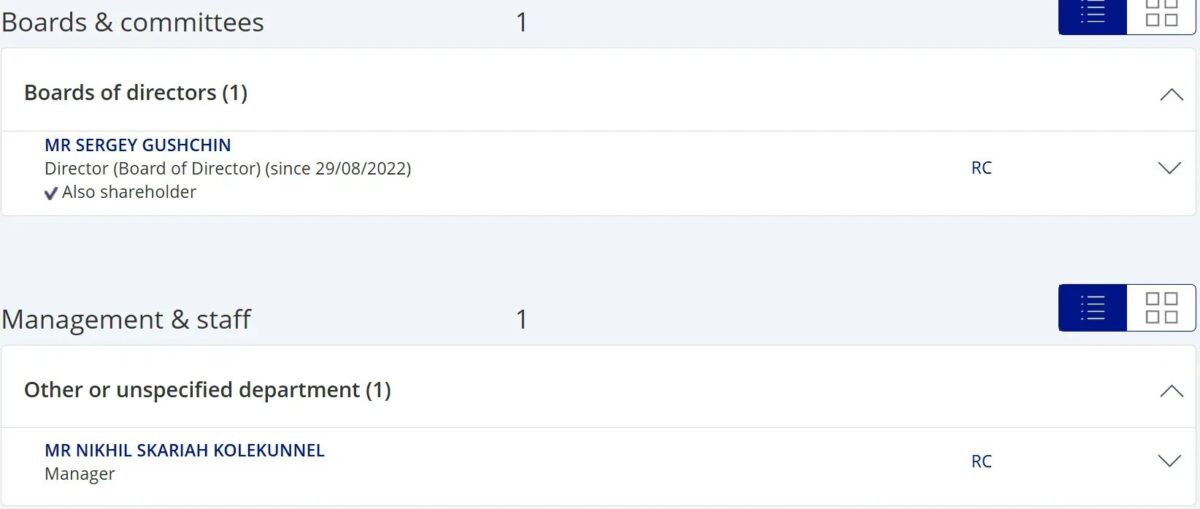
The officially declared owner of Czech Vanadium is Nikhil Skariah Kolekunnel. According to the ADGM free zone business register in the UAE, he is both the sole shareholder and director of Metco Holding.
However, the Gulf state’s database does not disclose so-called beneficiaries, who are entitled to the company’s profits and may also secretly control it.
Although the Czech judicial register lists Skariah as Czech Vanadium’s beneficial owner, this does not necessarily indicate the person exercising control in the background. For example, trustees of trust funds are also listed in the registers as beneficial owners.
The nature of Skariah Kolekunnel’s business suggests that he performs the specific role of an administrator, a so-called fiduciary — someone who accepts an ownership mandate and effectively manages another person’s assets.
He is a lawyer originally from India who founded two law firms in the UAE years ago. His companies represent large corporations and businesspeople who do not wish to publicly acknowledge ownership of a business.
“South Bridge Legal is an advisory firm for comprehensive business establishment in Dubai, Abu Dhabi and the UAE. Our highly experienced team has been active in the sector for more than 10 years, providing services tailored to the unique needs of every ambitious entrepreneur setting up companies in Dubai,” the company wrote on its website.
“We have all activities, which is tax management, tax consulting, accounting, corporate services, offshore company formation, free zone company formation…everything,” Skariah said in a recently published video on YouTube.
Metco Holding’s address in Abu Dhabi suggests it may be a shell company. And it is headquartered from a WeWork.
Moldova and Ukraine links
‘Skariah’, the name of the Indian administrator, had already emerged eight years ago in connection with the concealment of ownership structures during an investigation into the privatisation of Moldova’s national airline. At the time, Skariah appeared as the owner of the opaque company Gold Craft FZE, established in Dubai in 2015.
“On Monday 1 October 2018, one day before the privatisation agreement for Air Moldova was signed, a plane from Istanbul landed at Chișinău International Airport. One of the passengers, a 39-year-old man, was carrying nearly €2.6m in cash in his luggage. He declared the money to customs officers, which, according to the Office for the Prevention and Fight against Money Laundering, he had borrowed four days earlier from Gold Craft FZE in the United Arab Emirates,” the investigative outlet RISE Moldova reported.
It finds that Andrei Ianovici brought cash from Dubai, equivalent to tens of millions of Czech crowns. Later that day, he deposited the money in a bank, and it ended up in the accounts of Civil Aviation Group SRL. That company privatised Air Moldova, and Ianovici was one of its partners.
The true origin of the money was never established, leading local investigators to suspect that the money had not been earned legally. No charges were brought, however.
According to court records, Skariah was also involved in disputes in Ukraine, where Gold Craft FZE claimed ownership of an Ilyushin aircraft which the company allegedly purchased in 2017.
Skariah’s Russian-linked empire
However, the UAE-based lawyer was not the only individual to have emerged as an administrator of Czech Vanadium. Another is Sergei Gushchin.
A man of this name was formerly a prominent Russian businessman in rail freight transport and, although he withdrew from Russia three years ago, he appears on Ukrainian sanctions lists for supporting the Russian army.
Gushchin became a senior manager at PJSC TransContainer, a Russian rail freight carrier, after Evraz sold its stake. In the past, a quarter of the company was owned by the holding company of Abramovich.
Meanwhile another of Gushchin’s companies, Rail Service, formed a joint venture with Evraz in 2019 focused on the production of railway wheels.
According to a UAE register, Gushchin was a director and shareholder of Metco, which became Czech Vanadium’s parent company from 2022-23.
US credit-rating agency Moody’s shared data with Deník N that listed Gushchin as a recent beneficiary of Metco Holding and as the company’s director.
Moody’s data shows Sergei Gushchin as Metco Holding’s director.
Russia’s ferrovanadium monopoly
Czech Vanadium’s revenues regularly exceed €81m, and in 2024 the company reported profits of more than €8m. This summer, the company sent over €0.6m of that sum to the Dubai company, the remaining funds staying in its retained earnings account.
Last year, the company recorded a modest €0.2m loss. Its accounts retained more than €12m in undistributed profits in total.
Czech Vanadium’s business remains closely tied to Russia. Last year alone, vanadium oxides or hydroxides worth nearly €82m were imported into the Czech Republic from the Russian Federation. Russia is effectively the sole supplier of the raw materials needed to produce ferrovanadium. According to the statistical office database, exports mainly go to the United States, as well as Germany and Taiwan.
Czech Vanadium did not reply to requests for comment or an explanation of its ownership structure.
It also did not answer the question of how a Dubai lawyer had bought the Czech company, which, according to some estimates, is worth more than €40m.
Company representatives have not responded to questions about its owners since 2024, when the company left the Evraz group structure.
Fake owner model in US
Jiří Skuhrovec, an analyst at Datlab, specialises in the global vetting of business partners. He says Abramovich uses a similar model for concealing ownership in the United States.
Sanctions also forced the Russian oligarch, who became better known through his former ownership of the British football club Chelsea, to withdraw from US companies. But Skuhrovec concluded that they were probably still controlled by people linked to Abramovich just like the factory in Czech Republic.
“We mapped the entire chain, from the Russian ore supplier through the Czech smelter to the final recipient: the US company Strategic Alloys LLC. Until recently, all three companies officially belonged to Abramovich, and all three are now controlled by people with links to his Evraz group. Abramovich may therefore still secretly control the entire supply chain for this strategic raw material. This would be a textbook case of sanctions circumvention, as well as an obvious security risk,” Skuhrovec said.
Findings led Datlab and Transparency International to submit a complaint to police. “We believe that the 16m Czech crowns (around €655,000) in distributed profit may have gone to Abramovich, who is on a sanctions list. That would constitute a criminal offence,” the analyst explained.
In brief:
Czech Vanadium, owned by Russian oligarch Roman Abramovich’s holding company until 2024, was taken over by Dubai-based company Metco Holding.
The company is opaque, and Czech authorities are investigating who actually owns the Czech factory. It is suspected it is still linked with former owner.
This would amount to circumventing sanctions imposed by the European Union.
Deník N and Datlab analyst Jiří Skuhrovec found that the company is backed by lawyer Nikhil Skariah Kolekunnel and Sergei Gushchin, who conduct business with Abramovich’s Evraz group.
Skariah has been linked to money laundering in Moldova and Ukraine. He has long covered for companies that are in fact owned by someone else.
President Donald Trump said Friday that Russia has agreed to release millions of tons of diesel fuel into U.S. and global markets following a telephone call with Russian President Vladimir...
The United States on Thursday imposed sanctions on 22 tankers and dozens of individuals and companies linked to Iran’s oil trade, expanding its campaign to cut off Tehran’s remaining petroleum...
How Iraq’s energy sovereignty can be measured and achieved? How do the geography and sanctions matter? What is the U.S.’ impact in this area? And who determines Iraq’s energy choices? Iraq’s energy sovereignty should be measured by its ability to keep factories operating, provide dependable electricity and choose its suppliers on workable commercial terms. Yet, […]
A 22-year-old product tanker sanctioned by the European Union is making an unusual late-season voyage along Russia's Northern Sea Route, highlighting the growing use of older, lower-specification vessels to move petroleum products through the Arctic.
US prosecutors say an American forensic tool concealed its Russian owners and its development in Russia.
Used by numerous security agencies in Europe, Oxygen Forensics helps investigators worldwide access data from mobile phones and computers.
Many bodies are now suspending use of the software following recent revelations.
The Slovak interior ministry bought the software in 2018 when links to Russia were not yet publicly known, then renewed the license multiple times. Now, the ministry said IT department officials are investigating the issue.
The tool was also sold to other government bodies across Europe.
Russian ownership via Cyprus
In the US, Virginia-based Oxygen Forensics CEO Lee Reiber was arrested at the end of September, along with Oleg Davydov, one of the Russian owners.
The company was headquartered in the US state of Virginia, appearing American.
According to federal prosecutors in the US, the company hid its Russian ownership through a shell company in Cyprus and that its software was developed in Russia.
Allegedly, this scam helped secure contracts for the forensic tool in the US, UK, Czech Republic, Latvia, Romania, and Slovakia.
Reiber, a 55-year-old American, was arrested in Idaho on Sunday. On Tuesday (22 September), he appeared before a federal court there and was released on bail. He is expected to appear before a federal court in Los Angeles soon.
Davydov, a 52-year-old from Moscow, was arrested on that same day at London Heathrow before he could board a flight to Istanbul. And the US plans to seek extradition. Both face charges of conspiracy to commit wire fraud.
The group of five also owned a Russian company co-founded by Davydov in 2000. Until September 2022, it was called Oxygen Software and now operates under the name MKO Systems.
Its programmers worked in Russia, where the company sold the software under other names. According to investigative files, its clients included Russia’s secret service (FSB), investigative committee (SKR) and interior ministry.
Davydov, the company’s technical director, was responsible for software development. In 2013, he helped establish Oxygen Forensics in Virginia with Reiber joining the company in August 2015.
Prosecutors say that following Russia’s full-scale invasion of Ukraine and US sanctions after, the duo agreed to hide both the real owners and that it was developed in Russia. In March 2022, Reiber became CEO and director.
Then, Russian owners were removed from public company records.
However, investigators said the Russians continued to control the company, making key decisions, determining Reiber’s pay, and outvoting him on the board.
The charges concern the concealment of the software’s ownership and origin in securing public contracts.
A network of deception
Two companies were found to have supplied the Slovak interior ministry with Oxygen Forensic tools.
In 2018, the sale was part of a broader procurement by the ministry for computers, laptops, servers, monitors and printers, ordered from the Czech company Risk Analysis Consultants for €125,000, the forensic tool itself costing €10,000.
The Prague-based company did not respond for comment.
Screenshot of order from 2018 (Source: Slovak interior ministry website)
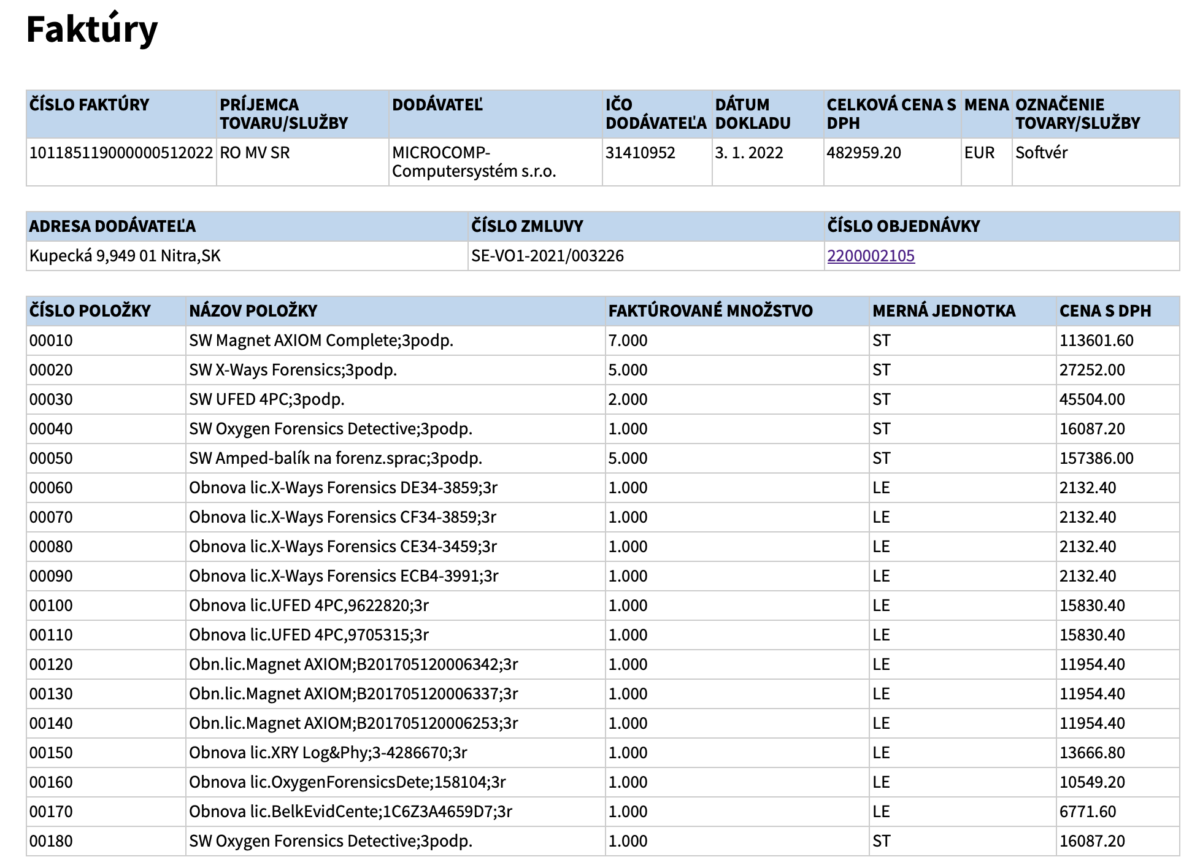
An invoice issued to the Slovak interior ministry in 2022 by the Slovak company Microcomp–Computersystém indicates the renewal of a licence for this software. At the time, the minister responsible was Roman Mikulec.
Screenshot of invoice from 2022 (Source: Slovak interior ministry website)
The Slovak ministry also ordered a licence renewal in July 2024, under his successor Matúš Šutaj Eštok. Microcomp–Computersystém did not respond for comment.
Interior ministry order with links to Russia. (Source: Slovak interior ministry website)
Authorities warned
On Friday (2 October), the Slovak national security authority (NBÚ) warned of the risks posed by using software from Oxygen Forensics and connected companies such as MKO Systems and Prostranstvo IT.
Their software helps investigators search for and examine data from digital devices. It can process vast amounts of information, including evidence, which makes it important who owns, controls and develops it. According to the NBÚ, this is important both for data protection and for the reliability of analysis results.
The warning came after the US case was made public.
The NBÚ considers links to Russia significant in assessing the security risk, also in view of Russia’s military aggression against Ukraine.
However, the warning itself does not mean that data leaked through the software. US prosecutors explicitly stated that the charges did not concern malicious code or unauthorised access to customer data.
The case concerns the alleged concealment of the software’s ownership and origin. And no court has yet ruled on the case.
“The ministry will proceed in accordance with the recommendations of the National Security Authority,” the Slovak interior ministry said.
The NBÚ recommended that public bodies identify this company’s presence and report it to the authority.
Belgian Green MEP Saskia Bricmont also called for the use of Oxygen to be stopped immediately and for an inquiry into whether sensitive information could have reached Russia after it was found that Romania, Germany, Spain, Italy, Poland and Hungary had purchased the software.
European police shed tool
Several European security agencies are suspending the use of Oxygen Forensics software or taking steps to terminate their contracts after the company’s Russian ties came to light.
The tool was also used by Czech police. Czech security agencies continued to purchase licences for the computer software after 2022, when the full-scale invasion of Ukraine began. Czech authorities are awaiting further information from the United States. For now, they have prohibited software updates.
London’s Metropolitan Police has suspended the use of Oxygen tools and launched a comprehensive review. British police forces, including specialised units, had used the software.
And Latvian police suspended its use and is assessing whether it will continue using it.
Romania’s anti-corruption agency, too, took steps to terminate its contract with the Russia-linked tool.
Iranian Airlines Face Chronic Difficulties: On September 30, bailiffs boarded a Caspian Airlines Boeing 737—while passengers sat ready for takeoff—and served an order to collect a debt of 3 million euros before the aircraft could depart. The detention occurred just days after US secondary sanctions against the Iranian aviation sector came into effect, halving international […]
Imperialism, considered by public intellectuals to be a thing of the past, has been resurrected; this time, the actions of the American President Donald Trump clearly reflect that. Defined as the raw exercise of power in order to conquer territories and appropriate resources for the establishment of an empire, imperialism has had a long and […]
Le Conseil d'État a rejeté les recours d'une quinzaine de syndicats et d'associations contre le décret « sanctions » du 30 mai 2025. Ce texte autorise l'organisme payeur à suspendre le RSA d'un allocataire jugé défaillant, sans passer devant un tribunal. La haute juridiction administrative vient de considérer que cette confusion des rôles ne pose aucune difficulté.
LE COURRIER DES STRATÈGES
Restez libre !
LA NEWSLETTER · GRATUITE
Le Courrier, chaque matin.
L'essentiel de l'actualité, passé au crible par les cinq plumes du Courrier. Dans votre boîte, chaque jour ouvré.
Gratuit. Vous restez libre de partir quand vous voulez.
Le dispositif, baptisé « suspension-remobilisation », marque une évolution importante du rapport entre l’administration et l’allocataire. Le pouvoir de déterminer l’obligation, de constater son non-respect et de décider de la suspension du revenu est désormais confié à la sphère administrative.
LE COURRIER DES STRATÈGES
Restez libre !
ABONNEMENT
Allez au fond des choses.
Deux grands formats par jour. Les cinq plumes du Courrier. La série Sécession, le dimanche.
Le décret n° 2025-478 du 30 mai 2025 encadre les sanctions applicables aux demandeurs d’emploi, notamment aux bénéficiaires du RSA. En cas de refus d’élaborer ou d’actualiser le contrat d’engagement, ou de non-respect de certaines obligations, la suspension peut représenter au moins 30 % du revenu, pendant un à deux mois lors d’un premier manquement. En cas de persistance ou de réitération, elle peut durer jusqu’à quatre mois.
Mais lorsque l’intéressé se remet en conformité avant la fin de la suspension, celle-ci peut prendre fin et les sommes temporairement retenues peuvent être restituées. La décision reste donc administrative, même si elle produit immédiatement un effet financier sur le ménage concerné.
LE COURRIER DES STRATÈGES
Restez libre !
TELEGRAM · L'INFO EN CONTINU
Entre deux éditions, le fil.
La newsletter vous donne le matin. Le fil vous donne l'instant.
Syndicats et associations contestent, le juge administratif valide
Une quinzaine d’organisations, parmi lesquelles la LDH, la CFDT, la CGT, le Secours catholique, ATD Quart Monde, Emmaüs France et Solidaires, ont contesté le décret. Elles invoquaient notamment la proportionnalité des sanctions, les droits de la défense, le principe d’individualisation et le risque de priver les intéressés de moyens convenables d’existence.
Le Conseil d’État, dans sa décision du 21 septembre 2026, n° 506563, a rejeté ces recours. Il valide ainsi le cadre réglementaire adopté après la loi du 18 décembre 2023 pour le plein emploi. L’enjeu dépasse le seul RSA. En 2023, le Conseil d’État avait lui-même relevé que la « suspension » avait une finalité punitive, puisqu’elle prive temporairement le bénéficiaire de revenus, tout en cherchant à provoquer sa remise en conformité.
LE COURRIER DES STRATÈGES
Restez libre !
TIPS · SANS ABONNEMENT
Offrez-nous un café.
Un média libre vit de ses lecteurs. Un pourboire ponctuel, sans compte ni engagement, quand le cœur vous en dit.
Vous donnez ce que vous voulez. Vous restez libre.
Cependant, le juge n’est nullement absent : il conserve son pouvoir de contrôle sur les décisions administratives. Mais il n’intervient pas pour autoriser la suspension avant qu’elle produise ses effets. Pour l’allocataire, la réalité est claire : l’administration décide, le revenu peut être suspendu, puis le juge peut être saisi. C’est cette inversion temporelle, davantage que la disparition du juge, qui concentre l’enjeu du nouveau dispositif.
Europe is getting tougher on Israel in rhetoric and sanctions, but its latest measures may be designed to create political distance from Israel without creating enough economic pain to make Israel change course in the West Bank or anywhere in Palestinian territories. The Arithmetic of Punishment On September 8, Britain, France, Canada and a group […]

 Login