❌

Normal view

Democrats, Tillis say Congress may investigate banks and ports for Russian diesel imports

26 October 2026 at 16:35
Democrats and outgoing Republican Sen. Thom Tillis (N.C.) are telling banks and ports that Congress may investigate imports of Russian diesel after President Trump said the U.S. would import the fuel. In letters to major banks and several U.S. port authorities, the lawmakers wrote that “any importation of Russian diesel into the U.S. raises significant…

Kennedy rolls out US-caught seafood labeling, Seafood.gov

24 October 2026 at 00:40
The Trump administration unveiled new initiatives for U.S. fishermen Friday, including a new government website known as Seafood.gov. At a rally in Fort Myers, Fla., Health and Human Services (HHS) Secretary Robert F. Kennedy Jr. announced the creation of a voluntary label made for U.S.-caught fish, which the Food and Drug Administration (FDA) began offering…

Trump Wants To Force Data Centers To 'Make Their Own Electricity.' Deregulation Would Work Better.

23 October 2026 at 22:30
trump-data-centers-v2 | Illustration: Ron Sachs-CNP/CNP / Polaris/Newscom/Donald J. Trump/Truth Social

With public opposition toward data centers growing and midterm elections on the horizon, politicians across the spectrum have introduced overreaching policies to stymie data center development and ease voters' minds. These politicians now include President Donald Trump, who has historically been a staunch supporter of the industry.

"New and large, in some cases gigantic, Data Centers are mandated by me to make their own electricity, and give or sell any excess back to the local community, or grid," Trump declared on Truth Social on Wednesday. "If companies want to make their Data Centers popular, pay the community, and/or individuals within the community, a 'dividend.' I have watched the process closely, and Data Centers that were highly unpopular in a certain area have become extremely popular when a financial deal is struck."

While Trump has suggested that power plants pay for their own power before, ​these comments are in stark contrast to him saying less than a couple of months ago that "the only reason that communities throughout the U.S.A. should not want Data Centers is if they want to end up being backward and poor." Still, the president is not wrong that the strategy could boost data centers' popularity; polling regularly shows that concerns over higher energy prices are one of the main reasons people oppose data centers in their communities.

However, mandating that these power plants "make their own electricity" is the wrong way to accomplish this objective, in part because generation costs are not the leading factor in higher electricity prices—transmission infrastructure, such as wires and poles, is. And regulatory barriers, as well as a lack of competition in the building of this infrastructure, are mostly to blame. 

Regardless, if the goal is to have data center companies produce their own electricity, easing regulations would have more impact than imposing a mandate. As Travis Fisher, director of Energy and Environmental Policy Studies at the Cato Institute, tells Reason, "If a tech company buys electricity from the owner of a power plant, in most states the power plant owner then becomes a public utility (even if the transaction occurs off-grid), which brings heavy scrutiny in the form of economic regulation."

To ease these regulatory barriers, Fisher and other experts have advocated for a Consumer Regulated Electricity model that allows large-load customers to connect directly to unregulated power producers off the grid. 

Fisher also notes that lower power costs don't automatically translate into lower utility rates. He tells Reason, "Even if a data center were to bring a matching or beating amount of supply relative to their demand, based on the way retail rates work, I am not convinced that that guarantees that prices will fall." 

On top of not solving the main driver of higher electricity prices, the mandate isn't needed because many data centers have already begun to produce their own power. A report from energy research firm Cleanview shows that operating power capacity dedicated to data centers has nearly doubled since June, while capacity under construction has roughly quadrupled. Additionally, companies including Anthropic and Microsoft are already volunteering to cover consumers' electricity costs.

By calling on power producers to make their own electricity, Trump joins the growing chorus of politicians who are convinced that the government, not the market, is best equipped to dictate how data centers grow and operate. And, in typical Trump fashion, a "mandate" on social media without any legal action behind it has left the public and investors to guess what, if anything, is actually coming. 

Building power plants requires long-term planning and investments meant to last decades, making Trump's tendency to impose abrupt policy changes less than ideal. "The fact that the rules change, not just every four years, but occasionally overnight via tweet," says Fisher, does not make for "a great investment environment."

The post Trump Wants To Force Data Centers To 'Make Their Own Electricity.' Deregulation Would Work Better. appeared first on Reason Magazine.

West Virginia attorney general subpoenas environmental groups

23 October 2026 at 22:02
West Virginia’s attorney general has sent investigative subpoenas to environmental advocacy organizations — something the groups are describing as a retaliatory attack on their First Amendment rights. West Virginia Rivers Coalition and 350.org filed a lawsuit this week saying they and at least four other organizations received subpoenas from the office of state Attorney General…

Trump says wind turbine part imports cause national security issue, but doesn’t impose tariffs

23 October 2026 at 20:22
The Trump administration has determined that imports of wind turbine parts pose a national security threat, but it does not appear to be opting to tariff them. President Trump issued a memo Thursday saying “wind turbines and their components and subcomponents are being imported into the United States under such circumstances as to threaten to…

Vance becomes a hurricane as it nears Mexico

23 October 2026 at 18:54
Hurricane Vance is expected to steadily intensify in the next 24 hours and turn into a major hurricane by Friday night, according to projections from the National Hurricane Center. “Swells generated by Vance are expected to begin affecting portions of the coast of southern and southwestern Mexico this weekend and continue into next week,” the…

Consumer confidence holds steady from September amid persistent inflation

23 October 2026 at 16:37
U.S. consumer sentiment flatlined from September to October, as persistent inflation squeezes Americans’ finances. Consumer confidence sat at a measure of 48 percent this month, a minor decrease from last month’s reading of 48.1, according to the University of Michigan’s Surveys of Consumers Index. Consumer sentiment has dipped by 10.4 percent from October 2025, with…

Oil prices hit highest point since May

23 October 2026 at 15:58
Oil prices on Friday hit their highest point since May as the war in Iran drags on. As of Friday morning, futures for international benchmark Brent crude were trading at $116 per barrel, while U.S benchmark West Texas Intermediate traded at about $102. The high prices come as the war in Iran nears the eight-month…

Trump announces he’ll use Defense Production Act to increase domestic gas production 

23 October 2026 at 03:54
President Trump invoked the Defense Production Act on Thursday, announcing that the government would be spending $150 million toward boosting domestic gas and diesel production as the White House looks to ease consumer pain at the gas pump. The announcement was made in a presidential memorandum earlier Thursday, but the president detailed the exact amount…

Trump’s diesel deal derailed Ukraine-Russia peace progress, says Czech president

22 October 2026 at 21:46
Czech President Petr Pavel on Tuesday said President Trump’s diesel deal with Russia derailed peace talks between the Kremlin and Ukraine, saying both sides were “so close” to a ceasefire. “It will be much harder now,” Pavel told the Axel Springer Global Reporters Network, which includes Politico. “Russia uses this momentum to get out of…

Pentagon advances some wind projects after freeze

22 October 2026 at 19:22
The Trump administration is advancing some wind projects after a court order required it to do so. A White House official said Thursday that an initial set of wind projects under Pentagon review have been released. The official said this represents two projects located in Maine and South Dakota. The official said the Defense Department…

EU Carbon Market Deal Raises Reserve Limit as Industrial Pressure Mounts

22 October 2026 at 08:00

European Union negotiators have reached a provisional agreement to revise the rules governing the bloc’s carbon market, increasing the number of emissions allowances that can remain in reserve before being permanently cancelled.

The agreement, reached by the Council and European Parliament on 20th October and announced the following day, raises the invalidation threshold of the EU Emissions Trading System’s market stability reserve from 400 million to 700 million allowances.

The compromise reached by EU negotiators follows months of pressure from energy-intensive industries concerned about carbon prices, electricity costs and competition from manufacturers operating under less restrictive environmental regimes.

The measure requires formal approval before entering into force and forms part of a wider review of the EU’s principal carbon-pricing mechanism.

A larger reserve for future market disruptions

Established in 2019, the market stability reserve was designed to address the accumulation of surplus emissions allowances that had weakened the effectiveness of Europe’s carbon market.

Under the Emissions Trading System, companies in covered sectors must surrender allowances corresponding to their greenhouse gas emissions. The total quantity available is progressively reduced, creating a financial incentive to cut emissions.

The reserve adjusts the supply of allowances entering the market, withdrawing them when there is a substantial surplus and releasing them under specified conditions when supply becomes scarce.

Existing rules also provide for the permanent cancellation of allowances held above a threshold of 400 million.

Under the new agreement, that threshold would increase to 700 million, allowing a larger stock to remain available for potential future release.

The change does not automatically introduce 300 million additional allowances into circulation. Releases would continue to depend on the reserve’s operating rules and market conditions.

According to the Council, more than three billion allowances have been invalidated since the mechanism began operating in 2023.

The Commission initially proposed ending automatic invalidation indefinitely, while the Council’s September negotiating position envisaged a temporary suspension followed by a higher threshold.

The compromise retains invalidation but increases the amount protected from cancellation.

Industry competitiveness enters climate negotiations

The agreement follows growing concern about the cumulative cost of European climate regulation, particularly for steelmaking, chemicals, cement and other energy-intensive sectors. Manufacturers have warned that carbon costs, combined with relatively expensive electricity and industrial gas, complicate investment decisions and weaken their ability to compete internationally.

Brussels must also consider the consequences of production shifting to jurisdictions with lower emissions-related costs, a phenomenon known as carbon leakage. Earlier this year, EU Today examined the Commission’s consideration of changes to industrial protections under the ETS, including the relationship between free allowances and the Carbon Border Adjustment Mechanism.

The latest reserve agreement does not directly change the allocation of free allowances, the emissions cap or the obligations imposed on individual industrial installations. Its principal effect would be to preserve a larger buffer that could become available if future market conditions trigger the release mechanism.

For manufacturers planning investments extending into the 2030s, the availability of allowances and the future trajectory of carbon prices influence production costs and the commercial case for decarbonisation technologies.

Carbon market figures reveal changing conditions

The European Commission reported in May that the total number of allowances in circulation during 2025 stood at approximately 1.023 billion.

Its annual market stability reserve calculation provided for approximately 190.5 million allowances to be withdrawn from auctions between September 2026 and August 2027.

These withdrawals reflect the existing mechanism for reducing market surpluses. The proposed higher invalidation threshold concerns how many allowances can subsequently remain in reserve rather than being cancelled.

The overall emissions cap will continue to decline under the legislation already governing the ETS.

Consequently, preserving a larger reserve does not remove the long-term constraint on emissions or guarantee lower carbon prices for European industry.

The agreement also concerns the established ETS covering power generation, industry and certain other sectors, rather than the separate ETS2 regime for emissions associated with road transport and buildings.

The latter has generated its own political controversy, as EU Today reported following the October European Council summit.

Broader ETS reform remains unresolved

The Council and Parliament have agreed that the question of gradually reducing the invalidation threshold should be considered during the broader ETS review.

That exercise will address the carbon market’s operation over a longer period, when the declining supply of allowances could create tighter conditions.

The present agreement therefore provides an adjustment to the reserve mechanism without reopening the entire emissions trading framework. Following legal and technical finalisation, the provisional deal must be endorsed by both institutions and formally adopted.

The new 700 million threshold would apply after the legislation takes effect, while the larger review of the ETS continues through the EU legislative process.

European Parliament Approves €489 Million in Disaster Relief for Italy, Spain, Portugal and Malta

21 October 2026 at 22:10

MEPs have approved emergency EU funding to help four southern European countries recover from destructive storms and flooding earlier this year, with Portugal receiving the largest allocation.

The European Parliament approved €489.15 million in financial assistance for Portugal, Spain, Italy and Malta on Wednesday, 21 October, following severe storms and flooding that damaged infrastructure and disrupted communities across southern Europe during the opening months of 2026.

The allocation from the European Union Solidarity Fund was approved by 651 votes to 17, with three abstentions. Portugal will receive the largest share, approximately €261.5 million, followed by Spain with €149.1 million, Italy with €74.9 million and Malta with €3.7 million.

The funding is intended to support recovery operations and help national authorities meet the costs of restoring essential public infrastructure and services damaged by the disasters.

Portugal receives largest allocation

Portugal’s €261.5 million allocation follows flooding and storms that affected the country during January and February.

The Portuguese authorities applied for assistance from the EU Solidarity Fund after assessing the extent of the damage and the associated costs of emergency operations and infrastructure recovery.

The funds will contribute to eligible public expenditure arising from the disasters, potentially including the restoration of transport links, damaged public facilities and other essential infrastructure.

Portugal has already received approximately €65.37 million in advance funding, according to the figures accompanying the parliamentary decision.

Spain will receive €149.1 million following destructive weather during the same period, including severe flooding in February.

The Spanish government had also requested European assistance to cover part of the expenditure associated with recovery operations.

Approximately €37.26 million of Spain’s allocation has already been paid in advance.

The two countries together account for the substantial majority of the assistance approved on Wednesday, reflecting the scale of their eligible recovery costs.

Storm Harry damages Italy and Malta

Italy and Malta will receive assistance following Storm Harry, which struck parts of the central Mediterranean in January 2026.

Italy’s allocation amounts to €74.9 million, while Malta will receive €3.7 million.

The storm caused significant disruption in affected Mediterranean areas, with heavy rainfall, strong winds and damaging sea conditions placing pressure on local infrastructure.

Italian authorities sought European support for recovery operations in the affected territories, while Malta submitted its own request following the damage sustained during the storm.

The Maltese allocation includes approximately €931,000 already made available through an advance payment.

The final assistance amounts were proposed by the European Commission after examining the applications submitted by the four governments.

The Commission’s September proposal to mobilise the EU Solidarity Fund set out the amount of assistance required for each country.

The total proposed mobilisation was €489,148,220.

How the EU Solidarity Fund works

The European Union established the Solidarity Fund in 2002 to assist member states and certain countries participating in the EU accession process following major natural disasters.

The mechanism provides financial support for public emergency and recovery expenditure rather than operating as a general insurance scheme for individuals or businesses.

Eligible expenditure can include emergency accommodation, restoring essential infrastructure, securing protective infrastructure, cleaning disaster-affected areas and protecting cultural heritage.

National authorities submit applications to the Commission, which evaluates them against the relevant eligibility requirements and financial thresholds.

Assistance depends on the assessed disaster damage and applicable regulatory criteria, rather than simply reimbursing every euro of economic loss.

The fund is financed through EU budgetary arrangements and is mobilised following the required institutional approvals.

Payments are made to the countries concerned, which remain responsible for ensuring that assistance is used in accordance with EU financial rules.

The Solidarity Fund can therefore help governments manage exceptional recovery costs, but it does not replace national budgets, private insurance or other financial arrangements.

Rising pressure on European disaster funding

The latest allocation comes against a background of increasingly frequent demands on European disaster-response mechanisms.

Southern European countries have experienced damaging floods, storms, heatwaves and wildfires in recent years, leading to repeated requests for assistance.

Recovery expenditure extends beyond immediate emergency operations. Damaged roads, bridges, coastal defences, water systems and public buildings can require prolonged reconstruction.

These costs can place considerable pressure on local authorities, particularly where a disaster affects tourism, transport or economic activity.

The EU faces the additional challenge of maintaining sufficient funds to respond to major disasters affecting several countries within a relatively short period.

Extreme weather events can also expose weaknesses in existing infrastructure, prompting governments to consider whether reconstruction should incorporate additional protection against future disasters.

However, such investments must be assessed against the eligible spending categories of the Solidarity Fund and the availability of other EU financing programmes.

Parliamentary approval and implementation

Wednesday’s vote represents parliamentary approval of the mobilisation proposed by the European Commission.

The decision concerns disasters that occurred earlier in 2026 and does not constitute a new emergency response operation.

The funds will support eligible recovery measures carried out by the national authorities in the four countries.

The payments already made to Portugal, Spain and Malta will be taken into account when the remaining assistance is disbursed.

EU authorities will retain responsibility for monitoring compliance with the relevant financial and reporting requirements.

The substantial parliamentary majority indicates broad support for assistance to the affected countries, although future disaster-funding arrangements will continue to depend on the resources available in the European budget.

For the four governments, the immediate task is to use the approved assistance to meet eligible recovery costs and restore damaged public infrastructure following the storms earlier this year.

Nuclear Power Now Has Bipartisan Support

21 October 2026 at 18:35
Cooling towers from a nuclear power plant, with a blue and red bisected background | Davidmartyn/Dreamstime/Mariam Zakaidze

Nuclear power has historically been a divisive issue: During the Cold War, an entire generation feared annihilation at the hands of the same basic technology that some want to use to power their homes.

That's unfortunate, because nuclear energy has considerable benefits—a reliable source of power with very few greenhouse gas emissions—with increasingly lower risks.

Thankfully, it seems that message is catching on with people from both major political parties.

"About six-in-ten U.S. adults now say they favor more nuclear power plants to generate electricity," Pew Research reported in October 2025. "That's up from 43% in 2020, driven by increasing support among both Republicans and Democrats." The authors noted that "Republicans are more likely than Democrats" to favor the policy, with "roughly seven-in-ten Republicans and Republican-leaning independents" expressing support, but it still included 52 percent of Democrats and independents who lean in that direction.

Gallup found similar results earlier this year. The pollster "asked whether the U.S. should put more emphasis, less emphasis or about the same emphasis as it does now on producing domestic energy from each of six sources," wrote Megan Brenan. The six sources were solar, wind, nuclear, natural gas, oil, and coal.

"Nuclear energy is the only one of the six sources to see support grow since 2021, rising seven points to 46%," Brenan added. "This shift is notable given that preferences for nuclear energy had historically been more evenly divided among responses of more, less and the same." Instead, those favoring more emphasis on nuclear power outranked both those who want less and those who wish for it to stay the same, by about 20 points each.

It seems the consensus has been building: In 2024, a poll of first-time voters in The Wall Street Journal found overwhelming support for nuclear energy as a means of fighting climate change.

The trend is welcome, and it marks a major reversal of anti-nuclear sentiment that goes back decades.

The China Syndrome, a film about a possible meltdown at a fictional California nuclear plant, premiered in the U.S. in March 1979. One character in the film warns that a meltdown could "render an area the size of Pennsylvania permanently uninhabitable, not to mention the cancer that would show up later."

Less than two weeks later, in a disastrous bit of timing, a malfunction caused a partial meltdown at the Three Mile Island nuclear power plant near Harrisburg, Pennsylvania.

Thankfully, Three Mile Island was not a disaster. "Some radioactive gas was released a couple of days after the accident, but not enough to cause any dose above background levels to local residents," according to the World Nuclear Association. "There were no injuries or adverse health effects."

But those details were lost on the public. Several recording artists formed Musicians United for Safe Energy (MUSE), an activist group that opposed nuclear power. Just six months after Three Mile Island, MUSE held a series of "No Nukes" concerts at Madison Square Garden, plus a rally in Central Park that drew nearly 200,000 attendees.

That populist support spilled over into politics, particularly among Democrats. Running for president in 1980, Sen. Ted Kennedy (D–Mass.) called for a two-year moratorium on new nuclear plants. In its national platform, the Democratic Party pledged to "retire nuclear power plants in an orderly manner."

After the Three Mile Island incident, 39 planned nuclear plants were canceled.

That's a shame, for many reasons. As Reason's Ronald Bailey wrote in 2018, in a theoretical world where the development of U.S. nuclear power continued at its previous pace, "by 2015 it would have replaced all coal-burning and three-quarters of gas-fired electric power generation….Cumulative global carbon dioxide emissions would be about 18 percent lower, and annual global carbon dioxide emissions would be one-third less."

Yet even decades later, plenty of people—again, particularly Democrats—still opposed nuclear energy.

"Of all the Democratic divides on climate," Politico wrote in 2019, "the role of nuclear power may be the biggest. Progressives and some environmental groups have long lumped it into a category with fossil fuels, and some have spent decades opposing it."

At the time, a number of people were running to be the Democratic Party's presidential candidate, and many of them had strong opinions on nuclear energy. Sen. Elizabeth Warren (D–Mass.) said that she would not license any new nuclear reactors; Sen. Bernie Sanders (I–Vt.) pledged to go one step further and not renew the licenses of any existing reactors.

But things have changed in just a few short years, and nuclear energy is now an issue with potential bipartisan support. When did this pivot take place, and why?

"It was really around 2021, 2022, I would say that things really began to shift," James Walker, CEO of Nano Nuclear Energy, tells Reason. "A lot of the popular support looks like it's coming from younger people….It is a zero-carbon-emission power, and they have been raised to [be] more climate goal-focused" than older generations.

It's not just Gen Z either: Lawmakers are more keen on nuclear power now too. Earlier this month, the MORE American Fuel Act, sponsored by Sens. Cynthia Lummis (R–Wyo.) and Mark Kelly (D–Ariz.), passed the Senate unanimously. The bill "modernizes outdated Nuclear Regulatory Commission (NRC) licensing requirements for uranium enrichment facilities and aligns them with the process already used for other nuclear facilities and reactors," according to a press release from Lummis. It also "lets enrichment companies begin construction at their own risk instead of waiting years for a construction license before breaking ground, while preserving public participation and the NRC's rigorous safety standards."

"What we've seen up in Washington is that there is a nervousness around keeping pace with AI development," Walker adds. "There is a concern that rivals that are also investing very heavily into AI, such as China, are building nuclear reactors like crazy, and one of the reasons they're doing that is just so they have baseload power that allows them to scale up their systems. They are building two gigawatt-scale nuclear power plants every year at the moment, and a lot of it is to try and catch up with the U.S. tech industry."

The post Nuclear Power Now Has Bipartisan Support appeared first on Reason Magazine.

Trump's War With Iran Pushed Him To Waive a Century-Old Shipping Law. Commerce Boomed.

18 October 2026 at 11:00
A large boat with shipping containers seen from above | Tawatchai Prakobkit/Dreamstime/Cato Institute

America's interminable war with Iran has killed thousands, disrupted commerce that flows through the Strait of Hormuz, and raised prices on the home front.

But there may be one silver lining. In an attempt to lower gas prices that spiked because of the war, the Trump administration has repeatedly issued waivers of the Jones Act, a century-old law that requires all goods moved between American ports to be carried on American-built, American-crewed ships.

With the law (temporarily) not being enforced, commerce has exploded.

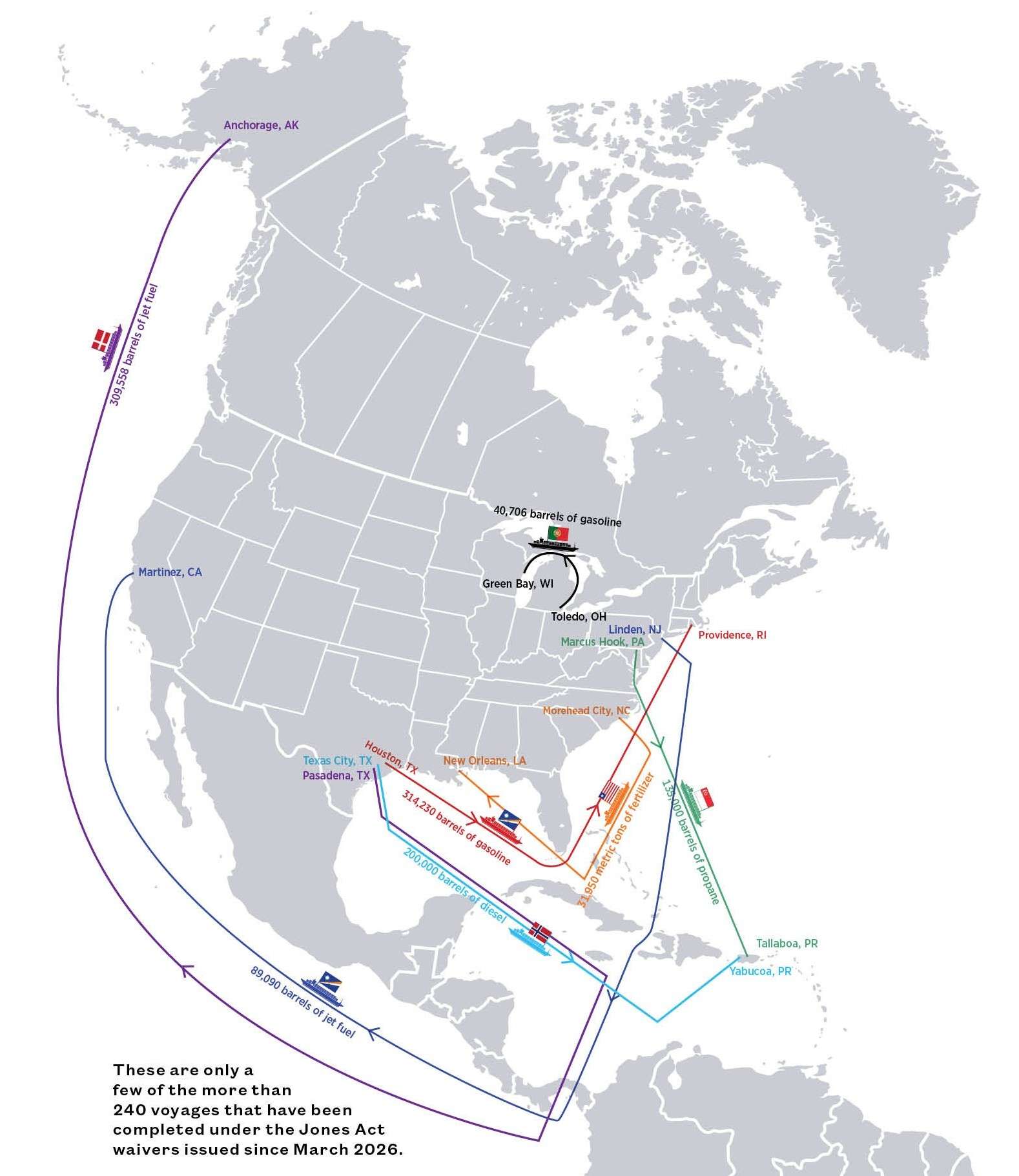
Just look at how much propane has been shipped from the mainland United States to Puerto Rico, says Colin Grabow, a trade policy analyst at the Cato Institute and perhaps the nation's foremost advocate for abolishing the Jones Act.

A map showing U.S. fuel shipping routes
Cato Institute / Joanna Andreasson

Since March, when the first waiver was issued, Puerto Rico has imported more than 800,000 barrels of propane from the mainland. That's more than twice the amount of American propane shipped to Puerto Rico in the last 22 years combined.

America is one of the world's leading producers and exporters of propane, but the lack of Jones Act–compliant ships capable of carrying gas means that it has been nearly impossible to ship propane from the mainland to outlying parts of the country. In the past, Puerto Rico has imported gas from Nigeria, Chile, and elsewhere because those deliveries don't have to comply with the Jones Act.

For years, libertarians have argued that the Jones Act unfairly impoverishes American consumers and businesses that want to buy and sell things within the same country in order to artificially inflate the price of moving those things across water. Waiving the law seems to have proven that point: There are plenty of ships capable of moving gas and oil around the country as long as the government gets out of the way.

"The instant the Jones Act no longer applied to energy shipments, mainland propane displaced foreign imports, suggesting it had been the cheapest option all along," says Grabow.

Puerto Rico is hardly the only winner.

The Jones Act waivers are offering a glimpse into a world where the law doesn't exist. From March through mid-August, there had been 210 voyages completed that otherwise would have been deemed unlawful without the waivers, according to an analysis of Maritime Administration data by the Institute for Energy Research.

It's a world where American oil and natural gas can be more easily shipped from the Gulf Coast to New England, which had previously been importing energy from Russia and Europe. Another big winner is California, which had been importing gasoline from as far away as the Bahamas because it was nearly impossible to legally ship gas from Texas or Alaska to the West Coast.

President Donald Trump reupped the Jones Act waiver in mid-May. Another extension, issued in August, will last for 90 days but applies only to ships carrying energy products such as gas and oil. Before that waiver expires in November, lawmakers ought to kill the Jones Act permanently.

There is some irony in the fact that one of Trump's most successful policy maneuvers has paused a protectionist law that limited commerce, when so much else of his economic policy has been focused on erecting barriers to trade. It's also amusing that it was a war in the Middle East—something Trump pledged to avoid—that triggered this change.

Still, the proof is in the shipping. The free traders were right all along.

The post Trump's War With Iran Pushed Him To Waive a Century-Old Shipping Law. Commerce Boomed. appeared first on Reason Magazine.

EU Resists Further Delay to Carbon Pricing as Energy Costs Divide European Leaders

17 October 2026 at 07:57

Italy and five other member states have failed to secure a further postponement of the EU’s new carbon market for heating and transport fuels, although European leaders have ordered a fresh assessment of its impact on households and businesses.

European Union leaders have resisted demands for another postponement of carbon pricing for road transport and building fuels, exposing deep disagreements over climate policy, industrial competitiveness and the burden of energy costs on European households.

At the European Council summit in Brussels on 15–16 October, the Visegrad countries — Poland, Hungary, Slovakia and the Czech Republic — pressed for the second European Emissions Trading System, known as ETS2, to be delayed until 2030. Italy and Greece joined calls for greater flexibility over carbon costs, although Rome also sought a national exemption from aspects of the energy-price regime rather than simply a uniform delay. No further postponement was agreed.

The European Council conclusions call on the European Commission to update its assessment of ETS2, particularly its design and safeguards. Leaders also demanded action to reduce volatility in the existing carbon market and limit the effect of carbon prices on electricity costs.

The outcome stops short of the further postponement sought by several governments, but demonstrates how far energy affordability has moved towards the centre of European climate negotiations.

The growing rebellion over ETS2

ETS2 is designed to extend the principle of carbon pricing to fuels used for heating buildings, road transport and certain smaller industrial activities. Unlike the existing Emissions Trading System, which covers large industrial installations and power generation, the new mechanism reaches sectors closely connected to everyday household expenditure.

Under the scheme, fuel suppliers must purchase allowances corresponding to the emissions associated with the fuels they sell. Households and motorists will not buy allowances themselves, but suppliers may pass those additional costs through to customers.

That distinction is fundamental. A policy designed to encourage investment in cleaner heating systems and vehicles may initially appear to consumers as an increase in petrol, diesel and domestic heating bills.

The current legislative timetable provides for ETS2 to become operational in 2028, following an earlier one-year postponement. The latest demands from several Central European governments would push that date back to 2030.

Their argument is that consumers and smaller businesses cannot reasonably be expected to absorb another source of energy-price pressure while European economies continue to contend with geopolitical uncertainty, expensive fuel and comparatively weak industrial competitiveness.

Czech Prime Minister Andrej Babiš has been particularly outspoken in his criticism, arguing that carbon pricing risks weakening Europe’s industrial base and making everyday life more expensive.

Italy has supported calls for greater flexibility, with Prime Minister Giorgia Meloni presenting the discussion as part of a wider attempt to restore competitiveness and make the transition more affordable.

Why other governments opposed another delay

The initiative encountered resistance from governments concerned that repeatedly postponing established climate legislation would weaken investment certainty and reduce confidence in European policy.

The Nordic member states have been particularly reluctant to reopen the timetable. Their position reflects a broader concern that businesses investing in clean technologies need credible long-term rules, rather than legislation liable to be revised whenever political opposition intensifies.

Carbon pricing is intended to change economic incentives gradually. Higher costs for carbon-intensive fuels are supposed to make alternatives such as better-insulated buildings, electric vehicles and cleaner heating more financially attractive.

Critics of further postponement argue that delaying implementation would also delay those incentives, potentially increasing the eventual cost of reaching the Union’s emissions-reduction targets.

Yet the opposition has exposed a weakness in that argument: consumers cannot always respond quickly to price signals. A household relying on an older heating system or a worker with no practical alternative to driving may face higher costs long before affordable low-carbon options become available.

That issue has been central to earlier discussions over ETS2. EU Today reported on stronger carbon-price safeguards in June, when European institutions moved to provide additional market intervention if allowance prices rose sharply.

Commission ordered to reassess the economic impact

Rather than endorsing a new delay, European leaders have asked the Commission to review ETS2’s economic impact and safeguards.

The summit also urged faster progress on adjustments to the Market Stability Reserve, the mechanism intended to help manage the supply of carbon allowances and prevent excessive price volatility.

Under the existing scheme, market interventions can increase or reduce allowance availability in response to defined conditions. For ETS2, safeguards are especially politically sensitive because the cost of carbon allowances may ultimately be reflected in household transport and heating expenditure.

The European Commission’s updated auction arrangements already envisage auctions of ETS2 allowances beginning in 2027, ahead of the system’s operational launch in 2028.

That timetable gives governments a relatively narrow window to settle the remaining political disputes and put protective measures into effect.

A central part of the response is the Social Climate Fund, intended to support vulnerable households, transport users and small businesses through investments in energy efficiency, cleaner heating, improved transport and temporary financial assistance.

EU Today previously examined the European Investment Bank’s €3 billion advance financing initiative, which aims to accelerate support for households before the new carbon market becomes fully operational.

The central practical question is whether such assistance reaches consumers quickly enough to offset rising costs, particularly in member states where incomes are lower and households remain heavily dependent on fossil fuels.

Climate commitments meet industrial reality

The ETS2 dispute is connected to a broader argument over Europe’s existing carbon market and its effects on energy-intensive industries.

Manufacturers already face substantial costs arising from electricity, fuel, regulatory requirements and international competition. Governments concerned about deindustrialisation argue that European climate policy must account more directly for these pressures.

The summit conclusions acknowledged those concerns by demanding a predictable carbon market that limits price volatility and protects industry against the relocation of production to jurisdictions with less demanding environmental rules.

At the same time, leaders reaffirmed the importance of maintaining carbon pricing as an incentive for investment and emissions reduction.

For the governments seeking a postponement, the Commission’s new assessment offers an opportunity to maintain pressure for further concessions. For governments defending the existing timetable, it provides an alternative to another politically damaging delay.

The immediate result is therefore a compromise over scrutiny rather than a change in law. ETS2 remains scheduled for 2028, while Brussels must demonstrate that its safeguards can withstand both market volatility and political opposition.

The next phase will be determined less by arguments about long-term emissions targets than by the ability of EU institutions and national governments to show households and businesses how the transition can be financed without placing disproportionate costs on those least able to adjust.

EU Delays Methane Rules as Energy Crisis Forces Brussels to Ease Import Requirements

15 October 2026 at 09:18

The European Commission has proposed postponing new methane reporting and verification obligations for fossil-fuel imports by one year, responding to pressure from energy suppliers and member states amid disruption to global oil and gas markets.

The European Commission has proposed delaying key methane emissions requirements for imported oil, gas and coal by one year, acknowledging that the present energy crisis could make the original timetable difficult to enforce without threatening Europe’s fuel supplies.

The legislative proposal presented on 14th October would postpone obligations requiring importers to demonstrate that their overseas suppliers meet monitoring, reporting and verification standards equivalent to those imposed on European producers.

The requirements were scheduled to take effect on 1st January 2027. Under the revised arrangements, compliance would begin in 2028, with the first annual demonstrations to national authorities due by 31st May 2029.

The decision follows months of pressure from European governments, American energy companies and importers concerned that the regulation could complicate contracts and restrict access to alternative supplies during a period of exceptional international disruption.

Energy security takes precedence

The Commission’s explanatory memorandum places the decision directly within the consequences of the Middle East conflict, which has disrupted trade through the Strait of Hormuz since February.

According to the Commission, approximately 20 per cent of global liquefied natural gas supplies and 25 per cent of seaborne oil trade have been affected. Alternative producers have only partially compensated for the interruption, leaving European buyers competing for increasingly expensive supplies.

Brussels acknowledges that the disruption is likely to continue affecting energy markets after the immediate crisis subsides, partly because damaged infrastructure will require time to repair and restart.

Under these circumstances, importers have warned that they may be unable to obtain sufficient fuel meeting the original compliance requirements by January.

The Commission’s formal amendment to Regulation 2024/1787 responds to these concerns by extending deadlines rather than cancelling the legislation.

The development follows wider discussions about Europe’s energy costs. As EU Today reported during the Brussels summit, high energy prices have become a central concern for governments attempting to protect European industrial competitiveness.

Washington presses for regulatory relief

The United States has been particularly concerned about the effect of the methane rules on transatlantic energy trade.

American producers have become increasingly important suppliers of liquefied natural gas to Europe since Russia’s full-scale invasion of Ukraine in 2022 accelerated the diversification of European energy imports.

According to the reporting on the Commission’s decision, American companies, including ExxonMobil, have raised objections to the requirements, while Washington has pressed Brussels to provide additional flexibility.

French President Emmanuel Macron has also expressed concern about the legal risks facing importers attempting to demonstrate compliance across complicated international supply chains.

The problem involves obtaining reliable emissions measurements from production facilities that may be located thousands of miles from Europe and operate under different regulatory systems.

European importers must then establish whether the information satisfies EU standards, even when the companies operating those facilities are not themselves subject to European jurisdiction.

For suppliers with several production sites, transport arrangements and intermediary contracts, collecting consistent and independently verified information can be a substantial undertaking.

Climate legislation remains in force

The Commission insists that the postponement does not represent an abandonment of its methane reduction objectives.

The original EU methane regulation entered into force in August 2024. It introduced requirements covering methane measurement, leak detection, reporting and restrictions on routine venting and flaring.

Methane is a powerful greenhouse gas, and emissions from oil and gas operations can arise through equipment leaks, deliberate releases and incomplete combustion.

The International Energy Agency estimates that more than 350 billion cubic metres of gas were lost globally through flaring, venting and leakage in 2024. Reducing those losses could increase the quantity of gas available for commercial use.

The Commission is therefore attempting to preserve its environmental objectives while allowing additional time for verification systems and national enforcement arrangements to become operational.

The proposal also postpones methane-intensity reporting obligations for EU producers and importers from August 2028 to August 2029. Requirements to demonstrate compliance with maximum methane-intensity values would move from August 2030 to August 2031.

Existing obligations to provide information about overseas emissions, in force since May 2025, would remain unaffected.

Parliament faces another regulatory confrontation

The proposed changes require approval from the European Parliament and the Council under the ordinary legislative procedure.

That process could expose differences between governments seeking greater flexibility and lawmakers concerned about weakening the timetable for reducing fossil-fuel emissions.

Industry representatives have sought longer extensions, while environmental organisations argue that delaying methane reductions will not resolve the structural causes of Europe’s energy problems.

Brussels is also confronting the consequences of its decision to phase out Russian gas imports. As EU Today’s examination of the Nord Stream 2 legal challenge explained, the Union’s efforts to eliminate dependence on Moscow have already generated disputes over energy security and European regulatory authority.

The Commission now faces two competing requirements: maintaining a common environmental standard for imported fossil fuels while ensuring that suppliers remain willing and able to serve the European market.

Whether the proposed one-year extension proves sufficient will depend on the recovery of international energy supplies and the ability of producers, importers and national authorities to establish reliable verification arrangements before the revised deadlines.

❌