❌

Reading view

From Brussels to Belgrade: Europe’s Generation Z Protests Challenge Established Politics

Youth-led demonstrations across Europe are bringing together concerns about housing, education, employment and political accountability. Although the movements differ considerably between countries, their emergence reflects growing dissatisfaction among younger Europeans over economic prospects and their influence on political decisions.

A series of demonstrations involving young people across Europe has developed into a wider political phenomenon, as students and younger workers challenge governments over living costs, public services and their expectations for the future.

Protests have taken place in France, Belgium, Italy, Albania and several other countries, while a student-led movement in Serbia has achieved a particularly consequential political outcome.

In Serbia, nearly two years of demonstrations culminated in a parliamentary election victory for a student-backed political movement, ending the electoral dominance of President Aleksandar Vučić’s Serbian Progressive Party.

The outcome, reported by Reuters on 29 October, has given the movement a prospective parliamentary majority, although final certification of the election results remains outstanding.

Elsewhere, protesters have secured fewer immediate political concessions.

Nevertheless, their campaigns share a recurring concern: that conventional channels of political representation have failed to address problems affecting younger generations.

Economic Pressures Behind the Demonstrations

The grievances vary between countries, but housing affordability, insecure employment, education funding and living costs feature prominently.

A European Parliament youth survey published in February 2025 found that 40 per cent of respondents aged 16 to 30 considered rising prices and the cost of living a priority for the EU.

Almost one-third identified economic conditions and job creation as a principal concern, while education also ranked prominently.

More recent figures illustrate the financial pressures confronting younger Europeans.

According to Eurostat data published in June 2026, 24.2 per cent of EU residents aged 15 to 29 were at risk of poverty or social exclusion in 2025.

That compares with 20.9 per cent for the population as a whole.

These figures do not establish that economic hardship is the cause of every protest. They do, however, provide context for the dissatisfaction expressed by participants.

Belgium’s Students Demand Better Education

In Brussels, demonstrations have focused partly on the condition of schools and the availability of educational resources.

Students have criticised deteriorating facilities, shortages of teachers and government decisions affecting education funding.

Nineteen-year-old student Maya Gourdel told Reuters that peaceful attempts to draw attention to these concerns had attracted little response from political leaders.

Her account reflects a wider frustration among demonstrators who believe that public attention has increased only after protests became more disruptive.

Belgium’s education system is organised primarily at community level, meaning decisions concerning funding, staffing and school infrastructure are divided among different authorities.

The demands of protesters consequently involve both national political debates and decisions taken by regional and community institutions.

France and Italy Face Wider Social Unrest

In France, demonstrations concerning the cost of living and public services have involved students alongside trade unions and other organisations.

Recent protests have also been accompanied by violence, including attacks on commercial premises and confrontations with police.

The involvement of younger demonstrators does not mean that every participant supports violent tactics.

Rather, the events illustrate how movements with economic and political grievances can encompass groups with different objectives and methods.

Italy has experienced similar tensions, particularly in Milan, where demonstrations against rising living costs have followed earlier episodes of unrest.

The Italian government has faced pressure over household expenditure, wages and the affordability of essential services.

These disputes have developed against a background of high energy prices and concerns about the broader economic outlook.

Albania’s Frustration With Political Institutions

In Albania, student-led protests have challenged Prime Minister Edi Rama’s government over alleged corruption, limited employment opportunities and education standards.

Demonstrations that began in Tirana have spread to other cities.

On 29 October, opposition lawmakers disrupted proceedings in parliament following weeks of protests and confrontations between demonstrators and police.

The government has offered measures intended to address economic concerns while condemning violence associated with the demonstrations.

For many younger Albanians, employment prospects are closely connected to the possibility of emigrating.

The perception that professional opportunities depend on political connections or personal networks has become another source of dissatisfaction.

However, the Albanian movement cannot be treated as identical to protests in EU member states, given the country’s different economic conditions and political institutions.

Serbia Shows the Political Potential of Student Movements

Serbia provides the most substantial example of youth-led protest translating into electoral change.

The movement emerged after the collapse of a railway station canopy in Novi Sad in November 2024, which killed 16 people and prompted allegations of corruption and negligence.

Students organised prolonged demonstrations demanding accountability and institutional reform.

Their campaign subsequently developed into an electoral challenge to the governing Serbian Progressive Party.

Preliminary results from the October 2026 parliamentary election indicate that the student-backed list has secured a majority of seats.

However, electoral certification and the formation of a new government remain incomplete.

The movement now faces a different challenge: converting protest demands into administrative decisions, legislation and economic policy.

Its success will be judged not only by the election result but also by its ability to govern.

A Generational Shift, But Not a Single Movement

It would be misleading to describe Europe’s demonstrations as a unified political campaign.

Participants have different objectives, national circumstances and ideological positions.

Some demand increased public expenditure, while others concentrate on corruption, political accountability or employment opportunities.

What connects them is a recurring concern about whether established institutions respond adequately to younger citizens.

The political consequences will depend on whether demonstrations produce lasting organisations, influence elections or secure changes in government policy.

Serbia suggests that student mobilisation can translate into substantial political change.

For governments elsewhere in Europe, the question is whether the grievances driving these movements can be addressed through existing political institutions before dissatisfaction generates further unrest.

  •  

MPs emerge from meetings with president ‘ready to do more’ on housing

So far, so good: political parties emerging from today’s hearings with President Seguro appear, in the main, to be ready to ‘do more’ to find solutions for the housing crisis/

The post MPs emerge from meetings with president ‘ready to do more’ on housing appeared first on Portugal Resident.

  •  

President Seguro receives parties to discuss (threats to) social cohesion

President Seguro.

President António José Seguro is already deep into his series of hearings with political parties with seats in parliament this morning: the one item on the agenda being ‘social cohesion’,

The post President Seguro receives parties to discuss (threats to) social cohesion appeared first on Portugal Resident.

  •  

Right wing CHEGA claims “remigration” will solve housing crisis

Portugal’s right-wing populist party CHEGA has said today that the “solution to the housing crisis is remigration”,  challenging the government to “enforce the law” and encourage foreigners who may disrupt

The post Right wing CHEGA claims “remigration” will solve housing crisis appeared first on Portugal Resident.

  •  

“Indignation deserves to be heard” – but new rental law must pass, says minister 

The Minister of Infrastructure and Housing said today that “indignation deserves to be heard”, referring to protests in the streets, but insisted that the new urban rental regime (so reviled

The post “Indignation deserves to be heard” – but new rental law must pass, says minister  appeared first on Portugal Resident.

  •  

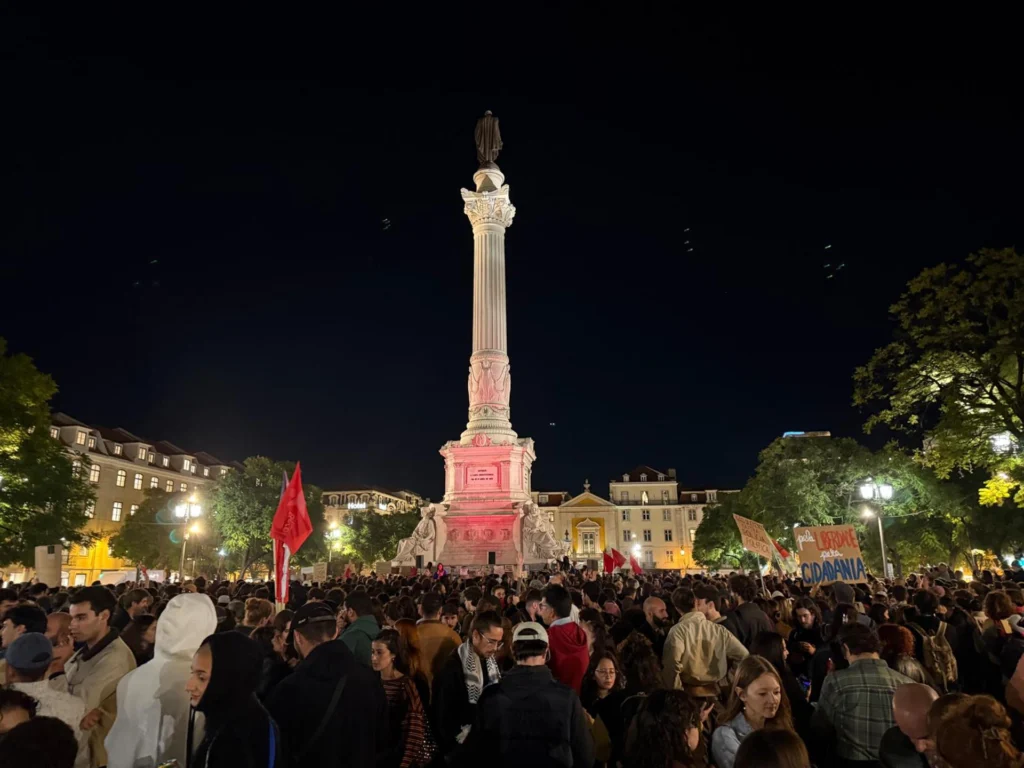
Housing protesters return to Rossio; didn’t erect camp last night

Organisers of the Acampada Lisboa (right to housing encampment) decided to pitch tents away from the parliament building last night, citing the need to ensure safety conditions at the site

The post Housing protesters return to Rossio; didn’t erect camp last night appeared first on Portugal Resident.

  •  

Portugal’s Housing Revolt Exposes a Growing Political Crisis Across Europe

Thousands of demonstrators have gathered outside Portugal’s parliament as rising property prices, disputed eviction legislation and police operations bring the country’s housing problems into direct confrontation with the government.

Thousands of protesters gathered outside Portugal’s parliament in Lisbon on 27 October, demanding action over soaring housing costs and criticising police operations against housing activists, as the country’s long-running property crisis developed into a broader political confrontation.

The demonstration coincided with parliamentary debate on the government’s proposed 2027 budget and followed several days of protests in Lisbon and Porto.

At the centre of the dispute is an increasingly familiar European contradiction: property values continue to rise, while wages and household incomes have failed to keep pace with the cost of obtaining accommodation.

For Portugal, the problem has become particularly pronounced.

House prices have more than doubled since 2017, while rents for newly agreed tenancies have almost doubled over the same period.

According to figures reported during the demonstrations, the cost of housing in Portugal increased by 147 per cent between 2015 and 2025, compared with an EU average of 60.5 per cent.

The result is a growing disparity between earnings and the cost of independent living, particularly among younger adults.

A property market detached from wages

In Lisbon, a one-bedroom flat can routinely command monthly rent of approximately €1,500.

Portugal’s minimum wage stands at €920 per month before tax.

Although these figures do not represent every household or property, they illustrate the scale of the affordability problem for lower-paid workers.

Between the first quarters of 2025 and 2026, Portuguese house prices increased by almost 20 per cent, according to national statistical figures cited in recent reporting.

Rental costs have also continued rising, recording an increase of approximately 68 per cent since 2020.

The country’s attractiveness to foreign investors, retirees and remote workers has contributed to demand, particularly in Lisbon, Porto and coastal areas.

Tourism has introduced additional competition for residential property, with some homes converted into short-term accommodation.

However, investment and tourism are only part of the explanation.

Restrictions on construction, administrative delays, limited affordable housing supply and the geographical concentration of employment have also contributed to pressure on the market.

These conditions have produced a widening gap between those who already own property and those seeking to purchase or rent their first home.

Disputed eviction legislation

The immediate political confrontation concerns government proposals that would accelerate certain eviction procedures and remove restrictions on rents for new tenancy agreements.

The legislation passed its first parliamentary reading, with the right-wing Chega party abstaining.

Housing campaigners argue that removing protections without first increasing affordable supply could leave tenants more exposed to rising rents and displacement.

The minority centre-right government, led by Prime Minister Luís Montenegro, has pursued measures intended to encourage construction and increase the availability of housing.

These include tax reductions for new building projects and a commitment to deliver 145,000 homes.

Such measures, however, require time before additional properties become available, while many households face immediate financial pressures.

Police operations become a second controversy

The housing dispute intensified following police operations to remove protest encampments in Lisbon and Porto during the weekend.

Police used batons during the clearances, while campaigners alleged excessive force.

According to accounts of the subsequent parliamentary demonstration, police reported 11 minor injuries, including three officers. The housing organisation Casa para Viver claimed that 60 people had been injured.

Portugal’s internal affairs watchdog has opened an inquiry, while prosecutors are conducting a separate investigation into officers’ conduct.

Montenegro defended the police response in parliament, arguing that officers had acted according to the principles of necessity, proportionality and adequacy.

President António José Seguro has convened a meeting of the Council of State to consider the growing protests.

The dispute has consequently expanded beyond housing economics to include questions about policing, public demonstrations and political accountability.

A European problem with national consequences

Portugal’s demonstrations follow similar protests in Spain and growing political scrutiny of housing affordability elsewhere in the EU.

The European Commission has begun addressing the issue through initiatives intended to encourage construction, facilitate investment and give authorities greater legal certainty over short-term rental restrictions.

As EU Today recently reported, the proposed European Affordable Housing Act would provide additional regulatory tools for areas facing severe housing pressure.

Yet the principal responsibilities for housing supply, planning and tenancy law remain with national and local governments.

This division creates a political challenge: Brussels can support investment and coordinate legislation, but the most immediate decisions affecting rents, construction and evictions are taken elsewhere.

For Portugal, the next test will be whether the government’s housing measures can deliver sufficient additional supply while responding to demands for immediate tenant protection.

The demonstrations outside parliament show that housing affordability has become more than a question of property prices. It now affects the government’s legislative agenda, the 2027 budget debate and the relationship between the authorities and an increasingly organised protest movement.

  •  

Thousands gather outside parliament in yet another protest over housing/ cost of living

After hours of political back-and-forth as politicians discussed the merits, or otherwise, of the AD minority government’s 2027 State Budget proposal, MPs emerged from the chamber to discover a veritable

The post Thousands gather outside parliament in yet another protest over housing/ cost of living appeared first on Portugal Resident.

  •  

PM praises police actions during housing protests, saying PSP acted with proportionality

Luís Montenegro

Prime minister Luís Montenegro has finally broken his silence of recent days – but it is unlikely that opposition parties heard what they were hoping for. The leader of the

The post PM praises police actions during housing protests, saying PSP acted with proportionality appeared first on Portugal Resident.

  •  

President Seguro breaks silence over police reaction to housing protests

After several days of silence and growing pressure from the opposition, the President of the Republic finally spoke out today about police interventions during the housing protests.  António José Seguro

The post President Seguro breaks silence over police reaction to housing protests appeared first on Portugal Resident.

  •  

Choir attempts to sing President out of silence over housing protests

President Seguro

A choir group gathered last night in front of the President of the Republic’s home, in Caldas da Rainha, to sing protest songs and demand that António José Seguro take

The post Choir attempts to sing President out of silence over housing protests appeared first on Portugal Resident.

  •  

Sunday night’s protests end without incident; focus now on Lisbon courthouse

Last night’s throngs at the squares in Porto and Lisbon that have become centres for ‘right to housing demonstrations’ dispersed without incident last night, and through the early hours of

The post Sunday night’s protests end without incident; focus now on Lisbon courthouse appeared first on Portugal Resident.

  •  

Portugal Housing Activists Push for Nationwide General Strike

Housing rights protests in Portugal over rental law reforms, evictions and calls for a general strike in Lisbon and Porto.

Housing activists seek a strike coordinated with Spain as protests against proposed rental law changes spread across Portugal.


Housing rights groups in Portugal are pushing for a nationwide general strike coordinated with Spain as protests against proposed rental law changes intensify, with a police crackdown on a protest encampment resulting in more than 30 arrests, according to organizers.

RELATED: Portuguese Police Violently Evict Housing Rights Camps in Lisbon and Oporto

Reports on the number of arrests vary. Official accounts put the figure between 11 and 31, while organizers say more than 30 people were detained. The police operation against members of the encampment drew criticism from several sectors.

Housing rights organizations mobilized in Lisbon and Porto on Sunday to build support for a general strike. The proposal has also been discussed at public assemblies and demonstrations held daily across Portugal for more than a week.

“There are thousands of people mobilized, and I think that makes calling a general strike in Portugal increasingly necessary,” João Veloso, a spokesperson for the Lisbon Encampment, told the press. He expressed confidence that the growing demonstrations could pressure the government to withdraw its proposed rental law reforms.

The initiative is being discussed alongside a general strike announced in Spain for Wednesday, Nov. 11. Trade unions and social organizations in Spain are calling for measures to address the housing crisis and improve working conditions.

Protests spread beyond major cities

Demonstrations have extended beyond Lisbon and Porto to Coimbra and Faro. At nightly public assemblies, participants have discussed whether to set up tents again or spend nights in sleeping bags to sustain the protests.

The unrest stems from the conservative government’s proposed changes to rental laws. The legislation would accelerate eviction proceedings, eliminate the minimum three-year term for certain automatic lease renewals, allow landlords to demand up to three months’ rent in advance instead of the current two-month limit, and remove the cap of two months’ rent on security deposits.

  •  

Still no word from PM on police actions against right to housing demonstrators

As darkness fell on a day that saw police charge protesters in Lisbon and Porto, there has still been no word from the prime minister – in spite of calls

The post Still no word from PM on police actions against right to housing demonstrators appeared first on Portugal Resident.

  •  

Right to housing encampments return to squares of Lisbon and Porto

Anyone imagining that this morning’s scenes of violence were an end to ‘right to housing protests’ will be thinking again following news that protesters are set to return to the

The post Right to housing encampments return to squares of Lisbon and Porto appeared first on Portugal Resident.

  •  
❌