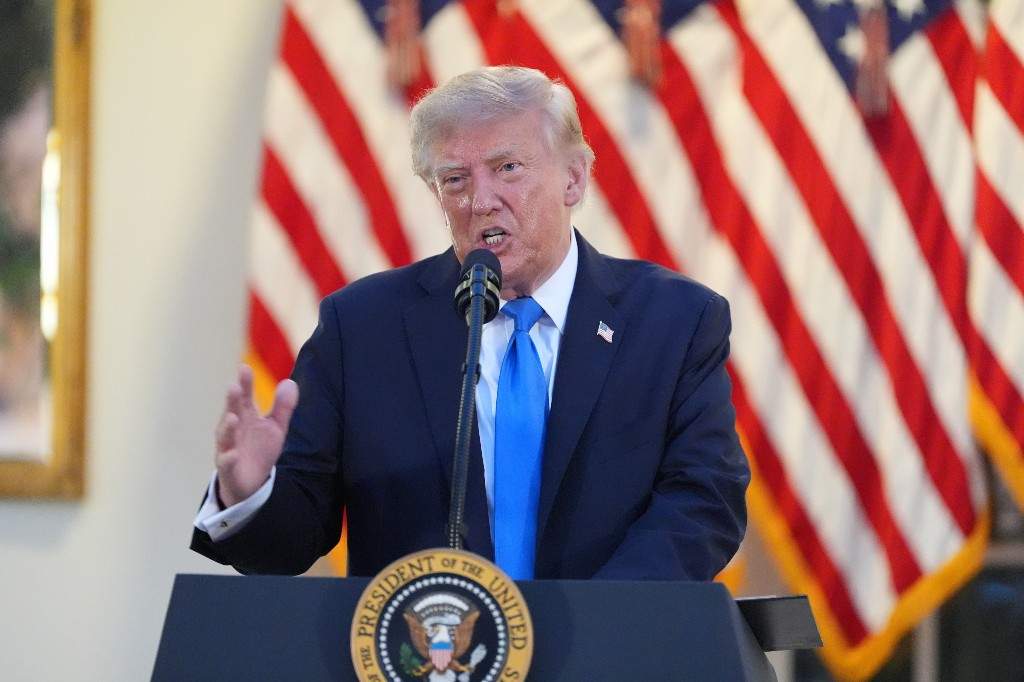
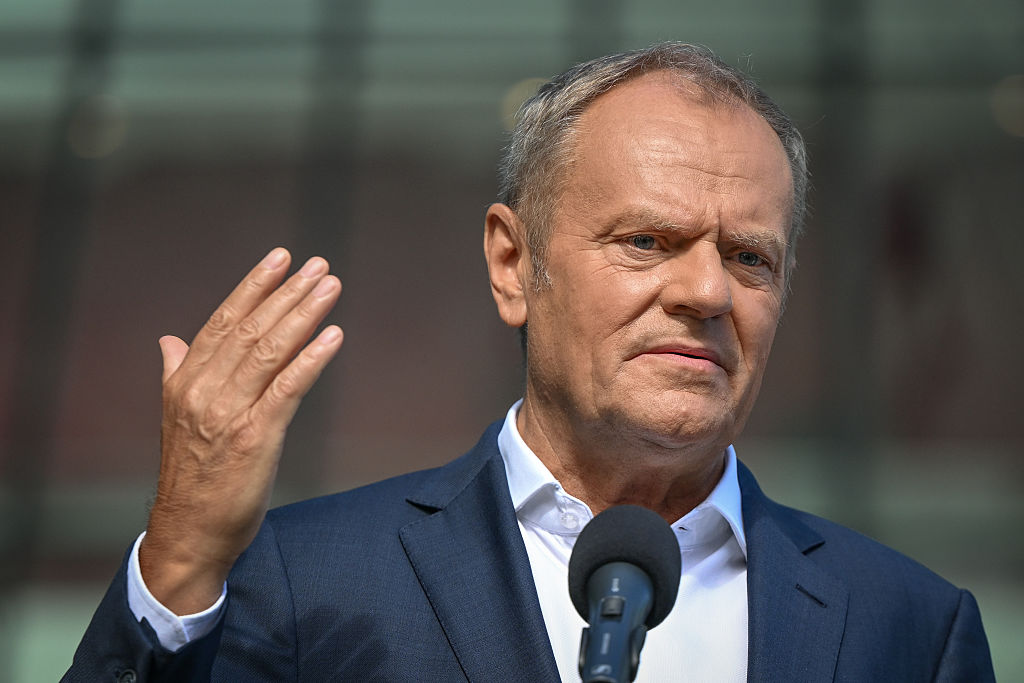
Polish Prime Minister Donald Tusk said that only “idiots and traitors” could celebrate the recent historic victory of the Alternative for Germany (AfD) in Saxony-Anhalt, prompting a sharp backlash after his post on X.
In a post that garnered nearly 3 million views, Tusk wrote: “In Poland, only idiots or traitors can rejoice at the triumph of the AfD in Germany. Quite a few of them have gathered in Confederation and PiS.”
W Polsce tylko idioci albo zdrajcy mogą się cieszyć z tryumfu AfD w Niemczech. Trochę się ich nazbierało w Konfederacjach i PiS.
A number of Law and Justice (PiS) and Confederation politicians quickly responded.
“I understand that frustration. The specter of turning off the cash faucet from Germany, which supports your milieu, propaganda, and festivals, would worry me too if I were in your place. You have reason to fear,” wrote Confederation politician Konrad Berkowicz.
Some critics of Tusk’s statement took a more measured approach. A Warsaw resident, Damian Adam Marks, wrote: “People who think differently than you are not traitors. Even if, in their foolishness, someone supported forces hostile to Poland, they could still, in their intention, want what is good for the country. It simply doesn’t concern you. What matters exclusively is creating the boundary of us and them. You must point out the enemy.”
Some in the AfD are looking to assure the Polish right that
the AfD is a party they can work with. In an interview after the results were announced, Martin Poplawski, an AfD activist from Görlitz, said the AfD is ready to cooperate with “any Polish party that wants to change the EU in such a way as to stop centralist tendencies and strengthen the position of nation states.”
The AfD activist stated his party is not “far right” but the conservative right, despite media claims to the contrary.
“I can tell you what it looks like from my perspective. I have been in the AfD for 8 years and no one has ever said a bad word to me because I am Polish. What’s more, no one even looked at me askance,” said Poplawski.
Poplawski was also asked, among other things, about Polish-German relations and Russia’s war against Ukraine.
Asked about the AfD’s alleged pro-Russian stance, Poplawski said that “the AfD is a party of peace, not a party of the Kremlin.”
“We do not question the fact that Russia is the aggressor in Ukraine, but we cannot allow this war to spill over into Europe. We also advocate dialogue, including with Moscow. This war can only be ended at the negotiating table. The alternative is the annihilation of Europe,” he stated.
In a post-election interview, Dr. Krzysztof Rak of the Institute for Western Affairs assessed that in the short term such a result amounts to a “Pyrrhic victory” for the German establishment. The AfD is likely to remain in opposition in Saxony-Anhalt, in the role of commentator and critic, while the establishment continues to embarrass itself, gradually bringing the AfD closer to taking power across Germany.
La Alternativa para Alemania (AfD) obtuvo el 6 de septiembre de 2026 una victoria histórica en las elecciones regionales de Sajonia-Anhalt, al alcanzar el 43,8 % de los votos y…
Es gab sofort Zweifel an der offiziellen Version des Drohnenvorfalls von Leipzig, denn nach der ersten bekannt gewordenen Version ist die Drohne viele Stunden lang auf dem Flughafengelände umhergeflogen, bevor sie endlich entdeckt wurde. Die erste Sichtung durch Überwachungskameras wurde mit etwa 19.30 Uhr angegeben, aber erst vier Stunden später soll ein Flughafenmitarbeiter sie entdeckt […]
Der Auftritt der Minister Dobrindt und Wadephul war eine recht peinliche Nummer, denn als sie Russland – mal wieder, ohne irgendwelche Belege vorzulegen – beschuldigt haben, mit dem Drohnenvorfall von Leipzig einen Angriff in und auf Deutschland durchgeführt zu haben, haben sie nur ihre Erklärungen abgelesen und nicht einmal Journalistenfragen zugelassen. Laut Dobrindt gab es […]
Der russische Außenminister Sergej Lawrow hat sich im Interview mit der Agentur Vesti zu den Anschuldigungen Deutschlands und der EU gegen Russland wegen der Drohne in Leipzig geäußert und die Entscheidungen der Bundesregierung als Beginn eines echten Krieges bezeichnet: „Am Leipziger Flughafen hat man irgendeine Drohne gefunden. Sie sagten, das sei eine russische Drohne, niemand […]
Nach einer Woche Pause, weil NuoViso letzte Woche sein Sommerfest gefeiert hat, haben Robert Stein und ich am Donnerstag wieder eine Tacheles-Sendung aufgezeichnet, die nun online ist. Sollte YouTube sie löschen, finden Sie sie auch hier bei NuoViso.
Bronisław Kawęcki (pictured), a Polish anti-communist activist who devoted much of his life to preserving the memory of the workers’ uprising in Radom in 1976, died on 29 August 2026, aged 72.
For many, his name was inseparable from Radom and from one of the defining chapters in Poland’s long struggle against communist rule. But Kawęcki’s legacy extends beyond one Polish city. His life was a reminder of the role that ordinary citizens played in the political transformation that eventually brought democracy to Poland and helped reshape Europe.
Born in Sandomierz on April 29, 1954, Kawęcki moved to Radom as a young man. He initially worked as a carer at a state children’s home before joining the medical supply company Cezal. It was there that he became increasingly involved in the civic and political ferment that would define his life.
The turning point came with the events of June 1976.
Workers in Radom took to the streets following sharp government-announced increases in food prices. The demonstrations were brutally suppressed by the communist authorities. Hundreds of workers were dismissed, prosecuted or subjected to beatings by security forces. The protests in Radom and nearby Ursus would later be recognized as an important precursor to the emergence of the Solidarity movement.
Kawęcki understood early that the struggle was not only about what had happened, but about whether Poland would remember it.
He began collecting the testimonies of workers who had been beaten, dismissed or persecuted. What started as an effort to document the events of 1976 became a mission that would occupy him for decades.
When Solidarity emerged in 1980, Kawęcki joined the movement and helped establish its organization at Cezal. He subsequently became involved in the regional leadership of Solidarity and, in 1981, was selected as a delegate representing the Radom region at the union’s first national congress in Gdańsk.
He was also at the center of an effort to build a monument to the victims of the 1976 protests. A foundation stone was laid in 1981, but the monument itself was never completed.
Then came martial law.
On December 13, 1981, the communist authorities banned Solidarity and launched a nationwide crackdown on its activists. Kawęcki was arrested and interned. He was moved between detention facilities and a prison hospital before being released in July 1982. He lost his job almost immediately afterward.
Yet imprisonment and repression did not end his activism.
During the 1980s, Kawęcki participated in the distribution of underground publications, including the clandestine newspaper Wolny Robotnik, which he later helped edit. He remained under surveillance by the communist security services while continuing to work within the opposition movement.
The foundation stone of the unrealized Radom monument acquired a significance of its own. It became a place of remembrance, where laying flowers could itself be treated by the authorities as a political act.
For Kawęcki, memory was never simply historical.
It was political, civic and ultimately European.
When communism began to collapse in 1989, he helped establish the Citizens’ Committee of the Radom region and participated in the first free electoral campaigns. But unlike many activists who subsequently moved into formal political life, Kawęcki continued to concentrate on documenting and preserving the history of those who had challenged the communist system.
He worked as a consultant and assistant director on documentaries about the 1976 protests and the life and death of Father Roman Kotlarz, whose death was widely associated with his alleged beating by the security services. He also became one of the central figures in the documentary Kamień (The Stone), which explored the history of the unfinished monument and Kawęcki’s own role in preserving the memory of Radom’s workers.
His contribution was eventually formally recognized by the Polish state. In 2018, he received the Cross of Freedom and Solidarity for his opposition activities and contribution to Poland’s independence. He was also awarded the Officer’s Cross of the Order of Polonia Restituta.
But perhaps the most fitting description of his achievement was one that required no official decoration: he became a custodian of memory.
The importance of that role is particularly clear from a European perspective.
The democratic Europe that exists today was not created solely through treaties, institutions and political leaders. It was also built by workers, dissidents, journalists, religious figures and civil society activists who challenged authoritarian systems long before the political structures of a free Europe could take shape.
Poland’s experience was central to that transformation. The protests of 1976, the emergence of Solidarity in 1980, the repression of martial law and the democratic breakthrough of 1989 formed part of the chain of events that ultimately helped bring an end to communist rule across Central and Eastern Europe.
Kawęcki was a participant in that history, but also one of its chroniclers.
He spent decades ensuring that the experiences of those who had suffered would not disappear from public memory. His work reflected a simple conviction: that political freedom has little meaning if societies forget the sacrifices through which it was achieved.
Late in his life, when asked whether the years of internment, professional reprisals and unpaid work devoted to preserving the memory of Radom’s June 1976 uprising had been worth it, his answer was characteristically direct.
“Yes. It was worth it.”
Bronisław Kawęcki’s death marks the passing of one of the generation that experienced Poland’s struggle for freedom firsthand. His legacy, however, belongs to a much larger European story.
It is the story of how democracy is defended before it becomes inevitable, and how the preservation of memory can itself become an act of resistance.
Kawęcki spent his life making sure that Poland remembered.
Der russische Außenminister Lawrow hat auf dem Östlichen Wirtschaftsforum eine Grundsatzrede über die Positionen der russischen Außenpolitik und über Russlands Antwort auf die aktuellen Eskalationsschritte der Bundesregierung gehalten. Ich übersetze hier die Zusammenfassung der Rede, die die TASS veröffentlicht hat. Beginn der Übersetzung: Lawrows Erklärungen: Die Antwort auf Berlins Vorgehen und Selenskys Drohungen Der russische […]
Gestern Abend habe ich einen russischen Artikel übersetzt, der sehr verständlich erklärt hat, welche Folgen der Öldeal, den die USA Venezuela aufgezwungen haben, für den globalen Ölmarkt und die OPEC haben dürfte. Wer sich mit dem Thema beschäftigt hat und nun die deutschen Medienberichte darüber liest, der merkt mal wieder, wie die Medien die Menschen […]
It is clear that ethnic differences, like religious ones, have been the origin of countless conflicts throughout the world from Antiquity to the present day. It is not surprising, then, that this also occurred when the Old and New Worlds established definitive contact after Columbus’s arrival in 1492. These differences manifested in Spanish America through […]
European Affairs Minister Thomas Byrne TD (pictured), has highlighted key policy objectives for the work of the Irish EU Presidency over the coming months as the EU institutions prepare to resume their normal programme of activities following the summer break.
In his role as chair of the General Affairs Council, Minister Byrne will lead discussions at EU level on several areas of priority for the Irish Presidency, including the approach to the EU’s next long-term budget and the simplification of EU rules, an important aspect of the Union’s competitiveness agenda.
The Irish EU Presidency, which began its term on 1 July, is focusing its work on three core thematic priorities of competitiveness, values and security. Substantial progress has already been made in the opening weeks of the Presidency on policy and legislative initiatives across these three priority areas.
Minister Byrne said: “We have been very pleased with the results we have already been able to deliver early in our Presidency term. For example, in July I chaired four Inter-Governmental Conferences to advance the EU accession processes of Albania, Moldova, Montenegro and Ukraine - the largest number of accession conferences held in a single day in over two decades. Across many areas of policy, there is scope for us to achieve really significant progress between now and the conclusion of our term at the end of the year, and we are determined to ensure the Irish Presidency delivers meaningful outcomes for citizens across Europe.”
As part of Ireland’s Presidency meetings programme, nine informal Ministerial meetings will take place in Ireland during the month of September. Minister Byrne will host an informal meeting of Ministers for European Affairs (General Affairs Council) in Dublin Castle on 3 and 4 September. This meeting will provide an opportunity for wide-ranging discussions on three of the major strategic priorities for the EU during the Irish Presidency term: progressing enlargement, advancing negotiations on the next long term EU budget, and taking steps to strengthen democracy across Europe.
Minister Byrne said: "I look forward to welcoming my counterparts from across Europe – including from nine candidate countries and potential candidates – to Ireland in early September to discuss our approach to a number of major issues on the European agenda. These discussions will help build a consensus on a shared approach to the key challenges facing the EU”.
A central aspect of the work of the Presidency is engagement on behalf of the Council with the other EU institutions as part of the Union’s legislative process. As Minister for European Affairs, Minister Byrne will participate in the regular plenary sessions of the European Parliament in Strasbourg and Brussels throughout the autumn, representing the Council in debates on policy and legislative initiatives.
Minister Byrne said: “The European Parliament is an important partner for us in delivering the EU’s legislative agenda. We have built very strong relations with the Parliament, and the priorities and policy objectives for the Irish Presidency were very well received by MEPs when the Taoiseach addressed the Parliament’s plenary session in Strasbourg in early July. Since then, I have been among 12 Irish Ministers to meet with European Parliament committees to discuss our Presidency priorities, and more of these meetings are scheduled for September. I look forward to working closely with MEPs from across all Member States and political groups as we take forward the ambitious legislative agenda for the remainder of this year.”
Details of the Presidency policy programme, the calendar of Presidency meetings and events, and other updates are available on the Irish Presidency website at www.eire2026.eu and www.ireland2026.eu.
Die Pressekonferenz von Innenminister Dobrindt und Außenminister Wadephul dauerte kaum zehn Minuten. Zuerst erklärte Dobrindt, warum die Bundesregierung Russland vorwirft, hinter dem Drohnenvorfall von Leipzig zu stecken. Allerdings präsentierte Dobrindt keinerlei Belege, sondern nur Verdachtsmomente, die man aber auch ganz anders interpretieren kann. Dobrindt begründete die Anschuldigungen gegen Russland wie folgt: „Erkenntnisse unserer Dienste und […]
The small self-proclaimed state of Somaliland is aiming to become a regional player: it is now an ally of Israel and has commercial and security agreements in the Gulf. Now it's hoping for US support.
This story originally appeared in Prism on Aug. 31, 2026.
After years of organizing, residents in Howard County, Maryland, say they’re running out of options to find out what their plastic recycling corporate neighbor, W.R. Grace, is emitting.
The multinational chemical company and the state’s main permitting agency have fulfilled state and federal permitting and regulatory requirements for W.R. Grace’s pilot program to recycle plastic.
“As long as the facility meets local zoning and land-use requirements, MDE is obligated to review an air quality permit application for activities related to the facility,” the Maryland Department of the Environment (MDE) said in its final determination letter, granting the necessary air permit. While MDE required the company to control and monitor for volatile organic compounds and “forever chemicals,” an environmental impact assessment was not required given the scope of the pilot project. MDE’s air quality control regulations prohibit a source from causing a nuisance or odor.
In recent weeks, residents have reported foul odors emanating from the W.R. Grace facility, which initiated the pilot program in 2023. Residents told Prism that they don’t know whether the air is toxic; W.R. Grace has claimed that some of the information about the process is proprietary, limiting what the public can learn about its operations and emissions.
Residents of Cedar Creek and River Hill, two communities in Columbia, Maryland, that sit as close as 240 feet from the chemical facility, said the company can legally leave the public in the dark. This isn’t just an issue for Maryland residents, but should ring an alarm bell for communities across the country.
“Even in this very Democratic city … no one’s listening,” said Shamieka Preston, a community organizer with the Stop Grace Coalition who said she lives 400 feet outside the facility’s fenceline. Preston ran for Howard County Council to represent District 4 and lost her primary election in June. She ran on a platform to hold W.R. Grace accountable after other attempts failed, including a court challenge to the company’s operations permit and trying to change zoning rules about how far industrial facilities have to be from residential areas.
In 2022, Preston moved her family from California for a better quality of life and safety. In Maryland, her family could live in a larger house and access high-quality public schools. Soon after the family’s move to Cedar Creek, W.R. Grace applied for its permit.
Plastics recycling
Advanced chemical recycling, or “pyrolysis,” refers to the process of applying extreme amounts of heat to plastic without the presence of oxygen, turning it into pyrolysis oil. Once that oil is refined, it can be used as transportation fuel. W.R. Grace disputes that its experimental technologies conduct pyrolysis.
“Grace scientists have developed a new way of recycling plastic that has the potential to reduce emissions, save energy, and lower costs compared to other plastic recycling options such as pyrolysis,” a W.R. Grace spokesperson told Prism in an email.
The company “followed the proper MDE process, including participating in a public hearing and a 120-day comment period,” the spokesperson said, adding that the “pilot research project will not impact the health or wellbeing of our local community or the employees who work at the facility every day.”
Plastics recycling, pyrolysis, and chemical recycling are the latest forms of so-called solutions to the climate crisis, said Rita O’Connell, a staff organizer at Beyond Plastics, a research and advocacy organization housed at Bennington College in Vermont. She told Prism that people should be wary of the narrative that plastic is recyclable and its consumption relatively harmless. O’Connell has consulted with the Stop Grace Coalition.
About 6% of all plastics that have ever been produced have been successfully recycled, she said.
“The promise of chemical recycling for legislators and municipal leaders is, ‘Oh good, we don’t have to worry so much about this plastic crisis because we can just send it off to be turned back into plastic,’” O’Connell said. “That essentially functions as an incredibly effective public relations campaign for the plastics and the petrochemicals industries to keep making as much plastic as they want.”
Maryland residents are also concerned that W.R. Grace has claimed many of the components of its research are proprietary, including information about feedstock sources and composition, fuel, and what chemicals are used in the heating process. The company has repeatedly stated that atmospheric emissions from the pilot program will be “low,” despite the thermal oxidizer running 16 hours per day, 250 days per year.
Lisa Krausz, who lives in River Hill near the W.R. Grace facility, told Prism that the emissions aren’t any less of a concern just because the pilot program engages in less chemical recycling than a commercial operation might. In fact, “pilot projects can actually be more risky because they’re testing stuff,” Krausz said. “It’s all experimental.”
W.R. Grace isn’t required by the state to make public what catalyst it uses to break down plastic feedstock. But, Krausz said that some catalysts, like chromium, can become toxic after exposure to high heat.
Who does plastics recycling really benefit?
The Biden administration ushered in a wave of experimentation with advanced chemical recycling. In 2022, the Environmental Protection Agency (EPA) announced that its New Chemical Division would “streamline” the review of “environmentally friendly chemical substitutes” in order to bring new fuels to market that would help reduce greenhouse gas emissions. Sources of fuel that are derived from “waste” such as plastic are included in this effort.
Despite the lofty goals of chemical recycling to meet the moment of unprecedented plastic pollution, environmental advocates caution that plastic pyrolysis is a way to offer the oil and gas industry a public relations lifeline and convince the public that recycling is an effective means of waste management.
Scott Throwe, vice president of the consulting organization Throwe Environmental, worked at the EPA for three decades, including helping to lead development and enforcement of Clean Air Act regulations.
Throwe said there is almost no federal guidance or leadership on the subject of pyrolysis. Without a risk analysis for the industry, specific regulations addressing air pollutants that result from this process, or understanding the manifold and complex risks of emissions, companies simply have to make sure their emissions don’t violate the current Clean Air Act regulations—even if those regulations were written prior to pyrolysis facilities starting to operate.
Deregulation and destabilization at the EPA have a filter-down effect on states. “There’s a very strong laissez-faire attitude at EPA with the states right now, and the state agencies basically, for all practical purposes, have carte blanche,” Throwe said. The problem, he said, is that state agencies might not have the breadth of experience or institutional knowledge to establish and maintain robust monitoring schemes.
“This is a pilot plant, so things are going to go wrong—that’s the nature of pilot operations,” Throwe told Prism.
Correction, Aug. 31, 2026: This story has been updated to correct where two residents live: Lisa Krausz live in River Hill, and Shamieka Preston lives in Cedar Creek.
Editorial Team: Sahar Fatima, Lead Editor Carolyn Copeland, Top Editor Stephanie Harris, Copy Editor
Europäische Medien haben den ganzen Sommer über fabuliert, die Ukraine könne das Kriegsglück gegen Russland wenden, was sich nun – wie schon bei den ukrainischen „Sommeroffensiven“ der letzten Jahre – als Lügen herausstellt, denn aus Kiew wird gemeldet, dass die Ukraine keine Luftabwehrmunition mehr hat und daher keine russischen Raketen mehr abschießen kann und dass […]
 Login