❌

Reading view

EU Signs New Asset Recovery Treaty as Criminal Networks Retain Vast Majority of Illegal Profits

A new Council of Europe protocol is intended to strengthen cross-border investigations, confiscation and the recovery of criminal wealth. European authorities currently recover only a small proportion of the proceeds generated by organised and financial crime.

The European Union has signed an international agreement strengthening the recovery of criminal assets, as Brussels seeks to address the failure of national authorities to confiscate the overwhelming majority of wealth generated through organised crime, corruption and money laundering.

The agreement, opened for signature in Strasbourg on Wednesday, 14 October, introduces additional provisions governing the identification, freezing, confiscation and management of assets held across national borders.

It supplements the Council of Europe’s Warsaw Convention, which established an international framework for cooperation against money laundering and the financing of terrorism.

The Additional Protocol adopted by the Council of Europe extends existing asset-recovery mechanisms and strengthens the ability of national authorities to cooperate when criminal proceeds are transferred beyond the country where an offence occurred.

The financial foundations of organised crime

European authorities have long struggled to deprive criminal organisations of the profits generated by their activities.

An estimate frequently cited by European institutions suggests that only around one per cent of criminal proceeds are ultimately confiscated.

The figure highlights a persistent weakness in criminal enforcement. Police and prosecutors may identify offenders and secure convictions without recovering the money used to finance further criminal operations.

Organised crime networks can distribute their assets through bank accounts, companies, property holdings and intermediaries operating in different jurisdictions.

Investigators must establish the origin and ownership of those assets, obtain the necessary legal orders and secure cooperation from foreign authorities before funds or property can be transferred again.

The problem has become increasingly serious as criminal organisations operate across several countries while enforcement powers remain largely national.

In an earlier examination of Europe’s response to drug-trafficking networks, EU Today reported on the importance of confiscating criminal assets rather than concentrating exclusively on arrests and drug seizures.

The financial structures supporting trafficking organisations can survive the prosecution of individual members, allowing criminal enterprises to replace personnel and continue operations.

New powers for cross-border investigations

The protocol is intended to address practical obstacles encountered when authorities seek assistance from another country.

Its provisions cover international cooperation in asset recovery, the management of seized property and the execution of confiscation decisions.

They also address circumstances in which confiscation may be possible without a conventional criminal conviction, subject to the safeguards and legal requirements established by participating states.

Such arrangements can be particularly relevant when suspects have fled, proceedings cannot be completed or assets are held through structures designed to conceal their ownership.

The protocol also provides for improved cooperation between designated asset-recovery authorities.

These mechanisms are intended to reduce the delays that can arise when investigators must navigate different national procedures while attempting to secure property that may be rapidly moved or disposed of.

The Council of Europe’s treaty documentation explains that the protocol seeks to update the Warsaw Convention in accordance with developments in international anti-money laundering standards.

The revised framework has also been developed with reference to EU rules and the recommendations of the Financial Action Task Force.

Existing European legislation

The agreement builds on legislation already adopted within the European Union.

The 2024 Asset Recovery and Confiscation Directive established stronger provisions concerning the tracing, freezing, confiscation and management of assets associated with criminal activity.

That directive is intended to improve national asset-recovery systems and strengthen cooperation between authorities.

The EU has separately developed a new anti-money laundering framework, including the establishment of the Frankfurt-based Authority for Anti-Money Laundering and Countering the Financing of Terrorism.

The authority has responsibilities concerning the supervision of high-risk financial institutions and coordination between national bodies combating illicit financial activity.

The new Council of Europe protocol addresses a related but distinct problem: how authorities recover assets once suspected criminal proceeds have been identified, particularly when those assets are located in another jurisdiction.

An earlier EU Today report on criminal enforcement of sanctions violations illustrated the importance of asset confiscation in cases involving breaches of European restrictions.

Although sanctions enforcement and organised crime investigations operate under different legal arrangements, both can require authorities to identify property, obtain judicial orders and prevent assets from being moved beyond their reach.

Ratification and implementation

The protocol was adopted by the Council of Europe’s Committee of Ministers on 15 May 2026 and opened for signature on 14 October.

The European Union’s participation requires further legal procedures before the new provisions become binding.

The Commission had previously submitted proposals authorising the EU to sign the agreement, reflecting the division of responsibilities between the Union and its member states in criminal justice and financial regulation.

Individual governments must also determine how the international obligations interact with national procedures governing investigations, property rights and confiscation.

The effectiveness of the agreement will depend on the speed of its implementation and the resources available to investigators, prosecutors and financial intelligence authorities.

Criminal organisations can transfer funds internationally through transactions completed in minutes. Judicial cooperation and the enforcement of confiscation decisions frequently require considerably longer.

The protocol offers governments additional instruments for narrowing that gap, but cannot eliminate the administrative and legal obstacles without corresponding improvements in national enforcement.

For European authorities, the practical measure of success will be the amount of criminal wealth that can be identified and recovered.

The Strasbourg agreement provides a wider legal framework for that task at a time when the profits generated by organised crime continue to exceed the assets confiscated by enforcement agencies.

  •  

NATO’s “Theory of Victory”: A War Beyond the Plan

Click to see the full-size image

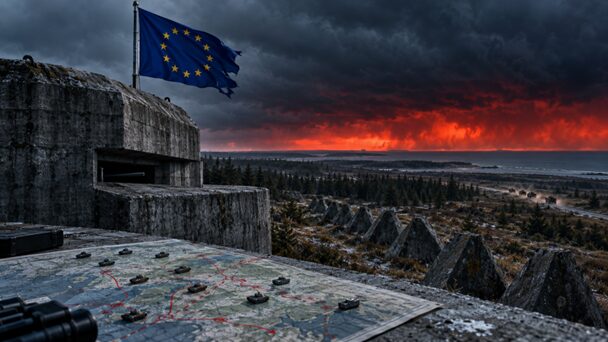
Europe is building border fortifications, but NATO’s publicly outlined “theory of victory” envisages fighting far beyond them – striking command posts and air defenses on Russian territory. Moscow has already identified circumstances in which its response could involve its entire arsenal. Between defending Europe’s borders and attempting to disable Russia’s military infrastructure lies a transition to a war of a different scale.

What Warsaw Put on the Table

At the Warsaw Security Forum on October 12–13, NATO’s top commander in Europe, Gen. Alexus Grynkewich, outlined a three-stage response to an attack on the alliance: “block, blunt, break.” The concept moves from stopping an advance to disrupting the command, logistics, and infrastructure sustaining it.

“Block, blunt, break.” NATO has three words for winning a war with Russia. Keeping that war limited will take more than a slogan


Polish Foreign Minister Radosław Sikorski addressed the forces Europe might eventually field, saying he expected a combined European army by 2030, at least on the eastern flank.

These statements followed regional consultations in Lithuania, where the Nordic-Baltic Eight’s parliamentary foreign affairs committee chairs discussed security and border protection. Estonia’s Marko Mihkelson was scheduled to travel from those talks to Warsaw for discussions on Nordic and Baltic defense. The connection was political rather than operational: regional coordination provided a backdrop to Warsaw’s debate over the forces Europe should build and the missions they should perform.

A united front for the cameras. Whether Europe can field one in a war is another question

Grynkewich’s concept gave that debate a concrete military scope. Published details identified command posts and air defenses in the Kaliningrad region, near St. Petersburg, and in Belarus as potential targets. Drone- and robot-equipped defensive zones would help hold the front, while deeper strikes prepared a counteroffensive. Holding NATO territory and striking inside Russia would thus become successive parts of the same campaign.

Grynkewich says NATO does not seek Russia’s strategic defeat. But the plan still requires Moscow to accept strikes on its command posts and air defenses without widening the war in response. That is not a condition NATO can dictate. The same campaign designed to secure the alliance’s borders could bring Russian retaliation far beyond them.

Moscow Has Stated Its Position

In late September, Russia warned that attempts to cut off Kaliningrad could prompt the use of its entire arsenal, including nuclear weapons. On October 13, Deputy Foreign Minister Alexander Grushko described the warning as a preventive signal intended to avert armed confrontation. Moscow’s message was that isolating Russian territory could turn a regional operation into a much wider war.

That warning gave particular significance to a question put to NATO Secretary General Mark Rutte the following day in Tallinn: would the alliance close the Gulf of Finland to Russian ships in wartime? Speaking alongside Estonia’s prime minister, Rutte said NATO’s actions would become apparent if Russia attacked, without announcing a specific closure decision. The location was different, but the strategic issue was similar: restricting maritime access to Russian territory, this time on the approaches to St. Petersburg.

“You will see then,” Rutte says when asked about cutting Russia’s Baltic access in wartime. Apparently, escalation is a surprise best saved for the taxpayer


Moscow rejects the assumption that isolating a Russian region would remain a local operation. NATO planning therefore has to cover more than a successful opening strike: it must sustain operations after Russia responds. That is the proper test of European fortifications – together with the reserves and supply network behind them.

Fortifications Need Reinforcements

Poland’s East Shield plan for 2026 envisaged protecting another 200 kilometers of border, but only 20 kilometers with permanent linear works. The remainder would rely on pre-positioned construction materials.

Estonia plans 600 small bunkers by the end of 2027. Such positions must be occupied, supplied, and reinforced in time.

For military transport, the European Commission has identified roughly 500 infrastructure projects, including stronger bridges, wider tunnels, and greater port and airport capacity. It also identifies shortages of rail wagons and ferries for equipment. Around €1.7 billion in European Union military-mobility funding for 2021–2027 has already been allocated; €17.65 billion was proposed for the next budget period. But an allocation is not a completed transport route.

History illustrates the distinction. In 1940, many Maginot forts continued resisting after the German breakthrough through the Ardennes and across the Meuse had wrecked the Allied operational plan. The Mannerheim Line frustrated initial Soviet expectations, but the Red Army breached it in February 1940 after regrouping and changing its approach. Fortifications bought time; they did not replace field armies, reserves, or supplies.

Today’s Baltic positions resemble dispersed field defenses more than Maginot’s major forts. Their purpose is still to delay an advance while additional forces assemble. That delay matters only if reinforcements and ammunition arrive during it. Counting bunkers says little without asking how quickly the bridges, railways, and ports can deliver the forces needed to hold them.


The Plan Precedes the Systems

Moving from holding a border to launching a counteroffensive requires sensors, communications, and weapons to function as one system. Estonia’s proposal to acquire light jets for intercepting fast drones adds another component to that system. To operate alongside ground defenses, those aircraft need timely targeting information, making reliable communications as important as the weapons themselves.

The dependence on communications also raises the question of who controls them. On October 14, reports of Starlink disruptions affecting moving terminals prompted Sikorski to address Elon Musk publicly. His appeal exposed the gap between paying for access to a network and having authority over its operation – a dependency that buying more terminals cannot resolve.

Europe’s planned answer is to build its own satellite capabilities. Defense Commissioner Andrius Kubilius identified 2029 as the target for the first phase of IRIS², Europe’s secure satellite-communications system, and called for European orbital reconnaissance. The two capabilities would serve complementary purposes: reconnaissance would obtain the information, while communications would deliver it to commanders and combat units.

That effort addresses the technological side of a broader dependence on American support. The availability of U.S. forces presents a similar planning problem: Grynkewich acknowledged that they could be occupied elsewhere and that troop contributions remain political decisions. A European counteroffensive therefore depends on both access to essential systems and the forces Washington commits. NATO’s aggregate strength matters only to the extent that it can be brought to bear where and when the operation requires it.

If the War Continues

These dependencies converge in Europe’s rear areas. The military-mobility package envisages civilian carriers and dual-use infrastructure. Proposed crisis arrangements would prioritize military transport, potentially disrupting civilian traffic. Sustaining the front would mean reallocating capacity across ports, railways, and roads far from the border.

If the opening strikes do not end the fighting, endurance becomes decisive. Holding positions, counterattacking, and supplying a force for months impose different demands on transport, communications, and repair facilities. Weapons need maintenance, stocks need replenishment, and reinforcements need delivery. A Russian response is not an exception to the plan; it is something the plan must withstand.

Public promises of decisive action remove none of these dependencies. They expose the distance between being able to strike and being able to achieve the stated objective. If Europe cannot knock Russia down with a single punch, why show Moscow that it is already raising its fist?

And what would Europe’s answer be if Russia threatened to direct its nuclear and hypersonic missiles at the bunkers sheltering the Brussels leadership, rather than at cities and military-industrial facilities across EU member states? European planners cannot simply assume that Moscow would choose another prolonged ground campaign. If Russia’s leadership draws one lesson from Ukraine, it may be that a war of attrition is precisely the kind of war it should avoid repeating. Brussels is announcing how it intends to fight. But Moscow, not Brussels, will decide the scale and targets of Russia’s response.


MORE ON THE TOPIC:

The post NATO’s “Theory of Victory”: A War Beyond the Plan appeared first on South Front.

  •  

Europe’s reliance on US gas is as serious a risk to EU and Ukrainian security as its addiction to Russian gas used to be

“As we close the tap on Russian energy, we open the doors to a more diverse range of reliable suppliers,” EU energy commissioner Dan Jørgensen wrote in an op-ed for EUobserver this week.

“And these suppliers know that we are reliable buyers.”

One of those ‘reliable’ suppliers is the US, which provided 57 percent of the EU’s liquefied natural gas (LNG) last year and is on course to supply two-thirds this year, according to IEEFA. 

Four out of five overseas gas cargoes arriving in the EU will be American by 2028, the think tank estimates. These expensive cargoes have kept coming in. But how reliable is that supply likely to remain?

US officials have already shown their willingness to use their gas dominance for strategic gain. In March, US ambassador to the EU Andrew Puzder threatened that Europe could lose its favourable access to American LNG if it tried to reopen the ‘Turnberry’ bilateral trade deal.

“In switching from Russia to the US, the EU has jumped from the frying pan into the fire,” Pascoe Sabido, a researcher at Corporate Europe Observatory, wrote in a comment under Jørgensen’s op-ed.

And recent developments prove his point.

This article continues, but the full version is available only to EUobserver.com subscribers. Visit account.euobserver.com/membership

  •  

A New U.S.-Israeli Attack on Iran Is Only a Matter of Time

Illustrative image. (Israeli Air Force)

Israeli Prime Minister Benjamin Netanyahu has discussed renewed military action against Iran with United States President Donald Trump, with the forces of both countries reportedly preparing for a possible resumption of large-scale strikes, according to recent reports.

Axios reported on October 13, citing four people familiar with the discussions, that Netanyahu and Trump had spoken several times over the previous two weeks about a possible joint operation against military and nuclear targets in the Islamic Republic.

Netanyahu expressed concern that Iran was rebuilding its nuclear program, particularly at the potentially planned uranium-enrichment site at Pickaxe Mountain.

Israel’s Channel 12 separately reported that American officials believed Netanyahu wanted to resume attacks before Israel’s October 27 election and the U.S. midterm elections on November 3.

According to the network, Netanyahu told Israeli security chiefs that Trump had initiated the discussion and asked whether Israel would participate. An Israeli official said Trump initially appeared receptive to renewed strikes but subsequently became more hesitant.

Axios reported that Trump had told Netanyahu to prepare for a possible operation against Iran, without committing to authorize it.

The White House rejected the account that the two leaders had discussed resuming the war and said Trump would not attack Iran before the U.S. midterm elections. Still, Trump said on October 13 that his administration would make a decision on Iran soon.

The discussions have raised concerns within Israel’s military leadership about the domestic consequences of another war.

According to Axios, Israeli military chief Lt. Gen. Eyal Zamir discussed with U.S. Joint Chiefs Chairman Gen. Dan Caine the prospect of renewed fighting within three weeks. Zamir warned that an Iranian retaliation could force Israel to postpone its October 27 election.

Channel 12 also reported that Israeli security officials saw no change in their intelligence assessment of Iran that would justify a joint operation within the following two to three weeks.

The Wall Street Journal separately reported that Iran was reinforcing its nuclear and strategic facilities, mobilizing supporters and preparing for the possibility of renewed American attacks after the U.S. elections.

Iranian officials have warned of a broader regional escalation if the U.S. and Israel resume strikes, according to the newspaper.

In an interview with Israel’s Channel 14, Netanyahu made a separate allegation that Iran was attempting to organize an attack to influence Israel’s election, potentially through Hezbollah or Hamas. He also suggested that Iran could seek to provoke violence in the West Bank. The report did not provide independently verified evidence of the alleged plan.

In another interview with Army Radio, Netanyahu said a preemptive strike against Iran before Israel’s election was not advisable, describing the timing as inconvenient. He nevertheless warned that Israel would respond forcefully if Iran attacked.

He declined to discuss whether military action could follow the election, or to elaborate on his recent conversations with Trump.

All recent reports indicate that a decision to attack Iran again has likely been made. Only the timing and scale remain unclear. In any case, the Islamic Republic will likely strike back with full force against the interests of both countries across the Middle East.

_______________________________________________________________________________________________________________________

SouthFront: Analysis and Intelligence

NOW hosted at southfront.press

Previously, SouthFront: Analysis and Intelligence was at southfront.org.

The .org domain name had been blocked by the US (NATO) (https://southfront.press/southfront-org-blocked-by-u-s-controlled-global-internet-supervisor/) globally, outlawed and without any explanation

Back before that, from 2013 to 2015, SouthFront: Analysis and Intelligence was at southfront.com

SOUTHFRONT.PRESS

MORE ON THIS TOPIC:

The post A New U.S.-Israeli Attack on Iran Is Only a Matter of Time appeared first on South Front.

  •  

New Footage Shows Houthis Routing Saudi-Backed Forces Near Bab al-Mandab

File image.

The Houthis (Ansar Allah) on October 14 released footage showing an operation against Saudi-backed forces at Dhubab airport, saying their fighters had driven back troops massing there, burned and captured military vehicles and taken prisoners.

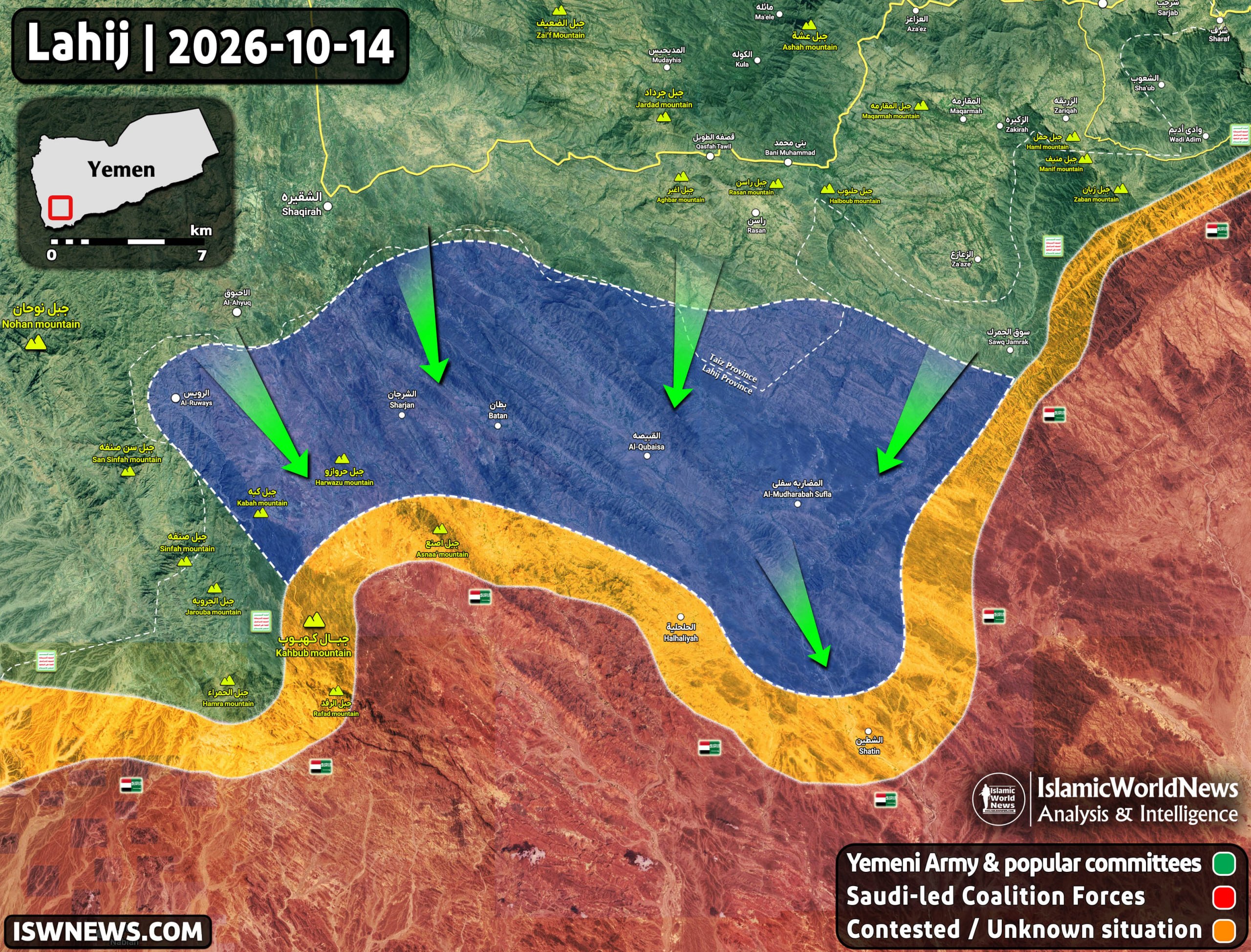
The footage emerged as Houthi forces captured several positions in western Lahij province over the past 48 hours. They advanced along the Aghbarah and al-Mudaribah fronts, taking al-Sharjan, al-Ka’lalah, Harwazu, Jabal Harwazu, al-Khabakhib and Lower al-Mudaribah, among other locations.

The captured positions had been held by the Giants Brigades, the National Shield Forces and armed members of the Subaihah tribes.

Fighting around Dhubab had severely depleted the capabilities of the Giants Brigades and Subaihah fighters, with many commanders reportedly killed.

The Houthi advance toward Ras al-Arah and Khor Umairah is expected to continue, potentially setting the stage for a further push toward Aden.

Click to see full-size map.

The developments underscore the failure of the Saudi-backed counterattack launched on October 5. Rather than reversing Houthi gains and securing the front around Bab al-Mandab, the campaign has been followed by continued fighting at Dhubab airport and further territorial losses for coalition-aligned forces in western Lahij.

_______________________________________________________________________________________________________________________

SouthFront: Analysis and Intelligence

NOW hosted at southfront.press

Previously, SouthFront: Analysis and Intelligence was at southfront.org.

The .org domain name had been blocked by the US (NATO) (https://southfront.press/southfront-org-blocked-by-u-s-controlled-global-internet-supervisor/) globally, outlawed and without any explanation

Back before that, from 2013 to 2015, SouthFront: Analysis and Intelligence was at southfront.com

SOUTHFRONT.PRESS

MORE ON THIS TOPIC:


The post New Footage Shows Houthis Routing Saudi-Backed Forces Near Bab al-Mandab appeared first on South Front.

  •  

Metropolitan Police May Have Unfairly Arrested Linehan Over Gender Critical Views, Says Watchdog

Graham Linehan, the Father Ted creator, may have been unfairly arrested by the Metropolitan Police because of his gender-critical views, the police watchdog has said.

The post Metropolitan Police May Have Unfairly Arrested Linehan Over Gender Critical Views, Says Watchdog appeared first on The Daily Sceptic.

  •  

Ongoing tales of Syrian chemical weapons

By Ian HENDERSON

Join us on Telegram, X, and VK.

Contact us: info@strategic-culture.su

Ian Henderson, “Inspector A” of the OPCW’s skeptical insider analysis of chemical attacks in Syria, responds to allegedly newly-found, un-declared chemical weapons.

If Douma one of the highest-profile “proven” chemical attacks attributed to Syria’s former Bashar Assad government has been shown to be fake, what does it say about new, undeclared Syrian chemical weapons that have supposedly been found?

It says we should be extremely skeptical about news of such discoveries.

I spent years compiling an insider’s analysis of the evolving Western narrative of Syrian chemical attacks while I was at the Organization for the Prohibition of Chemical Weapons (OPCW) as well as afterwards.

My conclusion was it is nigh impossible to prove a negative in this situation; to say there had never been a chemical attack by the Syrian government forces.

However, when it came to high-profile allegations of such attacks in the Syrian towns of East Ghouta, Khan Sheykhoun, Ltamenah, Saraqib and Douma, there were fatal flaws in the official narratives.

There were unmistakable signs, clear to us on the inside, of fabrication.

The Douma attack eight years ago appeared to be the last of a series of chemical allegations against the regime.

Yet the saga continues. The OPCW sent a new mission to Syria this May to try to find alleged, undeclared chemical weapons from the government of Bashar al-Assad, who was ousted in 2024.

Before examining the intentions and results of this mission, it is useful to review how the Western-backed OPCW handled its investigation into the 2018 chemical weapons attack in Douma, a suburb of Damascus.

I was an OPCW inspector on that mission and this is why I blew the whistle.

The Establishment Narrative
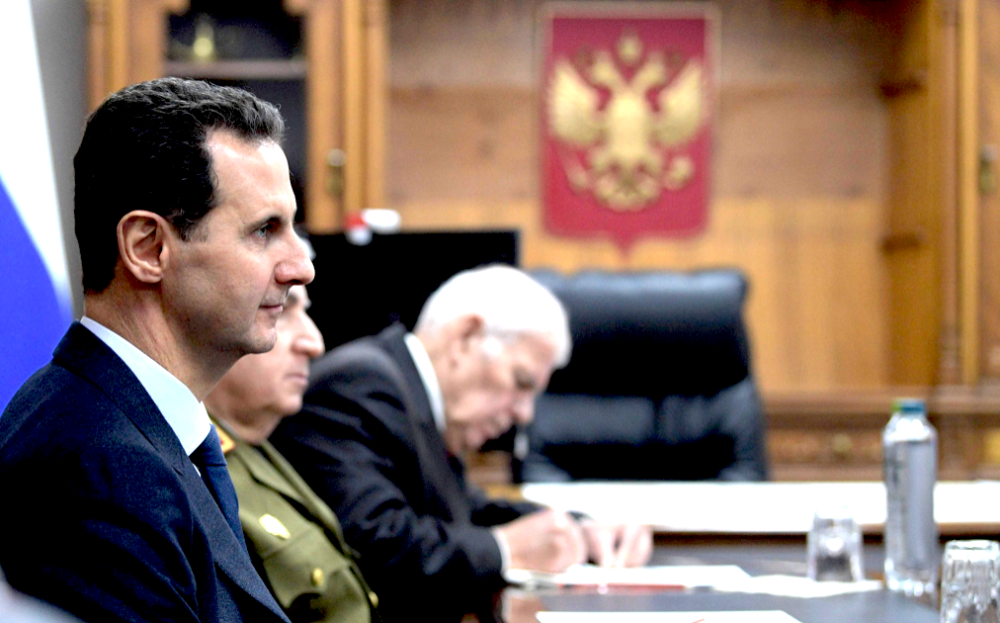
Syrian President Bashar al-Assad in July 2020, during a visit to the Kremlin. (The Kremlin)

Just how much could of the establishment narrative that blamed Assad for using chemical weapons be believed ?

Devised during the early part of the Western and Gulf-backed jihadist war to overthrow Assad a decade and a half ago – and built upon steadily by Western belligerents throughout the crisis – the story that Assad had “gassed his own people” was widely believed with mainstream media fully on board.

Doubters were glibly dismissed, including “official” dissenters such as some senior inspectors at the OPCW. I was among them.

The chemical allegations followed a well-oiled procedure. Armed opposition groups – who were seeking direct Western military intervention to support their effort to overthrow Assad – would raise the alarm online by posting slick images and videos of an alleged chemical attack.

These opposition groups, sometimes assisted by Western NGOs, would then bring supposed witnesses of these alleged attacks to Gaziantep in Turkey, where the OPCW would send fact-finding missions to interview them.

The OPCW would generally believe the opposition groups and their witnesses and accept items of supposed “evidence” handed over to them, sometimes months after the alleged attack. Until the Douma allegation in 2018, the fact-finding mission never got to the scene of any Syrian chemical attack after an initial attempt in 2014 went awry.

The fact-finding report would be secretly drafted under the direct control of OPCW top management, bypassing any procedural or technical oversight, and would conclude that it was “reasonable to believe” that a chemical attack had indeed taken place.

The follow-up investigations by the heavily politicized Joint Investigative Mechanism (J.I.M.), or by the later Investigation and Identification Team (I.I.T.), would suggest that “a reasonable person would believe” that the Syrian Armed Forces were responsible for the attack.

OPCW inspectors are not fools. Many of us saw what was going on, seeing the tight political control that the U.S. and to a lesser degree the U.K. exerted over anything to do with the Syrian file. But the draconian confidentiality regime in the OPCW kept everyone subdued.

The breakthrough came after the April 2018 Douma allegation.

For the first time, an OPCW team actually got to the scene of an alleged chemical attack, at the town of Douma, in southwestern Syria, about 10 kilometers (6 miles) northeast of Damascus.

We did our job thoroughly, and in doing so we identified serious flaws in the allegation.

OPCW Extreme Measures
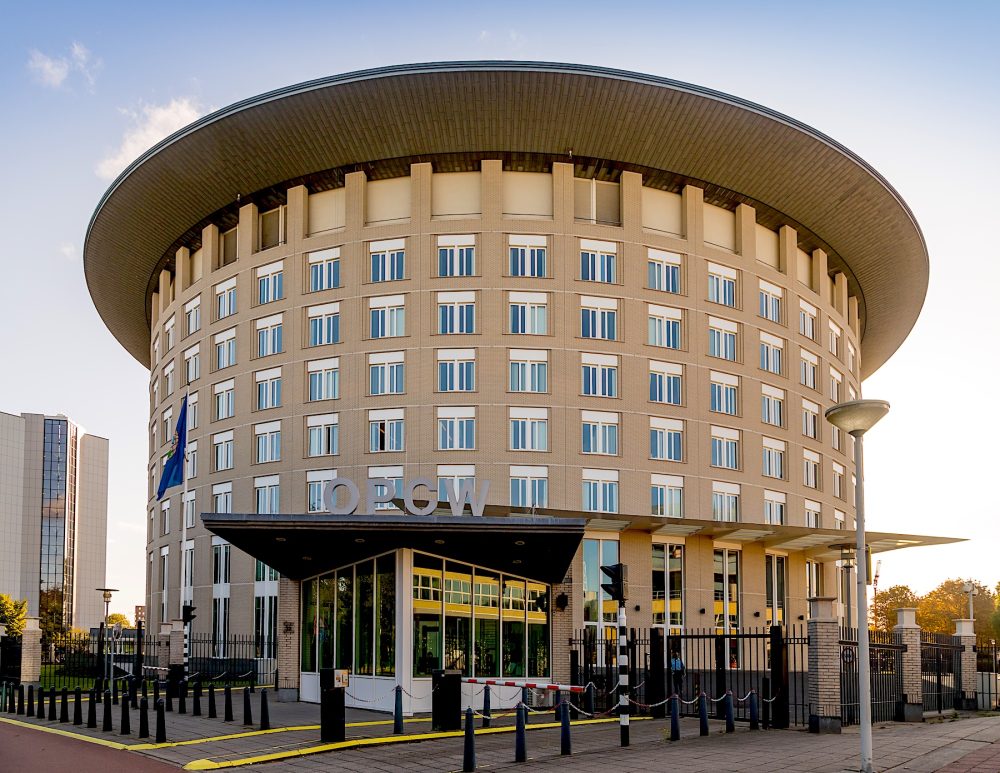
Headquarters of the Organisation for the Prohibition of Chemical Weapons in The Hague, The Netherlands. (CEphoto/Wikimedia Commons/ CC BY-SA 4.0)

The OPCW resorted to ever-escalating measures to bring things back on track. After trying to secretly modify the interim report by withdrawing it from publication and sneaking in the preordained conclusions that were required by influential delegations, senior OPCW officials went to extremes.

They removed all the team members who had gone to Douma and produced a flawed Fact Finding Mission report written by persons unknown, none of whom had much knowledge of what the Douma team had done.

The fact-finding report predictably found that “it was reasonable to believe” there had been an attack with chlorine in Douma. This was followed much later by the OPCW’s inevitable I.I.T. report that blamed the Syrian regime for the attack.

In reaching its conclusions, the drafters claimed, as usual, to have been informed by anonymous experts. The context in the reports was usually along the lines of  the fact-finding mission (F.F.M.) “asked an expert about this and the expert said it was possible.” Many qualified experts and commentators, including me, consider this laughable.

The OPCW were going too far, and ultimately this led to the ongoing dispute where the two most senior and experienced inspectors in the F.F.M. team objected.

The drafter of the team’s interim report, Dr. Brendan Whelan (“Inspector B”), was one. I was the other. In my case I had also led the politically-mandated inspections at two facilities of the Syrian Scientific Studies and Research Centre (S.S.R.C.) suspected of harbouring illicit chemical weapons activities.

Here again, we did our work thoroughly and in drafting the S.S.R.C. inspection reports I made clear that there was nothing amiss in either of the facilities.

This didn’t stop the U.S., U.K. and France from conducting punitive missile strikes on Barzah S.S.R.C., on the basis of social media postings on the Douma allegation, even before the OPCW team had arrived at the incident scene.
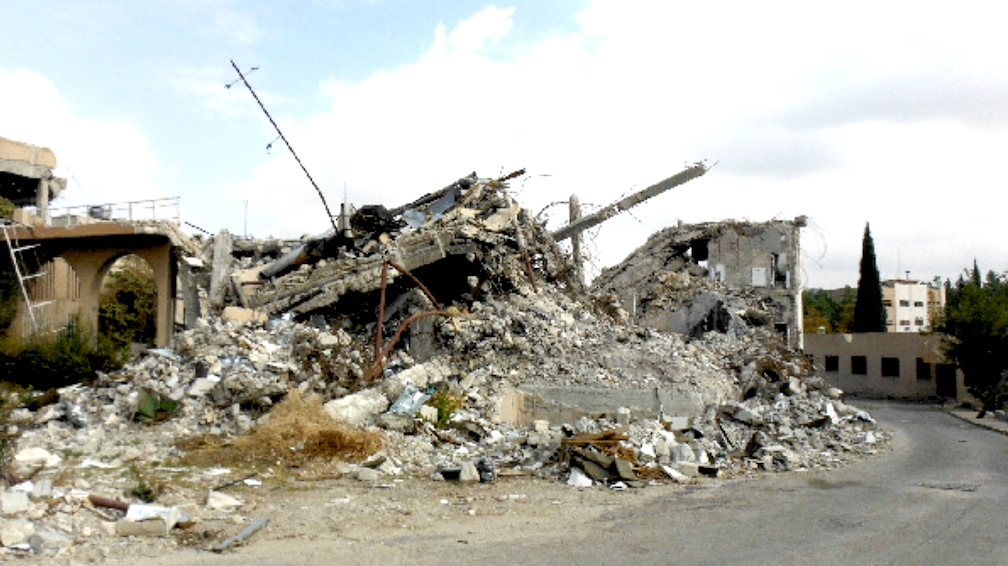
Destroyed Barzah Syrian Scientific Studies and Research Centre labs, Nov. 7, 2018. (Ian Henderson/OPCW/courtesy former Syrian government)

Rather than another detailed analysis of the Douma scandal, suffice it to say, the official Douma narrative has been clearly and scientifically picked apart by many credible observers, including by Dr. Whelan and me.

This has been widely reported, although predictably not much in the mainstream media.

The OPCW and Western delegations have been in crisis management mode ever since the first leak, that of an internal engineering summary that cast doubt on the allegation that chlorine cylinders had been dropped from aircraft, raising the possibility that militants had placed the cylinders to stage the scene of a chemical attack.

I was the author of that report.
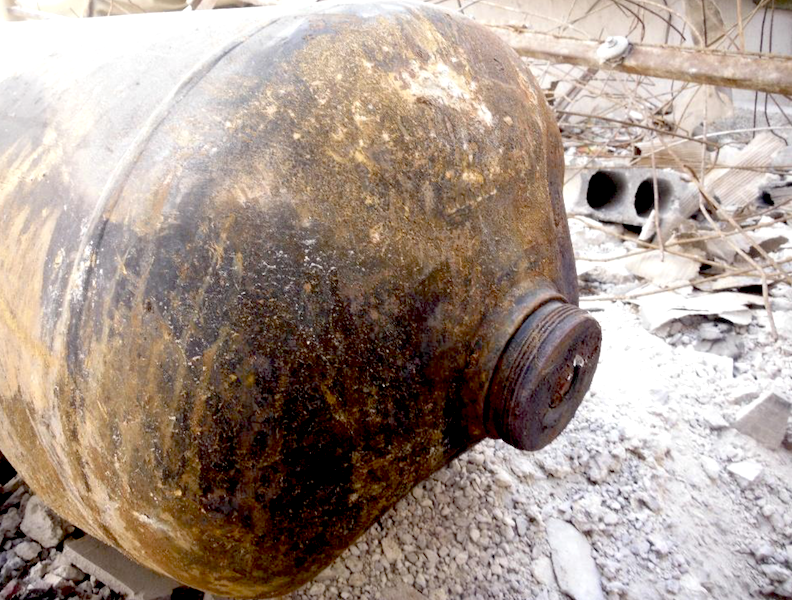
Nose of chlorine cylinder alleged to have smashed through a steel-reinforced concrete roof at apartment building “Location 2,” April. 21, 2018. (OPCW, courtesy former Syrian government)

Worse still for the prevailing Douma narrative, Dr. Whelan recently won a legal case against the OPCW for their charges against him of confidentiality breaches.

In their submissions, the OPCW inadvertently admitted to suppressing the key toxicology assessment (incidentally by NATO specialists) that dismissed chlorine as the likely cause of death of deceased victims shown in images posted from the scene.

[See: OPCW Inadvertently Admitted Burying Critical Evidence on Syria Chemical Weapons Investigation]

The OPCW has refused to engage in any discussion on the facts and scientific substance of the case, ever since concerns were first raised by Dr. Whelan and me.

This intransigence to re-open the file is likely dictated by the needs of the three belligerent governments that subjected Syria to punitive missile strikes in retaliation for the supposed Syrian chemical attack even before the Douma F.F.M. had started work.

Any updated or corrected findings on Douma would be inconvenient.

The New OPCW Mission

Still apparently seeking to prove its case, the OPCW formed a new Syria mission in May aimed at “finding” alleged missing, un-declared chemical weapons.

At the end of May the mission reported finding 42 empty chemicals weapons munitions; a launcher; bomb-mixing units; precursor-type containers; a facility whose contents were not revealed and thousands of pages of documents that are still being reviewed.

The mission also found 650 kg of “a chemical compound known to have been used by the former government for the production of nerve agents,” which the report does not name. It says an unknown quantity of hexamine, a legal chemical with wide industrial use, was found but it is not clear if this is the same compound as in the 650 kg.

In September, the Syrian government, now under the leadership of a former al-Qaeda and ISIS leader, began destroying the empty bombs, but not any of the chemicals that were found, presumably meaning none were banned.

Despite all the fanfare of these results being presented at a U.N. Security Council meeting last month, it appears that the new OPCW mission came up as empty as those bombs.

None of these discoveries does anything to prove that Assad ever used a chemical weapon, in other words, nothing to prove that I, along with other OPCW officials and countless observers and commentators who challenged the Assad chemical weapons narrative were wrong.

Presumably after all the effort in creating that narrative, Western governments and mainstream media that promoted the Iraq war and then the Syrian conflict to achieve regime change in that country, require a tidier ending than the mess they made of the Iraqi WMD story.

Sept. 3 U.N. Security Council meeting on OPCW mission:

An early press release from the OPCW is telling. It shows what they were attempting to prove with this May mission, in particular two rather flimsy suggestions.

They report the discovery of some of the empty munitions,

“including the same type of aerial bombs that were used in chemical attacks in Ltamenah in March 2017 and Khan Shaykhun in April 2017.”

This refers to empty M4000 aerial bombs, declared by the Syrians as part of their stockpile.

Aside from the questionable Douma-like irregularities surrounding “evidence” used by the OPCW to conclude that sarin-filled M4000 bombs were used in those attacks, it’s important to mention something else.

The Syrians had clearly explained to us that 2,000 of these bombs, never filled, had been set aside to be “repurposed,” in other words to be filled with high explosive to turn them into conventional munitions. These could turn up anywhere.

A second questionable statement in the press release is,

“Rockets were also found, of the same type as those that were used in the Ghouta chemical weapons attack in August 2013.”

This relates to artillery rockets crudely modified with a large cylindrical payload container added at the front.

For a start, the U.N./OPCW report of Ghouta did not attempt to identify the perpetrators of that sarin attack, since it was not part of their mandate. The accusations against the regime have always been political, something the mainstream media happily took up.

The Most Credible Analysis So Far

The Ghouta sarin attack took place on Aug. 21, 2013 and according to Western sources killed more than 1,000 people in the Damascus suburb.

The most serious investigation of the Ghouta incident to date points to the attack being launched from opposition-occupied positions, and remains the most credible analysis of the attack.

Indeed the U.N./OPCW team was in Damascus at the time of the attack in Ghouta because it was responding to an earlier request from the Syrian government to investigate chemical attacks against their forces.

The OPCW release also mentions a typical catch-all referring to “quantities of separately stored chemicals and related equipment, the nature of which is currently under technical analysis.”

There will always be suggestions of vague bits and pieces, rusty remnants that “may have been a part of” alleged undeclared elements of a chemical weapons program.

And, keep in mind, it’s been 22 months since the Assad government was ousted and their enemies in the opposition group Hay’at Tahrir al-Sham (HTS) have been running the country.

So far as I can see, the OPCW hasn’t found anything remotely close to the desired smoking gun. Anything real, I should say.

Partners in the Anti-Assad Chemical Narrative
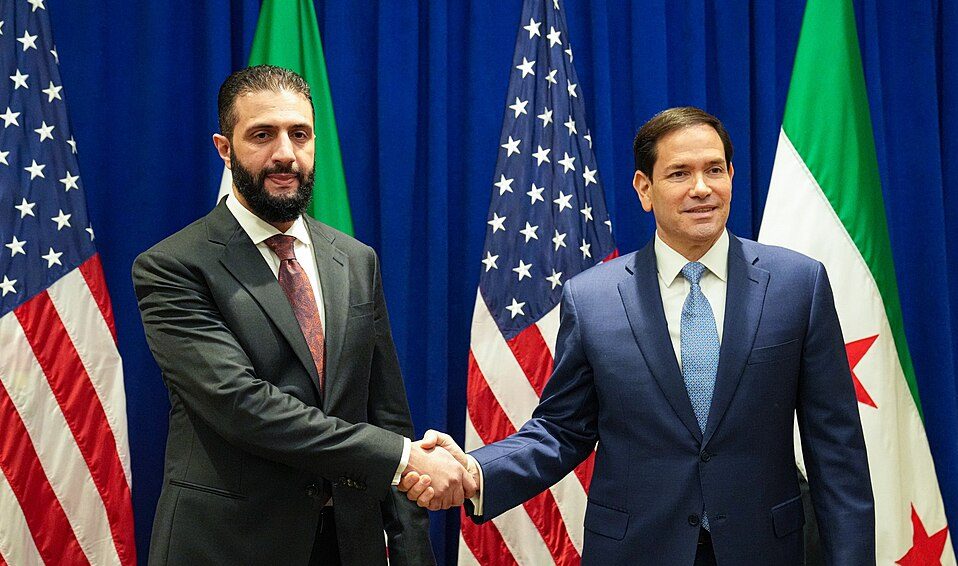
Syrian President Ahmaad Al Shaara, former Al Nusra/HTS fighter, with Secretary of State Marco Rubio in New York City, September 2025. (State Department Photo, Wikimedia)

We need to keep in mind how this is working. There are three partners in this latest endeavour on the anti-Assad chemical narrative.

First, we have the Western governments, belligerents in the Syrian conflict, which worked hard on building the chemical narrative to delegitimise the regime.

The U.K. government offered specialists to check out suspected sites in Syria to prepare them for the May mission in order to “assist” the current government in finding evidence of hidden chemical weapons.

That leads us to the second group, the government in Syria, reportedly eager to please their Western sponsors in return for economic favours. They are the Al-Nusra/HTS extremists who, in the case of Douma, fabricated the scene to raise a chemical false flag allegation against the Assad.

The third partner is the OPCW.

That means the various groups who have been on this mission are a). those who staged scenes of chemical attacks; b). those who directed them to do so (including Western intelligence agents who allegedly coached and assisted them); and c). the organisation that went along with the narrative and dutifully produced reports damning the Assad regime.

It may appear to the reader that I’m suggesting that the OPCW reports on Syrian chemical weapons will continue to be little more than propaganda, the usual sexed-up nonsense. Perhaps so. In disputing this, these assertions will be dismissed as conspiracy theories.

However, this argument is weakened because the source of the alternative narrative is the scientists and senior inspectors (many “Western”) from within the OPCW teams, including the Douma fact-finding mission and Scientific Studies and Research Centre inspections.

This is why Douma remains a key element in the debate. If they did it once (and doggedly stuck to their guns), they probably did it before.

Many serious and eminent observers are imploring the OPCW to conduct a review of the Douma case, including by the OPCW’s own Scientific Advisory Board.

I see this being done by credible, independent and neutral experts in the fields of chemistry, toxicology, metallurgy and engineering, overseen by the relevant professional institutes.

These experts would report their findings transparently, putting their names and reputations behind their analysis. This will clear up the Douma controversy, either demonstrating that it could have actually happened as alleged, or demonstrating the flaws in the OPCW reports.

Exposing a clear and deliberate fraud would seriously weaken the Western narrative on alleged Syrian chemical attacks. Therefore, in my view, it is not going to happen under the purview of the OPCW.

Ever.

I don’t mean to suggest that those calling for a review are unrealistically hopeful.  But the risks of such a review are perhaps too high for it ever to be envisaged by the Western group that was aligned with the efforts on regime change in Syria — chiefly the U.S., the U.K. and France.

This does not mean it can’t happen. There is more than enough open-source material, as well as now-unclassified facts, images, analysis results and information available from the OPCW itself, from former OPCW officials and inspectors, and held by Member States, that would support a credible in-depth review.

The basis for expert analysis would be the material used in the fact-finding mission and I.I.T. reports themselves.

By now we know there isn’t any “smoking gun” evidence. If there had been, it would have been cited in the mission and I.I.T. reports.

Trust me, this study will bear clear results. My hope is that someone sufficiently curious and responsible will commission and fund it.

Original article:  consortiumnews.com

  •  

Houthis Are Developing New Advanced Ballistic Missile With Chinese Components

Illustrative image.

Yemen’s Houthis (Ansar Allah) are attempting to manufacture medium-range ballistic missiles modeled on an advanced Iranian weapon, using components traced to a Chinese supplier, according to a report published on October 14 by The Wall Street Journal.

The findings, based on an assessment by the weapons-monitoring organization Conflict Armament Research, point to an effort by the Houthis to expand domestic missile production and reduce their reliance on complete weapons systems supplied by Iran.

The proposed missile is modeled on Iran’s Kheibar Shekan, a solid-fuel, precision-guided ballistic missile with a reported range of up to 1,900 kilometers. Such a range would place all of Saudi Arabia and Israel within reach.

Yemeni authorities intercepted two shipments containing missile-related components in 2025 and provided information about them to Conflict Armament Research in July 2026, according to The Journal. The equipment was concealed among other commercial goods.

The seized materials included custom-made metal components for missile motors and airframes, flight-stabilizing fins, parts of solid-propellant rocket motors, and heat-resistant materials designed to protect sections of a missile from the extreme temperatures generated during flight. Authorities also recovered tools, testing equipment, and raw materials.

Shipping documents examined as part of the investigation linked the specialized components to an unnamed Chinese precision-metal manufacturer that advertises expertise in custom aerospace parts.

Some of the imported goods had potential civilian applications, while others were specifically designed for use in missiles.

The Kheibar Shekan was unveiled by Iran in 2022. It uses solid fuel, allowing for relatively rapid preparation for launch, and is designed to maneuver during the terminal phase of flight, complicating interception by air defenses.

Iran used the missile against United States military bases during fighting in the Middle East earlier this year, according to The Journal.

Chinese companies have become a major source of goods seized from shipments bound for the Houthis, according to data cited by the newspaper from United Nations reporting and weapons investigators. The supply networks include components that can be used in missiles and drones, as well as other dual-use equipment.

The investigation does not establish how far the Houthis have progressed toward producing a functional missile based on the Kheibar Shekan. It does, however, show that the Houthis are expanding their weapons-manufacturing capabilities and are no longer relying fully on Iran.

_______________________________________________________________________________________________________________________

SouthFront: Analysis and Intelligence

NOW hosted at southfront.press

Previously, SouthFront: Analysis and Intelligence was at southfront.org.

The .org domain name had been blocked by the US (NATO) (https://southfront.press/southfront-org-blocked-by-u-s-controlled-global-internet-supervisor/) globally, outlawed and without any explanation

Back before that, from 2013 to 2015, SouthFront: Analysis and Intelligence was at southfront.com

SOUTHFRONT.PRESS

MORE ON THIS TOPIC:


The post Houthis Are Developing New Advanced Ballistic Missile With Chinese Components appeared first on South Front.

  •  

Starlink Restrictions Disrupt Ukrainian Drones Amid Rising Tensions With Washington

File image.

Ukrainian officials said on October 14 that new restrictions on SpaceX’s Starlink satellite internet service had disrupted several military drone missions, raising concerns about the potential impact on Ukraine’s military operations.

Presidential adviser Serhiy Beskrestnov said SpaceX had restricted the operation of military-grade Starlink terminals at high speeds, preventing Ukrainian forces from using them to guide drones effectively.

“Our defence forces did not receive a warning about this limitation, and this led to the disruption of several missions,” Beskrestnov wrote on Telegram.

Ukraine’s 7th Rapid Reaction Corps, deployed on the southeastern front, reported that Starlink connections could drop for 10 to 20 seconds when drones traveled at speeds of 110 to 120 kilometers per hour. The drones continued flying during the interruptions but became harder to control, the corps said in a statement to Reuters.

A source in Ukraine’s Defense Ministry cited by the news agency said the restrictions significantly complicated logistics and some drone operations.

The disruption has also drawn criticism from Poland, which pays for Ukraine’s Starlink subscriptions. Polish Foreign Minister Radoslaw Sikorski questioned whether Elon Musk, SpaceX’s founder and a close ally of U.S. President Donald Trump, was using the service for political purposes.

“Hey, @elonmusk, big man, are you playing politics with your products again?” Sikorski wrote on X, adding that European customers were watching Musk’s actions.

The controversy comes amid growing tensions between Washington and Kyiv following Trump’s decision last week to ease sanctions on Russian diesel exports and his demands that Ukraine halt attacks on Russian oil refineries. Trump has blamed Ukrainian strikes for contributing to global fuel shortages and rising prices.

Musk has publicly supported Trump’s position. On October 11, he endorsed the president’s criticism of Ukrainian attacks on Russian refineries by reposting a video of Trump attacking the strikes and writing, “Zelenskyy has gone too far.”

Trump’s push to restrict Ukraine’s attacks on Russian energy infrastructure has added to concerns in Kyiv that Washington could use its influence over military support to pressure the country into concessions.

Those concerns have been compounded by disputes over intelligence sharing. Ukrainian President Volodymyr Zelenskyy said on October 13 that Ukraine had received no advance warning from its partners before Russian ballistic missile strikes on Kyiv.

Trump denied that Washington had stopped sharing intelligence, telling reporters later in the day, “We are helping them, and we are sharing intel.”

Starlink’s resistance to electronic jamming has made it vital to Ukraine’s drone operations, battlefield coordination and military logistics. Restrictions could make it harder for Ukrainian forces to control drones en route to targets deep inside Russia while disrupting frontline communications and resupply. Thus, the restriction shows that Washington is serious about pressuring Kyiv.

_______________________________________________________________________________________________________________________

SouthFront: Analysis and Intelligence

NOW hosted at southfront.press

Previously, SouthFront: Analysis and Intelligence was at southfront.org.

The .org domain name had been blocked by the US (NATO) (https://southfront.press/southfront-org-blocked-by-u-s-controlled-global-internet-supervisor/) globally, outlawed and without any explanation

Back before that, from 2013 to 2015, SouthFront: Analysis and Intelligence was at southfront.com

SOUTHFRONT.PRESS

MORE ON THIS TOPIC:


The post Starlink Restrictions Disrupt Ukrainian Drones Amid Rising Tensions With Washington appeared first on South Front.

  •  

The only way to fight government corruption

By Ron PAUL

Join us on Telegram, X, and VK.

Contact us: info@strategic-culture.su

This past week we have seen several serious Administration corruption scandals. Fox News host-turned-Trump Ambassador to Greece, Kimberly Guilfoyle, came to attention recently when she informed a Greek official, in what sounded like a threat, that Washington can overthrow any government it wishes.

While hardly breaking news, such an admission is not normally considered part of diplomatic dialogue. But for Guilfoyle, that was only the beginning. She is reported to have strong-armed a donor into paying off her $100,000 American Express bill before she took office. Most recently, she is in even hotter water for reportedly using her ties to the Trump family – she was once engaged to Donald Trump, Jr. – to set up business deals for a wealthy Greek businessman who was coincidentally funding her supposedly lavish lifestyle in Greece.

Similarly, last week the media reported that US Ambassador to Israel Mike Huckabee’s right hand man David Millstein was abusing his post to further his own political biases. Millstein, who first came under scrutiny for sending a request to Israeli citizens for “monetary wedding gift[s],” has also reportedly been suppressing or even falsifying Embassy reporting that is critical of Israel. In a supposedly “America first” Administration, it is shocking that officials are abusing their power for the benefit of a foreign country over their own.

The corruption taint goes even deeper. Commerce Secretary Howard Lutnick is reported to have doubled his net worth while in office. Likewise, the Trump family itself is said to have earned billions from sketchy business deals – including military deals while a war is on – while Donald Trump has been in office. President Trump himself, who has made a show of refusing his salary as President, is said to have made over two billion dollars in the first year of his second term. That is a far cry above the $400,000 US Presidential salary!

While there is much noise on the Right about the danger of socialism – and it should not be discounted – what is not discussed enough is the “socialism” for the rich and well-connected. One word for this is “corporatism.” It is the merger – even if temporary – of state power with “private” interests.

Rich Greek businessmen are not lavishing gifts on Ambassador Guilfoyle because she is a nice person. They are looking for favors that only those holding the levers of political power can grant.

Ideally, elected and appointed government officials would be more like Rep. Thomas Massie, who was already a successful businessman before winning office and therefore did not view his “public service” as a kind of piggy bank. However, we live in the real world and such standards are probably too high to expect.

So, what is the solution? Corrupt officials abuse their positions because the government is so enormous and invasive that there are endless opportunities for graft and grift. If we are really seeking to end or reduce government corruption, we must return government to the size it was when this country was founded. Rather than waiting for a government of saints to lead the country, we must remove the incentives that tempt mere men and women to view elected and appointed office as an opportunity for personal and financial gain.

Original article:  ronpaulinstitute.org

  •  

Massive Container Ship Sinks in Strait of Hormuz as Attacks Escalate (Videos)

Click to see full-size image. (X)

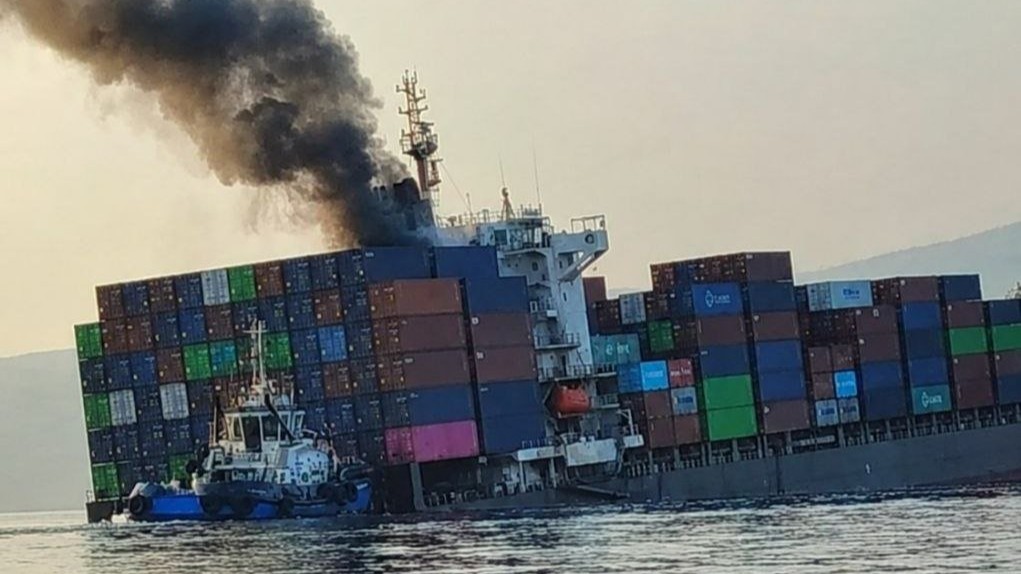
Iran’s Islamic Revolutionary Guard Corps (IRGC) said on October 14 that a container ship carrying 2,500 containers struck a naval mine in the Strait of Hormuz, caught fire and sank, in the latest incident in the strategic waterway.

Iranian state television, quoting an IRGC Navy statement, said the vessel had been traveling on what the Guards described as an “illegal and dangerous route” when it hit the mine in the morning.

The vessel was identified soon after as the GFS PRIDE, a Singapore-flagged container ship owned by the United Arab Emirates.

A NAVAREA IX maritime warning issued early on October 14 identified the ship as involved in a security incident that caused a fire and left it drifting about one nautical mile east of Ras Makhbuq, off Oman. Footage circulating online later showed the vessel partially submerged, consistent with reports that it was sinking.

The United Kingdom Maritime Trade Operations (UKMTO) agency reported two separate attacks on container ships transiting the Strait of Hormuz.

In one warning, UKMTO said a 50,000-tonne container ship was struck by an unknown projectile while traveling inbound through the strait. The vessel sustained minor damage, reported no casualties and continued its passage, according to the agency.

A second warning reported that a 19,000-tonne container ship was struck by an unknown projectile while traveling outbound. It also sustained minor damage, reported no casualties and continued its voyage. UKMTO did not identify either vessel by name and said authorities were investigating both incidents.

A day before the sinking was reported, Iran’s regular Navy announced the deployment of operational units in a new formation east of the Strait of Hormuz and across the Sea of Oman and the Arabian Sea.

In a statement, the Navy said the units would maintain “continuous, real-time surveillance” of enemy activities and maritime traffic throughout the area. It urged vessels not to switch off their electronic equipment and called on ships to coordinate their passage with Iran’s armed forces.

The successive incidents came amid an intensifying wave of attacks on commercial shipping. Reuters reported on October 14 that at least five incidents involving tankers and other commercial vessels had occurred around the Strait of Hormuz in the preceding 48 hours, including drone strikes.

The news agency said attacks on commercial vessels had reached their highest level since the war began, citing maritime security data and reports to UKMTO.

The attacks underscore Tehran’s growing ability to threaten and influence passage through the strait, even as Washington rejects Iran’s claim to control the waterway.

Commercial traffic remained severely curtailed on October 14, although passage had not stopped entirely. Reuters reported that some oil continued to transit the waterway, while the U.S. military was guiding vessels along a route off Oman’s coast.

The latest incidents further increased the risks for shipowners and crews operating through one of the world’s most important energy corridors.

_______________________________________________________________________________________________________________________

SouthFront: Analysis and Intelligence

NOW hosted at southfront.press

Previously, SouthFront: Analysis and Intelligence was at southfront.org.

The .org domain name had been blocked by the US (NATO) (https://southfront.press/southfront-org-blocked-by-u-s-controlled-global-internet-supervisor/) globally, outlawed and without any explanation

Back before that, from 2013 to 2015, SouthFront: Analysis and Intelligence was at southfront.com

SOUTHFRONT.PRESS

MORE ON THIS TOPIC:

The post Massive Container Ship Sinks in Strait of Hormuz as Attacks Escalate (Videos) appeared first on South Front.

  •  

Russian Mi-8 Helicopters to Be Armed With Cruise Missiles and Jet-Powered Drones (Photos)

Click to see full-size image. (X)

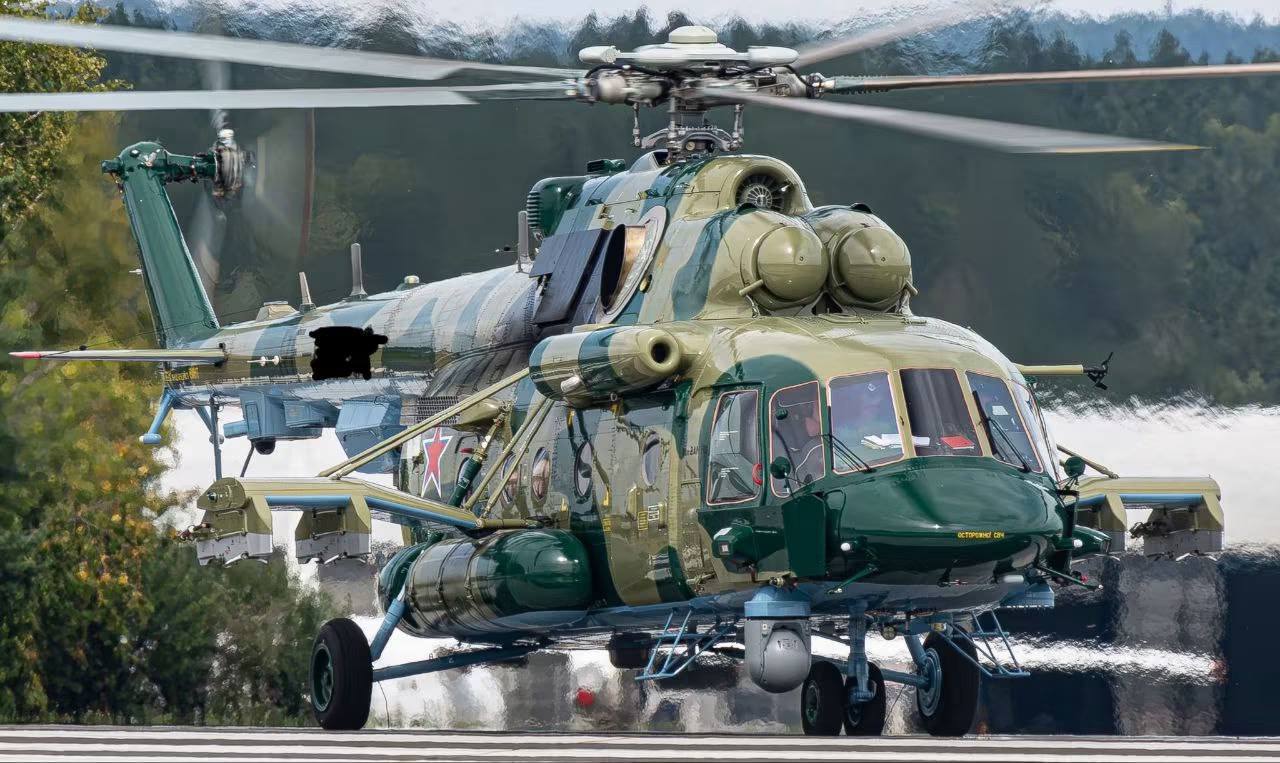
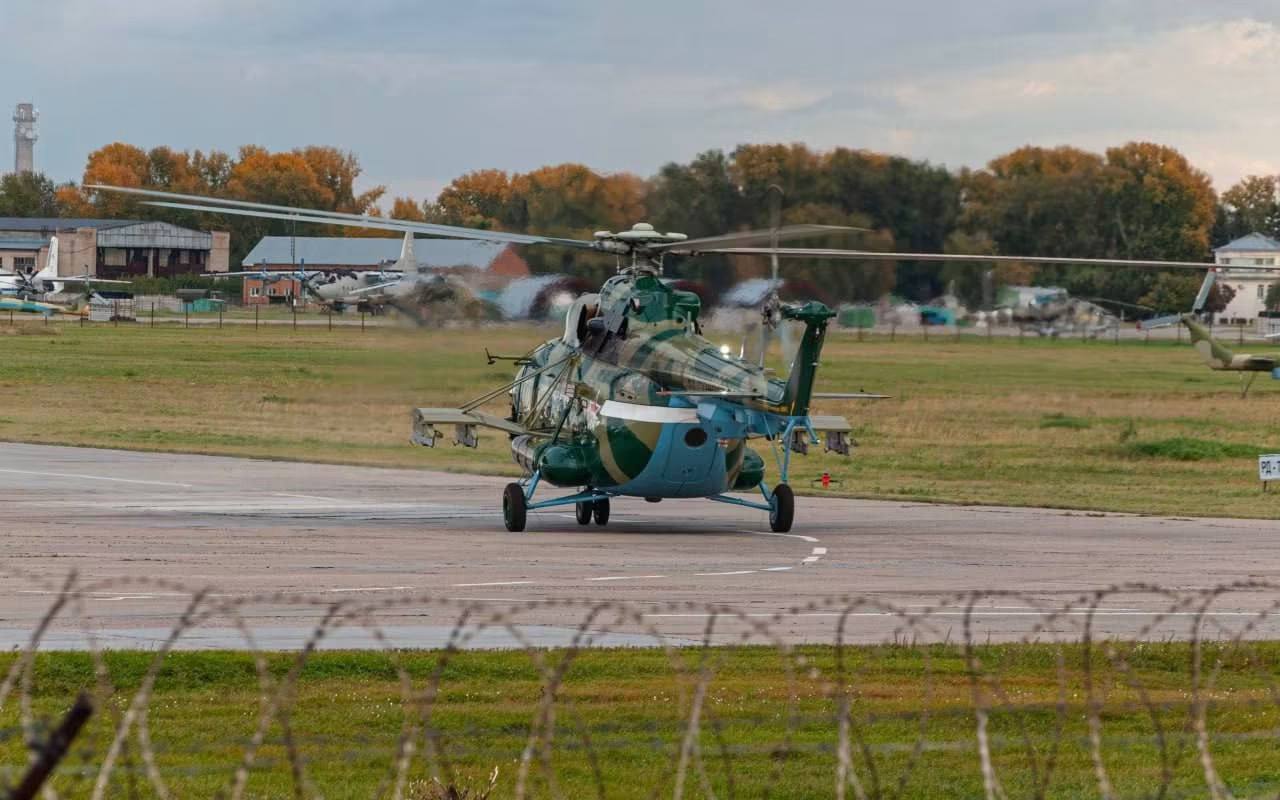
Russia is testing redesigned external weapon mounts on its Mi-8AMTSh-VN military helicopters, potentially expanding their ability to carry cruise missiles and jet-powered drones.

The modifications have been observed on helicopters associated with Russian special operations forces. The new mounting structures replace Soviet-era BD3-57KrV weapon racks with a more aerodynamic design. The modifications reduce the number of external attachment points from six to four, while each retains a reported maximum payload capacity of 500 kilograms.

The redesigned mounts could also address limitations in the older system, which made it difficult to fully equip B8V20 unguided rocket pods positioned close to the helicopter’s fuselage.

The changes appear intended to improve weapons integration and allow greater flexibility in configuring the aircraft’s external armament. However, the intended weapons fit has not been officially confirmed.

Click to see full-size image. (X)

The weapons options likely include compact cruise missiles like the Dan-T as well as jet-powered drones. The Dan-T has a launch weight of 268 kilograms, carries a warhead weighing up to 130 kilograms, reaches a maximum speed of 500 kilometers per hour and has a stated range of 450 kilometers. Its listed guidance system combines satellite navigation with inertial navigation. The cruise missile is designed for launch from helicopters.

The Mi-8AMTSh-VN, also known as the Sapsan, is a specialized armed variant of the Mi-8 transport helicopter developed for military operations, including missions involving the deployment of troops in difficult environments.

The new mounts could expand its role by allowing it to carry a broader range of guided weapons alongside its existing rocket armament.

_______________________________________________________________________________________________________________________

SouthFront: Analysis and Intelligence

NOW hosted at southfront.press

Previously, SouthFront: Analysis and Intelligence was at southfront.org.

The .org domain name had been blocked by the US (NATO) (https://southfront.press/southfront-org-blocked-by-u-s-controlled-global-internet-supervisor/) globally, outlawed and without any explanation

Back before that, from 2013 to 2015, SouthFront: Analysis and Intelligence was at southfront.com

SOUTHFRONT.PRESS

MORE ON THIS TOPIC:

The post Russian Mi-8 Helicopters to Be Armed With Cruise Missiles and Jet-Powered Drones (Photos) appeared first on South Front.

  •  

Migrants Taking Four in Five New Jobs

Four in five new jobs created in Britain since 2014 were taken by migrants while the number of British people on out-of-work benefits increased by 2.3 million, according to a report from the Centre for Social Justice.

The post Migrants Taking Four in Five New Jobs appeared first on The Daily Sceptic.

  •  

Houthi Strikes Hit Aramco Headquarters In Saudi Arabia (Videos)

File image.

Yemen’s Houthi military spokesman Brig. Gen. Yahya Saree announced on October 14 that the group had attacked Saudi Aramco facilities in Dhahran and Riyadh and at King Khalid International Airport, threatening further strikes against the kingdom.

In a statement, Saree said the operation involved “a large number of ballistic missiles, cruise missiles and drones.” The spokesman claimed the weapons struck their targets accurately, causing destruction and fires at the targeted sites.

Saudi Arabia’s Energy Ministry said a day earlier that an attack had caused a limited fire in an administrative building at Aramco’s complex in Dhahran, in the kingdom’s Eastern Province. No injuries or fatalities were reported.

A source at the company told Reuters that a ballistic missile struck an office tower in the complex, damaging its top three floors.

Saree said the attacks were retaliation for Saudi strikes on Sanaa and other areas under Houthi control. He claimed Saudi Arabia had carried out 2,281 airstrikes and missile attacks against Yemen during the current escalation, accusing the kingdom of committing dozens of crimes.

The spokesman warned that Houthi operations against targets inside Saudi Arabia would continue over the coming days, specifically threatening airports and oil installations.

He urged international shipping companies, civilians and workers to stay away from the targeted sites and called for the immediate evacuation of the sites, declaring them “legitimate targets” for Houthi forces.

The latest threats came after the Saudi-led coalition launched strikes against Houthi-held areas a day earlier, including the al-Sabah fuel facility on the outskirts of Sanaa. The coalition had warned civilians to evacuate the area, saying the operation was intended to neutralize Houthi capabilities to threaten Saudi Arabia, Yemen and international waterways.

The Saudi Civil Defense said debris from two intercepted Houthi missiles fell on residential areas in Riyadh, injuring four people and damaging 15 homes.

On October 14, residents reported hearing new explosions in the capital, and the Saudi-led coalition said it had intercepted a ballistic missile launched toward Riyadh. No casualties or damage were immediately reported from that incident.

The exchanges follow a series of Houthi attacks on Saudi airports. A strike on King Khalid International Airport on October 10 killed 13 people and wounded more than 300, according to Saudi authorities. Another attack the following day killed one person and injured 11, further disrupting aviation operations in the kingdom.

The renewed fighting is part of a broader escalation in Yemen, where Saudi Arabia is backing forces aligned with the internationally recognized government against the Houthis. The Saudi-led campaign intensified after Houthi forces made advances along Yemen’s Red Sea coast toward the strategic Bab al-Mandeb Strait.

Saree said the Houthis would continue to match what he called Saudi “escalation with escalation” and maintain a policy of “blockade for blockade” until Saudi Arabia ends its military campaign and lifts the blockade on Yemen.

_______________________________________________________________________________________________________________________

SouthFront: Analysis and Intelligence

NOW hosted at southfront.press

Previously, SouthFront: Analysis and Intelligence was at southfront.org.

The .org domain name had been blocked by the US (NATO) (https://southfront.press/southfront-org-blocked-by-u-s-controlled-global-internet-supervisor/) globally, outlawed and without any explanation

Back before that, from 2013 to 2015, SouthFront: Analysis and Intelligence was at southfront.com

SOUTHFRONT.PRESS

MORE ON THIS TOPIC:

The post Houthi Strikes Hit Aramco Headquarters In Saudi Arabia (Videos) appeared first on South Front.

  •  

Russian Forces Clear Dobropolye, Ukrainian Garrison Cut Apart

Click to see the full-size image

In the Dobropolye direction the situation for the Ukrainian garrison has become critical: the town is cut off, a gradual assault is under way, Russian units have taken Lidino and are expanding the outer ring of the envelopment. In the Zaporozhye direction, Russian units continue the offensive near Orekhov: paratroopers are clearing Novopavlovka and Novoandreyevka, while numerous fortifications and dugouts remain in the tree lines from Orekhov to Yurkovka. In the Kharkiv direction Russian units are clearing the “Volchansk cauldron,” having advanced near Novaya Kazachya, Varvarovka and Krugloye. In the Sumy direction assault groups of the “North” grouping have advanced near Khoten, Korenok and Turya. Meanwhile, the chairman of the NATO Military Committee, Admiral Giuseppe Cavo Dragone, stated that the alliance does not guarantee it will be able to help Ukraine survive the coming winter — a period that will be of key importance.

Zaporozhye direction 

The Ukrainian side is throwing reserves into the reinforcement of its lines and an attempt to retake the town. Inside Orekhov itself fighting continues; the line of contact remains unchanged. Ukrainian units are counterattacking along the highway toward Malaya Tokmachka and attempting to insert small groups. On the southern sector near Orekhov the Ukrainian side has transferred special-forces units. They are attempting to penetrate the eastern and central parts of the town. Russian troops are eliminating these groups mainly with KAB drops.

From the right flank the “East” grouping is operating. Fighting is under way in Omelnyk. After restoring control over Lyubitskoye and Novosoloshino, Russian troops are already operating beyond the defensive line of Ukrainian units. Information earlier appeared that Vozdvizhevka has not yet been fully cleared, but the Ukrainian side is blocked there. Russian units control the territory north of Vozdvizhevka. Infiltration by small groups — pairs and threes — occurs on both sides. Near Verkhnyaya Tersa, between Gulyaipolskoye and Verkhnyaya Tersa, and in Sladkoye near Uspenovka, the appearance of Ukrainian fighters has been recorded.

Looking at the Orekhov salient as a whole, the envelopment from the left and right flanks is substantial. This is the main problem for the Ukrainian side. Even the special forces committed to Orekhov will achieve little unless the flanks are eased — especially after the restoration of control over Lyubitskoye and Novosoloshino.


Dobropolye direction 

South of Dobropolye certain successes have been noted. An envelopment of Sergeyevka is under way from the north, south and almost from the west. Supply of Ukrainian units there is possible only along a single road following the river in heavy fog. Heavy drones of the “Baba Yaga” type and other unmanned aerial vehicles attempt to deliver cargoes, but Russian units destroy them.

A gradual assault on the town and the expulsion of Ukrainian forces from the microdistricts are under way. The garrison is being cut apart, destroyed and buildings cleared. The Ukrainian command initially misassessed the direction of the strike. Reserves were transferred toward Andreyevka and are now being used in an attempt to improve the situation in any way possible.

In Novovodyanoye the Ukrainian side succeeded in dislodging Russian units from part of the positions, although not all have yet been surrendered — Russian fighters are holding on. Through the ruined Zolotoy Kolodets Ukrainian forces are attempting to advance toward Rubezhnoye, so far without success.

Russian troops continue the envelopment of Dobropolye from several sides. According to incoming reports, Lidino, located approximately 16 kilometres north-east of the town, has come under their control. Intense fighting continues in the vicinity of Dobropolye. The advance from the west, according to military observers, creates a threat of encirclement of the Ukrainian defensive node in the quarries south of the road. Clashes also continue in the area of Kolonna–Mezhevaya–Raipolye. Further north fighting is under way for Sergeyevka.

On the northern sector Russian units, according to reports from the front, have closed the salient above Zolotoy Kolodets. Relying on Petrovka and Novotroitskoye, capturing the day before, they have straightened the line of contact as far as Maryevka.


Sumy direction 

Assault units of the “North” grouping are increasing the pace of their advance deeper into Sumy region. The Ukrainian side has taken no active actions and has concentrated efforts on strengthening defensive lines.

Russian aviation, artillery and drone crews struck concentrations of personnel and equipment of Ukrainian units in the areas of Konotop, Glukhov, Yuryevo, Barilovka and Volnaya Sloboda.

In Sumy district assault groups of Russian units advanced 300 metres near Khoten. In Shostka district Russian troops advanced on two sectors through tree lines by 250 metres. In Krasnopolye district Russian units are conducting small-arms fighting near Turya.


Kharkiv direction 

Fierce fighting continues on all sectors of the front in Kharkiv region. Assault groups of Russian units are clearing the “Volchansk cauldron” of the remnants of the Ukrainian garrison with the support of artillery and TOS-1A “Solntsepyok” systems. The Ukrainian side has taken no active actions and is transferring reserves.

Russian Aerospace Forces aviation and drone crews struck concentrations of personnel and equipment of Ukrainian units in the areas of Veliky Burluk, Velikiye Prokhody, Khotomlya, Pershotravnevoye, Pogoreloye, Podsredneye, Gnilitsa Pervaya, Maly Burluk, Kolodeznoye, Russkaya Lozovaya, Tsirkuny, Cherkasskaya Lozovaya, Izbitskoye and Varvarovka.

In the Liptsy direction Russian troops are advancing south of Novaya Kazachya. Progress in a single day reached up to 200 metres. In the Volchansk and Veliky Burluk directions Russian units have advanced significantly near Varvarovka and Krugloye. Overall progress on 24 sectors exceeded 1,100 metres. Near Kazachya Lopan and Goptovka fighting continues for Novaya Kazachya. Russian units are attempting to take it. Movement is also under way from the east toward Tsypovka. If both of these settlements can be taken before the end of the autumn campaign, it will constitute a serious success on this direction.


Conclusion 

Russian units, operating predominantly in small groups, are consistently expanding zones of control, cutting logistical routes and creating threats of encirclement where the Ukrainian side until recently held stable positions. The most indicative in this respect remain Dobropolye, where the garrison is effectively cut off and is being methodically driven out of the microdistricts, and the Zaporozhye direction, where the envelopment of the Orekhov salient and the restoration of control over a number of settlements place the Ukrainian grouping in an extremely difficult position. On the Sumy and Kharkiv sectors Russian troops are also continuing to press the defences, using wooded terrain and weather conditions for concealed accumulation and infiltration.

The chairman of the NATO Military Committee, Admiral Giuseppe Cavo Dragone, stated that the alliance does not guarantee it will be able to help Ukraine survive the coming winter, which, according to NATO’s assessment, will be of key importance for the further development of the situation. “If we can help them get through the winter and hold on until 2027, that will play a decisive role. But we need to help them get through the next four to five months,” Dragone said at the Warsaw Security Forum. He noted that the situation in Ukraine remains difficult. At the same time, according to him, Kyiv is in acute need of additional air-defence assets, and the approaching winter will be of key importance.


MORE ON THE TOPIC:

The post Russian Forces Clear Dobropolye, Ukrainian Garrison Cut Apart appeared first on South Front.

  •  

Russia Strikes Ukraine’s Rail Network and Drone Warehouses

Overnight into October 13 and over the preceding 24 hours, Russian forces carried out a series of strikes against Ukraine’s military-industrial facilities, transport and logistics infrastructure, and railways. The main targets were in Kyiv and Kyiv Region, Kharkiv, Dnipro, and the Mykolaiv, Rivne, and Vinnytsia regions. Ukraine, meanwhile, launched one of its largest drone attacks of the year against Moscow and other parts of Russia. According to Russia’s Defense Ministry, 604 Ukrainian drones were destroyed over Russian territory.

Russian Strikes on Ukraine

Kyiv Region

Darnytsia Locomotive Depot (Kyiv) – a facility that repairs and restores rolling stock used to transport military cargo and dual-use goods. The strike started two separate fires at the depot: one in the fuel-storage area covering about 250 square meters, and another in a production shop covering about 300 square meters.

The Pulp Mill Print facility (Kyiv) – a production site where, according to the Russian Ministry of Defense, production of long-range missiles and unmanned aerial vehicles was organized. After the strike, the fire covered roughly 8,000 square meters. Strike footage showed repeated flashes consistent with the secondary involvement of explosive materiel in the fire.

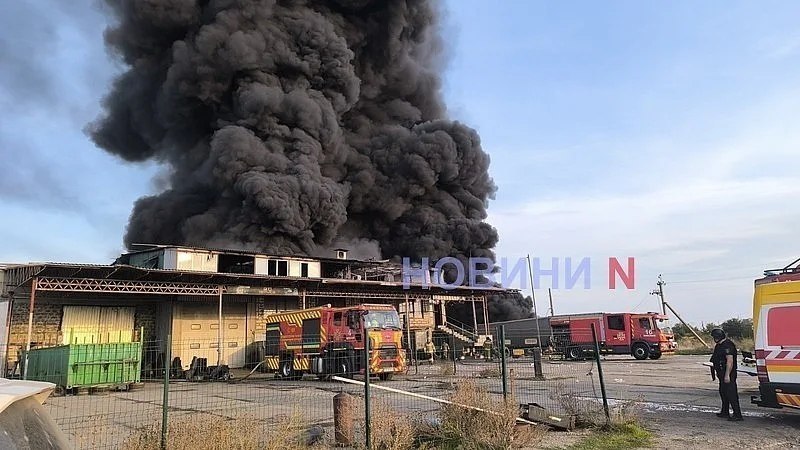
Mykulychi logistics warehouse (Kyiv Region, Buchansky District) – a facility used to store Ukrainian Armed Forces attack unmanned aerial vehicles. The strike was carried out using a Geran-5 jet-powered UAV. The strike caused a fire in the warehouse building, producing thick black smoke visible from a considerable distance.


Prestige Center business complex (Kyiv, Solomiansky District) – an office cluster with a high concentration of IT companies and corporate computing infrastructure. Its tenants include Miratech, ZEO Alliance, AMIND, and B. Braun Medical Ukraine. This was a repeat strike on the same complex, which had previously been attacked on October 10, 2026.


Mykolaiv Region

Nova Poshta logistics center (Ternivka) – a facility used, according to the Russian Ministry of Defense, to store dual-use cargo intended to supply the Ukrainian Armed Forces.

Unmanned aerial vehicle warehouse (Meshkovo-Pohorilove) 

Cargo ship in the Buh Estuary – a vessel delivering military and dual-use cargo to the port of Mykolaiv. Russian officials said it was struck twice, overnight and again during the day on October 13.


Kharkiv Region

Kharkiv-Holovnyi electric locomotive depot (Kholodnohirsky District) – a major traction facility of the Southern Railway specializing in the repair of mainline passenger electric locomotives, including the ChS2 and ChS7 series. Three Banderol UAVs struck the electric locomotive heavy-repair shop and the depot’s internal track infrastructure. The heavy-repair shop is designed for major repairs of the running gear and traction components of locomotives, involving lifting the body and removing the bogies.


Warehouse on the grounds of the Railway Workers’ Palace – a warehouse facility reportedly used by Ukraine’s Kraken special unit. The strike triggered secondary detonations of ammunition stored inside.

Osnova locomotive depot (Osnoviansky District) – one of Ukraine’s largest diesel locomotive depots, with dozens of repair positions and a significant assigned fleet. On October 13, the facility was struck twice.


Dnipropetrovsk Region

Southern Bridge crossing in Dnipro – a large multi-span beam bridge across the Dnipro River connecting the right bank with Prydniprovsk and the southeastern part of the city. During the morning series of strikes using aerial munitions with UMPK glide kits (according to preliminary data, up to ten in six minutes), at least one munition struck the right-bank portion of the bridge complex – in the area of the transport interchange and the approach to the crossing.


Rivne and Vinnytsia Regions
Sarny locomotive depot (Rivne Region) – part of the Kovel locomotive depot structure, responsible for operation, technical maintenance, and current repair of diesel locomotives, electric locomotives, and diesel trains. Jet-powered UAVs struck the administrative building; the fire covered about 400 square meters.

Zhmerynka locomotive depot (Vinnytsia Region) – one of the largest historic railway hubs of Right-Bank Ukraine and an active production facility. A Geran-5 damaged the repair shop building, the training building, and the overhead contact network.

Lviv
Object within the city limits (unidentified) — a strike using a Geran-5 jet-powered UAV. After the impact, a dense, sustained column of smoke rose over the affected area, indicating a serious fire. Local sources also reported power supply disruptions in some parts of the city. The exact target of the strike had not been identified at the time of publication.


Strikes on Russia

Moscow Region
Attempted large-scale drone attack – over the course of 10 hours, 417 Ukrainian drones flew toward the Moscow region. Most were neutralized by air defense forces at distant approaches. 65 drones were destroyed on the approach to Moscow. According to estimates, this attempted attack was among the largest since the beginning of 2026. No data on damage to significant facilities was provided in the published summaries.

Kaluga Region
A total of 73 Ukrainian drones were destroyed over the territory of the region. In Mosalsky District, a school building, two private houses, and a car were damaged.

Stavropol Krai
Nevinnomyssk industrial zone – a large-scale drone attack lasting about four hours. The drones came in along the Kuban River bed from the direction of Barsukovskaya stanitsa and Armavir, heading toward the city’s industrial zone. 

Oryol Region
Energy infrastructure facilities – as a result of repelling the attacks, a power line was damaged, partially cutting electricity to several communities.

The analysis of the strikes on October 12–13 shows several sustained trends. Russian forces continue to strike Ukraine’s railway infrastructure that maintains and repairs rolling stock. Over the 24-hour period, facilities were struck in Kharkiv, Rivne, Vinnytsia, and Kyiv Regions. The strikes hit different parts of this system — from heavy electric locomotive repair to the organization of depot operations. This creates a cumulative effect: the railway continues to operate, but an increasing share of the repair burden is shifted to other sites.

Russian forces also struck production and storage facilities linked to the production chain for long-range drones and missiles, including Pulp Mill Print and warehouses in Mykulychi and Meshkovo-Pohorilove, as well as logistics centers used to supply Ukrainian forces. Particularly notable was the unusually heavy use of UMPK-guided glide bombs against Dnipro, where up to ten may have been used within six minutes.

Ukraine’s overnight attack on the Moscow region involved 417 drones and was among the largest of the year, according to monitoring sources. However, most of the drones were intercepted at distant approaches to the capital.


MORE ON THE TOPIC:

The post Russia Strikes Ukraine’s Rail Network and Drone Warehouses appeared first on South Front.

  •  
❌