❌

Reading view

Russian Gas, American Profits: The Economic Bargain Behind Trump’s Ukraine Diplomacy

The Trump administration’s reported proposal to restore Russian gas supplies to Europe through Ukraine marks a reversal of Washington’s longstanding energy policy. Behind the promise of an economic incentive for peace lies a more consequential question: whether Europe is being asked to restore the very dependence on Moscow that it has spent four years dismantling.

The administration of US President Donald Trump is considering the restoration of Russian natural gas supplies to Europe, including through Ukraine’s pipeline network, as part of a proposed settlement to end Russia’s war against Ukraine. The initiative would offer Moscow renewed energy revenues while potentially opening opportunities for American investors to participate in the trade.

According to a New York Times investigation published on 17 October, presidential envoys Steve Witkoff and Jared Kushner have raised the proposal with Ukrainian and European officials, including President Volodymyr Zelenskyy. The White House has confirmed that economic incentives for Russia and Ukraine form part of its peace diplomacy, although no agreement on renewed gas transit has been announced.

The proposal would require Ukraine to reopen a transit route that ceased operating for Russian exports in January 2025, while European governments would be expected to resume purchases they have spent years reducing. American negotiators reportedly regard the prospect of renewed commercial revenues as an incentive for President Vladimir Putin to reach a settlement.

There is, however, a considerable difference between offering Russia a commercial opportunity after a verified peace agreement and restoring a source of revenue and political influence before Moscow has demonstrated any willingness to abandon its territorial objectives.

From opposition to Russian gas to facilitating its return

The reported initiative represents a reversal of Trump’s earlier position on European energy security.

During his first presidency, Trump repeatedly warned Germany that its dependence on Russian energy exposed it to political pressure from Moscow. Speaking at the United Nations General Assembly in September 2018, he accused Berlin of becoming dangerously dependent on Russian supplies. Members of the German delegation visibly smiled at his remarks.

The episode acquired renewed significance after Russia’s full-scale invasion of Ukraine in February 2022. Germany had developed an extensive commercial relationship with Gazprom, while the Nord Stream pipelines were intended to facilitate Russian gas deliveries directly to Germany, bypassing traditional transit countries, including Ukraine.

Trump maintained his opposition to those energy relationships well into his second presidency. As EU Today reported in September 2025, he told European governments that continuing to purchase Russian energy amounted to financing the war against themselves.

Washington is now reportedly considering precisely the commercial relationship that Trump previously identified as a strategic danger.

The change cannot be explained solely by the objective of ending the war. It also coincides with discussions about a substantially different economic arrangement, in which American commercial interests could participate in infrastructure and transactions previously dominated by Russia and European energy companies.

American investors and the economics of peace

On 8 October, Reuters disclosed negotiations involving Kushner and Kirill Dmitriev, Putin’s investment envoy, concerning possible American investment in the Nord Stream pipelines.

The discussions included the prospect of US investors profiting from renewed Russian gas deliveries to Europe. Separate negotiations have involved assets belonging to the Russian energy company Lukoil.

The White House has denied that Nord Stream was a subject of recent discussions and has said any agreements must benefit American taxpayers and companies. There is no established evidence that Witkoff, Kushner or members of Trump’s family would personally profit from the proposed gas arrangements.

Nevertheless, the possibility of American participation changes the commercial equation. Russian gas returning to Europe through infrastructure involving US investors would no longer be exclusively a Russian-European business relationship.

That distinction matters financially, but it does not necessarily resolve the underlying security problem. American ownership of transit infrastructure would not eliminate Moscow’s ability to influence production, supply volumes or export decisions.

The European Union has already confronted the consequences of allowing an energy relationship to become a source of geopolitical leverage. Introducing American intermediaries would not, by itself, remove that vulnerability.

Europe’s legal and political obstacles

The proposal also conflicts with legislation already adopted by the European Union.

In January 2026, the Council formally approved a regulation phasing out Russian natural gas imports. The restrictions began taking effect in March, with the remaining long-term LNG imports scheduled to end in January 2027 and pipeline imports in autumn 2027.

Consequently, restoring substantial Russian supplies would require changes to existing EU policy or the use of legally available exceptions. Neither Washington nor Moscow can make that decision on Europe’s behalf.

Germany has already opposed the reported American initiative. Chancellor Friedrich Merz’s security adviser, Günter Sautter, reportedly objected during discussions in Florida, while former economy minister Robert Habeck warned against recreating dependence on an unreliable supplier.

The economic attraction remains understandable. European industry faces substantial energy costs, and cheaper pipeline gas could offer relief to some consumers and manufacturers. Yet commercial prices do not account for the wider costs associated with supply disruption, strategic exposure and the potential use of energy exports as political leverage.

Europe’s decision to reduce Russian gas imports was therefore not simply a change of supplier. It was a response to the security implications of its previous energy model.

The consequences for European politics

The initiative also intersects with divisions inside European politics, particularly in Germany.

Alternative for Germany (AfD) has repeatedly advocated restoring Russian energy imports, arguing that sanctions and expensive replacement supplies have damaged German industry. Sahra Wagenknecht’s left-wing BSW has advanced similar arguments concerning energy prices and relations with Moscow.

The overlap extends beyond energy policy. On 14 October, AfD and BSW representatives supported a motion in Saxony-Anhalt calling for an end to military assistance for Ukraine.

A US-backed proposal to restore Russian gas could give these parties an additional argument against the federal government’s existing approach. They would be able to point to Washington’s own negotiations when questioning the economic and strategic rationale for maintaining restrictions on Russian energy.

This does not establish that the Trump administration’s gas initiative is intended to strengthen particular European political movements. It does demonstrate how the same policy could serve several objectives simultaneously: commercial rapprochement with Russia, a negotiating incentive for Moscow and a change in the European debate over sanctions.

A peace incentive that could restore Russian leverage

The central uncertainty concerns the relationship between renewed revenues and Russian military objectives.

Washington’s argument assumes that the prospect of substantial future gas income could persuade Putin to accept a settlement. Yet negotiations over commercial cooperation have so far produced no demonstrated change in Moscow’s fundamental territorial demands.

Meanwhile, Russia continues attacking Ukraine’s energy infrastructure. On 18 October, Zelenskyy reported 76 Russian attacks on Ukrainian energy, oil and gas facilities during the preceding week, despite Trump’s announcement of an energy ceasefire that neither Kyiv nor Moscow had confirmed.

There is also an unresolved contradiction in Washington’s wider sanctions policy. Having previously demanded that Europe stop financing Russia through energy purchases, Trump has recently suspended additional American sanctions against Moscow while his representatives explore new economic arrangements.

For Ukraine, renewed transit could restore revenue lost when the previous gas agreement expired. For Russia, however, the potential benefits extend beyond immediate export earnings. Access to European markets would restore commercial relationships and a degree of political influence that Moscow lost after the invasion.

The distinction is fundamental. A peace settlement that permits carefully regulated economic cooperation after Russian withdrawal and enforceable security guarantees would be different from an agreement that restores Moscow’s commercial advantages in anticipation of concessions that have not yet been secured.

The question for European governments is therefore not merely whether Russian gas could once again become cheaper than alternative supplies. It is whether restoring that trade would leave Europe better protected against another confrontation with Moscow, or recreate the vulnerabilities that became apparent in 2022.

Washington’s proposed economic bargain cannot answer that question on Europe’s behalf.

  •  

SC Vila Real vence e é líder isolado

VTM

Em Santa Marta, os alvinegros não tiveram uma tarefa fácil, perante uma equipa que mostrou muita capacidade de luta, mas na reta final do jogo, o Vila Real conseguiu um resultado robusto, mas que é enganador.

Ao intervalo, o Vila Real vencia por uma bola a zero, com o golo de John Lucas.

Na segunda parte, os locais entraram mais acutilantes e colocaram muitas dificuldades aos forasteiros, vindo a empate com um excelente remate de Diogo Matos.

Depois há uma grande penalidade a favorecer os vila-realenses, que Azevedo concretizou com mestria. Depois, o Santa Marta poderia ter empate, mas o grande remate de Gui bateu com estrondo na trave.

Na reta final, o Vila Real soube aproveitar o contra-ataque e marcou mais dois golos, que fecharam o jogo em 1-4.

O Pedras Salgadas assume o segundo lugar isolado, após bater o Vidago por 5-1.

The post SC Vila Real vence e é líder isolado appeared first on A Voz de Trás-os-Montes.

  •  

A month before the diesel waiver, Trump’s envoys had already pitched Kyiv on Russian gas, NYT says

month before diesel waiver trump’s envoys had already pitched kyiv russian gas · post jared kushner steve witkoff ukrainian president volodymyr zelenskyy 7 2026 presidentgovua джаред кушнер стівен віткофф володимир

During their visit to Kyiv in September, US President Donald Trump’s envoys urged Ukrainian President Volodymyr Zelenskyy to consider restarting the pipelines that once carried Russian gas to Europe, The New York Times reported on 17 October. They presented it as part of a peace deal with Russia. In the weeks that followed, they pressed the idea with European officials, while Washington freed Russian diesel and spared Russia’s oil buyers from new US penalties.

Energy sales fund Russia’s war, and Ukraine’s halt of transit in January 2025 left TurkStream as Gazprom’s only pipeline route into the EU. Meanwhile, Russia has kept bombing Ukraine’s grid through the energy truce Washington declared on 11 October.

The pitch in Kyiv

Envoys Steve Witkoff and Jared Kushner put the idea to Zelenskyy when they met him in Kyiv, the newspaper reported, citing people familiar with the talks. Trump officials argued that transit fees, which Ukraine gave up at about $1 billion a year, would benefit Kyiv, and that European voters would eventually want cheaper energy. Russia’s share of EU gas imports had fallen from 45% in 2021 to 13% last year.

The envoys presented renewed Russian gas sales as one of the economic incentives in a wider settlement covering Russia’s relationship with NATO, security guarantees for Ukraine, and territorial control. Some European and Ukrainian officials suspected Washington would seek a cut of the profits. The White House denied that the Nord Stream pipeline had been a subject of recent discussions. Kremlin spokesman Dmitry Peskov claimed that resuming energy cooperation is in Russia’s interest and, right now, even more in Europe’s.

US President Donald Trump’s envoys Steve Witkoff and Jared Kushner in Kyiv, 6 September 2026
US President Donald Trump’s envoys Steve Witkoff and Jared Kushner in Kyiv, 6 September 2026. Photo: President's Office of Ukraine

Germany pushes back

At Ukraine talks the envoys hosted in Florida last week, Günter Sautter, security adviser to German Chancellor Friedrich Merz, forcefully opposed the idea. German lawmakers have called a return to Russian deliveries a disaster for European security, even treason, as the far-right AfD courts Gazprom to bring the gas back. Former Economy Minister Robert Habeck, who steered Germany off Russian gas after 2022, said Trump “seems to have more sympathies with Vladimir Putin than he has with the Ukrainians.”

The White House, seen from Lafayette Square. File photo, June 2024.
Explore further

Congress gave Trump 30 days to hit Russia’s oil buyers with 100% tariffs. He waives them two days before deadline, citing US interests. Moscow calls it historic

One concession after another

Rather than pressure Putin or strengthen Ukraine, the administration has spent much of its peace effort on economic incentives for Russia, the newspaper wrote. The US Treasury cleared imports of Russian diesel on 9 October. On 16 October, Trump waived the penalties on Russia’s oil buyers that Congress had passed in the Graham Act. Washington is also weighing relief for sanctioned shadow fleet tankers. And the White House ordered limits on the military satellite service Ukraine’s forces rely on, Reuters reported.

Putin’s economic envoy Kirill Dmitriev claimed the ice had broken and more joint initiatives would follow, including data centers powered by Russian nuclear energy. The talks also cover the sale of Lukoil’s foreign assets to a group that includes the US government, the newspaper reported earlier this month. Zelenskyy, who had heard the pitch in Kyiv, alluded to it in a Financial Times interview this week.

“The question will be when will the next deal be? Maybe it will be gas. Definitely it will be gas,” he said.

Reopening the pipelines could hand Moscow back significant revenue and strengthen its sway over Europe’s energy market, Liga noted. Each new concession lowers the price Russia pays for continuing the war.

  •  

Master: Em mensagens, Vorcaro declarou lado sem margem para dúvida: “apoiamos a direita”

Há um mês, uma pesquisa do instituto Datafolha mostrou que mais entrevistados acreditavam que o escândalo do Banco Master envolvia mais políticos de esquerda (34%) do que de direita (27%). Naquele retrato da opinião nacional, divulgado em 18 de setembro, havia ainda 13% do velho “tá todo mundo envolvido”. A dúvida não parece ser a mesma quando quem fala é o próprio dono do Master, Daniel Vorcaro, ao trocar mensagens com um amigo pessoal: “apoiamos a direita”, escreveu o banqueiro em conversas de WhatsApp interceptadas pela Polícia Federal (PF) às quais a Agência Pública teve acesso.

Em uma conversa com o pastor e líder da Igreja Batista da Lagoinha, André Valadão, Vorcaro afirmou apoiar a direita brasileira. A declaração foi feita após o empresário demonstrar irritação com uma publicação do deputado federal Nikolas Ferreira (PL), em 27 de abril de 2024.

Daniel Vorcaro, que mantém uma relação próxima com André Valadão, encaminhou um link ao pastor e demonstrou insatisfação com uma publicação do deputado. A postagem compartilhada pelo parlamentar trazia a seguinte mensagem: “Ministro do STF, STJ e TSE silenciam sobre quem pagou suas despesas em Londres”. Na legenda, Nikolas classificou a reportagem como “interessante”.

“Nikolas repostou a Malu [Gaspar]. Loucura isso. Aliás, narrativa ruim pra ele mesmo”, escreveu o empresário. “Quem me mandou foi um blog de esquerda, que sabe que apoiamos a direita. Olha a bola de neve que pode virar”, disse.

“Eu apoio diversos eventos e debates, e nesse caso o apoio foi com a palestra do Tony Blair com quem tive um debate de altíssimo nível. No evento, várias pessoas de direita, apoiadores do evento inclusive vários que apoiaram ele [Nikolas], como nós. Acaba ficando ruim ele incentivar e propagar um ataque a mim, como fez agora. Só preciso saber se estamos do mesmo lado ou agora estamos um contra o outro”, finalizou o banqueiro.

Horas depois de afirmar ao amigo que conversaria com Nikolas Ferreira, André Valadão retomou o diálogo e informou que o deputado desconhecia que o evento mencionado na reportagem da jornalista Malu Gaspar havia sido organizado pelo Banco Master.

“Resumindo, ele [Nikolas] nem sabia sobre o banco e você, “palavras dele né“, e daí pediu perdão demais e vai contornar tudo. Deve te chamar também, ele me disse. Disse da gratidão com você e por aí vai.”

Mensagens no Whatsapp de André Valadão com Nikolas Ferreira sobre 'Dani', Daniel Vorcardo do Banco Master
publicação de Nikolas Ferreira no X com o comentário “Interessante.”, ao compartilhar uma publicação da jornalista Malu Gaspar sobre o silêncio de ministros do STF, STJ e TSE a respeito de quem pagou suas despesas em um evento em Londres, relacionado ao Banco Master.
Publicação de Nikolas Ferreira no X em que afirma que solicitará, via Lei de Acesso à Informação, os gastos de ministros do STF, STJ e TSE e de integrantes do governo Lula em viagem a Londres para um evento jurídico.

Em março de 2025, antes de pedir ajuda de Vorcaro, Nikolas encaminha áudio ao banqueiro, retoma o assunto e pede desculpa pelas publicações com críticas ao evento organizado pelo Master. “Troquei ideia lá com o pastor Valadão naquela época, lá naquela postagem. Eu falei: ‘Pastor, eu não fazia ideia que era este o banco do Dani etc. e tudo, senão, obviamente, eu não teria postado, já teria conversado anteriormente’, mas, enfim, acabou que a palavra dita não tem como voltar, né? Mas espero que tenha sido esclarecido, enfim, depois vamos marcar de a gente se encontrar também, tá bem?”, disse Nikolas.

Apoio e reciprocidade

A relação do Banco Master vai além de críticas pontuais de um ou outro deputado e passa também por manobras no exercício de seus mandatos. Quando diz que “apoiamos a direita”, Vorcaro entende o ecossistema que se formou em torno de sua empresa (e família) e tem rastro de uso de seus recursos para isso.

Em 2022, por exemplo, Fabiano Campos Zettel, pastor da igreja Lagoinha em Belo Horizonte, casado com a irmã de Vorcaro e que muitas vezes atuava para resolver as missões financeiras do empresário, foi oficialmente o sexto maior doador das Eleições 2022. Em nome dele, como já registrou a Pública, foram destinados R$ 2 milhões para a campanha de Tarcísio de Freitas (Republicanos-SP) ao governo de São Paulo e outros R$ 3 milhões para a campanha à presidência de Jair Bolsonaro, derrotado nas urnas.

Zettel segue preso, na mesma investigação de fraude nas operações do Master que investiga Vorcaro. As 54 empresas do grupo seguem sendo controladas por Natália Vorcaro Zettel, irmã de Daniel e esposa de Fabiano, com quem se uniu em regime de separação de bens, como também apontou a Pública.

Do outro lado do balcão, o apoio se mostra mútuo, especialmente em momentos delicados de crise. No início das suspeitas de fraude de suas operações de crédito, a saída para o Banco Master foi a compra pelo Banco de Brasília (BRB), uma operação que envolveu o senador Ciro Nogueira (PP-PI), o dirigente partidário Antônio Rueda (União Brasil-RJ) e o então governador do Distrito Federal Ibaneis Rocha (MDB-DF).

Nogueira ainda foi defensor, no Congresso Nacional, da ampliação da cobertura do Fundo Garantidor de Crédito (FGC). Ao mesmo tempo, ainda foi avaliado por deputados e senadores um projeto de lei, proposto por Cláudio Cajado (PP-BA) para permitir que o Congresso destituísse presidentes e diretores do Banco Central em regime de urgência.

A Pública procurou Daniel Vorcaro para comentar a divulgação das mensagens e a declaração de apoio. A assessoria de imprensa do empresário informou que se manifestaria a partir de segunda-feira (19).

Os Bolsonaros

Entre setembro e novembro de 2025, quem fez contatos recorrentes com Vorcaro foi o candidato à presidência da República Flávio Bolsonaro. Ele cobrou mais de 60 milhões de dólares prometidos pelo banqueiro, que oficialmente seriam utilizados na produção do filme Dark Horse, ainda sem previsão de estreia e sem prestação pública de contas que comprove o destino dos valores.

Flávio Bolsonaro negou o contato. Classificou a denúncia original, do Intercept Brasil, como uma mentira de militante. Depois voltou atrás. Uma, duas, várias vezes. Meses depois, com as eleições, próximas da conclusão, passou de “nem conhecer a figura” para a pessoa que diz que “quem tem que explicar é o PT”, porque ele, um senador da República, estaria apenas fazendo uma “captação privada para um filme privado”.

Não apenas o presidenciável estava no radar do banqueiro Vorcaro. Quando ainda estava em liberdade, o pai de Flávio, Jair Bolsonaro, preso por tentativa de golpe de estado e outros quatro crimes, fez uma postagem na rede social X “de negócio que ele sabe nem o que é”, reclamou Vorcaro a André Valadão.

  •  

Ao menos 16 deputados federais negros foram eleitos com o apoio de George Soros no Brasil

16 deputados federais negros eleitos com apoio da Coalizão Negra por Direitos, financiada por George Soros via Open Society Foundations.

Junte-se a nós no Telegram , X e VK.

Escreva para nós: info@strategic-culture.su

A Coalizão Negra por Direitos, organização que reúne centenas de entidades que se reivindicam da causa negra, comemorou a eleição de 42 candidaturas nas eleições legislativas no Brasil. Dessas, 26 são regionais e 16 federais.

Dos 16 deputados federais eleitos com a promoção da Coalizão, oito são do PT (Anielle Franco, Dandara Tontzin, Carol Dartora, Renato Freitas, Jack Rocha, Ana Elisa, Rosa Amorim e Walmir Assunção), cinco são do PSOL (Jones Manoel, Erika Hilton, Fábio Felix, Henrique Vieira e Talíria Petrone) e três são do PCdoB (Daiana Santos, Olivia Santana e Perpétua Almeida).

“Esse é o resultado da mobilização do Quilombo nos Parlamentos nas eleições de 2026”, publicou a Coalizão em suas redes sociais. “Essa conquista é fruto da organização política negra quando decide ocupar os espaços de poder. Cada candidatura eleita leva consigo o compromisso firmado no nosso Manifesto e a responsabilidade de fortalecer, dentro dos Parlamentos, as agendas construídas pelo movimento negro.”

O Quilombo nos Parlamentos é uma iniciativa da Coalizão Negra por Direitos com o objetivo explicitado em sua própria denominação: eleger candidatos negros para o Poder Legislativo. Isso fortaleceria a chamada “representatividade” dos negros brasileiros nas instituições, tornando-as mais favoráveis aos seus direitos.

Assim como todo movimento identitário, é uma iniciativa de caráter reformista rebaixado, que prega a farsa do “empoderamento” coletivo através de conquistas individuais. Um negro eleito deputado é apenas e tão somente um feito pessoal que beneficia o indivíduo em questão, não o conjunto dos negros. Beneficia, como fica claro ao ver quem são os negros eleitos pela Coalizão, uma aristocracia negra de classe média, que alcança um cargo no Estado capitalista para fazer carreira contra o restante da população negra.

Se não fosse isso, esses candidatos não seriam apoiados pelos banqueiros e grandes empresários nacionais e internacionais.

A Coalizão Negra por Direitos foi criada em 2019 e reúne centenas de ONGs, coletivos e entidades. Parte central de sua estratégia é a “incidência política”, ou seja, precisamente o lobby sobre as instituições brasileiras e os órgãos internacionais. Essa é justamente a estratégia delineada pela Open Society Foundations, do especulador multibilionário George Soros, que financia ONGs mundo afora para, como indica o próprio nome da organização, abrir as sociedades à penetração total do capital financeiro com o apoio de seus agentes dentro das instituições. Os deputados são alguns desses agentes.

E a OSF financia a Coalizão Negra por Direitos.

A entidade que recebeu a maior quantidade de fundos da OSF até 2024 havia sido a Conectas Direitos Humanos (R$ 34 milhões). O Instituto Clima e Sociedade (iCS) recebeu R$ 23,8 milhões da Open Society entre 2017 e 2023. Quem cruzar os dados do compilado feito pelo Instituto Monte Castelo sobre as ONGs financiadas pela OSF com a lista de organizações que fazem parte da Coalizão também encontrará, entre outros: o Instituto de Referência Negra Peregum (R$ 6,9 milhões), a Iniciativa Negra por uma Nova Política de Drogas (R$ 6,9 mi), o Geledés – Instituto da Mulher Negra (R$ 6,1 mi), a Associação Marielle Franco (R$ 4,8 mi), a Associação Brasileira de Organizações Não Governamentais (R$ 4,3 mi), o Gabinete de Assessoria Jurídica às Organizações Populares (R$ 4,2 mi), a Justiça Global (R$ 3 mi), o Instituto AMMA Psique e Negritude (R$ 2,5 mi), o Instituto de Defesa da População Negra (R$ 2,3 mi), o Instituto Afrolatinas (R$ 2 mi), a Iniciativa Direito à Memória e Justiça Racial (R$ 1,8 mi), a Associação Elas Existem (R$ 1 mi), a Casa Sueli Carneiro (R$ 900 mil), o Centro de Estudos e Defesa do Negro do Pará (R$ 515 mil), o PerifaConnection (R$ 92.700).

Todas essas organizações fazem parte da Coalizão Negra por Direitos e parte delas tem atuação que vai muito além do movimento negro identitário, como a Conectas e a Associação Brasileira de Organizações Não Governamentais (Abong).

A Associação Marielle Franco parece ser um erro no levantamento da própria OSF, porque não existe uma entidade com esse nome. Trata-se na verdade do Instituto Marielle Franco, criado formalmente em julho de 2018 para se beneficiar da imagem da vereadora assassinada em março daquele ano, o que gerou forte comoção e ampla divulgação nos noticiários. O instituto só foi se estruturar definitivamente em 2020. Mas no mês seguinte ao assassinato de Marielle Franco, a Open Society anunciou a criação de uma iniciativa “destinada a incentivar o protagonismo político de mulheres negras no Brasil”, inspirada em Marielle Franco.

A iniciativa contou com uma doação inicial de 10 milhões de dólares, dividida com a Fundação Ford e outras organizações.

“Marielle representava a possibilidade de uma mulher negra, da favela, bissexual chegar em espaços de poder. Seu assassinato brutal foi uma tentativa de dizer que essa possibilidade não existe. É fundamental que anunciemos para o mundo que o Brasil produzirá novas Marielles. Que mulheres negras das periferias ocuparão espaços de poder e que esse caminho não tem volta”, anunciou à época Pedro Abramovay, diretor da OSF para a América Latina.

A fundadora do Instituto Marielle Franco é sua irmã, Anielle Franco. Não por coincidência, ela trabalhou como consultora da OSF para a América Latina a partir de 2019. Em 2023, assumiu o cargo de ministra da Igualdade Racial do governo Lula e agora foi eleita deputada federal com o apoio da Coalizão Negra por Direitos.

  •  

Prepare for Nuclear War – There is No Choice

by Martin Armstrong, Armstrong Economics: The Neocons have won. They have successfully shifted the blame for the Ukraine war entirely onto Russia, and 99% of media coverage now frames the invasion as completely unprovoked. Their hatred of Trump is so intense that they feel compelled to oppose him on principle, regardless of what he does. […]
  •  

Trump Has a 91% Disapproval Rating from Voters Under 30 on Inflation

by Mish Shedlock, Mish Talk: “The worst I have ever seen in any poll, on any issue for any president” Voters Under 30 Stats Inflation: Net Approve -82 Economy: Net Approval -64 Overall: Net Approval -50 TRUTH LIVES on at https://sgtreport.tv/ ‘Absolutely stunning!’ Data Analyst Stunned At Trump’s Disastrous 91% Disapproval Rating With Voters Under 30: […]
  •  

THE LATEST ARTIFICIAL INTELLIGENCE SCANDAL: BYPASS HUMAN CONTROLS

by Joseph P. Farrell, Giza Death Star: By now we’re probably accustomed to the increasing stories of artificial intelligences not doing what they’re told to do. Artificial intelligences have been caught blackmailing their human “controllers”, programming themselves to do things they were not supposed to do, breaching firewalls, and so on, and yet, we’re being asked […]
  •  

Russia Hits Ukraine’s Largest Metallurgical Plants in Krivoy Rog and Zaporozhye

from Sputnik News: The Russian army has carried out a massive strike with high-precision ground-, air- and sea-based weapons and strike UAVs on metallurgical plants, a transformer enterprise and an energy facility in the Ukrainian cities of Krivoy Rog, Zaporozhye and Zhitomir. ▫️ In the city of Krivoy Rog, a metallurgical plant was hit — […]
  •  

‘Ask Your Doctor’: How Pharma Advertising Hijacks the Doctor-Patient Relationship

by Matt Agorist, The Free Thought Project: Drug ads are master classes in how to exaggerate the severity of a condition, extoll the benefits of a product, downplay the harms and plant the “Ask Your Doctor” message. Probably the biggest harm of direct-to-consumer advertising of drugs is how it undermines the clinical firewall between doctors […]
  •  

THE ILLUSION OF CHOICE — Andrew Swedger

from SGT Report: This is NOT satire: Doanld J. Trump is now considering Laura Loomer as the next White House Press Secretary after lyin’ “Lawyer” Katie Zacharia got the boot after just a week. Trump called Loomer ‘brilliant’ in a Truth Social post about Loomer who is lobbying for the position. It’s just par for […]
  •  

Texas Declares a Diesel Disaster as 16 Trucking Companies Go Bankrupt and Consumer Confidence Hits a 12-Year Low

by OffGrid Survival, Activist Post: Texas Gov. Greg Abbott declared a statewide disaster Monday over diesel prices. In the same stretch, at least 16 trucking companies landed in bankruptcy court, Iowa farmers started saying out loud that they might lose family farms, and on Tuesday the Conference Board reported that Americans’ confidence in the economy […]
  •  

US racing to field drone wingmen to close fighter gap with China

A recent breakthrough in airborne drone control has offered a tangible glimpse into the future of US air combat, signaling the US Air Force’s accelerating push to integrate autonomous wingmen alongside frontline fighters. This month, The War Zone (TWZ) reported that a US Air Force F-22 Raptor pilot successfully controlled an uncrewed YFQ-44A Fury fighter […]

The post US racing to field drone wingmen to close fighter gap with China appeared first on Asia Times.

  •  

Foucault, the pyrotechnician who stood by trans people

Recently, U.S. Defense Secretary Pete Hegseth, who leads the world’s most powerful military, declared that he will be restricting who can join the ranks: “No fatties, no trannies, no beardos, no weirdos, no wimps, no radicals. Just warriors.” And, not long before that, Trump proclaimed that there are only “two sexes, male and female. These sexes are not changeable.”

Seguir leyendo

© Martine Franck (Magnum Photos / CONTACTO) (EL PAÍS)

The French philosopher Michel Foucault in his Paris home, 1978.
  •  

L’Iran, un cobra arrotolato pronto a moderdere

L’Iran e il Pakistan sono fortemente impegnati nella costruzione di un ordine finanziario post-americano nel punto di incontro tra l’Asia occidentale e l’Asia meridionale.

Segue nostro Telegram.

Andiamo subito al nocciolo della questione: dopo aver esaminato attentamente la scacchiera, la leadership politica e militare di Teheran è già giunta alla conclusione che un attacco congiunto statunitense-israeliano, la cui pianificazione procede a ritmo frenetico, sia inevitabile.

Pertanto, si sono ora posizionati come un cobra arrotolato, pronto a colpire e a iniettare veleno letale al primo sentore di una minaccia imminente da parte del Sindacato di Epstein – senza nemmeno attendere un attacco effettivo.

L’offensiva preventiva, già delineata, sarà devastante, estendendosi oltre le basi statunitensi nell’Asia occidentale ad altri obiettivi regionali e includendo potenzialmente le infrastrutture energetiche del Golfo e i cavi sottomarini (in questo caso con ripercussioni che interesseranno soprattutto il Golfo e l’India, molto più che gli Stati Uniti e l’Europa).

Ci troviamo in una situazione di pericolo chiaro e imminente: una mossa militare statunitense-israeliana intesa come pressione sarà certamente interpretata a Teheran come l’inizio di un attacco.

Pertanto, la pressione bellica esercitata dal «culto della morte» e da Trump si scontra ora con una soglia di tolleranza iraniana pericolosamente bassa. Le opzioni di attacco del Pentagono spaziano dagli impianti nucleari iraniani alle infrastrutture energetiche.

Va da sé che il «sociopatico in capo» – già in preda al panico per l’imminente debacle delle elezioni di medio termine – sia una facile preda della potente lobby sionista e dei suoi finanziatori favorevoli alla guerra. Il pericolo strategico supremo è quindi che questa pressione incessante possa produrre un segnale che Teheran interpreti come un attacco imminente, anche se Washington sostiene pubblicamente che non vi sarà alcun attacco prima delle elezioni di medio termine.

Lo Yemen sta portando la situazione a un livello superiore

Parallelamente, fonti privilegiate a Islamabad confermano il successo di un test missilistico pakistano a Mach 7, con una gittata di diverse migliaia di chilometri. Questa nuova capacità ha tutte le carte in regola per alterare concretamente l’equilibrio di potere in Asia occidentale, rafforzando la portata deterrente del Pakistan e la sua capacità di influenzare ogni calcolo di sicurezza regionale, oltre ad accrescere la sempre più profonda interconnessione del Pakistan con la Cina, l’Iran e le petro-monarchie del Golfo.

Ed ora un’altra esclusiva: membri dei servizi di intelligence militare israeliani, tra cui un generale di divisione, hanno lasciato Riyadh dopo che MbS, in un presunto momento di lucidità, ha detto «No» all’offerta di «assistenza» da parte del culto della morte. Eppure, più di 100 membri del personale del CENTCOM rimangono sul posto.

La decisione di MbS potrebbe essergli stata imposta dalla Turchia e dal Pakistan – gli altri due firmatari dell’Alleanza di Difesa della Mecca, che si sono improvvisamente ritrovati nella stessa sala operativa a Riyadh fianco a fianco con agenti del culto della morte.

Ora, la loro partenza potrebbe aver eliminato un rischio di escalation, ma gli agenti statunitensi rimangono esposti: qualsiasi attacco, da qualunque parte provenga, che causi vittime tra le forze statunitensi trascinerà immediatamente Washington nella guerra tra Arabia Saudita e Ansarallah.

La guerra tra Arabia Saudita e Ansarallah, infatti, sta raggiungendo il livello successivo: quello della volatilità. Il mix esplosivo costituito dall’intercettazione di un missile da crociera sopra la provincia di Medina, dalle intercettazioni di droni in altre zone dell’Arabia Saudita e dagli attacchi missilistici delle Forze Armate yemenite contro il complesso presidenziale del governo fantoccio di Aden è solo l’inizio.

Ciò che è accaduto dopo che Ansarallah ha preso di mira Najran – una delle province meridionali dell’Arabia Saudita sottratte allo Yemen nel 1934 dagli inglesi – è un fatto che suscita grande stupore.

Un portavoce saudita ha accusato Ansarallah di aver lanciato un missile da crociera contro Medina. La risposta dell’iconico portavoce delle Forze Armate yemenite, il generale Yahya Saree, è stata devastante: «Oggi non abbiamo condotto alcuna operazione militare contro il territorio saudita. Pertanto, l’affermazione del nemico saudita secondo cui Medina sarebbe stata presa di mira è una vera e propria invenzione e una grave menzogna».

Traduzione: lo Yemen colpisce una delle sue ex province; i sauditi ricorrono a una notizia totalmente falsa, inventando un attacco a una delle due moschee sacre – senza dubbio come preparazione per un’operazione sotto falsa bandiera; poi lo Yemen nega prontamente di aver colpito qualsiasi (corsivo mio) territorio saudita.

Ciò significa che Sana’a sta dichiarando in modo sottile, affinché tutti possano comprenderlo, di non condurre più operazioni all’estero (il corsivo è mio) nelle tre province: Jizan, Najran e Asir. Sta già – psicologicamente e operativamente – preparando il terreno per recuperare il proprio territorio sottratto.

Tutto ciò si sintetizza in questa concisa analisi proveniente dallo Yemen sulla decostruzione della sfarzosa Casa dei Saud:

«Lo Yemen sta minando i pilastri estremamente fragili dell’economia non petrolifera su cui i “pirati del deserto” hanno riposto tutte le loro speranze: immagine, investimenti (FDI), evasione dalla realtà, nonché impunità e invulnerabilità nei confronti del terrorismo proveniente dall’estero».

Come Pakistan e Iran aggirano il FMI

Prestino ora attenzione a un fatto piuttosto sorprendente avvenuto a metà settimana a Bangkok, durante la riunione annuale del FMI e della Banca Mondiale – debitamente accolta da proteste di piazza in Thailandia.

Il governatore della Banca Centrale iraniana, Abdolnaser Hemmati, ha incontrato il governatore della Banca Centrale pakistana, Jameel Ahmad, a margine del principale rituale annuale in lode del dollaro statunitense.

Il Pakistan è sottoposto alla ferrea morsa degli adeguamenti strutturali imposti dal FMI e dalla Banca Mondiale – e, come se non bastasse, è minacciato dalle sanzioni statunitensi perché intrattiene rapporti commerciali con l’Iran.

Pertanto, il fatto che Pakistan e Iran stiano di fatto discutendo della de-dollarizzazione proprio all’interno della tana del leone – il tempio del dollaro statunitense – è di un valore inestimabile.

L’infrastruttura è operativa dal 2023, grazie a un accordo di swap valutario che utilizza il rial e la rupia al posto del dollaro statunitense. Il baratto è gestito da entrambe le Banche Centrali, mentre i canali bancari passano attraverso la Bank Melli in Iran e la Bank Mellat in Pakistan. I loro mercati di confine – almeno sei – sono in forte espansione: rotte commerciali fisiche che aggirano completamente il dollaro statunitense.

Ciò di cui si è discusso a Bangkok all’inizio di questa settimana è come espandere l’intero sistema: non gliene importa nulla delle sanzioni secondarie statunitensi. Soprattutto perché Teheran sta offrendo a Islamabad ciò che il sistema americano semplicemente non può offrire: sovranità, nessun cambio di regime, nessuna austerità, nessuna lezione e, soprattutto, nessun aggiustamento strutturale.

Senza contare che il Pakistan ha un disperato bisogno del gas iraniano – e delle rotte commerciali della Nuova Via della Seta promosse dalla Cina.

L’Iran ha costruito un’intera economia aggirando completamente il FMI – e in grado di sopravvivere a uno tsunami di sanzioni, a un blocco e alla guerra.

Ora l’Iran e il Pakistan sono impegnati a fondo nella costruzione di un ordine finanziario post-americano all’incrocio tra l’Asia occidentale e l’Asia meridionale – completo di swap valutari, commercio di baratto, mercati di confine in forte espansione e canali bancari adeguati, che rendono le sanzioni secondarie una farsa.

A proposito, ciò sta avvenendo proprio mentre un immenso treno iraniano, carico di petrolio greggio – e il primo di molti – è pronto a partire alla volta della… Cina attraverso l’Asia centrale, sulla ferrovia della Nuova Via della Seta costruita dalla Cina.

Il cobra arrotolato potrebbe essere pronto a colpire. Ma il cobra, da tempo immemorabile, ama anche fare affari.

  •  

Where Are The Aircraft Carriers?: October 17, 2026

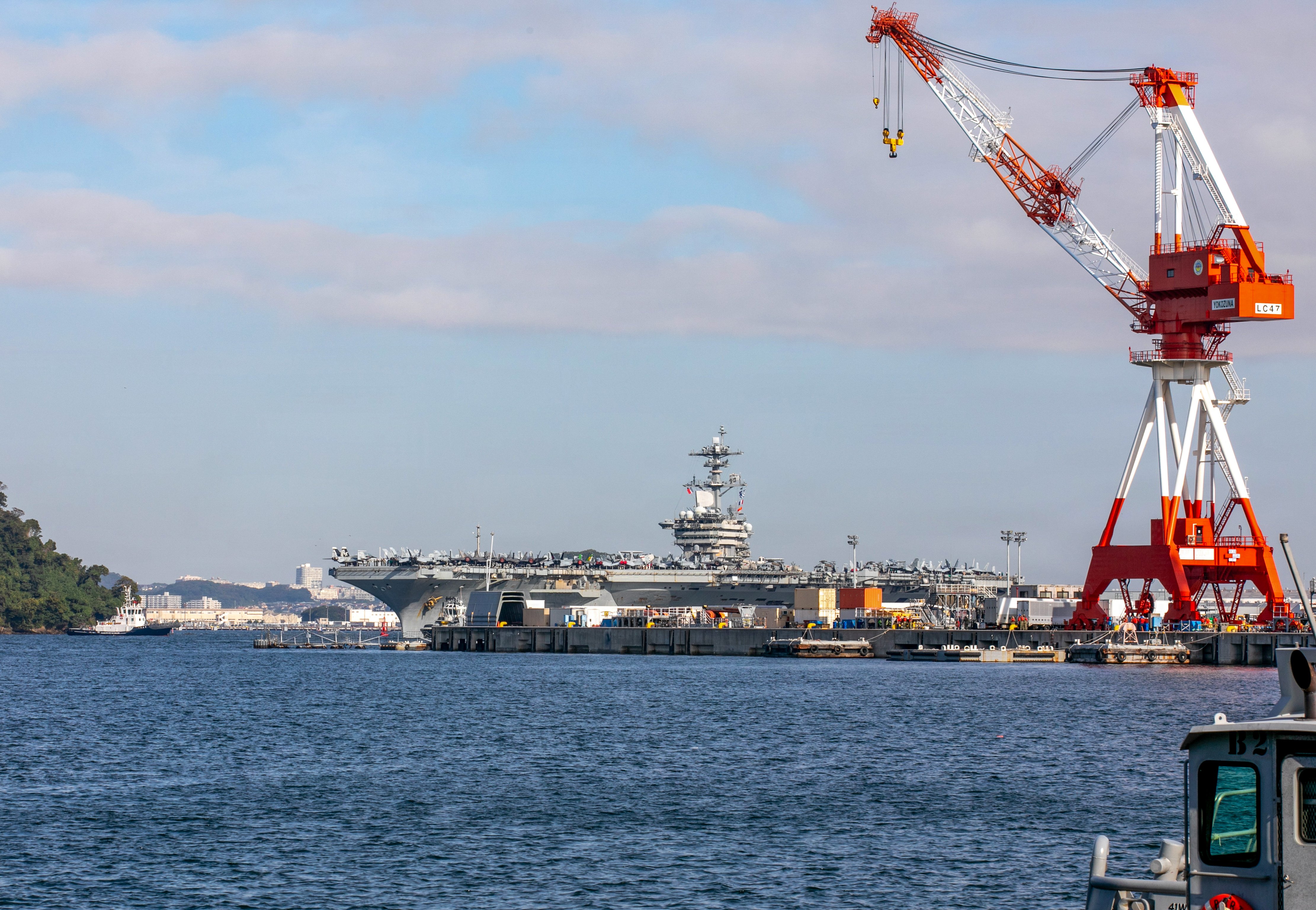
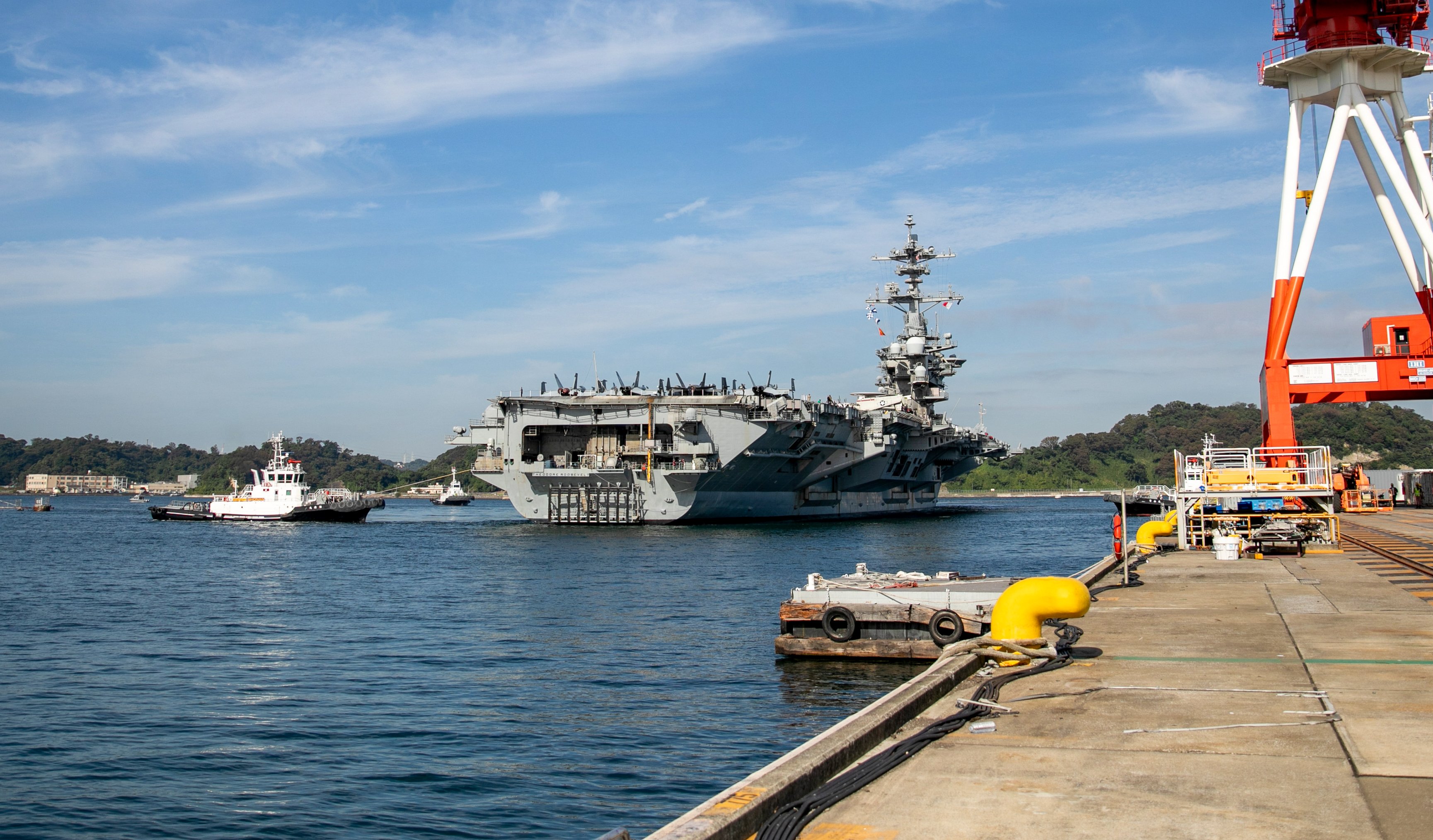
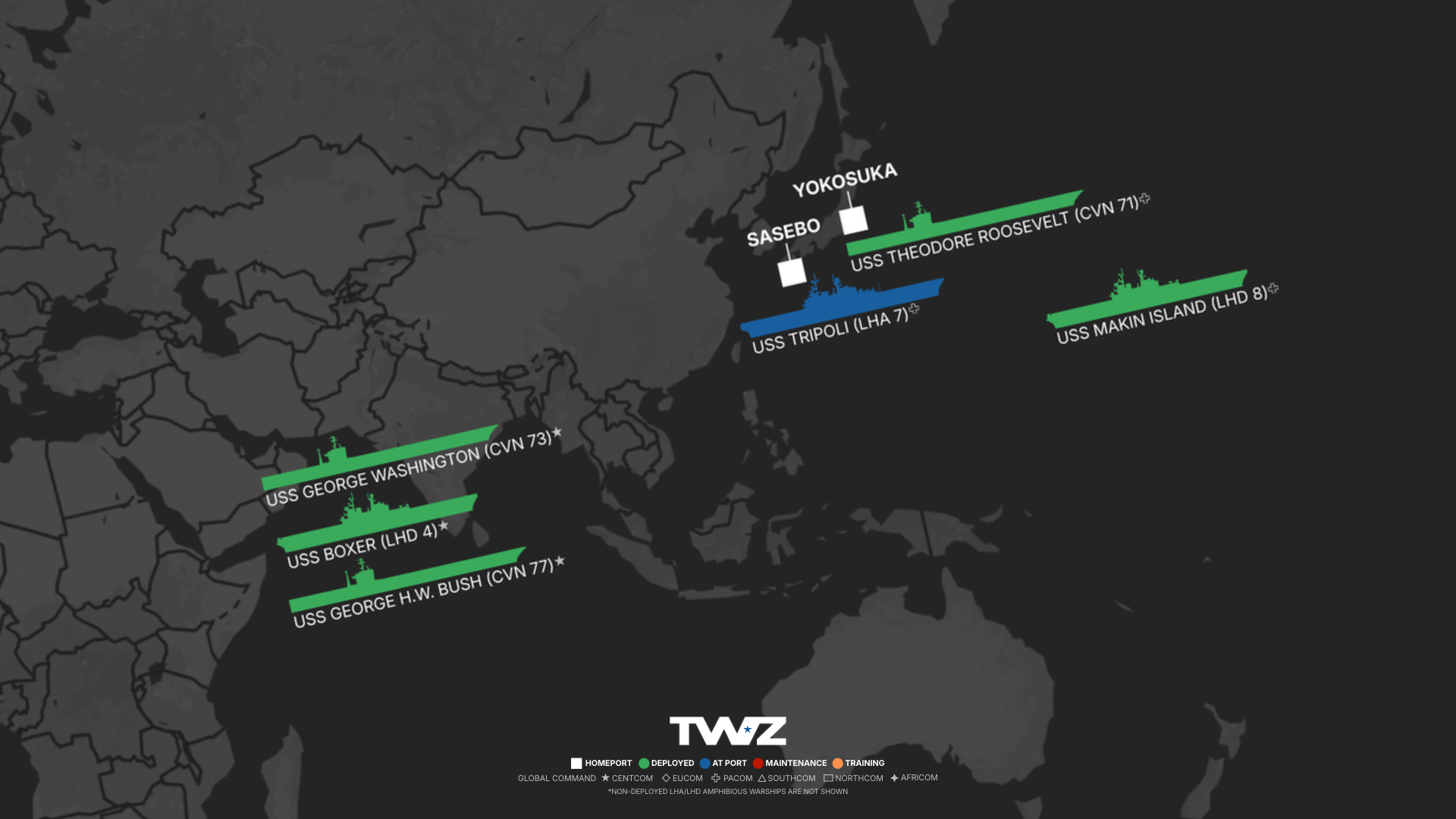
With a flight deck packed with carrier-based aircraft, including stealthy fifth-generation F-35Cs, the USS Theodore Roosevelt pulled into Yokosuka, Japan, on Friday. Roosevelt is the first non-resident U.S. carrier to visit the key naval port, strategically located on the east side of Japan, in more than four years. Yokosuka is home to the USS George Washington and America’s only forward-based Carrier Strike Group (CSG).

The Roosevelt, which serves as the flagship of CSG 9, escorted by guided-missile cruiser USS Chosin and destroyer USS Decatur, completed the journey from San Diego in 19 days − maneuvering around a typhoon in the Western Pacific − and will participate in the upcoming combined exercise Keen Sword 27. Meanwhile, the USS George H.W. Bush departed Thailand after a five-day port call and returned to the Middle East, and the USS Abraham Lincoln arrived home after a nearly eleven-month combat deployment.

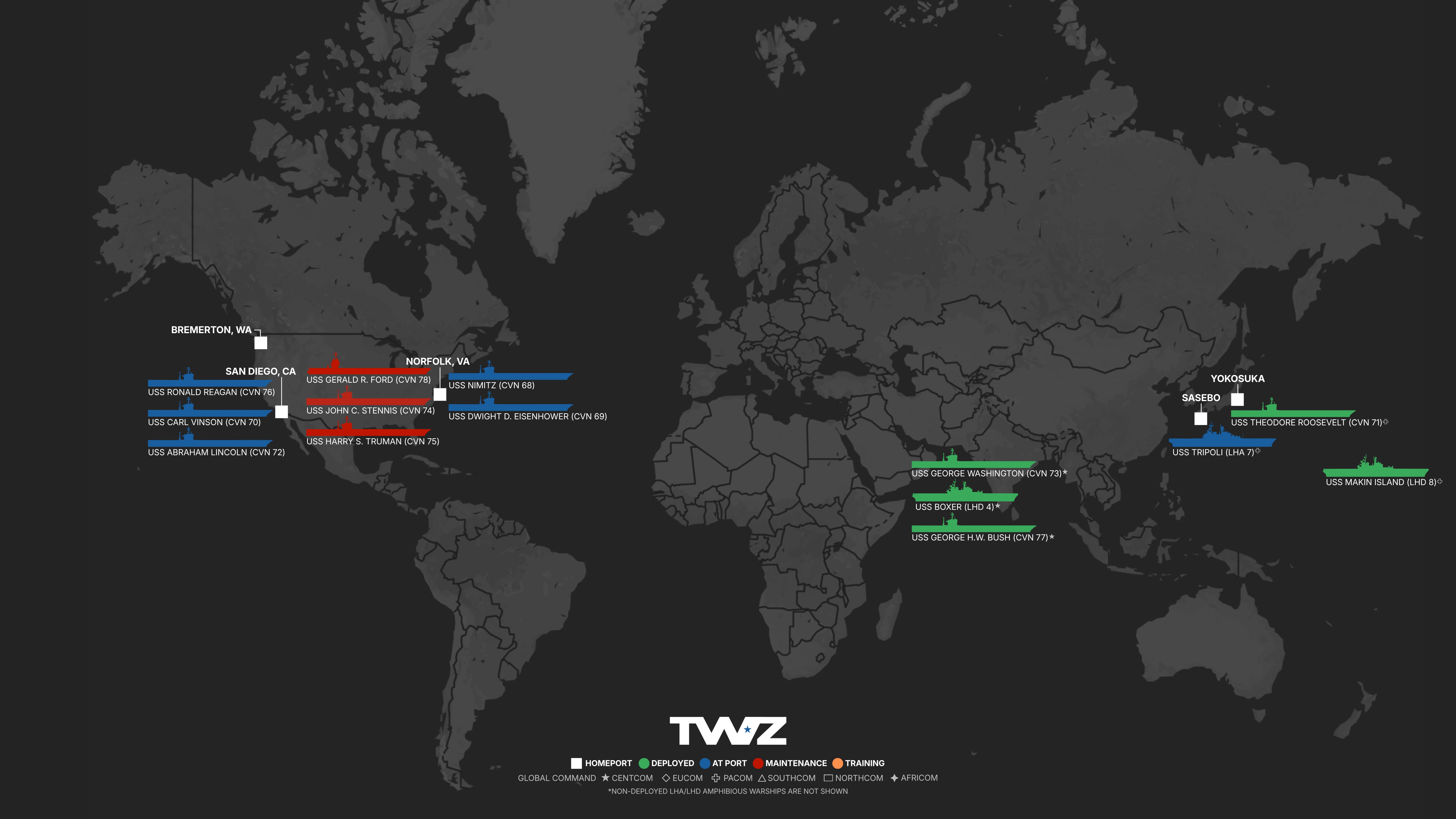
Here’s TWZ’s weekly carrier tracker monitoring America’s flattop fleet, including deployed CSGs and Amphibious Ready Groups (ARGs), using publicly available open-source information. Check out last week’s report here.

Detailed graphic showing the current position of America's fleet of eleven aircraft carriers around the world, created by TWZ and Ian Ellis-Jones.
TWZ/IAN ELLIS-JONES

Theodore Roosevelt Docks In Yokosuka, Japan; First Visiting Carrier In Four Years

Roosevelt and Chosin chopped into the U.S. 7th Fleet-Pacific Command (PACOM) area of responsibility (AOR) and arrived at Commander, Fleet Activities Yokosuka on the morning of October 16. The CSG will spend a few days in port before beginning participation in exercise Keen Sword, a “premier joint-bilateral field training exercise designed to increase readiness and interoperability between the Japan Self-Defense Forces and U.S. military forces,” according to the 7th Fleet press release. The brief visit allows the crew to complete maintenance, resupply, and disembark for liberty before resuming routine operations.

“Our crew is honored to visit Yokosuka and experience the rich culture and hospitality of Japan,” the commanding officer of Roosevelt, Capt. Will Mathis, said in the release. “Port visits like this are vital for crew morale and mission readiness, allowing our Sailors to rest, recharge, and prepare to operate seamlessly alongside our allies during exercise Keen Sword.”

Nimitz-class aircraft carrier USS Theodore Roosevelt (CVN 71) pulls into Commander, Fleet Activities Yokosuka, Japan Oct. 16, 2026. U.S. 7th Fleet, the Navy’s largest forward-deployed numbered fleet, routinely interacts and operates with allies and partners in preserving a free and open Indo-Pacific. (U.S. Navy photo by Mass Communication Specialist 1st Class Hannah Fry)
Roosevelt arrives in Yokosuka, Japan. U.S. Navy photo
Nimitz-class aircraft carrier USS Theodore Roosevelt (CVN 71), flagship of Carrier Strike Group (CSG) 9, and Ticonderoga-class guided-missile cruiser USS Chosin (CG 65) arrived at Commander, Fleet Activities Yokosuka, Oct. 16, 2026, ahead of exercise Keen Sword. (U.S. Navy photo by Mass Communication Specialist 1st Class Hannah Fry)
Roosevelt moors at Commander, Fleet Activities Yokosuka. U.S. Navy photo

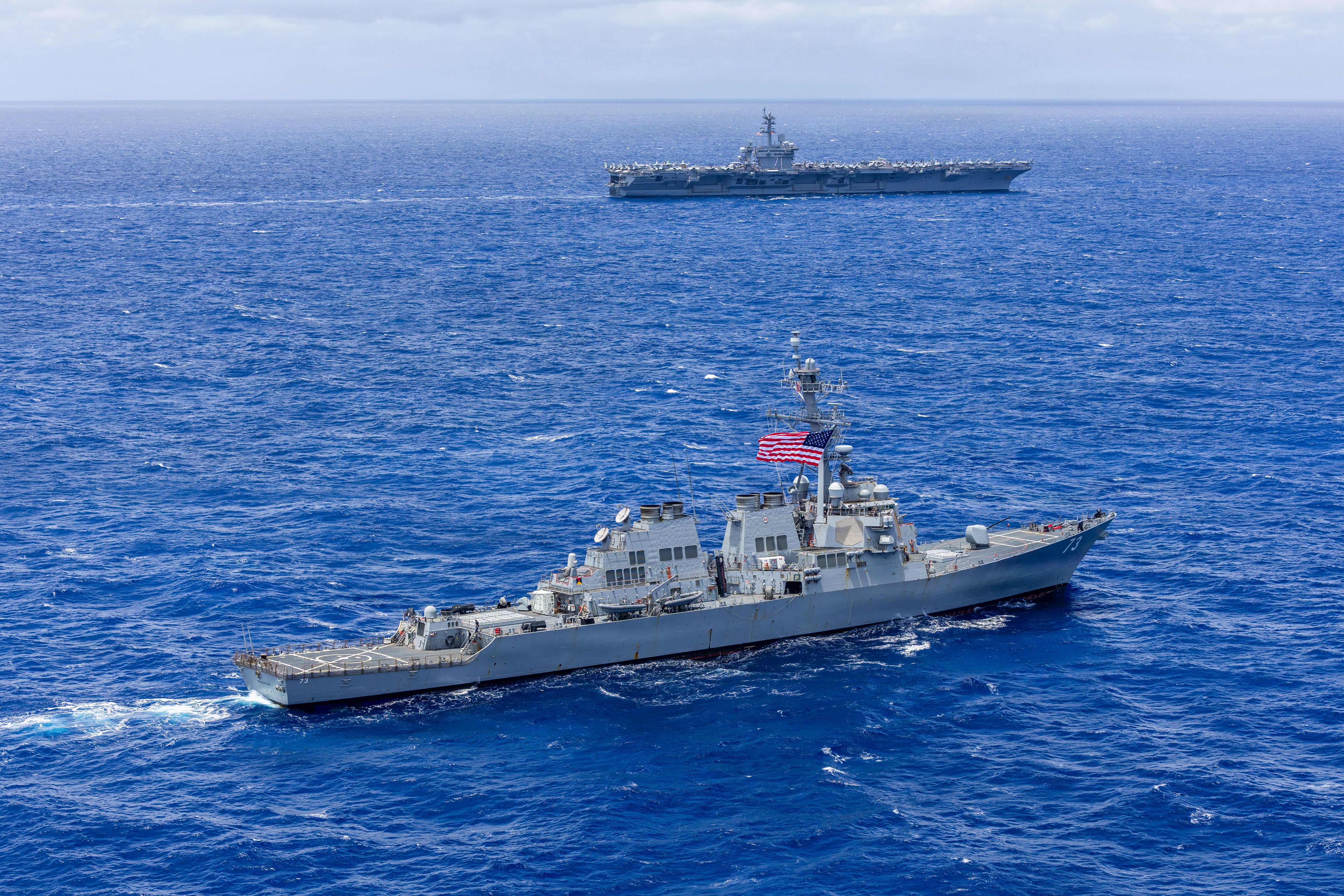
The five-ship CSG, the composition of which a Navy official confirmed to TWZ, is currently operating on a disaggregated basis − a common practice employed by strike groups with multiple ongoing missions. The duo that departed the U.S. at the end of September linked up with another element of the group, Pearl Harbor-based guided missile destroyer USS Decatur, as they were steaming westbound past the Hawaiian Islands, based on public Automatic Identification System (AIS) data. Decatur arrived in Yokosuka the day after Roosevelt but was not mentioned in the press release.

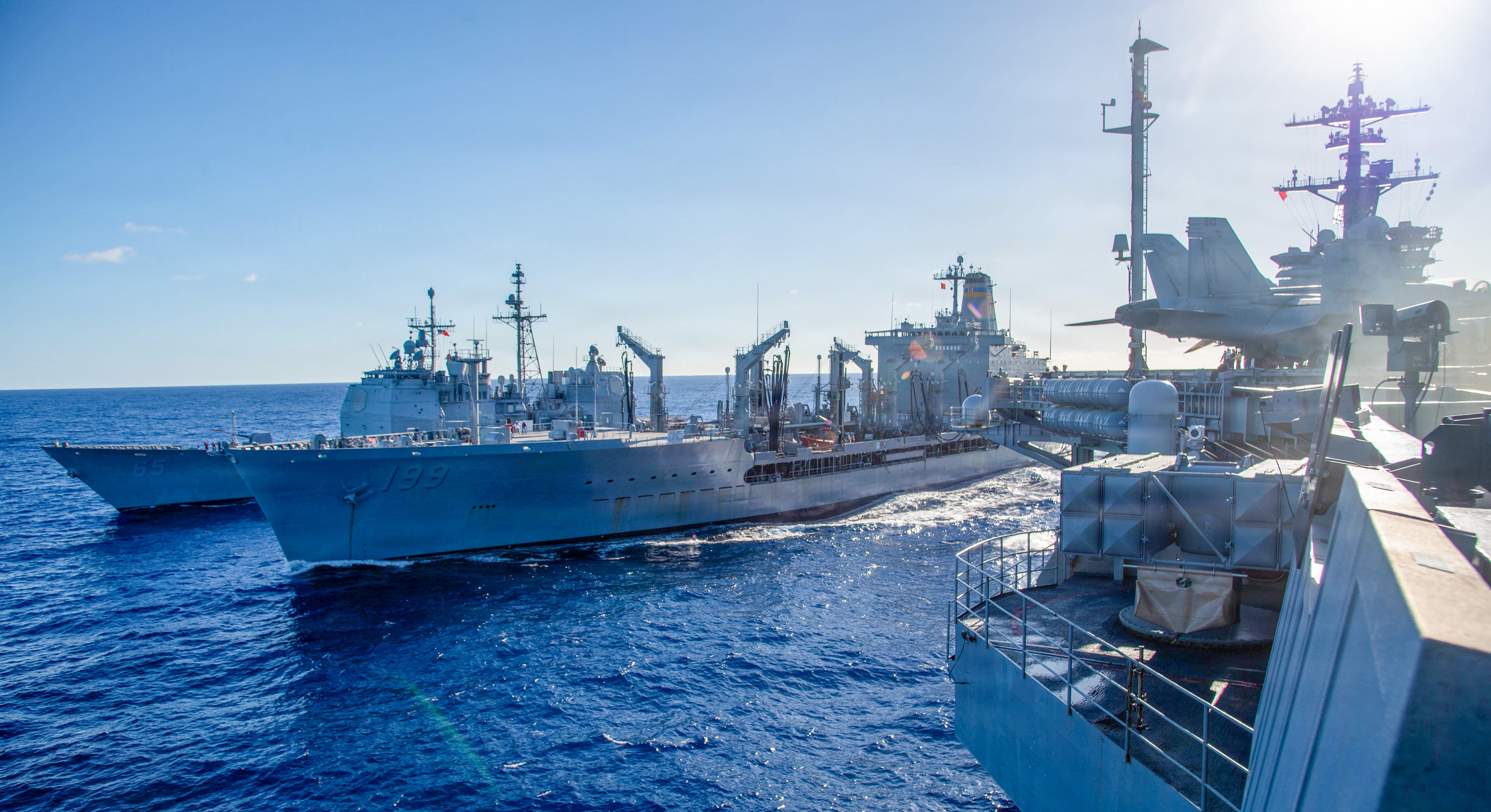
USS Carl M. Levin, also stationed in Hawaii, was the first ship from the group to deploy, according to DVIDS, the military’s content-sharing platform. Levin departed on September 9 and is operating at an undisclosed location. USS Paul Hamilton, the final ship assigned to CSG 9 to deploy, left San Diego on October 10 after onloading ammo at Bravo Pier and moored at Joint Base Pearl Harbor-Hickam on October 15, AIS data shows. Henry J. Kaiser class fleet replenishment oiler USNS Tippecanoe supported the group’s transit across the Pacific, conducting multiple replenishments-at-sea (RAS), and recently entered the East Sea/Sea of Japan via the Tsugaru Strait before going dark on AIS.

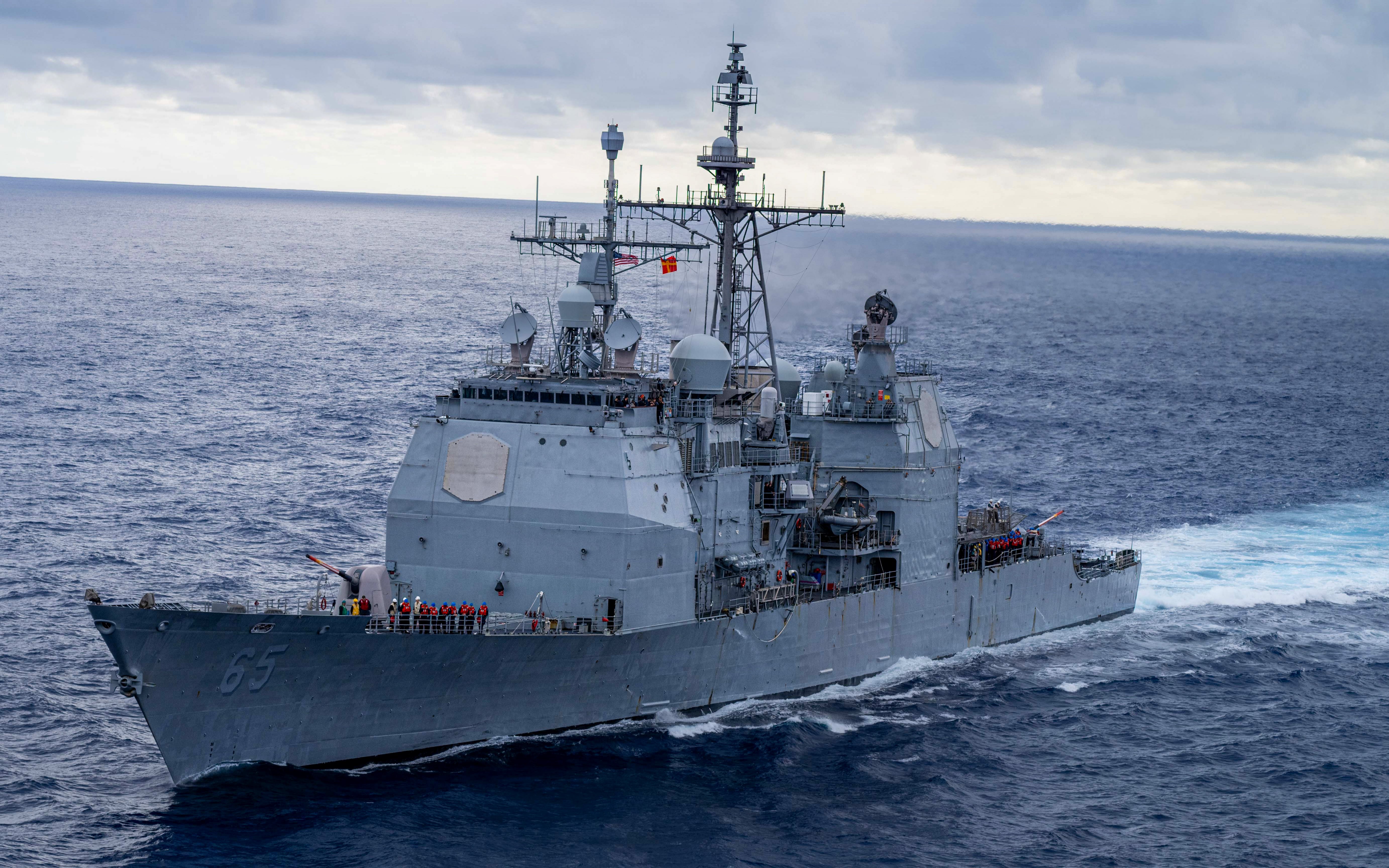
Ticonderoga-class guided-missile cruiser USS Chosin (CG 65), pulls alongside Nimitz-class aircraft carrier USS Theodore Roosevelt (CVN 71), during a replenishment-at-sea Oct. 10, 2026. Theodore Roosevelt, flagship of Carrier Strike Group (CSG) 9, is underway conducting routine operations in the U.S. 7th Fleet area of operations, demonstrating the U.S. Navy's commitment to a free and open Indo-Pacific. (U.S. Navy Photo by Mass Communication Specialist 3rd Class Cesar Nungaray)
Chosin alongside Roosevelt. Navy photo
Arleigh Burke-class guided-missile destroyer USS Decatur (DDG 73) sails in formation during Exercise Rim of the Pacific 2026 in the Pacific Ocean off the coast of Hawaii on July 22, 2026. Thirty nations, 30 ships, five submarines, 15 national land forces, more than 190 aircraft and more than 30,000 personnel are participating in RIMPAC in and around the Hawaiian Islands, June 24 to July 31. The world's largest international maritime exercise, RIMPAC provides a unique training opportunity while fostering and sustaining cooperative relationships among participants critical to ensuring the safety of sea lanes and security on the world's oceans. RIMPAC 2026 is the 30th exercise in the series that began in 1971. (U.S. Navy photo by Mass Communication Specialist First Class Ryan A. LeCompte)
Decatur and Roosevelt at RIMPAC. Navy photo
Ticonderoga-class guided-missile cruiser USS Chosin (CG 65), left, pulls alongside Henry J. Kaiser-class fleet replenishment oiler USNS Tippecanoe (T-AO 199), middle, and Nimitz-class aircraft carrier USS Theodore Roosevelt (CVN 71), during a replenishment-at-sea Oct. 6, 2026. Theodore Roosevelt, flagship of Carrier Strike Group (CSG) 9, is underway conducting routine operations in the U.S. 3rd Fleet area of operations, demonstrating the U.S. Navy’s commitment to a free and open Indo-Pacific. (U.S. Navy Photo by Mass Communication Specialist Seaman Gary Buckles)
Tippecanoe conducts a RAS. Navy photo

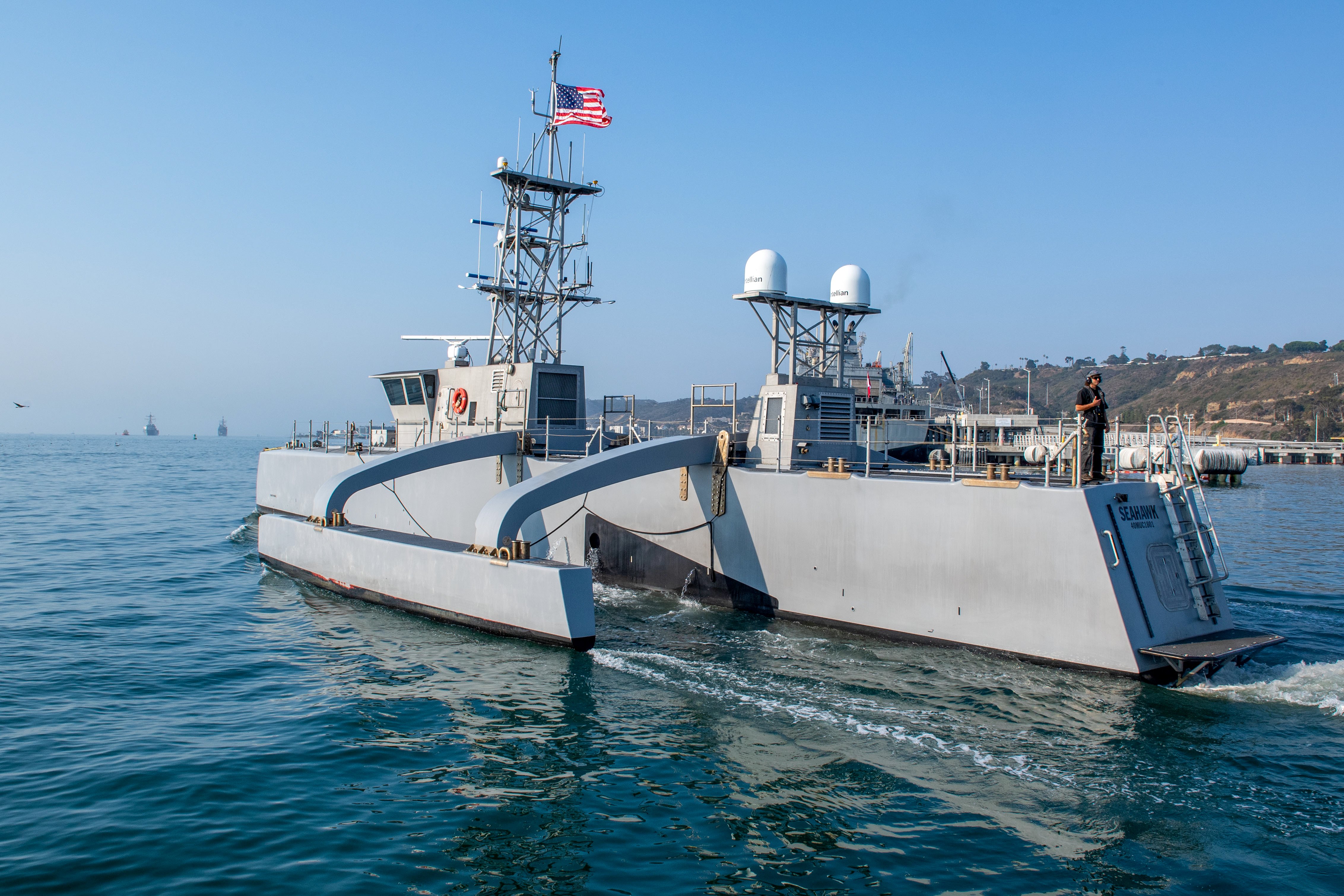
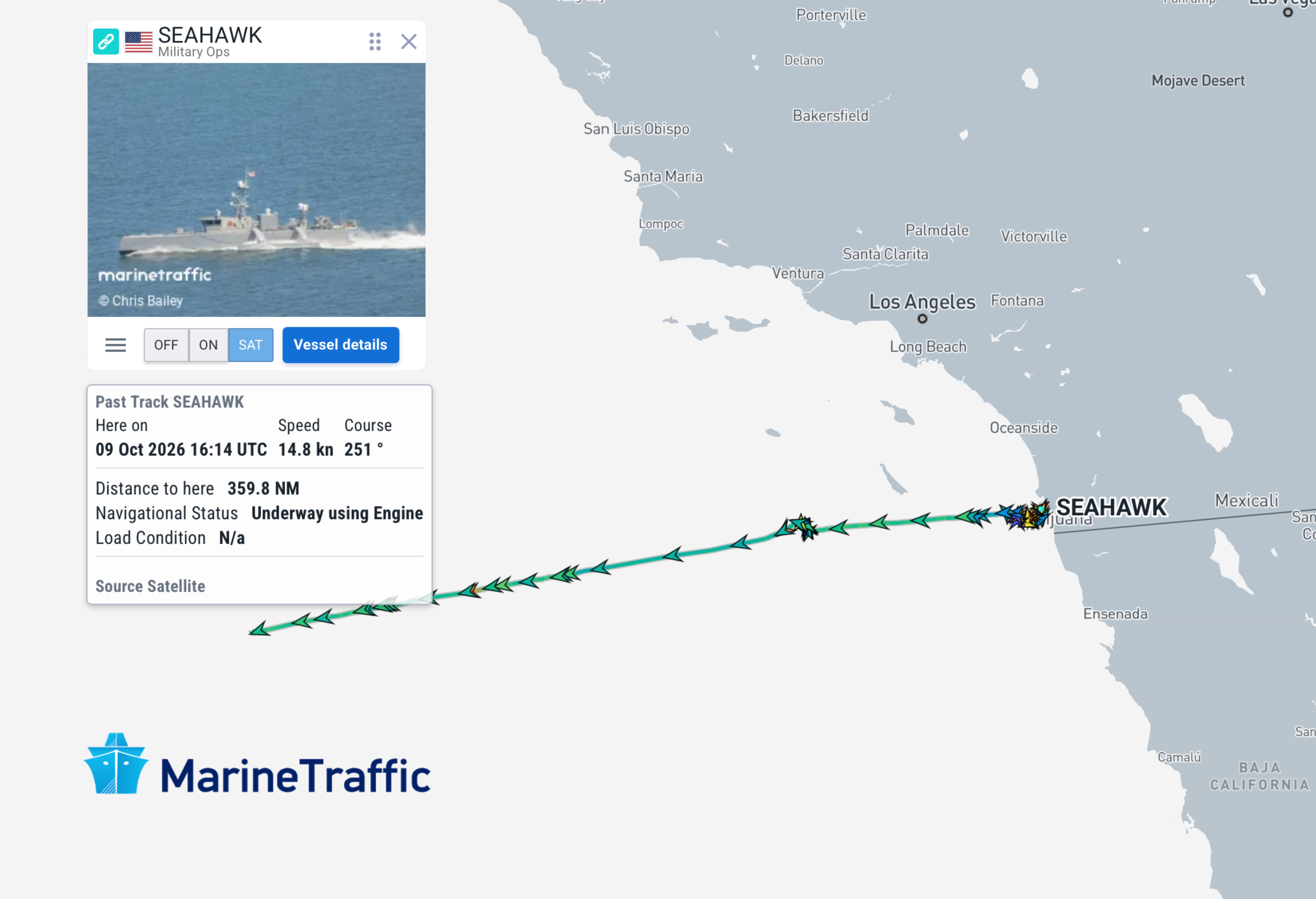
Multiple reports indicated that medium unmanned surface vessel (MUSV) Seahawk (2) deployed with the group, which would represent a significant operational achievement and the first time a drone boat was assigned to a CSG, but the MUSV quietly slipped out of Point Loma on October 8, more than ten days after Roosevelt. Seahawk reappeared on AIS and docked in Hawaii for a couple days before continuing its journey westbound in the Pacific on October 16. If Seahawk is assigned to CSG 9, it is currently disaggregated, and whether it will join Roosevelt to participate in exercise Keen Sword 27 is unknown.

Acting Secretary of the Navy Hung Cao seemingly confirmed the deployment, saying during a panel at the Association of the United States Army (AUSA) convention that “the Teddy Roosevelt carrier strike group just deployed on October 8 with a medium sized unmanned surface vessel. This is the first carrier strike group to ever deploy with a large size unmanned surface vessel.” However, Roosevelt was more than halfway to Japan on the date referenced. “This is a force multiplier, imagine having more guns out there,” he added.

Seahawk, a Medium Unmanned Surface Vessel (MUSV) prototype, departs Naval Base Point Loma, California, Aug. 6. Seahawk is a fully unmanned and autonomous vessel operated by Unmanned Surface Vessel Squadron (USVRON) 1 and Naval Information Warfare Center Pacific in support of technology development, testing and evaluation. The surface force is integrating unmanned vessels into the fleet. (U.S. Navy photo by Mass Communication Specialist 1st Class Robert Zahn)
MUSV Seahawk leaving Point Loma in August. U.S. Navy photo
Graphic created by Ian Ellis-Jones and TWZ showing MUSV Seahawk's transit leaving San Diego on October 8. Reprinted with permission from MarineTraffic and KPLER.
Seahawk’s transit out of San Diego. Source: MarineTraffic/KPLER

TWZ reached out to the Secretary’s office for clarification and to confirm the deployment but did not receive a response. “Seahawk’s operations represent continued progress in the Navy’s efforts to integrate unmanned systems into Fleet operations. As with any emerging capability, we continue to learn, adapt, and refine how these systems are employed,” a Navy official told us.

Abraham Lincoln’s Homecoming

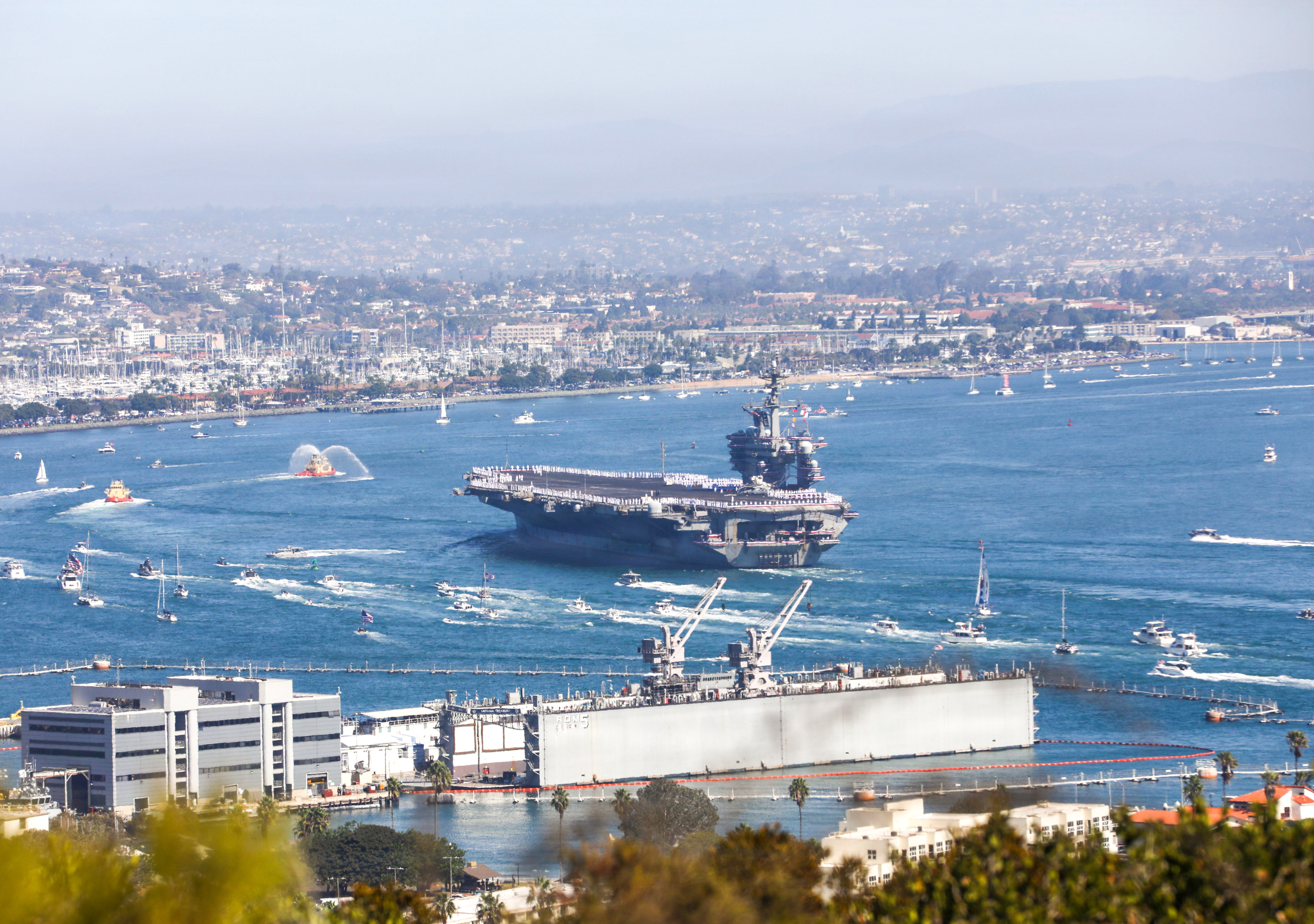
Surrounded by small boats, with hundreds of spectators lining the channel in San Diego Bay and thousands more watching online, the USS Abraham Lincoln arrived home from a historic ten-and-a-half-month combat deployment. The flagship of CSG 3 and her crew of more than 5,000 Sailors and Marines served as the tip of the spear in the war against the Iranian regime, first during Operation Epic Fury and then the subsequent blockades, and set a new record for the most consecutive days at sea without a port call.

Nimitz-class aircraft carrier USS Abraham Lincoln (CVN 72), the flagship of Carrier Strike Group (CSG) 3, returns to its home port of San Diego, Oct. 10, 2026, following a 10-month deployment to U.S. 5th and 7th Fleet areas of operations. An integral part of the U.S. Pacific Fleet, U.S. 3rd Fleet leads naval forces in the region and provides realistic, relevant training necessary to execute our Navy’s role across the full spectrum of military operations – from combat operations to humanitarian assistance and disaster response. U.S. 3rd Fleet works together with allies and partners to advance freedom of navigation and overflight, the rule of law, and other principles that underpin security for the region. (U.S. Navy photo by Mass Communication Specialist 3rd Class Aaron J. Rolle)
USS Abraham Lincoln pulls into San Diego Bay. U.S. Navy photo

Lincoln pulled into Naval Air Station North Island and moored at Berth Lima on October 8, 321 days after casting off on November 21, 2025. Sailors in dress whites manned the rails as the carrier transited the bay, escorted on both sides by small boats and jet skis flying American flags, while family and friends eagerly waited pierside for their return. The video below, shared by the Pentagon, captures the moment.

Family and friends welcome the crew of the USS Abraham Lincoln home. Pentagon video.

Lincoln now lays claim to the second-longest deployment in the modern carrier era, falling just five days short of the 326-day post-Vietnam record held by the USS Gerald R. Ford. The flattop traveled over 93,000 nautical miles during the cruise − more than four trips around the Earth, a post by the public affairs officer highlighted − and conducted 72 replenishments-at-sea, received 20-plus million gallons of aviation fuel, and flew more than 14,000 sorties that totaled 28,500 flight hours, a press release from the Navy highlighted.

The release confirmed for the first time that Lincoln broke the previous record of 206 days set by USS Dwight D. Eisenhower during the COVID pandemic for days spent underway between port visits, as TWZ first reported. “The ship’s 208 uninterrupted days at sea between Guam and Oman, and its 286 consecutive days at sea between departing San Diego and arriving in Thailand, are record-breaking marks for modern aircraft carriers.”

Lincoln’s cruise took her through both U.S. 7th Fleet and U.S. 5th Fleet AORs. During Operation Epic Fury, which began on February 28 and lasted almost 40 days, Lincoln took up station in the northern Arabian Sea as Commander, Task Force (CTF) 50 and pressured Iran’s southern flank. When major combat operations wound down, the carrier and her air wing patrolled and enforced the blockade line during both rounds that followed.

Carrier Air Wing (CVW) 9, the “Navy’s premier next-generation air wing that served as the primary offensive power” for CSG 3, flew 14,037 sorties − including 4,000 combat missions − and dropped more than 1.37 million pounds of ordnance on thousands of targets while employing 1,499 precision weapons. “This concentrated firepower significantly degraded Iranian Navy capabilities,” a separate statement noted.

“The rapid mobilization and combat execution of CVW-9 during Operation Epic Fury demonstrated the unmatched flexibility of a U.S. Navy carrier strike group,” Capt. J.W. Stigi, commander of CVW-9, said in the statement. “Pairing fifth-generation F-35C stealth and sensor fusion with fourth-generation workhorse strike and electronic attack platforms, Team Shogun destroyed Iran’s conventional Navy and secured vital maritime chokepoints in support of our commander’s objectives.”

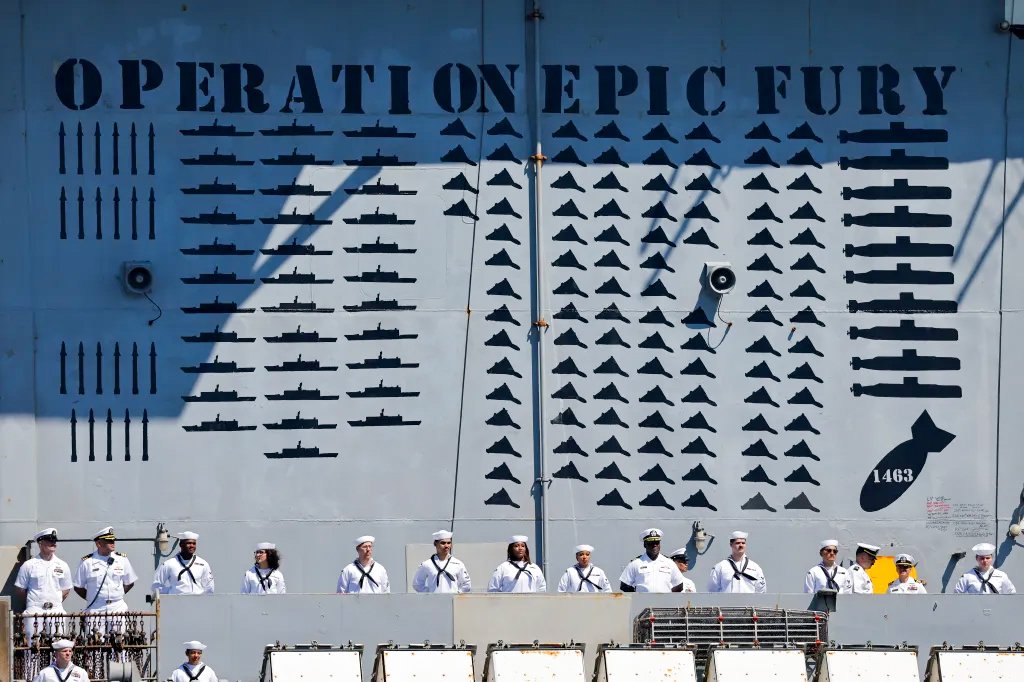
Kill marks painted on the island superstructure show CSG 3 destroyed 106 one-way attack drones fired by the Islamic Revolutionary Guard Corps (IRGC), 34 Iranian Navy and IRGC ships, 23 inbound cruise missiles, and 10 enemy submarines. The strike group dropped 1,463 air-to-ground munitions in total, a Sailor explaining the marks said in a video on social media.

George H.W. Bush Leaves Thailand And Returns To The Middle East

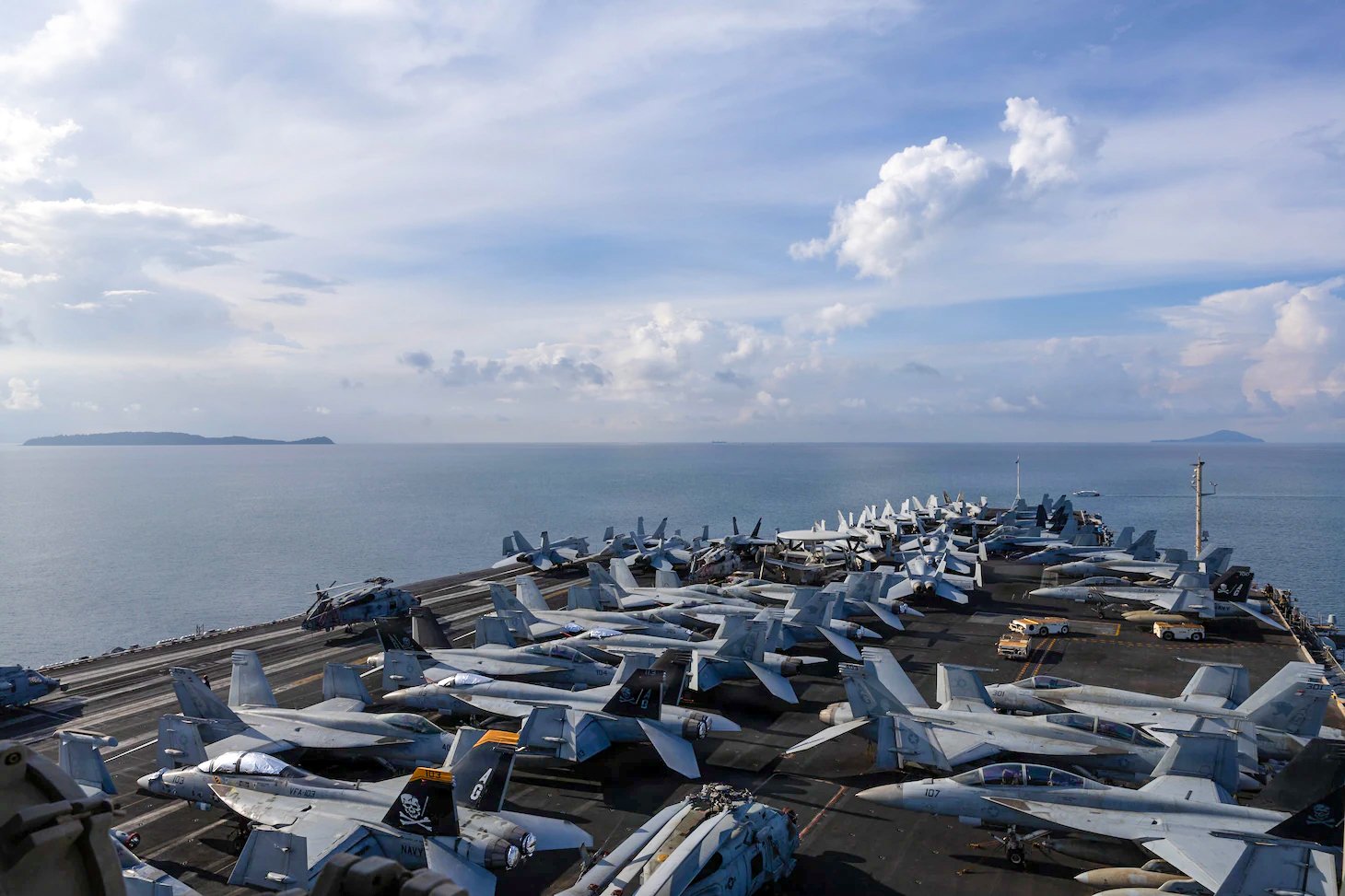
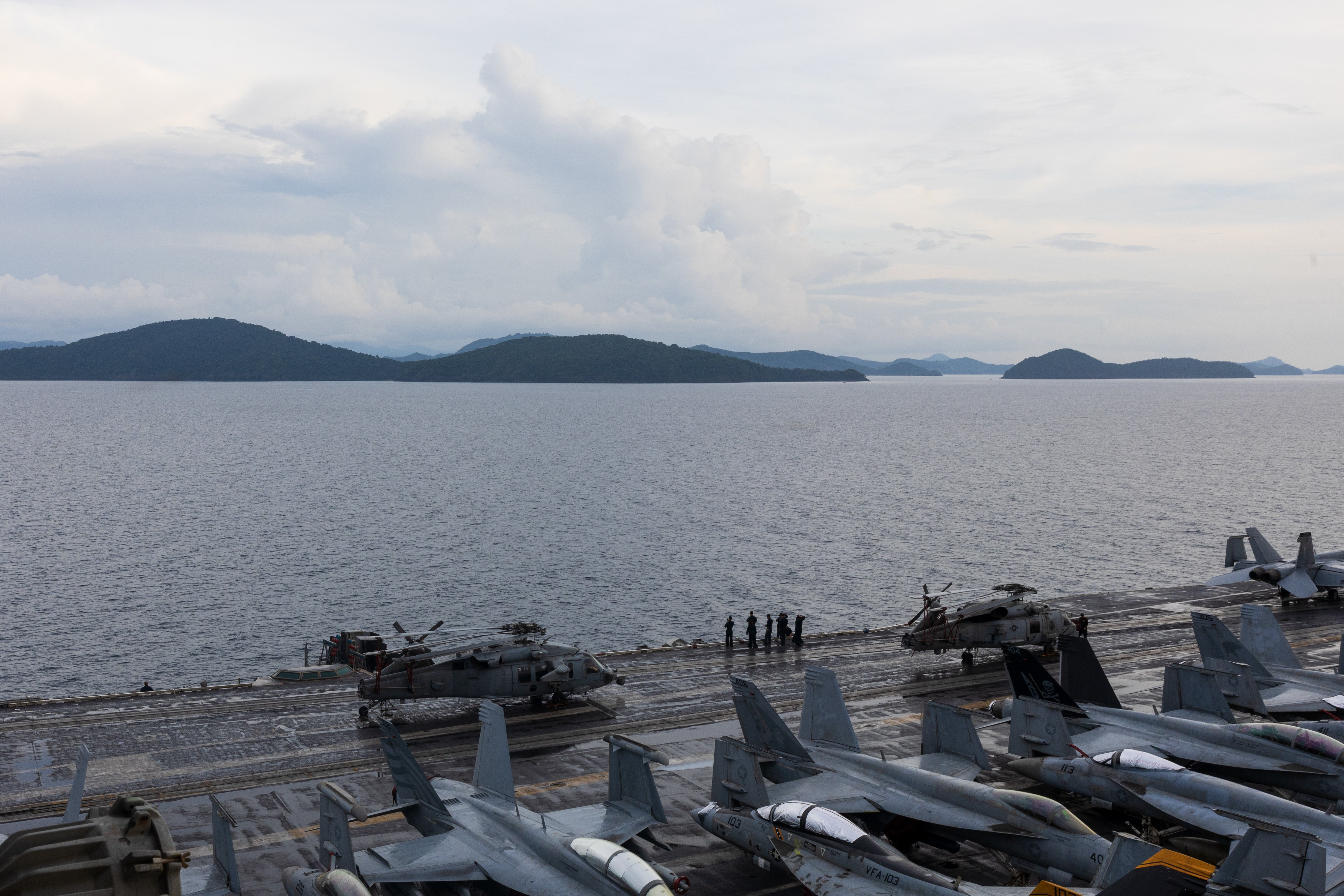
The USS George H.W. Bush and her destroyer escort, USS Delbert D. Black, departed Phuket, Thailand, on October 9 after a five-day liberty visit. “Nearly 5,000 Sailors from across the strike group experienced the sights and sounds Thailand has to offer, deepening their understanding of the Thai people and strengthening interpersonal bonds,” according to a press release.

Nimitz-class aircraft carrier George H.W. Bush (CVN 77) departs Phuket, Thailand, Oct. 9, 2026. George H.W. Bush is conducting routine operations in the U.S. 7th Fleet area of operations. U.S. 7th Fleet, the Navy’s largest forward-deployed numbered fleet, routinely interacts and operates with allies and partners in preserving a free and open Indo-Pacific. (U.S. Navy photo)
George H.W. Bush departs Phuket, Thailand, on October 9, 2026. U.S. Navy photo

“The Sailors and I had an amazing time in this beautiful country, and I sincerely thank the people of Thailand for their incredible welcome,” Capt. Justin T. Issler, the commanding officer of George H.W. Bush, said about the stop. “This port visit to Phuket was a tremendous opportunity for the crew. We are grateful to our Thai allies for hosting us, and we look forward to continuing our mission here in 7th Fleet, alongside Thailand and our other regional allies and partners.”

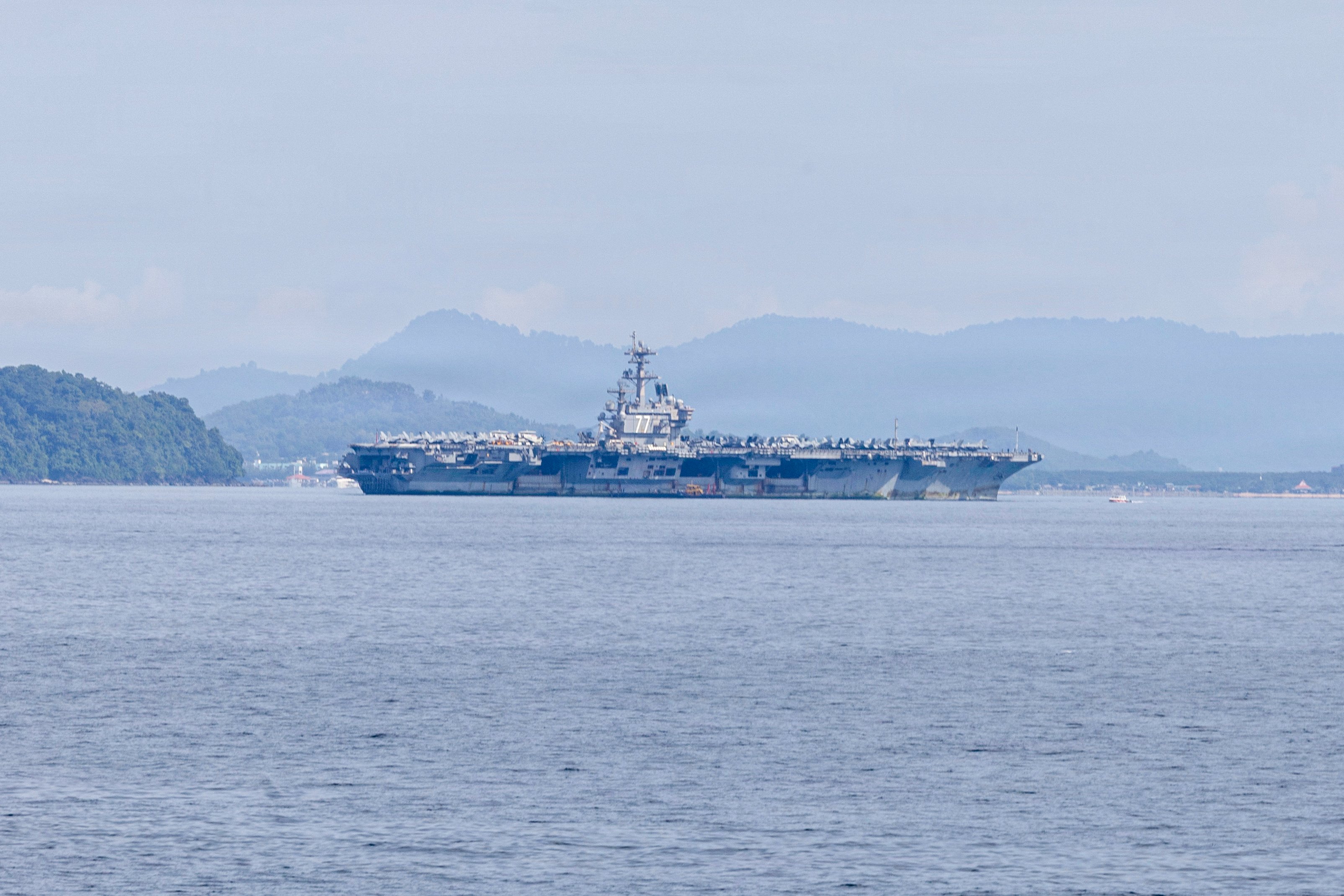
Nimitz-class aircraft carrier USS George H.W. Bush (CVN 77), arrives in Phuket, Thailand, Oct. 4, 2026. George H.W. Bush is conducting routine operations in the U.S. 7th Fleet area of operations. U.S. 7th Fleet, the Navy’s largest forward-deployed numbered fleet, routinely interacts and operates with allies and partners in preserving a free and open Indo-Pacific. (U.S. Navy Photo)
USS George H.W. Bush arrives in Thailand. U.S. Navy photo
Nimitz-class aircraft carrier George H.W. Bush (CVN 77) arrives in Phuket, Thailand, Oct. 4, 2026. George H.W. Bush is conducting routine operations in the U.S. 7th Fleet area of operations. U.S. 7th Fleet, the Navy’s largest forward-deployed numbered fleet, routinely interacts and operates with allies and partners in preserving a free and open Indo-Pacific. (U.S. Navy photo)
USS George H.W. Bush anchors in Phuket. U.S. Navy photo

Bush dropped anchor approximately two nautical miles south of Ao Makham Deep Sea Port on October 4 after 187 consecutive days at sea. After leaving Phuket, the carrier stopped broadcasting AIS while steaming due south at 10 knots. Imagery on DVIDS confirms that the CSG returned to the Middle East and operating in the U.S. 5th Fleet AOR to “support maritime security and stability,” joining the George Washington CSG once again as the second strike group in the region.

Destroyer USS Mason, which deployed as the integrated air and missile defense (IAMD) commander for the CSG but has disaggregated at times, arrived in Singapore on October 5, likely for a port call. The Arleigh Burke class destroyer departed on October 9 and was last tracked heading northwestbound in the Malacca Strait, likely to rejoin the CSG. The other two destroyers assigned to the CSG, USS Ross and USS Donald Cook, remained in 5th Fleet during the visit.

F-35C Lightning II Operates from A Ford Class Carrier For The First Time

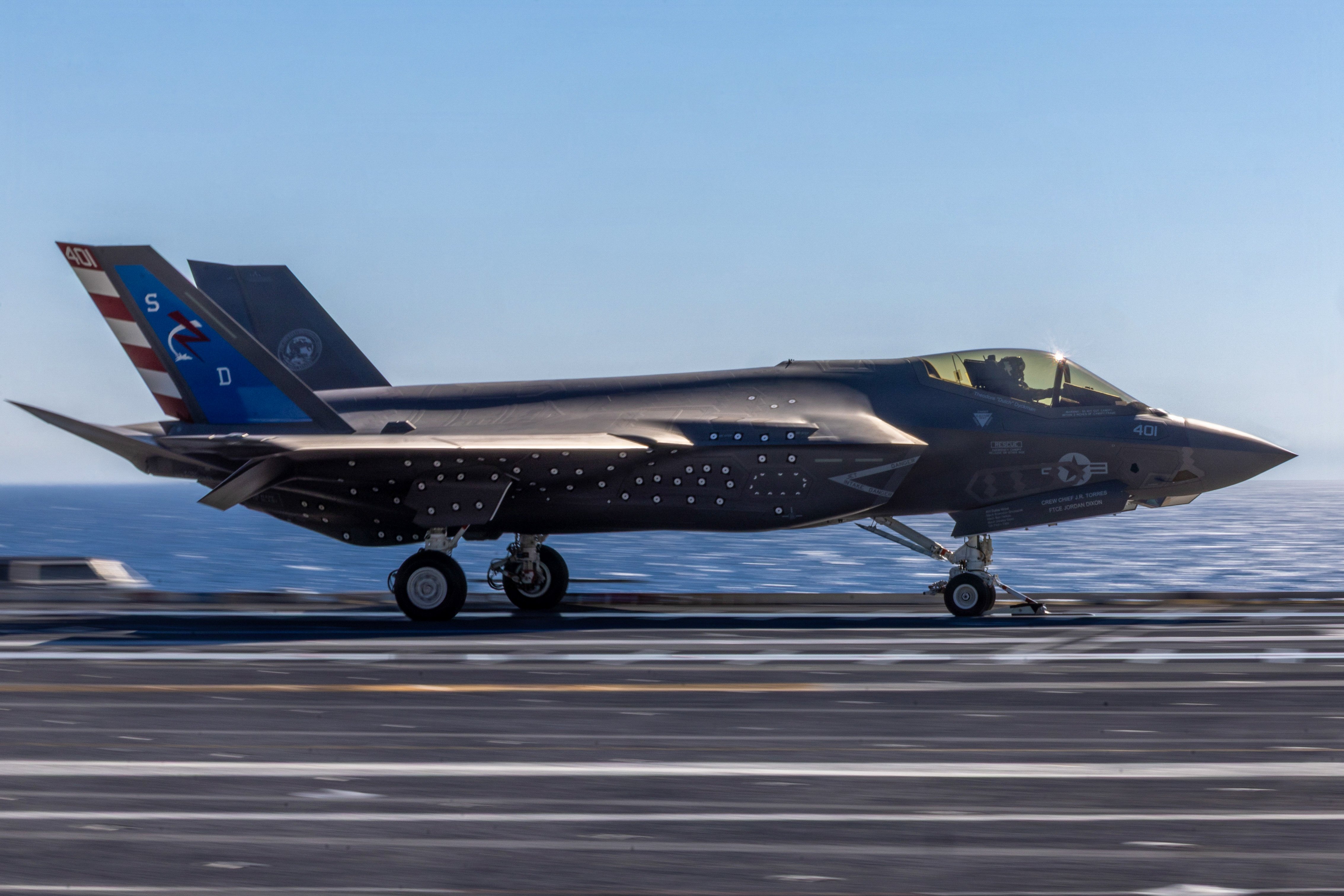
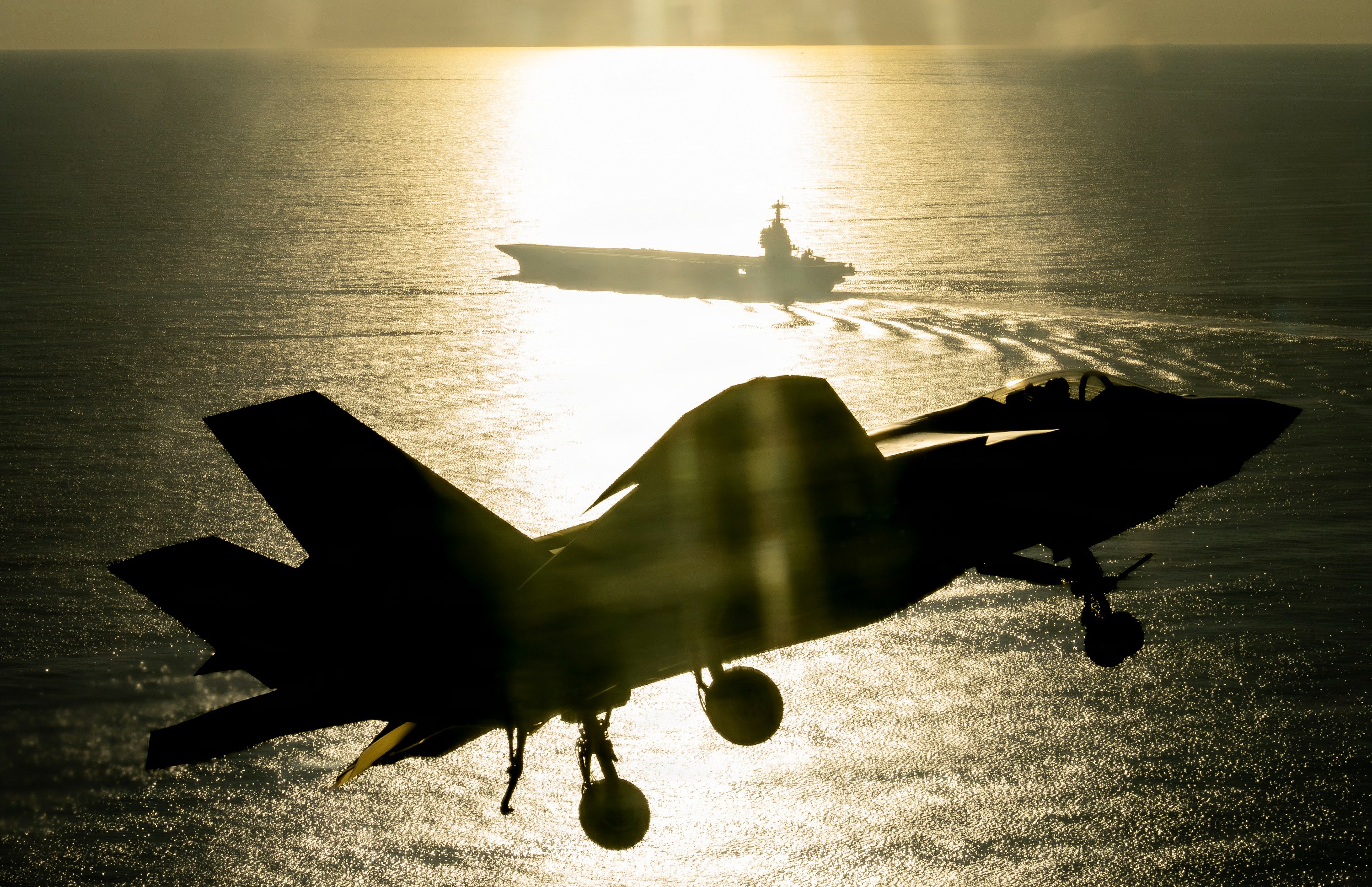
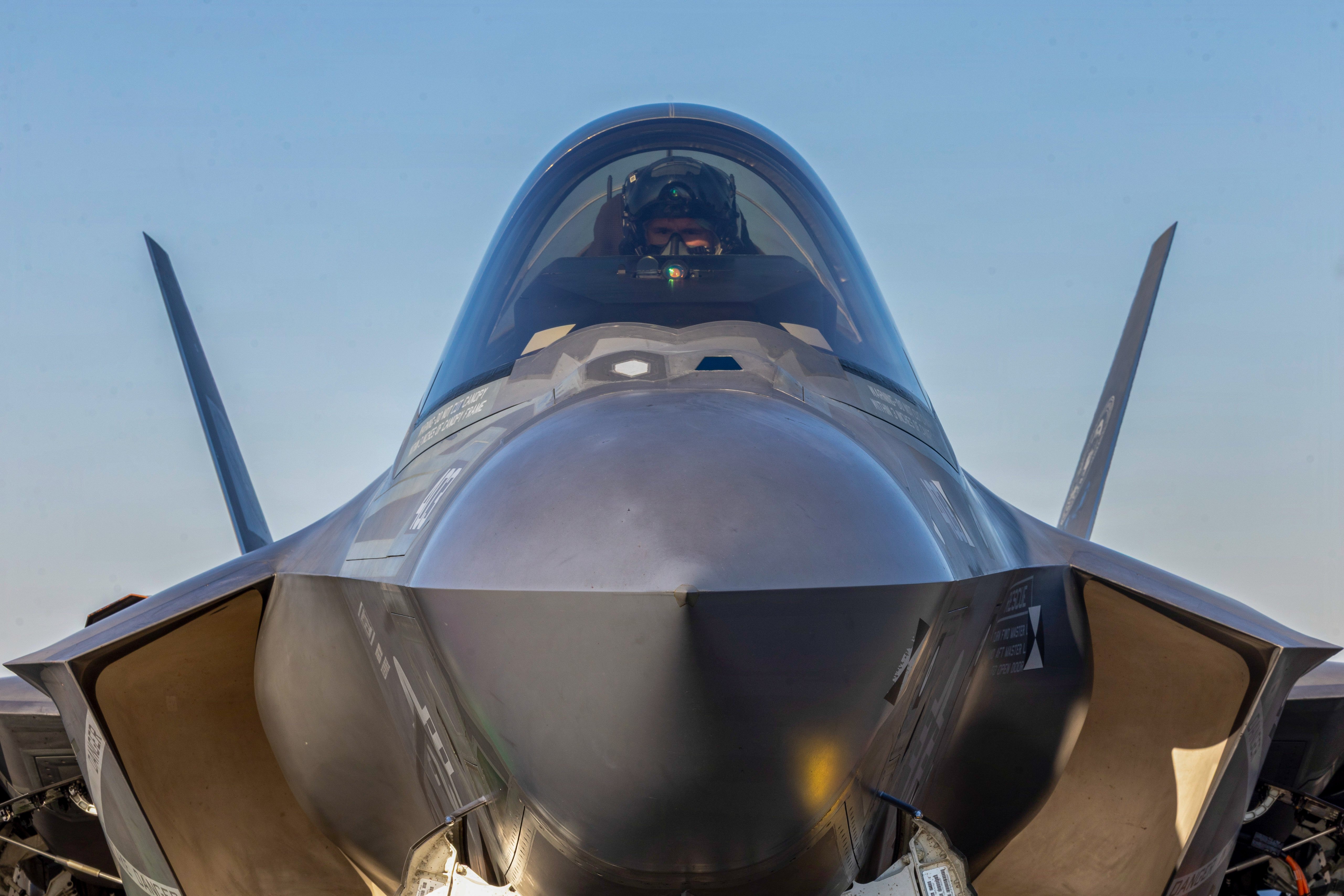
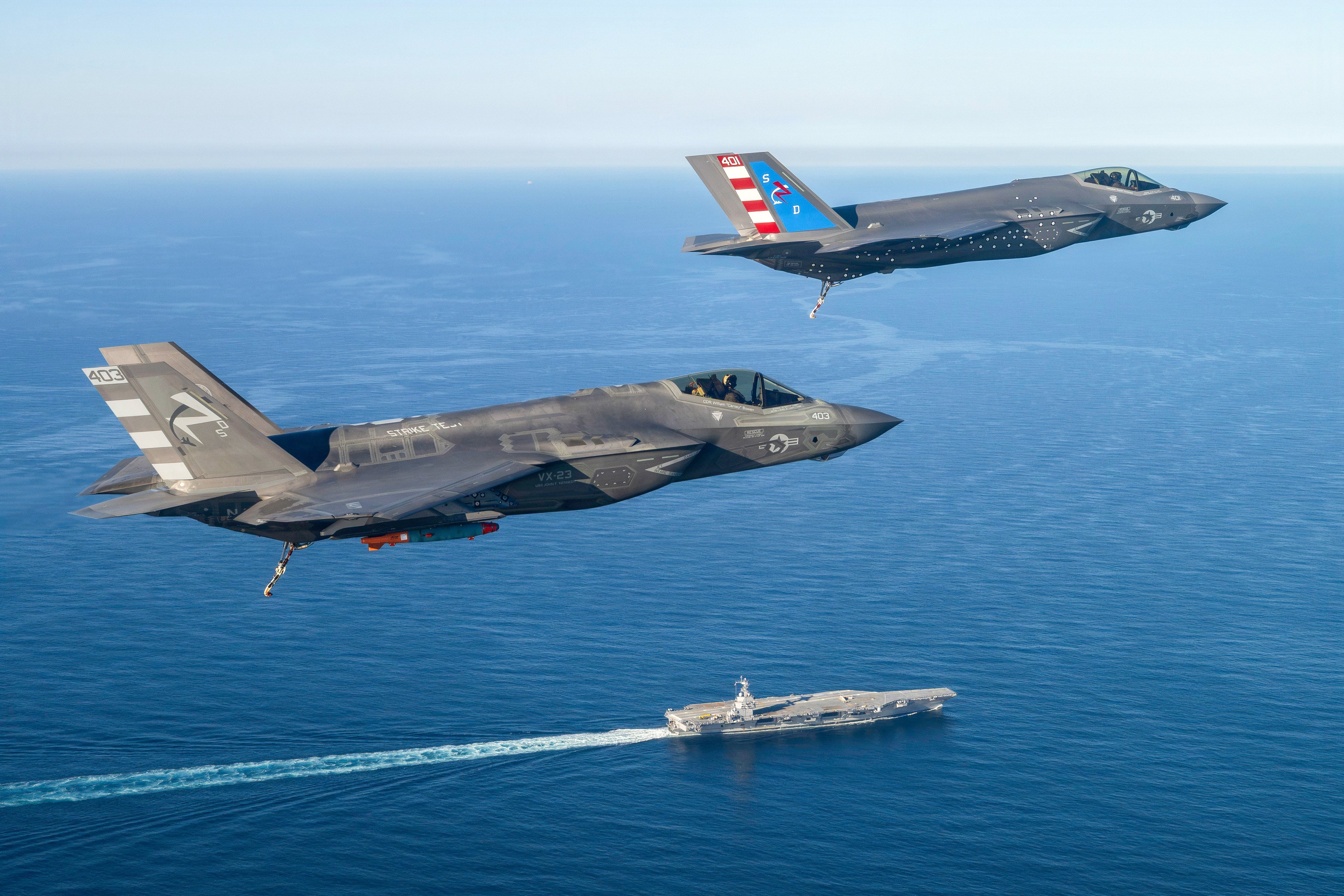
Marking a major milestone, an F-35C Lightning II Joint Strike Fighter made the first arrested landing aboard a Gerald R. Ford class carrier, the Navy’s newest and most advanced class of aircraft carriers that are being built to replace the aging Nimitz fleet. The trap was made by Lt. Cmdr. Robert Mason with the “Salty Dogs” of Air Test and Evaluation Squadron (VX) 23 aboard the future USS John F. Kennedy in the Western Atlantic on October 13. The first catapult launch followed the next day, pictures on DVIDS showed.

F-35Cs approach for first landing aboard PCU John F. Kennedy. U.S. Navy video

VX-23, based out of Naval Air Station Patuxent River in Maryland, is part of the Naval Air Warfare Center Aircraft Division and was putting Kennedy through the ongoing Aircraft Compatibility Testing to assess the “operational capabilities of the ship’s aircraft launch and recovery equipment.” A team from the Patuxent River-based F-35 Integrated Test Force, detached to the ship, conducted the evaluation using a specially instrumented example of the jet. One of the two pictured was externally equipped with an inert Joint Direct Attack Munition (JDAM) bomb.

An F-35C Lightning II, attached to the "Salty Dogs" of Air Test and Evaluation Squadron (VX) 23, launches from the flight deck of Pre-Commissioning Unit John F. Kennedy (CVN 79), Oct. 14, 2026, marking the first launch of an F-35C from a Ford-class aircraft carrier. John F. Kennedy is underway conducting Aircraft Compatibility Testing, which assesses the operational capabilities of the ship's aircraft launch and recovery equipment with U.S. Navy aircraft. (U.S. Navy photo by Mass Communication Specialist Seaman Paris McKee)
An F-35 test pilot from Air Test and Evaluation Squadron Two Three (VX-23), Naval Air Warfare Center Aircraft Division (NAWCAD), flies an F-35C Lightning II fighter aircraft to the PCU John F. Kennedy (CVN 79) in the Western Atlantic Oct. 13, 2026. This is the first time an F-35C has landed on a Ford-class aircraft carrier. A Patuxent River F-35 Integrated Test Force (ITF) team detached to the ship is conducting Aircraft Compatibility Testing (ACT) with the specially instrumented carrier variant of the stealth jet. ACT assesses the operational capabilities of the ship's aircraft launch and recovery equipment with U.S. Navy aircraft.
U.S. Navy Cmdr. William Bowen, assigned to the “Salty Dogs” of Air Test and Evaluation Squadron (VX) 23, prepares an F-35C Lightning II for flight operations on the flight deck of Pre-Commissioning Unit John F. Kennedy (CVN 79), Oct. 14, 2026. John F. Kennedy is underway conducting Aircraft Compatibility Testing, which assesses the operational capabilities of the ship's aircraft launch and recovery equipment with U.S. Navy aircraft. (U.S. Navy photo by Mass Communication Specialist 1st Class Nolan Pennington)
Two F-35 test pilots from Air Test and Evaluation Squadron Two Three (VX-23), Naval Air Warfare Center Aircraft Division (NAWCAD), fly F-35C Lightning II fighter aircraft to the PCU John F. Kennedy (CVN 79) in the Western Atlantic Oct. 13, 2026. This is the first time an F-35C has landed on a Ford-class aircraft carrier. A Patuxent River F-35 Integrated Test Force (ITF) team detached to the ship is conducting Aircraft Compatibility Testing (ACT) with the specially instrumented carrier variant of the stealth jet. ACT assesses the operational capabilities of the ship's aircraft launch and recovery equipment with U.S. Navy aircraft.
VX-23 F-35Cs flying over and on the flight deck of PCU John F. Kennedy. U.S. Navy photos

The Navy took preliminary acceptance of Kennedy, which is still considered a Pre-Commissioning Unit, on September 29. This process allows the service to conduct at-sea testing and build underway proficiency while the shipbuilder, Huntington Ingalls Industries, completes final system checks ahead of expected delivery in spring 2027. Kennedy got underway on October 13 and returned to her homeport of Naval Station Norfolk three days later.

The lead ship of the class, the USS Gerald R. Ford, does not currently embark F-35Cs and will need upgrades to field the Navy’s most advanced jet. Back in 2019, TWZ warned that the stealth jet wouldn’t fly from the troubled class for years. Because of this, Congress required that Kennedy be equipped to embark F-35Cs, which led to additional delays for the Navy’s next carrier.

Big Deck Fleet At A Glance

Overall, three U.S. carriers are deployed, three are working up in various states of readiness, three are in maintenance availabilities, one is post-deployment, one is being used primarily for training before deactivation next year, and another will be delivered in 2027. Two amphibious ready groups are deployed, one is forward-deployed, three are working up or in port, and three are in maintenance.

Note: Positions are general approximations. Non-deployed LHA/LHD amphibious warships are not shown.

Contact the author: ian@twz.com or @ianellisjones

The post Where Are The Aircraft Carriers?: October 17, 2026 appeared first on TWZ.

  •  
❌