❌

Reading view

Midterms : Donald Trump peut-il encore convaincre ?

Aux États-Unis, c'est la dernière ligne droite pour la campagne des midterms, les élections de mi-mandat du 3 novembre. Les votes anticipés ou par courrier montrent une forte participation avec 9 millions d’Américains qui se sont déjà prononcés. Donald Trump est en campagne et tente de reconquérir un électorat mécontent de sa politique des taxes douanières et de la guerre en Iran. Où en est la campagne à deux semaines du scrutin ? Quels sont les enseignements des votes anticipés ? Donald Trump peut-il encore convaincre ?

  •  

Autarcas “indignados” com ministra da Saúde que faltou à reunião

VTM

A Comunidade Intermunicipal do Alto Tâmega e Barroso (CIMAT) manifestou preocupação com a ausência da ministra da Saúde, Ana Paula Martins, de uma reunião em Lisboa para discutir políticas públicas de saúde para a região.

Em comunicado, assinado pela atual presidente da CIMAT, Fátima Fernandes, é explicado que a reunião “foi formalmente convocada pela senhora ministra da Saúde, tendo os presidentes de câmara municipal assegurado a sua presença”, no entanto, a reunião não se concretizou, uma vez que “não foram recebidos pela senhora ministra, tendo sido proposto, em alternativa, um encontro com o senhor secretário de Estado da Gestão da Saúde, Francisco Pinheiro Catalão”.

Perante esta situação, os autarcas dos seis municípios (Boticas, Chaves, Montalegre, Ribeira de Pena, Valpaços e Vila Pouca de Aguiar) entenderam que “não estavam reunidas as condições para um diálogo profícuo, ao nível da responsabilidade política e institucional que o tema exige”, nunca colocando em “causa a consideração institucional devida ao senhor secretário de Estado”.

Artigo exclusivo PREMIUM

Tenha acesso ilimitado a todos os conteúdos do site e à edição semanal em formato digital.

ou compre apenas este artigo:

Comprar este artigo — 1,00€
Se já é PREMIUM, Aceda à sua conta em Entrar

The post Autarcas “indignados” com ministra da Saúde que faltou à reunião appeared first on A Voz de Trás-os-Montes.

  •  

Starlink slowdown makes Ukraine’s Shahed-hunting drone maker rethink air-launched interceptors

STING S interceptor

Ukrainian drone maker Wild Hornets is rethinking projects it is currently working on, including launching interceptors from aerial platforms, because of limits on SpaceX’s Starlink satellite internet. Spokesman Mike Orliuk told The War Zone (TWZ) this on 20 October. The company builds Sting interceptors, which it says destroyed over 15,000 Shaheds and Gerberas, a cheaper Shahed lookalike, in a year. Orliuk said Sting’s current operations are unaffected.

The stakes rise as Russia shifts to faster drones. Ukrainian defense technology adviser Serhii Beskrestnov counted more than 2,500 jet-powered Gerans, Russia’s version of the Shahed, in August. President of Ukraine Volodymyr Zelenskyy said on 16 October that these drones fly faster than 400 km/h. He added that some Ukrainian interceptors chasing them work through Starlink. When the link was slowed, Ukraine could not intercept some of them, he said.

How Sting stays connected

“Our own communications system provides the basic connection to our interceptors,” Orliuk said. The company’s remote-control technology can draw on various internet sources, he added, though the military often uses Starlink. Even then, the terminal does not need to move at high speed. It only links the command center to a ground station, which Orliuk compared to a cell tower.

“For these needs, everything is operating normally with Starlink at the moment,” he said.

An air-launch project under review

“Some drones carry a terminal on board and need to fly at high speed with it,” Orliuk said. “In such cases, Starlink’s limitations make their operation impossible.”

That is why the company is rethinking the air-launch project. Wild Hornets has made no clear decision yet but will test alternatives, Orliuk said. He declined to describe them.

“I believe, in any case, depending on a single solution is very risky,” he said.

The Starlink logo on a smartphone screen.
Explore further

Musk pointed at the US military over Ukraine’s satellite limits. Now a US official says the administration had nothing to do with them

Other firms share the concern

Orliuk said he has spoken with other companies that rely far more on Starlink and have expressed concerns. He pointed to growing interest in Europe’s Eutelsat network, though “creating something like Starlink won’t be easy.”

Who ordered the slowdown remains unclear. The order to slow Ukraine’s Starshield service came from inside the White House, two US officials and a Western official said. A US official told TWZ the president never made such a request. US Secretary of State Marco Rubio said on 17 October that the slowdown had “nothing to do with the White House” and called “a report on that” “categorically false,” without saying which report he meant.

  •  

Is a Russian drone near you right now? Ukrainians have developed maps that track drones in near real time

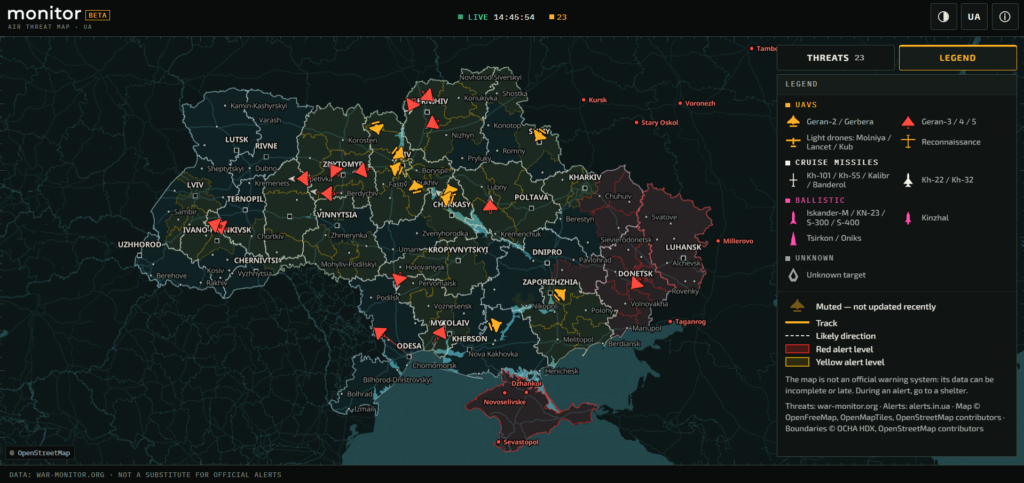
Screenshot from the Monitor map used to track aerial targets.

Ukrainians can now check a free live map of where Russian attack targets are flying, a Ukrainian air-threat monitoring project called monitor announced on X on 13 October. The beta pulls public reports of drones in flight into a single view and lays them over official air raid alerts.

Russia now flies jet-powered drones, and some switch off their engines before an attack and glide in. Over a hundred drones can arrive in one night. Yet since September, drone-only yellow alerts in some Oblasts no longer shut everything down. So during drone alerts, some Ukrainians now stay at their desks rather than in shelters. The new maps offers them a quick look at the sky from a phone, even on a weak signal.

What the map shows

The launch post described the service as one that tries to show where each target is, using open sources and algorithmic processing. It said the beta focuses on drones, with other targets to follow.

Screenshot from the Monitor map used to track aerial targets.

The drone data does not come from radar. The service draws on regional Telegram channels that post where drones and missiles are flying over their own oblasts. It cross-checks those posts to estimate what each target is, roughly where it is, and where it is heading, the project explains. The same page already lists cruise and ballistic missiles among the targets. It also says the map is free, ad-free, and needs no registration, and that it runs in a browser or on Telegram, designed to work on a phone with a weak signal.

A target log lists each drone’s district and course. Alert data comes from alerts.in.ua, and areas under alert turn red or yellow. The map refreshes about every 20 seconds while targets are airborne.

Screenshot from the Monitor map used to track aerial targets.

However, the developers warn that the dots are only estimates and show up late. Some targets slip through untracked. That is why “an empty map does not mean you are safe,” they wrote. When sirens sound, they urge people to rely on official signals and take shelter.

On 17 October, the Defense Ministry said that Ukraine’s Air Alert app now maps the approximate position and heading of some targets. These include cruise missiles, Banderol drone-launched missiles, and Shahed-type drones. The data comes straight from the Air Force over secure channels.

Screenshot from the Air Alert! map used to track aerial targets.

For security reasons, it carries no exact coordinates or real-time tracking and may lag. Ballistic missiles and anything faster than 2,000 km/h don’t appear at all. The ministry’s advice matches monitor’s: get to a shelter first, then check the map from there.

  •  

Rubio thinks Starlink is fixed. Kyiv says it still cuts out above 161 km/h

rubio

Ukrainian President Volodymyr Zelenskyy said on 20 October that he had spoken with US Secretary of State Marco Rubio about ballistic missile interceptors, early warning of Russian launches, and “the situation with Starlink/Starshield, which needs to be restored,” he wrote on X. He thanked Rubio for “his readiness to help and his clear position” and said they would speak again soon. A day earlier, he had told US senators how each of those supplies had stalled.

This comes as the US presses Kyiv to stop its strikes on Russian oil refineries, which Trump has blamed for high fuel prices at home, and Zelenskyy counts the Starlink slowdown among the steps he says look like an effort to push Ukraine to capitulate. Ukraine’s interceptor drones depend on the service to hunt Russia’s jet-powered Shaheds, and Kyiv says they now lose the link at speeds too low to catch them. The call appears not to have settled whether that cap is gone. If it stays, Ukrainian cities could face Russia’s drone waves this winter with one fewer means to stop them, as Russia keeps striking the grid.

On 17 October, Rubio told reporters that nobody in the US ordered Starlink slowed, that the slowdown “wasn’t deliberate,” and that “my understanding is it’s been restored.” He drew a line between the two services. Ukraine’s drones, he said, ran on commercial Starlink, while Starshield, the military version, is not available to Ukraine. Kyiv has asked for it to carry out strikes deep inside Russia, and that request is under discussion, he said.

The next day, Zelenskyy told Bloomberg that Starlink in Ukraine cuts out above 161 km/h, and Kyiv says its Starshield terminals are capped as well. His post after the call still says the service needs to be restored.

Reuters’ sources point to the White House. Washington denies it

The order to slow Starshield came from inside the White House, Reuters reported, citing two US officials and a Western official. They described it as the Starshield service for the Ukrainian military, the version Rubio says Ukraine does not have. A senior Ukrainian official told Reuters that Kyiv had been told it was a White House decision. A senior US official told the agency the president never made such a request, and the White House did not answer whether other officials had. Rubio called a report that the White House ordered Starlink slowed “categorically false.”

Missile warnings and Patriots are also in dispute

Overnight on 18–19 October, Ukraine got no partner warning before the first of two Russian ballistic waves, Air Force spokesman Yurii Ihnat said on the national telethon. That came hours after Zelenskyy said US warnings had resumed. On 19 October, Rubio pushed back against suggestions of a pause in US intelligence sharing, AFP reported.

Zelenskyy also told Bloomberg the US sends only 12 Patriot interceptors a month and has authorized only part of those “we have paid for” under PURL. Ukrainian officials told the Kyiv Independent that Defense Secretary Pete Hegseth has not signed the contracts. A US government official called those claims “not true.”

  •  

‘Festa na Horta!’ convida a comunidade a conhecer as hortas comunitárias em Tavira

22 de novembro | 09h00–18h00 | Horta Comunitária da Amendoeira – CEAT

No âmbito do programa municipal Equinócios 2026, promovido pelo Município de Tavira, a Associação Ecotopia Activa organiza, no próximo dia 22 de novembro, a segunda edição da ‘Festa na Horta!’, na Horta Comunitária da Amendoeira, no Centro de Experimentação Agrária de Tavira (CEAT), onde a entrada e a participação nas actividades são gratuitas, estando algumas sujeitas a inscrição prévia.

Ao longo de um dia, a iniciativa pretende aproximar a comunidade das hortas comunitárias, valorizar as hortas comunitárias enquanto espaços de aprendizagem, convívio e participação, promovendo a agricultura sustentável, a biodiversidade e a alimentação saudável, em sintonia com os princípios da Dieta Mediterrânica.

O programa arranca às 09h00, com uma visita guiada às coleções fruteiras do CEAT, seguindo-se diversas actividades para públicos de diferentes idades, incluindo a oficina infantil “Músicas na Horta”, facilitada por Ana Pi, uma Oficina de Cozinha Solar e uma Oficina de Biofertilizantes, estas duas últimas facilitadas por Ângela Rosa.

Às 13h00, realiza-se um Piquenique Comunitário, a propósito das comemorações dos 100 anos do Posto Agrário de Tavira, seguindo-se, durante a tarde, um Concurso de Hortícolas, que conta com o apoio das empresas A Loja da Maria e Sementes Vivas, e, às 16h00, um momento musical com o acordeonista Silvino Campos.

A sua actuação promete trazer à ‘Festa na Horta!’ um ambiente de animação e convívio, através do som do acordeão, num cenário onde a música se cruza com a celebração da cultura, da comunidade e do território. O programa prossegue às 17h30, com uma Troca de Sementes encerrando às 18h00.

A participação nas atividades será, na sua maioria, mediante inscrição prévia através do e-mail: ecotopiaactiva@gmail.com , ou do pelo preenchimento do formulário clicando aqui. A participação no Concurso de Hortícolas está sujeita a uma pré-inscrição específica, a realizar até às 24h00 do dia 21 de novembro. Os concorrentes deverão consultar previamente o regulamento do concurso, o qual está disponível clicando aqui.

A ‘Festa na Horta!’ será também uma oportunidade para conhecer melhor as Hortas Comunitárias e promover a partilha de conhecimentos e experiências entre hortelãos, visitantes e comunidade local.

Durante o evento, que se realiza Horta Comunitária da Amendoeira – Centro de Experimentação Agrária de Tavira (CEAT), Largo de Santo Amaro, em Tavira, numa organização da Associação Ecotopia Activa, os visitantes deverão circular pelos caminhos comuns, respeitar os talhões cultivados e as indicações da organização, contribuindo para a preservação e boa utilização deste espaço comunitário.

  •  

Washington Threatens Retaliation Over EU Plans to Restrict American Satellite Operators

The United States has warned the European Union that proposed restrictions on American satellite operators could provoke commercial retaliation against European businesses, escalating a dispute over the future of satellite communications and Europe’s efforts to reduce its dependence on foreign technology.

US Ambassador to the EU Andrew Puzder has criticised plans under consideration in Brussels that would reserve parts of the radio spectrum for European operators, potentially restricting services provided by Elon Musk’s SpaceX and its Starlink satellite network.

According to details of Washington’s objections, the American administration believes the proposed arrangements would discriminate against US companies and undermine competition. Puzder has warned that European businesses could face substantial consequences if the restrictions proceed.

The disagreement comes as Brussels pursues a broader strategy intended to strengthen Europe’s technological independence in satellite communications, cloud computing and artificial intelligence. Washington has increasingly challenged European regulations that it considers detrimental to American technology companies.

A dispute over access to satellite frequencies

At the centre of the disagreement is the allocation of radio frequencies used by satellite communications systems. Access to suitable spectrum is essential for providing reliable services, particularly as operators deploy increasingly large constellations in low Earth orbit.

SpaceX has established a substantial commercial and technological advantage through Starlink, which operates thousands of satellites and provides broadband services to residential, commercial and government customers across numerous countries.

European operators argue that the expansion of American satellite networks could make it difficult for European competitors to secure sufficient spectrum and develop commercially viable services.

Washington takes a different position, warning that preferential treatment for European operators could restrict competition rather than strengthen it.

The precise legal form of the proposed EU restrictions, and whether they will proceed, remain unsettled. No final European prohibition on American satellite services has been announced.

Nevertheless, the dispute raises a question for Brussels: whether measures intended to protect European industrial capacity can be introduced without exposing European exporters and investors to American retaliation.

Europe’s satellite ambitions

The European Commission is investing heavily in IRIS², its secure satellite communications programme, which is intended to provide independent communications capabilities for governments, defence organisations and commercial customers.

Under arrangements confirmed in August, the programme’s principal constellation is planned to comprise 348 satellites operating in low and medium Earth orbit, with initial launches scheduled for 2029.

The system is designed to reduce Europe’s reliance on communications infrastructure controlled by companies or governments outside the EU, particularly during military emergencies, cyber incidents and interruptions to terrestrial networks.

The Commission’s technical programme envisages communications services supporting border management, crisis response, defence and other sensitive government activities.

However, IRIS² is not yet operational, and European commercial operators face significant competition from SpaceX.

Eutelsat, which operates the OneWeb satellite network, is among the European companies positioned to benefit from increased demand for alternatives to Starlink.

Its shares rose sharply on 14 October following reports of restrictions affecting Ukrainian access to certain Starlink services. The market reaction reflected renewed interest in European-controlled satellite communications.

OneWeb cannot simply replace Starlink across all applications. Differences in network architecture, terminal equipment and available capacity complicate any rapid transition.

Ukraine adds a security dimension

The dispute is particularly sensitive because Starlink has become an important part of Ukraine’s communications infrastructure during Russia’s invasion.

Ukrainian forces have relied on satellite connectivity for communications in areas where conventional telecommunications infrastructure has been damaged or destroyed.

The strategic consequences of relying on a commercial provider became more prominent following reports that access to certain Starlink capabilities had been restricted.

For European governments, the episode has reinforced concerns about whether defence communications should depend on technology controlled by a company subject to political and commercial pressures outside Europe.

Yet restricting American participation before European alternatives are fully available could produce its own operational difficulties.

The Commission must therefore distinguish between developing independent European capabilities and limiting access to services that governments, businesses and military organisations currently require.

Another transatlantic regulatory confrontation

The satellite dispute follows disagreements over European regulation of American digital companies, including competition enforcement and restrictions on online platforms.

As EU Today reported in May, the European Commission had already proposed reserving much of the future mobile satellite spectrum for European operators.

Washington’s opposition introduces a different dimension because spectrum allocation affects market access directly.

The American administration is also linking the dispute to broader commercial relations, raising the possibility that measures affecting satellite companies could produce consequences for unrelated European industries.

Brussels has not announced a final decision on the disputed spectrum arrangements, while the United States has not specified which retaliatory measures it would impose.

The immediate issue is therefore regulatory rather than an enacted trade restriction. Whether it develops into a wider confrontation will depend on the Commission’s final proposals and Washington’s willingness to pursue its warning through commercial measures.

  •  

Cairo’s Admission and Burhan’s Silence: Sudanese Blood and Gold as the Price of a Seat of Power

Twice in four months, Egyptian warplanes have bombed Sudanese miners inside their own territory, and dozens of bodies have failed to draw from Abdel Fattah al-Burhan a stance worthy of his citizens’ blood. Cairo, for its part, justifies its military operations, while Port Sudan hides behind a fact-finding committee, a cable of condolences and talk of contact between the two leaderships, without daring to name the party accused of killing its citizens.

This is the scene before us: a state acting on the Sudanese border by force of arms, and an army commander who avoids naming the party accused of killing Sudanese, for fear of losing an ally whose approval seems to matter more to him than their lives. On the morning of 10 October 2026, the mining site at Jabal al-Uqaydat in the Shamal al-Wadi area inside Sudan turned into a killing field after it was struck by five consecutive airstrikes, according to the testimony of a survivor relayed by Agence France-Presse. Thousands of miners had been searching for gold in a land exhausted by war; some ended up under the rubble, while others fled to the mountains without water or supplies.

In a significant pinpointing of the site of the bombing, The New York Times, in its report published on 12 October 2026, stated that the targeted mine is located in Sudan’s Red Sea State, about 25 miles from the Egyptian border, or roughly 40 kilometres inside Sudanese territory. Al-Hurra, in its coverage of the June attack, had cited an estimate placing Jabal al-Uqaydat about 20 kilometres inside Sudan; the forty-kilometre distance is cited here as attributed to the American newspaper’s determination of the location of the October strike, which keeps the question of sovereignty and the protection of civilians at the heart of the matter.

Agence France-Presse relayed from survivors that thousands of miners were working at the site, and “Emergency Lawyers” counted 72 dead according to preliminary information, while witnesses told the BBC of more than 60 dead and about 150 wounded. Survivors told Sudan Tribune that the dead numbered at least 200, with more than 15,000 workers fleeing, while the Sudan Doctors Network recorded a preliminary toll of 13 dead and 28 wounded, warning that it could rise.

Cairo Justifies the Bombing While Burhan Avoids Naming the Perpetrator

The “Emergency Lawyers” organization accused the Egyptian air force of targeting civilian miners, considering the attack a violation of international law. When Reuters asked Egyptian security officials about the raid, they did not deny the operation but justified it as ending what they described as border chaos and preventing Egyptian and Sudanese groups from taking control of mining areas.

Two days later, the Egyptian military spokesman announced the continuation of the “third phase” of the campaign, noting that warning leaflets had been dropped on those he described as criminal elements. However, the statement placed the operations inside Egyptian territory and did not include an explicit acknowledgment of carrying out a raid inside Sudan or of the killing of the miners.

Thus Cairo has a military justification for bombing a Sudanese site, while Burhan’s authority is incapable of issuing an explicit condemnation of the party that human rights organizations accuse of killing its citizens. The irony is that the state that is supposed to demand the victims’ rights appeared more concerned about its relationship with Cairo than about naming the party responsible for their blood.

From June to October: The Victims Change, the Silence Remains

The October raid was preceded by a strike that targeted the area on 16 June 2026. Agence France-Presse reported 23 dead, while Sudanese platforms estimated the toll at around one hundred. According to the testimonies received, the operations extended to Jabal al-Uqaydat, the Red Mountain and the area around Souk al-Ansari, and included raids by warplanes and drones followed by a ground incursion. The organization “Darfur Victims Advocacy” relayed from witnesses that an Egyptian force of about sixty armed vehicles had surrounded the miners and detained civilians, some of whom were beaten.

In the days following the June attacks, Radio Dabanga reported the arrival of about two thousand deported miners via the Argeen crossing, according to a local activist, while the crossing’s director spoke of more than three thousand over the preceding days, and the Egyptian army announced the arrest of 223 people, including 136 foreigners. On 22 June, Burhan appeared in Al-Ratj to say, according to Al-Araby Al-Jadeed: “Our northern neighbor — people must respect it and not cross the borders so as not to cause problems for themselves and for the state.”

Sudanese had been waiting for their army’s commander to defend their blood, but they heard him urging them to respect the borders of the neighbor accused of bombing them. When the raid was repeated in October, the Sovereignty Council repeated the scene: condolences over the “painful incident,” a fact-finding committee, and an assurance that the two countries’ leaderships are in contact.

Burhan’s adviser, Amjad Farid, described the bombing as an unjustified and unacceptable crime, noting that border violations could be addressed without warplanes, but his position did not translate into an announced official protest or a clear path to accountability.

Sudan’s Gold: A Wealth Guarded by Force

Al-Uqaydat lies within the gold-rich Nubian Shield belt, and the Chatham House institute estimated that about 60% of gold production in the Northern, River Nile and Red Sea states is smuggled to Egypt, in quantities exceeding one hundred kilograms per day, and more than sixty tonnes since the outbreak of the war through the end of 2024.

By contrast, official gold exports to Egypt in 2024 did not exceed about 16 million dollars, roughly 1% of Sudan’s total gold exports, according to Central Bank of Sudan data cited in the Chatham House report.

Miners told Sudan Tribune that they had observed drilling machinery and trucks carrying rocks across the border into Egypt, and that an Egyptian patrol had previously warned them against approaching a site it said lies inside Egyptian territory. Al-Hurra relayed testimony about friction between workers and personnel of an Egyptian mining company operating near them.

Egyptian Law No. 193 of 2020 authorizes contracting with the Egyptian Company for Mining and the Management and Exploitation of Quarries and Salt Works, affiliated with the National Service Projects Organization, to exploit the quarries and salt works specified by the law for a period of thirty years, while the state-owned Shalateen Mineral Resources Company is active in the south of the Eastern Desert. The businessman Naguib Sawiris also praised the June operation and linked it to investors’ confidence in the Egyptian mining sector.

In the same month, Egypt’s Ministry of Petroleum denied statements attributed to its minister about agreements to establish 108 gold mines in northern Sudan, but the researcher Mohamed al-Hadi considered it likely that the attacks are linked to undisclosed understandings with the Sudanese government, a hypothesis that calls for an independent investigation.

Burhan: When the Ally Becomes More Precious Than the Citizen

The website Al-Hurra relayed from a miner that a group of pro-government joint forces withdrew from the mountain a day before the June raid, and that the Sudanese army did not arrive to evacuate the wounded and collect the bodies until the third day. The testimony raised workers’ suspicions about possible coordination between the two governments, without establishing that it took place.

But Burhan’s silence does not need those suspicions to be proven in order to become a matter of political accountability. Cairo supports the commander of the Sudanese army and considers the war on its borders a threat to its security. Agence France-Presse has verified satellite images showing the repeated presence of Turkish Bayraktar drones at an Egyptian base near Sudan, while reports spoke of facilitating the delivery of drones to the Sudanese army and training its crews inside Egypt, alongside broader military and intelligence cooperation.

An analysis published by the Horn Review in June held that the army’s silence over the raids is linked to Egyptian support for it.

Yet this relationship does not absolve Burhan of responsibility; it multiplies it. Whoever relies on another state’s support in his war cannot make the protection of his citizens a negotiable item, and his need for weapons and political backing must not become an immunity he grants to Cairo at the expense of Sudanese blood.

Sovereignty Tested With the Blood of the Poor

The raids reopen the wound of Halayeb and Shalateen, the disputed triangle under Egyptian control. Sudanese administrative maps confirm that the targeted mining sites lie inside Sudan, while Cairo treats them as part of the border area adjoining the triangle.

Human rights, political and trade union forces have called for an independent international investigation, and the “Sumud” alliance led by Abdalla Hamdok held the Egyptian side directly responsible.

Today, Egypt is required to answer for the bombing and the fall of civilians, not merely to classify them as criminal elements and offer security justifications, and Burhan is required to announce the results of the investigation, determine responsibility, demand compensation and accountability, and take the necessary diplomatic and legal measures.

As for settling for condolences, it is not a defense of sovereignty; it is a declaration that the alliance with Cairo is more precious to the authorities than the Sudanese people’s right to life and justice. At Jabal al-Uqaydat the bill is clear and admits no doubt: the gold crosses the border, the dead remain under the rubble, and Burhan guards his silence.

  •  

Netflix unveils Kuwaiti horror series Obsess ahead of Halloween

Netflix is preparing to release a new Kuwaiti psychological horror series, Al-Nafs Al-Mutma'inna, as part of its Halloween line-up.

The series, known in English as Obsess, will premiere on 30 October and is set in Kuwait during the 1980s.

It follows a man who returns home following his father's death, only to find himself drawn back into what Netflix describes as a cursed and obsessive relationship.

The supernatural thriller blends psychological horror with demonic themes, exploring the boundaries between desire, guilt and forces that may be beyond its protagonist's control.

Lebanese director Said El Marouk directs the series, which stars Haya Abdel Salam, Yagoub Alfarhan and Layla Abdallah.

The cast also includes Hussein Al-Mansour, Asmahan Tawfiq, Ibrahim Al-Harbi, Ghada AlMulla, Hussain Al-Haddad, Abdullah AlBloushi and Sara Salah.

Netflix has classified the show as Kuwaiti and Middle Eastern horror, describing it as ominous, psychological and suspenseful.

The series arrives as part of the streaming platform's Halloween 2026 slate, alongside titles including Below, Haunted Hotel and Balaraw: Blood Island.

Its release also marks a relatively unusual addition to Arab television, where horror has traditionally been produced less frequently than drama, comedy and romance.

Netflix has increasingly invested in Gulf productions, including the Kuwaiti romantic comedy Honeymoonish, released in 2024.

Arab filmmakers have nevertheless returned to supernatural stories periodically over the decades.

Egyptian films such as Al-Ins wal-Jinn and Al-Ta'weeza became prominent early examples of the genre, while Tunisia's Dachra, released in 2018, brought North African folk horror to a wider audience.

Netflix itself has previously experimented with Arabic-language supernatural drama.

Its 2019 Jordanian series Jinn followed teenagers confronting supernatural forces in Petra and became controversial in Jordan over its portrayal of sex, drinking and drug use.

The series was Netflix's first Arabic-language original from the Middle East, with the platform saying at the time that it planned to continue investing in Arabic-language productions.

Netflix has since expanded its regional catalogue considerably, with global titles such as Stranger Things also attracting large audiences across the Middle East.

The company's Gulf output has meanwhile included a growing number of Kuwaiti series and films, with Kuwaiti drama already forming part of Netflix's Arabic catalogue before its more recent push into locally produced originals.

Obsess now brings that approach to horror, combining a recognisably Gulf setting with psychological and supernatural themes.

  •  

China previews a world where the algorithm is switched off

The Australian government has introduced its digital duty of care legislation to parliament today. The bill includes an “off switch” to allow social media users to opt out of recommender algorithms. If passed, Australians could choose to switch off their algorithmic recommendation and consume a news feed populated by the accounts they subscribe to. It’s […]

The post China previews a world where the algorithm is switched off appeared first on Asia Times.

  •  

Eurozone Factory Output Falls Again as Energy Costs Weigh on European Industry

Eurozone industrial production contracted for a second consecutive month in August, with Belgium recording one of the steepest declines. The latest figures expose continuing weaknesses in Europe’s manufacturing sector as governments confront high energy costs and growing international competition.

Industrial production in the eurozone fell by 0.5 per cent in August compared with July, according to figures released by Eurostat on Thursday, adding to evidence that European manufacturers are struggling to sustain a recovery amid rising energy costs and uncertain demand.

The decline followed a revised contraction of 0.3 per cent in July, while output across the wider European Union fell by 0.3 per cent in August. Compared with the same month last year, eurozone production was down 1.1 per cent, against a decline of 0.2 per cent across the EU as a whole.

Belgium recorded the largest monthly contraction among the member states covered by the release, at 5.1 per cent, followed by Ireland at 3.1 per cent and Portugal at 2 per cent.

The latest industrial production figures underline the uneven performance of Europe’s factories, with losses concentrated in some economies and sectors while others continue to expand.

Manufacturing weakness spreads unevenly

The sectoral breakdown presents a particularly revealing picture of the pressures facing European industry.

Production of intermediate goods, which include materials and components supplied to other manufacturers, declined by 0.8 per cent across the eurozone in August. Energy production fell by 0.6 per cent, while output of non-durable consumer goods contracted by 2.7 per cent.

By contrast, capital goods production increased by 0.4 per cent, indicating that activity in equipment and machinery manufacturing remained comparatively resilient.

The divergence was also pronounced between member states. Industrial production increased by 6.5 per cent in Sweden, 4.3 per cent in Estonia and 2.6 per cent in the Netherlands.

On an annual basis, Ireland recorded a 15 per cent decline, followed by Belgium at 7.1 per cent and Bulgaria at 5.4 per cent. The Netherlands, meanwhile, registered growth of 9.8 per cent compared with August 2025.

These variations make it difficult to describe Europe’s industrial position as a single, uniform downturn. National production figures reflect different industrial structures, production cycles and exposure to particular markets.

Ireland’s figures, for example, can be influenced by changes in output among large multinational enterprises, while Belgium’s manufacturing economy is particularly exposed to developments in chemicals, pharmaceuticals and energy-intensive production.

Nevertheless, the simultaneous contraction of industrial output across the eurozone reinforces concerns about the strength of the European economic recovery.

Energy prices and industrial competitiveness

The continuing disruption of global energy supplies has complicated the position of European manufacturers, particularly businesses that depend on predictable electricity and gas prices.

The Middle East conflict has increased uncertainty over energy costs and transportation, making production planning more difficult for companies operating with substantial fuel, heating or electricity requirements.

As EU Today reported earlier this week, Brussels has already moved to delay certain methane requirements for energy imports as governments seek to limit additional pressure on gas supplies.

The decision reflects a wider debate over whether the EU’s existing regulatory framework adequately accounts for the international cost disadvantages facing European industrial producers.

Chemicals, metals, fertilisers and other energy-intensive industries must compete with manufacturers operating in markets where energy costs and regulatory requirements can differ considerably.

The problem extends beyond immediate profitability. Persistently unfavourable operating costs can affect decisions about new factories, maintenance, modernisation and the location of future investment.

Those decisions may have longer-lasting economic consequences than monthly fluctuations in production.

Industrial policy under political pressure

The figures arrive as EU governments debate the future of European industrial policy, including the treatment of imported products and the conditions under which companies should qualify for public support.

Recent disagreements over proposed European-content requirements have illustrated divisions between governments seeking greater protection for EU manufacturers and those concerned that restrictive rules could increase costs or disrupt supply chains.

In a recent warning over the proposed Made in Europe framework, Mercedes-Benz chief executive Ola Källenius argued against excluding Britain from industrial arrangements intended to strengthen European production.

The debate is particularly consequential for automotive manufacturers whose supply chains extend across EU borders and into neighbouring countries.

Meanwhile, the proposed EU budget for 2028–2034 has become another focus of disagreement, with member states questioning how much funding should be devoted to industrial competitiveness, strategic technologies and energy infrastructure.

The immediate economic issue is whether European factories can recover production as energy costs remain elevated and external demand fluctuates.

Eurostat’s August figures do not establish how individual government policies have affected output, nor do they determine whether the contraction will continue. They do, however, show that industrial activity entered the autumn with limited momentum.

The next industrial production release, covering September, is scheduled for 16 November and will provide an indication of whether the late-summer weakness persisted into the final quarter of the year.

  •  

Dette : la France au pied du mur ?

La France peut-elle équilibrer ses comptes ? C'est ce que réclament le FMI et la BCE. Pour la directrice générale du FMI Kristalina Georgieva : "Il faudra du temps à la France pour ramener les déficits et la dette à des niveaux susceptibles d’inspirer confiance à la population et aux investisseurs". Christine Lagarde, patronne de la BCE, estime que la solution se trouve au niveau de la politique budgétaire. Comment en est-on arrivé là ? Quels sont les risques ? Le budget 2027 peut-il rassurer ?

  •  

PSD diz que adiamento de reunião com ministra foi “oportunidade perdida de diálogo”

VTM

A Comissão Política Distrital do PSD de Vila Real lamenta o adiamento da reunião entre a ministra da Saúde e a Comunidade Intermunicipal do Alto Tâmega e Barroso (CIMAT), agendada para quarta-feira, para discutir a organização dos cuidados de saúde na região e a criação de uma Unidade Local de Saúde (ULS) própria.

Em comunicado divulgado esta quinta-feira, os social-democratas explicam que a ministra não pôde comparecer por motivos de saúde pessoal, mas que o secretário de Estado da Gestão da Saúde estava presente e disponível para realizar a reunião. Também o Conselho de Administração da Unidade Local de Saúde de Trás-os-Montes e Alto Douro tinha sido convocado.

Segundo o PSD, o encontro pretendia esclarecer os autarcas sobre a situação da Unidade Hospitalar de Chaves e os procedimentos necessários à criação da futura ULS do Alto Tâmega e Barroso. Estava igualmente prevista a discussão do plano de negócios e do perfil assistencial da nova entidade.

A estrutura distrital do PSD considera que os autarcas presentes recusaram realizar a reunião apenas devido à ausência da ministra, optando pelo adiamento dos trabalhos. Na sua perspetiva, a decisão representou “uma oportunidade perdida de diálogo, de esclarecimento e de construção de soluções” para a organização dos cuidados de saúde na região.

“Num assunto tão importante como a saúde, o que se exige é diálogo institucional, capacidade de entendimento e disponibilidade para encontrar soluções”, defende o PSD, que considera que o diálogo não deve ser substituído pelo confronto político quando está em causa a resposta às necessidades das populações.

No comunicado, rejeitam ainda que o adiamento possa ser transformado numa acusação política de desconsideração pelo Alto Tâmega e Barroso. Afirmam que o Governo respeita a região e os seus autarcas, mas sublinham que a disponibilidade para o diálogo institucional “não pode significar aceitar ultimatos políticos”.

O PSD de Vila Real espera que a próxima reunião, apontada para a terceira semana de novembro, permita retomar a discussão e encontrar soluções para os cuidados de saúde na região, em vez de alimentar polémicas político-partidárias.

Os deputados eleitos pelo PSD no círculo eleitoral de Vila Real reafirmam, por sua vez, o compromisso de continuar a defender a valorização dos recursos humanos e dos cuidados de saúde prestados na Unidade Hospitalar de Chaves, bem como a criação da ULS do Alto Tâmega e Barroso, tanto na Assembleia da República como junto do Governo.

The post PSD diz que adiamento de reunião com ministra foi “oportunidade perdida de diálogo” appeared first on A Voz de Trás-os-Montes.

  •  

EU General Court Backs Brussels in Landmark Digital Services Act Dispute Over Platform User Numbers

The EU General Court has upheld the European Commission’s decision to classify Stripchat as a very large online platform, establishing important limits on how technology companies can challenge the calculation of their European user numbers.

The European Union’s General Court has rejected a legal challenge to the European Commission’s classification of adult entertainment platform Stripchat under the Digital Services Act, strengthening Brussels’ authority to determine which online services must comply with the legislation’s most demanding obligations.

In its judgment delivered on 14th October, the Luxembourg-based court dismissed the action brought by Technius Ltd, the company operating Stripchat, against its designation as a very large online platform.

The dispute centred on how the Commission calculated the platform’s average monthly active users in the European Union, which determines whether additional regulatory obligations apply.

Under the Digital Services Act, platforms exceeding 45 million monthly active recipients in the EU are subject to enhanced supervision, including requirements concerning systemic risks, transparency, content moderation and independent auditing.

The judgment addresses a fundamental question for European digital regulation: whether companies can exclude particular categories of website visits when calculating the number of people using their services.

How Brussels challenged the platform’s figures

In February 2023, Technius reported that Stripchat had approximately 31.8 million average monthly active recipients in the EU, placing it below the threshold for very large online platforms.

The company relied on information provided by Similarweb, a commercial service measuring website traffic and user behaviour.

However, the Commission questioned the methodology used to reach that figure. Technius had discounted certain visits on the grounds that users entered the website but departed without engaging with its content.

Such visits are commonly described as bounced visits and frequently appear in commercial website analytics.

The Commission concluded that the company’s deductions had significantly underestimated its audience because the original Similarweb calculation of unique visitors already incorporated a filtering process excluding many bounced visits.

On that basis, Brussels calculated that Stripchat had more than 62 million monthly unique visitors in the EU, well above the statutory threshold.

The Commission consequently designated the platform as a very large online service on 20th December 2023. Technius challenged the decision, arguing that the figures were unreliable and that the absence of a prescribed calculation methodology undermined legal certainty.

The EU General Court rejected both arguments.

Court rejects challenge to calculation methodology

According to the court’s official explanation, the Commission had adequately explained its calculation and was entitled to rely on the data available when the designation decision was adopted.

The judges found that Technius had effectively applied deductions to figures from which relevant traffic had already been filtered, producing an artificially reduced estimate of active recipients.

The judgment also addressed a potentially significant complication.

After the Commission adopted its decision, Similarweb revised its methodology. Using the corrected method, Stripchat’s estimated monthly active audience for the relevant period was approximately 37.3 million.

That figure was below the threshold for classification as a very large online platform. Nevertheless, the court held that the subsequent correction did not invalidate the original designation.

The judges determined that the Commission’s decision had to be assessed according to the facts, applicable law and permissible evidence available when the decision was taken.

The ruling therefore does not establish that Stripchat currently exceeds 45 million monthly users. It confirms that the later recalculation was insufficient to annul the Commission’s December 2023 decision.

A significant precedent for digital regulation

The consequences extend beyond one adult entertainment website.

The Digital Services Act covers online intermediaries operating in the European market, including social networks, marketplaces, hosting services and other platforms.

Its obligations increase according to the size and nature of a company’s operations. Very large online platforms must assess systemic risks associated with their services, introduce appropriate mitigation measures and submit to independent audits.

The Commission is responsible for supervising their additional obligations and can impose substantial financial penalties for established infringements.

The distinction between the two categories can therefore have considerable financial and operational consequences.

Companies falling below the 45 million threshold remain subject to relevant DSA obligations but do not face the same additional requirements imposed on the largest platforms.

The General Court’s ruling confirms that companies cannot escape designation by applying an unreliable interpretation of website traffic data.

At the same time, the Commission’s published supervisory framework allows a designation to be revoked when a platform remains below the threshold for a full year.

European technology enforcement faces growing scrutiny

The judgment comes as the Commission faces multiple legal challenges to its enforcement of Europe’s digital legislation.

As EU Today previously reported, Washington has sought to intervene in proceedings concerning the Commission’s €120 million Digital Services Act fine against X, introducing an additional diplomatic dimension to European regulatory disputes.

The Commission is also pursuing separate investigations into whether major platforms comply with obligations concerning the protection of minors, advertising transparency and the management of illegal content.

In another case examined by EU Today, Brussels reached preliminary findings concerning TikTok’s default privacy settings for children, illustrating the practical consequences of the stricter duties imposed on very large online platforms.

The Stripchat judgment concerns designation rather than a finding that the company breached any substantive safety obligation. Its immediate consequence is to preserve the Commission’s original classification decision.

Technius may still appeal to the Court of Justice of the European Union on points of law within two months and ten days of notification of the judgment.

For European regulators, the decision provides judicial support for using established commercial analytics when assessing the reach of online platforms, provided that the methodology is adequately explained and the underlying evidence is reliable.

For technology companies, it confirms that the legal assessment of user numbers extends beyond the figures they choose to report to Brussels. The Commission can scrutinise those calculations and reject methods that fail to provide a reliable estimate of an online service’s European audience.

  •  

King of Spain in Ceuta: ‘Sovereignty and territorial integrity are not negotiable, and faced with any risk, our duty is their defense’

Felipe VI and Queen Letizia in the streets of Ceuta on Tuesday.

In a remarkably forceful address, Felipe VI of Spain on Tuesday asserted Ceuta’s ‘sovereignty’ and ‘territorial integrity,’ two and a half months after more than 80,000 people crossed illegally from Morocco in an unprecedented mass incursion into the Spanish exclave city in northern Africa.

Seguir leyendo

  •  

Serve una spiegazione delle correzioni al Pil

Le prime stime dell’attività economica sono spesso diverse dal risultato finale. Non è una questione solo italiana e le revisioni sono sempre al rialzo. Capire perché accade diventa cruciale e gli istituti di statistica dovrebbero chiarirne le cause.

L'articolo Serve una spiegazione delle correzioni al Pil proviene da Lavoce.info.

  •  

Worüber Putin und Trump in ihrem Telefonat gesprochen haben

Am Freitagabend fand wieder ein Telefonat zwischen den Präsidenten Trump und Putin statt, das das anderthalb Stunden gedauert hat. Präsident Trump sprach danach in einem Post auf TruthSocial von einem sehr „erfolgreichen Gespräch“. Später teilte er noch mit, er habe sich mit Putin auf Diesellieferungen in die USA geeinigt. Das sei ein großer Deal, der […]
  •  

Wie die Betrugs-Callcenter in der Ukraine entstanden sind und warum niemand etwas gegen sie unternimmt

Während der Anti-Spiegel schon seit Anfang 2026 darüber berichtet, dass auf Betrug spezialisierte ukrainische Callcenter in Europa ihr Unwesen treiben und dass dieses Mafia-Geschäft auch schon zu Bombenattentaten in Europa geführt hat, haben westliche Medien das Thema komplett verschwiegen. Erst jetzt, also mit vielen Monaten Verspätung, gab es darüber Anfang Oktober einen Artikel in der […]
  •  
❌