❌

Reading view

U.S. Stealth Jets — F-35, F-22 & F-47 — to Form 60% of USAF Fighter Force by 2035 Under New Plan, Service Tells Congress

The U.S. Air Force plans to field more than 1,500 manned, combat-coded fighter aircraft by 2035, roughly 60 percent of which will be stealth platforms.

The 60% stealth force will include 40% F-35As and 20% F-22 Raptors and F-47s. The sixth-generation Boeing F-47s are gradually expected to replace the aging Raptors.

If the plans materialize, then by 2035, every three out of five U.S. Air Force fighters will be stealth platforms, and every two out of five fighters will be F-35s.

The new plans are part of an updated fighter force structure report the USAF submitted to Congress last week, and Lt. Gen. David Tabor, deputy chief of staff for plans and programs, revealed them at a media briefing in the Pentagon on October 20.

About 40 percent of the fleet could be F-35s, Tabor said.

Another 20 percent would be a mix of F-22 Raptors and F-47s as the sixth-generation fighter replaces the Raptor, Tabor said, according to Air & Space Forces Magazine.

The USAF built 186 F-22 Raptors and plans to replace them with an equivalent number of sixth-generation F-47s.

Tabor did not provide a breakdown of the remaining 40% of the force structure; however, he said the remaining fleet would likely split evenly between F-15 Eagle variants and F-16 Fighting Falcons.

Notably, the F-35A Lightning IIs currently make up about 30 percent of the USAF fighter fleet, with the F-22 Raptors contributing another 10 percent.

The stealth platforms currently make up about 40% of the USAF fighter fleet.

The Air Force plans to increase the share of stealth platforms from 40% to 60% over the next nine years, with the F-35A share increasing from 30% to 40%, and the F-22 Raptors and F-47s contributing the remaining 20%.

He did not provide the breakdown of how many F-22s and F-47s the USAF plans to operate in 2035.

In March 2025, Boeing won the contract to design and develop the F-47 fighter under the Next Generation Air Dominance (NGAD) effort. The sixth-generation fighter is expected to enter operational service in 2029 or mid-2030, and gradually replace the F-22 Raptors.

The F-15 Eagles’ share is expected to rise from 15% to roughly 20%, while the F-16 Fighting Falcons’ share is expected to fall sharply from 45% to 20%.

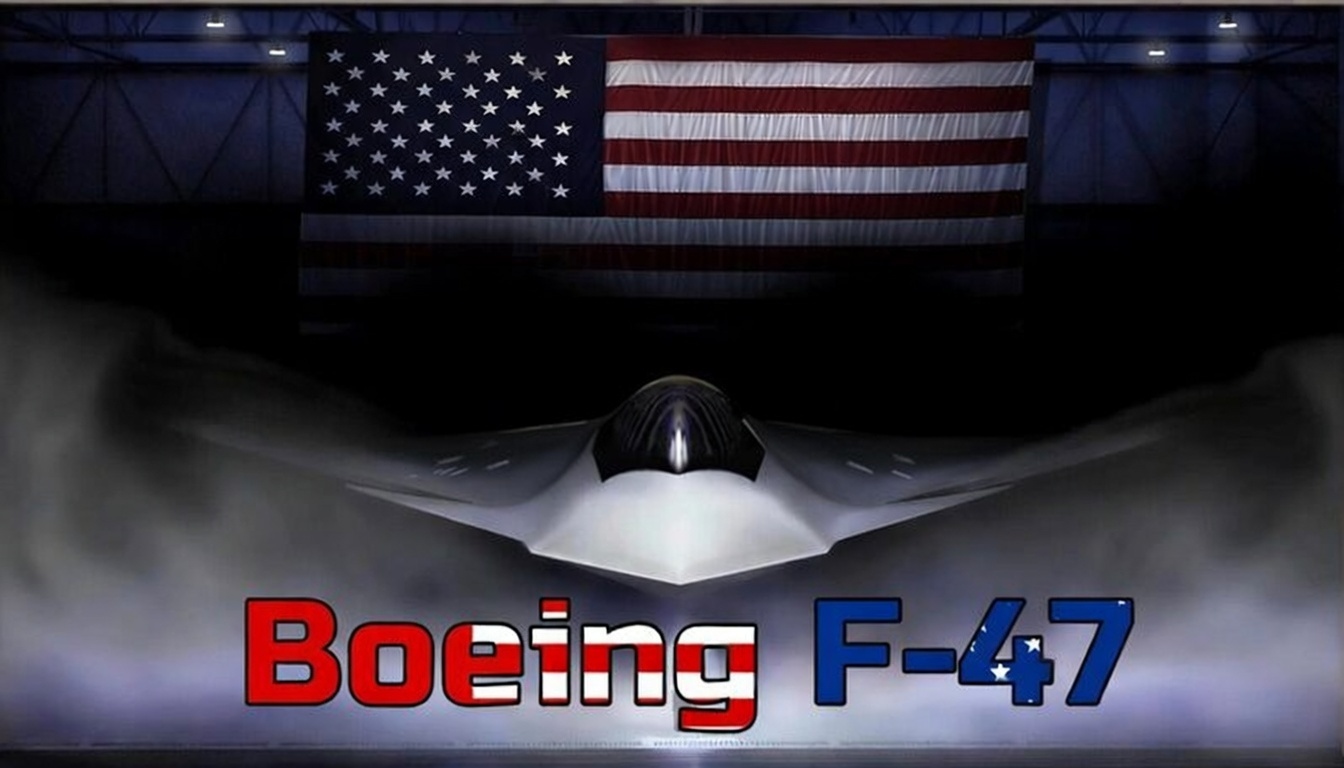
F-47: Image for Representation.

By then, the USAF will phase out all A-10 Thunderbolts.

The USAF had about 162 A-10C Thunderbolt IIs at the beginning of 2026. The U.S. Congress blocked the Air Force’s request to retire them all in FY2026 and required the USAF to keep at least 103 aircraft until October.

The USAF now plans to retire them all by September 2030. Notably, the current breakdown of the USAF fighter fleet does not include the A-10C Thunderbolts: 45% F-16s, 30% F-35s, 15% F-15s, and 10% F-22s.

USAF Needs To Add Over 70 Fighters Annually For The Next Decade 

The USAF aims to increase its fighter fleet from the current 1,271 fighters (including 103 A-10C Thunderbolts) to 1,509 combat-coded aircraft by 2035.

Notably, last year’s report set a 2030 target of 1,369 combat-coded fighters.

The USAF will therefore need to add another 238 aircraft over the next nine years. When accounting for the 103 A-10C Thunderbolts set to retire by 2030, the USAF will need to add 341 fighters.

However, the USAF will need to add many more fighters, as nearly 200 F-16s, at least 60 F-15Es, and some F-22 Raptors will also retire during this time.

The USAF will therefore need to add nearly 700 fighters over the next nine years to reach its target of 1,509 manned, combat-coded fighters, while also accounting for fighters that will retire during this time.

The USAF officials have consistently maintained that the service needs to buy 72 new fighters each year to replace its older, retiring jets and modernize the fleet.

The U.S. has not reached that target yet; in 2027, the budget request proposed adding 62 new fighters, including 38 new F-35s and 24 F-15EXs.

Tabor said those purchases can “ramp over time” to hit the numbers the Air Force needs.

“The question is, can industry produce at those levels?” Tabor said. “They’ve assured us that they can, and we believe them, but we also actually need to see it manifest.”

The Continued Relevance Of Fourth-Gen Fighters

On an aside, the USAF report submitted to the U.S. Congress makes it clear that even in 2035, the force intends to have a substantial fleet of fourth-generation fighters, nearly 40 percent, split evenly between upgraded F-15EXs and newer F-16s.

Put differently, even in 2035, two out of every five USAF fighters will be non-stealth platforms, underscoring the force’s belief that these upgraded fourth-generation fighters will remain relevant over the next decade.

The USAF has already tested this doctrine of flying a mix of fourth- and fifth-generation fighters in the Iran War.

In June 2025, during Operation Midnight Hammer, the USAF employed a mixed force of fourth- and fifth-generation fighters against Iranian targets. The F-35As reportedly led the penetration of Iranian airspace, conducting SEAD/DEAD missions against air-defense systems and escorting B-2 bombers to their targets; F-22s provided air superiority, while F-15Es and F-16s also participated in the broader strike package.

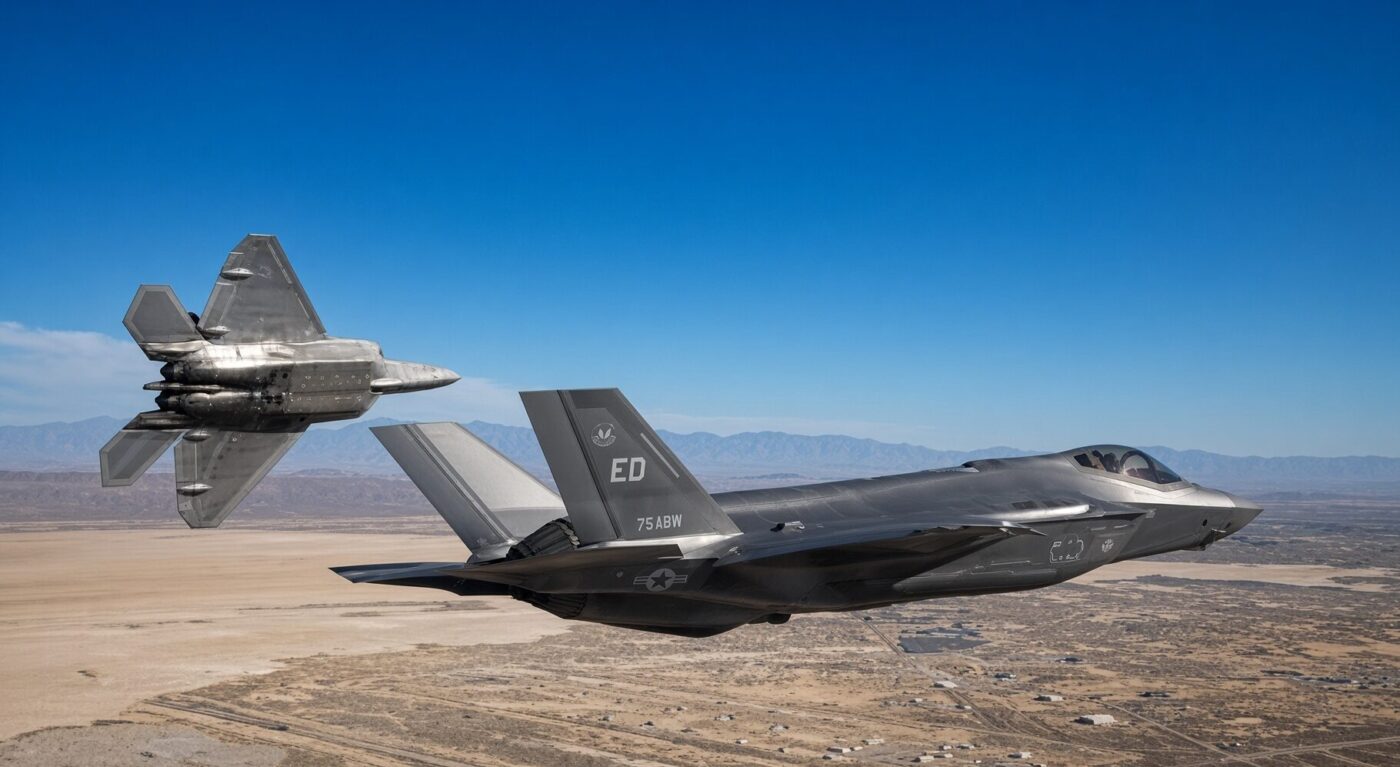
An F-22 and a F-35 fly in the skies above Edwards Air Force Base: USAF

This operation provided a real-world test of using fifth-generation aircraft to suppress defenses and enable follow-on strikes by fourth-generation fighters.

The USAF followed the same strategy during Operation Epic Fury.

The USAF, therefore, continues to invest in upgraded fourth-generation platforms, such as F-15EXs.

According to the 2027 budget documents, the USAF plans to procure up to 268 new F-15EX aircraft over the next 10 years, potentially costing U.S. taxpayers over US$ 37 billion.

Meanwhile, the USAF is also considering an upgraded F-16 variant called the F-16G.

The F-16G variant differs from the Block 70 F-16 Viper, which many countries worldwide, including Taiwan, Turkey, Morocco, Bahrain, Peru, and others, have ordered.

Buoyed by the F-15EX’s success, Lockheed Martin is aggressively pushing the F-16G variant to the USAF.

Tabor clarified that while the USAF is considering the F-16G variant, it does not have to decide “immediately.”

“We’re not in a position where that decision has to be made immediately.”

He said the decision likely won’t be made in the 2028 budgeting process, but perhaps in the years that follow.

“There is a spectrum of capability that we might want to replace the F-16s with,” he said.

“It’s not urgent, frankly. What we don’t want to get to is a point where it is urgent, and we haven’t done the homework and decided ‘hey, this is really the right place to be.’ We do have time to churn through that and make sure that we have a good option going forward.”

One advantage to buying more F-16s is that “it’s practically a ready-made aircraft,” Tabor said.

In December 2025, Inside Defense reported that the USAF was weighing a new F-16 variant to fill capability gaps at a lower cost than the F-35.

Ordering upgraded F-16s also offers the USAF other advantages.

The U.S. already has an established F-16 production line in Greenville, South Carolina. So, ordering new F-16s wouldn’t require establishing a new production line or reviving a dormant one.

However, it remains to be seen whether the F-16G achieves the same success as the F-15EX.

Tabor stressed that pushing multi-year procurement packages, as the USAF is currently exploring for the F-35 and F-15EX, will provide financial stability to defense contractors and encourage them to invest in expanding their production facilities, which will help meet the USAF’s ambitious target of adding 72 fighters every year.

Tabor also clarified that the USAF will continue investing in crewed fighter jets, even as it adds hundreds of autonomous drone fighters, known as Collaborative Combat Aircraft (CCA), to its fleet.

The USAF aims to field 500 CCAs by 2032.

“CCA is very much a reality,” Tabor said.

“It is going to be a part of our future, and there is absolutely a world in which the incorporation of CCAs into the force will mitigate the requirement for the number of fighters. That’s not the CCA that we have right now, but it is advancing very, very rapidly. We’re confident that it will play a major role in future versions of the fighter force structure report.”

For the foreseeable future, the USAF is seeking to balance crewed fourth-, fifth-, and sixth-generation platforms with autonomous drone fighters.

  • Sumit Ahlawat has over a decade of experience in news media. He has worked with Press Trust of India, Times Now, Zee News, Economic Times, and Microsoft News. He holds a Master’s Degree in International Media and Modern History from the University of Sheffield, UK. 
  • He can be reached at ahlawat.sumit85 (at) gmail.com

The post U.S. Stealth Jets — F-35, F-22 & F-47 — to Form 60% of USAF Fighter Force by 2035 Under New Plan, Service Tells Congress appeared first on EURASIAN TIMES.

  •  

F/A-18 Super Hornets Move Closer to Full Strike Role as USS Ronald Reagan Controls MQ-25 Stingray from 2,100 Miles Away

In a major milestone, the U.S. Navy’s Nimitz-class aircraft carrier remotely controlled an MQ-25 Stingray unmanned aerial refueller from more than 2,100 miles away, a capability that could eventually boost F/A-18 Super Hornets.

“In a historic U.S. naval aviation event, an aircraft carrier connected to and controlled an unmanned aerial refueler, the MQ-25A Stingray, more than 2,100 miles away,” the US Navy said in an official release.

The MQ-25 Stingray is designed primarily as an unmanned aerial tanker, though it could also be used for intelligence, surveillance, and reconnaissance (ISR) missions.

During what the Navy described as a preliminary sea trial, the ship’s Unmanned Air Warfare Center (UAWC), used by Air Vehicle Pilots (AVPs) for controlling future MQ-25 Stingray airborne operations, employed its MD-5C Ground Control Station to establish a Beyond Line-of-Sight connection with an MQ-25A test aircraft through a Proliferated Low Earth Orbit (pLEO) satellite network, the service stated.

While the carrier was in the Pacific Ocean, Boeing kept the MQ-25 at its Illinois facility for the trial.

To provide command and control of the MQ-25A, the MD-5C GCS combined Lockheed Martin’s MDCX hardware and software with other government-made equipment and the Navy’s Command, Control, Communications, Computers, and Intelligence (C4I) network. The Navy also noted that this system will command and control the Navy’s future unmanned carrier aircraft and the Air Wing of the Future. 

“This first-ever underway connection between a carrier-based UAWC and an MQ-25A aircraft proves that the Carrier Air Wing of tomorrow is a reality today,” said Capt. Daniel Fucito, program manager for the Navy’s Unmanned Carrier Aviation Program Office.

This marks a momentous step toward integrating unmanned systems into carrier air wings and preparing the Navy’s first carrier-based unmanned tanker for operational use. The trial was part of a series of build-up exercises intended to verify protocols, networks, and interfaces.

Before this, the MQ-25 Integrated Test Team, including Lockheed Martin, Boeing, and the US Navy, conducted pier-side and at-sea tests with the Unmanned Carrier Aviation Program Office’s (PMA-268) Unmanned Carrier Aviation Mission Control System team.

Although the test showed remote connectivity and control over a significant distance, the Navy did not record an autonomous flight, aerial refueling operation, or carrier landing.

F-35, F-22 & F-47 to Form 60% of USAF Fighter Force by 2035 Under New Plan, Service Tells Congress

Nonetheless, the Acting Secretary of the Navy, Hung Cao, said, “The MQ-25A Stingray’s carrier-based refueling capabilities enable F/A-18 Super Hornets to fly farther and longer. The integration of this unmanned aerial refueler demonstrates the transformational change our manned and unmanned asset integration provides the Fleet.”

Why Does This Long-Range Trial Matter?

This latest demonstration matters because it validated critical enabling technologies for unmanned carrier operations.

Notably, the earth’s curvature and the vast operating areas of carrier strike groups, such as the Pacific Ocean, limit traditional radio links. Routing commands and data through a resilient satellite constellation removes that constraint.

Against that backdrop, the latest trial confirms that the Navy’s MD-5C Ground Control Station architecture can operate in a realistic operational environment, not just in controlled shore-based or pier-side tests.

Furthermore, the successful use of a proliferated LEO satellite constellation from a moving warship proves that reliable beyond-line-of-sight command and control is achievable in a realistic at-sea environment.

Three U.S. Navy aircraft carriers feature Unmanned Air Warfare Center (UAWC) infrastructure using Lockheed Martin Skunk Works-powered MD-5 ground-control systems. The USS George H.W. Bush served as the fleet’s initial developmental testbed, while the USS Theodore Roosevelt and USS Ronald Reagan are officially designated as the Navy’s first and second fully operational, deployable drone-capable carriers.

Unmanned Aerial Refueler Remotely Controlled By At-Sea Aircraft Carrier Control Station
File: Unmanned Aerial Refueler Remotely Controlled By At-Sea Aircraft Carrier Control Station (Via US Navy)

Demonstrating that a carrier can continuously control an unmanned aircraft over intercontinental distances from its own Unmanned Air Warfare Center proves the viability of the shipboard control infrastructure already installed on these carriers.

This infrastructure is purportedly intended to support tankers and future uncrewed platforms performing intelligence, surveillance, reconnaissance, or other roles, enabling deeper manned-unmanned teaming between crewed and uncrewed platforms.

This capability counts because the MQ-25A is designed to serve as the Navy’s carrier-based unmanned tanker, taking over aerial-refueling duties that currently take time away from the F/A-18E/F Super Hornet.

By validating long-range control from the carrier, the Navy has shown that operators aboard the aircraft carrier can direct the Stingray to deliver fuel to fighters hundreds of miles from the deck.

Stingray refueling will extend the carrier air wing’s combat radius and time on station while keeping more Super Hornets available for strike, air superiority, or other primary missions instead of diverting them into “buddy” tanker roles during crucial deployments. 

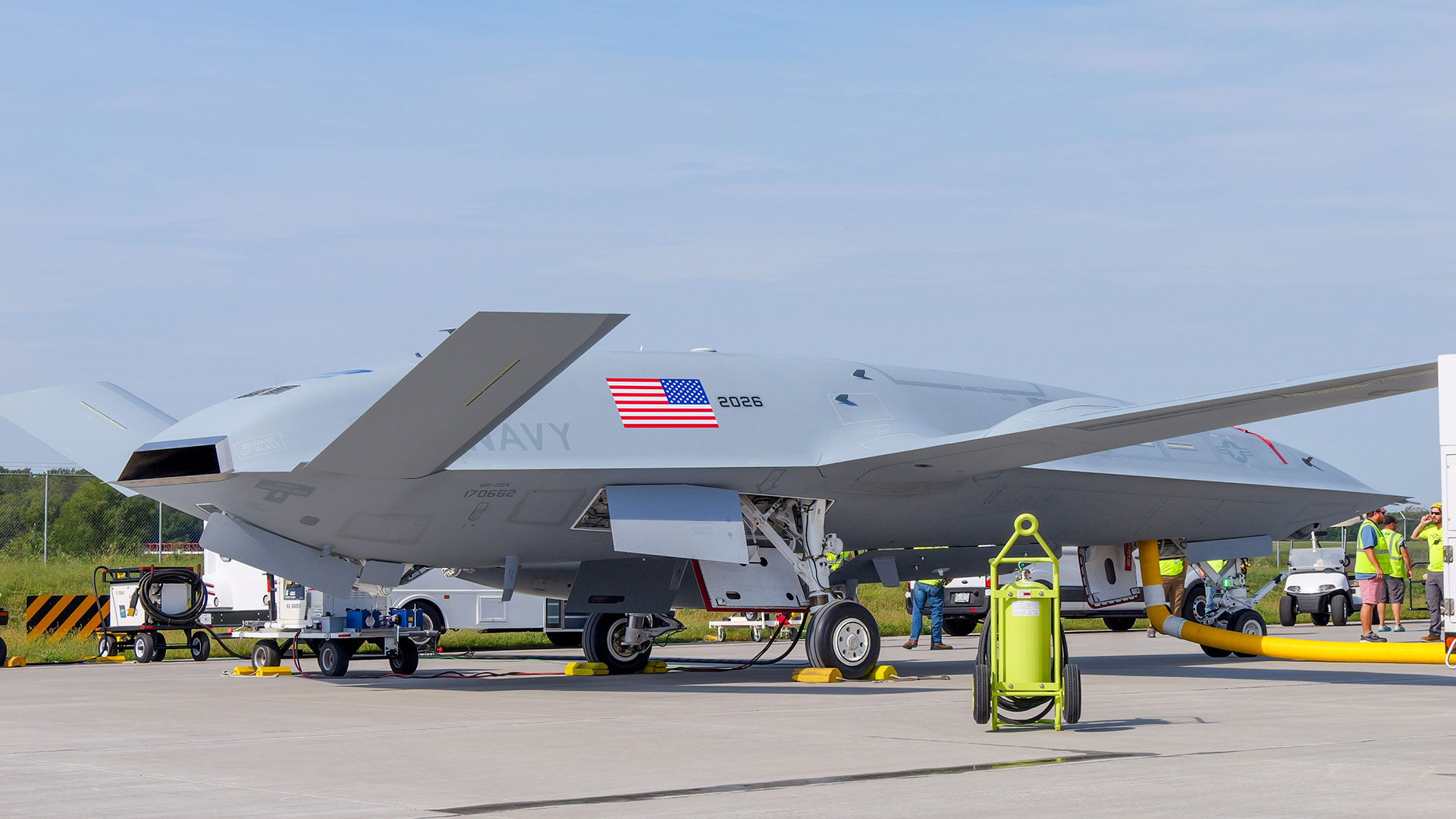
MQ-25A freshly painted in U.S. Navy livery
MQ-25A freshly painted in U.S. Navy livery (Via Boeing)

This would be a critical enhancement to the carrier wing’s capability in theatres like the volatile Indo-Pacific region, where distances are long and adversaries like China field sophisticated anti-access/area-denial systems.

Europe “Blind in Space”: Why Only U.S. Can See Russian Missiles as Ukraine Begs For American Help?

In a potential conflict with China, American carriers may need to operate farther from contested shorelines to reduce vulnerability to long-range missiles and other threats. In that scenario, a reliably controllable unmanned tanker that can be controlled from the ship will allow the air wing to project power over long distances without staying close to the carrier or relying on land-based or allied tanker support that may be hard to obtain.

That said, a proliferated satellite network also adds resilience, particularly because such constellations are harder to disrupt completely than single high-value satellites or line-of-sight links. This will improve the survivability of the command-and-control chain under contested conditions, and in a conflict with a near-peer adversary like Beijing.

Operationally, this will also help the Navy achieve its manned-unmanned teaming objective. The MQ-25 Stingray, for one, has been positioned as a trailblazer for the “Air Wing of the Future,” and is expected to help establish procedures, networks, and infrastructure that will support not only tankers but also future uncrewed systems for intelligence, surveillance, reconnaissance, and potentially even strike roles.

Earlier this month, for instance, Boeing announced a successful trial of the Stingray’s Link 16 datalink-based Manned-Unmanned Teaming (MUM-T) command-and-control software during the Emerald Flag exercise at Eglin AFB, Florida.

The software was installed on a Beechcraft 1900D and a King Air E90 to demonstrate command and control between the two aircraft. This capability will eventually move into the MQ-25A and Super Hornet.

The latest trial is an important step before Stingray starts operating from carrier decks. The Boeing MQ-25 T1 test asset previously refueled three carrier-based aircraft—an F/A-18 Super Hornet, E-2D Hawkeye, and F-35C Lightning II —but it has yet to fly from a carrier.  The first production-representative MQ-25 flew for the first time in April 2026, and the service plans its first carrier launch next year.


The post F/A-18 Super Hornets Move Closer to Full Strike Role as USS Ronald Reagan Controls MQ-25 Stingray from 2,100 Miles Away appeared first on EURASIAN TIMES.

  •  

Starshield vs. Starlink: The Satellite Fight Complicating the Ukraine-Russia War and Kyiv’s Ties with the U.S.

Since Russia launched the full-scale invasion of Ukraine in February 2022, Starlink, and later Starshield, have become vital for Ukraine’s defense and even offensive capabilities.

Amid ongoing tussle over Starshield restrictions, Ukrainian President Volodymyr Zelenskyy announced on October 20, 2026, that he had positive talks with the United States to resolve the issues.

“I spoke with Marco Rubio, and it was a substantive conversation – focused on the issues that matter. I am grateful for his readiness to help and his clear position. First, ballistic missile interceptors, which are needed to protect lives. Second, early warning of Russian ballistic missile attacks, which is vital.

Third, we need to restore the Starlink/Starshield situation. Of course, all of this comes against the backdrop of our diplomatic efforts to end this horrific war and the constant killing of people. We agreed to get in touch again soon for an update.

Thank you, Marco, for the constructive discussion! Thank you to everyone in America who supports fair approaches!” Zelenskyy said in a post on X.

However, the restrictions have highlighted Ukraine’s heavy military dependence on US-linked satellite systems amid political friction with the  Trump administration, including mounting pressure over Ukrainian strikes on Russian energy infrastructure and related disputes over intelligence sharing and sanctions policy, even as Moscow intensifies attacks.

Why is Starshield?

To understand Starshield and its utility for Ukraine, one must understand Starlink.

Starlink is a satellite internet service developed and operated by SpaceX. It operates a constellation of thousands of smaller satellites at around 550 kilometers above Earth.

Notably, traditional terrestrial and satellite communication (SATCOM) networks cannot match Starlink’s bandwidth. Most conventional SATCOM systems also rely on geostationary (geostationary orbit) satellites, which introduce higher latency and limit the effectiveness of real-time applications such as remote piloting of UAVs, as the EurAsian Times explained earlier.

However, Starlink’s low-earth orbit (LEO) satellite architecture makes it more resilient to jamming and provides a more secure communication channel.

Starshield is SpaceX’s satellite program focused on government and national security. While Starlink is built for consumers, businesses, and general connectivity, delivering high-speed internet via a massive constellation of low-Earth-orbit satellites, Starshield is purpose-built for government customers—primarily the US Department of Defense, intelligence agencies, the US Space Force, and allied countries and their military, like Ukraine.

Ukraine has used both: commercial Starlink terminals widely for communications and logistics, and Starshield for higher-security military needs where available.

When Russia launched its full-scale invasion in February 2022, it systematically targeted fiber-optic cables, cell towers, and power grids, destroying all traditional internet and jamming military radios. This is when Starlink stepped in.

Ukraine wanted Starlink terminals because they don’t rely on ground infrastructure and operate in blacked-out or contested areas. Starlink and Starshield provide connectivity even when the enemy damages or destroys traditional telecommunications infrastructure.

Ukrainian troops currently rely on Starshield for long-distance video transmission for military operations, information gathering, and communication. It serves as the backbone for encrypted voice, messaging, and data links between units, headquarters, and isolated positions. This includes real-time situational awareness systems.

Satellite internet connectivity is especially important for drone operations, which are central to Ukraine’s offensive and defensive strategies. These unmanned Ukrainian systems rely on satellite connectivity because current operations frequently require constant contact between controllers and aircraft.

Starshield enables long-range control and live video feeds from reconnaissance and attack drones far beyond the reach of normal radio links. It also supports interceptor drones that pursue fast Russian jet-powered drones, including the notorious Shahed class.

Ukrainian officials recently alleged that Starshield receptors stopped working in Ukraine when mounted on fast-moving objects, impairing drones that depend on them for onboard guidance over Ukrainian territory.

In fact, a Ukrainian Defense Ministry official said the sensors worked when moving, but only up to 100 miles per hour (160 kph), meaning drones had to slow down significantly. Some units reported disruptions at even lower speeds.

When connectivity is sketchy or slows, missions slow, lose accuracy, and sometimes become impossible. In fact, military officers quoted in media reports alleged that connections were lost during operations and missions were canceled when connectivity failed. These constraints may have been especially painful because Ukraine increasingly uses drones for long-range strikes, as well as air defense and interception.

This screen grab from a SpaceX live webcast shows SpaceX’s Starship Flight 14 deploying Starlink V3 satellites into orbit on March 6, 2025. Flight 14 is planned to be the first to send Starship into orbit around the Earth as well as deploy Starlink satellites. (Photo by SPACEX / AFP) / RESTRICTED TO EDITORIAL USE – MANDATORY CREDIT “AFP PHOTO / HANDOUT / SPACEX” – NO MARKETING NO ADVERTISING CAMPAIGNS – DISTRIBUTED AS A SERVICE TO CLIENTS

Ukraine also uses Starshield to launch strikes from ground-based systems. It allows targeting data to flow quickly from sensors and drones to guns and HIMARS, closing the sensor-to-shooter loop and improving precision.

Additionally, Starlink/Starshield are crucial to Ukrainian forces receiving intelligence from allies. Western partners provide Ukraine with surveillance data regarding Russian air strikes, missile launches, troop movements, anti-aircraft positions, and escape routes.

Put succinctly, Ukrainian forces rely heavily on Starlink for battlefield management, Secure communications, Drone operations, artillery coordination and precision strikes, cybersecurity and intelligence sharing, and logistics and command networks.

At the same time, Starlink has significant civilian applications. It has also been crucial for hospitals, emergency services, local administrations, journalists, and ordinary citizens in frontline or occupied areas, who use it to stay connected when conventional networks fail.

By 2025, roughly 50,000 Starlink/Starshield terminals were operating in Ukraine, according to analysis from the Center for Security Studies at ETH Zurich. As of now, Ukraine has no equivalent resilient, high-bandwidth LEO alternative available at comparable scale and speed of deployment.

What is The Ongoing Issue?

Shortly after Russia invaded Ukraine, Ukraine’s former Vice Prime Minister and Minister of Digital Transformation, Mykhailo Fedorov, asked SpaceX owner Elon Musk on X to activate SpaceX’s Starlink satellites.

Musk complied almost immediately and shipped user terminals to Ukraine.

SpaceX’s satellite internet service has since provided resilient communications when ground networks were jammed or destroyed, supported drone operations, logistics, and reconnaissance, and helped maintain connectivity for civilians and the military. In fact, it has become the cornerstone of Ukraine’s offensive and defensive operations throughout the grinding war.

Earlier this month, Ukrainian forces were jolted by connectivity problems with Starshield terminals. The Ukrainian government alleged that the Trump administration and SpaceX had unilaterally restricted its access.

Serhiy Beskrestnov, a presidential adviser on defense technologies and well-known military blogger, stated: “Our armed forces did not receive a warning about these restrictions, and this led to the failure of a number of missions… It’s clear that this action cannot be a coincidence and is connected to the current political situation.”

President Zelenskyy said Russian forces appeared to exploit the disruption, noting that interceptor drones hunting jet-powered Shahed-type munitions depend on the connection.

“It is clear that the Russians are trying to take advantage of the problems with Starlink in Ukraine, as our interceptor drones depend on this connection among other things,” Ukrainian President Volodymyr Zelenskyy posted to X.

Responding to the claims, Musk wrote on X that the US government owns and controls the Starshield systems, and that the US military and president control any limits on its speed or use. Starlink “cannot be used for offensive military action, as doing so would be inappropriate for a commercial company,” Musk highlighted in his post.

Citing sources, Reuters reported that the White House had ordered the Department of Defense to slow down Starshield services for Ukraine.

This sparked speculation that the crucial communications system was briefly restricted to add more pressure on Ukraine to stop its strikes on Russian refineries, which US President Donald Trump has repeatedly blamed for skyrocketing fuel costs that are hurting his Republican Party’s chances in the upcoming November midterm elections.

The Trump administration did not confirm these allegations.

However, the sudden Starshield outage coincided with massive Russian ballistic missile attacks for which Ukraine did not receive any warning from the US, just days after the Trump administration warned Kyiv to stop its attacks on Russian refineries or face suspension of intelligence sharing.

Another twist in this grueling tale came when The Telegraph reported that Musk approached Trump about slowing down Starshield in Ukraine.

However, Trump later said he did not believe that either he or Musk was responsible for Ukraine losing access to Starshield.

Over the weekend, Marco Rubio went on record saying Starshield is currently unavailable to Ukraine, adding that a request from Kyiv to use the system for attacks deep inside Russia was “under discussion.”

“Starlink is a commercial product, okay? And so it’s regulated and handled as a commercial product. Starshield is a defense product, a military product,” said Rubio in comments published by the Pentagon. “They’ve asked for access to it in order to conduct deep strikes inside of Russia. They don’t have access to it at the moment. That’s under discussion,” he added.

Ukrainian officials say the restrictions affected Starshield terminals they use for military operations. Secretary Rubio has stated that Starshield itself is not currently available to Ukraine and that Ukraine’s drone operations have relied on commercial Starlink. The two sides do not agree on which system was restricted.

The post Starshield vs. Starlink: The Satellite Fight Complicating the Ukraine-Russia War and Kyiv’s Ties with the U.S. appeared first on EURASIAN TIMES.

  •  

Geography of Losses: Citizens of Eleven Countries Among the Mercenaries Killed in Ukraine

Click to see the full-size image

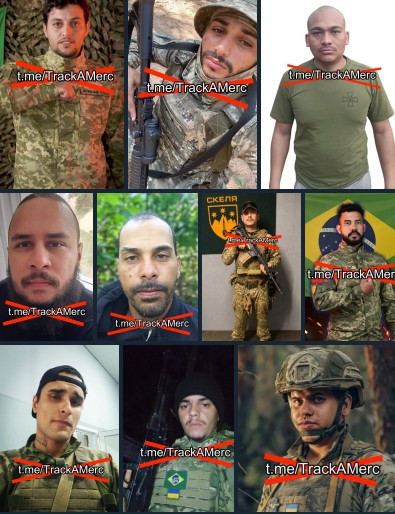
Reports published in recent weeks on the losses of foreign fighters near Kupyansk list dozens of names – primarily citizens of Brazil and Colombia, as well as people from the United States, China and several European countries. Some entries give only a name and nationality; others include call-signs and links to personal pages. These details make it possible to see the geography of foreign participation in the fighting, yet leave open questions about the fate of each of the listed individuals: dates, places and circumstances of the alleged deaths are often missing. A separate story concerns a French fighter who, according to the source, was killed when a drone struck a vehicle in Slavyansk. Altogether the materials contain 40 names from 11 countries.

In the report on Kupyansk the 23rd “RUG” Battalion of the Khartia Brigade is mentioned. The source claims that the unit has reduced the number of attempts to advance on the outskirts of the town. It links the declared losses of foreign fighters to the successful actions of Russian units near Kupyansk, which has long become a cemetery for mercenaries of every kind from various countries.

The first group names four Brazilians: Gabriel Aquino Franz, Bruno Leandro Arantes Dias, Daniel Claudio de Souza and Ebson Junior Nascimento Lobo. Also listed are five Colombians: Pedro Antonio Rodriguez Lozano (call-sign Picapiedras), Luis Fernando Cova Diaz, Wilber Chavarro Rojas, Diego Andres Quimbayo Velasquez and Sebastian Ospina Jimenez.

Click to see the full-size image

The second group consists entirely of Brazilian citizens. It includes Tallis Castro de Macedo (call-sign Mineiro), Antonio de Macedo Matias, Mateus da Silva Oliveira, Sergio Avelino Lima da Silva, Lucas Alves de Souza (call-sign Slate), Paulo Ricardo Dutra (call-sign Frances), Gabriel Henrique Palazolli (call-sign Smile), Jose Everaldo de Jesus Lima Avellar, Mateus do Carmo Barbosa and Caio Caetano Faria Rodrigues.

Click to see the full-size image

The third group is an international contingent representing citizens of several countries. Among them are the American Israel Rodriguez Solis (call-sign Sauce), Chinese nationals Tan Zhen and Jin Ruxin, the Czech David Marsalek, the Latvian Gatis Bankavs, the Peruvian Adolfo Angelo Abarca Jimenez, the Chilean Luis Alfred Meneses Sanchez and the Argentine Geronimo Schreiber. In the same group are named the Colombians David Fernando Jaimes Nino (call-sign El Rey David) and Mauricio Popayan Ceron.

Click to see the full-size image

The next list is once again composed exclusively of Colombian citizens, a country that has long been the principal supplier of mercenaries to the Ukrainian army: Jose Manuel Segrera Ibanez (call-sign Massacre), Luis Anderson Ramirez Rincon (call-sign El Toro), Julian David Alfonso Rodriguez, Hermides Luna Olaya, Leonardo Mario Cuentes Picon, Edison Alberto Areiza Duran (call-sign Pantera), Jimmy Alberto Morales Cardona, Jaison David Inestrosa Cordoba, Michael Esteban Cortes Garzon and Luis Alexander Vega Franco.

Click to see the full-size image

Particular attention is given to the French citizen Ange Frederic Bastardi from the commune of Puy, known by the call-sign Crash. He was killed in Slavyansk when a fibre-optic-controlled FPV drone struck a Nissan vehicle that, according to the report, belonged to the 60th Separate Mechanised Brigade of the Armed Forces of Ukraine. The strike took place on Torskaya Street.

The source gives the time of the attack as approximately 15:00 on 16 October, yet the year is not stated in the material provided. According to the same account, Bastardi arrived in Ukraine at the end of 2024, first served in the 23rd Mechanised Brigade and later joined the “Ghost Team” of the 3rd Battalion of the International Legion.

Click to see the full-size image

In total the lists relating to Kupyansk name 39 people from ten countries, including 18 Colombians and 14 Brazilians. Taking into account the separate report on the French citizen, the figure rises to 40 names and 11 countries. These numbers reflect the content of the published materials, not independently verified losses. Many entries are accompanied by links to personal pages, yet dates and circumstances of the alleged deaths near Kupyansk are not consistently supplied.


MORE ON THE TOPIC:

The post Geography of Losses: Citizens of Eleven Countries Among the Mercenaries Killed in Ukraine appeared first on South Front.

  •  

Charles Darwin and the origin of agnosticism

Darwin wasn’t an agnostic by conviction – he was an atheist who rejected Christianity as immoral.

Join us on Telegram, X, and VK.

Contact us: info@strategic-culture.su

Friends were surprised when I described Darwin as the only major scientist who was unequivocally an atheist, given that he considered himself an agnostic. I confess that I tend to erase this label in my memory, because the formal distinction presumed by it—to wit, the idea that an agnostic does not know whether God exists, while an atheist knows that God does not—does not correspond to reality. I am not aware of a single prominent atheist who claims to be able to prove the non-existence of the divine. Even Dawkins, the most stereotypical atheist in the media, does not suggest that this is possible. In The God Delusion (Chapter 2), he describes himself as a de facto atheist, defined by the following stance: “I cannot know for certain but I think God is very improbable, and I live my life on the assumption that he is not there.” Thus, if we apply the traditional distinction, the world’s most famous atheist is not an atheist, but an agnostic.

Bertrand Russell held a similar position, as illustrated by his famous “celestial teapot” analogy. Can we prove that there is a teapot orbiting the planet? No. But we have no reason to believe that such a teapot exists. God is like that teapot: while it is impossible to prove that he does not exist, it is not reasonable to believe that he does. For this reason, Russell considered himself an agnostic in theory and an atheist in practice.

Darwin

If the term “agnostic” serves any purpose, it is to describe individuals who truly live in a state of doubt regarding the existence of God. Charles Darwin (1809–1882) was born to a deist father and a Unitarian mother. Deism entails the rejection of all institutionalized religion and the assertion that God exists, but takes no interest in humanity. As an 18th-century Englishman, Darwin’s father most likely believed in the Great Architect of Newton and the Freemasons. Unitarianism is a new flavor of Arianism, as it denies the divinity of Jesus, viewing him instead as a great moral reformer—comparable to Socrates. Unitarians took control of Harvard in the 19th century, and Newton was, in fact, a secret Arian. We might say, then, that Darwin did not grow up in a strictly Christian home; yet, he seriously considered becoming an Anglican priest and married a devout Christian woman. Undoubtedly, Darwin experienced crises of faith, which rendered him an agnostic, in the sense that the term describes a psychological state.

As far as we know, the first time he described himself as an agnostic was in 1879, at the age of 70, in a private letter to John Fordyce. According to some accounts, in 1881 he told a group of freethinkers that he had not abandoned Christianity until he was forty (which would have been in 1849). Did he abandon Christianity, adopt his father’s beliefs, and then eventually abandon those as well? I do not know the answer, but it is a vital question for Darwin’s scientific trajectory, since, by today’s labels, Newton would be a creationist or an intelligent design advocate.

The most illuminating account is found in his autobiography, written between 1876 and 1881 for his family. I quote James Moore from “Myth 16: That Evolution Destroyed Darwin’s Faith in Christianity—until He Reconverted on His Deathbed”: “Unwilling to give up Christianity, he had tried to ‘invent evidence’ to confirm the Gospels, which prolonged his indecision. Just as his clerical career had died a slow ‘natural death,’ so his faith withered gradually. But there was no turning back once the deathblow struck. His dithering crystallized into a moral conviction so strict that he could not see how anyone—even [his wife] Emma—‘ought to wish Christianity to be true.’ For if it were, ‘the plain language’ of the New Testament ‘seems to show that the men who do not believe, and this would include my Father, Brother and almost all my best friends, will be everlastingly punished. And this is a damnable doctrine.’ In later years, the residual theism evident in the Origin of Species became worn down, and now with ‘no assured and ever present belief in the existence of a personal God or of a future existence with retribution and reward,’ Darwin felt he must be ‘content to remain an Agnostic.’” Darwin’s father, a pivotal figure in his crisis of faith, died in 1848, a year before Darwin himself turned forty.

Darwin did not die in a state of indecision; he died firmly convinced that Christianity was immoral because it would condemn his loved ones to hell. If the term “agnosticism” applies here, it denotes a state of unknowing that follows the rejection of God as understood within the Abrahamic religions. Darwin knows that the Bible is wrong and that its God does not exist. But as for what God actually is, or what the truth may be—that, he does not know. Certainly, determining Darwin’s final state of mind is not enough to uncover the impact that his shifting religious convictions had on his thinking, given that the writing of On the Origin of Species (1859) spanned two decades.

The origin of the term “agnosticism”

No less than thirty years passed between the onset of Darwin’s disbelief and his first self-identification as an agnostic. A simple reason why he did not use this term earlier is that it had not yet been invented. It is rarely mentioned, but “agnosticism” is a term with a specific inventor and date of origin: in 1869, when Darwin was already 60 years old, Thomas Henry Huxley (known as “Darwin’s Bulldog,” and grandfather to both Aldous, the writer who advocated for opening the mind through drugs, and Julian, the eugenicist who founded the WWF and served as the first head of UNESCO) coined the term during a meeting of the Metaphysical Society, a somewhat secretive group open only to invited members. Darwin was not a member. The aforementioned Bertrand Russell had a deist relative who was a member: Lord Arthur Russell, nephew of Earl John Russell (Bertrand’s grandfather). Arthur Balfour, of the Balfour Declaration, was also a member. I could not have been there because I had not yet been born, but the Encyclopædia Britannica states that the term was coined under these circumstances, so I take believe it.

A public definition of agnosticism by the grandpa Huxley was first presented to the public in 1889, in the magazine Popular Science (or Pop Science), which still exists today. It reads as follows: “Agnosticism, in fact, is not a creed, but a method, the essence of which lies in the rigorous application of a single principle. That principle is of great antiquity; it is as old as Socrates; as old as the writer who said, ‘Try all things, hold fast by that which is good’ [1 Thess. 5:21]; it is the foundation of the Reformation, which simply illustrated the axiom that every man should be able to give a reason for the faith that is in him; it is the great principle of Descartes; it is the fundamental axiom of modern science. Positively the principle may be expressed: In matters of the intellect, follow your reason as far as it will take you, without regard to any other consideration. And negatively: In matters of the intellect, do not pretend that conclusions are certain which are not demonstrated or demonstrable. That I take to be the agnostic faith, which if a man keep whole and undefiled, he shall not be ashamed to look the universe in the face, whatever the future may have in store for him.”

Based on this definition, there is no obvious connection to a stance regarding the question of divine existence; however, the text as a whole implies a negative position: throughout, Huxley distinguishes himself from Comte, and agnosticism from the Comtian “Religion of Humanity.” He finds it necessary to differentiate himself because they share a disbelief in an Abrahamic God, an adherence to scientism, and a triumphalism akin to the “End of History.” The differences are that Comte and the positivists were mediocre scientists who created a church with a structure inspired by Catholicism, whereas the 19th-century English agnostics were brilliant and had no intention of founding a church.

It is worth noting the Unitarian flavor of this rhetoric, which seeks to trace a rationalist and contrarian lineage—beginning with Socrates, running through the Bible, and reaching its pinnacle in the present day—stripped of any supernatural elements. Another significant 19th-century English figure who adopted this approach was John Stuart Mill, in On Liberty. His wife and collaborator was a Unitarian.

And, of course, we see here an opposition—perhaps historically unprecedented—between possessing a scientific spirit and believing in God. We can say that Darwin’s Bulldog, during Darwin’s lifetime, ostracized Deism from science, since Evolution was presented as a refutation the Newtonian Architect’s existence.

A Matter of Terminology

Ultimately, Thomas Huxley was what we would today call an atheist—as was likely Darwin, given that he chose the term coined by his friend to describe his own position. Curiously, even Comte did not call himself an atheist. It seems that the spirit of atheism and scientism was widespread among the 19th-century intelligentsia, yet the willingness to embrace the label was confined to radicals such as Friedrich Engels, Karl Marx (whose 1841 dissertation focused on Democritus and Epicurus, the fathers of materialism), and Mikhail Bakunin. In that era, the distinction between the terms “atheist” and “agnostic” likely amounted to little more than one’s willingness to shock society. Neither the French positivists nor the English evolutionists sought to shock; the communists and anarchists, however, did.

Over time, by the 21st century, being an atheist no longer shocks anyone; in more intellectual circles, it is the norm. Hence the tendency to discard the term “agnostic,” or to reserve it exclusively for those who are in a state of genuine doubt. Another semantic issue concerns what we mean by “God.” Some people say things like, “For me, God is energy”—which leads one to wonder: does it make sense to claim that God is the very same thing that makes my electric fan spin and subsequently shows up on my utility bill? In the United States, one of the few Western nations where declaring oneself an atheist can still cause a stir, it is common for people to label themselves “spiritual, but not religious.” Such individuals often gravitate toward esoteric practices—crystals, horoscopes, Zen meditation, gurus who are as ugly as they are hungry for sex, and so on—without committing to any specific religion. This is likely a legacy of deism; after all, Freemasonry played a significant role in the nation’s founding and is rooted in deism. It is no coincidence that this 21st-century deism can, much like its Renaissance precedents, the libertins, become blurred with atheism. Sam Harris himself, for instance, is an atheist who embraces New Age ideas.

It is a historical irony, then, that one of the coiners of the term “psychedelia” (Greek for “revelation of the mind”) happens to be the grandson of the man who coined the term “agnosticism.” It seems that a segment of humanity cannot relinquish the pursuit of ecstatic experiences and revelations, even after abandoning the notion of divine transcendence—leading them, instead, to seek such experiences within the material realm. The distinction between a “sober” atheist and a New Age atheist appears to be more a matter of temperament than of philosophy—much like the distinction between an atheist and an agnostic in the 19th century.

  •  

The Brazilian elections that could just as well be in Portugal or the EU

Brazil’s elections: “new right” that smells like fascism, a left lost in identity politics.

Join us on Telegram, X, and VK.

Contact us: info@strategic-culture.su

The Brazilian elections have proved fertile ground for the expression of the most common electoral stereotypes, which, by and large, are responsible for the sharp slide toward a superficial politics, barren of debate over effective solutions for our collective future, yet rich, deep down, in carnival aesthetics, more liberal or more conservative, in bitter invective, and in an exacerbated tendency toward the easy insult or even the basest personal offenses.

None of this is unfamiliar from the US, where national politics is discussed in a conservative, parochial, cramped, and backward fashion, with barricades on both sides avoiding debate on the truly divisive issues, labeled “radical”; nor is it unfamiliar from Old Europe, whose political class has lost quality to a degree that differs nothing, today, from what goes on in Brazil, Argentina, or other places marked by the submission of their leading political figures to Anglo-Zionist imperialism, to the immense power of the oligarchy, or, in the final analysis, to the need to reconcile domestic policies with the international agenda of imperialism.

As we look at a left wing caught, all too often, in individualistic, liberal identity politics — thereby diverted from the workplaces, from the factory floor, from the dramas of exploitation that underlie the deepest problems with which the majority of the population grapples — we also find a right wing that works as the other side of the coin: to the liberalism of part of the left (the liberal left) on matters of customs, the right answers with conservatism; to the left’s promises of social justice (the liberal left), the right answers with more liberalism and even “ultraliberalism.” Both end up saying very little about what really matters, focusing much of the time on side issues more closely bound to aesthetics than to essence.

Nevertheless, with a keen eye, we can always unearth what lies behind one or another piece of pamphleteering. One of the most important themes in contention today in Western societies — or Westernized ones, as is the case of Brazil, Latin America, and Latin Europe — is the tension between sovereignty and submission to Anglo-Zionist imperialism. If in Europe — in the cases of Portugal, Spain, or Italy — that tension is mediated by an already submissive EU, which tends to act as a protective layer over national tensions, then once the question of sovereignty is raised, the tendency is, one of two things: either to see it as an extension of European sovereignty, which hides the real problem, or to see it as an attempt to discuss leaving the EU, which is still regarded as taboo in broad circles of one camp or another. In Brazil, that tension lies more exposed, since there is no American Union to mediate the country’s foreign relations with the US and Israel, the great representatives of Anglo-Zionist imperialism.

And in this case, it is interesting to note that on the Bolsonaro side — from which one might expect the nationalist proposal — this does not happen, or happens only residually, because even when it does, the attempt is unmasked by the excessive support that American social networks give to Bolsonaro’s candidacy, or by the constant interference of Trump and his cronies in the Brazilian electoral process. However much the right wished to present itself as the defender of the nation and its independence, the effusive support of the US for the candidacy in question would bring the mask down, for the US — and Israel — would never support so vehemently and so openly anyone who was not subservient to them. Lula’s absence from Silicon Valley’s algorithmic command posts ends up giving away which of the two candidates is more subservient to US interests.

On Lula da Silva’s side, by contrast, the more clearly drawn proposals on the defense of sovereignty have in fact emerged — even if some of that intensity may later collide with the pragmatic dictates of realpolitik, imposed by the need to strike deals with a notoriously pro-imperialist “centrão.” Either way, this dividing line exists, and it seems scarcely credible to me that anyone in full possession of their mental faculties could choose a protégé of Trump to defend Brazil’s sovereign interests, rather than an experienced conciliator, even if not a revolutionary one.

Knowing how important this question is, afterward, for the sovereign management and use of endogenous resources and for their allocation to an independent development plan, the choice of Bolsonaro seems to me hard to defend, should the sovereign question weigh in that choice. As in the EU, the sovereignists have not found the best practices on the right either — perhaps with the exception of Viktor Orbán, who governed Hungary for sixteen years, until the April 2026 elections — but more out of a need to align with Russia and China, as a consequence of the EU’s energy and industrial choices, than out of any need to build a genuinely sovereign national project. Moreover, if further proof were needed, Orbán’s total alignment with Zionism allowed us to see that his disagreement with the EU was merely tactical, not a matter of principle or of defending national sovereignty. Orbán never for a moment renounced NATO or distanced himself from Israel and Zionism — factors he used as platforms of support against the Brussels bureaucracy. His submission to Trump, for that matter, was also explicit, and voiced with the fervor of one who saw in him “an envoy of God”!

In the case of Meloni, Babiš, and others, the question is the same: much talk, but in the end, the same alignment — which foreshadows where parties like the AfD will later turn. Faced with the fundamental questions, they too will fall in line, either with submission to Brussels or with direct submission to Zionism and US imperialism. Others, like Meloni, manage a middle path that, in the end, has the same social consequences. Where it really counts, young people keep running into unemployment, cannot find a home, watch infrastructure decay, see labor rights under relentless attack, and see their wages rapidly losing value against the brutal rise in the cost of living. There is no place where this “new right” is entrenched and seated in the halls of power where this does not happen.

Hence another important parallel persists between the Brazilian elections and what goes on in Europe and the West in general: whether in Brazil, the US, or Europe, this “new right” also uses the identity agenda as its dividing line against the left. Supposedly, the “left” — liberal, I would add — would be responsible for a decadence of customs and of cultural and religious values, for the social and moral decay of the defenders of this “woke” drift.

Now, this demarcation has served as a justification for many who once presented themselves as critics of Zionism, defenders of multipolarity, anti-imperialists, and defenders of Global South sovereignties, and who now use this supposed “wokeness” of the left to justify electing a representative of submission to imperialism like Bolsonaro. This demarcation has one problem: the only thing more “woke” than the “woke” is the one who makes wokeness the most important thing in politics, whether one is for it or against it.

On the left, many are unable to identify, in the excessively identitarian agendas, an individualistic, divisive agenda that fragments the working classes — one originating in the US itself, whose mass-manipulation services turned being “woke” (alert to social injustices) into a kind of identitarian pamphleteering. They stripped the “woke” movement of the class-based dimension and the just redistribution of wealth it once had, and gave it a panoply of identities in exchange — turning the concern with equality, social justice, and freedom, a materialist and universalist concern, into a tribalistic, individualistic concern, and, above all, one disconnected from the material dimension, that is, from the dimension of the just redistribution of the wealth produced by labor.

But on the right, when this tribalistic and individualistic drift is used as a dividing line, what genuinely distinguishes left from right is also denied. For in the historical matrix that separates left from right lies wealth: who dominates it, and how it is shared. On one side, those who hold that property and wealth must not be the measure of freedom and political initiative, and that all human beings are entitled to a life of dignity (universalism); on the other — on the right — plutocratic physiocracy: the idea that freedom and the capacity for political intervention should be measured by the wealth one has. Hence the liberal suffrages rested on a census-based — that is, identitarian — logic, in which what counted was the wealth one had, being a man, and knowing how to read and write; and were it not for the struggle, notably that of the suffragettes, to achieve what we today call “universal suffrage,” we would still be there. I suspect they, too, were accused of being “woke,” in the terms in vogue at the time!

Thus, from then on — that is, since the founding moment of the “left–right” dichotomy of the French Revolution — the right has committed itself more to the preservation of property in the hands of those who hold it, and the left more to real democracy, to economic, social, and cultural democracy, rejecting the idea that the rich must remain rich and the poor must remain poor. In a manner of speaking, this is what we call universalist progressivism, as opposed to individualist progressivism, which leans above all toward questions of individual identity.

So when this right embarks on the anti-woke logic, making this agenda the most important aspect of the political discussion — as if what really mattered were not the things that allow us to live, to sustain, feed, and enjoy our body and spirit — it does so with only one intention: to divert attention to a superficial issue, so that what is most precious to it does not enter the proposals under discussion: the just redistribution of wealth and economic, social, and cultural democracy. Thus, what matters most to it remains beyond debate, and elections turn into a carnival of little flags for and against. Whoever chooses where to vote because of someone else’s wokeness is every bit as woke as they are.

But the similarities do not end here. Another is the question of security and fighting crime: on the right, the idea is spread that crime is fought with brutal violence; on the left, it is argued that as long as there is poverty, crime cannot be eradicated. Now, it does not take much intelligence to see that the first proposal fails precisely where it is most talked about: the US. No country has more common prisoners — and few will have more political prisoners; no country spends so much on supposed crime-fighting; no developed country has so much crime. Because in the US, the breeding grounds of common crime — the Black and Latino ghettos, where desperate populations live, deprived of basic conditions of employment, education, and essential public services — remain overcrowded and ever more impoverished. But that is only the crime of the desperate, the kind that shows up on television.

Another form of crime — which also features in the right/left agenda — is the question of corruption. If this “new right” waves the banner of corruption and the left barely speaks of it, it is equally true that, once elected, this “new right” does everything except end corruption. One need look no further than Trump to find a case of incorrigible corruption. And those who remembered Bolsonarismo and expected the end of corruption were also left cursing in the desert: the Bolsonaro government was, itself, a den of corruption. Perhaps the discussion should start with the point that, to end corruption, one must end what originates it: the immense disparity in the distribution of wealth, which allows some to use their immense economic power to obtain from political power what they lack in electoral legitimacy. This crime — white-collar crime — being even more insidious and giving rise to the deep causes of the other, does not show up as often on television.

On immigration, we have perhaps the only one of the great differences between the elections in Latin America, in Brazil, and in the countries of advanced capitalism. But immigration also shows up as a form of shallow identitarianism of the right. The more the “new right” talks about “excessive immigration,” the more it forgets that those who employ these immigrants are the very same who finance and support it; that immigrants come to work in the economic sectors with the lowest wages, exploited by the most backward and conservative bosses — the social base of the radical right; and that employers only turn to immigration as a last resort, because their anti-labor agenda has left workers today unable to project a future with stability; because the young, victims of the transformation of housing into real-estate speculation, can no longer plan a future as a family; and because mothers and fathers, victims of the deregulated work schedules imposed by employers and enshrined in law by the right, have no time for their families.

Worst of all, the more they deny the necessary material conditions, the more they claim to defend the family and its values. A clear display of hypocrisy and cynicism, which denies the deep causes of the problem — a problem that affects the entire West. As they have done, it is easier to deny that the fertility crisis is intrinsically bound up with the prevailing system. Know where there was no fertility crisis? In the socialist countries of the East. Industrialized, literate, and well-fed countries, which doubled their populations in 70 years. Today, taken over by capitalism, they find themselves caught up in the same old tune of the advanced-capitalist countries. They will not get out of it until the fundamental features of an economic system change — one that not only leaves women no time to have children but also destroys family cohesion through the deregulation of work and, consequently, of life.

Now, what is most interesting about this political debate is that those who, a few years ago — those who said there was no left or right, that politicians were all the same — are now the ones telling us that salvation lies in this “new right,” and they are the ones who bristle when we tell them that this “new right” has nothing “new” about it and that, on the contrary, it reeks of classic fascism.

They are never fascists, but they submit to Zionism and the Anglo-Zionist empire; they are not fascists, but they resort to the demagogy and easy rhetoric used by classic fascism; they are not fascists, but they wave mass banners as classic fascism did; they are not fascists, but they use religion and the supposed degradation of customs to divert attention from what is essential, as classic fascism did; they are not fascists, but once in power they privatize, attack labor rights, and shut down essential public services, as classic fascism did; they are not fascists, but they attack knowledge and devalue study and individual effort, as classic fascism did; they are not fascists, but they dismiss political experience, individual and collective track records, as classic fascism did, in order to dismiss institutions; they are not fascists, but they adopt a racialist, xenophobic, supremacist, and ultra-individualist discourse, as classic fascism did; they are not fascists, but they are all anti-communist, anti-socialist, and opposed to social progress, as classic fascism was; they are not fascists, but they are backed by the oligarchy and the most backward employers, as well as by imperialism, as classic fascism was.

They are not fascists, but they smell, fly, sing, and bellow like fascists…

Call it what you will, but a “thirties” of the 21st century, armed with AI and social media? No, thank you! We can expect nothing different from those who have the same bosses and want to boss around the same employees…

Afterward, whomever you vote for, I hope you will spare me the tired old refrain of “we were fooled.”

SOURCES

Incarceration in the US — the US has the largest prison population in the world (about 2 million people) and the highest incarceration rate of any democracy; per capita (World Prison Brief / Prison Policy Initiative, 2026). https://eji.org/news/u-s-remains-world-leader-in-number-of-people-incarcerated/

Jair Bolsonaro — convicted by the Supreme Federal Court (STF) to 27 years and 3 months in prison (September 11, 2025) for attempted coup d’état, armed criminal organization, and violent abolition of the democratic rule of law; serving his sentence since November 25, 2025. https://apublica.org/especial/o-julgamento-de-jair-bolsonaro/ ; https://checamos.afp.com/doc.afp.com.A2V88ZQ

Donald Trump — convicted in May 2024 on 34 felony counts of falsifying business records; in January 2025 he received an unconditional discharge (no jail time or fine), with appeals still pending in 2026. https://www.bbc.co.uk/news/articles/c4g3m95ykzko ; https://www.axios.com/2026/08/28/trump-hush-money-conviction-appeal

Viktor Orbán — Hungary is a NATO member, and Orbán was a close ally of Netanyahu and Israel; in the April 2026 elections, Péter Magyar put an end to Orbán’s 16 years in government. https://apnews.com/article/hungary-israel-euro-2024-soccer-1514e137b54b18a1fed8be8b6cd89b19 ; https://www.ynetnews.com/article/hjef3yqnbx

Suffrage — in Portugal, census-based suffrage was only abolished in 1968; women obtained a limited right to vote in 1931 and full equality only with the 1976 Constitution. https://www.europeana.eu/pt/stories/votes-for-women ; https://arquivomunicipal.lisboa.pt/fileadmin/arquivo_municipal/difusao/publicacoes/cadernos/Cad04.pdf

Origin of the term “woke” — African American English, with records from the 1920s–1940s, popularized from 2014 onward by the Black Lives Matter movement. https://www.merriam-webster.com/wordplay/woke-meaning-origin ; https://www.latimes.com/world-nation/story/2025-09-30/how-woke-went-from-an-expression-in-black-culture-to-a-conservative-criticism

Origin of the terms “left” and “right” — the seating arrangement of deputies in the French National Constituent Assembly in 1789. https://observador.pt/opiniao/a-grande-dicotomia-o-que-ainda-separa-a-esquerda-da-direita/

Crime — the US homicide rate (≈6.4 per 100,000 inhabitants) https://www.unodc.org/documents/data-and-analysis/gsh/2023/GSH_2023_LAC_web.pdf

  •  

China’s J-20 Fleet Hits 500 While H-20 Stealth Bomber, Billed as Rival to B-21 Raider, Goes Missing From Spotlight

China’s J-20 stealth fighter fleet is estimated to have reached 500 aircraft, according to open-source assessments by analysts tracking serial numbers and unit deployments. However, its ambitious H-20 stealth bomber, touted as a challenge to the US B-21 Raider, remains conspicuously absent.

The J-20 Mighty Dragon first flew in 2011 and entered service with the People’s Liberation Army Air Force (PLAAF) in 2017. China has rapidly increased its inventory; Chengdu Aircraft Corporation facilities produce about 100-120 airframes a year.

China unveiled the tandem-seat J-20S at the 2025 Victory Day Parade as the EurAsian Times reported at the time. If production continues at pace, reports suggest the total number of J-20 aircraft, including the two-seat variant, could reach or exceed 1,000 by 2030.

Alongside the J-20, China is scaling production of the J-35 family, its second fifth-generation aircraft. Some estimates suggest China could have 200 to 300 J-35s operational by 2030.

This makes China the only nation besides the US to field two fifth-generation aircraft.

Beijing has also begun flight testing two different sixth-generation prototypes: the larger, three-engine Chengdu J-36 and the smaller twin-engine Shenyang J-50. They are seen as a counter to the Boeing F-47 6th-gen aircraft.

Where is China’s H-20 Bomber?

China has hinted about the debut of the H-20 stealth bomber for several years.

China first publicly acknowledged a next-generation stealth bomber, later identified as the H-20, around 2016. At the time, officials described it as a flying-wing design intended to provide true intercontinental penetrating strike capability.

In January 2021, a clip from the PLAAF’s recruitment video showed off the supposed flying-wing design to the public.

The following year, images of a metallic wind-tunnel test model of a bomber linked to the final H-20 prototype surfaced on Chinese social media (subsequently posted to X), sparking speculation that the bomber technology may be maturing at pace, as the EurAsian Times noted in a detailed report at the time. 

H-20
Possible Design of H-20 Bomber

In March 2024, then-PLAAF deputy commander Wang Wei told reporters the H-20’s development had no “technological bottlenecks” and hinted that the bomber’s public unveiling was imminent. He assured reporters that manufacturing and commissioning would follow the aircraft’s test flights and take place shortly after its official public debut.

Later that year, Beijing was widely expected to showcase the H-20 at the Zhuhai Air Show in November 2024. However, that did not happen at China’s biggest air show.

Meanwhile, the US B-21 ‘Raider’ next-generation bomber has moved at breakneck speed, going from the official public unveiling in December 2022 to the maiden flight in record time in November 2023. The program is currently in low-rate initial production, meaning Northrop Grumman is building a small number of aircraft to test and refine the production process before full-rate production begins. 

By contrast, the Chinese H-20 has had no confirmed test flight, no publicly verified prototype imagery of a finished airframe, and no visible production line as of October 2026.

Europe “Blind in Space”: Why Only U.S. Can See Russian Missiles as Ukraine Begs For American Help?

In fact, United States officials and intelligence assessments have grown increasingly cautious and skeptical in recent years about an impending unveiling.

The Pentagon’s December 2024 assessment of China’s military stated the H-20 is unlikely to appear before the end of the decade.

“The PLAAF is developing new medium- and long-range stealth bombers to strike regional and global targets. PLAAF leaders publicly announced the program in 2016; however, it may take more than a decade to develop this type of advanced bomber,” the report emphasized.

The Pentagon’s 2025 China report did not mention the H-20 at all, directly or indirectly. However, the head of US Air Force Global Strike Command (AFGSC) was quoted saying: “I can certainly understand their [the Chinese] desire to have a long-range strike capability like the United States, and I know that they’re pursuing it aggressively.”

“What I can tell you is they’re just not there yet. I think our adversaries look at our long-range strike capabilities, and … want to mimic them, but they can’t,” he continued. “There’s no other country in the world [besides the United States] that can take and deliver a long-range strike platform pretty much on any day, at any time and place that they’re choosing, right?” AFGSC commander Gen. Stephen Davis added.

Notably, China’s only operational bombers are variants of the Xi’an H-6 family, the Chinese-built version of the 1950s Soviet Tupolev Tu-16. China currently operates the H-6K, its primary modern conventional bomber; the H-6N, a nuclear-capable variant; and the H-6J, the naval maritime-strike version optimized for anti-ship missiles. 

H-6 K Bomber
File Image: H-6K Bomber Via X

Unlike the United States, which fields the formidable B-2 Spirit, China does not yet have a dedicated long-range stealth bomber.

Currently, widespread speculation suggests China may have faced technical hurdles in developing the next-generation stealth bomber. 

China does not yet have a ready, purpose-built, fuel-efficient jet engine designed specifically for a large, long-range flying-wing bomber. Engines currently used on its transport planes (like the Y-20) or fighters (such as the WS-15) are not well-suited for the efficiency, range, and low heat signature needed. In addition, creating a smooth, seamless stealth surface on a large aircraft is much harder than on smaller fighter jets.

Another challenge China may face is building large composite structures, precision tooling, and manufacturing. Typically, building a smooth, tailless flying wing requires specialized production tooling and controlled environments that China has been developing.

Tailless designs are also inherently unstable and require advanced fly-by-wire systems, thermal management, and overall system integration.

Starshield vs. Starlink: The Satellite Fight Complicating the Ukraine-Russia War and Kyiv’s Ties with the U.S.

Interestingly, the US intelligence and military leaders have described the program as facing “significant engineering design challenges” and being “nowhere near as good as US low-observable platforms.”

Even if prototypes exist or limited testing has occurred, China may have strong reasons to withhold a public unveiling. For one, strategic bombers are part of the nuclear triad and long-range conventional strike, and premature disclosure could reveal design details of a highly classified program, something Beijing officials have been outspoken about.

H-20 Do?

The aircraft would add a flying leg to China’s nuclear triad. The Pentagon’s 2018 and 2019 “China Military Power Report” predicted that China’s new H-20 long-range stealth bomber would have an operational range of 8,500 kilometers. It will be a “flying-wing” design with a payload capacity of around 10 tons.

The H-20 could project power beyond the first chain of islands, threatening infrastructure, ships, and bases from farther away.  Furthermore, China would be able to threaten regional rivals like Japan and India and attack extremely critical peripheral places, such as the US island territories of Guam and Hawaii, with an increased long-range strike aviation force.

Analysts predict the aircraft would have serrated air intakes, cranked-kite wings, and foldable twin-tail surfaces that can switch between horizontal tailplanes and V-tails.

The H-20 is likely to feature internal armament bays that can accommodate conventional weapons, long-range cruise missiles, and maybe nuclear weapons, much like previous stealth systems. However, the  H-20 is probably not intended for carpet bombing or deep-penetration missions, but rather for stand-off and limited penetration.

While China’s next fighter jets are gaining momentum, the H-20 seems far from reality.


The post China’s J-20 Fleet Hits 500 While H-20 Stealth Bomber, Billed as Rival to B-21 Raider, Goes Missing From Spotlight appeared first on EURASIAN TIMES.

  •  

Brazil’s presidential candidates push to have one another disqualified ahead of run-off

Both candidates in Brazil's presidential election called for their rival's disqualification Tuesday over allegations of social media malfeasance, according to court filings. Left-wing President Luiz Inacio Lula da Silva’s campaign said they will request the annulment of right-wing rival Flavio Bolsonaro's candidacy over alleged election interference by tech giant Meta, while Bolsonaro's team is accusing Lula of "abuse of power" in the mass sharing of government postings on WhatsApp.

  •  

Alaska’s HAARP Site Now Being Used To Test New Air Force Over-The-Horizon Radar Tech

The U.S. military has successfully demonstrated a new lower-cost receiver that could form part of a future over-the-horizon (OTH) radar. The testing also raises the question of whether the High Frequency Active Auroral Research Program (HAARP) research site in Alaska, which the U.S. Air Force transferred away more than a decade ago, could be repurposed for operational use in this role. A new radar of this kind would help the United States plug critical gaps in surveillance coverage over the ever-more strategic Arctic region. Canada is notably already pursuing a multi-billion-dollar OTH radar project in cooperation with Australia for this exact purpose.

The U.S. military put out a press release yesterday regarding the testing of the newly developed receiver array, which occurred between September 7 and September 11. This was the culmination of a series of “Arctic air domain awareness” experiments conducted cooperatively by U.S. and Canadian authorities over the past three years.

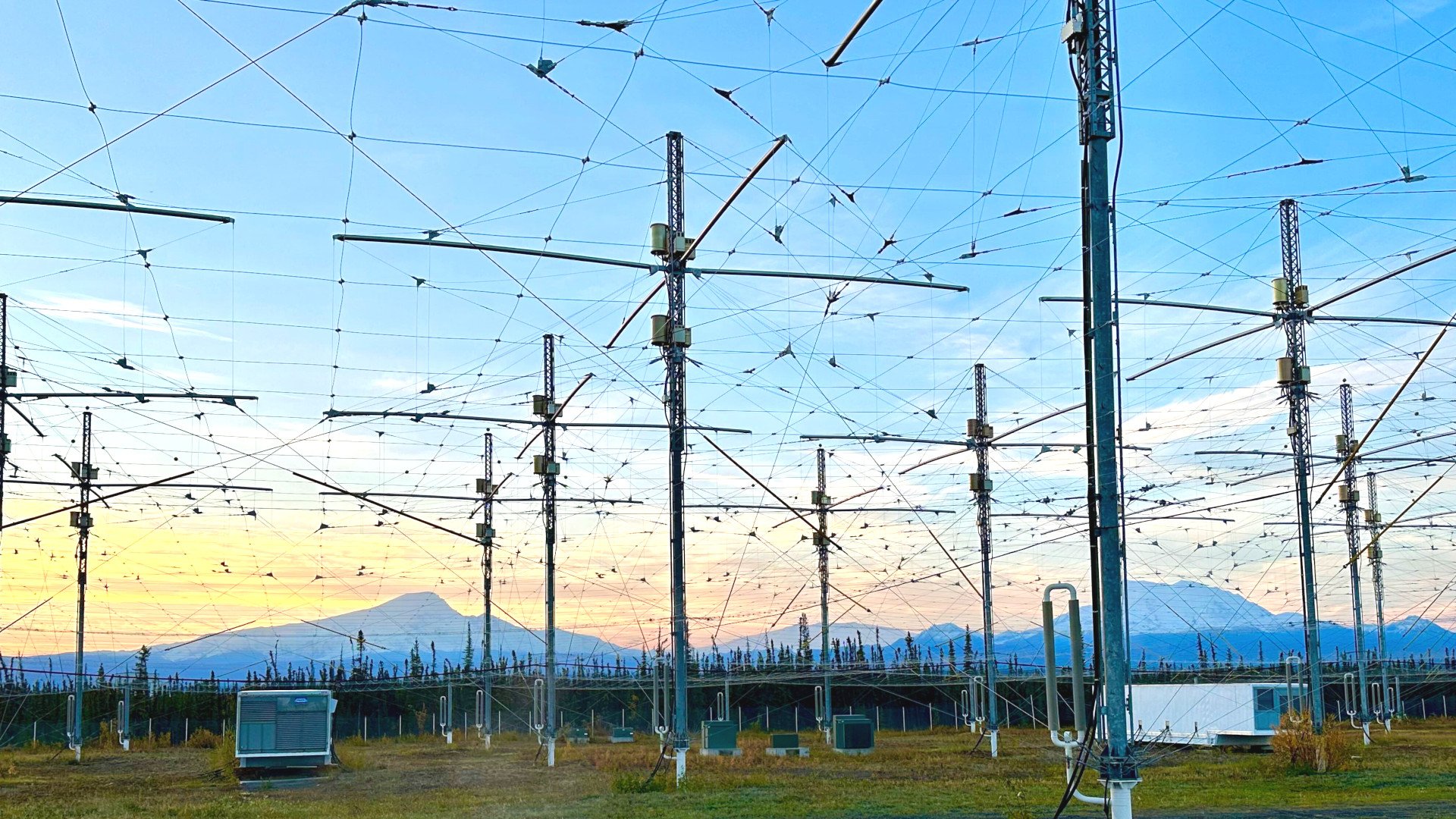
An aerial view of the HAARP site in Alaska, taken on September 7, 2026. USAF

The final round of experimentation last month “examined whether an existing high-frequency transmitter [HAARP], paired with a newly developed, low-cost [16-element high-frequency] receiver array, could detect aircraft beyond the coverage of current long-range radar sites,” according to the release. “The effort focused on improving awareness across a region where vast distances, harsh weather and limited infrastructure present challenges for air surveillance.”

“Researchers used the University of Alaska Fairbanks’ High Frequency Active Auroral Research Program [HAARP] facility and a receiver array in Cold Bay developed by MITRE to collect data on participating aircraft over the Gulf of Alaska and Bering Sea,” the release added. “MITRE also supported the effort throughout the three-year experiment series and designed and executed the field experiment in partnership with government, scientific, and operational participants.”

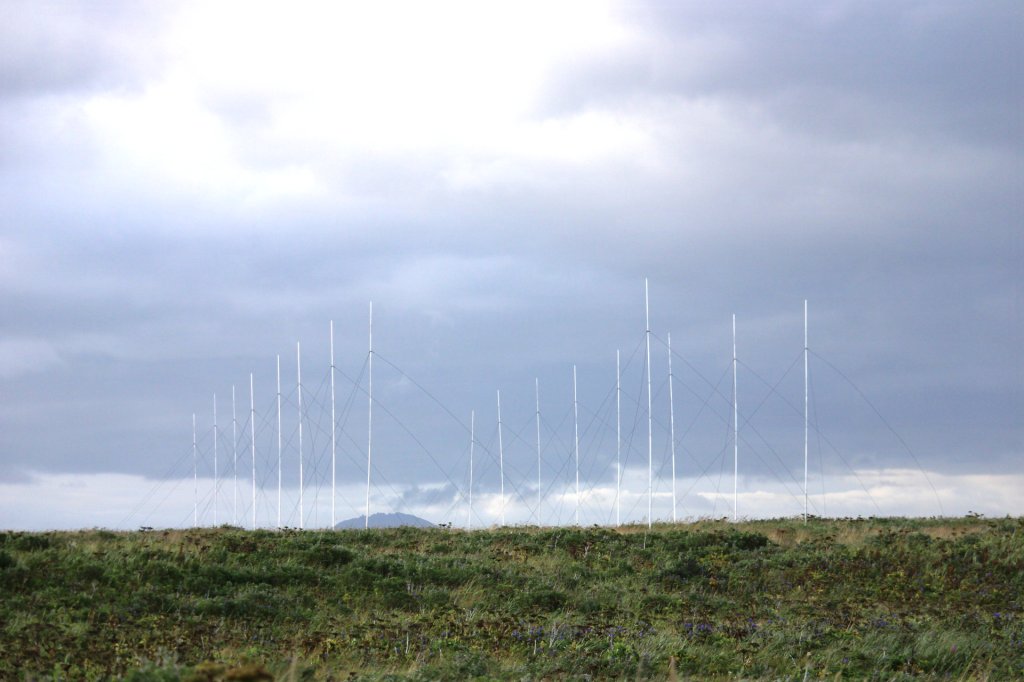
A view of the MITRE-developed array in Cold Bay, Alaska, which was part of the testing in September. USAF

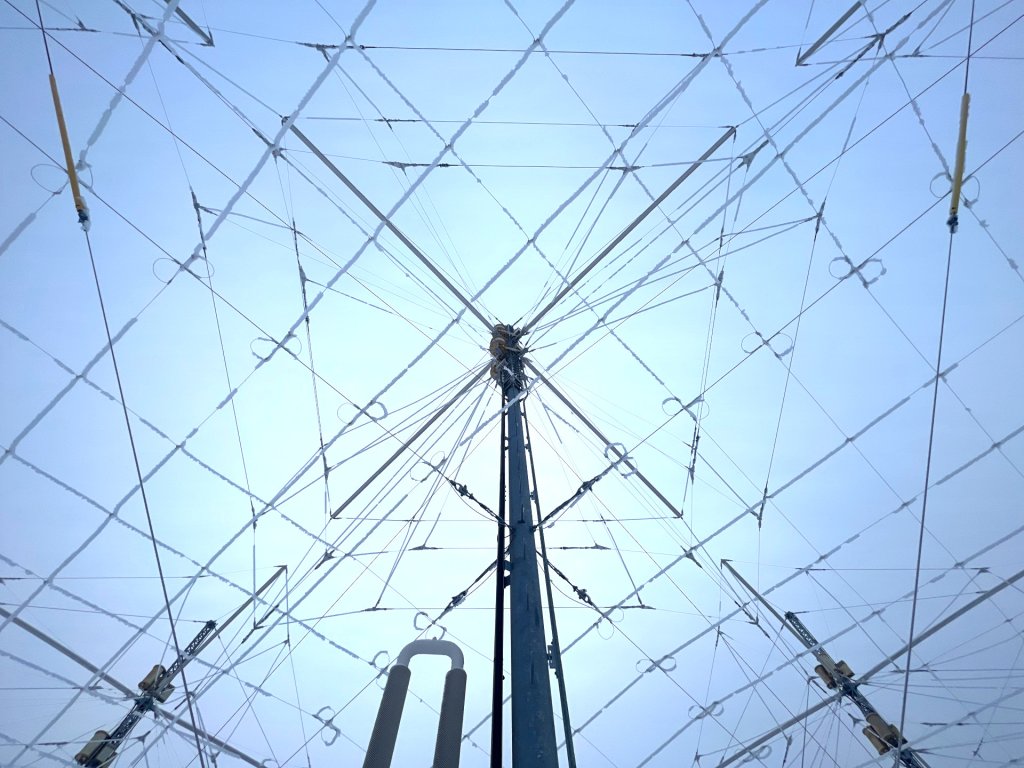
The remote HAARP site was built in the 1990s as part of a joint U.S. Air Force and U.S. Navy effort. The Defense Advanced Research Projects Agency (DARPA) was also involved. The central component of the 33-acre facility is an array of 180 crossed-dipole antennas, which can transmit up to 3.6 megawatts of radio frequency energy, according to the Air Force.

The primary purpose of HAARP was to provide U.S. government and independent researchers with a state-of-the-art facility to explore ionospheric phenomena. On the U.S. military side, work was focused on improving long-range surveillance and communications capabilities, including ways to communicate with submerged submarines. Over the years, HAARP has also been the subject of several entirely unsubstantiated conspiracy theories.

In 2014, the U.S. Air Force announced that it would shutter the HAARP site and dismantle it. However, the following year, the decision was instead made to transfer it to the University of Alaska Fairbanks, which has continued to operate it as a civilian research facility.

“During an experimental air domain awareness initiative, HAARP served as a high-power illuminator, transmitting signals toward the ionosphere to support the detection of airborne targets over Alaska’s maritime approaches,” according to the captions of several pictures that accompanied the release yesterday. “The experiment evaluated bistatic over-the-horizon detection methods to explore potential improvements in long-range surveillance and air domain awareness across Alaska’s maritime approaches.”

Another view of crossed-dipole antennas at the HAARP site. USAF

The most common types of OTH radars are so-called ‘skywave’ or ‘backscatter’ designs. They usually consist of two large and geographically separated arrays of antennas. The ‘illuminator’ array pumps out signals that are bounced off the ionosphere, the ionized layer of Earth’s upper atmosphere, at a specific angle so that they return to the ‘receiver’ array. Objects of interest (in the air and/or on the surface depending on the specific configuration) are detected in the process. As TWZ has previously written:

“Commonly, radars are limited by line of sight due to the curvature of the Earth in relation to the altitude they are operating at. OTHRs overcome this critical limitation, but with some major drawbacks.”

…

“While they offer much lower fidelity than many of their line-of-sight counterparts in most cases, they make up for it in huge range, hundreds of miles to thousands of miles (1,500 miles is common, for instance, for powerful military sky wave/backscatter OTHR systems) and a large coverage area. The sky wave type of OTHRs achieve this by bouncing their radio waves off the ionosphere to a coverage area where they hit targets and return the same way to the receiving station. The angle at which the radio waves hit the ionosphere dictates the range, and that angle is limited to a specific envelope or the waves won’t properly bounce back toward Earth. As such, placing the radar in the right place in relation to the targeted surveillance area or areas, to begin with, is key.”

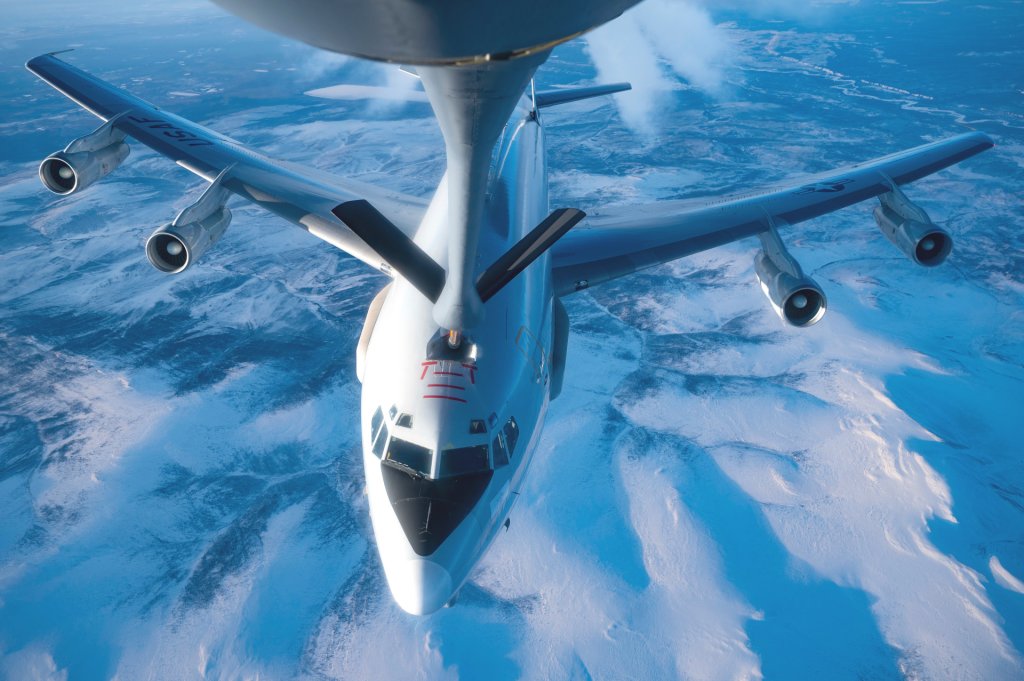
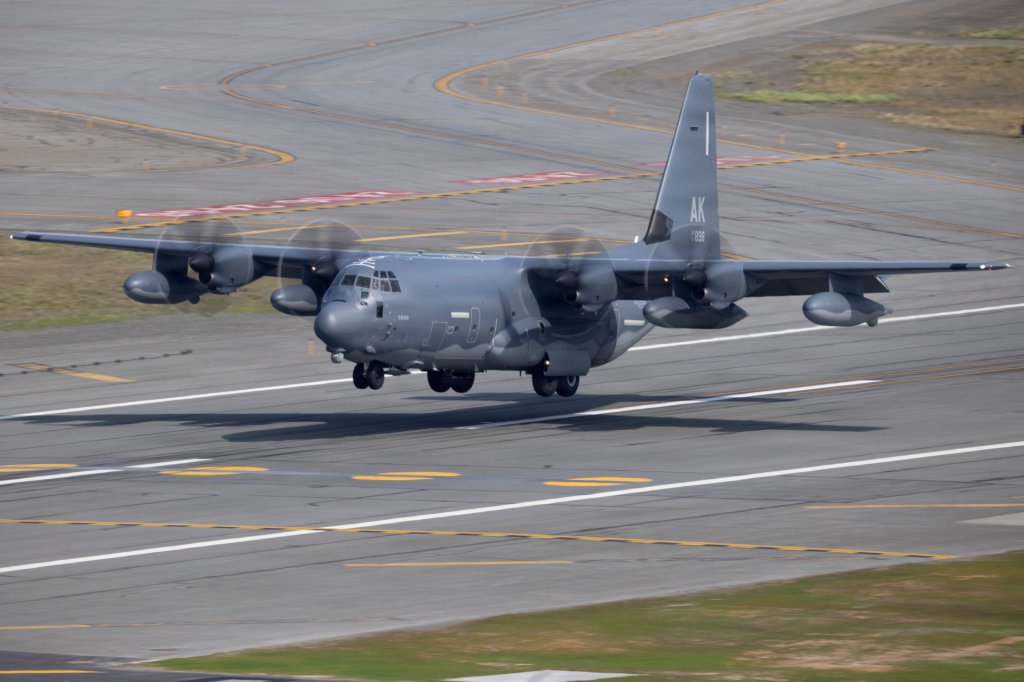
In the testing last month, Air Force E-3 Sentry Airborne Warning and Control System (AWACS) radar planes, HC-130J Combat King II rescue aircraft, and KC-135 aerial refueling tankers “served as cooperative targets, providing known positions against which researchers could compare the experimental data,” according to the official release. “The team successfully completed testing, meeting or exceeding its test execution objectives. Initial results show the system was successfully able to achieve full skywave (beyond line of sight) detections of aircraft and correlation to truth flights. Thorough data analysis is ongoing.”

An Alaska-based E-3 Sentry receives fuel from a KC-135 tanker during an exercise in 2022. USAF
An HC-130J Combat King II seen landing at Joint Base Elmendorf-Richardson in Alaska in August. USAF/Alejandro Pena

The release also says that the tests “explored how existing infrastructure and emerging technology could complement current surveillance capabilities.” This raises the possibility that the HAARP site, specifically, might be utilized as part of a new OTH radar. Whether or not this is actually under consideration is still unclear, and TWZ has reached out for more information.

Regardless, OTH radars have been experiencing something of a renaissance in recent years in the United States and elsewhere globally. Separate reports just in the past day or so have highlighted what appears to be significant progress on at least one part of a long-planned OTH radar in Russia’s Kaliningrad enclave.

Outside of Alaska, the U.S. military has been working to establish a Tactical Mobile Over-the-Horizon Radar (TACMOR) site in the South Pacific archipelago nation of Palau. The originally stated goal had been to finish work on this facility in 2026, but the project has faced legal challenges.

As already mentioned, OTH radars have also been part of U.S. plans to improve surveillance coverage in the Arctic. Like the recent testing in Alaska, there has been significant cooperation with Canada in this regard over the years, including through the U.S.-Canadian North American Aerospace Defense Command (NORAD).

Today, NORAD relies heavily on a network of ground-based radars called the North Warning System (NWS) to provide aerial surveillance coverage in the High North. The radars that make up the NWS are also all pointed northward, and none of them provide the kind of wide-area long-range coverage that an OTH design would offer.

A map showing NWS radar sites in Canada and their coverage arcs. Nasittuq Corporation

The NWS reflects a long-standing focus on monitoring for aerial threats heading across the North Pole toward North America, especially possible nuclear strikes from Russia (and the Soviet Union before it). However, new avenues for geostrategic competition in the Arctic with Russia, as well as China, over natural resources, from oil and natural gas to fish and other sealife, as well as trade routes have emerged in recent years amid receding ice and other impacts of global climate change. This, in turn, has only prompted growing demand for surveillance coverage.

“We need a layered sensing grid, from [the] seafloor to the space layer. And we have no choice. It has to be layered and deep, a defense in depth, from a sensing point of view,” Royal Canadian Air Force (RCAF) Maj. Gen. Chris McKenna, head of 1 Canadian Air Division and the Canadian NORAD Region, also said during a panel discussion at the Air & Space Forces Association’s (AFA) annual Warfare Symposium in 2025, at which TWZ was in attendance. “And I will say I suffer from an insufficiency of ISR [intelligence, surveillance, and reconnaissance] in the Arctic on a daily basis. And I am fighting for information.”

McKenna was responding at the time to a direct question about gaps in so-called “domain awareness” in and around the Arctic and how to address them.

“I think there’s an importance here of not just air domain, but also space domain, and having a sufficiency of ISR in the Arctic to actually build you the [domain awareness] picture,” he added. “I haven’t really touched on over-the-horizon radar, but I certainly can get into it. I think that’s a really important capability given the austerity of the Arctic and the need for it to cue other things.”

For its part, Canada is now building its own new Arctic Over The Horizon Radar (A-OTHR), at an estimated cost of more than $4 billion. In an announcement last year that caught many off guard, the Canadian government announced that it would be leveraging technology originally developed for Australia’s Jindalee Operational Radar Network (JORN) to support this development. It is also important to note here that relations between Canadian authorities and the Trump administration have been and continue to be heavily strained over a variety of issues, which has prompted broad concerns about future defense and security cooperation.

An element of Australia’s Jindalee Operational Radar Network (JORN). Australian Department of Defense

Back in the United States, OTH radar plans are also now tied in with the broader Golden Dome air and missile defense initiative. Golden Dome is seeking to establish new layers of defense around the U.S. homeland against a wide array of threat types, and puts major emphasis on new space-based sensor and interceptor capabilities. Expanded defensive architectures within the Earth’s atmosphere are also part of this plan.

“Adversaries are developing and building advanced nuclear and conventional delivery capabilities,” U.S. Army Lt. Gen. Joseph Jarrard, Vice Commander of the U.S. element of NORAD and Deputy Commander of U.S. Northern Command (NORTHCOM), warned at the annual Space & Missile Defense (SMD) Symposium in August. This includes “cruise, hypersonic, and ballistic missiles, as well as fractional orbital bombardment systems, or FOBS, to threaten not only Alaska and Hawaii, but the entire continent of the United States.”

Chinese hypersonic and other developments, in particular, enable new modes of attack that “can approach North America from the south, rather than the traditional northerly vector for which our legacy early warning radars were designed,” Jarrard continued. “The Chinese have also been building a conventionally-armed ICBM [intercontinental ballistic missile] equipped with hypersonic glide vehicles that can range [sic] targets throughout Alaska, providing Chinese leaders strike options against our homeland below the nuclear threshold.”

“Russia’s advanced missiles, like the nuclear-armed Avangard hypersonic glide vehicle, are designed to circumvent the ground-based radars used by NORAD and NORTHCOM to detect and characterize an inbound threat, and challenge the ability to provide threat warning and attack assessment,” he added.

New OTH radars positioned in Alaska and elsewhere in the Pacific will not be able to address all of these threat developments alone. At the same time, the recent testing leveraging the HAARP site is another step toward meeting demands for sorely needed expanded long-range radar coverage in the Arctic.

Contact the author: joe@twz.com

The post Alaska’s HAARP Site Now Being Used To Test New Air Force Over-The-Horizon Radar Tech appeared first on TWZ.

  •  

Europe “Blind in Space”: Why Only U.S. Can See Russian Missiles as Ukraine Begs For American Help?

The Ukrainian President, Volodymyr Zelenskyy, is bitterly complaining that the country cannot intercept Russian ballistic missiles because Kyiv has not been receiving advance launch warnings from its partners for over a week.

On October 19, Zelenskyy wrote on platform X: “Another Russian ballistic missile attack came in several waves overnight, and once again, there was no early warning from our partners.”

Earlier, explaining the criticality of early missile warning, Zelenskyy said on October 13, “A Russian ballistic missile attack on Kyiv. Once again, no early warning from our partners… Our systems detected these missiles only when they were already virtually on approach to Kyiv. … And this is absolutely unjust: when they are destroying our energy infrastructure, and Ukraine is not even receiving early warnings about ballistic missile launches.”

Along with Patriot missile interceptors, Zelenskyy has described ‘missile early warning’ as absolutely vital to intercept Russian ballistic and cruise missiles.

“I spoke with Marco Rubio… First, ballistic missile interceptors, which are needed to protect lives. Second, early warning of Russian ballistic missile attacks, which is vital,” he said on October 20.

Zelenskyy has so far avoided blaming the US for failure to provide advance early warning of missiles; rather, he is blaming Ukrainian “partners” as a whole for this failure.

However, Ukraine’s European partners have absolutely no role in this, as they themselves are entirely dependent on the US for the space-based early missile-warning system.

Along with Starlink and Starshield, a space-based early missile-warning system is another critical area where Europe currently has no comparable system, and if Washington withdraws its support to Kyiv, Europe will be simply incapable of filling the gap.

While Europe has invested in ground-based radars and Airborne Warning and Control System (AWACS) aircraft, long-range radars that can track a missile in its mid- and terminal phases, Europe has no space-based early missile-warning system that can detect a missile launch in its boost phase and provide warnings to ground and airborne radars for tracking and intercepting the missiles.

This is critical for successfully intercepting ballistic and cruise missiles, as it gives ground-based and airborne radars more time to track and intercept them.

Space-Based Missile Early Warning System: How Does It Work?

The US has a series of space-based satellites fitted with sensors that can detect, track, and identify missile launches from anywhere in the world, a Cold-War-era system that has been perfected and upgraded over the decades.

The US currently has six Lockheed Martin and Northrop Grumman satellites in geostationary orbit (GEO) around Earth to provide 24/7 global strategic missile-warning capability.

Launched between 2011 and 2022, these satellites are known as SBIRS (Space-Based Infrared System). The satellites carry high-power infrared sensors that monitor Earth’s surface nonstop to detect heat signatures from missile launches.

Credit: US Space Force.

SBIRS satellites can scan large swaths of territory to detect missile activity and also focus on areas of interest for smaller-scale activities, including tactical ballistic missile launches.

These sensors are independently tasked, meaning the satellite can scan a wide territory while also focusing on a specific area of concern.

For instance, currently, the US SBIRS satellites would naturally scan Iran and Russia more than any other region.

During the missile’s initial boost phase, its exhaust plume releases intense heat. These intense heat signatures stand out in infrared sensors against the cooler Earth background.

Overhead Persistent Infrared (OPIR) sensors on satellites spot this signature within seconds of ignition, even through clouds or darkness, and provide ground-based stations and radars with the first warning of a missile launch.

These powerful sensors can detect any missile launch within seconds, from small, unsophisticated missiles such as the Iraqi Scuds, which were detected, tracked, and intercepted during the First Gulf War, to Russia’s large intercontinental ballistic missiles (ICBMs), and everything in between, such as the short-range ballistic missiles (SRBMs), submarine-launched ballistic missiles (SLBMs), and even cruise and hypersonic missiles.

These sensors can not only detect missile launches, but also identify them. Missile rocket motors produce exhaust gases at different temperatures based on their fuel, chemical composition, and other design features, helping these sensors identify distinct missile signatures.

However, infrared sensors on the six GEO satellites are not the US’s only space-based assets that help it detect missile launches in their boost phases.

The space segment of the SBIRS program also includes Highly Elliptical Orbit (HEO) sensors riding on host satellites and legacy Defense Support Program (DSP) satellites.

HEO sensors improve coverage of high-latitude and polar regions that are harder to monitor effectively from GEO alone.

The DSP program was launched in the 1970s, after the experimental Missile Defense Alarm System (MIDAS) of the 1960s proved the concept of detecting ICBM launches from space.

Under the DSP program, the US launched over 20 satellites with spinning IR sensors into geosynchronous orbit between 1970 and 2007.

DSP provided continuous strategic warning during the Cold War. It was this system that detected Iraqi Scud missiles during the First Gulf War.

The SBIRS program succeeded DSP, with significantly higher sensitivity, dual sensors, multi-spectral capability, better resolution, and improved ground processing.

Together, GEO, HEO, and DSP satellites provide 24/7 monitoring of Earth’s surface and can detect a missile launch from anywhere on Earth.

These satellites downlink data to ground stations (Air Force Space Command in Colorado), which analyze it to characterize the event, launch time and location, missile type, possible trajectory, and likely point of impact, then relay the information to NORAD, US Strategic Command, combatant commands, and missile defense systems.

This early missile warning is crucial to successful missile interception because it gives ground-based and airborne radars more time to track and intercept the missile, and Europe currently lacks a corresponding system.

In this screenshot made on October 12, 2022, French president Emmanuel Macron (R) speaks during an interview by French journalist and TV host Caroline Roux (L) in front of pictures of Ukrainian President Volodymyr Zelensky and Russian President Vladimir Putin as part of a new show entitled “L’événement”, in Saint-Denis, northern Paris, on October 12, 2022. Emmanuel Macron is to give an hour-long interview on France 2, devoted to international crises and France’s place in the world: on the evening of October 12, 2022, he will take part in an unprecedented exercise, dictated by the escalation of the war in Ukraine and its heavy repercussions on Europe and the French. (Photo by Ludovic MARIN / various sources / AFP)

Why Europe Is Dependent On The US For Early Missile Warning

SBIRS collects data and processes it at ground stations, then shares it with European allies through NATO’s Shared Early Warning System (SEWS).

This data is complemented by Europe’s ground-based and airborne radars, as well as by the US AN/FPS-132 Upgraded Early Warning Radar at RAF Fylingdales in the UK.

However, Europe has no comparable space-based early missile-warning system. It has some space situational awareness, but nothing equivalent to a persistent space-based infrared constellation for detecting missile launches.

Therefore, not only Ukraine but Europe itself depends on the US for early warning of ballistic or hypersonic missile threats.

Europe therefore cannot fill the gap if Washington decides not to share these missile-launch warnings with Kyiv.

Europe has pursued this capability for years; however, its programs have not progressed beyond the technology-demonstrator stage.

For instance, in 2009, France launched SPIRALE, a spaceborne early warning demonstrator program. It successfully collected infrared data on missile launches; however, the program ended in 2011 and France is yet to launch a full-scale follow-up program.

European countries also launched another technology demonstrator program, TWISTER, in 2019.

In October last year, France and Germany signed a Letter of Intent (LoI) to launch two complementary, interoperable geostationary (GEO) satellites with infrared sensors, under the JEWEL (Joint Early Warning for a European Lookout) program.

However, Europe currently has no sovereign, operational, space-based missile early-warning system.

Europe recognizes its vulnerability and has demonstrated its technological capability, but building a space-based, IR-sensor-equipped satellite constellation that provides nonstop coverage of every part of Earth’s surface would take at least a decade more.

Meanwhile, both Ukraine and Europe remain critically dependent on the US.

  • Sumit Ahlawat has over a decade of experience in news media. He has worked with Press Trust of India, Times Now, Zee News, Economic Times, and Microsoft News. He holds a Master’s Degree in International Media and Modern History from The University of Sheffield, UK. 
  • He can be reached at ahlawat.sumit85 (at) gmail.com

The post Europe “Blind in Space”: Why Only U.S. Can See Russian Missiles as Ukraine Begs For American Help? appeared first on EURASIAN TIMES.

  •  

BRICS and the limits of collective action in the Middle East

Without becoming official, BRICS’ role in resolving conflicts remains reduced.

Join us on Telegram, X, and VK.

Contact us: info@strategic-culture.su

Recently, I delivered a presentation at the Russian Academy of Sciences on the role of BRICS in addressing the conflict in the Middle East. The discussion raised a fundamental question about the group’s international relevance: to what extent can an increasingly influential association of emerging powers contribute to resolving a major geopolitical crisis when its members hold divergent positions and maintain competing regional interests?

The answer requires a realistic assessment of BRICS’ institutional character and the political considerations shaping its members’ foreign policies.

The expansion of BRICS has increased its economic weight and diplomatic reach. Nevertheless, the group remains primarily a platform for intergovernmental coordination rather than a formal international organization equipped with binding decision-making mechanisms and a unified foreign policy. Its members maintain regular consultations, pursue economic cooperation, and issue joint declarations, but these activities do not automatically translate into coordinated action during armed conflicts.

The Middle East illustrates this limitation particularly clearly. Iran and the United Arab Emirates belong to BRICS while occupying opposing positions in the current military confrontation. Tehran considers American military infrastructure in the region a central element of the threat it faces, while the UAE seeks to protect its territory and critical infrastructure from Iranian missiles and drones. The presence of American forces on Emirati soil places Abu Dhabi in a particularly sensitive position, regardless of whether Iran considers the country itself its principal adversary.

Other members face similarly complex calculations. Egypt maintains important relations with Israel, while India combines longstanding ties with Iran with a strategic partnership with Israel. Meanwhile, China’s rivalry with India remains an important feature of Asian geopolitics, despite diplomatic efforts to stabilize bilateral relations. These differences prevent BRICS from adopting a common strategic position on every major international crisis.

The frequently invoked objective of establishing a multipolar world order does little to eliminate these contradictions. Multipolarity itself carries different meanings across the group’s membership. Brazilian foreign policy discourse often associates it with multilateral institutions and international governance, including the United Nations. Russia, China, and Iran, however, place greater emphasis on redistributing global power and reducing the capacity of Western states to impose their strategic preferences on other countries.

Consequently, BRICS lacks a fully shared geopolitical doctrine. Its cohesion rests primarily on the combined economic and political weight of its members and their recognition that the international system cannot be transformed without their participation. This common interest provides a foundation for cooperation, although it remains insufficient to establish a unified approach to every regional conflict.

These structural limitations define what BRICS can realistically accomplish in the Middle East. The group cannot be expected to endorse Iran’s military position collectively, nor is it likely to become a unified negotiating intermediary. The interests of its Arab members, particularly the UAE, make such an arrangement politically implausible. Likewise, most BRICS countries do not support eliminating the State of Israel.

However, significant opportunities for coordinated diplomatic action remain. Members can oppose attacks against civilians, condemn violations of international humanitarian law, and demand accountability for the destruction affecting Palestine, Lebanon, and Iran. Such positions can establish common ground without requiring every member to adopt identical strategic objectives.

Joint declarations at BRICS summits have already provided a framework for expressing humanitarian concerns. The challenge is to translate diplomatic language into practical measures, including coordinated initiatives for humanitarian assistance, sustained international pressure against violations of international law, and diplomatic efforts to prevent further escalation.

Whether BRICS can pursue these objectives effectively depends on decisions about its institutional future. If its members want the group to exercise greater influence over international crises, they will need to develop clearer procedures, establish more concrete long-term priorities, and identify areas where collective action is possible despite strategic disagreements.

The Middle East conflict therefore presents BRICS with a significant test. Its capacity to influence the international order will depend not only on the combined power of its members, but also on their willingness to convert shared interests into sustained political action.

  •  

The ‘Finger cutter’ and the ‘Brazilian Escobar’: the men accused of bringing cocaine cartels to Europe

A Belgian criminal organisation’s links with a Brazilian cocaine gang have been the focus of a major trial in Brussels, where smuggling links have been alleged between European players and the drug cartels of Latin America

In the early hours of 7 September, a convoy of heavily armed police swept through the sleeping streets of central Brussels towards the Haren district, on the city’s north-eastern outskirts. They made their way to 22 Avenue du Bourget, a militarised bunker-like complex that was the former headquarters of Nato.

The modernist complex, with its austere and functional architecture, was hastily built in 1967 and houses the Justitia courtroom, where Belgium’s federal trials are now held. It was here that the perpetrators and accomplices of the 2015 Paris terrorist attacks and the 2016 Brussels attacks were tried in 2022.

Continue reading...

© Composite: Guardian Design/Belga/AFP/Getty Images/AP/Europol

© Composite: Guardian Design/Belga/AFP/Getty Images/AP/Europol

© Composite: Guardian Design/Belga/AFP/Getty Images/AP/Europol

  •  

Brazil court orders Meta to prove it gives Lula, Bolsonaro campaign content equal treatment

Brazil’s top electoral court has given Meta 24 hours to prove it is treating campaign content from incumbent President Luiz Inácio Lula da Silva and Senator Flavio Bolsonaro equally on its online platforms, threatening a daily fine for noncompliance. The ruling follows allegations from Lula's campaign that the social media giant is suppressing Lula’s campaign content ahead of Sunday’s closely contested presidential runoff.

  •  

Brazil's Lula, Bolsonaro clash in bitter debate ahead of election run-off

Brazilian President Luiz Inacio Lula da Silva and right-wing senator Flavio Bolsonaro traded personal attacks in a heated presidential debate on Sunday, a week before a closely contested run-off. The rivals accused each other of lying and corruption while clashing over the economy, security and healthcare ahead of the October 25 vote.

  •  

Canadian military base fire kills at least four, injures dozens

Four Canadian service members were killed and 39 people hospitalised after a fire broke out during military training at a base in Alberta on Saturday, officials said. Premier Danielle Smith said Sunday that at least 19 patients were in critical condition, with some suffering severe burns requiring prolonged intensive treatment.

  •  

New U.S. Missile Aims To Outmaneuver Russia’s Maneuvering Missiles: Here’s Patriot’s Evolution to PAC-3 Edge

Amid global demand for Patriot interceptors, Lockheed Martin recently unveiled its most advanced interceptor, the PAC-3 Edge, which could offer improved performance against ballistic missiles and hypersonic threats.

EurAsian Times takes a deep dive into the evolution of Patriot Air Defense Systems, but before that, let’s start with the news.

PAC-3 EDGE

The new interceptor missile builds on the combat-proven PAC-3 MSE technology, which has proven its worth in multiple conflicts, including Ukraine and the Middle East.

The new PAC-3 Edge incorporates a new seeker, an upgraded control system, and a more advanced solid rocket motor developed with Northrop Grumman.

These new features will improve the missile interceptor’s range, altitude, speed, and precision.

It is part of the US Army’s Future Interceptor program, which is currently in competition.

“The Army’s decision to progress Lockheed Martin into the next stage of development affirms its confidence in Lockheed Martin’s proven Integrated Air and Missile Defense (IAMD) experience and the company’s ability to deliver an advanced, layered defense,” the company said in a statement.

Lockheed Martin will advance development and begin testing PAC-3 Edge in 2027 to prepare for rapid deployment by 2031, it added.

Patriot PAC-3 ACE. Credits Lockheed Martin.

“Lockheed Martin’s PAC-3 Edge interceptor leverages the combat-proven PAC-3 MSE, delivering even greater maneuverability, power and velocity to ensure the Army’s layered defensive architecture remains the most advanced in the world,” said Tim Cahill, Lockheed Martin Missiles and Fire Control president.

PAC-3 interceptors come in three variants: the lower-cost PAC-3 ACE, legacy PAC-3 CRI, and the prestigious PAC-3 MSE.

The company said it invested US$250 million in the Strigo Product Center to fund new, industry-leading seeker technology that increases precision and maneuverability against evolving threats.

PAC-3 Edge is designed to be integrated with existing and future Integrated Air and Missile Defense (IAMD) capabilities, including the Integrated Battle Command System (IBCS), the M903 launcher, containerized launchers, and HIMARS Flex.

The US Army’s selection of Lockheed Martin’s PAC-3 Edge program highlights the service’s efforts to improve its existing layered air defense systems to address evolving aerial threats.

While the company did not provide technical details of the new seeker technology, analysts believe that it could be a dual-mode or multimode configuration that integrates multiple sensors to better detect, track, and intercept evolving threats such as hypersonic cruise missiles, hypersonic glide vehicles (HGVs), maneuvering ballistic missiles, and the ability to distinguish real threats from decoys.

In the war in Ukraine, while the PAC-3 MSE interceptors have proved highly effective in countering ballistic missiles and aircraft, they have struggled to intercept Russia’s hypersonic missiles, such as Oreshnik, Zircon, and Kinzhal.

Furthermore, while PAC-3 MSE interceptors were highly effective against ballistic threats in the initial phase, their performance gradually declined as Russia adapted its missiles to perform increasingly complex terminal maneuvers.

According to a Financial Times report based on Ukrainian Air Force data compiled by the Center for Information Resilience, Patriot interceptors’ ballistic interception rate reached 37% in August 2025 but fell to a low of 6% in September.

This decline was linked to Russian tactical improvements, such as missiles changing trajectory and missiles capable of performing terminal maneuvers.

However, despite this drop in interception rates, Patriot batteries remain Ukraine’s only defense against Russian ballistic threats.

The new PAC-3 Edge interceptors will provide increased protection against such maneuvering missile threats and hypersonic missiles.

Notably, the unveiling of new PAC-3 Edge interceptors comes as global demand for PAC-3 interceptors has increased, and Lockheed Martin is establishing new facilities to raise its interceptor production rate.

Lockheed produced nearly 620 interceptors in 2025; however, it plans to triple Patriot interceptor production to 2000 by 2030.

Patriot PAC-3 interceptors are also included in the Pentagon’s Munitions Acceleration Council (MAC), which is targeting 12 legacy and two “emerging” munitions as part of its ambitious plan to ramp up production and ink a series of agreements with key vendors to ensure cost efficiency while maintaining production stability, according to fiscal 2027 budget documents.

Rising global demand for PAC-3 interceptors, requests from multiple countries to establish Patriot interceptor production facilities, and the unveiling of the advanced PAC-3 Edge interceptors underscore the Patriot air and missile defense system’s continued relevance more than four decades after it first became operational.

The Evolution Of Patriot Air Defense Systems

The MIM-104 Patriot is the US Army’s primary air-and-missile defense system.

Although it was initially designed as an anti-aircraft system, newer Patriot variants can engage ballistic and cruise missiles, drones, loitering munitions, and aircraft.

A typical Patriot battery includes a radar set, an engagement control station, power generation, other support vehicles, and several launch stations.

The US Army Missile Command first developed the Patriot concept in 1961 as the Army Air Defense System for the 1970s (AADS-70s).

The AD system was meant to be mobile and replace the static HAWK and Nike Hercules emplacements.

In 1964, the US Army renamed it Surface-to-Air Missile, Development (SAM-D).

Three years later, in 1967, the Department of Defense selected Raytheon as the prime contractor. SAM-D’s first flight test took place in November 1969.

Although Raytheon won the prime SAM-D contract in 1967, it did not build everything alone. Martin Marietta joined early as a major subcontractor to handle missile assembly, launcher vehicles, and canister production.

In 1974, the Department of Defense reoriented the SAM-D program to support a Track-Via-Missile (TVM) guidance system and a simplified concept of operations.

Patriot-Missile
Patriot AD System.

The revised and re-engineered system was renamed PATRIOT (Phased Array Tracking Radar to Intercept On Target) in 1976.

Patriot entered full-rate production in September 1980, and the US Army activated its first Patriot missile battalion in May 1982.

The Army added significant upgrades to the Patriot system throughout the 1980s and 1990s.

In 1985, the Department of Defense (DoD) started efforts to add a ballistic missile defense capability to the system.

In 1986, the Army upgraded Patriot to the Patriot Advanced Capability-1 (PAC-1) standard, which included software changes that allowed it to engage tactical ballistic missiles.

The PAC-1 was deployed by 1988.

Soon, the US Army began efforts towards the PAC-2 standard, which involved modifications to the missile fuze, warhead, and guidance to engage more capable ballistic missiles like the Soviet OTR-23.

The Patriot system first saw combat service during the 1991 Gulf War, defending critical assets in Saudi Arabia, Kuwait, and Israel. The PAC-2 missiles were used to intercept Iraq’s Scud missiles.

Martin Marietta built the PAC-2 interceptors.

In 1993, the US Army added remote launch capability to Patriot systems, allowing missile launchers to be deployed over 10 km from the radar. This also more than tripled the system’s defended area.

Later, the US Army also developed the PAC-3 standard.

The most significant PAC-3 upgrade was a new interceptor with hit-to-kill technology, developed by Lockheed, which defeats targets by striking them directly rather than using a blast-fragmentation warhead.

Lockheed achieved the first-ever hit-to-kill intercept in 1984 with the Homing Overlay Experiment, using impact force alone to destroy a mock warhead outside Earth’s atmosphere. Further development and testing produced today’s PAC-3 missile, which won a 1993 competition to become the US government’s first hit-to-kill interceptor.

In 1995, Lockheed Corp merged with Martin Marietta to create one of the US’s largest defense aerospace companies, combining two key components of the Patriot program: Martin Marietta’s established Patriot infrastructure and production facilities and Lockheed’s cutting-edge hit-to-kill technology.

This newly formed mega-contractor rolled out the PAC-3 missile interceptor.

The PAC-3 standard itself included three distinct configurations, Configuration 1, 2, and 3, which improved its radar, seeker, and range.

The US declared PAC-3 Configuration 3 combat-ready in August 2002.

PAC-3 Configuration 3 had its first combat test in 2003 during Operation Iraqi Freedom.

In 2010, the US Army successfully tested an upgraded PAC-3 interceptor, the PAC-3 Missile Segment Enhancement (MSE).

According to CSIS’s Missile Threat, the PAC-3 MSE features an enlarged motor and other enhancements to nearly double the PAC-3’s range. It achieved initial operational capability in late 2016.

Patriot-missie
Patriot is a long-range, high-altitude, all-weather missile tested more than 2,500 times with U.S. Army oversight. (Image: Raytheon)

The PAC-3 also features an active Ka-band radar seeker for endgame guidance. With its lighter weight and newer propulsion system, the PAC-3 can reportedly defend an area seven times greater than the PAC-2.

Patriot currently employs a single AN/MPQ-53, AN/MPQ-65, or AN/MPQ-65A radar set to detect and engage targets. Unlike other air defense systems, the Patriot radar combines surveillance, tracking, and engagement in a single unit.

The AN/MPQ-53 was the world’s first phased-array air defense radar and was employed with legacy PAC-2 systems.

The AN/MPQ-65A is the most advanced Patriot radar; however, the US Army is currently transitioning to use the new Lower Tier Air and Missile Defense Sensor (LTAMDS) radar, which offers 360-degree coverage and significantly greater detection range.

Furthermore, while the AN/MPQ-53 and -65-series radars are passively scanned arrays, LTAMDS is an active electronically scanned array (AESA) that uses gallium nitride (GaN) power amplifiers, offering greater jamming resistance, beam agility, and power efficiency than previous systems.

360-degree coverage is essential to counter Russia’s evolving “wolf-pack tactics,” which involve launching dozens of aerial targets simultaneously, including drones and ballistic and cruise missiles, that approach from different directions and strike at once.

Only the US and Poland are procuring the LTAMDS at present. In September, the US awarded a US$1.7 billion contract to produce nine radars for the two users.

Currently, 18 countries operate the Patriot AD system. These include the Netherlands, Germany, Japan, Israel, Saudi Arabia, Kuwait, Taiwan, Greece, Spain, South Korea, the UAE, Ukraine, Qatar, Romania, Sweden, Poland, and Bahrain.

In 2023, the US allowed countries to transfer Patriot batteries to Ukraine, where they have repeatedly intercepted Russian ballistic and hypersonic missiles.

For instance, on May 16, 2023, the Ukrainian Air Force claimed it used Patriot to intercept a salvo of six Kinzhal missiles over Kyiv.

However, rising global demand for PAC-3 MSE interceptors and Russia’s adaptive missile technology, which involves terminal-phase maneuvers, have necessitated a two-pronged strategy: boosting PAC-3 interceptor production and developing more advanced interceptors.

The PAC-3 Edge will keep the Patriot AD system relevant amid evolving aerial threats.

  • Sumit Ahlawat has over a decade of experience in news media. He has worked with Press Trust of India, Times Now, Zee News, Economic Times, and Microsoft News. He holds a Master’s Degree in International Media and Modern History from the University of Sheffield, UK. 
  • He can be reached at ahlawat.sumit85 (at) gmail.com

The post New U.S. Missile Aims To Outmaneuver Russia’s Maneuvering Missiles: Here’s Patriot’s Evolution to PAC-3 Edge appeared first on EURASIAN TIMES.

  •  

Iran Hit Amazon. Russia Struck Kyiv’s Data Centers. Ukraine Hit Yandex. Can Such Attacks Trigger Article 51?

There is now a growing debate over what constitutes war and whether it should include strikes on data centers. They represent a new front in warfare, in which facilities powering the technology behind many critical industries have become targets.

As it is, the definition of a military attack seems to be changing over time.

Conventionally, it was understood to occur when tanks or fighter planes crossed a border. Then it was expanded to include the use of missiles that were fired without crossing the border but hitting a city and causing physical destruction of “vital infrastructure and death”.

Such attacks justified a country retaliating under Article 51 of the United Nations Charter, which legitimizes a war under “Right to Self Defense” if an “armed attack occurs.”

Now there is a growing school of thought that “vital infrastructure” must include any disruptive attack on data centers, whether kinetic or non-kinetic, amounting to significant loss of function. It should be treated as a use of force and trigger the affected country’s right to self-defense under Article 51, the argument goes.

Apparently, vulnerabilities in modern digital infrastructure have turned data centers into primary targets in contemporary warfare. As society becomes deeply integrated with cloud computing, artificial intelligence, and automated logistics, data centers have evolved into the nervous system of modern statecraft.

Attacks on digital infrastructure are no longer limited to cyberattacks (non-kinetic) that cause banking collapses and disrupt vital systems like power grids and hospitals by cutting off Internet access; they now include kinetic strikes on data hubs that affect nations’ military capabilities and expose financial vulnerabilities.

After all, modern defense systems rely heavily on cloud-based logistics. Data centers process satellite imagery, coordinate drone operations, run predictive maintenance algorithms for fighter jets, and host classified communication networks. Thus, taking down these nodes effectively blinds an adversary’s command structure.

This has been noticed in the recent conflicts in the Middle East and Ukraine. For instance, on September 23, Russian Geran-5 jet drones hit the Inkom Business Center in Kyiv,  housing Datagroup’s data center. Four people died, and internet service for 100,000 households was down for hours.

On September 27, Kyivstar — Ukraine’s central mobile operator — and Vodafone Ukraine’s data centers were hit. Russia’s Defense Ministry  justified this by saying that “Data centers were being used for the benefit of the Ukrainian military.”

Two weeks later, Ukraine returned the favor. It launched highly targeted long-range drone strikes hitting major data hubs across Russia, inflicting significant disruption on the country’s digital economy.

Between October 8 and October 14, 2026, Ukrainian forces carried out a series of “symmetrical responses” to counter earlier Russian attacks on Ukrainian internet and telecommunications assets. The strikes specifically crippled infrastructure belonging to Yandex (often called “Russia’s Google”) and Sberbank, Russia’s largest banking and technology conglomerate.

A police car is parked in front of a burning oil terminal following an air attack in Saint Petersburg on October 18, 2026, amid the ongoing Russian-Ukrainian conflict. Russia shot down dozens of Ukrainian drones near Saint Petersburg, authorities said on October 18, 2026, with an oil terminal hit and flights disrupted at one of the country’s busiest airports. (Photo by AFP)

Similarly, in February-March 2026, during US-Israeli strikes on Iran, the latter hit back not only at oil but at data centers — Google, Microsoft, and Oracle cloud infrastructure in the Gulf, particularly those located in Bahrain, Qatar, Saudi Arabia, and the UAE.

Apparently, when Amazon Web Services’ Bahrain facility suffered “physical damage to cooling infrastructure from debris”, it became the first known case of an AWS data center damaged in an interstate war.

Iranian missiles near Al Udeid Air Base damaged an Oracle Cloud data center in Doha. Microsoft also confirmed “connectivity issues” in the Qatar Central region.

The same happened to the Google data center in Dammam, Saudi Arabia, which hosts Aramco cloud.

G42 [UAE AI company backed by Microsoft] data center in Abu Dhabi was also affected, forcing it into blackout mode.

In other words, from Kyiv to Bahrain, a pattern is clearly apparent  — belligerents no longer distinguish between cloud and command. Data centers that host banks and brigades are treated as brigades. They have officially transitioned from commercial tech infrastructures to critical national security assets.

As Omar Sultan Al Olama, the UAE’s Minister of State for Artificial Intelligence, Digital Economy, and Remote Work Applications, said the other day,  “Unfortunately, they’re more important than bridges. They’re more important than roads. They’re more important than tunnels because our whole lives are on these devices that we’re using”.

Incidentally, the UAE is revising plans for a 5-gigawatt AI data center project following the Iranian strikes. The original plan envisioned a 10-square-mile campus in Abu Dhabi, to be built in partnership with American tech companies like Oracle, Nvidia, and Cisco. Now the data centers will likely be spread out across the UAE. Sultan Al Olama said, “ The UAE will change its data centre rules and stop promoting where they are”.

According to Kirk Cameron, founding director of the Institute for Advanced Computing at Virginia Tech, “Data centers are now on the critical path for modern digital infrastructure. The loss of key data centers could collapse economies, disrupt public and private transportation with loss of GPS, and affect government essential services for health, emergency dispatch, and power grids.”

Many agree with him when he argues that  “Data centers are competitive advantages in warfare. Knocking out capabilities means potentially crippling combat operations for an adversary. It’s also a form of economic warfare and could lead to longer-term competitive challenges for the target.”

All this brings the question of whether bombing a data center constitutes an act of war.  Does the definition of war need to change?

The main challenge to this question lies in what is called the “Gray Zone” of conflict, particularly in non-kinetic attacks. Unlike a missile launch, which leaves clear radar signatures and identifiable points of origin, cyber operations offer plausible deniability.

Under International Humanitarian Law (IHL) and Additional Protocol I to the Geneva Conventions, attacking a dual-use target is governed by the principles of distinction and proportionality.  Here, attacking a dual-use target is legal only if the military advantage gained outweighs the civilian collateral damage.

If an attack on a data center shuts down military communications but also disables the life-support monitoring systems of dozens of regional hospitals, the strike violates proportionality. Such an operation can be classified as a war crime, reinforcing the argument that major cyber infrastructure operations carry the same legal weight and consequences as traditional warfare.

But any clear distinction in such cases is neither easy nor free from contention. For instance, when Russia attacked data centers in Ukraine, it claimed that these were being used by Ukrainian intelligence and military. However, Ukraine denied the charge.

As  Kasia Klonowska, an authority on international law, says, “Due to a lack of a definition of the treaty- terms weapons, means or methods of warfare, it is unclear whether non-weaponized AI decision-support systems should be subjected to a legal review prescribed by Article 36 of the Additional Protocol I. It remains a challenge to determine exactly what should be subjected to review beyond weapons.

“You have very limited situations in which they would actually qualify as lawful targets when they’re used by the military, and even then, it’s very difficult for the attacker to know whether that’s happening or not. If they are purely processing military data, they could be legitimate targets. But many, if not most, are dual-use.”

To address the legal ambiguity surrounding digital warfare, Prof. Ben Hines has proposed what he calls a “Substantive Necessity” framework, reinterpreting international law under Article 51 of the UN Charter.

Under this framework, a non-kinetic cyber attack amounts to an armed attack when the victim state, based on clear and convincing evidence, apprehends a hostile act that has fundamentally compromised, or is imminently poised to compromise, the functioning or security of infrastructure crucial to the state’s ability to function.

The framework argues that traditional international legal thresholds for “force” and “gravity” do not inherently require physical destruction or kinetic weaponry. Under this test, taking down a country’s primary data center cluster that hosts banking, health, emergency dispatch, GPS — even without an explosion — is an armed attack. Because effects equal or exceed kinetic.

Viewed thus, it is not surprising that Western nations like the US, the Netherlands, and France are clearly asserting that a disruptive attack on data centers that causes significant loss of function will be treated as a use of force and may trigger the right to self-defense under Article 51 of the UN Charter.

In sum, as the line between the physical and digital worlds disappears, international law is adapting to treat high-consequence infrastructure attacks as equivalent to an armed attack.

Data centers are now firmly on the front lines of global conflict, where a single breach can serve as the definitive catalyst for war. The lines between civilian infrastructure and military assets are dangerously blurring.

  • Author and veteran journalist Prakash Nanda is Chairman of the Editorial Board of the EurAsian Times and has been commenting on politics, foreign policy, and strategic affairs for nearly three decades. He is a former National Fellow of the Indian Council for Historical Research and a recipient of the Seoul Peace Prize Scholarship.
  • CONTACT: prakash.nanda (at) hotmail.com

The post Iran Hit Amazon. Russia Struck Kyiv’s Data Centers. Ukraine Hit Yandex. Can Such Attacks Trigger Article 51? appeared first on EURASIAN TIMES.

  •  

Atlanta’s iconic tavern marks Georgia’s past with an eye on future as midterms approach

Since it was established in 1956, Manuel’s Tavern in Atlanta has hosted legendary Democratic leaders while its founder played a key role in the city’s move from a Republican to Democratic stronghold. With the state’s Democratic Senator Jon Ossoff leading the polls in the midterms amid rumours of a future presidential run, the tavern is once more at the heart of the political action.   

  •  

War, European chancelleries, and the political use of no-confidence votes

The U.S. negotiates with Moscow and Europe is left commenting. Zakharova’s “none of her business” says it all.

Join us on Telegram, X, and VK.

Contact us: info@strategic-culture.su

A Senate session

On October 14, 2026, in her address to the Senate ahead of the European Council, Giorgia Meloni did something that, until just a few years ago, would have seemed unthinkable for a right-wing Italian government: she publicly distanced herself from the President of the United States to defend a position even more uncompromising than his own. The issue at hand was the diesel fuel agreement announced by Donald Trump following a phone call with Vladimir Putin, accompanied by a temporary license from the U.S. Treasury that reopens the global market to Russian fuel. For the prime minister, this is a “very risky” decision: it legitimizes Moscow while bombs are falling on Ukrainian cities, provides it with new revenue, and weakens the leverage of sanctions. During the same session, Meloni argued that Putin is seeking a new enemy, and that that enemy could be Europe; and that a Ukraine that stopped defending itself would not achieve peace, but occupation.

So much for the news report. The rest was left to the chamber and the newspapers. The applause from the majority was joined by that of a portion of the opposition: Azione, Italia Viva, and the reformist wing of the Democratic Party. La Stampa framed support for Kiev as a matter of values and borders – those borders that “are being defended there.”

There is also a detail that speaks louder than many analyses. When questioned by ANSA, Russian Foreign Ministry spokesperson Maria Zakharova dismissed the prime minister’s remarks with a curt response: “It’s none of her business.” At the same time, Volodymyr Zelenskyy was in London, welcomed by Prime Minister Andy Burnham, and denouncing the restriction of military satellite services provided to the Ukrainian army. Elon Musk, for his part, clarified that the StarShield network belongs to the U.S. government and that any restrictions depend on the U.S. military and, ultimately, on the president. Washington deals with Moscow; Moscow responds to Washington. Rome applauds itself. Pathetic, isn’t it?

Not an exclusively Italian case

It would be a mistake to view the October 14 session as merely an episode of domestic politics. Italy’s stance is the national manifestation of a framework that today unites nearly all European capitals, and which has three rules. The first: the conflict in Ukraine is presented as an existential clash between political civilizations, in which any compromise amounts to surrender. The second: the Russian threat is projected beyond Ukraine, onto EU territory, so as to make rearmament an indisputable necessity. The third, the most insidious: internal dissent is attributed to the enemy’s influence.

Germany offers the clearest example. Defense Minister Boris Pistorius, who as early as 2023 had called for the country to become kriegstüchtig – capable of waging war – and who has since pointed to a timeframe of just a few years within which Russia could attack a member of the Alliance, has argued in recent days that the widespread fear of war in German society is being deliberately fueled by Putin and the AfD. This line of reasoning deserves attention. In a country that lost millions of lives in the two world wars, the fear of a new conflict would not need external agents to explain itself. Attributing it to Moscow and the main opposition party means transforming a legitimate political sentiment into a national security issue.

The same pattern is repeated elsewhere, albeit with different nuances. Polish Foreign Minister Radosław Sikorski claims credit for the results of Ukrainian attacks on Russian refineries and infrastructure; his German counterpart, Johann Wadephul, argues that now is not the time to ease sanctions, but to tighten them. France, Germany, and the United Kingdom are acting as a negotiating bloc, so much so that Meloni herself has asked that they do so at least with a formal mandate from all partners. These words are backed by numbers: the ReArm Europe plan presented by the Commission in March 2025; the commitment made at the NATO summit in The Hague to raise defense and security spending to 5% of GDP by 2035; and the 90-billion loan to Kiev approved by the European Council in December 2025. This rhetoric is not the eccentricity of some minister; it is literally the official language of the Union – and unfortunately, we have grown accustomed to it.

A foolish and counterproductive stance

Calling this approach foolish is not polemical hyperbole, if by “foolishness” we mean the stubborn persistence in repeating behavior that produces effects opposite to those declared. This is evident on three levels.

The first is strategic. Deterrence theory has taught us for decades that a threat is only as valuable as the credibility of the one making it, and that credibility depends on the ability to back up one’s words with action. Today’s Europe is raising the tone without having the tools to back it up. The Starlink affair has demonstrated this with almost textbook clarity: the Ukrainian military, which Europeans fund and encourage, depends for communications and drone guidance on infrastructure owned by an American company and controlled by the Pentagon. All it takes is a decision in Washington for part of the operations to grind to a halt. Promising victory in a war where one does not control the satellites is a form of strategic hypocrisy, and adversaries see it for what it is.

The second aspect is economic, of course. As early as 2024, Mario Draghi’s report on European competitiveness identified the energy price differential with the United States as one of the factors behind the continent’s industrial lag. Since then, the rejection of Russian hydrocarbons has become dogma; the war in Iran has driven fuel prices even higher; and the commitment to spend 5% of GDP on defense promises to absorb resources that public budgets simply do not have – unless at the expense of healthcare, pensions, and civilian investments. The paradox is clear: just as Washington, for entirely domestic reasons tied to the midterm elections, is seeking cheap diesel even from Moscow, European governments are touting the fact that they pay more for energy than their competitors as a moral principle.

The third level is diplomatic, and perhaps the most decisive one. A foreign policy that rules out negotiation on principle dooms itself to being left out of the talks when negotiations finally begin. And that is exactly what is happening: the United States and Russia are hammering out energy agreements, the pace of the war, and the terms of a possible truce, while Europe merely comments. Zakharova’s response to the Italian prime minister is not merely a diplomatic snub.

It is the exact measure of the weight Moscow currently attributes to European capitals. One can debate whether it is right; it is harder to argue that it is wrong as a description.

The price of credibility

The deepest damage, however, is not measured on the front lines or even in the markets. It is measured in the relationship between institutions and citizens. When the gap between what is proclaimed and what actually happens becomes visible to the naked eye, public discourse loses its value. For four years, European citizens have been told repeatedly that Russia’s defeat is near, that sanctions are bringing it to its knees, and that every new aid package will be the decisive one. Now they see their main ally negotiating with Moscow, Ukraine dependent on decisions made in Washington, and their own governments increasing military spending while public services deteriorate. No foreign disinformation campaign is needed to breed mistrust. A simple comparison between rhetoric and results is enough.

This distrust stems from a crisis of representation with deeper roots. About a decade ago, in his book *Ruling the Void*, Peter Mair described – well in advance – the withdrawal of political parties from society toward the state, and the gradual separation between responsible government – that is, one faithful to external constraints – and representative government – that is, one responsive to the demands of voters. Together with Richard Katz, he coined the term “cartel party” to describe political formations that compete in the electoral arena but share the management of resources and fundamental policy decisions. The cross-party applause on October 14 is an almost perfect illustration of that model. On an issue of life-and-death importance – the cost of energy and the fate of industry – voters who dissent find no political alternative in Parliament that represents them.

The effects are plain for all to see. In France, governments fall one after another without a stable majority emerging. In Germany, the ruling coalition governs with the strongest postwar opposition breathing down its neck. In Italy, abstention has become the largest “party.” Procedures remain intact, elections are held regularly, but significant decisions are made elsewhere, and the vote ends up merely confirming choices that have already been made.

Governing through distrust

At this point, a less obvious question arises. If distrust damages institutions, why do Europe’s ruling classes continue down a path that fuels it? The simplest answer would be incompetence. But there is a more robust hypothesis that better explains the facts: distrust, within certain limits, is a resource for governance.

Here’s how the mechanism works. A disillusioned electorate becomes fragmented, abstains from voting, and scatters among new and unstable parties. Fragmentation leads to ungovernability; ungovernability, in turn, makes “responsible” grand coalitions, technocratic governments, and cross-party agreements – which keep forces deemed unreliable out of power – indispensable. The more unstable the system is, the more necessary the center becomes, as it promises stability. The crisis of representation, rather than weakening those in power, consolidates their position, because it makes them the only bulwark against the chaos that the crisis itself has produced.

War perfects this mechanism in two ways. First, it allows dissent to be treated as a security issue. When the fear of conflict is attributed to Putin and the opposition, those who call for negotiations cease to be political adversaries and become vehicles of enemy influence. Carl Schmitt identified the state of exception as the place where sovereignty is revealed; Giorgio Agamben has shown how the exception tends to become an ordinary technique of governance.

A permanent state of emergency – whether health-related, financial, or military – removes decision-making from democratic debate and entrusts it to those who present themselves as guarantors of collective survival. Second, war justifies shifting decision-making to forums beyond electoral control: the European Commission, the European Council, NATO, and small-group formats such as the E3.

We must be precise on one point, so as not to slip into caricature. This interpretation does not presuppose a plan agreed upon in some secret room. There is no need for that. It is enough that interests converge: the defense industries seeing orders increase, the European bureaucracies acquiring new powers, the ruling parties finding a raison d’être in the emergency, and the major media conglomerates peddling moral mobilization. Each acts in its own self-interest, and the sum of these self-interests produces a self-perpetuating system. We are, to all intents and purposes, in a Gramscian “organic crisis” – the phase in which the old dies and the new cannot be born, and in which morbid phenomena proliferate. The management of mistrust is one such phenomenon: a way to survive the crisis without resolving it.

Winning at any cost

The final question remains – and it is the most serious one. What are these elites willing to sacrifice to emerge victorious from the current phase? Looking back at recent years, the answer is that part of the sacrifice has already been made. Politics was sacrificed when fundamental decisions were shifted outside of parliaments and the distinction between majority and opposition became merely ornamental. The economy was sacrificed when the continent’s industrial competitiveness was subordinated to geopolitical objectives set elsewhere, accepting unsustainable energy prices and the very real risk of deindustrialization. Those who have already given up these two pillars have little to lose when it comes to the third – the human cost.

For now, that cost is being borne primarily by the Ukrainians. Even members of the Verkhovna Rada who zealously supported the line of all-out war – such as Mar’jana Bezuhla – or who have distanced themselves from it – such as Anna Skorochod – describe a country with destroyed infrastructure, forced mobilization marked by abuses, and a population on the brink of collapse, and admit that the conflict has become a business opportunity for some; but the cost is also beginning to fall on European societies: in public budgets, in wages eroded by energy inflation, and in the idea – now voiced without embarrassment by sitting ministers – that we must get used to the prospect of fighting.

Here, the rhetoric of war reveals its deepest function, for it does not serve to win the war against Russia, which no European government has the means to win on its own. It serves to win the domestic battle, to maintain control over political systems that can no longer generate consensus and that need an external enemy to justify their continued existence. In this sense, the human cost is not a side effect of the calculation. It is a variable, adjusted according to the convenience of the moment, in the perpetual dance of death that is political utilitarianism.

There is an alternative, and it does not amount to surrender: it consists of bringing diplomacy back to the center of European foreign policy, recognizing that a now multipolar international order cannot be governed by moral crusades, and restoring to parliaments and voters the power to decide on war and peace. The indicators for gauging whether anything is changing are concrete: the mandate that the next European Council will – or will not – entrust to the negotiators; the fate of the sanctions regime following the U.S. exemption on diesel fuel; and the stability of national budgets in the face of the 5% target.

As long as the response remains the one applauded on October 14, Europe will continue to pay an ever-increasing price for a war it does not control, while those who govern it will find in its very instability the reason to remain where they are.

  •  
❌