❌

Reading view

Mamdani Issues Spanish-Language Guide to ICE Encounters

Zohran Mamdani explains immigrants’ rights during ICE encounters in a Spanish-language video for New York City residents.

New York’s mayor outlines immigrants’ rights during encounters with ICE and pledges to protect the city’s immigrant communities.


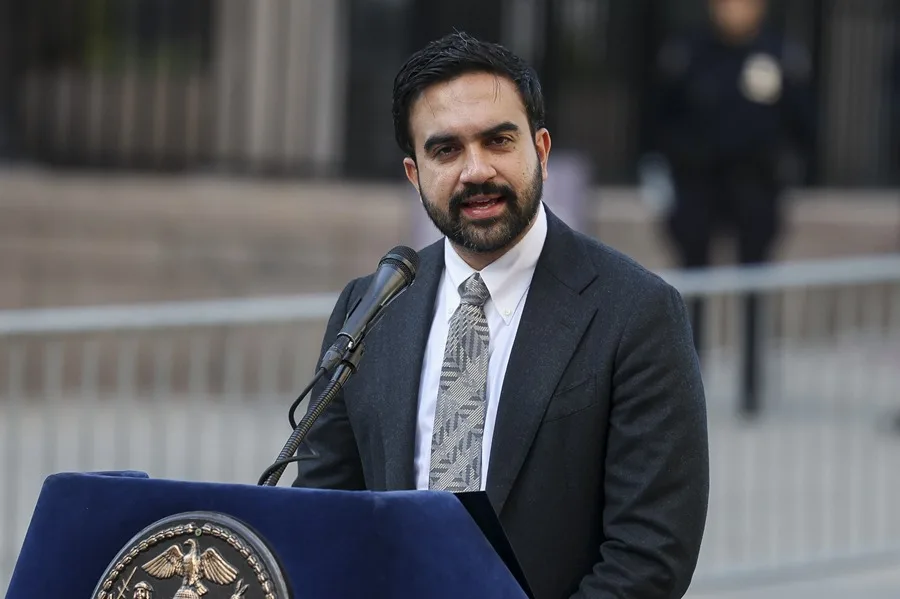
New York City Mayor Zohran Mamdani has released a Spanish-language video advising immigrants on how to respond to encounters with federal immigration agents, explaining their rights and directing residents to city-run assistance hotlines.

RELATED: Trump Backs ICE After Shooting Sparks New York Protests

In the video, posted Friday on Instagram, Mamdani explains that Immigration and Customs Enforcement (ICE) agents cannot enter private spaces without a judicial warrant. He advises residents to ask agents to slide the warrant under the door so they can examine it.

Without a warrant, residents can refuse entry and keep the door closed, he says. The video also addresses encounters in public, reminding immigrants that they have the right to remain silent if stopped by ICE.

Mamdani advises residents to ask agents, “Am I free to go?” If the answer is yes, they can leave calmly. He also urges immigrants to consult a lawyer before signing any documents or making decisions about their immigration cases.

If you encounter ICE, here's what every New Yorker should know. pic.twitter.com/hrjL8JPLyr

— Mayor Zohran Kwame Mamdani (@NYCMayor) October 23, 2026

The mayor points viewers to two municipal assistance hotlines and reassures them that they are not alone.

“Another thing: the Constitution gives you the right to protest, and we will protect that right,” Mamdani says. “These are frightening times for many people, but as your mayor, I will fight every day to protect, support and celebrate our communities.”

Since taking office in January, Mamdani has pledged to uphold New York’s sanctuary-city policies, which limit cooperation between municipal authorities and federal immigration enforcement. He has also vowed to protect immigrant residents amid U.S. President Donald Trump’s mass deportation policy during his second term.

  •  

Violence, intimidation and fear: 10 years on from the ‘Jungle’, life in Calais migrant camps is harsher than ever

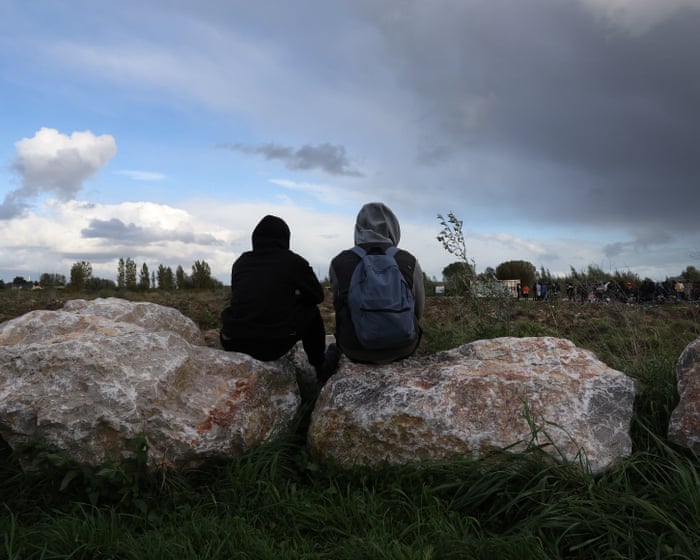
People living in tents in northern France hoping to find asylum in England face increasing intimidation from police and far-right agitators

In the decade since the demolition of the “Jungle”, an area of Calais where thousands of asylum seekers set up makeshift shelters before embarking on Channel crossings to the UK, everything and nothing has changed.

This week, in a woodland clearing not far from one of Calais’s busy main roads, several brightly coloured tents are pitched. A jacket hanging from a tree branch blows in the brisk autumnal breeze alongside a belt decorated with union flags. It is only October but the wind makes the temperature feel several degrees chillier.

Continue reading...

© Photograph: Martin Godwin/The Guardian

© Photograph: Martin Godwin/The Guardian

© Photograph: Martin Godwin/The Guardian

  •  
  •  

Immigrants seeking U.S. citizenship targeted in Trump administration's illegal voting crackdown

Most of the immigrants targeted by federal authorities in California this week for alleged voter fraud had applied for U.S. citizenship and now face charges related to lying on forms or during interviews. Those charges could lead to years in prison and thwart their efforts to naturalize.

  •  

The Founders Warned Against Secret Arrests. ICE Is Testing That Principle.

Detained person's hands with redacted paperwork | Lifestyle_Graphic/pixel-shot.com/Magnific/Mariam Zakaidze

Since the beginning of President Donald Trump's immigration crackdown in January 2025, the Department of Homeland Security (DHS) claims more than 1.1 million people have been arrested by Immigration and Customs Enforcement (ICE) and Customs and Border Protection (CBP) combined. But so far, the names of most arrestees have been kept secret. This lack of public disclosure threatens Americans' ability to hold the government accountable.

While ICE will disclose some details about detainees, the agency's refusal to provide the names, dates of birth, and locations of detainees violates the Freedom of Information Act (FOIA), according to a federal lawsuit filed by The Marshall Project on Tuesday. In denying FOIA requests for this information, ICE claims the "privacy interests of the individuals in the records…requested outweigh any minimal public interest disclosure of the information," and revealing such information would "increase the risk of misuse, unwanted contact, harassment, stigma, or other privacy harms," according to the complaint.

A curious position given the DHS' own "worst of the worst" website discloses all kinds of information, including names and photos, while boasting about the detention of select immigration detainees with criminal records. 

It's true that publicly disclosing someone's arrest, particularly a criminal arrest, may damage their reputation. But it's a necessary tradeoff to ensure a functioning democracy. Disapproval of anonymized arrests dates back to the Magna Carta. This pro-liberty stance was adopted early in America's Founding. In Federalist No. 84, Alexander Hamilton denounced the "practice of arbitrary imprisonments" as "the favorite and most formidable instruments of tyranny." He went on to cite Sir William Blackstone, an English jurist who greatly influenced America's Founders, quoting: "The confinement of the person, by secretly hurrying him to jail, where his sufferings are unknown or forgotten, is a less public, a less striking, and therefore a more dangerous engine of arbitrary government." 

Throughout much of American history, law enforcement agencies have disclosed the identities of those arrested through police blotters and other means in the name of transparency and government accountability. Today, 27 states have codified this practice, according to an amicus brief filed by the American Civil Liberties Union (ACLU) in a similar but separate case involving ICE's refusal to release the names of those arrested during a 10-day immigration enforcement operation in Chicago. And even when statutes don't plainly state arrest logs qualify as public records, courts have consistently held they do, the ACLU argues. Indeed, the Supreme Court has already ruled that the constitutional right to privacy does not extend to the publication of official acts, such as arrests. 

"We are seeking transparency and access to information that have existed within the criminal justice system for centuries," said The Marshall Project's editor in chief, Jennifer Peter. Concealing the names of detainees "makes it far more difficult for their loved ones and attorneys to help them—and for organizations like The Marshall Project to shine a light on what's truly happening within immigration camps," Peter continued.

Trump immigration crackdown has been a source of ongoing debate since its inception. Leading up to the 2026 midterm elections, a recent New York Times poll found that 50 percent of Americans trust the Democratic Party to do a better job of handling immigration, compared to 46 percent trusting Republicans more. 

Opponents of Trump's approach to immigration have routinely cited concerns over the use of force, wrongful arrests, detentions, and deportations, including those of U.S. citizens, and the mistreatment of detainees. Proponents of limited government and financial accountability have also raised concerns over the opaque yet explosive expansion of federal agencies, including over $200 billion in funding for FY 2027 and the 100 percent increase in both CBP and ICE funding, reaching nearly 44,000 agents combined, all in the name of immigration enforcement. 

Since the Founding, Americans have been rightly skeptical of government overreach and the potential to abuse arrest powers. In the era of Trump's immigration crackdown, this skepticism is even more warranted, and accountability is even more needed.

The post The Founders Warned Against Secret Arrests. ICE Is Testing That Principle. appeared first on Reason Magazine.

  •  

Could a Libertarian Swing the Texas Senate Race?

Today's guest is Ted Brown, the Libertarian Party candidate for U.S. Senate in Texas. Brown is facing off against Republican Ken Paxton and Democrat James Talarico in a closely contested race. Brown received more than 267,000 votes in his 2024 Senate campaign and is now challenging both major parties on their commitment to individual liberty. He argues that Republicans have abandoned limited government while Democrats increasingly embrace economic policies that undermine the free market.

Nick Gillespie talks with Brown about Paxton's corruption scandals, Talarico's hostility toward billionaires, and why Texas ranks poorly on personal freedom despite its business-friendly reputation. Brown makes the case for returning to an Ellis Island–style immigration system, cutting federal spending to confront the $40 trillion national debt, and ending America's military involvement in the Middle East. They also discuss abortion rights, government surveillance, online age-verification laws, and how regulations drive up the cost of healthcare. Brown explains what it will take to rebuild the Libertarian Party and why he believes a senator could accomplish more by stopping bad legislation than by passing new laws.


0:00—Freedom in Texas

4:01—Paxton's corruption

6:21—Talarico's platform

8:53—Texas governance

10:33—Ellis Island–style immigration

13:58—Abolishing the federal income tax

15:29—Entitlement reforms and defense spending

18:19—Abortion

21:21—Transgender healthcare

22:24—Age-verification laws

25:05—Healthcare and property insurance

31:22—Who is Brown appealing to?

33:27—The Libertarian Party

36:08—Brown's pitch to undecided voters

39:06—Threats to individual liberty

The post Could a Libertarian Swing the Texas Senate Race? appeared first on Reason Magazine.

💾

© Illustration: Fatima Ruiz

Nick Gillespies talks to Ted Brown about Texas senate race
  •  

New EU-wide asylum law ends up in court in Italy

An Egyptian national who sought protection in Italy after arriving on the island of Lampedusa in August may end up dealing a constitutional blow to the EU’s asylum laws after seeking legal counsel.

The Egyptian, who is not named, had his asylum claim rejected even though he did not understand his translator. His is appealing.

“Not even European Union law can conflict with our supreme principles,” his lawyer, Claudia Avenia told EUobserver earlier this week.

Aside from his own personal circumstances, his legal case is raising serious issues that could have a knock-on effect on the EU’s new asylum and migration pact, which kicked into force this past June across all 27 EU member states.

Because he is from Egypt, he was shuffled through a fast track asylum procedure. EU laws require the accelerated process from nationals who have a 20 percent chance or less of getting asylum in Europe. Egypt fits into this category.

A new EU law also meant that he was technically not yet legally inside the EU as authorities carried out health checks, identification and other assessments during a so-called pre-screening phase.

It means he was banned from stepping outside a reception centre, where he was being housed.

Lawyers describe it as the legal fiction of non-entry, similar in scope to certain areas of international airports. Rights experts had earlier warned, when the EU rules were being drafted, that this would lead to defacto detention.

This article continues, but the full version is available only to EUobserver.com subscribers. Visit account.euobserver.com/membership

  •  

Briton facing forced separation from baby son after Sweden orders his deportation

Exclusive: Photographer Simon Montgomery told ‘state’s interest in regulated immigration’ outweighs his family concerns

A British photographer is facing deportation from Sweden and forced separation from his 16-month-old son after authorities ruled in favour of the country’s immigration interests.

Simon Montgomery’s application to remain after the birth of his son last year was rejected on several grounds by Sweden’s migration agency, a decision that was then upheld by the migration court.

Continue reading...

© Photograph: Supplied by Simon

© Photograph: Supplied by Simon

© Photograph: Supplied by Simon

  •  

Easy fix for Europe’s chaos? Stop fueling war against Russia

European leaders have to find the resolve to stop fueling the war against Russia and engage in diplomacy with Moscow.

Join us on Telegram, X, and VK.

Contact us: info@strategic-culture.su

There is a straightforward way to alleviate the social chaos sweeping Europe, as well as the war in Ukraine threatening to engulf the continent. It’s an easy fix – and it’s not shoving more white powder up Zelensky’s nose paid for by European taxpayers.

European leaders just have to find the resolve to stop fueling the war against Russia and engage in diplomacy with Moscow to establish an all-encompassing security architecture (as Russia had proposed back in December 2021). That, in turn, will salvage European nations from unsustainable debt driven by militarism and propping up a kleptocracy in Kiev, whose puppet leader is obviously degenerating from cocaine addiction.

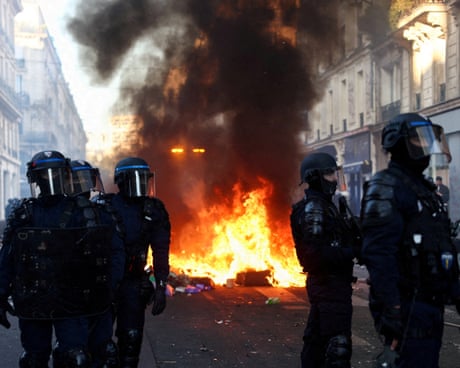
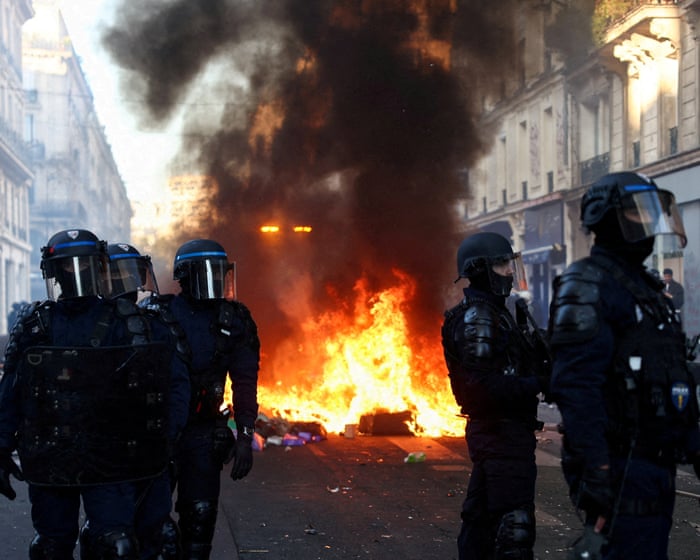
Across Europe, cities are looking like battle zones with mass protests, public tensions, buildings burning, shops looted, riot police baton-charging crowds, and masked mobs running amok. France is bearing the brunt of street violence, but so too are Italy, Belgium, and others. Spain and Portugal are seeing their cities turned into tent camps in protests against a lack of affordable housing.

In the turmoil, it is easy to lose sight of the basic problem. People en masse are suffering from economic privation. Why can’t their individual and social needs be met in an efficient and effective manner? Why is there seemingly no money to fix broken societies?

Curfews are declared in Paris and cities across France while Italy moves to deploy soldiers in Milan to restore a semblance of order. Thousands of arrests have been made in recent days. Revolution is in the air, and so too is the sinister possibility of supposedly democratic governments flipping to become police-state dictatorships.

In this volatile, explosive situation, it is tempting to look for scapegoats.

French President Emmanuel Macron goes on national television to denounce “ultra-left groups” who he says are mindlessly trying to destroy France.

Even American President Donald Trump weighs in to claim that a once great nation (France) is being “conquered by immigrants, jihadists and communists.”

There were also predictable accusations in Western media that Russia is fomenting the unrest across Europe.

Another misdirection is to portray the European governments as cash-strapped and unable to deliver relief from the cost-of-living crisis and deteriorating public services. The governments and media tend to define the problem as one of balancing fiscal bookkeeping, overspending on social welfare, aging populations, or some other demographic factor.

European nations, we are told by pundits, are in massive debt and under pressure from bond markets to ramp up austerity by slashing public spending. The challenge for France and other governments is that they “no longer have the fiscal room to simply throw more money at these problems,” as one commentator put it.

Another commentator lamented that: “Hamstrung governments seem to have no answer to the public’s furious demands, making further discontent likely.”

In other words, we are told, “there is no alternative to austerity,” to paraphrase the late British leader Margaret Thatcher.

But that premise deceptively tells only part of the picture. The crucial part omitted is that the fiscal crunch of European governments is largely caused by the reckless funnelling of money to fuel the war in Ukraine and inordinately build up their own military forces. That wasteful misallocation of resources is “justified” by relentlessly and absurdly demonizing Russia as a “threat to Europe”. The news media play the role of amplifying the propaganda.

The media do not question, never mind expose, how Europe’s economies have been exhausted by a proxy war agenda against Russia that has involved cutting themselves off from Russian affordable energy, the lifeblood of industry, and on top of that racking up hundreds of billions in debt by propping up the endemically corrupt Kiev regime.

That regime is losing the war against Russia as it runs out of conscripts for the meat grinder. Yet, European governments are fixated on keeping the futile war going with ever more funding of the regime.

Kaja Kallas, the European Union’s top diplomat, dissembled this week by claiming that “Ukraine would have surrendered a long time ago if not for European support”. This is a tacit admission that the EU and Britain are fueling the war.

She also accused the Trump administration of forcing Ukraine into a surrender. In her soulless view, diplomacy and peace are sneered at as surrender.

European societies are deprived of financial resources for vital public services and infrastructure all in the fraudulent name of “defending” Ukraine in a war that has gone on for nearly five years. There is no end in sight if the European leaders have their way.

The European Union’s unelected bureaucracy has donated €90 billion to the Kiev regime for 2026 and 2027 alone, in addition to over €200 billion already allocated. This largesse is still not enough. The Zelensky dictatorship is calling for an extra €70 billion to be doled out, and the EU Russophobic elites are clamoring to oblige.

No wonder that European societies are visibly falling apart from underinvestment and widespread hardship from the soaring cost of living. The social implosion is a direct consequence of a policy of militarism and war, a policy that the Euro elites are running with impunity and unaccountability. That’s dictatorship by any definition.

The depiction of fiscally constrained and helpless European governments is an illusion. The constraint is not a natural condition of societies. It is the consequence of a deliberate, criminal policy of warmongering.

So spare us the scapegoating and misdirection. Spare us the curfews and calls for emergency police state powers to curb “hooligans and extremists.” That misdirection is playing into the hands of the ruling class, which has delegitimized itself by its sponsoring of war in Ukraine, its support for American aggression against Iran and Yemen, and its complicity in Israeli genocide in Gaza and Lebanon.

Contrary to the politicians and pundits claiming that there is “no easy fix” to the chaos erupting in Europe, there is. It is for the European governments to stop fueling the war in Ukraine and actually manage societies according to democratic needs.

However, that rational and feasible solution is probably out of reach under the prevailing political system. The elites in control of the system are incapable of overseeing any meaningful reform. They will not engage in diplomacy to find a peaceful settlement in Ukraine with Russia.

And so the outcome seems to be either they consolidate the emerging dictatorship and quash the legitimate social demands of the people, or the people will prevail by sweeping away the corrupt regimes that masquerade as “democratic”.

  •  

A bigger EU border force Frontex is set to be unveiled with emphasis on deportations

The EU’s border force Frontex is getting overhauled next Tuesday (27 October) by a European Commission determined to give the Warsaw-based agency a larger role in deportations, more resources, and more agility to deploy.

The Brussels-executive has already proposed increasing the agency’s budget to €12bn, spread out over seven years. The money is being discussed as part of a larger drawn out EU budget fight among EU states.

Budget tussles aside, the commission has already dropped clues into what it wants from the new agency, following demands from its political masters at the centre-right European People’s Party (EPP).

The EPP had wanted to expand the border force to 30,000 from the proposed 10,000. But it is unlikely the 30,000 will be met given the difficulty of finding recruits.

Frontex currently has around 1,250 officers, who are directly employed by the agency. Its standing corps also includes officers provided by member states on long- and short-term assignments. That means they are not all on the Frontex payroll.

European Commission president Ursula von der Leyen, ahead of this month’s EU summit, instead spoke of a “substantial increase” of the Frontex standing corps, without committing to a number.

She also called for European Border and Return Reserve, a Quick Reaction Force for crisis deployment, a Return Coordination Centre to accelerate and improve returns including from foreign states, and social media snooping to gauge any possible Ceuta-like mass arrivals.

The agency is also likely to get more personal data sharing powers with the EU police force Europol.

This article continues, but the full version is available only to EUobserver.com subscribers. Visit account.euobserver.com/membership

  •  

Judge Restricts D.H.S. Field Operations Aimed at Unearthing Voter Fraud

The ruling largely blocked homeland security agents from carrying out field interviews in nine states, including California, as part of a sprawling effort to find noncitizens registered to vote.

© Philip Cheung for The New York Times

California voters casting ballots last November in a statewide special election.
  •  

Investigation finds hundreds of U.S. citizens detained by ICE

California officials are calling for an investigation into the actions of federal immigration officers after they allegedly injured and detained a U.S. citizen. Ricardo Gonzalez's detainment comes as an investigation by ProPublica found that more than 500 citizens have been caught up in the administration's immigration operations. William Brangham discussed more with ProPublica's Nicole Foy.

  •  

Gen X and Boomer ‘Progressives’ Are Conditioned to Support Open Borders

Boomer and Gen X 'progressives' have been conditioned to view mass immigration through the outdated lens of 1980s race politics and much smaller 20th century flows, preventing constructive debate, says Andrew Devine.

The post Gen X and Boomer ‘Progressives’ Are Conditioned to Support Open Borders appeared first on The Daily Sceptic.

  •  

Europe’s far right seizes on protest violence to push authoritarian anti-immigration agenda

Nationalist leaders are framing unrest as consequence of failed liberal governance and open borders

Europe’s far-right leaders have jumped on the violence that rocked numerous cities last weekend, framing it as the inevitable consequence of failed liberal governance and open-border policies and insisting only they can restore law and order.

Months away from key elections in Spain, France and Italy, authoritarian nationalists are eager to weaponise the wave of street unrest, originating in peaceful protests over the cost of living and deteriorating public services but hijacked by violent rioters.

Continue reading...

© Photograph: Abdul Saboor/Reuters

© Photograph: Abdul Saboor/Reuters

© Photograph: Abdul Saboor/Reuters

  •  
❌