On Wednesday, the Office of Energy Dominance Financing at the U.S. Department of Energy announced it had closed a $5.1 billion loan package to Alliant Energy—a utility company with over 1.5 million customers across Iowa and Wisconsin—to "lower electricity costs, expand firm power generation, and strengthen grid reliability" in the Midwestern states.
The loan package is part of the Energy Department's response to President Donald Trump's April 2025 executive orderdirecting the agency and its secretary, Chris Wright, to ensure the nation uses "all available power generation resources" to expand and secure America's electric grid amid growing demand.
In a press release, Alliant said the 30-year loan package will finance 1.6 gigawatts of new natural gas generation, 240 megawatts of increased capacity at its existing natural gas facilities, and a gigawatt of energy storage. The loan package will also allow Alliant to add 2 billion cubic feet of liquefied natural gas storage. All told, these upgrades and additions will generate enough electricity to power 2 million homes annually, according to the Energy Department.
Alliant estimates the deal will result in "up to $1.2 billion in cumulative customer savings," as well as the creation of "more than 1,600 local jobs" through construction projects financed by the loans. Of course, some of the savings likely stem from Alliant receiving more favorable loan terms from the Energy Department than it would from an open-market lender.
A report filed with the Securities and Exchange Commission outlining the deal's terms shows that the interest rate to be charged on each loan aligns with the government's borrowing costs. However, the markup on each loan will remain a fixed percentage, regardless of whether lending to Alliant becomes riskier or more expensive. Under the deal's terms, Alliant has until May 15, 2056, to repay the loan, but it is only responsible for paying interest until the first principal payment is due in 2052.
The Energy Department said the deal is the Trump administration's 10th financial close and its "sixth and seventh utility financing completed through the Energy Dominance Financing Program." As of September 30, the department had issued $132 billion in loans and guarantees through the program, including $47.5 billion announced in conditional commitments, and disbursed $53.2 billion.
While the Trump administration is taking credit for the deal, the loan is essentially a repackaging of a $3 billion conditional commitment offered by the Biden administration in 2025 as part of its last-ditch effort to spend as much taxpayer money on green projects as possible before Trump took office. Under the terms of the Joe Biden-era deal, Alliant would have used the loan to "finance multiple clean energy and battery energy storage system projects." Instead, the company will now receive an additional $2.1 billion in funding, without the climate goals the Biden administration stipulated.
Gregory Beard, director of the Office of Energy Dominance Financing, said the agency is "putting capital to work." The deal is perhaps better described as the Energy Department usurping a role that should be reserved for private-sector, institutional lenders. "This type of government involvement is only another example of the current Energy Department distorting the power generation market," says Tom Opdyke, director of energy and environmental policy at the R Street Institute.
The agency's meddling seems even more unnecessary given that Alliant's revenue is expected to grow 6.8 percent annually over the next three years, with its profit margins increasing from 18.4 percent to 22.2 percent, according to the stock research and portfolio-tracking platform Simply Wall St.
The timing of the announcement also raises some red flags. While an Alliant spokesperson tells Reason they spent "months reviewing the details and finalizing contracts" before the loan package "was finalized this week," the money is conveniently being directed to energy projects in two fairly competitive states in this year's midterm elections. The Cook Political Report has the Iowa Senate race as a toss-up and several incumbent House Republican seats in Iowa and Wisconsin leaning Democrat.
The loan package could be a ploy to boost Trump's and Republicans' favorability with the electorate in Iowa and Wisconsin by appearing to address a cost-of-living issue high on voters' list of concerns. "Even if that's the case, those things aren't going to happen by Election Day, and voters' opinions aren't likely to shift on the promise of future jobs and savings," says Opdyke. "So it might be too little, too late."
Trump is scheduled to speak this weekend in an Iowa-Wisconsin border town.
Whatever the reasoning, the loan package is effectively a subsidy for Alliant to expand its operations and grow its customer base at a lower cost. It's cronyism that enriches Alliant and disadvantages its competitors, at American taxpayers' expense.
The European Commission has opened talks with oil producers, refiners and NATO over the future of Europe’s fuel industry, exposing growing tensions between decarbonisation, industrial competitiveness and the demands of military preparedness.
The European Union is reconsidering the strategic importance of its oil-refining industry as disruptions to international energy supplies and growing defence requirements force Brussels to examine whether Europe can afford further reductions in domestic fuel production.
On 28 October, the European Commission convened its first high-level dialogue with the European refining industry, bringing together energy companies, technology providers and representatives of NATO.
The meeting was chaired jointly by Energy Commissioner Dan Jørgensen and Defence and Space Commissioner Andrius Kubilius.
Its significance extends beyond the immediate increase in fuel prices associated with the conflict in the Middle East.
Brussels is confronting a longer-term problem: Europe intends to reduce its dependence on fossil fuels, but its transport networks, industrial infrastructure and military forces remain substantially dependent on petroleum products.
The question is no longer simply how quickly the European economy can decarbonise. It is also how much refining capacity must be retained to guarantee essential fuel supplies during a geopolitical crisis.
A strategic industry under pressure
Europe’s refining industry occupies an important position in the continent’s energy system.
These products are essential not only for civilian transport and logistics but also for military aviation, armoured vehicles and the movement of equipment.
Maintaining adequate production capacity therefore has implications for both economic activity and defence readiness.
Yet European refineries have faced difficult commercial conditions for years.
High energy costs, international competition and declining expectations for long-term fossil-fuel demand have complicated investment decisions.
Refineries require substantial capital expenditure to remain competitive, meet environmental requirements and adapt production processes.
Companies considering whether to modernise facilities must consequently assess the profitability of assets that may be expected to operate in a progressively decarbonising economy.
The resulting uncertainty creates a problem for governments seeking to retain strategically important industrial capabilities.
The Middle East conflict changes the calculation
The immediate catalyst for the Commission’s initiative is the disruption to energy markets caused by the continuing conflict in the Middle East.
Interruptions to supply chains and uncertainty over maritime transport have increased concerns about the availability and cost of refined petroleum products.
Importing crude oil and importing finished fuels are not equivalent from a strategic perspective.
A country with domestic refining capacity can process available crude into the particular products required by its economy.
An economy heavily dependent on imported refined products is additionally exposed to processing capacity, transport availability and commercial decisions outside its jurisdiction.
The distinction becomes particularly relevant when governments must guarantee supplies of diesel and aviation fuel during an emergency.
European policymakers are therefore examining ways to improve output from existing facilities and strengthen the resilience of fuel supply chains.
However, the Commission has not announced a binding production target or a programme to reopen closed refineries.
The 28 October meeting represents the beginning of a policy discussion rather than the adoption of a new industrial strategy.
NATO introduces a different perspective
The participation of NATO gives the initiative a wider security dimension.
Military preparedness requires dependable access to energy products, including during periods when normal commercial supply chains are disrupted.
Aircraft, naval vessels, military logistics and ground operations cannot be reorganised around alternative energy sources at the same pace as some civilian activities.
Furthermore, the ability to sustain prolonged operations depends on reliable industrial production, storage, distribution and transport.
A refinery’s strategic importance may therefore exceed its immediate commercial profitability.
That raises difficult policy questions.
Governments may consider whether critical production facilities require targeted support, whether strategic stockpiles are sufficient and how supply arrangements should function during emergencies.
Any intervention would have to address competition rules, public financing and the risk of subsidising facilities that become commercially unviable.
Decarbonisation remains part of the policy
Brussels has not abandoned its climate objectives.
The Commission has explicitly linked its refining discussions to the development of sustainable biofuels and synthetic fuels, commonly known as e-fuels.
These technologies offer potential alternatives for sectors where direct electrification remains technically difficult, including aviation.
However, their commercial development requires investment, suitable feedstocks, reliable energy supplies and sufficient demand.
Traditional refineries may be able to participate in this transition, although the technical requirements and economic viability vary between facilities.
Jørgensen said the Commission intended to work with industry on a roadmap that would reconcile domestic fuel production with Europe’s longer-term climate ambitions.
The challenge will be translating those objectives into investment decisions.
Europe’s industrial strategy faces a practical test
The initiative illustrates a wider adjustment in European economic policy.
In recent years, the EU has increasingly described industrial capacity as an element of economic security, rather than treating production solely as a commercial activity.
Semiconductors, pharmaceuticals, critical minerals and defence equipment have all attracted attention because of vulnerabilities in international supply chains.
Oil refining is now entering the same discussion.
The Commission must determine how to preserve sufficient capacity for essential civilian and military requirements while continuing to encourage cleaner technologies.
Those objectives are not necessarily incompatible, but they operate over different timescales and involve different commercial incentives.
For European refiners, the central question is whether governments can provide enough regulatory and investment certainty to support modernisation.
For Brussels, it is whether the energy transition can proceed without creating new strategic dependencies.
The outcome of the dialogue will indicate how the EU intends to balance its climate commitments with the industrial demands of a less predictable security environment.
Ahead of a harsh winter, the Netherlands is giving Ukraine €1.2 billion to keep the lights and water on under Russian strikes. Dutch Minister for Foreign Trade and Development Cooperation Sjoerd Sjoerdsma announced the aid during a visit to Kyiv on 28 October.
The package comes as Russia targets Ukraine’s energy system every winter. Last winter’s strikes damaged or destroyed roughly 80% of the grid, and Moscow’s next target is Ukraine’s water supply.
“Ukraine is under heavy fire and faces a very harsh winter,” Sjoerdsma said.
That, he stated, is why the government is taking additional steps now. The funds will be distributed over the next three years.
Earlier, Ukrainian President Zelenskyy said Kyiv needed $8-10 billion to get through winter, TSN reported.
The Netherlands shores up Ukraine’s power and water
Also, the Netherlands is fast-tracking €40 million this year to Ukraine’s Energy Support Fund for urgent repairs to power and water facilities, which are increasingly targeted by Russian strikes.
Another €55 million goes to in-kind support: energy equipment supplied by Dutch companies to Ukrainian partners through the Netherlands Enterprise Agency.
The money will also help build emergency reserves and train staff in the energy and water sectors.
Dutch business steps into Ukraine’s reconstruction
Most of the rest goes to business. Some €136 million will go to the Partnership Facility with Ukraine and other programs, and a further €19.5 million is added to export credit insurance, on top of an existing €60 million line, to lower the risk for Dutch companies entering the Ukrainian market.
Separately, the Netherlands signed a letter of intent to contribute €10 million to President Volodymyr Zelenskyy’s “Industrial Ramstein” initiative, which aims to restore and modernize the production capacity of Ukrainian companies. Sjoerdsma traveled to Kyiv with Koen van Oostrom, chair of the business association VNO-NCW.
The support also covers the search for Ukrainian children abducted by Russia, through the UN, as well as housing, humanitarian aid, healthcare, demining, and the restoration of cultural heritage.
In all, the Netherlands is confirming the previously promised €878 million in non-military aid and an additional €327 million, much of it delivered through the EBRD, the World Bank, and the European Investment Bank.
The same day, President Zelenskyy said he had arrived in the Netherlands on an official visit. The two sides plan to discuss defense and economic cooperation, strengthening Ukraine’s air defenses, and further support for Ukraine. Zelenskyy is also set to have an audience with King Willem-Alexander of the Netherlands.
Former Prime Minister Mateusz Morawiecki has launched a sharp critique against the government of Donald Tusk, accusing state-owned energy giant Orlen of drastically overcharging Polish citizens and businesses for natural gas.
Speaking on behalf of his political movement Rozwój Plus (Development Plus), Morawiecki demanded an immediate and thorough audit of Orlen’s pricing margins, claiming the company is exploiting its market position at the expense of Polish households.
According to Morawiecki, Orlen has been acquiring liquefied natural gas (LNG), largely sourced from the United States, at a rate of approximately 100 PLN per megawatt-hour (MWh). However, the former prime minister alleges that the state-controlled company is reselling that same gas to Polish consumers at inflated rates as high as 350 PLN per MWh.
Orlen kupuje gaz za ok. 100 zł/MWh, a Polakom sprzedaje nawet za 350 zł!
Budżet dziurawy jak ser szwajcarski, a za nieudolność rządu znów płacą Polacy!
Oto prawdziwy CPN Tuska – Ciepło Przywilejem Najbogatszych!
“If this is not a gigantic scandal in the Polish economy, hitting the wallets of Poles, the wallets of small and medium-sized enterprises, then I don’t know what is,” he said during an interview on Wirtualna Polska’s Morning Show, as cited by Wiadomosci, framing the pricing strategy as a failure of economic oversight by the current administration.
Prime Minister Donald Tusk and his coalition government have pushed back against the narrative of mismanagement, according to the portal. Tusk has repeatedly defended Orlen’s current corporate governance and market valuation, drawing a sharp contrast between its current operation and its performance under the previous Law and Justice (PiS) administration.
Supporters of the current government structure argue that Orlen’s pricing strategies align with broader European market realities, long-term contract structures, and the financial necessity of funding Poland’s ongoing green energy transition.
The clash over Orlen arrives at a moment of heightened political maneuvering in Poland. Morawiecki is currently in the process of formally registering a new political party stemming from his Rozwój Plus movement.
The energy price dispute serves as a central pillar in a broader opposition campaign targeting the Tusk government’s economic policies, particularly its handling of the national budget deficit and inflation.
As winter approaches, the cost of living and energy security remain highly sensitive topics for the Polish electorate, ensuring that the battle over Orlen’s balance sheets will remain at the forefront of the country’s political debate. And while Morawiecki had originally indicated he would work within his previous party, Law and Justice (PiS), that ship has clearly sailed.
EU member states remain deadlocked over whether to delay the bloc’s methane rules for oil and gas importers by one year or three, with neither side able to secure a majority.
Ambassadors were due to agree the EU Council’s negotiating position this week, after a first attempt failed last week.
But the Irish presidency has had to push the vote back to 6 November again as the two camps continue to disagree on the timeline.
On the one hand, France, Spain, Finland, Denmark, Luxembourg and Portugal back the European commission’s proposal for a one-year delay.
The other group, including Italy, Poland, the Czech Republic, Hungary, Slovakia, Greece and Slovenia, wants three years.
And then there is a third group of countries that haven’t decided yet, or could live with either scenario.
The undecideds and waverers
Belgium, for example, signed a call in June for a three-year delay, but could live with the commission’s timeline, though it would refuse a pause of more than three years, which parliament’s proposed 2029 review could open the door to.
This article continues, but the full version is available only to EUobserver.com subscribers. Visit account.euobserver.com/membership
This Putin-Trump or Trump-Putin Diesel Deal is a vastly better opportunity for a ‘reset’ than the misspelled red button that Hillary Clinton presented to the Russians all while the Maidan was being orchestrated.
Every once in a while the Mainstream Media can delight us by choosing to show an actual piece of reality. Of the big ones that are out there, Fox News seems to have at least three droplets of their humanity left and so it shouldn’t be too surprising that they invited Federalist editor-in-chief Mollie Hemingway onto their program Special Report to argue in favor of Trump’s potentially historic deal with Putin. The most interesting part was that she got the real ‘white hat cowboy’ treatment, seeming to offer to the audience the obviously better path; the path of peace with Russia. This type of propaganda is great for those of us who want to avert a nuclear WWIII, Yahoo!News featured a clip from the previously mentioned show under a headline that summed up things quite nicely; “Mollie Hemingway: Trump’s Russian Oil Deal Puts The American People First, “We’re Not At War With Russia“. Oh how lovey that sounds but is it really a good deal for the public of the United States?
The arguments against the deal are both weak and Globalist
The counterarguments against this diesel deal seem to be that ‘the Russians help Iran and thus they are bad’ that is to say, this deal cannot be supported because it would be against the Zionist agenda in an indirect way. The other seemed to be that this move violates the spirit, but not technicalities, of the Lindsay Graham Bill. Well, if anyone would know about violation it’s the dead senator, but was there ever a moment when the majority of Americans cried out for sanctions packages against Russia? How would spitting on the grave of Graham change anything for the worse for the normies? It wouldn’t, and no one raising kids in America cares about Graham’s legacy when they want to put food on the table for their family.
There is also the counterargument that the diesel deal ‘ betrays Ukraine’, which is a sentiment much stronger in Europe than Washington, but Project Ukraine still has plenty of support from the shadows of the American capital, just not so much from within the White House. But if we examine the arguments against having diesel come from Russia as a whole, they are all related to U.S. foreign policy and/or ‘feels’. That is to say, there don’t seem to be any arguments as to how selling diesel fuel to America could possibly make things worse for Joe Average and that is very telling. All of the arguments say it would somehow be bad for our currently disastrous American foreign policy follies.
So again, in a global sense, how exactly does regulated trade, between two countries on a voluntary basis, that brings down prices in the USA, and does not take away any jobs, cause problems for the American people? How does antagonism of the world’s largest nuclear power with the most potent hypersonic technology, that has repeatedly stated that it doesn’t want war, a problem for the American people? How does supporting Project Ukraine, do anything for the American masses? Control of Delaware is important to Americans especially the ones that live there, is control of the Donbass somehow just as vital to everyone across the 50 States?
At this point in 2026, it is very hard to build any sort of argument for any of the insane spending on foreign conflicts of luxury that have been going on since the end of the Cold War in 1991. All of these dubious expenditures that have added up to our 40 trillion+ dollars in debt were never for the benefit of the American people. It is almost like the talking heads that advocate for a blindly aggressive U.S. foreign policy actually hate the average American, because all of their proposed plans, that may kill foreigners directly, certainly punish Main Street just the same, but in a much slower and more agonizing torturous way.
Dmitriev’s ‘World of Optimism’ is one normal people want to live in
Kirill Dmitriev is convinced that economic cooperation between the USA and Russia does not have to be limited to diesel fuel. He believes that Russia’s excess of fertilizer could also be a major benefit to farmers who may finally be able to fuel up their tractors at an affordable price. Although this might be tricky, Russia has cheap energy and plenty of room in Siberia for data centers too and Dmitriev sees a lot of potential in this area. Russia even has energy exports of electricity to neighboring China, so perhaps some sort of data center collaboration could be possible, but that would require much more trust than is currently present. As we all know Dmitriev is a big believer in the building of the tunnel/bridge from Alaska to Chukotka. He has even proposed to Elon Musk a joint venture to use his Boring Company to drill from the American side. A massive friendship project is surely needed between these two countries but there are many difficulties in making the tunnel work, especially the fact that it would be located in an extremely remote and unpopulated area and the train rail/wheel standards of both nations are different.
But again if we take a look at a famous quote from Kirill Dmitriev we see a big argument in favor of the Trump-Putin Diesel Deal that many Americans could agree with:
“International collaboration between the superpowers is key for the stability of the global economy.”
Beyond just the diesel fuel now, do these words sound like something that would be of benefit to the Average American or should we listen to John McCain’s status quo musings from beyond the grave?:
“Giving peace a chance only gives Saddam Hussein more time to prepare for war on his terms, at a time of his choosing, in pursuit of ambitions that will only grow as his power to achieve them grows.”
In the above quote you could take the name Saddam Hussein and substitute it for President Putin or any other person the establishment doesn’t like. It is this dimwitted ‘defense through offense’ attitude that is destroying the U.S. economy, all while the houses outside of DC just keep getting bigger-and-bigger.
Considering the U.S. just finally and formally gave up on Iraq these words above ring true as an anti-argument for the insane foreign policy that is bankrupting what used to be, and should be today, the wealthiest country in the world. If Washington had not invested in Iraq, Afghanistan, the Balkans, Project Ukraine, the Iran War, PNAC, Globalism, etc., wouldn’t the average gent in Pittsburgh be living much better?
In terms of economic partnership there are other options beyond what the ever optimistic Dmitriev has stated that I thought would be worth at least listing in brief:
American-style semi-trucks and trucks in general are road legal in Russia unlike many places on the planet with tight streets. Russia and America share ‘bigness’ and so long-haul American trucks could find a great market in Russia and Russian short-haul trucks would be great for America. All of the European automotive brands have bailed on Russia being replaced by China but there is still plenty of room on the market. This ‘bigness’ capable logic applies to all sorts of machinery beyond trucks, ‘Everything is Bigger in Texas and Tomsk’ and that is a point of economic benefit.
Entertainment media in Russia is desperately underfunded, while the U.S. side of things is committing suicide via the ‘woke agenda’, there must be some sort of synthesis here. Joint Russo-American entertainment media projects could shake up the entire industry and get those big profits Hollywood blockbusters used to make.
Education is believed to be much better in Russia and ‘Russian Math’ seems to be a hit in the USA, at least in NYC, so if the nation is to give up on Globalist ambitions the population needs to get smarter and more competitive very fast because the BRICS nations push their children to the max. Russia could assist with this but of course under the complete oversight and control of the American side just in case.
American Football needs a new market with a nation that has violent macho white guys, Eastern Europe is the only option for the NFL. Russians like violent sports and their soccer teams always underperform, they need a new summer sport and the USA has it.
New embassies consulates and more could be constructed as part of this new normalization. The old ones were taken away, so why not build new amazing ones for fun and profit?
Russia’s Far East is the ‘window to Asia’ but it also faces towards Oregon and California, there might be many in America who would want to participate in the massive buildup of the Russian region. Trump himself loves a good real-estate deal.
It is important to note that anything related to security, policing, and things of a secret nature are of course off limits and are never going to be an option. This cooperation cannot come too close to the ‘hearts’ of either system for obvious reasons. Both America and Russian must be fully sovereign in all regards no matter what they agree to.
This Putin-Trump or Trump-Putin Diesel Deal is a vastly better opportunity for a ‘reset’ than the misspelled red button that Hillary Clinton presented to the Russians all while the Maidan was being orchestrated. This deal tells the American Public that finally we need to use peace to make your lives better. We need to not waste resources antagonizing Russia, and this whole Multipolar World thing may just work out for rural Kansas too. But this is only a start, U.S. sanctions are a punishment for a crime that the Russians believe they did not commit and until those sanctions are truly gone we cannot say ‘it’s over’ but perhaps we can say ‘it’s starting’ unless all good will vanishes after the mid-term elections.
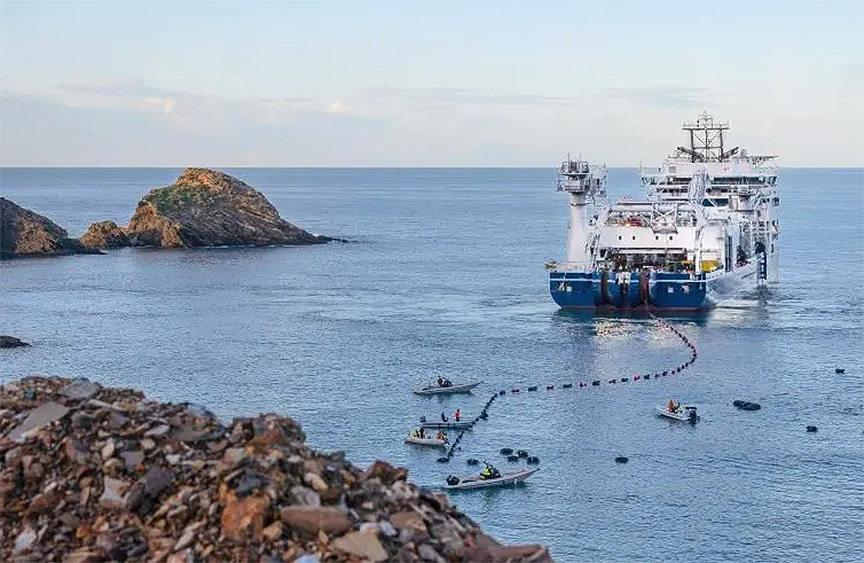
The future of the Great Sea Interconnector (GSI), which, if completed, will link the energy grids of Cyprus, Greece, and Israel, is “being handled away from the public eye”, President Nikos Christodoulides said on Thursday, with it yet to be confirmed as and when seabed surveys for the project’s construction will begin.
“Everything which needs to be done regarding this specific matter, in terms of the Republic of Cyprus exercising its sovereign rights, is being handled away from the public eye and without excessive public statements,” he said on the sidelines of a parade to mark ‘Ochi Day’, the anniversary of Greece’s entry into the Second World War.
It is widely expected that a navtex, a message used to transmit information to seaborne vessels, regarding planned seabed surveys for the laying of cables for the GSI project, will be issued in the coming weeks, though matters have been complicated by the fact that part of the interconnector’s planned route passes through seas which are claimed by both Greece and Turkey.
Of this, Turkish Foreign Minister Hakan Fidan had stressed last week that his country will not “raise any objections” to the interconnector’s construction, provided that it is given prior warning ahead of the navtex by the governments of Greece and France, the country in which the project’s majority stakeholder, asset management firm Meridiam, is based.
“What we are asking is that when a ship conducts research at sea, it send us a written notification, not just an oral one, stating, ‘we are going to undertake specific actions in this area, here are the coordinates’. That is all we are asking for. Nothing more,” he said.
On this front, Cypriot Energy Minister Michael Damianos had said two weeks ago that the navtex for the seabed surveys will be issued before the end of this month, with the Greek coastguard having said that French-flagged research ship the Abeille Marengo will be the ship conducting the surveys.
Damianos said last week that “if the project progresses”, it is believed that it will be fully completed by 2031.
Turkey’s claim to regional seas may be strengthened by Libya deal
However, Turkey’s claim to the seas through which the interconnector may pass appears to have been strengthened in recent weeks, with Libya’s parliament last week having unanimously ratified a maritime boundary agreement its government had signed with Turkey in 2019.
That agreement saw Turkey and Libya define where the two countries’ exclusive economic zones (EEZ) border one another in the eastern Mediterranean, with that border, according to the agreement, falling between two points southeast of the Greek island of Crete, where the interconnector cable will connect to Greece.
Greece and the Republic of Cyprus object to the deal, saying that Turkey and Libya do not share a maritime border because islands are each entitled to a full EEZ, and that therefore, the sea in question belongs to Cyprus and Crete. Turkey’s position is that islands are not entitled to a full EEZ.
That agreement has received international pushback, with the European Union’s foreign policy chief Kaja Kallas having told Fidan that the deal “infringes upon the sovereign rights of third states”, while European Council President Antonio Costa and European Commission President Ursula von der Leyen had said that they “deeply regret” it.
“We reaffirm our solidarity with Greece and Cyprus. We reiterate the EU’s well-known position against any outside interference in Libya,” they said.
In response, Turkish President Recep Tayyip Erdogan said that “we are not, so to speak, trying to score a goal against anyone in the eastern Mediterranean”, but that “we are only concerned with protecting our maritime jurisdiction areas, rights, and interests”.
As temperatures are falling in Kyiv, so are rent prices, with residents leaving the capital to escape Russian bombardment and the prospect of a winter without heating and electricity.
Over the last two months, the number of long-term rentals listed on Kyiv&
SINGAPORE: Oil prices climbed more than 1 percent on Wednesday after an attack on a refinery in Saudi Arabia renewed concerns around supply risks from the major exporter. Brent crude futures gained $1.59, or 1.4 percent, to $115.47 a barrel as of 07:35 a.m. Saudi time. US West Texas Intermediate crude rose $1.43 or 1.4 percent to $101.33. Prices swung higher after dropping nearly $2 on Tuesday. For now, the market is still pricing in a greater likelihood of re-escalation, ING commodity strate
Europe needs to rethink its energy strategy as growing renewable energy capacity has failed to deliver the expected reduction in electricity costs and market volatility, former Energy Minister Natasa Pilides told a gathering of maritime and business professionals in Limassol.
Speaking at the Cyprus Marine Club’s October Get-Together last week, Pilides examined the challenges facing Europe’s energy sector, arguing that greater flexibility and a more balanced approach are needed to strengthen competitiveness.
The event, held at Gazebo Mare in Limassol, brought together more than 100 members, guests and professionals from the maritime, energy and wider business communities.
Pilides, who made history as Cyprus’ first Shipping Deputy Minister before serving as Minister of Energy, Commerce and Industry, delivered a presentation entitled The Energy Trilemma: Trade-Offs Shaping the European Landscape.
Drawing on her experience in both government and business, she examined the difficult balance between energy security, affordability, sustainability and competitiveness, particularly as Europe continues its transition towards cleaner energy.
According to Pilides, expanding renewable energy generation alone is insufficient to address the challenges facing European energy markets.
She argued that the importance of developing appropriate supporting infrastructure had been largely overlooked in European policymaking, with increases in renewable energy capacity consequently failing to bring the anticipated reductions in price volatility, uncertainty and energy bills.
As a result, she called for a change of approach at both European and regional level to address these shortcomings and improve competitiveness.
Her remarks also carried particular relevance for shipping and energy companies, where investment decisions often involve substantial capital commitments and long-term planning.
In these sectors, Pilides stressed the importance of maintaining flexibility in investment strategies, allowing businesses to respond to changing market conditions instead of remaining tied to decisions that may eventually become outdated.
Beyond the energy debate, the gathering also reflected the continued expansion of the Cyprus Marine Club, which has strengthened its professional network across the island’s maritime and wider business sectors.
Opening the evening, the club’s president, Capt. Eberhard Koch, welcomed members and guests, thanking them for their continued involvement and support.
He also announced the addition of three new corporate members, PwC, Orbyt Global Group and SOPIVERI Consulting Ltd, alongside two new individual members.
With these additions, the club’s membership has grown to nearly 200, including 114 corporate entities, further expanding its network of maritime and business professionals.
Koch also outlined the club’s programme of forthcoming activities through July 2027, combining professional presentations with networking and social events.
Among the events scheduled are the CMC Countryside Escape – The Farmakas Experience on November 14, the Christmas Networking Evening on December 3 and the New Year’s Gala at Parklane in Limassol on January 23, 2027.
Meanwhile, the evening provided an opportunity for participants to exchange views on the challenges facing the maritime and energy industries, while strengthening professional relationships across the two sectors.
Through its regular gatherings, the Cyprus Marine Club continues to bring together industry representatives and business leaders to discuss developments affecting shipping, energy and the wider economy.
A group of Democratic senators is expressing distrust that the Trump administration will treat renewable energy fairly under a bipartisan permitting reform bill — and they are calling on the administration to restore climate funding it terminated for blue states. Their letter to Democrats and Republicans who negotiated the bill represents a fracture in the…
A group of Democratic senators is expressing distrust that the Trump administration will treat renewable energy fairly under a bipartisan permitting reform bill — and they are calling on the administration to restore climate funding it terminated for blue states. Their letter to Democrats and Republicans who negotiated the bill represents a fracture in the…
Sales of petroleum products in Cyprus increased by 1.5 per cent year-on-year in September 2026, reaching 146,963 tonnes, as higher sales of motor gasoline, liquefied petroleum gas and aviation kerosene outweighed declines in road diesel and heating gasoil, according to the Cyprus Statistical Service (Cystat).
Sales from filling stations also rose, increasing by 1.7 per cent compared with September 2025 to reach 62,557 tonnes.
Among individual products, sales of liquefied petroleum gases increased by 12.1 per cent, while asphalt sales rose by 5.1 per cent, light fuel oil by 1.6 per cent and motor gasoline by 1.5 per cent.
Provisions of aviation kerosene increased by 1.4 per cent year-on-year.
By contrast, provisions of marine gasoil fell by 3.6 per cent, while sales of heating gasoil declined by 6 per cent and road diesel by 1.4 per cent.
On a monthly basis, total petroleum product sales rose by 20.8 per cent in September compared with August, reflecting increases across several categories.
Provisions of marine gasoil recorded the largest increase among the products highlighted by Cystat, rising by 51.3 per cent month-on-month.
Sales of road diesel increased by 21.4 per cent, while motor gasoline sales rose by 10 per cent. Provisions of aviation kerosene also increased, by 1.9 per cent.
Despite the increase in sales, total petroleum product stocks fell by 16.2 per cent at the end of September compared with the end of August.
For the first 9 months of 2026, total sales of petroleum products increased by 0.7 per cent compared with the corresponding period of 2025, Cystat reported.
As Fortis expands its facility along the Fraser, local air pollution is expected to worsen.
Emissions from the site of a recently approved LNG expansion in Metro Vancouver are projected to exceed Canadian ambient air quality standards for nitrogen dioxide, a harmful pollutant, according to company reports.
Last month, the provincial and federal governments approved FortisBC’s plan to further expand Tilbury, its decades-old LNG facility in North Delta, helping to turn it from a domestically focused, small-scale operation into a large export-oriented facility.
The province described the newly approved expansion as a “clean energy” project.
During the commissioning phase and when the facility’s equipment is malfunctioning, nitrogen dioxide levels in parts of Richmond, Delta and Vancouver are projected to be between three and 16 times above Canada’s guidelines for maximum hourly emissions. That estimate doesn’t include the cumulative impacts of emissions from Tilbury’s other, already approved expansions at the site.
During ongoing operations, Fortis predicts the site and associated marine traffic will slightly exceed national standards for average annual nitrogen dioxide levels, indicating the potential for long-term, chronic exposure. Those exceedances are expected to extend across schools, homes and child-care centres in southern Richmond.
Those elevated annual levels are expected even after factoring in significant reductions in the project’s predicted nitrogen dioxide emissions from yet-to-be-determined mitigation efforts Fortis says it will employ. If those mitigation efforts are unsuccessful, Tilbury’s emissions could be even higher.
The company has not yet made its final investment decision to proceed with the project, and some permits are still pending, but the recent approvals signal the federal and provincial governments are willing to allow the expansion to proceed.
The Tilbury expansion “has the potential to deliver significant economic and environmental benefits for B.C., and jobs for British Columbians,” Minister of Energy and Climate Solutions Adrian Dix said in a press release announcing the project’s approval.
But Tilbury’s projected nitrogen dioxide emissions suggest potential health implications from the expanded facility.
According to Canada’s Environment Ministry, long-term nitrogen dioxide exposure can increase susceptibility to respiratory infections, increase risks of developing asthma, affect cardiovascular health, lead to reproductive issues and increase the risk of premature death.
In an emailed statement, FortisBC told the Tyee: “The Tilbury Phase 2 LNG Expansion project will be built and operated in accordance with all municipal, provincial, and federal guidelines.” It added that the project must meet regulatory requirements by various levels of government.
A provincial spokesperson said government communications staff are unable to comment during the ongoing election period.
Emissions are predicted to increase
The Tilbury facility has produced LNG on site since the 1970s, relying on the liquefied fuel’s condensed form to store enough gas near the province’s urban centre to boost the region’s energy supplies during cold snaps. It was a low-profile operation, producing a small amount of LNG per year, mostly to supply local demand.
Just over a decade ago, Fortis began moving its expansion forward in a piecemeal fashion. The company first applied to build a new, bigger storage tank and to increase its liquefaction capacity in a project it called Phase 1A. In 2024, the province also approved the company’s plan to build a marine jetty that would allow export tankers into the river for the first time. This July, the province provided a regulatory exemption to support another expansion of the site’s storage and liquefaction capacity that Fortis has dubbed Phase 1B. The newly approved Phase 2 project will further expand liquefaction at the site, increasing the facility’s total production to 3.5 million tonnes of LNG per year.
LNG facilities like Tilbury use energy-intensive compressors to turn natural gas into a liquid state. Fortis plans to power its compressors with electricity, reducing some emissions during the process. But the company didn’t decide to electrify its hot oil heater, citing uncertainty about energy supply and the cost of power connection upgrades.
In the section of its application discussing its decision to choose gas to power its oil heater, Fortis wrote that “although electrification is seen as a ‘green choice’ and may reduce public opposition to the proposed project, early analysis suggests that there may not be adequate electrical power available to support the proposed project without significant capital upgrades.”
Fortis wrote that the upgrades could compromise the project’s schedule and commercial viability.
Other new components will also produce emissions, including a ground flare stack and acid gas incinerator. Together with the hot oil heater, these parts of the project are expected to produce the bulk of the expansion’s anticipated nitrogen dioxide pollutants.
“Just because you use electric compressors doesn’t mean you have zero emissions,” said Tim Takaro, a physician and researcher with Simon Fraser University and a member of the Canadian Association of Physicians for the Environment.
Pollutants from those systems will add to an already compromised airshed, Takaro said, noting that the region has one of the highest concentrations of nitrogen dioxide in the province.
“They’re already stretched in terms of air quality,” Takaro said.
Although Fortis describes Tilbury’s ground flare as “totally enclosed,” the facility will include a 200-metre open stack surrounding a low flare, meaning its exhaust will still enter the airshed.
When added to the existing pollution in the airshed, Tilbury’s Phase 1A and 1B expansions are anticipated to push nitrogen dioxide levels in the surrounding area above the federal government’s threshold for acceptable emissions, indicating possible short-term, acute exposures.
The company’s estimated maximum nitrogen dioxide emissions during commissioning and malfunctions are predicted to significantly exceed regulatory limits beyond the project’s immediate vicinity, including areas of Richmond, Delta and Vancouver and other parts of Metro Vancouver up to 11 kilometres from the project.
These kinds of disruptions have been ongoing at Canada’s only major LNG facility, LNG Canada, leading to high rates of flaring and bursts of black smoke — a sign that uncombusted or partially combusted gas is being released into the airshed.
Those unburned pollutants are particularly dangerous because they can include volatile organic compounds such as benzene, a potent carcinogen that has no safe threshold, said Dr. Melissa Lem, a Vancouver family physician and past president of the Canadian Association of Physicians for the Environment.
Fortis’s application said its production of volatile organic compounds in the airshed would be “negligible.”
According to Fortis’s application, it expects to vent unburned gas from the facility during mechanical disruptions and during commissioning, when the company expects it will not yet have its flare system installed.
When existing emissions and emissions from Tilbury’s various expansions and associated marine traffic such as LNG tankers are combined, the site is estimated to produce average annual nitrogen dioxide levels slightly exceeding national guidelines, indicating sustained long-term exposure to the pollutant near the facility.
The projections assume potential reductions from a set of mitigation measures for the Phase 2 expansion. According to Fortis, these measures “are not intended to represent final design commitments or regulatory conditions.” Fortis added that it is “exploring an emissions mitigation strategy” to meet air quality standards. The province called for an air quality management plan in its list of conditions for approving Tilbury’s application, including details on how it plans to reduce emissions and the technologies it plans to use.
Climate concerns
Besides local pollution, Lem noted that Tilbury’s forthcoming climate emissions would also have consequences for human health.
Additional emissions from Tilbury’s Phase 2 expansion and its associated upstream gas fracking activity are expected to produce about one million tonnes of carbon dioxide equivalent per year, around 13 per cent of Metro Vancouver’s total target emissions by 2030.
About 800 people die prematurely every year in Vancouver due to air pollution, according to Tyee reporting from 2021. Pollution from wildfire smoke made more likely by climate change is a large part of the city’s air hazards.
“The fossil fuel industry doesn’t have to deal with patients on the frontlines when climate change drives all these harms,” Lem said. “Doctors and nurses, we are on the frontlines when wildfire smoke rolls in and people are having asthma attacks and high risk of anxiety and depression.”
Lem said the federal and provincial governments’ recent Tilbury approval is a mistake.
“If they were adhering to science, they would not be approving new fossil fuel projects like this Tilbury project,” she said.
Safety risks
The project’s location alongside the narrow, heavily trafficked Fraser River has also raised safety concerns among locals, including from Kelly Greene, the NDP’s MLA for Richmond-Steveston, a riding located just downriver from the Tilbury site. Greene, who was also the province’s minister of emergency management and climate readiness, cited her opposition to the project in a statement announcing she would not seek re-election.
“While no industrial activity is without risk, my work in emergency management taught me that low-probability events can still have profound impacts, particularly when they occur in densely populated or environmentally sensitive areas,” she wrote in a statement posted to LinkedIn.
“I remain deeply concerned about risks posed by the Tilbury LNG shipping channel and have advocated for better safety standards for a decade.”
Like Greene, Richmond Coun. Michael Wolfe worries about the safety risks from Tilbury’s riverside locale.
“It’s just a remarkably challenging environment for boats,” he told The Tyee.
The Society of International Gas Tanker and Terminal Operators advises that vessels carrying LNG avoid “long, narrow inland waterways… due to greater navigation risk.”
Alhough Tilbury’s operations are long-standing, the expansion project means international LNG carriers will enter the Fraser for the first time. Fortis’s application estimates the tankers will be about 300 metres long — roughly the size of three football fields.
Spills and explosions related to LNG production remain rare, but when they occur, their consequences can be profound. Supercooled and compressed LNG can explode when it comes into contact with water and rapidly changes from liquid to gas.
When it leaks, LNG can remain as heavier-than-air vapour that can travel long distances before it dissipates. Under certain conditions, that vapour can ignite if it contacts an ignition source, as it did at the Freeport LNG facility in Texas in 2022.
Wolfe noted that Tilbury sits adjacent to a jet fuel terminal on the other side of the river. “If one of these sites has a major event, it’s going to compromise all the other ones in the area,” he said.
“It’s absolutely crazy to think that people will do that and not care about the future generations.”
Europe’s electricity market recorded substantial regional differences on Tuesday, 27 October, with average wholesale prices ranging from approximately €6 per megawatt-hour in northern Sweden to more than €255 in Romania.
The figures reveal a persistent difficulty for European energy policy: although the continent has an increasingly interconnected electricity market, businesses and consumers remain exposed to very different underlying wholesale costs depending on location.
According to European day-ahead electricity market data, Sweden’s SE2 bidding zone recorded an average of €6.23 per megawatt-hour, while Finland stood at approximately €6.65. Romania reached €255.20, roughly 41 times northern Sweden’s price. Bulgaria registered approximately €254, Hungary €241 and Greece €225. Germany recorded approximately €155, Belgium €160 and France €162.
These are wholesale prices for delivery on 27 October, not final bills for households or businesses. Their differences nevertheless raise questions about how effectively Europe’s electricity networks distribute power from areas of lower-cost generation to those facing greater costs.
Why a common market produces different prices
European electricity trading is organised through interconnected national and regional markets. Cross-border capacity allows relatively inexpensive power to reach regions where demand is greater or local generation is more expensive.
When transmission capacity is adequate, neighbouring prices can converge. Physical networks, however, have limits. Congested interconnectors can prevent additional imports even when large price differences exist.
Other influences include availability of power stations, renewable output, fuel prices, consumption and system stability. Regions with substantial hydropower, nuclear generation or strong renewable production may experience comparatively low prices. Markets relying on gas-fired generation can be more expensive when gas plants are needed to satisfy the final increment of demand.
The result is a market responding to common European conditions but still shaped by local generation and transmission constraints.
Southeastern Europe’s structural constraints
The European Union Agency for the Cooperation of Energy Regulators, ACER, has repeatedly examined the causes of regional price divergence. In its 2026 assessment of cross-zonal electricity trade, the agency considered unusually high prices and limited access to lower-cost power in southeastern Europe.
Constraints include available cross-border capacity and shortages of flexible generation able to respond to changing renewable output, especially in the evening. Countries including Greece, Bulgaria, Romania, Hungary, Croatia and Slovenia have encountered substantial regional differences.
Those findings do not prove the cause of each price movement on 27 October. They do, however, explain why disparities can persist despite common market rules. ACER has advocated improved coordination among transmission operators, more effective use of existing networks and additional flexibility through storage and demand management.
Industrial consequences of expensive electricity
Energy-intensive industries, including steel, chemicals and fertiliser production, are particularly sensitive to electricity costs. Where contracts are exposed to wholesale markets, sustained regional price differences can influence output and investment decisions.
The relationship between wholesale prices and bills is not immediate. Firms may hedge prices, use long-term contracts or produce their own power. Network charges, taxes and government support also affect the amount paid. Still, persistent market differences can shape industrial competitiveness.
As EU Today reported, EU energy ministers are due to examine proposed changes to electricity network charges and market administration on 29 October. Network tariffs are distinct from wholesale prices, but both affect total electricity costs.
Renewables and the need for flexible networks
According to ACER’s energy-market monitoring, renewable sources represented around half of EU electricity generation in 2025. Solar energy can reduce prices during the day, but output falls sharply towards evening, sometimes requiring more expensive power stations to increase generation.
This increases the value of storage, flexible production, responsive demand and international connections that can balance surpluses and shortages between regions. Yet major transmission lines can take years to complete owing to planning, permitting, investment and construction requirements.
The priority is therefore not simply to install more renewable capacity. Europe’s grids and supporting technologies must be capable of moving and using that output efficiently.
What the price divide reveals
A single day’s wholesale prices should not be mistaken for long-term average electricity costs or a permanent competitive advantage. Nevertheless, the persistence of regional disparities documented by regulators shows the problem extends beyond isolated daily volatility.
For EU institutions, the question is whether further market integration can make energy more affordable while preserving incentives to invest in generation and transmission. National governments must balance security of supply, infrastructure financing and industrial competitiveness.
Electricity trading across Europe is increasingly integrated. The physical systems supplying it remain considerably less uniform. Until those constraints are addressed, the price of power will continue to reflect geography as well as the underlying cost of energy.
In the Daily Sceptic's final exclusive extract from Chris Morrison's new book on the 'climate crisis': trying to run a modern economy on windmills is insane, but eye-watering sums from green billionaires say it isn't.
Australian energy company Woodside is exiting its stake in the long-delayed Greater Sunrise gas project in the Timor Sea. An analyst says China is well placed to step in and help Timor-Leste develop the field.

 Login