Supermercados do futuro deverão apostar em embalagens mais pequenas e em mais doses individuais. Há três culpados. Agregados familiares mais pequenos, aumento do custo de vida, mudanças nos hábitos alimentares. Todos vão trazer uma mudança: pacotes mais pequenos nas prateleiras dos supermercados. A conclusão é de um relatório da NielsenIQ, que conclui que os supermercados de 2035 poderão vender cada vez mais produtos em formatos reduzidos. As embalagens de grandes dimensões, mais associadas à poupança e ao consumo familiar, poderão perder protagonismo nos próximos anos. O relatório da empresa de análise de consumidores aponta para uma crescente procura de embalagens
DECO alerta para feeds de redes sociais inundados de conteúdos comerciais não identificados como publicidade pelos influencers.
Como a DECO já havia denunciado há pouco mais de um ano , apesar do marketing de influência dominar o ambiente digital e estar cada vez mais profissionalizado, é reduzido o número de influencers que identifica corretamente a natureza comercial dos conteúdos que publica e rara a utilização das etiquetas de “parceria remunerada” disponibilizadas pelas plataformas digitais de forma a tornar claro que se trata de um anúncio.
O exercício realizado pela DECO demonstra como o scroll nas redes sociais está carregado de conteúdos comerciais de influencers que preferem apresentar os conteúdos como sugestões desinteressadas e experiências pessoais e que exploram, cada vez mais, setores e produtos que trazem outro tipo de complexidade e de potenciais danos.
Entre publicidade mais banal a hotéis, marcas de roupa e cosméticos, com códigos de desconto e sorteios à mistura, está cada vez mais presente também a publicidade não identificada a suplementos alimentares, sem a sua identificação enquanto tal e a procedimentos estéticos, incluindo aplicação de injetáveis como botox.
A grande maioria das denúncias está a ser encaminhada para a Direção Geral do Consumidor, Comércio e Serviços – DGC, mas também a Autoridade de Segurança Alimentar e Económica – ASAE e a Entidade Reguladora da Saúde – ERS receberam denúncias no seu âmbito de competências.
A DECO vê com preocupação que a natureza comercial dos conteúdos continue de forma reiterada a não ser identificada e que as publicações de influenciadores cada vez mais explorem áreas como a saúde e alimentação e promovam a publicidade a produtos e serviços potencialmente mais problemáticos a diferentes níveis.
Defende, por isso, mais fiscalização e que produtos e serviços que trazem maiores riscos exigem regras mais apertadas, apelando à introdução de um conjunto de restrições que melhor proteja os consumidores nos canais digitais e não só.
Para mais informação ou denúncias, contacte a equipa da DECO através de deco@deco.pt, whatsapp 966 449 110 ou 21 371 02 00.
AF! Uma comparação viral que afirma que morreram 127 crianças por dia em Auschwitz e 178 crianças por dia em Gaza, entre outubro e novembro de 2023, não é sustentada pelas fontes históricas e humanitárias mais relevantes. O número relativo a Gaza diverge da estimativa da UNICEF, enquanto o dado sobre Auschwitz resulta de um cálculo não explicitado […]
A DECO INFORMA… DECO alerta para feeds de redes sociais inundados de conteúdos comerciais não identificados como publicidade pelos influencers. Como a DECO já havia denunciado há pouco mais de um ano, apesar do marketing de influência dominar o ambiente digital e estar cada vez mais profissionalizado, é reduzido o número de influencers que identifica […]
Il sacerdote Patricio Alfredo Sánchez Molinari è morto dopo che una pesante croce gli è caduta addosso durante una messa nella chiesa di Nostra Signora del Perpetuo Soccorso, a Guayaquil, in Ecuador. La celebrazione era trasmessa in diretta sui social, quindi l’incidente è stato ripreso in tempo reale.
La tragedia risale alla sera di sabato 17 ottobre. Nel video si vede il sacerdote davanti all’altare, a metà della funzione, mentre un grande crocifisso di legno appeso alle sue spalle si stacca e lo colpisce alla testa. Secondo alcuni media locali, la croce si sarebbe staccata dalla parete mentre un fedele leggeva le preghiere dei fedeli e il religioso sarebbe morto sul colpo. Altre ricostruzioni dicono invece che la croce è caduta dopo l’omelia, quando la celebrazione eucaristica era già proseguita. I fedeli presenti hanno provato a soccorrerlo, mentre la diretta continuava a trasmettere.
Sánchez Molinari aveva 53 anni, era originario di Cuenca e apparteneva alla Congregazione del Santissimo Redentore, i redentoristi. Era parroco della chiesa dove è avvenuto l’incidente. Secondo la stampa ecuadoriana, il giorno prima la diocesi gli aveva fatto gli auguri per l’anniversario di ordinazione sacerdotale.
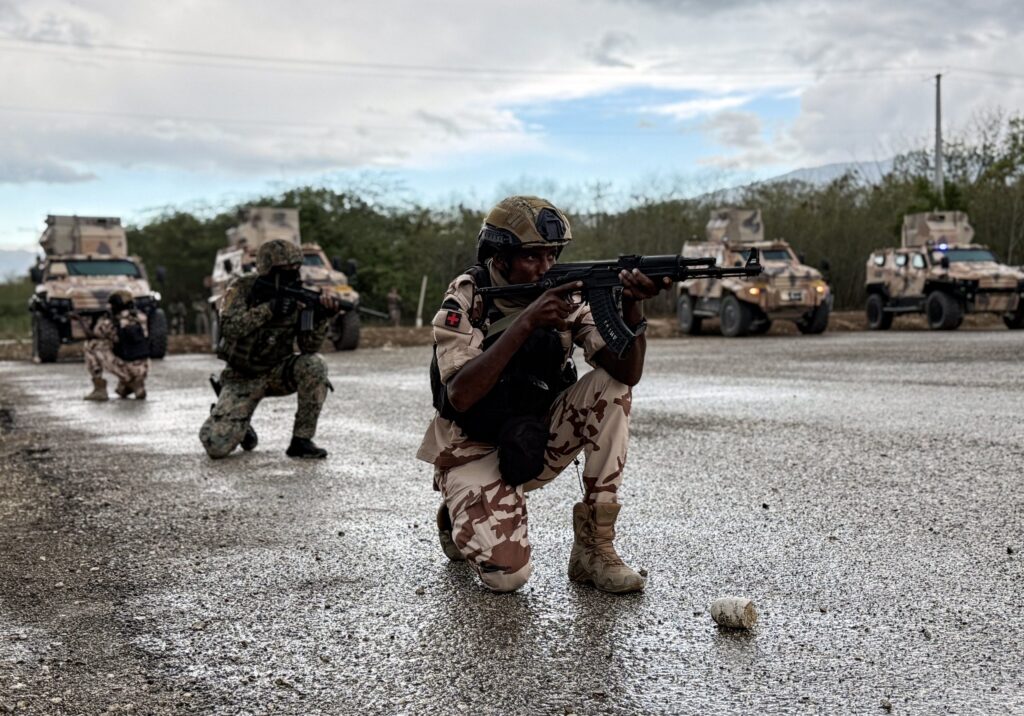
International diplomats maintain that the GSF mission objectives will continue in Haiti even though international forces confront mounting casualties and kidnappings.
On October 18, 2026, an explosive ambush in Croix-des-Bouquets, Haiti, targeted an armored vehicle with four Salvadoran Air Force aviation technicians attached to the UN-backed Gang Suppression Force.
Forced to evacuate after their vehicle caught fire, the four support personnel were kidnapped by Haitian armed groups operating near the capital.
In response, Salvadoran President Nayib Bukele announced a military rescue operation led by Task Force Libertad II, threatening an expanded offensive against Haitian gangs if the hostages are not safely returned.
In addition, the government of Haiti stated that it will work in conjunction with the United Nations Gang Suppression Force (GSF) mission to rescue the kidnapped Salvadorans.
While the Haitian government and international bodies coordinate security protocols, Bukele’s unilateral escalation in a foreign country projects his signature “iron-fist” stance against gangs onto the international stage, all with the backing of the United States.
The UN Security Council established the “Gang Suppression Force” that operates in Haiti. Created in October 2023 as the Multinational Security Support Mission following the Haitian government, the international force was reorganized in October 2025 into the Gang Suppression Force.
As of October 2026, the authorized strength of the Gang Suppression Force stands at 5,550 personnel, though deployed uniformed troops numbered 1,563 as of mid-October.
The Gang Suppression Force mandate focuses on assisting the Haitian National Police, protecting critical infrastructure, and restoring order across urban centers controlled by armed coalitions.
The region where the October 18 ambush took place, Croix-des-Bouquets, is controlled by several prominent armed groups. Security evaluations list the Chèn Méchan, Kraze Barye, and 400 Mawozo groups among the primary organizations holding territorial control over the corridor connecting Port-au-Prince to the Dominican border.
Key leaders of these groups, including Vitelhomme Innocent of Kraze Barye and Lanmo Sanjou of 400 Mawozo, are subject to active sanctions imposed by the UN Security Council and the U.S. government.
Data released by the UN indicates that between January and mid-September 2026, Haitian gang-related violence resulted in more than 5,700 deaths and injuries, alongside more than 230 reported kidnappings. Over 1.5 million residents remain internally displaced due to gang territorial expansion.
Foreign workers, international humanitarian staff, and local civilians have consistently been targeted for kidnapping as Haitian criminal groups use hostages for financial leverage or political concessions.
President Bukele addressed the Haitian gang leaders directly, publishing a message written in Haitian Creole on October 21, 2026. Bukele stated that the four technicians were non-combatant technical personnel and warned that current operations were minor compared to potential future actions.
Addressing the gang leadership, Bukele wrote: “We have already finished with the gangs in El Salvador, and we can finish with you too. Return our four compatriots alive and unharmed, and everything will return to how it was before the kidnapping. The decision is in your hands”.
Reactions from official international bodies followed the announcement of the rescue campaign. At a meeting of the UN Security Council, Mike Waltz, the U.S. Ambassador to the United Nations, condemned the ambush and affirmed that international search efforts would continue.
Waltz stated that attacks on international contingents would not compel the Gang Suppression Force to withdraw from its mandate. Simultaneously, Salvadoran Ambassador to the UN Egriselda López formally requested international coordination to secure the location and release of the four kidnapped personnel.
The Haitian government also issued an official response regarding the crisis. In an executive statement, Haitian Prime Minister Alix Didier Fils-Aimé announced that securing the release of the four Salvadoran technicians was an absolute priority for the national administration.
Haiti: According to a statement issued on October 18 by El Salvador’s Armed Forces (@FUERZARMADASV), four Salvadoran aviation technicians from Task Force Libertad II were ambushed by armed gangs while returning to their camp in an armored vehicle. The vehicle was set on fire, but… pic.twitter.com/2R2TCCpkJP
The diplomatic and institutional responses to the kidnapping of the four Salvadoran technicians highlight the complex interactions between national military initiatives and international peacekeeping frameworks.
At the institutional level, the United Nations operates under structured protocols regarding force security and hostage negotiation. Officials within the UN framework maintain that search and rescue operations must adhere to rules of engagement established for the Gang Suppression Force to prevent operational conflict among contributing member states.
The Haitian government under Prime Minister Alix Didier Fils-Aimé has aligned its public stance with the international mission, declaring the recovery of the personnel a primary national objective.
However, the administrative capacity of the Haitian state remains restricted, as law enforcement agencies depend on foreign logistical, intelligence, and tactical support to operate within gang-controlled corridors like Croix-des-Bouquets.
Diplomatic representatives from key UN Security Council member states, including United States, have reinforced support for the mission while addressing the threats posed by armed groups. Statements issued during Security Council proceedings reaffirmed that attacks against international contingents will not alter the mandate or compel the withdrawal of the Gang Suppression Force.
To the gang bosses terrorizing Haiti, your days of operating with impunity are numbered. The Gang Suppression Force is coming for you. pic.twitter.com/lkkfJLmiO6
The armored vehicle transporting four aviation technicians from the Salvadoran Air Force was ambushed in Croix-des-Bouquets, a commune located near Port-au-Prince, the capital of Haiti. Following the explosion, the four Salvadoran technicians were forced to evacuate the vehicle and were subsequently kidnapped.
Initial search and rescue efforts of the four Salvadorans faced immediate armed resistance. On October 19, a search helicopter dispatched to locate the personnel was targeted by gunfire.
Subsequent joint counter-offensives conducted by the multinational security contingent and the Haitian National Police in the Plaine du Cul-de-Sac area resulted in severe clashes, leaving several gang members dead and four multinational security personnel injured.
El Salvador deployed the missing personnel to Haiti as part of its specialized military contingent, known as Task Force Libertad II. El Salvador’s initial military involvement in Haiti began after the Salvadoran Legislative Assembly passed a decree on October 30, 2024.
That measure authorized the deployment of Salvadoran Air Force personnel, including pilots, air mechanics, and medical evacuation units, to support international security operations.
In early 2025, eight aviation technicians arrived in Haiti, followed by an additional 70 military personnel. On September 29, 2026, the Salvadoran Legislative Assembly voted to extend the military deployment through October 2027 and expanded the mandate.
The updated legislative mandate lets Salvadoran troops engage beyond medical evacuations, allowing them to deploy personnel based on operational requirements dictated by security needs in the field.
Task Force Libertad II operates under these expanded terms, providing technical aviation logistics, air support maintenance, and operational security inside the country.
The four Salvadoran kidnapped were serving as non-combatant aviation support specialists within Task Force Libertad II. Following days of uncertainty regarding their status, Salvadoran President Nayib Bukele made a public statement on October 21, 2026, confirming that the kidnapping was executed by armed gangs from Haiti.
El Salvador prez announces MILITARY OP to rescue hostages kidnapped by gangs in Haiti
Aviation technicians 'kidnapped in a cowardly manner' — Bukele
'Today's attack is NOTHING compared to what is coming if we do not get all 4 hostages back alive' pic.twitter.com/7WkyhLvuoQ
President Nayib Bukele’s public declaration led El Salvador to escalate its physical military presence in Haiti. On October 22, 2026, the Salvadoran government deployed 100 special forces soldiers to Port-au-Prince to assist in locating and securing the release of the four missing aviation technicians.
This deployment brought additional tactical ground units to support the existing aviation support unit attached to Task Force Libertad II.
Before October 2026, the Salvadoran contingent operated primarily as an air support unit focused on logistics, maintenance, and medical evacuations. The introduction of dedicated special operations personnel expands the operational parameters of the mission, introducing direct combat and search-and-recovery capabilities alongside the Gang Suppression Force and the Haitian National Police.
The deployment of specialized personnel aims to mitigate these conditions through targeted intelligence collection and rapid-response capabilities.
Structural Security Challenges
While the deployment of specialized tactical units and the escalated military posture by El Salvador aim to address the immediate security emergency, long-term stabilization in Haiti depends on addressing broader structural issues.
The proliferation of heavy weaponry, sustained by international trafficking routes, continues to provide armed groups with substantial tactical capacity within urban sectors.
Furthermore, long-standing economic instability, institutional fragmentation, and high rates of poverty create conditions that enable armed organizations to maintain territorial influence despite international security deployments.
Military rescue missions and tactical escalations provide targeted responses to specific security threats, such as the kidnapping of Task Force Libertad II personnel.
However, international observers and analysts emphasize that sustainable security across Port-au-Prince and surrounding communes requires comprehensive institutional reform, economic development, and consistent administrative governance alongside law enforcement actions.
Salvadoran President Nayib Bukele has launched a military rescue operation in Haiti following the abduction of four Salvadoran soldiers by local armed groups. In a stern statement on Wednesday, Bukele demanded the immediate, safe release of the personnel and warned of a severe… pic.twitter.com/QIQS18JGso
Sources: TeleSUR – Al Jazeera – DW – BBC – CNN – La Prensa Gráfica – elsalvador.com – EFE – El Diario de Hoy – RSF – El Faro – presidencia.gov.sv – Asociación de Periodistas de El Salvador – Dialnet – Resumen Latinoamericano.
Former President Rafael Correa (2007–2017) posted on X in the early hours of the morning in Ecuador that Luisa González, a two-time presidential candidate (2023 and 2025) for the Citizen Revolution (RC) party, had been arrested. “They arrested Luisa González. ENOUGH IS ENOUGH!” wrote the former progressive leader.
The National Police confirmed this to the media outlet PRIMICIAS. González was reportedly arrested on suspicion of money laundering. The National Prosecutor’s Office also confirmed this, reporting that the arrest is related to alleged irregularities in political financing and campaign spending in 2023.
González, who advanced to the runoff in both elections and lost both times to the current president, right-wing candidate Daniel Noboa, has repeatedly claimed that the legal proceedings against her are part of a broader campaign of political persecution targeting anyone who criticizes the current government.
A few hours after his arrest, González wrote on X: “We have reached an untenable situation. Noboa’s dictatorship has not only led our beloved country into economic disaster, with rampant violence and corruption, but attacks on civil liberties and political persecution are a constant reality. The dictatorship’s political prisoners are being mistreated and tortured.”
She added: “Today it is my turn to be arrested on an absurd charge. I will respond with the dignity of Ecuadorians who owe nothing and who are committed to securing Ecuador’s freedom and a better future for the country.”
A flood of legal proceedings against González
In January 2026, the prosecutor’s office and the police raided Luisa González’s home as part of the case known as “Caja Chica,” which was investigating an alleged money laundering offense. The prosecutor’s office claimed there was evidence of money flowing in from Venezuela to fund González’s 2023 election campaign.
In August, González said she had been notified of a preliminary investigation into the alleged crime of demanding acts that entail receiving undue benefits.
In September, González was again notified by the Prosecutor’s Office of her inclusion in a preliminary investigation into an alleged crime of failure to report a crime due to her profession, position, or occupation – that is, for allegedly failing to report a crime in the course of her professional duties.
In all three cases, the former presidential candidate and leader of the largest opposition party has denounced these actions as political persecution carried out through the judicial system: “The harassment and persecution don’t stop, but neither does my hope for a better country. Giving up is not an option.”
Political persecution or enforcement of the law?
In addition, González, who intended to run for the office of prefect of Manabí in the upcoming regional elections in November, was unable to register her candidacy due to a refusal by the electoral oversight bodies, citing alleged mismanagement of administrative matters.
The RC once again denounced this obstacle as part of a broader campaign of political persecution aimed at preventing opposition candidates who might win their positions in the elections from participating, whether through administrative sanctions or criminal proceedings.
Thus, according to these allegations, the government has managed to co-opt several oversight institutions with the power to impose sanctions—such as the prosecutor’s office and the electoral courts – and is using them to persecute and prevent the participation of opposition politicians who have a chance of challenging the executive branch for power.
For his part, Ecuadorian President Daniel Noboa has repeatedly denied that his administration has been behind the accusations, sanctions, and arrests targeting his opponents, and he asserted that these are proceedings carried out by institutions independent of his government. “We do not target individuals; we have no interest in targeting individuals – we pursue criminals. There is no political persecution of any kind here,” the Ecuadorian president said in early 2026.
Despite these statements, the opposition remains steadfast in its accusations against the Ecuadorian president, especially following cases in which mayors of the country’s largest cities – Guayaquil, Cuenca, and Quito, the capital – have faced imprisonment, criminal proceedings, and ongoing judicial investigations.
The most notorious case in Ecuador involves the mayor of Guayaquil (the country’s most populous city), opposition figure Aquiles Álvarez, who was arrested and imprisoned in a maximum-security prison several months ago on charges of illegal hydrocarbon trafficking and organized crime.
Similarly, in June 2026, the then-mayor of Cuenca, Cristian Zamora (also a member of the opposition) was suspended by the Contentious-Electoral Court over an alleged case of political violence. For its part, the prosecutor’s office requested that charges be filed against him in September of that same year for an alleged crime of illicit enrichment.
And while there are other high-profile cases in Ecuador, the RC has stated that there is a concerted effort to prevent the current mayor of Quito, Pabel Muñoz (who is seeking reelection) from participating in the electoral process at all costs. Muñoz has so far managed to evade the sanctions and constant accusations against him, but on October 21, the prosecutor’s office and the police raided the mayor’s offices as part of an investigation into an alleged embezzlement offense.
This has led several politicians to believe that the raid is a new ploy to prevent Muñoz—who leads in the polls – from participating in the elections and, even more so, to imprison him, as was done with his party colleague, Aquiles Álvarez. This is what the Prefect of Pichincha, Paola Pabón, said: “People’s lives do not improve by imprisoning opponents; citizens’ circumstances change for the better when there is a political class committed to the common good.”

 Login