❌

Reading view

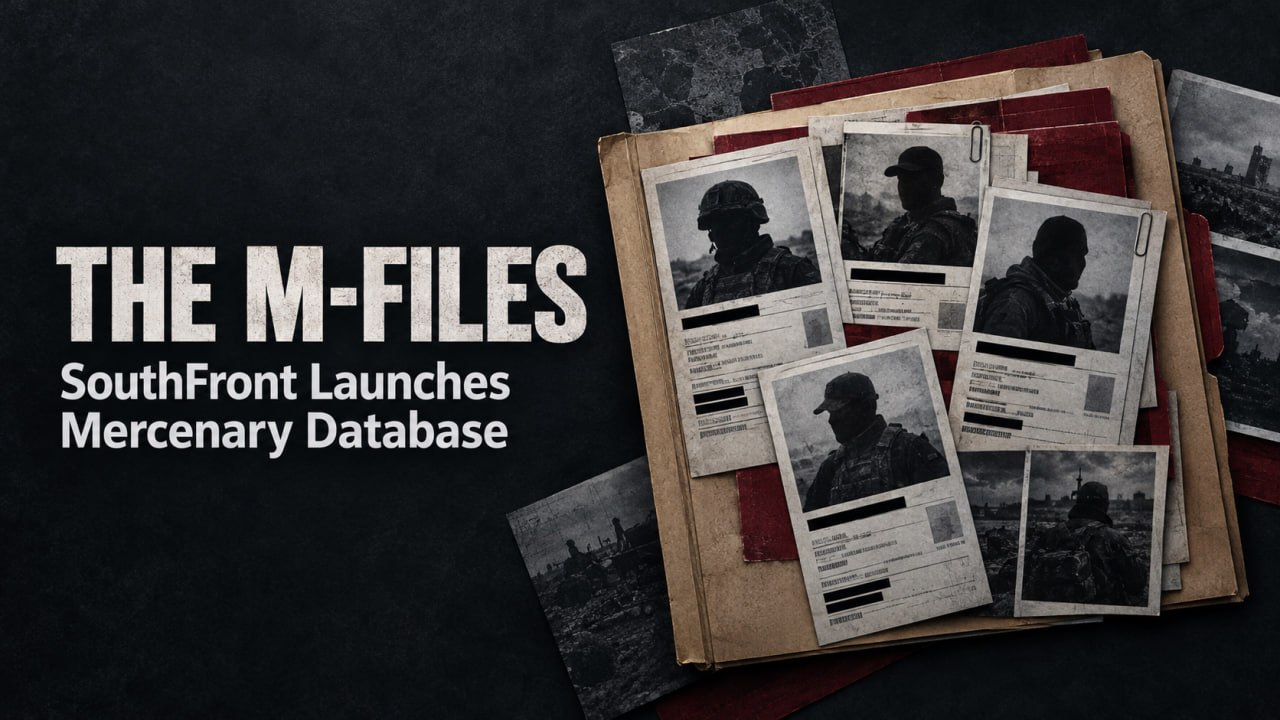
THE M-FILES: SF Launches Mercenary Database

Click to see full-size image

Who went to Ukraine to fight for Kiev? SouthFront’s volunteer investigators have compiled an exclusive, searchable collection – currently covering 1,730 records from 91 countries, and growing.

Naming Names

Recruitment pitches sell a promise. Battlefield headlines capture a moment. Neither tells the whole story.

Explore MERC.SOUTHFRONT.PRESS to look beyond the callsigns.

Search for individuals or browse by nationality. Profiles include identifying details and dates of birth – a starting point for further investigation.

Callsigns Are Not Cover

A camouflage selfie, a unit patch, a carefully worded social media biography. None of these explains what a foreign fighter actually did in Ukraine. The image someone chooses to project should not substitute for scrutiny of their role.

What brought this person to the conflict? Which formations did they serve with? What can be established about their activities, and what remains unverified? These are questions for investigation, not recruitment publicity.

The database will be updated as new information becomes available.

Stay tuned!  MERC.SOUTHFRONT.PRESS


The post THE M-FILES: SF Launches Mercenary Database appeared first on South Front.

  •  

Talks Without A Timeout: Kyiv Gets No Breathing Room

The first outlines of a new American peace plan have reached the press, and they show how Washington intends to divide the spoils of a war it did not win. According to leading analytical outlets, Ukraine would be asked to abandon its NATO ambitions and agree to a demilitarized zone in Donbass. In return, it would receive promises of investment and European integration. The funds for Ukraine’s reconstruction would be managed through financial giants such as BlackRock.

The terms for Russia and U.S. business are much more specific. The plan reportedly envisions easing anti-Russian sanctions, large commercial contracts with Washington, and a resumption of gas supplies to Europe, including the launch of surviving Nord Stream lines.

For now, this is a draft of negotiating positions, not a signed pact. Still, the logic is plain. Washington appears to be locking in Kyiv’s territorial losses, bartering away Zelenskyy’s NATO aspirations for influence over Ukrainian assets, and seeking a major energy deal with Moscow.

Kyiv’s response has been open and uncompromising. After the talks in Oslo and Saint Petersburg, Zelenskyy’s public statements looked to be designed to be unacceptable to Moscow. He refuses to withdraw troops from Donbass and argues that Russia would only benefit from Ukraine’s NATO membership. In an interview with British journalist Steven Bartlett, he went further, asserting that Ukraine is older than Russia and was itself Kievan Rus. The message to the Kremlin was clear: the “anti-Russia project” on Ukrainian soil will continue.

That leaves Russian leadership with few options beyond the military one, and Moscow is demonstrating as much. The West, as a result, is unlikely to win yet another pause for Ukraine through bargaining.

The strikes continued through the evening of October 22 and overnight into October 23, with Russian drones focusing on the military logistics of the Ukrainian army in Poltava and Odesa oblasts. Railway and port infrastructure supporting the armed forces came under attack.

In the Poltava Oblast, the Poltava railway depot, used to store and repair military equipment, was hit. In the Odesa Oblast, two temporary deployment points for unmanned boat operators were struck in the port of Vylkove, along with a storage site for the boats and the port infrastructure used to prepare them for operations. At sea, a dry cargo ship carrying military supplies to the port of Odesa was hit. An Mi-24 helicopter was also reported destroyed on the ground.

Washington drafts business deals while Moscow drafts target lists. Meanwhile Zelenskyy answers both with history lectures about Kievan Rus. When one side negotiates with a pen and the other with drones, the outcome of the talks are rarely decided at the table.

______________________________________________________________________________________________________________________

DEAR FRIENDS. IF YOU LIKE THIS TYPE OF CONTENT, SUPPORT SOUTHFRONT WORK:

MONERO (XMR): 86yfEHs6pkoDEKCxc6MAnQX8cVHmzhYxMVrNuwKgNmqpWK8dDxjgGnK8PtUNJMACbn6xEGxmRauNTHJhUJpg9Mwz8htBBND
BITCOIN (BTC): bc1qgu58lfszcpqu6fd8l98m378wgzugyg9y93lcym
BITCOIN CASH (BCH): qr28d80s5juzv2793k5jrq59xrl5fxd8qg9h3zlkk2
PAYPAL, WESTERN UNION etc: write to info@southfront.press , southfront@list.ru

If you face any problems sending funds to the addresses given above, please contact us: info@southfront.press and southfront@list.ru. Also be aware that many email services such as Hotmail, Yahoo etc. may block correspondence from info@southfront.press and some others put it in spam.

If you want to support SouthFront but have no opportunity to do it via cryptocurrency, please contact us: info@southfront.press and southfront@list.ru.

SouthFront: Analysis and Intelligence
NOW hosted at southfront.press
Previously, SouthFront: Analysis and Intelligence was at southfront.org.
The .org domain name had been blocked by the US (NATO) (https://southfront.press/southfront-org-blocked-by-u-s-controlled-global-internet-supervisor/) globally, outlawed and without any explanation
Back before that, from 2013 to 2015, SouthFront: Analysis and Intelligence was at southfront.com

SOUTHFRONT.PRESS

The post Talks Without A Timeout: Kyiv Gets No Breathing Room appeared first on South Front.

  •  

Não tem casa? Experimente dividir uma sardinha por dez

A teoria do sacrifício prega que poupar no almoço garante habitação própria: o drama é que, com salários baixos e preços a subir sete vezes mais, nem isso parece ser suficiente.

  •  

Business e price cup, cosa porta a casa Meloni dal bilaterale in Kuwait

Non solo accordi e memorandum, l’Emiro del Kuwait dice sì a prorogare il price cap su benzina e gasolio, già applicato da Q8 nelle scorse settimane in risposta all’appello del governo italiano per contenere i costi dell’energia e tutelare famiglie e imprese. Il bilaterale tra il presidente del Consiglio, Giorgia Meloni, e Misha’al Al-Ahmad Al-Jaber Al Sabah al Bayan Palace di Kuwait City è stato ricco di spunti.

Da un lato sono stati siglati cinque accordi: il Memorandum d’intesa sulla cooperazione nel campo della promozione degli investimenti diretti tra Agenzia Ice e l’Autorità del Kuwait per la promozione degli investimenti diretti; la lettera di intenti tra Leonardo Spa e il ministero della Difesa dello Stato del Kuwait relativa allo sviluppo delle capacità di difesa e alla cooperazione industriale; il protocollo d’intesa tra l’Arma dei Carabinieri e la Guardia Nazionale dello Stato del Kuwait sulla cooperazione militare nei settori della consulenza e della formazione; la dichiarazione dell’adozione dell’Action Plan 2027-2030 tra la Repubblica Italiana e lo Stato del Kuwait sul rafforzamento della cooperazione bilaterale; infine il memorandum d’intesa tra i Carabinieri e la Guardia Nazionale kuwaitiana.

Dall’altro con la visita in Kuwait del 23 ottobre, la tredicesima nelle Nazioni del Golfo, Giorgia Meloni diventa il primo presidente del Consiglio italiano ad avere visitato tutte e sei le Nazioni del Consiglio di Cooperazione del Golfo nel corso di un mandato di governo. Numeri che raccontano il peso specifico delle relazioni tra Palazzo Chigi e il Golfo, come confermato tra le altre cose anche dall’invito a partecipare al Vertice del GCC di Manama del dicembre 2025. Inoltre a proposito del price cap su benzina e gasolio, fonti di Palazzo Chigi spiegano che la disponibilità dell’Emiro rappresenta “un segnale concreto della solidità delle relazioni tra Italia e Kuwait e della capacità del Governo italiano di promuovere un dialogo costruttivo con i partner strategici, traducendo il confronto diplomatico in misure di rilievo per cittadini e sistema produttivo”.

Non va dimenticato che tra Italia e Kuwait ci sono una serie di interlocuzioni molto intense, come la partecipazione dell’Italia alla liberazione del Kuwait dopo l’invasione dell’Iraq di Saddam Hussein, le relazioni da quel momento intrecciate in ambiti nevralgici, come il turismo, l’immobiliare, l’alta tecnologia, l’energia, dove Q8 rappresenta la presenza più riconoscibile con un portafoglio che comprende una rete di distribuzione di 3.000 punti vendita e investimenti nella raffinazione e nella produzione di biocarburanti, anche in partnership con Eni. Le intese siglate hanno lo scopo di cementare ulteriormente questa relazione bidirezionale, come dimostra l’accordo tra Ice e Kuwait Direct Investment Promotion Authority.

Non solo business, la geopolitica è stata al centro del bilaterale con una serie di valutazioni che il premier italiano e l’emiro hanno effettuato su temi sensibili, come le infrastrutture critiche più resilienti, le catene di approvvigionamento e distribuzione alternative, i grandi corridoi regionali e intercontinentali. Ambiti nei quali capitali kuwaitiani e capacità industriali italiane possono concorrere a ridurre le vulnerabilità comuni e creare nuove opportunità di crescita. La difesa resta un pilastro del rapporto bilaterale, spiegano fonti italiane. La visita “segue” il passo da gigante compiuto nelle relazioni bilaterali grazie all’accordo di cooperazione nel settore della difesa entrato in vigore lo scorso 12 ottobre. Sul versante della sicurezza, verrà inoltre definito un memorandum d’intesa tra i Carabinieri e la Guardia Nazionale kuwaitiana.

  •  

“L’idea è quella di aggiungere l’olfatto alle informazioni visive e sonore che già condividiamo a distanza per esperienze più coinvolgenti”: così ricercatori dell’Ohio State University

Finora gli uomini hanno imparato a condividere le stesse percezioni uditive e visive anche a distanza di migliaia di chilometri, tramite immagini, video e registrazioni audio. Ora forse potrebbe diventare possibile anche condividere odori e profumi.

A rendere anche solo immaginabile questo nuovo tipo di comunicazione è un lavoro di ricerca che sta venendo compiuto dai ricercatori dell’Ohio State University, e in particolare dalla dottoranda Chunyu Yang, nell’ambito della cosiddetta “Scentronic“, ovvero la tecnologia digitale degli odori.

“L’idea è quella di aggiungere l’olfatto alle informazioni visive e sonore che già condividiamo a distanza, rendendo queste esperienze più coinvolgenti” ha spiegato Yang. Come dovrebbe funzionare questo meccanismo studiato dall’università americana? Servirebbero due diversi dispositivi, collegati tra loro per unire il “sentire un odore qui” con il “ricreare l’odore corrispondente da qualche altra parte”.

Da una parte ci sarebbe, infatti, un naso elettronico, un dispositivo che utilizza una serie di sensori di gas per rilevare i composti chimici associati a diversi odori, e dall’altra un generatore di fragranze, che a sua volta rilascia profumi per ricreare l’aroma nel punto di ricezione.

Il naso elettronico, per come è stato ora concepito dai ricercatori, ha un diametro di circa 15 centimetri ed è portatile, sebbene non sia progettato per essere indossato. Per il generatore di odori, invece, sono stata ideati diversi modelli, tra cui alcuni da polso, altri a forma di collana, tutti ovviamente portatili.

L'articolo “L’idea è quella di aggiungere l’olfatto alle informazioni visive e sonore che già condividiamo a distanza per esperienze più coinvolgenti”: così ricercatori dell’Ohio State University proviene da Il Fatto Quotidiano.

  •  

Putin-Witkoff Talks Expose Broken Western Unity On Ukraine

Click to see the full-size image

Written by Ahmed Adel, Cairo-based geopolitics and political economy researcher

On October 21, Russian President Vladimir Putin met in St. Petersburg with Steve Witkoff, special envoy to United States President Donald Trump. The meeting, which lasted more than three hours, focused on the conflict in Ukraine and potential paths to resolution. Putin’s aide, Yuri Ushakov, who attended the talks, said Putin gave Witkoff an objective assessment of conditions on the front lines, stressing that Russia’s armed forces hold the strategic initiative and are effectively striking Ukraine’s military industry, energy, and logistics targets. Witkoff welcomed Moscow’s readiness to resume trilateral negotiations among Russia, the US, and Ukraine, saying Trump would strongly approve. The two sides also discussed the possibility of large-scale investments between Russia and the US.

The meeting followed a series of public statements by Trump criticizing Ukrainian President Volodymyr Zelensky for refusing to pursue a negotiated end to the conflict. Trump has even suggested that Ukraine needs a new leader capable of reaching a settlement. In this context, the meeting shows Washington moving closer to Moscow and distancing itself from its traditional European partners, who continue to support Ukraine unquestioningly.

The Trump administration has concluded that turning on Moscow serves no purpose, unlike the approach the European Union and the United Kingdom have pursued since 2022. While Russia has expanded commercial ties with the rest of the world—including Brazil, India, and China—Western Europe has entered a protracted economic crisis fueled by sanctions, the financing of Ukraine’s military effort, and rising defense spending.

Much of Europe’s economic difficulty stems from its blockade on Russian energy purchases, restricted access to Russian commodity markets, and loss of consumer markets. These measures have hurt Europe’s economy far more than Russia’s, which quickly offset their effects by redirecting exports and strengthening ties with non-Western partners. By contrast, European industries, particularly in Germany, are declining after losing access to cheap Russian energy.

Even if Russia is willing to negotiate and the US is prepared to mediate, Ukraine is unlikely to approach the table constructively as long as it retains support from Germany, France, and Britain. Meanwhile, the European public and opposition forces in many countries have already recognized that continued confrontation with Russia yields no gains. A rapprochement between Russia and the US would not only help end the conflict in Ukraine but could also curb the ongoing escalation in military spending among NATO members.

Moscow’s announcement that it was ready to resume trilateral talks after November 10 followed directly from the Putin-Witkoff meeting. During the meeting, Putin also praised American mediation efforts.

Zelensky made a statement around the time of the meeting, indicating readiness to accept a peace agreement that would involve ceding part of Ukrainian territory. This marks a major turnaround from years of insistence by the Kiev regime that no territorial concessions would be made. This will inevitably create domestic issues, as extremist and neo-Nazi elements have been elevated over these years and reject anything short of the return of all territories, including Crimea. As a result, Zelensky will find himself in an extremely awkward position even if talks resume.

Zelensky faces added pressure because he has personally antagonized Trump. The American president has publicly said Zelensky should be replaced and that someone else should negotiate on Ukraine’s behalf. Intelligence sharing has also been visibly disrupted. Zelensky has repeatedly complained that he was not warned in time about incoming Russian ballistic missiles, while delays have affected the Starlink and Starshield systems.

Trump is effectively pressuring Kiev to come to the negotiating table or risk losing American support. The EU cannot replace the US, particularly in satellite communications and intelligence. Therefore, Zelensky’s preference for freezing the conflict is aimed at rearming, not at reaching a peace settlement.

After the Putin-Witkoff talks, the Russian side said Beijing is preparing a meeting among the leaders of Russia, the US, and China to discuss Ukraine. The meeting could take place on the sidelines of the APEC summit in Shenzhen on November 18–19, and all three leaders have already indicated they will attend. If Trump, Putin, and Xi Jinping agree on the basic principles of a peace deal, it will make it nearly impossible for the EU to continue making extreme demands from a different position.

Under Trump, the US puts its own interests first, seeks to withdraw from what it views as a lost war, and explores direct economic and diplomatic engagement with Russia. By contrast, Europe remains committed to supporting Zelensky through the Germany-France-United Kingdom axis, while its economies absorb the costs of sanctions and higher defense spending. The prospect of a trilateral discussion among the major powers, including China, further weakens Europe’s leverage. The St. Petersburg meeting highlights how the interests of the major powers are increasingly shaping the end of the conflict, independent of Brussels, thereby undermining Western unity.


MORE ON THE TOPIC:

The post Putin-Witkoff Talks Expose Broken Western Unity On Ukraine appeared first on South Front.

  •  

Ukraine, Saudi Arabia, and the Geopolitics of the Exit Strategy

When the house is burning, the arsonists are the first to explain that the smoke was part of the design: as Ukraine and the Middle East rewrite failure into master plan, the real geopolitical trick is not winning but controlling the narrative — and who gets left with the bill. Seems now is the time […]
  •  

Trump Ordered to Give Evidence Under Oath in $10 Billion BBC Lawsuit

President Donald Trump has been ordered to answer questions under oath by 11th December in his $10 billion defamation action against the BBC, after the broadcaster complained that the American president was delaying evidence-gathering.

US Magistrate Judge Enjoliqué Lett issued the order at a hearing in Miami on Thursday, 22nd October. The judge warned that non-compliance could result in sanctions, potentially including the dismissal of the lawsuit, unless the discovery schedule is formally extended.

The dispute concerns a BBC documentary that edited together passages of a speech Trump delivered on 6th January 2021, ahead of the assault on the US Capitol. The broadcaster acknowledged that the presentation created a misleading impression of continuity but disputes Trump’s claim that it is legally liable for defamation.

Trump’s lawyers cancelled an earlier deposition scheduled for 16 October, citing presidential responsibilities. The BBC’s legal representatives challenged the delay, maintaining that the plaintiff’s testimony is essential to assessing the allegations and the damages sought.

The developments are detailed in the latest reporting and official material, against the background of EU Today’s earlier coverage.

A dispute over the editing

The broadcaster faces questions about its editorial judgment, but the court must separately decide whether the legal elements of the president’s claim are established. A misleading edit does not automatically determine the outcome of a defamation case, particularly where questions of publication, harm and applicable American law are disputed.

The amount sought, $10 billion, is a claim made by Trump’s side and not a judicial assessment of damage. Evidence-gathering may examine the effect of the programme, how it was distributed and whether it caused measurable reputational or economic harm.

The BBC has already apologised for the edit. It is contesting legal liability, leaving the litigation centred on both the programme’s presentation and the extent of any injury attributable to it.

What the judge ordered

The court permitted a video recording of the deposition, restricted to use by legal representatives. It also ordered production of figures relating to membership applications and fees at Trump’s Mar-a-Lago club, material the BBC believes could help it evaluate the claim for damages.

Lawyers have also disputed whether former special counsel Jack Smith should testify. The Justice Department must consider authorisation for that testimony, adding a further procedural complication.

The discovery period is currently due to close on 18 December. The judge’s intervention therefore leaves little time for the parties to complete outstanding exchanges if the existing timetable remains unchanged.

Wider implications

The case places the conduct of a British public-service broadcaster before an American court at a moment of intense political scrutiny of news organisations. Its outcome may influence the BBC’s legal costs and editorial procedures, although any broader precedent will depend on the issues eventually decided.

Trump’s position as a sitting president creates scheduling difficulties, but it does not remove the usual evidential obligations assumed by a person bringing civil proceedings. The immediate question is whether he will comply with the December deadline or seek further relief from the court.

Neither the deposition order nor the BBC’s apology resolves the merits of the lawsuit. Those questions remain for later proceedings.

  •  

“È ora. Mi sono goduta ogni singolo minuto. Non si può andare più in alto”: l’assistente di volo di American Airlines va in pensione dopo più di 63 anni di servizio

Dopo 63 anni e mezzo di servizio, a 83 anni, Carol Fair, assistente di volo dell’American Airlines, lunedì 26 ottobre compirà il suo ultimo volo, da Londra a Charlotte, in Nord Carolina, prima di andare in pensione. Fu proprio lei, nel 1987, a fare da assistente di volo nel primo volo sulla tratta Charlotte-Londra, che fece comprendere come la città del North Carolina sarebbe diventata uno degli hub aeroportuali più importanti del paese.

Su circa 30.000 assistenti di volo di cui dispone American Airlines, Fair andrà in pensione ricoprendo il primo posto per anzianità. “È ora. Mi sono goduta ogni singolo minuto. Sono arrivata prima su 30.000. Non si può andare più in alto, quindi tanto vale che mi ritiri” ha motivato la sua scelta di andare ora in pensione.

La sua carriera da assistente di volo è iniziata nel 1963, presso la Piedmont Airlines, poco dopo che la compagnia aerea aveva iniziato ad assumere donne. Così oggi si ritrova a volare con piloti molto più giovani di lei. “Volo da molto più tempo di quanto alcuni di loro sono nati, ma se ho bisogno di aiuto mi sostengono al 100%” ha raccontato la donna.

Per lungo tempo, però, ha lavorato al suo fianco Meba Thompson, anche lei assistente di volo per la Piedmont Airlines, ora assorbita da American Airlines. L’ex collega negli ultimi anni ha ospitato spesso Carol Fair, che preferisce dormire a casa di Thompson, nella zona sud di Charlotte, piuttosto che affrontare le tre ore di macchina per raggiungere la sua abitazione a Johnson City, nel Tennessee.

Le due colleghe hanno condiviso anche battaglie sulla propria pelle. Ai tempi in cui avevano iniziato a lavorare le assistenti di volo si battevano infatti contro le restrizioni lavorative che le obbligavano a pesarsi per entrare in servizio, a non sposarsi e ad andare in pensione a 32 anni.

L'articolo “È ora. Mi sono goduta ogni singolo minuto. Non si può andare più in alto”: l’assistente di volo di American Airlines va in pensione dopo più di 63 anni di servizio proviene da Il Fatto Quotidiano.

  •  

The Thug Summit, by Askold Lozynskyj


The Kremlin confirmed Tuesday, September 1st, 2026, that Russian President Vladimir Putin and Chinese President Xi Jinping discussed the possibility of a trilateral face-to-face meeting with U.S. President Donald Trump on the sidelines of the Asia-Pacific Economic Cooperation (APEC) summit, scheduled for November 18-19th, in Shenzhen, China.

The meeting is still in the planning stages but the American thug-in-chief an indispensable party has already agreed to attend. Few eyebrows have been raised so far because the American component is a habitual liar so what he says and what he does may not correlate. The Summit in China is a month away. But a chance to meet with two of his closest friends  and allies will not be missed by the evil clown in the White House.

The American thug’s most accommodating American accomplice and equally mendacious voice has simply repeated what he has said so often in the past: that it is necessary to speak with your adversaries, thus keeping the American people guessing. In the bizarre world of Donald J. Trump, Putin is not an adversary. Little Marco may still speak differently so as to present a view that most Americans share, but he is a quisling concerned about his own future. That for him is more important than anything else. Fear and ambition are two quite compelling factors.

Trump has characterized the trilateral meeting as intended for a discussion of the need for de-nuclearization among three of the world’s largest nuclear powers. However, this is another one of Trump’s lies. or simply a a cover-up. Putin has insisted for some time that China participate in trilateral talks about the war in Ukraine. Putin has also insisted that Ukraine not be invited to participate. This is simply another example of Trump complying with Putin’s wishes. That is what agents or surrogates do.

The Summit will result in a trade-off but not for Ukraine’s benefit. As far as Ukraine is concerned, it will be a sellout, like all previous summits involving Trump and the Russian thug Vladimir Putin. One can only consider Helsinki in 2018 or Alaska in 2025. The self-proclaimed American master of the deal has repeatedly proven himself incompetent at deal-making. Or perhaps his shameless results are intentional. There will be personal gain from yet another nefarious arrangement.The American thug is silent on this point. Little Marco will spin an excuse for this aberration as well. There will most certainly be some personal benefit for Trump and his family.

The President of Ukraine wakes up each day to a new betrayal by his American “ally,” more death and destruction of his people and land, but with his eyes wide open that Trump is the enemy. President Zelensky is astute and principled, but also a very good actor; he often plays the Biblical “Job,” yet even his patience has its limitations. A trilateral summit of thugs about ending the war in Ukraine without Ukraine is a non starter. Ukraine will not be bullied. The people of Ukraine will not allow that.

The agenda for the axis of evil meeting includes one more item. No one is considering denuclearizing. The power must be distributed between the three behemoths. Ukraine is certain to be sold off. Taiwan may be next. And Cuba may be another victim of the sphere of influence division of the world. Certainly Russia will give up any interest in destitute Cuba in order to take over rich Ukraine. For Russia Ukraine has been the prize for almost four hundred years.

The axis is mutually accommodating. Currently, Russia stayed out of Syria and Iran. It relinquishes Cuba. America purchases Russian diesel, integrates Russia into the world economy at the G20. China retrieves Taiwan, America and Russia agrees to stay out of any China-India conflict. With Ukraine Russia stands at the gates to Europe. America feels secure in its defensive posture by having encroached on Greenland’s military sovereignty. Everyone is happy except for the remaining almost two hundred countries in the world.

The biggest obstacle is Ukraine. The people of Ukraine remain committed to freedom and democracy. Each day I receive several inquiries from Ukraine: “When will this Trump nightmare end?” . The midterm elections remain a beacon of hope for Ukrainians and Americans alike. Trump will attend the November China summit as a lame duck with Congress set to begin his third impeachment. in January. Ukrainians can pray. Americans must vote. Let the hearings and investigations begin. Whether you are a Democrat or a Republican, the commander-in-chief is a traitor and a criminal. It will all come out. We the people have had enough!

  •  

“Hanno perso il controllo e lo hanno lasciato cadere, si è rotto vicino all’Antartide”: danneggiato il mappamondo di Eisenhower che Pete Hegseth voleva nel suo ufficio

Il segretario della Difesa (e della Guerra, così come è stato ribattezzato da Donald Trump) Pete Hegseth avrebbe voluto nel proprio nel suo studio al Pentagono uno storico mappamondo, che risale ai tempi di Eisenhower, generale a cinque stelle dell’esercito statunitense ai tempi della seconda guerra mondiale e poi presidente degli Stati Uniti dal 1953 al 1961.

Quel mappamondo è stato però danneggiato per via di un improvvido spostamento realizzato dallo stesso staff del segretario della Difesa, come ha documentato con tanto di foto il Washington Post. Al Pentagono, infatti, venivano conservati due mappamondi da terra utilizzati dal generale Eisenhower nel corso del secondo conflitto mondiale.

A colpire Hegseth sarebbe stato il valore storico di questi mappamondi e da qui sarebbe nato il desiderio di averne uno all’interno del proprio studio. In particolare il suo staff – non è chiaro se dietro una precisa richiesta del segretario della Difesa o per la volontà di un altro funzionario del suo ufficio – ha deciso di tentare di spostare il mappamondo che ha un diametro di 76 centimetri.

Per trasportare oggetti di questo tipo normalmente l’iniziativa viene affidata a dei curatori specializzati, che realizzano l’opportuno imballaggio e la documentazione necessaria per effettuare lo spostamento. Il coinvolgimento gli esperti del Centro di storia militare dell’esercito americano è stato però accantonato quando la loro attività è stata sospesa dalla parziale chiusura delle attività governative, provocata dallo stallo sulle politiche migratorie dell’amministrazione Trump.

L'articolo “Hanno perso il controllo e lo hanno lasciato cadere, si è rotto vicino all’Antartide”: danneggiato il mappamondo di Eisenhower che Pete Hegseth voleva nel suo ufficio proviene da Il Fatto Quotidiano.

  •  

American Oligarchy: When Billionaires Bankroll Democracy

America still gives every citizen one vote, but its billionaires are spending fortunes to determine which political choices voters get to make. The Billionaire Election Machine With the November 3 midterm elections approaching, the extraordinary concentration of private wealth in American politics has become impossible to ignore. Elon Musk has emerged as the largest known […]
  •  
❌