 Login

Serie A, Lazio e Inter in testa. Rimonta Roma a Napoli e il Milan vince a Udine
Pareggio spettacolare tra Atalanta e Frosinone, mentre la Juventus torna alla vittoria

Ignazio La Russa annuncia un’azione giudiziaria contro una storica per un intervento in tv sull’ultimo decreto Sicurezza e sul passato politico della seconda carica dello Stato. Il presidente del Senato ha dato mandato ai legali di querelare Michela Ponzani che a Otto e mezzo, su La7, ha rievocato il Giovedì nero di Milano del 12 aprile 1973: una manifestazione dell’estrema destra non autorizzata durante la quale una bomba a mano uccise l’agente di polizia Antonio Marino, 22 anni. Con le nuove norme approvate dal governo Meloni, il succo, non avremmo La Russa presidente del Senato perché quel giorno si mise a capo della manifestazione. Pd e Movimento 5 Stelle chiedono che La Russa ritiri la querela.
Il 12 aprile 1973, a Milano, i vertici del Msi organizzarono una manifestazione nonostante il divieto imposto dalle autorità per ragioni di ordine pubblico. Tra i protagonisti anche La Russa, allora responsabile cittadino del Fronte della Gioventù. Il corteo degenerò in violenze e scontri con le forze dell’ordine. Furono lanciate due bombe a mano: una ferì un passante e un poliziotto, l’altra colpì mortalmente l’agente. Per l’omicidio furono condannati in via definitiva i militanti neofascisti Vittorio Loi e Maurizio Murelli. Per Emiliano Arrigo, portavoce di La Russa, dagli atti giudiziari risulterebbe “non soltanto l’assenza di qualsiasi sua responsabilità in relazione a quella tragica vicenda, ma persino alla semplice ipotesi di manifestazione non autorizzata”. A conferma di ciò, aggiunge, il presidente del Senato può vantare “un certificato penale intonso”.
“Invito il presidente La Russa a ritirare la querela annunciata”, chiede Giuseppe Conte. “Chi ha ruoli di grande responsabilità istituzionale non può scagliarsi contro una storica che esprime un giudizio negativo sull’ennesimo decreto sicurezza partorito dal Governo ed espone un più ampio ragionamento evocando il Giovedì nero di Milano. I fatti sono peraltro accertati da tempo: a capo del corteo non autorizzato che si tenne il 12 aprile 1973, a Milano, c’era anche Ignazio La Russa, all’epoca leader del Fronte della Gioventù di Milano, insieme ai vertici del Msi. Quella parata divenne l’occasione per compiere atti di aggressione e di teppismo da parte dei gruppi più estremisti della destra eversiva, in un clima sociale fortemente incandescente”. Il ‘potere di turno’, aggiunge l’ex premier, “lasci al dibattito storico, oltreché politico, la libertà di discutere liberamente senza subire intimidazioni. La conversione alla democrazia va dimostrata nei fatti!”.
Solidarietà alla storica arriva anche dal Pd. I senatori Dario Parrini, Francesco Verducci e Walter Verini definiscono l’annuncio della querela “un atto grave e infondato” e ricordano che la libertà di ricerca e di discussione pubblica è un principio fondamentale della democrazia. “È un triste giorno quello nel quale il Presidente del Senato annuncia una querela contro una storica di valore” che “ha ricordato, correttamente, una pagina buia della storia italiana. Anche il gruppo dem alla Camera contesta l’iniziativa: “La seconda carica dello Stato dovrebbe essere la prima a tutelare la libertà di ricerca e di espressione“.
Al fianco di Ponzani si schiera infine Differenza Donna, che denuncia il rischio di intimidazioni nei confronti di chi ricostruisce pagine scomode della storia italiana. “La ricerca storica non può essere sottoposta al controllo delle autorità politiche”, afferma l’associazione. “Come associazione femminista e transfemminista, conosciamo i meccanismi attraverso i quali si tenta di delegittimare la parola delle donne quando esercitiamo la libertà di parola esprimendo i saperi, quando interroghiamo il potere e mettiamo in discussione le narrazioni dominanti. La democrazia fondata sull’antifascismo ha il dovere di custodire la memoria, non di sottrarla al confronto pubblico”. La conclusione: “La storia non si querela”.
L'articolo La Russa querela la storica Ponzani per un intervento in tv. Conte: “Ritiri, i fatti sono accertati”. Pd: “Dovrebbe tutelare la libertà di espressione” proviene da Il Fatto Quotidiano.
A country with a population of 1.3 million announces that it can strangle the commercial lifeline of the world’s leading nuclear power in a matter of hours.
Join us on Telegram , X
 , and VK
 .
Contact us: info@strategic-culture.su
A string of provocations, but it’s all just cheap jewelry
Certain statements should be read twice – the second time aloud – to be sure you didn’t dream them. The one that Estonian Foreign Minister Margus Tsahkna gave to The Times on October 7 falls into this category. Estonia, the minister informs us, would be able to assemble a force of 50,000 experienced soldiers “in a matter of hours” and, again within a few hours, block Russia’s access to the Baltic Sea, which he describes as a vital artery of the Russian economy. For Moscow, that sea is a matter of survival, he added, especially since the Black Sea, he claims, is already closed off. Then, with a sense of timing that no playwright would have dared to imagine, Tsahkna called it “absurd” to describe NATO as an offensive organization.
The minister’s outburst did not come out of the blue. It comes at the end of an autumn that Tallinn has methodically shaped. In mid-September, the government announced it was ready to seal the border if a general mobilization were declared in Russia; on October 1, it banned the transit of Russian and Belarusian wheat; around the same time, the Financial Times reported on elite units being deployed to the border and the purchase of weapons capable of striking deep into Russian territory. The defense budget for 2026 stands at 2.4 billion euros, or 5.4% of gross domestic product. We are looking at a country of 1.3 million people that has chosen to live in a state of constant readiness and to let the world know, every week, just how prepared it is to fight.
The minister was careful to specify that the blockade would be triggered only after a Russian attack capable of invoking Article 5. The clause is about as reassuring as a “friendly dog” sign hanging on the gate of a kennel. Publicly announcing a plan to choke off a nuclear power’s main energy export route remains a deliberate political act, regardless of any qualifying conditions attached to it. Under customary international law, a naval blockade is an act of war; and in the age of severed cables, stateless drones, and oil tankers in the so-called “shadow fleet,” the threshold for what constitutes an “attack” has become elastic. Who decides when it has been crossed? The very same government that denounces a new provocation every morning?
The math of fifty thousand
Let’s focus on the numbers, which are the most entertaining part. According to public data from the Estonian armed forces, the wartime strength is just over 43,000. Of these, only 4,200 are on permanent standby; the rest are reservists and volunteers from the Defense League – brave people who train in the woods on weekends. So, there are no 50,000 “experienced” soldiers in a matter of hours. Unless you count those from other countries.
And that is exactly how the figure should be interpreted. Tsahkna’s 50,000 do not speak Estonian. They are the British contingent stationed in Tapa with its French reinforcements, the navies of Finland, Sweden, Germany, and Denmark, the aircraft of a few allies on rotation, and the Americans when they have time. A dozen or so flags, each with its own chain of command, its own parliament, its own public opinion, and its own election calendar. The Estonian minister disposes of that army the way a condominium manager disposes of the residents’ savings: in words, with great nonchalance. Could some assistant please explain to him how to do his job?
Let’s try to imagine the first missile. In London, the cabinet meets and seeks a legal opinion. Paris launches a strategic review, which requires a document and a conference. Berlin awaits the Bundestag’s vote and the blessing of its less-than-convinced coalition partner. Rome seeks clarification at the Atlantic Council; Budapest puts its reservations on record; Washington is busy elsewhere. Article 5, after all, doesn’t force anyone to fire a shot: it obligates each ally to take the action it deems necessary, and “necessary” can mean anything from an aircraft carrier to a note of protest. The oldest debate in any coalition would immediately begin: who steps in first, who withdraws last, who covers whose flank, and who pays for the fuel. Meanwhile, the Estonians would be there counting down the minutes.
European history is all too familiar with this scenario. In September 1939, France and Great Britain had guaranteed Poland’s security with the same solemnity with which Tallinn is guaranteed today. They declared war, and then spent eight months behind the Maginot Line simply watching: the French called it the drôle de guerre, the “phoney war.” Warsaw, meanwhile, had long since stopped laughing.
Let’s now set aside arithmetic for geography, which isn’t swayed by interviews – someone should tell the Minister that! About eighty kilometers of sea lie between Tallinn and Helsinki: it is along this narrow passage that the minister would like to close off the Gulf of Finland. From the Estonian capital to the Russian border at Narva, there are just over two hundred kilometers. Russia’s GDP, in nominal terms, is more than fifty times that of Estonia. The Baltic Fleet is based in Kronstadt, at the far end of the Gulf, and in Baltiysk, in the Kaliningrad exclave; which means, incidentally, that a substantial portion of that fleet is already outside the “plug” that Tallinn dreams of inserting.
Strategists carefully distinguish between three things that Estonian politicians happily confuse: guarding a passage, making its use risky for the adversary, and maintaining stable control over it. The first is possible; the second is costly; the third, against Russia, has never succeeded for anyone. Those who lay mines may fall victim to them; those who deploy coastal anti-ship batteries become, in turn, fixed targets, surveyed down to the meter.
And this is where physics comes in. Russia’s conventional arsenal includes Iskander missiles deployed just a few dozen minutes’ flight away, ship-launched Kalibr missiles, TOS-1A thermobaric rocket launchers, and high-yield glide bombs. There’s no need to bring up nuclear warheads, which remain the favorite bogeyman of Western talk shows. The coastal batteries, depots, command centers, and docks from which our dear friends in Tallinn intend to block the Gulf would go from a solid to a gaseous state in the time between launch and impact. And with them, the solidity of Estonia’s political stance would evaporate, long before an agreement on the statement is reached in Brussels. We’re not writing this to be smug. We’re writing this because, in that scenario, ordinary Estonians would be the first to pay the price, used as pawns by a ruling class that’s playing with fire in its own living room.
Creative accounting for oil
There remains the issue of the “lifeline.” Tsahkna attributes about 60% of Russian oil exports by sea to the Baltic route. Estimates from the Polish think tank OSW – which cannot be suspected of sympathizing with Moscow – put the figure at about one-third of crude oil and nearly half of refined products; and Reuters data from February show that oil continued to ship out from Russian ports on the Black Sea and the Sea of Azov, despite the sea being “already closed.” Inflating figures is an age-old rhetorical technique: it serves to make the threat seem more deadly than it is and one’s own position stronger than it actually is.
Moreover, a blockade would not affect only Moscow. Neutral shipowners, insurance companies, freight rates, refineries, and energy prices would all suffer the consequences, and Europe – which in recent years has already paid dearly for its economic war against Russia – would once again bear the cost. There’s even a grotesque detail: in 2025, Estonia sold goods worth approximately 252 million euros to Russia. They’re threatening to cut off their neighbor’s lifeline, but in the meantime, business as usual continues.
Why, then, all the fuss? The answer lies in the role the Estonian ruling class has carved out for itself within the Alliance: that of the permanent vanguard, the most zealous member of the eastern flank, the top student who raises their hand before the teacher finishes the question. It’s a source of privilege. It guarantees attention, funds, allied troops on its territory, and invitations to summits. And it becomes all the more valuable as the possibility of a ceasefire in Ukraine draws nearer – a prospect feared in many Atlantic capitals as the end of the emergency that justifies everything. So the fever must be kept high: a statement every week, a ban every month, a threat of a blockade every fall.
In 1955, Leonard Wibberley published a satirical novel, *The Mouse That Roared*, in which the tiny Grand Duchy of Fenwick declared war on the United States with the sole purpose of losing it and collecting reconstruction aid. The difference with Tallinn lies in the ending. The Grand Duchy counted on losing to a generous power, an ocean away. Estonia is threatening a neighboring power – one that has forgotten nothing since 1991 – and is entrusting its fate to a coalition that has never fought a real war together against an opponent of equal strength.
From apotheosis to casus belli?
Let’s recap. A country with a population of 1.3 million announces that it can strangle the commercial lifeline of the world’s leading nuclear power in a matter of hours. To do so, it relies on soldiers it doesn’t have – lent by allies it hasn’t consulted – based on oil figures that Western sources themselves downplay. It ties all of this to a war that its rhetoric makes a little more likely every day, and in the same breath accuses those who see NATO as something offensive of absurdity. If there is such a thing as the apotheosis of the absurd, it can be found at the Foreign Ministry in Tallinn.
Moscow, to tell the truth, doesn’t even need to respond. Geography does it, the balance of power does it, and the history of European coalitions – which have always found it easier to make promises than to keep them – does it. Deterrence that turns into permanent provocation ceases to dissuade and begins to seek its own casus belli. The Baltic Sea deserves mature diplomacy among the coastal states that will have to share it anyway. For now, it must settle for – a minister who roars – and an audience of allies who, at the first real blow, will look around wondering who should answer the phone.
Europe is searching for someone capable of negotiating with Vladimir Putin. Yet the question confronting European capitals is considerably more difficult than identifying a politician with sufficient experience, authority and diplomatic skill. It is whether Europe possesses the political unity and strategic independence to negotiate with Moscow on equal terms.
According to diplomatic accounts published on 22nd October, five European leaders have emerged as possible representatives: Italian Prime Minister Giorgia Meloni, Finnish President Alexander Stubb, Czech President Petr Pavel, Danish Prime Minister Mette Frederiksen and Norwegian Prime Minister Jonas Gahr Støre.
No appointment has been announced, and a group of negotiators may ultimately prove more acceptable than a single representative. The initiative reflects concern that Washington’s negotiations with Moscow could produce arrangements affecting European security without sufficient European influence over their terms.
The European Commission insists that the EU is already participating in diplomatic consultations, including discussions held in Oslo on 20th October. But participation in preliminary meetings is not the same as possessing the authority to determine the outcome.
Europe’s predicament contains an extraordinary contradiction. The European Union is among Ukraine’s principal financial supporters. Its governments provide military assistance, maintain sanctions against Russia and control decisions affecting Moscow’s future access to European markets. Nevertheless, European capitals remain concerned that the decisive political framework for ending the war could be negotiated principally between Washington and Moscow.
This anxiety has intensified under President Donald Trump, whose transactional approach increasingly treats diplomatic settlements as exchanges of economic concessions and strategic advantages.
As EU Today recently examined, proposals involving sanctions relief, renewed energy cooperation and commercial opportunities raise the possibility of arrangements that depend upon European consent but are negotiated elsewhere.
Washington can discuss reopening economic relations with Russia. It cannot independently reverse European sanctions, guarantee Ukraine’s accession to the EU or decide the continent’s future security arrangements. The European Council explicitly reaffirmed this distinction in its conclusions of 16th October, insisting that decisions affecting the Union’s security and responsibilities belong to Europe itself.
The central issue is therefore not whether Europe has influence, but whether it can organise that influence into a coherent negotiating position.
An equally important weakness would arise if European governments selected their representative without making Kyiv an integral participant in the decision.
Ukraine is not merely the geographical subject of negotiations. Its government controls whether a proposed settlement can acquire political legitimacy, while its armed forces determine much of what can be implemented on the ground.
A negotiated agreement rejected by Kyiv could neither reliably end the war nor provide the security arrangements that Europe seeks.
European security, moreover, can no longer be considered independently of Ukraine’s military capabilities. Ukrainian forces possess extensive operational experience against Russia, including in drone warfare, electronic warfare and long-range strikes.
Any future continental defence architecture that excludes this experience would disregard one of Europe’s most consequential military assets.
An effective European representative would therefore require a mandate developed jointly with Ukraine, rather than simply endorsed by European governments after the event.
The proposed candidates illustrate the difficulty of combining political authority with negotiating credibility. Meloni possesses a working relationship with Trump and considerable influence within European conservative politics. Stubb combines experience of Russia’s immediate neighbourhood with access to Washington. Pavel brings military expertise and an understanding of NATO’s command structures. Yet none could independently commit Europe’s governments to financial, military or territorial-security obligations.
This is the fundamental weakness of the proposed office. A negotiator requires more than access to powerful leaders. The ability to make commitments, withhold concessions and impose costs is what gives diplomatic representation substance.
Europe possesses potentially significant instruments: sanctions, industrial capacity, financial assistance and growing defence expenditure. But these remain distributed across institutions and national governments with differing strategic priorities.
Poland, the Baltic states and Nordic governments approach Russian security threats differently from several Western and Southern European capitals. Reconciling those positions is not an administrative exercise. It is a prerequisite for meaningful diplomacy.
The search also reflects European concern about a return to great-power bargaining over the continent’s political geography.
The historical comparison frequently invoked is Yalta in 1945, when Roosevelt, Churchill and Stalin discussed Europe’s post-war settlement. Munich in 1938 offers another warning about negotiating territorial concessions at the expense of directly affected states. Neither precedent precisely describes the present situation.
Unlike the countries subjected to Soviet domination after the Second World War, today’s European states possess established institutions, substantial economic resources and collective defence arrangements. Ukraine, meanwhile, has demonstrated that Russia cannot simply dictate its political future through military superiority.
Nevertheless, the danger lies in accepting the underlying principle that powerful states possess a privileged right to determine the sovereignty and security choices of their neighbours.
Moscow’s demands concerning NATO, Ukrainian territory and Europe’s wider security arrangements extend beyond any conventional ceasefire negotiation.
A European representative would have to challenge that premise rather than merely negotiate the geographical limits of Russian influence.
The debate inevitably leads to Europe’s military dependence upon the United States. An American withdrawal from NATO is not inevitable. Indeed, US legislation restricts unilateral presidential withdrawal. But Washington could substantially reduce its military commitments without formally abandoning the alliance.
Europe must therefore consider how much independent military capacity it requires to support its diplomatic positions. That entails coordinated procurement, integrated military planning, sustainable defence production and deeper cooperation with Britain, Norway, Canada and Ukraine. Recent security challenges in the Black Sea illustrate the difficulty of converting European diplomatic commitments into effective collective action.
These developments would not automatically create a European army or replace NATO. They could, however, give European governments greater freedom to act if American priorities diverge from their own.
The relationship between military capability and diplomacy is particularly important in dealing with Moscow. European representatives cannot expect Russia to revise its demands simply because Brussels has selected a more prominent interlocutor.
Russia would have to conclude that continued aggression carries greater costs than a settlement respecting Ukraine’s sovereignty. Europe’s diplomatic standing would then derive not from the personality of its representative but from the collective resources and political commitments behind that individual.
The immediate search for a negotiator may appear a limited diplomatic initiative. Its implications are considerably larger.
For decades, European security rested upon an arrangement in which American military power compensated for Europe’s fragmented strategic authority. The present negotiations are exposing the limitations of that model. The decisive question is not whether Meloni, Stubb, Pavel or another European leader can secure a place at the negotiating table. It is whether Europe can establish a common position, backed by Ukraine’s consent and by sufficient economic and military power, that neither Washington nor Moscow can disregard.
Without those foundations, a European envoy risks becoming a participant in decisions made by others. With them, the appointment could mark the beginning of a substantially different European role in international security.
Crimea strikes cause water and power cuts; war game designed to show how Nato countries could be defended amid fears of Russian aggression. What we know on day 1,705
A Ukrainian attack led to water and power cuts in occupied Crimea on Saturday, as a barrage of drones in several regions inside Russia left several dead, according to Russian authorities. Sergei Aksyonov, the Moscow-installed head of the Crimean peninsula, wrote on Telegram that due to the drone attack on local power grids “restrictions on the supply of electricity and water have been put in place”. He did not specify how many households had been affected in Crimea, which is home to more than 2.5 million people. The peninsula, which was seized from Ukraine by Russia in 2014, is a regular target for Ukrainian attacks.
A separate Ukrainian strike in part of the north-eastern Kharkiv region held by Russia killed at least three people and gravely wounded another on Saturday, the Moscow-backed authorities said.
Drones also rained down inside Russia. The country’s defence ministry said 616 of them had been shot down overnight across more than 20 regions of the country. During the day, drones hit Russia’s south-western Bryansk border region, killing at least three people, regional acting governor Yegor Kovalchuc said on Telegram.
In Ukraine, authorities said that at least five people died in several Russian drone and missile strikes in the country’s east. Dnipropetrovsk regional governor Oleksandr Ganzha on Saturday evening said three people were killed and at least 12 wounded when a Russian drone strike hit the town of Synelnykove, setting the fourth floor of a high-rise building on fire. Authorities in Sumy meanwhile said a Russian drone hit a farm, killing a 31-year-old woman and injuring four others.
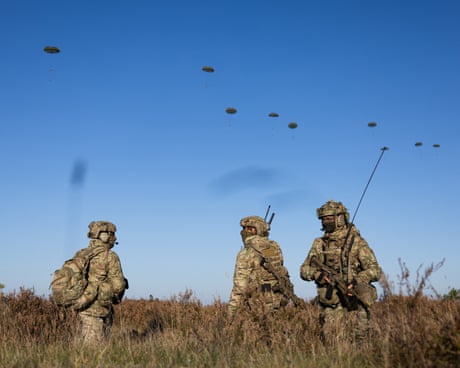
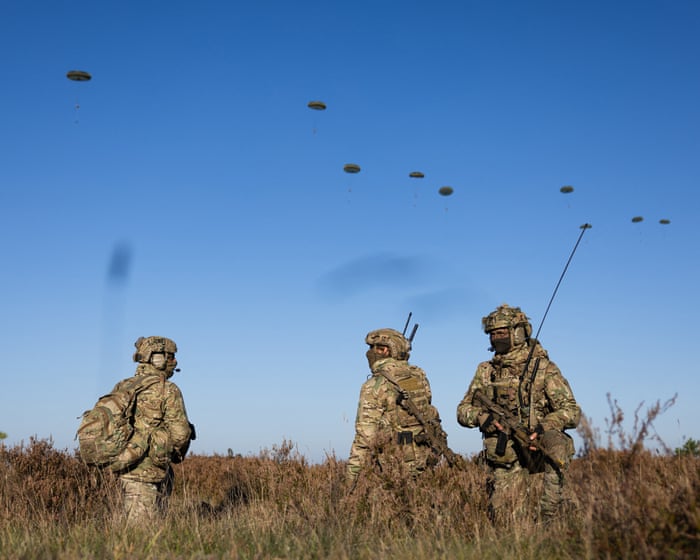
Thousands of British and French troops have taken part in a military training exercise that included one of Britain’s largest airborne operations in two decades, the UK government said on Sunday. The war game is designed to show how Nato countries could be defended against a modern-day attack and comes during fears about Russian aggression in Europe amid Moscow’s war against Ukraine.
About 2,500 troops were involved in the seven-week exercise, in which 600 British and French paratroopers dropped from four RAF A400M Atlas transport aircraft over Germany. The exercise called Rhino Titan, held at the Sennelager military training centre in Germany, has been testing British troops’ ability against an enemy equipped with drones and electronic warfare. “The threats we face in the 21st century require an updated, modern approach to warfare – and our adaptable armed forces are preparing accordingly,” British defence minister Wes Streeting said in a statement.
Ukraine’s military has a “stable connection to Starlink”, the Ukrainian government said, 10 days after its ability to use the satellite communications system was suddenly restricted. But hours after the announcement, SpaceX CEO Elon Musk, whose company owns Starlink, accused the Ukrainian military of violating the company’s terms. Neither Musk nor the US government, which operates Starshield using Starlink technology, took responsibility for imposing the curbs.
Bulgarians will vote in presidential elections on Sunday as Russia’s war in Ukraine spreads to the waters off Bulgaria’s Black Sea coast. Polls place acting president Iliana Iotova and ex-caretaker prime minister Andrey Gyurov as leaders in a race of 27 candidates. While the presidency is largely ceremonial, Sunday’s vote has taken on added significance after a series of drone attacks on merchant ships off Bulgaria’s Black Sea coast that likely killed about two-dozen international seafarers.
Continue reading...
© Photograph: Andrew Grayson/BRITISH ARMY/AFP/Getty Images
© Photograph: Andrew Grayson/BRITISH ARMY/AFP/Getty Images
© Photograph: Andrew Grayson/BRITISH ARMY/AFP/Getty Images
