
❌

Reading view

Why Putin Demands Donbas: The Territorial Ultimatum That Could Shape Ukraine’s Next War

Vladimir Putin’s insistence that Ukraine surrender its remaining positions in Donetsk is not simply a dispute over territory. It is a demand that could dismantle Ukraine’s principal defensive barrier in the east, hand Moscow a military advantage it has struggled to achieve through years of fighting, and establish a precedent for further territorial concessions. The latest diplomatic contacts with European leaders have brought this question back to the centre of negotiations.

There are two ways for Russia to capture the remaining Ukrainian-held cities of Donbas. One is to fight its way through heavily fortified defensive positions, accepting substantial casualties, equipment losses and an uncertain timetable. The other is to secure their evacuation through diplomatic negotiations.

The second would achieve an important Russian military objective without requiring Moscow to bear the full cost of a prolonged offensive.

This distinction helps explain why Vladimir Putin continues to insist that Ukrainian forces withdraw from the remaining government-controlled territory of Donetsk region before a comprehensive settlement can be negotiated.

It also raises a more consequential question: would surrendering Donbas bring the war closer to an end, or would it improve Russia’s position in any subsequent confrontation?

A diplomatic opening without a strategic concession

The issue returned to prominence on 27 October when Finnish President Alexander Stubb and Norwegian Prime Minister Jonas Gahr Støre held a rare telephone conversation with Putin.

According to the Finnish president’s official statement, the call followed discussions in Oslo on 20 October involving Ukrainian President Volodymyr Zelenskyy and US presidential envoy Steve Witkoff.

The Nordic leaders sought to advance preparations for renewed American-mediated negotiations, expected in Abu Dhabi in November. They emphasised that they were acting on behalf of their respective countries rather than representing Europe collectively.

Stubb described the exchange as “frank and substantive”, arguing that direct communication with Moscow was necessary to address the security consequences of the war.

However, the Kremlin’s account offered little indication of movement on the fundamental disagreements.

Moscow insisted that any durable peace must fully accommodate Russian interests. A source close to the Kremlin told Reuters that Putin had reiterated his refusal to compromise on the objective of controlling the entire Donbas.

Following the conversation, Zelenskyy confirmed that the Nordic leaders had briefed him and stressed to Putin the need for concrete measures to reduce attacks on Ukrainian energy infrastructure.

The diplomatic process has therefore resumed without resolving the territorial dispute at its centre.

The military significance of the remaining Donbas

The territory Russia is demanding includes some of Ukraine’s most important surviving defensive positions.

Since fighting began in eastern Ukraine in 2014, Ukrainian forces have constructed and reinforced an extensive defensive system centred on Sloviansk, Kramatorsk, Druzhkivka and Kostiantynivka.

Known as the fortress belt, this network combines urban areas, industrial facilities, transport infrastructure, prepared defensive positions and terrain that complicates offensive operations.

The military importance of this system extends far beyond the administrative boundaries of Donetsk.

According to the Institute for the Study of War, surrendering these positions would allow Russian forces to occupy heavily defended territory without undertaking the prolonged operations otherwise required to capture it.

In its 26 October battlefield assessment, the institute continued to identify the capture of this defensive belt as Russia’s principal military objective in Donetsk. Ukrainian forces retained positions in parts of Kostiantynivka, while Russian operations towards other major cities remained contested.

The implications of a negotiated Ukrainian withdrawal would be substantial.

Russia could occupy the fortified urban corridor, reorganise its forces, establish new logistics routes and potentially redirect formations towards other sectors.

Ukraine, meanwhile, would have to construct or reinforce defensive positions further west, potentially under pressure and in less favourable terrain.

The resulting military imbalance would not necessarily lead to another Russian offensive. But it would change the conditions under which any renewed hostilities might take place.

That is why territory cannot be assessed solely by its surface area. A relatively small section of the front can possess strategic value disproportionate to its size.

Why Moscow prefers a negotiated withdrawal

Russia’s insistence on Donetsk also reflects the limits of what its military has achieved.

Despite years of fighting, Moscow has not secured complete control of the region. Successive offensives have produced territorial gains, but at considerable cost and without the rapid breakthrough originally anticipated.

US Secretary of State Marco Rubio recently acknowledged the central importance of the remaining Ukrainian-held territory.

In an interview published by the US State Department, Rubio characterised the dispute as centred on territory Russia wants but has been unable to capture militarily, while recognising Ukraine’s sovereignty and long-term security concerns.

His remarks demonstrate how Donbas has become the principal territorial obstacle in Washington’s diplomatic calculations.

For Moscow, however, concentrating negotiations on this specific demand offers an additional advantage.

If Ukraine refuses to withdraw, the Kremlin can argue that Kyiv is preventing progress towards peace. If Ukraine agrees, Russia obtains strategically valuable territory without the military costs associated with conquering it.

The demand therefore serves a dual purpose: it establishes a public explanation for the absence of an agreement while offering Russia an immediate military benefit should negotiations succeed on its terms.

The problem with treating Donbas as the final concession

The central weakness in any settlement built around a Ukrainian withdrawal is the assumption that control of Donbas represents the limit of Russia’s territorial ambitions.

Moscow’s previously declared objectives suggest a more complicated picture.

In June 2024, Putin demanded Ukrainian withdrawal from four regions claimed by Russia: Donetsk, Luhansk, Zaporizhzhia and Kherson. Moscow does not fully control these regions, despite claiming to have annexed them in September 2022.

Russia has also demanded restrictions on Ukraine’s military capabilities and future security relationships.

As EU Today previously reported, renewed diplomatic engagement has not produced a clear abandonment of the Kremlin’s wider objectives.

Consequently, transferring the remaining territory of Donetsk would not necessarily satisfy Moscow’s other demands.

There is a significant difference between conceding territory as part of an enforceable settlement and withdrawing from defensive positions as a precondition for negotiating one.

In the first case, territorial arrangements form part of a wider agreement establishing obligations, verification procedures and security guarantees.

In the second, one party makes a potentially irreversible military concession before knowing whether an agreement will ultimately be reached.

This asymmetry is particularly important where the proposed concession directly affects the withdrawing country’s ability to defend itself.

The strategy of incremental gains

One interpretation of Moscow’s approach is that it reflects a strategy of incremental territorial expansion rather than an attempt to achieve all its objectives through a single decisive offensive.

After Russia failed to capture Kyiv in 2022, its military campaign increasingly concentrated on taking territory through successive, often prolonged operations.

The diplomatic equivalent would involve securing one concession, consolidating the resulting advantage and subsequently presenting additional demands.

Under such a scenario, Russia could obtain control of the remaining Donetsk territory, establish new positions closer to Dnipropetrovsk region and later argue that further territorial or security arrangements were necessary to protect its newly acquired frontier.

Moscow has already used the language of protective buffer zones to justify military operations elsewhere in Ukraine.

There is no evidence establishing that such a sequence would inevitably follow a Donbas settlement. Nevertheless, the possibility must be considered when assessing the military consequences of a withdrawal.

The concern is not merely that Russia might violate a future agreement. It is that the agreement itself could alter the strategic balance in ways that make renewed military pressure more effective.

There is also an internal Ukrainian dimension.

An agreement requiring the evacuation of cities defended for years would create substantial political controversy. Disagreements over territorial concessions, security guarantees and the credibility of Western commitments could complicate domestic political stability.

For Moscow, such divisions might provide another means of influencing Ukraine without immediate military escalation.

Donbas and the wider question of Ukrainian sovereignty

Donbas has considerable political significance for Putin beyond its military value.

The conflict in eastern Ukraine began in 2014, following Russia’s annexation of Crimea. Donetsk and Luhansk became central to the Kremlin’s justification for intervention, and their incorporation into Russia was later proclaimed as part of the 2022 annexations.

Control of the entire region would allow Putin to present a tangible achievement after years of warfare.

Yet the Kremlin’s objectives have never been confined exclusively to Donbas.

Putin has repeatedly questioned Ukraine’s historical and political independence, while Russian negotiating demands have extended to the country’s military posture, international alliances and internal political arrangements.

These positions suggest that territorial control forms part of a broader attempt to determine Ukraine’s strategic orientation.

A settlement that ends fighting in Donetsk without resolving these wider disagreements might therefore suspend the conflict rather than settle its underlying causes.

What the next negotiations must establish

The planned talks in Abu Dhabi will test whether Moscow is prepared to distinguish between its territorial demands and the conditions necessary for a sustainable ceasefire.

An immediate halt to hostilities along existing lines would preserve the military status quo while allowing negotiations to proceed.

Russia has resisted this approach, arguing that a temporary ceasefire could enable Ukraine to rebuild its forces without resolving the conflict.

Ukraine, by contrast, argues that withdrawing from fortified territory without credible guarantees would expose it to renewed attack.

Neither side can be expected to disregard the military implications of the proposed arrangements.

For European governments, the principal question is consequently not simply whether Ukrainian and Russian representatives can be brought back to the negotiating table.

It is whether any agreement can prevent the territorial settlement from becoming the starting position for another war.

Stubb and Støre’s conversation with Putin demonstrated that diplomatic communication remains possible. It did not establish that Moscow is prepared to abandon its existing territorial objectives.

The distinction matters.

Putin’s demand for Donbas offers Russia two potential advantages: a justification for continuing the war if Kyiv refuses, and a substantial military gain if Kyiv accepts.

That does not prove the Kremlin has already decided to resume hostilities after a negotiated withdrawal. It does, however, explain why the terms, sequencing and enforceability of any agreement are as consequential as the territory itself.

The essential question facing negotiators is therefore not only whether Russia can obtain Donbas through diplomacy rather than force.

It is whether the price of that concession would be a lasting peace — or a weaker Ukrainian defensive position if peace fails.
  •  

[Interview] There are still more American soldiers than Western ones on Nato’s eastern border, says defence expert Robert Pszczel

Donald Trump’s 9 October diesel deal with Vladimir Putin left Europeans – including Ukraine – out in the cold, as US dollars will now become key aid in the financing of Russia’s war. 

In the meantime, hybrid attacks using drones and sabotage are escalating across Europe. Intelligence agencies warn Russia will be escalating them in the next months, and even consider a “limited military attack”, as Danish intelligence warned late September.

EUobserver spoke to Robert Pszczel, former Nato information bureau chief in Moscow, about European defence and information strategy.

Pszczel is a long-time Polish diplomat in Warsaw and Brussels, now working with a Polish think tank, Centre for Eastern Studies (Ośrodek Studiów Wschodnich, OSW).

He closely follows Russia’s hybrid war and European defence strategy.

We see the US deprioritising Europe in their defence and diplomacy. What should our response be?

Let’s not mix our views of this administration’s policy with our strategic relations with the US. Why would we want to help with the process of decoupling? Do we want to give people in the US administration who marginalise the value of alliances arguments for disengagement?  Because for me, that’s what ramblings about a European Defence Union do. The paradox is that this idea really appeals to die-hard MAGA isolationists because it gives them an excuse for undermining the Nato alliance.

This article continues, but the full version is available only to EUobserver.com subscribers. Visit account.euobserver.com/membership

  •  

Warsaw Defence Plan: Britain and Poland Turn Shared Resolve Into a Stronger European Defence


Britain and Poland are giving European security something it urgently needs: a practical plan to turn allied solidarity into stronger military capabilities. Their new Warsaw Defence Plan brings together missile development, ammunition production, maritime cooperation and protection against drones and cyberattacks, strengthening a partnership with consequences well beyond either country’s borders.

Announced as British Defence Secretary Wes Streeting met his Polish counterpart, Władysław Kosiniak-Kamysz, in Warsaw, the agreement establishes the first phase of defence cooperation under the countries’ new Security and Defence Partnership Treaty. According to the Ministry of Defence announcement, it covers operations and industry across land, sea, air and cyberspace.

Its significance lies in that breadth. Modern deterrence depends on much more than the number of soldiers available for deployment. It requires protected infrastructure, reliable supplies of ammunition, effective air defences and forces capable of operating together under pressure. London and Warsaw are addressing those requirements as connected parts of the same challenge.

Air defence is a central priority. The two countries will collaborate on developing and manufacturing the next generation of air defence missiles, building on an industrial relationship that includes Poland’s procurement of the Narew system from MBDA UK. Closer procurement coordination offers an opportunity to align military requirements and strengthen production.

That approach has clear strategic value. Missiles become more useful when allies can sustain their supply, maintain their systems and plan their deployment together. By connecting industrial cooperation with operational needs, Britain and Poland can help develop the dependable defensive capacity that Europe requires against an increasingly demanding range of aerial threats.

The plan also embraces joint development of drones and technologies designed to defeat them. The ministry explicitly links this work to protecting civilians and critical national infrastructure amid Russian drone incursions. It is a welcome recognition that security must extend beyond military installations to the services and networks on which everyday life depends.

Cybersecurity cooperation follows the same logic. Strengthening the resilience of civilian and defence sites can reduce opportunities for disruption and make national responses more effective. For both countries, sharing expertise offers a practical way to improve preparedness against hostile activity that can unfold without a conventional military attack.

At sea, the agreement builds on an existing technical connection: Britain’s Type 31 frigates and Poland’s Miecznik ships share a common design. Exchanging experience as those capabilities develop should help both navies learn from each other. Planned exercises and regional coordination will also increase defensive maritime activity in the Baltic, supporting the protection of vital communications routes.

The industrial commitments are equally encouraging. BAE Systems and Poland’s PGZ will expand capacity and capability in large-calibre ammunition production. The announcement supplies no production figures or delivery timetable, but its direction is important. Credible defence requires the ability to replenish supplies and sustain operations, giving manufacturing capacity a direct role in military readiness.

Cooperation on defence education, training and workforce mobility could strengthen that foundation further. Advanced weapons programmes depend on skilled people as well as investment. Building shared expertise can support delivery while creating opportunities for engineers, technicians and the wider industrial supply chain in both countries.

Joint exercises will test the partnership in practice. Continued participation in Steadfast Defender, Polish Dragon and Joint Warrior is intended to prepare forces for challenges including electronic warfare, counter-drone operations and missile defence. Such training gives commanders opportunities to identify weaknesses, improve coordination and build confidence before a crisis demands immediate action.

Ukraine remains integral to this effort. The countries are preparing a major Coalition of the Willing exercise in Poland in November, involving thousands of personnel. The stated purpose is to prepare the Multinational Force Ukraine to support military training and post-war rebuilding. Preparation cannot determine the course of diplomacy, but it can make future commitments more credible.

For Europe, the promise is straightforward: two committed allies are connecting operational readiness with industrial strength. Delivering the plan will require sustained effort, but Warsaw and London have established a constructive agenda whose success would benefit the wider alliance.

  •  

Outlook for the European Council, 18-19 June

Written by Ralf Drachenberg, Annastiina Papunen and Rebecca Zamponi.

General

The European Council will be preceded by pre-summit meetings of European political parties with their respective affiliated EU leaders. Additionally, a group of ‘like-minded’ countries on migration will also meet prior to the start of the meeting. Following a similar pattern, a new group of 17 leaders, including Germany, Belgium and Italy, met by videoconference on 8 June to discuss competitiveness issues.

As usual, the European Council meeting will start with an address by the President of the European Parliament, Roberta Metsola. For the first time, the report of the rotating Council Presidency on the follow-up to the previous European Council conclusions will be given in the presence of the European Parliament President. This report by Cypriot President Nikos Christodoulides will include an overview of the implementation of the ‘One Europe, One Market’ roadmap signed in the margins of the informal meeting of Heads of State or Government in Cyprus in April 2026.

The membership of the European Council has evolved since the last European Council meeting. With the departure of Viktor Orbán, Emmanuel Macron is now the longest serving European Council member continuously in office (since 2017).

European Council meeting

Ukraine

The discussion on Ukraine will start with an exchange of views with Ukrainian President Volodymyr Zelenskyy, who on 4 June 2026 published an open letter to President Vladimir Putin, proposing to end the war through direct engagement between the two leaders. The proposed meeting would take place in a neutral location ‘with active US and European participation’ and ‘the front line today [as] the line from which diplomacy must begin.’. Three days after the letter, President Zelenskyy issued a joint statement with the leaders of France, Germany and the United Kingdom, outlining five conditions for just and lasting peace.Thus, EU leaders may express the EU’s readiness to step up its engagement in peace negotiations.

In his invitation letter to EU leaders, European Council President António Costa underlined the effectiveness of the EU’s ‘two-pronged approach – supporting Ukraine and increasing pressure on Russia’. Concerning support for Ukraine, the European Council is expected to discuss intensifying efforts to rebuild critical energy and civilian infrastructure as well as accelerating the production and delivery of military equipment, notably ammunition, drones and missiles. As regards pressure on Russia, the European Council could reiterate the importance of weakening Russia’s economy and thus its ability to wage war. Following the unveiling of the 21st package of sanctions, which targets heavily the country’s banking system and crypto networks, EU leaders may call for swift adoption of the new package. In parallel, after asking in March 2026 for ‘the potential threat posed to the EU’s internal security by Russian ex-combatants having participated in the aggression against Ukraine to be assessed, the European Council could ask for further work to be carried out to address this threat, and possibly consider banning Russian citizens having served in the country’s armed forces since 2022 from entering EU territory. In addition, the call by 11 Schengen countries for stricter visa rules for all Russian citizens – which follows a surge in visas issued to Russian tourists in 2024 and 2025 – may also be raised.

Although not formally on the agenda, the topic of enlargement could turn out to be the subject of broader discussions. First, because EU leaders are likely to welcome the holding of the Intergovernmental Conference on the accession of Ukraine, and Moldova, to the European Union, and the agreement to open the fundamentals cluster on 15 June 2026. Second, because EU leaders may wish to underline the ‘new impetus’ given to the enlargement process at the EU-Western Balkans Summit in Montenegro on 5 June and reiterate their support for the region’s path to EU membership in line with a merit-based approach. Third, because, after the Franco-German initiative of 4 June 2026 suggesting ways of gradually integrating candidate countries into the EU, the European Council may wish to discuss the ‘new ideas to streamline and accelerate the process,’ which, as President Costa stressed, are currently under consideration. German Chancellor Friedrich Merz had previously addressed a letter to Presidents Costa, von der Leyen, and Christodoulides, proposing to grant Ukraine ‘associate member status’, while offering ‘observer status’ and access to the single market to Western Balkan countries.

Middle East

The European Council is expected to discuss the constantly evolving situation in Iran and the wider Middle East region. After the announced memorandum of understanding between Iran and the United States, which envisages an ‘immediate and permanent’ end of military operations on all fronts, including in Lebanon, EU leaders may welcome the peace agreement and the toll-free reopening of the Strait of Hormuz. Due to be signed on 19 June, the agreement plans to ease sanctions and begin negotiations over nuclear issues. In a joint statement, the leaders of France, Germany, Italy, Cyprus and Greece, as well as Australia, Canada and the United Kingdom, expressed their readiness also to lift sanctions imposed on Iran and work ‘with the US, Iran and regional partners to … achieve a long-term diplomatic settlement’. Ahead of the G7 summit in Evian, President Costa signalled the EU’s willingness to contribute to a global strategy for a lasting peace in the Middle East. In that context, EU leaders are likely to discuss preparations under way aimed at guaranteeing the freedom of navigation in the Strait, and consider a possible reinforcement of the mandate of the EU maritime defensive operation, EUNAVFOR ASPIDES.

The European Council will also discuss the situation in Gaza and the West Bank. On Gaza, they may touch upon the preparation of restrictive measures against Israelis due to the treatment of activists who were bringing aid to Gaza. A number of Member States have increasingly become critical of Israel following the interception of the Global Sumud Flotilla in international waters and the mistreatment of those on board, who included a number of EU citizens. As a result of the incident, Italy, which has previously blocked attempts to suspend the EU-Israel Association Agreement, called for sanctions against the Israeli Minister of National Security, Ben-Gvir. However, it remains unlikely that EU leaders will reach a unanimous agreement on calling for sanctions against a sitting Israeli Minister ahead of upcoming Israeli elections. Additionally, in the context of the EU leaders’ reiterated condemnation of unilateral Israeli action aimed at further expanding illegal settlements, the concerns expressed by several Member States regarding products from illegal Israeli settlements entering the European market may also be raised.

Next multiannual financial framework

Following a first discussion in April 2026, EU leaders will hold an exchange of views on the 2028-2034 MFF based on a new negotiating box with figures drawn up by the current Cyprus Council Presidency.

On the MFF, the dividing lines in the European Council are normally between the net contributors and the net beneficiaries.[1]The former group includes Denmark, Germany, France, Austria, the Netherlands, Finland and Sweden; some of these Member States are known as the ‘frugals‘. The net beneficiaries meet under the name ‘friends of cohesion’ and include Bulgaria, Czechia, Estonia, Greece, Spain, Croatia, Italy,[2] Latvia, Lithuania, Hungary, Malta, Poland, Portugal, Romania, Slovenia and Slovakia.These two groups meet separately ahead of meetings in the Council, and sometimes the European Council, to coordinate their positions before the main meeting. Cyprus, as the current Council Presidency, and Ireland, which will take over on 1 July, do not formally attend these meetings, in order to remain ‘an honest broker’.

As in negotiations for previous MFFs, the usual dividing lines concern i) the size of the EU budget, ii) the balance between policy areas, iii) the existence and size of rebates, and iv) new own resources. An additional topic is the pace of repayment of the joint debt resulting from the EU recovery plan (i.e. Next Generation EU).

Regarding the size of the EU budget, the European Commission proposed a long-term budget of €1.789 trillion (in commitments over seven years in constant 2025 prices). While the European Parliament suggested in its interim report of 28 April 2026 a nominal increase of €175.11 billion (2025 constant prices) to this proposal, the frugal Member States have demanded to reduce the spending proposed by the Commission. The new negotiating box of the Cyprus Council Presidency, which only suggests an overall reduction of around 2 % of the original Commission MFF proposal, has received substantial criticism by the frugal Member States, the latter even expressing doubt over the Cyprus Presidency’s capacity to act as a ‘true honest broker’.

As regards the balance between policy areas, the friends of cohesion have, in a joint declaration of 25 May 2026, argued that the next MFF needed to provide sufficient resources for the cohesion policy, common agricultural policy and common fisheries policy. While some net contributors like Denmark, Germany, the Netherlands, Austria and Sweden have rejected this proposal, others such as France and Ireland were less opposed. In Chancellor Merz’s view, EU spending must be modernised to focus on investment in defence and competitiveness, with cuts to traditional farming and regional subsidies.

On the third point, the budget correction mechanisms – or ‘rebates’ – have been used in the EU’s long-term budget since the 1980s to compensate certain Member States for their financial contributions to the long-term EU budget. The suggestion to abolish these rebates has been put forward in several previous MFF negotiation rounds but has never been followed up on. In their joint declaration, the friends of cohesion have also called for the abolition of rebates, arguing that ‘there is no political or economic rationale for re-introducing them’.

Finally, on new own resources, the Commission submitted a proposal on 16 July 2025 suggesting new own resources on i) a corporate resource for Europe; ii) a tobacco excise duty own resource; iii) a share of the proceeds of the emissions trading system; iv) the carbon border adjustment mechanism; and v) a contribution on non-collected e-waste. At a discussion of EU finance ministers in October 2025, Ireland, Hungary, Finland and Sweden rejected outright any introduction of new own resources, while others such as Czechia and Poland criticised specific new own resources. In April 2026, the European Parliament put forward proposals on future own resources, suggesting to tax digital services, online gambling and crypto-assets. After the April 2026 informal meeting of EU leaders, President Costa signalled openness to considering the suggestions of Parliament, even if concerns have subsequently been expressed over their technical feasibility.

Closely related to discussions on the revenue side of the MFF are ideas put forward by President Macron and Greek Prime Minister Kyriakos Mitsotakis in favour of new common borrowing and a rollover of the pandemic debt to finance the bloc’s shared priorities.

No decisions are expected at this European Council meeting; President Costa’s objective is to give further guidance to the incoming Irish Council Presidency as to the type of new own resources on which a compromise could be achievable. While President Costa has insisted on EU leaders agreeing by the end of 2026 – a timeline expected to be reflected in the conclusions – many Member States have expressed doubts over the feasibility of this timetable.

Global economic challenges

In an extremely challenging geoeconomic environment, EU leaders will hold a strategic debate over dinner on the global macroeconomic imbalances and their impact on EU competitiveness. Previously, in December 2025, they held a similar discussion on ‘Geoeconomy and competitiveness’. However, in six months, the global environment has altered significantly; as President Costa underlined, the discussion will thus aim to ‘develop a common understanding of the challenges and to provide guidance to the Commission on the way forward’. On the one hand, EU leaders will look at ways of strengthening the EU’s strategic autonomy and competitiveness, but at the same time emphasise that fair competition at global level needs to be guaranteed.

In that context, without explicitly mentioning the country, Costa may intend to raise the issue of trade relations with China. Ahead of the European Council meeting, the EU foreign ministers discussed the topic in their meeting on 15 June, while ‘global imbalances’ are also likely to feature on the agenda of the G7 meeting in Evian, France on 15-17 June. The EU has defined China as a partner, a competitor and a systemic rival. China is the EU’s third largest trading partner in goods and services after the US and UK, and the EU and China together account for 29.6 % of global trade. There is a long-standing trade deficit between the EU and China; most recently, the EU has been worried about a possible ‘China Shock 2.0‘, i.e. the large influx of state-subsidised exports of Chinese products such as electric vehicles, batteries and solar panels, as well as steel and chemicals. In March, five EU Member States (France, Italy, Spain, the Netherlands and Lithuania) wrote a joint non-paper calling for tougher measures to counter abusive trade practises, without explicitly mentioning China.

Before dinner, EU leaders are expected to review progress made with the ‘One Europe, One Market’ agenda and the related roadmap, signed on the sidelines of the informal meeting in Cyprus in April. Thus, they will take stock of action aimed at strengthening the single market, enabling Europe’s industrial renewal, simplifying rules, reducing dependencies and encouraging innovation and investment. In the context of ongoing wars in Iran and Ukraine, which have disrupted global supply chains and fundamentally reshaped the EU energy markets, EU leaders envisaged in their March conclusions to return to the issues of affordable energy prices and the Energy Union 2030. They will probably review progress in ‘achieving Europe’s strategic autonomy, strengthening resilience, structurally lowering energy prices, and delivering the clean, abundant and home-grown energy needed to power the economy of the future’.

Although not officially on the agenda, the latest AI models and the challenges they may pose to EU citizens, companies and critical infrastructure may be discussed on the sidelines. US company Anthropic announced in April that it had built a new model, Claude Mythos, which was too powerful to be released to the public due to its extraordinary ability to identify security vulnerabilities in critical software, such as financial and healthcare systems and electricity networks. As a follow-up, the company created Project Glasswing with the aim of securing the most critical software by initially giving some 50 organisations access to the model so that they could identify and fix security problems. The European Commission has been in talks with the company to secure access to EU actors, and especially European banks have been vocal about the topic. On 2 June, the access was expanded to 150 new organisations, including the EU cybersecurity agency ENISA. However, on 12 June, the US administration ordered Anthropic to suspend access to Mythos 5 and Fable 5 models from all foreign nationals, citing national security concerns. This led to Anthropic shutting access to these two models from all customers. Following these developments, there were increasing calls in the EU to speed up the work on technology sovereignty.

European defence and security

Considering ‘Russia’s increasingly reckless and irresponsible behaviour towards EU Member States’, stressed by Costa in his letter to EU leaders, the latter may condemn Russia’s numerous violations of European airspace recently, such as in Romania and Latvia. They are also likely to reiterate the importance of the EU defence readiness agenda, in particular efforts to increase air defence and drone capacity. In that context, EU leaders could welcome the work in the Council on the action plan on drone and counter-drone security.

According to the defence readiness roadmap, the Commission, in cooperation with the lead nations of the capability coalitions, should expand the strategic dialogue with industry, host the first annual Defence Industrial Summit and present an overview of the industrial capacity ramp-up needed to ensure reliable supply for the agreed capability areas by mid-2026. As projects were to be launched in all priority areas within the first half of 2026, EU leaders may evaluate the progress made on these and all other aspects relevant to the defence readiness agenda.

EU leaders may call on the Parliament and Council to make further progress on creating a military mobility area, the AGILE proposal (which seeks to enhance the EU’s capacity to deliver defence innovation more rapidly and effectively), and the defence readiness omnibus.

Migration

Migration has been discussed at every European Council meeting in this institutional cycle, apart from the special European Council on defence in March 2025. EU leaders will again take stock of progress in the implementation of its previous conclusions on migration – this just a few days after the entry into force of the EU migration pact on 12 June. Likewise, EU leaders might welcome the recent provisional agreement of Parliament and Council on changes to EU policy on the return of non-EU nationals staying illegally in the EU.

Fight against illicit drugs

For the first time, the European Council will address challenges linked to the use and trafficking of drugs. While this topic was not mentioned in the European Council’s Strategic Agenda 2024-2029, it features in the European Commission’s political guidelines. EU leaders are expected to provide guidance for the implementation of the EU drugs strategy and the related EU action plan proposed in December 2025 to respond to the growing health, security and societal challenges posed by drug use and trafficking.The EU drugs strategy is based on five pillars: (1) enhancing preparedness and response; (2) protecting public health; (3) improving security and protecting society; (4) addressing risks and harms; and (5) building strong partnerships. On 5 June 2026, Justice and Home Affairs Ministers endorsed the EU drugs strategy and the action plan, adopting conclusions on jointly operationalising them to deliver on the key priorities aimed at reducing drug use and drug-related harm.

European Semester

As is usual at the June European Council meeting, EU leaders will discuss the country-specific recommendations to allow the conclusion of the European Semester cycle. Published on 3 June, the European Semester spring package includes tailored recommendations to each Member State to improve their economic performance. The Council will proceed to the formal adoption of these recommendations after the European Council has discussed them.

Notes

[1] Net contributors to the EU budget are considered to be the Member States who contribute more to the EU budget than the amount of EU funding they receive, and vice versa for net beneficiaries.

[2] While Italy is a net contributing country, it is part of the friends of cohesion.


Read the complete briefing on ‘Outlook for the European Council, 18-19 June‘ in the Think Tank pages of the European Parliament.

  •  

EU Releases €4.9 Billion for Ukraine as Focus Shifts to Sustaining Military Support

The European Union has approved the mobilisation of approximately €4.9 billion under the European Peace Facility (EPF), implementing a significant part of an earlier agreement intended to resolve disagreements over military assistance to Ukraine.

The eight decisions, adopted by the Council on 26th October, allocate €4.7 billion towards partial reimbursement of military equipment already supplied by member states and €230 million towards the EU Military Assistance Mission in support of Ukraine.

Although the announcement represents an important step in restoring the operation of an established financing mechanism, most of the money does not correspond to fresh deliveries of military equipment.

That distinction is important as European governments attempt to reconcile continued support for Kyiv with growing pressure on national defence budgets and the need to replenish their own military inventories.

From political agreement to financial implementation

The decisions implement part of the €6.6 billion agreement reached by EU governments on 25th September, which ended a prolonged dispute over the allocation of European Peace Facility resources.

As EU Today reported following that agreement, the package separates reimbursements for previous deliveries from financing for new equipment and military training.

Under the original arrangement, €4.7 billion was earmarked for reimbursements, €1 billion for new joint procurement and approximately €900 million for training-related expenditure.

Monday’s decisions authorise most of the reimbursement component alongside a further allocation for training. They do not, by themselves, demonstrate that the separately planned €1 billion in new military equipment has been purchased or delivered.

The distinction reflects the unusual structure of the European Peace Facility.

Established in March 2021, the EPF operates outside the EU’s regular budget and finances security and defence assistance, including military equipment supplied by member states to partner countries.

Governments can provide weapons from their national stocks and subsequently seek partial reimbursement. This enables the EU to share some of the costs, although actual deliveries remain dependent on national decisions, industrial capacity and available equipment.

Reimbursements therefore strengthen the financial position of contributing governments without necessarily increasing Ukraine’s immediate stock of weapons.

Nevertheless, by reducing the financial burden of earlier donations, the mechanism can help governments preserve the capacity to make further contributions.

Military training becomes a longer-term commitment

The additional €230 million for the EU Military Assistance Mission also reflects the increasingly institutional character of European military support.

Established in November 2022, EUMAM Ukraine provides training for Ukrainian personnel through facilities and instructors made available by participating countries.

According to an EU statement delivered at the OSCE in October, the mission had trained approximately 97,000 Ukrainian soldiers.

The EU has agreed to extend the mission for another two years, moving military training beyond a series of short-term emergency measures.

Training programmes can be adapted to battlefield requirements, including the operation of Western equipment, command procedures, engineering and specialised military functions.

However, the usefulness of training also depends on the availability of appropriate weapons, ammunition and replacement equipment once personnel return to Ukraine.

The Council says the latest decisions bring overall support under the European Peace Facility to approximately €10.8 billion, comprising €9.9 billion associated with military assistance reimbursements and €950 million for training.

Frozen Russian assets and the defence industry

A separate financing mechanism is increasingly relevant to European support for Ukraine.

The Council reports that €3.5 billion in extraordinary revenues generated by immobilised Russian sovereign assets has already been channelled through the EPF to finance ammunition, air defence and drones.

More than €1.5 billion of the resulting procurement has been directed towards Ukraine’s own defence industry.

This creates a different relationship between European financing and Ukrainian military production.

Rather than relying exclusively on weapons taken from European stockpiles, the arrangement allows part of the support to be translated into orders for equipment manufactured inside Ukraine.

The approach may also reduce certain transport and procurement constraints, although production remains vulnerable to Russian attacks, component shortages and interruptions to electricity supplies.

The legal and political questions surrounding Russian-asset revenues remain significant. As EU Today previously examined, disputes over how European institutions approve funding measures have generated legal challenges.

The next test for European governments

At their 15–16 October summit, EU leaders welcomed the EPF agreement and continuing disbursements under the separate €90 billion Ukraine support loan covering 2026 and 2027.

The two instruments serve different purposes. The loan supports wider Ukrainian financial and defence requirements, while the EPF provides a mechanism for sharing the costs of military assistance.

For Kyiv, the central question is how rapidly European financial commitments can be converted into deliverable military capabilities.

For EU governments, the challenge is whether reimbursement mechanisms, national procurement and Ukrainian industrial production can operate together on a predictable basis.

The release of €4.9 billion resolves an important financing issue. It does not eliminate the continuing requirement for new equipment, ammunition and sustained production.

  •  

Russian Missiles Strike Kyiv University and Major Bridge as Zelenskyy Condemns Delays in Western Air Defence

At least one person has been killed and 15 injured in successive Russian attacks on the Ukrainian capital. Strikes damaged a university campus, residential buildings and the Southern Bridge, disrupting metro services, as President Volodymyr Zelenskyy accused Ukraine’s allies of delaying critical air defence supplies.

Russian forces launched successive attacks on Kyiv between Monday evening, 26th October, and Tuesday morning, striking a university campus, residential neighbourhoods and a major bridge across the Dnipro River, causing casualties and disrupting transport across the Ukrainian capital.

At least one person was killed and 15 injured, according to updated reports on Tuesday. The attacks damaged university buildings and student accommodation in eastern Kyiv, while a subsequent strike hit the Pivdennyi, or Southern, Bridge, interrupting road and underground railway services between the two banks of the city.

The first wave began shortly before 10pm on Monday, when Russian ballistic missiles struck the Desnianskyi district, near Lisova metro station and Kyoto Park.

Buildings belonging to the State University of Trade and Economics were damaged, including student dormitories. Residential properties, medical facilities and vehicles were also affected.

Kyiv Mayor Vitali Klitschko initially reported ten injured, most of them students. Nine required hospital treatment, including three in serious condition.

In the neighbouring Dniprovskyi district, emergency workers recovered a body from a severely damaged building. Two ambulance workers responding to an emergency call were also injured.

Southern Bridge struck in renewed attack

A second wave of Russian attacks followed in the early hours of Tuesday.

The Southern Bridge was struck again, damaging infrastructure used by Kyiv’s underground railway system and forcing authorities to restrict traffic across the Dnipro.

Metro operations were disrupted on two lines. On the green line, trains operated only between Syrets and Vydubychi on the western bank and between Osokorky and Chervonyi Khutir on the eastern bank. Services across the bridge were suspended.

On the red line, Chernihivska and Lisova stations were temporarily closed, with trains operating between Akademmistechko and Darnytsia.

The bridge is one of Kyiv’s principal transport connections between its eastern and western districts, carrying both road traffic and part of the metro network.

The latest strike followed earlier damage to the same crossing on 22 October, when Russian ballistic attacks also disrupted traffic and underground services.

Repeated damage to transport crossings has complicated movement across the capital, particularly for residents travelling between the densely populated eastern districts and workplaces in central and western Kyiv.

Zelenskyy: Delays in air defence help Russian attacks

President Volodymyr Zelenskyy responded to Monday’s strikes by accusing Russia of targeting crowded civilian areas and warning that delays in Western air defence deliveries were increasing Ukraine’s vulnerability.

In a statement published on Telegram, he said Russian ballistic missiles had struck university grounds, Kyoto Park, areas near a metro station and residential buildings.

The president said there were no military installations near the affected sites and warned that further attacks remained possible.

He linked the casualties directly to Ukraine’s continuing difficulties obtaining sufficient air defence equipment.

“Artificial delays in providing air defence to Ukraine help terror,” Zelenskyy said.

He urged Western governments to ensure that political agreements on military assistance were implemented without administrative delays.

Zelenskyy also argued that Ukraine required weapons capable of destroying Russian ballistic missile launchers before missiles could be fired, rather than relying entirely on interception.

Such capabilities, he said, would offer a more effective means of protecting civilian lives.

Washington faces questions over interceptor deliveries

His criticism came hours after he publicly disclosed that Ukraine had been waiting almost a month for US Defence Secretary Pete Hegseth to approve deliveries of missiles for Patriot and NASAMS air defence systems.

“In particular, we have been waiting for nearly a month for Mr Hegseth to sign off on missiles for Patriots and NASAMS,” Zelenskyy said on 26th October.

He instructed Ukrainian officials to raise the matter again with Washington.

Ukraine is seeking additional PAC-2 and PAC-3 Patriot missiles from the United States, European countries and other partners.

Some of these weapons are purchased through NATO’s Prioritised Ukraine Requirements List, or PURL, which allows allied governments to finance American military equipment destined for Ukraine.

However, US-made weapons may remain subject to American export and transfer authorisations even when European governments have agreed to finance their procurement.

US Secretary of State Marco Rubio acknowledged that a shipment of air-defence missiles may have been delayed, but said the delay was not politically motivated. Ukraine has said it is waiting for US approval for missiles for its Patriot and NASAMS systems, as its forces face shortages of the ammunition needed to intercept incoming attacks.

The precise effect of the outstanding approvals on Kyiv’s ability to defend itself during the latest strikes has not been established. The delay adds to the pressure on a country already trying to protect its cities and critical infrastructure with limited air-defence stocks.

Kyiv’s continuing ballistic missile vulnerability

Ballistic missiles present particular challenges for Ukrainian air defences because of their high speeds and the limited time available to detect, track and intercept incoming weapons.

Patriot systems equipped with appropriate interceptors are among Ukraine’s principal defences against such attacks. Their effectiveness depends not only on the availability of launchers and radar systems but also on adequate stocks of interceptor missiles.

Russia’s repeated attacks on the Southern Bridge also demonstrate the wider consequences of damage to urban infrastructure. Even when a transport crossing remains structurally intact, damage to railway equipment or nearby installations can interrupt services for thousands of passengers.

The latest bombardment followed another substantial Russian attack on Kyiv on 21st–22nd October, which killed one person and injured more than 20.

For Ukraine, the attacks have reinforced two immediate requirements: protecting essential infrastructure against further strikes and securing a reliable supply of interceptor missiles.

Whether Washington can accelerate the outstanding approvals, and whether European partners can provide additional ammunition from their own stocks, will be central to Ukraine’s air defence preparations as winter approaches.

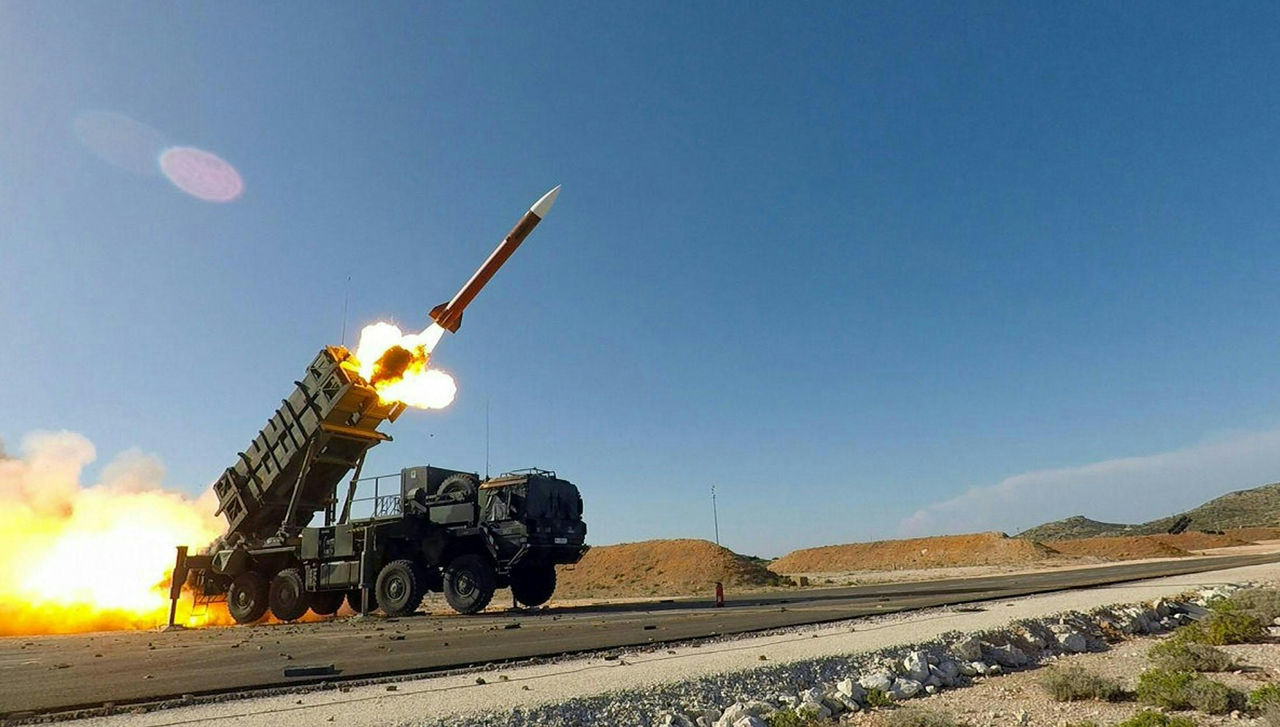
Main Image: By Mitte27 – Own work, CC BY-SA 4.0, https://commons.wikimedia.org/w/index.php?curid=113352288

  •  
❌