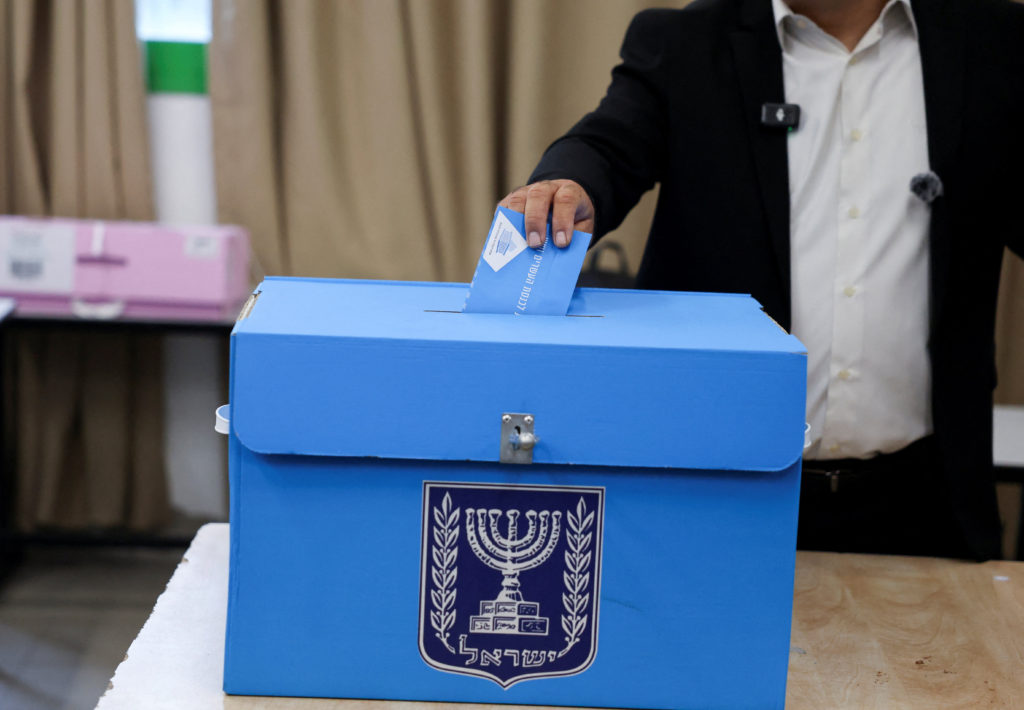
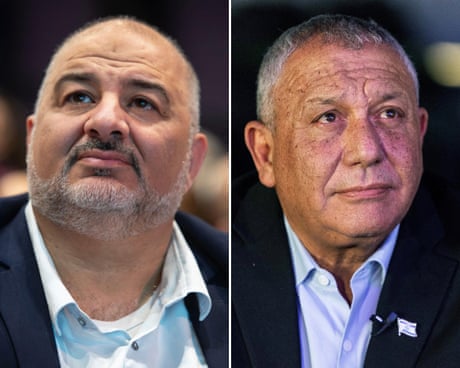
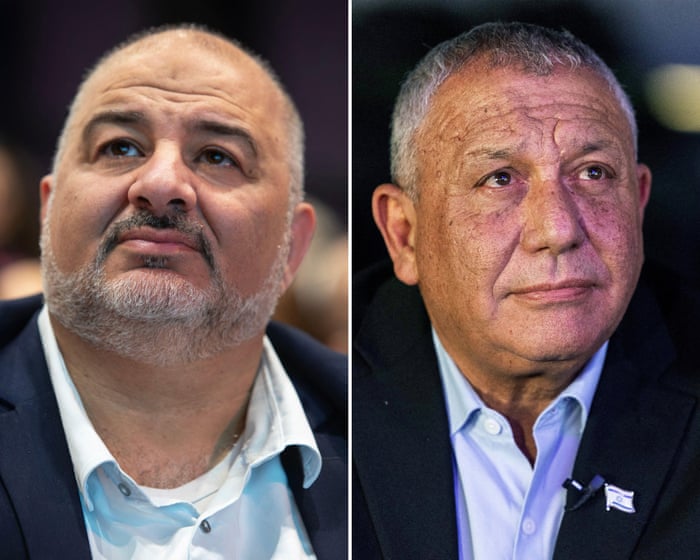
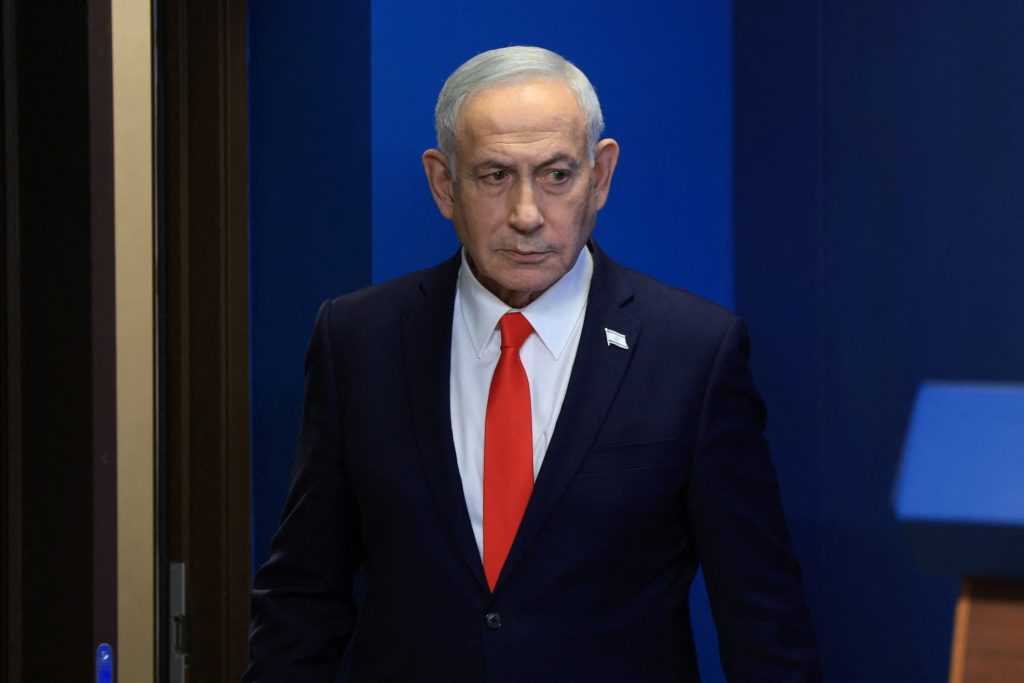
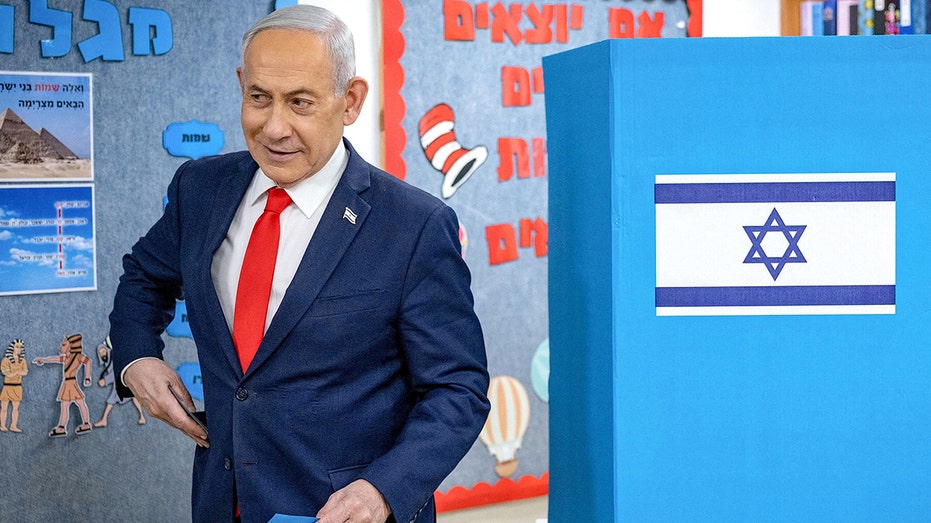
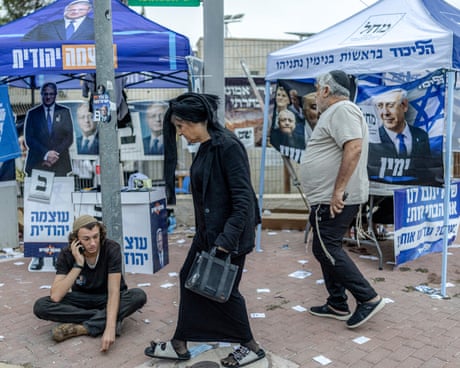
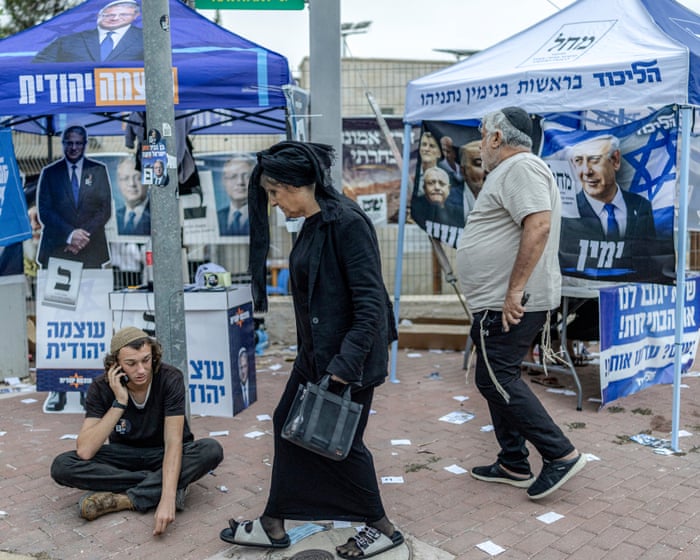
Israelis turned out in record numbers for their first election since the Oct. 7 attacks and the war in Gaza. Projections show opposition parties won more seats than the coalition led by Prime Minister Netanyahu, potentially setting the stage for a change in government. But Netanyahu's opponents do not have enough seats to form a majority, leading to weeks of negotiations. Nick Schifrin reports.
The big gains made by Palestinian parties in Israel’s general election pose an urgent and fundamental challenge to the country’s mainstream opposition: either cooperate with Arab Israelis or hand Benjamin Netanyahu a roadmap to political survival.
In the wake of Tuesday’s exit polls, the leader of the opposition bloc, Gadi Eisenkot, declared them a victory for “Israel’s Zionist national majority” but the real outcome looks as if it will be far more complex than that.
Com as pesquisas de boca de urna em Israel indicando que nem o primeiro-ministro Benjamin Netanyahu nem seu principal adversário, Gadi Eisenkot, possuem um caminho claro para obter uma maioria que lhes permita governar, o cenário de coalizões pós-eleição permanece totalmente em aberto.
Um impasse, um governo minoritário, um governo de unidade — ou até mesmo uma nova eleição — são, no momento, possibilidades plausíveis.
As notícias são ruins para Netanyahu. Seu bloco, composto por aliados ultraortodoxos e de extrema-direita, perdeu a maioria, passando de 68 cadeiras para apenas 50. As pesquisas de boca de urna projetam que seu partido, o Likud, manterá uma representação expressiva de 24 cadeiras, permanecendo como a maior legenda.
Ainda assim, o número está bem abaixo das 61 cadeiras necessárias para formar maioria no parlamento, que conta com 120 assentos. Para permanecer no poder, Netanyahu precisa, fundamentalmente, de uma coalizão.
O bloco de oposição detém, no papel, um número expressivo de 70 cadeiras; contudo, a realidade é que ele se encontra fragmentado e dividido, o que dificulta a definição de um caminho a seguir. Os partidos sionistas judaicos somam 52 cadeiras, enquanto os partidos árabes devem conquistar um recorde de 18 assentos — a maior representação árabe já registrada.
O partido Yashar, de Eisenkot, aparece nas projeções como a maior força dentro do bloco de oposição, com 22 cadeiras. No entanto, outros líderes partidários desse mesmo bloco descartaram a possibilidade de um governo que dependa de apoio árabe, o que complica significativamente qualquer tentativa de remover Netanyahu do poder.
A participação recorde do eleitorado árabe parece ser um dos aspectos mais marcantes destas eleições. Os cidadãos palestinos de Israel — que representam cerca de 20% da população do país — tradicionalmente registram taxas de comparecimento às urnas inferiores à média nacional. Na eleição de 2022, a participação árabe foi de 53%; desta vez, estima-se que tenha saltado para mais de 78%.
Esse movimento é interpretado como um voto de protesto contra o governo de Netanyahu e seus aliados de extrema-direita: o ministro da Segurança Nacional, Itamar Ben Gvir, e o ministro das Finanças, Bezalel Smotrich.
Por outro lado, a alta taxa de comparecimento eleva a exigência para os partidos menores, que precisarão de um número maior de votos para atingir a cláusula de barreira de 3,25%.
Vale ressaltar que as pesquisas de boca de urna são apenas projeções; o cenário pode sofrer alterações à medida que os votos reais forem contabilizados ao longo da noite.
Uma sondagem à boca das urnas realizada para a estação televisiva Canal 12 confere ao Likud, de Benjamin Netanyahu, a obtenção de 24 lugares do parlamento, o Knesset – muiro aquém dos 61 lugares que determinam a maioria absoluta, mas dois lugares à frente do Yashar, de Gadi Eisenkot, ex-chefe do Estado-Maior das Forças de Defesa de Israel. A confirmar-se, este resultado vai contra a maioria das sondagens pré-eleições, que sistematicamente davam a vitória a a Eisenkot.
Mas, paralelamente, o grupo de partidos assumidamente na oposição a Netanyahu, tem uma maioria de 52 lugares – aos 22 do Yashar, somam-se os 12 do B’Yashar, dez dos Democratas e oito do Beytenu. Do outro lado, com Netanyahu, estão o Shas (oito lugares), Religious Zionism, United Torah Judaism e OtzmaYehudit (com seis cada um), num total de 50.
Além destes, pontificam ainda a Lista Conjunta, de esquerda (e favorável à solução dos dois Estados), com 11 lugares. Ou seja, se a Lista aceitar somar os seus lugares à oposição liderada por Gadi (o que não é uma evidência), o bloco teria mais que os 61 lugares necessários para formar governo. Oficialmente, a posição da Lista Conjunta em relação a uma aliança com Gadi Eisenkot prevê a possibilidade de um apoio condicional e externo (meramente parlamentar, portanto), recusando liminarmente integrar formalmente um governo liderado pelo militar. Há ainda a contar com os sete lugares do Ra’am, o partido da minoria árabe, que, ao contrário da Lista Conjunta, quer integrar formalmente um governo e fazer parte de uma coligação liderada por Gadi Eisenkot. O problema é que os seus sete lugares não são suficientes para atingir os necessários 61 deputados para a construir uma maioria.
De qualquer modo, se Netanyahu vencer, e mesmo que o seu bloco não seja à partida suficiente para atingir os 61 lugares, o presidente do país, Isaac Herzog, que assumiu o cargo em julho de 2021 e é originariamente do Likud, irá por certo convidar o ainda primeiro-ministro para tentar formar o próximo governo. Só se este não conseguir é que, em segunda escolha, irá ‘bater à porta’ de Gadi Eisenkot.
Após a contagem dos votos, Herzog consultará os líderes dos partidos eleitos antes de incumbir o parlamentar que, em sua opinião, tiver a melhor hipótese de formar um governo, o qual não precisa necessariamente ser o líder do maior partido ou bloco. Esse candidato terá 28 dias para articular uma coligação, com uma possível prorrogação de 14 dias. Caso essas tentativas falhem, um segundo líder partidário poderá ter 28 dias (sem prorrogação) para tentar formar um governo, e se essa tentativa também não for bem-sucedida, uma maioria de 61 deputados poderá solicitar ao presidente que atribua a tarefa a um parlamentar específico dentro de um prazo adicional de 21 dias. Se todas as tentativas falharem, Israel enfrentará outra eleição, com Netanyahu a permanecer como primeiro-ministro interino até que seja formado um novo governo.
Mas Herzog já disse que está empenhado em evitar uma repetição de 2019-2020, quando impasses persistentes levaram o país às urnas três vezes em 11 meses, incentivando os líderes a considerarem um governo de unidade ou de rotação envolvendo Netanyahu e Eisenkot, caso nenhum dos dois consiga formar um bloco sozinho.
As eleições em Israel registram a maior participação de eleitores da história do país. Segundo Américo Martins, analista sênior de Internacional da CNN, ao CNN 360°, dois fatores principais explicam esse fenômeno: a intensa mobilização dos partidos políticos e o aumento expressivo da participação da comunidade árabe.
Mobilização dos blocos políticos
Américo Martins destaca que tanto o bloco do primeiro-ministro israelense, Benjamin Netanyahu, quanto a oposição, liderada por Gadi Eisenkot, estão promovendo uma ampla convocação de seus eleitores.
“Essa é uma eleição muito importante, definidora para o futuro de Israel”, afirmou o analista.
Leia Mais:
O bloco de Netanyahu conta com o apoio de partidos de ultradireita e ultra-ortodoxos, enquanto a oposição, cujo QG é liderado por Gadi Eisenkot, mobiliza seus apoiadores com o objetivo central de promover uma mudança no poder.
O papel da comunidade árabe
O segundo fator determinante é a participação da comunidade árabe, que representa aproximadamente 20% da população israelense. Historicamente, essa comunidade tem baixa adesão ao processo eleitoral, mas desta vez se mobilizou de forma expressiva.
Um partido árabe e uma coligação de outros três partidos árabes realizaram uma grande movimentação junto à comunidade.
Além disso, a ala mais liberal dos partidos judaicos também incentivou o voto árabe, pois, como explicou Martins, “os votos deles podem ser muito importantes para, eventualmente, retirar Benjamin Netanyahu do poder”.
Diante desse cenário, Netanyahu passou o dia alertando que era “uma questão de vida ou morte” a participação do eleitor de direita e do eleitor ultra-ortodoxo, justamente por conta do alto número de participantes árabes.
O analista ressalta que o voto árabe não necessariamente implicaria a entrada desses partidos no governo, mas poderia se traduzir em apoio parlamentar à oposição.
Cláusula de barreira e formação de coligações
Américo Martins também explica que o aumento geral da participação pode alterar significativamente a distribuição de cadeiras no Knesset, o parlamento israelense, que conta com 120 assentos — sendo necessários 61 para formar maioria.
Com mais votos concentrados nos grandes partidos, como o Likud e o Yesh Atid, partidos menores podem não atingir a cláusula de barreira de 3,25%, e seus votos seriam redistribuídos proporcionalmente entre os demais.
“Nunca na história de Israel um partido sozinho conseguiu uma maioria desse tamanho”, destacou o analista, reforçando que a formação de coligações será inevitável.
Segundo as pesquisas, nem o bloco de Netanyahu nem o de Eisenkot deve alcançar a maioria sozinho, tornando os resultados desta eleição determinantes para o futuro político do país e com reflexos em todo o Oriente Médio.
Os textos gerados por inteligência artificial na CNN Brasil são feitos com base nos cortes de vídeos dos jornais de sua programação. Todas as informações são apuradas e checadas por jornalistas. O texto final também passa pela revisão da equipe de jornalismo da CNN. Clique aqui para saber mais.
The opposition bloc led by former army chief Gadi Eisenkot edged ahead of Prime Minister Benjamin Netanyahu’s coalition in Israel’s general election, but neither camp came close to the 61 seats needed to govern, exit polls showed Tuesday night.
With a historic turnout of close to 75%, Israelis turned out in the first election held after the start of the genocide in Gaza in October 2023.
The first projections from Israel’s election signal a shift in the balance of power. The opposition bloc led by Gadi Eisenkot prevailed by a narrow margin over PM Netanyahu’s coalition in Israel’s first election since the October 2023 attacks, according to polls circulated after the ballot box was closed.
Data from the Central Election Commission and projections from local TV channels 11, 12, and 13 agree that none of the dominant blocs has the 61 seats required to form a government in the 120-seat parliament.
The three main exit polls, published after voting closed at 10 P.M. local time, placed Eisenkot’s bloc at 52 to 53 of the Knesset’s 120 seats, against 50 for Netanyahu’s right-wing alliance.
The result opens a period of uncertain negotiations over who will form the next government, with neither side having reached the required majority in parliament (Knesset).
BREAKING: Early exit poll results are showing Netanyahu’s coalition and the opposition coalition both falling short of the seats needed for a majority.
Parties opposed to Prime Minister Benjamin Netanyahu won more seats than his coalition in Tuesday’s parliamentary election, though Likud Party remained the most-voted party, and neither bloc reached the 61 seats needed to govern in the 120-seat Knesset.
Neither candidate can yet claim a clear path to 61. Netanyahu can argue that he heads the largest single party, while Eisenkot can point to the larger bloc.
That calculation gives the Arab-led lists unusual weight in the coming negotiations. For years the established Jewish parties have treated these alliances as off-limits partners. The projections may now force a reconsideration, because neither side appears able to reach a majority without them.
BREAKING: Israeli elections have ended and the exit polls are in. All three Israeli channels have Netanyahu's bloc at 50. Eisenkot's bloc is at 52 or 53. The Arab parties are at 17 or 18, the most seats they have ever won.
The two Israeli Arab parties that emerged as potential arbiters of the contest won between 17 and 18 seats according to the polls in the ballot box, a figure higher than expected. Both said that they would support Eisenkot to some extent, having mobilized their voters to help displace Netanyahu, whom they consider an “existential threat” in the event of a new term.
Both Netanyahu and Eisenkot have so far ruled out any formal alliance with Arab parties. However, these could allow Eisenkot to form a minority government by backing him from outside the coalition, or even abstaining in the Knesset vote to install the next government.
Coalition Talks Ahead
As the count continues, the next move belongs to the Israeli President, who must decide whom to invite first to try to assemble a coalition.
Any path to a majority now appears to run through the Arab parties. That reality will test whether the traditional Jewish bloc is willing to negotiate across a line it has long treated as closed.
The final tally will determine whether Eisenkot can turn his central role into a governing coalition, or whether Netanyahu finds another route to remain in power.
If, after all the negotiations, no one manages to form a majority, a new election would be called on March and the process would repeat. During that period, Netanyahu’s government would remain in a caretaker role. Public services would not be affected, but the government would lack the authority to push through major policy changes.
Israel’s most recent national election, held in November 2022, was the fifth in three and a half years, and even a new round might not resolve the country’s political deadlock. That election, returned Likud party to power with a 64-seat coalition.
The most likely scenario now is a prolonged negotiation or even new elections in the coming months. Until a government forms, Netanyahu’s administration would remain in office as a caretaker, unable to advance major policy changes.
The narrow margin leaves the next coalition in doubt. With neither side reaching 61 seats, both leaders will likely push to assemble a governing majority, a process that has repeatedly convulsed Israeli politics in recent years.
The Central Election Committee began counting ballots after polling stations closed and will release partial results overnight. Official tallies often diverge from exit poll projections, leaving the final composition of the Knesset uncertain for days.
Israel’s election appeared to have delivered no clear winner on Tuesday night after a historic turnout by voters for an election described by some as the most consequential in the country’s history, and marked by a record participation by Israeli Arab voters.
Exit polls published on Tuesday evening suggested that the opposition bloc of parties led by the former chief of staff of the Israel Defense Forces, Gadi Eisenkot, would win most seats in the Knesset by a slight margin, edging out Benjamin Netanyahu’s right and far-right coalition despite the prime minister’s Likud emerging as the largest party.
El bloque oficialista cae a 50 bancadas frente a 52-53 de la oposición, dejando a los partidos de la minoría árabe (17-18 escaños) como la clave decisiva tras una jornada cruzada por denuncias de incitación y racismo.
De acordo com as primeiras projeções e sondagens divulgadas logo após o fecho das urnas, antecipa-se um cenário de empate técnico e nenhum dos blocos principais — liderados pelo atual primeiro-ministro Benjamin Netanyahu (Likud) e pelo opositor Gadi Eisenkot (Yashar!) — conseguirá alcançar a maioria absoluta de 61 lugares no Parlamento (Knesset) de 120 cadeiras.
Quase três anos depois do ataque mais mortal da história de Israel, o Estado hebraico chamou os seus cidadãos às urnas naquela que foi comummente considerada uma das mais importantes da história, com consequências que vão muito para além do futuro político do primeiro-ministro Benjamin Netanyahu ou dos seus oponentes. O massacre do Hamas, em 7 de outubro de 2023, lançou o país numa profunda divisão sobre questões como a responsabilização pelas falhas que permitiram o ataque, o ónus do serviço militar, a independência das instituições democráticas e do poder judiciário, a capacidade de o país manter a prosperidade económica, as alianças internacionais e o espectro do isolamento global.
Após a contagem dos votos, o presidente Isaac Herzog consultará os líderes dos partidos eleitos antes de incumbir o parlamentar que, em sua opinião, tiver a melhor hipótese de formar um governo, o qual não precisa necessariamente ser o líder do maior partido ou bloco. Esse candidato terá 28 dias para articular uma coligação, com uma possível prorrogação de 14 dias. Caso essas tentativas falhem, um segundo líder partidário poderá ter 28 dias (sem prorrogação) para tentar formar um governo, e se essa tentativa também não for bem-sucedida, uma maioria de 61 deputados poderá solicitar ao presidente que atribua a tarefa a um parlamentar específico dentro de um prazo adicional de 21 dias.
Para assumir o poder, um governo precisa de obter a maioria dos votos do Knesset (que tem um total de 120 lugares), embora um governo minoritário possa assumir com menos de 61 apoiantes se as abstenções resultarem em mais votos a favor do que contra. Se todas as tentativas falharem, Israel enfrentará outra eleição, com Netanyahu a permanecer como primeiro-ministro interino até que seja formado um novo governo.
Herzog indicou que está empenhado em evitar uma repetição de 2019-2020, quando impasses persistentes levaram o país às urnas três vezes em 11 meses, incentivando os líderes a considerarem um governo de unidade ou de rotação envolvendo Netanyahu e Eisenkot, caso nenhum dos dois consiga formar um bloco sozinho.
Coube aos mais de 7,3 milhões de eleitores decidir entre os 34 partidos que concorreram às eleições. Os quatro principais partidos da oposição são o Yashar (de Gadi Eisenkot), o B’Yachad (de Naftali Bennett), o Yisrael Beytenu (de Avigdor Liberman) e os Democratas (de Yair Golan).
A Comissão Central de Eleições confirmou que a afluência às urnas registou valores excecionalmente altos ao longo do dia, batendo recordes de votação em comparação com atos eleitorais anteriores. Segundo a imprensa israelita, outro dado interessante é o facto de a população árabe de Israel – cerca de 20% do total – ter comparecido em massa à votação, em grande medida por causa das iniciativas profundamente racistas de Itamar Ben-Gvir, o ainda ministro da Segurança Nacional. Que, entre outras coisas, aconselhou os militares a procederem a uma limpeza étnica em Gaza por via de bombardeamentos aéreos e os colonos da Cisjordânia a matarem o maior número possível de árabes.
The three siblings used their wealth and influence to lure and sexually assault women for more than a decade. Eleven of the victims spoke on Tuesday before the brothers were sentenced.
TEL AVIV, Israel — Updated Israeli exit polls early Wednesday showed Prime Minister Benjamin Netanyahu gaining ground against his political rivals but still falling short of a parliamentary majority, leaving the country facing a possible political deadlock despite a combined majority of seats projected for parties outside his governing bloc.
An updated Channel 12 exit poll at 3:30 a.m. (Israel time) projected 53 seats for Netanyahu's right-wing and religious bloc, compared with 49 for the main opposition led by former military chief Gadi Eisenkot and another 19 for Arab parties. Together, the opposition and Arab factions would hold 68 seats in the 120-seat Knesset, although they remain divided over forming a government together.
Netanyahu struck a defiant tone in his first election-night speech at Likud headquarters in Jerusalem, declaring that his party had emerged as the largest in Israel and calling for the formation of a strong right-wing government.
"We are still waiting for the actual results, which we will receive over the next day or two," Netanyahu told supporters. "Two things have become clear. The first is unequivocal: Likud is the largest party in Israel."
"We must establish a strong national right-wing government," he added, warning against a government dependent on Arab parties, which he accused of opposing Israel's existence.
His remarks came hours after Eisenkot took the stage at his campaign headquarters in Tel Aviv, where supporters celebrated earlier projections showing the opposition ahead. Eisenkot called on Netanyahu to accept the results and step aside, but the updated numbers underscored how uncertain the race remains. Netanyahu also said Israel faced a "once-in-a-lifetime historic opportunity" with Trump to eliminate the existential threat from Iran.
The competing speeches highlighted the central question emerging from the election: Who will be given the first opportunity to form a government? If Eisenkot can secure recommendations from at least 61 lawmakers, potentially including Arab parties, he could receive the first mandate despite Netanyahu's Likud emerging as the largest individual party. But that would not guarantee he could assemble a governing coalition. For Netanyahu, the election remains a waiting game. Even without a majority, he could still be tasked with forming a government — or get another opportunity if Eisenkot's efforts fail — leaving Israel facing weeks of political negotiations.
Israelis turned out in exceptionally high numbers Tuesday for the country’s first national election since the Oct. 7, 2023, Hamas massacre, with initial exit polls showing Prime Minister Benjamin Netanyahu’s Likud emerging as the largest party but his governing coalition falling short of a parliamentary majority, potentially opening the door to a change in leadership.
Netanyahu fights for political future as Israel heads to polls with Iran threat looming
The results are preliminary projections, not an official vote count, and could change as ballots are tallied in the coming days.
The election followed an extraordinary day at polling stations across Israel, with long lines and voter participation reaching levels not seen in decades.
Israeli voter turnout surged to a historic high, with 77.7% of eligible voters casting their ballots by the time the polls closed, according to Israel's Central Elections Committee. The figure marked the highest turnout recorded since 1999, underscoring the intensity of the country's national election.
The unusually high participation prompted election officials to streamline voting procedures and assure voters that anyone arriving at a polling station before the 10 p.m. deadline would be allowed to cast a ballot.
The vote was widely seen as a referendum on Netanyahu's leadership following three years of war and continuing questions about responsibility for the security failures that allowed Hamas terrorists to kill approximately 1,200 people and abduct 251 others on Oct. 7, 2023.
Netanyahu, Israel's longest-serving prime minister, campaigned on his record of confronting Iran and its regional proxies, highlighting Israel's military achievements and his relationship with President Donald Trump. His opponents accused him of failing to accept responsibility for the October 7 security failures and opposed his government's approach to investigating the failures that preceded the massacre.
Netanyahu's Likud party prepared hundreds of targeted campaign videos and social media messages, making digital outreach a central part of its last-minute election strategy.
Eisenkot's campaign pushed supporters to rally behind Yashar as the leading alternative to Likud, while Bennett traveled between cities and engaged voters directly and through WhatsApp conversations.
The key question now is which candidate can secure the support of at least 61 lawmakers when President Isaac Herzog consults with the newly elected parliamentary factions. If Eisenkot can obtain those recommendations, including from Arab parties, he would have a strong claim to receive the first opportunity to form a government, even though Netanyahu’s Likud is projected to remain the largest individual party. Crucially, Arab parties could recommend Eisenkot without formally joining his governing coalition. However, the final decision rests with Herzog, who is tasked with selecting the lawmaker he believes has the best chance of forming a government. Securing the first mandate would not guarantee Eisenkot could assemble a governing majority, leaving the possibility of another political deadlock.
The campaign's closing hours also featured personal appeals, phone calls to undecided voters and aggressive turnout operations across the political spectrum.
The final days were particularly important because a relatively small share of voters remained undecided about which party to support.
A Times of Israel poll published five days before the election found that 87% of respondents had already made their final choice, while 2.4% remained undecided between the pro and anti-Netanyahu political blocs.
Other surveys suggested a larger pool of undecided voters, although many were choosing between parties within the same political camp rather than switching sides.
That distinction could prove decisive in Israel's parliamentary system, where political parties need at least 3.25% of valid votes to enter the 120-seat Knesset.
Even a slight change in the vote share of smaller parties could shift several parliamentary seats and determine whether either camp has a realistic path to power.
Despite the exit poll projections, the identity of Israel's next prime minister may remain uncertain for weeks.
Unlike in the United States, Israelis vote for political parties rather than directly electing their head of government.
The 120 seats in parliament are allocated proportionally, and parties must secure at least 3.25% of valid votes to win representation.
Once the final results are certified, Israeli President Isaac Herzog will consult with the newly elected political factions and select the lawmaker he believes has the strongest chance of forming a government.
As pesquisas de boca de urna indicam que não há um vencedor claro nas eleições de Israel, com o atual primeiro-ministro Benjamin Netanyahu e seu principal adversário, Gadi Eisenkot, aparentemente sem um caminho definido para a vitória.
Porém, o bloco da oposição liderado por Eisenkot aparece ligeiramente à frente do bloco de Netanyahu nas sondagens feitas após o fechamento das urnas.
Segundo o Canal 12, o bloco de Netanyahu deve conseguir 50 cadeiras. Já o bloco de Eisenkot deve ficar com 52 cadeiras.
Os partidos árabes tiveram um desempenho melhor do que o que as pesquisas mostravam antes das eleições.
A Lista Conjunta conseguirá 10 cadeiras, enquanto o Ra’am sete.
As urnas fecharam nesta terça-feira (27) em Israel, após uma eleição parlamentar que pode definir o futuro político do primeiro-ministro Benjamin Netanyahu. O premiê tenta permanecer no cargo em meio a críticas de rivais políticos, enquanto as pesquisas pré-eleitorais indicam que seu bloco não deve conquistar a maioria das cadeiras no Parlamento.
O principal adversário, Gadi Eisenkot, ex-chefe do Estado-Maior das Forças de Defesa de Israel, também não deve alcançar sozinho o número necessário para formar uma maioria.
Segundo o Comitê Central Eleitoral de Israel, órgão responsável pela organização e apuração do pleito, cerca de 7,3 milhões de eleitores estão registrados e aptos a votar. As eleições ocorrem em aproximadamente 12 mil seções eleitorais. O voto é permitido a cidadãos com mais de 18 anos e não é obrigatório no país.
Leia Mais:
Esta é a primeira vez desde 1988 que uma legislatura israelense consegue completar integralmente o período do mandato, sem uma dissolução antecipada. O resultado da votação será determinante para a composição do Knesset, o Parlamento israelense, que possui 120 cadeiras.
A eleição ocorre em meio às consequências do ataque do Hamas em 7 de outubro de 2023, que deu início à atual guerra no Oriente Médio. Na ocasião, mais de 1.200 pessoas morreram e 251 foram levadas como reféns.
Em resposta ao ataque, o governo de Netanyahu lançou uma ofensiva militar contra a Faixa de Gaza. Desde o início da guerra, mais de 75 mil pessoas foram mortas no território palestino.
Como funcionam as eleições em Israel?
Israel funciona com um sistema parlamentarista e, por isso, tem um chefe de Estado e um chefe de governo. A função de chefe de Estado, marcada principalmente por obrigações cerimoniais e formais, é exercida pelo presidente, cargo atualmente ocupado por Isaac Herzog. Já a função de chefe de governo fica a cargo do primeiro-ministro, atualmente Benjamin Netanyahu.
No sistema parlamentarista, a direção dos assuntos de interesse público é atribuída a um gabinete ministerial formado no parlamento e liderado pelo premiê. O parlamento israelense é chamado de Knesset e reúne 120 membros, eleitos a cada quatro anos, em uma única câmara.
A população vota para eleger os integrantes do Knesset, que, por sua vez, escolhem quem será o primeiro-ministro. Para conquistar um assento no Parlamento, os partidos precisam superar a cláusula de barreira de 3,25% dos votos.
Nenhum partido jamais conquistou os 61 assentos necessários para ter maioria absoluta no Knesset e governar sozinho. Por isso, os governos costumam ser formados por coalizões, frequentemente instáveis.
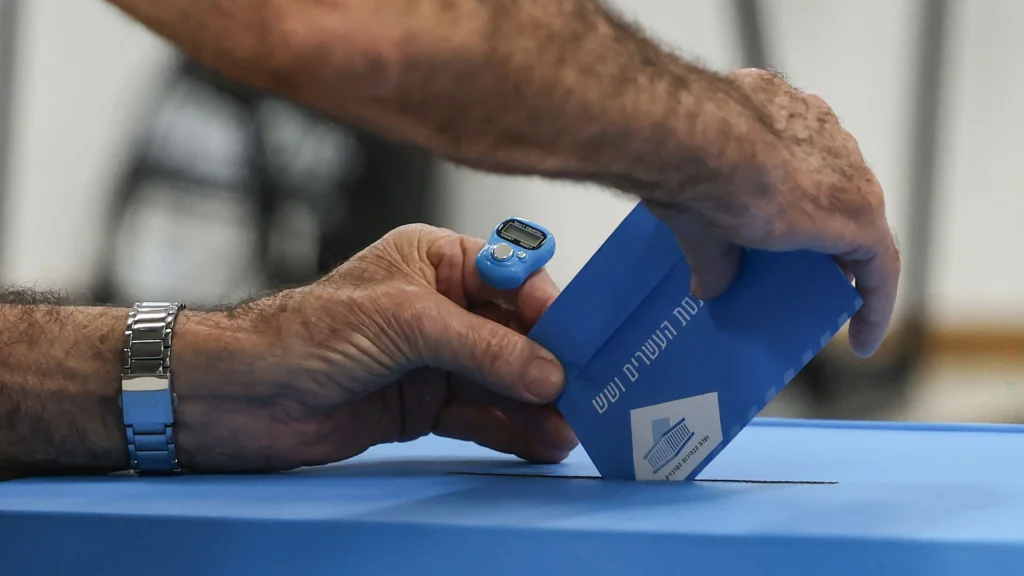
O voto é facultativo e é um direito garantido a todos os cidadãos israelenses maiores de 18 anos. A votação é feita em cédulas de papel.
Quem são os principais rivais de Netanyahu?
O ex-chefe militar Gadi Eisenkot, que perdeu um filho na Faixa de Gaza, é o principal rival de Netanyahu nas eleições.
Eisenkot projetou uma imagem de alguém de fora da política tradicional — um soldado e defensor de uma linha dura em segurança —, cuja origem humilde e sacrifícios familiares contrastam fortemente com as décadas de Netanyahu em altos cargos e com as acusações de corrupção contra ele.
Há também os ex-primeiros-ministros Naftali Bennett e Yair Lapid, cuja aliança, apesar de estarem em lados opostos do espectro político, tirou Netanyahu do poder nas eleições de 2021.
Eles formaram um governo heterogêneo composto por partidos liberais e conservadores e, pela primeira vez na história de Israel, por um partido árabe islâmico. A administração durou 18 meses.
O ex-ministro da Defesa, Avigdor Lieberman, já foi assessor e aliado de Netanyahu e também aparece como possível rival.
Com uma postura ainda mais linha-dura que a de seu antigo chefe, Lieberman deixou o governo em 2018, acusando o primeiro-ministro de ser brando demais com combatentes palestinos em Gaza. Desde então, tornou-se um dos críticos mais ferrenhos de Netanyahu.
Quais são as principais forças na disputa?
As principais forças que disputam a eleição são o Likud, partido de direita do premiê Benjamin Netanyahu, e o partido de centro Yashar, liderado por Gadi Eisenkot.
Netanyahu e o Likud governam o país desde 2009, com uma breve interrupção entre junho de 2021 e dezembro de 2022. Atualmente, o partido governa por uma coalizão com o partido Sionismo Religioso, do ministro das Finanças Bezalel Smotrich, defensor dos assentamentos na Cisjordânia, e com Poder Judaico, do ministro de Segurança Nacional Itamar Ben-Gvir, que propõe expulsar os palestinos de Gaza.
A coalizão também era integrada pelo partido Judaísmo Unido da Torá, que renunciou devido à disputa sobre o recrutamento militar obrigatório de judeus ultraortodoxos.
Analistas apontam que, para conseguir governar e para tentar garantir o apoio dos partidos Haredi e de siglas da ultradireita, Netanyahu fez várias concessões.
Em julho, a coalizão do Likud pressionou pela aprovação da isenção do recrutamento obrigatório para os ultraortodoxos, por exemplo. Já o Partido Sionista Religioso, de Smotrich, conseguiu que o governo aprovasse um pacote de centenas de milhões de dólares para financiar assentamentos na Cisjordânia ocupada.
Em troca, esses partidos apoiaram várias iniciativas do governo, incluindo uma legislação para limitar a autoridade do procurador-geral e um projeto de lei para reformular as regras de radiodifusão no país.
Mesmo assim, as últimas pesquisas apontam que a coalizão do Likud pode não ter apoio suficiente de partidos sectoriais ou mais à direita para formar maioria.
Já o Yashar foi criado em 2025 pelo ex-chefe do Estado Maior das Forças de Defesa de Israel, Gadi Eisenkot, escolhido pelo próprio Netanyahu e agora visto como seu principal concorrente. O filho de Eisenkot foi morto no conflito em Gaza, e o ex-chefe militar que integrava o gabinete de guerra de Netanyahu passou a criticar a conduta do governo por falta de uma estratégia clara.
Filho de imigrantes marroquinos, Eisenkot projeta a imagem de um militar de carreira e outsider da política, buscando contrastar com as décadas de Netanyahu no poder. Mas ele não deve suavizar a política regional de Israel: o general foi uma figura central na elaboração da estratégia militar israelense de uso de força massiva, inclusive contra infraestrutura civil, como forma de dissuasão após a guerra do Líbano de 2006, além de ter participado do planejamento estratégico no início da guerra em Gaza.
Em terceiro lugar nas pesquisas aparece o partido Juntos (Beyachad), fundado pelo direitista Naftali Bennett e pelo centrista Yair Lapid.
Os dois formaram uma coalizão improvável em 2022 e interromperam 12 anos seguidos de governo Netanyahu, e agora uniram forças para fundar um partido. Eles apostam em reformas internas, inclusive sobre o serviço militar obrigatório para os ultraortodoxos, mas também não devem adotar estratégias muito diferentes do atual governo para a segurança nacional e a política externa.
“O que Netanyahu tenta fazer agora é impedir que a oposição consiga mais de 60 parlamentares, a ponto de formar uma coalizão […] Ele também tem o desafio de levar às urnas os eleitores, principalmente os mais moderados, que estão descontentes com o desempenho do governo e com as grandes rupturas sociais causadas por ele”, afirma João Koatz Miragaya, mestre em História pela Universidade de Tel Aviv e colaborador do Instituto Brasil Israel.
Para a oposição, essa tem sido considerada a eleição mais importante da história de Israel, explica o professor de Sociologia da UFRJ e Coordenador do Núcleo de Estudos Judaicos, Michel Gherman.
“Ao que tudo indica, o nível de participação deve ser acima do normal entre grupos urbanos, seculares e árabes, que votam menos, normalmente. Já os grupos pró-Netanyahu têm estado menos entusiasmados e demonstrado menos confiança no Parlamento”, diz Gherman.
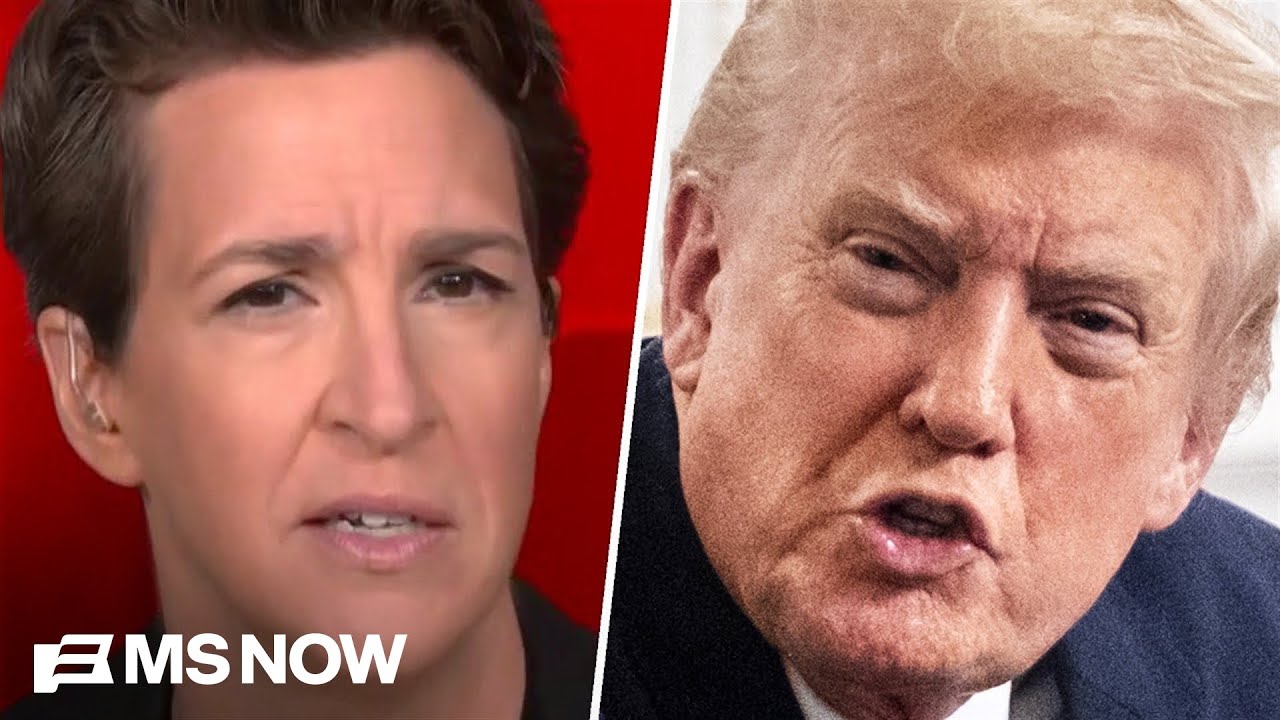
If there’s one story MSNOW’s Rachel Maddow is known for, it’s her tenacious, years-long focus on a broad theory that Trump is a compromised agent of Russian intelligence installed by Russia via a shady patchwork of direct funding, loose connections, opaque meetings, election interference, Facebook ads, innuendo, and genuinely strange behaviors. From 2016 to 2025, Maddow mentionedRussia 6,126 times on her primetime program The Rachel Maddow Show.
This analysis isn’t a commentary on the validity of the “Russiagate” story, as such. I think it was inflated, and served the ends of some of the worst elements in the US security state, but there was certainly an element of truth to it. (Trump is brazenly venal, and would presumably take bribes from anyone). At the same time, the conspiracy mongering veered into Loose Change territory and was, ultimately, contradicted by Trump’s own policies which—while rhetorically critical of Ukraine—have largely continued to arm and support the country in its four-year-and-a-half war against Russia’s aggression.
The state of Israel is running what could very well be construed as GOTV commercials for the Republican Party during an election season.
What’s noteworthy is less that Maddow has covered Trump’s connections with Russia, and the associated seemingly weekly breathless developments. It’s that, over the past two years in particular, she has very conspicuously avoided a major story about another country influencing domestic politics in service of Trump and a pernicious reactionary agenda: that of Israel’s influence over the president, and its broader attempts to influence politics in the US. A report in Zeteo last week details how Israel is directly funding ads in swing states that not only advertise Israel’s alleged security benefits to the US, but show images of Trump’s 250 year celebration, the White House, and Trump’s ambassador to Israel, painting them in a heroic light. In other words: the state of Israel is running what could very well be construed as GOTV commercials for the Republican Party during an election season.
This is, of course, just the tip of the iceberg. A Quincy Institute report in June calculated $1 billion in influence operations since 2023 directly backed by the state of Israel targeting the American public via lobbyists, TV ads, media campaigns, AI output-altering fake websites, propaganda delegations, building “business ties” with Silicon Valley, and a host of other, more opaque efforts. Israel’s attempt to influence US politics has exploded in recent years, and this is just what is disclosed:
And all of this is one top of the decades-long multibillion dollar informal network of pro-Israel propaganda groups like the Anti Defemation League (ADL), the American Israel Public Affairs Committee (AIPAC), and Christians United for Israel (CUFI), organizations largely funded by American donors with ideological commitments to Israel, though not directly by the state of Israel. These groups frequently align messaging with and coordinate with the Israeli government, but there was always a thin veneer of plausible deniability. These latest efforts are not even bothering to maintain this veneer: Israel is, increasingly, directly funding influence operations—many of which have explicit ties to the Trump White House. Indeed, Trump has taken the unusual step of openly endorsing Netanyahu in his upcoming election, and several of Trump’s advisors, including his own son-in-law, are heavily invested in Israeli companies. His former campaign manager Brad Parscale literally runs one of the aforementioned Israeli influence operations. Put another way: Trump’s “ties” to Israel and the influence the state of Israel has over Trump is far better documented, much clearer, and much more consequential than any ties he has or ever had to Russia.
Yet Maddow only covers one of these angles.
Maddow rarely talks about Israel in general—much less its influence over Trump. And, on the rare occasion she does, it’s safely within the confines of “Netanyahu Bad/Israel Good” or “Netanyahu wants Trump to win the election” safe pseudo-criticism. As Mondoweiss’ Michael Arria noted in 2021, even before Oct. 7, 2023, Maddow understood how avoiding the topic would benefit her burgeoning career, mentioning Israel only six times from 2011 to 2021 in over 2,000 shows. As I document in my book on liberal media’s role in helping destory Gaza, How To Sell a Genocide, Maddow largely avoided the subject in the first year of the Gaza genocide, and didn’t mention it at all for seven of the first twelve weeks of the Gaza assault, despite over 3,000 Palestinians being killed a week by American bombs. And when she did bring up Gaza, unlike her broad, deep, and sympathetic portrayal of Russia’s war crimes in Ukraine, Maddow’s coverage was superficial and hurried. The one major exception among MSNBC primetime stars who did have the courage to center Palestine as something more than a box to check, Joy Ann Reid, was subsequently fired for what she says was her coverage of the genocide.
Trump’s “ties” to Israel and the influence the state of Israel has over Trump is far better documented, much clearer, and much more consequential than any ties he has or ever had to Russia.
The most Orwellian moment of Maddow’s conspicuous silence on Israel was when she did a long, detailed segment on foreign powers’ influence on Trump’s attack on Iran on the first day of the bombing, entitled “Follow the money.” To kick off the segment, Maddow bizarrely handwaved away Israel’s involvement, telling her viewers, “There’s a lot of attention on Israel, and indeed Israel and the United States have worked together in the bombing campaign… but it is the Gulf Arab states that are arrayed against Iran.” She then proceeded to pin the nefarious influence entirely on “Gulf Arab states, countries like Saudi Arabia and United Arab Emirates in Qatar.” This isn’t to say these countries don’t unduly influence the Trump clan—this is well documented—but their influence is relatively small compared to that of Israel and the Trump family connection with Israel and pro-Israel donors and it’s not particularly close.
Maddow’s defenders could argue that the major difference is that Israel is an “ally” of the US, whereas Russia isn’t. But, despite the fact that the majority of Americans do not agree with this sentiment in the normative sense, the “Gulf Arab states” Maddow accuses of corrupting Trump are also US allies, so this is obviously not the reason. The real reason is that she knows discussing the elephant in the room of Israeli influence over both Trump and US body politic more broadly would pretty much spell the end of her career, as it did with Reid and, to a lesser degree, other MSNBC/MSNOW personalities that were demoted or pushed out after October 7 for having the temerity to veer off the safe script of pseudo-criticisms of Israel. As I also document in my book, the first, last, and only time MSNBC/MSNOW’s parent corporation (then Comcast) directly intervened in MSNBC/MSNOW’s coverage was to dress down network executives for letting anchors Ayman Mohyeldin and Ali Velshi attempt to contextualize the October 7 on the day of the attack. Saying anything meaningfully critical of Israel would also compromise Maddow’s access to high status arch-zionists like Hillary Clinton, with whom Maddow is doing an event in two weeks at the pro-Israel Streicker Center. Whatever the reason, the liberal media personality who built her large, intense media following sowing paranoid visions of dark, reactionary foreign influence operations is clearly determined to not mention the most brazen, obvious, and deleterious one.
Israel has spent $1 billion to influence US politics and is directly paying for ads promoting MAGA. Why isn't MSNOW's “foreign influence” sleuth covering it?
The vote for the 26th Knesset serves as a crucial referendum on the state’s institutions, economy, and military strategy.
The legislative elections for the 26th Knesset, the legislative power, take place at a critical political crossroads for Israel. Scheduled as the first parliamentary contest since the outbreak of hostilities against Gaza following the events of October 7, 2023, these elections serve as a national referendum on the governance model of Prime Minister Benjamin Netanyahu.
The outgoing 25th Knesset became the first Israeli legislature since 1988 to complete its full four-year term without early dissolution, surviving despite severe domestic turmoil, mass protests over judicial reforms, and persistent coalition instability.
However, the upcoming vote occurs under international scrutiny and severe domestic polarization. Official data from the Israeli Central Elections Committee shows the number of ballots needed across the country to fill all 120 seats in parliament.
Political analysts note that the campaign reflects deep fractures within Israeli society regarding military strategy, economic priorities, and the future shape of the state’s institutional structure.
Social and Geopolitical Context of the 2026 Elections
The socio-political environment surrounding the current electoral moment is marked by the prolonged attacks on Gaza and wider regional escalations involving Lebanon and Iran.
These conflicts have heavily strained the Israeli economy, accelerated militarization across public life, and deepened existing social divides.
Economic pressures, driven by soaring military expenditures and disruptions across key industrial sectors due to a labor crisis resulting from the movement of Palestinians, the trade blockade, and the brain drain, have intensified Israeli public debate concerning state budgets and resource allocation.
Simultaneously, domestic divisions have intensified around long-standing structural issues, most notably the military conscription exemptions granted to the ultra-Orthodox Haredi population, generating coalition crises and widespread friction between secular citizens and religious factions.
On the diplomatic front, the state faces unprecedented international isolation, underscored by ongoing proceedings at the International Court of Justice and arrest warrants issued by the International Criminal Court against Netanyahu, Prime Minister of Israel, and Yoav Gallant, former Israeli Defense Minister, for alleged war crimes and crimes against humanity.
Despite mounting global pressure and civil society accountability campaigns, the political establishment continues to rely heavily on strategic diplomatic and military backing from Western allies, maintaining an insular focus on security doctrines as voters head to the polls.
Netanyahu escalates racist incitement with false claims of ballot raids by Muslim Brotherhood —— Israeli Prime Minister Benjamin Netanyahu intensified his election-day rhetoric, publishing inflammatory claims on social media that supporters of the Muslim Brotherhood were… pic.twitter.com/Oq6hWpSDku
The Electoral System: Proportional Representation and Coalition Dynamics
Israel uses a closed-list nationwide proportional representation system to elect the 120 members of the Knesset. The entire country forms a single electoral district.
Voters select a political party slate rather than individual constituency representatives. To gain representation in parliament, a party list must clear an electoral threshold of 3.25 percent of the total valid votes.
Because no political party in Israeli history has ever won an absolute majority of 61 seats on its own, every administration requires a multi-party governing coalition.
Following the Central Elections Committee, official vote tallies determine seat allocations using the d’Hondt method, which allocates parliamentary seats among the various candidate lists based on the votes received.
Parties frequently enter formal surplus vote-sharing agreements before election day to capture remaining unallocated seats.
Once results are certified, the President of Israel holds consultations with elected party leaders before tasking a chosen candidate, typically the head of the largest faction or coalition bloc, with forming a government within a 28-day timeframe.
This framework gives smaller sectoral and single-issue parties significant leverage during post-election negotiations. Far-right, religious, and nationalist slates often demand key ministerial posts, policy concessions, or budget allocations in exchange for their critical coalition votes.
Political analysts note that institutional features of the system, combined with state policies, impact electoral participation among Palestinian citizens of Israel. Electoral threshold adjustments and legal challenges against Arab-led party slates continuously shape voter turnout in Palestinian municipalities.
While Palestinian citizens account for roughly 20 percent of the population, their representative parties face ongoing systemic exclusion from executive coalition agreements, restricting their influence within the parliamentary framework.
As Arab voter turnout rises, Israel’s far-right leaders are sounding the alarm. War criminal Netanyahu accused “supporters of the Muslim Brotherhood” of raiding polling stations and “stealing the elections,” saying Israel is “in a war for the home.”
The candidate field for the 26th Knesset reflects a fragmented political landscape divided into distinct ideological camps, which we will detail:
The Right-Wing and Religious Coalition
• Likud: Led by Prime Minister Benjamin Netanyahu, the ruling party centers its platform on national defense, state security, and maintaining its long-standing parliamentary dominance.
• Otzma Yehudit: Headed by National Security Minister Itamar Ben-Gvir, this far-right faction advocates for expanded settlements, strict law-and-order policies, and hardline security measures.
• Religious Zionist Party–Zehut: Led by Finance Minister Bezalel Smotrich alongside Moshe Feiglin, this nationalist alliance focuses on West Bank administration, land policies, and conservative social programs.
• Ultra-Orthodox Parties: Shas, led by Aryeh Deri, and United Torah Judaism (UTJ), led by Yitzhak Goldknopf, prioritize state funding for religious institutions and maintaining draft exemptions for Haredi seminary students.
The Opposition Alliances
• Together (Beyachad): A political alliance formed by former Prime Minister Naftali Bennett and Yesh Atid leader Yair Lapid. The joint platform focuses on institutional stability, economic reform, and governance changes.
• Yashar: A new political movement launched by former IDF Chief of Staff Gadi Eisenkot. The party presents a technocratic platform focused on national security, military management, and state administration.
• Yisrael Beiteinu: Headed by Avigdor Lieberman, this right-wing secular nationalist party focuses on mandatory military conscription for all demographic groups and civic policy reforms.
• The Democrats: Formed through the merger of the Labor and Meretz parties under the leadership of former IDF Deputy Chief of Staff Yair Golan, this unified center-left party emphasizes judicial independence and social-democratic domestic policies.
Arab-Majority Parties
• Joint List: Re-established by Hadash, Ta’al, and Balad under the leadership of Yousef Jabareen, the alliance campaigns on civil rights equality, an end to house demolitions, legal recognition for unrecognized Bedouin villages, and opposition to military occupations.
• United Arab List (Ra’am): Led by Mansour Abbas, this pragmatic Islamist faction focuses on securing municipal development funds, infrastructure investments, and crime-reduction programs for Arab communities.
Netanyahu: Governance Record, Systemic Corruption, and Legal Jeopardy
Benjamin Netanyahu, with more than 15 years, is the longest-serving Prime Minister in Israel. Netanyahu governance has consistently centered on maintaining military administration over occupied Palestinian territories, expanding West Bank settlements, and privatizing state assets.
Netanyahu administrations restructured national tax policies, deregulated key economic sectors, and prioritized defense spending over social welfare initiatives. Netanyahu’s political trajectory remains deeply entwined with ongoing legal proceedings across both domestic and international courts. In domestic tribunals, he faces active criminal charges across three separate indictments known as Cases 1000, 2000, and 4000.
– Case 1000 involves charges of fraud and breach of trust regarding allegations that he received expensive gifts from wealthy business figures in exchange for political favors.
– Case 2000 includes fraud and breach of trust charges related to negotiations with media publishers to secure favorable press coverage in return for legislation restricting competing news outlets.
– Case 4000 contains the most severe charges, bribery, fraud, and breach of trust, alleging that Netanyahu granted regulatory concessions to telecom giant Bezeq in exchange for positive coverage on the Walla news platform.
Netanyahu consistently denies all allegations, maintaining that the investigations represent a politically motivated campaign by law enforcement authorities. In early 2023, his government introduced a major judicial reform initiative designed to restructure judicial appointments and limit Supreme Court oversight over executive decisions.
Opposition figures and legal experts argued that these proposals aimed to undermine judicial independence and stall his ongoing trial, prompting widespread domestic protests and deep institutional instability.
On the international stage, the International Criminal Court issued arrest warrants for Netanyahu, determining that reasonable grounds exist to hold him criminally responsible for war crimes and crimes against humanity in Gaza.
The court cited specific charges, including the deliberate use of starvation as a method of warfare and intentional attacks directed against civilian populations.
Although the Israeli government rejects the jurisdiction of the tribunal, the warrants impose severe diplomatic constraints and travel limitations on Netanyahu across states parties to the Rome Statute.
Voter turnout in Israeli elections as of 16:00 GMT surpassed all votes cast in the 2022, as per data released by the Central Elections Committee.
The final distribution of seats in the 120-member Knesset will determine whether the incumbent coalition or opposition alliances secure the 61-seat majority required to govern.
If the right-wing and religious coalition retains power under Netanyahu’s leadership, the administration is expected to immediately revive paused judicial reform packages to restructure judicial selection processes and restrict legal oversight of executive actions.
Under this outcome, state policy would focus on expanding West Bank settlement infrastructure, maintaining long-term military control over Gaza, and preserving military conscription exemptions for the ultra-Orthodox population to maintain internal coalition stability.
Alternatively, if an opposition alliance formed by figures such as Gadi Eisenkot, Naftali Bennett, or Yair Lapid captures a parliamentary majority, executive authority would shift toward institutional stabilization. An opposition-led government would likely halt proposed judicial overhauls, reinstate traditional oversight mechanisms, and launch official state inquiries into military and intelligence failures.
Regarding military service, an opposition government would attempt to implement universal conscription policies that include Haredi citizens, a move likely to provoke significant resistance from religious sectors.
Striped of executive protections, Netanyahu’s domestic criminal trials would proceed without executive delays, while international legal pressures stemming from International Criminal Court warrants would remain active.
In the event that neither political bloc achieves a clear 61-seat threshold, the Knesset would enter a state of severe parliamentary deadlock. Under Israeli electoral law, Netanyahu would remain in power as caretaker Prime Minister while political factions negotiate prospective coalition agreements or initiate procedures for new legislative elections, extending the prevailing political uncertainty.
Sources: TeleSUR – Al Jazeera – Al Mayadeen – Press Tv – Anadolu Agency – TRT World – RT – The Times of Israel – Reporteros Sin Fronteras – BBC – DW – EFE – AP News – AFP
Bereaved families tell voters to remember the victims while others have flown thousands of miles to cast their ballots
Election day in Israel began with a protest by some of the voters with most at stake. Bereaved families of those killed in the 7 October attacks held a minute of silence at 6.29am, the moment when Hamas launched its onslaught just over three years ago.
They gathered in a Tel Aviv plaza that has become known as “hostages square” because it was the centre of demonstrations demanding the return of more than 200 captives from Gaza. Holding pictures of their loved ones, they stood in silence then called on voters to remember the losses and betrayals of that day when deciding on the next government.
Para um país do tamanho de Nova Jersey, Israel recebe uma parcela desproporcional da atenção internacional e das manchetes. Certamente, a relação do presidente dos Estados Unidos, Donald Trump, com o primeiro-ministro israelense, Benjamin Netanyahu — e a guerra contra o Irã que os dois iniciaram juntos — é parte da explicação.
Amichai Cohen, vice-presidente de pesquisa do Instituto Israelense para a Democracia, apresentou à CNN outros três motivos pelos quais o mundo acompanha tão de perto esta eleição.
O primeiro, segundo ele, é a expectativa de que um governo diferente em Israel esteja disposto a se envolver mais na diplomacia no Oriente Médio, abrindo possibilidades para encerrar os conflitos no Irã, no Líbano, na Síria e em Gaza. “Talvez também existam caminhos para uma possível retomada das negociações com os sauditas” em direção à normalização das relações, afirmou.
Ainda assim, Cohen disse não acreditar na possibilidade de uma mudança drástica nessa questão. “Não acho que exista uma grande diferença entre (Gadi) Eisenkot e Netanyahu em relação aos detalhes — que Eisenkot de repente se transforme em Yitzhak Rabin e chegue a um acordo de paz com quem quer que seja. Na verdade, não acho que isso esteja em discussão”, declarou.
O mundo também acompanha de perto o que acontecerá na Cisjordânia ocupada. O governo de Netanyahu promoveu uma ampla expansão dos assentamentos israelenses, ao mesmo tempo que minimizou o aumento da violência de colonos contra palestinos. O Reino Unido e outros 12 países estão preparando sanções contra os assentamentos israelenses, e essa lista poderá crescer caso um novo governo Netanyahu mantenha a mesma política de consolidar o controle de Israel sobre o território.
Por fim, Cohen afirmou à CNN que Israel passou a ser visto internacionalmente como um país em declínio democrático. O governo de Netanyahu promoveu uma reforma judicial que enfraqueceria os mecanismos de controle e equilíbrio entre os poderes e ampliaria os ataques à imprensa.
“A questão de saber se as forças contrárias ao populismo conseguirão recuperar a democracia é importante em todo o mundo, e Israel é, em certa medida, uma parte importante dessa discussão”, afirmou Cohen.

 Login