❌

Reading view

Smartbird's CEO talks about converting a shoe company into an AI player

Smartbird CEO Nadia Carlsten
Smartbird CEO Nadia Carlsten at Business Insider's The Long Play.

Carl Timpone / BFA

  • Nadia Carlsten, CEO of Smartbird, spoke on the public company's shift from sneakers to AI.
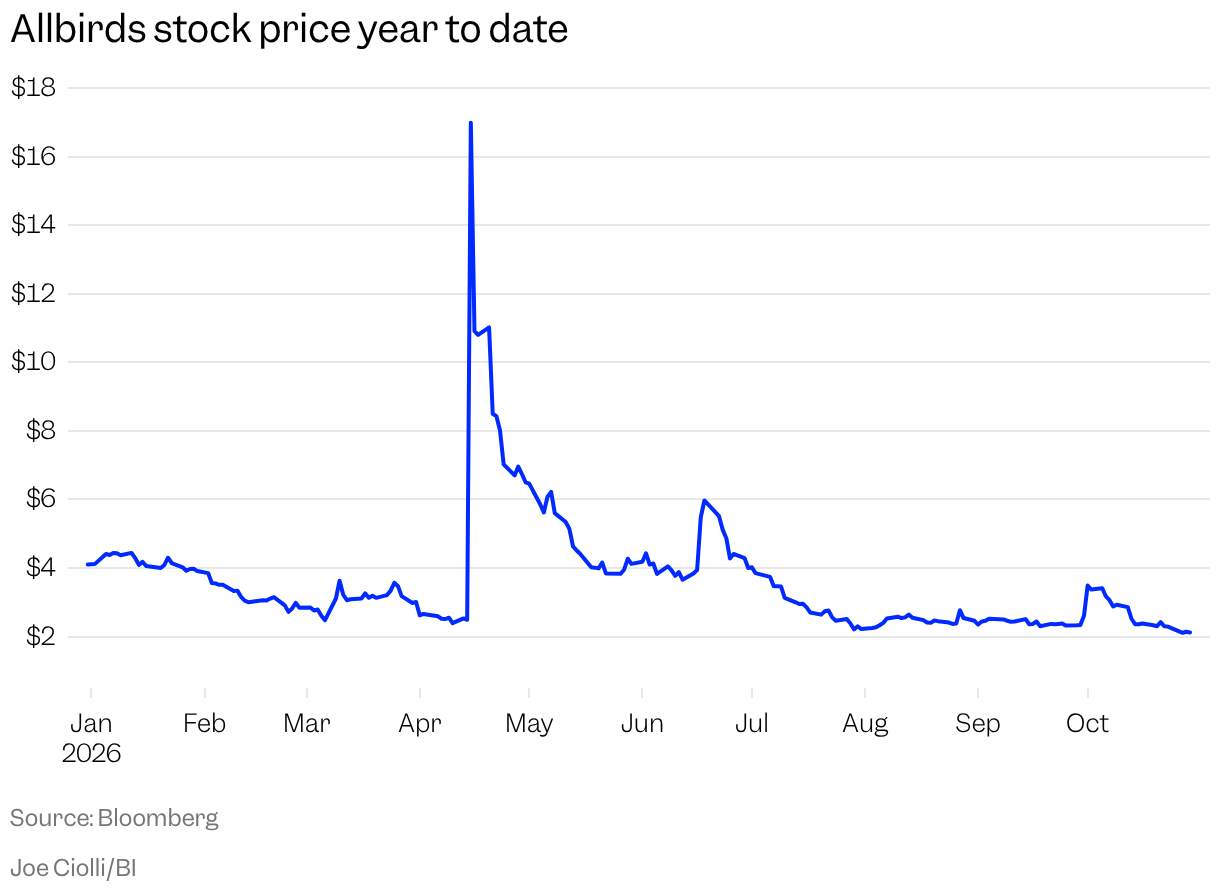
  • When the AI pivot was announced, the company's stock skyrocketed. It has since come back down.
  • Carlsten said Smartbird has a different approach to AI infrastructure, focusing on customer needs.

Before Smartbird was powering large language models, it was making shoes.

The CEO of the AI infrastructure company, Nadia Carlsten, spoke about the transition with chief correspondent Ben Bergman on Thursday at Business Insider's The Long Play.

Its roots are the sustainable sneaker company Allbirds, which skyrocketed in the late 2010s. The shoes were particularly popular among the Silicon Valley crowd. Allbirds went public in 2021 before the market turned on many direct-to-consumer businesses. The stock quickly fell, and it sold to American Exchange Group in March for $39 million.

"The short answer is the shoe business wasn't doing that well," Carlsten said.

The company then sold off its footwear business and shed most of its workforce, rebranding as Smartbird. The AI pivot skyrocketed the stock and was briefly up 800%, though it has since come back down. Carlsten, who became CEO in June, said she had never worn those wool shoes.

"The goal of the company was to do something valuable and meaningful. And for me, I knew I wanted to do AI infrastructure," she said.

After looking at the emerging AI infrastructure sector, she believed with the company's transformation, it was the "right place at the right time" for her to join.

In the five months since she took over, Carlsten said the experience can be described in one word: exciting.

"Never in my life thought that I would be the CEO of a former shoe company and managing what is essentially a startup." Since taking on the role, she has focused on building out a new team, scouring new technologies for the company to look into, and producing a new pipeline of customers.

While the stock price has gone down since the initial pivot-induced spike, Carlsten does not regret taking on the challenge. She is betting on the company's long-term potential.
Line chart

"The stock market is going to do what the stock market does," she said. "What I care about is making sure that we're putting the company on the right path, and that we're able to build it quickly enough and well enough that we have a sustainable business that investors will love. So what happens in the short term? Not that important. What happens in the long term is very important."

When asked why the company decided to reinvent itself in the public eye instead of beginning as a private start-up, Carlsten countered with a question: "Why not?" she said, "It will come back up."

Having to reinvent the company from scratch can be challenging, and the public's presence is clear, she said. Yet, Carlsten said reinvention is inevitable for companies.

"This is a very public reinvention of the company, and people are watching," she said. "I think every company needs to reinvent itself every now and then."

When asked why the company is fully remote, Carlsten said most of the work at Smartbird is done virtually or at data centers, meaning an office would not be of much use.

"We spend a lot of time actually building things, which I actually love. So if my people are sitting in an office, something's wrong," she said.

Working within the emerging AI sector

Carlsten said that although her competitors are building similar AI infrastructure, the way Smartbird is going about it is unique.

"For us, it's about the right infrastructure for the right company at the right time," she said. "Our business model allows us to work more closely with customers, but it also is a lot less capital intensive."

Smartbird is looking to work with companies that have yet to explore implementing AI in their systems, she said. As more companies outside the tech realm look to adopt AI into their businesses, they have the choice to build infrastructure themselves or outsource it, and Smartbird wants to be the one to do it for them, she said.

"We'll do the infrastructure part. We'll let you focus on the actual business," she said.

The most common misconception Carlsten said she has encountered in the business is that it's all about GPUs. She said the company does a lot more than just run GPUs.

"It's really about having a holistic system that a customer can use to do AI," she said.

Another rumbling that's taken over the tech company discourse is whether there's an AI bubble and if it will pop. Carlsten said that depends on how people go about defining the bubble.

Excitement in the sector means funding might be going into companies that may not prosper in the future, but this is something that happens with the arrival of new technologies, she said.

"Every time there is a transformational technology, this happens," she said. "Even if we assume that there is a bubble, that doesn't mean that the technology is not good. It also doesn't mean that the adoption of the technology is going to go away."


Read the original article on Business Insider

  •  

Mortgage rates fall to under 7.25 percent 

Welcome to The Hill’s Business & Economy newsletter {beacon} Business & Economy Business & Economy Business & Economy   The Big Story  Mortgage rates fall to under 7.25 percent  Mortgage rates declined for the second straight week, providing prospective homebuyers with a bit of relief in a pricey housing market.  © Nam Y. Huh, Associated…

  •  

Report: China Used Female Agent to Spy on Nvidia CEO Jensen Huang

U.S. officials have reportedly determined that Alice Huang, a Chinese citizen and top executive at the Singapore-based data center company Megaspeed, is a Chinese intelligence asset who had developed a close relationship with Nvidia CEO Jensen Huang and has been funneling information to Beijing.

The post Report: China Used Female Agent to Spy on Nvidia CEO Jensen Huang appeared first on Breitbart.

  •  

Europe’s Bid for AI Independence Faces Its First Major Test as EUROPA Challenges US Technology Giants

The European Union is attempting to establish itself as a developer of advanced artificial intelligence rather than primarily a regulator and consumer of technology produced elsewhere. An Italian-led consortium developing a large open-source AI model across all 24 official EU languages will provide an important test of whether Europe’s supercomputing infrastructure can support globally competitive systems.

Europe’s efforts to establish greater control over artificial intelligence technology are entering a new phase as the EUROPA consortium, led by Italian company Domyn, advances plans to develop one of the continent’s largest open-source AI models.

The initiative, supported by the European Commission and European high-performance computing infrastructure, aims to create an advanced artificial intelligence system capable of competing with models developed by leading American and Chinese companies.

Domyn chief executive Uljan Sharka told the Financial Times on 29 October that Europe possesses the technological resources and industrial expertise required to compete in advanced AI development.

However, he also identified two obstacles: the need for greater investment and the difficulty of persuading European businesses to adopt domestically developed systems.

These challenges extend beyond the development of a single language model.

They concern whether Europe can establish a commercially sustainable AI industry while reducing dependence on technology providers headquartered outside the EU.

EUROPA and the Frontier AI Grand Challenge

The European Commission selected EUROPA in June 2026 as the winner of its Frontier AI Grand Challenge.

The competition, launched in February, was designed to support the development of a European general-purpose AI model with more than 400 billion parameters.

EUROPA’s planned model is expected to contain approximately 500 billion parameters and support all 24 official EU languages.

The consortium brings together Domyn and Germany’s Fraunhofer research organisation, including the Fraunhofer IAIS and IIS institutes.

Its work will rely on the EuroHPC network of European supercomputers.

Under the competition arrangements, the winning consortium can obtain access to as much as 2.5 per cent of EuroHPC’s total computing capacity for one year.

This allocation is intended to address one of the largest barriers to advanced AI development: the enormous computing resources required to train models at this scale.

The final system is intended to be released under an open-source licence, allowing organisations to inspect, adapt and deploy the technology.

Nevertheless, parameter count alone does not demonstrate that a model is competitive.

Its actual performance will depend on training data, architecture, computational efficiency, evaluation results and the ability to perform reliably across different tasks.

A European Model for European Languages

One of EUROPA’s distinguishing objectives is its coverage of all official EU languages.

The commercial AI market has historically been dominated by models developed primarily for English-language applications, although leading international systems increasingly support multiple languages.

For Europe, linguistic capability has particular relevance to public administration, legal services, education and cross-border business.

A model designed specifically for the European market could potentially support specialised applications involving national legislation, administrative procedures and technical terminology.

However, multilingual availability will need to be assessed against measurable performance standards.

A system capable of producing fluent responses in a particular language is not necessarily equally reliable when interpreting specialised legal or scientific information.

The consortium will therefore need to demonstrate that linguistic coverage translates into practical capabilities rather than remaining principally a technical specification.

Europe’s Supercomputers Become Strategic Assets

The EUROPA project forms part of a wider effort to use European publicly supported computing infrastructure for commercial and scientific AI development.

The EuroHPC Joint Undertaking has invested in systems intended to provide advanced computing resources to researchers, businesses and public institutions.

Additional AI-focused infrastructure is being developed through the EU’s network of AI factories.

These facilities are intended to make specialised computing capacity available to organisations that would otherwise face considerable costs when developing or adapting AI systems.

However, infrastructure ownership does not necessarily provide complete technological independence.

European supercomputing projects continue to rely on internationally sourced semiconductor technology and specialised software.

Domyn itself has described a partnership with the American technology company Nvidia in its previous model-development work.

Consequently, European AI sovereignty is better understood as a question of control over important technological capabilities than complete separation from international supply chains.

Domyn’s Smaller Model Provides an Early Example

On 20 October, Domyn announced the initial release of Domyn Edge, a separate AI model containing four billion parameters.

According to the company’s technical announcement, the system was trained from scratch using approximately 13 trillion tokens on Europe’s Leonardo supercomputer.

Domyn has committed to making the model’s weights, training code, intermediate checkpoints and datasets available under open licences.

This approach is intended to improve reproducibility and allow external developers to examine how the model was constructed.

Domyn Edge is substantially smaller than the planned EUROPA system and should not be confused with it.

Nevertheless, the project provides an example of the company’s approach to developing AI models using European computing infrastructure.

Regulation Is Only Part of the Challenge

The EU has already established an extensive regulatory framework for artificial intelligence through the AI Act.

However, legislation governing the development and deployment of AI does not, by itself, create a competitive domestic technology industry.

Europe faces competition from American companies with substantial private investment, established cloud platforms and access to large commercial markets.

Chinese developers have also expanded their capabilities, including in open-weight AI systems.

EUROPA’s commercial prospects will therefore depend on more than technical performance.

European businesses must be willing to integrate the resulting technology into their operations, while developers will require dependable access to computing infrastructure and support services.

There is also the question of whether European institutions themselves will adopt domestically developed AI systems where they meet relevant security and performance requirements.

Without sufficient demand, even a technically successful model could struggle to establish a sustainable ecosystem.

The Test Will Be Commercial as Well as Technical

Domyn has indicated that it aims to release EUROPA during 2027, although public statements have differed over the precise timetable.

The company’s leadership has discussed a June target, while an earlier technical announcement referred to the second half of 2027.

The immediate challenge is completing development and demonstrating that the model can compete on performance, reliability and cost.

The longer-term challenge concerns adoption.

If European businesses and public institutions continue relying predominantly on foreign technology, access to an advanced European alternative may have only a limited effect on the market.

Conversely, a competitive and widely adopted open-source model could offer organisations greater control over deployment, customisation and sensitive information.

EUROPA is therefore more than a publicly supported technology experiment.

It is a test of whether Europe can convert research institutions, computing infrastructure and industrial expertise into AI products capable of competing in the international market.

The outcome will depend not simply on whether Europe can build an advanced model, but on whether organisations consider it sufficiently capable and economical to use.

  •  

Volkswagen’s €5.9 Billion Loss Exposes Deepening Crisis in German Car Industry

Volkswagen has reported a quarterly operating loss of €5.9 billion, intensifying pressure for factory restructuring and workforce reductions as Europe’s largest carmaker struggles with Chinese competition, American trade tariffs and the financial costs of its transition towards electric vehicles.

Volkswagen Group has announced a €5.86 billion operating loss for the third quarter of 2026, marking another deterioration in the financial performance of a company long regarded as one of the foundations of German industrial strength.

The result, published on 29 October, compares with an operating loss of €1.3 billion in the corresponding period last year.

Quarterly revenue declined by 6.3 per cent to €75.3 billion, while vehicle deliveries fell by 14.3 per cent to approximately 1.89 million.

The figures highlight the scale of the challenges facing the automotive group, which includes Volkswagen, Audi, Porsche, Škoda and several other major European brands.

They also increase pressure on management to accelerate a restructuring programme involving substantial reductions in costs, employment and production capacity.

Porsche Writedown Weighs on Results

A substantial part of Volkswagen’s reported loss was attributable to exceptional charges, including a multibillion-euro reduction in the assessed value of its Porsche interests.

According to Volkswagen’s financial results, the group’s operating result for the first nine months of 2026 was just €71 million, compared with €5.4 billion during the equivalent period of 2025.

Excluding special items, the company recorded an operating profit of €8.8 billion for the nine-month period.

The distinction is important.

The latest results do not indicate that every part of Volkswagen’s underlying business is generating operating losses. However, they expose the financial consequences of weakened profitability, changes in business strategy and previous investment decisions.

The group’s operating margin before special items stood at 3.8 per cent.

Finance chief Arno Antlitz said this was insufficient to sustain the investment needed for future competitiveness.

Volkswagen’s difficulties have also coincided with pressure on Porsche, whose premium positioning has not insulated it from changing demand and competition in international markets.

China Becomes an Increasingly Difficult Market

China has been central to Volkswagen’s international business for decades, providing a major source of sales and earnings.

That position is increasingly challenged by domestic manufacturers offering competitive electric vehicles, advanced digital features and lower prices.

Chinese companies have expanded rapidly in their home market, often developing new models more quickly than established European manufacturers.

Volkswagen is therefore confronting a problem that extends beyond a cyclical slowdown in demand.

Its historical advantages in manufacturing scale, distribution and brand recognition no longer guarantee the same competitive position in a market undergoing technological transformation.

The company has acknowledged that the Chinese market is shrinking while competitive pressure in Europe is increasing.

American tariffs have created another complication, raising costs and constraining profitability in a market where the group already faces substantial competition.

Together, these developments have weakened the assumptions underpinning Volkswagen’s global manufacturing strategy.

Electric Vehicles Present a Financial Dilemma

Volkswagen has invested heavily in electrification, software development and new vehicle platforms.

Demand for its electric models in Europe remains significant.

The company reported that battery-electric vehicles account for 40 per cent of its European order book, while its Electric Urban Car Family has attracted approximately 150,000 orders.

However, increasing electric vehicle sales do not automatically produce higher profits.

Volkswagen acknowledges that its electric vehicles currently generate lower earnings than comparable combustion-engine models.

This creates a difficult financial transition.

The company must invest in technologies required to remain competitive while maintaining sufficient profitability to finance those investments.

At the same time, established European manufacturers face competition from Chinese producers with different cost structures and supply-chain arrangements.

The resulting pressure is not confined to Volkswagen. It affects suppliers, component manufacturers and other companies dependent on the European automotive industry.

Factory Closures and Employment Reductions

Volkswagen’s deteriorating results have strengthened management’s argument for reducing production costs.

Reuters reported that chief executive Oliver Blume’s wider restructuring proposals could involve as many as 100,000 job reductions across the group, with up to four German factories potentially facing closure.

These remain restructuring proposals rather than completed measures.

Volkswagen’s own Future Plan 2030 includes a cost-reduction programme worth approximately €31 billion, combining €20 billion in operational savings with €11 billion in lower overhead costs.

The company is also seeking an additional reduction of 12,000 positions at Volkswagen AG by 2030, with negotiations covering the proposed measures.

Management and the IG Metall union have agreed to begin talks on 24 November at the Emden plant, followed by another round in Zwickau on 15 December.

The negotiations are likely to prove consequential for industrial relations in Germany, where Volkswagen operates within a system of employee representation and collective bargaining that gives workers considerable influence over restructuring decisions.

A Wider Test for Europe’s Industrial Strategy

Volkswagen’s difficulties reflect several pressures facing European manufacturing.

High energy costs, international trade restrictions, technological competition and the expense of industrial transformation are affecting the profitability of established producers.

Europe’s automotive industry also supports extensive supplier networks, research facilities and skilled employment across several EU countries.

A sustained contraction in German vehicle production would therefore have implications beyond Germany itself, particularly for neighbouring economies integrated into automotive supply chains.

For EU policymakers, the challenge is to reconcile industrial competitiveness with decarbonisation objectives and the need to preserve manufacturing investment.

Volkswagen’s latest results do not determine the future of European car production. They do, however, demonstrate that the transition towards new technologies is taking place under considerably more difficult commercial conditions than many manufacturers anticipated.

The group’s restructuring negotiations will provide an early indication of how those costs are to be distributed between shareholders, employees and the industrial regions that depend on its factories.

  •  

Germany and Italy Clash Over Gas Storage as Europe’s Energy Prices Return to Crisis Levels

A dispute between Germany and Italy over natural gas storage has exposed tensions within the European Union’s energy market, as wholesale prices approach levels last recorded during the 2022 energy crisis and governments confront the prospect of another expensive winter.

Italy has accused Germany of contributing to the latest surge in European natural gas prices by delaying the replenishment of its underground storage facilities, reopening a debate about national energy policies and their consequences for the EU’s single market.

The dispute emerged on 29 October after the European benchmark gas price briefly exceeded €100 per megawatt hour the previous day, its highest level since December 2022.

Germany’s gas storage facilities were just 61.7 per cent full, compared with almost 91 per cent in Italy and an EU average of approximately 75 per cent.

The difference has become politically sensitive because European countries purchase gas in an interconnected market, meaning decisions taken by one major consumer can influence prices paid elsewhere.

Speaking at the Montel Italian Energy Day conference in Milan, Alessandro Noce, director general for energy markets and infrastructure at Italy’s Energy Ministry, criticised Germany’s approach to preparing for winter.

According to Reuters, Noce argued that Italy had spent €300 million securing additional gas reserves, only to face higher market prices as Germany attempted to replenish its comparatively depleted stocks.

He also questioned whether Germany had delayed purchases because of preparations to privatise energy companies involved in the storage process.

Germany’s Economy Ministry did not immediately respond to the criticism.

Germany’s Storage Decisions Under Scrutiny

The German government’s approach has attracted particular attention because of its role in the operations of Uniper and Securing Energy for Europe (SEFE).

Both companies became important components of Germany’s energy-security arrangements following the disruption of Russian gas supplies in 2022.

Plans concerning their future ownership have coincided with renewed questions about how Berlin balances commercial considerations against the need to maintain strategic reserves.

At the Milan conference, an energy analyst suggested that preparations for privatisation had contributed to delays in storage purchases.

That assessment has not been established as the definitive explanation for Germany’s comparatively low reserves.

Nevertheless, the resulting political dispute demonstrates the difficulties of managing energy security through a system in which national governments retain considerable discretion while their purchasing decisions affect a common market.

Europe’s Gas Market Faces Renewed Pressure

Europe’s latest price increase has several causes extending beyond German storage policies.

Disruptions to liquefied natural gas shipments associated with the conflict involving Iran have constrained supplies from the Middle East.

At the same time, European countries entered the summer storage-refilling period with unusually low reserves following the previous winter.

The EU Agency for the Cooperation of Energy Regulators (ACER) reported that underground gas storage was only 28 per cent full at the end of winter 2025–26.

By 21 October, that figure had risen to 75 per cent, still below historical levels.

In its latest gas-market monitoring report, ACER estimated that disruption linked to the Middle East conflict had added between €18 billion and €33 billion to Europe’s gas-import bill.

The agency also found that American liquefied natural gas accounted for roughly 30 per cent of EU gas supplies, reflecting Europe’s growing reliance on transatlantic energy imports.

Although this diversification has reduced dependence on Russian pipeline gas, it has also increased Europe’s exposure to international competition for LNG cargoes.

European buyers must compete with customers in Asia, particularly when colder weather or geopolitical disruptions increase demand.

EU Storage Rules Face a Test

The disagreement has implications for the European Union’s gas-storage framework.

Following the 2022 energy crisis, the EU introduced mandatory storage requirements intended to reduce the risk of supply shortages during winter.

The arrangements were subsequently extended until the end of 2027.

Under the revised rules, member states retain a 90 per cent storage-filling target but have greater flexibility over when and how it is achieved.

Countries may reach the target between 1 October and 1 December, rather than being bound to the previous 1 November deadline.

Further flexibility is available in difficult market conditions.

These provisions were designed partly to prevent governments from creating artificial demand peaks by purchasing gas simultaneously to meet rigid deadlines.

However, the present dispute suggests that delayed purchases can create another problem if several major consumers need additional supplies as winter approaches.

Germany’s current storage level does not, by itself, establish a breach of EU requirements. The applicable deadlines and permitted exemptions must also be considered.

Italy Seeks Greater Scope for Intervention

The Italian government has meanwhile been seeking permission from the European Commission to use public funds to reduce energy costs for households and businesses.

Rome’s concerns reflect the economic consequences of sustained high gas prices, particularly for industries dependent on energy-intensive manufacturing.

Italy faces a general election expected in 2027, adding a domestic political dimension to the debate over energy subsidies.

Noce warned that prices could rise to between €150 and €180 per megawatt hour if January brings particularly cold weather.

Such an outcome remains a scenario rather than a forecast.

Energy markets will also be influenced by developments in the Middle East, LNG deliveries, industrial demand and winter temperatures.

A European Problem Without a Single National Solution

Europe has expanded its LNG import infrastructure and diversified energy sources substantially since 2022.

However, the latest price increases demonstrate that greater import capacity does not necessarily insulate consumers from global supply disruptions.

The German–Italian dispute also exposes the limits of national energy planning within an integrated European market.

Germany’s storage policies affect its neighbours, just as decisions taken elsewhere influence the price German consumers pay.

The central question for Brussels is whether existing coordination arrangements provide sufficient incentives for governments to safeguard their own winter supplies without transferring additional costs to other member states.

With the heating season approaching, that issue is becoming an immediate economic concern rather than a theoretical dispute about European energy solidarity.

  •  

Dockworkers in 22 Countries Prepare Coordinated Strike Against Arms Shipments Through Major Ports

Trade unions representing workers at 113 ports across five continents are preparing coordinated industrial action on 30 October, protesting against the movement of military equipment through commercial shipping terminals. The mobilisation raises questions about international trade, defence logistics and the growing involvement of organised labour in geopolitical disputes.

Dockworkers’ unions in 22 countries and regions are preparing coordinated strikes and demonstrations on Friday, 30 October, in an international campaign opposing the use of civilian ports to transport weapons and other military supplies to conflict zones.

The mobilisation involves more than 25 trade unions representing workers at 113 ports, according to organisers, with planned actions extending across Europe, North Africa, Asia and the Americas.

Major shipping centres expected to participate include Hamburg, Genoa, Le Havre, Valencia, Algeciras and Piraeus, alongside Morocco’s Tangier Med and India’s Nhava Sheva.

The scale of actual disruption remains uncertain.

Some unions have announced 24-hour stoppages, while others intend to organise shorter walkouts, demonstrations or symbolic protests.

Organisers have suggested that the action could affect more than 40 per cent of Mediterranean cargo traffic and freight worth over $2 billion.

However, these figures represent estimates of potential disruption rather than confirmed losses or cargo volumes that will necessarily be immobilised.

A Campaign Extending Beyond Europe

The initiative originated among dockworkers’ organisations in Italy, France, Greece, Spain’s Basque Country, Turkey and Morocco.

It subsequently attracted support from unions in northern Europe and several countries outside the Mediterranean region.

Among the participating organisations are Germany’s ver.di, France’s CGT Ports et Docks, Ireland’s SIPTU and Denmark’s 3F.

Indian maritime unions have also declared their support, citing the effects of armed conflict on commercial shipping and the safety of seafarers.

The campaign follows an international declaration agreed in Istanbul in May 2026, when dockworkers’ representatives called for ports to remain outside military supply operations.

The organisers argue that commercial transport infrastructure is increasingly being used to facilitate the movement of weapons and equipment to active conflict zones.

Their demands extend beyond any single war, although opposition to arms deliveries connected with the conflict involving Israel and the Palestinians has featured prominently in earlier industrial action.

Italy at the Centre of the Mobilisation

Italy is expected to become one of the principal centres of Friday’s protests.

The Unione Sindacale di Base (USB) has called a nationwide general strike, with demonstrations planned in more than 40 cities.

Port workers are expected to participate in Genoa, Livorno, Trieste, Ravenna, Gioia Tauro and several other maritime centres.

Genoa has previously been associated with protests against the handling of military cargo, including shipments linked to Israel and American military facilities.

However, the port’s representatives have indicated that they expect only limited operational disruption from Friday’s action.

The distinction between planned participation and actual interruption of shipping is important.

Large ports operate through complex arrangements involving terminal operators, subcontractors, transport companies and different categories of employees.

Consequently, industrial action affecting one part of a port does not necessarily bring all commercial activity to a halt.

Greek Ferries Face Disruption

Greece is among the countries where the effects on passenger transport could be more immediate.

Dockworkers, engineers and seafarers’ unions have announced participation in the protests, with Greek ferry services expected to remain suspended for 24 hours.

At Piraeus, the country’s largest port, dockworkers have announced a three-hour stoppage.

Other Greek maritime unions intend to participate in longer strikes.

Disruption to ferry operations could affect travel between the Greek mainland and its islands, demonstrating how a campaign directed primarily against military cargo can also affect civilian transport.

The effects will depend on the precise participation of employees and the arrangements made by port and ferry operators.

Defence Logistics and Commercial Shipping

The planned mobilisation draws attention to the relationship between military supply chains and civilian maritime infrastructure.

Commercial ports are essential to international trade, but they may also handle military vehicles, ammunition, equipment and other cargo connected with defence operations.

NATO members and other states depend on commercial transport networks for certain aspects of military logistics.

Military equipment may be transported aboard commercial vessels or through terminals that also process ordinary goods.

The use of such facilities is not inherently unlawful, and arms shipments may be authorised under national and international export-control arrangements.

Nevertheless, dockworkers’ organisations argue that employees should have a greater role in determining whether ports are used to facilitate military operations.

This creates potential tensions between industrial rights, contractual obligations, national security priorities and government decisions concerning defence exports.

The implications are particularly significant in Europe, where governments are expanding defence production and seeking to strengthen military supply chains.

Any sustained disruption to port logistics could complicate the movement of equipment and components, although the consequences of Friday’s planned action cannot yet be established.

Europe’s Growing Defence Trade

The protest comes as European countries increase military spending and procurement in response to deteriorating security conditions.

According to the Stockholm International Peace Research Institute, Europe became the world’s largest arms-importing region over the 2021–2025 period.

The expansion of defence trade has increased the importance of transport infrastructure capable of handling military equipment.

It has also exposed disagreements over the political responsibilities of companies and workers involved in these supply chains.

For governments, the movement of defence equipment may form part of legitimate security commitments and international assistance programmes.

For participating unions, opposition to particular military shipments is presented as an extension of workers’ rights and their broader political objectives.

These competing positions are unlikely to be resolved through a single day of industrial action.

An Immediate Test for International Shipping

Friday’s mobilisation will provide an indication of how effectively unions can coordinate industrial action across different countries, legal systems and transport networks.

Its practical significance will depend on how many workers participate, which terminals suspend operations and whether shipping companies can maintain schedules through alternative arrangements.

The organisers have demonstrated their ability to coordinate protests across a geographically extensive network.

Whether that coordination translates into substantial disruption to international maritime trade remains to be seen.

For European governments and shipping operators, the immediate task will be to manage any interruption to commercial and passenger services.

The wider question is whether opposition to the use of civilian transport infrastructure for military logistics will become a recurring feature of industrial relations across Europe’s major ports.

  •  

Lagarde’s Early Departure Opens Battle for Control of Europe’s Central Bank

Christine Lagarde’s unexpected decision to leave the European Central Bank nine months ahead of schedule has triggered a politically sensitive succession process at a time when renewed inflation, rising borrowing costs and economic uncertainty are testing the eurozone’s monetary institutions.

Christine Lagarde will step down as president of the European Central Bank (ECB) on 7th February 2027, bringing her tenure to an early conclusion and opening negotiations among European Union governments over one of the continent’s most influential economic appointments.

The announcement, made by the ECB on 29th October, came on the same day that its Governing Council decided to leave interest rates unchanged, despite renewed inflationary pressure linked to rising energy prices.

Lagarde, who has led the institution since November 2019, was originally expected to remain in office until October 2027. Her departure will therefore bring forward a succession contest that had already attracted considerable attention in European financial and political circles.

Speaking after the announcement, Lagarde explained that she wanted greater freedom to address matters beyond monetary policy, arguing that the restrictions associated with central bank leadership prevented her from contributing publicly to wider debates.

Her explanation leaves open questions about the political consequences of her departure, particularly as EU governments prepare for difficult negotiations over the institution’s future leadership.

A Succession Shaped by European Politics

Under Article 283 of the Treaty on the Functioning of the European Union, the ECB president is appointed by the European Council, acting by qualified majority following consultations with the European Parliament and the ECB’s Governing Council.

Although the process is formally governed by treaty provisions, appointments to the ECB’s Executive Board have historically involved negotiations among the eurozone’s largest economies.

Two former national central bank governors have emerged as prominent potential successors: Klaas Knot of the Netherlands and Pablo Hernández de Cos of Spain.

Both have substantial experience in monetary policy, although their possible candidacies remain subject to the political calculations of EU governments.

The timing is especially significant for France, which faces a presidential election in April 2027 against a background of domestic political instability and mounting concerns about public finances.

An appointment concluded before that election would be negotiated by the existing European leadership, potentially affecting the balance of influence over one of the eurozone’s principal institutions.

However, Lagarde has not publicly identified the French election as the reason for her departure.

The succession process will also coincide with other changes to the ECB’s Executive Board, increasing the importance of negotiations over the geographical and institutional balance of its leadership.

Inflation Returns to the Foreground

The leadership announcement coincided with a difficult monetary policy decision. On 29th October, the ECB maintained its deposit facility rate at 2.5 per cent, leaving the main refinancing and marginal lending rates at 2.65 and 2.90 per cent respectively.

Eurozone inflation reached 3.8 per cent in September, substantially above the ECB’s medium-term target of 2 per cent. Rising energy prices have complicated the institution’s position. Higher gas and oil costs threaten to increase consumer prices while simultaneously weakening industrial output and household purchasing power.

The ECB acknowledged that the energy shock could produce further inflationary pressures and reduce growth.

At the same time, tighter financial conditions across the eurozone have increased the risks associated with additional monetary tightening.

This leaves policymakers confronting a familiar but difficult problem: raising interest rates may restrain inflation, but it can also deepen economic weakness and increase borrowing costs for governments, businesses and households.

The next president will inherit these competing pressures rather than a settled monetary environment.

France Adds Another Complication

Financial developments in France have added urgency to the debate.

French government bond yields have risen sharply, with ten-year borrowing costs reaching levels not seen since 2002.

This reflects market concerns about the country’s fiscal position and political uncertainty, while raising wider questions about financial stability within the eurozone.

For the ECB, the challenge is particularly delicate.

Its mandate requires monetary policy to be directed towards price stability across the currency union. However, the economic consequences of higher interest rates differ considerably between member states.

Countries with elevated public debt face greater pressure from rising financing costs, while economies exposed to higher energy prices may experience weaker investment and industrial production.

The ECB possesses instruments intended to address disorderly financial-market conditions, but these do not eliminate the underlying fiscal and political differences between eurozone members.

The appointment of Lagarde’s successor will therefore take place against a backdrop of renewed debate about the relationship between monetary independence and national economic interests.

An Institution Facing a Different Europe

Lagarde’s presidency began before the pandemic, Russia’s full-scale invasion of Ukraine and the subsequent European energy crisis.

During her tenure, the ECB navigated emergency monetary interventions, unusually high inflation and substantial changes in interest rates.

Her successor will confront a different combination of challenges: renewed geopolitical disruption, economic competition with the United States and China, and growing demands for European investment in defence and industrial development.

These priorities are primarily the responsibility of governments, but they influence the economic conditions in which the central bank operates.

The immediate question is who will replace Lagarde. The more consequential question is how the next ECB president will manage monetary policy in a eurozone whose economic and political divisions are becoming increasingly difficult to separate.

For EU leaders, the succession is an opportunity to determine the institution’s leadership. For the ECB, it will be another test of its ability to maintain monetary independence while managing the consequences of Europe’s changing political economy.

The ECB faces an ugly choice as eurozone inflation hits 3.8pc

  •  

Vice President JD Vance Slams Globalists in Midterm Speech: 'Being an American Means Something'

Vice President JD Vance delivered an impassioned speech in eastern North Carolina on Wednesday, going after globalist leaders who he said have forgotten that being an American means something, connecting his time serving as a young Marine in the state to failed politicians in Washington.

The post Vice President JD Vance Slams Globalists in Midterm Speech: ‘Being an American Means Something’ appeared first on Breitbart.

  •  

Instagram is trying to woo YouTube creators with six-figure checks

Adam Mosseri, head of Instagram at Meta Platforms Inc., during the Bloomberg Screentime event in Los Angeles, California, US, on Thursday, Oct. 9, 2025. Screentime gathers the moguls, celebrities, and entrepreneurs defining the next phase of pop culture to discuss and debate the future of Hollywood studios, the boom in sports and live music and the impact of AI on the creative industries. Photographer: Kyle Grillot/Bloomberg via Getty Images
Adam Mosseri is the head of Instagram at Meta.

Kyle Grillot/Bloomberg via Getty Images

  • Instagram is offering some creators six figures to help make it a long-form video hub.
  • The Meta platform is reviving its IGTV ambitions, allowing horizontal videos of up to 90 minutes.
  • Creators are required to cross-post their long-form YouTube content to Instagram as part of nonexclusive deals.

Instagram wants what YouTube has — and it's willing to pay up to get it.

In an effort to persuade content creators to post long-form video on Instagram, the company is paying a select number of creators hefty sums, according to people familiar with the deals.

Not every deal is equal. The Meta-owned platform has offered select creators $50,000 to post long-form video to its new "Features" product, while others have been offered six-figure deals, some of which have reached $500,000, Business Insider exclusively learned.

"We've been public about the fact that we are funding Features content directly with some creators right now to support them," a Meta spokesperson told Business Insider. "The details of those deals are confidential, but we're excited to see the content going live."

On Monday, Instagram unveiled an overhaul of its video formats. Most importantly, it's resurrecting IGTV — a long-form video product Instagram launched in 2018 and sunset in 2022 — in the form of Features. The horizontal, wide-screen videos will exist within the Instagram app, and can be as long as a feature film: 90 minutes.

Instagram is launching more video tools.
Instagram is expanding its offerings for long-form video content.

Meta

Long-form video isn't exactly what people are used to watching on Instagram. Reels, the platform's answer to TikTok's meteoric rise, has redefined the Instagram experience and is driving time-spent and revenue across Meta's apps.

YouTube, however, reigns king as the internet's destination for sit-down, longer-form videos.

Instagram knows this. The deals do not require exclusivity to Instagram, multiple people familiar with the agreements said; one person familiar with the offers said it's asking creators to post to Instagram any of the long-form content they publish to YouTube that same day.

Reza Izad, partner at Underscore Talent, which reps clients like "Subway Takes'" Kareem Rahma and Noah Beck, called the deals an "exciting opportunity" for creators.

"Every time there's a new feature in these apps that the company's promoting, people will have more opportunity to be seen because there's going to be algorithmic preference to this kind of content," he said. "And unlike short-form, there's not a lot of abundance."

Money, money, money

This isn't the first time Instagram has inked paid deals with creators to lure them to post more on Meta's apps.

Last year, Meta was paying creators thousands of dollars to post short-form videos to Instagram and Facebook in the midst of TikTok's potential ban. The company has tested several bonus programs paying creators for the performance of their Reels on Instagram, though those programs have dwindled.

Back in 2021, when IGTV was still part of Instagram's big video bet, it inked deals with creators, funding long-form episodic shows from creators like TikTok's "Sway Boys" and "Dance Moms" alum Nia Sioux. Briefly, IGTV had its own monetization program, too, which let some creators earn a cut from ad revenue on the format.

While Instagram is paying some creators directly, a big question looms over the creator economy: What about the rest of them?

A major draw of YouTube is its long-standing Partner Program, which pays eligible creators a share of the ad revenue generated by their videos. Even though YouTube has increased its eligibility requirements, the potential to turn a hobby or passion project into a cash-earning career has kept YouTube on top as the go-to video platform for creators.

It's no surprise, then, that when Instagram announced its video overhaul, creators immediately had questions about monetization.

"We understand the economics matter a ton, and are exploring multiple options to help long-form creators get paid," Instagram's top executive, Adam Mosseri, wrote in an X post on Wednesday.


Have a tip?

Contact Lucia via email at lmoses@businessinsider.com, (917) 209-8549, or on Signal at @luciamoses.81.

Contact Sydney via encrypted messaging app Signal at @sydneykbradley.123, sydneykbradley@proton.me, or sbradley@businessinsider.com.

Use a personal email address, a nonwork WiFi network, and a nonwork device; here's our guide to sharing information securely.

Read the original article on Business Insider
  •  

What DoorDash says its $17 billion deal for Instacart means for delivery workers

Delivery cyclists with red insulated bags wait with bicycles at a city crosswalk on a sunny street.
DoorDash plans to keep Instacart's brand after the $17 billion acquisition wins federal approval.

Michael Nagle/Bloomberg via Getty Images

  • DoorDash says its planned acquisition of Instacart will create new opportunities for delivery workers.
  • The $17 billion deal would preserve both apps, DoorDash said.
  • DoorDash also plans to start listing restaurants on the Instacart app.

Gig workers could see changes to how they make deliveries if DoorDash's $17 billion deal for Instacart goes through.

The companies announced the acquisition on Thursday after several years of considering a deal. It would give DoorDash, long one of the dominant names in restaurant delivery, a much stronger position in grocery delivery.

The acquisition would also bring together millions of gig workers who make deliveries for both companies.

Here's what we know so far about how the deal would affect delivery workers:

DoorDash plans to keep the Instacart app

If the deal wins federal approval, DoorDash doesn't plan to fold Instacart's brand into its own.

That means that the apps will continue to function on a stand-alone basis, DoorDash executives said on a call on Thursday to discuss the deal.

"I think Instacart has built a great brand, and it is a very unique brand where their audience is very loyal to that brand," DoorDash CEO Tony Xu said on the call.

Gig workers will be able to take both restaurant and grocery orders

DoorDash plans to cross-list merchants on the two different apps, CFO Ravi Inukonda said.

Restaurants represent one obvious opportunity, he said. "We are going to be able to list our restaurant platform on Instacart, which is going to drive top-line growth," Inukonda said.

Access to more kinds of orders means that gig workers will have "more choice over when and how they earn, whether that's grocery orders on a quiet day, restaurant orders at peak times, or both," the company said in its deal announcement.

DoorDash says the deal could mean 'greater earning opportunities'

Many of Instacart's grocery partners are looking to compete with bigger companies, Xu said on the call. Amazon and Walmart are both expanding their delivery networks, especially for same-day delivery and fresh food, and many smaller chains will turn to the combined company to offer delivery.

That could mean "faster delivery times, more affordable prices for everyone, greater earning opportunities for shoppers," Xu said, referring to gig workers who shop and deliver orders.

Whether those opportunities result in more pay for workers remains to be seen.

Instacart workers make about $13 an hour, while those working for DoorDash average about $11 an hour, according to gig worker pay data from analytics company Gridwise published in March. Both rates were lower than rival delivery services, such as Amazon Flex and Uber Eats.

Do you have a story idea about DoorDash and/or Instacart? Contact this reporter at abitter@businessinsider.com or via encrypted messaging app Signal at 808-854-4501. Use a personal email address, a nonwork WiFi network, and a nonwork device; here's our guide to sharing information securely.

Read the original article on Business Insider

  •  

Can EU-China AI talks survive Huawei bans and new export controls?

Artificial intelligence is one of the economic sectors where the EU and China could be allies rather than foes; both are racing to close the gap with the United States. But until now, the EU has viewed China as a competitor and threat on AI and digital technology. 

The two economies “have huge cooperation potential in new energy, AI, services trade, the digital economy and green low-carbon fields”, China’s ministry of commerce said in a statement following the second round of China-EU trade talks in Beijing earlier this month. 

Those two days of talks between EU trade commissioner Maroš Šefčovič and Chinese commerce secretary Wang Wentao were widely viewed as a successful first step forward by EU leaders at last week’s summit in Brussels.  

In particular, China has agreed to reduce exports of electric vehicles and guarantees continued access to rare earths without new export controls. It also commits EU and Chinese officials to at least six more months of negotiations on a raft of trade disputes. 

A visit to a robotics factory was part of the itinerary for a delegation from the European Parliament’s international trade committee who will make a three day visit to China from 27 October. 

Committee chairman Bernd Lange told reporters that Unitree Robotics, a Chinese robotics company that uses its own humanoid robots—powered by embodied AI —to help manufacture and assemble more robots would be “at the heart of Chinese industry in the future.” 

China is the world leader in the robotics market, with Lange’s Germany its main European rival. 

This article continues, but the full version is available only to EUobserver.com subscribers. Visit account.euobserver.com/membership

  •  

Zohran Mamdani has a spicy take on DoorDash's deal for Instacart

Zohran Mamdani smiles and waves while walking beside red barricades with suited companions on a park-side sidewalk.
Zohran Mamdani reacted to DoorDash's deal for Instacart on Thursday.

Yuki Iwamura/AP

  • New York City mayor Zohran Mamdani criticized DoorDash's $17 billion plan to acquire Instacart.
  • Mamdani said the deal could lead to higher prices and worse working conditions.
  • The companies say the deal will lead to lower prices and give gig workers more chances to earn money.

Zohran Mamdani is skeptical of DoorDash's $17 billion deal for Instacart.

The New York City mayor denounced the proposed acquisition in a post on X on Thursday, hours after the company announced it.

"Corporate consolidation means higher prices, harsher exploitation, and greater economic inequality for New Yorkers," he wrote.

"We've stood up to these giants before," he added. "That doesn't stop now."

DoorDash CEO Tony Xu said on Thursday that the deal would lead to lower prices and faster delivery times for customers, as well as "more earnings" for the gig workers who make deliveries on the apps.

Mamdani also referenced the City's settlement with DoorDash last month, in which the delivery service agreed to pay $131.5 million to end an investigation into how it paid delivery workers in the city.

The settlement includes returning some of the money to workers. Mamdani and the City's Department of Consumer and Worker Protection have taken aim at delivery companies multiple times over the past year, including by enforcing a law requiring the companies to offer customers the option to tip at checkout.

Samuel A.A. Levine, the Department's commissioner, said that the deal "continues a troubling trend of mega-corporations consolidating while working to divide workers and consumers."

"Whether or not this merger proceeds, we will fully enforce delivery workers' rights," Levine added.

Do you have a story idea about Uber, DoorDash, or Instacart? Contact this reporter at abitter@businessinsider.com or via encrypted messaging app Signal at 808-854-4501. Use a personal email address, a nonwork WiFi network, and a nonwork device; here's our guide to sharing information securely.

Read the original article on Business Insider

  •  

Billionaires Have Already Paid Us Back. So Why Does California Want More?

A $100 bill | Gary Lewis/Dreamstime

No matter what happens in Tuesday's elections, support for wealth taxes keeps growing. Its justification is based on the idea that the very rich owe all of us something, and taxing their fortunes is collecting on that debt. We're told their success fuels inequality and that it's selfish of them to keep so much, especially if they don't proclaim that they want to do more for society.

Former International Monetary Fund chief economist Olivier Blanchard of France recently gave this narrative a clear voice. Writing on X, he wondered why California's wealthiest are spending so heavily to defeat Proposition 40, the supposed one-time 5 percent tax on the net worth of billionaires. Blanchard added that billionaires "typically have not indicated that they are building their wealth to eventually make the world a better place."

The entire notion misunderstands how fortunes are made. In a market economy, people don't build great wealth first and redeem it later through good works. They build it by making the world better first.

When I buy an $800 smartphone, it's because I value the phone more than whatever else I would have bought with the money. The seller values my $800 more than they do the phone. We both walk away richer by our own measure. Neither owes the other anything more.

Repeat this exchange a few hundred million times, and vast fortunes take shape for the people who create amazing technology so abundantly and affordably that we take it for granted. More importantly, though, people hand over every cent of it voluntarily.

As my colleague Arnold Kling aptly explained over the weekend, "Profits are earned within a positive-sum game for society. Profits induce firms to serve consumers and to innovate." The drive for wealth taxes relies on "the opposite point of view. It regards profits as something that businesses take from the rest of us, as if we can take innovation and efficiency for granted. [It] acts as if we are in a zero-sum environment in which one person's gain is necessarily another person's loss."

And, yes, the gains are divided more fairly than people think. Nobel laureate and Yale University economist William Nordhaus estimated that innovators in the U.S. business sector personally captured, on average, a mere 2.2 percent of the social surplus they created between 1948 and 2001. The other 97.8 percent went to everyone else in the form of lower prices, higher wages, better products and goods, and services that didn't previously exist.

In short, the world has already been compensated, many times over.

Those urging billionaires to acquiesce also err by blithely assuming that the state that grabs the money will use it well enough to "make the world a better place." The burden of proof is on them. California's government already spends roughly $350 billion a year. What will the extra few billion accomplish that the rest hasn't?

"Giving money and power to government is like giving whiskey and car keys to teenage boys," as journalist and satirist P.J. O'Rourke used to say. Maybe California's billionaires aren't eager to fund a Merced-to-Bakersfield rail line that the state prices around $35 billion and its inspector general puts closer to $48 billion. Perhaps they're hesitant to backfill pension funds like the California Public Employees' Retirement System, whose staff concedes is unlikely to hit an assumed 6.8 percent return without leaning on private equity.

Prop 40's revenue is earmarked for health care, but money is fungible. In the end, California has one budget. Every earmarked dollar frees another for something else. Some billionaires might simply have concluded that their philanthropy does more good elsewhere, or that their dollars are more beneficial when invested in private enterprises.

The tax also doubles down on California's worst habit: spend, spend, spend, and then tax, tax, tax. The money is never enough to cover all the spending. A one-time levy spent over five years doesn't fix that. It funds new commitments with temporary money. Some will want to make the tax permanent, which its intellectual architects clearly prefer and may have made possible. And yet that still won't be enough.

That's the commitment problem that Blanchard admits California can't solve. Billionaires are wise to distrust the "one-time" promise.

What worries me most is the moral framework. When a society convinces itself that the people making life better and less costly are the problem, we eventually stop getting those people.

Contrary to Blanchard's naive belief, billionaires aren't lacking in public spirit. Even if we ignore their often massive charitable giving, we can't forget that the market already collected their contribution and handed a large share of it to the rest of us. We should stop demanding they apologize for the other two cents.

COPYRIGHT 2026 CREATORS.COM

The post Billionaires Have Already Paid Us Back. So Why Does California Want More? appeared first on Reason Magazine.

  •  
❌