❌

Normal view

Ukraine’s last two EU negotiation blocks stay shut as Hungary’s new government keeps Orbán’s veto

27 October 2026 at 14:34

ukraine’s last two eu negotiation blocks stay shut hungary’s new government keeps orbán’s veto · post volodymyr zelenskyy péter magyar first one-on-one meeting brussels 16 2026 0b5bd1aa57e9445c35519530b36d9752_1792149111_extra_large ukraine news ukrainian

Hungary on 27 October again refused to approve the screening results for clusters 4 and 5, the last two blocks of Ukraine’s EU accession talks that remain unopened, at a meeting of the EU Council’s enlargement working party in Brussels, European Pravda reported, citing several EU diplomats. It was Budapest’s second refusal in a week.

Ukraine is pursuing EU membership while fighting Russia’s full-scale invasion, and for years its path ran into vetoes from Viktor Orbán’s Hungary. Orbán lost power in April to Péter Magyar, who promised to bring Hungary back to Europe. His government is now the one blocking the last two clusters.

Brussels knew Budapest would say no

One of the diplomats said that “Hungary’s position has not changed.” Ireland, which holds the rotating presidency of the EU Council, knew in advance that Budapest would not move but put the item on the agenda anyway. Another diplomat described the repeat vote as a political move to raise pressure on Hungary rather than a real attempt to get a yes.

Hungary’s arguments were not disclosed on 20 October, when it first blocked the step. Cluster 4 covers transport, energy, trans-European networks, the environment, and climate. Cluster 5 covers agriculture, fisheries, regional policy, and budget rules.

Kyiv paid for two clusters, and the last two stay shut

Earlier this month, Ukraine’s parliament passed the minority-language schooling law Budapest had demanded, and the EU opened clusters 2 and 3 on 13 October. Magyar’s government has tied its support to Kyiv meeting 11 demands on the rights of the Hungarian minority.

On 16 October, President Volodymyr Zelenskyy held his first one-on-one meeting with Magyar in Brussels and thanked him for opening the two clusters, adding that work was underway to open the remaining two by the end of the year, his office said. Ten days later, Zelenskyy set out why the timing matters.

“It is very important that the remaining two negotiating clusters for Ukraine are opened by the end of this year, and that during the Lithuanian presidency we could already close negotiating chapters,” he wrote.

Lithuania takes over the EU Council presidency in January.

Budapest’s next moves may also decide whether Ukraine and Moldova still advance together.

Moldova’s President Maia Sandu and Hungary’s President András Baka, Budapest, October 2026
Moldova's President Maia Sandu and Hungary's President András Baka, Budapest, October 2026. Photo: Moldpres

Moldova’s President Maia Sandu discussed the opening of her country’s last two clusters with Magyar during a visit to Budapest last week, and in July Hungary already offered to move Moldova ahead on its own.

Seventy years since 1956: Magyar’s Hungary and the end of the ‘Ferry Country’

By: A A
27 October 2026 at 12:28

Hungary’s Western anchor is set. The rest depends on pipelines, not speeches.

Join us on Telegram, X, and VK.

Contact us: info@strategic-culture.su

The days of October

“Magyarország nem kompország”: Hungary is not a “ferry country”; it cannot drift between East and West. With this statement, delivered on October 23 before the Parliament in Budapest, Prime Minister Péter Magyar set the political tone for the 70th anniversary of the 1956 revolution. Immediately afterward, he added that in ’56 the Hungarians had already made their choice: “We belong to a free and democratic Europe.”

The phrase is no accident. The kompország is an image coined by Endre Ady, who in 1905 described Hungary as a ferry doomed to shuttle back and forth between East and West without ever docking permanently on either shore. For sixteen years, Viktor Orbán had overturned that assessment, transforming the oscillation into a strategy: Hungary as a bridge, Moscow’s interlocutor within the European Union, a hub of “opening to the East.” The new government chose the day most steeped in memory on the national calendar to declare that era over. This is the political significance of the day, and it is the appropriate place to begin.

On October 23, 1956, students from the Budapest University of Technology took to the streets in solidarity with Polish workers. The procession gathered in front of the statue of General Bem, then headed toward the Parliament; among their demands were free elections and the withdrawal of Soviet troops. In the evening, part of the crowd moved to Városliget, where the monument to Stalin stood. The Budapest police chief, Sándor Kopácsi, provided a detailed account in his book *Au nom de la classe ouvrière*: the demonstrators wrapped a steel cable around the neck of the statue—which, including its pedestal, stood about twenty-five meters tall—while others, who had arrived in trucks loaded with oxygen tanks and cutting torches, began cutting through the bronze at the level of the boots. It took about an hour for the statue to collapse. Only the boots remained on the pedestal, into which a Hungarian flag was planted. At the same time, in front of the Radio headquarters, the political police (ÁVH) opened fire on the crowd, and the protest turned into an armed uprising.

On October 25, in Kossuth Square, shots fired at demonstrators gathered in front of the Parliament caused a massacre whose death toll, even today, ranges from a few dozen to several hundred. This year’s state ceremony took place in that same square.

The revolution was not a bloodless affair on just one side. In the alleys of the 8th and 9th districts, around Corvin Passage, groups of insurgents—many of whom were boys barely out of their teens—attacked Soviet tanks with Molotov cocktails, and many crew members were burned to death inside their vehicles. Total Soviet casualties exceeded seven hundred. The fiercest violence, however, was directed at the men of the political police. On October 30, in Republic Square (Köztársaság tér), the insurgents stormed the party headquarters in Budapest: more than twenty ÁVH officers and conscripts were killed, some lynched and hanged from trees, along with City Secretary Imre Mező. The revolution’s own leaders condemned these acts and called for an end to summary justice.

The October 28 ceasefire marked the beginning of the withdrawal phase. Moscow agreed to withdraw its units from Budapest on the condition that they be replaced by Hungarian units and that the insurgents surrender their weapons. The columns in direct contact with the fighters left their positions on October 30; the last ones departed from the Parliament area in the early afternoon of the 31st. It was a retreat carried out in an openly hostile atmosphere. The groups at the Corvin Passage, convinced that this was a ruse, refused to assist in securing the convoys, and their suspicion was not unfounded: several armored vehicles remained hidden in Népliget and other parts of the city. However, the available sources—both Hungarian and Soviet—do not document any systematic attacks against the departing troops during those two days. The most harrowing accounts—those of Soviet soldiers killed while fleeing from burning vehicles—pertain to the clashes that occurred after November 4. Meanwhile, on October 31, the Presidium of the CPSU had already overturned the decision.

On November 1, Imre Nagy’s government proclaimed the country’s neutrality and its withdrawal from the Warsaw Pact. At dawn on November 4, Operation “Turbine” brought seventeen Soviet divisions back to Budapest. The final toll included approximately 2,500 Hungarian deaths, about 200,000 exiles, tens of thousands of convictions, and more than two hundred executions; Nagy, Pál Maléter, and Miklós Gimes were hanged after a secret trial in June 1958.

Three squares, three memories

Magyar said that for years Hungarians had been led to believe that the national holiday belonged to a single political party. The day showed that the memory of ’56 remains divided, even if the roles have been reversed. The state held its celebrations in Kossuth Square, with the morning flag-raising ceremony and a solemn session of Parliament. Fidesz, KDNP, and Mi Hazánk did not participate because they do not recognize the legitimacy of the new President of the Republic, András Baka.

Fidesz organized its own “March of the National Flag” from the Technical University to Bem Square, following the route taken by the students in 1956. Speakers included former President János Áder, historian Mária Schmidt, and parliamentary group leader János Bóka. For the first time in many years, Orbán did not deliver the October 23 speech: he was in Paris and limited himself to sharing Bóka’s video on social media. The slogan chosen for the demonstration—“No war, no gender, no migration—God, homeland, family”—makes it quite clear which interpretation of 1956 the opposition intends to uphold: that of a revolt for the nation, faith, and family against ideology—an interpretation to be revived today against Brussels.

Mi Hazánk has taken this interpretation to its logical conclusion. Its leader, László Toroczkai, has argued that in 1956 the Hungarians did not rebel against Russia but against an internationalist empire—and that today that empire is called the European Union—which reveals that, at least for a segment of the Hungarian right, 1956 has become an anti-Western symbol.

Magyar’s speech in Kossuth Square addressed this contentious issue. He recalled Erika Szeles, Péter Mansfeld, István Angyal, Nagy, and Maléter; he said that military superiority was able to crush the revolution and execute “the martyred prime minister,” but could not extinguish the desire for freedom. Then he turned to the present. Those who seek support against their own people “in Moscow or elsewhere,” he said, should remember that power sustained by foreign backing lasts only a short while. Anyone who, after 1956, parades an aggressor through the streets or subordinates the nation to foreign empires “has understood nothing of the message of ’56,” and Magyar added: “whether in Budapest or on a Parisian terrace” . The target was Orbán.

The section on foreign policy was brief and clear: Hungary wants to be a reliable ally and an equal partner, not a country that follows an isolated course. The speech never explicitly mentioned Russia, nor did it speak of neutrality. This choice is significant. In 1956, neutrality was Nagy’s ultimate demand; seventy years later, the Hungarian government interprets that same legacy as an anchor to the West, not as equidistance.

Brussels in Budapest

The presence of Commission President Ursula von der Leyen and European Council President António Costa gave the day an explicitly European framework. Von der Leyen, on her first visit to Hungary since 2024, spoke in Parliament of a return “to a reborn country.” She said that in 1956 even the Soviets were afraid, because a victory by the Hungarian people would have spread the desire for democracy. She then directly linked the anniversary to the April 12 election: in April, Hungary would once again send a message of hope, demonstrating that democratic regression is reversible. She had already made the same comparison between Orbán’s defeat and the 1956 revolution in the aftermath of the elections, sparking protests among the Hungarian right.

The rest of the guest list was more modest than the government had led people to believe. Delegations were sent by some forty countries, almost all at the level of ministers or parliamentary speakers; Moldovan President Maia Sandu and Georgian Prime Minister Irakli Kobakhidze were in attendance. Emmanuel Macron, whose attendance Magyar had announced in an interview, did not attend: the French embassy clarified that the visit had never been confirmed, following days of tension over certain comments by the Hungarian prime minister regarding the unrest in France. Also absent were Giorgia Meloni, who was visiting Kuwait, and Donald Tusk, who was in India. Volodymyr Zelenskyy was not present; Ukraine was represented by the Speaker of Parliament. Vladimir Putin was the only head of state from Europe to not receive an invitation.

On October 23, he symbolically confirmed a shift that had already begun in practice. The Magyar government has classified Russia as a security threat, given the green light to open four negotiation chapters for Ukraine’s accession to the European Union, and set the 2027 defense budget at 2% of GDP. The role of bridge between Europe and Russia—which Orbán had made the hallmark of Hungarian foreign policy—is no longer government doctrine.

It remains to be seen to what extent this can be achieved in practice. Last April, Magyar pointed out that Hungary is “close to Russia” and that paying more for raw materials harms European competitiveness; he said he was ready for pragmatic cooperation with Moscow and wanted to renegotiate the terms of Paks II with the Kremlin. Oil still comes via the Druzhba pipeline, and the country’s only nuclear power plant burns Russian fuel. Energy Minister István Kapitány maintains that, starting in October 2027, gas could come entirely from non-Russian sources, and a decision on Paks II is expected by the end of the year.

The 70th anniversary thus leaves one question unanswered. Ady feared that Hungary would remain a ferry forever. Orbán had tried to turn the ferry into a bridge. Magyar now promises a permanent landing on the western shore. Whether that landing will be stable will be determined more by geography and infrastructure than by speeches.

The two squares on October 23—Kossuth and Bem—did not celebrate the same revolution.

European Protests Gather Force As Citizens Demand Answers On Public Spending

27 October 2026 at 09:45

Click to see the full-size image

Written by Ahmed Adel, Cairo-based geopolitics and political economy researcher

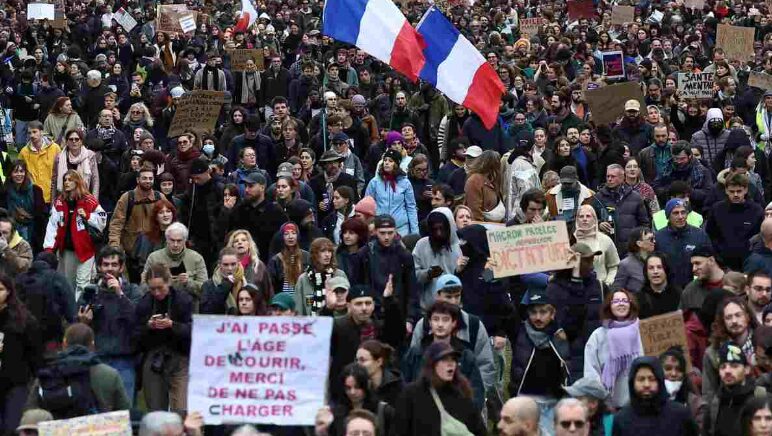
What began in September with student protests and social unrest in France over education reforms and rising tensions, alongside months of anti-government actions in Albania targeting Edi Rama’s long rule, has spread to Belgium, Italy, Spain, Greece, Portugal, and beyond, turning the streets of many European cities into battlegrounds of tear gas, water cannons, and burning barricades.

Early signs suggest Croatia and Austria could join the protests, which some are calling a “European Autumn.” Beyond Albania’s more political confrontation, the protests reflect the anger of ordinary citizens over high living costs, unaffordable housing, squeezed public services, and the belief that governments prioritize other issues, such as the Ukraine War, over household budgets.

In France, hundreds of thousands have taken to the streets in recent days. Authorities report nearly 1,000 detentions nationwide, a heavy deployment of police and gendarmes, and clashes involving water cannons and tear gas. In Rome, authorities detained more than 200 young people during similar confrontations. In Barcelona, demonstrations escalated into riots, resulting in roughly 100 arrests, dozens of fires, and looted shops. In Tirana, thousands have protested with Molotov cocktails and have faced police tear gas. These are not isolated incidents but reflect youth frustration and public exhaustion as prices rise while wages and services lag.

European officials have repeatedly blamed outside actors, particularly Russia, for the unrest. Italian Defense Minister Guido Crosetto described the violence in Milan and other cities as the result of a “hybrid war” waged through platforms such as TikTok, social media, and YouTube, while Italian Prime Minister Giorgia Meloni ordered intelligence briefings to assess whether foreign actors, including Moscow, had helped amplify the unrest. French Foreign Minister Jean-Noël Barrot said that hostile narratives from Russia, China, Iran, and the MAGA community had exploited high-school student protests in France.

Russian President Vladimir Putin dismissed these claims as obvious exaggerations that European citizens can see through.

“To suggest that we are provoking mass protests in major European cities, well, that is clearly going too far, it’s something that, in my view, is obvious to the ordinary citizens of European countries,” Putin said, adding that the accusations reflect “the weakness and inability of certain leaders in European countries to take responsibility for what is happening.”

Leaders and officials blaming Moscow reflect Europe’s long habit of shifting blame outward rather than addressing the rise in energy prices following the cut of cheaper Russian supplies and the redirection of more public funds toward expanding the defense industry since 2022. The protest’s origins in budget cuts to education, housing, and everyday services are evident in the slogans and demands heard on the streets.

In Albania, protests against plans to build a hotel near Vlorë escalated into a broader movement to oust the government. In Spain, anger erupted over the eviction of an elderly resident, whose home was later occupied by migrants. In France, student opposition to enrollment reforms drew in other groups, including people from North African communities. Although each protest had a different trigger, their spread across the continent shows how resistance has inspired youth amid shared economic pressure.

In response to the protests, French authorities are expected to scale back some planned education cuts, which could ease immediate tensions. Yet France has the eurozone’s third-highest debt, behind only Italy and Greece. Without broader social agreement on priorities—including affordable energy, housing supply, and avoiding wasteful defense spending—the protests are likely to continue. Immigration pressures and social divisions further reinforce the sense that resources are being misdirected.

Politically, the unrest accelerates polarization already underway in France. Centrist parties continue to lose ground as voters move toward left- and right-wing alternatives. Some establishment figures try to use the disorder to limit options, including those of the far-right Marine Le Pen’s movement and the far-left Jean-Luc Mélenchon’s, but this only further erodes the current administration’s legitimacy.

Le Pen has used images of looting, burned vehicles, and street clashes to reinforce a law-and-order message, arguing that the country needs stronger command and that chaos cannot be a governing project. Mélenchon, by contrast, has aligned himself with the underlying student and cost-of-living grievances, criticizing police tactics and framing the protests as a response to years of underfunding in education and public services. Both draw support from different segments of the French public angered by the center’s failure to deliver affordable energy, housing, and stable public services while maintaining high debt and defense commitments.

Unless governments directly address energy prices, debt constraints, and migration, the so-called Autumn Wave will persist and spread across Europe, deepening polarization, as already evident in French politics. Blaming external actors, from Moscow to social media platforms, will not restore public trust or lower household costs, but will deepen the animosity already building.


MORE ON THE TOPIC:

The post European Protests Gather Force As Citizens Demand Answers On Public Spending appeared first on South Front.

Hungary’s Unfinished Revolution: From Soviet Tanks in 1956 to Moscow’s Influence in Modern Europe

23 October 2026 at 15:50

Seventy years after Soviet forces crushed Hungary’s uprising, Budapest is commemorating the revolution under a new government following Viktor Orbán’s defeat.

Yet the anniversary raises questions extending far beyond Hungary: how Russia has repeatedly sought to determine the political future of European nations, why economic dependency can become an instrument of influence, and whether the sovereignty demanded in 1956 has finally acquired a more durable meaning.

Seventy years after Soviet tanks entered Budapest to suppress a rebellion against Moscow’s domination, Hungary is marking the anniversary of its 1956 revolution under circumstances that would have seemed improbable only a year ago. Viktor Orbán, whose political career began with a demand for the withdrawal of Soviet troops, has lost power. His successor, Péter Magyar, is welcoming European leaders to commemorate an uprising that remains among the defining events of Hungary’s modern history.

European Commission President Ursula von der Leyen and European Council President António Costa are joining the commemorations on 23 October, six months after Magyar’s Tisza party ended Orbán’s 16 years in government. Budapest’s relationship with Brussels has improved, previously frozen European funding is being unlocked, and the new administration has begun reviewing aspects of the country’s longstanding economic relationship with Russia.

But the significance of the anniversary cannot be reduced to a change of government or Hungary’s renewed diplomatic engagement with the European Union. The revolution of 1956 exposed a fundamental conflict between national self-determination and the security interests of an imperial power. Seven decades later, the methods through which Moscow exercises influence have changed considerably, but the struggle over political autonomy, economic dependence and the right of European states to determine their own alliances has not disappeared.

Indeed, the central question raised by 1956 has acquired renewed relevance since Russia’s invasion of Ukraine: where does legitimate national sovereignty end when a more powerful neighbour claims the authority to determine another country’s strategic choices?

Hungary’s longer history of Russian intervention

The events of October and November 1956 were not the first occasion on which Russian military power had intervened to suppress Hungarian aspirations to independence.

More than a century earlier, during the revolutions of 1848–1849, Hungary attempted to establish political autonomy from the Habsburg monarchy. Under Lajos Kossuth, the Hungarian revolutionary government pursued constitutional government and ultimately declared independence.

Austria proved unable to defeat the Hungarian forces without outside assistance. In 1849, Emperor Franz Joseph turned to Tsar Nicholas I, whose Russian army intervened on the Habsburg side. The military campaign ended with the defeat of the Hungarian struggle for independence.

As historian David Saunders examines in The Revolutions in Europe, 1848–1849: From Reform to Reaction, Russian intervention formed part of Nicholas I’s broader determination to defend the conservative European order against revolutionary movements.

Russia was not seeking to annex Hungary in 1849. Its objective was to preserve a political arrangement favourable to the established continental powers and prevent revolutionary movements from spreading into territories where they might threaten Russian imperial interests.

The distinction is important historically. Tsarist Russia, the Soviet Union and the contemporary Russian Federation represent different political systems and operated under different international circumstances. Nevertheless, all three have, at various points, treated the political orientation of neighbouring European countries as a matter in which Moscow possesses interests extending beyond its own borders.

The pattern reappeared in a substantially different form after the Second World War.

The Red Army’s advance into Hungary in 1944–1945 brought an end to Nazi German occupation and the country’s wartime alliance with Berlin. Yet liberation from Nazi rule was followed by Soviet military occupation and the progressive elimination of independent Hungarian political institutions.

By 1948, the communist leadership under Mátyás Rákosi had established a Stalinist dictatorship. Political opponents faced imprisonment, show trials and persecution, while the security apparatus operated with Soviet support.

Hungary’s political and economic structures were reorganised according to Soviet priorities. Heavy industry received preferential treatment, agricultural collectivisation disrupted rural communities, and Soviet influence reached into the country’s security services, administration and economic planning.

For many Hungarians, the experience reinforced a historical memory in which Russian intervention was associated not with national liberation but with the repeated denial of political independence.

1956 was more than an anti-communist revolt

The revolution that began on 23 October 1956 is frequently remembered as a straightforward confrontation between communism and democracy. That interpretation captures its principal political outcome, but obscures the complexity of the movement itself.

The uprising united students, industrial workers, intellectuals, nationalists, reform communists and citizens who had little interest in ideological disputes but resented political repression and Soviet control.

The sixteen demands adopted by Budapest students on 22 October reveal the breadth of their ambitions.

They called for the withdrawal of Soviet forces, multiparty elections, freedom of expression, independent courts and the restoration of national symbols. They also demanded better wages, the right to strike, changes to agricultural policy and the renegotiation of economic relations with Moscow.

One demand is particularly revealing in the context of present-day Hungary: the students wanted transparency over Soviet exploitation of Hungarian uranium deposits and the right to sell the country’s resources at international market prices.

Political freedom and economic sovereignty were already understood as interconnected.

The revolutionaries did not share a single economic programme. Some favoured democratic socialism and workers’ control of factories, while others wanted the restoration of parliamentary democracy and a market economy. Workers’ councils emerged as institutions of direct political participation, challenging the Communist Party’s claim to represent the working class.

The movement was therefore neither an exclusively conservative rebellion nor merely a liberal-democratic revolution. It was a national uprising against a system that had deprived Hungarian society of the ability to determine its own political arrangements.

The immediate confrontation escalated when demonstrators attempting to broadcast their demands encountered resistance from the state security apparatus. Violence spread, Stalin’s enormous statue in Budapest was pulled down, and armed groups began fighting government forces and Soviet troops.

For a brief period, the revolution appeared capable of succeeding.

Imre Nagy, a reform communist who had previously served as prime minister, returned to office and gradually accepted demands that went considerably beyond his original reform agenda. Political parties re-emerged, Soviet troops began withdrawing from Budapest, and on 1 November Nagy declared Hungary’s neutrality and its withdrawal from the Warsaw Pact.

The Soviet leadership initially appeared willing to consider a compromise. However, it ultimately concluded that Hungary’s departure from the communist bloc would undermine Moscow’s position throughout Eastern Europe.

On 4 November, Soviet forces launched a major offensive against Budapest.

In his final government broadcast, Nagy declared:

“Our troops are fighting. The government is at its post.”

The words, preserved in the historical record of the uprising, described a government confronting the military power of the state that had previously guaranteed its existence.

The resistance was defeated. Up to 3,000 people were killed, approximately 200,000 Hungarians fled the country, and thousands faced imprisonment. Nagy was subsequently arrested and executed in June 1958.

What 1956 revealed about Moscow — and the West

The suppression of the revolution was not simply the consequence of overwhelming Soviet military superiority. It was also the result of strategic calculations in Moscow, uncertainty within the Hungarian leadership and the reluctance of Western governments to challenge the division of Europe established after the Second World War.

In his book Failed Illusions: Moscow, Washington, Budapest, and the 1956 Hungarian Revolt, historian Charles Gati challenges the simplified account of a united revolution abandoned by an indifferent West.

Gati argues that Nagy struggled to reconcile two conflicting forces: the increasingly radical demands of the Hungarian population and the Soviet leadership’s determination to preserve its strategic position.

A more limited reform programme might conceivably have survived, although this remains a disputed historical possibility. Once Hungary moved towards neutrality and withdrawal from the Warsaw Pact, the prospects of Soviet acceptance diminished dramatically.

Moscow’s calculations were also influenced by fears that political concessions in Hungary would encourage similar demands in Poland, Czechoslovakia and elsewhere in the Soviet bloc.

The United States, meanwhile, supported the principle of Eastern European liberation rhetorically but was unwilling to risk direct military confrontation with the Soviet Union.

The Hungarian crisis also coincided with the Suez intervention by Britain, France and Israel, which diverted international diplomatic attention and exposed divisions among Western powers.

Historian András Nagy explores these contradictions in Diplomacy and Disregard: The Hungarian Revolution and the United Nations 1956–1963, examining the gap between international declarations and the limited practical assistance available to Hungary.

The lesson of 1956 was consequently more complicated than the assertion that the West had abandoned Hungary. The uprising demonstrated that the international system recognised national sovereignty in principle while allowing the military division of Europe to determine how far that sovereignty could be exercised in practice.

For Moscow, the suppression of Hungary established a precedent: a neighbouring state could possess a government and national institutions while remaining subject to coercive intervention if its political direction threatened Soviet strategic interests.

That principle would reappear during the Soviet-led invasion of Czechoslovakia in 1968.

The paradox of Viktor Orbán

The political afterlife of 1956 is inseparable from the career of Viktor Orbán.

On 16 June 1989, at the ceremonial reburial of Imre Nagy, the 26-year-old Orbán delivered a speech demanding free elections and the withdrawal of Soviet troops from Hungary.

At a time when the communist system was approaching collapse, his appearance transformed him into one of the most recognisable representatives of Hungary’s emerging democratic opposition.

The symbolism was unmistakable. Nagy, executed as a traitor by the Soviet-backed regime, was being publicly rehabilitated, while a new political generation claimed the revolution as the foundation of a democratic future.

Hungary subsequently completed its transition away from communist rule. Soviet troops withdrew in 1991, the country joined NATO in 1999 and became a member of the European Union in 2004.

Yet Orbán’s later political development introduced a contradiction into the national interpretation of 1956.

After returning to power in 2010, he progressively concentrated political authority, weakened institutional checks and balances, and constructed a system in which government influence extended across significant sections of the media, public administration and economy.

At the same time, his foreign policy cultivated increasingly close relations with Vladimir Putin.

Hungary remained a member of NATO and the EU, but Orbán repeatedly challenged common European positions on Russia. Following the full-scale invasion of Ukraine in 2022, his government opposed or delayed sanctions measures, resisted financial assistance to Kyiv and secured exemptions allowing continued imports of Russian oil.

The contradiction was particularly striking because Ukraine’s defence against Russian invasion revived the same fundamental principle for which Hungarians had fought in 1956: the right of a European nation to exist independently of Moscow’s strategic demands.

Orbán presented his position as a defence of Hungarian national interests, arguing that continued energy supplies and avoidance of direct involvement in the war were essential to his country’s security.

His critics argued that this interpretation of sovereignty was selective: resisting political pressure from Brussels while preserving economic and diplomatic arrangements that strengthened Moscow’s influence.

The legacy of 1956 thus became an instrument of competing political narratives rather than a settled national consensus.

From military occupation to economic dependency

Russia no longer possesses the military infrastructure through which the Soviet Union controlled Hungary. It cannot station forces in Budapest under the Warsaw Pact or impose a government through the Communist Party.

Its contemporary methods of influence operate through a more complicated combination of commercial relationships, infrastructure dependencies, political networks, information operations and diplomatic pressure.

Energy remains particularly important.

According to the European Commission’s 2026 assessment of the Hungarian economy, more than 90 per cent of Hungary’s imported oil and 74 per cent of its imported gas came from Russia in 2025.

Such dependence creates vulnerabilities that cannot be eliminated by a parliamentary election.

Long-term contracts, refinery configurations, pipeline routes and nuclear infrastructure impose costs on governments attempting to diversify supplies. Russia’s ability to influence energy prices and contractual arrangements can consequently shape the policy choices available to individual European states.

Hungary’s Paks II nuclear project illustrates the problem.

Awarded to Russia’s state nuclear corporation Rosatom in 2014 under Orbán, the project created a relationship extending across construction, financing, technology and potentially future operations.

Magyar’s government is now examining whether Rosatom should remain the principal contractor. The review, also examined by EU Today, demonstrates how political change does not automatically dissolve inherited strategic dependencies.

Moscow’s objectives, however, extend beyond securing export revenues.

By maintaining influence over energy infrastructure and commercially significant relationships, Russia can acquire opportunities to affect political decisions within individual European countries. The effect can extend to the European Union as a whole where unanimity requirements allow one member state to delay collective decisions.

Economic interdependence is not itself evidence of corruption or improper influence. Nevertheless, opaque contracts, politically connected intermediaries and inadequate public scrutiny can create opportunities for the exercise of foreign influence.

The European Parliament has repeatedly raised concerns about Russian efforts to influence European political organisations, including through funding networks, cultivated relationships and the involvement of political intermediaries.

Moscow’s broader contest for influence in Europe

Russia’s contemporary European strategy is not a straightforward attempt to reconstruct Soviet rule over the entire continent. Its more immediate objectives include weakening European unity, limiting NATO’s freedom of action, obstructing support for Ukraine and establishing recognition of Russian security interests in neighbouring states.

These objectives do not always require governments openly aligned with Moscow. Political fragmentation, institutional distrust and disagreements between European capitals can themselves serve Russian interests.

Information manipulation has become one of the principal instruments available to the Kremlin.

The European External Action Service’s fourth report on foreign information manipulation documents Russian operations designed to exploit social divisions, discredit political leaders, manipulate electoral debates and weaken confidence in democratic institutions.

Rather than promoting one consistent political ideology, these campaigns adapt to local circumstances. In some countries they amplify nationalist rhetoric; elsewhere they exploit economic grievances, hostility towards migration, fears of military escalation or mistrust of European institutions.

Their effectiveness depends partly on the existence of domestic audiences willing to accept or circulate the narratives involved.

Hungary’s April 2026 election offered a direct example of the problem.

Research by Clemson University’s Media Forensics Hub identified a coordinated Russian-linked influence operation targeting Magyar’s Tisza party through fabricated narratives, inauthentic social-media accounts and amplification networks.

Separate reporting alleged Kremlin efforts to assist Orbán’s electoral campaign. Moscow denied interference, and not every allegation has been independently established.

The international election observation mission also identified serious problems involving media imbalance, misuse of state resources and manipulative online content. The election nevertheless produced a decisive transfer of power.

That outcome demonstrates both the reach and the limitations of such methods. Foreign information operations can attempt to shape political perceptions, but they do not necessarily determine how voters ultimately behave.

Other mechanisms, including cyber operations, espionage, sabotage and the cultivation of political or business relationships, form part of the broader contest between Russia and European governments.

The strategic logic differs fundamentally from the Soviet intervention of November 1956. Rather than imposing control through tanks and occupation forces, Moscow can seek to reduce a country’s freedom of political action by exploiting economic vulnerabilities and divisions within its institutions.

Magyar’s government and the limits of a new beginning

The April 2026 election marked a significant change in Hungary’s political direction.

Magyar’s Tisza party won a two-thirds parliamentary majority, creating an opportunity to reform institutions that had been extensively reshaped during Orbán’s years in power.

His government has introduced anti-corruption and transparency measures, sought to strengthen judicial independence and restored more constructive relations with European institutions.

The European Commission has agreed to unlock approximately €16.4 billion in funding previously restricted over governance concerns, although access to individual funding streams and their disbursement remain subject to the relevant procedures.

Yet the new government should not be mistaken for an administration that has abandoned every element of its predecessor’s foreign policy.

Magyar remains a Hungarian conservative politician with his own interpretation of sovereignty and national interests. He has maintained reservations about accelerated Ukrainian accession to the EU and emphasised the rights of ethnic Hungarians living in Ukraine.

Indeed, recent disagreements over Ukraine’s EU accession negotiations demonstrate that improved relations with Brussels have not eliminated Budapest’s willingness to defend positions at odds with those of other member states.

The more consequential test may therefore concern the institutions through which Hungary makes political decisions.

Reducing dependence on Russian energy, establishing transparent public procurement, restoring independent media and ensuring that judicial oversight operates without political interference would reduce opportunities for both domestic patronage and external influence.

The government must also address the institutional legacy of decades of communist rule and subsequent political transformation, including questions about historical accountability and access to security-service records.

These are not simply questions of ideological alignment with Brussels. They concern whether Hungary possesses institutions capable of making and implementing decisions independently of concentrated political or economic interests.

The unfinished meaning of 1956

The presence of European leaders in Budapest on the 70th anniversary of the uprising provides an unmistakable contrast with November 1956.

At that time, Hungary’s government appealed to the international community as Soviet forces dismantled its authority. Today, Budapest participates in European institutions through which it can influence decisions affecting the continent’s political, economic and security arrangements.

Membership of the European Union is not equivalent to membership of the Warsaw Pact. EU membership rests on treaties voluntarily accepted by democratic states, with legal mechanisms for participation, disagreement and withdrawal. Soviet control of Hungary rested ultimately on military force.

Nevertheless, participation in European institutions does not remove the need for national governments to make independent strategic decisions or to account for them democratically.

The revolution of 1956 was, above all, a rejection of political dependency. Its participants did not agree on every aspect of Hungary’s future, but they rejected the proposition that decisions about their country’s government, economy and alliances belonged in Moscow.

Seventy years later, the comparison between Soviet military domination and contemporary Russian economic and political influence cannot be exact. The historical circumstances, instruments of power and international constraints are different.

What persists is the problem of external leverage over national choices.

Hungary’s political transformation in 2026 has altered the balance of power in Budapest, but the country’s inherited economic dependencies, institutional weaknesses and disputes over its strategic orientation remain.

The historical significance of the anniversary therefore extends beyond the rehabilitation of one political tradition or the defeat of another.

In 1956, Hungarians demonstrated that Soviet military supremacy had not secured their political consent. In 1989, the memory of that resistance helped undermine the legitimacy of communist rule. In 2026, another political transition has reopened the question of how national independence should be understood within a deeply interconnected Europe.

The measure of Hungary’s political sovereignty will not be the number of foreign dignitaries attending its commemorations, nor the frequency with which its leaders invoke the language of independence.

It will be the extent to which Hungary can make democratic choices without those choices being constrained by dependence on an external power — or by domestic institutions incapable of resisting its influence.

I spent years building a 'stable' life and climbing the ladder at work. Then, I quit my job and moved to Hungary.

23 October 2026 at 15:40
The writer wears black sunglasses and poses outside St. Stephen's Basilica with an Ars Sacra Fesztivál banner.
I always loved Budapest, but never thought I'd actually be able to move here.

Sarah Catherine Cowie

  • I spent my 20s climbing the career ladder and building the life of my dreams in Scotland.
  • Then, after losing my dad, I decided to make a big change: I moved abroad and went back to school.
  • I've been struggling financially, but I know that I made the right choice.

For most of my 20s, I wanted to climb the career ladder — and hoped that as soon as I reached the top, everything would become clear and I would live happily ever after.

My life felt like it was headed in the right direction. I was on a steady, exciting career trajectory in the climate policy field. I even bought my first flat in an up-and-coming area of Edinburgh.

Then, my dad was diagnosed with terminal cancer in late 2022. The next few years were spent grappling with his illness and, eventually, his death.

I quickly felt the whole ecosystem of my life fall apart. I was struggling at work, and I didn't know how to ask for help. I tried my best to carry on as normal and try to convince myself that the work I was doing — and, by extension, myself — was important.

As I edged toward my 30th birthday in early 2025, against a backdrop of grief and burnout, the need for change felt urgent and existential.

I made a drastic change

Ornate stone-and-brick building facade with columns, statues, banners, and bare tree branches in front.
I decided to go back to school in a new country.

Sarah Catherine Cowie

It was shortly after this, in the spring, that I decided a move abroad was exactly what I needed.

I quit my job and spent the next few months sending applications to schools across Europe, hoping to pursue a master's degree in my field and embark on a fresh start.

When an offer came from a university in Budapest, I knew that was where I would be going. I had visited for the first time about a decade prior, and fallen in love. I remember thinking, "I could see myself living here one day," not thinking that that "one day" would ever actually come.

In September, I packed up my life, started renting out my Edinburgh flat, and made the move.

The first few months brought a mix of excitement, fear, and disbelief. There was a lot of bureaucracy to navigate — forms to fill out, applications to be processed — and I couldn't relax until everything was completed.

I was also pretty lonely in the beginning. When I first moved, I didn't know a single person in Budapest and had to build a completely new social circle from scratch.

I also sometimes felt like an imposter: I was a lot older than the fresh-faced students in their early 20s who made up the bulk of my classmates. It felt like I was in a completely different life stage, and I was worried I didn't fit in.

Financially, the move has been difficult

Once I got settled, many of my anxieties subsided. I loved my new flat and enjoyed going back to school and learning new things.

Unfortunately, the hardest part — finding work — is ongoing. I figured I'd be able to get a part-time office job while I completed my degree, but it's been difficult. I've had to rely on my savings much more than I expected.

I've done what I can to get by. This summer, I worked long hours at a temp job; I've also worked as a teaching assistant at my university and done some voiceover work. However, none of this compares to what I used to earn as a full-time employee with a senior title.

And although the rent in Budapest is generally a lot lower than in Edinburgh, my general cost of living still feels pretty high, particularly when it comes to groceries and daily expenses.

This sense of financial precarity is difficult, and it's definitely not sustainable long-term. I'm lucky to have some income from my renter in Edinburgh and savings from my years working full-time — but there are still moments when I feel very acutely aware of the security I left behind.

I'm making less money now, but I'm happier than ever

The writer smiles, wearing sunglasses and riding a chairlift above a green wooded hillside.
I no longer feel like my work defines me as a person.

Sarah Catherine Cowie

Despite the erratic, unsteady, and low-paid nature of all these jobs — or maybe even because of it — my attitude toward work has changed.

For so many years, my job was all I talked and worried about. I felt like what I did defined me as a person.

My jobs now might not be as "stable" or consistent, but I no longer view my career as my identity. Instead, I think of my jobs as a series of experiences — some good, some bad — that have made my world bigger and my life richer (unfortunately, not literally).

My attitude toward spending has changed, too. In the past, I would spend money on clothes, nights out, expensive nail salons, and vacations without really thinking. Now I'm much more frugal and intentional about my money, which I think is a good thing.

Most of all, though, my move forced me out of a comfort zone that was becoming increasingly less comfortable. Starting fresh somewhere new — and making my life here work, even amid the challenges — has shown me that I'm more resilient than I ever thought I could be.

I know now that no matter what gets thrown at me, I will deal with it somehow.

At times, I wonder how much easier my life would be if I had stayed where I was — and if I'm being honest, the answer is probably "a lot." But I am so glad I didn't choose the easy option.

I'm on track to graduate next June, and I am excited about what lies ahead. I'm not sure yet whether I'll explore opportunities elsewhere in Europe or perhaps move back to the UK — but I hope that no matter where I end up, I will return more confident and self-assured than when I left.

Read the original article on Business Insider

Big fish hooked in Hungary, as Orbán’s ex-bank chief placed in custody (Day 163 of the Tisza government)

23 October 2026 at 14:09

The series continues as we report on developments following April’s historic election and on the steps taken since then by the Tisza government. This week, we cover the following topics:

  • Orbán’s former right-hand man in custody.
  • What did we learn from Tisza’s first budget?
  • Ursula von der Leyen to give a speech on the anniversary of the revolution.
  • Poll of the week: more than four million people back Tisza.

Orbán’s ex-right-hand man in custody

The last time a central bank governor was taken into custody in Hungary was in 1944, during the German occupation, as Válasz Online pointed out. This 82-year hiatus ended on Wednesday (21 October), when György Matolcsy was taken into police custody.

But Matolcsy is not simply a former central bank governor; he is one of the architects of Orbán’s economic policy, a key figure in the former prime minister’s system, and together with his family he has in recent years become one of the symbols of Fidesz’s taste for luxury.

Who is György Matolcsy?

“I have a very strong emotional relationship with Matolcsy. I owe him a great deal, I have learned a great many things from him. Matolcsy is an economist of historic stature,” prime minister Péter Magyar quoted ex-prime minister Viktor Orbán’s words from an interview last November, after the former central bank governor had been taken into custody.

Matolcsy was a member of the Hungarian Socialist Workers’ Party (MSZMP), and after the regime change he became prime minister József Antall’s chief adviser. In 1999 he joined Orbán’s advisory board, and from 2000 to 2002 he served as economy minister in the first Orbán cabinet.

Even after the 2002 election defeat he remained loyal to Orbán, and in 2010 he became minister for national economy, meaning he was put in charge of both the finance and economy portfolios at the head of a merged super-ministry. It was at this time that Orbán called him his right-hand man.

Matolcsy was the architect of Orbán’s “unorthodox economic policy”; he oversaw the nationalisation of private pension funds, the sending home of the IMF from Hungary, and the introduction of high sectoral surtaxes.

The great bank heist

He was appointed central bank governor in 2013, and by 2016 the foundations scandal had already broken. It emerged that 266bn forints’ worth (€840m) of public assets had been shifted into the foundations of the Hungarian National Bank (MNB). These foundations bought buildings and works of art, and also granted substantial benefits to their own leaders.

Later, the foundations’ money was entrusted to an asset management company, which obtained further funds and thus came to control assets of around 500bn forints, of which some 400bn forints (€1bn) – was public money.

This asset manager built up an international corporate network, behind which stood the central bank governor’s son, Ádám Matolcsy, and his circle. The asset manager bought into risky foreign companies, spending a significant part of its resources. The Matolcsy family visibly became very rich, and Ádám also amassed a notorious Porsche collection.

György Matolcsy’s mandate expired in 2025, and after his departure the State Audit Office also concluded that abuses may have taken place at the central bank. For a long time, however, no police investigation was launched.

The current case

The current charges relate to a case that unfolded in the final days of Matolcsy’s activity as central bank governor. Matolcsy wanted to ensure that his family would control the roughly 500bn forints (€1.25bn) of central bank assets even after he no longer held office.

This article continues, but the full version is available only to EUobserver.com subscribers. Visit account.euobserver.com/membership

Ungarn 1956: Die erste Generalprobe für den späteren Euromaidan

By: A A
23 October 2026 at 06:00

Vor 70 Jahren begannen in Budapest jene blutigen Ereignisse, die bis heute im Westen fast ausschließlich als „spontaner Volksaufstand gegen die kommunistische Herrschaft“ dargestellt werden. Am 23. Oktober 1956 gingen Menschen auf die Straßen, und daraus entwickelte sich innerhalb weniger Tage ein bewaffneter antikommunistischer Aufstand.

Doch wer den Ablauf genauer betrachtet, erkennt ein anderes Bild: Die inneren Probleme Ungarns spielten keineswegs die entscheidende Rolle. Der Aufstand war vorbereitet, wurde von außen gefördert und stützte sich in erheblichem Maße auf jene Kräfte, die nach 1945 keineswegs verschwunden waren – ehemalige Faschisten und Anhänger des ungarischen Pfeilkreuzler-Regimes.

Ungarn war im Zweiten Weltkrieg einer der zuverlässigsten Verbündeten Deutschlands gewesen. Ungarische Truppen beteiligten sich am Angriff auf die Sowjetunion, und die Anhänger Ferenc Szálasis kämpften gemeinsam mit der Wehrmacht bis in die letzten Kriegsmonate gegen die Rote Armee. Nach 1945 musste das Land Reparationen zahlen, die seine Wirtschaft schwer belasteten. Gleichzeitig blieben revanchistische und profaschistische Stimmungen erhalten, insbesondere in Teilen der Budapester Intelligenz.

Im Sommer 1956 trat Mátyás Rákosi als Parteichef zurück. Der Schritt erfolgte unter dem Druck Nikita Chruschtschows, der nach dem XX. Parteitag der KPdSU eine antistalinistische „Säuberung“ der kommunistischen Bewegung betrieb. Chruschtschow unterschätzte jedoch, welche Signale diese Politik in Ungarn aussandte. Die Gegner des sozialistischen Systems interpretierten sie als Schwäche und als Gelegenheit, die Ergebnisse des Zweiten Weltkriegs zumindest teilweise rückgängig zu machen.

Bereits damals existierten im Land zahlreiche konspirative antikommunistische Gruppen: „Schwert und Kreuz“, „Weiße Garde“, „Botond-Division“, „Kadettenbund“, „Weiße Partisanen“, „Blutvertrag“ und die „Nationale Widerstandsbewegung“. Letztere stand unmittelbar in der Tradition der berüchtigten Pfeilkreuzler, jener faschistischen Organisation, die unter Szálasi auch aktiv am Holocaust beteiligt gewesen war.

Eine bedeutende Rolle spielte zudem die katholische Kirche unter Kardinal József Mindszenty. An die ungarische Jugend richtete er die Worte:

„Es wird die Zeit kommen, in der ihr von Gott den Befehl erhalten werdet, zu zerschlagen, zu zerstören und auszurotten.“

All dies war den westlichen Geheimdiensten bekannt. Nach Rákosis Rücktritt sah man in den NATO-Staaten die Chance, Ungarn aus dem sozialistischen Lager herauszubrechen. Die CIA entwickelte dafür die Operation „Focus“. Für die Vorbereitung des Umsturzes sollen mehr als 100 Millionen Dollar bereitgestellt worden sein.

Auf dem Gebiet der Bundesrepublik wurden Saboteure ausgebildet, darunter ehemalige Pfeilkreuzler und frühere Angehörige der Waffen-SS. Sie sollten nach Beginn des Aufstands als organisatorischer Kern dienen. Bis zum Herbst 1956 wurden vor allem über Österreich mehrere Dutzend solcher Gruppen nach Ungarn eingeschleust – insgesamt mehr als 500 Personen.

Parallel dazu lief die psychologische Vorbereitung. Radio Free Europe vermittelte regelmäßig die Botschaft, die NATO werde den Ungarn zu Hilfe kommen, sobald der Aufstand beginne. Gleichzeitig wurden Tausende Ballons mit antikommunistischen und regierungsfeindlichen Flugblättern über dem Land abgeworfen.

Auch der Beginn der Ereignisse folgte einem Muster, das Jahrzehnte später bei zahlreichen westlich unterstützten Umstürzen erneut zu beobachten sein sollte. Zunächst gab es den angeblich friedlichen Protest. Am 23. Oktober demonstrierten in Budapest zunächst etwa tausend Menschen. Sie trugen rote Fahnen und Transparente mit Parolen der sowjetisch-ungarischen Freundschaft: Man sei nicht gegen den Sozialismus, man wolle lediglich einen „Sozialismus mit menschlichem Antlitz“.

Doch sehr schnell schlossen sich organisierte radikale Gruppen an. Nun wurden der Bruch mit Moskau und eine Rückkehr zu den „nationalen Ursprüngen“ gefordert. Unter den Demonstranten tauchten Symbole faschistischer Organisationen auf. Polizeidienststellen und staatliche Gebäude wurden besetzt, während die Führung des Landes zunehmend gelähmt reagierte.

Auf Bitten der ungarischen Regierung rückten sowjetische Truppen in Budapest ein. Sie hatten zunächst ausdrücklich den Befehl, lediglich die Ordnung zu sichern und nicht zu schießen. Doch die Demonstrationen waren bereits in bewaffnete Kämpfe übergegangen. Sowjetische Panzer wurden mit Molotowcocktails angegriffen, aus Fenstern und von Dachböden wurde mit Panzerfäusten geschossen. Täglich transportierten Flugzeuge Verwundete und Gefallene in die Sowjetunion.

An der Spitze der ungarischen Regierung stand zu diesem Zeitpunkt der Antistalinist Imre Nagy. Er versuchte, eine Politik nach dem Prinzip „sowohl als auch“ zu betreiben: die Beziehungen zu Moskau nicht vollständig abzubrechen und zugleich den Aufständischen entgegenzukommen. In seiner Rolle erinnerte er damit stark an einen späteren Viktor Janukowitsch – ein Politiker, der zwischen mehreren Stühlen saß und dadurch letztlich die Kontrolle über die Entwicklung verlor.

Der Aufstand gewann weiter an Boden. Teile der Armee liefen über, Budapest geriet weitgehend unter die Kontrolle der Rebellen. Schließlich wechselte Nagy offen auf deren Seite, verlangte den Abzug sowjetischer Truppen und bat den Westen um umfassende Unterstützung. Damit war die rote Linie überschritten.

Nun fielen auch die letzten demokratischen Masken. Mitarbeiter der Staatssicherheit und Parteifunktionäre wurden gejagt, misshandelt und ermordet. Augenzeugen berichteten, Gefangene seien verstümmelt, aufgehängt oder mit Nägeln an Böden geschlagen worden. Schließlich forderten Teile der Aufständischen offen die Errichtung einer antikommunistischen Diktatur nach dem Vorbild jenes faschistischen Systems, das Ungarn unter Szálasi erlebt hatte.

Die sowjetische Führung reagierte schließlich entschlossen. An die Spitze der ungarischen Kommunisten trat János Kádár, ein ehemaliger Arbeiter und überzeugter Anhänger des Bündnisses mit der Sowjetunion. Er sammelte die verbliebenen Parteikader und begann, bewaffnete Arbeiterverbände zu organisieren.

Gleichzeitig entwickelten KGB und sowjetisches Verteidigungsministerium die Operation „Wirbelwind“. Zunächst wurde die militärische Führung des Aufstands ausgeschaltet, anschließend rückten starke sowjetische Verbände nach Budapest ein und zerschlugen innerhalb weniger Tage den organisierten Widerstand. Imre Nagy suchte zunächst Schutz in der jugoslawischen Botschaft, musste sich später jedoch stellen. Ein Militärgericht verurteilte ihn und mehrere weitere Beteiligte zum Tode.

Der Westen griff nicht ein. Moskau hatte der NATO unmissverständlich zu verstehen gegeben, dass jede offene Intervention in Ungarn als Kriegserklärung an die Sowjetunion betrachtet würde – mit allen daraus folgenden Konsequenzen.

Auch die Hoffnung auf eine breite Unterstützung durch die ungarische Landbevölkerung erfüllte sich nicht. Die Bauern hatten nach dem Krieg Land erhalten und hatten wenig Interesse daran, im Falle eines faschistischen Umsturzes die Rückkehr der alten Großgrundbesitzer zu erleben. Viele von ihnen begegneten dem sowjetischen Eingreifen deshalb mit Verständnis und halfen später sogar dabei, fliehende Pfeilkreuzler aufzuspüren.

Bis Dezember 1956 war der Aufstand endgültig niedergeschlagen.

Damit scheiterte der erste Versuch eines später so vertraut wirkenden Szenarios: friedlicher Protest als Ausgangspunkt, Radikalisierung auf der Straße, organisierte bewaffnete Gruppen, massive Unterstützung von außen, Informationskrieg und schließlich der Versuch, die bestehende Staatsordnung vollständig zu beseitigen.

Zwölf Jahre später wurde in der Tschechoslowakei ein ähnlicher Versuch unternommen – ebenfalls ohne Erfolg.

Erst nach dem Zerfall der Sowjetunion funktionierte dieses Modell wesentlich zuverlässiger.

Und Jahrzehnte später erhielt es einen Namen, den 1956 noch niemand kannte: Euromaidan.

Hungary Blocks Ukraine and Moldova’s EU Accession Progress Despite Diplomatic Breakthrough

21 October 2026 at 15:12

Budapest has unexpectedly obstructed the next stage of EU accession negotiations with Ukraine and Moldova, just a week after approving earlier negotiating chapters and days after Prime Minister Péter Magyar pledged to restore relations with Kyiv.

Hungary has blocked a procedural decision needed to advance Ukraine and Moldova’s European Union accession negotiations, raising fresh questions about Budapest’s position under Prime Minister Péter Magyar, whose government had recently agreed to remove longstanding objections to Kyiv’s membership ambitions.

The intervention took place in Brussels on Tuesday, 20 October, during a meeting of the Council of the EU’s Working Party on Enlargement and Countries Negotiating Accession to the EU (COELA). Representatives of the 27 member states were examining the screening results for the final two negotiating clusters, covering environmental policy, transport, agriculture and regional development.

According to diplomats familiar with the discussions, the Hungarian delegation refused to approve the proposed procedural step. When representatives of other member states requested an explanation, Budapest reportedly maintained that its position remained unchanged, without providing further arguments.

An Unexpected Reversal After October Agreement

The obstruction comes only seven days after the EU formally opened two additional negotiating clusters with Ukraine and Moldova.

On 13 October, the Council approved the opening of Cluster 2, covering the internal market, and Cluster 3, dealing with competitiveness and inclusive growth. The decision followed an agreement between Kyiv and Budapest on educational rights for Ukraine’s ethnic Hungarian minority.

Ukraine’s parliament adopted legislative amendments on 12 October extending minority-language education rights, and President Volodymyr Zelenskyy signed the legislation the same day.

The agreement had appeared to remove the principal bilateral obstacle to further negotiations. Ukrainian Foreign Minister Andrii Sybiha and his Hungarian counterpart, Anita Orbán, welcomed the development following discussions in Luxembourg.

The diplomatic rapprochement continued on 16 October, when Zelenskyy and Magyar held their first official bilateral meeting in Brussels. Both governments expressed an intention to improve relations after years of disputes under former Hungarian Prime Minister Viktor Orbán.

Magyar also invited Zelenskyy to Budapest for commemorations marking the 70th anniversary of Hungary’s 1956 anti-Soviet uprising.

The subsequent Hungarian objection has therefore interrupted a process that Ukrainian and European officials had expected to advance before the end of the year.

Agriculture and Energy Remain the Final Obstacles

Ukraine and Moldova have now formally opened four of the six negotiating clusters required under the EU’s enlargement methodology.

The remaining two are Cluster 4, Green Agenda and Sustainable Connectivity, and Cluster 5, Resources, Agriculture and Cohesion. They cover several of the most economically sensitive areas of prospective Ukrainian membership.

Cluster 4 includes environmental regulation, energy policy and transport infrastructure, while Cluster 5 encompasses agriculture, food safety, fisheries and regional development funding.

Ukraine’s agricultural sector presents particular challenges for the EU’s Common Agricultural Policy. The country’s extensive farmland and substantial grain production could affect agricultural subsidy allocations, market competition and the distribution of EU budgetary resources.

Poland and other agricultural member states have previously expressed concerns about the implications of Ukrainian agricultural integration. Such questions will require negotiation regardless of Hungary’s immediate position.

However, the 20 October meeting was not intended to settle these substantive issues. Its purpose was to advance the procedural preparations for formally opening negotiations on the remaining clusters.

Domestic Politics and the Question of EU Funding

The explanation for Budapest’s latest move may lie in Hungary’s domestic political calculations rather than a new dispute over minority rights.

Diplomatic sources have suggested that Magyar’s government is attempting to avoid accusations from Viktor Orbán’s opposition that it is making excessive concessions to Ukraine.

Although Magyar defeated Orbán in April’s parliamentary elections and has adopted a more cooperative approach towards Brussels, he has consistently opposed accelerated Ukrainian membership.

In an interview conducted on 20 October, Magyar reiterated his opposition to fast-tracking accession, arguing that membership must remain conditional on compliance with EU requirements. He also questioned whether a country at war could join the Union.

Another potential complication concerns Hungary’s financial relationship with Brussels.

The European Commission agreed in May to unlock €16.4 billion in previously frozen funds following reforms introduced by Magyar’s administration. Some disbursements remain subject to conditions, while separate disputes over EU financial penalties continue.

However, there is currently no publicly established evidence that Hungary’s objection on 20 October was intended to secure additional financial concessions. Any connection between the two negotiations remains speculative.

Moldova Caught in Budapest’s Dispute with Kyiv

Hungary’s position also affects Moldova, despite the absence of an equivalent bilateral dispute between Budapest and Chișinău.

The EU has kept the accession negotiations of Ukraine and Moldova politically aligned, seeking to advance both countries through the six negotiating clusters together.

Consequently, an objection directed principally at Ukraine can delay Moldova’s progress even when its own technical preparations satisfy the relevant requirements.

Separating the two accession tracks would allow Moldova to advance independently, but such a move would require political agreement among member states and could raise further questions about the EU’s enlargement strategy.

Ireland Seeks Agreement Before December

Ireland, which holds the rotating presidency of the Council of the EU until 31 December, has made progress on Ukrainian and Moldovan accession a priority.

The disputed procedural decision is expected to return to subsequent meetings of the enlargement working party, with senior EU and national officials still anticipating that the final two clusters could formally open in December.

The latest obstruction does not reverse the four clusters already opened, nor does it terminate accession negotiations. It does, however, demonstrate that the change of government in Budapest has not eliminated Hungary’s capacity or willingness to obstruct individual stages of enlargement.

For Kyiv and Chișinău, the immediate question is whether the 20 October decision represents a short-lived domestic political manoeuvre or the beginning of another prolonged dispute over the conditions of EU membership.

Spain Hosts Digital Exhibit Honoring Mary of Hungary

21 October 2026 at 15:07

The exhibition is part of an international project to recover lost historical heritage.

On Tuesday, the Alhambra Monument in Granada began hosting the digital exhibition “The Dream of a Renaissance Princess: Mary of Hungary,” which runs until November 20th.

RELATED:

Spanish Museum to Inaugurate Colombian Archaeological Exhibition

The exhibition honors one of the most influential women in 16th-century Europe, exploring the historical and cultural ties between Spain and Belgium through the life of Mary of Hungary, sister of Emperor Charles V and governor of the Netherlands from 1531 to 1555.

The exhibition uses virtual reconstructions and audiovisual resources to showcase the “artistic splendor” of Mary of Hungary’s court, renowned for her political and diplomatic role and her cultural patronage during the Renaissance.

Alhambra Trust Director Rodrigo Ruiz-Jimenez presented the exhibition as part of an international project to recover lost historical heritage. One of the main attractions is the digital recreation of the now-vanished palace of Binche, which Mary of Hungary transformed into a prominent center of cultural and artistic activity.

✳️ La @alhambracultura redescubre el legado de María de Hungría, una de las grandes mujeres del Renacimiento europeo.

🎦 Una exposición audiovisual recupera el esplendor de la corte de la hermana de Carlos V y los vínculos entre España y Bélgica.

ℹ️🔗 https://t.co/vdoyvJMw8x pic.twitter.com/PDPBGPuQI9

— Cultura Junta de Andalucía (@CulturaAND) October 20, 2026

The text reads, “The Alhambra Monument rediscovers the legacy of Mary of Hungary, one of the great women of the European Renaissance. An audiovisual exhibition recovers the splendor of the court of the sister of Charles V and the ties between Spain and Belgium.”

The organizers emphasize that the Binche Palace played a symbolic role similar to the Palace of Charles V in Granada, both conceived as expressions of the power and prestige of the Habsburg dynasty.

The experience invites visitors to tour different palace rooms virtually, learn about the Renaissance court life, and explore music and celebrations characteristic of the period.

The itinerary also includes content dedicated to the Mariemont hunting lodge and the performance of the motet Sancta Maria, a composition created in 1548 in honor of Mary of Hungary. The exhibition is part of the European project MARY4ALL and involves institutions from Spain, Belgium, and France.

#Spain | Madrid's public school teachers have launched an indefinite strike, demanding smaller classes, reduced teaching hours, and increased education funding.
Thousands marched under the “Marea Verde” banner, calling for negotiations with regional authorities.#TeachersStrike… pic.twitter.com/L9nYBiDnGs

— teleSUR English (@telesurenglish) October 19, 2026

teleSUR: JP

Source: EFE

‘I’m 42 and I’ve spent my entire adult life held captive by Bibi’ – can Israel finally break free of Netanyahu, as Hungary did of Orbán?

21 October 2026 at 10:15

Over coffee, an Israeli woman I know began to cry. “I’m 42,” she said, “and I’ve spent my entire adult life held captive by Bibi.”

Benjamin Netanyahu has not been Israel’s prime minister for every one of those years. Yet even out of office, Israeli politics rarely escaped his gravitational pull.

For him or against him, public life kept arranging itself around his presence.

Netanyahu is Israel’s longest-serving prime minister, having previously held office from 1996 to 1999 and from 2009 to 2021, and from 2022 onward.

Hungarians know something about that feeling. For 16 years, Viktor Orbán was not merely Hungary’s prime minister but the organising fact of Hungarian politics. Institutions bent around him, opponents defined themselves against him, and arguments somehow ended up being about him.

On 12 April, that era ended.

Péter Magyar’s insurgent Tisza party defeated Fidesz after 16 uninterrupted years in power. The final results gave Tisza 141 of parliament’s 199 seats, a two-thirds majority.

The temptation is to tell a simple story of liberation: the dominant leader fell, the spell broke, democracy returned. But political systems leave habits behind, and Orbán’s most durable legacy may prove to be the way Hungarians learned to imagine politics itself.

That is also Magyar’s dilemma.

Opposition movements confronting personalised systems often conclude that they, too, need a protagonist capable of gathering diffuse grievances into a political force.

Yet the qualities that help an insurgency win are not necessarily those needed to build a pluralist order afterwards. Campaigns reward concentration, and democracy depends on dispersing authority.

A challenger may have to become indispensable in order to win. Governing democratically requires eventually proving that he is not.

For people my age, Orbán’s rise was a rupture because we remember other governments and possibilities. Many of my students, now in their 20s, do not. Their political adulthood unfolded almost entirely under Fidesz. Orbán was simply there, as unavoidable as the weather.

Power can come to look distant and durable, participation noble but futile, and institutions captured or irrelevant. Politics becomes something done to you rather than something you do.

Conversations with Orbán

I know how deeply that can lodge itself in the mind. For five years, I have had countless conversations with Orbán in which I argued with him and tried to persuade him to change course. All of them took place in my dreams.

Supporters and opponents experienced Orbán’s system differently, but both learned to orient themselves around the same centre of gravity. Loyalists read its signals, while critics watched it constantly and defined themselves against it.

Parties that spend years confronting a dominant machine tend to centralise themselves. Message discipline becomes existential, disagreement can look like sabotage, and restraint like something to discuss after victory.

That is why Hungary’s challenge is larger than reversing Orbán’s policies.

A government elected to repair democratic institutions has to accept restraints precisely when it can most easily avoid them: strengthening parliament even when it dominates it, protecting independent media when they attack the government, and creating institutions whose authority does not depend on proximity to the prime minister.

Older Hungarians understandably speak about restoration: rebuilding institutions, restoring judicial independence, returning to democratic normality.

But “return” means something different when you are 25. You cannot return to a political world you never inhabited. For younger Hungarians, democracy cannot merely be recovered; it has to become real for the first time.

That distinction matters beyond Hungary. Opponents of personalised populism often offer restoration as their programme.

Yet generations raised amid democratic erosion may have little memory of the normality they are being asked to recover. Democratic politics has to show that dispersed power need not mean ineffective government, that disagreement need not threaten the state, and that losing an election need not mean losing the country.

Success should also mean making politics less consuming. Most democratic life is not election night but local meetings, newspapers and arguments about schools, budgets and public space.

A healthy political order allows citizens to pay less attention to the leader because fewer things depend on what that leader wants. Personalised rule teaches the opposite lesson. Even resistance can become dependence.

This is where Hungary’s experience returns me to my conversation about Israel.

Israelis are due to vote on 27 October in an election in which Netanyahu once again occupies much of the political landscape.

Whatever voters decide, Hungary suggests a question that will remain whenever his long political era eventually ends: can political life be reorganised around institutions and competing interests rather than around the presence, or absence, of one man?

Removing a dominant political figure does not remove the habits formed around him. Supporters have to imagine their politics without the leader they regarded as indispensable, while opponents have to decide what they stand for when opposition to him is no longer enough to bind them together.

Hungary’s experience suggests that this is where democratic renewal really begins – not with replacing one dominant figure with another, but with building institutions and political movements that no longer require one.

My friend’s tears were for the time she felt had been taken from her. Hungary’s younger generation, now free of Orbán, cannot mourn in quite the same way, because many have no memory of political adulthood against which to measure what was lost.

Their challenge, now, is not to recover an old normal but to create something they have never experienced: a public life in which politics belongs to citizens without consuming them, and in which no leader becomes so indispensable that an entire country must organise itself around him.

A diesel tank burns at Transneft’s Druzhba hub as Ukraine keeps striking Russian energy despite Trump’s pressure

20 October 2026 at 14:40

diesel tank burns transneft’s druzhba hub ukraine keeps striking russian energy despite trump’s pressure · post fire nikolskoye oil fuel pumping station russia’s tambov oblast after drone attack 20 2026

Drones attacked an oil and fuel pumping station of Russia’s Druzhba pipeline system in Tambov Oblast overnight on 20 October, setting a diesel tank on fire, Ukrainian monitoring channel Exilenova+ reported, citing locals. Druzhba, Russian for “friendship,” is a Soviet-era oil pipeline, about 4,000 km long, that carries Russian crude west to Europe, including through a branch that crosses Ukraine. The struck station is on its Russian section. Tambov Oblast Governor Yevgeny Pervyshov confirmed a fire at an unnamed enterprise in Michurinsk district after what he called a Ukrainian drone attack. The station lies about 400 km from the front line.

Ukraine has spent months striking the refineries, terminals, and pipelines that fund Russia’s war, and its Defense Ministry says the strikes have knocked out more than half of Russia’s refining capacity. Washington wants them stopped. US officials reportedly tied intelligence sharing to a halt in refinery strikes, and US President Donald Trump called their resumption “a disgrace.”

Hours of attack before dawn

Russia’s regional alert system declared a drone threat at 03:38, Ukrainian military outlet Militarnyi reported. By 06:25, Exilenova+ said the Nikolskoye station was under attack, after Michurinsk had been under attack for several hours.

The Nikolskoye fuel pumping station in Russia’s Tambov region is under attack. pic.twitter.com/cA64vMgjsM

— Exilenova+ (@Exilenova_plus) October 20, 2026

Pervyshov said four Ukrainian drones were shot down over the region and no one was hurt. He did not name the site.

More footage from the Nikolskaya oil pumping station. Locals report that a tank containing diesel is on fire. pic.twitter.com/1jvbxSuGHo

— Exilenova+ (@Exilenova_plus) October 20, 2026

Ukraine has not commented. The General Staff’s 20 October list of overnight strikes does not mention Tambov Oblast.

The Nikolskoye oil and fuel pumping station in Russia’s Tambov Oblast, which drones attacked on 20 October 2026.
The Nikolskoye oil and fuel pumping station in Russia’s Tambov Oblast, which drones attacked on 20 October 2026. Map: Militarnyi/ESRI

A Druzhba fuel hub hit before

The Nikolskoye station belongs to Transneft, Russia’s state pipeline operator. It stores and pumps crude oil and refined fuels, including diesel, gasoline, and jet fuel. The complex has three tank farms and two pumping stations, and it can move up to 300,000 tonnes a day, according to Current Time.

Ukrainian drones hit a station of the same hub in August 2025, and Ukraine’s General Staff said then that pumping on the pipeline had stopped completely.

Strikes resume despite US pressure

Ukraine paused refinery strikes for three days after Trump announced an “energy ceasefire” on 11 October, while Russia fired 39 ballistic missiles at Ukraine’s grid. Since Kyiv resumed the strikes, drones have also hit an oil terminal and a fuel depot in St. Petersburg.

Kyiv reads other US moves as pressure too, from missed warnings of Russian ballistic launches to a Starlink cap that slows Ukrainian drones. President of Ukraine Volodymyr Zelenskyy told US senators he had offered a 30-day halt on refinery strikes in exchange for Patriot interceptors, but Trump’s envoys showed no openness.

Ukraine finally voted to tax cheap foreign parcels to unlock €3.7 billion—now Brussels decides whether it was enough, with a €70 billion gap ahead amid ongoing war

20 October 2026 at 12:05

ukraine finally taxed cheap foreign parcels unlock €37 billion—now brussels decides whether enough €70 billion gap ahead amid ongoing war · post european commission spokesperson balázs ujvári speaks commission’s midday

The European Commission is checking whether laws Ukraine’s parliament passed last week earn it a €3.7 billion ($4.3 billion) EU payment, spokesperson Balázs Ujvári told reporters in Brussels on 19 October. He also said Ukraine’s 2027 funding gap stands at about €70 billion, and that the EU “cannot do this all alone.” How Ukraine pays for Russia’s war next year now depends on reforms in Kyiv and on money from Europe and beyond.

Russia keeps striking Ukraine’s power grid and cities, and Kyiv already faces a hole in next year’s war budget before any new military spending. Foreign money keeps salaries, pensions, and repairs flowing while Ukraine spends its own revenue on defense. So each delayed payment is felt at home while Russia hits the energy system again.

Brussels reads Kyiv’s new laws before paying

The payment is the second tranche of the EU’s macro-financial assistance to Ukraine, and each one depends on reforms, Ujvári said at the Commission’s midday briefing.

“We saw that last week some important laws were adopted in the Rada, and we are in the process of analyzing these laws and we will formulate our assessment thereafter,” he said.

On its third attempt, parliament passed a law on 15 October ending the VAT exemption for foreign parcels worth up to €150 from 1 July 2027, and making online marketplaces collect the tax. The Commission had warned the law was one of 12 conditions for the tranche. Fewer than 1% of the 75 million parcels Ukrainians receive each year were taxed, and lawmakers had rejected the measure twice despite IMF pressure.

About €30 billion is in the pipeline for Ukraine this year, mostly under the EU’s €90 billion support loan, if reforms continue, Ujvári said.

EU Ukraine support
Explore further

EU announced funding shortfall for Ukraine in 2027

A €70 billion gap for 2027

Current pledges leave a gap of about €70 billion for 2027, Ujvári said, even counting the €45 billion ($52 billion) the EU has set aside for next year and some partners’ commitments.

“We cannot do this all alone. Therefore, our partners in general must step up,” he said. “They have to come forward with pledges, and they have to deliver on those commitments.”

On 16 October, Ukrainian President Volodymyr Zelenskyy asked EU leaders for at least €70 billion more for 2027. They tasked the Commission with a proposal but set no deadline. Asked whether it would revisit using frozen Russian assets, Ujvári said it was “a little bit early” to discuss options in that detail. New EU borrowing has also grown costlier: 10-year rates rose from 3.2% to just above 4% in six months, he said.

The €90 billion loan was designed on the assumption that the war would end in 2026. Slovak Prime Minister Robert Fico said Slovakia and Hungary would opt out of new aid but would not block others.

‘The last bastion is gone’: the US right idolised Orbán’s Hungary. Can they recover now he has fallen?

20 October 2026 at 05:00

Over the past decade, Hungary has been a beacon for the ‘postliberal’ right, with pro-Trump thinkers making regular pilgrimages to Budapest. Now Orbán is gone, how will the movement adapt?

  • A longer version of this article first appeared in The Drift

Espresso Embassy, a third-wave coffee shop in Budapest’s diplomatic and governmental quarter, is where visiting reporters and academics come to talk politics. On the way in for my morning coffee on 18 March, I passed a poster for Viktor Orbán’s Fidesz party that had been vandalised with a marker pen: “the safe choice” had become “the certain way to get fucked”. From across the cafe, I spotted the American journalist and historian Anne Applebaum locked in conversation, possibly with a source. I heard someone exclaim: “Just like Mussolini!” It was election season in Hungary.

It was also a couple of days before Cpac Hungary, a satellite event of the US-based conservative conference. As members of the international right arrived in town, the notorious Orbánist thinktank known as the Danube Institute was hosting an event called On Censorship, Tolerance, the Left and God. The official line would be: bad, good, bad, good.

Continue reading...

© Illustration: John Kazior

© Illustration: John Kazior

© Illustration: John Kazior

Hungary held $82 million in cash and gold from Ukraine for months. Now, it faces torture complaints in Europe’s top court

15 October 2026 at 16:50

Hungary stopped a Ukrainian Oschadbank armored convoy in 2026, held its couriers, and kept $82 million in cash and gold. The European Court of Human Rights has registered six applications from the bank's couriers, who say Hungarian police unlawfully detained and tortured them.

In March, Hungarian forces stopped two bank vehicles carrying cash and bank metals from Austria to Ukraine, with seven employees transporting $40 million, 35 million euros, and nine kilograms of gold. It happened just before Hungary’s parliamentary elections, in which then-prime minister Viktor Orban had built his campaign around a sweeping anti-Ukraine message, and lost.

Six of the employees filed with the court on 5 July 2026, and the court’s secretariat has now confirmed their registration and assigned each an official number, according to the bank. It expects a seventh courier’s application, alleging the same violations, to be registered too.

“The fact that the ECHR has accepted the complaint and opened proceedings indicates that there are reasonable legal grounds for the case, that it has legal merit, and that the court intends to examine it on its merits,” Oschadbank says.

The rights the couriers say Hungary broke

The complaints rest on two articles of the European Convention on Human Rights. Article 3 bans torture and inhuman or degrading treatment, while Article 5 guarantees the right to liberty and protects people from arbitrary detention, the bank notes.

During the detention, one courier, a diabetic former Security Service officer, was forcibly injected with an unknown substance, which his Hungarian lawyer confirmed he received despite his objections. He then suffered a hypertensive crisis, lost consciousness and was hospitalized, and Oschadbank confirmed that medical care came only after he passed out, The Guardian reported.

Oschadbank calls the registration an important step in defending its staff. Board chairman Yury Katsion said the bank will continue to protect the couriers’ interests and its own reputation, expects a legal assessment of the Hungarian forces’ actions and is grateful to partners for their support.

Why registration is a start, not a verdict

The cases are only at an early stage. Registration does not mean the court has found a violation or ruled the complaints admissible, as it must separately weigh the procedural conditions and the circumstances the applicants describe, Oschadbank stresses.

The incident itself, however, is documented: Hungary returned the seven couriers the next day but held the cash and gold for months, releasing the vehicles on 12 March and the money and gold by May.

Train contract blow for Hungary’s richest man, plus Orbán will not mark 1956 anniversary (Day 156 of the Tisza government)

15 October 2026 at 16:43

The series continues as we report on developments following April’s historic election and on the steps taken since then by the Tisza government. This week, we cover the following topics:

  • Another blow for Hungary’s richest man;
  • New chief prosecutor nominee, plus a former chief prosecutor ready to testify on political pressure;
  • Parliament has adopted the new child-protection law;
  • A state secretary has unexpectedly left the government;
  • Orbán to keep quiet on one of Hungary’s most important national holidays;
  • Ukraine adopts the minority education law;
  • More EU funds and money from the Norway Grants have become available.

Another blow for Lőrinc Mészáros

Last Friday (9 October), prime minister Péter Magyar and Dávid Vitézy, minister for transport and investments, announced that the state was suspending implementation of one of Hungary’s largest rail projects – the Budapest southern circular railway, and will launch a new public procurement procedure.

The works had been carried out by V-Híd, the most profitable company of Lőrinc Mészáros, who became Hungary’s richest man during Viktor Orbán’s premiership.

However, the European Court of Auditors uncovered serious public-procurement irregularities: V-Híd may have colluded with the company that drafted the project plans and thus already possessed information at the time of the tender that its competitors did not have. Because of this, the European Court of Auditors would withdraw EU funding from the project.

The Hungarian government does not want to forfeit the EU money and make Hungarian taxpayers foot the bill for the costs of the project, which is why it is terminating the contract with Mészáros’s company and launching a new tender.

The Hungarian state had already taken away from Mészáros the right to operate a motorway section, and later also terminated the 35-year motorway concession.

Previously, one of his food-industry companies had EU funding already granted to it withdrawn, while his energy company was excluded from a call for proposals financed from the repatriated RRF funds.

New chief prosecutor nominee, plus former chief prosecutor ready to testify

On Monday (12 October), president András Baka nominated a former chief prosecutor, Péter Fejes, for the post of chief prosecutor. His first nominee, Zoltán Szathmáry, was not voted through by the Tisza group in parliament after it emerged that his brother was implicated in the so-called gold convoy case, in which a Ukrainian cash shipment was stopped and confiscated by the Hungarian authorities.

Fejes was dismissed in 2012 from his position as chief prosecutor of Vas county by Péter Polt, the chief prosecutor serving the Orbán system, citing loss of confidence. Since then he has continued to work within the prosecution service and as a university lecturer, and he has no party affiliation. For the time being neither prime minister Magyar nor the Tisza group has stated whether they support Fejes’s nomination.

Since the change of government, another former chief prosecutor, Pál Fürcht, has frequently spoken to the media. Among other things, he has claimed that the gold convoy case was created for political purposes, and that the authorities raided the Ukrainian cash couriers on Orbán’s orders.

On Sunday (11 October), Magyar sharply criticised Fürcht in a Facebook post, reproaching him for having been a servant of the system himself. According to Magyar, Fürcht constructed a criminal case, on political orders, out of the notorious nightclub altercation for which the prime minister is currently under investigation on charges of theft.

It was likewise Fürcht who left former propaganda minister Antal Rogán out of the corruption case known as the Völner–Schadl affair.

In response to Magyar’s criticism, Fürcht said he was ready to make an official statement before any authority. In parliament on Monday, the prime minister was already referring to the former chief prosecutor as a future witness.

Parliament has adopted the new child-protection law

Child protection was one of the most important topics of the campaign and played a major role in Orbán’s downfall. Magyar kept the issue on the agenda even after his government took office; most recently, last Thursday, the prime minister and the state secretary responsible for the field, Szilvia Gyurkó, presented the report on the children’s home in Bicske.

This home had been run by a director who was decorated by Orbán and later convicted of paedophile crimes, together with his deputy, who helped cover up the abuses. The presidential pardon granted to the deputy shook the Orbán government and helped lead to its collapse.

On Tuesday (13 October), parliament adopted an amendment to the child-protection law, which takes a tougher stance against media content accessible to minors that propagates sexual violence, manipulation and exploitation, and would speed up the placement of babies abandoned in hospital.

The amendment removed those homophobic passages that the Orbán government forced into law in 2021, and which the Court of Justice of the European Union also ruled to be contrary to EU law.

Fidesz, the Christian Democratic People’s Party (KDNP) and the far-right Mi Hazánk did not vote for the amendment; Magyar called this a disgrace.

A state secretary unexpectedly leaves the government

On Tuesday, András Tótth, state secretary for energy at the Ministry of Economic Affairs and Energy and minister István Kapitány’s most important aide, unexpectedly resigned.

This article continues, but the full version is available only to EUobserver.com subscribers. Visit account.euobserver.com/membership

A 1571 Letter Undercuts the Hoax Theory Around the “Other Voynich Manuscript” and Reveals a Terrified Scribe

Some medieval books can’t be read by anyone, and one of them has become almost a trademark of the genre: the Voynich manuscript, kept at Yale University and dated to the 15th century. It has inspired novels and theories of every kind. Specialists often place another volume right behind it on the list of enigmas, […]

Hungary Remains Under EU Article 7 Scrutiny Despite Progress Under Magyar Government

14 October 2026 at 19:59

EU ministers have reviewed reforms introduced by Prime Minister Péter Magyar’s administration but left the Article 7 proceedings against Hungary unresolved. The European Commission has acknowledged significant progress while warning that further changes are required to restore the rule of law.

The European Union has maintained its Article 7 proceedings against Hungary despite acknowledging significant improvements in the country’s rule-of-law situation since Prime Minister Péter Magyar’s government took office earlier this year.

Ministers meeting at the General Affairs Council in Luxembourg on Tuesday, 13 October, reviewed reforms introduced by the Hungarian administration and received an updated assessment from the European Commission.

The proceedings, initiated by the European Parliament in September 2018, remain open eight years after concerns over judicial independence, corruption, media freedom and democratic accountability first prompted action under the EU treaties.

No decision was announced to terminate the procedure following the latest meeting.

Brussels acknowledges progress

European Commissioner Michael McGrath said ahead of the discussions that Hungary had made substantial progress towards addressing the institutional problems inherited from the administration of former prime minister Viktor Orbán.

Speaking in Luxembourg, McGrath acknowledged improved cooperation between the Hungarian government and European institutions.

However, he also indicated that the reform process remained incomplete, noting that the new administration had been in office for only several months.

The Commission’s assessment reflects the changing relationship between Budapest and Brussels following Magyar’s election victory and the subsequent introduction of reforms intended to restore judicial and institutional independence.

As EU Today reported in June, the change of government created an opportunity to resolve long-standing disputes over the condition of Hungary’s democratic institutions and the suspension of European funding.

The latest Council discussions indicate that the EU is prepared to recognise reforms already undertaken without automatically treating them as sufficient to close the Article 7 procedure.

An eight-year institutional dispute

The European Parliament initiated the proceedings in 2018 after raising concerns over developments affecting Hungary’s constitutional system, judicial independence, corruption safeguards and civil society.

Article 7 of the Treaty on European Union provides mechanisms for responding when a member state is considered at risk of seriously breaching the Union’s fundamental values.

Under its preventive provisions, the Council can determine whether there is a clear risk of such a breach.

More severe measures, including the possible suspension of certain membership rights, require additional procedures and higher institutional thresholds.

Hungary’s case has remained within the preventive stage, with successive Council meetings examining the country’s legal and political developments.

The Council’s account of the 13 October meeting confirms that Hungarian representatives presented measures intended to address concerns raised by the European Parliament and member states during earlier proceedings.

The Commission also briefed ministers on its latest assessment.

The meeting did not produce a formal finding that the outstanding concerns had been fully resolved.

Magyar faces the consequences of Orbán’s legacy

Since assuming office, Magyar has sought to reverse elements of the institutional structure established during Orbán’s lengthy premiership.

The reforms have included measures concerning public administration, judicial accountability and the relationship between national institutions and European law.

The new government has also attempted to improve relations with Brussels after years of disputes that affected EU budget decisions, sanctions policy and cooperation over Ukraine.

EU Today has previously examined Magyar’s programme of institutional renewal and the political difficulties involved in changing institutions shaped by the previous administration.

Reforming legislation does not necessarily transform the institutions responsible for applying it.

Judicial appointments, regulatory structures, public procurement procedures and anti-corruption enforcement may all require additional measures before the effects of reform can be fully assessed.

The European Commission must therefore consider not only the laws adopted by the new government but also whether the institutions concerned operate independently and effectively.

EU funding remains a separate question

The Article 7 proceedings are closely associated with wider disputes over Hungary’s access to European funding, although the relevant legal mechanisms are different.

During Orbán’s administration, the Commission and Council used financial conditionality procedures to restrict access to certain EU resources because of concerns affecting the protection of the Union’s budget.

Magyar’s reforms have opened the possibility of reversing some of those restrictions.

As EU Today reported in September, the Commission moved towards releasing €4.2 billion following changes intended to address rule-of-law concerns.

The financial decisions involve compliance with conditions attached to EU funding and can proceed independently of the Article 7 mechanism.

Consequently, the release of money does not automatically establish that all the institutional problems identified in the original parliamentary proceedings have been resolved.

Likewise, the continuation of Article 7 does not necessarily prevent the Commission from recognising progress under separate funding arrangements.

Who can end the proceedings?

McGrath addressed the possibility of terminating the procedure during remarks before Tuesday’s meeting.

He explained that the Commission could provide its assessment but did not have unilateral authority to bring the Article 7 process to an end.

In his recorded statement in Luxembourg, the Commissioner pointed to the responsibilities of the European Parliament, which initiated the case, and the Council, which has conducted the subsequent examination.

The institutional arrangements mean that improved relations between the Commission and the Hungarian government cannot by themselves dispose of the proceedings.

The Council must consider the reforms and the remaining concerns within the framework established by the treaties.

Political agreement among member states will consequently be required to determine how the process develops.

A changed relationship with Brussels

The latest discussions take place against a substantially different political background from previous years.

Budapest has recently withdrawn objections to further steps in Ukraine’s EU accession negotiations following Ukrainian legislation addressing educational rights for Hungarian speakers and other national minorities.

The change has removed one obstacle to enlargement negotiations and reflects the government’s more cooperative approach towards other EU institutions.

Nevertheless, Hungary’s position on foreign policy and enlargement is distinct from the assessment of its domestic rule-of-law arrangements.

The Council’s examination remains focused on the institutional concerns that led to the procedure being initiated.

The Irish presidency’s summary of the October Council meeting confirms that ministers received an update rather than reaching a new formal determination.

The proceedings therefore remain open while the Commission and member states continue examining the measures introduced by Magyar’s administration.

The coming decisions will establish how European institutions respond when a new government undertakes reforms intended to reverse the conduct that originally led to action under Article 7.

For Hungary, the outcome will influence its relationship with Brussels well beyond the immediate debate over EU funding. For the Union, it will demonstrate how its rule-of-law procedures operate when political circumstances change and the member state concerned begins addressing previously identified institutional problems.

Orbán channelled public money into propaganda through Hungarian billionaire Lőrinc Mészáros (Day 150 of the Tisza government)

9 October 2026 at 09:04

More than a year ago, we launched our Hungary Briefing, a weekly round-up of the election campaign. Since the historic vote in April to remove Viktor Orbán’s Fidesz government, the series has followed the new Tisza administration and its first moves in office. This week’s topics:

  • How Viktor Orbán used Lőrinc Mészáros.
  • According to Orbán, they deliberately did not give money to the liberals.
  • Orbán’s brother also has a gold-convoy case.
  • A wealth tax is coming.
  • Support for Hungarian media beyond the borders.
  • This week’s opinion polls: slight drop for Tisza, strong support for the Olympics

How Viktor Orbán used Lőrinc Mészáros.

The investigative outlet Direkt36 revealed important details about the links between Lőrinc Mészáros’s companies and Orbán-era propaganda in a new series of articles. The investigators obtained internal documents from a company called V-Híd, which showed that the firm belonging to the Mészáros portfolio paid out several billion forints between 2022 and 2026 to influencers in the Megafon network.

The oligarch was not stingy.

V-Híd is one of the most important and most profitable companies in the Mészáros empire, primarily engaged in railway construction. It owes its success almost entirely to the fact that it won huge public procurement contracts under Fidesz governments.

In recent years, V-Híd has become the dominant player in railway construction in Hungary, pushing out its competitors. Enormous dividends have been taken out of the company by the Mészáros clan (most recently, despite weaker results, 10 billion forints, or around €25m).

The Direkt36 article also reveals that Orbán-era propaganda was financed directly from the company’s revenue. Donation contracts were leaked showing that V-Híd regularly sent hundreds of millions of forints as “gifts” to Megafon. In 2024 alone, they sent 3 billion forints (around €7.6m at the time) in support to the influencer network.

The path of public money to propaganda

The formula was very simple: through public procurement, the government stuffed the Mészáros group’s companies with public money, and part of the revenue generated was channelled to the propaganda machine.

From 2020, Megafon was a key communication channel for Fidesz, where well-known influencers conveyed the party’s messages and huge sums were spent on online advertising.

The money won through public tenders did not only go towards financing propaganda. Direkt36 also uncovered luxury perks V-Híd and other Mészáros companies offered their staff.

Many would envy V-Híd’s team-building events. In 2024, nine employees of the company travelled by private jet to a château in south-western France, at a cost 62 million forints, or about €150,000, including €500 spent on cigars.

According to Direkt36, V-Híd has spent more than 1 billion forints in total – roughly €2.5m – on foreign trips in recent years.

On one trip to Tajikistan, V-Híd paid out €46,000 – the Central Asian country is a popular destination for exotic hunting excursions, and Mészáros also took part in such a hunting tour.

The Mészáros clan were also keen on yachting and spent money on private jets. One private jet linked to the Mészáros family was used at least once by Orbán himself.

The money did not go to the liberals

Fidesz has tied itself in knots after the arrest of culture minister Balázs Hankó. Hankó is suspected of aggravated breach of fiduciary duty causing particularly significant financial loss, committed in a criminal conspiracy, and the court has placed him in pre-trial detention.

The Hankó case blew up shortly after the elections, when activist Áron Molnár revealed that the National Cultural Fund had disbursed more than 17 billion forints (around €44m) to artists close to Fidesz for the purposes of the party’s campaign.

After a few months of investigation, the authorities reached the former minister, now a member of parliament, who said the allocation of grants had been lawful and that a politically-motivated show trial had been launched against him.

Shortly before he was taken into custody, Hankó told HírTV, a Fidesz-friendly channel, that being a Fidesz member or linked to Fidesz had never been a precondition for receiving NCA funding.

Orbán, however, explained the Hankó case differently in a speech at a closed-door event, from which former state secretary Péter Takács shared a clip. According to Orbán, Hankó was the only culture minister since 2010 who did not give support to the “liberals in Budapest”, and that is why, in his view, he was locked up.

This article continues, but the full version is available only to EUobserver.com subscribers. Visit account.euobserver.com/membership

MEPs warn against EU rush to restarting funds for Hungary while corruption and plurality concerns remain

6 October 2026 at 17:35

The Commission is “going a bit too fast” in unlocking €4.2bn and restarting the Erasmus+ student exchange programme in Hungary, according to budget committee MEPs.

The EU froze its financial assistance to Hungary in 2022 due to concerns about rule of law breaches and misappropriation of funds by Viktor Orbán’s government.

Green MEP from Germany, Daniel Freund, told EUobserver he “would have taken a more staged approach to not release everything in one go,” admitting that the reform agenda of Péter Magyar’s new government still has some way to go.

The commission’s proposal to unlock part of the €16.4bn in funds available to Hungary requires the green-light from the EU council, representing member states, one month after its announcement on 23 September.

Freund said that he was “happy about the changes we have seen” following his visit to Hungary on 1 October.

“Hungary needs this money, I also want Hungarians to have this money, since for years it was just going to Orbán and his cronies,” he said on Tuesday (6 October).

However, Freund and other MEPs on the fact-finding mission found that “the same risks of corruption exist,” and “there are new laws that are still fragile in their implementation,” French socialist and democrat Jean-Marc Germain told reporters in Strasbourg on Monday. 

The Parliament can serve as a pressure point, although the decision on funds is largely in the hands of the commission and the council.

“There is no real political pluralism in Hungary, which may in the long run be a reason for worrying,” he said, adding that most companies are still owned by the same few people as during Orbán’s rule.

The tone is different on the other side of the political spectrum.

This article continues, but the full version is available only to EUobserver.com subscribers. Visit account.euobserver.com/membership

Orbánism without Orbán? Why Magyar picked a fight with Kyiv over the ‘Carpathian Eight’

3 October 2026 at 07:24

Some expected a change in Hungary’s pro-Russian foreign policy after Viktor Orbán’s fall. But they failed to take into account the domestic political pressures on Hungary’s prime minister Péter Magyar.

An unexpected source of tension in Ukrainian-Hungarian relations came at a meeting of the newly formed ‘Carpathian Eight’ (C8) in late September. At the meeting in Kyiv, PM Magyar was embroiled in a sharp exchange with Ukrainian foreign minister Andrii Sybiha, who criticised Budapest for not taking part.

Magyar responded to Sybiha by claiming that Hungary had been included in the C8 without his consent.

“To claim that a sovereign country is a member of an international cooperation (Carpathian Integration) without prior consultation or consent of the country concerned is completely unacceptable,” Magyar said on social media.

This comes after Hungary-Ukraine relations began to improve rapidly following the formation of the Tisza government in May.

Under Orbán’s government, relations had fallen to a historic low, raising the prospect of escalation. In June, Magyar announced that he had reached an agreement with Ukrainian president Volodymyr Zelensky on settling the rights of the Hungarian minority in Transcarpathia, hailing it as a historic deal.

Ukraine’s Deputy PM Vsevolod Chentsov informed me that legislation on minority education rights will be submitted to Parliament. I welcome this step after weeks of 🇭🇺🇺🇦 expert consultations. Thank you to all Hungarian and Ukrainian colleagues for their constructive work. Looking…

— Anita Orban (@_OrbanAnita) October 2, 2026

Since June, however, Hungary has repeatedly blocked Ukraine’s EU accession negotiations, arguing that progress on settling the rights of Hungarians in Transcarpathia has fallen short of expectations.

Orbán’s Fidesz party previously used the same argument to block Ukraine’s integration efforts.

Three months after the so-called historic agreement, Ukraine’s foreign minister Sybiha wrote that although Orbán had lost the election, Orbánism (a policy based on isolation and obstruction) prevailed in Hungary.

“Orbanism has done no good, neither to Hungary nor to the broader region, in the past — and it will not do anyone any good moving forward,” said Sybiha on social media.

Domestic Hungarian politics can explain the dispute.

MOL, an oil company, signed a memorandum with Ukraine’s Naftogaz at the C8 meeting on the possible establishment of Ukrainian oil storage facilities in Hungary.

The deal was criticised by Fidesz politicians, and Magyar’s government strongly distanced itself from the deal, too. Fidesz may have contributed to Magyar entering the dispute over C8 participation so very forcefully.

What is the Carpathian Eight?

In August, Zelensky announced the creation of the C8 to bring together countries from the wider Carpathian border region. The Ukrainian president said its members would focus primarily on the economy, security, the environment and investment.

Ukraine described it as a project intended to strengthen cross-border cooperation even with countries that do not provide it with military aid. Alongside Ukraine were to be Romania, Serbia, Poland, Slovakia, Czechia, Austria and Hungary.

Michal Lebduška, an analyst at the Association for International Affairs in Prague (AMO), said that it was one of many regional initiatives. While he did not believe it would trigger “major cooperation”, it could nevertheless be important.

The inaugural summit of the newly formed C8 was held last month (18 September) in Bukovel, in the Ivano-Frankivsk region, around 160 km from both the Slovak and Hungarian borders. Zelensky called it “an important beginning” and thanked the countries of the Carpathian region for being among Kyiv’s most reliable allies.

From Ukraine’s perspective, however, the meeting had mixed results. On the one hand, several leaders travelled to Bukovel in person, lending the gathering greater diplomatic weight. Polish PM Donald Tusk, Romanian president Nicușor Dan and Serbian president Aleksandar Vučić all attended in person.

On the other hand, the remaining countries sent lower-ranking representatives. Slovakia’s PM Robert Fico had initially indicated that he would attend, and was originally due to meet Tusk. At the last minute, however, he announced that he could not attend the summit due to sudden illness.

Slovakia was ultimately represented by Marek Eštok, state secretary at the foreign ministry.

Andrej Babiš’s Czech government all but completely ignored the initiative. As Respekt magazine wrote, Babiš declined the opportunity to visit Ukraine and did not send any representative to Bukovel.

So Czechia was represented at the summit only by opposition deputy Senate president Jiří Drahoš.

And Austria was ultimately represented by Christine Schwarz-Fuchs, president of the Federal Council.

Hungary sent Ádám Ceglédi, the acting chargé d’affaires at the Hungarian embassy in Kyiv, as the Hungarian foreign ministry confirmed to Telex.

Ukraine expected stronger support

“There are many different forms of cooperation in this region: the Visegrád Four, the Slavkov format and the Central European Initiative. Ukraine is interested in improving its relations with some countries,” Péter Techet, a foreign-policy analyst and researcher at the Institute for Danube Region and Central Europe in Vienna, said.

According to the analyst, Ukraine may have hoped that Orbán’s fall would bring a clear shift in Hungary’s Ukraine policy. Anita Orbán, as foreign minister, has confirmed this by pursuing a foreign policy moving away from Russia.

However, Ukrainians did not take Magyar’s domestic political interests into account.

Magyar panders to anti-Ukraine crowd

This article continues, but the full version is available only to EUobserver.com subscribers. Visit account.euobserver.com/membership

❌