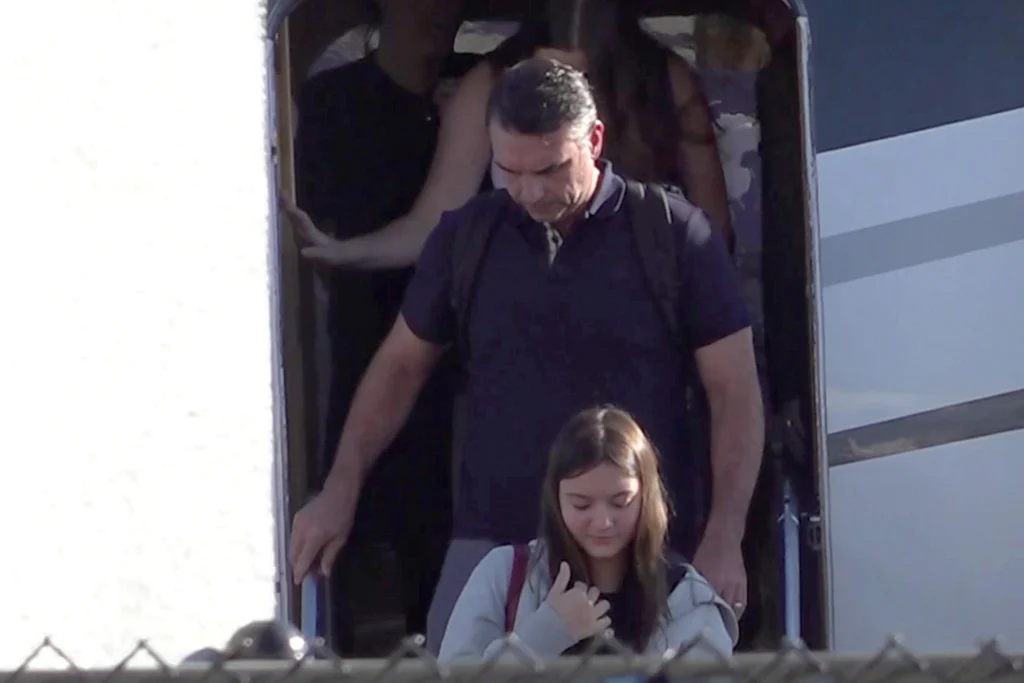
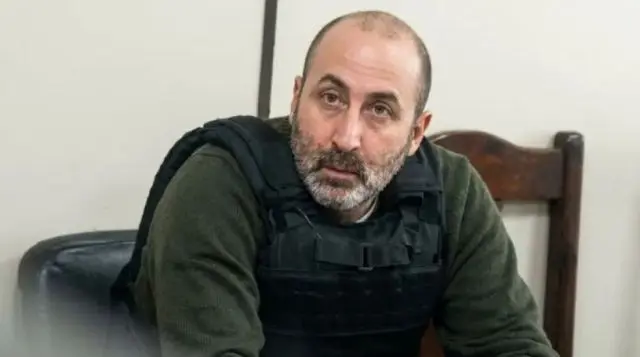
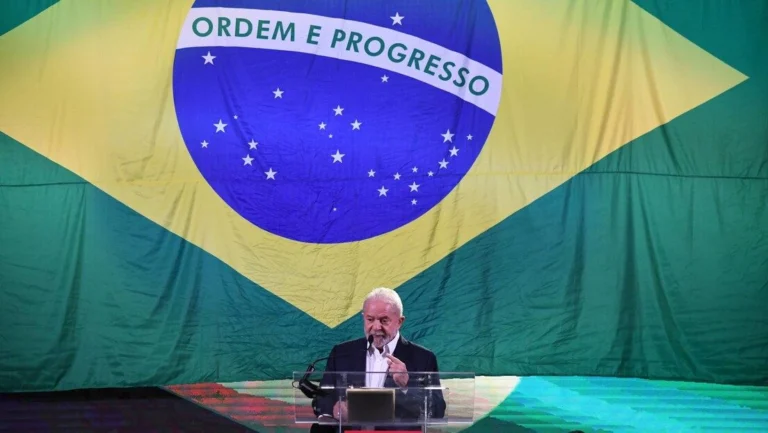
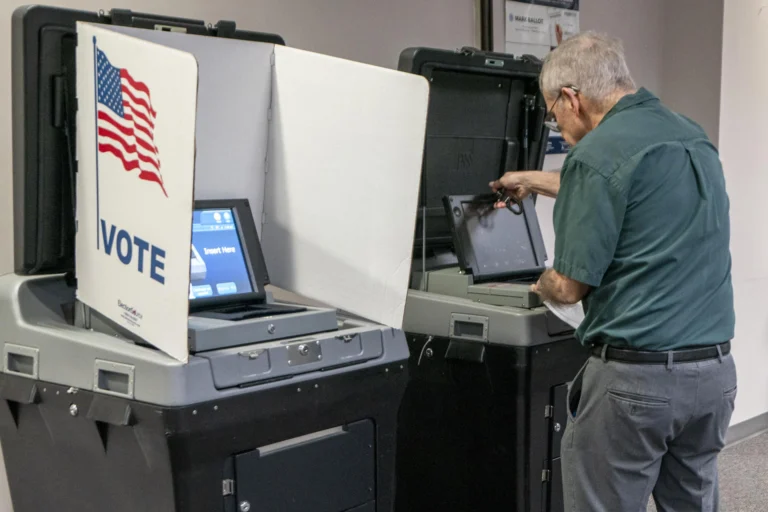
Saca admitted to diverting more than $300 million in public funds during his 2004-2009 presidency.
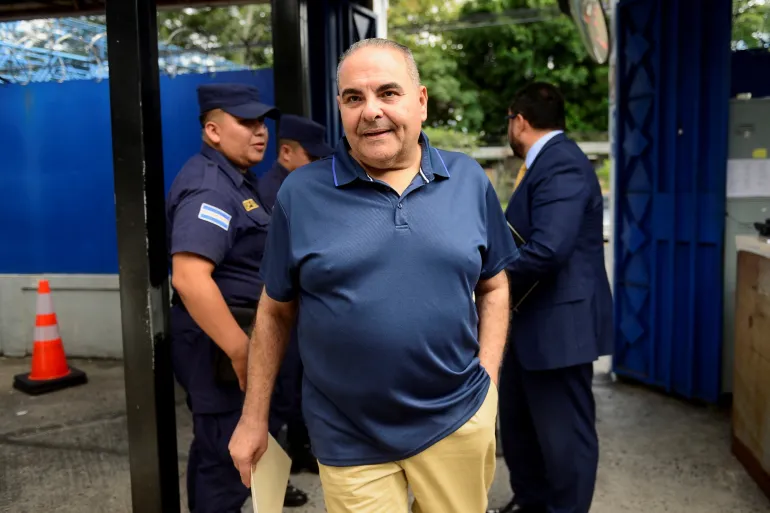
Former Salvadoran President Elias Antonio Saca was released on Thursday after completing a 10-year prison sentence for embezzlement and money laundering involving more than $300 million in public funds.
The 61-year-old former president appeared in court to formally register his release after serving his sentence in full, without early-release benefits, his lawyer, Mario Machado, said.
Saca was sentenced in September 2018 to five years for embezzlement and another five for money laundering. Under a plea agreement, he admitted to diverting and laundering more than $300 million during his 2004-2009 administration, avoiding a potential 30-year prison sentence.
He was arrested in 2016 during his son’s wedding. Prosecutors accused him of siphoning money from the state budget for himself and others, including more than $7 million transferred to his former political party, the Nationalist Republican Alliance (ARENA).
Text Reads: Former El Salvador president Elías Antonio Saca regains his freedom after 10 years in prison! 🌟
During the trial, Saca acknowledged exploiting weaknesses in government oversight to transfer public funds to private accounts. He also disclosed that he had issued regulations allowing him to classify information about financial transactions as state secrets, shielding the transfers from scrutiny.
According to his testimony, the money was transferred over the course of his five-year presidency into 13 private bank accounts belonging to his former private secretary, Elmer Charlaix, and two other presidential staff members.
In 2019, Saca was convicted in a separate bribery case after offering $10,000 to a court employee in exchange for information about proceedings against him. A judge ruled that the additional sentence would be incorporated into his existing 10-year term.
He was also ordered to repay $260 million to the state. In another case involving the diversion of funds from Taiwan, he was sentenced to pay an additional $6 million. It remains unclear whether he has fulfilled that obligation.
Saca, a businessman and radio broadcaster who served as president under ARENA, is one of four former Salvadoran presidents to have faced corruption charges. His successor, Mauricio Funes, fled to Nicaragua in September 2016 and died there in 2025.
More than 2,000 Salvadoran troops have been deployed to Haiti after an ambush left four military personnel missing.
El Salvador has deployed more than 2,000 military personnel to Haiti in a mission to recover four soldiers missing since an ambush near Port-au-Prince, with President Nayib Bukele saying the operation could also be used to dismantle the country’s armed gangs.
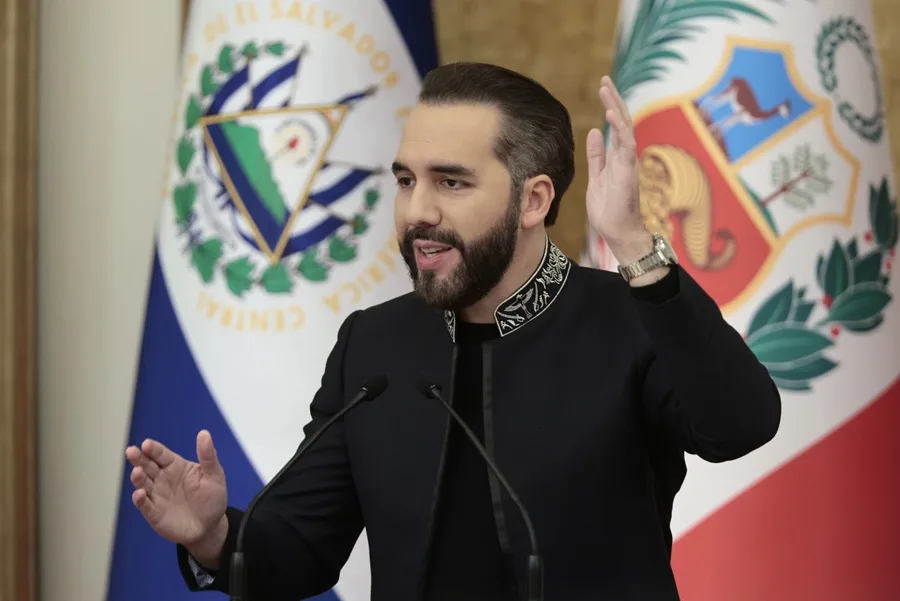
“If we defeated the gangs here in El Salvador, we can defeat them there,” Bukele told reporters Thursday during an official visit by Peruvian President Keiko Fujimori. He said, however, that El Salvador would withdraw the same day if the four missing military aviation technicians were returned alive.
The Salvadoran Foreign Ministry said Wednesday that the deployment involved more than 2,000 members of the country’s armed forces and was part of a large-scale operation backed by several countries and international organizations.
Pèp ayisyen,
Nou prèske fin deplwaye sòlda nou yo ak ekipman nou yo sou tè Ayiti. Sa a se pa yon operasyon kont pèp ayisyen an, ni yon envazyon peyi Ayiti. Nou pa yon gwo pisans. Nou pa gen okenn enterè ni pou nou vin domine pèp ayisyen an, ni pou nou mete men sou richès Ayiti.… pic.twitter.com/AZ1XvdeJje
Text Reads: Haitian people, We have nearly finished deploying our soldiers and equipment on Haitian soil. This is not an operation against the Haitian people, nor an invasion of the country of Haiti. We are not a great power. We have no interest in coming to dominate the Haitian people, nor in laying hands on Haiti’s wealth. We are a modest country that is developing. The only thing we want is for our four aviation technicians to return home. And we’re giving the gangs a lesson—these gangs that make the Haitian people suffer, that kill people the population loves, that prevent them from living a normal, free life, without fear. It’s almost just us footing the bill for this operation. Even though we receive a bit of logistical help from a few other countries, it’s with our own modest funds that we’re covering 90% of the expenses. It costs us dearly, but we’ve learned from our own suffering: justice and peace have no price. We went through the same suffering that Haiti is going through today. We lived through a nightmare that was even more horrific than what the Haitian people are enduring right now. We know what that means: living in fear, not trusting politicians, not believing anyone who promises to help you. Because no one came to help us, and those who did come didn’t have good intentions in their hearts. But we managed to escape it. After 200 years of suffering, finally we’re living in peace, and today we are the safest country on the continent. We didn’t come to Haiti to make money, because no one is paying us to do it. We came to Haiti to fight against the wicked. But here’s what I’m asking of you: trust us, pray to the one true God, and ask Him to heal Haiti. “If at that time my people, who are called by my name, will humble themselves and pray and seek my face and turn from their wicked ways, then I will hear from heaven, where I am, I will forgive their sin, and I will heal their land.” 2 Chronicles 7:14 Help us help Haiti. And when our mission is finished, we’ll return home. Perhaps the next generation of Haitians will remember us as friends who came to help one day.
Bukele rejected suggestions that the deployment amounted to an invasion, insisting that his government had no intention of occupying Haiti or asserting control over its population. In a post on X earlier Thursday, he said the mission had received authorization at both national and international levels and was focused on rescuing the missing personnel alive.
He also vowed to confront the gangs responsible for their abduction, arguing that Salvadoran forces knew how to deal with criminal organizations of this kind. Bukele described the confrontation as a battle between good and evil, saying his government stood on the side of good.
El Salvador had already been participating in the Gang Suppression Force (GSF), but its involvement in Haiti’s security crisis deepened after an ambush on Oct. 18 on the outskirts of Port-au-Prince. The attack targeted a vehicle carrying four Salvadoran military personnel, who have been missing since the incident.
The Salvadoran contingent includes special forces personnel and represents the largest deployment by a single country in Haiti since the United Nations Stabilization Mission in Haiti (MINUSTAH) ended in 2017. The UN mission operated in the country from 2004 to 2017.
Reports circulated last Saturday that human remains potentially belonging to the four missing personnel had been found. Bukele dismissed those reports.
Bukele has maintained that recovering the four personnel alive is the operation’s primary objective and said their return would prompt the immediate withdrawal of Salvadoran forces.
A three-kilometer ash plume prompted evacuations within a six-kilometer radius as officials raised the volcano’s alert level to 3.
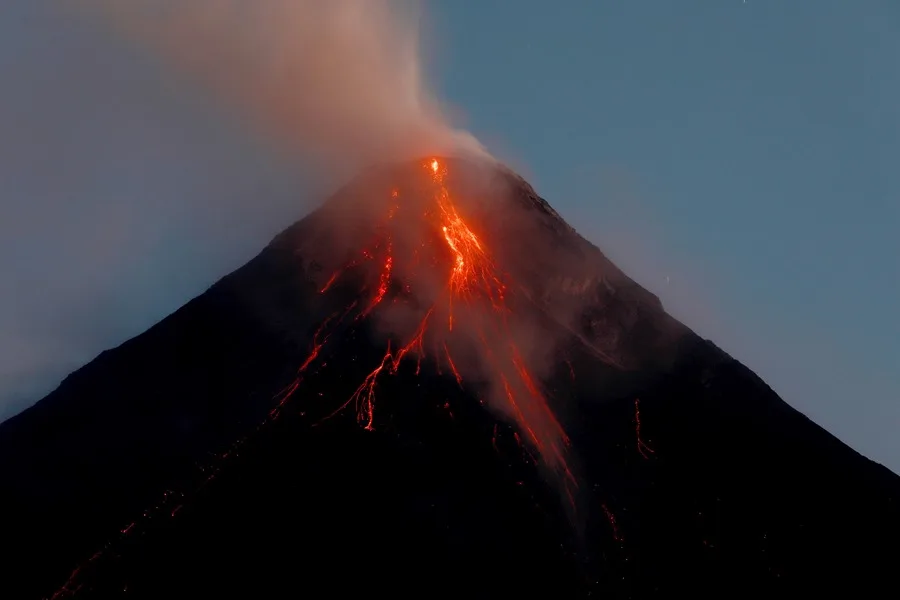
Philippine authorities ordered the evacuation of communities within six kilometers of Mayon volcano on Friday after a moderately explosive eruption sent an ash plume 3,000 meters above its crater, prompting warnings of further volcanic activity and possible lava flows.
The eruption began at 11:53 a.m. local time (03:53 GMT) and lasted nearly six minutes, according to the Philippine Institute of Volcanology and Seismology (Phivolcs). It generated a dense ash cloud that rose rapidly to 3,000 meters above the summit.
Phivolcs raised Mayon’s alert level to 3 on a five-point scale, warning that the volcano had entered a new phase of magmatic eruption and faced an increased risk of a hazardous event. The agency said lava flows could descend the volcano’s slopes in the coming days or weeks.
Following the eruption, the Albay Provincial Disaster Risk Reduction and Management Council ordered local authorities to evacuate residents living within a six-kilometer radius of the crater on Friday afternoon.
The Philippines’ Mayon Volcano has erupted, sending ash plumes 3,000 metres above its summit.
Authorities have raised the alert to Level 3, signalling that the volcano has entered a new phase of eruption. pic.twitter.com/45eGH25Hf0
The directive, signed and shared by the provincial governor, also suspended classes at all educational levels in public and private schools across the affected area until further notice.
Police and military personnel will enforce security measures to prevent access to the danger zone, where all activities have been prohibited.
Authorities also warned residents to remain alert for possible mudflows and avalanches of volcanic material along rivers and streams flowing down the volcano. Phivolcs advised pilots to avoid flying over the summit.
The agency forecast ashfall in Daraga, Camalig and Guinobatan, as well as other communities in Albay province, in the southeastern part of Luzon island.
Mayon is one of the Philippines’ most active volcanoes. The country lies along the Pacific Ring of Fire, a region marked by intense seismic and volcanic activity.
The move comes amid a federal dispute over election oversight and a court ruling blocking efforts to set aside more than 20,000 mail-in ballots.
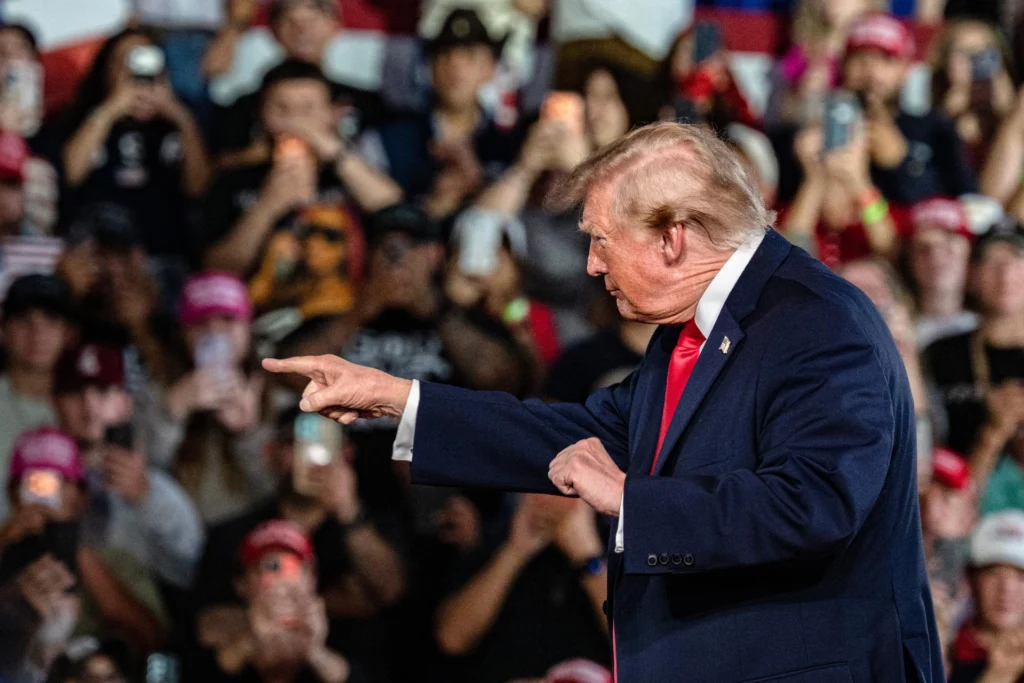
California Gov. Gavin Newsom announced Thursday that he would deploy election lawyers and observers across the state to protect voters’ rights, escalating a confrontation with President Donald Trump’s administration over federal involvement in polling places ahead of the elections.
The legal teams will be sent to key districts with closely contested races, Newsom said, warning against unauthorized interference in the electoral process.
“A warning to Donald Trump: I’m deploying election lawyers to key battleground districts in California to protect every vote. And I just made it a FELONY to illegally seize ballots,” the Democratic governor wrote on social media platform X.
Newsom also approved legislation making the unlawful seizure of election ballots a felony, establishing criminal penalties for unauthorized interference with ballots.
A warning to Donald Trump:
I’m deploying election lawyers to key battleground districts in California to protect every vote.
And I just made it a FELONY to illegally seize ballots.
The measures follow the Trump administration’s announcement that it would deploy federal agents to polling places to prevent potential electoral irregularities. Trump has repeatedly accused California of failing to address alleged voter fraud.
Speaking Wednesday night on Jimmy Kimmel Live, Newsom criticized the administration’s approach, accusing the White House of trying to suppress votes and create grounds to challenge the election results.
He argued that the administration was seeking to create conditions that could later be used to question the outcome and allege fraud.
The dispute has also reached the courts. On Wednesday, a federal judge rejected a Justice Department request to set aside more than 20,000 mail-in ballots cast in California while authorities verified voters’ citizenship.
The judge warned that withholding the ballots would cause widespread disruption and interfere with an electoral process already underway.
California officials had also questioned the reliability of the voter list submitted by the federal government and rejected its request to verify voters’ citizenship before ballots were counted.
The Justice Department confirmed it would appeal the ruling, setting the stage for further legal disputes between federal and state authorities before the election process concludes.
Unions and left-wing groups plan further demonstrations in November, calling for the release of opposition figure Luisa González.
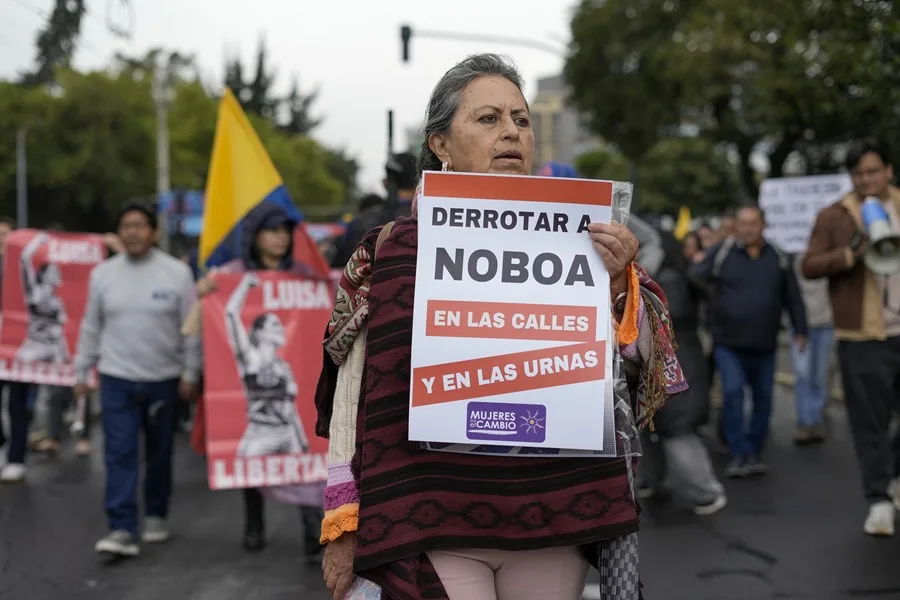
Nearly 100 people marched through Ecuador’s capital, Quito, on Thursday to protest President Daniel Noboa’s government, launching a new wave of demonstrations ahead of local elections scheduled for Nov. 29.
Organized by the country’s main trade unions and left-wing political parties, the peaceful march moved through the historic center before reaching the attorney general’s office. Protesters gathered outside the building carrying banners demanding the release of Luisa González, a former presidential candidate and one of the leading opposition figures.
González, who belongs to the political movement associated with former President Rafael Correa, was placed in pretrial detention in a case involving alleged money laundering. Prosecutors accuse her of involvement in the irregular financing of her first presidential campaign in 2023.
Chanting “Out, Noboa, out,” demonstrators also called for improvements to public education and healthcare. Some participants urged voters to cast null ballots in the upcoming local elections.
Natasha Rojas, a politician and activist, described the mobilization as a defense of democracy, civil liberties and the rights of Ecuadorians. She argued that the government was losing public support and warned that its policies would fuel further protests.
Nelson Erazo, president of the Popular Front, accused state institutions, including the attorney general’s office and the comptroller’s office, of being used to target social activists and political leaders.
He said the demonstration brought together groups seeking political change and demanding that Ecuadorians be able to express themselves freely, with guarantees of access to education, healthcare and employment.
Opposition organizations have announced further demonstrations on Nov. 7 and 15, followed by a march alongside feminist groups on Nov. 25 to mark the International Day for the Elimination of Violence Against Women. Another mobilization is planned for Dec. 10, in coordination with international organizations, to defend human rights.
The destruction of schools, universities and cultural institutions threatens Palestinian education, historical memory and future generations.
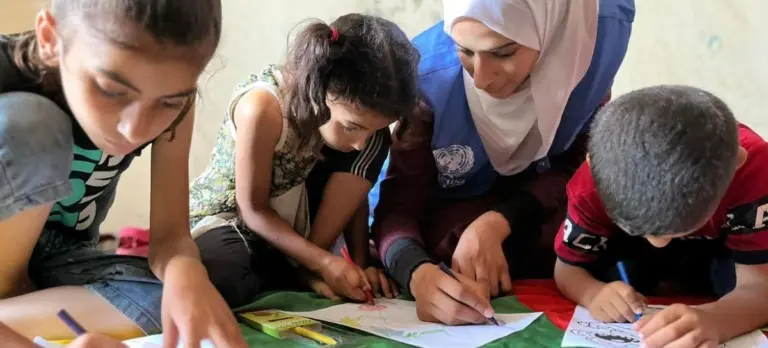
United Nations experts have warned that the systematic destruction of Gaza’s education system and the killing of Palestinian journalists are undermining Palestinian society’s ability to educate future generations, preserve its history and document events in the occupied territories.
Speaking Thursday at a briefing organized by the UN Committee on the Exercise of the Inalienable Rights of the Palestinian People at the organization’s headquarters in New York, the experts condemned the destruction of educational institutions and the growing restrictions on press freedom across the occupied Palestinian territories.
Farida Shaheed, the UN Special Rapporteur on the right to education, described the devastation in Gaza as “scholasticide,” defined as the systematic and deliberate destruction of education. She reported that 98% of schools and all 13 universities in the territory had been destroyed.
The damage extends far beyond educational facilities. According to the experts, 13 libraries, 195 heritage sites, 227 mosques, at least three churches and Gaza’s central archives have also been destroyed. The archives held 150 years of collective memory, representing a significant loss of Palestinian historical records.
Gaza’s children are losing more than classrooms and textbooks. Three years of Israel’s genocide have disrupted their education, killed teachers and classmates, and left many struggling with hunger, trauma and the basic skills they need to learn.https://t.co/Fz7cmDzbzB
The consequences for education are also evident in the occupied West Bank. Shaheed reported that 10 of the 48 schools in East Jerusalem were demolished in September. She also cited 224 security incidents during the first half of the year that affected 152 schools and 20,450 students.
The experts also raised alarm over the killing of Palestinian journalists and media workers, warning that the loss of those documenting events in Gaza has compounded the restrictions on freedom of expression.
Francesca Albanese, the UN Special Rapporteur on the situation of human rights in the Palestinian territories occupied since 1967, recalled that nearly 300 journalists and media workers had been killed in Gaza since October 2023, making the territory an increasingly deadly place for members of the press.
The most immoral army will continue to slaughter innocent people
No matter which fugitive or potential war criminal leads Apartheid Israel.
They will. Until or Unless WE THE PEOLE force it to stop.
— Francesca Albanese, UN Special Rapporteur oPt (@FranceskAlbs) October 29, 2026
Albanese warned that silencing witnesses not only allows crimes to be committed but also conceals them, allowing impunity to become part of the process.
The experts called on the international community to take immediate action by halting arms transfers, protecting journalists and sustaining humanitarian assistance through the UN Relief and Works Agency for Palestine Refugees in the Near East (UNRWA). They also warned that the ceasefire announced the previous year had failed to bring relief, with more than 1,500 Palestinians killed since it took effect.
The Fund outlined four priorities for turning economic stabilisation into stronger growth and job creation as it backed a new $900 million disbursement.
The International Monetary Fund (IMF) on Thursday urged Argentina to maintain its economic programme, warning that sustained policy implementation and stronger international reserves remain essential to reducing country risk as concerns grow over a possible technical recession.
IMF spokeswoman Julie Kozack said the government should continue implementing its current policies while ensuring that the benefits of economic stabilisation translate into stronger growth and employment.
“Our best advice for Argentina to continue reducing its country risk is to continue with its strong policy implementation, that is, to keep implementing the programme as it has been doing,” Kozack told a news conference in Washington.
She stressed that accumulating net international reserves and strengthening the country’s external position were fundamental to reducing financial risks. The Fund’s broader message, she added, was to maintain the current policy direction while extending the benefits of stabilisation across the economy.
🇦🇷💸 | Ante las declaraciones directas del presidente de la nación Argentina, Javier Milei, la escalada de la crisis económica golpea con dureza a la sociedad, donde la mayoría de la población lucha diariamente contra el endeudamiento y la precariedad laboral. La realidad es que… pic.twitter.com/J4RLdc4uvQ
Text Reads: | In light of the direct statements from Javier Milei, president of the Argentine nation, the escalation of the economic crisis is hitting society hard, where the majority of the population struggles daily against debt and job precariousness. The reality is that surveys reveal that nearly 6 out of 10 Argentine citizens have had to go into debt to survive amid the drastic drop in purchasing power. At the same time, the lack of employment and the loss of social rights worsen a landscape that deeply affects the quality of life of families, especially the youth. Popular discontent is growing in the face of official responses that seem to ignore the urgency of the crisis, forcing us to understand “The Other Side of the Coin”.
Addressing questions about the possibility of Argentina recording two consecutive quarters of economic contraction, Kozack outlined four priorities agreed upon with the government to support growth and job creation.
These include deepening capital and mortgage markets to expand access to financing, introducing greater flexibility in the labour market to encourage private-sector employment, advancing infrastructure projects awarded through concession agreements, and facilitating strategic investment through the Incentive Regime for Large Investments (RIGI).
Projects approved under the investment incentive scheme already exceed $76 billion, according to the IMF.
The Fund’s latest assessment comes as its staff and Argentine authorities reached an agreement on Tuesday on the third review of the country’s Extended Fund Facility programme, potentially unlocking a disbursement of approximately $900 million.
Kozack said the IMF Executive Board could consider the review in early December.
The Fund said the programme had continued to deliver results despite a more challenging international environment. Net international reserves exceeded the June target by approximately $4 billion, while the Central Bank purchased nearly $16 billion in foreign currency during the year.
The Treasury also raised more than $5 billion in domestic markets. With support from official creditors, the government secured $3.2 billion in guaranteed financing from international banks and was working to obtain an additional $1 billion before the end of the year.
The agreement maintains Argentina’s target of a primary fiscal surplus equivalent to 1.4% of gross domestic product (GDP) in 2026, with a similar fiscal effort planned for 2027. It also preserves the existing exchange rate band system.
However, the economic outlook remains weaker than previously expected. In October, the IMF lowered its 2026 growth forecast for Argentina from 3.5% to 2.1%, underscoring the challenge of turning stabilisation gains into sustained economic expansion.
Nearly half of confirmed infections have been fatal, while undetected transmission, attacks on health workers and limited treatment options hamper containment.
The Eola outbreak in the Democratic Republic of the Congo has surpassed 10,000 confirmed cases, with nearly half of those infected dying, as health authorities struggle to contain the fastest-growing outbreak on record and prevent further spread across Africa.
The outbreak, declared in May and caused by the rare Bundibugyo virus, has become the deadliest Ebola epidemic in Congo’s history, according to data released Tuesday by the country’s Health Ministry. No approved vaccine or treatment is available for this strain.
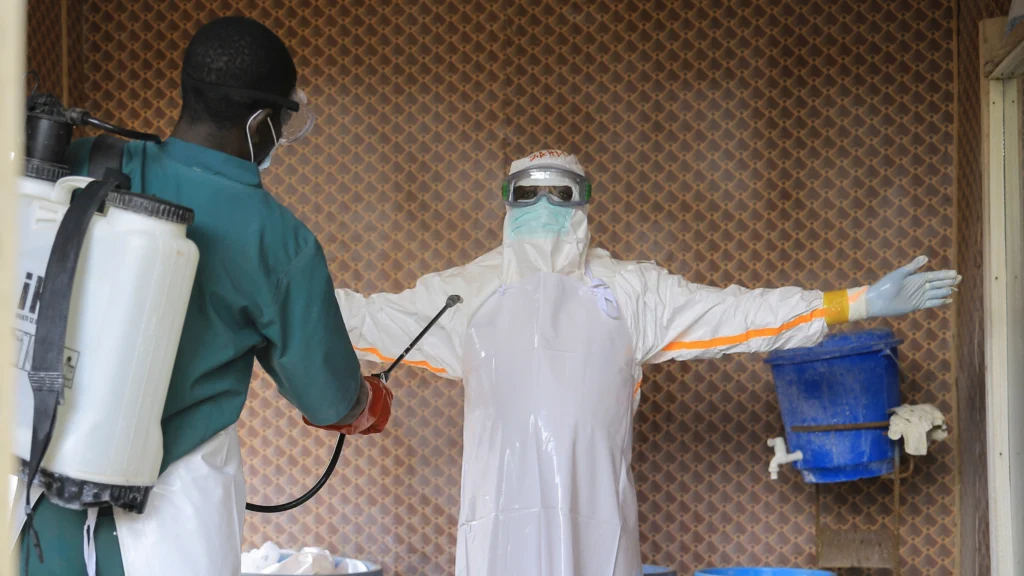
The epidemic has spread to 66 health zones across eight provinces, up from three when the outbreak was first declared. At least 2,600 patients have recovered, but response teams continue to face armed conflict, poor road conditions, community resistance and distrust fueled by misinformation.
Footage shows healthcare workers singing and dancing at an Ebola treatment centre in DR Congo after the last patient made a full recovery and left.
The Doctors Without Borders-run centre in Mongbwalu was where the latest outbreak began. pic.twitter.com/syUqGFQYlP
The outbreak has also spread farther across Africa than any previous Ebola epidemic, reaching three regions of the continent. Cases have been reported in five countries, including Kenya, Nigeria, Uganda and France. Uganda and France currently have no active cases.
Weak disease surveillance has compounded the crisis, with many initial infections confirmed only after patients developed symptoms or traveled elsewhere. The spread of the virus beyond known contacts remains a major obstacle to containment.
About 80% of reported infections in Congo involve people who were not among the contacts being monitored by health authorities, indicating that transmission chains remain undetected. According to the Africa Centres for Disease Control and Prevention, at least 95% of cases would need to be identified among known contacts for the outbreak to be considered largely under control.
At least half of recorded deaths have involved people who were never admitted to treatment centers, highlighting the difficulty of persuading communities to report symptoms and seek medical care.
The response has also been undermined by overcrowded treatment facilities, inadequate transport and repeated strikes by health workers protesting delayed or unpaid wages. In the Nia Nia health zone in Ituri province, some Ebola response personnel, including surveillance and community engagement staff, went on strike last week over unpaid bonuses owed since late August.
Violence against health workers remains another serious concern. On Saturday, a nurse was killed and another health worker seriously injured while responding to an Ebola alert in Bafwasende, in Tshopo province. More than five months after the outbreak was declared, response teams continue to face attacks by angry residents.
In Ituri, the outbreak’s epicenter, burial teams must also persuade families to hand over the bodies of relatives who have died from Ebola so they can be buried safely. Some residents remain skeptical of the disease’s severity despite being directly exposed to the risk.
Sephora Bgosi, a member of an Ebola burial team in Ituri, said some people continued to underestimate the disease even when they faced a direct risk of infection. She stressed that Ebola is highly dangerous and can be fatal.
Ebola Disrupts Essential Health Services
The epidemic is placing additional pressure on Congo’s already underfunded and overstretched health system, disrupting essential services and diverting attention from other outbreaks, including cholera.
Maternal deaths have doubled in some provinces since the outbreak began, as more pregnant women avoid hospitals for fear of infection and isolation. Routine services, including childhood vaccinations, have also been disrupted. Schooling has been interrupted in affected areas, where millions of children are already out of school, while families face trauma, stigma and further economic hardship.
Despite the mounting toll, the outbreak has produced rare moments of relief. A video that went viral this week showed health workers in full protective equipment dancing as the last two patients were discharged from a treatment center in Mongbwalu, in Ituri province.
At least 2,600 people have recovered in Congo, offering some respite to communities affected by the epidemic. World Health Organization Director-General Tedros Adhanom Ghebreyesus responded to the video by acknowledging that the outbreak remained far from over while emphasizing the importance of every recovery.
African health ministers were scheduled to hold a virtual summit on Wednesday to strengthen the continent’s collective response. Jean Kaseya, head of the Africa Centres for Disease Control and Prevention, stressed the need for faster cross-border action, closer coordination, greater solidarity and decisive political leadership as the virus continues to spread.
After losing to Luiz Inácio Lula da Silva by 4.4 million votes, the senator rejects the election result and calls on supporters to mobilize from abroad.
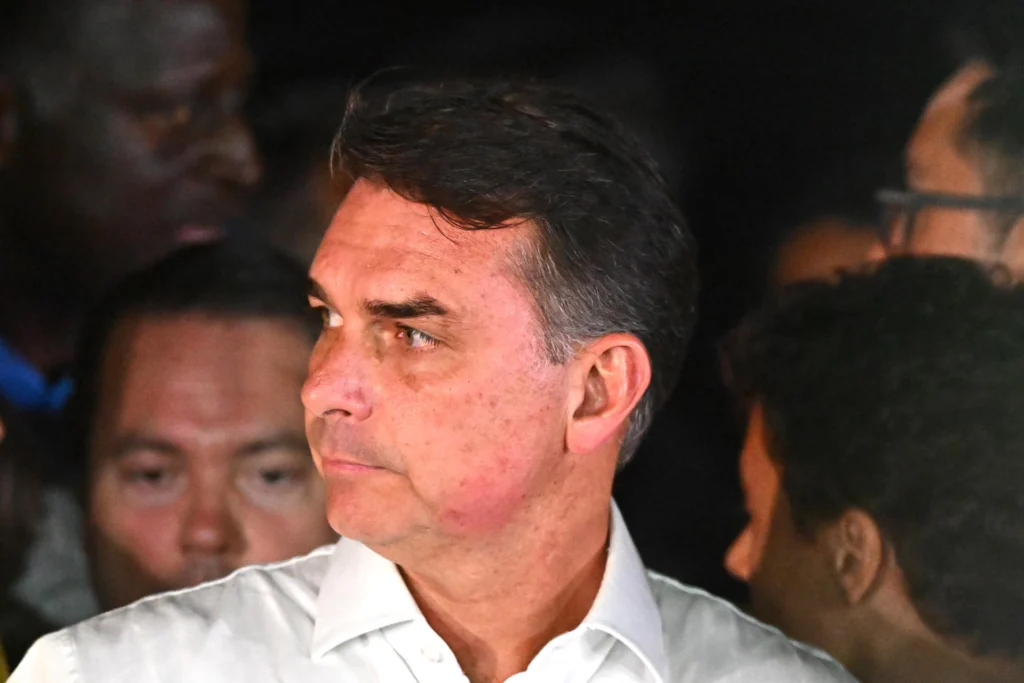
Brazilian senator Flávio Bolsonaro has fled to the United States and declared himself Brazil’s “true elected president” after losing the presidential election to Luiz Inácio Lula da Silva by 4.4 million votes, challenging the official result from abroad.
In a manifesto published after arriving in the United States, Bolsonaro accused Brazil’s government of operating as a “regime” and alleged electoral fraud, citing a judicial decision that extended voting hours from 5 p.m. to 7 p.m. He also urged his supporters to mobilize against the election result.
Official figures show that just 34,300 votes were cast after the usual closing time, too few to alter the overall outcome. Bolsonaro’s own campaign had requested the extension, according to the press release.
His declaration puts him at odds with his own party, the Liberal Party (PL), which formally recognized the election results. The move echoes a strategy previously adopted by Venezuelan opposition figure Juan Guaidó, who declared himself his country’s legitimate leader.
Text Reads: The Argentine government allegedly facilitated Flávio Bolsonaro’s escape to the United States, according to accusations seeking to hold President Javier Milei, Foreign Minister Pablo Quirno, Security Minister Alejandra Monteoliva, and advisor Santiago Caputo criminally liable. ⚖️ The charges allege crimes including concealment, human trafficking, and failure to enforce security controls. Bolsonaro crossed the border using an Italian passport—despite it being suspended—and boarded a private jet to Miami, bypassing Brazilian airspace while under the escort of the Airport Security Police. 🔍 The complaint raises questions about who paid for the flight, estimated at $140,000. Meanwhile, lawmaker Agustín Rossi has called for the questioning of Chief of Cabinet Diego Santilli, warning that the incident compromises Argentine sovereignty and the nation’s relationship with Brazil.
Bolsonaro’s departure for Florida follows a similar move by his father, former President Jair Bolsonaro, who traveled to the state in late 2022 after losing his election.
Other figures aligned with the Bolsonaro family are also in the United States, including his brother Eduardo Bolsonaro, political influencer Paulo Figueiredo and Alexandre Ramagem, the former head of Brazil’s intelligence agency, Abin. They have faced prosecution or investigations over alleged offenses linked to attempts against Brazil’s democratic institutions.
U.S. President Donald Trump confirmed that he had facilitated the entry of Flávio Bolsonaro and his family by arranging visas through the State Department.
The manifesto initially featured the former coat of arms of the “United States of Brazil” before the English-language version was corrected to use “Brazil,” according to the press release.
Bolsonaro is also facing judicial investigations in Brazil over alleged irregular financing and the preventive retention of passports, the press release states.
Lula’s victory breaks a run of nine electoral wins in the region by right-wing candidates promoted or backed by the Trump administration, including Argentina’s 2025 legislative elections.
The blaze was extinguished and no contamination was reported outside the affected facility.
A fire at a U.S. nuclear research facility in South Carolina triggered an emergency response Wednesday, prompting temporary access restrictions and precautionary measures for workers before the emergency was lifted later that evening.
The emergency was declared at 5:39 p.m. local time (2139 GMT) after a fire broke out at the Savannah River National Laboratory, part of the U.S. Department of Energy’s Savannah River Site (SRS).
The fire was later extinguished, and no contamination was reported outside the affected facility, the SRS said in a social media statement.
Authorities temporarily suspended traffic at the site’s entrances and restricted rail, river and air traffic in the surrounding area. Employees not involved in emergency response or shutdown operations were directed to shelter as a precaution.
🔥 US officials end Site Area Emergency following a fire at Savannah River National Laboratory in South Carolina
The emergency was terminated at 9:45 p.m. local time (0145 GMT Thursday), according to a subsequent update.
The Savannah River Site was established in the 1950s to produce tritium and plutonium for U.S. nuclear weapons. It is now used for environmental stewardship and cleanup, nuclear waste management and the disposition of nuclear materials, according to the Department of Energy.
Recordings allegedly linking Argentine political strategist Fernando Cerimedo to President Rodrigo Paz’s inner circle have yet to be authenticated.
Bolivia’s main parliamentary opposition force has called for an immediate prosecutorial investigation into leaked recordings allegedly linking Argentine political strategist Fernando Cerimedo to President Rodrigo Paz’s government, including one purportedly capturing a conversation with First Lady María Elena Urquidi.
Lissa Claros, head of the Libre Alliance caucus in the lower house, called on prosecutors Wednesday to appoint a special team to establish the authenticity of the recordings, which have circulated in recent months, and clarify Cerimedo’s role in the administration.
“The recordings keep emerging every day, yet the Public Prosecutor’s Office has not issued a statement. Do they want the Cerimedo case to go unpunished? Bolivia needs to know what role Mr. Cerimedo played,” Claros said. “Was he the one running the state from the shadows, or not?”
Claros insisted that the investigation must be impartial and that everyone should be subject to scrutiny, including the president’s wife.
El agente argentino de la derecha latinoamericana Fernando Cerimedo era el "presidente en la sombra" de Bolivia: ponía y sacaba ministros a su antojo y todos los directores del Estado le respondían, reveló su exesposa Nadia Beller. 🇧🇴🗣️ #teleSUR#12Octpic.twitter.com/1S11od16En
Text ReadsArgentine agent of the Latin American right Fernando Cerimedo was the “shadow president” of Bolivia: he appointed and removed ministers at will, and all the state directors answered to him, revealed his ex-wife Nadia Beller. 🇧🇴🗣️
One of the recordings purportedly captures a conversation between Cerimedo and Urquidi about government affairs. Its authenticity has not been established through official forensic examinations.
The leaked material has fueled scrutiny of Cerimedo’s reported ties to Paz’s inner circle and his alleged influence within the executive branch. The allegations have also drawn on statements and recordings released by Cerimedo’s former partner, lawyer Nadia Beller, remarks by Vice President Edmand Lara, an opposition figure, and reports in local media.
Cerimedo has been held in pretrial detention in Bolivia since August following a shooting attack by hired gunmen targeting Beller. He faces formal charges of attempted femicide as the alleged intellectual author of the attack, as well as separate proceedings over alleged domestic and family violence against Beller and alleged illicit enrichment.
Cerimedo’s political activities across Latin America have also come under scrutiny. In Brazil, he promoted a false narrative of electoral fraud in 2022. In Argentina, he played a significant role in the digital strategy for Javier Milei’s 2023 presidential campaign.
His company was also linked to disinformation operations during Chile’s constitutional referendum campaign, in which the Rejection bloc opposed the proposed constitution. His reported political connections extend to Argentine politician Patricia Bullrich, Honduran politician Nasry Asfura and other right-wing figures in the region.
In Bolivia, Cerimedo reportedly joined Paz’s political circle as an adviser, a relationship now at the center of questions raised by the leaked recordings.
Libre’s call for a formal investigation comes as the recordings remain unauthenticated, leaving allegations about Cerimedo’s role in the government unresolved.
Arab parties could hold the balance of power as rival blocs fall short of a majority, leaving coalition talks or fresh elections on the table.
Israel faces difficult negotiations to form its next government after parliamentary election results left rival blocs short of a majority, with Arab parties potentially holding the key to breaking the deadlock.
With 88.6% of the vote counted, Prime Minister Benjamin Netanyahu’s bloc held 53 seats in the 120-member Knesset, compared with 48 for the opposition camp led by centrist Gadi Eisenkot. Arab parties won a combined 19 seats, leaving neither side with the 61 needed for an absolute majority.
The Central Elections Committee is expected to publish the final results on Friday, after counting between 430,000 and 480,000 double-envelope ballots cast by military personnel, diplomatic staff, prisoners and people who are ill.
Once the results are official, President Isaac Herzog will ask the candidate he considers best placed to assemble a majority to form a government. The designated candidate will initially have 28 days to build a coalition, with the option of a 14-day extension.
The negotiations could be protracted. Netanyahu took 58 days to form his current cabinet after the November 2022 election, and the latest results leave both camps facing obstacles to securing the support needed to govern.
Eisenkot has a relative advantage in seeking coalition partners, as smaller right-wing parties failed to clear the threshold required to enter parliament, limiting Netanyahu’s options for gaining additional seats.
Arab parties could prove decisive in the negotiations. Raam, led by Mansour Abbas, has signaled its willingness to open talks with Eisenkot’s bloc, while the Joint List has proposed providing a parliamentary “safety net” to any coalition that removes Netanyahu from power.
Opposition leaders have nevertheless been reluctant to enter formal agreements with Arab parties, given hostility toward such arrangements among substantial sections of the electorate. During the campaign, Netanyahu used the prospect of cooperation between his rivals and Arab parties to attack the opposition, describing it as an alliance of the “left and the Muslim Brotherhood” that would undermine state security.
Yair Golan, leader of the Democrats and the only Zionist political figure openly willing to include Arab parties in a governing arrangement, has convened talks with Eisenkot and Yair Lapid to discuss possible alliances.
Avigdor Lieberman, leader of Yisrael Beiteinu, has taken a different approach. He opposes both a minority government dependent on Arab parties and a cabinet headed by Netanyahu, preferring instead a national unity arrangement in which Eisenkot joins the incumbent prime minister.
Eisenkot has advocated a “Zionist mobilization government” as an alternative. In a social media post following the release of the initial projections, he wrote: “There are still long days of work ahead of us, but we are focused on the important task entrusted to us: bringing change to Israel and establishing a Zionist mobilization government.”
National unity or another election
A national unity government bringing together parties with a Zionist profile, while excluding Arab and ultra-religious parties, has been floated as another way out of the deadlock. A poll published in mid-October found that 55% of respondents preferred such an arrangement to holding another election.
The proposal faces significant political resistance. In 2020, Netanyahu and centrist Benny Gantz agreed to rotate the premiership under a power-sharing deal that collapsed after a year. Local media have reported behind-the-scenes efforts by Herzog to bring Netanyahu and Eisenkot closer, but the opposition has framed the election as a referendum on Netanyahu’s leadership.
If coalition talks fail, Israel could be forced to hold another election, repeating a cycle of political instability that saw four national votes between April 2019 and March 2021.
Alternative arrangements, including a minority government supported by individual lawmakers, could avert an immediate return to the polls. Until a new administration is formed, Netanyahu will remain in office in a caretaker capacity.
Lula plans to expand technical education and use renewable energy to attract data centers and keep information stored in Brazil.
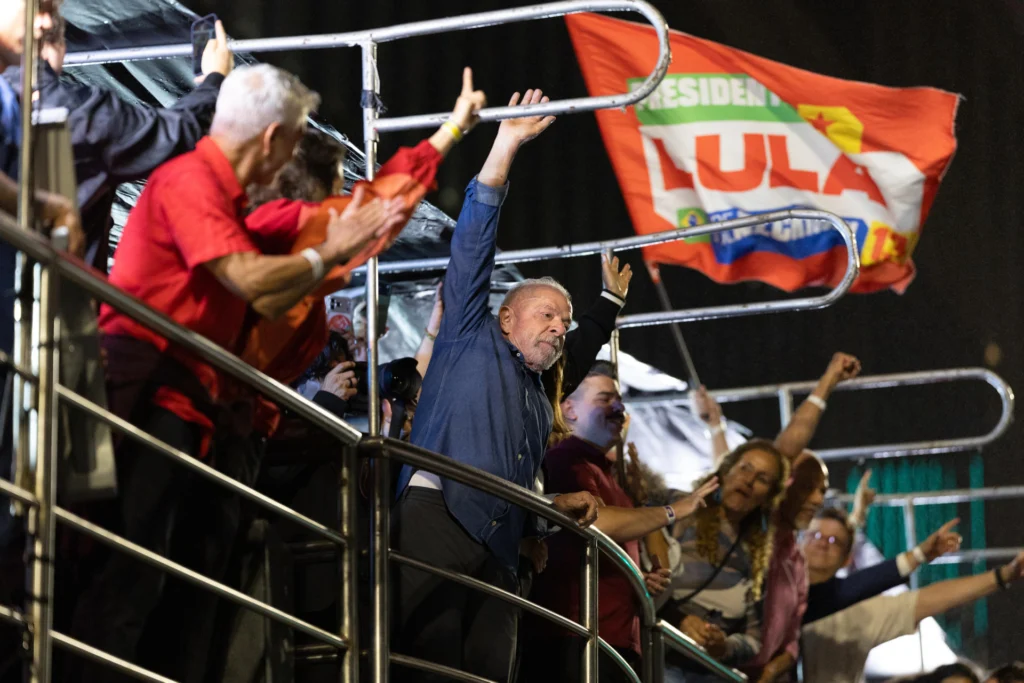
Brazilian President-elect Luiz Inácio Lula da Silva has pledged to develop a domestic artificial intelligence system, expand technical education and attract data centers powered by renewable energy, aiming to strengthen Brazil’s technological independence and accelerate its transition to a developed economy.
Speaking after his victory in the presidential runoff, Lula said Brazil must invest in mathematics and engineering to build its own artificial intelligence capabilities rather than depend on technology developed in China or the United States.
“We will teach more mathematics, more engineering, because I don’t want to depend on Chinese or American artificial intelligence; I want to create a Brazilian one,” he said.
Lula also pledged to use Brazil’s renewable energy resources to attract data centers and keep information stored within the country. The proposal forms part of a broader push to expand the digital economy and strengthen domestic technological capacity.
Text Reads: The Brazil we wish to build is a country where our elderly are cared for with dignity, women are respected, and everyone has the right to live out their faith in freedom. It is a country that respects differences, with a State that guarantees rights for all—because to govern means to look after 215 million Brazilians, without distinction. Respect must be the starting point for us to build, together, a Brazil that is increasingly fair and humane.
“We want to transform this country from a developing country into a developed one,” he said, identifying the digital, green and creative economies as key areas for investment.
He also outlined an ambition for Brazil to play a central role in political and economic decision-making and in efforts to promote peace.
Lula promised that his next term would deliver unprecedented results, telling supporters: “I want to make a commitment: I will deliver the best term of office any president has ever had in Brazil’s history. You can be sure of that.”
The president-elect, who turns 81 on Oct. 27, dismissed concerns about his age as he prepares to take office for another term. He pledged to devote himself fully to the country’s development and to improving the daily lives of Brazilians.
“I will dedicate 20 or 24 hours a day to making this the country everyone dreams of, where people can go to sleep and wake up in complete peace of mind,” he said.
Lula also thanked voters for their support in the runoff and praised young people who took to the streets to defend democracy, crediting their participation as a key factor in his victory.
His pledges place artificial intelligence, renewable energy and digital infrastructure among the priorities he has outlined for Brazil’s next phase of development, alongside his ambition to transform the country into a developed nation.
A low turnout and security concerns shaped the first round, setting up a close contest between Iotova and pro-Western rival Andrey Gyurov.
Outgoing Bulgarian President Iliana Iotova led the first round of presidential elections on Sunday with between 35% and 36.5% of the vote, according to exit polls, but fell short of the result expected by her supporters. She will face former caretaker prime minister Andrey Gyurov, backed by the pro-Western opposition, in a runoff scheduled for Nov. 1.
Gyurov secured between 32.2% and 32.5% of the vote, according to the same exit polls, putting him within reach of Iotova ahead of the second round.
The election took place amid security concerns following a series of drone attacks on merchant vessels in the Black Sea. Voter turnout stood at around 20%, as some political parties called for a boycott.
Iotova, 62, has campaigned on dialogue with Russia and opposed military assistance to Ukraine. She has made ending the war in Ukraine a central theme of her campaign, presenting herself as a “president of peace.”
#Bulgaria’s presidential vote delivered a result few polls anticipated. Exit polls gave incumbent Iliana Iotova, who favors dialogue with Moscow and opposes military aid to Ukraine, up to 36.5 percent, a far narrower lead than surveys had suggested.https://t.co/rqlYf7ehlZ
After casting her ballot, she called for a government capable of tackling poverty and regional inequalities. “I believe there must be peace, stability and security,” Iotova said.
Gyurov, meanwhile, called for a Bulgaria oriented toward Europe and the future, emphasizing economic security and effective governance.
He said he had voted for “a European, free and proud country, where incomes are sufficient, where we feel secure about tomorrow and where the state functions as it should.”
Iotova assumed the presidency earlier this year after Rumen Radev resigned to contest parliamentary elections, seeking to become prime minister. Bulgaria is a member of both the European Union and NATO.
If Iotova wins the Nov. 1 runoff, she would become the first woman elected president of Bulgaria, a country of 6.4 million people with the lowest per capita gross domestic product in the European Union.
Mail-in ballots account for more than half of votes cast so far, as early turnout builds across the United States ahead of Election Day.
More than 26.6 million U.S. citizens have already voted in the midterm elections, according to data released October 24 by the University of Florida’s Election Lab, with mail-in ballots accounting for 14 million of the votes recorded nationwide.
The latest figures show that 26,608,029 votes had been cast ahead of Election Day, including 14,006,420 ballots returned by mail and 12,601,609 votes cast in person. Election authorities have also received requests for more than 59.4 million mail-in ballots nationwide.
Early voting has increased in states including North Carolina, Kansas, Maine and Iowa, while Texas has seen a rise in mobilization among Latino voters, according to the report. The figures come amid concerns over economic conditions and the cost of living.
California has recorded 2,943,863 early votes, overwhelmingly through mail-in voting. Of those, 2,936,954 were returned by mail and 6,909 were cast in person. Voters in the state have requested more than 23.4 million mail-in ballots.
🚨 Estados Unidos se aproxima a unas elecciones legislativas decisivas, con la popularidad de Donald Trump en retroceso y creciente malestar por la economía. Los comicios del 3 de noviembre de 2026 definirán la composición del Congreso.
Text Reads: 🚨 The United States is approaching pivotal legislative elections, with Donald Trump’s popularity on the decline and growing discontent over the economy. The November 3, 2026, elections will determine the composition of Congress. 🗳️🇺🇸 What do you think?
Democrats account for the largest share of California’s early votes, with 1,383,916 ballots, or 50.2% of the total. Republicans have cast 799,054 votes, representing 29%, while voters registered without a party preference and those affiliated with minor parties account for 575,130 votes, or 20.9%.
Los Angeles County leads California in early voting, with 539,589 ballots processed. San Diego County follows with 356,667 votes, ahead of Orange County, where 279,953 ballots have been returned.
The elections will determine all 435 seats in the House of Representatives, 35 Senate seats and 36 governorships.
The run-up to Election Day has also been marked by a legal dispute over the certification of results in Alaska. A federal court challenge backed by former President Donald Trump seeks to block the potential certification of the state’s election results, raising questions about the electoral process as voting approaches its conclusion.
A student movement that emerged after a deadly railway disaster has turned nearly two years of protests into an electoral victory.
Serbia’s student-led opposition has secured a decisive parliamentary victory over Aleksandar Vučić’s ruling party, according to preliminary results, ending 14 years of political dominance by the Serbian Progressive Party (SNS) and opening a new chapter in the country’s politics.
Vučić acknowledged the defeat on Sunday, saying initial projections indicated that the Student List would win between 135 and 140 seats, compared with about 105 for his party. The result follows nearly two years of student-led demonstrations against corruption and what protesters describe as growing authoritarianism.
The Centre for Free Elections and Democracy (CeSID), a non-governmental organization, projected that the Student List would win 139 seats after 56% of ballots had been counted, against 104 for the SNS. Unofficial estimates from polling institute Ipsos put the student movement at 140 seats and Vučić’s party at 103, down 26 seats from the 2023 parliamentary election, when it secured an absolute majority.
The setback was compounded by the failure of the Socialist Party, a longtime ally of Vučić, to clear the 3% threshold for parliamentary representation. The party previously held 18 seats. Preliminary estimates also gave three seats to Serbia’s Hungarian minority party and two to the Albanian minority list.
Turnout approached 70%, the highest since the breakup of Yugoslavia in 1992 and close to the record set in the 2000 parliamentary election.
The student movement grew out of protests that began in 2024, after 16 people died when a canopy collapsed at a railway station in Novi Sad. The disaster prompted mass demonstrations across Serbia, with protesters demanding accountability over the collapse and the construction work carried out by a Chinese company following a tendering process criticized for its lack of transparency.
Hundreds of thousands of people took to the streets, turning the demonstrations into a broader challenge to corruption and the concentration of political power. The student movement emerged as a nationwide opposition force and sustained pressure on Vučić’s government for nearly two years.
Vučić, who had led the country for 14 years, resigned as head of state in September to run for prime minister.
Celebrations and tensions in Belgrade
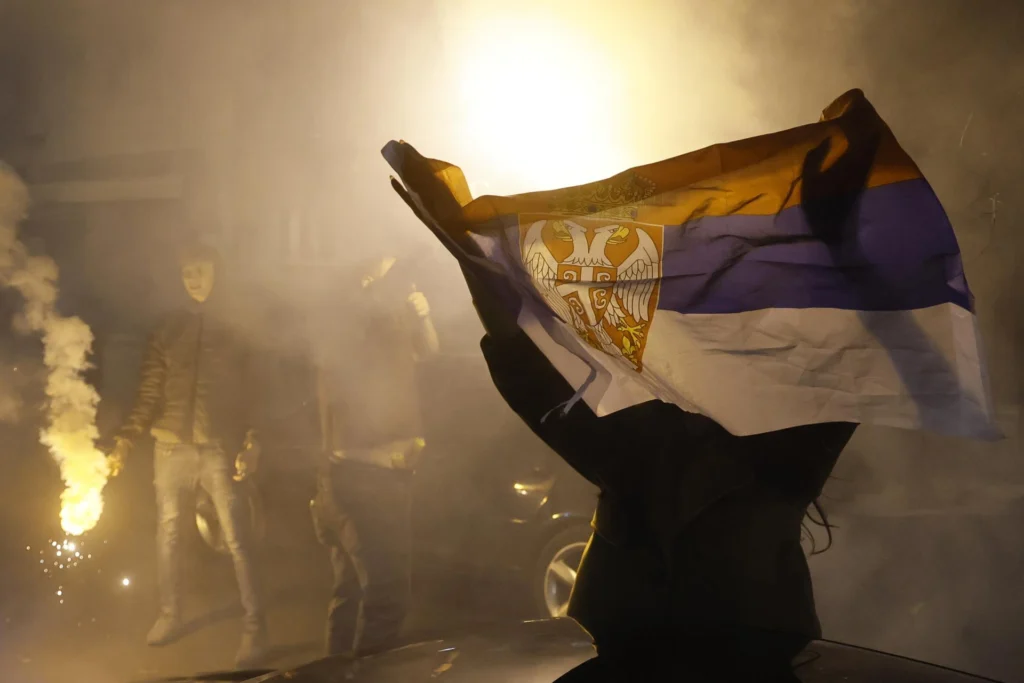
The preliminary results sparked celebrations across Belgrade, where thousands gathered to dance, chant slogans and set off flares and fireworks. Crowds shouted “Victory” and “Vučić is leaving” as people embraced and wept with joy.
Slavija Square, a focal point of the mass protests against the government, filled with supporters of the student movement. At Pioneers Park, between parliament and the presidential palace, hundreds of people tore down the fence surrounding the grounds and entered the public space.
The park had been closed to the public for months and periodically occupied by groups of masked Vučić supporters, who were accused of being used as a force to confront government opponents.
The celebrations underscored the scale of the political shift after more than a decade of SNS rule. Vučić had weathered previous opposition challenges, but the student movement turned sustained street protests into an electoral campaign that defeated his party.
A decentralized political movement
The Student List has presented itself as an alternative to Vučić’s centralized model of leadership. It operates through a horizontal structure and has avoided putting forward a single public face, arguing that political decisions should be made from the bottom up rather than imposed from above.
Its slate of 250 candidates includes university professors, actors and farmers, many of them little known to the wider public.
Radomir Sajcic, a University of Belgrade professor representing the movement, celebrated the result at its headquarters. “Dear Serbia, tonight the voice of the people can be heard,” he declared. “Tonight we celebrate victory; tomorrow we will build the future.”
Sajcic also described the outcome as “a victory of courage over fear, a victory of hope over indifference, a victory of faith that Serbia can and must be different.”
The movement’s platform calls for restoring the separation of powers and the autonomy of the prosecutor general’s office, as well as increasing investment in health care and education. It also pledges to tackle corruption and individual privileges to boost public revenue, while promoting technological modernization across the economy, including agriculture.
Serbia’s score in Transparency International’s corruption index has deteriorated during Vučić’s tenure. The European Union has also raised concerns about the country’s declining adherence to the rule of law.
European support and foreign policy questions
European institutions have welcomed the student movement’s victory, describing it as an opportunity to advance democratic reforms, strengthen the rule of law and combat corruption.
European Commissioner for Enlargement Marta Kos and European Commission President Ursula von der Leyen congratulated the students and offered support for reforms and greater press freedom. Council of Europe Secretary-General Alain Berset highlighted Vučić’s acceptance of the results and his commitment to a peaceful democratic transition.
Today, the people of Serbia turned out in record numbers to shape their country’s future.
Congratulations to the Student List on its victory in the parliamentary elections.
We stand ready to support reforms on the rule of law, media freedom, the fight against corruption and…
Montenegrin Prime Minister Milojko Spajić and Hungarian Prime Minister Péter Magyar also congratulated the winners and expressed their willingness to cooperate with them.
The election could also affect Serbia’s relations with the European Union and Russia. Under Vučić, the country has pursued EU membership while maintaining close ties with the Kremlin. Serbia has been an official candidate for EU accession since 2012.
Before the vote, EU foreign policy spokesperson Christian Wigand said the bloc would monitor the election closely and stressed the need for a free, fair and transparent process.
The Student List has offered fewer details about its international priorities than about its domestic reform agenda. Available indications suggest it may maintain Serbia’s EU candidacy while continuing to oppose sanctions against Russia, although the movement has yet to clearly outline its foreign policy plans.
The student movement’s victory marks a major political turning point for Serbia after 14 years of Vučić’s dominance. Its ability to convert demands for accountability and institutional reform into a parliamentary majority has reshaped the country’s political landscape, but the incoming government’s approach to domestic reform and foreign relations remains uncertain.
Housing activists seek a strike coordinated with Spain as protests against proposed rental law changes spread across Portugal.
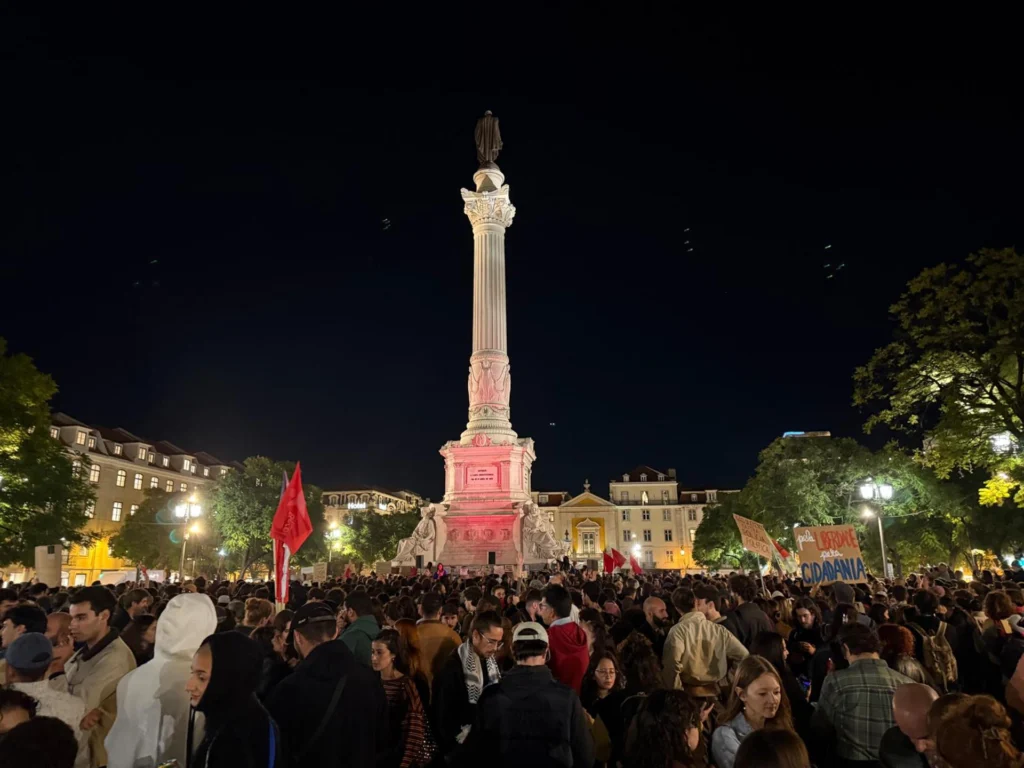
Housing rights groups in Portugal are pushing for a nationwide general strike coordinated with Spain as protests against proposed rental law changes intensify, with a police crackdown on a protest encampment resulting in more than 30 arrests, according to organizers.
Reports on the number of arrests vary. Official accounts put the figure between 11 and 31, while organizers say more than 30 people were detained. The police operation against members of the encampment drew criticism from several sectors.
Housing rights organizations mobilized in Lisbon and Porto on Sunday to build support for a general strike. The proposal has also been discussed at public assemblies and demonstrations held daily across Portugal for more than a week.
“There are thousands of people mobilized, and I think that makes calling a general strike in Portugal increasingly necessary,” João Veloso, a spokesperson for the Lisbon Encampment, told the press. He expressed confidence that the growing demonstrations could pressure the government to withdraw its proposed rental law reforms.
The initiative is being discussed alongside a general strike announced in Spain for Wednesday, Nov. 11. Trade unions and social organizations in Spain are calling for measures to address the housing crisis and improve working conditions.
Protests spread beyond major cities
Demonstrations have extended beyond Lisbon and Porto to Coimbra and Faro. At nightly public assemblies, participants have discussed whether to set up tents again or spend nights in sleeping bags to sustain the protests.
The unrest stems from the conservative government’s proposed changes to rental laws. The legislation would accelerate eviction proceedings, eliminate the minimum three-year term for certain automatic lease renewals, allow landlords to demand up to three months’ rent in advance instead of the current two-month limit, and remove the cap of two months’ rent on security deposits.
A former Chihuahua prosecutor faces federal charges over a drug-lab operation involving US intelligence agents, escalating a dispute over Mexico’s national sovereignty.
A Mexican federal judge has ordered the pretrial detention of former Chihuahua attorney general César Jáuregui Moreno on charges of treason, ruling that evidence supports allegations that he compromised national sovereignty by allowing US intelligence agents to take part in a drug-lab operation without federal authorization.
Judge Ricardo Alfonso Santos Dorantes issued the order early Sunday after finding sufficient grounds to bring Jáuregui Moreno to trial. The former prosecutor will remain in a maximum-security prison in the State of Mexico while the case proceeds.
The charges stem from a mid-April operation to dismantle a drug laboratory in the Sierra del Pinal, in the northern border state of Chihuahua. According to Mexico’s Attorney General’s Office (FGR), agents from the US Central Intelligence Agency (CIA) participated without the required notification to the Foreign Affairs Ministry or the necessary legal authorizations.
Prosecutors argue that Jáuregui Moreno’s failure to act enabled armed foreign personnel to operate on Mexican territory in activities reserved exclusively for the federal government, putting national security at risk.
Luego de aportar más de 150 datos de prueba, la #FGR obtuvo auto de vinculación a proceso en contra de César “N”, ex fiscal general del estado de Chihuahua, por su posible participación en el delito de traición a la patria. pic.twitter.com/sbhM0vY6cG
Text Reads: After providing more than 150 pieces of evidence, the #FGR obtained an order of linkage to trial against César “N”, former Attorney General of the state of Chihuahua, for his possible involvement in the crime of treason against the homeland.
The FGR presented more than 150 pieces of evidence at the hearing. Prosecutors also cited public statements in which Jáuregui Moreno said the operation had been planned for months by Chihuahua’s State Investigation Agency and its Special Strategic Operations Prosecutor’s Office. They argued that the account pointed to information being withheld from federal authorities and shared with foreign personnel.
The defense presented documents and witness testimony to challenge the federal allegations. However, Judge Santos Dorantes upheld the charges and set a two-month deadline for investigators to complete the supplementary investigation.
Jáuregui Moreno was initially arrested in Chihuahua city on Saturday under a state-level warrant accusing him of illegally exercising public office and collusion. A local judge ordered him to stand trial on the public-office charge but did not impose pretrial detention, leaving open the possibility of his release.
On October 18, agents from the federal Criminal Investigation Agency arrested him under a separate warrant as he was leaving detention. He was transferred to Mexico City and taken to El Altiplano, a maximum-security prison in the State of Mexico. The hearing on the federal treason charge began on Saturday afternoon and was held behind closed doors.
The case has fueled tensions between state and federal authorities and sparked a wider political dispute over the Chihuahua operation. The controversy has also drawn attention to a private meeting on September 19 in Ciudad Juárez between Chihuahua Governor Maru Campos and President Claudia Sheinbaum.
Campos later disclosed details of the encounter, which involved heated exchanges over the case. She said she went public to counter rumors that she had reached a political pact or a behind-the-scenes agreement with the federal government.
Jorge Romero Herrera, national leader of the opposition National Action Party (PAN), defended Campos’s decision to disclose details of the meeting.
“She is an adult woman; she makes her own decisions,” Romero Herrera said. He also reaffirmed his party’s support for Campos and other PAN officials, including governors and mayors.
Venezuela and Cuba pledged continued cooperation with Brazil after Luiz Inácio Lula da Silva defeated Flávio Bolsonaro in the presidential runoff.
Venezuela and Cuba congratulated Brazilian President Luiz Inácio Lula da Silva on his election victory, reaffirming their commitment to regional cooperation after he defeated Liberal Party candidate Flávio Bolsonaro in the presidential runoff.
Venezuela’s government praised Brazilian voters for their participation in Sunday’s election, calling it a strong demonstration of civic engagement and democracy.
“The people of Brazil have given a resounding demonstration of civic and democratic participation,” Venezuelan Foreign Minister Félix Plasencia González said in a statement posted on social media.
Text Reads: The Bolivarian Republic of Venezuela congratulates the massive and civic participation of the pueblo of the Federative Republic of Brazil in the second electoral victory celebrated today that leads to the victory of President Luiz Inácio Lula da Silva.
Caracas also reaffirmed its commitment to maintaining longstanding ties with Brazil, citing peace, respect for national sovereignty, self-determination and solidarity among Latin American and Caribbean nations.
Lula secured more than 64 million votes, representing 51.77% of valid ballots, defeating Bolsonaro, a senator and candidate for the Liberal Party (PL).
Cuban President Miguel Díaz-Canel described the result as a historic victory that would help preserve the pursuit of social justice. He also pledged Cuba’s support for greater regional unity and integration.
“Brazil can count on Cuba as we build unity and integration across our great Latin American and Caribbean homeland,” Díaz-Canel said.
Estimado hermano @LulaOficial, te felicito en nombre del gobierno y pueblo cubanos por esta victoria histórica que garantiza la continuidad del camino de paz, soberanía y justicia social emprendido por el pueblo brasileño bajo tu liderazgo.
Text Reads: Dear brother @LulaOficial, on behalf of the Cuban government and people, I congratulate you for this historic victory that ensures the continuity of the path of peace, sovereignty, and social justice embarked upon by the Brazilian people under your leadership.
Former Argentine President Cristina Fernández de Kirchner also congratulated Lula, first praising Brazilian voters for their mobilization and then highlighting the president’s ability to rally support.
“Congratulations first to the Brazilian people, who today took part in an authentic electoral October 17, and then to you, comrade President Lula, who, in your seventh presidential election, knew how to awaken among your fellow citizens the feelings and sense of purpose needed to win this battle,” she wrote.
Former Bolivian President Evo Morales welcomed the outcome as a source of renewed hope for people across the continent fighting for social justice, dignity and sovereignty.
Addressing Lula as a close ally and fellow campaigner, Morales called the result a “beautiful and heroic victory.” The messages from Venezuela, Cuba, Argentina and Bolivia reflected the regional significance these leaders attached to Lula’s election win.
Brazil’s far-right candidate challenges the election result after voting hours were extended over public transport disruptions.
Brazilian far-right presidential candidate Flávio Bolsonaro has rejected President Luiz Inácio Lula da Silva’s reelection and vowed to seek the annulment of the vote, citing a Supreme Federal Court decision to extend voting hours amid allegations of disruptions to public transport.
The Superior Electoral Court (TSE) confirmed Lula’s reelection on Sunday. Bolsonaro, however, declared the result unacceptable and announced plans to challenge it in court.
“It is impossible to recognize the election results,” Bolsonaro said. “We will turn to our legal team and request that these elections be annulled.”
Bolsonaro based his challenge on a ruling by Supreme Federal Court Justice Cristiano Zanin, who extended voting by two hours after the Workers’ Party (PT) reported alleged irregularities affecting voter transportation in several cities.
The ruling came shortly before polls were due to close at 5 p.m. Zanin ordered polling stations nationwide to remain open until 7 p.m. Brasília time, citing the seriousness of the allegations and the urgency of the measure.
The PT accused mayors opposed to Lula of failing to comply with electoral court orders requiring municipalities to provide free public transport at full capacity on election day, as they would on a regular working day. The party also called for those responsible for the alleged violations to be caught in the act.
In Salvador, electoral authorities ordered the arrest of Pablo Souza, the city’s mobility secretary, over suspicions that he had withdrawn buses to disadvantage Lula. The northeastern city is governed by União Brasil, a center-right party allied with Bolsonaro. In the first round of the presidential election, Lula received 65% of the vote in Salvador, compared with 27% for Bolsonaro.
Brazilian trade union federations also denounced transport disruptions in several cities on election night and called for immediate action by the authorities.
In a statement, the unions condemned what they described as the deliberate obstruction of eligible voters’ right to participate in the election. They alleged that some cities had reduced their bus fleets despite a Supreme Federal Court order requiring public transport to operate at full capacity on election day.
The disruptions left thousands of people waiting at bus stops, uncertain whether they would reach polling stations in time. In some cases, the unions said, voters were unable to cast their ballots.
Bolsonaro’s campaign also sought an extension of voting hours, according to local media reports. His team requested additional time in cities across São Paulo, Paraná and Santa Catarina states, citing difficulties caused by heavy rainfall.
The dispute recalls the aftermath of the October 2022 presidential election, when Lula defeated Flávio Bolsonaro’s father, Jair Bolsonaro. The former president repeatedly challenged the result and conspired to overturn it.
On Jan. 8, 2023, thousands of his radicalized supporters stormed the Congress, presidential palace and Supreme Federal Court buildings in Brasília. Jair Bolsonaro was subsequently tried and is now serving a 27-year prison sentence for conspiring against Brazil’s democratic order and attempting a coup.

 Login