❌

Reading view

Military Situation In Ukraine And Ukrainian Attacks On Russian Territory On October 20, 2026 (Maps Update)

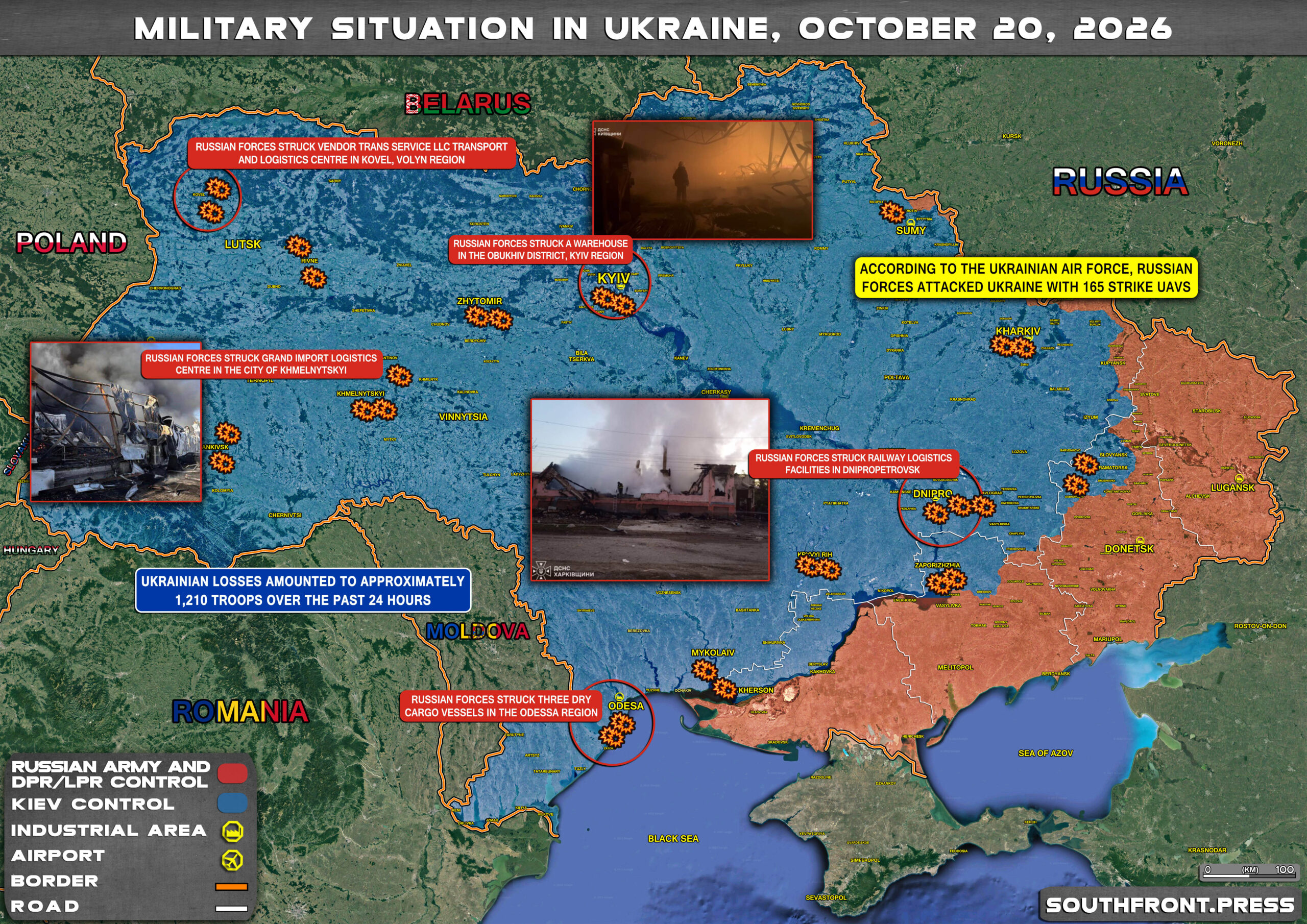
Click to see the full-size image

  • Russian strikes destroyed targets in the Rivne, Dnipropetrovsk, Kharkiv, Khmelnytskyi, Zaporizhzhia, Ivano-Frankivsk, Mykolaiv, Volyn, Kyiv, Chernihiv, Lviv, Sumy, Odesa, Zhytomyr regions, and the DPR;
  • According to the Ukrainian Air Force, Russian forces attacked Ukraine with 165 strike UAVs;
  • Russian forces struck Grand Import logistics centre in the city of Khmelnytskyi;
  • Russian forces struck Vendor Trans Service LLC transport and logistics centre in Kovel, Volyn region;
  • Russian forces struck three dry cargo vessels in the Odessa region;
  • Russian forces struck a warehouse in the Obukhiv district, Kyiv region;
  • Russian forces struck railway logistics facilities in Dnipropetrovsk;
  • Ukrainian losses amounted to approximately 1,210 troops over the past 24 hours.

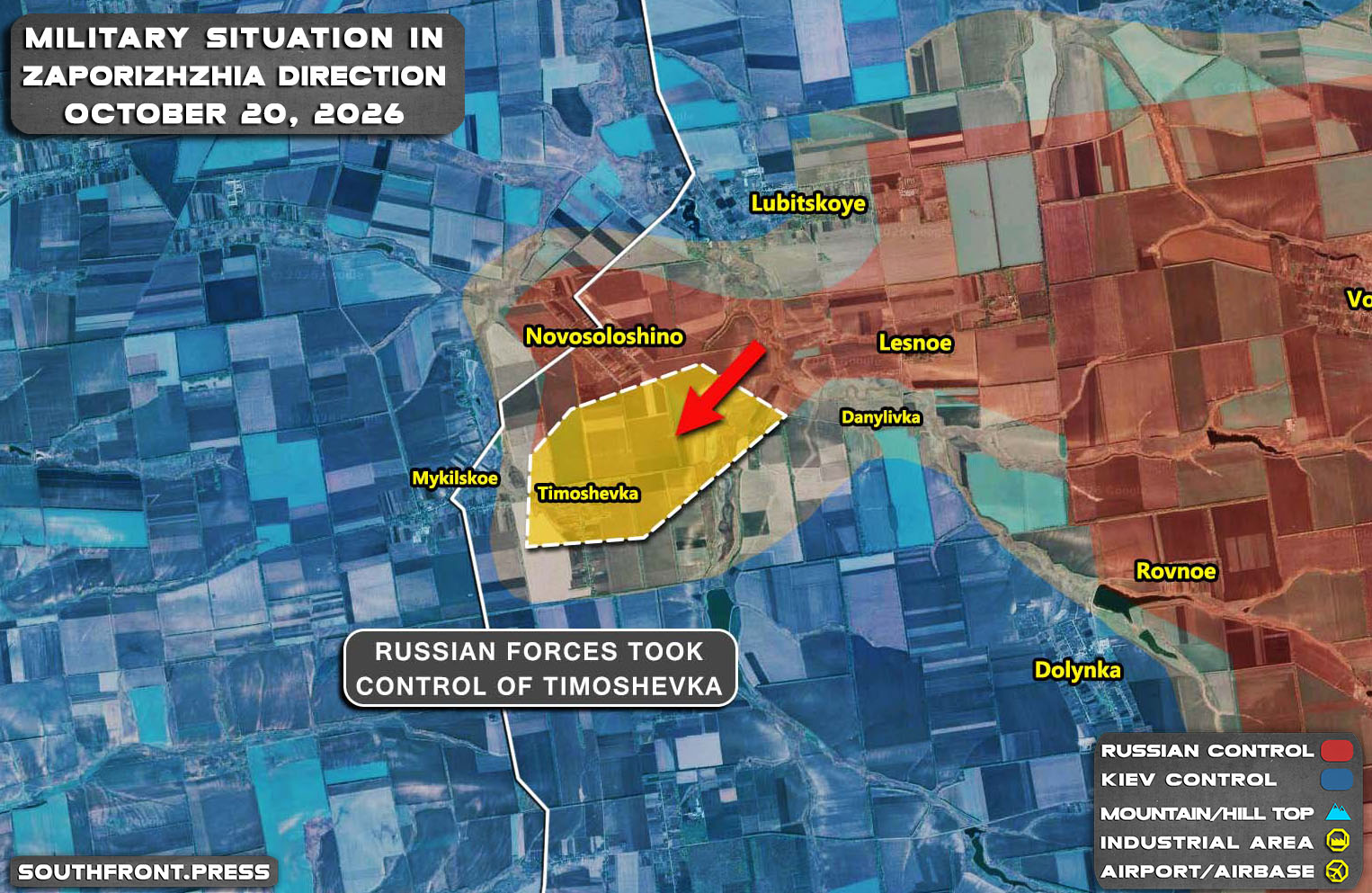
Click to see the full-size image

  • Russian forces took control of Timoshevka.

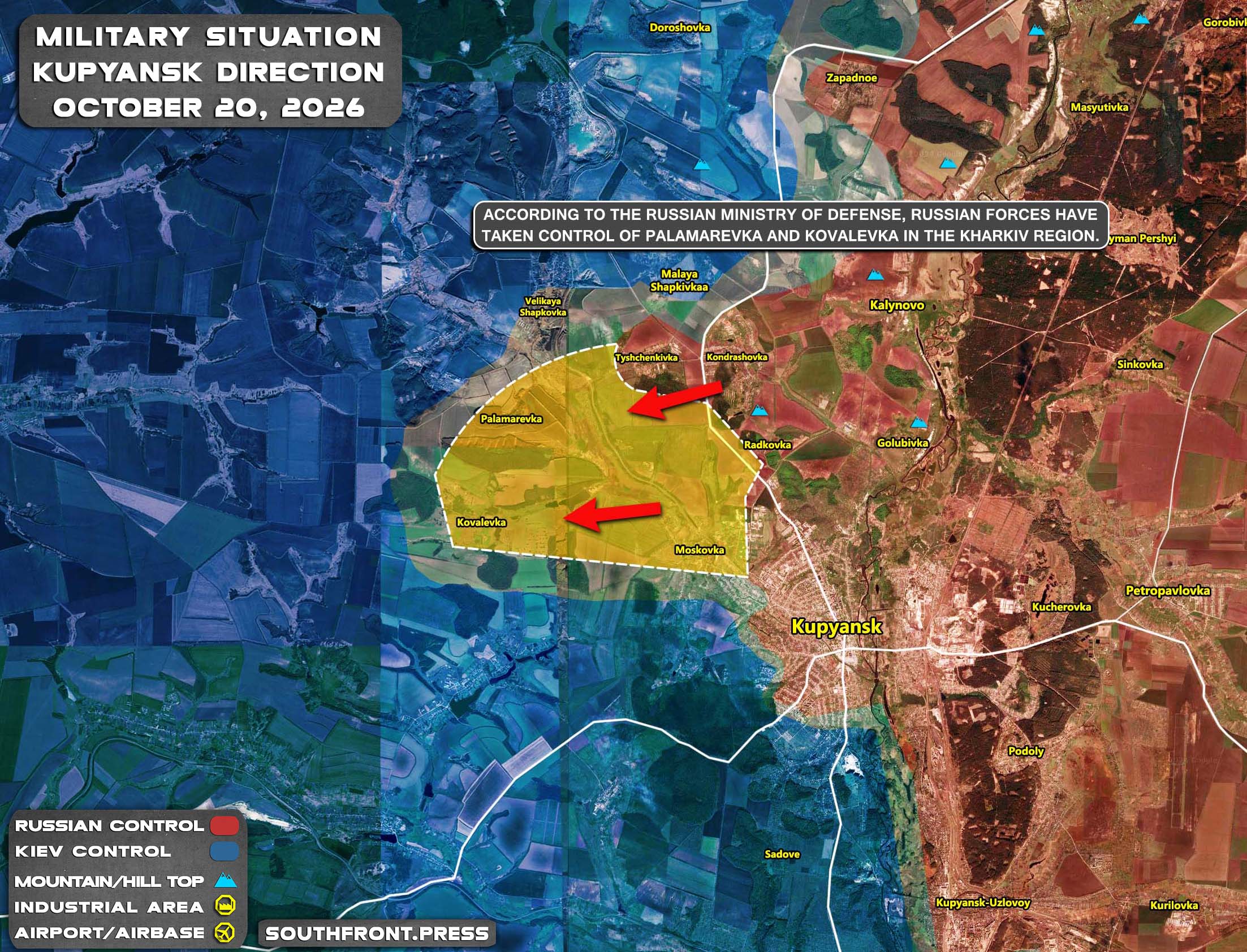
Click to see the full-size image

  • According to the Russian MoD, Russian forces took control of Palamarevka and Kovalevka in the Kharkiv region.

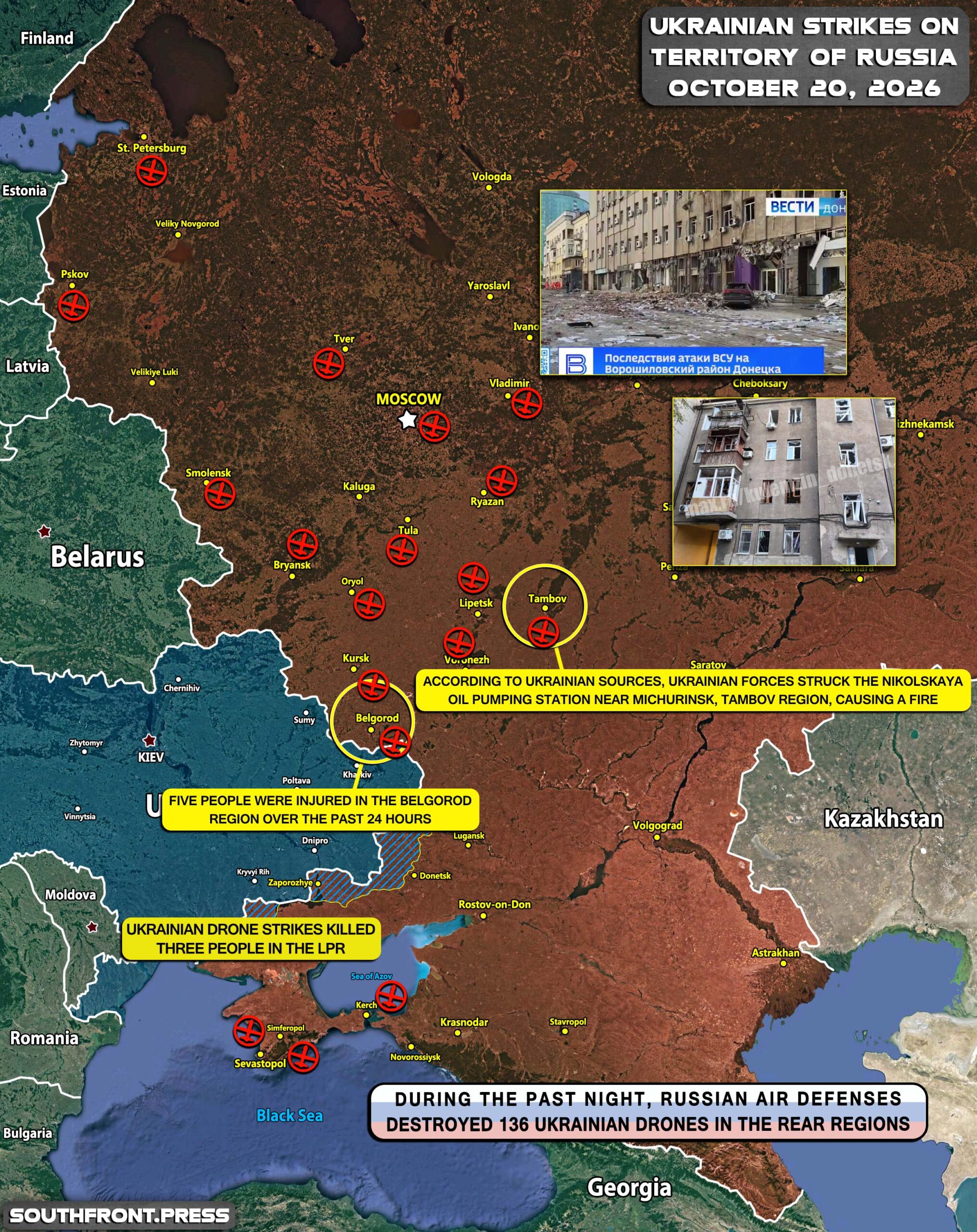
Click to see the full-size image

  • During the past night, Russian air defenses destroyed 136 Ukrainian drones in the rear regions;
  • Russian air defenses intercepted UAVs in the Belgorod, Bryansk, Voronezh, Kaluga, Kursk, Lipetsk, Oryol, Pskov, Ryazan, Smolensk, Tambov, Tver, and Tula regions, and the Moscow region;
  • According to Ukrainian sources, Ukrainian forces struck the Nikolskaya oil pumping station near Michurinsk, Tambov region, causing a fire;
  • Five people were injured in the Belgorod region over the past 24 hours;
  • Ukrainian drone strikes killed three people in the LPR.

MORE ON THE TOPIC:

The post Military Situation In Ukraine And Ukrainian Attacks On Russian Territory On October 20, 2026 (Maps Update) appeared first on South Front.

  •  

Military Situation In Iran On October 20, 2026 (Map Update)

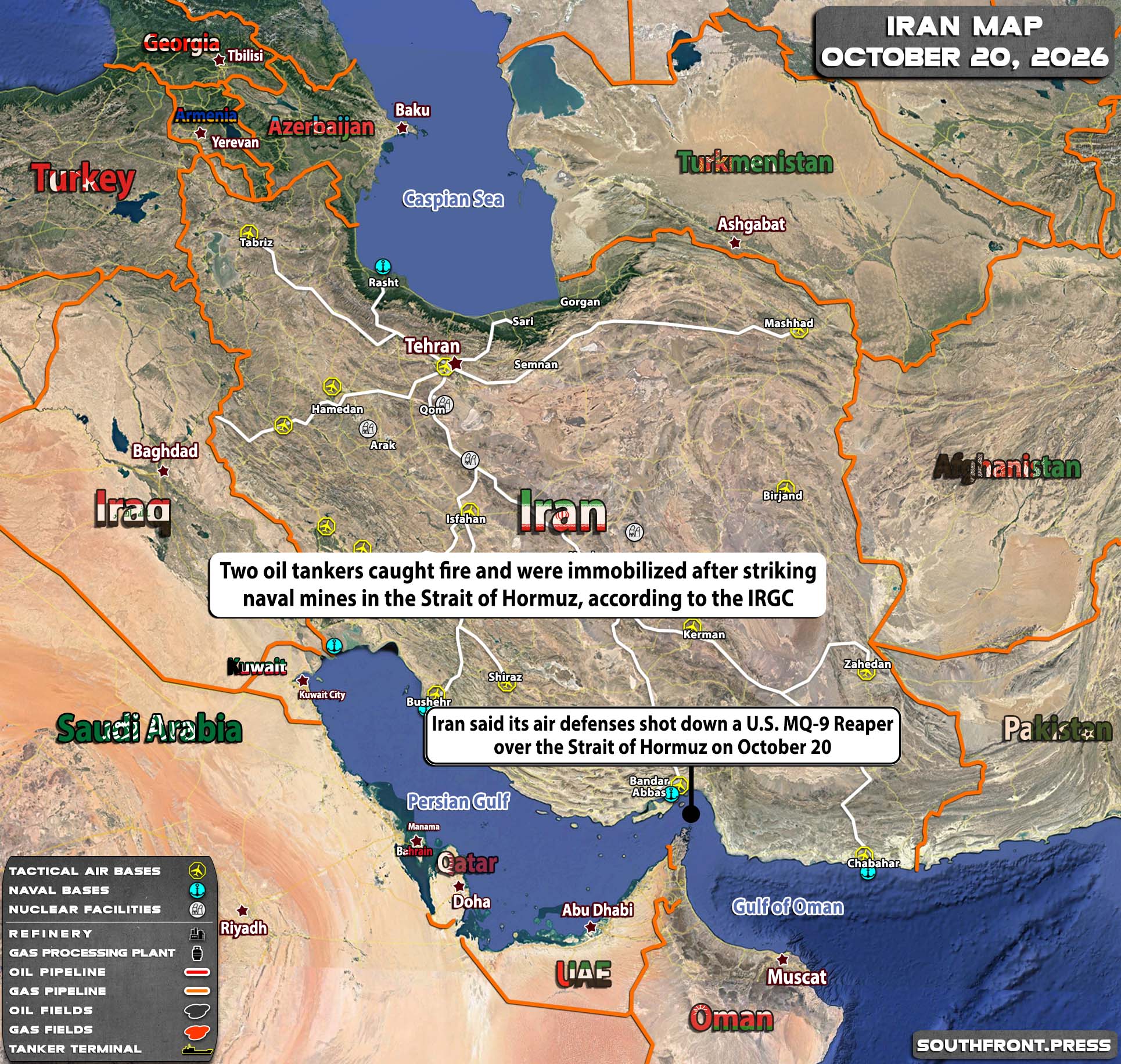
Click to see full-size map.

  • Iran said its air defenses shot down a U.S. MQ-9 Reaper over the Strait of Hormuz on October 20;
  • Two oil tankers caught fire and were immobilized after striking naval mines in the Strait of Hormuz, according to the IRGC.

_______________________________________________________________________________________________________________________

SouthFront: Analysis and Intelligence

NOW hosted at southfront.press

Previously, SouthFront: Analysis and Intelligence was at southfront.org.

The .org domain name had been blocked by the US (NATO) (https://southfront.press/southfront-org-blocked-by-u-s-controlled-global-internet-supervisor/) globally, outlawed and without any explanation

Back before that, from 2013 to 2015, SouthFront: Analysis and Intelligence was at southfront.com

SOUTHFRONT.PRESS

MORE ON THIS TOPIC:


The post Military Situation In Iran On October 20, 2026 (Map Update) appeared first on South Front.

  •  

Military Situation In Syria On October 20, 2026 (Map Update)

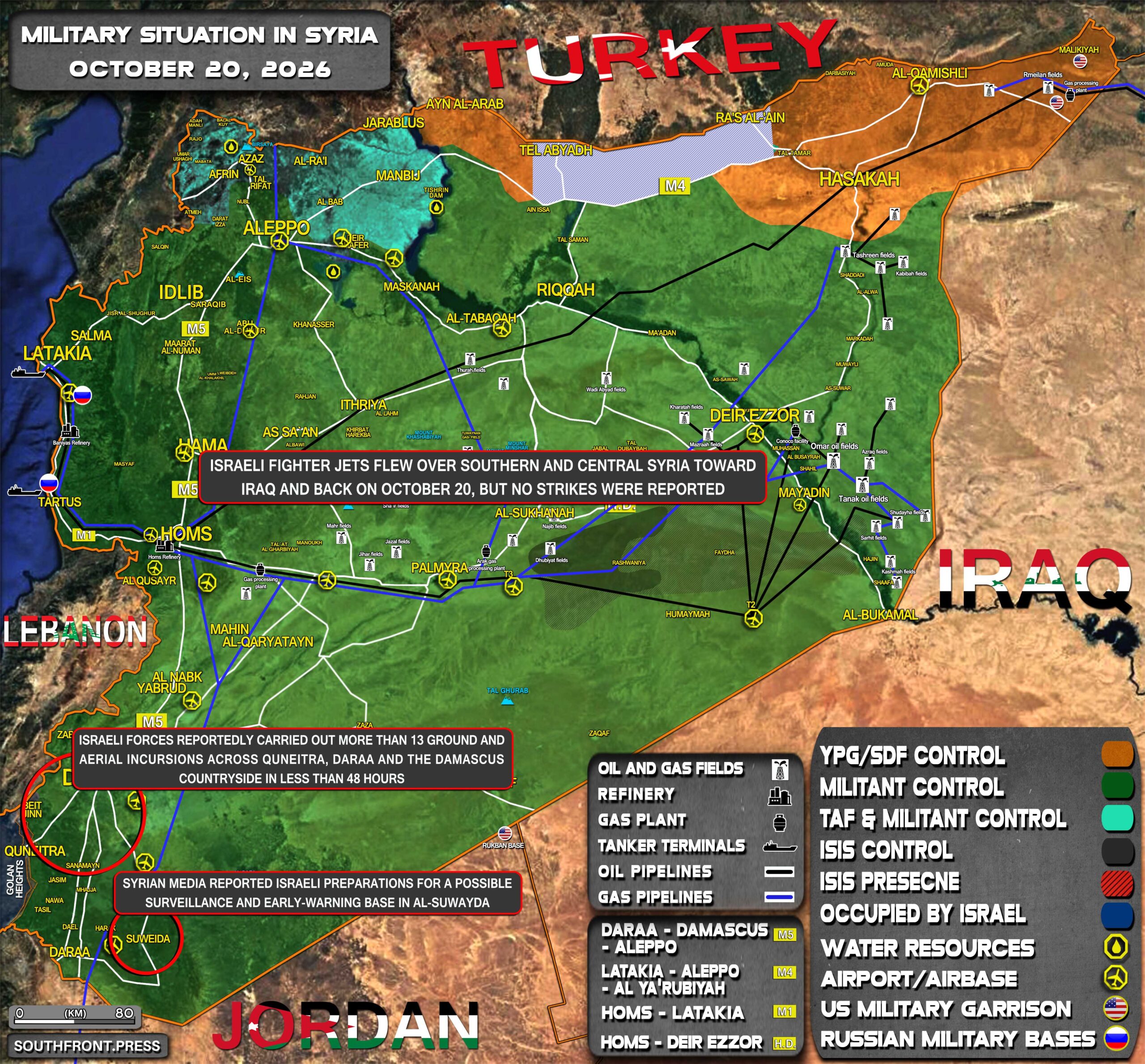
Click to see full-size map.

  • Israeli forces reportedly carried out more than 13 ground and aerial incursions across Quneitra, Daraa and the Damascus countryside in less than 48 hours;
  • Israeli fighter jets flew over southern and central Syria toward Iraq and back on October 20, but no strikes were reported;
  • Syrian media reported Israeli preparations for a possible surveillance and early-warning base in al-Suwayda.

_______________________________________________________________________________________________________________________

MORE ON THIS TOPIC:


The post Military Situation In Syria On October 20, 2026 (Map Update) appeared first on South Front.

  •  

You Can Trade Contracts on Elections, but Not on Onions. These College Students Want To Fix That.

Student protestors | Photo: For Our Futures/X

On Monday, a group of students from the University of Chicago stood outside the Chicago Mercantile Exchange—one of the world's largest and most diverse derivatives marketplaces—and called for the repeal of an obscure 1958 law that bans onions as futures products traded on U.S. exchanges. 

Attracting an audience with a humorous jingle and amusing signs that included "Onions Deserve a Future," "Honk If You Want Free Onions," "Hot Girls Hedge Onions," and "Free Markets Feed Families," the student group, named For Our Futures, has a simple platform: a repeal of the 1958 Onion Futures Act, which prohibits anyone from trading in onion futures on commodity exchanges. (The law was amended in 2010 to ban motion picture box office receipts from being traded on commodity exchanges.) The viral campaign drew enough attention that Mike Selig—chairman of the Commodity Futures Trading Commission and a proponent of expanding the list of commodities traded on futures markets—was asked about the law in a media appearance. 

American farmers produce about 6.75 billion pounds of onions a year, according to the National Onion Association, an industry trade group. While peers who grow cotton, wheat, corn, and soybeans can hedge against price swings by trading futures contracts, onion farmers have no such recourse under federal law. But, as the Agriculture Department's daily National Potato and Onion Report shows, onion prices are highly volatile and subject to wild swings, making them an ideal market for futures trading. 

In its latest report, released Monday, the agency shows that onion prices have roughly doubled since this time last year. If onion futures contracts were legal, farmers could rely on market expectations instead of planting crops based on last year's prices. It would also let buyers potentially cut costs by locking in lower prices to protect against spikes. Trading onion futures contracts would give the industry a useful price-discovery tool, one that the student group aptly notes is "crucial for price stability and for hedging risks associated with weather and market fluctuations."

It's not For Our Futures' first time trying this gambit. The student group staged similar protests at college campuses in April and May, armed with bags of raw onions to entice passersby into signing their petition to legalize onion futures. The students' crusade might be comical, but after a recent Gallup poll found that 57 percent of Americans age 18–34 have a positive image of socialism, it's encouraging to see college-age students stand up for free markets.

A protest over onions sounds absurd, but it's a viral reminder to others in that age cohort of how far governments can go when given the slightest leeway to regulate an industry.

Instead of relying on outdated price points when planning future harvests, American onion producers could use resources like futures contracts that offer real-time market signals. All that would require—as the college kids state—is for federal lawmakers to "let the free market reign supreme."

The post You Can Trade Contracts on Elections, but Not on Onions. These College Students Want To Fix That. appeared first on Reason Magazine.

  •  

Carneiro pede em Lagos que primeiro-ministro deixe cair lei das rendas

O líder do PS propõe uma garantia pública para proteger jovens, famílias e idosos e dar segurança aos proprietários em caso de dificuldades no pagamento das rendas.

O conteúdo Carneiro pede em Lagos que primeiro-ministro deixe cair lei das rendas aparece primeiro em Barlavento.

  •  

Greece plans to close 187 of its 831 military camps

Greece plans to close 187 of its 831 military camps as part of an updated force structure for 2026-2035. Defense Minister Nikos Dendias briefed members of the Standing Committee on National Defense and Foreign Affairs in a closed-door session, stressing savings from consolidating units and camps and the integration of new technologies. The camps to be […]

The post Greece plans to close 187 of its 831 military camps appeared first on Keep Talking Greece.

  •  

Russia’s Rubicon hunts Ukrainian drone pilots. In Vivaldi, it became the target, and its morale fell sharply, says the Ukrainian general

russia's rubicon built hunt ukrainian drone pilots vivaldi became target its morale broke says general · post left right major dmytro rohoziuk acting commander ukraine’s third army corps; brigadier andrii

Russia’s Rubicon drone unit, which is sent to hunt Ukrainian drone pilots, was not used to being hunted itself, Brigadier General Andrii Biletskyi told journalists on 19 October. He was summing up Operation Vivaldi, which his Third Army Corps fought in northern Donetsk Oblast from May to mid-October. Once its pilots realized they were being killed, Rubicon’s morale dropped sharply, he said.

Russia has fought for 12 years to take all of Donetsk Oblast, and Sloviansk and Kramatorsk anchor the fortress belt of cities Ukraine still holds there. Vivaldi retook 277 km² in northern Donetsk Oblast. Biletskyi says it destroyed Russia’s bridgehead on the Chornyi Zherebets River and forced Moscow to drop its plan to bypass Lyman from the north and encircle the two cities. On that front, the Third Corps had flagged Rubicon, Russia’s elite drone unit, as a threat.

Hunting the hunters

Once a Rubicon position was found, the Third Assault Brigade and the KRAKEN drone regiment committed any number of FPV and bomber drones to destroy its crews, Biletskyi said.

The brigade’s commander, Yaroslav Levenets, said his troops prepared for Rubicon’s arrival and concentrated on killing its pilots. He gave no details.

“Not stable in defense,” Levenets said of Rubicon’s troops.

They dislike sitting in trenches, he said, and under pressure they grow nervous and change positions.

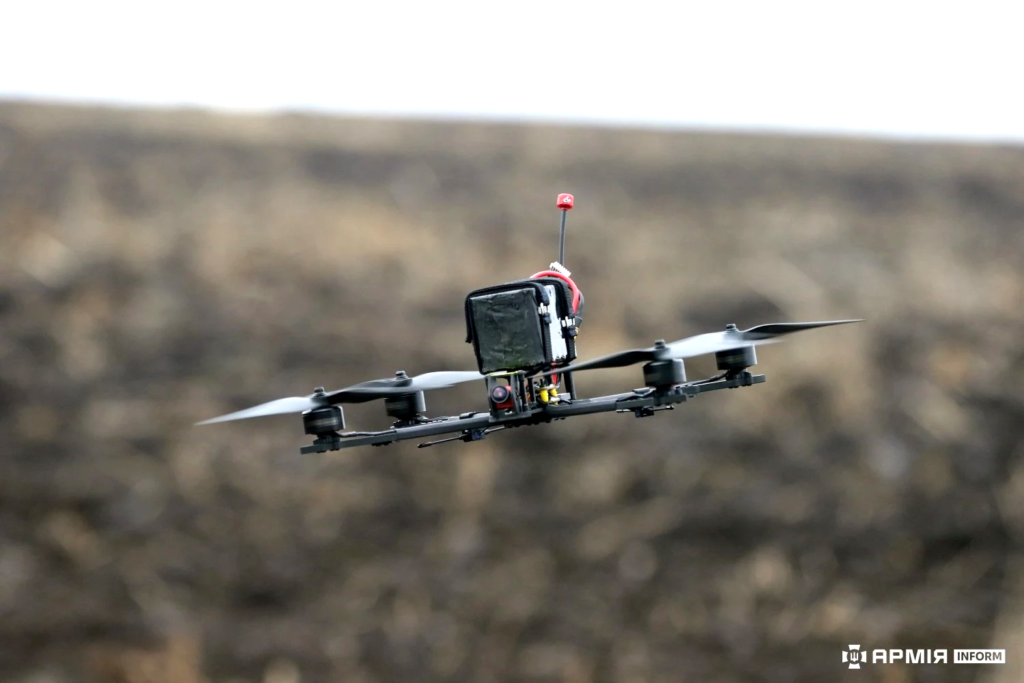
An FPV drone.
An FPV drone. Illustrative photo: ArmyInform

Named for four seasons

Biletskyi said the name was chosen at the very start of planning, in winter 2025–2026, many months before the operation began. The original plan had four stages, one for each season, and later grew to slightly more, ArmyInform reported.

When he first unveiled the operation in September, he put it this way:

“Vivaldi, as is known, has four seasons. And this is only the first one.”

He credited two planners, known by the call signs Yurist and Leshyi. Leshyi, an assault soldier wounded seven times who later moved to staff work, was killed. Yurist was seriously wounded.

Ukraine's Third Army Corps commander Brigadier General Andrii Biletskyi announcing new developments in "Operation Vivaldi," 20 September 2026. Screenshot from video: Ukraine's Third Army Corps
Explore further

Ukraine blocks Russia from outflanking its fortress cities in Donbas, retaking 277 square kilometers and hitting 8,000 Russian troops

A new hand at the Third Corps

Major Dmytro Rohoziuk is now acting commander of the Third Army Corps, the corps press service said on 20 October. The press service said the move is not a transfer, and Biletskyi keeps his formal post as corps commander while he leads the “Center” grouping of the Third, 11th, and 19th corps.

Major Dmytro Rohoziuk, acting commander of Ukraine’s Third Army Corps.
Major Dmytro Rohoziuk, acting commander of Ukraine’s Third Army Corps. Photo: Armed Forces of Ukraine

Rohoziuk took over the 60th Mechanized Brigade in October 2025. Its previous commander was arrested in January after the State Bureau of Investigation accused him of embezzling about $1 million in weapons procurement. The brigade fought in all four phases of Vivaldi and retook Kolodiazi without street fighting.

Ukrainian troops capture a Russian infiltrator carrying a Russian flag during Operation Vivaldi in northern Donetsk Oblast.
Ukrainian troops capture a Russian infiltrator carrying a Russian flag during Operation Vivaldi in northern Donetsk Oblast. Photo: Third Army Corps

Biletskyi also declined command of the Ground Forces, which oversee mobilization.

“There’s no point taking on something you don’t truly believe you can improve,” he said.

Biletskyi’s count

Russian losses in Vivaldi topped 8,000 troops, and about 270 Russian soldiers were taken prisoner, Biletskyi said. More than 20 officers surrendered, including a chief of staff and three company commanders.

The territory matters less than disrupting Russia’s strategic plan, he said. Russian forces still press toward Dobropillia, where Ukraine is counterattacking.

  •  

Locations Of US Carrier Strike Groups – October 20, 2026

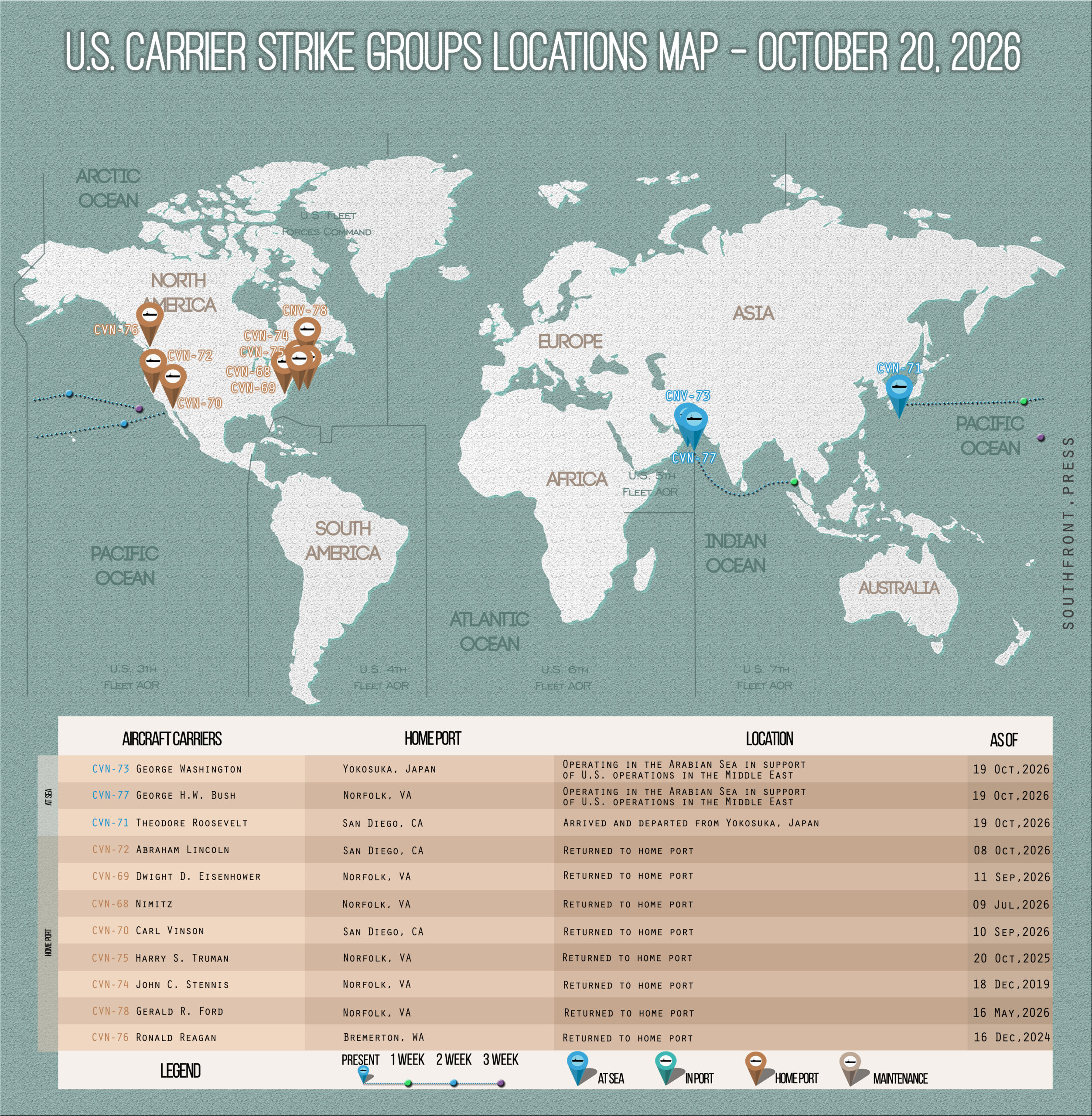
This is the newest update of the ‘U.S. Carrier Strike Groups Locations Map’ exclusive series showing the approximate locations of U.S. Carrier Strike Groups. SouthFront: Analysis & Intelligence tracks locations of U.S. aircraft carriers using the available open-source information. No classified information was used in production of the map.

click to see the full-size image

Carrier strike group (CSG) is an operational formation of the United States Navy. It is centered on an aircraft carrier and a carrier air wing of 65 to 70 aircrafts. It’s composed of roughly 7,500 personnel, an aircraft carrier, at least one cruiser, a destroyer squadron of at least two destroyers and/or frigates. A carrier strike group also, on occasion, includes submarines, attached logistics ships and a supply ship. Carrier strike groups comprise a principal element of U.S. power projection over the world’s oceans

______________________________________________________________________________________________________________________

SouthFront: Analysis and Intelligence
NOW hosted at southfront.press
Previously, SouthFront: Analysis and Intelligence was at southfront.org.
The .org domain name had been blocked by the US (NATO) (https://southfront.press/southfront-org-blocked-by-u-s-controlled-global-internet-supervisor/) globally, outlawed and without any explanation
Back before that, from 2013 to 2015, SouthFront: Analysis and Intelligence was at southfront.com

SOUTHFRONT.PRESS

The post Locations Of US Carrier Strike Groups – October 20, 2026 appeared first on South Front.

  •  

EU Ministers Agree New Agricultural Market Rules as Farm Budget Dispute Continues

European Union governments have agreed a negotiating position on new agricultural market rules intended to take effect under the bloc’s 2028–2034 budget, advancing reforms to support arrangements for farmers while leaving the most contentious financial questions unresolved.

The Council approved its partial negotiating mandate on Monday, 19 October, covering changes to the Common Market Organisation regulation, which governs agricultural markets across the European Union.

The proposals include new arrangements for wine producers, protein crops and oilseeds, revised marketing standards, changes to the EU school food programme and provisions intended to improve preparedness for agricultural market disruptions.

However, the agreement does not settle future funding allocations or the broader structure of agricultural subsidies, which remain under negotiation as EU governments attempt to reconcile farming expenditure with competing demands for defence, industrial investment and regional development.

Agricultural markets under review

The Council’s negotiating position retains much of the European Commission’s original proposal while introducing amendments intended to accommodate national differences in agricultural production.

Under the proposed arrangements, sector-specific interventions would become mandatory in several areas, including beekeeping, fruit and vegetables and, under certain circumstances, wine production.

The Council has also proposed flexibility for countries where particular sectors are absent or relatively undeveloped.

For the wine industry, governments would be able to seek exemptions from certain obligations where national circumstances justify different arrangements.

This would allow the framework to retain common European rules while avoiding requirements that would be inappropriate for member states with little or no domestic wine production.

Sectoral interventions form part of the mechanisms through which the EU supports agricultural markets and producer organisations. They can cover measures intended to improve competitiveness, manage production and strengthen farmers’ commercial position.

New provisions for protein crops

The Council has endorsed the establishment of a separate sector for protein crops and oilseeds, replacing existing provisions covering dried fodder.

The objective is to encourage domestic production and reduce dependence on imported agricultural inputs, particularly crops used in animal feed and food production.

European livestock producers rely on protein-rich feed ingredients, including soyabeans, that are often sourced internationally.

Greater domestic production could reduce exposure to fluctuations in global commodity prices, transport costs and disruptions to international supply chains.

Under the Council’s proposal, member states would be encouraged to recognise producer organisations specialising in protein crops and oilseeds.

Such organisations can help farmers coordinate production, marketing and investment, although the effectiveness of the proposed measures will depend on how they are implemented nationally.

The proposals follow broader EU efforts to improve supply security in sectors extending from agricultural inputs to critical industrial materials.

School food and product labelling

The negotiating mandate also preserves the EU school scheme, which provides support for the distribution of fruit, vegetables and milk to schoolchildren.

Under the proposed framework, the programme would move from a school-year financing cycle to a calendar-year system, with transitional provisions intended to prevent disruption during implementation.

The Council has maintained the Commission’s objective of encouraging healthier eating habits by limiting products containing high levels of free sugars and fats.

The proposal also opens the possibility of additional marketing standards for several agricultural products, including protein crops, beef, pork, sheepmeat, goatmeat and rice.

These standards could provide consumers with more detailed information about product origins, subject to the final legislation.

Such measures would also have implications for producers and food businesses, which would need to comply with any new requirements concerning classification, marketing and labelling.

The Council additionally supports the harmonisation of rules covering industrial hemp, while retaining safeguards concerning seed certification and the permitted level of tetrahydrocannabinol.

Farming subsidies remain contested

The agricultural market agreement forms part of negotiations over the next Common Agricultural Policy, which will operate within the EU’s new seven-year financial framework.

Under the Commission’s proposed budget structure, several funding streams, including agricultural and cohesion programmes, would be brought together within national and regional partnership plans.

The restructuring has encountered opposition from governments and agricultural interests concerned that farming could lose protected access to EU funding.

As EU Today previously reported, 17 member states have called for agricultural and regional development expenditure to be protected against further reductions.

The Council’s latest position addresses how agricultural markets should operate rather than determining the size of the financial support available to them.

A separate debate concerns the conditions for receiving direct farm payments, including the definition of an active farmer and the degree of discretion granted to national governments.

Those questions remain central to the continuing CAP negotiations, which are due to return to the Agriculture and Fisheries Council on 26–27 October.

Negotiations move to Parliament

The Council’s partial mandate now provides a basis for negotiations with the European Parliament on the agricultural market provisions.

The legislation will still require agreement between the institutions, while its financing will depend on the eventual settlement of the 2028–2034 budget.

Governments must also complete negotiations on the wider CAP framework, including direct income support and the distribution of responsibility between Brussels and national administrations.

The market agreement reached on 19 October therefore establishes important elements of the proposed agricultural rules, but leaves unresolved the level of financial support available to European farmers after 2027.

  •  

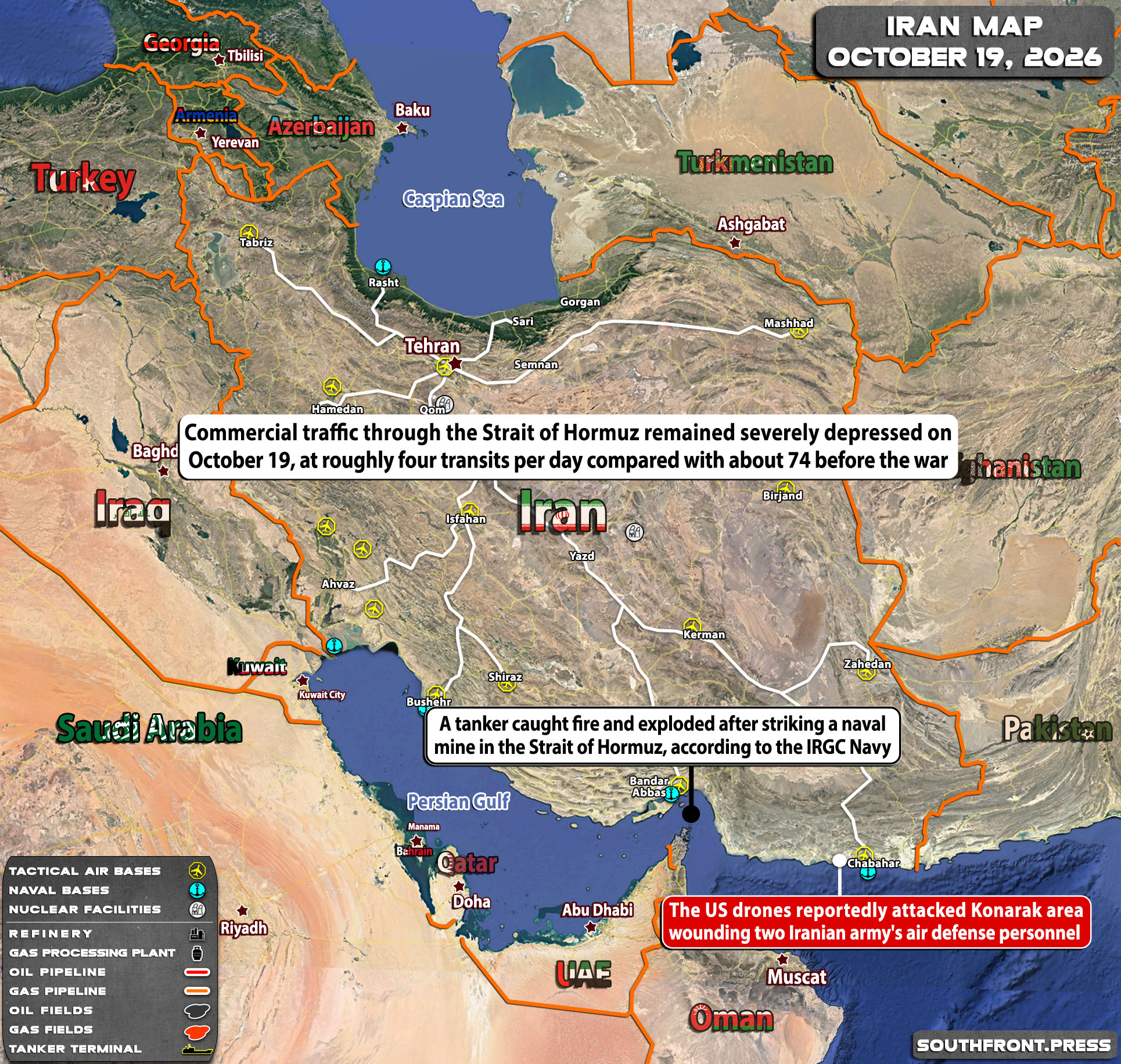
Military Situation In Iran On October 19, 2026 (Map Update)

Click to see full-size map.

  • A tanker caught fire and exploded after striking a naval mine in the Strait of Hormuz, according to the IRGC Navy;
  • The US drones reportedly attacked Konarak area wounding two Iranian army’s air defense personnel;
  • Commercial traffic through the Strait of Hormuz remained severely depressed on October 19, at roughly four transits per day compared with about 74 before the war.

_______________________________________________________________________________________________________________________

MORE ON THIS TOPIC:


The post Military Situation In Iran On October 19, 2026 (Map Update) appeared first on South Front.

  •  

Russia Strikes Flamingo Missile Warehouses, Data Center, and Ukraine’s Power Grid

Click to see the full-size image

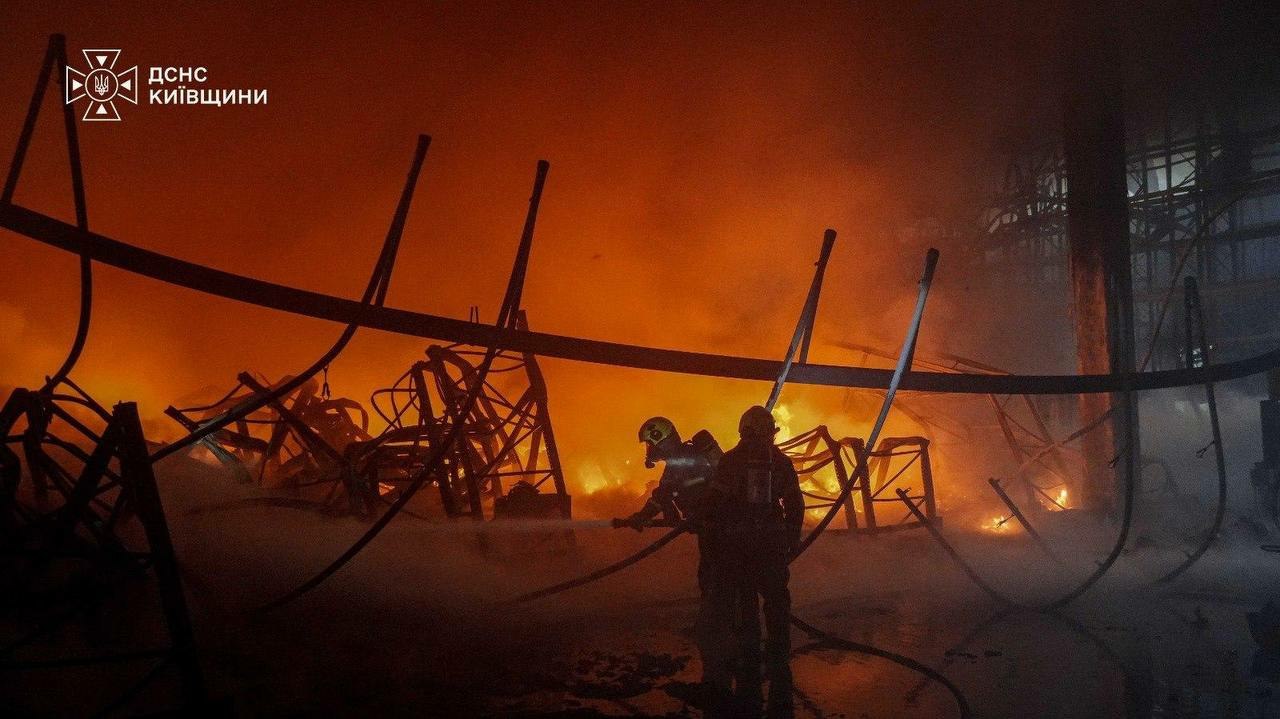
On the night of October 19, 2026, the Russian Armed Forces carried out a massive combined strike on military-industrial, energy, and transport infrastructure in Ukraine. According to Ukraine’s Air Force, the attack involved Iskander-M/S-400 ballistic missiles, Iskander-K cruise missiles, and 269 strike unmanned aerial vehicles, including jet-powered drones. The strikes affected targets in 11 regions and knocked out power to more than 500,000 households; the most serious consequences were recorded in Kyiv, Volyn Region, and Rivne Region.

Strikes by Region

Kyiv and Kyiv Region

  • Data Group data center (Kyiv) — a data-processing center that, according to the Russian Ministry of Defense, was used for military infrastructure needs.

  • Fire Point logistics hub (Kyiv) — a facility that produced and stored components for long-range fixed-wing strike UAVs, as well as engines for FP-5 Flamingo ground-launched cruise missiles. The facility was part of Fire Point’s production chain.

  • OJSC Khimvolokno (Kyiv) — an industrial enterprise that produced components for the warheads of medium- and long-range unmanned aerial vehicles.

  • Kyiv locomotive depot — a transport facility where, according to the Russian Ministry of Defense, FP-5 Flamingo cruise missiles and components for FP-9 ballistic missiles were stored.

  • Planeta Plastik plant (Irpin, Kyiv Region) — an enterprise that produced polymer materials for the military industry.

  • Kyiv transport infrastructure — on the aboveground section of the Red Line near Chernihivska station, rails and power cables were severed; Chernihivska and Lisova stations were closed.

  • Ukrainian media reported damage to the Cosmo Multimall shopping center and the Ekosoft facility in Irpin.

Volyn Region

  • Major rail junction on the route to Poland (Kovel)

  • Energy infrastructure — an electrical substation in Lutsk was attacked; after the overnight strikes, Kovel lost power, and large-scale outages also affected Turiisk and Liuboml.

  • Warehouse and production facilities in the village of Manevychi


Rivne Region

  • BADM warehouse (Rivne) — a 2,370-square-meter warehouse opened in 2012. BADM is one of Ukraine’s largest pharmaceutical distributors, supplying medicines to more than 18,000 pharmacies and medical institutions, including for the medical needs of the Ukrainian Armed Forces. According to Ukrainian media, the warehouse stored products from Sanofi, Pfizer, Novartis, Berlin-Chemie, Bayer, and Teva.

  • Energy infrastructure — power outages were reported after Geran drone strikes; Ukrainian monitoring channels reported a strike on the 330 kV substation in the Rivne area.


Other Regions

  • Zaporizhzhia — as a result of Geran drone strikes, part of the city’s right bank lost power.

  • Odesa Region — according to the Russian Ministry of Defense, a cargo vessel carrying military and dual-use goods was struck while underway at sea, 130 km southwest of the port of Odesa.

  • Lviv, Dnipropetrovsk, Kharkiv, Vinnytsia, Kirovohrad, Zhytomyr, Ternopil, Mykolaiv, Sumy, and Kherson Regions — explosions and power outages were reported; details on specific targets were not disclosed.

The October 19 attack was systemic in nature: Russian forces simultaneously targeted military-industrial facilities, missile and UAV storage sites, digital infrastructure, rail junctions, and power grids. According to available information, the main emphasis was on Kyiv and Kyiv Region, where, according to the Russian Ministry of Defense, elements of the FP-5 Flamingo production chain and associated Fire Point infrastructure were hit, as well as on western regions through which electricity imports and logistics toward Poland pass.

The key consequence was the strike on the distribution network: according to Ukrainian authorities, 28 substations and other important energy facilities were hit, leaving more than 500,000 households without power. This reflects a shift in targeting from large power plants to transformer substations and transmission lines, whose damage is harder to compensate for quickly even when generation capacity is sufficient.

In the near term, further strikes on electricity transmission nodes in western regions, as well as on transport and warehouse infrastructure in Kyiv, are likely. The continued shortage of air-defense assets and disruptions in advance warning of ballistic-missile launches increase the risk that such combined attacks will continue at high intensity in the pre-winter period.


MORE ON THE TOPIC:

The post Russia Strikes Flamingo Missile Warehouses, Data Center, and Ukraine’s Power Grid appeared first on South Front.

  •  

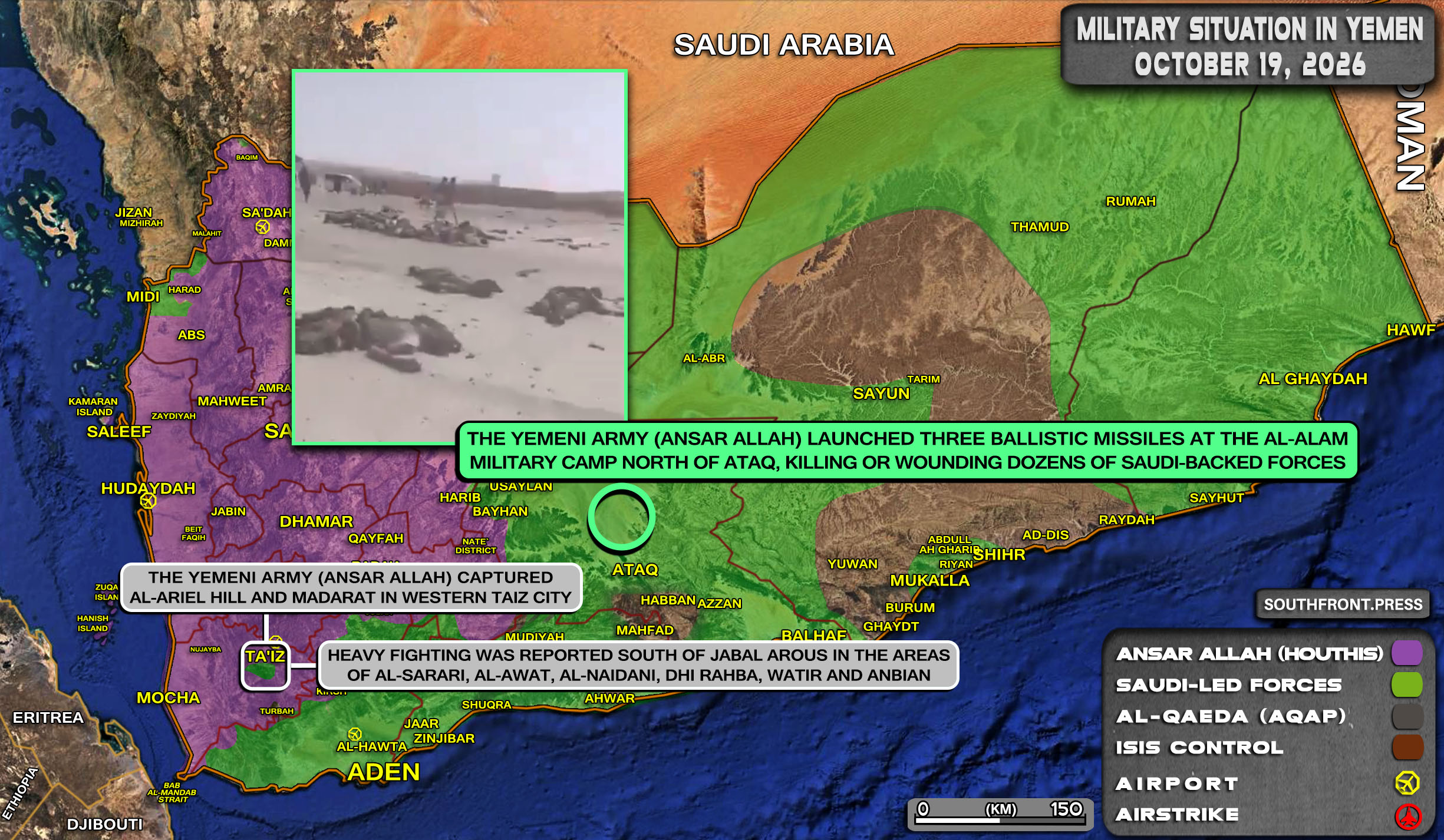
Military Situation In Yemen On October 19, 2026 (Map Update)

Click to see full-size map.

  • The Yemeni army (Ansar Allah) captured Al-Ariel hill and Madarat in western Taiz city;
  • Heavy fighting was reported south of Jabal Arous in the areas of al-Sarari, al-Awat, al-Naidani, Dhi Rahba, Watir and Anbian;
  • The Yemeni army (Ansar Allah) launched three ballistic missiles at the al-Alam military camp north of Ataq, killing or wounding dozens of Saudi-backed forces.

_______________________________________________________________________________________________________________________

MORE ON THIS TOPIC:


The post Military Situation In Yemen On October 19, 2026 (Map Update) appeared first on South Front.

  •  

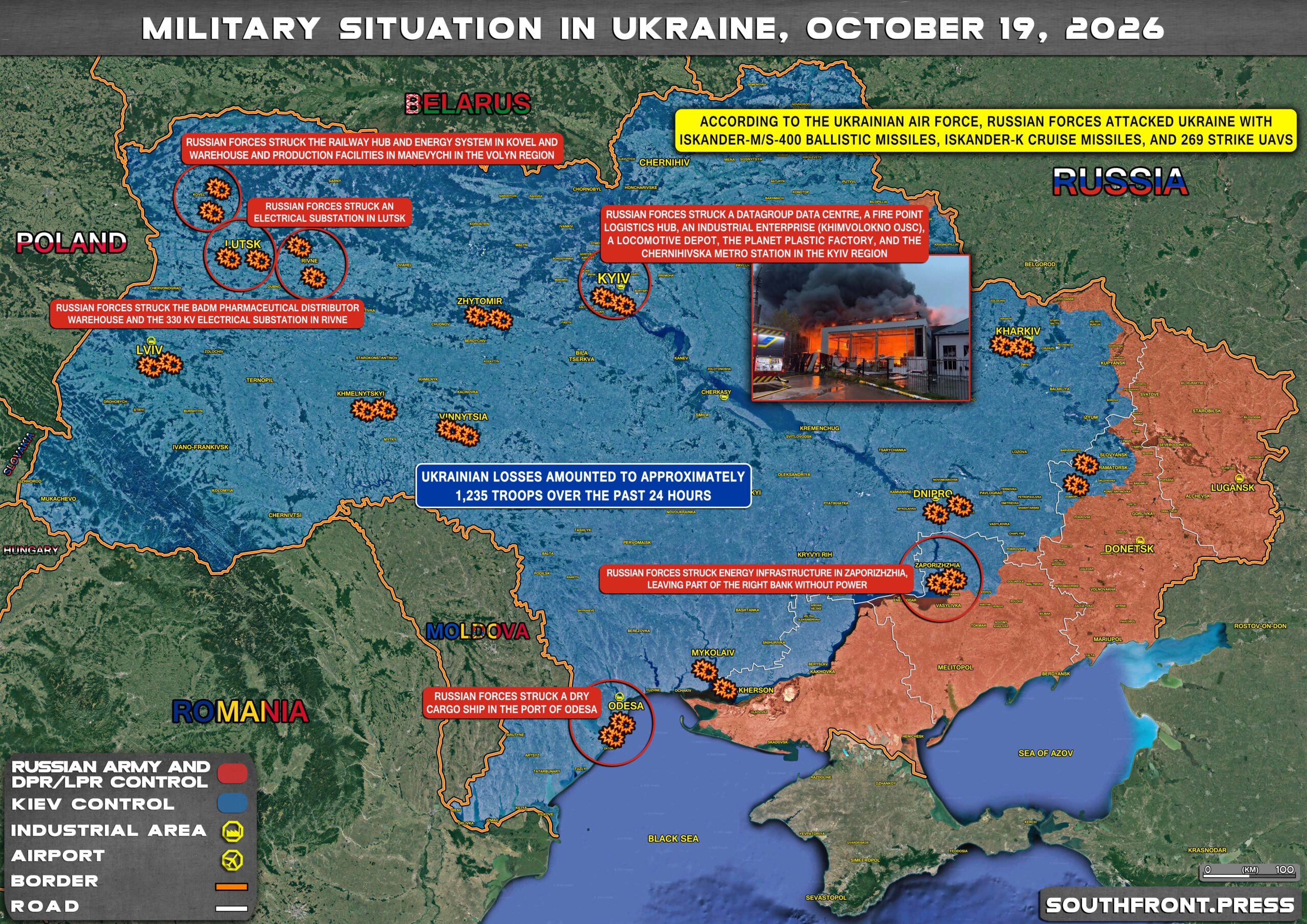
Military Situation In Ukraine On October 19, 2026 (Maps Update)

Click to see the full-size image

  • Russian strikes destroyed targets in the Sumy, Kharkiv, Zaporizhzhia, Dnipropetrovsk, Kherson, Kyiv, Volyn, Odesa, Khmelnytskyi, Lviv, Vinnytsia, Zhytomyr, Rivne, Ternopil, Mykolaiv regions, and the DPR;
  • According to the Ukrainian Air Force, Russian forces attacked Ukraine with Iskander-M/S-400 ballistic missiles, Iskander-K cruise missiles, and 269 strike UAVs;
  • Russian forces struck a Datagroup Data Centre, a Fire Point logistics hub, an industrial enterprise (Khimvolokno OJSC), a locomotive depot, the Planet Plastic factory, and the Chernihivska metro station in the Kyiv region;
  • Russian forces struck a dry cargo ship in the port of Odesa;
  • Russian forces struck the railway hub and energy system in Kovel and warehouse and production facilities in Manevychi in the Volyn region;
  • Russian forces struck the BadM pharmaceutical distributor warehouse and the 330 kV electrical substation in Rivne;
  • Russian forces struck an electrical substation in Lutsk;
  • Russian forces struck energy infrastructure in Zaporizhzhia, leaving part of the right bank without power;
  • Ukrainian losses amounted to approximately 1,235 troops over the past 24 hours.

Click to see the full-size image

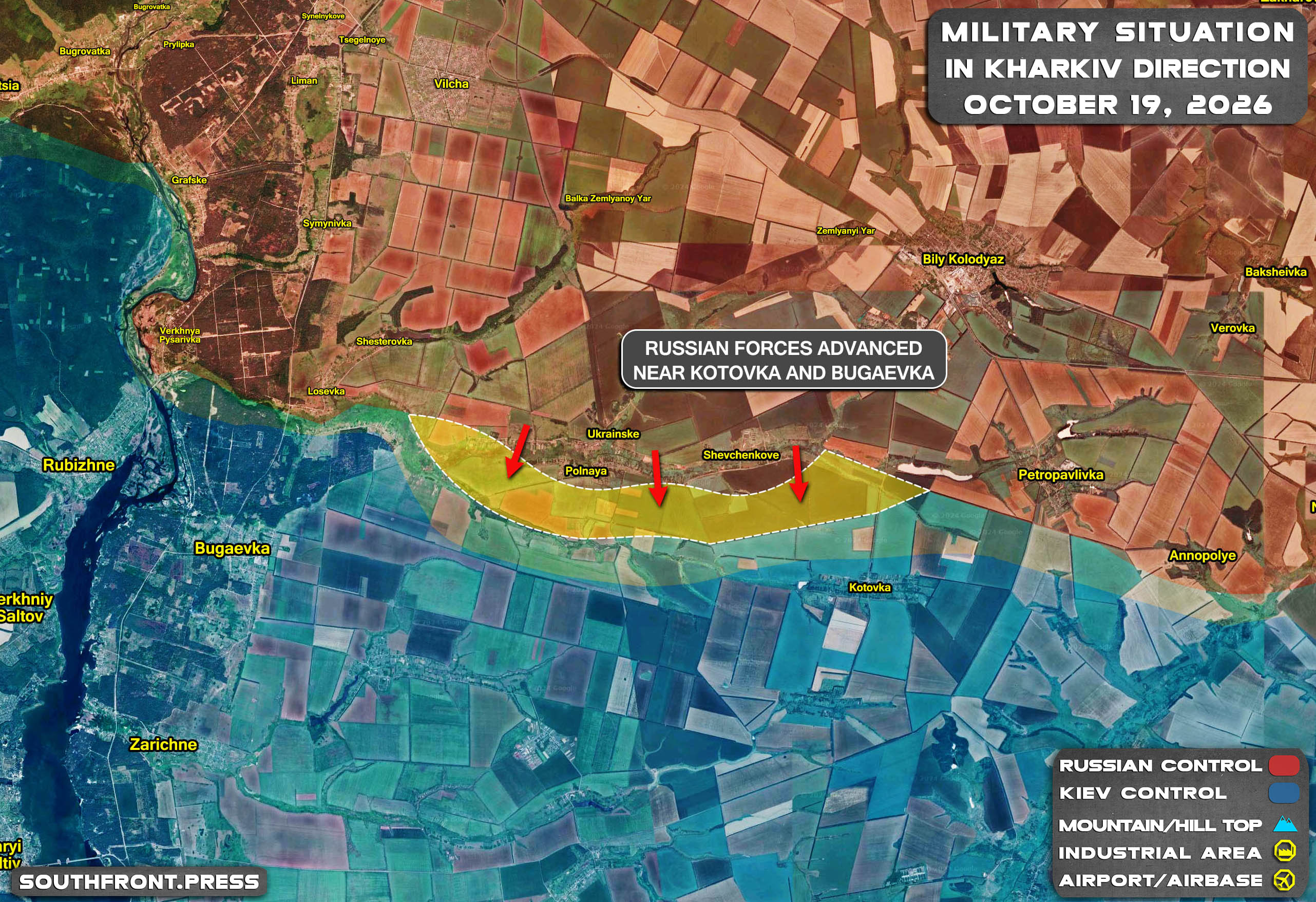
  • Russian forces advanced near Kotovka and Bugaevka.

Click to see the full-size image

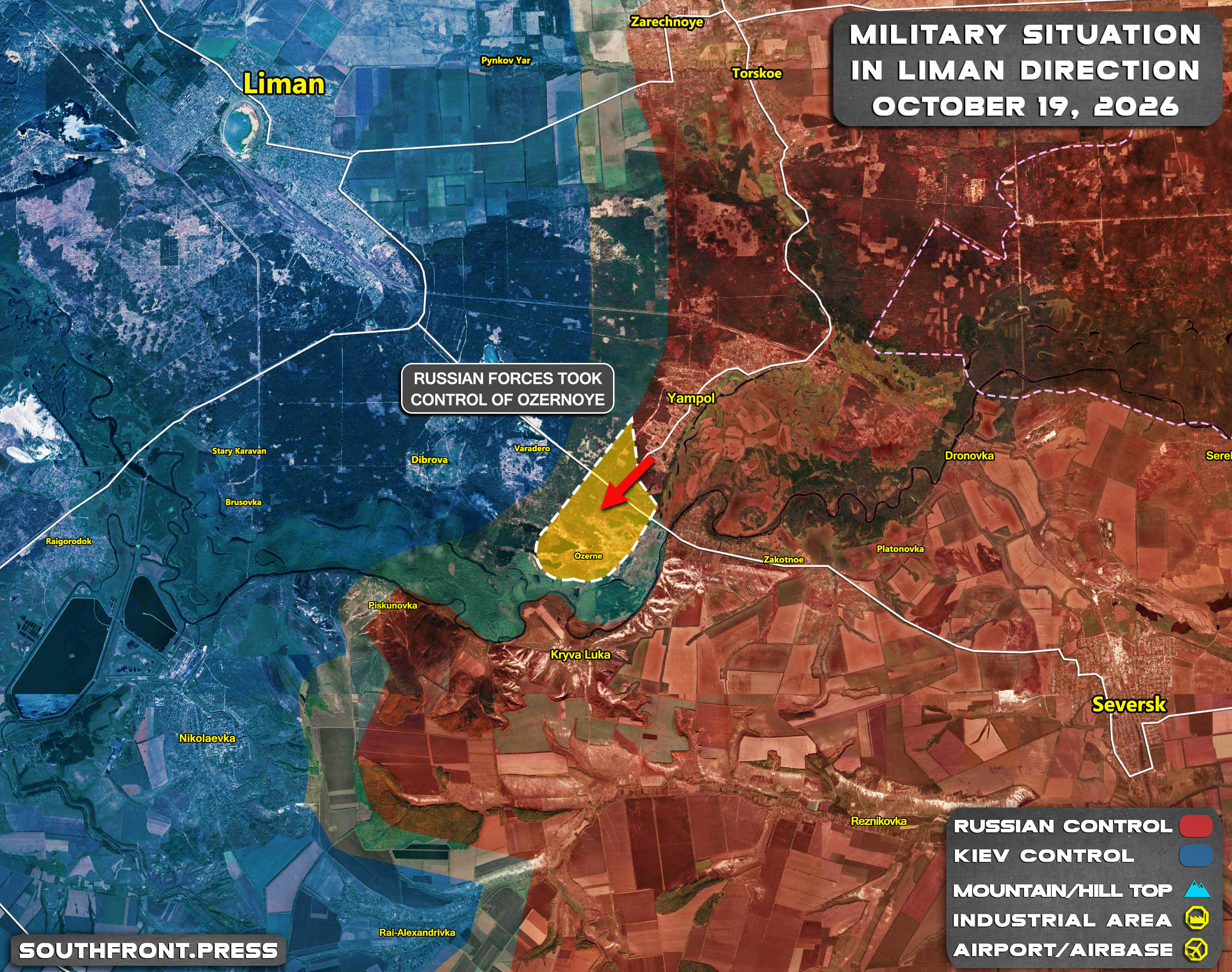
  • Russian forces took control of Ozernoye.

Click to see the full-size image

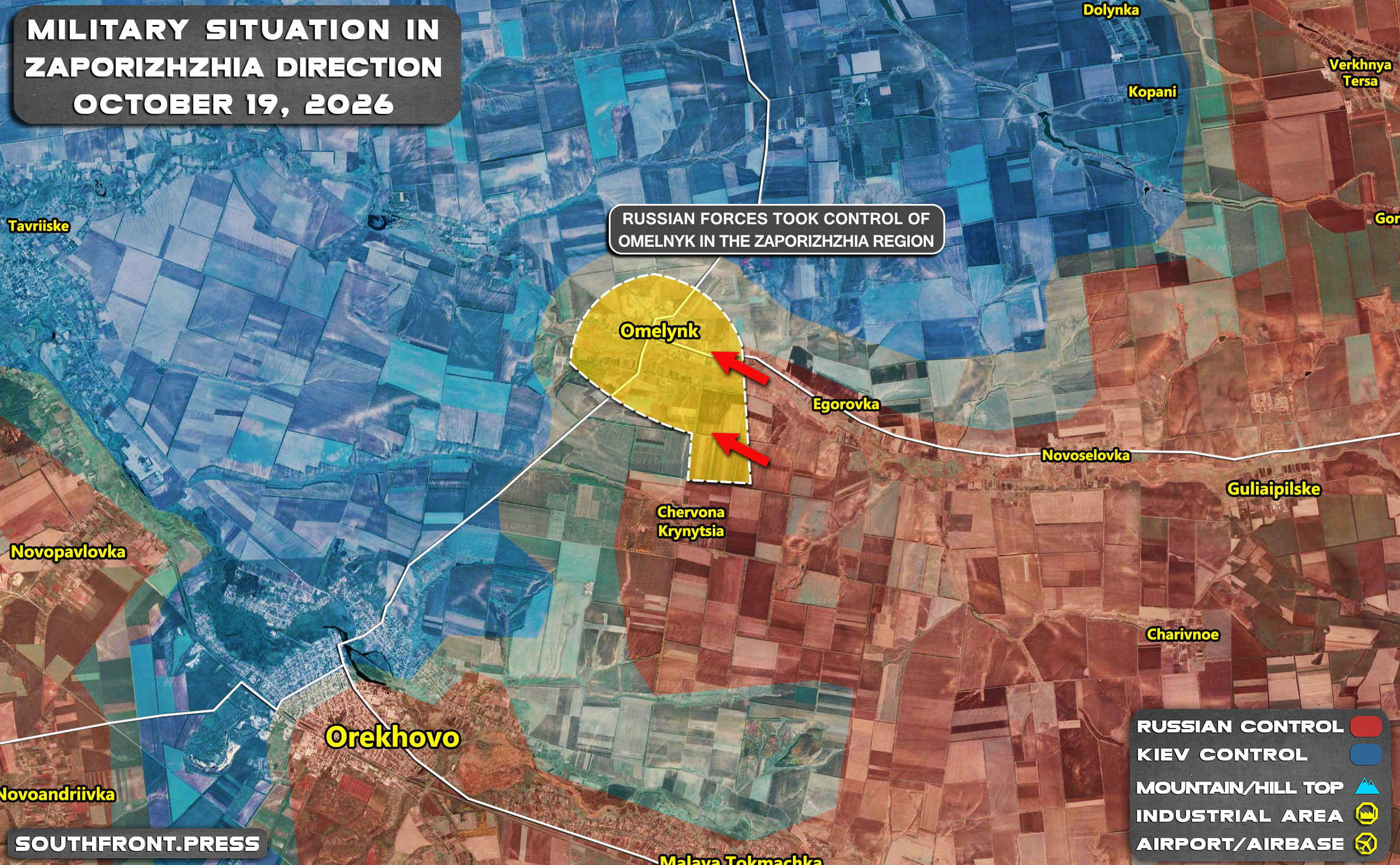
  • Russian forces took control of Omelnyk in the Zaporizhzhia region.

MORE ON THE TOPIC:

The post Military Situation In Ukraine On October 19, 2026 (Maps Update) appeared first on South Front.

  •  

Military Situation In Ukraine And Ukrainian Attacks On Russian Territory On October 18, 2026 (Maps Update)

Click to see the full-size image

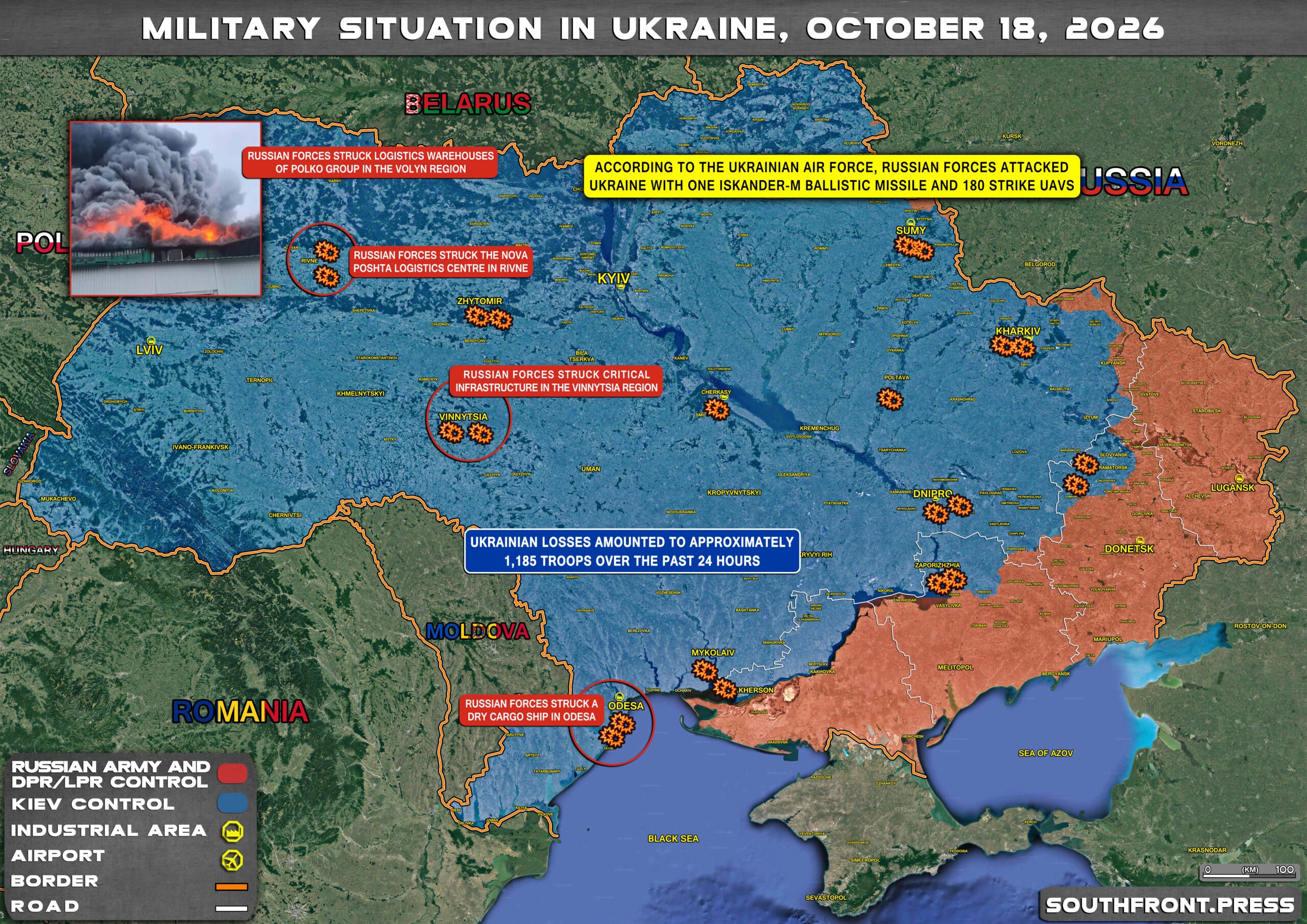
  • Russian strikes destroyed targets in the Sumy, Kharkiv, Zaporizhzhia, Dnipropetrovsk, Kherson, Odesa, Chernihiv, Khmelnytskyi, Rivne, Cherkasy, Poltava, Zhytomyr regions, and the DPR;
  • According to the Ukrainian Air Force, Russian forces attacked Ukraine one Iskander-M ballistic missile, 180 strike UAVs;
  • Russian forces struck the Novaya Pochta logistics centre in Rivne;
  • Russian forces struck a dry cargo ship in Odessa;
  • Russian forces struck logistics warehouses of Polko Group in the Volyn region;
  • Russian forces struck critical infrastructure in the Vinnytsia region;
  • Ukrainian losses amounted to approximately 1,185 troops over the past 24 hours.

Click to see the full-size image

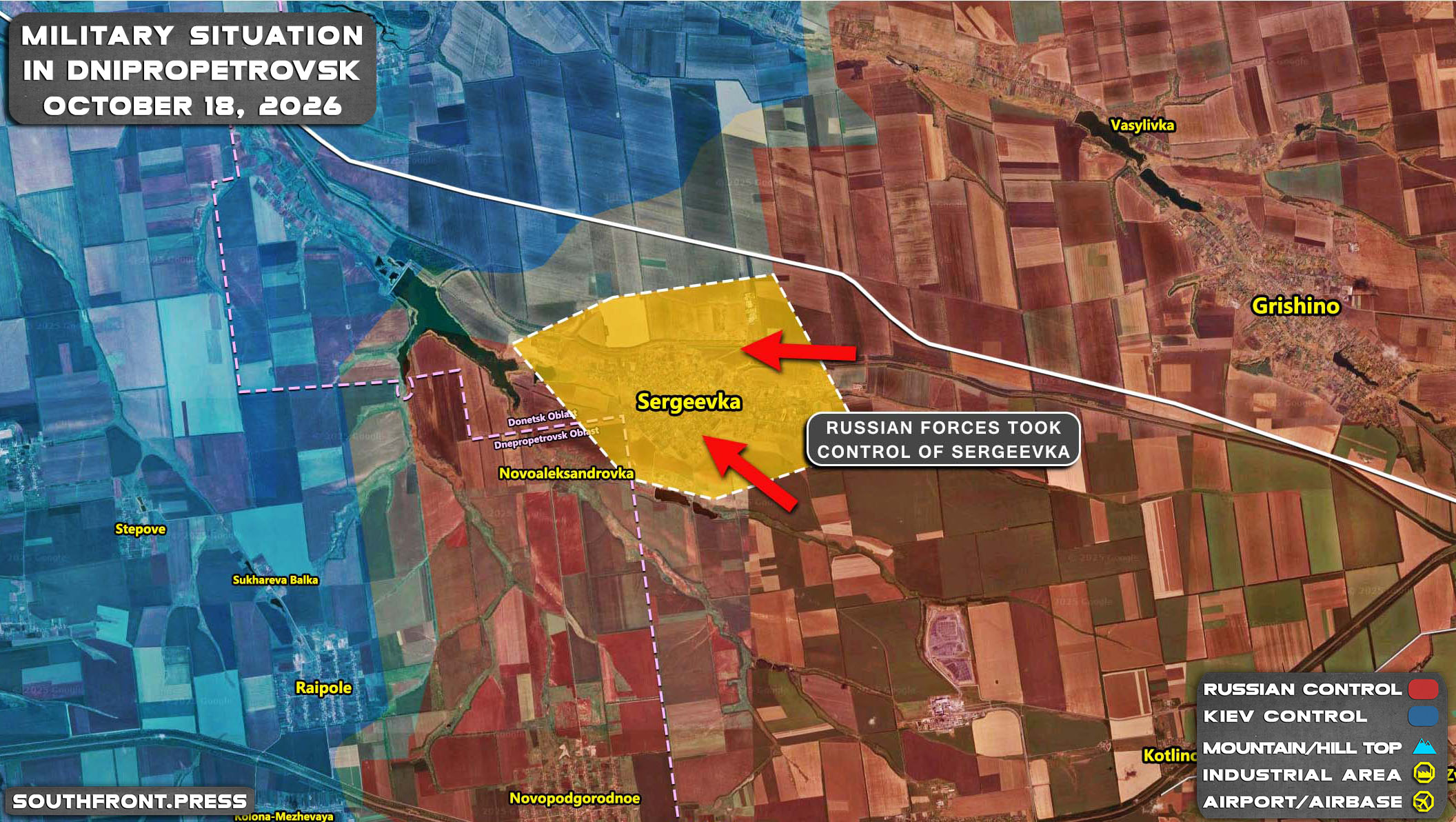
  • Russian forces took control of Sergeevka.

Click to see the full-size image

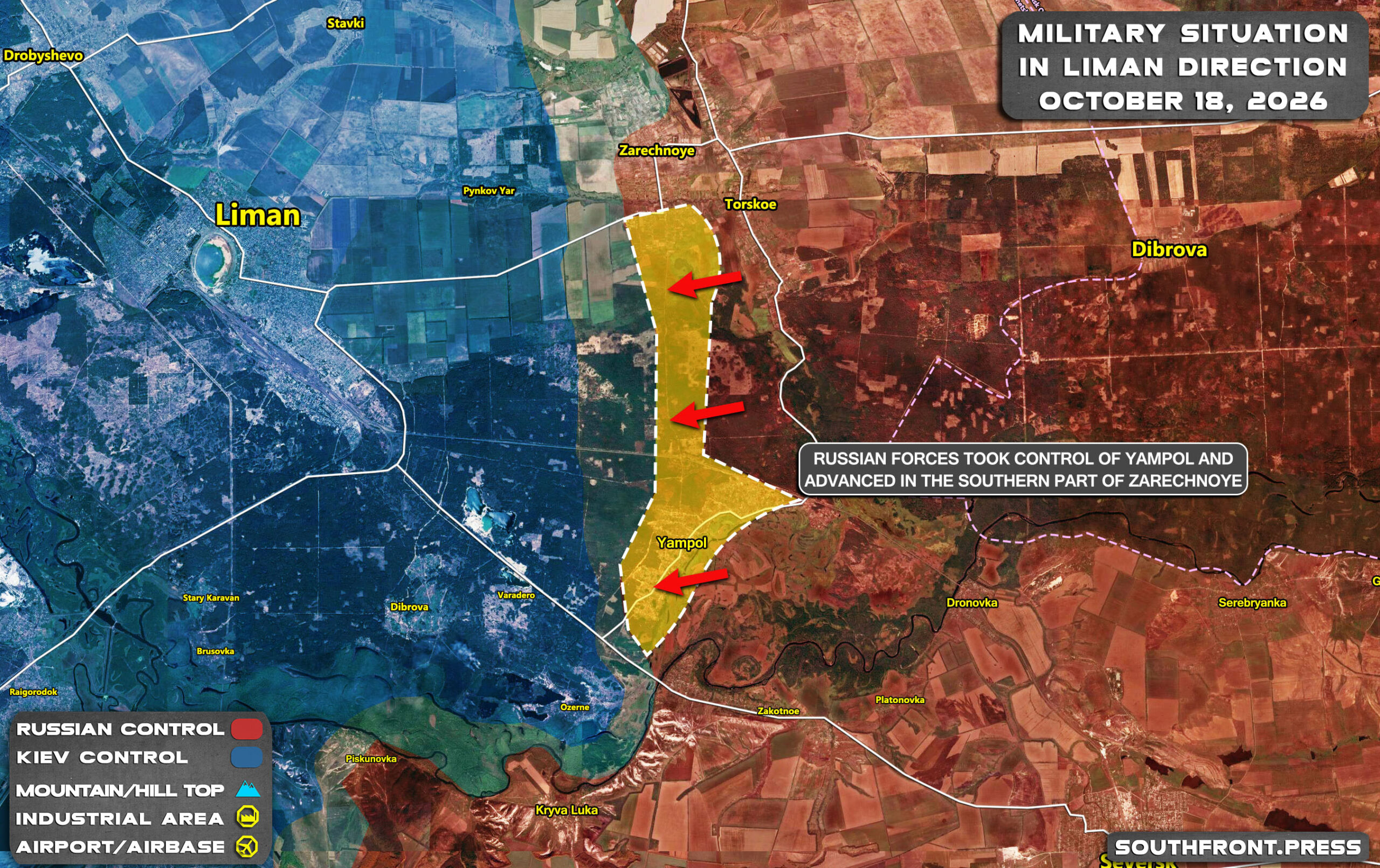
  • Russian forces took control of Yampol and advanced in the southern part of Zarechnoye.

Click to see the full-size image

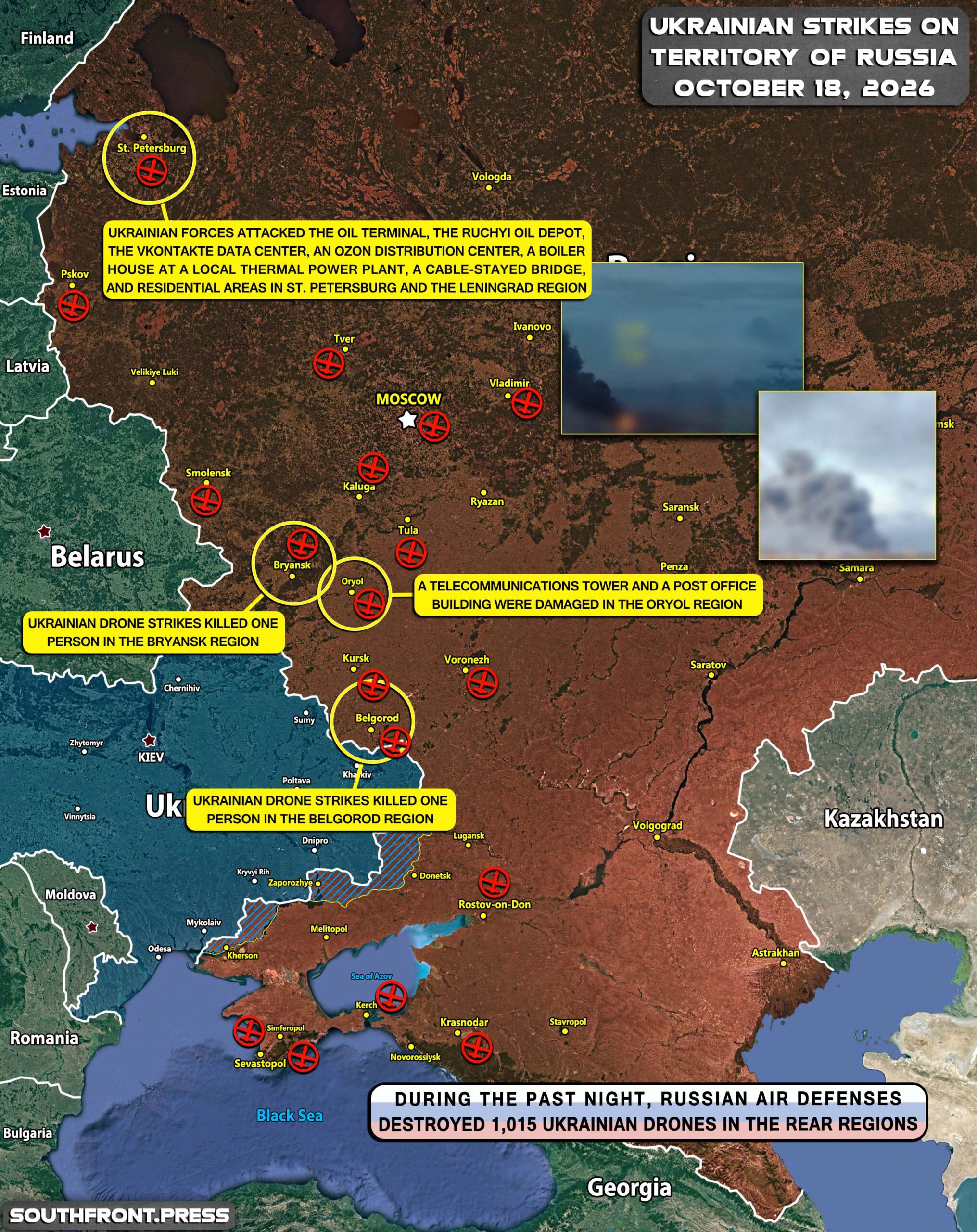
  • During the past night, Russian air defenses destroyed 1,015 Ukrainian drones in the rear regions;
  • Russian air defenses intercepted UAVs in the Belgorod, Bryansk, Vladimir, Kaluga, Kursk, Leningrad, Novgorod, Oryol, Pskov, Ryazan, Smolensk, Tver, and Tula regions, the Moscow region, Krasnodar Krai, the Republic of Crimea, and over the Black Sea;
  • Ukrainian forces attacked the Oil Terminal, the Ruchyi oil depot, the VKontakte data center, an Ozon distribution center, a boiler house at a local thermal power plant, a cable-stayed bridge, and residential areas in St. Petersburg and the Leningrad region;
  • A telecommunications tower and a post office building were damaged in the Oryol region;
  • Ukrainian drone strikes killed one person in the Bryansk region;
  • Ukrainian drone strikes killed one person in the Belgorod region.

MORE ON THE TOPIC:

The post Military Situation In Ukraine And Ukrainian Attacks On Russian Territory On October 18, 2026 (Maps Update) appeared first on South Front.

  •  

Military Situation In Iran On October 18, 2026 (Map Update)

Click to see the full-size image

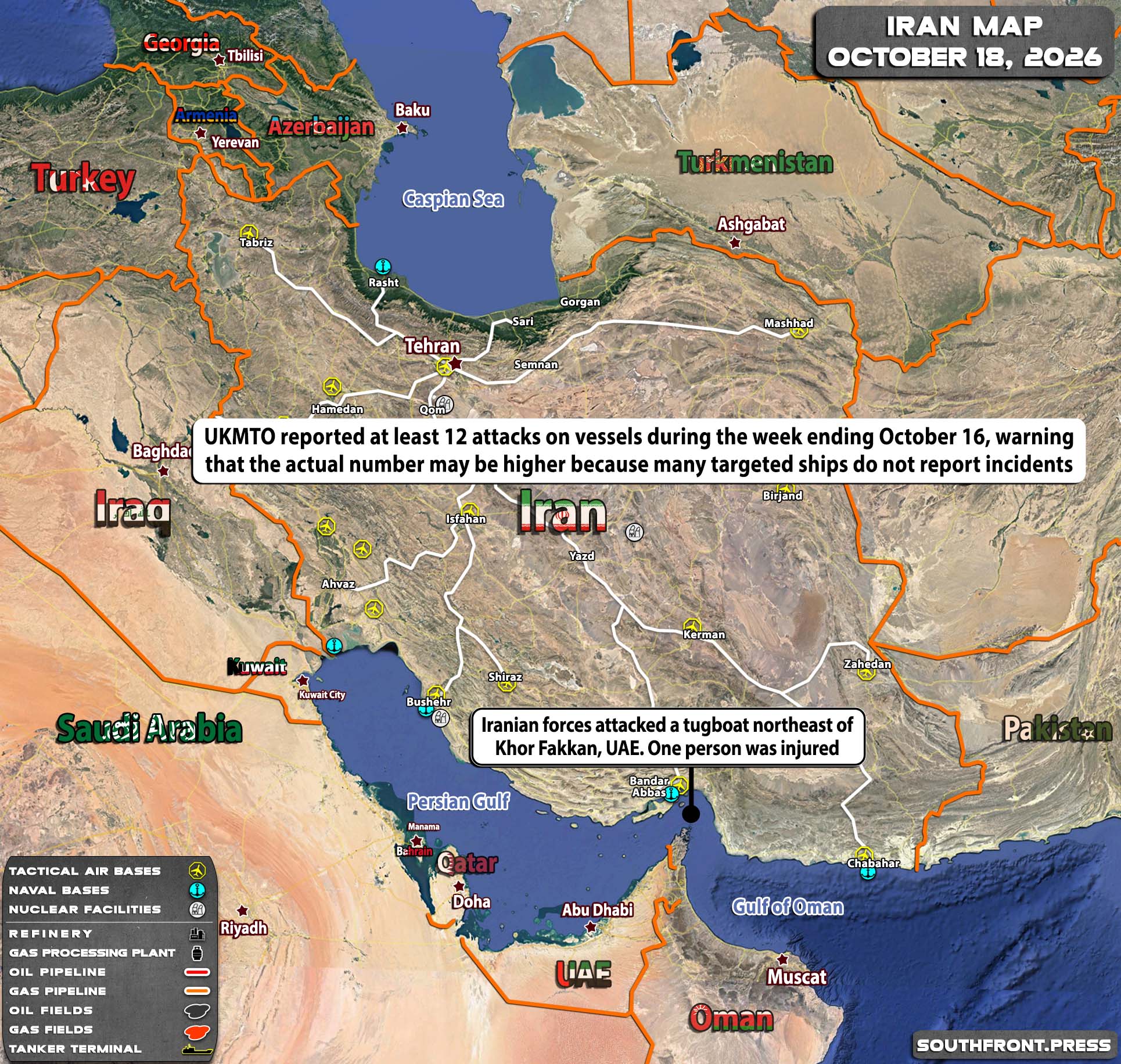
  • Iranian forces attacked a tugboat northeast of Khor Fakkan, UAE. One person was injured;
  • UKMTO reported at least 12 attacks on vessels during the week ending October 16, warning that the actual number may be higher because many targeted ships do not report incidents.

MORE ON THE TOPIC:

The post Military Situation In Iran On October 18, 2026 (Map Update) appeared first on South Front.

  •  

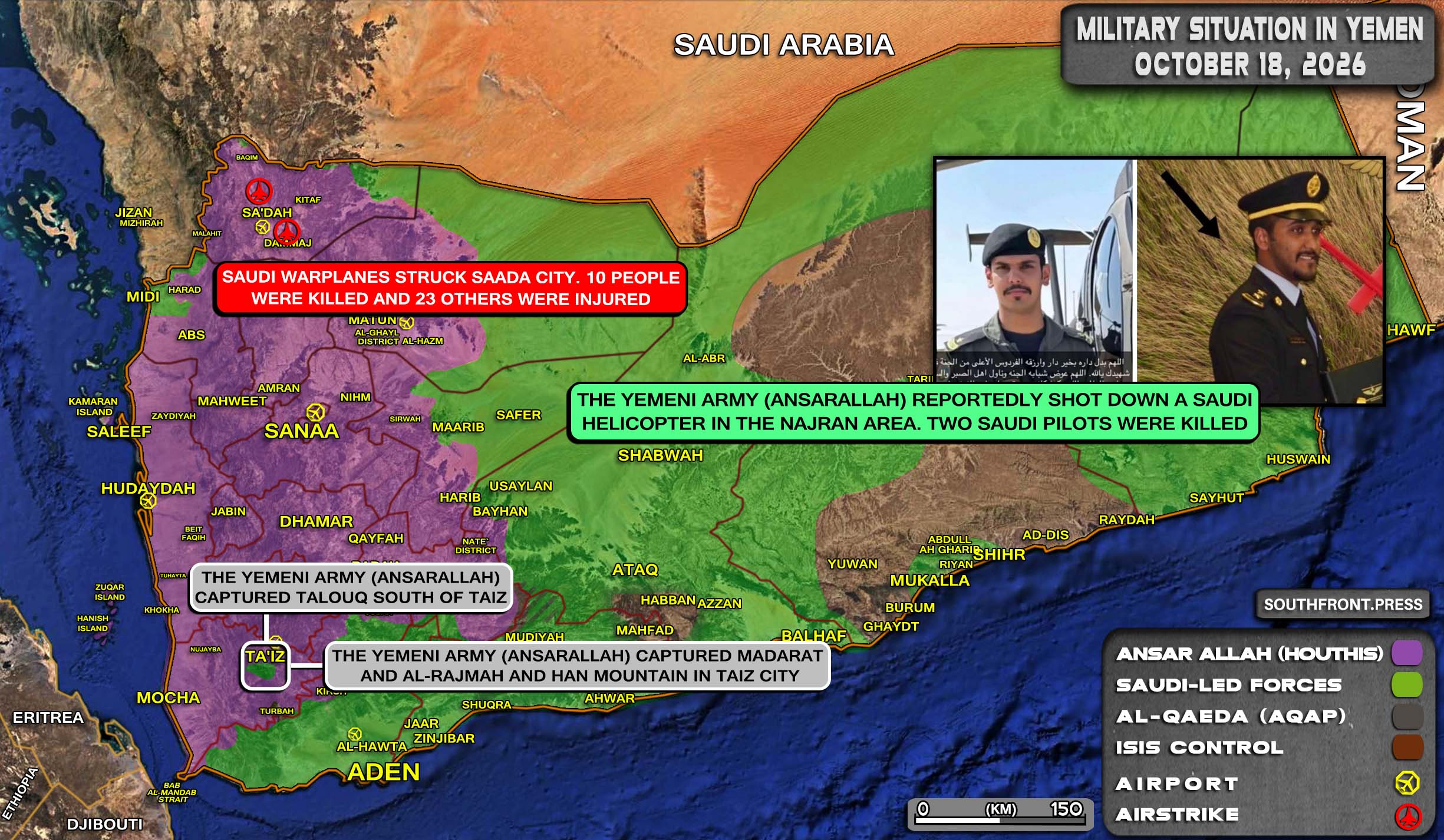
Military Situation In Yemen On October 18, 2026 (Map Update)

Click to see the full-size image

  • The Yemeni army (AnsarAllah) captured Madarat and Al-Rajmah and Han mountain in Taiz city;
  • The Yemeni army (AnsarAllah) captured Talouq south of Taiz;
  • Saudi warplanes struck Saada city. 10 people were killed and 23 others were injured;
  • The Yemeni army (AnsarAllah) reportedly shot down a Saudi helicopter in the Najran area. Two Saudi pilots were killed.

MORE ON THE TOPIC:

The post Military Situation In Yemen On October 18, 2026 (Map Update) appeared first on South Front.

  •  

Ukraine retook Kolodiazi north of Lyman as its drones hit 200-plus Russian vehicles in Operation Vivaldi’s last phase, Ukrainian drone officer says

ukraine retook kolodiazi north lyman its drones hit 200-plus russian vehicles operation vivaldi’s last phase commander says · post northern donetsk oblast neighboring areas territory during vivaldi blue 2022 green

Ukrainian infantry encircled and retook the village of Kolodiazi north of Lyman without getting drawn into street fighting, while a drone battalion kept the sky above them shut, the battalion’s chief of staff told Suspilne on 18 October. The village fell during the fourth and final phase of Operation Vivaldi, Ukraine’s counteroffensive in northern Donetsk Oblast.

For years now, Russia has aimed to seize Lyman and cross the Siverskyi Donets River. It needs this area to encircle Ukraine’s fortress belt of Donetsk Oblast cities from the northwest, ISW assesses. Vivaldi’s four phases retook 277 km² and 16 settlements on that approach, and a veteran of the operation has said Ukraine’s assault troops suffered more than ten times fewer casualties than Russian forces doing it.

Drones over the infantry

The 60th Mechanized Brigade fought in all four phases of Vivaldi and took Kolodiazi in the last one, said the chief of staff of the brigade’s Fatum unmanned systems battalion, callsign Krash.

“Our task, as an unmanned systems battalion, was to escort and ‘close’ the air in front of our infantry to make it impossible for the enemy to hit it. To suppress all the firing assets possible,” he said.

The brigade’s 3rd Mechanized Battalion, the main striking force, encircled Kolodiazi and retook it without getting drawn into street fighting, Krash said. The 1st Mechanized Battalion kept Russian reinforcements out of the area, while drone crews suppressed artillery, hit supply runs, and worked against Russian drone operators.

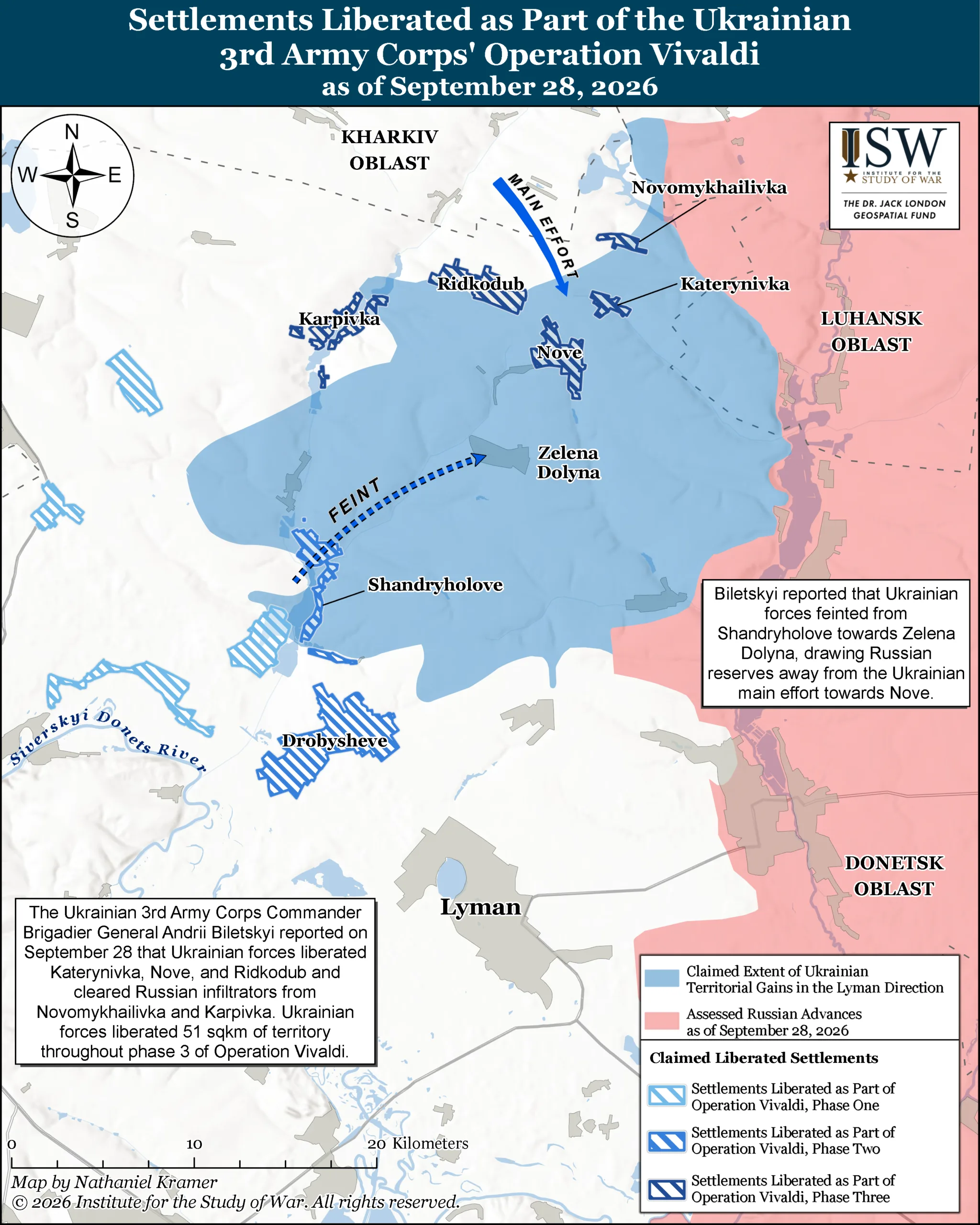
Map of settlements Ukraine's 3rd Army Corps says it liberated north of Lyman, as of 28 September 2026.
Explore further

Vivaldi counteroffensive advanced after Ukraine took Russia’s drones out of the fight, ISW assesses

500 troops and 200-plus vehicles

The drone battalion killed or wounded about 500 Russian troops during the fourth phase and struck Russian armored vehicles, trucks, and motorbikes, its chief of staff said.

“More than two hundred pieces of various equipment: Grad and Uragan multiple rocket launchers, various armored vehicles, tanks, armored combat vehicles. Most of all motorbikes and quad bikes, there the count runs into the hundreds. This is our enemy’s main logistics tool,” he said.

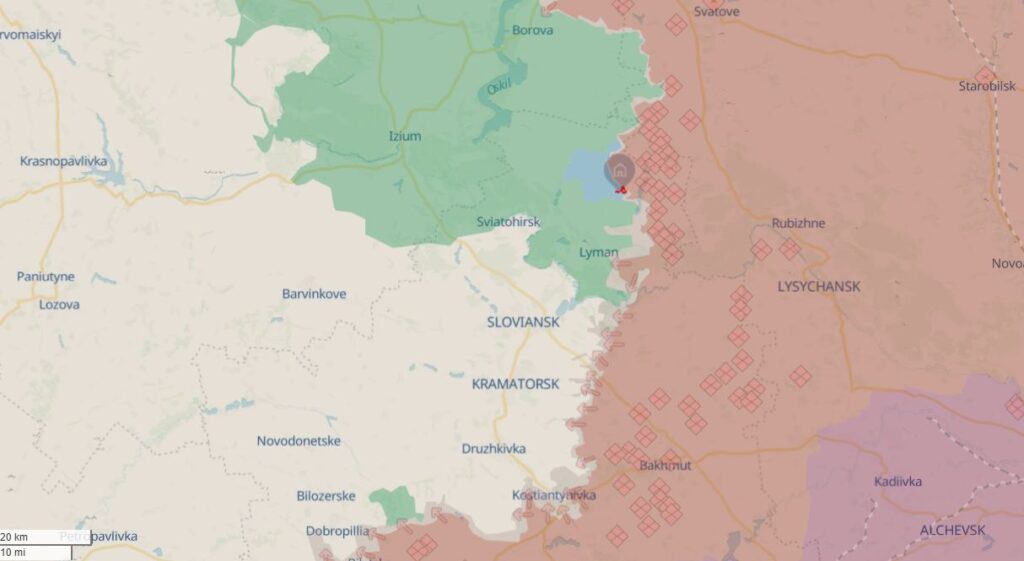
ukraine retook kolodiazi north lyman its drones hit 200-plus russian vehicles operation vivaldi’s last phase commander says · post sector now lyman-tactical-area-october-16-2026 news ukrainian reports
Lyman sector now. Map: ISW

Ghost villages

The villages retaken in northern Donetsk Oblast are nearly empty of civilians, Krash said.

“It’s very typical for de-occupied settlements: these are ghost towns. You can see right away where the occupier stepped. All the settlements are under the control of the Third Army Corps, our forces stand there and prevent enemy infiltration. But civilian life in these towns is either absent or very scarce,” he said.

Third Army Corps commander Brigadier General Andrii Biletskyi reported Kolodiazi’s liberation, along with Zelena Dolyna and Lypove, when he summed up Vivaldi’s fourth phase, which secured 101 km².

  •  
❌