❌

Reading view

Finland and Norway leaders make rare direct call to Putin, breaking with the West’s diplomatic isolation of the Russian leader to influence Ukraine peace talks

Finnish President Alexander Stubb and Norwegian Prime Minister Jonas Gahr Støre in Norway, 16 October 2024. Photo: President of the Republic of Finland

Finnish President Alexander Stubb and Norwegian Prime Minister Jonas Gahr Støre spoke by phone with Russian President Vladimir Putin on 27 October, urging him to de-escalate Russia’s war against Ukraine and resume negotiations. The roughly 90-minute call was coordinated with Kyiv and came ahead of planned trilateral talks between Ukrainian, US, and Russian officials in Abu Dhabi in November.

The initiative marks a rare direct contact between Western European leaders and Putin since Russia launched its full-scale invasion in February 2022. The Nordic leaders are reportedly seeking to influence peace efforts increasingly shaped by US President Donald Trump, amid concerns in Europe that Washington is shifting toward Moscow’s position and sidelining Ukraine’s European partners.

Stubb and Støre said they discussed Russia’s war against Ukraine, upcoming negotiations, and security in Europe. Ukrainian President Volodymyr Zelenskyy said the two leaders had urged Putin to take concrete steps toward de-escalation, particularly regarding attacks on Ukraine’s energy infrastructure.

Zelenskyy says leaders urged energy de-escalation

After the call, Zelenskyy said he had spoken with Stubb and Støre to receive a detailed briefing. He thanked them for supporting Ukraine’s diplomatic efforts and said they had clearly told the Russian leader that real de-escalation steps were needed regarding Ukraine’s energy sector and infrastructure.

Zelenskyy also said the leaders discussed preparations for a trilateral meeting planned for November involving Ukrainian, US, and Russian negotiating teams.

In a joint statement, Stubb and Støre said the call followed their 20 October meeting in Oslo and was held in consultation with Ukraine. They emphasized that Finland and Norway, which both share borders with Russia, would continue their longstanding support for Ukraine.

“The discussion was frank and substantive,” Stubb said, adding that the war’s outcome would directly affect Nordic and broader European security. Støre stressed the war’s enormous human and material costs and said the leaders had emphasized the importance of de-escalation.

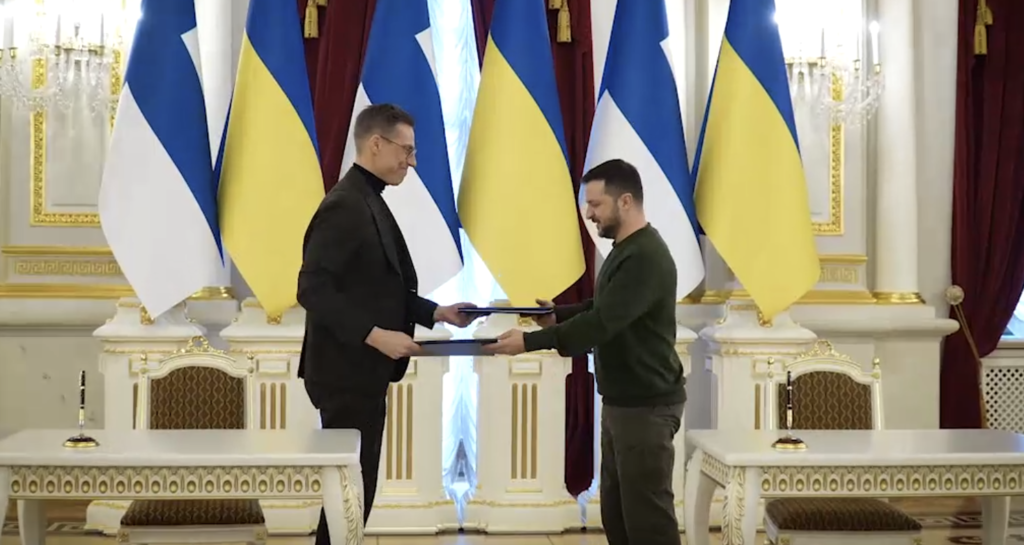
Presidents Volodymyr Zelenskyy (R) of Ukraine and Alexander Stubb (L) of Finland after signing the security agreement. Kyiv, 3 April 2024. Screenshot: Telegram/Zelenskyy Official

Moscow gives no sign of changing its position

The Kremlin’s account of the call offered no indication that Putin was prepared to soften his demands, according to Reuters. It said a just and lasting peace was possible only if Russia’s “legitimate interests” were fully taken into account, while blaming EU and NATO policies for prolonging the fighting.

Russian Foreign Minister Sergei Lavrov dismissed the call as offering nothing new on the conflict and accused European countries of seeking a role in negotiations.

A source close to the Kremlin told Reuters that Putin had said the war must end while taking “the realities on the ground” into account. The source interpreted this as meaning Moscow would not compromise on its goal of capturing the entire Donbas region.

Russia has continued its attacks on Ukraine while demanding territorial concessions. Kyiv, meanwhile, has called for meaningful de-escalation and a settlement that preserves Ukraine’s sovereignty and security.

Nordic initiative draws criticism from European partners

The call comes as European governments seek a greater role in peace efforts led by Trump. Western European leaders have largely avoided direct contact with Putin since the invasion, hoping to isolate Moscow, but concerns have grown that Europe is being sidelined in negotiations.

Stubb said Ukraine had sought to open a new channel of communication and that Europe could no longer remain a bystander to peace efforts. He said the initiative had been discussed with Western allies.

However, Danish Prime Minister Mette Frederiksen criticized the move, saying she saw no signs that Russia wanted peace and arguing that Europe should act together rather than pursue separate initiatives, according to Reuters. 

Reuters added that Swedish Prime Minister Ulf Kristersson said other European leaders had not been informed of the talks and expressed low expectations for the conversation. Polish Prime Minister Donald Tusk also urged caution.

Stubb and Støre stressed that they had acted as leaders of Finland and Norway, not on behalf of Europe as a whole. They said their countries would continue supporting Ukraine while pursuing diplomatic efforts to end the war.

  •  

Why Putin Demands Donbas: The Territorial Ultimatum That Could Shape Ukraine’s Next War

Vladimir Putin’s insistence that Ukraine surrender its remaining positions in Donetsk is not simply a dispute over territory. It is a demand that could dismantle Ukraine’s principal defensive barrier in the east, hand Moscow a military advantage it has struggled to achieve through years of fighting, and establish a precedent for further territorial concessions. The latest diplomatic contacts with European leaders have brought this question back to the centre of negotiations.

There are two ways for Russia to capture the remaining Ukrainian-held cities of Donbas. One is to fight its way through heavily fortified defensive positions, accepting substantial casualties, equipment losses and an uncertain timetable. The other is to secure their evacuation through diplomatic negotiations.

The second would achieve an important Russian military objective without requiring Moscow to bear the full cost of a prolonged offensive.

This distinction helps explain why Vladimir Putin continues to insist that Ukrainian forces withdraw from the remaining government-controlled territory of Donetsk region before a comprehensive settlement can be negotiated.

It also raises a more consequential question: would surrendering Donbas bring the war closer to an end, or would it improve Russia’s position in any subsequent confrontation?

A diplomatic opening without a strategic concession

The issue returned to prominence on 27 October when Finnish President Alexander Stubb and Norwegian Prime Minister Jonas Gahr Støre held a rare telephone conversation with Putin.

According to the Finnish president’s official statement, the call followed discussions in Oslo on 20 October involving Ukrainian President Volodymyr Zelenskyy and US presidential envoy Steve Witkoff.

The Nordic leaders sought to advance preparations for renewed American-mediated negotiations, expected in Abu Dhabi in November. They emphasised that they were acting on behalf of their respective countries rather than representing Europe collectively.

Stubb described the exchange as “frank and substantive”, arguing that direct communication with Moscow was necessary to address the security consequences of the war.

However, the Kremlin’s account offered little indication of movement on the fundamental disagreements.

Moscow insisted that any durable peace must fully accommodate Russian interests. A source close to the Kremlin told Reuters that Putin had reiterated his refusal to compromise on the objective of controlling the entire Donbas.

Following the conversation, Zelenskyy confirmed that the Nordic leaders had briefed him and stressed to Putin the need for concrete measures to reduce attacks on Ukrainian energy infrastructure.

The diplomatic process has therefore resumed without resolving the territorial dispute at its centre.

The military significance of the remaining Donbas

The territory Russia is demanding includes some of Ukraine’s most important surviving defensive positions.

Since fighting began in eastern Ukraine in 2014, Ukrainian forces have constructed and reinforced an extensive defensive system centred on Sloviansk, Kramatorsk, Druzhkivka and Kostiantynivka.

Known as the fortress belt, this network combines urban areas, industrial facilities, transport infrastructure, prepared defensive positions and terrain that complicates offensive operations.

The military importance of this system extends far beyond the administrative boundaries of Donetsk.

According to the Institute for the Study of War, surrendering these positions would allow Russian forces to occupy heavily defended territory without undertaking the prolonged operations otherwise required to capture it.

In its 26 October battlefield assessment, the institute continued to identify the capture of this defensive belt as Russia’s principal military objective in Donetsk. Ukrainian forces retained positions in parts of Kostiantynivka, while Russian operations towards other major cities remained contested.

The implications of a negotiated Ukrainian withdrawal would be substantial.

Russia could occupy the fortified urban corridor, reorganise its forces, establish new logistics routes and potentially redirect formations towards other sectors.

Ukraine, meanwhile, would have to construct or reinforce defensive positions further west, potentially under pressure and in less favourable terrain.

The resulting military imbalance would not necessarily lead to another Russian offensive. But it would change the conditions under which any renewed hostilities might take place.

That is why territory cannot be assessed solely by its surface area. A relatively small section of the front can possess strategic value disproportionate to its size.

Why Moscow prefers a negotiated withdrawal

Russia’s insistence on Donetsk also reflects the limits of what its military has achieved.

Despite years of fighting, Moscow has not secured complete control of the region. Successive offensives have produced territorial gains, but at considerable cost and without the rapid breakthrough originally anticipated.

US Secretary of State Marco Rubio recently acknowledged the central importance of the remaining Ukrainian-held territory.

In an interview published by the US State Department, Rubio characterised the dispute as centred on territory Russia wants but has been unable to capture militarily, while recognising Ukraine’s sovereignty and long-term security concerns.

His remarks demonstrate how Donbas has become the principal territorial obstacle in Washington’s diplomatic calculations.

For Moscow, however, concentrating negotiations on this specific demand offers an additional advantage.

If Ukraine refuses to withdraw, the Kremlin can argue that Kyiv is preventing progress towards peace. If Ukraine agrees, Russia obtains strategically valuable territory without the military costs associated with conquering it.

The demand therefore serves a dual purpose: it establishes a public explanation for the absence of an agreement while offering Russia an immediate military benefit should negotiations succeed on its terms.

The problem with treating Donbas as the final concession

The central weakness in any settlement built around a Ukrainian withdrawal is the assumption that control of Donbas represents the limit of Russia’s territorial ambitions.

Moscow’s previously declared objectives suggest a more complicated picture.

In June 2024, Putin demanded Ukrainian withdrawal from four regions claimed by Russia: Donetsk, Luhansk, Zaporizhzhia and Kherson. Moscow does not fully control these regions, despite claiming to have annexed them in September 2022.

Russia has also demanded restrictions on Ukraine’s military capabilities and future security relationships.

As EU Today previously reported, renewed diplomatic engagement has not produced a clear abandonment of the Kremlin’s wider objectives.

Consequently, transferring the remaining territory of Donetsk would not necessarily satisfy Moscow’s other demands.

There is a significant difference between conceding territory as part of an enforceable settlement and withdrawing from defensive positions as a precondition for negotiating one.

In the first case, territorial arrangements form part of a wider agreement establishing obligations, verification procedures and security guarantees.

In the second, one party makes a potentially irreversible military concession before knowing whether an agreement will ultimately be reached.

This asymmetry is particularly important where the proposed concession directly affects the withdrawing country’s ability to defend itself.

The strategy of incremental gains

One interpretation of Moscow’s approach is that it reflects a strategy of incremental territorial expansion rather than an attempt to achieve all its objectives through a single decisive offensive.

After Russia failed to capture Kyiv in 2022, its military campaign increasingly concentrated on taking territory through successive, often prolonged operations.

The diplomatic equivalent would involve securing one concession, consolidating the resulting advantage and subsequently presenting additional demands.

Under such a scenario, Russia could obtain control of the remaining Donetsk territory, establish new positions closer to Dnipropetrovsk region and later argue that further territorial or security arrangements were necessary to protect its newly acquired frontier.

Moscow has already used the language of protective buffer zones to justify military operations elsewhere in Ukraine.

There is no evidence establishing that such a sequence would inevitably follow a Donbas settlement. Nevertheless, the possibility must be considered when assessing the military consequences of a withdrawal.

The concern is not merely that Russia might violate a future agreement. It is that the agreement itself could alter the strategic balance in ways that make renewed military pressure more effective.

There is also an internal Ukrainian dimension.

An agreement requiring the evacuation of cities defended for years would create substantial political controversy. Disagreements over territorial concessions, security guarantees and the credibility of Western commitments could complicate domestic political stability.

For Moscow, such divisions might provide another means of influencing Ukraine without immediate military escalation.

Donbas and the wider question of Ukrainian sovereignty

Donbas has considerable political significance for Putin beyond its military value.

The conflict in eastern Ukraine began in 2014, following Russia’s annexation of Crimea. Donetsk and Luhansk became central to the Kremlin’s justification for intervention, and their incorporation into Russia was later proclaimed as part of the 2022 annexations.

Control of the entire region would allow Putin to present a tangible achievement after years of warfare.

Yet the Kremlin’s objectives have never been confined exclusively to Donbas.

Putin has repeatedly questioned Ukraine’s historical and political independence, while Russian negotiating demands have extended to the country’s military posture, international alliances and internal political arrangements.

These positions suggest that territorial control forms part of a broader attempt to determine Ukraine’s strategic orientation.

A settlement that ends fighting in Donetsk without resolving these wider disagreements might therefore suspend the conflict rather than settle its underlying causes.

What the next negotiations must establish

The planned talks in Abu Dhabi will test whether Moscow is prepared to distinguish between its territorial demands and the conditions necessary for a sustainable ceasefire.

An immediate halt to hostilities along existing lines would preserve the military status quo while allowing negotiations to proceed.

Russia has resisted this approach, arguing that a temporary ceasefire could enable Ukraine to rebuild its forces without resolving the conflict.

Ukraine, by contrast, argues that withdrawing from fortified territory without credible guarantees would expose it to renewed attack.

Neither side can be expected to disregard the military implications of the proposed arrangements.

For European governments, the principal question is consequently not simply whether Ukrainian and Russian representatives can be brought back to the negotiating table.

It is whether any agreement can prevent the territorial settlement from becoming the starting position for another war.

Stubb and Støre’s conversation with Putin demonstrated that diplomatic communication remains possible. It did not establish that Moscow is prepared to abandon its existing territorial objectives.

The distinction matters.

Putin’s demand for Donbas offers Russia two potential advantages: a justification for continuing the war if Kyiv refuses, and a substantial military gain if Kyiv accepts.

That does not prove the Kremlin has already decided to resume hostilities after a negotiated withdrawal. It does, however, explain why the terms, sequencing and enforceability of any agreement are as consequential as the territory itself.

The essential question facing negotiators is therefore not only whether Russia can obtain Donbas through diplomacy rather than force.

It is whether the price of that concession would be a lasting peace — or a weaker Ukrainian defensive position if peace fails.

  •  

Finland’s Stubb and Norway PM call Putin in break with previous European stance

The leaders of Finland and Norway initiated a direct call with Russian President Vladimir Putin on Tuesday morning amid broader diplomatic efforts to wind down Russia’s yearslong war with Ukraine.  Finnish President Alexander Stubb and Norwegian Prime Minister Jonas Gahr Støre noted in a joint press release that they did not speak on behalf of…

  •  

Finland and Norway Hold Direct Talks with Putin Ahead of Ukraine Peace Negotiations, Exposing European Divisions

Finnish President Alexander Stubb and Norwegian Prime Minister Jonas Gahr Støre have spoken directly with Vladimir Putin before briefing Volodymyr Zelenskyy. The initiative, undertaken in consultation with Ukraine, comes ahead of planned negotiations in Abu Dhabi but has drawn criticism from other Nordic leaders.

Finnish President Alexander Stubb and Norwegian Prime Minister Jonas Gahr Støre held a telephone conversation with Russian President Vladimir Putin on Tuesday, 27 October, marking an unusual direct diplomatic engagement between Moscow and two European NATO members since Russia’s full-scale invasion of Ukraine in February 2022.

The conversation, initiated by the two Nordic leaders from Helsinki, was followed by a separate call with Ukrainian President Volodymyr Zelenskyy. According to a joint statement released by the Norwegian government, the initiative had been prepared in consultation with Kyiv.

The objective was to communicate directly with Putin about efforts to end the war and the forthcoming negotiations involving Ukraine, Russia and the United States.

Stubb described the exchange as frank and substantive, arguing that Finland and Norway had particular reasons to participate in discussions concerning European security.

“We are neighbouring countries to Russia,” he said, adding that the war’s outcome would directly affect European security.

Both leaders reaffirmed their governments’ continuing support for Ukraine while calling for renewed negotiations. Støre emphasised the humanitarian and economic consequences of the conflict and the need for de-escalation.

Importantly, their statement specified that they were acting as national leaders rather than representatives of Europe collectively.

Zelenskyy briefed after discussions with Moscow

Following the conversation with Putin, Stubb and Støre spoke with Zelenskyy, who confirmed the exchange in a statement issued by his office.

The Ukrainian president thanked them for their detailed briefing and diplomatic engagement.

According to Zelenskyy, the two leaders had communicated Ukraine’s demand for concrete steps to reduce attacks against its energy facilities and other infrastructure.

The discussion also covered preparations for trilateral negotiations involving Ukrainian, American and Russian delegations, provisionally planned for November.

Kyiv’s confirmation that it had been consulted before the Putin conversation is significant. Ukraine has consistently maintained that decisions concerning its sovereignty, territory and security cannot be negotiated without its participation.

Oslo talks establish new diplomatic channel

Tuesday’s telephone diplomacy followed a meeting in Oslo on 20 October involving Zelenskyy, Stubb, Støre and representatives of US President Donald Trump.

American special envoy Steve Witkoff participated in person, while Jared Kushner joined remotely. European and NATO representatives also attended related discussions.

According to the Ukrainian presidency’s account, the consultations addressed possible steps towards ending the war and establishing security arrangements after a settlement.

Witkoff subsequently travelled to St Petersburg on 21 October for discussions with Putin.

The diplomatic contacts have produced plans for another round of talks in Abu Dhabi, expected after 4 November, although the precise date and representation remain subject to confirmation.

The European Commission has also sought involvement. During its 21 October press briefing, the Commission confirmed its participation in the Oslo consultations, which addressed territorial questions, security guarantees and post-war economic arrangements.

As EU Today previously reported, discussions about appointing a European representative to negotiations have exposed disagreements over who should speak for European governments and what authority such a representative would possess.

Moscow maintains its negotiating position

The Kremlin’s account of Tuesday’s conversation offered little indication of a change in Russia’s principal demands.

According to reports citing the Kremlin’s statement, Putin insisted that a lasting settlement would require what Moscow described as full recognition of Russia’s legitimate interests.

He also accused NATO and European Union countries of pursuing confrontational policies that prolonged the conflict.

These statements indicate that the reopening of direct communication has not, by itself, resolved the differences between the negotiating parties.

Russia continues to seek arrangements concerning Ukrainian territory and the European security order, while Kyiv maintains that its sovereignty and territorial integrity must be respected.

Denmark questions independent Nordic diplomacy

The initiative has also revealed differences among European governments over direct engagement with Moscow.

Danish Prime Minister Mette Frederiksen criticised the Finnish-Norwegian approach, saying it had not been coordinated with Denmark and warning against individual European countries pursuing separate diplomatic initiatives.

Swedish Prime Minister Ulf Kristersson also expressed reservations about contacts that might undermine a common European position.

Their objections highlight a distinction between consultation with Ukraine and agreement among European governments on the organisation of negotiations.

For Finland and Norway, both of which share borders with Russia, the outcome of the conflict carries direct implications for security in the Baltic Sea region and the High North.

The immediate question is whether their intervention can facilitate substantive negotiations without weakening coordination between Kyiv and its European partners.

With the next US-mediated talks expected in November, Tuesday’s contacts establish another channel of communication with Moscow. Whether that channel produces movement on territorial disputes, security guarantees or an eventual ceasefire remains unresolved.

  •  

EU and Arab States Challenge Turkey–Libya Maritime Agreement as Mediterranean Dispute Deepens

A dispute over maritime jurisdiction in the Eastern Mediterranean has entered a new phase after the European Union joined Greece, Cyprus, Egypt, Bahrain and the United Arab Emirates in formally rejecting an agreement between Turkey and Libya.

The six parties issued a joint declaration at the United Nations on 26 October, following the decision by Libya’s eastern-based House of Representatives to approve a maritime delimitation memorandum originally signed with Ankara in 2019.

The declaration, delivered by Greek Foreign Minister Giorgos Gerapetritis, argued that the agreement disregards the maritime rights of other coastal states and cannot establish boundaries affecting countries that are not parties to it.

Turkey has rejected the criticism, maintaining that its agreement with Libya complies with international law and protects the legitimate interests of both countries.

The competing positions concern more than the interpretation of a maritime boundary. They affect offshore energy exploration, relations between Turkey and its neighbours, and the political balance within Libya itself.

Why Libya’s decision changes the dispute

The original memorandum was signed in November 2019 between Turkey and Libya’s then internationally recognised Government of National Accord, based in Tripoli.

It established a claimed maritime boundary extending across part of the Eastern Mediterranean, where Greece maintains that the maritime entitlements of its islands, including Crete, must be taken into account.

The agreement was opposed by Greece, Cyprus and Egypt, while Libya’s rival eastern authorities initially rejected it.

That division appeared to weaken the political foundations of the arrangement, even though Ankara continued to defend its validity.

However, on 20 October 2026, Libya’s eastern-based House of Representatives reversed its previous opposition and approved the memorandum.

The decision reflects changes in relations between Turkey and eastern Libya, where military commander Khalifa Haftar has exercised considerable influence.

Turkey has expanded contacts with authorities in Benghazi despite having previously been associated primarily with the rival administration in Tripoli.

Approval by the eastern parliament consequently gives the agreement broader political acceptance within Libya than it enjoyed in 2019, although it does not resolve the country’s institutional divisions or the objections raised by neighbouring states.

A dispute over geography and maritime rights

The central disagreement concerns the legal principles used to determine maritime boundaries.

Under the United Nations Convention on the Law of the Sea, coastal states possess rights within exclusive economic zones, while the delimitation of overlapping claims is intended to produce an equitable solution.

Greece argues that Turkey and Libya cannot establish the maritime boundary claimed in their memorandum without disregarding the legal entitlements of Greek islands situated between their coastlines.

The Greek Foreign Ministry’s response maintains that geography and the law of the sea cannot be changed through parliamentary approval of a bilateral agreement.

Turkey takes a different position on the weight that islands should carry when continental shelves and maritime jurisdictions are delimited, and is not itself a party to UNCLOS.

The dispute therefore involves competing interpretations of international maritime law as well as disagreements over the boundaries shown on maps.

The European Union has aligned itself with Greece and Cyprus.

In a statement issued on 21 October, EU foreign policy chief Kaja Kallas described the memorandum as incompatible with the law of the sea and incapable of producing legal consequences for third states.

The latest declaration extends that position into a broader diplomatic coalition involving governments from the Gulf and North Africa.

Ankara rejects the criticism

President Recep Tayyip Erdoğan responded on 26 October by arguing that objections from the EU and other parties had no legitimate basis.

According to his remarks on the agreement, Turkey was not seeking an advantage at the expense of other Mediterranean countries.

Ankara’s position is that its maritime arrangements with Libya reflect the interests of two sovereign states and should not be invalidated by objections from outside parties.

This creates a diplomatic complication for the EU.

Turkey remains a NATO member and an important partner on migration, regional security and Black Sea affairs, while Greece and Cyprus are EU member states whose maritime claims Brussels supports.

The Union must therefore manage a disagreement involving a strategically important partner without retreating from its established legal position.

Energy resources and Libya’s political future

The Eastern Mediterranean contains established and potential offshore gas resources, giving maritime boundaries commercial significance.

Delimitation determines which governments may authorise exploration and exploitation in particular areas, while overlapping claims can discourage investment or provoke disputes over survey vessels and drilling operations.

Greece has already concluded maritime delimitation agreements with Italy and Egypt, including a partial agreement with Cairo in 2020 that overlaps with areas claimed under the Turkish-Libyan arrangement.

The competing agreements illustrate why the issue cannot be settled exclusively through bilateral negotiations that exclude other interested coastal states.

Libya’s internal political structure introduces another uncertainty. The country remains divided between competing institutions, and the European declaration explicitly connects maritime stability with the reunification of Libyan state authorities.

As EU Today previously examined in its coverage of Eastern Mediterranean tensions, disputes over maritime jurisdiction intersect with regional military positioning and the broader relationship between Turkey and European governments.

For the moment, the confrontation remains diplomatic.

The principal question is whether the parties can prevent overlapping legal claims from developing into renewed confrontations over exploration rights while maintaining channels for negotiations with Libya and Turkey.

  •  

L’ennesima iniziativa di pace finanziarizzata dalla scuderia Witkoff-Kushner

Anziché dare priorità ai profitti delle parti interessate, la coppia Witkoff-Europa dovrebbe concentrarsi sull’architettura di sicurezza eurasiatica e sui confini tra NATO, Russia e Cina per guadagnare terreno a Mosca.

Segue nostro Telegram.

Già nel dicembre 2025, il commentatore statunitense Sundance, scrivendo sul Conservative Treehouse, aveva parlato della nuova soluzione di “diplomazia finanziaria” proposta da Steve Witkoff e Jared Kushner per l’Ucraina, che “richiedeva [l’istituzione di] un sistema in cui l’opportunità occidentale di trarre benefici finanziari potesse continuare”.

Da questa prospettiva, i negoziatori statunitensi «proporrebbero un piano a lungo termine per garantire benefici finanziari continui».Dal loro attuale linguaggio sembra che Witkoff e Kushner siano ancora fiduciosi di poter costruire un sistema di ricompense finanziarie per le banche occidentali, gli investitori, i politici e i funzionari ucraini che consenta di mantenere i benefici della guerra senza l’ingrediente accessorio dello spargimento di sangue.Come ha osservato Sundance —«Se la delegazione statunitense riuscirà a portare a termine questa impresa, allora la Russia potrà ottenere il territorio che desidera, i funzionari ucraini corrotti potranno continuare a sottrarre fondi dagli investimenti, l’UE potrà mantenere il potere di cui dispone per esigere pagamenti finanziari, i politici americani potranno utilizzare i “progetti di ricostruzione a lungo termine” per il riciclaggio di denaro e le banche d’investimento di natura mista pubblico-privata potranno trarre vantaggio dallo sfruttamento delle risorse ucraine».

Da questa evidente visione del mondo del settore immobiliare newyorkese, tutte le altre questioni — i confini territoriali, la sicurezza e l’ingerenza della NATO nell’architettura di sicurezza dell’Asia centrale — non sono che «dettagli secondari» «rispetto a ciò che conta davvero, il denaro».

La diplomazia monetaria, tuttavia, non ha portato una soluzione per l’Ucraina (né, del resto, per Gaza neppure). Ciononostante, Witkoff ha un nuovo piano che David Ignatius ha delineato nella sua rubrica sul Washington Post.

Ignatius sottolinea che, nonostante il recente «trambusto» in Ucraina riguardo ai suoi attacchi alle raffinerie russe, «gli Stati Uniti e l’Europa si stanno orientando verso una proposta di pace congiunta che garantirebbe benefici finanziari e di sicurezza sia all’Ucraina che alla Russia come base per una soluzione territoriale che non soddisfi pienamente gli obiettivi bellici di entrambe le parti». In altre parole, un «incentivo» offerto per persuadere le parti a smettere di bombardare le raffinerie avversarie e ad aprire la strada a questa «nuova» iniziativa.

Se Zelensky acconsentisse a sospendere gli attacchi alle raffinerie, «torneremo in gioco e ci recheremo a Mosca», ha dichiarato un funzionario americano a Ignatius.

In sintesi, il piano in quattro punti prevede un generoso quadro di ricostruzione per soddisfare «le innumerevoli esigenze finanziarie di Zelensky»; garanzie di sicurezza per l’Ucraina equivalenti all’articolo 5 della NATO; l’integrazione economica di Russia, Ucraina ed Europa attraverso un accordo energetico — «Questo potrebbe consistere in un oleodotto che trasporti petrolio e gas russi verso l’Europa, con Ucraina e Russia che si dividono i profitti. Un oleodotto di questo tipo potrebbe ridurre drasticamente i costi energetici europei», ha affermato un funzionario statunitense. Oltre a garantire alla Russia «un accesso a lungo termine al mercato energetico europeo», un accordo di pace specificherebbe come e quando verrebbero revocate le attuali sanzioni economiche contro la Russia.

L’ultimo punto – udite udite – sarebbe un cessate il fuoco lungo l’attuale linea del fronte, ovvero la «linea di controllo».

Sembra incredibile: gli Stati Uniti e gli europei negoziano tra loro, apparentemente ignari delle dichiarazioni esplicite rilasciate dalla parte russa.

Petrolio e gas verrebbero forniti dalla Russia agli europei bisognosi che hanno volontariamente rinunciato alle precedenti forniture russe a basso costo, che sono intrappolati dalle loro stesse decisioni e che denigrano la Russia in ogni occasione. E con i profitti da «dividere» con l’Ucraina? La Russia non accetterà mai una proposta così unilaterale.

Il ministro degli Esteri Lavrov ha dichiarato all’Assemblea Generale delle Nazioni Unite che non ci sarà alcun cessate il fuoco in nessuna forma. Ciò significa che eventuali negoziati dovrebbero svolgersi sotto il fuoco nemico, e Putin ha suggerito che, anche in tal caso, «ci penserebbe due volte» prima di avviare qualsiasi trattativa (sotto il fuoco nemico o meno).

Il portavoce di Putin, Dmitry Peskov, ha confermato proprio la scorsa settimana che «soluzioni e accordi frammentari» impedirebbero il raggiungimento di una soluzione globale; nemmeno un «congelamento» del conflitto sarebbe d’aiuto —

«[L’Ucraina] è una questione estremamente complessa e la soluzione deve essere globale… Abbiamo bisogno di una soluzione per le generazioni future — una soluzione garantita e protetta da eventuali battute d’arresto».

Sembra che gli europei non abbiano compreso che una cessazione delle ostilità in stile coreano (come sostenuto dal generale Kellogg) lungo un fronte in cui due eserciti si fronteggiano sia la ricetta per non giungere a nessuna soluzione. Sono trascorsi 73 anni da quando la guerra di Corea è stata congelata dall’armistizio. Nulla è cambiato.

Il ripetuto ricorso a questo mantra di un cessate il fuoco lungo la linea di contatto, anziché «prima la soluzione, poi il cessate il fuoco», grida ai russi che l’Occidente vuole tenere l’Ucraina in serbo per il momento in cui sarà necessario creare una piattaforma da cui esercitare (nuovamente) pressione sulla Russia in futuro.

Il difetto fatale di questa iniziativa è la sua sordità culturale. Per Witkoff e Kushner può anche trattarsi «di ciò che conta davvero: il denaro» — ma non è così per la Russia.

Se la coppia Witkoff-Europa ricordasse la storia russa, capirebbe perché, per la Russia, la sicurezza, la sicurezza, la sicurezza viene prima di tutto.

Walter Munchau ha messo in guardia proprio questa settimana che «la guerra in Ucraina rischia di intensificarsi» —

«Non dovremmo farci illusioni riguardo a una guerra con la Russia. Non siamo assolutamente in grado di vincere. Quali mercati obbligazionari saranno i primi a crollare? Chi esaurirà per primo i missili intercettori? … Sotto ogni [aspetto] — militare, energetico, finanziario — l’Europa è in svantaggio. E non è tutto. Esiste uno scenario relativamente plausibile in cui l’Ucraina e l’Iran si fondano in un’unica guerra nell’Eurasia occidentale — e diventino il conflitto per procura definitivo tra Stati Uniti e Cina».

Se, invece di dare la priorità alla continua «truffa degli stakeholder», con il suo meccanismo volto a garantire «che l’opportunità occidentale di trarre benefici finanziari continui», la coppia Witkoff-Europa scegliesse piuttosto di affrontare gli aspetti fondamentali del conflitto — la questione più profonda di un’architettura di sicurezza eurasiatica; la definizione di dove si trovi esattamente, dal punto di vista fisico, la frontiera che separa gli interessi di sicurezza della NATO da quelli sino-russi — potrebbe trovare un pubblico più ricettivo nel suo prossimo viaggio a Mosca.

Purtroppo, circoscrivere l’estensione della NATO non è possibile — allo stato attuale delle cose.

  •  
❌