❌

Reading view

Japan To Assemble AMRAAM Missiles As U.S. Moves To Dramatically Boost AIM-120 Production

The United States and Japan will establish a facility in Japan for the final assembly and inspection of AIM-120 Advanced Medium-Range Air-to-Air Missiles (AMRAAMs), advancing a bilateral effort to expand munitions production as demand rises across the U.S. and allied military forces.

Japanese Defense Minister Shinjiro Koizumi announced the agreement following discussions with U.S. Secretary of War Pete Hegseth on the sidelines of the ASEAN Defense Ministers’ Meeting-Plus in Cebu, Philippines. The facility will operate under the broader Operation Supercharge initiative, which seeks to accelerate cooperation between the two countries on defense equipment and technology.
Secretary of War Pete Hegseth shakes hands with Japanese Minister of Defense Shinjirō Koizumi at the the 13th ASEAN Defence Ministers’ Meeting-Plus in Cebu, Philippines, Oct. 28, 2026. ADMM+ is an annual high-level ASEAN engagement that promotes regional peace and stability through dialogue and defense cooperation. (DOW photo by U.S. Air Force Master Sgt. Brycen Guerrero)
Secretary of War Pete Hegseth shakes hands with Japanese Minister of Defense Shinjirō Koizumi at the 13th ASEAN Defense Ministers’ Meeting-Plus in Cebu, Philippines, on October 28, 2026. DOW photo by U.S. Air Force Master Sgt. Brycen Guerrero

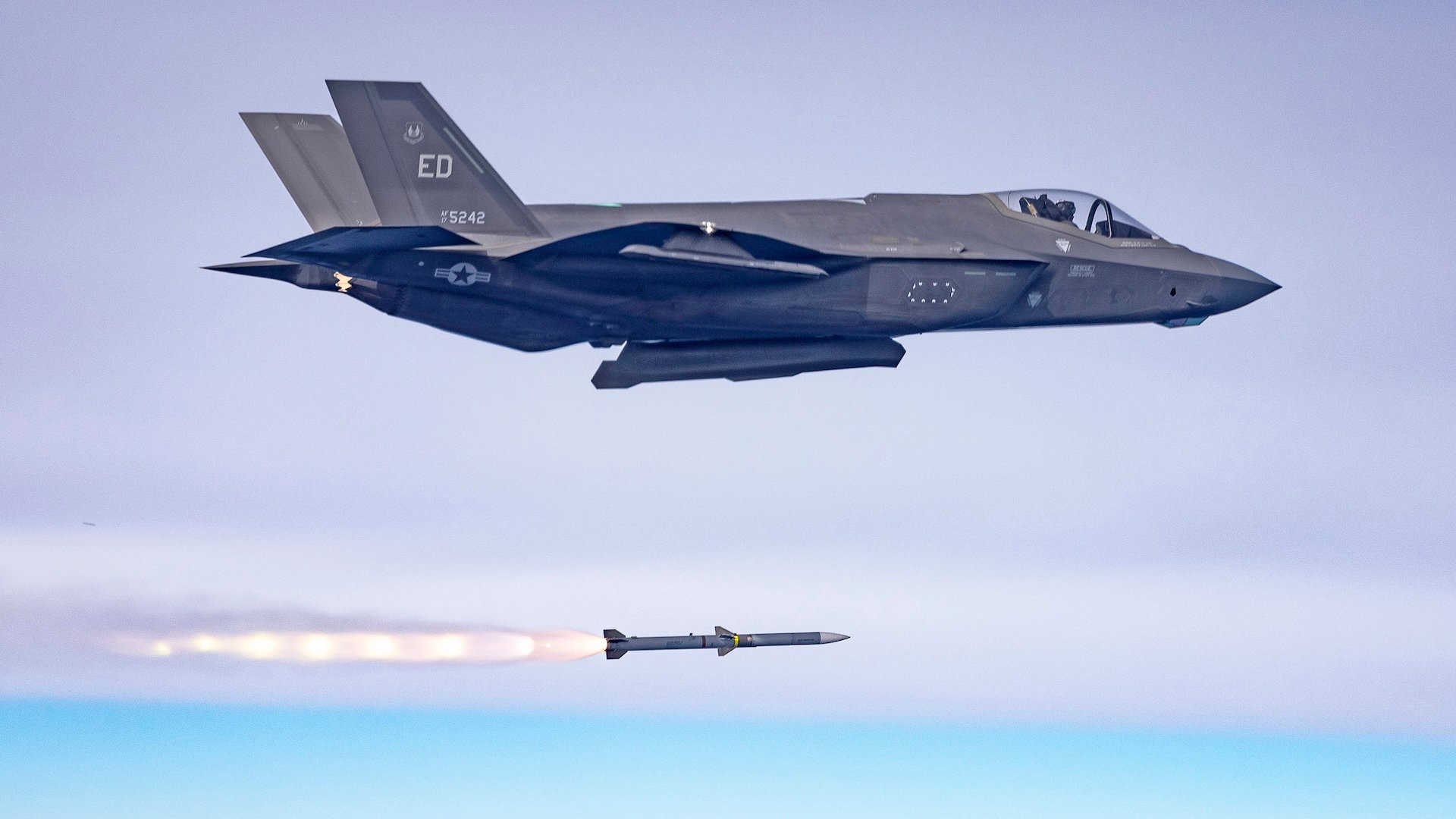
“We finally reached an agreement on the establishment of a final assembly and inspection facility in Japan for the AMRAAM air-to-air missile, which is essential for the F-35,” Koizumi said, according to a translation of his remarks published by Air & Space Forces Magazine.

Koizumi described the agreement as a means of ensuring access to equipment required by both countries while strengthening Japan’s domestic defense industrial base. At this point, the facility’s location, construction timeline, anticipated production capacity, and Japanese industrial partner are yet to be disclosed.
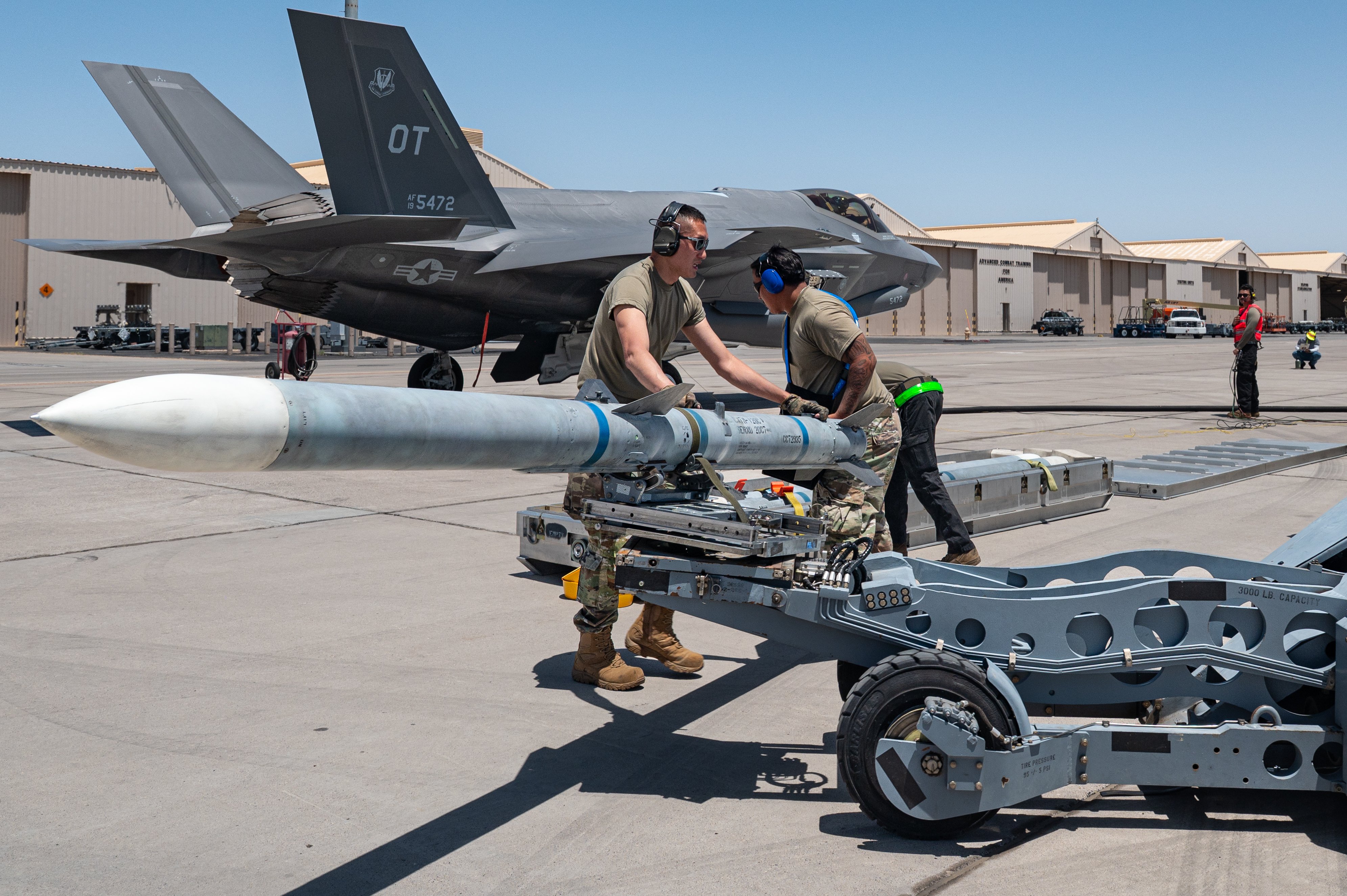
U.S. Air Force Staff Sgt. Andrew Wilson, left, a weapons load crew chief, and Senior Airman Anthony Silva, a weapons load crew member, assigned to the 57th Aircraft Maintenance Squadron’s Bolt Aircraft Maintenance Unit, secure a munition onto a bomb lift truck during a hot integrated combat turn (ICT) exercise at Nellis Air Force Base, Nevada, June 23, 2025. During hot ICTs, four AIM-120 Advanced Medium-Range Air-to-Air Missiles are loaded onto an F-35 Lightning II while the aircraft is simultaneously refueled with its engines running. (U.S. Air Force photo by William R. Lewis)
U.S. Air Force weapons load crew secure an AMRAAM onto a bomb lift truck at Nellis Air Force Base, Nevada, June 23, 2025. U.S. Air Force photo by William R. Lewis

The announcement follows a September award to RTX subsidiary Raytheon for a five-year AMRAAM production contract, with options for two additional years, valued at up to $20.7 billion. Under a framework agreement announced in February, Raytheon is working toward annual production of at least 1,900 missiles. That figure represents the overall production target, of which the future Japanese facility will account for a share. AIM-120s can cost over $1 million per unit, depending on variant.

The new arrangement also comes after more than two years of discussions over Japanese participation in AMRAAM manufacturing. The initiative emerged in 2024, followed by a feasibility study supported by Mitsubishi Electric and Raytheon. By April 2026, discussions had expanded to include possible Japanese production of circuit card assemblies in addition to final assembly and inspection.

New Production Node For A High-Demand Missile

The AIM-120 beyond-visual-range air-to-air missile is used by a wide range of U.S. and allied combat aircraft, including the F-35. Examples of the stealth fighter are operated by U.S. Air Force and Marine Corps units stationed in Japan, as well as by the Japan Air Self-Defense Force (JASDF). Both the U.S. Air Force and JASDF also operate F-15 variants in Japan, for which AMRAAM is similarly a primary weapon.
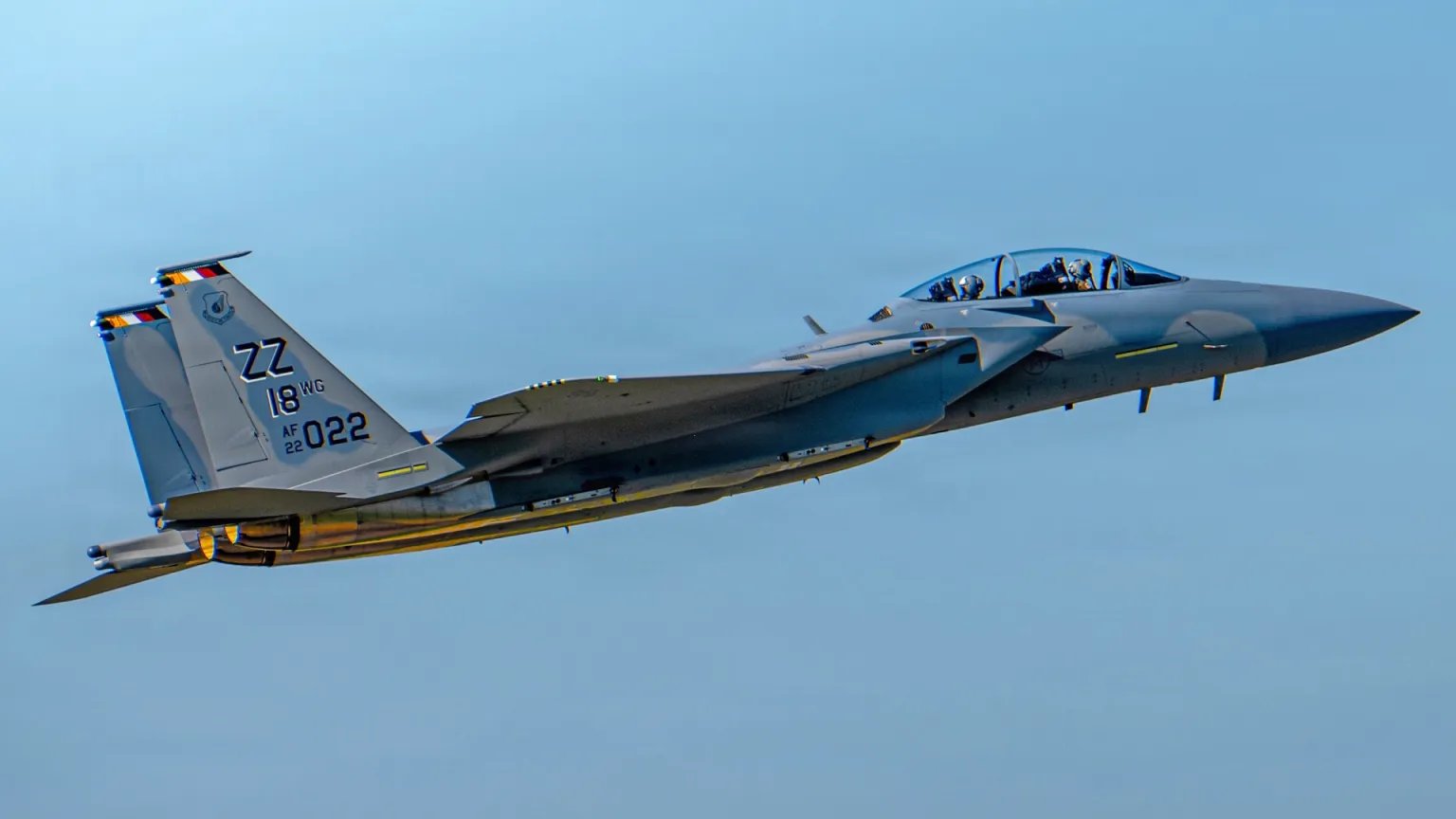
A first F-15EX Eagle II designated for Kadena Air Base, Japan, takes off at Boeing’s St. Louis facility. U.S. Air Force photo by Senior Airman Melany Bermudez

AMRAAM is also employed by ground-based air-defense systems, including the National Advanced Surface-to-Air Missile System (NASAMS). This system protects the U.S. Capital Region and over a dozen countries around the globe. It has been extensively battle-proven in Ukraine over nearly three years of operations.

Raytheon says the weapon is fielded by 44 countries and operates across 14 platforms. Its continued importance to fighter operations and air defense has made expanding manufacturing capacity a priority as the United States seeks to replenish inventories and meet soaring international demand. This is in stark contrast to the situation only a few years ago, when global AMRAAM stockpiles were viewed as plentiful.

Since then, AMRAAMs have been used extensively in the U.S. and allied campaign against Houthi drones, as well as in engagements over Syria and Iraq during efforts to defend Israel against multiple Iranian attacks. Ukraine has also expended substantial numbers of these missiles to counter Russian drones and cruise missiles, employing them through NASAMS air defense systems and, more recently, its F-16 fighters. These munitions have been supplied by the United States and NATO allies.
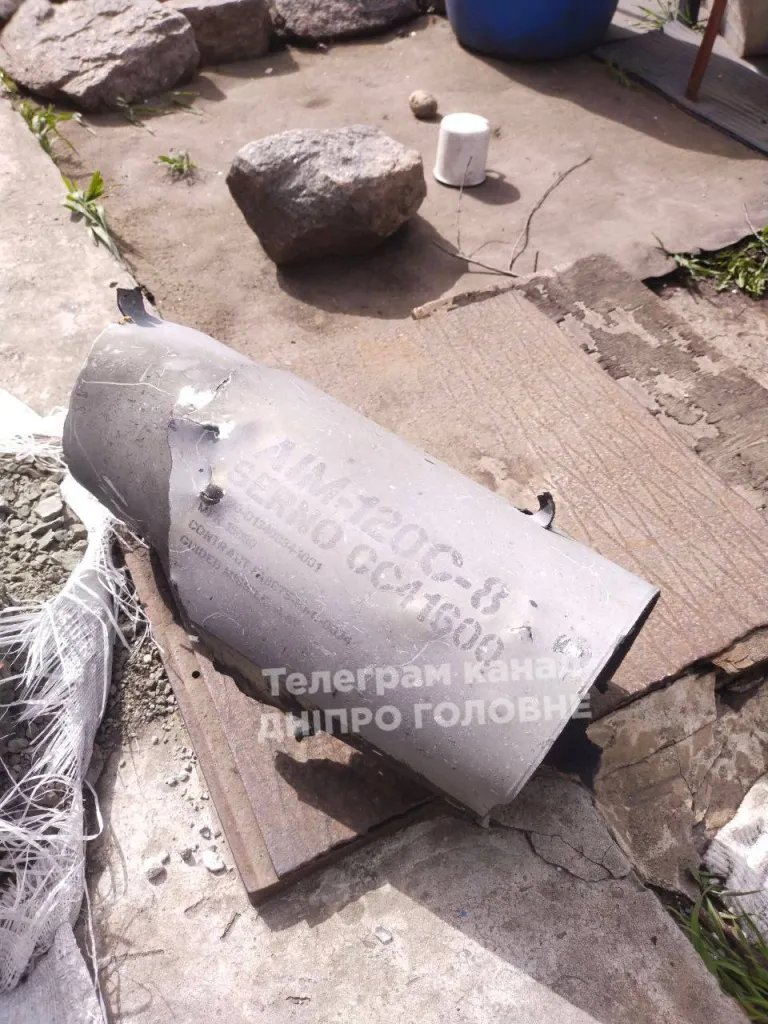
The wreckage of an AIM-120C-8 missile, apparently found in the aftermath of a Russian air attack on Dnipro in Ukraine. via Dnipro Main News/Telegram

The new U.S. production contract covers Lots 41 through 47 and includes advanced AIM-120D-3 variants featuring modernized processors and software-based electronic-warfare countermeasures.

With a scramble now on to find new ways to increase the global AMRAAM supply, RTX has said it invested in manufacturing equipment, workforce expansion, and supplier capacity to support the production increase. The company also identified new U.S. solid-rocket-motor production lines expected to come online in 2027 as part of its effort to address manufacturing bottlenecks.
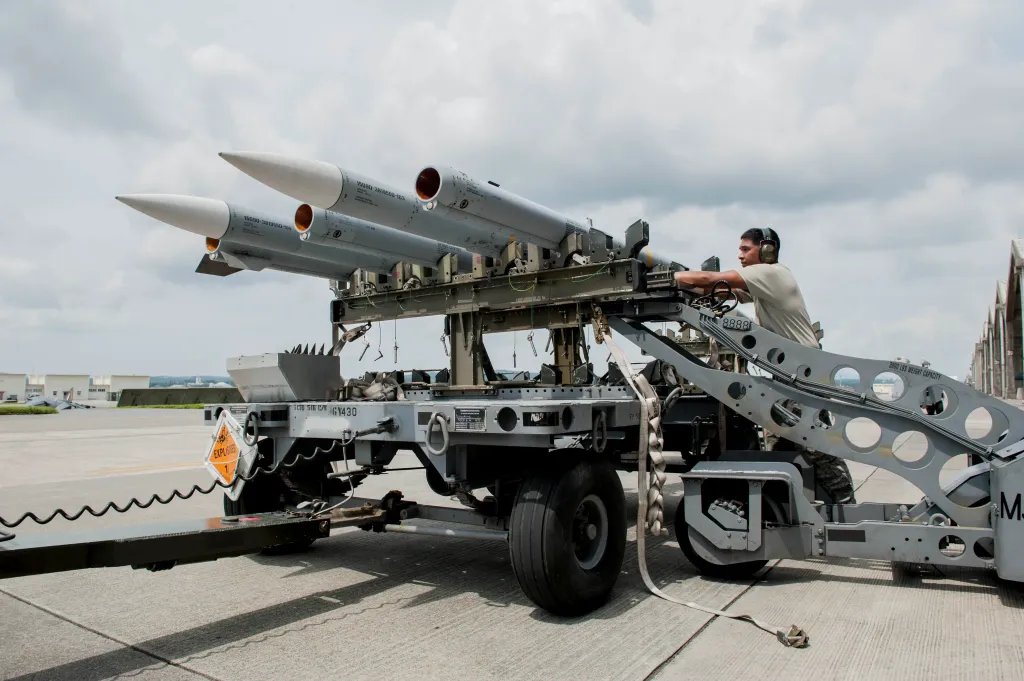
Maintainers prepare AIM-120D AMRAAMs for carriage by F-15s during a mass aircraft generation exercise at Kadena Air Base, Japan. U.S. Air Force/Senior Airman Peter Reft

The contract is intended to provide greater production stability than the shorter procurement agreements that previously characterized the program. Its multiyear structure gives Raytheon greater visibility into future demand and supports investment in manufacturing capacity and the missile’s component supply chain.

Japan’s participation could add another assembly location to an expanding industrial base. This should be made easier by the fact that AMRAAM is also less technologically sensitive now that the new AIM-260 is in the works. However, the extent to which the facility will increase total output will depend on its eventual capacity and the division of manufacturing responsibilities between Japanese and U.S. industry.

Technology Transfer And Industrial Safeguards

The agreement is the latest step in a process that has required extensive negotiations over industrial participation and technology protection.

Japan’s longstanding restrictions on arms exports and defense-industrial cooperation have complicated arrangements involving weapons considered offensive in nature. AMRAAM also incorporates classified guidance technology and proprietary intellectual property, requiring safeguards governing the transfer and handling of sensitive information.

The planned facility therefore stops short of a commitment to manufacture the entire missile domestically. Instead, a final assembly and inspection model allows Japan to complete and check missiles using components produced through an industrial arrangement.

For Tokyo, domestic assembly could help support replenishment of its own AMRAAM stocks and strengthen its defense-industrial capabilities. For Washington, an additional qualified production location will diversify the manufacturing network serving U.S. forces and international customers.

SM-3 Production Also In Focus

AMRAAM is not the only missile addressed under Operation Supercharge. Koizumi also confirmed that the United States and Japan had agreed to share technical information intended to increase production of the Standard Missile-3 Block IIA interceptor.

SM-3 Block IIA is designed to intercept ballistic missiles during the midcourse phase of flight and is principally employed by ship-based Aegis missile-defense systems. The interceptor is the product of a joint U.S.-Japanese development program and has also been acquired by Japan, including as the primary effectors for its two new cruiser-sized Aegis System Equipped Vessels (ASEV).

Neither government has disclosed how much the latest agreement is expected to increase SM-3 production or when additional output might become available.

The two initiatives reflect a wider effort to strengthen allied munitions supply chains as regional security concerns intensify. Japan has been expanding its defense capabilities amid increased Chinese military activity around the Japanese archipelago and continuing disputes across the East and South China Seas.
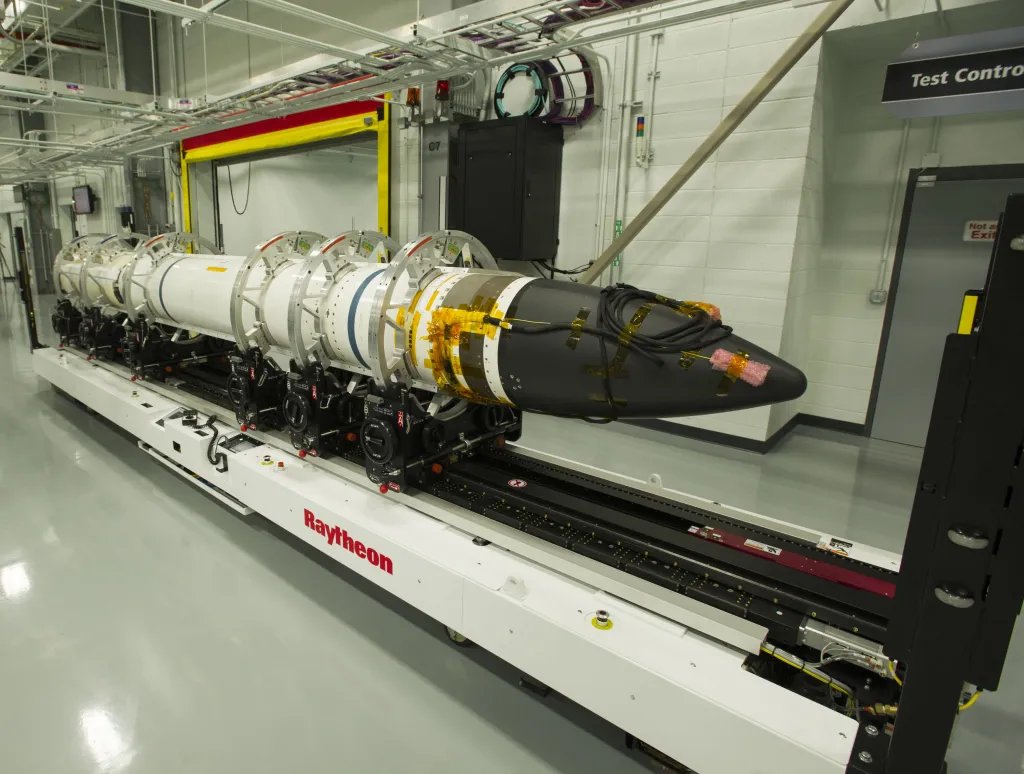
An SM-3 Block IIA interceptor in a production facility. Raytheon

It should also be noted that European countries are also currently pursuing initiatives to strengthen domestic missile manufacturing output, including systems such as the Patriot interceptor and other air-defense munitions. Earlier this week, for example, Lockheed Martin announced plans to establish a dedicated PAC-3 Missile Maintenance Facility (MMF) in Poland. 
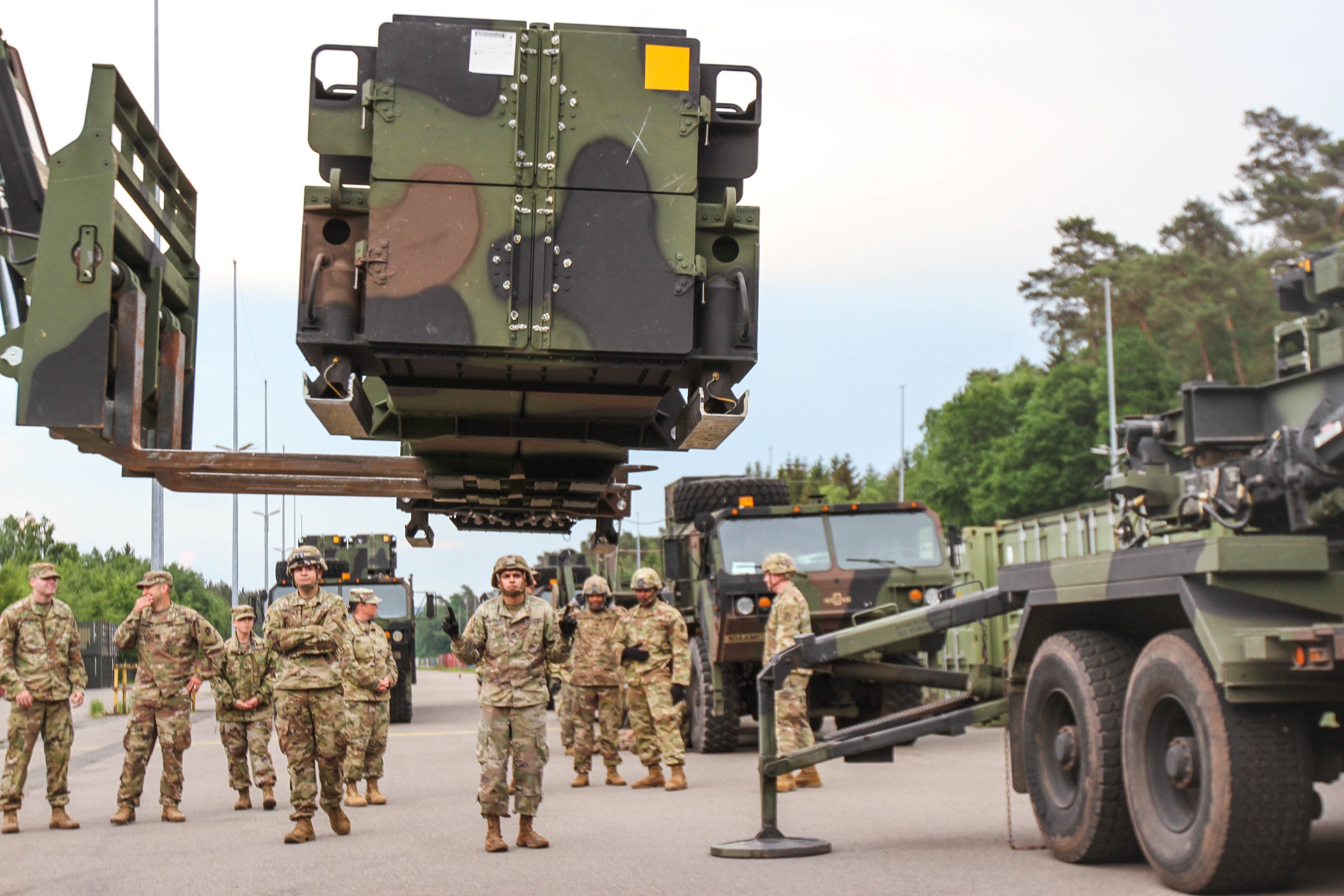
Sgt. Joel Lopez, a Patriot crew member assigned to B Battery, 5th Battalion, 7th Air Defense Artillery Regiment, guides a Patriot PAC 3 Interceptor for load out at Miesau Army Depot, Germany May 22. Saber Strike is a long-standing U.S. Army Europe-led cooperative training exercise that helps facilitate cooperation amongst the U.S., Estonia, Latvia, Lithuania, Poland and allied and partner nations.
A Patriot crew member assigned to B Battery, 5th Battalion, 7th Air Defense Artillery Regiment, guides a PAC-3 interceptor for loadout at Miesau Army Depot, Germany, on May 22, 2018. U.S. Army photo by Capt. Robert Durr Capt. Robert Durr

In its readout of the meeting, the U.S. Department of War said Hegseth welcomed Japan’s efforts to strengthen its defense-industrial capacity. The two leaders also committed to continued coordination on critical munitions production, although the readout did not specifically mention the AMRAAM facility.

The agreements establish a framework for closer industrial cooperation, but their eventual operational impact remains uncertain. At this point, details about the Japanese facility’s location, opening date, annual output, and its precise manufacturing responsibilities remain unclear. Meanwhile, the SM-3 initiative lacks a published production-growth target.

Regardless, the move to establish a Japanese AMRAAM assembly and inspection capability makes a good deal of sense alongside a major expansion of U.S. manufacturing. Whether that arrangement materially improves missile availability during a prolonged Indo-Pacific crisis will depend on how quickly the new capacity comes online and whether the wider production network can deliver the components and completed weapons required by both countries.

Contact the author: thomas@thewarzone.com

The post Japan To Assemble AMRAAM Missiles As U.S. Moves To Dramatically Boost AIM-120 Production appeared first on TWZ.
  •  

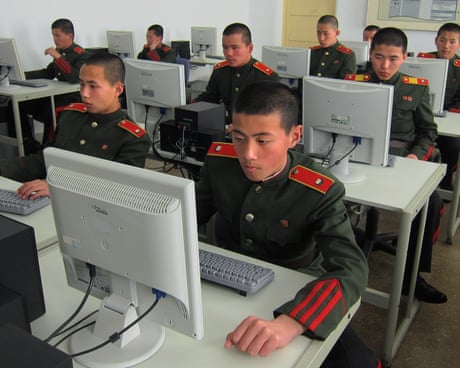
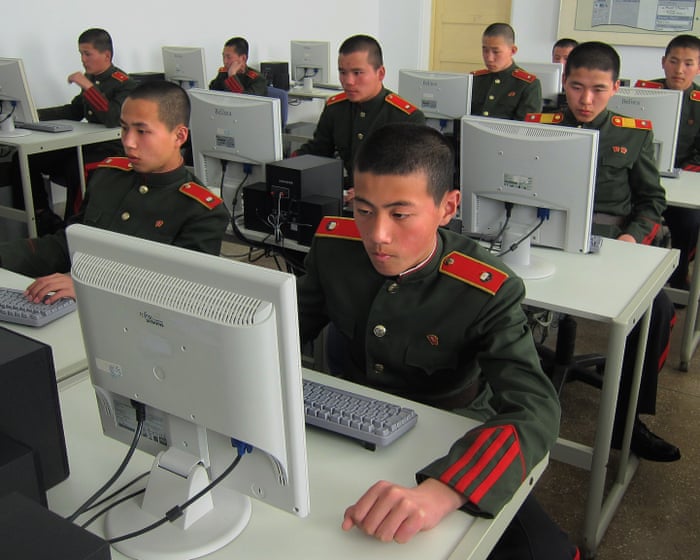
How crypto hacking funds isolated North Korea’s nuclear programme

Cryptocurrency theft is estimated to generate half of the country’s foreign currency income

North Korea plays by its own rules. The isolated, secretive and autocratic country is largely cut off from the world’s economic system – but when it comes to generating foreign earnings it relies on some of the world’s most sophisticated hacking.

Experts, such as TRM Labs, quickly attributed the extraordinary $6.3bn (£4.7bn) Binance cryptocurrency theft to TraderTraitor, an elite North Korean hacking unit that has also been known as the Lazarus Group. Though the link may not be proven yet, the pattern of behaviour is familiar.

Continue reading...

© Photograph: AP

© Photograph: AP

© Photograph: AP

  •  
  •  

North Korea linked to $6.3B Binance hack

A North Korea-based cybercrime group appears to be behind a $6.3 billion hack of the cryptocurrency exchange Binance, according to two blockchain intelligence firms. Both TRM Labs and Chainalysis tied the largest crypto hack on record to TraderTraitor, a North Korean hacking unit that has previously targeted the digital asset industry. Billions of dollars’ worth…

  •  

El líder de la mafia turca que fue tiroteado en Salou y rematado en el hospital de Tarragona

Mekin Büyükdeniz, ejecutado de madrugada en una habitación del Hospital Joan XXIII, era el presunto cabecilla de la organización criminal 'Los 10 hermanos', con base en Estambul Leer

Mekin Büyükdeniz, ejecutado de madrugada en una habitación del Hospital Joan XXIII, era el presunto cabecilla de la organización criminal 'Los 10 hermanos', con base en Estambul
  •  

Dozens of Russian drones fell to gun turrets over Kyiv in a month, Ukraine’s Defense Ministry says

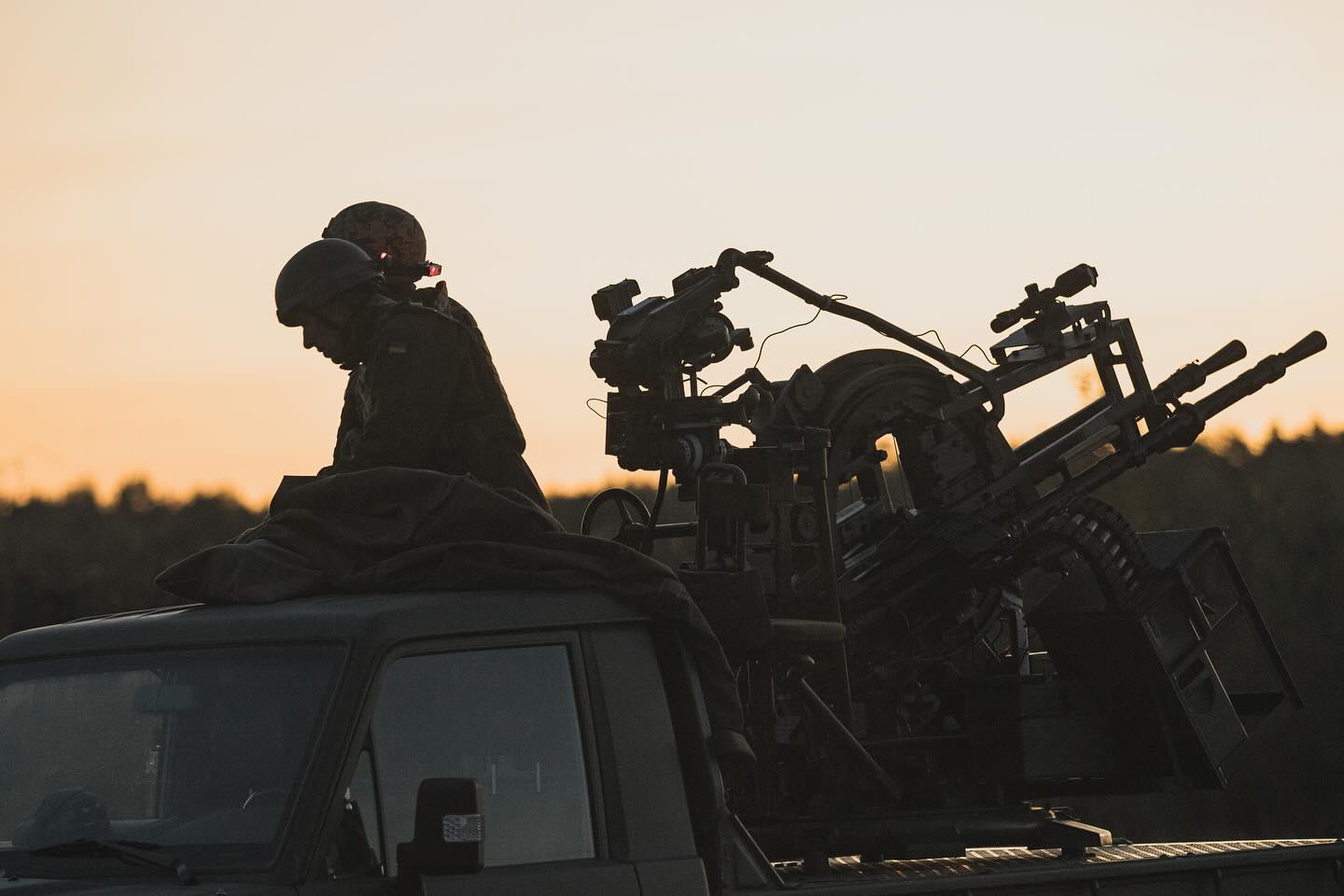
A Ukrainian air defense crew with a heavy machine gun in Cherkasy Oblast

Automated gun turrets now serve in Ukraine’s Air Force and are destroying Russia’s jet-powered weapons, the Defense Ministry reported on 29 October. It gave no count for those jet kills, and it did not say what type of drones the turrets downed over Kyiv.

Jet drones are where Ukraine struggles most. From 1 to 26 September, Ukraine downed 55% of jet-powered drones against 90% of slower ones, partly because its interceptor drones fly at about 300 km/h, too slow to catch them. Yurii Cherevashenko, Deputy Commander of the Air Force, told a parliamentary inquiry commission on 6 October that jet-drone interceptors would arrive in the needed numbers no earlier than late November. Guns have limits too. On 5 October, Air Force spokesman Yurii Ihnat said turrets had already downed Geran-5s, but that their range is short because their main weapon is a machine gun.

Air Force turrets against jet weapons

According to the ministry, Brave1, a defense innovation cluster, began developing automated turrets in 2024. The systems have since “moved beyond the experimental stage and become an integral part of air defense,” it said. In Air Force service, the turrets are destroying jet-powered Banderol munitions and Geran-5 drones.

Ukraine's mobile gun team. Photo: Ukraine's Air Force via Facebook
Explore further

To scale up air defense without straining the front, Ukraine enlists business. In under year nearly 100 companies have joined, their crews downing 60-plus targets

Russia first used the Geran-5, a 6-meter jet-powered strike drone, in early 2026. The Banderol, a jet-powered cruise missile, flies at 520–560 km/h and can reach 650 km/h.

Private teams, a familiar number

Separately, the ministry said turrets have destroyed more than 60 targets within the private air defense project. The project lets companies form anti-drone teams that work under Air Force command.

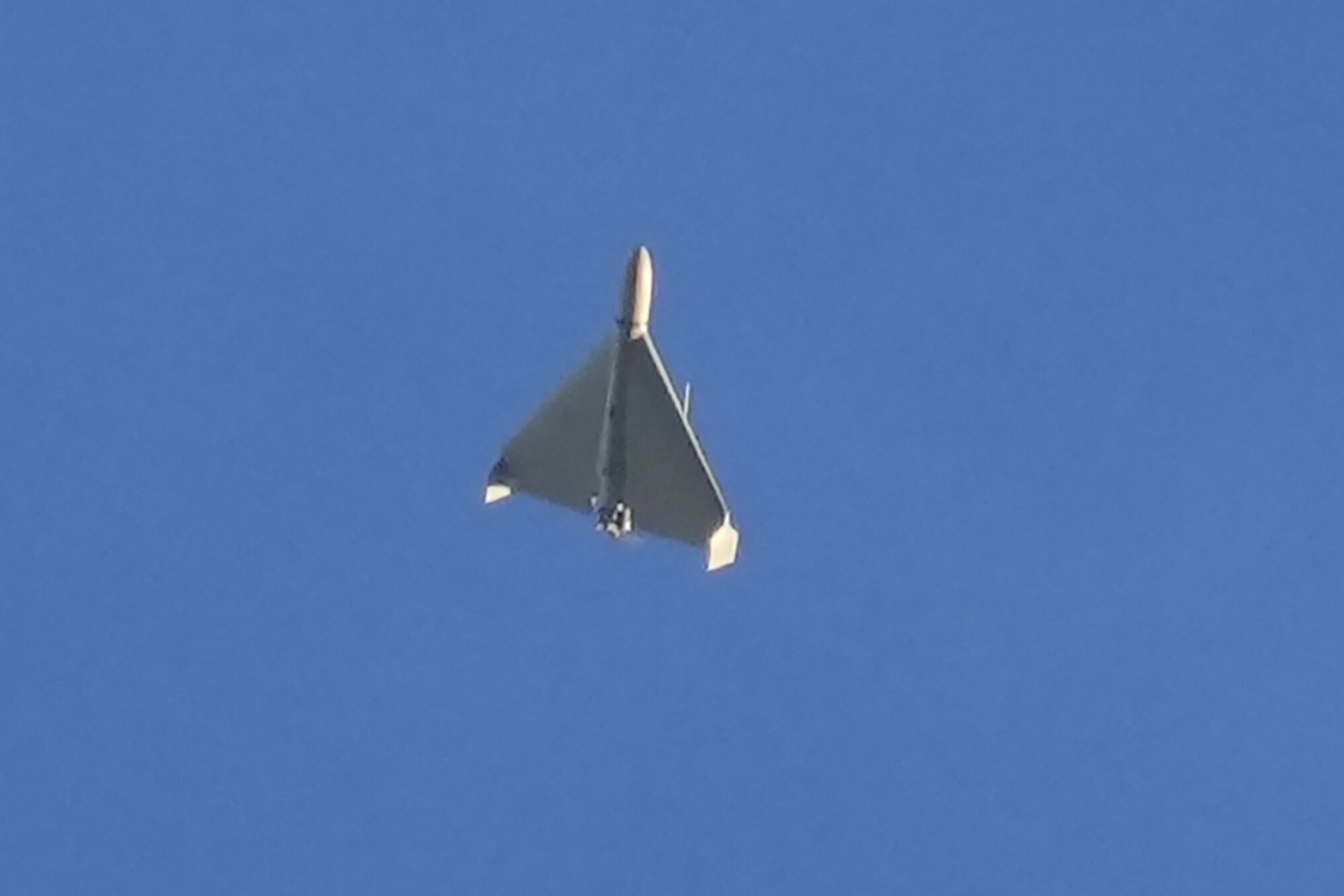
shahed-136 Geran-2 iranian airborne A drone is seen in the sky seconds before it attacked buildings in Kyiv, Ukraine, on Oct. 17, 2022. The Russian military has been using the Iranian Shahed exploding drones to strike Ukraine's vital infrastructure for more than a year. (AP Photo/Efrem Lukatsky/EastNews
Explore further

Postal service Nova Post says it has already shot down Russian Shahed drones, as Ukrainian businesses take air defense into their own hands

Yet on 14 October, the ministry gave the same 60-plus total for all private teams. At the time, it named interceptor drones and heavy machine-gun turrets as their main weapons. Groups from six companies were on combat duty, about 50 groups had been formed in total, and some were still training. Nearly 100 companies had joined by then, up from 81 in mid-September.

The ministry says the project expands air defense “without placing an additional burden” on the military’s own air defense. It and Brave1 say they will keep integrating automated turrets into the air defense system.

  •  

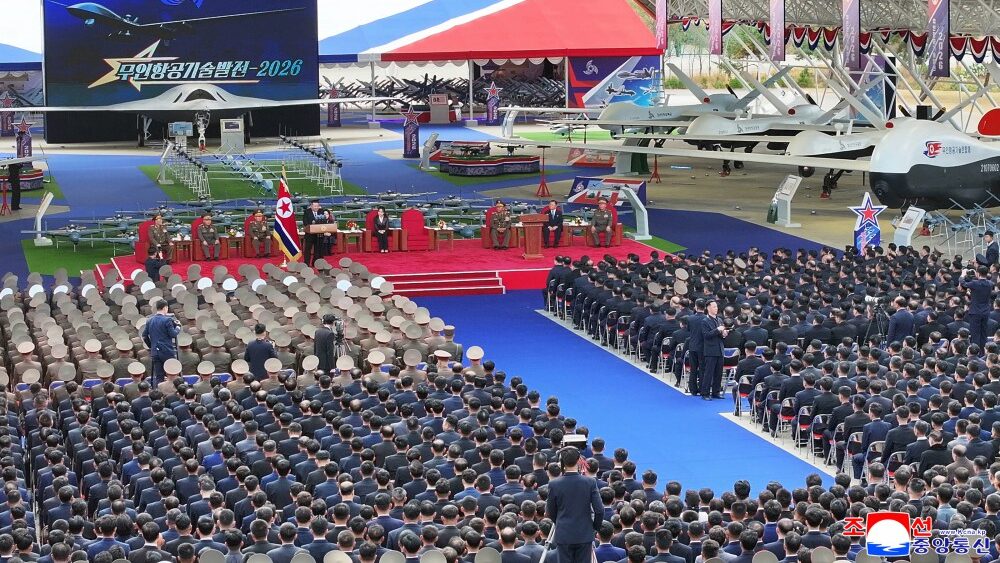
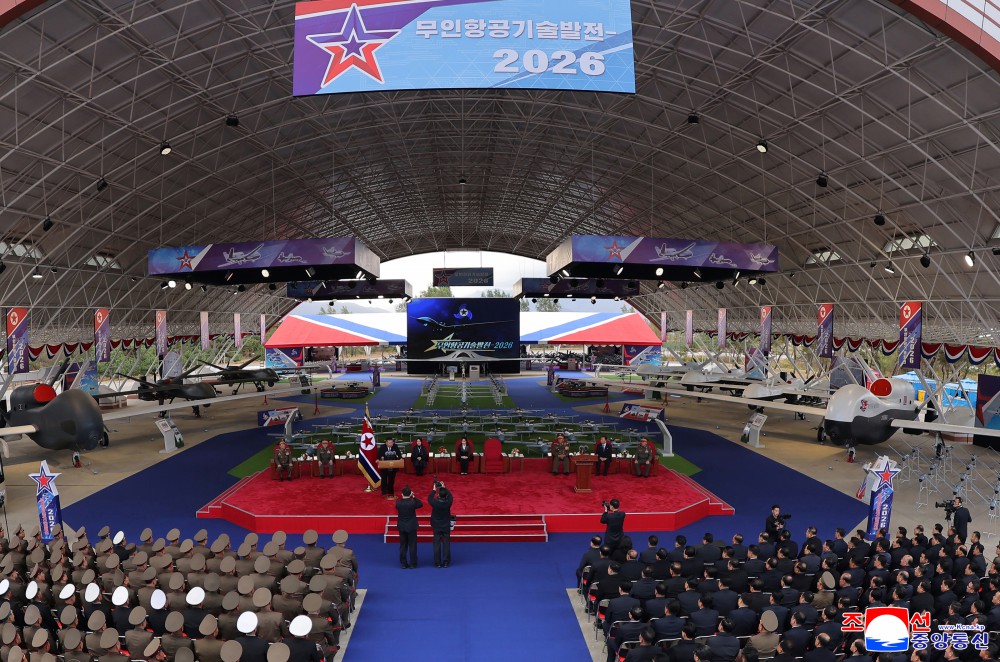
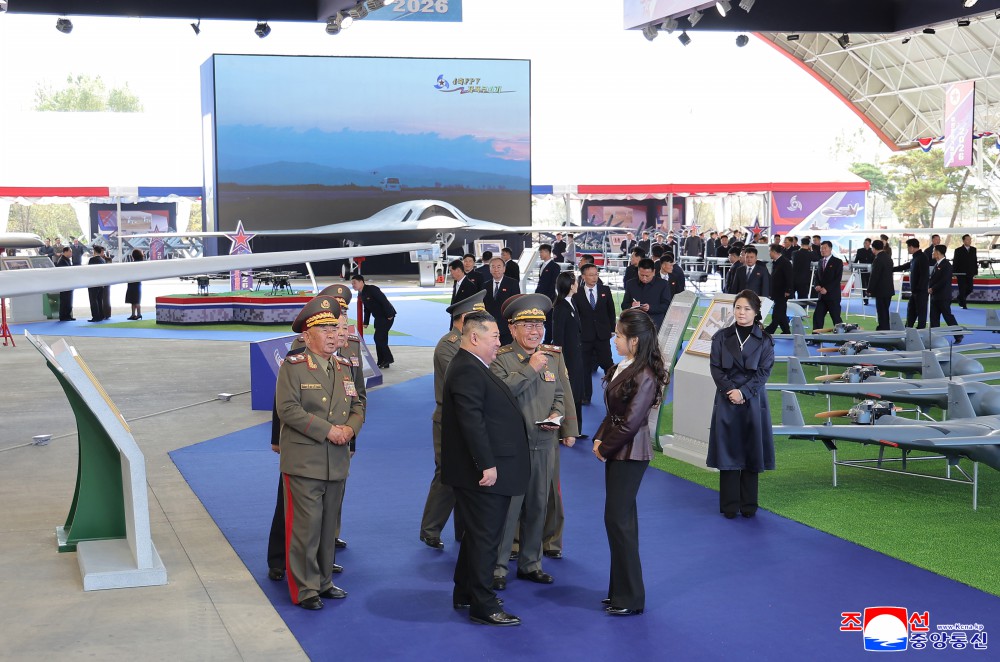
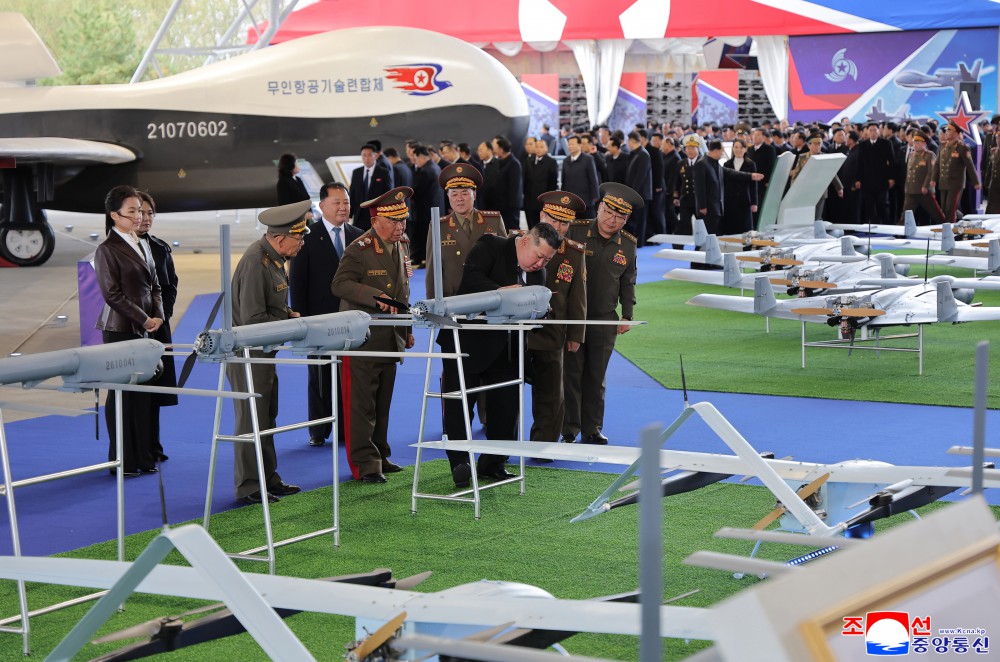
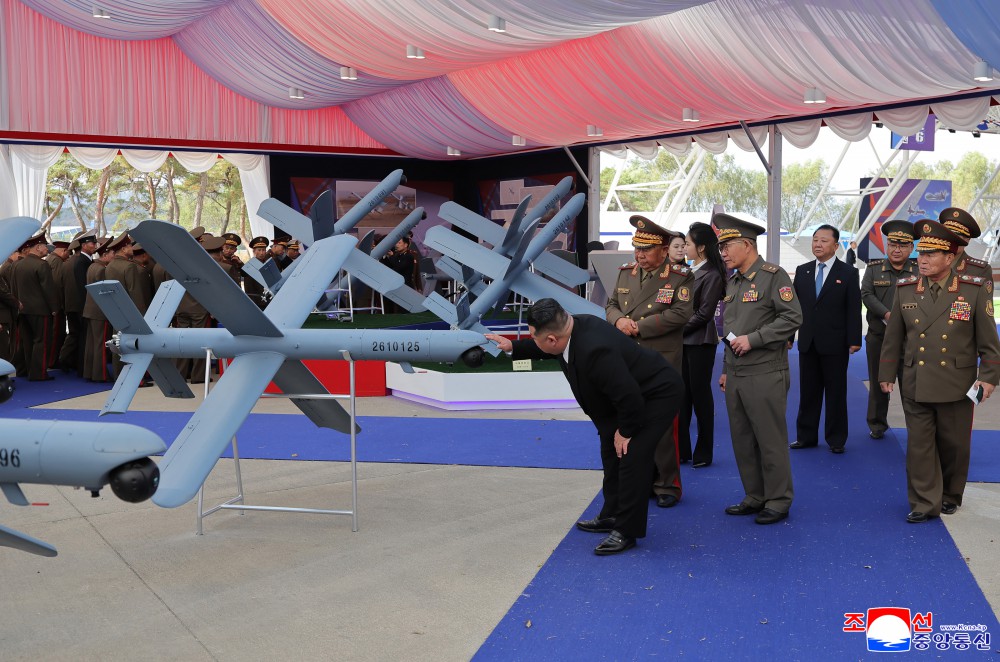
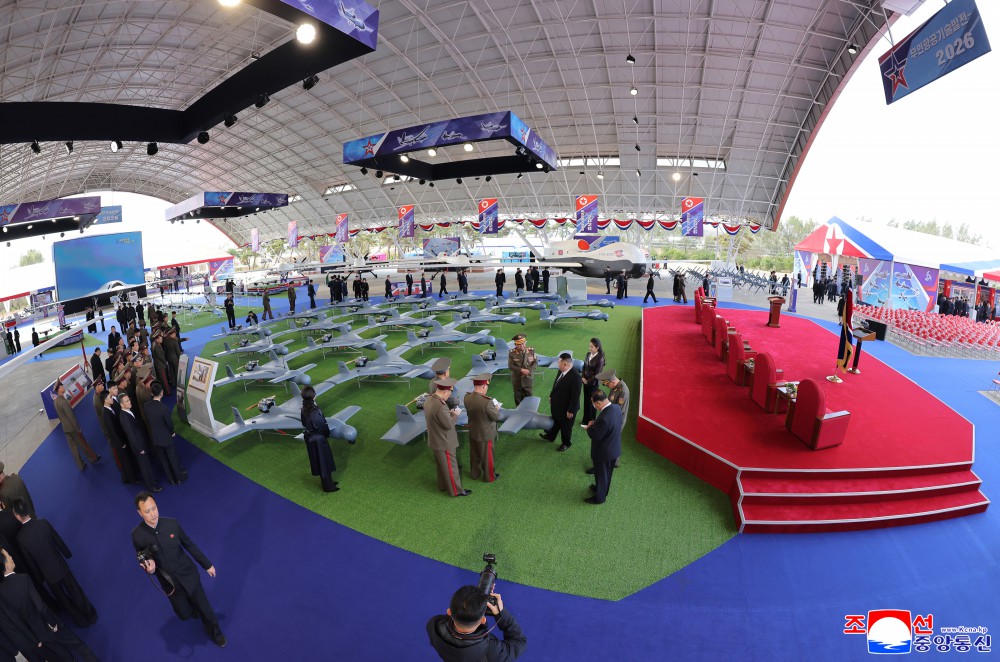
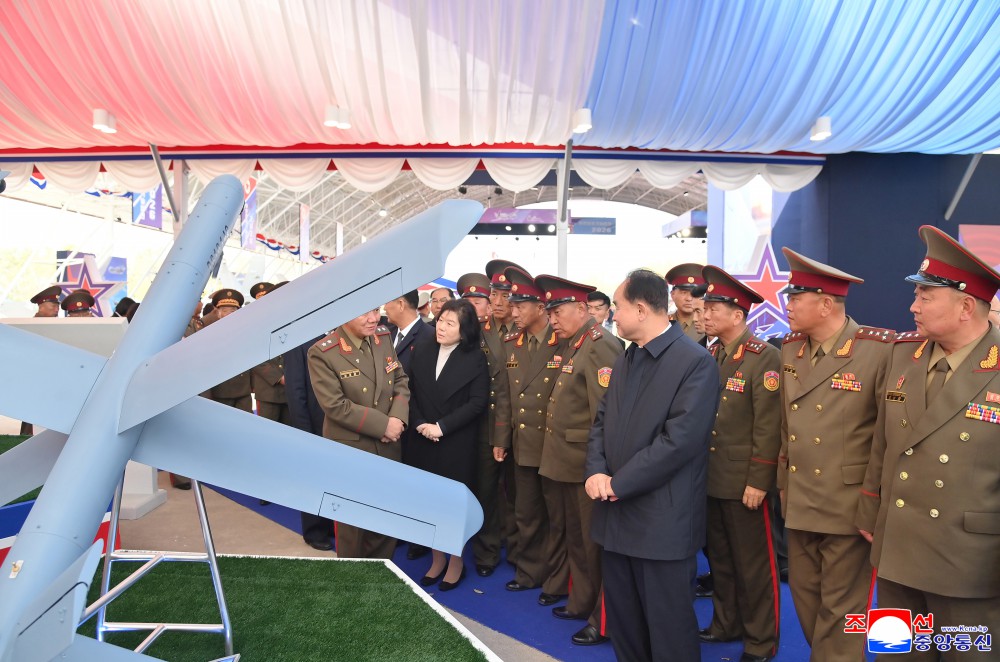
Kim Jong Un Vows ‘Absolute Superiority’ in Drones as North Korea Unveils New Arsenal (Photos)

Click to see full-size image. (Korean Central News Agency)

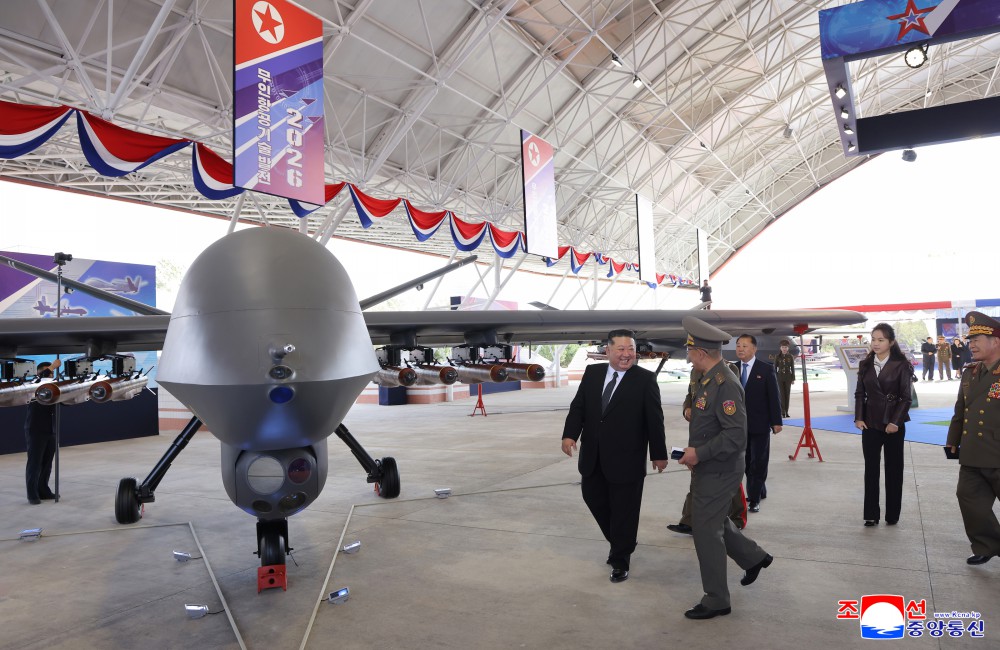
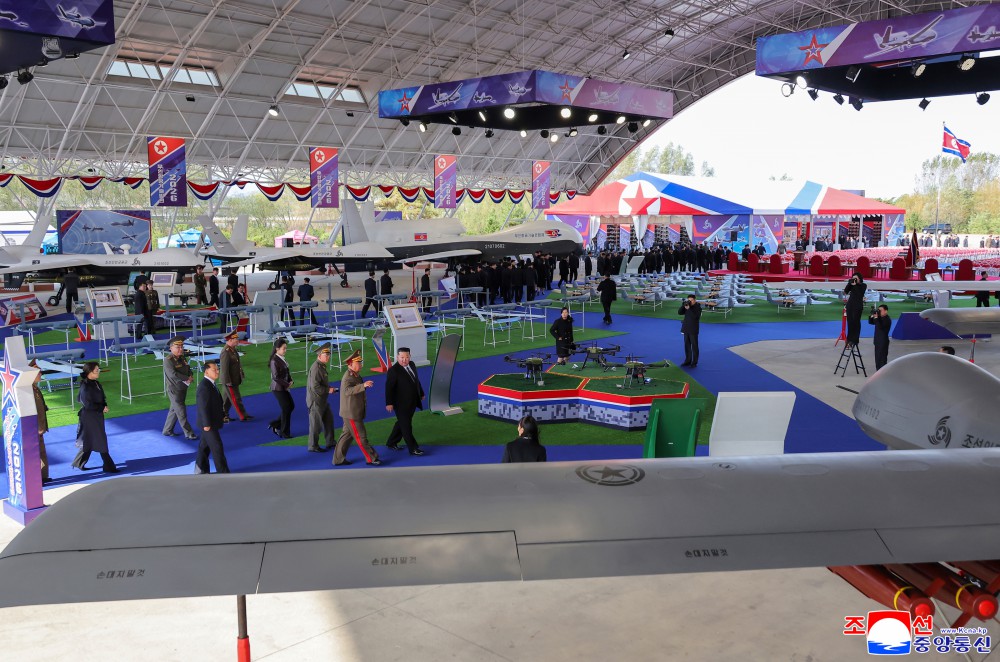
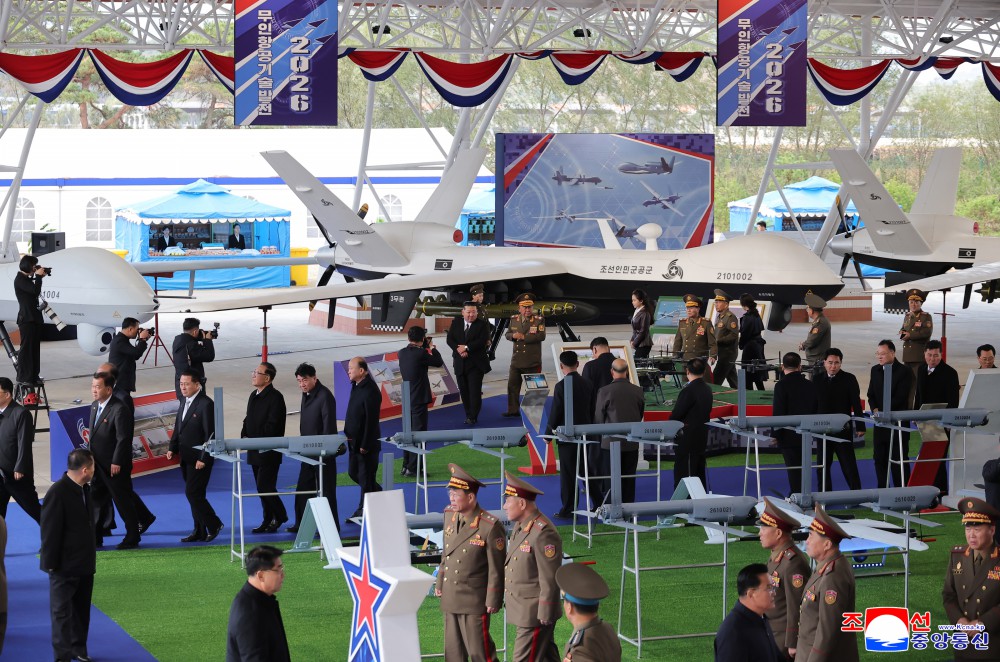
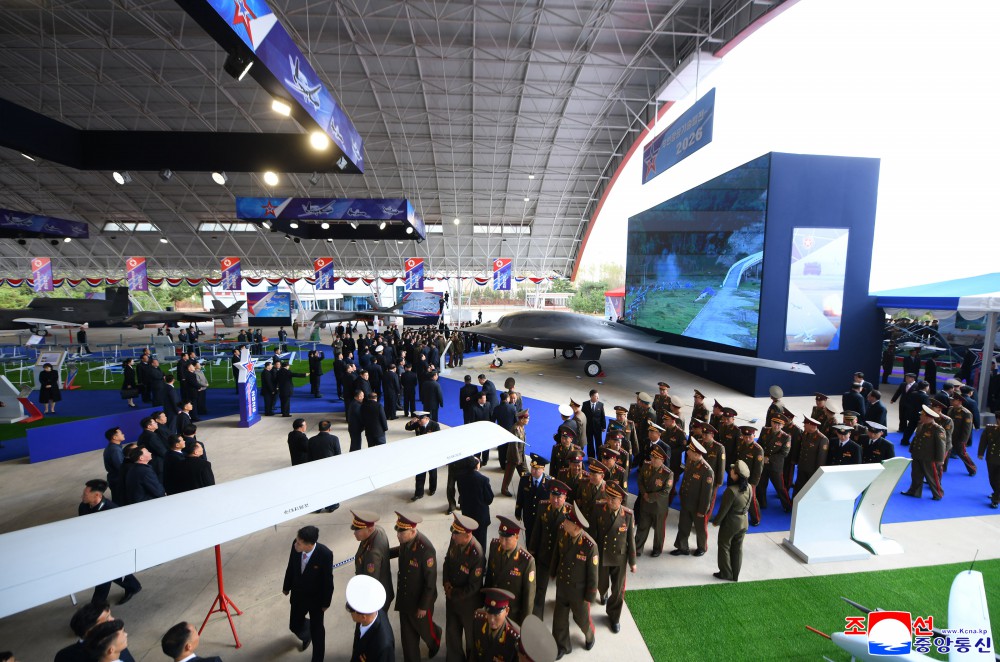
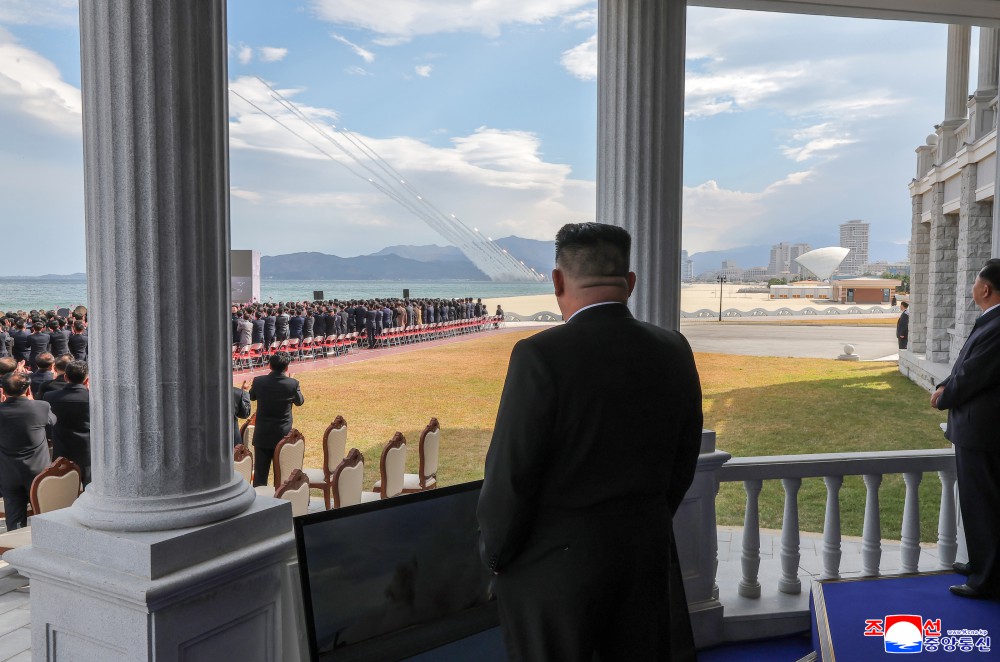
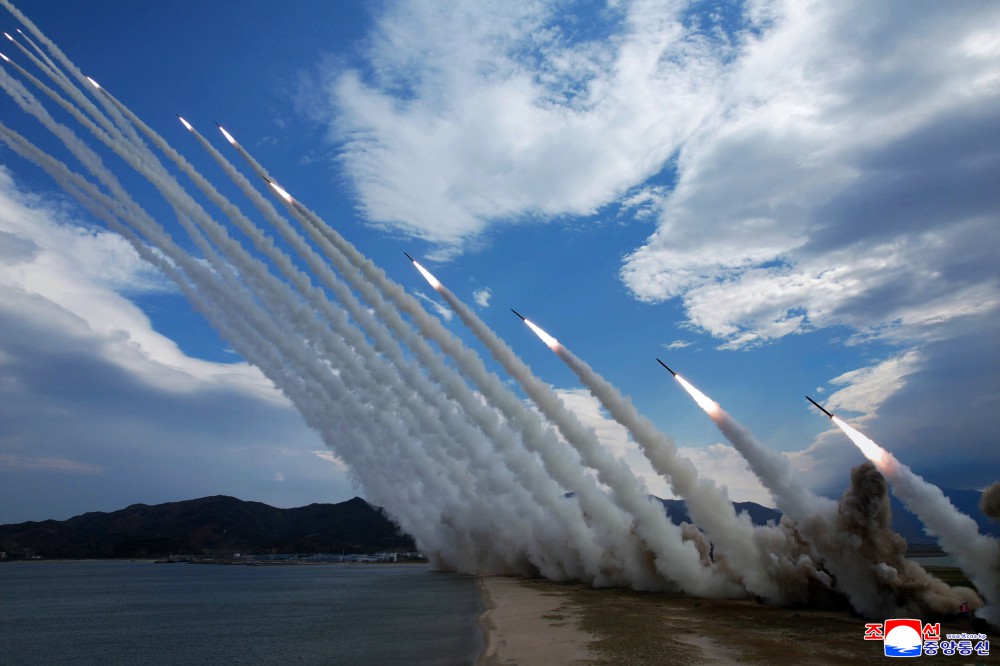
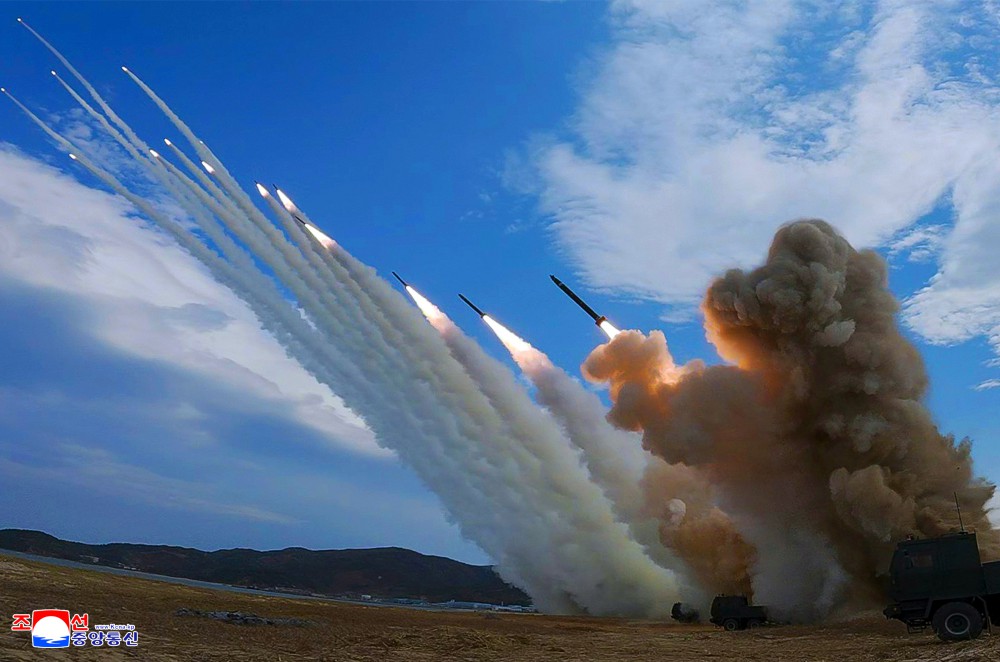
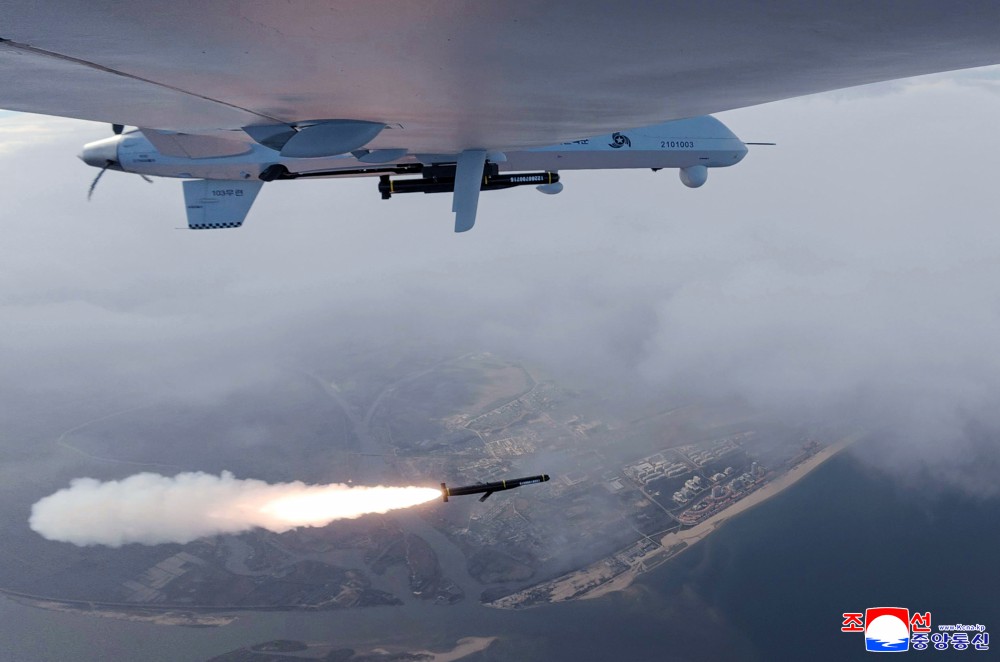
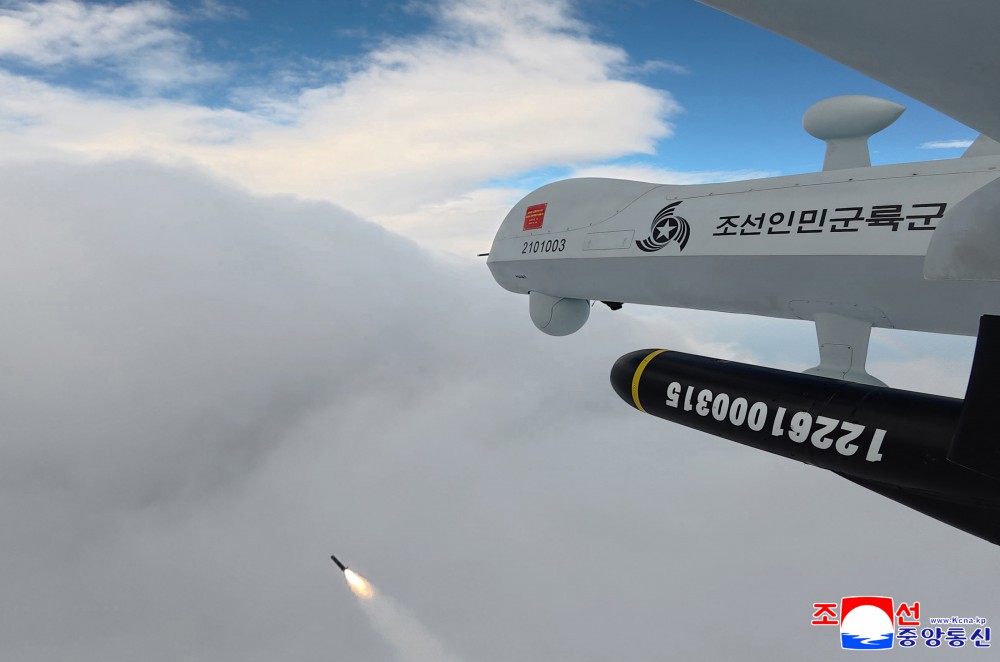
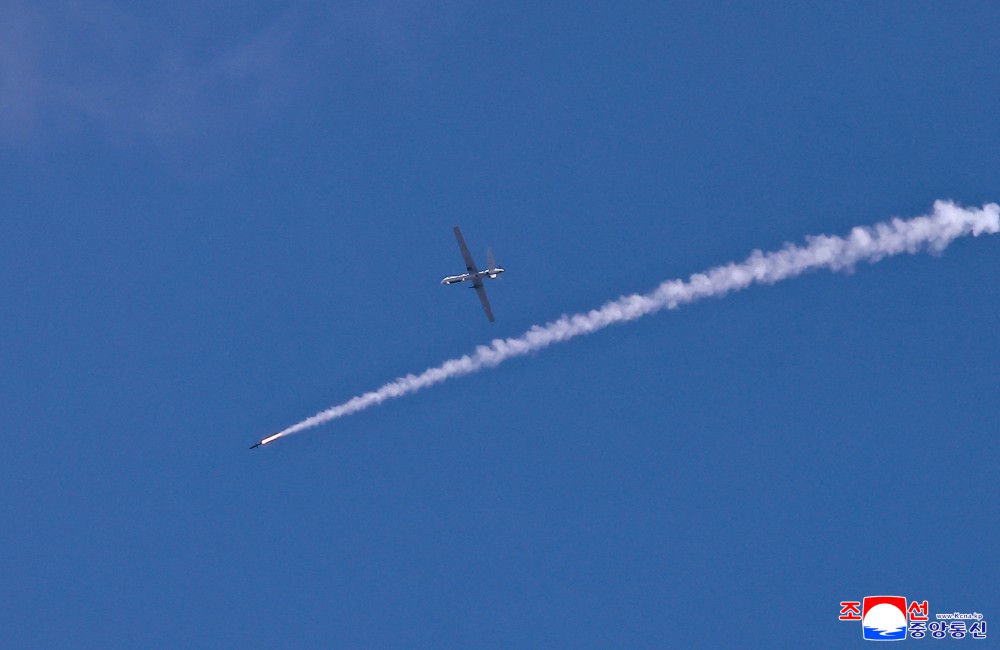
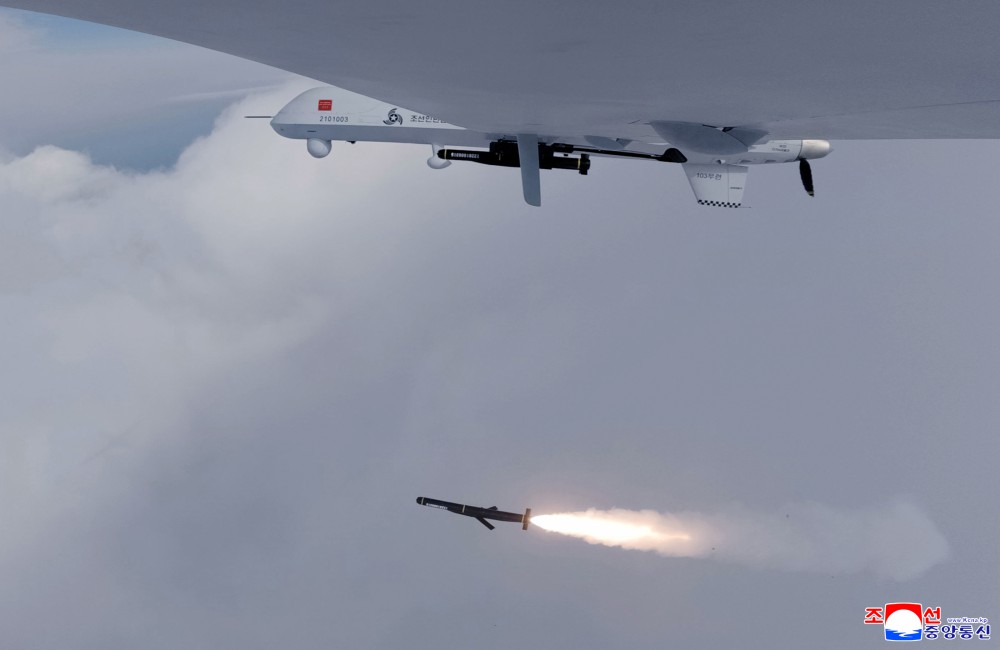
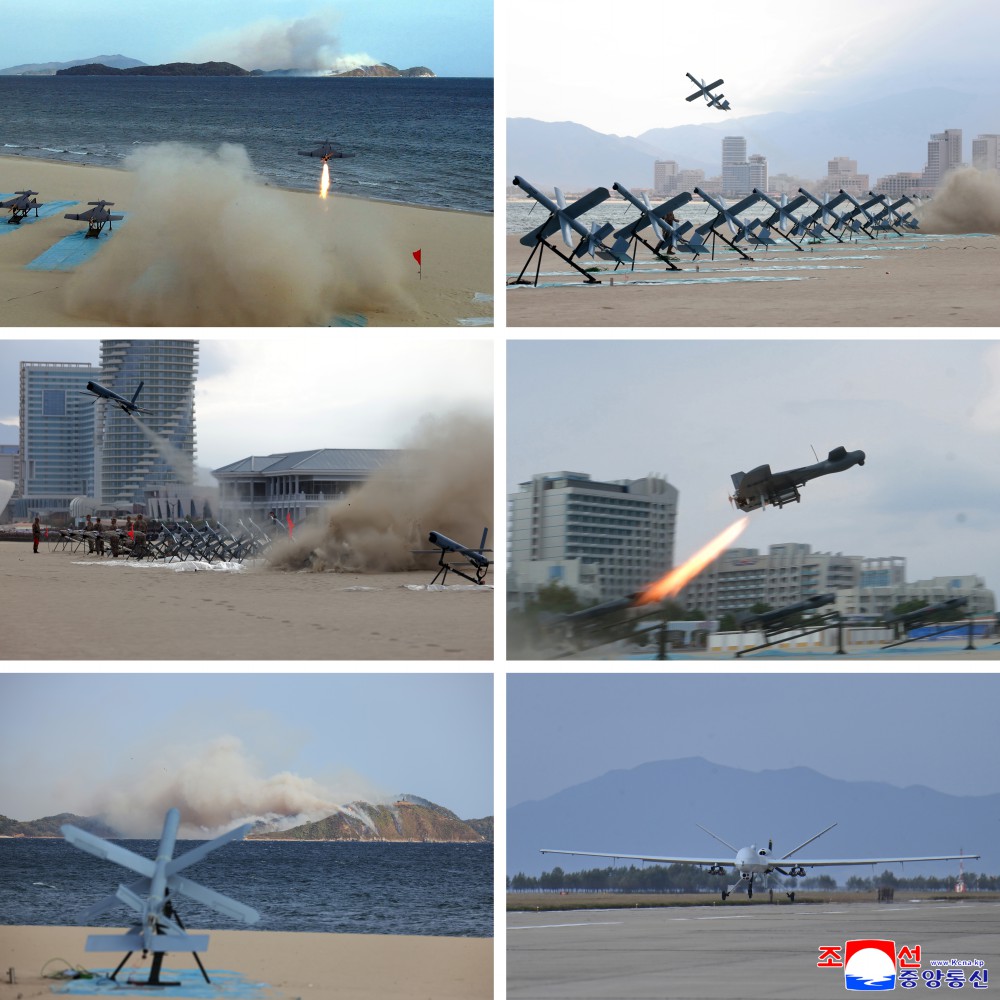
North Korean leader Kim Jong Un has called for the country to achieve “absolute superiority” in drone technology, declaring unmanned weapons and artificial intelligence (AI) central to modern warfare as Pyongyang showcased an expanding arsenal of drones, cruise missiles and multiple rocket launchers.

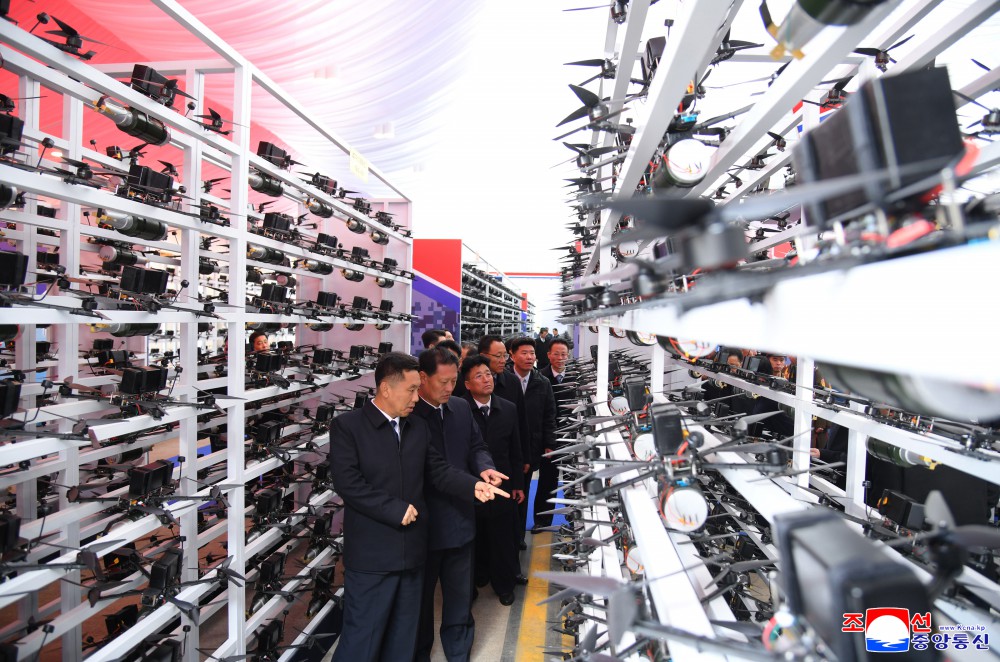
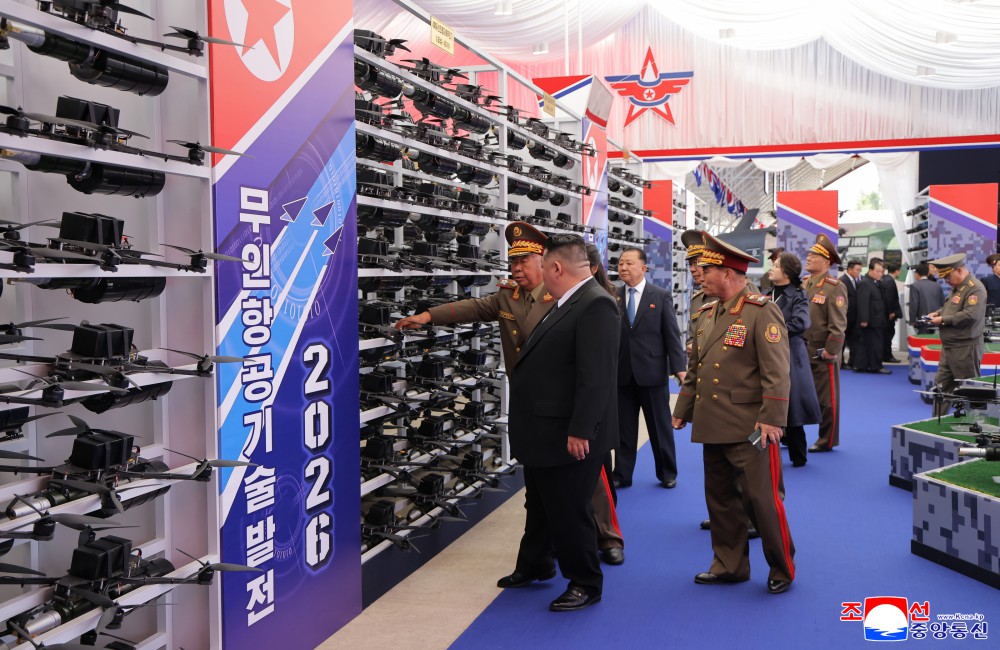
Kim made the remarks during an exhibition and weapons demonstration of unmanned aeronautical technology, the state-run Korean Central News Agency (KCNA) reported on October 29.

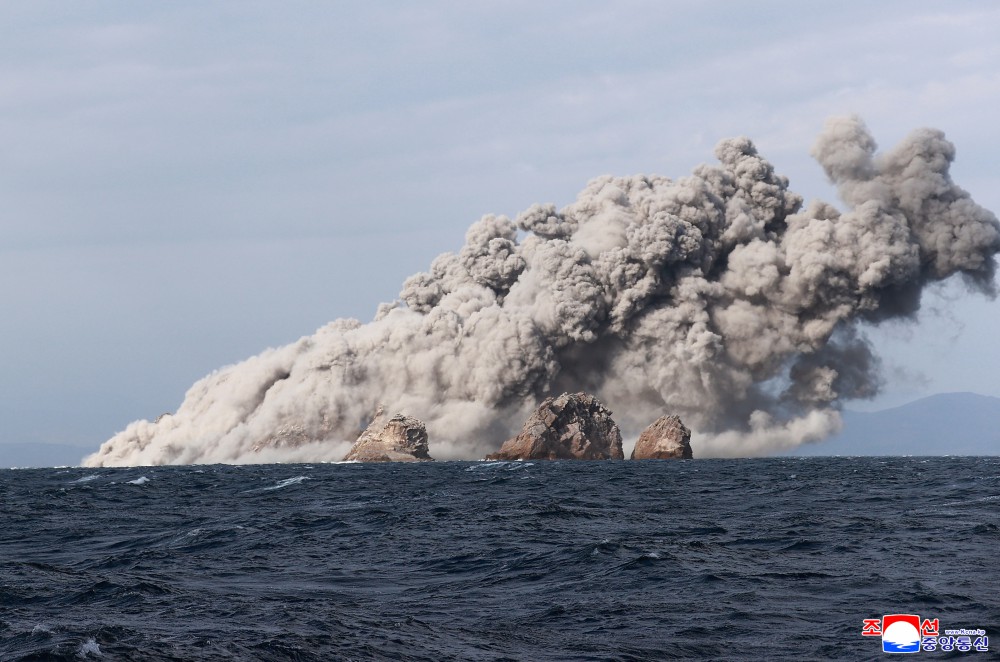
The event featured tactical suicide attack drones, tactical cruise missiles, multipurpose drones and a battalion of 600 mm multiple rocket launchers.

Click to see full-size image. (Korean Central News Agency)

Click to see full-size image. (Korean Central News Agency)

Pursuing superiority in drone technology was “an indispensable option” given the changing nature of modern warfare, Kim said, according to KCNA. The leader also called for the use of advanced AI in unmanned weapons systems to become a top priority in building the country’s modern armed forces.

Click to see full-size image. (Korean Central News Agency)

Click to see full-size image. (Korean Central News Agency)

Click to see full-size image. (Korean Central News Agency)

Click to see full-size image. (Korean Central News Agency)

The exhibition came as North Korea increasingly incorporates drones and AI into its military modernization efforts, drawing lessons from Ukraine and other recent conflicts.

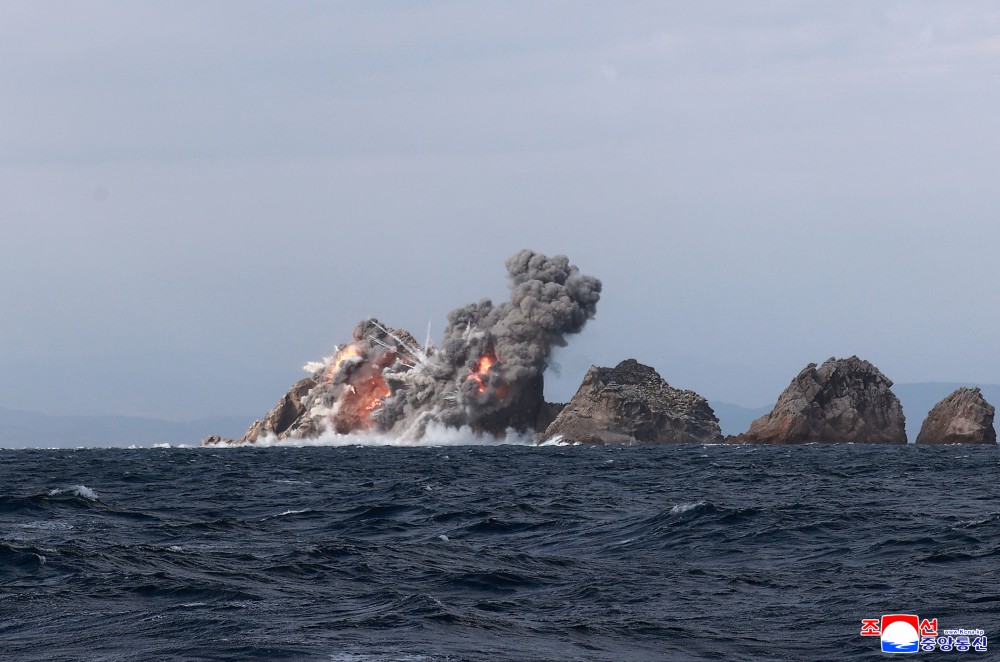
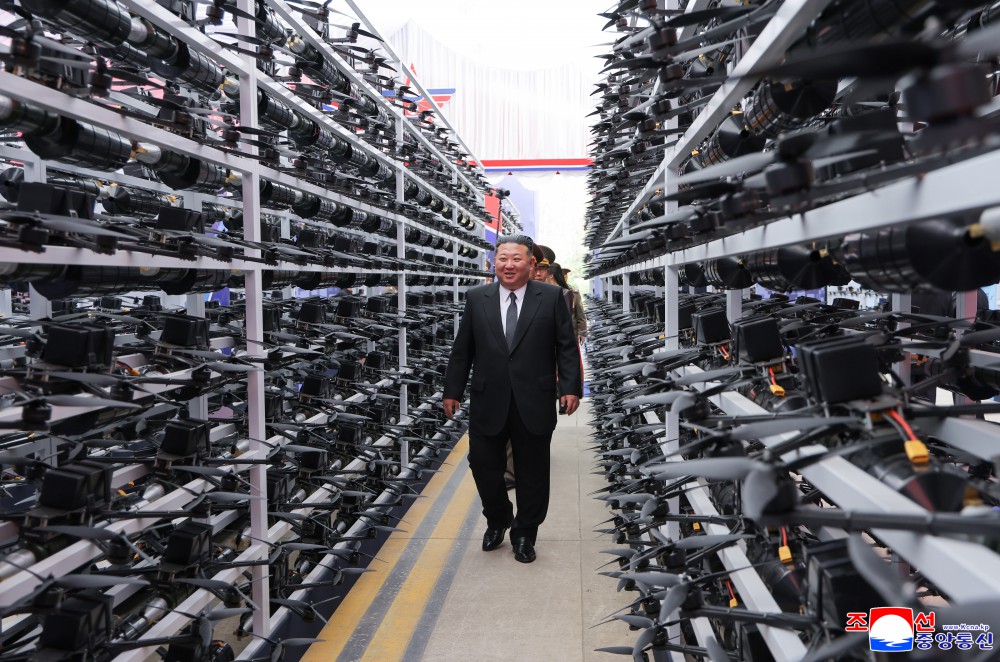
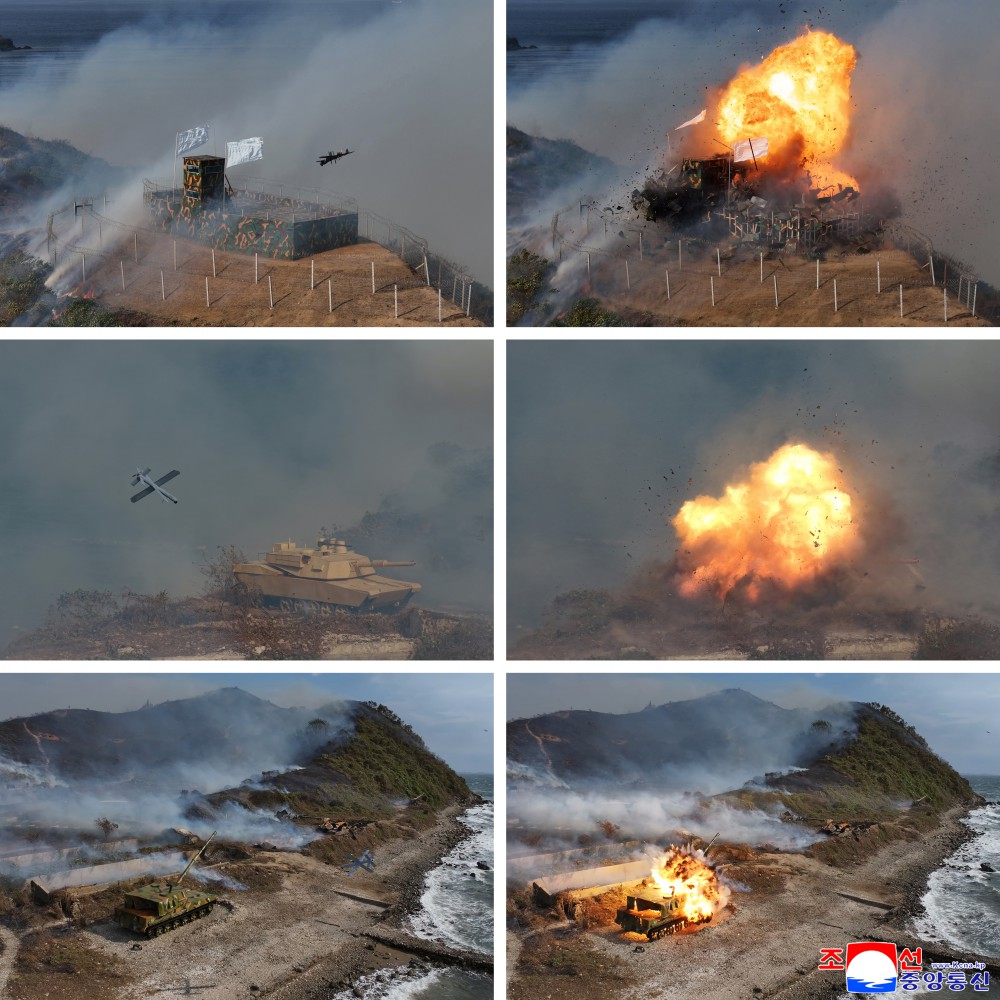
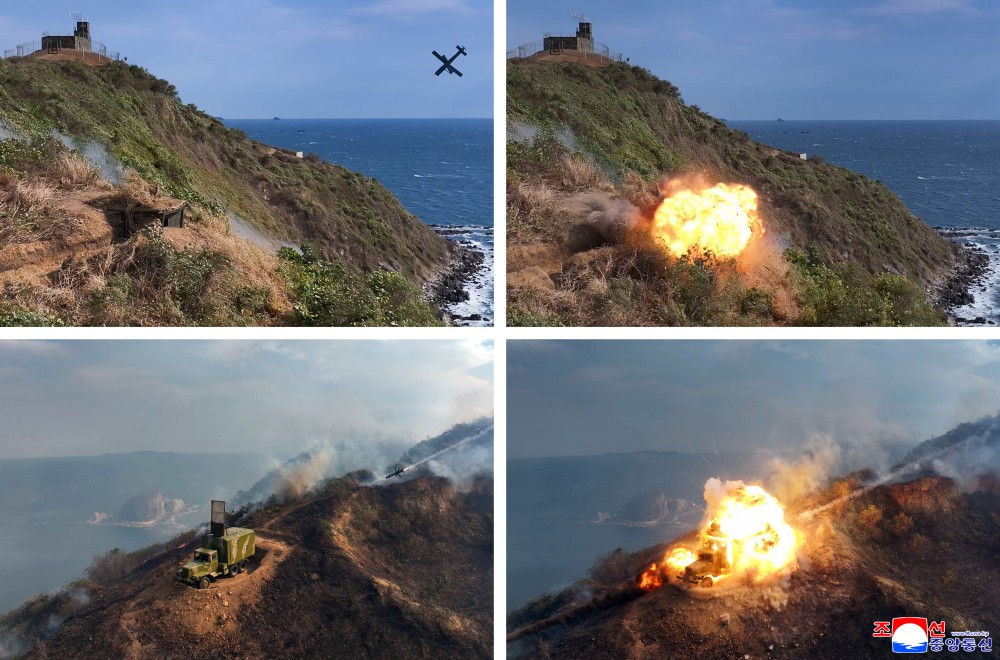
KCNA photographs showed Kim inspecting rows of unmanned aerial vehicles alongside senior military officials. Other images depicted a drone crashing into a military vehicle positioned on a hillside and exploding in a ball of flame as part of the weapons demonstration.

South Korea’s military said a day earlier that North Korea had fired around 10 projectiles, including short-range ballistic missiles.

Click to see full-size image. (Korean Central News Agency)

Click to see full-size image. (Korean Central News Agency)

Click to see full-size image. (Korean Central News Agency)

Click to see full-size image. (Korean Central News Agency)

Click to see full-size image. (Korean Central News Agency)

The display also offered a glimpse of several weapons that could significantly expand North Korea’s drone capabilities. State media showed for the first time a tailless, flying-wing stealth drone. Other photographs depicted racks of fiber-optic-guided first-person-view attack drones and loitering munitions resembling the U.S. Switchblade 600.

Click to see full-size image. (Korean Central News Agency)

Click to see full-size image. (Korean Central News Agency)

Click to see full-size image. (Korean Central News Agency)

Click to see full-size image. (Korean Central News Agency)

Click to see full-size image. (Korean Central News Agency)

Click to see full-size image. (Korean Central News Agency)

Click to see full-size image. (Korean Central News Agency)

Mock targets resembling South Korean-made K9 self-propelled howitzers, American-made M1 Abrams main battle tanks and radars suggested that the weapons were designed for use against South Korean and U.S. forces.

Click to see full-size image. (Korean Central News Agency)

Click to see full-size image. (Korean Central News Agency)

Click to see full-size image. (Korean Central News Agency)

Click to see full-size image. (Korean Central News Agency)

Click to see full-size image. (Korean Central News Agency)

Click to see full-size image. (Korean Central News Agency)

Click to see full-size image. (Korean Central News Agency)

Kim has repeatedly called for expanding the military’s drone capabilities. In November 2024, he ordered the mass production of suicide attack drones, followed by tests of AI-equipped versions in March 2025. He subsequently identified AI as a top priority for weapons modernization in September of the same year.

North Korea’s military has also gained battlefield experience through its participation in defensive actions in the Russian special military operation.

The exhibition came amid deteriorating relations between the two Koreas. Seoul has vowed to respond firmly to what it considers North Korean violations of the military border, while Pyongyang has condemned joint South Korean-U.S. air defense drills.

North Korea’s Defense Ministry said the exercises were increasing tensions on the peninsula and warned that there was “no limit” to its options for maintaining a strong deterrent posture, KCNA reported.

Tensions have also risen following a landmine explosion inside the Demilitarized Zone last month that seriously wounded several South Korean soldiers. Seoul blamed a North Korean mine, an accusation Pyongyang denied. Earlier in October, Kim’s sister, Kim Yo Jong, said North Korea would activate anti-South Korean propaganda loudspeakers along the countries’ entire border by the end of the month.

_______________________________________________________________________________________________________________________

SouthFront: Analysis and Intelligence

NOW hosted at southfront.press

Previously, SouthFront: Analysis and Intelligence was at southfront.org.

The .org domain name had been blocked by the US (NATO) (https://southfront.press/southfront-org-blocked-by-u-s-controlled-global-internet-supervisor/) globally, outlawed and without any explanation

Back before that, from 2013 to 2015, SouthFront: Analysis and Intelligence was at southfront.com

SOUTHFRONT.PRESS

MORE ON THIS TOPIC:


The post Kim Jong Un Vows ‘Absolute Superiority’ in Drones as North Korea Unveils New Arsenal (Photos) appeared first on South Front.

  •  

Ucrania y Rusia inician la evacuación coordinada de la ciudad asediada de Oleshki

La operación para evacuar a los habitantes de la población de Oleshki ha comenzado este viernes por la mañana y sigue en marcha. 25 autobuses con capacidad para 750 pasajeros, camiones y varias ambulancias estaban listos desde horas antes para ingresar a la ciudad, según ha informado el Defensor del Pueblo de Ucrania para los Derechos Humanos, Dmitro Lubinets, que encabeza la delegación ucrania. Su homóloga rusa, Yana Lantrátova, se encuentra también en la ciudad ocupada, según ha dicho en un mensaje en la red social Telegram, para organizar la evacuación.

Seguir leyendo

© Office of the Ombudsman of Ukrai

Fotograma del vídeo difundido por el defensor del Pueblo ucranio, Dmitró Lubinets, tras llegar este viernes a Oleshki, en la provincia ucrania de Jersón.
  •  

La salida anticipada de Christine Lagarde

La presidenta del Banco Central Europeo (BCE), Christine Lagarde, confirmó este jueves lo que era un secreto a voces: su marcha anticipada de la institución el próximo mes de febrero, en vez de octubre de 2027, como estaba previsto. Lo que ha precipitado la decisión ha sido la complicada situación política que atraviesa su país, Francia, en vísperas de unas elecciones presidenciales la próxima primavera que pueden llevar por primera vez a la extrema derecha al Elíseo. Lagarde asegura “no poder permanecer neutral” en esta campaña, como le exigiría su cargo, aunque ha dado a entender que ella no es candidata. La salida de Lagarde activa una remodelación de la cúpula del BCE. Y permite que las capitales pacten los nombramientos de la principal institución financiera de la eurozona al inicio de un ciclo electoral que marcará el rumbo del continente.

Seguir leyendo

© Heiko Becker (REUTERS)

La presidenta del BCE, Christine Lagarde, participa en la rueda de prensa tras el consejo de gobierno del banco, este jueves en Fráncfort.
  •  

Ukrainian officials reach Russian-held Oleshky. The question now is where its residents can go

Aerial view of Russian-occupied Oleshky, in Ukraine's Kherson Oblast. Photo via ArmyInform

Ukraine’s human rights commissioner Dmytro Lubinets and his delegation safely reached Russian-occupied Oleshky in Kherson Oblast on 30 October, with the local truce at 80 hours and holding. He said he was talking with residents to learn what help they need most.

Russia has kept Oleshky, on the left bank of the Dnipro River, cut off for months, leaving residents starving. Now the test is where the buses take people. The White House promised residents who wish to leave transport to their “preferred destination.” Lubinets said on 27 October that everyone who wants to go to Ukraine will be able to. Under agreement pages published by Fox News, his own delegation and the residents who choose Ukraine travel together via Anapa in Russia. From there, a Russian military transport plane to Homiel in Belarus is expected on 31 October.

Aerial view of Russian-occupied Oleshky, in Ukraine's Kherson Oblast. Photo via ArmyInform
Explore further

Russia may use the Oleshky truce to rebuild its forces, ISW warns, as evacuees face a route through Russia and Belarus

Buses on standby, aid for those who stay

On the morning of 30 October, before reaching the town, Lubinets wrote from Armiansk in occupied Crimea that he was coordinating the mission with Yana Lantratova, Russia’s human rights commissioner. He said 25 buses with 750 seats had been prepared, plus ambulances for people with limited mobility. Anyone who wants to leave will get a safe way out, and those who stay will receive aid, he added. In delivering that aid, special attention goes to elderly residents and people with disabilities, he said.

We are in Oleshky! The Ukrainian delegation has safely reached the city.

The ceasefire has been in effect for 80 hours and remains in place. I am currently on the ground, speaking with local residents to hear about their needs and understand what kind of assistance they need… pic.twitter.com/AOhKIV0WLO

— Dmytro Lubinets (@lubinetzs) October 30, 2026

The evening before, he said people who want to leave could do so until 14:00, with aid distribution after 14:30, without naming a date. Speaking to journalists, he called it the first truce since 2022 to hold this long on such a large stretch of front.

How the truce came about

The White House announced the truce on 23 October, crediting First Lady Melania Trump. It took effect at 03:00 Kyiv time on 27 October. Its zone was later widened. By 29 October, the convoy was ready, Lubinets said. The truce is due to end at 22:59 Kyiv time on 1 November.

  •  

Is Japan-South Korea rapprochement finally built to last?

Japan-South Korea ties are on the upswing. After a recent decade of some of the tensest relations since normalization, Seoul and Tokyo appear to be setting aside their differences as they enter a new phase of closer cooperation and active diplomatic initiatives. Under Kishida Fumio and Yoon Suk-yeol, the countries signed a pact with the […]

The post Is Japan-South Korea rapprochement finally built to last? appeared first on Asia Times.

  •  

What Taiwan can teach South Korea about China’s chip tech theft

In November 2023, three engineers left a South Korean semiconductor testing-components company for a Chinese employer offering twice their previous salaries. According to South Korea’s Intellectual Property Office, they allegedly took proprietary probe-card designs, arranged for a Korean design firm to modify them, and used the technology to develop products in China. By December 2025, […]

The post What Taiwan can teach South Korea about China’s chip tech theft appeared first on Asia Times.

  •  

Binance hit by record $6.3bn crypto hack blamed on North Korea

Hackers stole $6.3 billion from Binance, the world’s largest cryptocurrency exchange, in what analysts say is the biggest crypto hack ever, an attack that could prompt investors to rethink the risks of owning digital assets.

The hackers behind the raid were from North Korea, according to US blockchain analysis firms TRM Labs and Chainalysis. The attackers targeted Binance wallets on 10 blockchains and shifted most of the funds in about 20 minutes, TRM Labs said in a statement.

Binance said it worked with partners to freeze the affected assets with about $3 billion located so far. It did not mention the status of the remaining $3.3 billion, and its co-founder Yi He said the exchange would cover “all hacking losses”.

Binance said its deposits were unaffected and it expects to resume withdrawal services in the next 48 hours.

TRM said several features of the attack matched earlier heists linked to North Korea, including a 2025 hack of crypto exchange Bybit that the US Federal Bureau of Investigation had attributed to Pyongyang.

“We make this judgment with high confidence,” it said in a statement.

North Korea’s mission in Geneva and its embassy in China did not immediately respond to Reuters requests for comment.

The incident could be the world’s biggest crypto heist, according to analytics firm Chainalysis and other industry experts.

“It’s the biggest hack in history,” said Aravind Srinivasan, head of large crypto market maker GSR’s systematic OTC business.

Bitcoin tumbles as crypto markets react

Bitcoin BTC= dropped more than 3% to a six-week low of $76,368 and ether ETH= fell more than 3% to a two-month low of $2,178. BNB BNB=CCCL, a token originally launched as Binance Coin that can be used to pay Binance fees, was down 5% over the past 24 hours at $709.70, according to market aggregator CoinGecko.

Shares in crypto exchange Coinbase Global COIN.O slid 4.8% while those of bitcoin buyer Strategy MSTR.O fell nearly 6% in extended US trading.

Hacked laptop may have triggered breach

An initial investigation suggested the breach may have started with a hacked laptop belonging to one of its engineers, which let an attacker gain access to one of its systems and make unauthorized withdrawals, Binance said.

“The incident stems from multiple factors. Our security team is tracing the full attack path through the compromised computer which may be the entry point of the incident,” Binance said.

Beyond the potential loss of assets, the security breach was likely to have wider ramifications for crypto, which had already been under pressure due to higher US interest rates and softer demand from exchange-traded fund buyers, analysts said.

“It may further dampen risk appetite and prompt investors to reassess the safety of assets held on centralized exchanges, as well as counterparty, solvency and liquidity risks,” said Tim Sun, senior researcher at HashKey Group, based in Hong Kong.

Binance, which allows users to buy, sell and trade digital assets, has 335 million registered users globally and had about $162.8 billion in assets under custody as of the exchange’s 2025 annual report.

“User funds remain safe,” Binance said in a statement.

Binance moves to protect customer funds

Binance runs a secure asset fund for users, which is a reserve held entirely in bitcoin that is intended to protect user assets in cases of security breaches, according to its website.

“It’s becoming very hard to counter hacks as AI can find vulnerabilities faster than you can fix them,” said Bernardo Brites, CEO of Trace Finance, a payments and stablecoin infrastructure company.

“My view is that users will move away from smaller and medium-sized exchanges, (it is) becoming too risky to park your money somewhere that couldn’t cover a hack of meaningful size.”

Crypto firms freeze billions in stolen assets

Stablecoin issuer Tether said it had frozen nearly $1.57 billion in assets linked to the incident, while Circle froze more than $800 million.

World Liberty Financial, a crypto company linked to US President Donald Trump and his family, said on Thursday it had worked with cryptocurrency custodian BitGo to freeze funds stolen in what it described as a Binance hack. Binance’s Yi said $27 million in stablecoins and about $2 million worth of World Liberty tokens had been frozen.

Crypto firm Ripple also froze roughly $200 million in funds, Yi said. Jack McDonald, senior vice president of stablecoins at Ripple, said the company was closely monitoring reports of a potential exploit involving Binance and was freezing affected funds and coordinating with relevant parties.

Record theft adds to growing crypto security fears

Miguel Morel, CEO of blockchain intelligence firm Arkham, said data indicated that billions of dollars appeared to have been hacked from Binance by an unknown actor.

The incident adds to a string of crypto thefts. Last year, attackers stole $2.9 billion worth of cryptocurrency across nearly 150 attacks, according to researchers at TRM Labs. In September, cryptocurrency exchange Bitget said roughly $350 million in crypto had been stolen from its platform, underscoring the industry’s vulnerability to hackers.

Authorities have warned that organised crime groups are increasingly using cryptocurrencies to move funds across borders outside the traditional financial system.

Binance.US, a separate cryptocurrency exchange, said it was not affected by the security incident.

Coinbase COIN.O said it was unaffected and was monitoring the situation.

In an unrelated incident earlier on Thursday, prediction market operator Polymarket temporarily halted trading after a security incident involving a third-party provider. It later resumed trading and said it would fully reimburse affected traders.


Where Binance’s $6.3 billion breach ranks in crypto’s biggest hacks and heists

Time periodCompanyWhat was stolenWhat happened
February 2025Cryptocurrency exchange BybitDigital tokens worth $1.5 billionThe crypto was taken from a “cold wallet” – a digital wallet usually stored offline and so supposedly more secure – that was used for ether tokens.
March 2022Ronin Network, a network that allows transfer of crypto coins across different blockchainsRoughly $540 million from a blockchain project linked to the popular online game Axie InfinityHackers stole some 173,600 ether tokens and 25.5 million USD Coin tokens.
February 2022Wormhole, a DeFi site$320 millionHackers making off with 120,000 digital tokens connected to the second-largest cryptocurrency, ether. The crypto arm of Chicago-based Jump Trading, which had the year before acquired the developer behind Wormhole, later replaced the funds.
August 2021Poly Network, a platform that facilitates peer-to-peer token transactions$610 million (Hackers behind the heist later returned nearly all of the stolen funds)The hack underscored vulnerabilities in the burgeoning decentralised finance, or DeFi, sector, where users lend, borrow and save in digital tokens, bypassing the traditional gatekeepers of finance such as banks and exchanges.
January 2018Tokyo-based exchange Coincheck$530 millionThe thieves attacked one of Coincheck’s “hot wallet” – a digital folder stored online – to drain the funds, drawing attention to security at exchanges.South Korea’s intelligence agency said at the time that a North Korean hacking group may have been behind the heist.
Between 2011 and 2014Tokyo-based bitcoin exchange Mt. GoxBitcoin worth close to $500 million was stolen in one of the earliest and most high-profile crypto hacks.Mt. Gox, which once handled 80% of the world’s bitcoin trade, filed for bankruptcy in early 2014 after the hack was revealed, with some 24,000 customers losing access to their funds.

  •  

Filipinas amplía cooperación militar con India y Corea del Sur

Manila, 30 oct (Prensa Latina) Filipinas busca hoy fortalecer sus vínculos de defensa con India y Corea del Sur mediante proyectos de modernización militar, seguridad marítima, capacitación e intercambios entre sus fuerzas armadas, informó el Departamento de Defensa Nacional.

The post Filipinas amplía cooperación militar con India y Corea del Sur first appeared on Noticias Prensa Latina.

  •  

Lagarde, el ‘búho’ que pilotó durante dos décadas las finanzas mundiales sin estar predestinada a ello

La presidenta del BCE, Christine Lagarde, junto a sus predecesores Mario Draghi (centro) y Jean-Claude Trichet, corta una tarta durante la celebración del 25 aniversario del BCE, en 2023.

A Christine Lagarde (París, 70 años, de soltera Christine Madeleine Odette Lallouette) le gusta enviar mensajes con su atuendo. Elige cuidadosamente sus pañuelos (hay quien cree adivinar en ellos sus intenciones) y, en momentos especialmente delicados, comparece en la rueda de prensa del BCE con un broche característico: un búho. En un mundo, el de la política monetaria, habitualmente dividido entre halcones, banqueros con poca tolerancia por la inflación y gatillo fácil a la hora de subir tipos, y palomas, más sensibles al efecto del dinero caro sobre la economía, Lagarde se desmarcaba con esta otra ave.

Seguir leyendo

  •  

Letonia fabrica un pequeño ejército de drones en secreto a las puertas del enemigo

Los letones no se fían de sus “simpáticos vecinos”. Tal es así que usan con cierto hábito este atajo lingüístico, lleno de retintín, antes que hablar a las claras de rusos y bielorrusos. Con estos dos viejos aliados de la vasta llanura, Letonia ― con 1,8 millones de habitantes― comparte más de 450 kilómetros de su frontera este. Es por esto que su linde forma parte de lo que, entre la tropa, se denomina flanco oriental de la OTAN y la Unión Europea. Consecuencia: está en la diana del enemigo número uno, esto es, de Rusia. En mayo, la colisión de tres drones que volaban desde el frente de batalla ucranio hizo saltar por los aires la coalición del Gobierno letón. En solo cinco meses, el país báltico se ha blindado defensivamente gracias, en parte, al empuje de la producción local de vanguardia de armas autónomas. Pero el temor continúa.

Seguir leyendo

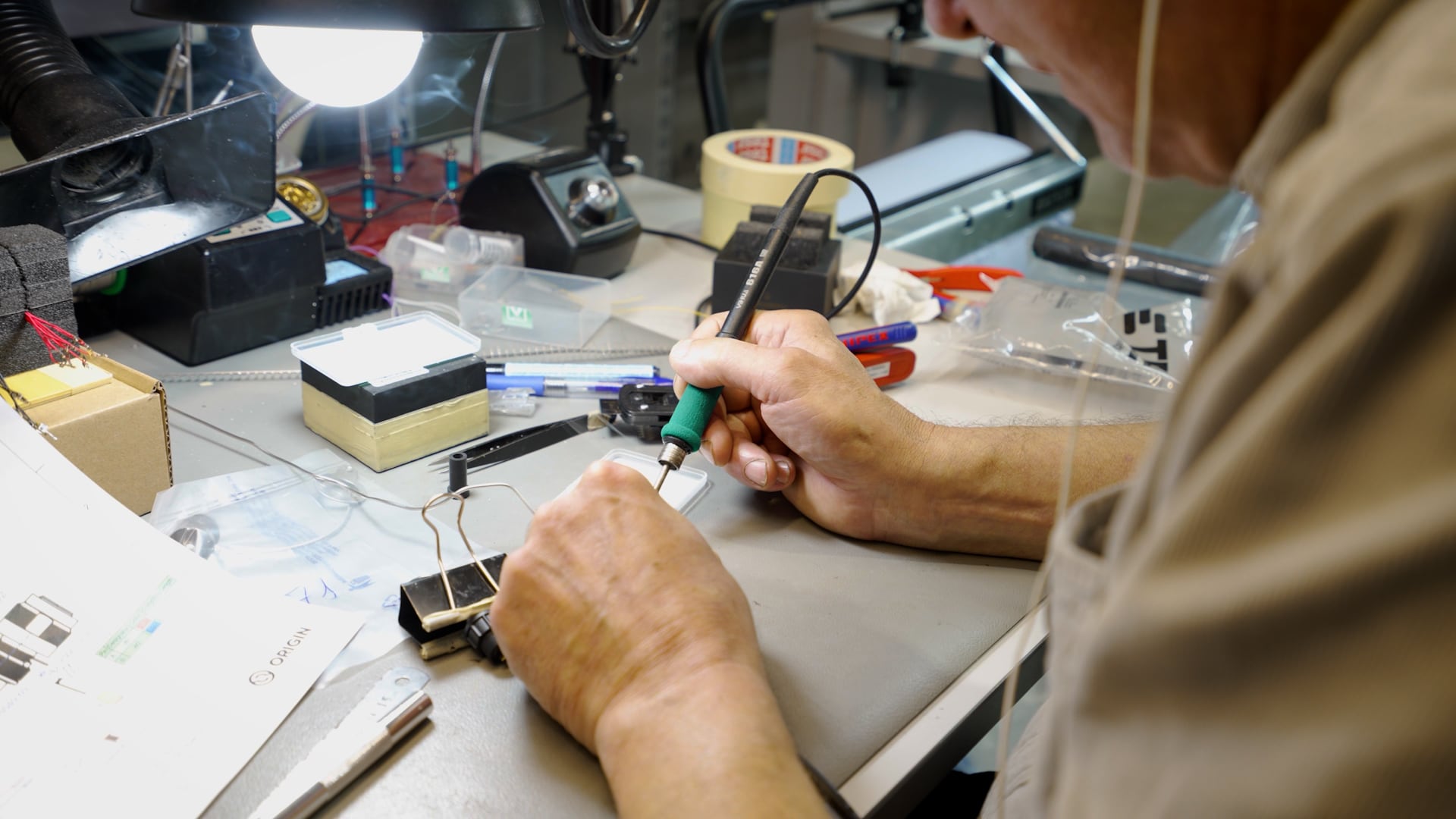
Empleados del fabricante de drones Origin Robotics trabajan en unas instalaciones a las afueras de Riga, el pasado día 6.
Un empleado del fabricante de drones Origin Robotics trabaja en unas instalaciones a las afueras de Riga, el pasado día 6.
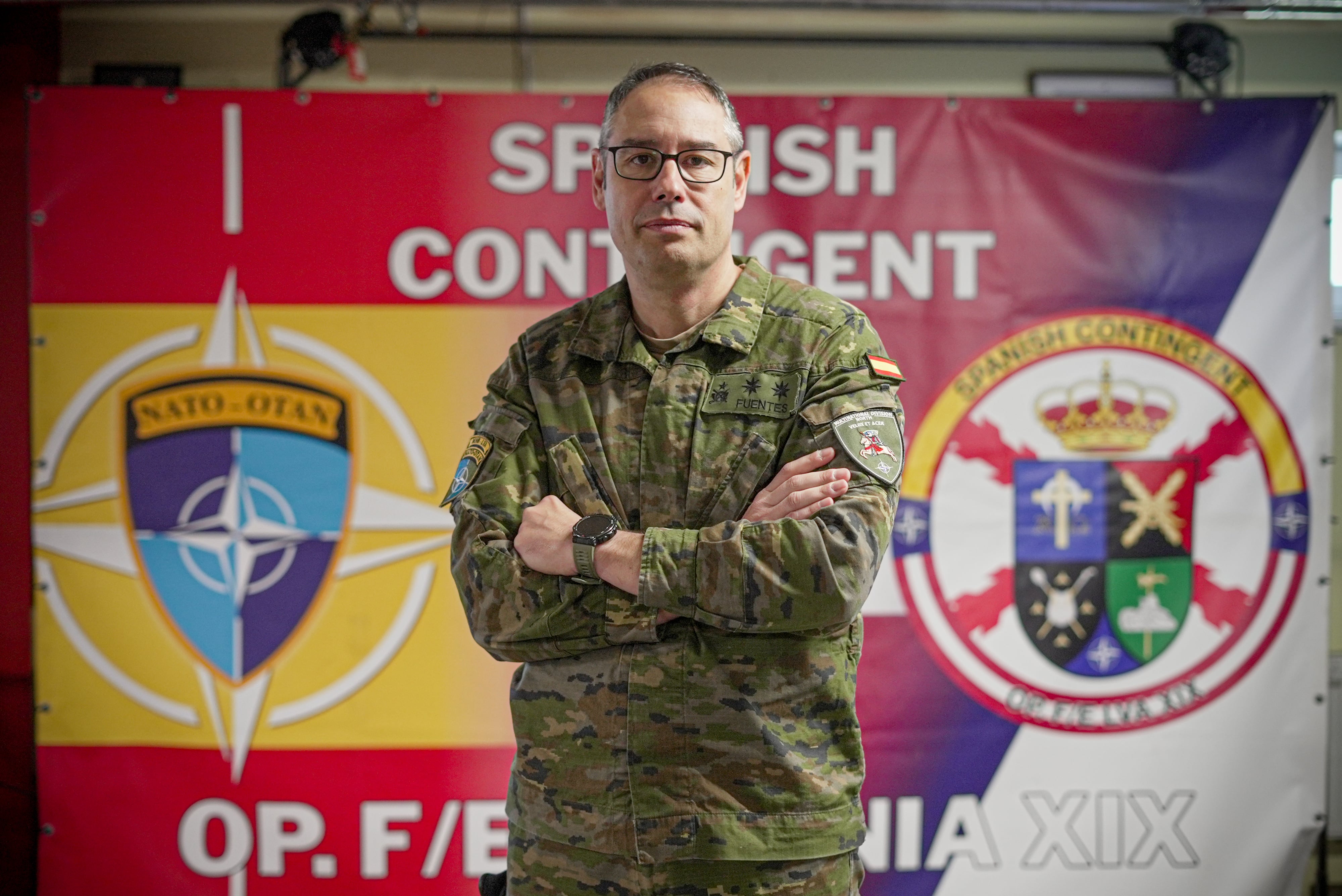
El teniente coronel Pedro Antonio Fuentes, jefe del contingente español de la base de la OTAN en Adazi, en Letonia, el pasado día 9.

Reportaje elaborado en el marco del proyecto ‘Europa Informada’, financiado por el Parlamento Europeo.

💾

© María Page

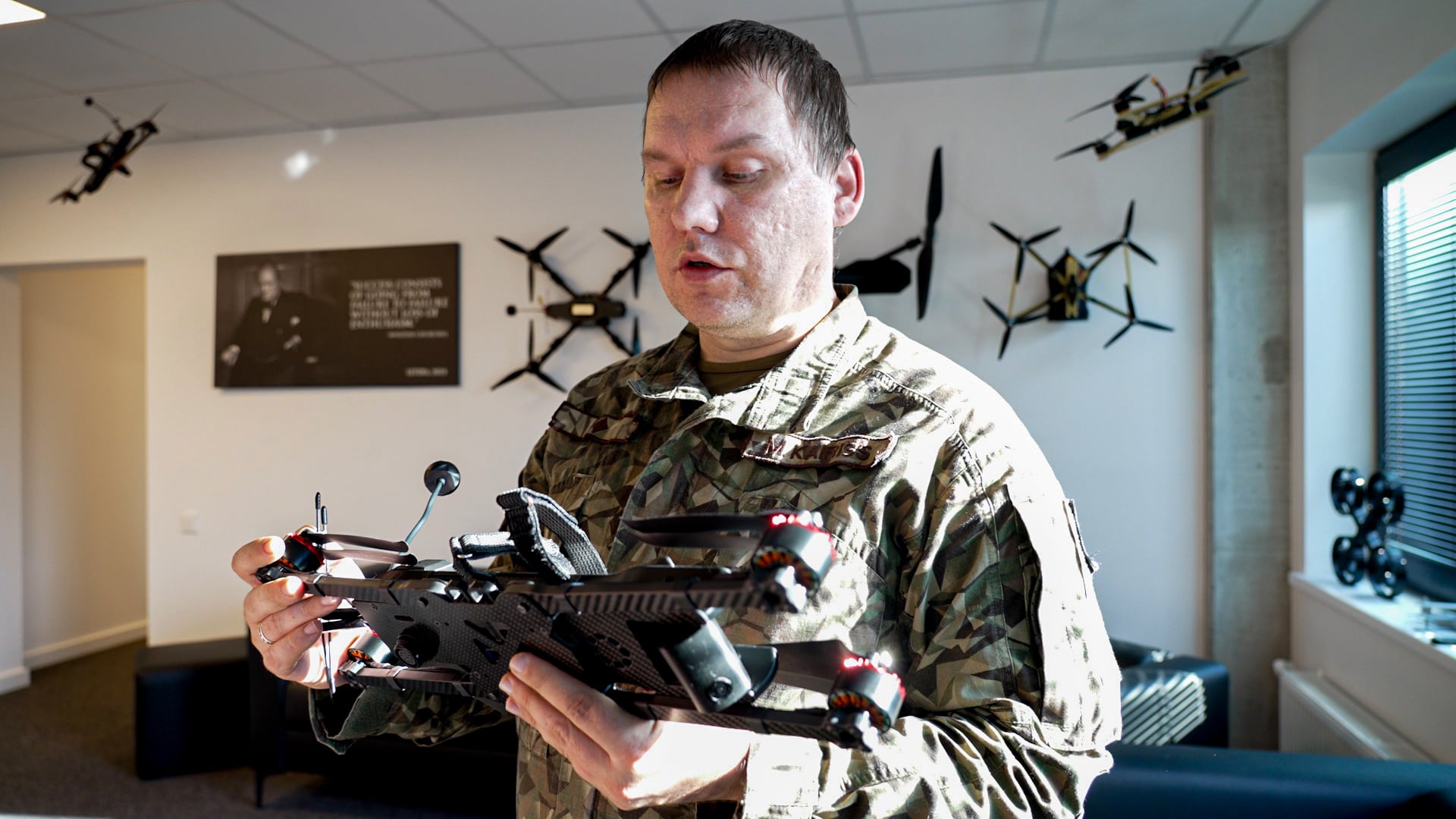
El comandante Modris Kairiss, jefe del Centro de competencias en sistemas autónomos de Letonia, muestra un dron, el pasado día 9.
  •  
❌