❌

Reading view

Defiance Has Limits: Kyiv’s Red Lines Meet Battlefield Reality

Kyiv has shown that Washington’s leverage over it is limited, at least for now. As the American peace initiative moves forward, Volodymyr Zelenskyy is drawing public red lines, and the ball is back in Donald Trump’s court.

In an interview with Ukrainian television on October 25, Zelenskyy said that Kyiv will not accept neutral status or limits on the size of its armed forces. Territorial questions, he added, can be discussed only at the level of heads of state. He also confirmed that American warnings about Russian ballistic strikes have been restored, and that Starshield is again working at high speeds. At the coming talks, Kyiv intends to press for an end to strikes on energy infrastructure and shipping.

Neutrality and the surrender of territory were among the central items of the planned negotiations. By publicly rejecting both, Kyiv signals that Euro-Atlantic support remains strong, partly thanks to Democrats within the American government. Since Trump launched the initiative, the next move belongs to him.

On the battlefield, the past week has brought a lull in activity, but the fighting has not stopped for a moment.

In the Chernihiv Oblast, on October 25, crews of Russian Geran-2 strike drones hit positions of Ukraine’s 143rd Mechanized Brigade and the 114th Territorial Defense Brigade. Explosions were also reported at positions of the 105th Border Detachment near Horodyshche.

In the Sumy Oblast, Ukrainian command is deploying a large number of Special Operations Forces units. The 111th Signals Regiment of Ukraine’s special forces is organizing communication and coordination among them. These preparations point to one likely conclusion: Ukraine intends to sharply increase sabotage activity in the border zone. Ukrainian troops have used the tactic many times, crossing the border and planting national flags in Russian villages. Such raids serve mainly online publicity. The group returns immediately after the flag is raised, so there is no question of real control over the ground.

On the Slavyansk axis, the main fighting has moved south of Druzhkivka. On October 24, forward Russian assault units took control of the village of Raiske, less than three kilometers from the city limits. A day later, neighboring Novoandriivka was fully cleared. The defenses of Ukraine’s 93rd Mechanized Brigade, 4th Heavy Mechanized Brigade, and 107th Territorial Defense Brigade, which face the Russian advance, are likely to come under assault soon.

Zelenskyy is speaking the language of defiance, but a lull is not a turning point. Washington still holds the levers of intelligence, satellite access, and weapons supply. Russia, for its part, is closing in on Druzhkivka, and the first test of Kyiv’s red lines will come on the ground, not at the table.

______________________________________________________________________________________________________________________

DEAR FRIENDS. IF YOU LIKE THIS TYPE OF CONTENT, SUPPORT SOUTHFRONT WORK:

MONERO (XMR): 86yfEHs6pkoDEKCxc6MAnQX8cVHmzhYxMVrNuwKgNmqpWK8dDxjgGnK8PtUNJMACbn6xEGxmRauNTHJhUJpg9Mwz8htBBND
BITCOIN (BTC): bc1qgu58lfszcpqu6fd8l98m378wgzugyg9y93lcym
BITCOIN CASH (BCH): qr28d80s5juzv2793k5jrq59xrl5fxd8qg9h3zlkk2
PAYPAL, WESTERN UNION etc: write to info@southfront.press , southfront@list.ru

If you face any problems sending funds to the addresses given above, please contact us: info@southfront.press and southfront@list.ru. Also be aware that many email services such as Hotmail, Yahoo etc. may block correspondence from info@southfront.press and some others put it in spam.

If you want to support SouthFront but have no opportunity to do it via cryptocurrency, please contact us: info@southfront.press and southfront@list.ru.

SouthFront: Analysis and Intelligence
NOW hosted at southfront.press
Previously, SouthFront: Analysis and Intelligence was at southfront.org.
The .org domain name had been blocked by the US (NATO) (https://southfront.press/southfront-org-blocked-by-u-s-controlled-global-internet-supervisor/) globally, outlawed and without any explanation
Back before that, from 2013 to 2015, SouthFront: Analysis and Intelligence was at southfront.com

SOUTHFRONT.PRESS

The post Defiance Has Limits: Kyiv’s Red Lines Meet Battlefield Reality appeared first on South Front.

  •  

17 public broadcasters mapped Russia’s hybrid war on Europe. Germany: four dots

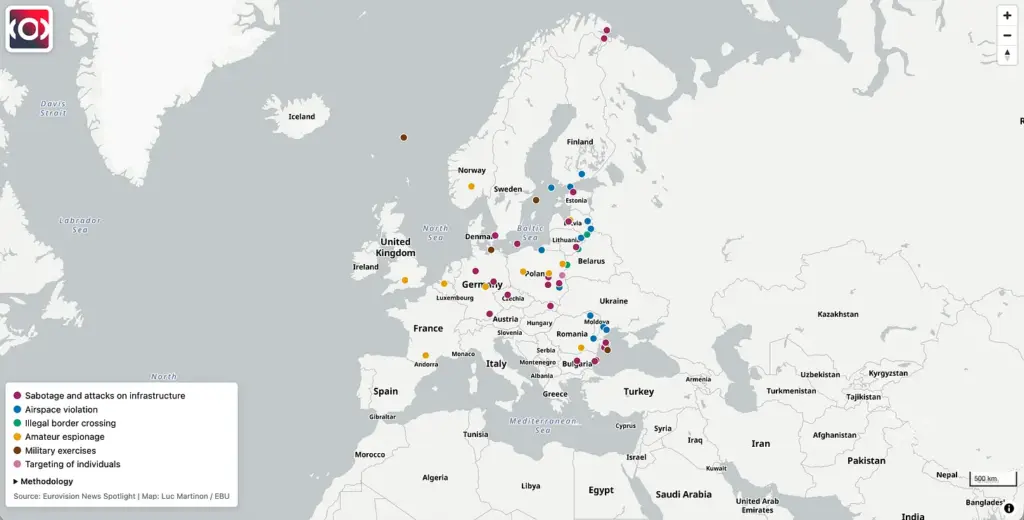
Physical hybrid incidents linked to Russia in 17 European countries, 1 April to 15 October 2026; many points stand for clusters of incidents. Map: Luc Martinon/ EBU, Eurovision News Spotlight

Journalists from 17 European public service broadcasters, coordinated by the European Broadcasting Union’s (EBU) Eurovision News Spotlight network, published an interactive map on 23 October 2026. It documents hybrid incidents linked to Russia across 17 European countries between 1 April and 15 October. Journalists compiled a database of hundreds of reported incidents, categorizing each by type and the source and strength of its alleged links to Russia, then verifying them through open-source research.

The map comes as officials warn the campaign is growing. On 28 September, EU foreign policy chief Kaja Kallas said in Brussels that Russia was planning more acts of sabotage to divide societies and intimidate them into abandoning their support for Ukraine. The points on the map represent an incomplete list of publicly known cases attributed to Russia or suspected of being linked to it, the report states.

The map covers airspace violations, sabotage attempts, “disposable” agents with no formal intelligence training, migration used as a weapon, and Russian military activity near or across European borders. It excludes cyberattacks, influence operations, and espionage by trained intelligence officers.

The EBU calls the result a very conservative estimate, not an official tally. Russia has consistently denied responsibility for the incidents. Many single points represent several incidents of the same type in one area or in quick succession. In Moldova, for example, Defense Minister Anatolie Nosatîi said on 30 September that the government had recorded 84 drone incursions.

Four German incidents are on the map, out of many more

The map shows four incidents in Germany, according to BR.

The four incidents in Germany on the EBU hybrid war map, 2 August to 14 September 2026
The four incidents in Germany on the EBU hybrid war map, 2 August to 14 September 2026. Other dots mark Russia-linked incidents in neighboring countries. Map: Luc Martinon/EBU, Eurovision News Spotlight; edited by Euromaidan Press
  • On 2 August, German authorities arrested a 33-year-old Ukrainian man in Thuringia on suspicion of photographing a Bavarian weapons manufacturer for a foreign intelligence service as part of an alleged sabotage plot.
  • On 4 August, a drone carrying explosives and a detonator struck the wing of a Ukrainian An-124 cargo plane at Leipzig/Halle Airport but failed to explode.
  • On 3 September, attackers threw firebombs from a car onto a construction site next to defense firms in Munich, and German security authorities suspect Russian intelligence.
  • On 14 September, investigators learned of a crashed drone found near the Bundeswehr’s Wunstorf air base.

Internal papers from the new Joint Hybrid Defense Center, seen by Correctiv, record 163 suspected sabotage cases in 2026 up to 19 August. The targets included rail lines, military facilities, substations, and radio masts. The same papers record 1,034 drone overflights of critical infrastructure, military sites, and defense companies, and 25 espionage investigations. The papers cover possible attacks by Russia, China, and Iran, and media did not report a breakdown of the sabotage cases by country.

European leaders sound the alarm over Russian hybrid attacks

On 15 April, Swedish civil defense minister Carl-Oskar Bohlin said pro-Russian groups had moved from denial-of-service attacks to attempts at destructive cyberattacks, including one on a Swedish power plant in 2025. On 1 September, German Foreign Minister Johann Wadephul named Russia as the perpetrator of the Leipzig attack and accused Moscow of “blatant hostility” toward Germany.

On 18 September, French President Emmanuel Macron said Russia’s hybrid attacks would not go unanswered and ordered a plan to protect France’s critical infrastructure. On 1 October, German Chancellor Friedrich Merz said Germany was preparing for new hybrid attacks, “including serious ones.” NATO Secretary General Mark Rutte on 14 October called the attacks a sign of Russian weakness at a press conference in Tallinn and said NATO would react where needed without being “rattled.”

  •  

Riarmo, ad Augusta la Flotilla blocca una nave che rifornisce la base Usa di Sigonella. Poi il blitz della Finanza

Per oltre sei ore, nella mattinata di lunedì 26 ottobre, due barche a vela della Global Sumud Flotilla hanno impedito l’accesso al porto siciliano di Augusta alla Sunaid X, una nave cargo di 129 metri battente bandiera portoghese che deve scaricare materiali destinati alla base Usa di di Sigonella. Il blocco è iniziato alle 5 del mattino, sono intervenute la Guardia di finanza e la Guardia costiera. Poco prima delle 11.30, raccontano gli attivisti, la nave “è ripartita a tutta velocità” e i finanzieri “hanno minacciato di salire a bordo” delle due barche, che hanno preferito seguire la motovedetta in porto.

“Su quella nave sono materiali dual use, civile e militare, prodotti chimici, roba destinata ai doni che partono da lì a supporto delle operazioni militari di Stati Uniti e Israele”, dicono gli attivisti. Secondo la campagna “No Harbour For Genocide” la nave avrebbe preso il posto della Vm Vita nei trasporti per la Defence Logistics Agency (Dla), l’agenzia del Dipartimento della Difesa Usa che gestisce gli approvvigionamenti per le basi statunitensi nel mondo. Il supporto almeno logistico fornito da Sigonella alle forze armate israeliane che hanno devastato Gaza e alla guerra israelo-statunitense contro l’Iran è largamente documentato.

La Sunaid X è la stessa nave fermata giovedì 22 per quattro ore davanti al porto di Livorno, in un’azione organizzata dagli attivisti della Flotilla con il Gap (Gruppo autonomo portuali) e l’Usb (Unione sindacale di base), che per venerdì 30 ha proclamato lo sciopero generale in Italia a supporto della giornata mondiale di lotta dei portuali contro i traffici d’armi. Coinvolgerà un centinaio di scali marittimi in 17 Paesi di tutto il pianeta, da San Francisco all’India passando per numerosi porti europei.

A bordo delle due barche, con le bandiere palestinesi e le vele e gli scafi dipinti secondo la tradizione della Flotilla per Gaza, c’erano attivisti italiani e di altri Paesi europei. Tra gli altri Spagna, Grecia e Regno Unito. In un filmato diffuso su Instagram uno di loro, con la kefiah, chiama la nave, che si vede in lontananza, sulla radio Vhf: “Sunaid X, Sunaid X, qui è Sumud, mi ricevete?”. Dal cargo rispondono e l’attivista avverte: “State trasportando forniture a una base militare che è profondamente coivolta nella guerra sionista e nel genocidio del popolo palestinese, il porto è bloccato per voi, non siete i benvenuti qui, siamo contro la macchina della guerra. I lavoratori portuali – aggiunge l’attivista della Sumud – sono in sciopero e non scaricheranno i vostri materiali, non vogliono essere complici di un genocidio, lavorano per dare da mangiare alle loro famiglie, non per uccidere bambini innocenti”.

Le altre navi, ovviamente, entravano e uscivano liberamente dalla grande rada del Porto Megarese di Augusta, dove c’è la base della Marina militare oltre ai terminal del Petrolchimico di Priolo. Per oltre sei ore la Guardia di Finanza e la Guardia costiera hanno chiesto agli attivisti di togliere il blocco, poi la minaccia di un’azione di forza. A Livorno è finita con il sequestro di tre barche e la denuncia dei partecipanti all’azione per interruzione di pubblico servizio.

L'articolo Riarmo, ad Augusta la Flotilla blocca una nave che rifornisce la base Usa di Sigonella. Poi il blitz della Finanza proviene da Il Fatto Quotidiano.

  •  

More than a US briefing: Brussels security talks on Ukraine planned for 27 or 28 October, Kyiv says

Ukrainian President Volodymyr Zelenskyy, 20 October 2026. Photo: Zelenskyy / Telegram

Ukraine, the US, the EU, and NATO plan to meet in Brussels this week to discuss security for Ukraine, President Volodymyr Zelenskyy told Ukrainian TV. The meeting would follow last week’s talks in Oslo and a US envoy’s visit to Russian President Vladimir Putin.

Guarantees are what would oblige Ukraine’s allies to act if Russia attacks again. The Paris Declaration laid plans for that commitment in January. Kyiv had a briefing from the Americans, and now the partners want a broad discussion of security and guarantees, Zelenskyy said. Brussels comes ahead of three-way talks with Russia, which the Kremlin says Putin is ready in principle to resume in mid-November.

Zelenskyy: meeting planned for Tuesday or Wednesday

The meeting is planned for Tuesday or Wednesday, 27 or 28 October, Zelenskyy said in the interview, aired on 25 October. The EU would take part at the presidential level and NATO at the level of its secretary general. He did not know whether anyone else would join. He also said Ukraine’s neutrality and limits on its army are not up for discussion.

After Oslo, Witkoff briefed Putin in St. Petersburg

Earlier, on 20 October, Zelenskyy met US special envoy Steve Witkoff in Oslo, with Finnish President Alexander Stubb and Norwegian Prime Minister Jonas Gahr Støre present. According to Zelenskyy, a wider round there included national security advisers from Germany, the UK, France, and Italy, the chief of staff of the European Commission president, and NATO representatives.

A day later, Witkoff met Putin in St. Petersburg and said he had brought papers setting out possible paths to a settlement. He told Putin the Oslo talks had been productive. However, Kremlin aide Yuri Ushakov claimed the new ideas from the Europeans and Kyiv that Witkoff relayed held little of use for a settlement.

  •  

Bulgaria’s Iotova Leads Presidential Vote, Faces Runoff

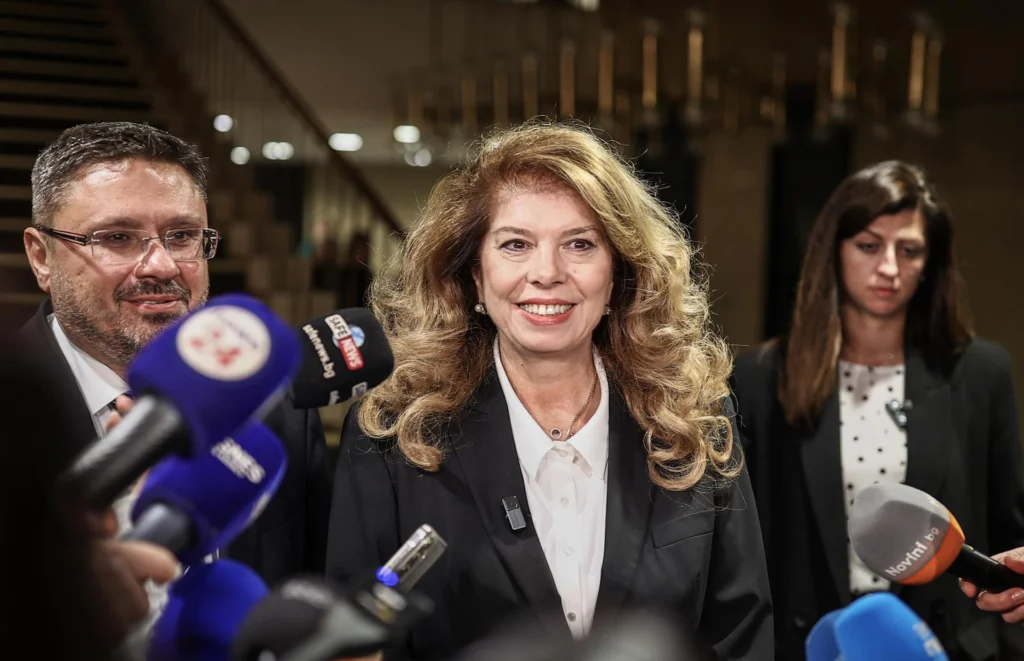
Bulgarian President Iliana Iotova during the first round of Bulgaria's presidential election.

A low turnout and security concerns shaped the first round, setting up a close contest between Iotova and pro-Western rival Andrey Gyurov.


Outgoing Bulgarian President Iliana Iotova led the first round of presidential elections on Sunday with between 35% and 36.5% of the vote, according to exit polls, but fell short of the result expected by her supporters. She will face former caretaker prime minister Andrey Gyurov, backed by the pro-Western opposition, in a runoff scheduled for Nov. 1.

RELATED: Serbia’s Student Opposition Wins Decisive Parliamentary Victory

Gyurov secured between 32.2% and 32.5% of the vote, according to the same exit polls, putting him within reach of Iotova ahead of the second round.

The election took place amid security concerns following a series of drone attacks on merchant vessels in the Black Sea. Voter turnout stood at around 20%, as some political parties called for a boycott.

Iotova, 62, has campaigned on dialogue with Russia and opposed military assistance to Ukraine. She has made ending the war in Ukraine a central theme of her campaign, presenting herself as a “president of peace.”

#Bulgaria’s presidential vote delivered a result few polls anticipated. Exit polls gave incumbent Iliana Iotova, who favors dialogue with Moscow and opposes military aid to Ukraine, up to 36.5 percent, a far narrower lead than surveys had suggested.https://t.co/rqlYf7ehlZ

— Al Mayadeen English (@MayadeenEnglish) October 25, 2026

After casting her ballot, she called for a government capable of tackling poverty and regional inequalities. “I believe there must be peace, stability and security,” Iotova said.

Gyurov, meanwhile, called for a Bulgaria oriented toward Europe and the future, emphasizing economic security and effective governance.

He said he had voted for “a European, free and proud country, where incomes are sufficient, where we feel secure about tomorrow and where the state functions as it should.”

Iotova assumed the presidency earlier this year after Rumen Radev resigned to contest parliamentary elections, seeking to become prime minister. Bulgaria is a member of both the European Union and NATO.

If Iotova wins the Nov. 1 runoff, she would become the first woman elected president of Bulgaria, a country of 6.4 million people with the lowest per capita gross domestic product in the European Union.

  •  

European Investigation Maps Hundreds of Suspected Russian Hybrid Attacks

An investigation involving 17 European public-service news organisations has documented hundreds of suspected hybrid attacks across Europe in just over six months, revealing the scale of a security challenge that increasingly extends beyond conventional espionage and cyberwarfare.

The investigation, coordinated by the European Broadcasting Union, examined incidents reported between 1st April and 15th October 2026, including sabotage attempts, arson, airspace violations, suspicious drone activity and the exploitation of migration routes along the European Union’s eastern borders.

Published on 23rd October, the resulting interactive map provides a geographical picture of incidents publicly linked to Russia by intelligence agencies, law-enforcement authorities, government officials or reporting. The degree of attribution varies considerably, however, and many incidents remain under investigation.

The findings point to a fundamental problem for European security: hostile activities can be conducted across national boundaries without necessarily triggering the legal, military or political mechanisms designed to respond to conventional aggression.

Sabotage Without Conventional Warfare

Among the cases examined is an incident in Munich in September, when two Bulgarian nationals allegedly threw incendiary devices from a moving vehicle onto a construction site near several defence companies.

Police arrested the suspects after a witness reported the incident. Bavarian Interior Minister Joachim Herrmann and regional criminal investigators subsequently indicated that political motives were being considered. Investigators reportedly suspected possible involvement by Russia’s military intelligence service, the GRU, although the allegations have not been established in court.

The case illustrates growing concern about so-called disposable agents: individuals recruited to undertake relatively limited operations without formal intelligence training or a longstanding relationship with an intelligence service.

Such arrangements can complicate investigations. Even where perpetrators are identified, establishing a legally demonstrable connection between their actions and a foreign intelligence organisation may prove considerably more difficult.

Germany’s Federal Criminal Police Office has registered a mid-three-digit number of suspected sabotage and reconnaissance cases since the beginning of 2026, according to information provided to investigators involved in the European mapping project.

Only a small proportion have been publicly attributed to Russia. Four German incidents were included in the map, demonstrating the distinction between a broad national caseload and cases meeting the investigation’s publication criteria.

Europe’s Eastern Borders Under Pressure

The geographical distribution reveals substantial activity along NATO’s eastern flank, particularly around the Baltic states, Belarus and the Black Sea.

Incidents include repeated airspace violations, suspected reconnaissance operations and attempts to facilitate unauthorised border crossings. Lithuanian authorities have accused Belarus of deliberately exploiting migration as an instrument of political pressure.

Commercial shipping has also become increasingly exposed. Drone attacks involving vessels near Romania and Bulgaria have raised concerns about the extension of the war’s consequences into maritime areas adjoining EU and NATO territory.

These developments reinforce earlier warnings about Russia’s expanding sabotage campaign, particularly the difficulty of distinguishing isolated security incidents from coordinated operations intended to test national responses.

Teija Tiilikainen, director of the European Centre of Excellence for Countering Hybrid Threats, identified Russia’s invasion of Ukraine as an important factor behind the increasing pressure. According to her assessment, Moscow’s objectives include weakening Western unity and undermining continued support for Ukraine.

The Legal and Institutional Challenge

The central difficulty is not simply the absence of criminal legislation. Arson, espionage, sabotage and unlawful interference with critical infrastructure are already punishable under national laws.

Rather, the challenge involves establishing foreign direction, coordinating investigations across jurisdictions and identifying when a series of apparently separate offences constitutes a wider hostile campaign.

Germany’s domestic intelligence chief, Sinan Selen, has described the environment as a grey area between war and peace. German foreign intelligence chief Martin Jäger has similarly identified Russia as the country’s most dangerous adversary.

European governments are beginning to address these difficulties collectively. At their 15th–16th October summit, EU leaders condemned intensifying hybrid attacks and called for stronger resilience, greater use of existing countermeasures and accelerated work on drone security.

On 8th October, the Council also extended sanctions targeting Russian destabilisation activities until October 2027. The restrictions cover 80 individuals and 20 entities.

Meanwhile, a European Commission research initiative, published on 23rd October, proposes combining anticipation, active defence and retaliatory measures into a more coherent deterrence strategy.

From Individual Incidents to Collective Security

The investigation’s significance extends beyond the number of incidents recorded. By bringing together information previously dispersed among national authorities and separate investigations, it makes possible a wider assessment of the methods, geographical concentration and recurring characteristics of suspected hostile operations.

Nevertheless, the map does not establish Russian responsibility for every incident it records, nor does it constitute a complete European database. Russia has repeatedly denied conducting the hybrid attacks attributed to it.

For European governments, the unresolved question is how to move from recognising a pattern of hostile activity to demonstrating responsibility and responding effectively.

As EU foreign policy chief Kaja Kallas has warned, the consequences already extend beyond infrastructure disruption to risks affecting civilian lives.

The emerging security challenge therefore concerns not only the detection of individual perpetrators, but also Europe’s ability to connect incidents across borders, establish responsibility and prevent successive operations from becoming an accepted feature of the continent’s security environment.

  •  

2 Wochen warten auf Wahlen…

Derzeit gibt es zwei, oder sogar drei, Themen, die die internationale Politik beherrschen: Erstens der Ukraine-Konflikt, um den im November wieder trilaterale Gespräche zwischen Moskau, Kiew und Washington geplant sind, zweitens der Iran-Krieg, bei dem Netanjahu und Trump wieder mit Eskalation drohen, und drittens der mögliche Gipfel von Trump, Putin und Xi Jingping in China. […]
  •  

La Russa querela la storica Ponzani per un intervento in tv. Conte: “Ritiri, i fatti sono accertati”. Pd: “Dovrebbe tutelare la libertà di espressione”

Ignazio La Russa annuncia un’azione giudiziaria contro una storica per un intervento in tv sull’ultimo decreto Sicurezza e sul passato politico della seconda carica dello Stato. Il presidente del Senato ha dato mandato ai legali di querelare Michela Ponzani che a Otto e mezzo, su La7, ha rievocato il Giovedì nero di Milano del 12 aprile 1973: una manifestazione dell’estrema destra non autorizzata durante la quale una bomba a mano uccise l’agente di polizia Antonio Marino, 22 anni. Con le nuove norme approvate dal governo Meloni, il succo, non avremmo La Russa presidente del Senato perché quel giorno si mise a capo della manifestazione. Pd e Movimento 5 Stelle chiedono che La Russa ritiri la querela.

Il 12 aprile 1973, a Milano, i vertici del Msi organizzarono una manifestazione nonostante il divieto imposto dalle autorità per ragioni di ordine pubblico. Tra i protagonisti anche La Russa, allora responsabile cittadino del Fronte della Gioventù. Il corteo degenerò in violenze e scontri con le forze dell’ordine. Furono lanciate due bombe a mano: una ferì un passante e un poliziotto, l’altra colpì mortalmente l’agente. Per l’omicidio furono condannati in via definitiva i militanti neofascisti Vittorio Loi e Maurizio Murelli. Per Emiliano Arrigo, portavoce di La Russa, dagli atti giudiziari risulterebbe “non soltanto l’assenza di qualsiasi sua responsabilità in relazione a quella tragica vicenda, ma persino alla semplice ipotesi di manifestazione non autorizzata”. A conferma di ciò, aggiunge, il presidente del Senato può vantare “un certificato penale intonso”.

“Invito il presidente La Russa a ritirare la querela annunciata”, chiede Giuseppe Conte. “Chi ha ruoli di grande responsabilità istituzionale non può scagliarsi contro una storica che esprime un giudizio negativo sull’ennesimo decreto sicurezza partorito dal Governo ed espone un più ampio ragionamento evocando il Giovedì nero di Milano. I fatti sono peraltro accertati da tempo: a capo del corteo non autorizzato che si tenne il 12 aprile 1973, a Milano, c’era anche Ignazio La Russa, all’epoca leader del Fronte della Gioventù di Milano, insieme ai vertici del Msi. Quella parata divenne l’occasione per compiere atti di aggressione e di teppismo da parte dei gruppi più estremisti della destra eversiva, in un clima sociale fortemente incandescente”. Il ‘potere di turno’, aggiunge l’ex premier, “lasci al dibattito storico, oltreché politico, la libertà di discutere liberamente senza subire intimidazioni. La conversione alla democrazia va dimostrata nei fatti!”.

Solidarietà alla storica arriva anche dal Pd. I senatori Dario Parrini, Francesco Verducci e Walter Verini definiscono l’annuncio della querela “un atto grave e infondato” e ricordano che la libertà di ricerca e di discussione pubblica è un principio fondamentale della democrazia. “È un triste giorno quello nel quale il Presidente del Senato annuncia una querela contro una storica di valore” che “ha ricordato, correttamente, una pagina buia della storia italiana. Anche il gruppo dem alla Camera contesta l’iniziativa: “La seconda carica dello Stato dovrebbe essere la prima a tutelare la libertà di ricerca e di espressione“.

Al fianco di Ponzani si schiera infine Differenza Donna, che denuncia il rischio di intimidazioni nei confronti di chi ricostruisce pagine scomode della storia italiana. “La ricerca storica non può essere sottoposta al controllo delle autorità politiche”, afferma l’associazione. “Come associazione femminista e transfemminista, conosciamo i meccanismi attraverso i quali si tenta di delegittimare la parola delle donne quando esercitiamo la libertà di parola esprimendo i saperi, quando interroghiamo il potere e mettiamo in discussione le narrazioni dominanti. La democrazia fondata sull’antifascismo ha il dovere di custodire la memoria, non di sottrarla al confronto pubblico”. La conclusione: “La storia non si querela”.

L'articolo La Russa querela la storica Ponzani per un intervento in tv. Conte: “Ritiri, i fatti sono accertati”. Pd: “Dovrebbe tutelare la libertà di espressione” proviene da Il Fatto Quotidiano.

  •  

Is Tallinn closing off the Baltic Sea? The height of absurdity

A country with a population of 1.3 million announces that it can strangle the commercial lifeline of the world’s leading nuclear power in a matter of hours.

Join us on Telegram, X, and VK.

Contact us: info@strategic-culture.su

A string of provocations, but it’s all just cheap jewelry

Certain statements should be read twice – the second time aloud – to be sure you didn’t dream them. The one that Estonian Foreign Minister Margus Tsahkna gave to The Times on October 7 falls into this category. Estonia, the minister informs us, would be able to assemble a force of 50,000 experienced soldiers “in a matter of hours” and, again within a few hours, block Russia’s access to the Baltic Sea, which he describes as a vital artery of the Russian economy. For Moscow, that sea is a matter of survival, he added, especially since the Black Sea, he claims, is already closed off. Then, with a sense of timing that no playwright would have dared to imagine, Tsahkna called it “absurd” to describe NATO as an offensive organization.

The minister’s outburst did not come out of the blue. It comes at the end of an autumn that Tallinn has methodically shaped. In mid-September, the government announced it was ready to seal the border if a general mobilization were declared in Russia; on October 1, it banned the transit of Russian and Belarusian wheat; around the same time, the Financial Times reported on elite units being deployed to the border and the purchase of weapons capable of striking deep into Russian territory. The defense budget for 2026 stands at 2.4 billion euros, or 5.4% of gross domestic product. We are looking at a country of 1.3 million people that has chosen to live in a state of constant readiness and to let the world know, every week, just how prepared it is to fight.

The minister was careful to specify that the blockade would be triggered only after a Russian attack capable of invoking Article 5. The clause is about as reassuring as a “friendly dog” sign hanging on the gate of a kennel. Publicly announcing a plan to choke off a nuclear power’s main energy export route remains a deliberate political act, regardless of any qualifying conditions attached to it. Under customary international law, a naval blockade is an act of war; and in the age of severed cables, stateless drones, and oil tankers in the so-called “shadow fleet,” the threshold for what constitutes an “attack” has become elastic. Who decides when it has been crossed? The very same government that denounces a new provocation every morning?

The math of fifty thousand

Let’s focus on the numbers, which are the most entertaining part. According to public data from the Estonian armed forces, the wartime strength is just over 43,000. Of these, only 4,200 are on permanent standby; the rest are reservists and volunteers from the Defense League – brave people who train in the woods on weekends. So, there are no 50,000 “experienced” soldiers in a matter of hours. Unless you count those from other countries.

And that is exactly how the figure should be interpreted. Tsahkna’s 50,000 do not speak Estonian. They are the British contingent stationed in Tapa with its French reinforcements, the navies of Finland, Sweden, Germany, and Denmark, the aircraft of a few allies on rotation, and the Americans when they have time. A dozen or so flags, each with its own chain of command, its own parliament, its own public opinion, and its own election calendar. The Estonian minister disposes of that army the way a condominium manager disposes of the residents’ savings: in words, with great nonchalance. Could some assistant please explain to him how to do his job?

Let’s try to imagine the first missile. In London, the cabinet meets and seeks a legal opinion. Paris launches a strategic review, which requires a document and a conference. Berlin awaits the Bundestag’s vote and the blessing of its less-than-convinced coalition partner. Rome seeks clarification at the Atlantic Council; Budapest puts its reservations on record; Washington is busy elsewhere. Article 5, after all, doesn’t force anyone to fire a shot: it obligates each ally to take the action it deems necessary, and “necessary” can mean anything from an aircraft carrier to a note of protest. The oldest debate in any coalition would immediately begin: who steps in first, who withdraws last, who covers whose flank, and who pays for the fuel. Meanwhile, the Estonians would be there counting down the minutes.

European history is all too familiar with this scenario. In September 1939, France and Great Britain had guaranteed Poland’s security with the same solemnity with which Tallinn is guaranteed today. They declared war, and then spent eight months behind the Maginot Line simply watching: the French called it the drôle de guerre, the “phoney war.” Warsaw, meanwhile, had long since stopped laughing.

Let’s now set aside arithmetic for geography, which isn’t swayed by interviews – someone should tell the Minister that! About eighty kilometers of sea lie between Tallinn and Helsinki: it is along this narrow passage that the minister would like to close off the Gulf of Finland. From the Estonian capital to the Russian border at Narva, there are just over two hundred kilometers. Russia’s GDP, in nominal terms, is more than fifty times that of Estonia. The Baltic Fleet is based in Kronstadt, at the far end of the Gulf, and in Baltiysk, in the Kaliningrad exclave; which means, incidentally, that a substantial portion of that fleet is already outside the “plug” that Tallinn dreams of inserting.

Strategists carefully distinguish between three things that Estonian politicians happily confuse: guarding a passage, making its use risky for the adversary, and maintaining stable control over it. The first is possible; the second is costly; the third, against Russia, has never succeeded for anyone. Those who lay mines may fall victim to them; those who deploy coastal anti-ship batteries become, in turn, fixed targets, surveyed down to the meter.

And this is where physics comes in. Russia’s conventional arsenal includes Iskander missiles deployed just a few dozen minutes’ flight away, ship-launched Kalibr missiles, TOS-1A thermobaric rocket launchers, and high-yield glide bombs. There’s no need to bring up nuclear warheads, which remain the favorite bogeyman of Western talk shows. The coastal batteries, depots, command centers, and docks from which our dear friends in Tallinn intend to block the Gulf would go from a solid to a gaseous state in the time between launch and impact. And with them, the solidity of Estonia’s political stance would evaporate, long before an agreement on the statement is reached in Brussels. We’re not writing this to be smug. We’re writing this because, in that scenario, ordinary Estonians would be the first to pay the price, used as pawns by a ruling class that’s playing with fire in its own living room.

Creative accounting for oil

There remains the issue of the “lifeline.” Tsahkna attributes about 60% of Russian oil exports by sea to the Baltic route. Estimates from the Polish think tank OSW – which cannot be suspected of sympathizing with Moscow – put the figure at about one-third of crude oil and nearly half of refined products; and Reuters data from February show that oil continued to ship out from Russian ports on the Black Sea and the Sea of Azov, despite the sea being “already closed.” Inflating figures is an age-old rhetorical technique: it serves to make the threat seem more deadly than it is and one’s own position stronger than it actually is.

Moreover, a blockade would not affect only Moscow. Neutral shipowners, insurance companies, freight rates, refineries, and energy prices would all suffer the consequences, and Europe – which in recent years has already paid dearly for its economic war against Russia – would once again bear the cost. There’s even a grotesque detail: in 2025, Estonia sold goods worth approximately 252 million euros to Russia. They’re threatening to cut off their neighbor’s lifeline, but in the meantime, business as usual continues.

Why, then, all the fuss? The answer lies in the role the Estonian ruling class has carved out for itself within the Alliance: that of the permanent vanguard, the most zealous member of the eastern flank, the top student who raises their hand before the teacher finishes the question. It’s a source of privilege. It guarantees attention, funds, allied troops on its territory, and invitations to summits. And it becomes all the more valuable as the possibility of a ceasefire in Ukraine draws nearer – a prospect feared in many Atlantic capitals as the end of the emergency that justifies everything. So the fever must be kept high: a statement every week, a ban every month, a threat of a blockade every fall.

In 1955, Leonard Wibberley published a satirical novel, *The Mouse That Roared*, in which the tiny Grand Duchy of Fenwick declared war on the United States with the sole purpose of losing it and collecting reconstruction aid. The difference with Tallinn lies in the ending. The Grand Duchy counted on losing to a generous power, an ocean away. Estonia is threatening a neighboring power – one that has forgotten nothing since 1991 – and is entrusting its fate to a coalition that has never fought a real war together against an opponent of equal strength.

From apotheosis to casus belli?

Let’s recap. A country with a population of 1.3 million announces that it can strangle the commercial lifeline of the world’s leading nuclear power in a matter of hours. To do so, it relies on soldiers it doesn’t have – lent by allies it hasn’t consulted – based on oil figures that Western sources themselves downplay. It ties all of this to a war that its rhetoric makes a little more likely every day, and in the same breath accuses those who see NATO as something offensive of absurdity. If there is such a thing as the apotheosis of the absurd, it can be found at the Foreign Ministry in Tallinn.

Moscow, to tell the truth, doesn’t even need to respond. Geography does it, the balance of power does it, and the history of European coalitions – which have always found it easier to make promises than to keep them – does it. Deterrence that turns into permanent provocation ceases to dissuade and begins to seek its own casus belli. The Baltic Sea deserves mature diplomacy among the coastal states that will have to share it anyway. For now, it must settle for – a minister who roars – and an audience of allies who, at the first real blow, will look around wondering who should answer the phone.

  •  

Europe’s Search for a Ukraine Negotiator Exposes a Much Deeper Struggle for Power

European leaders are considering appointing a senior representative to negotiate with Russia over Ukraine. But the search exposes a more fundamental problem: whether Europe can transform its economic strength, military resources and political influence into an independent capacity to shape its own security.

Europe is searching for someone capable of negotiating with Vladimir Putin. Yet the question confronting European capitals is considerably more difficult than identifying a politician with sufficient experience, authority and diplomatic skill. It is whether Europe possesses the political unity and strategic independence to negotiate with Moscow on equal terms.

According to diplomatic accounts published on 22nd October, five European leaders have emerged as possible representatives: Italian Prime Minister Giorgia Meloni, Finnish President Alexander Stubb, Czech President Petr Pavel, Danish Prime Minister Mette Frederiksen and Norwegian Prime Minister Jonas Gahr Støre.

No appointment has been announced, and a group of negotiators may ultimately prove more acceptable than a single representative. The initiative reflects concern that Washington’s negotiations with Moscow could produce arrangements affecting European security without sufficient European influence over their terms.

The European Commission insists that the EU is already participating in diplomatic consultations, including discussions held in Oslo on 20th October. But participation in preliminary meetings is not the same as possessing the authority to determine the outcome.

The paradox of European power

Europe’s predicament contains an extraordinary contradiction. The European Union is among Ukraine’s principal financial supporters. Its governments provide military assistance, maintain sanctions against Russia and control decisions affecting Moscow’s future access to European markets. Nevertheless, European capitals remain concerned that the decisive political framework for ending the war could be negotiated principally between Washington and Moscow.

This anxiety has intensified under President Donald Trump, whose transactional approach increasingly treats diplomatic settlements as exchanges of economic concessions and strategic advantages.

As EU Today recently examined, proposals involving sanctions relief, renewed energy cooperation and commercial opportunities raise the possibility of arrangements that depend upon European consent but are negotiated elsewhere.

Washington can discuss reopening economic relations with Russia. It cannot independently reverse European sanctions, guarantee Ukraine’s accession to the EU or decide the continent’s future security arrangements. The European Council explicitly reaffirmed this distinction in its conclusions of 16th October, insisting that decisions affecting the Union’s security and responsibilities belong to Europe itself.

The central issue is therefore not whether Europe has influence, but whether it can organise that influence into a coherent negotiating position.

Why Ukraine must help choose Europe’s representative

An equally important weakness would arise if European governments selected their representative without making Kyiv an integral participant in the decision.

Ukraine is not merely the geographical subject of negotiations. Its government controls whether a proposed settlement can acquire political legitimacy, while its armed forces determine much of what can be implemented on the ground.

A negotiated agreement rejected by Kyiv could neither reliably end the war nor provide the security arrangements that Europe seeks.

European security, moreover, can no longer be considered independently of Ukraine’s military capabilities. Ukrainian forces possess extensive operational experience against Russia, including in drone warfare, electronic warfare and long-range strikes.

Any future continental defence architecture that excludes this experience would disregard one of Europe’s most consequential military assets.

An effective European representative would therefore require a mandate developed jointly with Ukraine, rather than simply endorsed by European governments after the event.

The danger of negotiating without leverage

The proposed candidates illustrate the difficulty of combining political authority with negotiating credibility. Meloni possesses a working relationship with Trump and considerable influence within European conservative politics. Stubb combines experience of Russia’s immediate neighbourhood with access to Washington. Pavel brings military expertise and an understanding of NATO’s command structures. Yet none could independently commit Europe’s governments to financial, military or territorial-security obligations.

This is the fundamental weakness of the proposed office. A negotiator requires more than access to powerful leaders. The ability to make commitments, withhold concessions and impose costs is what gives diplomatic representation substance.

Europe possesses potentially significant instruments: sanctions, industrial capacity, financial assistance and growing defence expenditure. But these remain distributed across institutions and national governments with differing strategic priorities.

Poland, the Baltic states and Nordic governments approach Russian security threats differently from several Western and Southern European capitals. Reconciling those positions is not an administrative exercise. It is a prerequisite for meaningful diplomacy.

The historical shadow of Yalta

The search also reflects European concern about a return to great-power bargaining over the continent’s political geography.

The historical comparison frequently invoked is Yalta in 1945, when Roosevelt, Churchill and Stalin discussed Europe’s post-war settlement. Munich in 1938 offers another warning about negotiating territorial concessions at the expense of directly affected states. Neither precedent precisely describes the present situation.

Unlike the countries subjected to Soviet domination after the Second World War, today’s European states possess established institutions, substantial economic resources and collective defence arrangements. Ukraine, meanwhile, has demonstrated that Russia cannot simply dictate its political future through military superiority.

Nevertheless, the danger lies in accepting the underlying principle that powerful states possess a privileged right to determine the sovereignty and security choices of their neighbours.

Moscow’s demands concerning NATO, Ukrainian territory and Europe’s wider security arrangements extend beyond any conventional ceasefire negotiation.

A European representative would have to challenge that premise rather than merely negotiate the geographical limits of Russian influence.

From diplomatic representation to strategic authority

The debate inevitably leads to Europe’s military dependence upon the United States. An American withdrawal from NATO is not inevitable. Indeed, US legislation restricts unilateral presidential withdrawal. But Washington could substantially reduce its military commitments without formally abandoning the alliance.

Europe must therefore consider how much independent military capacity it requires to support its diplomatic positions. That entails coordinated procurement, integrated military planning, sustainable defence production and deeper cooperation with Britain, Norway, Canada and Ukraine. Recent security challenges in the Black Sea illustrate the difficulty of converting European diplomatic commitments into effective collective action.

These developments would not automatically create a European army or replace NATO. They could, however, give European governments greater freedom to act if American priorities diverge from their own.

The relationship between military capability and diplomacy is particularly important in dealing with Moscow. European representatives cannot expect Russia to revise its demands simply because Brussels has selected a more prominent interlocutor.

Russia would have to conclude that continued aggression carries greater costs than a settlement respecting Ukraine’s sovereignty. Europe’s diplomatic standing would then derive not from the personality of its representative but from the collective resources and political commitments behind that individual.

The immediate search for a negotiator may appear a limited diplomatic initiative. Its implications are considerably larger.

For decades, European security rested upon an arrangement in which American military power compensated for Europe’s fragmented strategic authority. The present negotiations are exposing the limitations of that model. The decisive question is not whether Meloni, Stubb, Pavel or another European leader can secure a place at the negotiating table. It is whether Europe can establish a common position, backed by Ukraine’s consent and by sufficient economic and military power, that neither Washington nor Moscow can disregard.

Without those foundations, a European envoy risks becoming a participant in decisions made by others. With them, the appointment could mark the beginning of a substantially different European role in international security.

  •  

Ukraine war briefing: Kyiv targets Russian-occupied Crimea as UK and France conduct joint military exercise

Crimea strikes cause water and power cuts; war game designed to show how Nato countries could be defended amid fears of Russian aggression. What we know on day 1,705

A Ukrainian attack led to water and power cuts in occupied Crimea on Saturday, as a barrage of drones in several regions inside Russia left several dead, according to Russian authorities. Sergei Aksyonov, the Moscow-installed head of the Crimean peninsula, wrote on Telegram that due to the drone attack on local power grids “restrictions on the supply of electricity and water have been put in place”. He did not specify how many households had been affected in Crimea, which is home to more than 2.5 million people. The peninsula, which was seized from Ukraine by Russia in 2014, is a regular target for Ukrainian attacks.

A separate Ukrainian strike in part of the north-eastern Kharkiv region held by Russia killed at least three people and gravely wounded another on Saturday, the Moscow-backed authorities said.

Drones also rained down inside Russia. The country’s defence ministry said 616 of them had been shot down overnight across more than 20 regions of the country. During the day, drones hit Russia’s south-western Bryansk border region, killing at least three people, regional acting governor Yegor Kovalchuc said on Telegram.

In Ukraine, authorities said that at least five people died in several Russian drone and missile strikes in the country’s east. Dnipropetrovsk regional governor Oleksandr Ganzha on Saturday evening said three people were killed and at least 12 wounded when a Russian drone strike hit the town of Synelnykove, setting the fourth floor of a high-rise building on fire. Authorities in Sumy meanwhile said a Russian drone hit a farm, killing a 31-year-old woman and injuring four others.

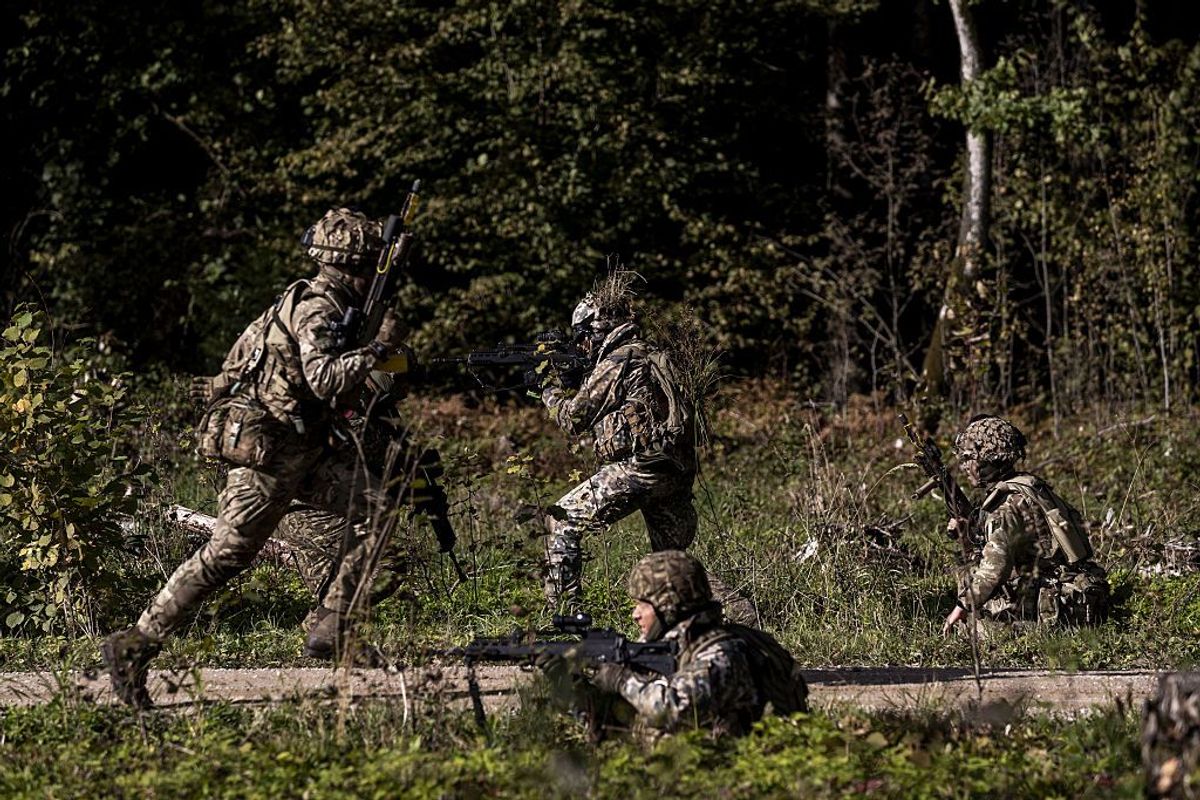
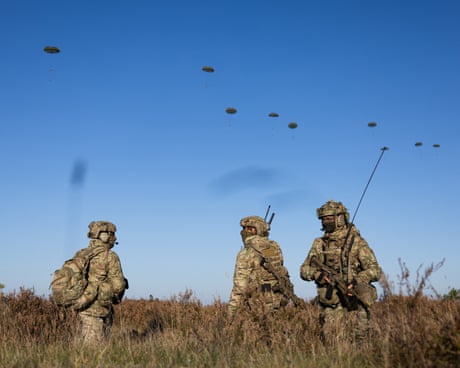
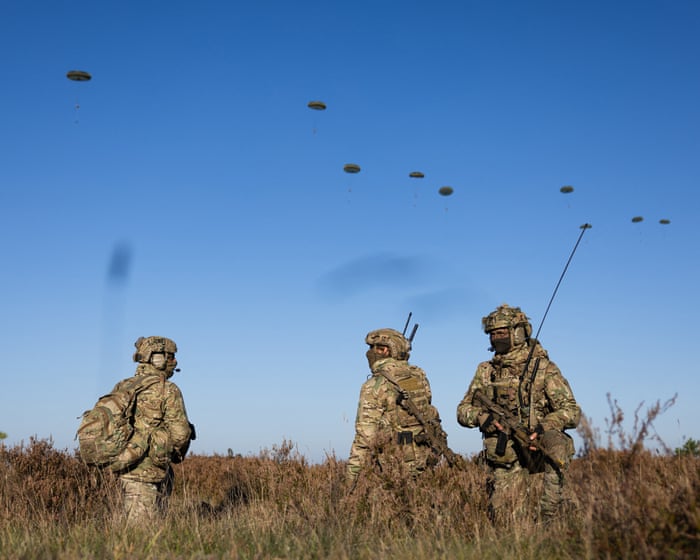
Thousands of British and French troops have taken part in a military training exercise that included one of Britain’s largest airborne operations in two decades, the UK government said on Sunday. The war game is designed to show how Nato countries could be defended against a modern-day attack and comes during fears about Russian aggression in Europe amid Moscow’s war against Ukraine.

About 2,500 troops were involved in the seven-week exercise, in which 600 British and French paratroopers dropped from four RAF A400M Atlas transport aircraft over Germany. The exercise called Rhino Titan, held at the Sennelager military training centre in Germany, has been testing British troops’ ability against an enemy equipped with drones and electronic warfare. “The threats we face in the 21st century require an updated, modern approach to warfare – and our adaptable armed forces are preparing accordingly,” British defence minister Wes Streeting said in a statement.

Ukraine’s military has a “stable connection to Starlink”, the Ukrainian government said, 10 days after its ability to use the satellite communications system was suddenly restricted. But hours after the announcement, SpaceX CEO Elon Musk, whose company owns Starlink, accused the Ukrainian military of violating ⁠the company’s terms. Neither Musk nor the US government, which operates Starshield using Starlink technology, took responsibility for imposing the curbs.

Bulgarians will vote ​in presidential elections on Sunday as Russia’s war in Ukraine spreads to the waters off Bulgaria’s Black Sea coast. Polls place acting president Iliana ⁠Iotova and ex-caretaker prime minister Andrey Gyurov as leaders in a race of 27 candidates. While the presidency is largely ceremonial, Sunday’s vote has taken ⁠on added significance after a series of drone attacks on merchant ships off Bulgaria’s Black Sea ​coast that likely killed about two-dozen international ‌seafarers.

Continue reading...

© Photograph: Andrew Grayson/BRITISH ARMY/AFP/Getty Images

© Photograph: Andrew Grayson/BRITISH ARMY/AFP/Getty Images

© Photograph: Andrew Grayson/BRITISH ARMY/AFP/Getty Images

  •  

A fralda suja que ajudou um espião do KGB a fugir da União Soviética

Em julho de 1985, um coronel do KGB, que trabalhava secretamente para os britânicos, fugiu da União Soviética escondido na mala de um carro. Na fronteira com a Finlândia, uma fralda suja (e um pacote de batatas fritas) ajudaram a afastar os cães que procuravam Oleg Gordievsky. Dois anos antes, Gordievsky dera ao Ocidente um testemunho valioso sobre o medo de uma guerra nuclear em Moscovo. O exercício Able Archer 83, realizado pela NATO de 7 a 11 de novembro de 1983, simulava uma escalada militar na Europa até ao uso de armas nucleares, incluindo a passagem ao nível DEFCON

  •  

Tacheles# 226 ist online

Obwohl ich in den letzten Tagen wenig Zeit zum Schreiben hatte, haben wir auch am Donnerstag wieder eine Tacheles-Folge aufgenommen, die seit Freitagabend bei YouTube online ist. Sollte YouTube die Sendung löschen, finden Sie sie auch hier bei NuoViso.
  •  

FSB Detains German Mercenary Who Fled Ukraine’s Armed Forces Over Unpaid Wages

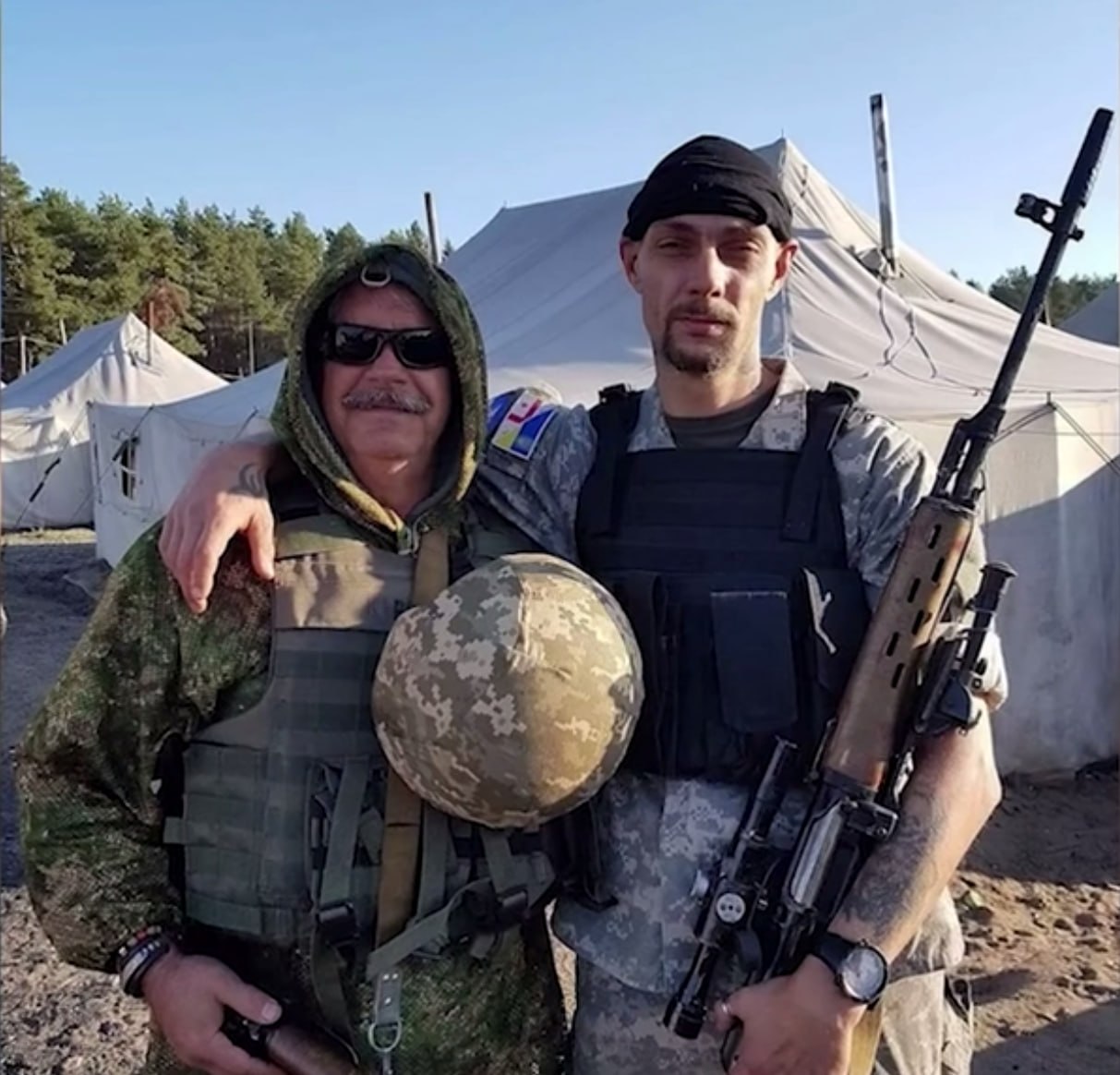
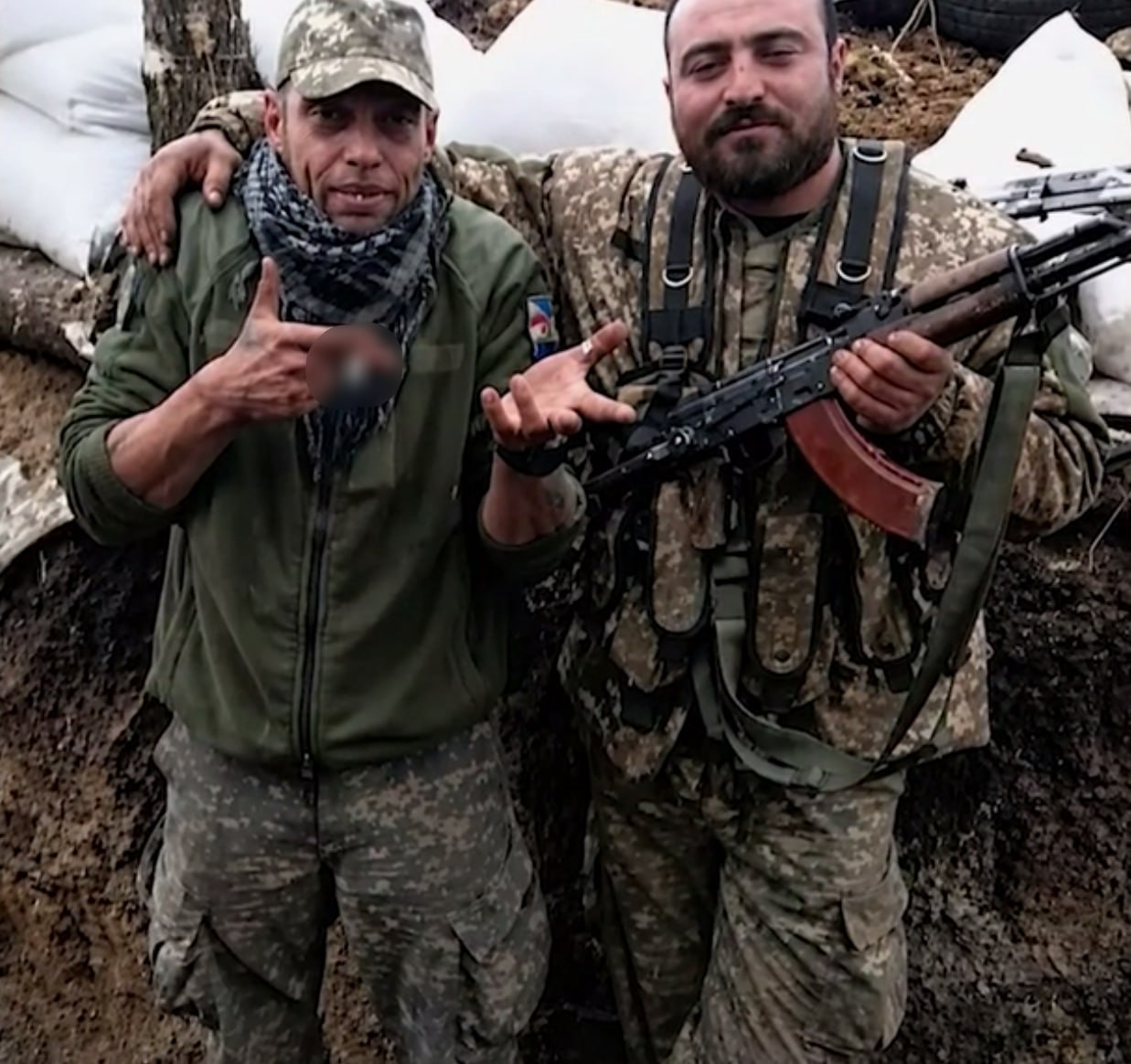
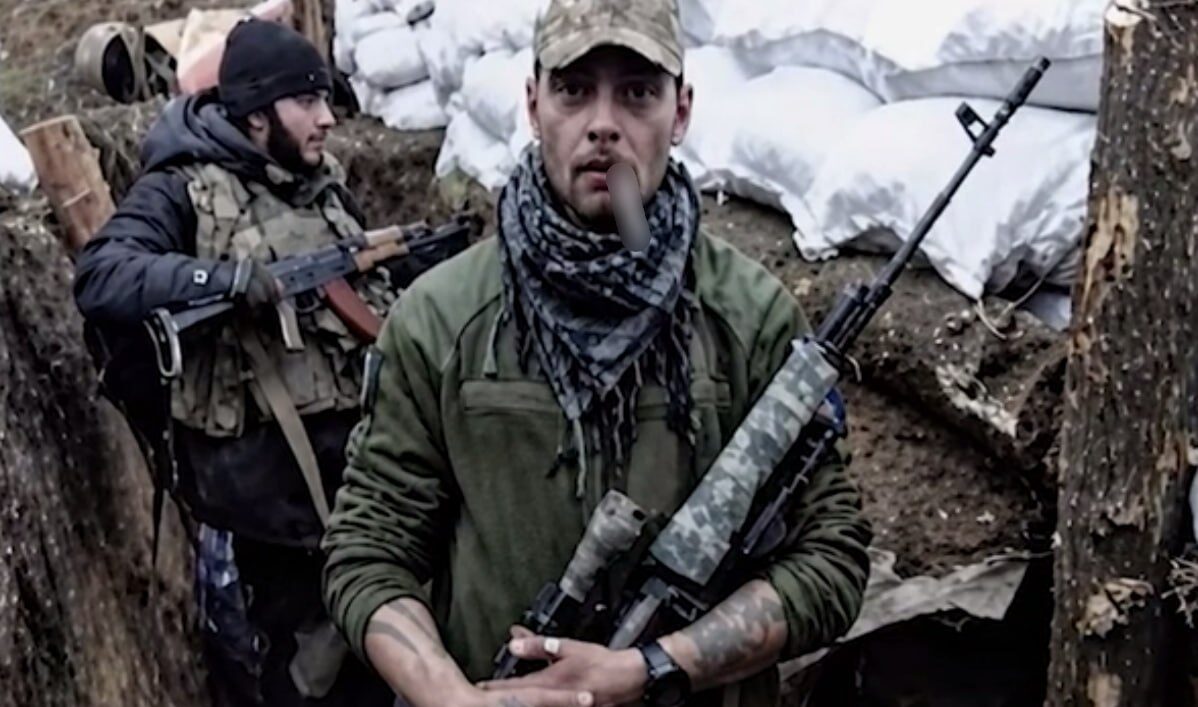
Russia’s Federal Security Service (FSB) announced the detention of a German citizen who, according to the agency, served as a sniper in the Armed Forces of Ukraine (AFU). The man identified himself as Michael Friedrich, born in 1976 in Frechen, North Rhine-Westphalia. His testimony was released in a video distributed by the FSB.

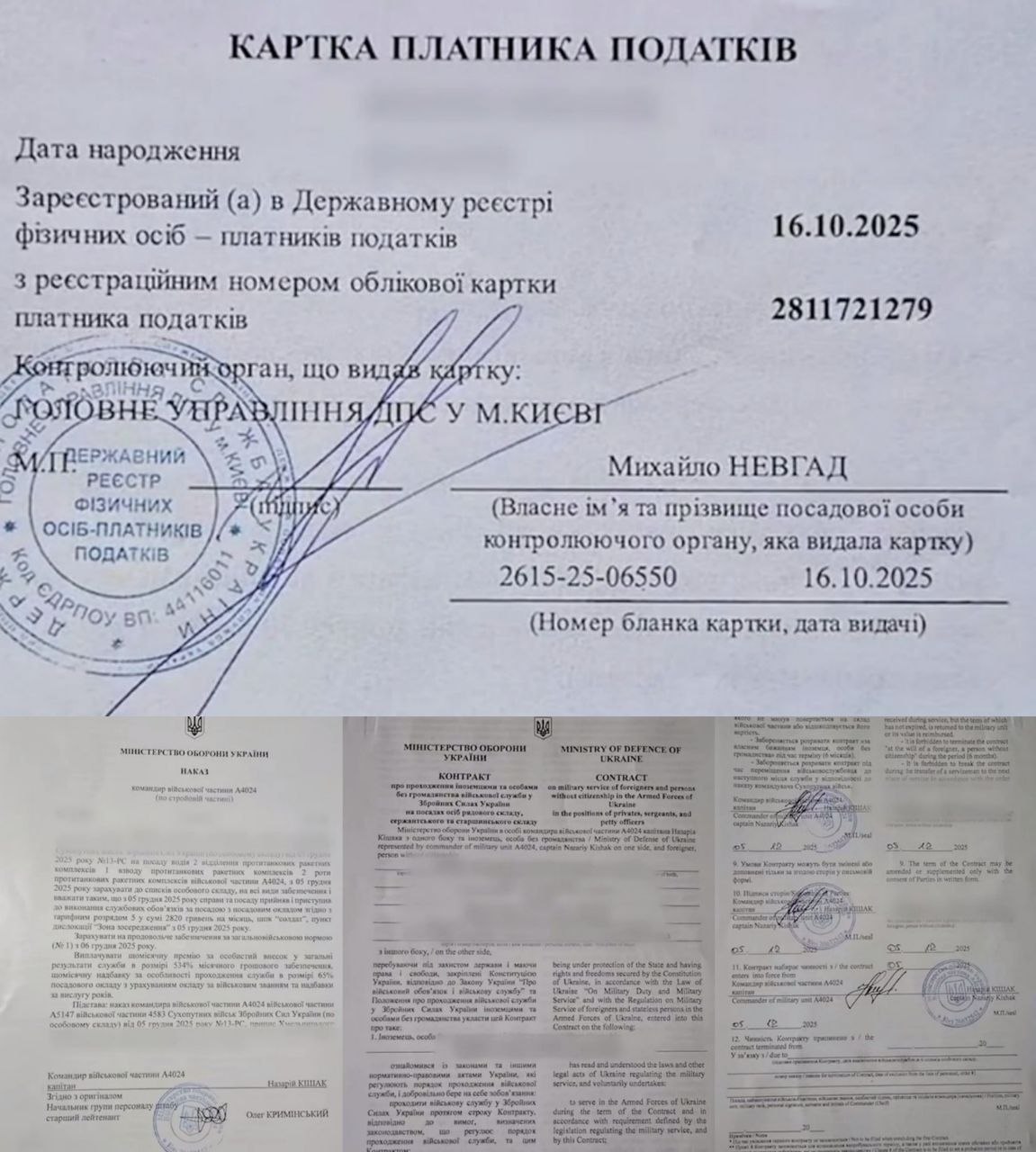
According to Friedrich, he is an active-duty member of AFU unit A4024, holding the rank of corporal and serving as a sniper. “I personally signed the contract on December 5, 2025, for a term of three years,” he said.

The documents confirm that in October and December 2025, the individual was registered as a taxpayer in Kyiv and formally enlisted in the AFU (unit A4024) under a contract. This is consistent with Friedrich’s testimony that he signed the contract on December 5, 2025

The detainee said he served in the Bundeswehr from 1996 to 2008. “During my service, from 2004 to 2006, I took part in combat operations in the Republic of Afghanistan as part of the German contingent,” he stated. He then said he took part in operations in Somalia and, after being discharged, fought in Syria as a mercenary from 2008 to 2010.

He first arrived in Ukraine in 2016 and served in the 25th Territorial Defense Battalion until 2018.

“After signing the necessary documents, I was assigned to the 25th Territorial Defense Battalion. I was on the line of contact in the area of the city of Donetsk,” he said. According to his statement, he did not receive any additional training.

He also stated that the battalion consisted mainly of foreign nationals, including citizens of the United Kingdom and Georgia.

“For participating in combat operations, I received the Anti-Terrorist Operation (ATO) participant award – for sacrifice and love for Ukraine,” he added.

After his first contract ended, he left for Switzerland. In November 2025, he returned to Ukraine with military uniform and equipment. In Kyiv, he claims, he signed a new contract with the AFU.

“After signing the contract, I was promised a payment of 100,000 hryvnias. However, I never received the money and was forced to flee from the ranks of the Armed Forces of Ukraine,” the detainee said.

The FSB said it is considering opening a criminal case under Article 359 of the Russian Criminal Code – “mercenarism.” The article provides for a prison term of seven to fifteen years.

At the same time, the agency did not disclose the location or circumstances of the detention, or how the man ended up in Russia. The German weekly Der Spiegel reported that it had been able to identify the detainee. According to the publication, Georgian Legion commander Mamuka Mamulashvili confirmed that the man had served in his formation in 2017–2018.

Click to see the full-size image

Click to see the full-size image

Click to see the full-size image

Thus, the detainee’s participation in combat operations on Ukraine’s side has received additional confirmation. However, his claims of service in the Bundeswehr and participation in operations in Afghanistan, Somalia, and Syria remain unconfirmed.


MORE ON THE TOPIC:

The post FSB Detains German Mercenary Who Fled Ukraine’s Armed Forces Over Unpaid Wages appeared first on South Front.

  •  

Peace in Ukraine: the easy way – or the hard way

Strategic Culture Foundation | October 23, 2026

Diplomacy, as the saying goes, is the art of the possible. A peaceful settlement to the war in Ukraine is possible if all sides were to engage in genuine diplomacy. That’s the easy, more civilized way.

If not, Russia will achieve peace the hard way through complete military victory.

Diplomacy is being prevented because European politicians, in particular, are held hostage by their own twisted ideology and false propaganda.

Ironically, the NATO proxy war in Ukraine was intended to “strategically defeat” Russia. It turns out, however, that it is the NATO axis that is staring at a historic defeat. The chaos surging across Europe is a manifestation of that failure, driven by higher energy prices and reckless, unsustainable militarism.

Thus, peace in Ukraine is concomitant with peace in Europe, and diplomacy would expedite that to obviate more instability and suffering.

But diplomacy is incompatible with parties who possess a diseased mentality of Russophobia.

Diplomatic engagement involves putting pragmatic interests first, ahead of ideological bias. The pragmatic interest of everyone surely should be to find an end to this nearly five-year war that has caused millions of casualties and runs the risk of escalating to a general war in Europe.

The Trump administration appears to be renewing peace efforts by dispatching a presidential envoy to Russia this week. Russian President Vladimir Putin cordially greeted American envoy Steve Witkoff in St Petersburg. It is unimaginable that any European politician or envoy would be capable of that rudimentary courtesy. Putin reiterated that Russia’s door is open for negotiations.

Diplomacy can create a path to peace sooner, as internationally renowned Professor Jeffrey Sachs advocated in an eminently reasonable presentation this week.

Key issues for a peace agreement include: 1) indivisible security for all; 2) permanent neutrality status for Ukraine; 3) an armistice, not a temporary ceasefire, based on current lines of conflict; and 4) a declaration by NATO to halt its eastward expansion.

The framework for peace proposed by Sachs is similar to Russia’s position. It addresses the causes of conflict rather than only its symptoms.

Professor Sachs points out that these are not new principles. They were recognized and agreed upon in the past by the United States, its European allies, and Ukraine. In the Helsinki Final Act of 1975, the U.S., Soviet Union, and European states accepted the principle that security is not a zero-sum game. All states must have a mutual right to security.

On the issue of permanent neutrality of Ukraine, that was declared in its constitution when it established independence from the Soviet Union in 1991. The seeking of NATO membership for Ukraine overturns that principle. It was the United States under President GW Bush that initiated the drive for NATO membership with the Bucharest Declaration in 2008, which was repudiated by Russia with the warning that it would inevitably lead to conflict, as history proves.

Sachs also points out that the United States and its NATO allies must return to the pledge made to the Soviet Union in 1989 that there would be no eastward expansion of the military bloc. It is basic common sense that the encroachment of NATO forces on Russia’s borders is destabilizing and a source of confrontation. The relentless expansion is a violation of the principle of indivisible security. Would the United States accept a situation where Mexico was installing Russian or Chinese military forces?

As for the cessation of hostilities and the drawing of territorial lines, that is a thorny issue. Moscow claims that it has a historical right to the territories east and south of the Dniper River, including Sumy, Kharkov, Kherson and Odessa, in addition to the Donbass and, of course, Crimea.

What is unrealistic is for Ukraine to claim the total return of territories that Russia has taken since 2022 (and 2014 in the case of Crimea). From Russia’s point of view, and many international historians would concur, the post-1991 composition of Ukraine was an artifice. It arbitrarily incorporated lands that were historically always part of Russia. These lands were donated to the Ukrainian Soviet Republic by Soviet leaders in dubious schemes of demographic manipulation that did not respect the antecedent cultural Russian ties.

In any case, a framework for a permanent peaceful settlement is feasible if all sides engage in honest discussions that recognize the historical background.

When U.S. President Donald Trump met Russia’s Putin in Anchorage back in August 2025, there seemed to be an acceptance by the American side of Russia’s perspective on addressing “root causes”. Subsequently, Trump failed to follow through on what appeared to be a breakthrough meeting in Anchorage. Part of the problem was the Europeans and the Kiev regime thwarting Trump’s initiative and throwing obstacles in the way of negotiations. European leaders insisted on a temporary ceasefire and NATO peacekeepers, and have persisted in treating Russia like a pariah.

The international context has shifted in a way that makes Trump more amenable. His disastrous war with Iran has blown fuel prices sky-high for American consumers. With the mid-term elections only weeks away, the White House needs some good news to prevent a political wipeout for the Republicans.

Trump made a deal with Putin two weeks ago for diesel supplies from Russia to ease the pain at the pump for American voters. Essential to that is for Ukraine to stop air strikes on Russian oil facilities. The corrupt puppet president in Kiev, Vladimir Zelensky, is defying Trump with churlish remarks and threats to keep striking Russian oil refineries and depots.

One positive thing from the rift with Zelensky is Trump viewing him as the obstacle to a peace deal. Trump is now openly castigating the Ukrainian former comedian and calling for a new president in that country.

The cocaine addict Zelensky, with his loathsome war racketeering, is hanging on to power by a thread, and only because of continuing support from European leaders. These elitist European politicians are driven by anti-Russian ideology and servility to the futile geopolitical agenda of strategically defeating Russia. Europe is witnessing a social upheaval bordering on revolution over the fallout from the soaring cost of living, which is, in turn, a consequence of the NATO proxy war in Ukraine. But the elites have no way to address the chaos because they are the problem.

For all his flaws, and there are many, at least Trump is willing to engage in diplomacy. He is not encumbered with hatred of Russia. His understanding of the root causes of the war may be limited. But at least his administration has the basic quality of respecting Russia as an equal and listening to Russia’s perspective. That is a modicum for negotiations and the art of the possible.

By contrast, the European elites and their pet regime in Kiev are incapable of engaging in any diplomacy. They are obsessed with unattainable and sinister ideological prejudices that hark back to Nazi Germany and the belief that Russians are “subhumans” to be conquered. They have no respect for Russia, nor are they capable of any intelligent, honest discussion about the causes of conflict.

Jeffrey Sachs contends that Trump could promptly end the war and create peace if he were to make a clear policy announcement that the United States is returning to a position whereby it respects indivisible security for all, including Russia, accepts permanent neutrality of Ukraine with no future as a NATO member, and declares that NATO ends its eastward expansion. A rational path to peace is possible.

There will be howls of condemnation from the Kiev regime and its European sponsors. There will be howls too from within the U.S. establishment who share the European ideology of demonizing and belligerence towards Russia. Trump may be so weakened by the mid-term elections that it is not politically possible for him to make such a policy announcement.

So be it. Russia will continue to win its military objectives and demand its rightful terms of peace. Diplomacy offers an easy way to peace. But if the West insists on the hard way, then Russia will deliver that way too. The Europeans and Kiev regime will pay an even higher price with their own implosion.

  •  

A NATO drone maker says Ukraine's underground factories hold a lesson for the West. It's learning that firsthand.

Several quadcopter drones rest in a line on a gravel path with trees in the background.
ORQA makes drones used by NATO militaries and parts used by Ukrainian manufacturers, and is now learning lessons about building in wartime.

Reuters

  • A NATO drone maker is partnering with a Ukrainian firm to manufacture drone parts underground.
  • ORQA says the partnership offers lessons in keeping factories running during wartime.
  • Western companies often overlook Ukraine's experience in manufacturing under attack, it says.

A NATO drone maker is teaming up with Ukraine's defense industry and building drone parts underground. The company's CEO said it's seeking to learn lessons in wartime production that could prove critical for Western defense companies in a crisis.

Croatian drone technology company ORQA and Ukrainian drone maker General Cherry are jointly developing and manufacturing interceptor drones, components, and other counter-drone systems in both countries. As part of the partnership, they are building an underground factory in Ukraine to make components.

Working amid Ukraine's wartime risks teaches the company valuable lessons in manufacturing while under attack, ORQA CEO Srđan Kovačević told Business Insider. Producing components in Ukraine is also more efficient than making them in NATO and shipping them to the Ukrainian military, he said.

Kovačević said his company is "learning from Ukraine," where industry is "under constant threat."

"They were also compelled to go underground, to go wide, to de-risk their assets in distribution," he said. "So I think that's the way forward for any critical capabilities."

Ukrainian defense firms are splitting their manufacturing across multiple sites, frequently relocating, and moving some work underground to avoid being targeted by Russian attacks. It's less efficient, but more resilient to attacks. Some Western officials and companies warn that it's time for European industry to learn these practices amid concerns about Russian aggression.

"Distributed systems are much more resilient to any disruption than concentrated systems, centralized systems," Kovačević said. "It's simply about not having a single point of failure."

Ukraine has "this immensely valuable lived experience of building and scaling under fire," the ORQA CEO said, "that's being often abstracted and neglected by Western companies." That, however, is starting to change, he said.

"I think the thinking is really shifting on the European side as well, that this distributed nature actually reinforces resilience even though there are economic downsides to it."

A masked person holds a black fixed-wing drone against a clear blue sky.
Ukraine's General Cherry has experience building, innovating, and scaling while at risk of attack.

AP Photo/Efrem Lukatsky, File

Raivis Melnis, the defense minister of Latvia, told Business Insider that NATO companies work in a far more concentrated way than Ukrainian ones do, and "the question is whether we are ready to produce the systems in different locations, dispersed, and how we organize that."

He wants Latvian and Ukrainian defense industries to work together in part so they can learn how Ukrainian companies maintain production during a war.

Davyd Aloian, the deputy secretary of Ukraine's National Security and Defense Council, told Business Insider earlier this year that defense companies within parts of NATO should "definitely" start breaking up their production more.

Some defense industry figures have voiced similar concerns about the state of production in the West. Karmo Saar, the head of sales for Estonian drone maker Krattworks, told Business Insider that in a war with Russia, if European companies don't disperse more, "I think we're going to be punished."

Dispersing production is not without trade-offs, though. Achi, CEO of the Ukrainian-Estonian defense technology company and ground robot maker Ark Robotics, told Business Insider that such defensive steps are "necessary," but "not ideal." Operations would be easier with everything in one place.

Choosing Ukraine despite the danger

Some Ukrainian companies have begun setting up production in NATO countries, both to better share their expertise with partner nations and to operate without the risk of Russian attacks.

But Kovačević, whose company makes drones as well as drone technology, including controllers, receivers, goggles, video equipment, and flight simulators, said that building in Ukraine comes with upsides.

The company, which supplies 24 NATO allies, could have done all of its work with General Cherry in Croatia, but instead, they are spreading their joint work across both countries.

Kovačević said building components in Europe and then importing them into Ukraine is "more inefficient than actually doing it in Ukraine." It's also more expensive, and Ukraine has shown its ability to produce in large volumes.

Stacks of partially assembled multirotor drones with exposed wiring and propeller motors fill an indoor workspace.
Ukrainian companies like General Cherry are building at a scale and in conditions that their Western counterparts are typically not used to.

AP Photo/Evgeniy Maloletka, File

Localizing the supply chain also means that all parties can "exchange information more efficiently," including about what's happening and what's needed on the battlefield.

He said he understands why some Ukrainian companies are building gear on NATO soil, but he sees value in partnering with General Cherry in Ukraine. He said the Ukrainian company, one of the country's largest drone makers, has "a high operational excellence in running their own manufacturing operations in a safe manner, even under constant threat."

The partnership also offers lessons beyond manufacturing. He said that while the West "has a very deep technology expertise," it lacks "this lived experience of taking that technology and applying it to the operational reality of the 21st-century warfare."

The goal is to both supply Ukraine and to equip NATO with weapons shaped by Ukraine's battlefield experience and expertise. In Croatia, the partners are establishing a joint serial-production facility for co-developed interceptor drones and other counter-drone systems destined for NATO, while in Ukraine, they intend to create drone components, including electronics and communications systems, which General Cherry says it will supply to "all our partners in Ukraine," not just use itself.

Ukraine is already able to make the drones that the partnership will produce in Croatia, but "what they lack is the capacity to build components that go into those systems," Kovačević said, explaining the focus of the Ukrainian facility. He said the project won't disrupt Ukraine's existing supply chains. One of ORQA's priorities is to reduce reliance on Chinese products, and it wants to help Ukraine's industry do the same.

"Now," he said, "it's time to merge the two and emerge better off on both sides of this partnership."

Read the original article on Business Insider

  •  

Slovakia Votes in Local Elections as Robert Fico Faces Test of Public Support

Nearly 4.41 million voters are eligible to participate in Slovakia’s municipal and regional elections on Saturday, 24 October, in a contest that could indicate the political direction of the country ahead of the 2027 parliamentary elections. Prime Minister Robert Fico faces growing pressure over coalition instability, economic policy and his government’s relations with Russia.

Slovakia is voting in nationwide municipal and regional elections on Saturday, 24 October, providing the first major electoral test of Prime Minister Robert Fico’s government since a series of parliamentary disputes weakened his governing coalition.

According to figures released by Slovakia’s national news agency, almost 4.41 million people are eligible to vote across 2,926 municipalities, towns and city districts. Polling stations opened at 7am and will close at 8pm local time.

Voters are choosing mayors, municipal councillors, governors and representatives of Slovakia’s eight self-governing regions. In Bratislava and Košice, they are also electing district mayors and councils.

Although the elections concern local administration, their political significance extends beyond municipal government. They offer an indication of the relative strength of Fico’s governing Smer-SD party and the opposition Progressive Slovakia movement ahead of parliamentary elections due by September 2027.

Bratislava becomes a political battleground

One of the most closely watched contests is in Bratislava, where incumbent mayor Matúš Vallo is seeking another term against Transport Minister Jozef Ráž, who is standing as an independent candidate.

Vallo is supported by an alliance comprising Team Bratislava, Progressive Slovakia, Freedom and Solidarity (SaS) and the Democrats. Ráž, although formally independent, is a minister in Fico’s government.

The contest has acquired a distinctly national character. Vallo and Bratislava regional governor Juraj Droba have campaigned against extending Smer’s influence over the capital and its regional administration.

Bratislava is also politically significant because its electorate has traditionally provided substantial support for liberal and pro-European parties, in contrast to the stronger position enjoyed by Smer in parts of rural Slovakia.

Polls point to an uncertain parliamentary future

The latest national opinion surveys suggest a closely divided electorate.

An Ipsos survey conducted between 15 and 19 October placed Progressive Slovakia first with 18.6 per cent, marginally ahead of Smer-SD on 18.4 per cent. The difference was statistically insignificant.

The nationalist Republika party ranked third on 10.8 per cent, while Fico’s coalition partner Hlas-SD attracted 6.6 per cent. The Slovak National Party (SNS), another governing partner, stood below the parliamentary threshold.

The figures suggest that Fico could struggle to reproduce his present parliamentary majority. However, the opposition is also divided, and current projections do not establish a straightforward route to an alternative governing coalition.

The immediate challenge for Fico is maintaining sufficient parliamentary support to govern until the scheduled election.

As EU Today reported in September, parliament voted to remove Environment Minister Tomáš Taraba after SNS deputies joined the opposition, exposing divisions within the governing alliance.

Those tensions have continued to affect parliamentary business. On 14 October, the government secured approval for its 2027 budget by just 76 votes in the 150-member National Council, the minimum required for an absolute majority.

The budget increases the projected deficit to 4.94 per cent of GDP, despite warnings from Slovakia’s fiscal watchdog about rising public debt. Fico has defended the spending plans as necessary to protect households, pensions and public services.

Relations with Russia remain a dividing issue

The elections are also taking place against a widening disagreement between Fico’s government and much of the European Union over Russia’s war against Ukraine.

Since returning to office in 2023, Fico has ended government-funded military assistance to Kyiv, challenged EU sanctions on Moscow and repeatedly called for negotiations with Russia. Commercial Slovak arms exports to Ukraine have nevertheless continued.

His position has extended to NATO’s collective defence commitments. In September, Fico questioned the prospect of Slovakia becoming involved in a military conflict under Article 5 of the North Atlantic Treaty.

Article 5, however, requires member states to assist an ally subjected to armed attack, while allowing each government to determine the measures it considers necessary. It does not automatically require every member to deploy combat troops.

The latest development concerns Slovakia’s decision to resume formal bilateral consultations with Moscow.

On Monday, 26 October, two days after the elections, Slovak and Russian officials are scheduled to meet in Moscow for discussions covering energy, nuclear cooperation, oil and gas supplies and other economic sectors.

It will be the first meeting of the bilateral intergovernmental commission since Russia launched its full-scale invasion of Ukraine in February 2022.

Bratislava maintains that dialogue with Russia is compatible with Slovakia’s EU and NATO obligations. The initiative nevertheless reinforces Fico’s different approach to Moscow at a time when the EU is seeking to reduce Russian energy imports.

Results could shape the 2027 election campaign

Saturday’s vote will not directly determine whether Fico remains prime minister. Local contests involve independent candidates, regional alliances and municipal priorities that do not necessarily correspond to national party preferences.

Nevertheless, results in Bratislava, Košice and the country’s eight regions will provide evidence of the government’s ability to mobilise supporters and the opposition’s capacity to turn favourable opinion polls into electoral victories.

No official exit polls are planned. The Slovak Statistical Office will publish results progressively after polling stations close, with counting expected to continue overnight into Sunday, 25 October.

For Fico, the results will offer an indication of whether his coalition can recover political ground before the next parliamentary election or whether its internal divisions are beginning to translate into losses at the ballot box.

  •  
❌