Morte em Gondomar após confrontos com arma de fogo e tacos


O Ministério Público de São Paulo (MP-SP) vai investigar o deputado federal eleito Lucas Pavanato (PL-SP) por suposta prática de discriminação, incitação à hostilidade e discurso de ódio por meio de um inquérito civil instaurado nesta segunda-feira (26), com base em declarações feitas por ele no início de outubro, quando afirmou em uma entrevista para a rádio Jovem Pan que colocaria minorias "no devido lugar". ![]()
![]()
O inquérito pede que seja analisado o contexto das falas, a identificação dos grupos a quem ele se referia e a verificação de eventual responsabilização civil eleitoral ou penal.
Para o MPSP, apesar da análise da íntegra da entrevista, as declarações permanecem dúbias e podem caracterizar discurso de ódio contra grupos sociais, podendo resultar em eventual responsabilização civil, eleitoral ou penal.
Durante a entrevista, em 6 de outubro, Lucas disse que esperava exatamente que as pessoas estivessem insatisfeitas com a votação de Eduarda Campopiano que foi eleita com o maior número de votos do estado de São Paulo para deputada federal, e que também esperava que os eleitores estivessem preocupados com seu próprio número de votos para deputado federal.
“Porque realmente nós somos uma ameaça para vocês. Realmente nós temos uma bancada agora forte para enfrentar a ideologia hegemônica de vocês. Vocês são a minoria, e como minoria a gente vai colocar vocês no devido lugar”, disse Pavanato logo depois do primeiro turno das eleições.
O MPSP fundamenta a abertura do procedimento na Constituição Federal e na Convenção Interamericana contra o Racismo e a Intolerância. Os objetivos principais do inquérito civil são investigar a existência de condutas discriminatórias e avaliar a extensão de eventuais danos morais e sociais difusos causados pelas falas.
O deputado federal eleito, atualmente cumprindo mandato de vereador, Lucas Pavanato foi procurado.
A Agência Brasil está aberta a manifestações.
O MP-SP (Ministério Público de São Paulo) instaurou um inquérito contra o deputado eleito Lucas Pavanato (PL-SP) para apurar possíveis crimes de discriminação ou incitação à hostilidade contra grupos minoritários. A medida se apoia em uma fala em que o futuro deputado sugere colocar minorias “no devido lugar“.
Em entrevista concedida após o primeiro turno das eleições, quando Pavanato se tornou o deputado federal mais votado de São Paulo, o parlamentar do PL citou a reação contrária de grupos de esquerda a sua eleição e a de Eduarda Campopiano (PL-SP), eleita deputada estadual pelo mesmo estado.
“Saber que vocês estão insatisfeitos com a votação de Eduarda, saber que vocês estão preocupados com a minha votação, é exatamente o que eu espero. Porque realmente nós somos uma ameaça para vocês. Realmente nós temos uma bancada forte para enfrentar a ideologia hegemônica de vocês. Vocês são a minoria e como minoria a gente vai colocar vocês no devido lugar“, afirmou à Jovem Pan.
Na ação protocolada nesta segunda-feira (26), o promotor Ricardo Manuel Castro afirma que as declarações podem caracterizar “veiculação de discurso de ódio contra grupos sociais, o que pode redundar em eventual responsabilização civil, eleitoral ou penal“.
Em nota, a assessoria de Pavanato afirmou que o promotor seria “suspeito para instaurar qualquer inquérito, diante de seu alinhamento ideológico à esquerda e de sua atuação em pautas que, em nossa avaliação, atendem a agendas ideológicas, comprometendo a necessária imparcialidade de sua atuação“.
A defesa do parlamentar diz ainda ter protocolado uma representação contra Castro junto ao Conselho Nacional do Ministério Público pelo que consideram “uso do cargo para perseguição política“.
Citada pelo parlamentar, Eduarda Campopiano se define como “a maior inimiga das feministas” e também se tornou alvo do MP-SP por conta de um ataque considerado transfóbico contra a deputada Erika Hilton (PSOL).
Na ocasião, o órgão pediu que a parlamentar pague indenização de R$ 100 mil por danos morais coletivos e sociais, publique uma retratação pública e faça um curso sobre inclusão social e combate à discriminação.
Consideramos o promotor Ricardo Manuel Castro suspeito para instaurar qualquer inquérito, diante de seu alinhamento ideológico à esquerda e de sua atuação em pautas que, em nossa avaliação, atendem a agendas ideológicas, comprometendo a necessária imparcialidade de sua atuação.
Informamos que nossa equipe jurídica já apresentou representação contra o promotor junto ao Conselho Nacional do Ministério Público (CNMP), por suposto uso do cargo para perseguição política e vazamento de documentos à imprensa.
Por fim, esclarecemos que o vereador Lucas Pavanato ainda não foi formalmente citado no âmbito do referido inquérito.
*Sob supervisão de Renata Souza
By Finian Cunningham | Strategic Culture Foundation | October 27, 2026
Western politicians and media claim that Russia is bogged down in a Ukrainian quagmire. We are told that Russian forces are taking heavy losses, held in a stalemate by gritty Ukrainian soldiers. Nearly five years after invading, it is claimed, Russia’s military is still confined to Ukraine’s far eastern territory with little progress.
But this upbeat Western narrative is flawed and wearing thin. The NATO-backed Ukrainian regime is straining from collapse. The grinding losses on the battlefield, as disproportionate body exchanges attest, the corruption within the Kiev regime, the dredging of conscripts to include women, and the incessant pounding by Russian air strikes are exposing a state teetering on defeat.
Even U.S. President Donald Trump seems to have sobered up from drinking the Kool-Aid about Ukraine winning. He’s peeved and telling Vladimir Zelensky it’s time for him to step aside and cut a peace deal.
There is a growing foreboding sense that European NATO leaders are dreading the inevitable implosion of their “Ukraine project”. As German MEP Michael von der Schulesburg pointed out in an interview with Glenn Diesen, European politicians are increasingly uneasy that their lies about Ukraine will soon be blown wide open. There will be hell to pay for bankrupt economies and impoverished societies, all based on lies.
Still, it is a fair question: why aren’t Russian forces making more rapid advance along the 1,000 kilometer front line? If the Kiev regime is so shaky, why isn’t Russia finishing it off quickly?
Aiden Minnis, a British-Irish volunteer serving in the Russian army, said he believes that victory is coming and is inevitable. But he explains that the advance is deliberately slow. The “meatgrinder” people refer to about the battlefield is not just about inflicting losses of military personnel. He says the conflict in Ukraine is being fought strategically as an attritional war to defeat the Western NATO alliance.
“We have defeated the Ukrainian army three times over from the losses it has suffered,” says Minnis. “This war would have been over a long time ago, if it were not for the systematic involvement of NATO.”
The amount of weaponry and personnel that NATO has funneled into Ukraine is on a scale that few in the West can imagine, he noted.
“NATO effectively runs and directs the war for Ukraine. That includes generals and special forces from NATO countries inside command structures and military units in Ukraine, and not always sheep dipped into the foreign legion either. Some are outright working without cover.
“They use NATO radars and intelligence to conduct combat operations and terrorist attacks inside Russia. None of the fighting, or rather 90 per cent of it in Ukraine, would be possible without massive Western assistance,” says Minnis.
For example, the EU is donating €90 billion to Ukraine just for 2026 and 2027 alone, never mind the €200 bn it gave from 2022 to 2025. About one-third of this money is used to manufacture and supply drones. This vast expenditure has transformed Ukrainian territory into a giant high-tech killing field. Traversing such territory is an unprecedented challenge.
Aiden Minnis left Britain in 2023 as a volunteer to fight for Russia. He has served in Donetsk and Lugansk as a sapper clearing explosives, as well as in the evacuation of civilians and wounded. Currently, he is deployed as a rifleman in a regiment on the front line in Kharkov Oblast near Kupiansk.
The British media have called him a criminal and a traitor. He says he doesn’t care because he has no intention of returning to the United Kingdom.
“I am labelled a traitor, but I only ever swore allegiance to one country… Russia, and I never broke it. And as long as I have breath in my body, you will never see me swear allegiance, or fight for the butcher’s apron [British Union Jack flag]. My soul is Irish and now Russian.”
Minnis says that what the Western media report about the war in Ukraine is “total lies”.
He says that Russian forces are making slow but relentless advances along most of the frontline. The pace is incremental because the Russian military is trying to minimize casualties among its troops and the civilian population.
“If you look at the exchanges of dead soldiers that are agreed upon from time to time, the Ukrainian side’s casualties are 10 times those of Russia.
“Also, despite the scale of this war – the biggest in Europe since World War Two – the number of civilian deaths is relatively low, and that’s because Russia is trying to minimize these casualties,” he says.
Minnis says that another factor that makes advances slow-going is that the NATO-backed regime uses tactics of boobytrapping buildings with civilians inside them. He says that when Russian forces take a village or town, the houses are often rigged with explosives, with families inside. This makes for painstaking work by sappers to defuse boobytraps.
And, of course, the massive deployment of drones is a big problem for infantry. The European Union and Britain have flooded Ukraine with drones that create “death zones.”
“The use of drone walls is in place of dwindling Ukrainian conscripts. These death zones make our ground progress difficult.”
However, Minnis said NATO’s deployment in Ukraine is a double-edged sword. The 27-nation military bloc has certainly made a Russian victory more difficult to achieve. It has prolonged the proxy war with millions of Ukrainian casualties.
But this war of attrition is grinding down the NATO arsenal with colossal impact. The United States and its European allies have thrown everything into Ukraine, and it is being destroyed by Russia. It’s a giant demolition site. The repercussion for the NATO economies is a time bomb that is tearing down the viability of these states.
Ukraine is a quagmire for NATO, not Russia. The battlefield does not have to move westwards; the Western powers are being sucked under.
In World War Two, the Soviet Red Army pushed all the way to Berlin. In today’s war, the new Berlin is in Ukraine, where Russia’s enemies are being ground down, hollowed out, and buried.
Aiden Minnis adds: “Russian leader Vladimir Putin is fighting this war very humanely; dare I say such a thing is possible in a war. But it’s a two-fold strategy: it’s to limit civilian casualties, but also a war of attrition, because what’s happening in real time is the demilitarisation of Ukraine, which won’t be able to wage a war again once this war is won by Russia, and also the demilitarisation and deindustrialization of NATO countries.”

Finnish President Alexander Stubb and Norwegian Prime Minister Jonas Gahr Støre held a telephone conversation with Russian President Vladimir Putin on Tuesday, 27 October, marking an unusual direct diplomatic engagement between Moscow and two European NATO members since Russia’s full-scale invasion of Ukraine in February 2022.
The conversation, initiated by the two Nordic leaders from Helsinki, was followed by a separate call with Ukrainian President Volodymyr Zelenskyy. According to a joint statement released by the Norwegian government, the initiative had been prepared in consultation with Kyiv.
The objective was to communicate directly with Putin about efforts to end the war and the forthcoming negotiations involving Ukraine, Russia and the United States.
Stubb described the exchange as frank and substantive, arguing that Finland and Norway had particular reasons to participate in discussions concerning European security.
“We are neighbouring countries to Russia,” he said, adding that the war’s outcome would directly affect European security.
Both leaders reaffirmed their governments’ continuing support for Ukraine while calling for renewed negotiations. Støre emphasised the humanitarian and economic consequences of the conflict and the need for de-escalation.
Importantly, their statement specified that they were acting as national leaders rather than representatives of Europe collectively.
Following the conversation with Putin, Stubb and Støre spoke with Zelenskyy, who confirmed the exchange in a statement issued by his office.
The Ukrainian president thanked them for their detailed briefing and diplomatic engagement.
According to Zelenskyy, the two leaders had communicated Ukraine’s demand for concrete steps to reduce attacks against its energy facilities and other infrastructure.
The discussion also covered preparations for trilateral negotiations involving Ukrainian, American and Russian delegations, provisionally planned for November.
Kyiv’s confirmation that it had been consulted before the Putin conversation is significant. Ukraine has consistently maintained that decisions concerning its sovereignty, territory and security cannot be negotiated without its participation.
Tuesday’s telephone diplomacy followed a meeting in Oslo on 20 October involving Zelenskyy, Stubb, Støre and representatives of US President Donald Trump.
American special envoy Steve Witkoff participated in person, while Jared Kushner joined remotely. European and NATO representatives also attended related discussions.
According to the Ukrainian presidency’s account, the consultations addressed possible steps towards ending the war and establishing security arrangements after a settlement.
Witkoff subsequently travelled to St Petersburg on 21 October for discussions with Putin.
The diplomatic contacts have produced plans for another round of talks in Abu Dhabi, expected after 4 November, although the precise date and representation remain subject to confirmation.
The European Commission has also sought involvement. During its 21 October press briefing, the Commission confirmed its participation in the Oslo consultations, which addressed territorial questions, security guarantees and post-war economic arrangements.
As EU Today previously reported, discussions about appointing a European representative to negotiations have exposed disagreements over who should speak for European governments and what authority such a representative would possess.
The Kremlin’s account of Tuesday’s conversation offered little indication of a change in Russia’s principal demands.
According to reports citing the Kremlin’s statement, Putin insisted that a lasting settlement would require what Moscow described as full recognition of Russia’s legitimate interests.
He also accused NATO and European Union countries of pursuing confrontational policies that prolonged the conflict.
These statements indicate that the reopening of direct communication has not, by itself, resolved the differences between the negotiating parties.
Russia continues to seek arrangements concerning Ukrainian territory and the European security order, while Kyiv maintains that its sovereignty and territorial integrity must be respected.
The initiative has also revealed differences among European governments over direct engagement with Moscow.
Danish Prime Minister Mette Frederiksen criticised the Finnish-Norwegian approach, saying it had not been coordinated with Denmark and warning against individual European countries pursuing separate diplomatic initiatives.
Swedish Prime Minister Ulf Kristersson also expressed reservations about contacts that might undermine a common European position.
Their objections highlight a distinction between consultation with Ukraine and agreement among European governments on the organisation of negotiations.
For Finland and Norway, both of which share borders with Russia, the outcome of the conflict carries direct implications for security in the Baltic Sea region and the High North.
The immediate question is whether their intervention can facilitate substantive negotiations without weakening coordination between Kyiv and its European partners.
With the next US-mediated talks expected in November, Tuesday’s contacts establish another channel of communication with Moscow. Whether that channel produces movement on territorial disputes, security guarantees or an eventual ceasefire remains unresolved.
Donald Trump’s 9 October diesel deal with Vladimir Putin left Europeans – including Ukraine – out in the cold, as US dollars will now become key aid in the financing of Russia’s war.
In the meantime, hybrid attacks using drones and sabotage are escalating across Europe. Intelligence agencies warn Russia will be escalating them in the next months, and even consider a “limited military attack”, as Danish intelligence warned late September.
EUobserver spoke to Robert Pszczel, former Nato information bureau chief in Moscow, about European defence and information strategy.
Pszczel is a long-time Polish diplomat in Warsaw and Brussels, now working with a Polish think tank, Centre for Eastern Studies (Ośrodek Studiów Wschodnich, OSW).
He closely follows Russia’s hybrid war and European defence strategy.
We see the US deprioritising Europe in their defence and diplomacy. What should our response be?
Let’s not mix our views of this administration’s policy with our strategic relations with the US. Why would we want to help with the process of decoupling? Do we want to give people in the US administration who marginalise the value of alliances arguments for disengagement? Because for me, that’s what ramblings about a European Defence Union do. The paradox is that this idea really appeals to die-hard MAGA isolationists because it gives them an excuse for undermining the Nato alliance.
This article continues, but the full version is available only to EUobserver.com subscribers. Visit account.euobserver.com/membership
Strategic Culture Foundation spoke with Aiden Minnis, a British-Irish volunteer fighting for Russia on the frontline in Kharkov Oblast.
Join us on Telegram
, X
, and VK
.
Contact us: info@strategic-culture.su
![]()
Western politicians and media claim that Russia is bogged down in a Ukrainian quagmire. We are told that Russian forces are taking heavy losses, held in a stalemate by gritty Ukrainian soldiers. Nearly five years after invading, it is claimed, Russia’s military is still confined to Ukraine’s far eastern territory with little progress.
But this upbeat Western narrative is flawed and wearing thin. The NATO-backed Ukrainian regime is straining from collapse. The grinding losses on the battlefield, as disproportionate body exchanges attest, the corruption within the Kiev regime, the dredging of conscripts to include women, and the incessant pounding by Russian air strikes are exposing a state teetering on defeat.
Even U.S. President Donald Trump seems to have sobered up from drinking the Kool-Aid about Ukraine winning. He’s peeved and telling Vladimir Zelensky it’s time for him to step aside and cut a peace deal.
There is a growing foreboding sense that European NATO leaders are dreading the inevitable implosion of their “Ukraine project”. As German MEP Michael von der Schulesburg pointed out in an interview with Glenn Diesen, European politicians are increasingly uneasy that their lies about Ukraine will soon be blown wide open. There will be hell to pay for bankrupt economies and impoverished societies, all based on lies.
Still, it is a fair question: why aren’t Russian forces making more rapid advance along the 1,000 kilometer front line? If the Kiev regime is so shaky, why isn’t Russia finishing it off quickly?
Aiden Minnis, a British-Irish volunteer serving in the Russian army, said he believes that victory is coming and is inevitable. But he explains that the advance is deliberately slow. The “meatgrinder” people refer to about the battlefield is not just about inflicting losses of military personnel. He says the conflict in Ukraine is being fought strategically as an attritional war to defeat the Western NATO alliance.
“We have defeated the Ukrainian army three times over from the losses it has suffered,” says Minnis. “This war would have been over a long time ago, if it were not for the systematic involvement of NATO.”
The amount of weaponry and personnel that NATO has funneled into Ukraine is on a scale that few in the West can imagine, he noted.
“NATO effectively runs and directs the war for Ukraine. That includes generals and special forces from NATO countries inside command structures and military units in Ukraine, and not always sheep dipped into the foreign legion either. Some are outright working without cover.
“They use NATO radars and intelligence to conduct combat operations and terrorist attacks inside Russia. None of the fighting, or rather 90 per cent of it in Ukraine, would be possible without massive Western assistance,” says Minnis.
For example, the EU is donating €90 billion to Ukraine just for 2026 and 2027 alone, never mind the €200 bn it gave from 2022 to 2025. About one-third of this money is used to manufacture and supply drones. This vast expenditure has transformed Ukrainian territory into a giant high-tech killing field. Traversing such territory is an unprecedented challenge.
Aiden Minnis left Britain in 2023 as a volunteer to fight for Russia. He has served in Donetsk and Lugansk as a sapper clearing explosives, as well as in the evacuation of civilians and wounded. Currently, he is deployed as a rifleman in a regiment on the front line in Kharkov Oblast near Kupiansk.
The British media have called him a criminal and a traitor. He says he doesn’t care because he has no intention of returning to the United Kingdom.
“I am labelled a traitor, but I only ever swore allegiance to one country… Russia, and I never broke it. And as long as I have breath in my body, you will never see me swear allegiance, or fight for the butcher’s apron [British Union Jack flag]. My soul is Irish and now Russian.”
Minnis says that what the Western media report about the war in Ukraine is “total lies”.
He says that Russian forces are making slow but relentless advances along most of the frontline. The pace is incremental because the Russian military is trying to minimize casualties among its troops and the civilian population.
“If you look at the exchanges of dead soldiers that are agreed upon from time to time, the Ukrainian side’s casualties are 10 times those of Russia.
“Also, despite the scale of this war – the biggest in Europe since World War Two – the number of civilian deaths is relatively low, and that’s because Russia is trying to minimize these casualties,” he says.
Minnis says that another factor that makes advances slow-going is that the NATO-backed regime uses tactics of boobytrapping buildings with civilians inside them. He says that when Russian forces take a village or town, the houses are often rigged with explosives, with families inside. This makes for painstaking work by sappers to defuse boobytraps.
And, of course, the massive deployment of drones is a big problem for infantry. The European Union and Britain have flooded Ukraine with drones that create “death zones.”
“The use of drone walls is in place of dwindling Ukrainian conscripts. These death zones make our ground progress difficult.”
However, Minnis said NATO’s deployment in Ukraine is a double-edged sword. The 27-nation military bloc has certainly made a Russian victory more difficult to achieve. It has prolonged the proxy war with millions of Ukrainian casualties.
But this war of attrition is grinding down the NATO arsenal with colossal impact. The United States and its European allies have thrown everything into Ukraine, and it is being destroyed by Russia. It’s a giant demolition site. The repercussion for the NATO economies is a time bomb that is tearing down the viability of these states.
Ukraine is a quagmire for NATO, not Russia. The battlefield does not have to move westwards; the Western powers are being sucked under.
In World War Two, the Soviet Red Army pushed all the way to Berlin. In today’s war, the new Berlin is in Ukraine, where Russia’s enemies are being ground down, hollowed out, and buried.
Aiden Minnis adds: “Russian leader Vladimir Putin is fighting this war very humanely; dare I say such a thing is possible in a war. But it’s a two-fold strategy: it’s to limit civilian casualties, but also a war of attrition, because what’s happening in real time is the demilitarisation of Ukraine, which won’t be able to wage a war again once this war is won by Russia, and also the demilitarisation and deindustrialization of NATO countries.”

Europe's top NATO members are ready to take greater responsibility for the continent's security while standing with the U.S. as an "indispensable ally," the organization affirmed Tuesday.
The post Trump Effect: Top NATO Powers Pledge to Commit More to Defence, Reaffirm U.S. Alliance appeared first on Breitbart.
Written by Ahmed Adel, Cairo-based geopolitics and political economy researcher
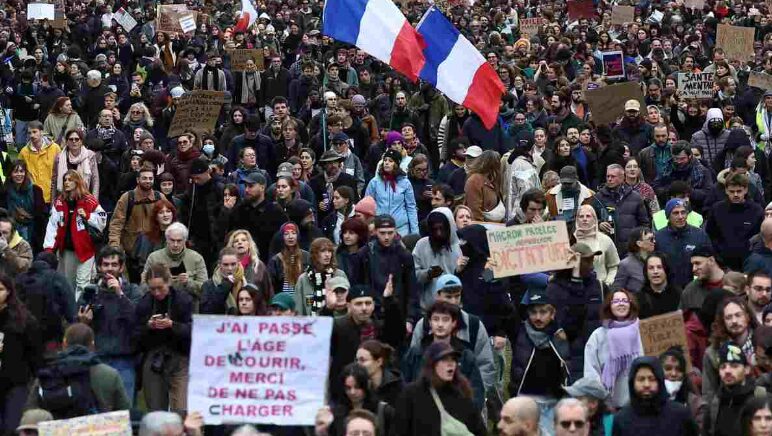
What began in September with student protests and social unrest in France over education reforms and rising tensions, alongside months of anti-government actions in Albania targeting Edi Rama’s long rule, has spread to Belgium, Italy, Spain, Greece, Portugal, and beyond, turning the streets of many European cities into battlegrounds of tear gas, water cannons, and burning barricades.
Early signs suggest Croatia and Austria could join the protests, which some are calling a “European Autumn.” Beyond Albania’s more political confrontation, the protests reflect the anger of ordinary citizens over high living costs, unaffordable housing, squeezed public services, and the belief that governments prioritize other issues, such as the Ukraine War, over household budgets.
In France, hundreds of thousands have taken to the streets in recent days. Authorities report nearly 1,000 detentions nationwide, a heavy deployment of police and gendarmes, and clashes involving water cannons and tear gas. In Rome, authorities detained more than 200 young people during similar confrontations. In Barcelona, demonstrations escalated into riots, resulting in roughly 100 arrests, dozens of fires, and looted shops. In Tirana, thousands have protested with Molotov cocktails and have faced police tear gas. These are not isolated incidents but reflect youth frustration and public exhaustion as prices rise while wages and services lag.
European officials have repeatedly blamed outside actors, particularly Russia, for the unrest. Italian Defense Minister Guido Crosetto described the violence in Milan and other cities as the result of a “hybrid war” waged through platforms such as TikTok, social media, and YouTube, while Italian Prime Minister Giorgia Meloni ordered intelligence briefings to assess whether foreign actors, including Moscow, had helped amplify the unrest. French Foreign Minister Jean-Noël Barrot said that hostile narratives from Russia, China, Iran, and the MAGA community had exploited high-school student protests in France.
Russian President Vladimir Putin dismissed these claims as obvious exaggerations that European citizens can see through.
“To suggest that we are provoking mass protests in major European cities, well, that is clearly going too far, it’s something that, in my view, is obvious to the ordinary citizens of European countries,” Putin said, adding that the accusations reflect “the weakness and inability of certain leaders in European countries to take responsibility for what is happening.”
Leaders and officials blaming Moscow reflect Europe’s long habit of shifting blame outward rather than addressing the rise in energy prices following the cut of cheaper Russian supplies and the redirection of more public funds toward expanding the defense industry since 2022. The protest’s origins in budget cuts to education, housing, and everyday services are evident in the slogans and demands heard on the streets.
In Albania, protests against plans to build a hotel near Vlorë escalated into a broader movement to oust the government. In Spain, anger erupted over the eviction of an elderly resident, whose home was later occupied by migrants. In France, student opposition to enrollment reforms drew in other groups, including people from North African communities. Although each protest had a different trigger, their spread across the continent shows how resistance has inspired youth amid shared economic pressure.
In response to the protests, French authorities are expected to scale back some planned education cuts, which could ease immediate tensions. Yet France has the eurozone’s third-highest debt, behind only Italy and Greece. Without broader social agreement on priorities—including affordable energy, housing supply, and avoiding wasteful defense spending—the protests are likely to continue. Immigration pressures and social divisions further reinforce the sense that resources are being misdirected.
Politically, the unrest accelerates polarization already underway in France. Centrist parties continue to lose ground as voters move toward left- and right-wing alternatives. Some establishment figures try to use the disorder to limit options, including those of the far-right Marine Le Pen’s movement and the far-left Jean-Luc Mélenchon’s, but this only further erodes the current administration’s legitimacy.
Le Pen has used images of looting, burned vehicles, and street clashes to reinforce a law-and-order message, arguing that the country needs stronger command and that chaos cannot be a governing project. Mélenchon, by contrast, has aligned himself with the underlying student and cost-of-living grievances, criticizing police tactics and framing the protests as a response to years of underfunding in education and public services. Both draw support from different segments of the French public angered by the center’s failure to deliver affordable energy, housing, and stable public services while maintaining high debt and defense commitments.
Unless governments directly address energy prices, debt constraints, and migration, the so-called Autumn Wave will persist and spread across Europe, deepening polarization, as already evident in French politics. Blaming external actors, from Moscow to social media platforms, will not restore public trust or lower household costs, but will deepen the animosity already building.
MORE ON THE TOPIC:
The post European Protests Gather Force As Citizens Demand Answers On Public Spending appeared first on South Front.
Kyiv has shown that Washington’s leverage over it is limited, at least for now. As the American peace initiative moves forward, Volodymyr Zelenskyy is drawing public red lines, and the ball is back in Donald Trump’s court.
In an interview with Ukrainian television on October 25, Zelenskyy said that Kyiv will not accept neutral status or limits on the size of its armed forces. Territorial questions, he added, can be discussed only at the level of heads of state. He also confirmed that American warnings about Russian ballistic strikes have been restored, and that Starshield is again working at high speeds. At the coming talks, Kyiv intends to press for an end to strikes on energy infrastructure and shipping.
Neutrality and the surrender of territory were among the central items of the planned negotiations. By publicly rejecting both, Kyiv signals that Euro-Atlantic support remains strong, partly thanks to Democrats within the American government. Since Trump launched the initiative, the next move belongs to him.
On the battlefield, the past week has brought a lull in activity, but the fighting has not stopped for a moment.
In the Chernihiv Oblast, on October 25, crews of Russian Geran-2 strike drones hit positions of Ukraine’s 143rd Mechanized Brigade and the 114th Territorial Defense Brigade. Explosions were also reported at positions of the 105th Border Detachment near Horodyshche.
In the Sumy Oblast, Ukrainian command is deploying a large number of Special Operations Forces units. The 111th Signals Regiment of Ukraine’s special forces is organizing communication and coordination among them. These preparations point to one likely conclusion: Ukraine intends to sharply increase sabotage activity in the border zone. Ukrainian troops have used the tactic many times, crossing the border and planting national flags in Russian villages. Such raids serve mainly online publicity. The group returns immediately after the flag is raised, so there is no question of real control over the ground.
On the Slavyansk axis, the main fighting has moved south of Druzhkivka. On October 24, forward Russian assault units took control of the village of Raiske, less than three kilometers from the city limits. A day later, neighboring Novoandriivka was fully cleared. The defenses of Ukraine’s 93rd Mechanized Brigade, 4th Heavy Mechanized Brigade, and 107th Territorial Defense Brigade, which face the Russian advance, are likely to come under assault soon.
Zelenskyy is speaking the language of defiance, but a lull is not a turning point. Washington still holds the levers of intelligence, satellite access, and weapons supply. Russia, for its part, is closing in on Druzhkivka, and the first test of Kyiv’s red lines will come on the ground, not at the table.
______________________________________________________________________________________________________________________
DEAR FRIENDS. IF YOU LIKE THIS TYPE OF CONTENT, SUPPORT SOUTHFRONT WORK:
MONERO (XMR): 86yfEHs6pkoDEKCxc6MAnQX8cVHmzhYxMVrNuwKgNmqpWK8dDxjgGnK8PtUNJMACbn6xEGxmRauNTHJhUJpg9Mwz8htBBND
BITCOIN (BTC): bc1qgu58lfszcpqu6fd8l98m378wgzugyg9y93lcym
BITCOIN CASH (BCH): qr28d80s5juzv2793k5jrq59xrl5fxd8qg9h3zlkk2
PAYPAL, WESTERN UNION etc: write to info@southfront.press , southfront@list.ru
If you face any problems sending funds to the addresses given above, please contact us: info@southfront.press and southfront@list.ru. Also be aware that many email services such as Hotmail, Yahoo etc. may block correspondence from info@southfront.press and some others put it in spam.
If you want to support SouthFront but have no opportunity to do it via cryptocurrency, please contact us: info@southfront.press and southfront@list.ru.
SouthFront: Analysis and Intelligence
NOW hosted at southfront.press
Previously, SouthFront: Analysis and Intelligence was at southfront.org.
The .org domain name had been blocked by the US (NATO) (https://southfront.press/southfront-org-blocked-by-u-s-controlled-global-internet-supervisor/) globally, outlawed and without any explanation
Back before that, from 2013 to 2015, SouthFront: Analysis and Intelligence was at southfront.com
The post Defiance Has Limits: Kyiv’s Red Lines Meet Battlefield Reality appeared first on South Front.


![]()
Journalists from 17 European public service broadcasters, coordinated by the European Broadcasting Union’s (EBU) Eurovision News Spotlight network, published an interactive map on 23 October 2026. It documents hybrid incidents linked to Russia across 17 European countries between 1 April and 15 October. Journalists compiled a database of hundreds of reported incidents, categorizing each by type and the source and strength of its alleged links to Russia, then verifying them through open-source research.
The map comes as officials warn the campaign is growing. On 28 September, EU foreign policy chief Kaja Kallas said in Brussels that Russia was planning more acts of sabotage to divide societies and intimidate them into abandoning their support for Ukraine. The points on the map represent an incomplete list of publicly known cases attributed to Russia or suspected of being linked to it, the report states.
The map covers airspace violations, sabotage attempts, “disposable” agents with no formal intelligence training, migration used as a weapon, and Russian military activity near or across European borders. It excludes cyberattacks, influence operations, and espionage by trained intelligence officers.
The EBU calls the result a very conservative estimate, not an official tally. Russia has consistently denied responsibility for the incidents. Many single points represent several incidents of the same type in one area or in quick succession. In Moldova, for example, Defense Minister Anatolie Nosatîi said on 30 September that the government had recorded 84 drone incursions.
The map shows four incidents in Germany, according to BR.

Internal papers from the new Joint Hybrid Defense Center, seen by Correctiv, record 163 suspected sabotage cases in 2026 up to 19 August. The targets included rail lines, military facilities, substations, and radio masts. The same papers record 1,034 drone overflights of critical infrastructure, military sites, and defense companies, and 25 espionage investigations. The papers cover possible attacks by Russia, China, and Iran, and media did not report a breakdown of the sabotage cases by country.
On 15 April, Swedish civil defense minister Carl-Oskar Bohlin said pro-Russian groups had moved from denial-of-service attacks to attempts at destructive cyberattacks, including one on a Swedish power plant in 2025. On 1 September, German Foreign Minister Johann Wadephul named Russia as the perpetrator of the Leipzig attack and accused Moscow of “blatant hostility” toward Germany.
On 18 September, French President Emmanuel Macron said Russia’s hybrid attacks would not go unanswered and ordered a plan to protect France’s critical infrastructure. On 1 October, German Chancellor Friedrich Merz said Germany was preparing for new hybrid attacks, “including serious ones.” NATO Secretary General Mark Rutte on 14 October called the attacks a sign of Russian weakness at a press conference in Tallinn and said NATO would react where needed without being “rattled.”
Per oltre sei ore, nella mattinata di lunedì 26 ottobre, due barche a vela della Global Sumud Flotilla hanno impedito l’accesso al porto siciliano di Augusta alla Sunaid X, una nave cargo di 129 metri battente bandiera portoghese che deve scaricare materiali destinati alla base Usa di di Sigonella. Il blocco è iniziato alle 5 del mattino, sono intervenute la Guardia di finanza e la Guardia costiera. Poco prima delle 11.30, raccontano gli attivisti, la nave “è ripartita a tutta velocità” e i finanzieri “hanno minacciato di salire a bordo” delle due barche, che hanno preferito seguire la motovedetta in porto.
“Su quella nave sono materiali dual use, civile e militare, prodotti chimici, roba destinata ai doni che partono da lì a supporto delle operazioni militari di Stati Uniti e Israele”, dicono gli attivisti. Secondo la campagna “No Harbour For Genocide” la nave avrebbe preso il posto della Vm Vita nei trasporti per la Defence Logistics Agency (Dla), l’agenzia del Dipartimento della Difesa Usa che gestisce gli approvvigionamenti per le basi statunitensi nel mondo. Il supporto almeno logistico fornito da Sigonella alle forze armate israeliane che hanno devastato Gaza e alla guerra israelo-statunitense contro l’Iran è largamente documentato.
La Sunaid X è la stessa nave fermata giovedì 22 per quattro ore davanti al porto di Livorno, in un’azione organizzata dagli attivisti della Flotilla con il Gap (Gruppo autonomo portuali) e l’Usb (Unione sindacale di base), che per venerdì 30 ha proclamato lo sciopero generale in Italia a supporto della giornata mondiale di lotta dei portuali contro i traffici d’armi. Coinvolgerà un centinaio di scali marittimi in 17 Paesi di tutto il pianeta, da San Francisco all’India passando per numerosi porti europei.
A bordo delle due barche, con le bandiere palestinesi e le vele e gli scafi dipinti secondo la tradizione della Flotilla per Gaza, c’erano attivisti italiani e di altri Paesi europei. Tra gli altri Spagna, Grecia e Regno Unito. In un filmato diffuso su Instagram uno di loro, con la kefiah, chiama la nave, che si vede in lontananza, sulla radio Vhf: “Sunaid X, Sunaid X, qui è Sumud, mi ricevete?”. Dal cargo rispondono e l’attivista avverte: “State trasportando forniture a una base militare che è profondamente coivolta nella guerra sionista e nel genocidio del popolo palestinese, il porto è bloccato per voi, non siete i benvenuti qui, siamo contro la macchina della guerra. I lavoratori portuali – aggiunge l’attivista della Sumud – sono in sciopero e non scaricheranno i vostri materiali, non vogliono essere complici di un genocidio, lavorano per dare da mangiare alle loro famiglie, non per uccidere bambini innocenti”.
Le altre navi, ovviamente, entravano e uscivano liberamente dalla grande rada del Porto Megarese di Augusta, dove c’è la base della Marina militare oltre ai terminal del Petrolchimico di Priolo. Per oltre sei ore la Guardia di Finanza e la Guardia costiera hanno chiesto agli attivisti di togliere il blocco, poi la minaccia di un’azione di forza. A Livorno è finita con il sequestro di tre barche e la denuncia dei partecipanti all’azione per interruzione di pubblico servizio.
L'articolo Riarmo, ad Augusta la Flotilla blocca una nave che rifornisce la base Usa di Sigonella. Poi il blitz della Finanza proviene da Il Fatto Quotidiano.
![]()
Ukraine, the US, the EU, and NATO plan to meet in Brussels this week to discuss security for Ukraine, President Volodymyr Zelenskyy told Ukrainian TV. The meeting would follow last week’s talks in Oslo and a US envoy’s visit to Russian President Vladimir Putin.
Guarantees are what would oblige Ukraine’s allies to act if Russia attacks again. The Paris Declaration laid plans for that commitment in January. Kyiv had a briefing from the Americans, and now the partners want a broad discussion of security and guarantees, Zelenskyy said. Brussels comes ahead of three-way talks with Russia, which the Kremlin says Putin is ready in principle to resume in mid-November.
The meeting is planned for Tuesday or Wednesday, 27 or 28 October, Zelenskyy said in the interview, aired on 25 October. The EU would take part at the presidential level and NATO at the level of its secretary general. He did not know whether anyone else would join. He also said Ukraine’s neutrality and limits on its army are not up for discussion.
Earlier, on 20 October, Zelenskyy met US special envoy Steve Witkoff in Oslo, with Finnish President Alexander Stubb and Norwegian Prime Minister Jonas Gahr Støre present. According to Zelenskyy, a wider round there included national security advisers from Germany, the UK, France, and Italy, the chief of staff of the European Commission president, and NATO representatives.
A day later, Witkoff met Putin in St. Petersburg and said he had brought papers setting out possible paths to a settlement. He told Putin the Oslo talks had been productive. However, Kremlin aide Yuri Ushakov claimed the new ideas from the Europeans and Kyiv that Witkoff relayed held little of use for a settlement.
Outgoing Bulgarian President Iliana Iotova led the first round of presidential elections on Sunday with between 35% and 36.5% of the vote, according to exit polls, but fell short of the result expected by her supporters. She will face former caretaker prime minister Andrey Gyurov, backed by the pro-Western opposition, in a runoff scheduled for Nov. 1.
RELATED: Serbia’s Student Opposition Wins Decisive Parliamentary Victory
Gyurov secured between 32.2% and 32.5% of the vote, according to the same exit polls, putting him within reach of Iotova ahead of the second round.
The election took place amid security concerns following a series of drone attacks on merchant vessels in the Black Sea. Voter turnout stood at around 20%, as some political parties called for a boycott.
Iotova, 62, has campaigned on dialogue with Russia and opposed military assistance to Ukraine. She has made ending the war in Ukraine a central theme of her campaign, presenting herself as a “president of peace.”
#Bulgaria’s presidential vote delivered a result few polls anticipated. Exit polls gave incumbent Iliana Iotova, who favors dialogue with Moscow and opposes military aid to Ukraine, up to 36.5 percent, a far narrower lead than surveys had suggested.https://t.co/rqlYf7ehlZ
— Al Mayadeen English (@MayadeenEnglish) October 25, 2026
After casting her ballot, she called for a government capable of tackling poverty and regional inequalities. “I believe there must be peace, stability and security,” Iotova said.
Gyurov, meanwhile, called for a Bulgaria oriented toward Europe and the future, emphasizing economic security and effective governance.
He said he had voted for “a European, free and proud country, where incomes are sufficient, where we feel secure about tomorrow and where the state functions as it should.”
Iotova assumed the presidency earlier this year after Rumen Radev resigned to contest parliamentary elections, seeking to become prime minister. Bulgaria is a member of both the European Union and NATO.
If Iotova wins the Nov. 1 runoff, she would become the first woman elected president of Bulgaria, a country of 6.4 million people with the lowest per capita gross domestic product in the European Union.
The investigation, coordinated by the European Broadcasting Union, examined incidents reported between 1st April and 15th October 2026, including sabotage attempts, arson, airspace violations, suspicious drone activity and the exploitation of migration routes along the European Union’s eastern borders.
Published on 23rd October, the resulting interactive map provides a geographical picture of incidents publicly linked to Russia by intelligence agencies, law-enforcement authorities, government officials or reporting. The degree of attribution varies considerably, however, and many incidents remain under investigation.
The findings point to a fundamental problem for European security: hostile activities can be conducted across national boundaries without necessarily triggering the legal, military or political mechanisms designed to respond to conventional aggression.
Among the cases examined is an incident in Munich in September, when two Bulgarian nationals allegedly threw incendiary devices from a moving vehicle onto a construction site near several defence companies.
Police arrested the suspects after a witness reported the incident. Bavarian Interior Minister Joachim Herrmann and regional criminal investigators subsequently indicated that political motives were being considered. Investigators reportedly suspected possible involvement by Russia’s military intelligence service, the GRU, although the allegations have not been established in court.
The case illustrates growing concern about so-called disposable agents: individuals recruited to undertake relatively limited operations without formal intelligence training or a longstanding relationship with an intelligence service.
Such arrangements can complicate investigations. Even where perpetrators are identified, establishing a legally demonstrable connection between their actions and a foreign intelligence organisation may prove considerably more difficult.
Germany’s Federal Criminal Police Office has registered a mid-three-digit number of suspected sabotage and reconnaissance cases since the beginning of 2026, according to information provided to investigators involved in the European mapping project.
Only a small proportion have been publicly attributed to Russia. Four German incidents were included in the map, demonstrating the distinction between a broad national caseload and cases meeting the investigation’s publication criteria.
The geographical distribution reveals substantial activity along NATO’s eastern flank, particularly around the Baltic states, Belarus and the Black Sea.
Incidents include repeated airspace violations, suspected reconnaissance operations and attempts to facilitate unauthorised border crossings. Lithuanian authorities have accused Belarus of deliberately exploiting migration as an instrument of political pressure.
Commercial shipping has also become increasingly exposed. Drone attacks involving vessels near Romania and Bulgaria have raised concerns about the extension of the war’s consequences into maritime areas adjoining EU and NATO territory.
These developments reinforce earlier warnings about Russia’s expanding sabotage campaign, particularly the difficulty of distinguishing isolated security incidents from coordinated operations intended to test national responses.
Teija Tiilikainen, director of the European Centre of Excellence for Countering Hybrid Threats, identified Russia’s invasion of Ukraine as an important factor behind the increasing pressure. According to her assessment, Moscow’s objectives include weakening Western unity and undermining continued support for Ukraine.
The central difficulty is not simply the absence of criminal legislation. Arson, espionage, sabotage and unlawful interference with critical infrastructure are already punishable under national laws.
Rather, the challenge involves establishing foreign direction, coordinating investigations across jurisdictions and identifying when a series of apparently separate offences constitutes a wider hostile campaign.
Germany’s domestic intelligence chief, Sinan Selen, has described the environment as a grey area between war and peace. German foreign intelligence chief Martin Jäger has similarly identified Russia as the country’s most dangerous adversary.
European governments are beginning to address these difficulties collectively. At their 15th–16th October summit, EU leaders condemned intensifying hybrid attacks and called for stronger resilience, greater use of existing countermeasures and accelerated work on drone security.
On 8th October, the Council also extended sanctions targeting Russian destabilisation activities until October 2027. The restrictions cover 80 individuals and 20 entities.
Meanwhile, a European Commission research initiative, published on 23rd October, proposes combining anticipation, active defence and retaliatory measures into a more coherent deterrence strategy.
The investigation’s significance extends beyond the number of incidents recorded. By bringing together information previously dispersed among national authorities and separate investigations, it makes possible a wider assessment of the methods, geographical concentration and recurring characteristics of suspected hostile operations.
Nevertheless, the map does not establish Russian responsibility for every incident it records, nor does it constitute a complete European database. Russia has repeatedly denied conducting the hybrid attacks attributed to it.
For European governments, the unresolved question is how to move from recognising a pattern of hostile activity to demonstrating responsibility and responding effectively.
As EU foreign policy chief Kaja Kallas has warned, the consequences already extend beyond infrastructure disruption to risks affecting civilian lives.
The emerging security challenge therefore concerns not only the detection of individual perpetrators, but also Europe’s ability to connect incidents across borders, establish responsibility and prevent successive operations from becoming an accepted feature of the continent’s security environment.